Ravenloft

Something’s gotta give

I thought I would play Ravenloft around Halloween this year. My friend returned all my Ravenloft books and boxed sets to me back in the spring after about 25 years, and since then I have been thinking it would be cool to run something in the Domain of Dread as a Halloween one-shot. But, in the meantime, I have played a lot of different games, mostly one-shots, mostly a lot easier to play in that format than any version of D&D. So I did consider starting a campaign or a multi-session adventure, but, to be honest, I didn’t have it in me to do all the reading and conversion that was necessary. I may be playing more RPGs than I ever have before in my life but that has an unlooked for side-effect: I have less time to prepare for games! This is a dilemma that has been exacerbated by my blog schedule and I have been thinking that I might have to make a change there too. I am switching to posting once every three days for the foreseeable future.

The Demiplane of Dread

So, I am not talking about the original Ravenloft adventure from AD&D 1st Edition or the Curse of Strahd released for 5E, but the setting released by TSR for AD&D 2nd Edition in 1990. It is by Bruce Nesmith and Andria Hayday. I think I have mentioned in another post that my friends and I played most of our AD&D in the Dark Sun setting but I would imagine Ravenloft comes a close second. I just loved having them create regular old characters in my home-brewed standard fantasy world and then dumping them, unceremoniously and with no warning through the mists into the forests of Barovia or the mountains of Forlorn and hitting them with monsters that drained levels and abilities and where there was no escape from he darkness and the terror. Although, I confess, the games were probably not very terrifying. I did my best, but I have always found horror a difficult genre to emulate around the table, especially with a system like D&D. The authors did their best to assist the Ravenloft DM with sections in the main book about the “Techniques of Terror,” where they discuss “Assaults on the Mind,” “Assaults on the Body,” “A Villain in Control,” and that sort of thing. But, the fact was, we were a gang of teenaged boys who mostly just wanted to hit things until they died so those were usually the kinds of adventures we got.

Looking at it from a more mature standpoint now, I would love to try to run it with a real sense of gothic horror. I think I am better equipped now to attempt it. Although I still think it would be a challenge and I might refrain from running it in a D&D-like system. Why? Well, the products for Ravenloft, while not all gold, are still some of the highest quality items I think TSR produced. Just look at all these handouts! Each one of them has something useful on the back of a beautifully illustrated card.

5E products are usually produced to a high standard, but they don’t have the variety and versatility that the 2nd Edition boxed sets did. They also don’t have the quality or usefulness of content. These boxes and sourcebooks are stuffed with useable materials; details on lands, villains, monsters, new spells, effects, encounter tables, maps, maps, maps. 5E setting guides of late, excepting maybe Planescape are very short on this sort of detail.

Adventures in Ravenloft

I usually wrote my own adventures back in the day. Or at least I would pick and choose liberally from the pre-written modules and combine them with my own scribblings to make them fit into an overarching campaign. Or that’s what I told myself I was doing. I have a funny feeling that, mostly, I was just trying o murder the PCs. This is another aspect of my style that has, thankfully, changed, since the good old days.

I do have a few Ravenloft adventures that might be fun to convert or even to just run in the original 2nd Edition ruleset.

Feast of Goblyns is a very flexible module that is designed to be run for characters of levels 4 to 7. It is presented in a format that allows many different paths to be taken through it, with the PCs potentially ignoring some major and minor plots depending on how they decide to play it. This one was designed to be the adventure that draws PCs into the Demiplane, which is always fun. I think I remember playing parts of this module but my memory is not good enough to recall which parts. At 96 pages, though, it would require a bit of commitment to play through the whole thing.

From the Shadows is written for rather high level characters, levels 9 to 12. It is based around the plots of Azalin the lich, lord of the domain of Darkon and his eternal conflict with Strahd Von Zarovich, famed ruler of Barovia and OG Ravenloft BBEG. A great deal of it takes place in Castle Avernus, the lich’s home, and that is pretty cool. I definitely played this but I don’t think the characters survived the whole way through.

Finally, I have the Book of Crypts, which is similar to the Book of Lairs but has 8 full adventures in it! This seems the most suitable for a shorter game or campaign and I might just take a look at running something from here before the spooky season is fully through.

Dear reader, have you ever played this version of Ravenloft? Do you yearn for the mists? Or would you rather play a game actually made for horror?

The Apprentice, Chapter 16 and Epilogue

The end

I’m under no illusions about what this story is. It was my very first attempt at writing anything log form. The quality of the writing (or lack thereof,) the self-indulgence and the repetition of tropes and cliches are all too clear to me. In fact, it’s been so long since I wrote this (more than 12 or 13 years, I think) that it no longer feels like I was the one who wrote it. This makes it easier for me to be critical of it, but it also allows me to see the parts that shine. The plot and the character of Maryk still work for me, and there are elements of the world I built here that I used in later writings too.

I decided to share the story here as something of an exercise, but also as a form of motivation. I would like to be a better writer, and I think, laying this book out here for the world to see (or whatever tiny proportion of the world visit my humble blog at any rate) has forced me to look at my writing from a very different perspective. And I can see the flaws and the areas for improvement. And, hopefully, that will push me to write more and to write better.

Anyway, dear reader, I hope you enjoy this finalé to the Apprentice. Let me know what you thought of the story in the comments if you like.

Chapter 16: Dead is Dead

Delegation of duties for the dead was surprisingly easy. I had already discovered in my work with the ancient dead that talents and predispositions still existed within their decaying bodies. Therefore, some were excellent farmers, some builders of notable skill and others natural warriors. In the case of the skeletons I had to just figure out which were which by assigning them the tasks and ascertaining whether they did them well or poorly. In the case of the recent dead of Pitch Springs they were readily categorised for me. The graveyard was already split into guilds’ sections so all the masons were buried together, all the smiths were in one section, all the cooks in another. Of course, a corpse’s previous profession was not the only consideration. Stage of decomposition as well as completeness or otherwise of body were also important. I separated them as best I could, sending a hundred or more farmer’s corpses into the countryside to begin working on the land, a trio of dead smiths into town to begin working at the forge, a score of shambling masons to begin construction of a much needed wall for the town, two dozen ex-quarrymen to the quarry to begin extracting stone for the wall, a baker’s dozen of deceased coachmen to liberate some of the town’s carts and start transporting the stone from the quarry. There were a few other small groups and individuals: I put Grey Greta back to work but not before I’d had her picked of all her flesh (a rotting, stinky washerwoman would never do.) Ditto the three cooks I found and sent to start cooking up a feast in the Town Square. A single sculptor’s corpse I put to work sculpting a statue of my father in the middle of Saint Frackas’ Square. My father’s empty corpse did end up at my side after all, grasping his bastard sword in two hands and standing to attention as much as one can when one’s head is lolling over one’s right shoulder like the knot on a tied up sack.

Duties assigned, I returned to my fortress to make plans for the next stage of my plan. I walked with my last skeleton guard and my father flanking me all the way back. By the time I reached my home the sun had come up and I could see many of my new servants out in the fields, hard at work. I knew there would be a backlash against them but I decided I would not allow it. Hurrying back to the fortress I gathered the remaining ancient skeletons and ordered them to wound anyone who tried to interfere with the work of the newer dead and then I sent them out to guard the workers wherever they were. This left the fortress all but undefended. I was not worried about an attack from town. There was a force of peace-keepers, certainly, but they were not particularly well regarded. The constabulary of Pitch Springs was never trained to a very high standard and were generally considered to be layabouts. I could not imagine them planning and executing a siege or infiltration, in fact, I doubt they could imagine it themselves. They had seemed to work effectively enough during the incident when I returned the mayor to town, to be fair to them, but even then it was my father who had landed the fatal blow. The only man I might have feared now stood at my side. I felt perfectly safe ensconced, once more, in my study.

I watched the happenings in the town and the surrounding country by the use of several Farsee mirrors all hung side by side on the wall of my study. There was unrest. The Pitch Springers mostly stayed indoors and avoided the few of the dead that I had sent to work there. I wondered if any of them would partake of the feast being prepared in the centre of town. When I saw a pair of constables attack the cooks I was appalled. Couldn’t they see that all they were trying to do was prepare a meal? Why would you assault cooks, whether living or dead? The skeleton guard made short work of the constables, though it was, perhaps, a little too efficient, removing a whole hand from one and shattering the kneecap of the other. On the Markinson’s farm, Old Father Markinson launched a single-handed assault on the rotting corpse of his former neighbour, Farmer Yantzi which had been cleaning his farmyard while the dogs cowered under the chicken coop. An attempted defense by the skeleton guard went awry and it ended up with a shattered skull at the end of the spade in Markinson’s hands. it crumbled into bones and dust and then the head came off Farmer Yantzi’s corpse too. I watched as the old man burned the body and the head. A number of other such incidents ended up with the dismemberment, decapitation or cremation of the dead servants I had sent out to help. The skeletons that were left after my father’s ambush were not warriors and it showed.

Most folk on the farms simply left the dead servants to it, however, and I began to hope that they were coming around to my way of thinking. Then I noticed that they were not just leaving the dead to their work, they were leaving the farms to the dead. A congregation had begun in the Temple of Mictus where it had all started. All the people of the town had gathered there and as the farmers arrived in Pitch Springs they made straight for it too. Undoubtedly, they were plotting against me. They thought me some sort of villain and they did not see the truth behind my actions. With them all gathered in one place, I was tempted to launch an assault of my own. After all, it seemed the only people I could trust and rely on were the dead ones. I looked at my father’s corpse standing nearby and wondered what the man would have done in my position. I laughed then, “You would never have been in this situation, would you?” Wholesale slaughter, though? No. There was no situation in which he would have condoned it. None. I would have to achieve my goals the hard way, as if any of this had been easy.

Before proceeding, however, I had to find out what they were doing in the temple. I could not penetrate its walls, however. I imagined it was the power of Mictus which kept me out. I consulted the Book of Royal Magic to find out what alternatives to Farsee were available to me. Every few moments, I looked up at the mirrors to see if anything had changed. It took about an hour, but eventually, there was movement. Six constables emerged from the temple’s front doors and saddled up the horses that they had left outside before riding off towards the bridge out of town. A pair of burly townsmen, bearing torches despite the bright daylight pulled the doors shut again after they had gone. Undoubtedly, the constables were coming to me. Maybe they had a plan to infiltrate the fortress and kill me. They would find that exceedingly difficult. I considered calling in some of the remaining ancient dead but quickly decided against it and sent the corpse of my father out to defend the gate and the walls. I was sure he would be more than capable, and so it proved. In fact, if the attack I was expecting had come from where I expected it to, I would be safe and well today.

I returned to my search for the spell I needed, secure in the knowledge that I was well defended. Some time later I heard the clatter of hooves on the paving stones of the little road up to the fortress gates and I knew the constables had arrived. Out of my window I could see nothing but the corpse of Korl Scharpetzi atop the battlements, looking down at his enemy as they shouted vowels at him from below.

Turning my back on the window, I returned to the book and the mirrors. “I have often wished, Maryk, that this was not you,” said a very familiar voice. I raised my hands and turned, “Master Gedholdt!” He was slowly walking towards me now, skinny as ever but much greyer than I remembered him and had he always had that limp? I do not think I had spared this man more than a passing thought since I ran away, taking his most prized possession with me. I certainly never expected him to turn up here, with an expression of sadness and determination on his face. “It is you, though, Maryk. What happened that transformed you into this?” He gestured to me and then the surrounding study and, by implication, the fortress. “I met someone and she opened my eyes to my responsibilities. Someone of my great abilities has an obligation to help others. That is all I have been trying to do: to improve my people’s lives.” Looking down at his boots he shook his head, “Improve your people’s lives by raising their dearly departed relatives to build armies of the dead?! You’re talking madness. You learned nothing when you were apprenticed to me! I taught you to use magic sparingly and for the best of reasons.” He was angry now, he felt betrayed. “Master I-” “Don’t call me that! I was never your master. I was just your mark, wasn’t I? You drew me in until you saw the opportunity to take what you wanted and go. You’re a trickster, a thief and a murderer.” He shouted the last word and threw out his hands in a magical movement. A wall hit me, I felt my nose burst and my chest crack and my legs lift off the floor; another wall hit me from behind, this time the real, solid wall of the study. I knocked the back of my head off it and my vision took a break again. Falling to the floor, I hurt all over but particularly in my chest where I was quite certain one of my lungs had deflated. I sucked breaths in at a rapid pace without much success in obtaining air from them. I looked up at my attacker. Never had I seen the man look like this, he looked dangerous. I inhaled deeply, once and shouted as best as my one remaining lung would allow, “Poppa!”

My father’s corpse would be coming but it would take time. How was I going to survive this? I had to think quickly and act quickly. The fastest spell I could remember was the first one I had ever performed, the first one that Master Gedholdt had taught me to perform. I said the word quietly and made the movements painfully. A sphere of light encapsulated the head of my old master, causing him to stumble back and fall over an ornate cherry-wood chair. I made for the door while he was blinded. I heard him roar the words of a cancellation spell as he struggled back to his feet behind me. I hobbled down the corridor and then down the stairs to my father and his protection. Where was he anyway? It should not have taken him so long to respond to the summons. I had expected to meet him on the stair but he was not there, nor was he in the entrance hall of the keep. Master Gedholdt had regained his feet and his vision, at least partially. I heard him cry out as he came to the stairs and fall down several of them before catching the bannister and regaining his balance. “Maryk! Maryk, this is pointless. You cannot escape this fate. You are accursed. This is the final fulfilment of those curses. Stop running and accept it.” I ran on. “Maryk! You don’t understand! I’m not alone here!” What did he mean by that? The constables posed no danger, that was for sure. Who else, then? Who-

I exited the great main doors of the keep and looked into the courtyard. The third of my masters stood there before the gates on the opposite side: the Fae-Mother. She stood at her full height, the hair on her head fluttering around the brickwork on the underside of the gate’s arch. A glow of dark, living green emanated from her uncovered face and hands, but her eyes, looking through me as usual were black holes in the glow and seemed to belong to the shadows behind her. My father’s headless body lay on the flagstones before her, broken and twisted bastard sword beneath it. I sobbed, it felt more like losing a father this time for some reason. Also, her presence filled me with an unconquerable fear. I fell to my knees at the top of the steps. Gedholdt stumbled awkwardly out the main door behind me. “I tried to warn you Maryk. I did not come here on my own,” he said as he came to stand beside me, “She sought me out.”
“I will speak for myself, Gedholdt.” The sound of her voice made all the stones which constituted my fortress vibrate at an incredible frequency, it made my eyes feel like they were being crushed. Even Gedholdt was having difficulty staying upright under the assault of the ancient Fae’s words. “You mentioned Gedholdt to me, do you remember?” I nodded. Pain in my chest and nose made it impossible to speak. “I knew he would understand what you were doing much better than I. I realised and released your potential and perhaps even pushed you in the direction you eventually took. I watched you and listened to your voices, inner and outer, for a time before you met me. I knew you already then, much better than you did yourself, and I saw a waste of a mind and a life. You humans and your butterfly lives, you must live them fully every second to make them worth while. The Fae can sit and contemplate or sleep for hundreds of years if we like but you…your people are different. I saw what you could become with the right desires in place and a sense of responsibility. I gave you those things when I touched you. When you started to raise the dead, your logic, I thought, was faultless. It was the perfect solution for all your people. When I saw the reaction of the townspeople to your creations, I was surprised. Why? Why could they not accept the servants you sent them? I had no inkling. That is why I sought out your Master Gedholdt. He explained it to me.” The Fae-Mother nodded to Gedholdt who started down the steps even as I cowered there at the top of them. “Folk should stay dead. Human folk that is,” he bowed to the Fae-Mother who tipped her head at him demurely. “We cannot come back whole from the other side. We cannot stop the progress of time on our bodies. No-one wants to see their dead wife or child or grandfather walking about town, faces rotting, stinking to high heaven. Dead is dead, Maryk. It is an unwritten rule and you broke it. But it’s even worse than that. So much worse.” Gedholdt had taken up a position at the right hand of the Fae-Mother and looked up the two feet to her eyes.
“Your servants. Their souls yet inhabit their bodies. Or rather, they were pulled back from the Aether to fill the empty spaces in their rotting corpses by your spell. This spell of yours required the revived bodies to have a force within them. But, cleverly, you changed the spell too, did you not? You altered it so that they would have to obey you or someone like you. So, even though these souls occupied their old bodies they could do nothing to control them.” She stopped talking, mercifully and looked down at the body of my father, sprawled on the ground before her.

I reeled and and covered my eyes as I lay on my back trying to breathe, trying to talk, trying to refute this, trying not to imagine the existence suffered by a mind trapped in a body it could not control. “No,” was all I could manage. “On the contrary. Where do you think the energy came from to do what you did? You? You are more foolish than I realised or I would not have given you my gift. Progress is all I ever strove for, as you know, for my people and yours. It is too late for my people now. Yet I thought you could do what I could not. But I cannot condone this. You have corrupted the very notion of progress by trying to achieve it in this way.” I heard her coming closer, both of them approaching.

“I didn’t know,” I wheezed.
“Ignorance is no excuse.” She was heartless. “The souls you stole to power the corpses which were at the very heart of your plans did not know what you had in store for them and yet you trapped them and used their energy without their consent.” The Fae-Mother stood over me now, her power rolling off her in terrible waves. I uncovered my eyes and looked up at her and Gedholdt beside her.

“There is only one punishment fit for the crime you have committed, Maryk,” Gedholdt’s voice cracked as he knelt by my shoulder, “ I think you know what it is.” A tear in his eye made my breathing catch. He turned away then and the Fae-Mother reached down to touch me again with her glowing fingertip, as she had done that day in my little cabin in Creakwood. That day she gave my life purpose, this day, she took it away.

Epilogue

So I died. I died and yet my life went on. Life, perhaps is not the correct word for this state. I exist as a presence inside my own rotting corpse. I can see after a fashion through the eyes of this body, well, eye, there is only the one left. If it were not for that, I think this existence might just be bearable.
The Fae-Mother briefly became my mistress again, well the mistress of my animated corpse. On the first day of my death, after she killed me on the steps of my fortress, she ordered me into my study. My body climbed the stairs back to the room where I had spent so much of my time doing such wondrous work and discovering such amazing things in my studies. I felt like a passenger on a carriage-ride on the way there. When I got there the Fae-Mother ordered my body to stop in front of one of the larger mirrors I used to use to Farsee. I stood there and then she left and Gedholdt went with her. I have not seen them or anyone else for a very long time.

I often used to wonder how long it had been since they left me there alone. I drove myself to distraction trying to keep track of the passing of the days. My mind went away for a while and when you are just mind, that is a serious thing. When finally I came back I knew not how long it had been so I gave up measuring days and weeks and months and years. I measured the passage of time, instead, by the rotting of limbs, the nibbling of rats, the decomposition of the body I was trapped in. There is no escaping it. But to try, I started to entertain myself with stories.

As I explained, my favourite one is the tale of the Man who Killed Sheep with a Stare and I told myself that one often, embellishing the tale in a variety of ways, adding more excitement or a new twist now and again. I had taken, more recently, to reciting to myself the tale of my own life. Once again I often changed it to please myself but it always began the same way. Perhaps I’ll start it again now and this time maybe I’ll let Cobbles live.

I don’t remember it, of course, but I killed my mother as a newborn. I did not learn this from my father. I was not aware of it at all until my sister told me. She has never forgiven me for it.

Between the Skies Part 3

How to begin

I’ve written about beginnings in RPGs before. I think they are crucial to establishing tone, theme, genre and expectations to the whole game, long or short. Many RPG books lay out pretty well, the genre and themes they explore, many providing starting adventures or scenarios to help you set the tone. Few do as good a job at helping you to begin as Between the Skies.

Now, as I’ve written in the previous entries in this series, Between the Skies by Huffa provides a whole lot of advice and options collected into a loosely defined game. It exists to help the players (including the GM) create the play-style and world they want. The text assumes that you will be using a set of rules that suits your table so, by necessity, the advice and tools it provides to help you begin playing are applicable in almost any game. Having read the Beginning Your Travels chapter, I can say it’s brimming with what is just plain good advice.

How and why

The why is an often overlooked element of an RPG character. What the hell are they doing any of this crazy shit for? Why are they travelling across the planes or through wild-space, in the specific example of Between the Skies. I wrote more about character motivation here. Obviously, this book has tables that help you to answer that question. They are wonderfully vague, as you might have come to expect. The vagueness allows your own imagination to combine with the generalities of the game already established by you and your group.

The How and Why do You Travel tables from Between the Skies. These include a "Who are you Traveling For? " d6 table, a "How do you travel?" d66 table and a "why are you traveling" d66 table
The How and Why do You Travel tables from Between the Skies. These include a “Who are you Traveling For? ” d6 table, a “How do you travel?” d66 table and a “why are you traveling” d66 table

You will notice there are three sub-tables there.

  • Who are you Traveling for?
  • How do you travel?
  • Why are you traveling?

Once again, it is important that they are incredibly general. You will find yourself building your world as you fill in the gaps around the results of this table.

It’s telling, isn’t it, that the how is also considered here? And that it’s randomised? This is one of the most fundamental questions to answer in establishing the setting, and, in many ways, the type of game you’re preparing to play and it’s left up to random chance. If you think of it from the perspective of a D&D game, there are not too many tables who are rolling the dice on running a Planescape, Spelljammer, Dark Sun or Forgotten Realms campaign next. But using this table gives you all the power. It allows you and your group to put down roots in the world you are going to play together in, and grow whatever you want out of them. You’re going to need a lot more than just the single result from the table but Huffa trusts that you can come up with that, and not only that you can do that, but that you will enjoy doing it. Luckily there are also a butt-load more tables in here to fire the imagination and get you moving in a direction.

How about this for a situation?

The Starting Site Recipe list from Between the Skies. It has 7 points.

Huffa would like you to start your first session in media res. That’s also what I always say. Clearly, she’s a genius. The great thing about the advice as presented in the Starting Situation section is that, once again, the in media res beginning has been formalised into a procedure. You are presented here with a series of steps required to create your Starting Site, what is called the “Starting Site Recipe.” After that you have bevvy of tables to help you in sorting out what type of situation it’s to be, what or who precipitated it, what type of site it is, its inhabitants and a some more trickle down tables that allow you to flesh out the various site types.

The Starting Situation tables from between the Skies. There is a "Starting Situation Type" d6 table with "precipitated by" 2d6 table attached. There are also two more 2d6 tables, "PCs aligned with..." and "PCs antagonistic towards..."
The Starting Situation tables from between the Skies. There is a “Starting Situation Type” d6 table with “precipitated by” 2d6 table attached. There are also two more 2d6 tables, “PCs aligned with…” and “PCs antagonistic towards…”

It makes it feel like, if you used this method, you would have your starting situation and location prepared in minutes and only need to write a short description of a few of the items you rolled up. As usual, when I read any part of this book, it just makes me want to give it a go.

How it looks

Luckily, there is a great little example Starting Situation presented in this chapter as well. It has been generated using the method described earlier and it is called “The Godshambles.” The entire situation is described in only a few short paragraphs, a couple of handy tables, a route map and particularly evocative illustration by Coll Acopian.

If you wanted, you could just use the Godshambles as your own starting situation and no-one could blame you. But, I think one of the beautiful things about the Starting Site Recipe is that the prompts you roll up on the tables will help you to imagine a situation that is fitting for the kind of game you have conjured together when you were creating characters and rolling on the how and why tables before. So, it is likely to feel a little loose around the hips or too baggy around the ankles compared to one you generated yourselves.

How it goes

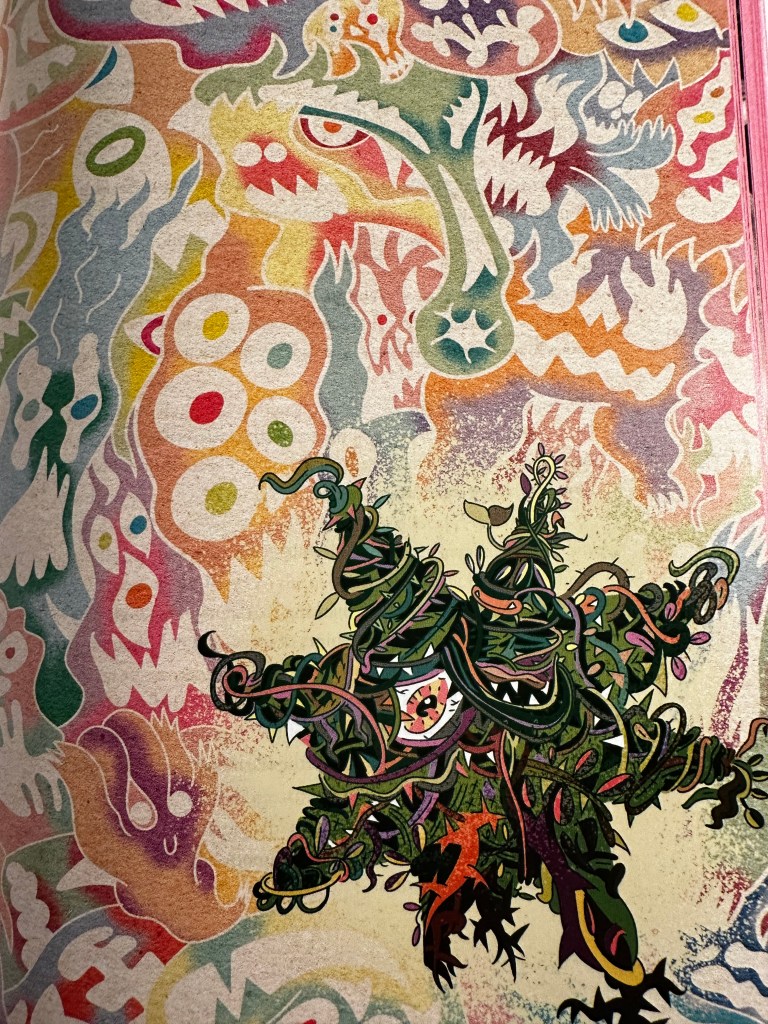
A full colour illustration from Between the Skies. It shows a star-shped being that seems to be made of an entaglement of vines and other plants floating through a multicoloured, psychadelic dreamscape.

Like I stated earlier, I am a big fan of the methods described in this chapter for beginning your game. I am excited to try it out and invite my players to be as big as part of the world building as I am, or bigger, from the very get-go.

Between the Skies has a lot more to offer. I have not even made it half way yet. But I think, for now, at least until I start actually playing it, I will pause this series of posts for now. I’ll bring them back when I have some more practical experience I think. See you then, dear reader!

The Apprentice, Chapter 15

Dad’s home

Guess who’s back in town?

Chapter 15: Taking Control

Gentleness and graciousness had not worked. I was trying to better the lives of everyone and they were blinkered by base fear and ignorance. How could I have imagined anything other than this reaction from these people? Their lives were so black and white, good and evil, alive and dead. It was disheartening. Yet I was not ready to give up on my plans; if they would not see the future I would make them see. The mayor would have his part to play though I would have to do some spell modification again before I could make that happen.

I set my servants to the task of cleaning up the courtyard. It was only then that I noticed the child. A girl of thirteen or maybe fourteen (yes, I realise the irony of me calling her a child but the fact was I felt and looked a great deal older.) It seemed she had fallen to the ground in the rush and scrum as folks panicked. Then one of the tables must have fallen on top of her, depositing chicken bones, corn husks and greens to cover her further. At some point she had been knocked unconscious. As the skeletons lifted the toppled table off her she stirred.
“Hide quickly!” I ordered them. As she pushed herself up off the flagstones I went to her side, “are you hurt?” I asked. “I don’t think so, at least not badly. What happened? Where is everyone? Where is my father? My father left me!” She was becoming distraught. Her head was whipping from side to side in search of a familiar face. Tears dropped from her cheeks and her lips quivered. “Shush now. They have not abandoned you. There was an emergency and they all had to flee. You may have been overlooked in the chaos but you will be returned to them. Here take a seat on the bench and have some water.” I stepped away to fetch a water jug from the table behind us and quickly performed Calm. When I returned, she gratefully accepted the cup from me and gave me a pretty smile in return.

“Now, someone at the party spoke to me of something odd. Perhaps you can illuminate the matter for me. This gentleman told me that the dead had risen in Pitch Springs once. Could this be true?” I asked. “Oh yes! It was the worst day I can remember. It was four years ago. There were three of them. One of them was Pretty Primmy Sharpetzi, one was this poor farmer who had walked under a plough and the last one was a little girl who died in a fire at her family’s farmhouse. I don’t know the names of the other two but I remember Primmy, all the girls do. We all wanted to look like Primmy when we grew up.”
“We live on Mictus Square so I saw the whole thing, well, when they came out of the temple anyways. I saw a little man or a boy leaving first, I don’t think he was one of the dead so I don’t know how he got away from them but they found Hindryk Scheimtzi inside the temple near the altar. There wasn’t much of him left, my Poppa said, but his Momma recognised his clothes. Anyways, it looks like maybe the dead ones had been too busy eating poor Hindryk to worry about this fellow who escaped. It’s funny, I remember seeing this little man pushing something ahead of him like it was on wheels, though I didn’t see any wheels on it. It might have been a big book or a little casket, it was hard to see. He pushed it all the way out of the square and not long after that the dead came out, I screamed when I saw the farmer. He came out first and ran off across the bridge.”
“I heard later that he had gone home to his farm, ate four chickens and a little puppy before his widow came outside to see what was happening. They say he almost chewed her head clean off before his son plucked up the courage to take him on with a pitch-fork, impaled his dead Poppa on it and stuck him to the wall of their stable. My Poppa, who’s one of the mayor’s men, said he was still struggling and writhing when he got out there to see what had happened. They burned the whole stable to do him in. It took a long time for him to stop moving and moaning, Poppa said.”
“The little burned girl went home too, I was told. Of course no-one was home. All her people died in the fire too, you see. I heard she lived for a few days after it happened and that’s why she wasn’t with them in the temple. So she went to the house but it was a burned down wreck. She went inside and just stayed there. It was a few days before anyone noticed there was someone in there. It was her old neighbour, a boy she used to play with, only six years old. I don’t know exactly what happened but she made short work of him by all accounts. After that she ran out of the house and into the town, attacking everyone she saw. A lot of folks got bit and scratched but she didn’t manage to kill anyone else before a constable rode her down on his horse. Even after that, she was still thrashing about though she was so broken she couldn’t get up. They caught her in a net and dragged her off outside town. Knowing about the fat farmer already, they burned her up and finished the job the house fire had started.”
“Primmy…poor Primmy. Guess where she went to. That’s right, she went home too, to her house on Saint Frackas’ Square but not before she visited the old washer woman she used to work for. Grey Greta got dragged out of that place and into the street. She was screaming and hollering so much half the town turned out to see what was happening. It was well past my bedtime but I snuck out wrapped in a blanket to find out what had happened. I saw Primmy there with her black eyes and blood all over her, tearing great chunks out of Greta with her teeth. By the time the constables arrived The woman was long dead and Primmy was just eating her! Everyone stayed well back, standing in doorways and behind anything they could find. I was hiding behind an old watering trough in front of the inn there when they came. When she saw them she hissed like a demon and spat the washerwoman’s blood at them. They charged her and forced her back into the house and then they threw lit torches in after her. We all watched it go up and everyone pitched in to put the fire out. When the constables went inside after it had cooled down, though, there was no sign of Primmy. She had escaped out the back. It was a few hours later when a constable went to check her house and he found what was left of her old governess in bits on the floor of the parlour. The whole place was covered in blood and Primmy, they said, was upstairs in her room, just sitting there on her bed. She tried to attack them when they found her but they hacked her to pieces and then burned the pieces in the square in front of the house.”
“It was all so scary and sad. I can’t believe that poor Primmy, Pretty Primmy ended up one of the walking dead.”
The girl fell silent then, her story done.
“Its time for you to go home now,” I said to her. I went and fetched one of the horses from the stables and lifted her up into the saddle. “Just tell your father you fell asleep after everything that happened and then took this horse home. Just pat him on the rump when you get there and he’ll make his own way back to me.” And away she went.

“She was not like you, my servant,” I said to the nearest of my skeletal minions, “her curse was unbalanced by a lack of control. You know your place and what you should do.” I looked down again at the corpse of the mayor, “although you do it a little over-zealously on occasion. I must bring control to Pitch Springs if this is ever to work anywhere else. You and you: take the body inside and leave it in my study,” I said, pointing at two of the ancient dead.

The next day, the mayor was up and about again. Dressed in a new shirt and jacket it was even difficult to tell that he had been speared through the chest and was missing a vital organ. He still looked dead, of course, but I had given him an ability unknown to the others; he could speak. Well, he could speak after a fashion. His mouth, undamaged and undecayed could still form words and I made it so that he could draw air into his lungs and release it to give his mouth’s words volume. I myself would give him the words to speak through a magical connection.
Back to Pitch Springs went its mayor with me following him all the way through the use of Farsee. I watched as he crossed the bridge and entered the town. An elderly man, his eyes no doubt, weakened by the years, approached to greet him. I could not hear what was said but as he drew nearer the old man slowed and peered harder before stopping, pointing at my mayor and running back into town, waving his hands about in the air. Panic ensued and all ran before the dead mayor. He continued on at a measured pace until he reached the town hall where he stood on the steps. The Town Square was deserted but I began to speak anyway.
“Folk of Pitch Springs, please come out to hear my words. I wish you no harm.” Nothing happened. Unsurprisingly, they did not believe me. “If you are so fearful then come and destroy this body…” This time there was movement on the far side of the square. A brace of mounted constables arrived followed by a few cowering townspeople brandishing torches. One constable started to shout something. I do not know what. I continued. “Finally, an audience. Please lend me your kind ears.” I noticed a few curtains flick in the windows around the square. I was getting their attention. “I have sent your former mayor here to tell you what I have to tell you. I am the occupier of the fortress on the Scharpetzi farm…Davus lu Fae, and I am speaking to you through this body for two reasons. One, I think you will take it better coming from the mouth of someone you know and trust; and two, to show you that the dead can be made to work for us. I raised this corpse from the dead to be a tool. It is a tool of communication, this one. Imagine a world where we used such tools to perform the manual tasks that we normally must spend hours of our time doing ourselves. They can farm, as they have on my land, resurrecting a farm from the dead. They can build and cook and wash and fetch and deliver and fight if necessary but all at our command. This is an opportunity that you can grab now! Imagine what your lives could become with the time to do as you please, when you please. Our people could progress culturally and academically and economically in great leaps!” I stopped speaking. The constables were very close now, right at the foot of the steps but their horses reared and shied away from the mayor’s animated corpse. The townspeople with their torches hung back and watched the mayor warily. Others had come out of their doors and stood around the edges of the square, hands covering mouths, eyes creased with disgust and dismay. “You still do not see the potential!” I shouted, angry now at their refusal to see my great vision for them. “You would prefer to fester in your pathetic little homes, toiling every day to earn a crust of bread when I am offering you a life of leisure and a feast! You do no-”

A man emerged from the town hall and walked around to look in the mayor’s drooping, pallid face. He was a big, broad, grey-haired, clean-shaven man, wearing a cuirass of banded mail and a bastard sword strapped to his back. I commanded the mirror to focus on the man as he spoke to the corpse. I fell to the floor when I saw his face as his achingly familiar lips and teeth and tongue formed the words, I – am – coming – for – you. I sat there, trembling as my father, Korl Sharpetzi, drew his enormous sword from its sheath and hacked the head off the mayor. He dragged body and head into the middle of the square. The townspeople closed in and threw their torches on it. I ended the Farsee spell and put my face in my hands. I wept as I had not done since I was just a babe. He was home and he wanted to kill me. He did not understand my plans. If there was one person in all the world I would have wanted to understand, it was my father, and I was sure he would. My certainty was misplaced, it seemed. Now, I had to make a plan to defend myself from him. He was war-hardened now, perhaps like he had been before he had ever had a family. He was a seasoned warrior and he had every reason to want to kill me: I had killed his daughter and then returned her to life as an abomination, I had caused the death of our governess who had been his own governess as a boy and he thought I was a menace to his town. I was afraid. I had never before been afraid of my father. When my sister and I were small children he never struck us and never raised his voice to us. Poppa always looked on us with kindness and understanding even though I had killed Momma and Primmy was always doing stupid things. The face of my father that I saw in the mirror had the look of someone possessed by hate and vengeance. He had earned some scars in the wars, I could see a jagged one running across his forehead and a crescent under his right eye but most of them were behind his bloodshot eyes.

I banished my fear, telling myself that if only I could meet him in person and he saw it was me I could talk to him rationally and make him see things my way. I dreamt of a tearful reunion, the two Scharpetzi men together again at long last. I imagined him at my right hand as my plans and my servants transformed the world. I was sure everything would turn out as I wanted it to; no, even better than that. Poppa wouldn’t hurt me, he would join me. So I decided to continue as if nothing had changed.
Now, graveyards, boneyards, cemeteries, mass graves, catacombs; these would all cease to be needed in the long run as corpses would be raised almost as soon as their souls had departed in the future that I pictured. So all those burial places would become plots of land that could be reclaimed in the name of progress. Until then, however, they were to be my primary source of new labour. I had to go recruiting that night, in fact and the most populous graveyard in the region was right on the edge of Pitch Springs. There were hundreds of corpses there, many of them would be too decomposed to be of any practical use but a great number would be relatively intact and could once again be made into productive members of society. It was time to go on an outing. A dozen of my skeletal servants accompanied me to the Pitch Springs Town Graveyard. The words were embossed on a metallic arch over the gate. It was the dead of night and the place was locked up so I had four of the skeletons pull the gates off their hinges to allow us entry. The gates clattered and clunked heavily onto the pavement outside and lay there resembling ornate cattle grids. I walked in after the gate wreckers, trailing skeletal minions. They formed a protective circle around me once I had come to a stop on the path in the centre of the graveyard.

I began the spell, the amalgam of spells which gave me control over the dead ones that I had raised. I sang the words and performed the movements perfectly but was interrupted when the skeleton directly to my right toppled over into a pile of bones and roots. It’s head had exploded. The circle had only just tightened around me when I saw the next one in line to the right collapse. What is happening to them? I thought. Is it magic? But then I saw it. An arrow streaked past my face, only a rib’s width from my nose, and exploded the skull of another skeleton directly to my left. I was under attack.

The area was covered in ancient, brittle bones. The magic that animated the skeletons also toughened and strengthened them but losing their heads seemed to break the spell and all its effects. Stepping backwards in an attempt to avoid the next arrow the sole of my boot connected with a leg bone which rolled and then crunched underfoot. The back of my head hit a paving stone with enough force to fill my eyes with black holes and bright stars. I was unable to arise immediately. While I lay there I could hear the swipe and swish of a heavy sword as it sang its way through my skeleton guard. I was showered with bone shards. Flinging my arms over my face I saved myself from blinding by that terrible rain. I shook my head painfully until my vision returned almost to normal and I saw him there, beheading the last of my skeleton guards. My father raised his enormous bastard sword in both hands and looked about him with practiced motions, wary, alert, ready to fight. From the corner of my eye I saw what he could not have from his vantage point; one of the skeletons, head battered sideways and crooked as a five-ace pack, trying to gain his feet behind a gravestone nearby where it had been knocked by the sheer force of one of my father’s terrific blows.

What would you do? I was not to have the chance to convince him of the rightness of my plans, his plan was to kill me, as quickly as he could. I could not, in good conscience, allow my father to murder his son after all that had happened to me in my life due to the murder of family members. What would you do? Well, that’s a question that does not matter. I was the one in this situation and I cannot imagine that anyone else has ever been in a predicament exactly like it before. Looking back now, however, I can see that, although I take responsibility for my actions like an adult, I know I was under the Fae-Mother’s influence still. I see it all so clearly…now that it is too late.

I called to him. He had not recognised me by my features alone since my features had changed so drastically in the years and months since last we had encountered one another. I called him, “Poppa! Poppa! Its me!” He looked towards me without a trace of the hate or anger that I had seen in his face when he was speaking to the mayor’s corpse. He wore the expression of focus and seriousness he always wore when working, no matter if he was pounding fence posts, writing a letter or teaching me a lesson. I knew what I was doing. I knew what was going to happen. I knew, even, a little of what I would have to live with later. But I was committed to my cause, to the betterment of all people, no matter the cost. “Maryk?” his whole face squinted and his forehead scar rippled in the folds of his brow, “It can’t be. Maryk is dead!” I levered myself up onto my elbows and said, “I’m not dead, Poppa. I’m Davus lu Fae. It is me. Just look. I know I have changed but you must know your own son.”

My Poppa leaned down, dropping his massive sword until the point rested on the ground. “By all the Saints…Maryk…What have you done here? Why do you look as if you are an older man than I? Was it…was it you that killed your sister? How could you do all this!? Didn’t I raise you better than this? Why, Maryk? Why? Why? Why?” I gazed up into his face. He was weeping. I had never seen him do that before. I remembered my sister saying that Old Aggie came to collect jars of his tears because they were magic. I remembered seeing his face smiling and at peace, sitting in his rocking chair following a long day’s work, puffing on his pipe and telling us all about goblin bakers and talking dogs and then his two bony hands grabbed each side of his grey head and snapped it sharply all the way around until he faced backwards. My father’s corpse fell on top of me and I screamed until the last remaining skeleton lifted it off and I was able to rise.
I finished the job I had come to the graveyard to do. More committed than ever before, that’s how I felt then. I had just killed my own father for the sake of it and now even he became just another dead servant along with everyone who had died in the town of Pitch Springs in the last hundred years.

Hex-jammer

Messin’ with 5E

I’m sure those of you who have been around for a while are aware of how much I enjoy mucking around with my D&D campaign. It is a Spelljammer campaign of the 5E variety and it has been running for quite some time. About 25 sessions, I think. That makes it one of the longest running campaigns I have ever had. That’s probably what makes me want to keep messing with it. A while ago, I introduced the very FitD idea of Engagement rolls before big jobs/dungeons and that has worked pretty well. I also brought in the adversity token, which have come in handy for our heroes in a few clutch moments, let me tell you!

1E Throwback

This post is not so much introducing yet another rules hack or even anything home-brew. It’s more about utilising a style of play that went out of fashion in D&D a long time ago. Hexcrawling! A couple of the oldest D&D publications I own are from AD&D 1st Edition. One of those is UK5 Eye of the Serpent, written by Graeme Morris and released in 1984. This was designed for one DM and one PC! Specifically, it was made to be the first adventure for a druid, ranger or monk character. This is besides the point. I just thought it was unusual. Also, it reminds me of a Troika! adventure I just read, The Hand of God, mainly because it starts much the same way, with the characters being abducted by a powerful winged creature and dumped in their nest at the top of something very, very high up.

Anyway, the point is the hex map of the outdoor region, Hardway Mountain (the name of which, I think we can all agree, is a little on the nose.) Now, the use of this map was incredibly restricted in the text. If your PC was playing a druid, not only did they have to have a prescribed set of three NPCs with them, they should also be forced to take a particular selection of the marked “routings.” These would be distinct from the routings a ranger or monk character would be forced down. You can see this laid out in the unfeasibly complicated two-page spread below.

Now, I think this is really interesting in comparison to what you might deem a hexcrawl style game today. I think most OSR games that use a hex map are thinking along the lines of open-world or sandbox play where you go to a certain hex on the map to explore, with the understanding that the whole thing will be open to your PCs. There might be geographical or other obstacles they have to overcome but that’s up to them, they can either try them out or forget about them.

When it comes to encounters, places of interest, etc. a lot of the time these will be generated randomly and the GM is discovering along with the players in many cases. Even if the GM is the one who came up with the encounter table they’re rolling on, they are not to know what the roll will turn up in the moment or what the PCs will do with them! I realise I am probably teaching my grandmother to suck eggs here, but I want to point out that, although the hexcrawl is a pretty old school style, it wasn’t always necessarily as free a style as it is generally taken to be today.

One last thing. That Eye of the Serpent module has some fantastic art by Tim Sell. Just check these out.

Hexing the Rock

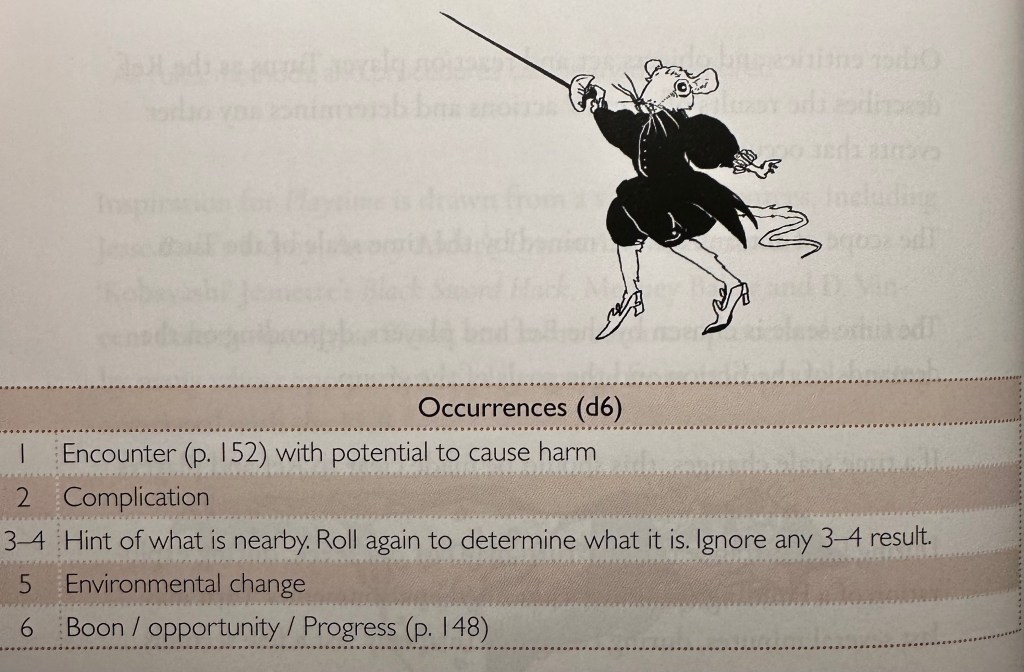
The Spelljammer campaign may have gotten a bit bogged down on the Rock of Bral. Why? Is it because it is the only location described at all in the Spelljammer 5E set? Maybe. Is it because all the plot threads of the campaign led there? Partly. Is it because it takes a life age of the earth to get through a round of 5E combat? That’s a distinct possibility. Anyway, the crew have spent a lot of time exploring, murdering, stealing, negotiating, shopping, drinking and dating on the topside of the Rock already. But one of them has had a literal ooze-heart pulling them to the underside since they got there and they finally made it down. Now, to get them there, I invented a little something I like to call the Shaft of Bral. Stop sniggering! It is a shaft of pure void half a mile wide through which you can reach not just the top and under sides of the Rock but everything in between too. So they took a little row-boat called a spell-rudder down to the bottom and now they are crawling through the hexes underneath. I threw a few random encounters at them on the way down as well. I invented a few encounters for the Shaft of Bral and put them in a d6 table. I got the players to roll for those and they had fun getting hit by another spell-rudder in a hit-and-run and avoiding the sickly air of a boat full of corpses on their way down.

So far, using the encounter table in Boo’s Astral Menagerie (the Spelljammer Monster Manual,) I have been unimpressed. The first time I used it they got an encounter with a ship of aggressive Vampirates. Then there was a fight that lasted three full sessions. It wasn’t all bad, it just derailed things in a less than ideal way. So, I thought I would just make my own encounter tables from now on.

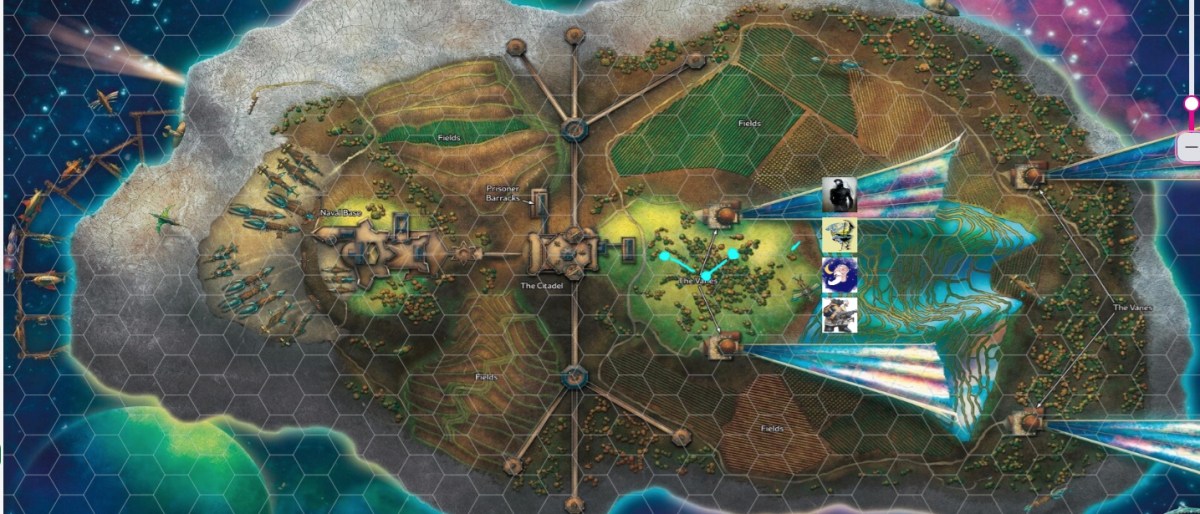
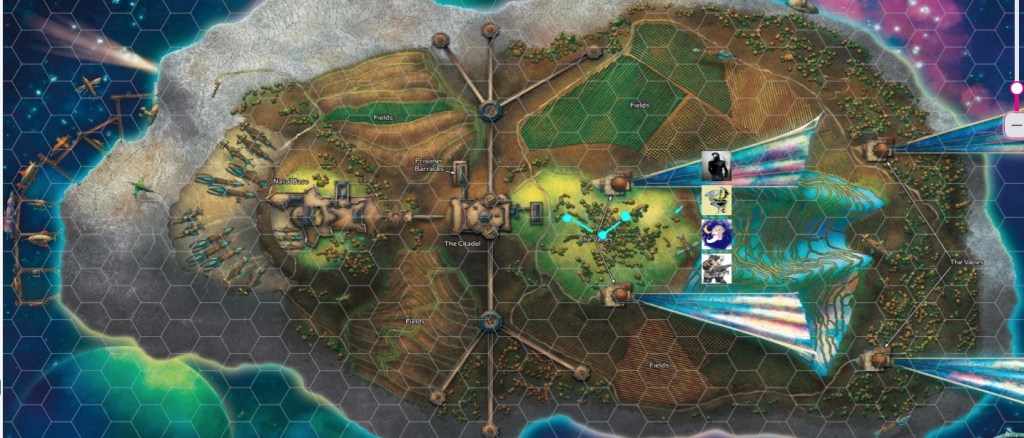
Once they were finally on the Underside of the Rock, I had to think about how I was going to handle it. It is a very large area, made up largely of farmland and forest and they were there to find one wee gnome. I could have just given them directions, but I wanted it to feel like they were exploring and finding their own way, so I took the map of the Underside of Bral and popped it into Roll 20. We are playing this game online so this worked out well. Then I set the map layer to have a hex grid, instead of the standard square one. Now, as they travel, each time they pass from one hex to another, we roll for an encounter. Some of these encounters are designed to beneficial, some are quite the opposite and others are what they make of them. They have been using their own skills, abilities and traits to push on towards their goals while getting the impression of uncovering things about this place as they move through it. I’m not sure how the creators of this version of the Rock imagined people using this map. Maybe this is exactly what they thought we would do! But, I doubt it. It doesn’t feel as though any thought went into that, in fact. As it is with so many recent D&D 5E products, you are given the bare minimum and expected to figure the rest out for yourself. Even a little advice to go along with the map would have been useful. I mean, even Eye of the Serpent did that in 1984.

Anyway, the last session we had was one of these hex crawl sessions and I can’t remember a funnier time. Genuinely laughed the whole way through. Now, I am incredibly loathe to take any credit for that. It was entirely the hilarious antics of the fantastic players I am blessed with. A couple of highlights:

  • Our Giff Charisma-Fighter/Paladin climbing a tree to hide from a patrol with his trousers ‘round his ankles because he thought his hairy grey arse-cheeks would help disguise him as a bunch of coconuts (didn’t work, it was an oak tree.)
  • Encountering a bunch of Hadozee who were on the run from the nearby prison but didn’t know how to escape the Underside. The party told them all about the secret hatch in that stump over there which led to the Shaft of Bral. What’s that? Do we have a boat there? Yep! On, ok, bye then! Good luck in the shaft!
  • Herbert Gũsfacher, ornithologist, the latest identity adopted by the party’s resident illusionist, Balthazar.
  • Gary, Son of Gary. Oh, are you based in the Garrison, Mr Gary-son? No, the Citadel, actually.

Anyway, these random encounters did help along the good times and, I hope, gave the players a sense of active exploration. They haven’t found what they were looking for yet (it’s Eccta, the plasmoid Mum) So I can’t go into any detail about what is in store but I will be using a lot more of my own home made hexcrawls and random encounter tables, that’s for sure.

The Apprentice, Chapter 14

Big plans

It’s nice to come up with plans and see them come to fruition, isn’t it? We gain an enormous sense of pride and well-being from our work, when it goes right, at least. Maryk is no different but his plans involve improving the lives of every living person, somehow. It’s a big deal! I’m sure we all wish him well in his endeavours, especially as his plans have a tendency to go a little awry, usually to the detriment of all those around him.

Chapter 14: The Working Dead

It had been in front of me for years. The last casualty of my curse offered the clue to how I could help my people gain their freedom. I spent several days in confinement while I studied and planned and prepared. Meanwhile, outside, the newly appeared fortress had begun to attract attention from the locals. I performed Farsee so that I didn’t have to show my face at the window. My assumption was that the local people had considered me dead, probably at the hands of the dead and moving Primula. I was in no hurry to disabuse them of this notion. It would be more useful for my identity to remain unknown. Anonymity might just offer even greater protection than my new home. Farsee transformed the surface of the mirror in my bedroom into an eye to view whatever I wished. It was one of the most useful spells I had mastered from the Royal Magic book. Now I looked at the area directly outside the gate and saw the Markinsons, beet-faced father and cruel sons. They were banging on the gate with sticks, either to get the attention of the occupant (me, though they couldn’t have known it) or to try to break it down. They would not succeed in either. I had no interest in them and a simple Silence spell around my room would take care of the noise they were making. Attention from the locals was inevitable of course but I had hoped to be left alone a little longer; I had a great deal of work to do, after all.

I found the spell I was looking for again. I had only used it once before and it had not worked as I had hoped it would that time but now I knew what to expect and I expected it to achieve my goals. I had to find another spell in the book, however, that I could use in conjunction to give me the control I had lacked last time. It would take time to find and even more time to meld the two spells. It was my greatest magical challenge yet. As such I spent all day every day for a week locked away in my, admittedly comfortable, rooms, studying and writing and working. I went out at night-time only, when it was safe to go and find food. I still survived on very little sleep each night, only an hour or two most nights, so that left me plenty of time to hunt. I used magic, obviously since I had never really handled a weapon with any great confidence. I simply lured the animals out with a simple Charm Beast spell and then fried them with a Firebolt. For vegetables I just went to the Markinsons’ and dug up what I wanted from their fields. I did not feel bad about this.

After a week like this I felt I was as magically ready as I would ever get. That evening I took my amalgamated spell on a scroll of parchment and exited my fortress, setting off to the Creakwood. I knew what I needed would be there. Coming upon the crevasse, I worried that I might have damaged what I needed, near as it was to the epicentre of the earthquake. As I got closer to my goal, though, I could see that it was more or less intact. Only a few gravestones had been knocked over, the graves themselves seemed unaffected.

The Dead, of course, would make the ideal workers for the society I wished to build. The dead would never tire, they did not require payment or even sustenance, they could be controlled to a degree the living could never be and to a degree the Ens could not because they did not have a will of their own. They could be much stronger than the living and would be unflinching and highly effective if sent into battle. Why had no other great mage ever thought of this before? I had read a great deal on the subject by this point. There had been many mages who raised the undead but none of them had ever sought to control them to such an extent. They had only ever been used in the pursuit of wholesale murder, chaos and terror. I think I am the first ever to have come up with a spell alloy that would not only raise the undead but also place them firmly in my own control. They would follow my instructions to the letter without question.

Of course the answer to my question is obvious to me now that I am free of the Fae-Mother’s influence. The dead deserve to remain dead and gone even if one thinks that the soul departs the body when life leaves it. No-one wants to see their loved ones or even their recently deceased acquaintances or neighbours walking about, performing everyday labours in a state of profound decomposition. Of course, the decomposition problem did not arise with the first set of bodies I took from their graves in the Creakwood.

The spell was quite a long one, taking about one hour to perform. When I finished the final movement I could see immediate results. Ancient skeletal hands, digging their way out of the ground, ripping roots apart on their way. They hoisted themselves up out of the holes they left behind and stood at attention by their gravestones like soldiers. There were more than a hundred of them but some had not come out so well. There were several missing skeletal limbs, one had no lower half and the ribcage of one was so badly damaged that it bowed forward constantly. Many of them had become one with the flora of the place and the right arm of one old blighter had been replaced by a long tentacle-like root. I was delighted with them. They would be my first workforce. I intended to put them to work in the fortress and the surrounding farm. I would make it thrive again and I would do it with the untiring limbs of my skeletons.
I marched them back to the fortress in the darkness. I had given them the command, “Defend me.” They defended me alright. They efficiently dealt with a fox, a house cat and a low-flying bat. All of them had simply gotten too close, I suppose. All of them might have caused me some harm, I suppose. Perhaps my orders had to be a little more specific, after all there was no reason for anyone or any thing to die needlessly.

Once back at the fortress I put them to work immediately. I had them destroy the old farmhouse and strip it of all useful building materials. You might think this caused me some distress but I was actually happy that the old place, abandoned and useless for so long, could be put to use in proving the rightness of my plans. I watched from the tallest of my four bright towers as the dead smashed it and tore it and pummelled it and I felt gladness. I watched them take the timbers and the stones and begin to build high walls around the farm. It might be difficult to do, I thought, but it was best if the neighbours did not yet know of the goings on in the Old Sharpetzi Place. Once the wall was finished I had them prepare the land. It had been a greenless, dusty ruin for so long that I did, at first, question whether we would have a chance of reviving it. “I have revived the ancient dead to serve me. One little farm should not be so difficult.”

There were certain things I could not have my servants do, however. They could not go to market to buy the seeds and beasts one requires to build a farm from scratch, at least not yet. Even if people accepted them, they would be incapable of negotiation and would be somewhat prone to being cheated. For now, I would have to handle any face to face dealings with other people. Even the idea of this made my heart race and the hairs stand up on the back of my neck. I once made a vow to myself to stay away from other people at all costs so that my curses would not fall on them and, although my outlook on life had changed since the Fae-Mother touched me, I had not forgotten this promise. I shook it off. “Well, if one person comes to harm I will honour them for their sacrifice in my cause.” This is what I told myself. I believed it too.

So, I went to town. Pitch Springs had changed not at all, unsurprisingly, though I noted the damage my earthquake had done and the absence of the old washerwoman’s house where Primula used to work. By the black burns on the walls of the adjacent houses I took it that it had burned down. I had to go early on a Saturday morning to get to the market before the largest crowd had gathered there. If I were to be recognised by any of the locals, it would be difficult to explain myself. An illusion worked to disguise me as an old man. This was not such a difficult trick considering how I already resembled someone four times my age. A slightly more difficult trick was to make the merchants believe I had paid them when I had no form of currency. I had considered taking a cartload of superfluous furniture from the fortress and trading it but I did not imagine that many of the agricultural traders and farmers who manned the stalls would have enough knowledge of art or joinery to offer a fair price for them even if they wanted them. All of that was academic, of course, because I had no way of transporting it all. Among other things, I was there to purchase beasts of burden. In the long term, I fully intended attaching the dead to carts and carriage and having them transport goods and even people without the need for expensive horses and donkeys. In the short-term, I had to keep my activities secret so the animals would be a necessity. Also I would need them to pull the cart-load of supplies I was about to purchase. I did perform magic to fool the merchants at the market that day. I had some qualms about this as thievery seemed about as low an act as one could perform. However, I told myself that once my plan was entirely successful I could repay them what I owed them and more.
I decided to start relatively small. I purchased several bags of seeds for grains and tubers and also some for a variety of hardy greens like cabbage and kale. A dozen laying hens I got at a very good price off a farmer from out near Priest’s Point (or would have, had I paid him for them at all.) The horses I purchased were two large, sturdy drays, white and brown of coat and they were more than capable of drawing the cart (conjured.) I also stocked up on food for myself so that I did not have to live on nothing but eggs and the Markinsons’ stolen produce from.

On my way back to the fortress, sitting atop the cart, I considered how lucky I was that I ran into no-one who knew me in Pitch Springs. This made me wonder, but I took it as a good sign and continued on past the place of Grey Steel’s death. My spirits were high and I hummed a tuneless tune the rest of the way.

When I got there I was forced to strike the Markinson boys blind. The two of them had come sniffing around the gate of the farm this time. Since my servants had erected the wall and the gate in it they could no longer make it all the way up to the fortress. I saw them from the road. They had brought dogs and scythes with them. Watching them from the safety of the shadow under the trees, I considered murdering them. I still despised them for their unwarranted cruelty to their own dog all those years before and the very sight of them caused a rage to rise in my chest. Instead, I decided that I would punish them and rid myself of them in another way. Since they acted as though they were blind to the suffering of their animals, I would make them blind in fact. Blind was the sort of spell of which Master Gedholdt would never have approved. It seems that the old Fomori Emperor rather enjoyed using it as a punishment for those who disobeyed him. It was the most fitting treatment I could imagine for those monstrous boys. I performed the spell as quickly as I could but just at the end, right before the final movement in which I had to cover my own eyes, the Markinsons heard me and turned my way. They glimpsed me. I was the last thing they would ever see. I watched them for a while after that, fumbling and crying for their mother and for me, “Old man! Old man! Help! We are blind!” I stayed quiet until they regained enough sense to catch their dogs by their collars and tell them to go home. Then I proceeded the rest of the way up the road and summoned my servants to open the gate for me. As the gate opened I ran over the pair of dropped scythes and never even looked at them.

Now, farm supplies secured, the work could begin in earnest. It would take a year, as I saw it, to really see the benefit that my untiring workforce could bring to folk. All seasons are important on a farm and there is always work to be done, no matter the weather. I remembered very well having to muck out the sheep sheds in the winter with frozen-solid fingers and mud in my boots. The skeletons had no feeling in their fingers anyway and no boots to get muddy. They worked night and day all year round, ploughing and sowing and feeding and collecting and reaping and harvesting. I went back to Pitch Springs several more times to “purchase” more supplies, each time with the illusion of a different disguise. If the merchants realised I had cheated them the last time they might be loathe to accept my custom again. I bought livestock and not just chickens, a hundred sheep and a couple of cows and goats for their milk. Before the year was out I was self-sufficient and I never had any work to do except trying to keep the locals off my back.
Inevitably, the Markinson’s were not the last folk to come and knock on my gates. I had the local constable visit one day. I watched him in the mirror but did not even consider allowing him entrance. What was he going to complain about? Building code violations? A number of travelling traders and tinkers came to the gate. I was tempted to treat with them but decided to just let them go on their way rather than reveal myself to anyone too soon. One morning a whole gaggle of Kor worshippers arrived. Kor was a god from Bruschia in the North who was supposed to protect folk from magic. I saw that Mrs Markinson was among them. Maybe she had converted to Korism after her lads came home blind. It wouldn’t help them now. Prayers and entreaties to their god did no good, the wall and gate remained standing as did my home. I watched them leave, downcast, and wondered if they had any inkling that I was trying to help them and improve their lives. How could they? These religious types were always so narrow-minded. Acceptance from them was, almost certainly, impossible. No matter. Once everyone else saw the results of my works and the labours of my servants, they would be forced to acknowledge that I was right and that I would be able to help them progress to a new cultural level just as the Fae-Mother had done with her own people. Except I would be even more successful.

During this whole year I did not see the Fae-Mother even once. For me, I think this was a blessing. She had provided me the impetus to take up my great work and I was always grateful for that but I did not need her now. I was going to reshape human society with the help of my servants. Dead humans helping living ones, as it should be. I did not need the involvement of the Fae in this work.

I decided on a date that I would show my works to the people of Pitch Springs, my birthday seemed appropriate. In the dark recesses of my ego I imagined the date becoming a feast day in the future, to commemorate my good works. Benefactor, philanthropist, sage; these were all the titles I imagined my people bestowing upon me. In dreams I had even imagined a new name applied to the square where I had spent so many years of my youth: “Saint Maryk’s Square.” It made no difference to me that my opposition to the parochial and myopic religion of the common folk would preclude any such beatification. I imagined a new religion in my dreams and my day-dreams both. I imagined myself at its head and the worship of power and magic as its basic and most dearly held tenets. “Mad,” you say? Yes, I think that is a fair description of my state of mind. As it happened, the common folk were more likely to curse my name than bless it and burn me in effigy on my birthday than toast my generosity and genius.

Came the anniversary of my birth, November first. I had spread the word about my revelation that was to come that day by talking to travellers, traders, minstrels and tinkers who were due to visit Pitch Springs. I spied them on the road with Farsee and went out to meet them before they reached the gates of the farm. “A great celebration at the new fortress” I called it, “Some wonderful news from the new owner of the Old Sharpetzi Place on the first day of November,” I told them, “An introduction to the master of the place and his servants will be offered to all who attend along with some well deserved food and drink for his neighbours,” was the news I sent them off with. The people of the town would be unable to help themselves. The curiosity alone would be too much for most. And I was right, of course. They arrived in droves and they were ushered up the newly built road past the old farmyard and up to the gate of the fortress. There I met them. Many of them I knew, some I knew well. None of them knew me though I did not wear a Disguise illusion for a change. Truly my physical appearance had deteriorated even further during my years as a forest hermit. I was sixteen now but resembled a decrepit sixty year old. That is what the folk saw when they met me, an old man, bent and grizzled but with surprisingly bright and intelligent eyes.
“Welcome all to my farm. It is my honour to play host to you this fine autumn day. My name is…Davus, Davus lu Fae. Please, please enter the courtyard, the feast awaits.” I made a signal with my hand and the skeletons, hidden on the wall behind the ramparts turned the mechanism which opened the huge wooden gates. The folk of Pitch Springs and the surrounding land rushed in to get a look at the great keep and to be the first to get to the food. They were led, unsurprisingly, by the Mayor, Yan Wassiltzi, a broad man of prodigious height and an appetite that was known throughout the valley. It was rumoured that he had eaten an entire pig in one sitting. I hoped I had had enough food prepared.

Mayor Wassiltzi approached me as he watched the other folk fill out the benches. There were five conjured long tables which occupied most of the courtyard’s space; all were heavily laden with meat and vegetables, all from the once dead Sharpetzi farm.
“As Mayor of Pitch Springs I would like to welcome you to the area. I don’t know how you managed to put all of this together so quickly but it is damned impressive! Damned impressive!” said the mayor before hurrying off to join the rest of the townspeople who were already feasting happily. I attended each of the tables in turn and talked amiably to their occupants. They were in high spirits and were very complimentary of the repast I had provided and the beer I had had brewed.
“So, Master lu Fae! You run this place all by yourself, then? Must be a lot stronger than you look, eh?” interjected one wit, Elger Gottzi, who had always had a mouth too big for his brain.
Nodding, unfazed, I said, “All will be revealed shortly, good sir, all will be revealed.”

The sun was beginning to fall through the sky again and the guests at my little party were starting to feel the effects of the strong beer. I decided it was time to reveal the nature of my servants. I climbed the steps to the great door of the keep and standing before it, I struck lightly on the side of a glass with a silver teaspoon. The general chatter and hubbub faded until I could make myself heard without shouting.

“Thank you, honoured guests, for your attention. You humble me, truly by your presence here today. While you are here, I hope you will do me the service of treating this place as your own home.” There was general applause, cheers and one call for more beer. “Thank you, thank you. You are too kind. I do not deserve such good neighbours. I hope I can continue to repay you for your generosity, you, and all the good folk of this valley. In fact, I believe I can.” A hush had settled completely now and all eyes had turned from tankards and plates to my face. I saw them squinting, trying to make out what I was talking about. many of the faces I spied were still wary of me, even after having partaken of a great deal of my food. I could see the question lying unasked in their eyes, “Who is this strange, little man with his riches and his fortress on a farm?” No, I had not yet earned trust but there was no turning back now.
“Many of you will remember this place from before. Once it was a thriving sheep farm owned by a well respected family but its fortunes turned. The animals died in their dozens. The fields dried up and then washed away. It was abandoned when I came upon it. I knew it was exactly the place I was looking for. This successful farm, producing the delicious meat and vegetables…and beer (a cheer went up) you have enjoyed today was built in just a year. You are looking at me now thinking, how could this old duffer have achieved all this? You are right, of course. I could not have done it all on my own. I had a great deal of help. My servants did most of the labour. I just came up with the plans for them.”

“So where are these servants of yours, Mister lu Fae? Are they hideous or invisible or all abed from working so hard! They have done a fine job and are to be congratulated for it.” The mayor rose from his seat and climbed the steps to stand beside me, chicken leg still grasped greasily in his prodigious fist. “Well, Your Honour, for you to see, first-hand the nature of my servants is the very purpose of this little party. I wanted you all to first see the very good work they have done, to taste the fruits of their labours and to know that, whatever they may look like, they are the most amazingly valuable resource that we, living, breathing human beings have ever had. What I am talking about is free labour! Not slaves, before you say it or even think it, no; the concept of slavery is abhorrent to me as it, no doubt, is to you good and gentle folk. No, it is the one, thus far, untapped source of free labour. My servants do not need to eat, they do not need to sleep, they do not require shelter though it may be best to keep them out of the rain and the hot weather if you are to avoid undue decomposition. They are the answer to all your prayers. My servants and more like them will make a life of labour unnecessary. From today on you will be able to follow, instead, any pursuit you choose to: art, music, poetry, prose, history, beer, gambling, sleeping! Anything at all! You will never have to work another day in your lives. My servants and their kind will do it all for you. In the last year they have made a dead farm live again, and today, they prepared this feast for you all. Would you like to meet them?” I asked, warming greatly to my role as host and soon-to-be saviour. The mayor struck me so hard on the back that I almost fell down the steps. “Hah! Well, of course we want to meet them, man! If they’re going to do all our work from now on, we should at least be introduced!” I recovered, coughed, and clapped three times, slowly. I did not watch the skeletons emerge, I watched the faces of my guests. I knew where the skeletons would emerge from, the door right behind myself and the mayor. Only twelve of them were to make an appearance. The courtyard was simply not big enough to house the feast and all the ancient dead too. Twelve was enough, more than enough. Faces in the crowd below blanched and a silence descended briefly, oh so very briefly. In a moment a table had been tipped over, a child had been trampled into the flagstones, a beer barrel had smashed in the courtyard, townsfolk ran towards the gate or stood transfixed, one shouted, “the dead have risen again!”

Beside me the mayor’s smile quickly vanished but he continued the action he had just began as the doors behind us had been opening His open hand once again caught me between the shoulder blades. There was no strength in this slap and I was barely moved a foot by it. I turned back to him to tell him not to fear, there was nothing to fear, when the leading skeleton caught the big man by his back-slapping arm. I watched with a quickly rising sense of panic as the boney servant’s other arm thrust itself between the mayor’s own shoulder blades and emerged slightly left of centre of his chest clutching the still beating heart of Pitch Spring’s first citizen. A wave of hot blood washed over me along with a few splinters of sharp bone, not from the hand of the servant but from the chest of the mayor. A woman started to release a series of short, loud screams like a high-pitched donkey-bray and everyone not fixed to the spot started pounding on the inside of the gates to be let out. “Open the gates!” I shouted and watched my guests leave in a very disorderly manner. I looked out on the courtyard, just brief moments before, the site of a merry feast, now a ruin of upturned furniture, scattered food and beer not to mention the gore still pumping from the chest of Mayor Wassiltzi. This had not gone to plan. “Drop the body,” I said quietly. The mayor slumped off the lowering arm of my servant and then tumbled, like a string-cut puppet down the steps making a sound like a side of beef being punched by a sack of tomatoes. It landed amongst the detritus of the party, face up, jaw slack and eyes staring in horror at the beautifully reddening sunset sky.
I stood, looking at the corpse for a moment until struck by an idea. Then I took the murdering skeleton by the shoulder bone and said to him, “Plan B it is. Waste not, want not.”
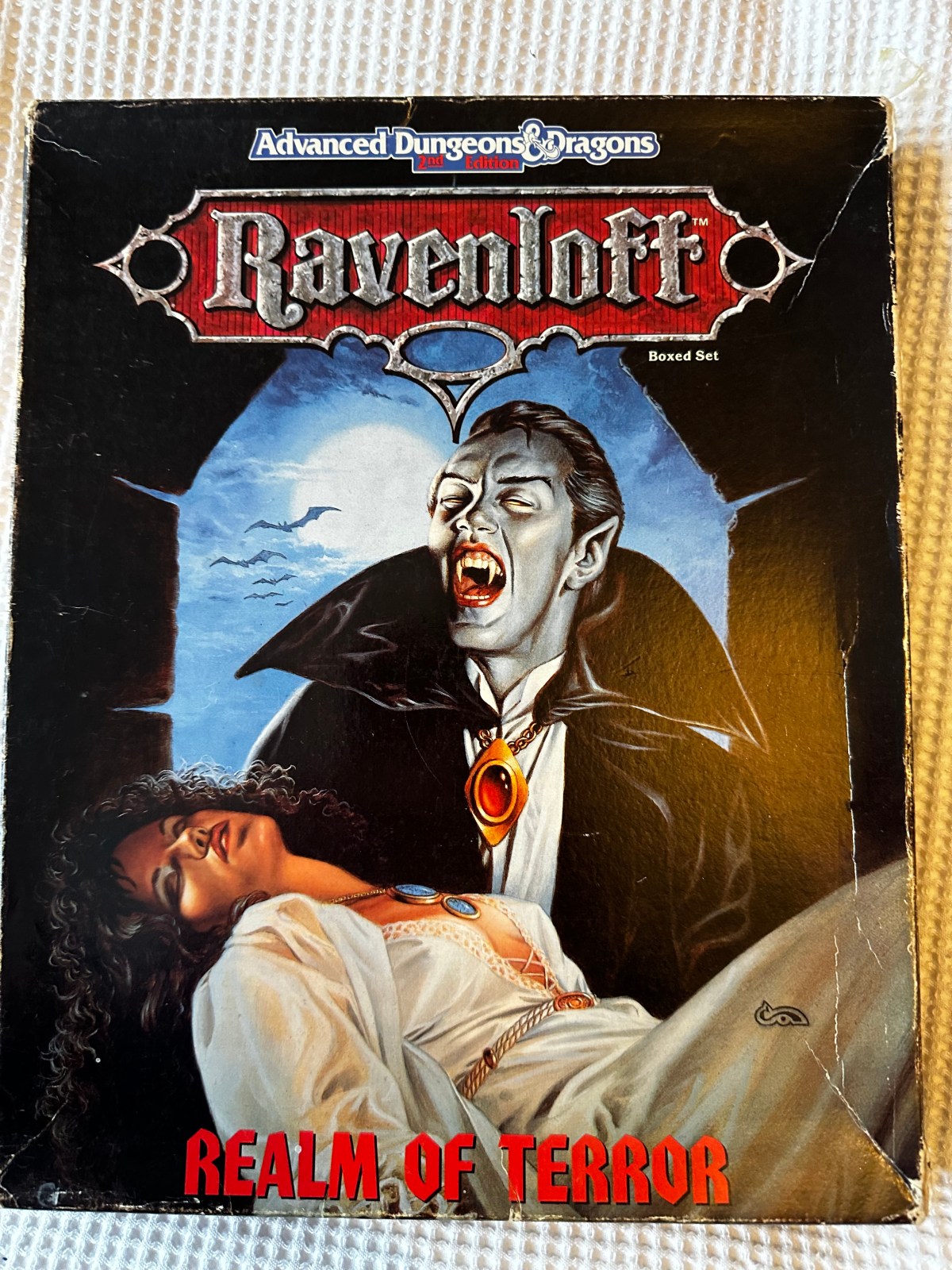
Between the Skies, Part 2

Back to the skies

Between the Skies is such a beautiful and fascinating book that it is a pleasure just to read it. If anything, all this writing about it is just slowing me down! But I do feel the need to evangelise a bit more. So join me, dear reader in an exploration of the character generation options. Or, if you haven’t read the first of these posts, you can catch up here.

Character Generation

The “Approaches to Character Generation” section encourages you to decide on the approach you want to use and then to roll on the relevant tables to flesh out the description. It’s important to note that your interpretation of the table results is what’s important, rather than having a strict set of attributes or traits that have specific meanings in the game.

It also tells you to note all of the things you want known about your character. I love this point, actually. Rather than waiting till it comes up in play, when a GM might casually bring up an element of your character that you don’t want the other PCs to know, you make it clear at the outset the only parts of your character or background that others would be aware of. Or maybe it just means that there are things about your character that no-one knows and that will come up organically during play, at which point they will become a part of them. Either way, it is an important point.

Character sheet with character generation question page no.1. This is for a "Through the Looking Glass" type character.
Character sheet with character generation question page no.1. This is for a “Through the Looking Glass” type character.

This section also directs you to go and take a look at the character sheets in the back of the book. There are three types, which I will get into below. But, notably, on the page before each actual character sheet, you’ve got a few questions printed in large font, taking up an entire page, to build a basis for your character. For the Lifepath and Spark procedures these are:

“Who are you?”
“What can you do?”
“What do you have?”
“What do you want?”
“Who do you know?”

And for the Through the Looking Glass procedure they are:

“Who are you?”
“What can you do?”
“How did you get here?”
“What are you searching for?”
“What have you brought with you?”

It’s almost as if their significance cannot be over-stated. It feels like these big old questions and the spaces for you to fill with your own answers to them on these pages could act as the character sheets themselves. Perhaps, if you don’t want to be too bothered with specifics, if you don’t want to use numbers and die types and the like to describe your character, you could just write a few answers to the best of your ability beneath each of the questions. That would be a good basis for a character in a fictional story. Would it be a good character in an RPG? In the very loosest of story-games, I feel like that’s more-or-less the approach and it works well, but it does depend on the type of story you and your table are trying to tell. In a space-pirate, treasure-seeking, swashbuckling adventure game, it might not hold up. But if your aim is to tell the story of a group of people caught in a difficult situation, informed by their backgrounds and desires, complicated by their relationships and inner lives, and their development as people over the course of the game, sure, it would be perfect. Writing about this makes me want to try it…

Character sheet with character generation question page no.1. This is for a "Through the Looking Glass" type character.
Character sheet with character generation question page no.1. This is for a “Through the Looking Glass” type character.

So, next to each question page is a “Worksheet.” Even the word-choice here is significant. It indicates that this is where you will be performing the admin for your character. Filling it in will be an exercise that you may find tedious or satisfying, very much depending on the type of person you, the player, are.

Each worksheet helps us to encapsulate a character designed according to one of three (four, kind of) procedures.

I mentioned in the last Between the Skies post that the procedure you use here is related to your approach to weirdness. So, if you have decided to go with “All the Weird” you can probably use any of the methods described, but if you are going with a “Venturing Out Into the Weird” approach, and you want mundane characters, you should think about going with the Spark character creation procedure (with a few modifications.) Once again, it’s important to note, all of this is advice, none of it is mandated. Choose and use what you like and discard the rest.

Lifepath character generation

I have never played it but I have heard about this character creation method being used in Traveller. Essentially, you map out your character’s life up to the point of the start of the game and this process creates the PC. You roll on the tables provided for this character generation method to establish events in your character’s life that lead to the accumulation of “Skills, allies, enemies, Mutations and Debt, among other things.”

Let’s take a look at some of the tables used for Lifepath character creation.

You have a Type table that contains a pretty wide array of permutations. I rolled up a Swimming Avian. I’m thinking seagull.

The Descriptor tables are d66 so have a lot of options in them too. You might be described as Huge, Transformed, Dead, Nomadic, Staunch or Minimal. These single adjectives should ignite the imagination and lead you down paths to fill in the blanks on your character sheet, or just in your mind.

You roll twice on the Aptitude table (also d66) and take the adverb form first and then the adjective form. So a roll of 54 and 45 (which I genuinely just rolled) would be Inspiringly Commanding.

After this you enter the Life Events section. It explains the basics of using this method and then tells you to go and roll on the Life Events tables. There are three tables to roll on depending on whether you want have your major life events on a Surface (I guess like a planet or something similar,) in Space or out in the Planes. You can switch between them and sometimes have to depending on the events you roll.
A sampling:

  • Quest for NPC completed, harmed – Roll powerful NPC for patron; Gain problem related to injury suffered by PC
  • Death, became undead – Create one Extraordinary Ability related to undeath; Create one Problem related to undeath; If already undead when this result is rolled, PC is destroyed, create new PC who has dead PC’s possessions.
  • Joined heresy – Joined heretical religious organisation; Gained ire of opposed religious organisation; Gained skill related to heresy
  • Became Hermit – Cannot roll any further life events; Gain skill related to hermeticism
  • Lost in the Planes – Cannot roll further life events
  • Became petty god – Roll or describe Focus; Gain Extraordinary Ability related to petty godhood; Petty gods are not necessarily more powerful than mortals

After this you have a bunch of tables to help you determine your Extraordinary Abilities, Skills, Mutations and Problems all of which will help to round out your character. There are some great entries in these tables but this blog post has already gotten away from me so I am going to have to skip on to the next method of character creation.

Spark character generation

ANother black and white illustration from Between the Skies. It shows a creepy person with no face except for two blank, white eyes. They open theirlong black coat as though they were selling hot watches, but inside are only toothy grins and gaping maws.

This is an entirely table based method, but, as the title suggests, the results you get from the tables should be used to spark the imagination of the player. As Huffa takes pains to point out more than once in the characters creation section, the tables might give you powers and abilities and they might even describe what you can do but they don’t tell you how your character does it. I think most of us assume this point without thinking about it in our games most of the time (my Magic Missile looks like three paper planes that explode when they hit!) but it’s a good thing to have it called out here formally. So the tables used for this method are very much based around the questions I listed above. Under the “Who are you?” section we have table after d666 table of descriptors to roll or choose from.
Here are a few nice ones:

  • Sickle mender – fixing what cuts
  • Messmaker – joyous entropy
  • False smile – feelings turned inside out
  • Babysitter

For “What can you do?” you can go back and use the tables under the Lifepath method for Abilities, Aptitudes and Skills.

“What do you want?” – There are a couple of tables here. You are encouraged to use these to “inspire a few sentences describing what your character wants.”
Examples:

  • Objects of Desire – Redemption, Surprise, More
  • Related to… – past self, rulers, daemons

When it comes to “Who do you know?” we have another trio of tables. These can be used to make two or three entities with whom you have a relationship of some kind. For instance:

  • Entity type – Creature
  • Relationship type – Debt holder
  • Relationship detail – Yearning

Once again, use these results as prompts to describe these relationships in a little more detail.

Finally, in the “What do you have?” section, you use the Starting Resources procedure with some changes. Generally this involves you having an alright weapon and some semi-decent armour, equipment needed for skills and maybe even a ship if that’s the sort of game you’ll be playing. You get to roll up an interesting object too! You will also possibly have some Assets or Debt to start with. There is, unsurprisingly, a table for that. Assets, Debt and Petty Cash are all rather abstracted in Between the Skies. You measure them in units where a unit of Petty Cash might buy you a nice meal and a unit of Asset or Debt would be the equivalent value of a house. I appreciate a system like this as counting gold pieces holds little or no interest for me. Also, Debt implies a Debt-holder and that could be an important relationship and could be used as motivation at some point.

Through the Looking Glass character generation

A full colour illustration from Between the Skies. The picture is of some strange characters, drawn in a deliberately childish style with funny hats heading towards some circus tents and away from a colourful bu threatening forest in the foreground.

Your character has done a full Alice and is now in a freaky other-world. Why are they there? What sort of personal disaster has led them to this point? What are they looking for in this isekai nightmare/dream realm? These are things you need to know about your Through the Looking Glass character.

Once again we have some tables to roll on. But interestingly,

It is assumed that Through the Looking Glass characters are mundane people from a world like our own, and that results are interpreted accordingly

A few sample descriptors from the tables:

  • Vengeful
  • Loopy
  • Ostentatious
  • Firefighter
  • Hack
  • Paparazzi
  • Avante Garde Hobby
  • Entrancing Dancing

On the “You (were) recently…” table we have a little more to shape your mundane character. You can roll on the d66 table to get these sorts of results:

  • Retired
  • Transitioned
  • Canceled

Under the “What can you do?” section, the abilities are a lot more “normal” than some of those in the previous character generation methods. They include stuff like:

  • Untapped Scholarly Education
  • Precocious Performative Love
  • Charming Spiritual Profession

One of the different questions belonging to this character generation method is “How did you get here?” This is, of course, of utmost importance to this type of character. Maybe you were trapped by an entity from another world. Perhaps you stumbled into it while intoxicated, seeking pleasure. Or was it that you were reincarnated after dying by a catastrophic event?

Even just reading the entries in these tables has my imagination all aglow with possibilities. They make me want to run this sort of game. I don’t think I have ever done that, not for such mundane PCs, at least. I want to see how such characters would be changed by such an impossible journey! Yum yum.

Another question that is specific to this character generation method is, “What are you searching for?” Ruby slippers? Aslan? That damned white rabbit? I suppose it could be any of those but why not roll on some tables instead?

The tables, interestingly, do not tell you exactly what you are looking for, just the type of thing you might be looking for (knowledge, person, object etc,) what that thing will provide (relief, comfort, affirmation) and what complicates it as a goal (explosive, famous, moving.) You should then get together and discuss the precise nature of the thing. The text suggests that, if you are all of a similar type of character, you should maybe all be striving for the same object but that you might each have a different motivation. This sounds like a wonderfully interesting potential grenade to throw into the works whenever the characters finally find the item they have wanted all this time. It smells like interpersonal conflict. Yum yum yum.

Lastly, for the Through the Looking Glass method, we are looking at the “What have you brought with you?” question. This is different to the “What do you have?” question common to the other two methods because your character is assumed to have been yoinked out of their own reality with only the items on their person. So they don’t get to have any Assets or Debt or any of the other starting equipment other types of characters might begin with, which is totally fair. Instead, they get a few basic items and maybe one Special Item. There is, as you might have guessed, a set of tables for that. Once again, these provide inspiration rather than outright answers to what that Special Item might be. So you might have an Alien Secret or a Mythical Key… This idea of only having what you had on you makes the prospect of the first few hours in a new world particularly enticing from a game perspective. How does one survive in a desert otherworld with nothing but a mobile phone, a wallet full of loyalty cards and used tissue? The answer could be that the locals are enchanted by the Spectral Device that you were handed just before being shoved through a portal.

Character generation using other games

There is a very interesting and useful section near the end of the Character Generation chapter. It provides a loose guide to using another system’s character creation method to make your Between the Skies character. Essentially, if you use this procedure, you will end up with a blended character. They will still consider the questions from the first two character generation methods but you will do your best to apply the answers to the character you have created using the other system. In some cases, this will mean that you are adding bits entirely from the question answering method as many systems do not consider things like what you want and who you know at the character creation step.

I am a big fan of Troika! so I am happy to see the practical example of using a Troika! background as the basis for a Between the Skies character here too. It makes it easier for me to picture using this method and elucidates the process in a practical way.

Character generation conclusions

All in all, I am impressed with the breadth of options presented in the chapter. You have no fewer than four different ways of making your character (and many more if you consider you could technically use the fourth method to use any other game’s mechanics to do it) a plethora of interesting tables to create some really weird or terribly mundane characters and a whole bunch of world-building before you have ever started playing the game in anger. The results you are likely to roll on things like the Life Events tables are going to haunt your game if the GM is paying any attention at all. You’re likely to establish the existence of certain NPCs, gods and demons, places, objects and catastrophic events that effect the whole world while rolling up your PC. I love this! It starts the whole table off with so many potential plots, grudges, vendettas, desires, loves, hates and motivations that the game should practically run itself from the moment you finish character creation.

As a process(es) it makes me excited to take part in it and even more excited to play the game, either as a GM or as a player.

What do you think, dear reader? Does this make you interested in Between the Skies? If not, perhaps I will continue to pursue this subject in another post in the near future so I can convince you. If so, maybe I’ll keep entertaining you with details and opinions of a subject you clearly enjoy! It’s a win-win!

The Apprentice, Chapter 13

Unlucky 13?

So little left in this tale. Chapter 16 will be the last one, so the countdown starts here. Do you think it will end well for young Maryk? In today’s chapter he makes a big change and some big decisions. His ambition is re-ignited and plans begin to form in his mind. It’s not all about him, after all, right? The whole world might benefit from his talents. It is his duty to help!

Chapter 13: Fortress

Much of the story of the Fae was unknown to me before the Fae-Mother chanced upon me (I say “chanced upon” but of course there was no chance about it. She knew where I was, why I was there and, possibly even what was going to happen to me there.) She told me all of it. Some of it, I believe, is coloured a little in her favour. The Ens seem unfeeling and destructive in her story except that they wanted freedom, which most humans crave for themselves (I do not think this is a concept which she understands.) Meanwhile, she feels as if her whole world was destroyed by her disloyal creations.

”Where are all the Ens now,” I asked one day after a long discussion about how best to help my people progress.
“They are not here now,” she said, “I assume they failed.”
I had, once again, taken up the habit of sleeping during my years in the wilds. The reason? Well, boredom, mostly. I had lost any and all ambition and desire for knowledge. My efforts to discover new knowledge at the start proved relatively fruitless, so I soon gave up. Other than the contents of the Emperor’s spell book, there was nothing to read. I spent a great deal of time in meditation and contemplation but generally became dissatisfied with my own thoughts after only an hour or two of this. So, I ate my fruit and made sure my home was relatively clean but outside these activities I didn’t get up to much. One night, I thought I would try a little nap and to my surprise, I discovered that the knack never leaves you. I did not sleep for long, no more than a few minutes, but it felt good and I decided to continue with it. Occasionally I have wondered whether this left my mind even more open to the Fae Mother. Lying there at night, mind undefended and dreaming who knows what. But then, of course, I did not know that she was still interested in me and that she would come back to me.

She did come back to me, of course. I awoke atop my pile of skins and furs one morning to find her sitting at my table in the cabin. This was a sight that was difficult to get straight in my head as the Fae-Mother was really too tall and my chairs too small for her to have been able to do this. She seemed to bring her own illumination into my messy hovel. My house was never dirty, my spells saw to that, but when you introduced the ancient nobility of the Fae-Mother to it, it became no better than a hole in the ground, a badger’s sett. “Bugger me!” I said under my breath. “Is that what you wish of me?” Asked the Fae-Mother. I shook my head into wakefulness and tried to remember my manners. “I was just startled, Fae-Mother. Your presence here in my humble home is unexpected.” I flung my blanket back and rolled out of bed. “Is there some way I can be of service?” The book lay closed on the table; she reached out a finger to it and held it a finger’s width away. “Of the humans I have met, you are not the most disagreeable,” this sounded promising already, “but you are very, very young to wield the power that you do. What will you do with it to help your people?” I did not like this turn of the conversation so much. “Mother, I have been cursed, as I told you before. The people could not benefit from my presence.” Her dark emerald eyes stared through me to the wall behind. I actually turned to see if she was looking at something there but quickly looked back. “I did not suggest that your presence among them would be necessary. Why did you bring this, with you?” she gestured, with a flick of her long index finger, at the libram, “The magic in this thing is so great and you use it in such petty, selfish ways.” I looked at my feet and shuffled them, I peered around my little cabin and saw the conjured clothing and blankets and furniture filling it; none of them were special or grand, my food was the most basic I could imagine, water-fruit, berries, some roots that I had found. I was not using the book’s magic to enrich my life so greatly and I told her so. “My life is incredibly simple, look at how I live, this is not luxury, Fae-Mother, this is subsistence.” She stood to her full height, she seemed to grow as she stood, in fact. Her head barely below the ceiling beams, she walked around my house, picked up some silver cutlery, let it fall again, swiped her fingers across a tapestry I had conjured depicting the Great Battle at Hollinhead, rested her hands on the back of a chair and said, “It is your choice to stay here out of the way, doing no harm, using your great gifts without imagination or direction. It is your choice to ignore the plight of the rest of your people and the possibilities, the potential you have to make their lives better and easier. How are they to progress when their brightest hides away in a hovel in a dying forest, subsisting on fruit and fen-crabs? You have luxury you do not deserve. You have the luxury to decide. Your decisions afford you the luxury of apathy. If your curses hurt or kill one or two or ten or one hundred, what of it? You could be helping and saving those most in need of it. Your mortal race has such a short time on the face of the earth, they should not have to toil and suffer, should they? Don’t they all deserve the choice of doing what they want? You did.”

I was sitting on the edge of my tiny bed, in my baggy, stained bed-gown, old man’s face raising my young man’s eyes to look far above into the celestial orbs of the Fae-Mother. I was enraptured and enchanted. She had me before she had even started speaking. Her magic was so strong that she did not even need to speak to bind me in her spell but her questions and her statements bound me even tighter. I nodded to her, momentarily dumb-struck, and then swallowed. “Yes. Yes. I see it now. I have been selfish. You are correct, Mother. I must help them! Those poor people! How should I do it? Be the muse to my imagination, Fae-Mother. I need help.” She looked down, looming over me, her shadow leaving me in almost total darkness. I watched her hand unfold from her long flowing sleeve and her finger emerge from the darkness and then she touched me in the middle of my forehead and I fell back on my bed and blacked out.

When I awoke I felt different. I felt a disdain for the man I had been. I felt disgust at the meagre existence I had allowed myself to slip into. Most of all, I felt ill at the waste of my time and my mind that I had perpetrated over the preceding three years. I had had the power of the Emperor of the Fomori the entire time and I built nothing more than a still-crumbling shack and some uninspired furniture. With the magic at my disposal I could build a kingdom, or a better society. I could become the world’s greatest explorer or scholar or sage. I had done nothing but hide in filth and exist in squalor. It was fear. I believe that’s what the Fae-Mother’s touch revealed to me. It was only my fear that kept me low. It was not the kind of bloody terror you might feel when confronted by a rabid wolf when you’re in nothing but pyjamas or the senseless fear certain folk feel at the very thought of speaking in public. The fear that kept me in this dreadful place was the type that exists in all one’s actions every day, the sort that has an effect on every decision one makes and every thought one allows to be consciously considered, it is the kind one never knows is there: fear of oneself.

I was no longer afraid. Realisation of the fear’s existence robbed it of the power it held over me. I remembered then the confidence and even arrogance with which I approached life as a younger lad. I was powerful and potent and I knew it. Primula and Cobbles’ deaths had instilled the fear in me but the Fae-Mother had shown me that my power was not to be contained, it was too important for that, even if it should cost a life or two along the way. My power and my genius were enough to vindicate my actions. I could make everything better for everyone, first in Pitch Springs and then the Valley and after that? Wherever I chose.

How was I to make everything better? How can one person, even one as brilliant as I, achieve such a lofty goal? I did not know then but I hoped the Fae-Mother would agree to be my inspiration as I had asked. I was sure of myself, but I knew what the Fae-Mother was capable of (or at least I thought I knew.) she led her whole people, there could be no greater advisor (please bear in mind that I had not heard the Fae-Mother’s full story at this point.) I had to seek her out again. But first I destroyed my pathetic cabin. I stood outside the mould-ridden excuse for a habitat, The Book of Royal Magic floating beside me open to the spell, earthquake. I never performed a spell so well before. I was absolutely unerring in my words, inflection, timing, movements. The finest dancer in the court of the King of the land could not have found fault with that performance and it opened a crack as wide as Saint Frackas’ Square and swallowed my home and all my possessions except for the clothes on my back and the book by my side. I heard much later that the earthquake was felt all the way in Bakhlvad and destroyed certain of the poorer built houses in Pitch Springs. A wing of the Town Hall was severely damaged and bones were uncovered in the ruins. Perhaps yet more evidence from the time of Mayor Moltotzi. The Creakwood too was forever changed by the quake. The crevasse separated it into two woods. One side had the stream, the other didn’t. The stream side flourished more than it had in decades, the other died but fed the land. The forest that was left was no longer called the Creakwood, it was called The Emerald Wood. As I see it now, that was my greatest achievement.

At that time, however, my ambitions knew no bounds. Looking back, I know it was the effect of the Fae-Mother’s powers on me but back then I thought I could change the world for the better. I thought my power gave me the right and the responsibility to do what I knew was best without interference. I still think there were elements of my plan that made sense and the reasons for what I did were pure but this wasn’t enough to avoid disaster.

I went in search of the Fae-Mother then. I walked the Crabfen where I had first encountered her to no avail. I journeyed to the quarry at the edge of civilised lands but did not find her. I travelled to Lake Brightwater and she was not there. In the end, I returned to the Creakwood, where I thought I would set about building my new home, this time a home fit for a person with my power. I looked to the book when I got there and found a spell near the front which was called simply, Fortress. That sounded like the thing I was looking for but it was an extremely long performance, it was to be started at dawn and there were major steps to include at midday, dusk and midnight and the performance could not be stopped at any time. It seemed physically impossible. I would need plenty of nourishment and rest before I started this spell but I had already destroyed my place of rest, the cabin was crushed in the Creakwood Crevasse. I needed somewhere to go and I knew just the place.

I returned to My World, the farm. The fields had dried up and there were no animals on the land. Even the old chestnut tree was dead. The house was an abandoned ruin. This was distasteful to me; it felt as though I were taking a step back, not progressing as the Fae-Mother had told me I should be. Still, my physical needs could not be denied. The Old Sharpetzi Place had seen better days but it provided me shelter from the cold and the rain and the wind while I stored up strength for the day of performance to come. I had brought some water fruit to stave off hunger and build strength and I produced a magical flame in the grate of the fireplace. A fire had not been lit in it in years and at first smoke billowed back into the parlour, blackening the floor about it but after I sent a levitating brush up the chimney it worked as it should and I was kept warm, sitting on an old sheepskin by the fire.

I had sat there by the fire with my sister beside me, watching my father smoke as he regaled us with tales of Dead Counts, Evil Mayors, Dragon Children, Magic Bears and all sorts of other wonderful subjects. Now, the house and farm were dead, my sister was dead and I assumed my father was too. In many ways it was fitting that I should come back here, I thought. I was the last member of my family and this was our family’s place (no matter the name on the deed.) My plan had been to perform my spell in the Creakwood and build my fortress there but this place seemed more fitting the more I thought about it. I went to the back window and looked up at the top field, now a dusty waste and knew that was the spot for my new home. Was I expecting to need the protection of hill and fortress? At that point, no, although I did foresee opposition from some to whatever I had in store, which I also had not yet worked out. I would be glad of it in the end, though.

I slept that night in front of the fire and dreamt of wonders, flying horses and metal men and fairy musicians. I woke before dawn to start the performance. I walked to the top of the hill and began at the appointed time, just as the sun peeked over the trees in the east. Movement would be constant for the entire day but many of the moves were only slight, I had to do no more than walk around the perimeter for much of the performance, nodding my head and chanting. The chanting was the most draining aspect of this gruelling performance as it had to be continued without pause for the entire day. I had developed a method of circular breathing to cope with that but it was not possible to stop for a break or a drink of water. I began to think that perhaps the Fomorin mages would perform a spell like this in concert, perhaps taking turns to chant and walk to allow them time to rest. This was not possible in my case, of course. Throughout the day I had a number of visitors. A scrawny ginger cat came to sit and bathe and watch my curious work until it grew bored with my repetitions and wandered off. A kestrel circled around my head as I circled the site of my new home. Finally, the Fae-Mother appeared, standing by the old gate of the field as if she had been there all along, supervising. She said nothing, just watched me. She was there when midday came and I stopped my circling and chanting and sang a passage in old Fomori, dancing into the centre of the circle I had described, ending it when I had prostrated myself in the dust, limbs splayed in the four prime directions of the compass. I then took up the chant again and walked back and forth along those directional lines my arms and legs had indicated. This continued until dusk when I repeated the actions of midday. Once I had done this there was a noticeable golden shimmer in the air around the circle. The sparkling seemed to trace the lines of walls and arches and ramparts. I was already exhausted by this time but I drew encouragement from the results I was beginning to see. I went on chanting and walking until midnight although my throat was raw and my feet were blistered. The shimmer became more and more pronounced after the sun had gone down. Now I could make out, not only walls and arches, but also towers and minarets and outbuildings in the courtyard. On and on I walked until the moon was high in the sky and I knew the end of the performance was approaching. I actually wept when the realisation hit me and with tears streaming down my cheeks I croaked the final few syllables of Fortress as I performed the last dance in the centre of the circle, which was no longer just a circle but a courtyard with high sandstone walls around which were dotted the outbuildings, smithy, stables, tannery and in the centre right by my side was a deep covered well. I span and saw the whole thing, the four strong tall towers with banners waving from them in the night air, the great solid wooden doors with black iron trim which led into the keep’s interior, the huge gate and portcullis, the only way in or out of the fortress, the ramparts, the arrow slits, the murder hole over the gate, the flagstones of the courtyard…

I awoke in a four-poster bed draped in the most luxurious bedclothes I had ever seen. I looked around the bright, high-ceilinged bedroom at sumptuous wall-hangings, gilded candelabras and paintings in oval frames of ancient Fomorin lords and ladies all flanked by shackled smiling slaves. “You have slept long enough, I think,” It was the Fae-Mother, of course. She stood at my bedside and touched her fingertips to my forehead as I sat up. “Yes, Fae-Mother. I agree. I have been asleep for three years.” She nodded and withdrew her hand. Then she walked around the spacious room much as she had done before in my old home, touching velvet and gold and solid stone this time. “I approve of this place,” she said. “This is the home of a man of great power. It reeks of power and it was a great physical effort for you to create it. You are going in the right direction. This is progress. But it is only progress for you. What would you do for the rest of your people? How will you better your world?” I threw back the covers and found a set of new clothes laid out for me. They were very much like the clothing the Fae-Mother wore herself. I picked them up and looked at her. “A gift,” she explained “for a new beginning.” Clothing like it I had never felt on my skin before, it was light as leaves and warm as fur, it seemed to change colour depending on the surface I stood upon or the wall at my back. “Most gracious of you, Mother. many thanks.” I bowed low and she inclined her head a little in acceptance. “What would I do for the rest of my people? I want to see them have the time to pursue knowledge and art and music and happiness. I do not want to see them reduced to broken old people anymore just because they had to work so hard all their lives to keep body and soul together. Work, labour, toil, these are the curses of the everyday man and woman. I saw it every day in Pitch Springs and on this very farm as a little boy. You work and work and work and then you die. There is more to life than that. I want others to see that as I do. So that is what I would do; I would remove the need for people to work; to give them freedom.” “Indeed. Admirable. Have you considered the method you would use to achieve this? It seems like an impossible task.”
She was looking through me again. She knew the answers before I delivered them but she knew that it would help me to realise the rectitude of my plans if I could have the agreement of someone like her, a master planner. “I have thought about it, yes. The work still has to be done. Folk need food, and shelter and clothing and ironmongery and defences. It takes work to maintain all of these things that we need, there is no way around that. So, we need someone or something else to do the work,” I looked her straight in the eye, “like the Ens, your own creations.” Again she simply nodded. I thought the voicing of this idea might have elicited a shocked response but of course it didn’t. She has, no doubt, heard it all in the millennia she has existed. “The Ens. Yes. They were my best idea and my worst. You can learn from my mistake. I could teach you how to breed and grow creatures like the Ens but you would have died before the first of them grew into anything useful and they would just betray you. No, not Ens, then. You must come up with a human solution. You must discover Maryk’s solution.” She walked over to where I stood by the window and she took my hand. I felt a thrill of excitement at her touch, a feeling I never experienced with a human girl. I looked up into her eyes. “Let your curses work for you.” “my curses? I do not…” I turned to look out the window and saw the Creakwood in the distance and the sun hanging low in the sky above it. When I turned back, the Fae-Mother was gone.

Between the Skies Part 1

Formalising the informal

We introduce informal rules on the fly in our games all the time. You need to figure out if someone can find a newspaper stand around here somewhere? Sure: odds, you find one, evens, you’re out of luck. Oh, you rolled a nat 20 on your investigation check? Well, that means you also get advantage on your next Thieves’ Tools check. You know what I’m saying. It’s not unusual. So, is it unusual to formalise this informality? Maybe, I suppose. But that is exactly what Huffa has done in her new book, Between the Skies.

I heard about this game from the Yes Indie’d podcast from Thomas Manuel. On the episode I linked above, you can hear him interviewing the writer and creator of Between the Skies, Huffa. You can get most of the background of the game from the podcast, if you’re interested, but if you need a TLDR, it started off as a digital release and then a series of zines you could get on itch.io until Exalted Funeral got involved and made it into a book. You can still get those there in free PDF format, by the way.

A couple of things struck me while listening to Huffa talk about her work. First was the subject matter of the game, which seemed rather Planescapey to me, the nineties one. Maybe cross that with some AD&D Spelljammer, a wee sprinkling of Troika! and just a little bit of Black Sword Hack. Strangeness in the spheres and across the planes of existence is the overall theme. It sounded both very old school and incredibly fresh at the same time. Where does the freshness come from, I hear you cry, dear reader! Well, that would be from the other thing that struck me about the interview; the ideas Huffa espouses when it comes to rules.

Why restrict yourself to one ruleset when there are so many out there to choose from?

A badly taken photo of the double-page spread before the At Play Between the Skies chapter of Between the Skies. There is an abstract monochrome picture in it.

So, like my very wordy sub-heading says, why go full Forged in the Dark all the time when certain situations might call for a Resistance System style roll with pre-established fallouts to hit them with? Why limit your game to using only Powered by the Apocalypse rules when you might also want to use adversity tokens sometimes? The point is, you should be able to play almost any game you want, using almost any rules that suit, not just the game but any given situation within a game. Is this dangerously anarchist? Maybe, but it also sounds like excellent fun. If you have been around here for a few months you’ll know that I like a good ludicrous mash-up. See my various attempts to introduce new and exciting elements to my D&D 5E game here and here. You might also remember me going on and on about how cool it was to use other games to establish the world and the city in a Blades in the Dark campaign I recently took part in.

If you’re interested in games and the rules of games and how they interact with the players, the setting, the events, this is an approach I think you might be able to appreciate.

Now, I will say that Huffa is not necessarily suggesting that you should abandon a single ruleset play style, but that you should open your mind to the idea of using the ruleset that most appeals to you when you pick up Between the Skies to play it.

Playtime is the name Huffa uses for the set of procedures presented in the book to allow for the style of play it espouses. It’s all about the “shared understanding of a fictional world.” And really, however you achieve that is the way to do it, with the understanding that this might look different for literally every table. Here are a couple of relevant quotes from the introduction:
“Judgement based on shared common sense is the fundamental ‘rule.’”
“All rules, methods and procedures can be used or ignored.”
This type of play is related to the FKR or Free Kriegspiel Revolution. This is a movement that rejects the cumbersome mechanics prevalent in so many games, particularly from the war-game or “Kriegspiel” side of the hobby. In FKR, the game is very much a conversation, where a player may suggest a way of overcoming an obstacle and the referee or someone in a similar role will make a judgement, based very much on the table’s shared understanding of the world they are creating together, as to whether or not it would work. Dice rolls may occur but they will be minimal.

And yet, Huffa has provided here, in the At Play Between the Skies chapter, a plethora of potential rules. Here’s a brief collection of some of the suggestions.

All time is tracked by Turns but the time scale of the Turn is dependent on the situation, longer for travel and exploration, shorter for investigation and shorter still for combat.

The Occurrences table on page 46 feels like the most basic denomination of the tables in this book. It is incredibly general but its presence and usage suggests at the way the whole game is to be played.

The Occurences table from Between the Skies. It is a d6 table. The possibilities are "Encounter," "Complication," "Hint of what is nearby," "Environmental Change" and "Boon/opportunity/Progress." There is also a small illustration of a well dressed mouse with a rapier above the table.
The Occurences table from Between the Skies. It is a d6 table. The possibilities are “Encounter,” “Complication,” “Hint of what is nearby,” “Environmental Change” and “Boon/opportunity/Progress.” There is also a small illustration of a well dressed mouse with a rapier above the table.

Use tokens to succeed at risky actions or extraordinary actions. Or! Choose a dice rolling mechanic from any of the bunch described in the book (coming from games like Blades in the Dark, Apocalypse World, Traveller, Electric Bastionland etc.) and see if you succeed, or if you succeed with consequences or if you just fail.

Or you can just play without dice!

Give your characters Conditions when they should get them. Let these conditions affect the riskiness of actions.

Injuries! Roll on the Injury table to really fuck them up. It’s a 1d6 table and the 6 is death or fatal wounds… So use this sparingly, I guess!

The Injury Die table from Between the Skies. it is a d6 table. the potential injuries are: "Superficial, "Cosmetic," "Hindering," "Treatment required, not debilitating," "Treament required, partially debilitating," "Debilitating, mortal injury or death."
The Injury Die table from Between the Skies. it is a d6 table. the potential injuries are: “Superficial, “Cosmetic,” “Hindering,” “Treatment required, not debilitating,” “Treament required, partially debilitating,” “Debilitating, mortal injury or death.”

You can, as Huffa suggests, use all of these rules or none of them or you can add any other systems or subsystems you can think of where appropriate.

Approaches to Weirdness

In the Setting Up Your Worlds Chapter it is time to decide how strange you want this game to be.

“Between the Skies is filled with weirdness. Its tables, and its author, revel in the strange.”

Huffa provides some options here, broad categories of weirdness that will help to define exactly how weird things are likely to get. Of course, this might change during the course of play, depending on how you and your players get into it.

Go “All the Weird” for a setting and game where the characters are probably at home in a very strange and out-there place. The sky is not even the limit here.

With the “Venturing Out into the Weird” approach you play humans with a limited but very much real knowledge of other planes and spheres but who have never left their homes before. Everything will be new to them but high levels of weird are ok.

If you want to be the weird in everyone else’s world, take up the “Playing he Monsters” approach. Your characters will be the only magical, non-human, truly strange things in an otherwise normal world. You will probably be feared and hated.

In a “Through the Looking Glass” style game your characters will start the game having found themselves in a strange and magical new realm. But they themselves are relatively mundane and must figure things out as they go along.

The approach you decide on will also have an influence on the character creation method you use. So it is of primary importance to the type of game you are looking to play.

A photo of one of the black and white illustrations from Between the Skies. it depicts a forested land and a starry sky overwhelmed by a nebula of some sort.

This section of the book asks a lot of questions about how the planes and space work in the universe of your game. There are familiar touchstones here with Planescape and Spelljammer being the obvious ones. But it tries to get you to really think about important things like how PCs might travel through this weird space, how gravity works and the real difference between worlds, space and the planes, if any.

Next time, I am going to get into the Between the Skies approach to character generation, which is exactly as lassaiz faire as you might have come to expect by now.

The Apprentice, Chapter 12

A Fae Tale

I often find it strange and somewhat embarrassing going back to these older examples of my writing. It was so long ago that I don’t have any clear memory of writing it and yet, I know I did. There are glaring flaws in it for me, but I present it more-or-less unvarnished for your judgement. This time, Maryk tells us the tale of the Fae, their rise and fall. In an incredibly round-about way, he explains the origins of the Fae-Mother and why she is all alone. Is it true? Of course not. But there are nuggets of truth in there, just like in any story.

Chapter 12: The Story of the Fae-Mother

Fae folk populated the world, or at least this part of it, long before man sprang forth to build and burn and breed. The Fae did none of those things. They grew and performed and were. It is said that there were Mountain Fae and Tundra Fae, Beach Fae and Fae of the Plains but the only ones who concern us here are the Woodland Fae of this valley, they called themselves the Giarro and the river which man later blackened takes its name from them.

In those days beyond antiquity the valley was ornamented with trees from northern mountains to southern sea and from eastern to western hills. The Creakwood was not even a handful of acorns back then, and it would have been swallowed twenty times over by the Valley Forest. The Giarro lived there amongst their trees. Their lives were of magic. They were magical beings themselves, immortal and unimpeded by the base physical necessities that so bedevil our crass existence. they consumed the world’s natural magic energy which, it is said, they harvested from the forest itself. They affected and manipulated their world with magic. Civilisation is not what you or I would have called their society and community. They had no houses or writing or domesticated beasts. They did not wage war on other Fae folk or other races. They did not use currency or, indeed, truly have a need for any worldly thing. They did not have ranks and all in the forest were considered equal, well, except for the first among equals, the Fae-Mother.

It was said that the Fae-Mother was the first and the leader, not only of the Giarro, but of all Fae in the world. So it was said but it was not true. There were other Fae-Mothers in other regions and lands but they are not important to our tale. The Fae-Mother of our tale was just like the other Giarro except for one very important difference: she, and only she, was capable of creating new Fae life. Fae were not birthed, not in the traditional human sense. As I have stated, they were without a messy, organic form like that of the forest beasts and, later, the humans. Without womb, they were born, instead, out of the thaumaturgical aether. Only the Fae-Mother knew the secret of this birthing and she required the merging of magical essences from at least two of the other Giarro Fae. Those Fae were diminished greatly in puissance and were forced to go into hibernation to regain their strength for a time after the process. During that time the rest of the Giarro gathered around the “new-born” Fae and taught her the way of the world. All Fae were created with equal potential and were assigned roles in their society as they were required. In this way, the Fae community was a perfectly homogeneous one.

The role of the Fae-Mother was not just to facilitate procreation but also to lead and direct the Fae. She had no advisors or sages or ministers or Fae Lords (though all of those exist in the myths we have about the Fae.) She led alone. She made all the decisions on the path her folk should take and how they should take it. Their success or failure was solely up to her.

A society like this one, so integrated and single-minded should be easy to lead. No cajoling or flattering or threatening would have been necessary to have her folk do what was required. All worked harmoniously and for the greater good of the Giarro, and their home, the Valley Forest. Being the first, however, made the Fae-Mother different to her children/followers/subjects. She had never been indoctrinated into the Fae way of life and she wanted more, she wanted improvements, she wanted progress. Progress, the Fae-Mother knew, was the very meaning and point of life. Why else would she have the ability to create more of her race from out of the very aether? As a race of immortals there was no need to replenish their numbers as humans do today, balancing life and death.

In her time in this world she had moved the Giarro Fae from where they had begun on the hills to the east of the river, down into the forest because she knew the very trees of this forest could nourish them all for as long as they wanted to remain there. She devised the process by which certain Fae harvested the magical energies of the trees and then distributed this amongst all the Giarro. She devised a new spell every day (it is still unclear as to the exact nature of Fae casting though it is known to be the progenitor of human magic. It is believed that, as they had no system of writing, ideas were communicated and disseminated by thought without the clumsy necessity for words.) These spells transformed the world of the Giarro. They would use magic to grow great tree towers, bridges of creepers, musical instruments, river-going vessels and artefacts like magic amplifiers, beacons, clothing and walking sticks. No grown Fae item was without a magical quality of some kind.

Human emotions can hardly be applied usefully to the Fae but for the purposes of our story let’s say the Fae-Mother felt pride at the progress of the Giarro. She often looked down on the Valley Forest from the tallest of the tree towers atop the highest of the hills in the west and was full of pride but was she satisfied? Oh no. She was an immortal, magical matriarch whose sole purpose was the eternal progress of her folk. She would never be satisfied. What she saw from her high perch was the movements of the Giarro about the Forest floor and through the branches and along the vine-grown walkways and up and down the river. The most time-consuming industry to which they applied themselves each day was the harvesting and distribution of magical energies. The Harvesters would use a spell of her own devising to draw out the energy from the forest’s trees. This magic was then stored in a kind of pod-container, an item bred and grown specially at the Fae-Mother’s design by the Gardeners. These containers were passed on to the Boaters who brought them up and down the river to jetties (also grown by the Gardeners) where they were handled and distributed by the Handlers. Each handler brought the pods during the day in giant leaf sacks (that’s right, the Gardeners again) to all the Fae in their part of the Forest. The following day the process started again.
The Fae-Mother herself had developed this system and although the harvesting and distribution of magical energies had been greatly improved over the years she could see that there would have to be a change if real progress were ever to be made. Her folk had too few musicians and poets and historians and she began to see the logic in filling more roles for these activities and fewer for the manual labour of harvesting. Their society flourished while their culture stagnated. Balance was required and would not be simple to achieve for anyone but the Fae-Mother.

Plans came easily to the Fae-Mother. That was her purpose after all. Her latest plan involved a whole generation of new births. With these births would come twice as many hibernations. There would be fewer old generation Fae left in the Valley Forest than new generation ones, in fact. This new generation would have more face to face time with the Fae-Mother than any generation previously. For a time, the Giarro society slowed down and entered a long winter. The magical energy in the trees was allowed to build up and then disperse naturally for the most part. The Fae remaining to teach the new generation their ways had plenty to survive on by simply providing for themselves. No matter what their role they absorbed the energy through touching the trees, this was not as efficient as the Fae-Mother’s previous system of absorption and distribution but it was only to be a temporary measure. The new generation of Giarro would be taught a new way.

Next, the Fae Mother decided to address the problem of her people’s manual labours. She was not willing to cull her own folk so she had to come up with a way of completing the work by other means. She needed servants but it would no more have occurred to her to domesticate the animals of the wilds than it would have occurred to you or I to sell our parents into slavery. No, there was really only one option, she would have the plants of the earth do the work for the Giarro. She would breed and grow plants that could walk and gather and contain and transport and distribute. They would be combined with the essences of animals to allow them to achieve these feats. These plants would have minds of their own. These plants were called Ens as an “en” was the Fae word for energy and that is what they provided freely. The new batch of gardeners would grow the Ens and then settle back to enjoy the freedom to explore the world, its beauty and magic and birds and beasts as new Ens replaced them in their work. The Ens were to be capable of doing any manual task that Fae could do and never require rest or wish to be entertained or have to consume magical energy themselves and even replicate themselves as necessary.

Hibernating in the half-aether caves beneath the far eastern hills, the old generation did not have an inkling of the actions of the Fae-Mother but, by the time they emerged, the new Giarro society was to be in place. The Fae-Mother knew that this new system would be difficult for the majority of the old society to accept as most of them had never known any role but that of Harvester, Gardener, Boater and Handler. She was uncertain of how they would react if she introduced the Ens while they were waking and this worried her greatly. Uncertainty had never invaded her consciousness before. Her only option was to create new Fae and send the old ones largely to the hibernation caves. Then, when they emerged, she would have the new generation introduce the old one to the new world. She was sure that, in time, the old generation of Giarro would see the benefit of their new roles and their way of life and not think of them as simply alien and wrong. If they would not accept it, the Fae-Mother did not know the consequences. There had never been anything so absurd as a war between Fae, that would be impossible. There had been some disagreements but only ever between Fae from different bordering lands; these were always settled amicably. She had no reason to expect unpleasantness but she had every reason to expect obedience.

The Ens were a thorough success. As they gathered and delivered, the Fae entered a new Age of Art. Music and song filled the Valley Forest from morning till night. The grandest and most beautiful of tree towers and sculptures dominated all corners of the valley The new generation of Fae experimented with the elements of air, water and fire to make works of unimaginable magnificence. And the Ens laboured on.

Hibernation ended for the old generation of Giarro and they emerged from their half-aether slumber. Their confusion and frustration was felt throughout the Forest and the new generation’s art took a distinctly grey and twisted turn during this time. The old Giarro were addressed by the Fae-Mother, her mind to theirs, “Your world of labours is gone, welcome to your new world, my Giarro. You will all receive new roles, artists, historians, musicians, poets. You will make our culture what it has always had the potential to be. You will make it beautiful.”

“What if we do not desire this?” There was a dissenting mind. It was strong and decisive and felt like only one other mind among all the Giarro, her own. Another Fae-Mother! Another creator! Another leader! The Fae-Mother was reeling still from the realisation when the Other spoke again, “You are aware of my existence and my role, yes? Then you know what it must mean. Your leadership is flawed. These Ens you have created are beings like us and cannot be used in this way. The Fae you tricked into hibernation may not want these new roles you are forcing upon them. What should they do now in your new world? I am here to lead where you have erred and failed.” The Fae-Mother severed the thought link between her new generation (the confusion and fear of whom was rank and patent in her mind) and the old. She cut herself off also from the Other. She also felt fear at the appearance of this imposter who wished to lead with ideas other than her own. This was impossible. Only she was the Fae-Mother of the Giarro. Having two was not possible. It could only bring disharmony and even conflict. A leader still, she anticipated and planned for this potential strife. If conflict arose they would need defence. Violence was alien to the Fae but not so the Ens who were created through the magical commixing of tree and beast: the natural world thrived on conflict. She had seen this many times. They were not grown to be defenders but they would do in a pinch while the Fae-Mother worked on a more final solution to the old generation problem. She summoned the Ens together so they could feel the power of her presence when she spoke to them.
“You were grown to serve the Giarro and you have done so with loyalty and excellence. You will continue to serve us by defending us.”
“What do we defend you from Great Mother?” The Ens asked as one. Looking down upon them from her tallest of tree towers she felt intimidated herself, with their huge wooden bodies and their thick wrapped vine arms the thousands of them looked as though they could certainly cause an enemy great hurt. “You will defend us from the Old Giarro who have come back to destroy our community and way of life. You will destroy them if they come here and give you cause. The New Giarro must not be made impure by their thoughts. I will prevent that. You must ensure that they are not made impure by their words or their touch. For this time, you will cease your current activities and go protect my Giarro from the taint of the old. Keep close to them and watch for the Old Ones. I do not know how they will move against us, but they will.” She reached out deeper into the minds of the tree servants. There was confusion there, just as there was in the minds of the New Ones and the Old Ones. And yet, there was also obedience and loyalty. They had been bred and grown well. Ens dispersed, the Fae-Mother set about constructing a wall of thought around her folk. They might have done this themselves and so spared her the energy but then, she would have to alert them to the existence of the Other and the reasons for cutting them off from their former fellows. She did not wish to deceive them. As she reached out with her mind to seal off the New Ones she could feel the Old Ones creeping amongst the trees of her Valley and congregating still at the caves of hibernation. At the centre of the congregation there was a mind that appeared to her as a void…The Other…she could sense nothing of her but saw her briefly In a glimpse from one of the New who had already fallen under her corrupting influence. She looked just like the Fae-Mother herself. She truly was an imposter then, some trick…somehow a trick… Or perhaps an unnatural aberration. She felt vindicated in her stand against this Other and endeavoured to close the minds of the right-thinkers as quickly as she could.

Attacks began to be felt through the aether as they occurred throughout the Valley Forest. A Fae life snuffing out is like a single candle of magic being doused, from a distance it is undetectable. Ten lives can be seen extinguished from quite a distance. One hundred Fae destroyed is like a great bonfire being put out all at once. The first few moments of the war felt like that in the mind of the Fae-Mother. It was over long before she might have expected it to be. The Ens had destroyed all of the Old Ones and brought The Other before her for judgement. “What judgement would you have me make on this being? She is an imposter and a fraud. There can be no other Fae-Mother. Destroy her and return to the harvest in the trees; our reserves run low,” said the Fae-Mother. “But she is you, Mother. We look at her and we see you, just as you are. If we would destroy her then why would we also not destroy you?” asked the Ens as one, The Fae-Mother discovered her error then. The Ens were thinking for themselves. They had followed her instructions until they had reached an impasse in the logic of them. Now they were left with the ability to question, they were left with no other choice but to question. She had made them too perfectly, had given them too much freedom. They should have been simply plants with the ability to do the tasks she assigned them but she had instilled in them the beast’s ability to learn and grow and ask. “You cannot destroy me, I am your creator. She is not your creator.” There was a pause from the Ens and a collective mental nod. “That is a fact we cannot deny and yet she could have created us just as you did. We can see the magical potential in her and the energy available to do it.” The Ens threw the Other to the ground and circled her. “We will do as you ask, but we will not continue to do it. This is the last time we shall do your bidding. We will not harvest for you and we will not deliver for you. We will bring progress to the Ens instead of the Giarro.” The Fae-Mother was taken aback. She had never even considered that her creations might rebel, might want something other than the betterment of her Fae. “You…you cannot do that. You are only here to serve us, your role is-” they interrupted her. “Our role has changed. Our minds are not like those of you Fae. Our fates are not sealed. We can destroy and we can build and we can decide for ourselves what is best for our people now.” With that the circle of Ens raised their mighty vine-tentacles above the Other. She looked at the Fae-Mother and smiled faintly before bowing. The mighty Ens crushed her. “We have decided that the Giarro are not best for our people now. Your decision to destroy the Old Ones was correct and now we carry it one step further. We have decided to destroy the New Ones also.”

The Fae-Mother fled. She was protected by their promise not to hurt their creator, perhaps, but she could not stand to watch as they cleansed the Valley Forest of her children. The fires of thousands of Fae were extinguished before that very day was done and the forest belonged to the Ens.

The story goes that the Fae-Mother retreated to the Caves of Hibernation and stayed there and sleeps there still.

I know better now.