Festive one-shot

Celebrate

It’s almost that time of year again, everyone’s favourite holiday where we all dress up as our favourite characters and talk funny. That’s right! Talk Like a Pirate Day is fast approaching! It falls on September 19th, as I am sure you all know. As is traditional, we’ll all be renting a parrot, donning an eyepatch, practicing our “yaaaar” and contracting scurvy to commemorate the joy and wonder brought to the world by that most under-rated of historical figures, the lowly pirate.

As well as that, this year, I thought it would be fun to run a pirate themed one-shot. Since an RPG named Pirate Borg exists, it seemed like the notions of a landlubber to choose any other game to use for the occasion.

There has been an unsettling number of Borgs released over the past number of years, certainly more than enough to make Jean-Luc Picard lose his temper. It can be hard to see the hacks as anything other than cashing in, however, and I will confess to thinking that way myself. But I hear very good things about Cy-Borg and Pirate Borg has been a pleasant surprise as I read through it. It is genuinely more fun and more entertaining than I was expecting. The art, design and layout are good and the vibe is perfect if you are looking for a horror pirate game.

I have really only just gotten into the character creation section so I thought I would do another character creation post! Everybody loves those, right?

Random pirate

I’m gonna roll for everything as is traditional around here. Luckily, this game is well set up to allow for that.

Here’s the step by step guide provided on page 27 of the core book:

A photo of the table from the Pirate Borg core book that illustrates the 5 steps to Create a Player Character (PC.)

Random tables

So, when it says to roll on the tables on this page, this is what it means:

  • Container table (d6) I rolled a 6! That means I get a friggin’ dinghy! Good start.
  • Cheap gear table (d12) Got a 4. That’s a shovel. Should be useful for digging up buried treasure or my own grave.
  • Fancy gear table (d12) 9 on a d12 = a worn out book. I imagine it to be the well-thumbed guide to the manners of the gentry in Paris and London 50 years ago.

Random scores

A pirate has 5 abilities, Strength, Agility, Presence, Toughness, Spirit. You roll 3d6 for each one and consult another table to determine what your score is. Here we go!

  • Strength: I rolled an 8 so that gives me a -1 (it could be worse)
  • Agility: That’s a 7, which is also a -1 (a pattern is forming)
  • Presence: 12! Phew! That makes the score an incredible 0!
  • Toughness: 6. Shit. That’s -2. This pirate is not an olympic athlete
  • Spirit: 10. OK, OK. That’s also a score of 0.
    Things might start to look up as I move on to a

Random class

You can choose to be a landlubber if you don’t want to take one of the 6 standard or two optional classes. But half the fun of this exercise is rolling everything up, I’m going to roll a d8 and take whatever class it gives me. In this case, I am including the optional classes.

Here are a list of the classes:

  1. Brute
  2. Rapscallion
  3. Buccaneer
  4. Swashbuckler
  5. Zealot
  6. Sorcerer
  7. Haunted Soul – there is another d6 roll here to decide the type of supernatural entity you might be. Includes vampire, zombie, skeleton. All the classics
  8. Tall Tale – if you get this one, you roll another d6 to determine what sort of tall tale your character is
    1-2. Merfolk
    3-4. Aquatic Mutant – this gets broken down even further. Lots of potential mutants out there, folks. If I roll this up, I’ll have to roll another d8 to find out which type of mutant I’ll be. Suffice it to state, Anglerfish is an option
    5-6. Sentient Animal – this one will involve another d6 roll to decide what animal my pirate is going to be…

Well, I rolled a 3. That means my character is going to be a Buccaneer.

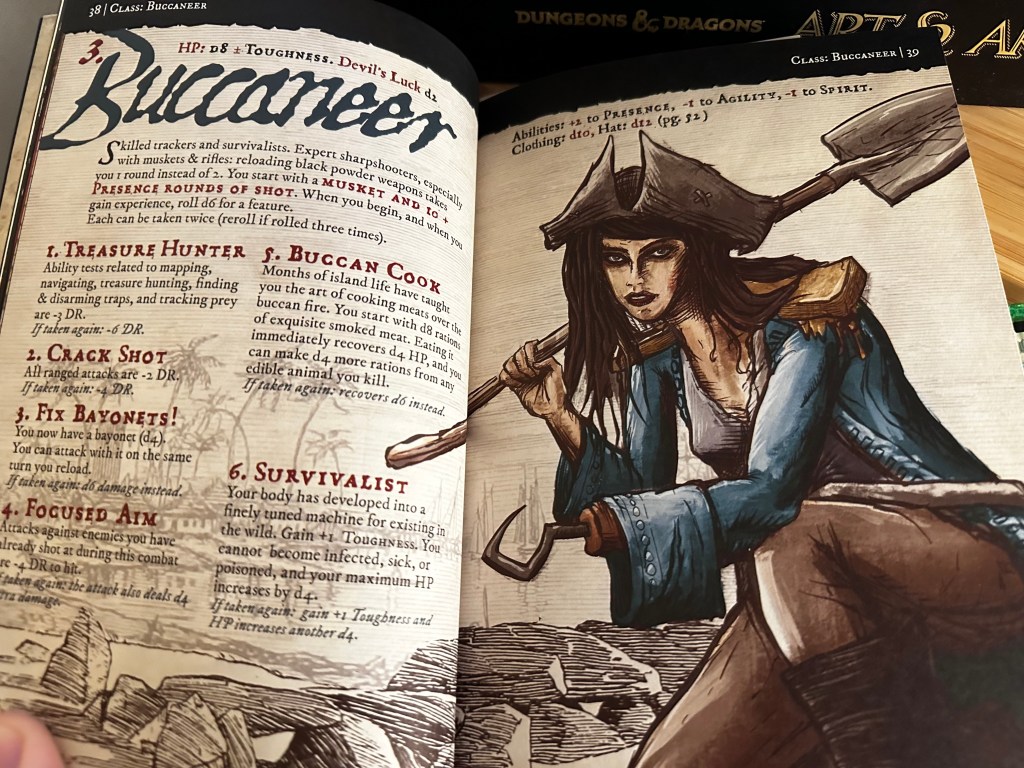
Skilled trackers and survivalists. Expert sharpshooters, especially with muskets and rifles

Buccaneers get a +2 to Presence, a -1 to Agility and a -1 to Spirit.
So that makes my Ability Scores:

  • Strength: -1
  • Agility: -2
  • Presence: +2
  • Toughness: -2
  • Spirit: -1
A photo of the two-page spread for the Buccaneer class in the Pirate Borg core book. The illustration on the second page shows a femme person wearing pirate gardb, including a tricorm hat. They have a hook instrad of a left hand and have a spade slung over the right shoulder.

For a Buccaneer, reloading a black powder weapon only takes one round instead of the usual two. I guess the hope is that you are far enough away from the bad guys that you have a round before they kill you or that they don’t have ranged weapons themselves.
I also start with a Musket and 10 + Presence rounds of shot. So that would be 12, then!

Random feature

I am going to now roll a d6 for my class feature. You do this when you first begin and then again each time you gain experience. Each feature can be taken twice, or so it says here in this book.

I rolled a 2! That is the feature, Crack Shot. That reduces the Difficulty Rating (DR) of all ranged attacks by 2. That’s pretty great actually. If taken again, the feature reduces that DR by another 2 points.

Random hit points

A Buccaneer gets to roll a d8 for hit points and add (or, in my case, subtract) my Toughness. Looks like d8 is the most common die for HP across the classes. I rolled a 7 so that leaves me with 5 HP. I am pleasantly surprised!

Random clothing and hat!

Now we’re on to the really important shit.
Buccaneers get to roll a d10 on the clothing table. The options range from Tier 0 rags to Tier 3 conquistador plate!

I rolled a frigging 10!! That’s the conquistador plate! -d6 damage. But it does add 4 to the DR for all agility tests and 2 to all defence test DRs. Also, the text goes out of its way to tell you you’re going to drown if you end up in the water…

Now for Hat! Have to roll a d12 for this.
You can get anything from “none” to “morion” on a d12.
I got a 6, bandanna, which I find acceptably piratical.

Random… Luck

A photo of the Devil's Luck page of the Pirate Borg core book. It shows an upsidedown five-pointed star with text describing the ways you can use a PC's Devil's Luck points in each of the five points and a pirate's skull in the middle. You can tell it belongs to a pirate because of the eyepatch over the left eye.
A photo of the Devil’s Luck page of the Pirate Borg core book. It shows an upsidedown five-pointed star with text describing the ways you can use a PC’s Devil’s Luck points in each of the five points and a pirate’s skull in the middle. You can tell it belongs to a pirate because of the eyepatch over the left eye.

Devil’s Luck is a resource that your character can use in Pirate Borg for the purposes of dealing max damage with an attack, lowering the damage done to you by d6, rerolling any die, neutralising a crit/fumble or lowering a test’s DR by 4. So it works like Omens in Mõrk Borg, basically.

Your class determines what you roll for your starting Devil’s Luck. The Buccaneer gets d2. For my purposes, I plucked the first die out of my dice bag and it turned out to be a glittery, turquoise d6. I rolled a 6! So that means I get 2 Devil’s Luck. Not too shabby, but not too great really, eh?

Random background

The next thing the step by step guide says to do is roll on the tables on pages 55 to 61. The first of those is a d100 table of backgrounds. These are more than just back story. They also determine your starting money and provide you with something significant like items, important NPCs and motivations.

I rolled a 97! That gives my pirate the “victim” background. That’s broad but might give me a spark for my actual backstory. It also gives me 2d6 x10 silver pieces and a haunted past (obvs.)

I rolled a 7 on my 2d6 so that’s 70 silver to begin. Along with the 200 I am likely to get for the conquistador armour, this buccaneer will be laughing all the way to the X.

Random flaw

Page 56 has the Distinctive Flaws table. It’s a d20 table of generally one-word personality traits. Some of these are only subjectively to be considered flaws in my opinion. I rolled a 9 and got “aggressive.” I would imagine that that is considered a good trait for a pirate in many situations. I’ll take it!

Equally, “2. Stubborn,” “6. Coward,” and “17. Paranoid” might all be considered beneficial to people in the pirating business at least some of the time.

Random trademark

I am rolling here for a Physical Trademark, rather than some sort of copyright or patent type deal. That would be a weird thing to include in the character creation section of a pirate game.

Another d20, here we go!
I rolled a 5… shit, I’m missing a hand; hook or claw instead. I’m thinking claw? Might be easier to handle my gun that way. Importantly, there is nothing in here about this causing any sort of mechanical drawback to your character, which I like.

Random idiosyncrasy

The full title of the table on page 58 is:

Idiosyncrasies one might have developed and will certainly never be rid of…Yet that certainly won’t stop you from trying.

It’s another d20 table. I have been using a different die for every single roll and I don’t see a reason to stop that now. It has been serving me semi-well thus far after all.
That’s a 12. Now this result might very well feed into the victim background I rolled up earlier:

You wronged and infamous pirate lord

I am beginning to think that the two are connected. My Buccaneer’s cat, Milly, tore out the throat of Captain Tall John Copper’s parrot, Butch. Milly jumped from the gunwale and swiped the emaciated bird off the shoulder of the famously bad-tempered pirate captain who had had men flayed alive and keel-hauled for less. As some sort of poetic justice, he made my pirate cook and eat poor Milly while the whole crew looked on, and then he chopped my hand off.

Random incidents

A photo of the Unfortunate Incidents & Conditions table from the Pirate Borg core book.  It includes a black and white illustration of an overloaded lifeboat on rough seas surrounded by debris and a d20 table beneath that.
A photo of the Unfortunate Incidents & Conditions table from the Pirate Borg core book. It includes a black and white illustration of an overloaded lifeboat on rough seas surrounded by debris and a d20 table beneath that.

This one has an incredibly long full title as well:

Unfortunate incidents & conditions having occurred or developed with or without one’s express consent, desire knowledge or general understanding

Guess what! It’s another d20 table. I rolled a 9 on this table. The result is unfortunate:

Your last crew was killed by undead. They left you alive on purpose

Shit. I hope my new crew doesn’t learn of this…
I am thinking that I made a deal with a necromancer to send his vitality-challenged minions to do in Captain Tall John Copper but they got a bit enthusiastic and did the whole ship instead, leaving me to take a dinghy (call back to the first roll of the character creation process!) to the nearest port and find some new gainful employment.

Random things

The last table in the list stretches right across from page 60 to page 61. It is entitled “Thing of Importance.” It is another d100 table.

I rolled a 79:

A long scar on your face

I think it is only fair that Milly gave me that just before I popped her in the stock pot.

Random name

There is only one thing left to do as part of this process, and that is the all important name. Now there is a table for names on the inside cover of the book so I think I will use that. It is a d12 table with three columns. I shall roll a d12 3 times and combine the names as I see fit:

Roll the first: 7 – Sam(uel) or Butch(er) or Philip
Roll the second: 3 – Robert(s) or Jack or Fernando
Roll the third: 11 – Genny or Isabel(la) or Jean

I imagine the name Butcher came from the Milly incident. It should go in the middle. So, it’s Isabella “Butcher” Fernando. That’s a bloody good pirate name if I do say so myself.

Random conclusion

Not really.
I thoroughly enjoyed the process of making his character. I am used, in more recent games of Mõrk Borg, to using their Skum Birther site to come up with a random character and that can be fun too, although I do think, when you are that far-removed from the process, you don’t have that strong an attachment to them. So, spending the time rolling up this pirate with you, dear reader, has been rewarding and has taught me quite a bit about the game as well. And that, after all, was the whole point of the exercise.

Have you played Pirate Borg, dear reader? Will you be celebrating Talk Like a Pirate Day this year? If so, what will you be doing for it?

The Apprentice, Chapter 3

This poor kid

I’m back today with another instalment of the Apprentice, the fantasy novel that I wrote a number of years ago. Our protagonist is in the throes of a difficult childhood, which he compares to the life of a cursed Count, surrounded by death and being the cause of the misfortunes of his loved ones. We all feel a bit like that sometimes, I think. It can seem like, no matter what we do, everything turns out badly, or that disaster follows in our wake. That is certainly how this poor kid sees things. Is he right?

Chapter 3: Greysteel and the Birds

We moved to the town of Pitch Springs when I was nine years old. I had a hand in the reason for that too. As I explained earlier, the farm where we lived in my youth was my whole world and it really was big enough to seem like that to a little boy. My world began to decay around the time of my eighth birthday.

When I arrived back to the farmyard after one of my daily chores, feeding the sheep in the western field, I came upon my father arguing hotly with a man I knew only as the Meat Man. He was the man who would normally pay my father for the sheep who were ready for slaughter. He came around several times during the season to pay my father for the sheep that had been driven to him. He was holding a bag of coins up to my father and my father was shaking his head. The Meat Man indicated one of the scrawny beasts which stared through the fence at them, chewing, chewing, chewing. Then he pointed to the yellow and brown pastures beyond the yard and proffered the bag again. My father’s gaze followed his pointing finger and then he looked up to heaven, closed his eyes and held out his hand to receive his meagre payment.

The Meat Man left that day and we did not see him again. The state of the farm declined further and further after that. The very grass died and the fields dried up and blew away. The animals had to be sold off piecemeal just to keep body and soul together. My father began to sell off the farm field by field in the end, until all we had left was our farmhouse and no form of income other than that brought in by my sister working for a local washerwoman. My world was falling apart and so was my father. A man weaker than he might have turned to gambling or drink but his belief in justice and the law was so absolute that he accepted the misfortunes that had befallen him since the death of his beloved wife and my murderous birth; he accepted it and found a way to support his family without his farm.

It emerged that there were many things that I did not know about my father’s past. It became clear that my father was not always the meek farmer and caring husband and parent the casual glance might mistake him for. It transpired that my father was a warrior of some skill and renown who had hacked, shot and strategised his way in and out of the worst battles of the War of the Twins long before I or even my sister was born. He had hidden this well. There was not a single weapon in our house used to fight anything more sinister than a fox or a bail of hay. There were no ornamental shields or plundered loot. He never once spoke of this former life to us. When he determined that he would return to soldiering after all these years and told us of his decision, I could not have been more gobsmacked if he had told me he intended to take a fish for a bride and honeymoon under the waves.

The last day of our lives as farmers was marked by a terrible event. My father had been transporting all our worldly possessions on a wagon to our newly purchased townhouse for the last three days. The final load was a large and precarious one containing a dresser, father’s rocking chair, several crates of crockery and metal goods, a saddle, four candlesticks and the kitchen sink. I was to sit atop it all the way to town, a great adventure which I had been eagerly anticipating. When I attempted to place my foot on a candlestick to heft myself up on top of the rocking chair which sat on the top of the load it shifted and caused the sink to fall off the back of the wagon. It took an hour to rearrange the contents of the wagon to a state of stability and father told me I could not sit on top. I was downcast and walked around the farmyard that was no longer ours, lightly kicking stones and fences and troughs. My father, noting my reaction, decided to make it up to me.

“Come up on Greysteel with me. We shall ride into town, father and son together on my stallion. You will be the tallest boy in Pitch Springs when you arrive. The other boys will never forget such an entrance.” My jaw dropped. My father had previously never even allowed me to touch his great grey mount. He was his prize possession. His compassion overcame his protectiveness, I suppose. I never felt more love for him than I did then. So, he reached down to me and hoisted me up onto the horse’s back, just in front of him on the saddle. I felt like a knight atop his proud steed. I remember looking back and up at my father, grinning as though I had just found my sister’s stash of boiled sweets. My father looked on, head held high. Even after everything, he never lost his sense of pride in himself and his family. I don’t think he ever did, at least not until the very end.

Now Greysteel was a well trained beast. He had trotted and galloped through everything from summer breezes to a tornado once. He never lost his nerve. I had never seen it happen and my father described him as the least skittish horse he had ever had. So why did he rear up on the road to Pitch Springs? What caused him to lose his fabled nerve? Me…it was always me. The old curse. The life of death. The Dead Count wandering the halls of his dead castle could tell you how that felt, feeling that everything bad that happened was his own fault.

Here is what happened. The day was fair and warm despite it being autumn now. We had left farmland behind and trotted steadily along the forest road, the last leg of the trip to Pitch Springs. My backside was sore from the saddle and I could not feel my thighs but I did not even consider complaining when my father had done me such a great service. So, to distract myself from the pain I started to whistle. It was a tuneless sort of whistle but melodic enough. I have always had a certain flair for music and even have a rather fetching tenor singing voice that some have admired. “Listen,” my father said as he stopped Greysteel under a darkening canopy. I stopped my noise and listened to that of the forest. A bird was mimicking my amateurish whistle, note for note. I started again when the bird’s call stopped. Once again the bird made an exact copy of my tune and another one took it up afterwards and another and another. It was quite the most wonderful thing I had ever heard. I began to whistle again when my father clamped a callused hand over my mouth. It smelled of leather and oil. That is how I always remember my father smelling even now. “Quiet,” he whispered. “That is the call of the razor-beaked minah. They are in numbers in these trees and you have woken them.”

Of course I had heard stories of this bird. One of the genuinely frightening stories that my father told us at the fireside was about the razor-beaked minah and how they would lure unsuspecting wood-walkers off the path by imitating human sounds and even speech. Once they were good and lost, the flock would attack. They were as large as a house-cat but much more ferocious and they hid in the all-year cover of evergreens until they swooped down to slice their prey to bloody gobs before feasting on the flesh, even as the victims still breathed. It was their common strategy to slice the tendons and peck out the eyes of their dinner to prevent escape. I had never even considered the possibility that the stories could be true and yet here we were faced by that very mythical beast.

“Just be quiet, now, son. They have failed to fool us but when they realise that we are on to them they may try to attack…if they are hungry enough.” He removed his hand from my mouth and I actually slapped my own over my face to stop a single sound from escaping. Tears streamed from my eyes in grief and terror, so certain was I that we were done for. My father felt me convulse as I tried to suppress the sobs. “We are not dead yet, lad. Greysteel here will spirit us away from this trouble faster than you can say “lickety-split.”” He was almost right.
He drove his heels into the stallion’s sides and Greysteel threw himself down the forest path and us, of course, with him. On and on we went, faster and ever faster. Greysteel’s acceleration seemed impossible as did the length of this minah bedevilled forest road. They whistled away, taunting me, I felt, with the childishness of my own inane whistle and then they attacked! They dove and swooped and plummeted in some cases, straight down from the forest. But they were all too slow for my father’s great beast. Greysteel was just about to beat them and emerge into dazzling sunlight when a razorbeak passed right beneath him. It took the little toe from my own left foot but more seriously, it took the tendons from the backs of Greysteel’s front legs. The horse reared up in an effort to stay upright but he had had it. My father tried to hang on but the weight of the two of us forced us off the stallion’s back. I watched the horse fall, ever so slowly, it seemed. maybe it was just in comparison to the impossibly swift escape run he had just attempted. His head hit the muddy ground with a heart-breaking thud and it was followed by the rest of his body. in seconds, the minah birds had swarmed all over my father’s prize stallion and consumed him.

Greysteel’s transformation from steed to meal provided us the distraction we required to escape. My father lifted me as though I were a rag, threw me over his shoulder and ran as fast as though he were unburdened by his treacherous son. When we stopped running, we were not far from the town. It was dark but the road was torchlit. He had let me down to make my own hobbling way. He said nothing but I looked at his face and saw the tracks in the dirt caking it, from his eyes to his clean-shaven jaw.

On Kickstarter

Kicking things off

I mean that’s what it was all about, yeah? Just, like, getting things started? Kickstarter might have changed its policies enough that more and more creators are jumping ship to Backerkit but it doesn’t change the impact it has had on the RPG scene (as well as many other indie scenes.) Many, many projects would not have existed without Kickstarter connecting their instigators with people who wanted them to instigate. I think we can all be grateful for that.

Swedish Machines

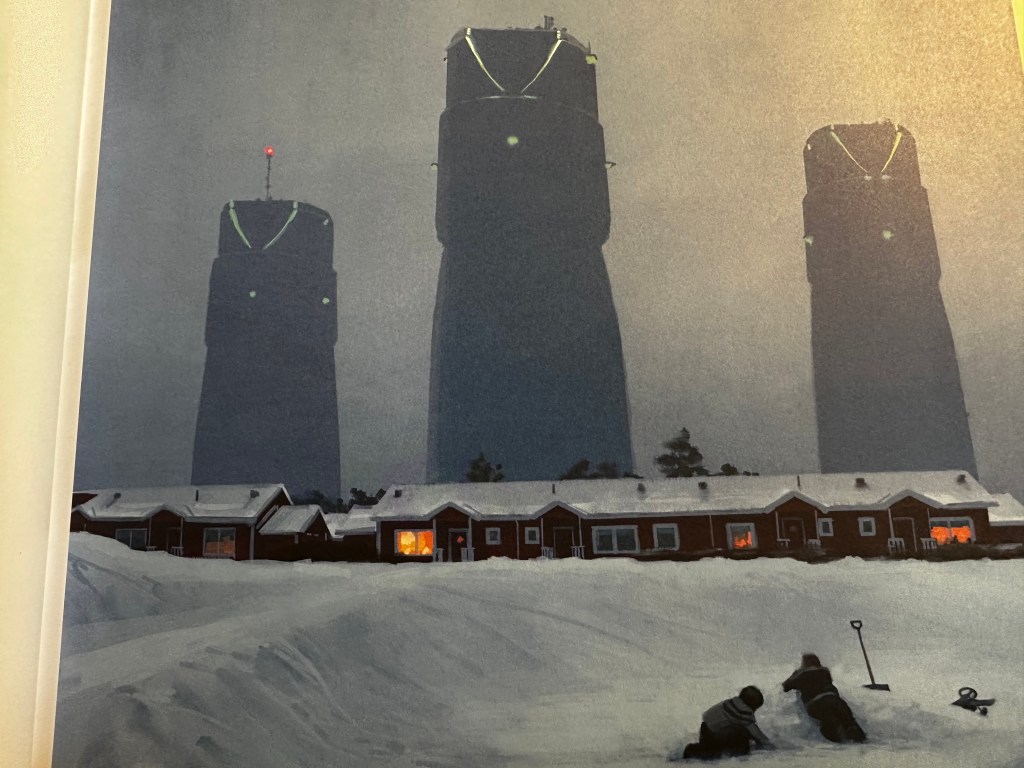
This is not the first Free League product that I have backed on Kickstarter and it probably won’t be the last. Right now, I’m waiting for the Replicant Rebellion Blade Runner boxed set and, another Simon Stålenhag project, the Electric State Roleplaying Game, for which I am rather excited.

But Swedish Machines is not an RPG book at all. In fact, if it is anything like the Tales from the Loop art book I received as a Christmas gift a few years ago, it is going to be a loose narrative related to the artworks presented in it. Together, in Tales from the Loop, at least, the art and the text tell the story of this strange, alternate 1980s where technology developed in a very different way than in the real world. That fact leads to some fascinating and terrifying occurrences that appear in a kind if vignette consisting of art and short fictional pieces.

I have every reason to believe that’s exactly what it will be. And I can’t wait to see what his mind has come up with this time.

Here is a short extract from the Kickstarter page to give us an idea:

Stålenhag’s most personal work yet, Swedish Machines explores masculinity, friendship, and sexuality in a queer science fiction tale about two young men stuck in the past – and in each other’s orbit. Their story spans decades, as fleeting moments become defining memories, and they set out to explore a mysterious forbidden zone together.

Set in his native Sweden and based in an alternate version of Mälaröarna outside of Stockholm, the place where he grew up, and still lives to this day, Swedish Machines juxtaposes giant futuristic machines and vehicles against the inner turmoil of the characters facing a social dystopia.

It makes me think Tales from the Loop and his other books must be related to this one. The setting, Mälaröarna, is also the setting for the Tales from the Loop RPG if you set your game in Sweden, rather than Nevada (the other option from the core book.) And, as well as that, the existence of giant futuristic machines makes it sound like this is in the same universe. I think it’s also really exciting that the book is focusing on this queer couple and their story. I have not read all of his books, but, certainly, Tales from the Loop had a much more ensemble tinge to its cast of characters.

And let’s just focus on the art for a moment. I don’t have the vocabulary to fully do it justice but I love how Stålenhag goes for realistic depictions of the world at a very specific time and in a very specific place but inserts the impossible into them. These impossible things, like the huge cooling towers with blinking lights in Tales from the Loop, or the giant cat mascot collapsing an overpass in Electric State are ignored or, at the very most, treated as mundane, by the characters in it. And the characters? Almost all have their backs to you, encouraging you to see the world through their eyes or to take their place in it. It’s great.

I believe that, once again, I am just a day too late posting this as the Kickstarter campaign finished up on September 5th. Still, it’s worth keeping an eye out for and picking up a copy when it is released more generally.

Kal-Arath

Slaps the roof of Kal-Arath This baby’s got everything your average OSR gamer could ever want or need. You want to drive Kal-Arath solo? No problemo. You want a co-driver, just you and them out on the open hexes? Kal-Arath’s got you. You want to take a group of four or five passengers out on a road-trip to who-knows-where with no preparation and hankering for some adventure on the highway of fantasy? DONE!

I became aware of Kal-Arath as a project by following Castle Grief on Instagram. And it is one of the projects I am most excited to receive. It has a wonderfully indie, hand-made quality to it and it’s telling us it’s going to do a lot of the work for us at the table:

Oracles, Starting Adventure Seeds, Points of Interest, Encounters, Settlements, NPCs, Dungeons, Items – all of these have their own tables for generation, and combined together create a setting flavorful setting that emerges from the tables themselves

That was actually an extract from the Castle Grief itch page, which you should also go and check out, dear reader!

The rules are purportedly a combo of elements from a number of other games. It uses 2d6 and employs at least some aspects from two games I have played before, Mörk Borg and Black Sword Hack. I am a big fan of both of these OSR games and really enjoy a 2d6 system in general. I know the actual dice you chuck don’t really make that much difference at the table, but 2d6 just feels good. OK?

Also, it’s got a lot of gnarly hand-drawn art too. It fits the idea of this game so well. I love it.

Anyway, Kal-Arath is definitely still live so go back it!

And, if you’re interested in Simon Ståhlenhag’s art, you should still be able to pick up a copy of Tales from the Loop.

The Apprentice, Chapter 2

A break from out regular programming

I know I said that I would get into some detail on each of the projects I’m backing right now and I will! I promise! For now, if you are interested in that, go check out this post here.

But can I tempt you to hang around here and enjoy a tale of the macabre? This is chapter 2 of the Apprentice. If you want to get caught up, this is the post you’re looking for. But, honestly, you could probably read this one as a short story and never know it was part of a wider story.

It’s quite a bit longer than most of my posts so go get yourself a nice cuppa and take it easy for a little while, why don’t you. So, here it is,

Chapter 2: The Tale of the Dead Count

An old count once lived in a far away land. People called this land “the Land of Gold” it was so rich. Count Ravetzi had an enormous castle on the top of a steep hill overlooking the town of Hopefield. The commoners all loved the Count, the Countess and their two brave and handsome sons, Bors and Lors (I always thought these were the worst made-up names I had ever heard in any of my father’s stories. He always just winked at me and said, “That’s how you know it’s true! Who would make up such ridiculous names?”) The noble family often gave to the poor of the village, the two sons brought glory to the town and the province in tourneys from Arabella to Zoarfrost, the Countess sponsored the education of many of the town’s second-born sons in the Great University of Spirehall, and the Count; Count Ravetzi was the most extraordinary of all; it is said he had healing hands. Stories abounded; Count Ravetzi had cured Old Nan Mercer of the pox, the warts fell off the hands of Fat Harolt when he touched them, he made Grandpa Gorenson see again, and a leper that lived in the ravine had his curse lifted after the Count paid him a visit. Hopefielders called him The Marvellous Count Ravetzi.

Now, as I’ve explained, this land was incredibly rich. Even the beggars on the streets used bowls of gold, it was rumoured. It had been able to remain rich because it was in a fertile valley bordered on three sides by steep mountains of great stature stretching all the way to the sea, a sea of such renowned ferocity and danger that not even the finest navigators of the age would dare to attempt a landing at the small harbour there with anything larger than a row-boat. In other words they were secure against invaders, sheltered from extreme weather and just generally safe from harm.

One day the brothers, Bors and Lors (laughable monikers!) went to the southern end of the valley near the mouth of the great River Arga which had carved it. There was an ancient forest there, famous for the size of its wild boar. The birthday of their father approached and it was always celebrated with the finest boar of the season roasted on a spit in the courtyard of the Count’s great castle. They would once again prove their skills as the greatest hunters in the Land of Gold and bag the boar for the spit.

Stalking their prey for three days and nights was not too much for them and they were rewarded finally with the sight of the most enormous boar either of them had ever encountered. The beast’s tusks were as long as Bors’ arm from wrist to shoulder and its bristles could have been used as daggers. They circled the beast as it drank from the shallows of the river and they were about to spear it when a volley of shafts streaked from the trees hanging over the riverbank, felling the beast and dashing the hopes of the brothers. When a shout came from the leader of the bowmen in the trees to drop their weapons and surrender, Lors and Bors, brave and mighty warriors though they were, had no choice but to comply.

Back in the castle, the Count and Countess knew nothing of the events in the forest and when the Count’s birthday arrived they had no doubt that their two sons would make it back in time with a prize beast for the feast. All preparations were made by the castle’s servants and the Countess herself oversaw them. Bunting was hung, banners were flown, helmets and trumpets were polished and a magnificent cake, seven tiers high was brought up from Hopefield’s proud master baker’s shop.

Everything was in readiness when Lors led his retinue through the gates and entered the courtyard. He was scarlet-faced and he did not cheer as he entered and he did not perform a lap of victory around the courtyard as was he was wont to do after a successful hunt. Most importantly, however, he was not accompanied by his brother.

“Where is Bors, where is your brother?” called the Countess. “He will be along shortly, Mother. You will see him soon.” Seemingly, the Count and Countess accepted this vague explanation and left the remaining preparations, those of the spit-roast, to Lors and his retinue.

Now, when my father told me the Tale of the Dead Count I was only seven years old and even I knew the fate that lay in store for poor old Bors. Must I actually relate it to you? I suppose I must.

That evening, all of the land’s worthies were gathered at the castle and many of the not-so-worthies as well. The Count’s generosity was well known and he displayed it particularly on the feast of his birthday. He would grant a boon to all who came to his feast. As a result, many folk who had not even received an invitation turned up at the castle or, if they did not manage to gain entry by bluff or stealth, waited outside the gates on the off-chance the Count or Countess would take pity on them and invite them in.

The boons granted by Count Ravetzi ranged from prize livestock to tales of wonder but, although there were no formal rules surrounding the requesting of boons it was simply not done to request money. No-one ever had, of course, so it was not certain that he would not grant it. The unspoken rule existed all the same and it never had to be tested as everyone in the Land of Gold was, as has been made abundantly clear, perfectly well off.

The final touches had been made to the courtyard and gardens where the party was to take place. All of the guests mingled freely in the courtyard, dressed in their very finest finery. They enjoyed the valley’s cherriest red wine, which had been perfected over centuries by the growers of the northern slopes; they nibbled on the fruit of the southern forests and cheese of the lowlands where they bred the most fertile and productive cattle in the known world. And everything was served on glittering gilt platters and from gem-studded goblets delicately crafted by the Land’s most famous artisans, whose skills were sought after from the frozen wastes of the North to the sizzling deserts in the South. The Land of Gold and all its riches were on display in that courtyard and dinner had not even been served.

The Count and his lady wife greeted their guests at the summit of the steps leading into the keep, he dressed in a specially tailored suit of azure silk and gold trim, and she in a shimmering golden gown and a stole of mountaintop-mink.

When they had greeted everyone and surveyed the party, again they asked Lors, “Where is your brother? Where is Bors?” Lors, eyes downcast and feet shifting answered, “You will see him at dinner.” Once again the noble couple simply accepted the answer and called for the feast to move to the garden for dinner.

The entire three hundred strong party followed their hosts around the keep to the torch-lit gardens and were seated at the feast-tables which were already groaning under the strain.

They had all followed the Count and Countess but they might as easily have followed their noses. The spit-roast had obviously been glazed in honey and spiced and the aroma hooked the hungry guests like prize-trout on the end of a line. The roasting pit itself was hidden behind a painted caravan, awaiting the serving-time when it would be revealed in all its glory. Once all guests had settled and all goblets were refilled the Count tapped his glass and rose to give his speech:

“Tradition has made this land the richest and happiest in all of Mittern. Tradition has led us here today to celebrate as we do each year. You have asked your boons when we met earlier, as tradition dictates, and they shall be granted, from century-old tokay to impossible riddle, when our evening’s feasting comes to an end. I have been asked one boon this year, however, that I cannot grant as it is not wholly for me to do so. My loyal and learned peer, the Duke of Minia Prima, has proposed a joining of our two proud houses through the marriage of his enchanting and radiant daughter, Suskia, to my first-born son and heir, Bors.”

The party-goers grew giddy with excitement and wine and a round of raucous applause had to be settled by the Count, still standing, speech unfinished.

“I, personally, would not even afford the answer a second thought. If it were my decision alone I would reply wholeheartedly, ‘yes!’”

More applause was once again settled by the Count who continued, “My son, Bors, is his own man and I have always trusted his instincts and his decisions. Someday he will make a fine Count and I would have him choose his own Countess. What say you Bors?” he raised his voice now to the crowd, as his eyes roamed over it, in a vain attempt to pick out his son. “Lors! You said your brother would be here for dinner! Where is he now? He has an important decision to make.” The Count still suspected nothing, Lors replied, “I believe he is ready, Lord Father.” With that, the caravan driver whipped the horses into action revealing the spit roast behind it.

Of course it was no great boar, it was the Great Bors. Now, as I explained earlier, I had guessed at the fate of poor Bors as soon as I heard that young Lors had returned alone. By the time my father reached this moment in the story, I think the impact of the mental image of the young man, crackling and spinning and popping and browning, his own body-fat hissing into the flames below and his face caught in a dripping-candle rictus had been lessened somewhat. Nonetheless, I never felt quite the same about the smoky rich smell of roasting meat after hearing the tale for the first time.

The Count’s face turned immediately ashen and then, quickly, began to redden. The Countess collapsed into a dead faint when, eventually, she realised the true nature of the spit-roast. Guests stood and shed napkins and goblets as they stared in horrified fascination at the roasted young man spinning, slowly spinning as he was turned by a man of Lors’ retinue.

“What are you playing at, man! Don’t you realise what you’re doing?” cried one of the stupider young nobles to the cook.
“Of course I knows what I’m doin’ Your Graciousness. If I don’t keep turnin’ this ‘ere spit, ol’ Bors ‘ere, ‘e won’t get done even-like on all sides,” a wretched human being, to be sure, but a dedicated cook I think you’ll agree. The stupid nobleman flung his goblet onto the lawn and grasped his sabre’s jewelled hilt. In a moment he sprouted four arrows, back, throat, belly and eye before collapsing to the lawn.

Panic gripped the assembled dignitaries and commoners alike. The ladies screamed and the gentlemen roared their indignation. The retinue emerged from behind hedge and wall and outhouse and took aim at the feasters with bows and crossbows. Of course, the retinue was made up of none other than the forest-ambushers, as you may have guessed.

“Great Count Ravetzi, Thank you for your hospitality on this, your birthday.” A crone emerged from behind Lors where, it seems, she had been lurking, unnoticed, the entire time. She was a shrunken, balding, ancient creature who was short one eyeball and all her teeth. She gripped a stick of willow in one hand, pointed at Lors. “Your youngest son, here, has been most accommodating. We came a long, long way from our homeland over the mountains and we were lost in the southern forest of your beautiful valley when we came across your two sons hunting. As I said, we had journeyed far and they welcomed us as kin. We camped together and supped together and I explained to them how we had heard of the fabulous wealth of the Land of Gold and the Count Ravetzi, it’s master. We had heard the stories so we decided to come and see it for ourselves.”
“We discovered a long forgotten mine which connects our barren, war-ravished land to your sun-blessed and lucky one. It was a difficult trek through the roots of the mountains and many of our number were lost to rockfalls and pale, saucer-eyed beasts but the sight of your verdant valley made all of our hardships seem worthwhile.”
“When we met your boys, why, they offered the hospitality of your own good house. They also explained that we could each ask a boon of you since we have arrived here on your birthday. Such generosity has been absent in the people on the other side of these mountains for generations, so we felt we had to come and witness it first hand. So! Here we are! Let me introduce myself, I am Valenna Gretzi and I am the mother of these boys…and their sorceress.” With that she tweaked her stick in the direction of the count’s remaining son who collapsed in a mess on the grass.

“What have you done to him?!” screamed Ravetzi, “My son! My son!”

“Your son! Your son! He yet lives but only as long as I decide to prolong his miserable, envious existence. I had to nudge him, but only ever such a little, to have him agree to our plans for Bors. He may have played the devoted brother and son very well but he was a jealous little bastard really. He wanted nothing more than to be the Count when you finally dropped dead but he also could never have done what his ambition required of him without my help. He did a fine job on Bors here, don’t you think? When I release him from my hold, he will, no doubt, suffer great remorse for his actions. It would not surprise me if he took his own life…”

“No!” The Count had dropped to his knees on the lawn in front of the witch. “Please do not take another son from me. Why? Why are you doing this? What have we done to you?”
This was, of course, typical of a blue-blood. They never really understand what drives the peasants and the commoners. Admittedly, the average tenant farmer does not go around cooking people and casting spells, but the principle is the same. This is neither here nor there, of course. What is important is her answer.

“What did you do? Well you woke up this morning in a magnificent castle beside your beautiful wife, threw back your satin sheets and pulled back your heavy curtains to reveal these well manicured gardens, My Lord. You sat down for a breakfast of quail’s eggs and pastries with fruit juice all prepared by your servants. You wore that ridiculous outfit because you can. You do all of these despicable things because you can, because you’re rich, because you have more gold under this castle than anyone could count in a lifetime. I hate you for that, my boys hate you for that just as much as I do and we want it. We want to take it away from you and leave you as broken and miserable as our lives are beyond those black mountains to the east. And we want to show all of these good people that we can do it whenever we want because we are willing to do what our ambitions require of us. That is why we are here. So, it is time to request my boon.”

“Boon…?” Ha!” Impossibly, the Count laughed, his voice cracked and his eyes bulged but he definitely laughed. “You want a boon from me after you forced my youngest son to murder and cook his own brother? You are mad?”

“What of your tradition?”

“Damn you.”

“You will be cursed. If you do not uphold the tradition of your family, you will fall under a curse so foul, you will wish you had granted me whatever I asked. You will live a life of death.”

“You have made me a life of death. How could it be worse? You are the curse upon my life, you foetid crone. I will grant you no boon. If you wish to take anything from me, you must take it by violence!”

With that the Count shouted for his guards and drew his sword. He leapt at the old witch and swung his gold-plated ceremonial sword in the direction of her wisp-haired head. It passed through a thick smoke pall instead. He lurched about, swinging wildly and roaring with wordless ferocity like a beast. His guests sat and stood where they had been, still surrounded by the Crone’s Boys.

And the Boys themselves? They laughed to see the great man torn down. Their laughter seemed to push Ravetzi over the edge of madness and he ran at the nearest bowman. He charged through a gaggle of jewel-laden ladies and flung them to the ground in his attempt to reach the guffawing intruder. He did not make it ten paces before the man’s colleagues made a quiver of him. Shafts emerging from his chest and stomach snapped with a terrible cracking as he fell, the only audible noise, it seemed to the assembled guests. He lay face down on the lawn for a moment, still but for his flowing blood. One last thing came to his ears before his heart stopped. “Your life of death, it didn’t last very long, eh, dearie? Never mind. You’ll have no more cares now. I’ve won and you have lost but I’ll take care of your beautiful home for you now you’re gone.”

Was this all for Count Ravetzi, do you think? Of course not, don’t be stupid. The tale, in case you are memory-deficient, is entitled “The Tale of the Dead Count.” We are approaching the end of the story but we have not seen the end of the Count. So I will continue and speed us to the finish lest you become weary of this.

The Count’s eyes cleared. It was as if a film had been lifted from them. It was not like awakening from sleep for he had not fallen asleep; he had died. He knew that. His heart no longer beat, his chest did not rise and it did not fall; it was still. His arms and legs felt as though they had fallen asleep, but once again, this was not the case; they were dead. He determined all of this in the few seconds since the clearing of his eyes but decided to try rising, despite having come to the conclusion that he was no longer amongst the living. It seemed to work though not as he remembered from his many days spent alive. He knew he was moving but he did not feel it. Looking about him he did feel something, however, and it was anger.

He surveyed the destruction that Valenna Gretzi and her Boys had wrought in the wake of his demise. His first-born son, Bors, spinning, spinning, like a pig on a spit; his younger son a broken heap lying on the ground, alive but dead to the world; all his guests were running now from the Boys who were using them for target practice; the ancient witch stood by the head table with the silken hair of the Countess grasped tightly in one gnarled talon and a shining steel dagger clutched in the other. He reached out his dead fingers towards his beloved wife and wheezed in a breath that he would need to make a shout. It was not loud when it came but it sounded like nails scraping on the inside of a coffin and the whispers of temple-mourners.

Everyone looked to him. A woman screamed, another arrow struck him, a dog howled and even Valenna Gretzi stared at the Late Count Ravetzi in horror. She struck anyway. A fountain bloomed from the throat of his love and before he could blink he was beside her. The Crone began to speak, “You were accursed. This is my-” She was cut short, however, by the lightest of touches from the Count’s hand on her face. She dropped dead, not before time, it might be argued. However, he had no time to celebrate the defeat of his enemy, the Countess lay dying at his feet. He was still a healer, was he not? He tried to heal her as he had Fat Harolt, Old Nan Mercer and Grandpa Gorenson, by laying on his hands.

The bleeding did stop almost immediately but when he took his hands away from the wound and examined his wife he could see that all else had stopped too, sight, breath, feeling, all gone. Grief gripped him and he screamed a coffin-nail scream clutching lamely at the stars. All those who heard it took to their heels. All those except his last remaining family, Lors, who had seen what his dead father had wrought on his mother and desired the same treatment. Lors was just shy of seventeen but the guilt he felt for the spit-roasting of his brother was enough for a lifetime. The young man threw himself into his father’s arms as the count knelt on the grass by his dead mother. When the Count looked down at his son, only a grey-faced corpse remained. As he looked into his son’s lifeless eyes. The Dead Count dropped the body beside his wife’s and walked to the castle, the screams of party guests and Mother’s Boys still filling the air around him, he closed the door of his home behind him and no-one has entered that place since that night.

So that was the Tale of the Dead Count. I related it for a reason. It was not that it was one of my favourite childhood stories, in fact I found it too predictable and full of holes. It was certainly not because my father claimed it was the story which turned his hair flour-white, I knew for a fact that that had occurred on the day of my birth and the day of my mother’s death. It was because I grew to know how the Dead Count fell at the end of the tale. I knew what it was like to be the death of people and want to hide away from the world. I will explain this eventually but first you will have to read of my years in the town of Pitch Springs.

On Backerkit

Sutlers

Some friends bought me Troika as a birthday present several years ago. It took me a long time to get around to reading it and even longer to get around to playing it. Honestly, this was nothing but a scheduling problem. I was intrigued and delighted by it from the start. The absurdity of the character backgrounds, the looseness of the setting, the unhinged art style, even the strangeness of the initiative rules; it just tickled me the same way a Monty Python sketch does.
In the intervening time I have been building a decent little collection of Troika books. The Melsonian Arts Council summer sale really helped with that. I have a number of PDFs that I picked up in various bundles over the years too. But I really love the quality of the physical books. They’re mostly hardback, they have beautiful art that is about as far as you can get from the polished style you get in 5e books, for instance, and they are not too pricey, normally. I recently picked up Whalgravaak’s Warehouse in physical form and, even though it isn’t hardback, the quality of the printing, the texture of the paper and the form factor are all so pleasing that I couldn’t fault it (except for the double-page spread maps that are much easier to see and use in the PDF version. Lucky I have both I suppose…)

Get it at Sutlers: A Troika Adventure Generator is the third project from the Melsonian Arts Council I have backed this year. The first two were Swyvers and Fungi of the Far Realms. Neither of these are Troika related. In fact, Swyvers is its own brand new game that I will get into in another post, while Fungi is system-agnostic. Anyway, I was excited to see a Troika product come out on Backerkit and very happy to back it. It seemed like I was not alone either; it funded in about twenty minutes!

The blurb they added to the Backerkit page for this one says a lot in a short sentence:

An enormous retail adventure generator for inclusion in sandbox campaigns within the city of Troika. Get a job! Meet the locals! Don’t die!

So, you’re going to play characters who work retail? Doesn’t sound fantastical or exciting. If you have ever worked retail, though, you’ll know there is a certain draw to the idea of being a shop assistant with access to lethal spells and weaponry.

Also, here’s the other thing: I know from experience that Troika scenarios can make the most mundane of situations into an adventure. I won’t give anything away but “The Blancmange and Thistle” from the Troika core book is an excellent example of that.

I’m also really intrigued by the description of this book. They call it an “adventure generator.” I’m expecting to see a boat-load of tables for the most ridiculous things. I’m hoping that it will allow you to create and run a Troika adventure sans-prep, on the fly. I would love that. Part of the description on the Backerkit page has this to say:

The book starts with a structured adventure to get the party hired and serving their first day at work, and then it opens up into hundreds (!) of random encounters and micro adventures

So I’m rather hopeful. Can’t wait to get my mitts on this one.

SYMATYOV

Have you ever played one of those solo journaling RPGs? They are somewhat de reguer, don’t you know. It seems like every other ad I get on Instagram is for another solo journalling RPG. I never really imagined that this type of game might be so popular. After all, for many people, the singular attraction of RPGs is the social aspect, getting around a table (or at least a Zoom window) with your mates or even some strangers to act out situations that would, frankly, be absurdly dangerous or embarrassing in real life together. And for those moments when you want to immerse yourself in a different world all on your own, there are computer games. So, it was a long time before I tried one out. I believe the first one I played was actually The Treacherous Realm by friend of the blog, Isaac Wilcox. It uses the Wretched & Alone system to create an immersive and fascinating journey where you are being hunted through some labyrinthine fae realm. You will probably die but it will be fun getting to that point!

That opened the doors for me and so I tried out Thousand Year Old Vampire, by Tim Hutchings, which I had picked up in a Bundle of Holding and forgot about. I believe this caused a bit of a stir when it first came out. It was a hit amongst people who, otherwise, might not have played this sort of solo game and, I believe, was the game that opened the floodgates for all of those that have proliferated in the years since. That was only just in 2020 so, we’re not really talking that long. But man, have they proliferated.

Now, here’s the thing: Thousand Year Old Vampire is designed for essentially infinite re-playablity but I have only played it a couple of times. Once again, scheduling. It does take a while to play, although, I suppose you could set aside 15 minutes a day or something. I was left with a few main impressions:

  • the prompts you use to build your game and your vampire’s story are perfectly written to provide just enough detail to set your imagination aflame but not enough to seem as though it is rail-roading you in a particular direction
  • the mechanic where your vampire is forced to rid themself of memories due to their unwieldy long life is clever and leads to some fascinating outcomes
  • it’s a really great tool to get you writing if you are in a slump
  • I learned a lot about the Kingdom of Breifne that once existed where Counties Leitrim and Cavan in Ireland now lie along with some of their neighbouring counties. I did a lot of research about the area and the era and that was fun in and of itself
  • the design of the book is gorgeous and evocative. Go and check it out.

So You Met a Thousand Year Old Vampire is the sequel I don’t think anyone expected. But it certainly got plenty of attention. It’s at about five times its original goal at this point on Backerkit, so even if you don’t back it, it’s probably going to happen anyway. If you do want to get in on the ground floor, though, as they say, go back it anyway. Buy Tim Hutchings another fountain pen or cravat.

Here is an extract from the Backerkit page:

Congratulations, you’ve made a friend! A mysterious friend with a complicated past. That friend is a vampire and might be a thousand years old, but you probably don’t know that yet.

Interestingly, although the character you play in this game seems to be a pretty regular person, it seems as though a lot of the play will revolve around the creation of your vampire companion. Not so surprising, I suppose. If I had a vampire friend, they would probably be the most interesting thing about me too. So, I’ll be intrigued to see how this works and how it differs from its predecessor.

OGA

Ultra-Violet Grasslands is an absolute beaut of a book. It got two editions and it is full of incredible artwork and fantastical ideas all brought to you from the mind and pen of Luka Rejec. It’s also filled with tables and tables and tables that allow you to build a game at the table, as it were, using intriguing, fun and challenging results:

Encounters on the Steppe of the Line Nomads”

Vornish Birds (L0, stalking) with glass recording eyes and metal innards, otherwise indistinguishable from the regular kind.
Mind-burned megapede (L8 , alien) shaking the ground on its odd journey, corundum encrustations glittering on its massive segmented neural nodes

And there is so much more in it. I just picked those entries out at random. They’re just so unctuous!

Our Golden Age (OGA) : An Ultraviolet Grasslands RPG []equel is big. And the first book was already pretty big. This time they decided to bring us two books for good measure.
Here’s what they have to say about it on the Backerkit page:

Experience fantascience roleplaying at the end of time. Escape the end of history. The eternal civilization is perfect. So say the gods, the machines. Will you defy the endless circle of awakening and forgetting? Can you kick a hole through the sky?

I don’t really know what a “[]equel” is but it’s ok. Just take my money! They have already taken a lot of people’s money. As it stands they have raised $489,412 on Backerkit out of a $50,000 goal.

Anyone else backing these products? Are you maybe excited about any others right now?