
Preposition
This post is part of a blog bandwagon started on the Roll to Doubt blog.
Click on the link above to take in the blogpost that’s piloting this bandwagon. Wagon-jumpers abound. You can find a very nice read on the same topic and a handy list of related blogposts on the Among Cats and Books blog.
What’s clear from even a cursory glance at the other blogs is that no two people are prepping in precisely the same way, so advice and recommendations come with the notice that your way is probably the best way. The thing is, in my experience, you find your way only through trial and error. Here’s my effort to tell you about my trials and my errors.
Preponderance of prep
I used to spend hours and hours preparing my games when I was a kid. To be clear, I loved doing it. I would happily get lost in the world-building, the map-drawing, the character creation and the encounter balancing for hours when I should have been studying. I still often think that I gained more from the time I spent on RPG preparation than I did from learning off -by-heart lists of dates and events or theorems and proofs. But I digress.


My prep used to be pages upon pages of tightly packed hand-writing explaining the background of an adventure, the major NPCs involved, the probable goals of the PCs and far more history about the setting than the PCs would ever be able to interact with. I drew maps by hand as well, when I had to. I didn’t run a lot of published adventures but I did make liberal use of soucebooks. I would select the people, places and things I wanted from those books and elaboate on them wildly, writing more pages on how they would connect with our campaign and adding a lot of extra details.
I sometimes wish I had the time to do preparation like this these days. But, when I do find myself with the time, and I sit at the computer to start working on it, I find I would rather shortcut it. I’ve asked myself why this is on many occasions. I’m not sure I have the answer, or else there are several. It could be to do with the process of writing in a notebook and drawing by hand on grid-paper. I don’t want to prep like that these days because having all of my work backed up digitally is invaluable. Time is still a factor. Even when I feel like I have some extra time on a particular day, I can’t guarantee that I’ll continually have that as the campaign progresses. But I think the main difference for me now is the feeling I get from making the world, its people, the major events, the game, at the table with my players. When you are all on the same page, when everyone comes together to create something greater than I ever could on my own, that’s one of the real joys of this hobby.
So, I don’t really do that anymore.
Preplanned not prepared
It’s taken me a long time to make this change, though. Even looking back at the work I did in preparing for our current Spelljammer game, I had thousands of words written on setting, backgrounds, NPCs, over-arching plot etc. And I would write thousands of words of session preparation while going along too. What I have discovered during the last couple of years of trying to prepare this way, however, is that that sort of prep is close to unusable at the table. Even if I am the one who wrote that dense paragraph of text, I can’t find what I’m looking for in it in the couple of seconds I have to react to something at the table, or to answer a player’s question without delay to keep the flow of the game going. Now, it’s not always a waste of time, I will admit. Sometimes, the very act of writing something will help to embed it in my memory and imagination, so obviating the need to check it at all. But, then again, there is the other effect of writing something down. It has the effect of making something true.
Truth at the table should only come from play. The only real things in the game world are what the PCs experience. Everything else, even things the characters have learned or heard about, is pure conjecture. Until it’s not.
This doesn’t mean I don’t prepare anything of course. I make plans for events I would like to occur or NPCs I want the PCs to interact with. But in those cases, I will write down something about the event, just a few details about what happens, who might be involved, what effects it might have. Or I will give the NPC some quirks, desires, flaws and interesting characterisations to bring them to life. But I will keep them to be used when and where they seem to fit.
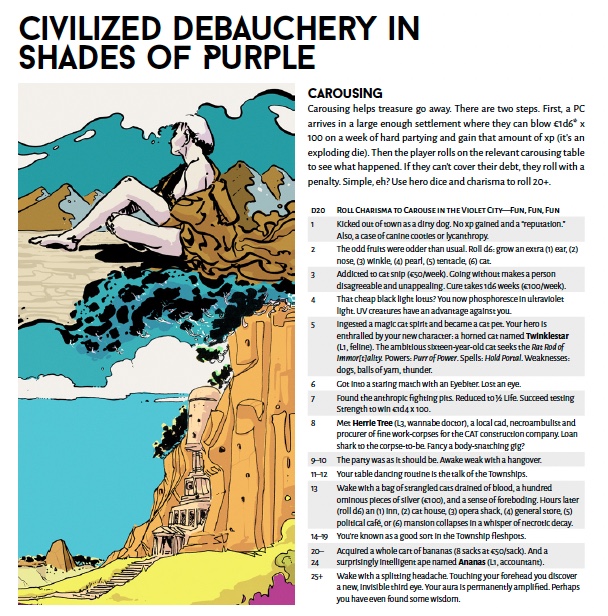
Otherwise, I revel in the joys of random tables. I use rumour tables and encounter tables quite judiciously these days. In a game like Ultraviolet Grasslands, I am spoiled with wonderful encounter tables, trade goods tables, carousing tables, and almost any other type of table I could desire. But when it comes to 5E, I am generally disdainful of the encounter tables provided. So I make my own. Made right and used right, these not only make for some interesting sessions, but also act to drive the game forward, introducing NPCs that become important to the plot, enemies that might defeat the PCs or might lead to vengeful associates pursuing them later. Importantly, I feel, they maintain an element of randomness and ensure that the players know their rolls have led them to the encounter, or not. It’s great if you can engineer it so that the players are rolling on random encounter tables at the end of a session. That allows you to take the result of their roll and make preparations for the specific encounter they rolled up for the next session. Usually, these days, I refer to Between the Skies for more tables and for inspiration to make the encounter really interesting.

Between the Skies does not limit encounters in space to just running into creatures, but also gives options for hazards the ship might run up against and problems that stem from the ship itself.
Here are the simple d6 and d4 tables I made to determine if the crew run into anything, and, if so, what it might be:
Wildspace encounter table d6
1-2 No encounter
3 Ship Hazard
4 Ship Problem
5-6 Encounter
3 Ship Hazards
Roll 1d4
- Hazard 1 – Storm, Flood
- Hazard 2 – Disorientation, Sphere
- Hazard 3 – Obstruction, Cold
- Hazard 4 – Trap, Haunting
4 Ship Problems
Roll 1d4
- Problem 1 – Armament, Separation
- Problem 2 – Quarters, Shrinkage
- Problem 3 – Cargo, Disappearance
- Problem 4 – Bridge (spelljammer helm), Error
5-6 Encounters
- Isolationists – Confusion, Related Entity – Unknown NPC, Glittering, Prayers
- Ship Parasite – Loss, Scales, Experiments
- Ruins, Ancient – Mourning, Related Entity – Petty God, Knots, Miscommunications
- Stowaway – Battle, Related Entity – Creature, Eggs, Blindspots
The descriptive words I listed beside each entry come from the spark tables in Between the Skies. These are invaluable resources that give you the inspiration to come up with truly unique situations, problems and obstructions. You should go and buy this book at the link above.


When I get the players to roll on these tables, I either make up the encounter/hazard/ship problem on the spot using the sparks of inspiration or I use the time between sessions to come up with something memorable.
A while ago, I realised the plot I came up with for the Spelljammer campaign was much less interesting to the players or their characters than the shenanigans that they got up to each session. They were more wrapped up in their own shit. And that was very cool. It made me want to make a sandbox for them to play around in instead of expecting them to interact with a plot they had little or no investment in. This goes back to the time I introduced a hex grid to the underside of the Rock of Bral. I did this to allow one of the PCs to drag the whole party with them to rescue their mother who was trapped in the prison down under. It did not serve the overall plot, really, but I had to have fun things for them to do while traversing this area so I made it a hex map and created some random encounter tables for each of the different types of terrain on the underside of the asteroid.
You know, it took me a long time to cop on to this though. The signs were all there. Dear reader, if your players never remember what is happening in the plot of your meticulously crafted campaign from one session to the next, you might be overloading them with plot. Maybe they just want to play their cool character and have fun moments between them and the other PCs and significant NPCs. Or maybe they are only interested in hitting things really hard. Or maybe all they have ever dreamed of is building their very own tower of necromancy built on the bones of their enemies. Or perhaps they just want to find their dad? Ever think of that? Maybe your plot is not that important to them. If you take nothing else away from this post, please take that.
I have drifted a little way away from the central theme of the post but I insist that, in actuality, you should be prepping for the sessions you want to have, and, more importantly, the sessions your players want to have.
Prepaid prep
Most of what I have been talking about is prep for D&D/OSR style games. Games that you can play as sandboxes without upsetting anyone. But, what, you might ask, dear reader, do I do to prepare for other types of RPGs?
I have some very specific examples here.
Free Leagues/Year Zero Engine Games
I have a few of these under my belt at this point. I can say that the type of prep I do for these is significantly different to what I have described above. The ones I can refer to are Tales from the Loop, Blade Runner and Alien. For me, the thing that holds these adventures together is the Countdown. This is something that’s rather integral to most Year Zero engine games. Below you can see the countdown from the Tales from the Loop adventure published in the core rule book, Summer Break and Killer Birds.

Once you get the timeline of events in place for one of these adventures everything can be positioned around it. Tales from the Loop adventures, in particular, I find, can be written with ease in the very specific format that Free League has presented to you in the book. They provide really valuable advice in all of their books for creating your own adventures. Blade Runner also provides lots of useful random tables to help you create your own case files for that game. When in comes to prep for this style of game, just make sure you know the countdown well, and you keep track of the shifts/days of activity for the PCs. After that, the published adventure or the one you have written in the provided format, will do the work for you. The rest is improv.
Resistance System, Spire/Heart
Resist the temptation to do anything other than read up on the specific areas the PCs are likely to interact with the next session and maybe jot down some NPC details/desires/stats. Resistance system games really thrive on improvising at the table and having the PCs drive the narrative forward with their actions and their fallouts. This is particularly true of Spire where most of the game occurs in NPC to PC interactions in my experience.
In Heart, I think it’s a good idea to have some idea of the landmarks your PCs might end up in. In the last game of Heart I GMed, I made it specifically Vermissian themed so that I knew they would be visiting a lot of Vermissian stations on the way down to Tier 4.
Prewritten trad scenarios

I am thinking of the Dragon Age game I’m running right now but I think this is advice you can apply to most adventures that are presented in dozens/hundreds of pages in long dense paragraphs. Read the full adventure, then, read it again, but this time, take all the relevant information from each room description, encounter text or whatever and transcribe it into something more easily digestible and more useful at the table. I use bullet points as that’s what I’m used to. I also usually take the more relevant enemy stats like Health, Defence and Armour Rating and note them too. This is me applying the lessons I learned from the mistakes I made as a kid and applying them to the published adventures written by professionals, I realise that. And maybe that’s presumptuous of me, but, hey, it works.
The second time you read it, you shouldn’t do it all at once. Just make those notes between sessions.
Conclusion
Prep can take many guises. It will be different for every GM. A lot of people use all sorts of apps and other technical solutions. All valid, but all I ever use is a wod processing app and a few dice. Whichever methods you use are probably going to be right for you, even if it takes you a while to figure out how you should do it.
 The Dice Pool