Forged in the Dungeon, Part 2

Engage!

This is an update on how my last session of Spelljammer went. More specifically how it went when implementing some mechanics I nicked, unapologetically from Blades in the Dark. If you don’t know what I’m updating you about, oh valued and discerning reader, go take a look at this post right here.

It was touch-and-go last night, to be honest. We only had about 2 hours to play and we were on course for the session to fully be a shopping episode. But, in the last 45 minutes or so, we managed to get into the new technique of using information gathering rolls and an engagement roll before interacting with the dungeon.

I think it worked pretty well, once we got into it. I briefly explained the concept and everyone was on board with it. So we went ahead and they started making up the ways they would use their specialties to help boost their chances with the engagement roll. One character described a trip to the pub to try and identify some locals who might know the way to this secret hideout they were looking for, one followed a potential gang member to the entrance, one questioned some dock workers they were helping out, one went to ask her sister for help and one staked out the most likely spots along the docks. They all used different skills and only one of them failed the information gathering roll. I set the Information gathering DC pretty low for this first time, a mere DC 10. I gave them +2 to the engagement roll for each success so they ended up with a +8 for a total of 18 on the engagement roll.

Now, I had prepared three maps on Roll20 and a bunch of potential encounters, both combat and social, traps and dangerous environments. I did not regret dumping two of those locations in favour of jumping straight to the dungeon entrance. Did the old dump and jump, as it were.

I narrated their discovery of and arrival at the building that hid the staircase to the hideout. I explained how the intelligence they had gotten in their information gathering phase had allowed them to figure out the best time to enter. I described the way they were warned to avoid dangers and possible traps on the stairs and then, satisfyingly, they got to the front door. And that’s where the action started.

Straight Dunjin’

I asked for some feedback on the technique at the end of the session and it was broadly positive. There was a definite consensus that, if we had simply role-played each of the scenes I described above with multiple rolls in each scene for stealth, deception, persuasion, etc, it would have taken hours and they would not have gotten anywhere near the entrance to the dungeon last night.

One player, Thomas, told me today that, because there tends to be a lot of “admin” in this campaign (ship stuff, money stuff, shopping stuff etc.) that it was refreshing to get to the action without a lot of rigmarole. I agreed that it felt good to use the precious time we have together (only 2 hours every fortnight) in as fun a way as possible. Last night, that involved sending them to an underground lair where they discovered a guy with the top of his head sawn off and a bunch of identical hobgoblins with gossamer threads attached to their necks. You know, good old fashioned fun!

We also talked about how they were able to retain a sense of having achieved this “easier” path to the entrance of Ozamata’s hideout. Since we went around the “table” and every character had input to how they wanted to help gather information and got to narrate and role-play within those short scenes, it felt earned more than given.

On the more measured side, I did get some feedback from Trevor that, although it worked well in that particular situation, it might be more difficult to apply in others. I have to agree with that assessment too. It is easy to apply this method when the PCs are aware of the exact job they have to do, when they have time to seek out information about it and to prepare in lots of different ways. It is not going to work so well when an encounter is meant to take them by surprise. Maybe that’s ok though. It’s not Blades in the Dark that we’re playing and it never will be. D&D isn’t supposed to feel like that. But that doesn’t mean that we can’t try to make it feel less like a grind and more narratively satisfying whenever possible.

I’m very well aware that, for most gamers who are used to the story-game play style, all I’m describing is maybe some half-arsed version of their regular RPG experience. Maybe it’s not even that. But I will say that, for me, it is fixing a distinct issue in a campaign that I very much want to continue playing but definitely want to speed up bit. I mean they have been playing the last day and a half on the Rock of Bral since last November… so, I want to move things along without making my players feel like I’m rushing them or demanding they do something they don’t want to. Hopefully, this technique will help to accomplish that.

Has anyone else tried something like this with any degree of success in D&D?

AD&D 2nd Edition

Masochism?

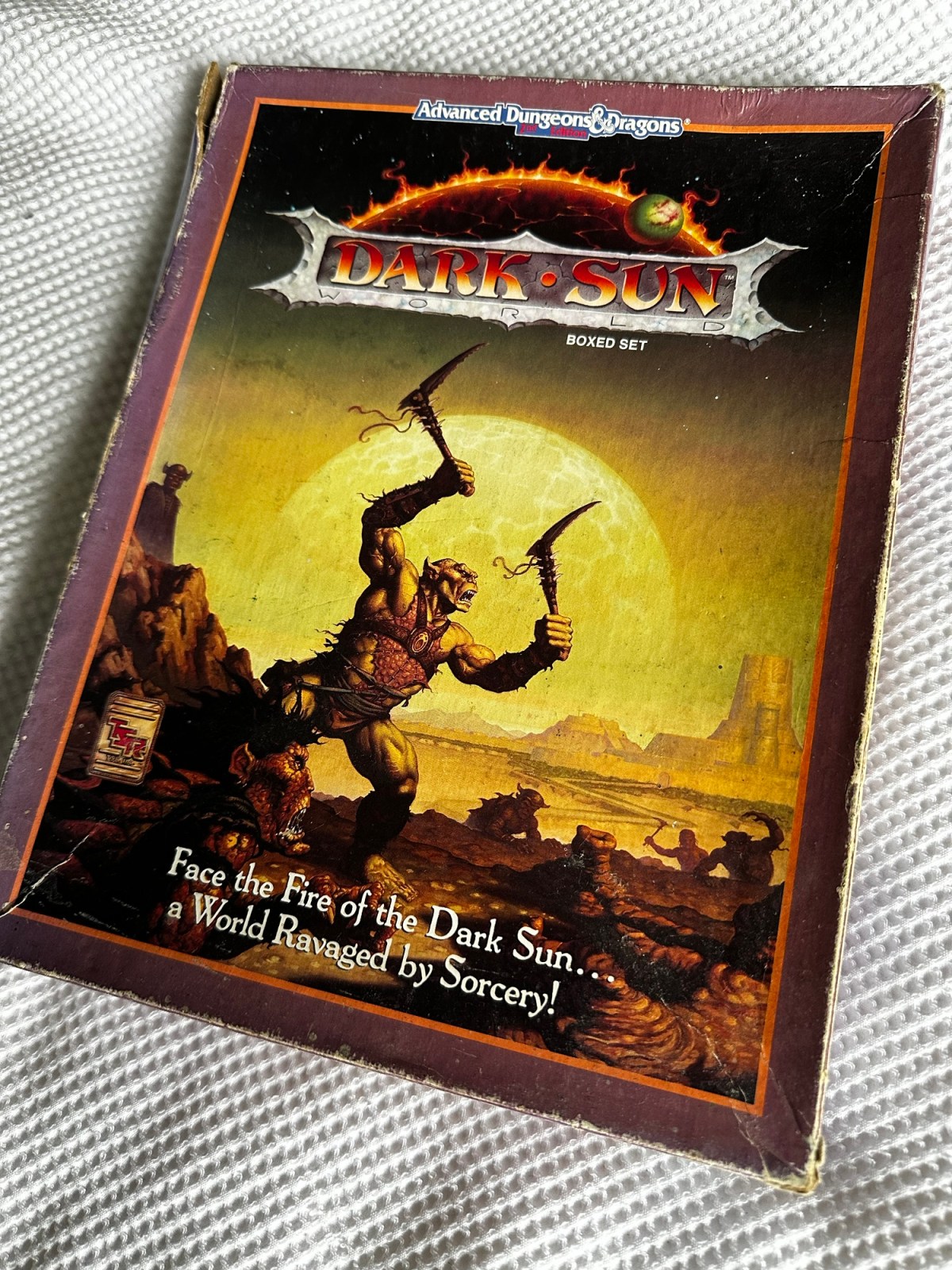
I have a hankering, beloved reader. I crave a little old school. Not revived or anything. No renaissance here. I’m talking, the original (at least for me.) I have been thinking about running an honest to goodness AD&D 2E campaign. That’s the system I cut my teeth on as a DM and I have a lot of the old books lying about on shelves, rarely picked up for any reason other than curiosity. I have a trio of my favourite settings from the old days, Planescape, Ravenloft and Dark Sun. But, is having them a good enough reason to want to run them? The rule set in 2E still involved THAC0, for crying out loud. Only certain races and certain alignments could play certain classes. Every rule seems over the top and over-worked when you look at them. So why? Why would I want to run it?

Nostalgia?

I ran the most successful campaign of my teenaged years in Dark Sun. I loved the setting. It was gritty and made life very difficult for your player characters. They had to start at 3rd level because a first level character wasn’t going to survive in the deserts of Athas too long. You were encouraged to create a “stable” of 5 characters and switch between them to level them all up, just because it was quite lethal. Most mages actively destroyed the land by casting spells and the Halflings were cannibals. It was fucking hardcore and we loved it. So, when I think about running AD&D again, I think I’m channeling the feelings from that time.

But I will admit there is also a sort of morbid curiosity to try it out. More as a historical research project than anything else. How would it compare to more modern systems like 5E or the Year Zero engine or even actual OSR systems?
And I think at least one of my players shares this sense of curiosity about this game and the legacy it spawned. He didn’t get to experience it so maybe it’s just his curiosity too. I mean, people really did love it, right? So, why?

Dark Sun

There is also another point, though. It might even be the main reason I want to do it. Dark Sun itself. WOTC have indicated in the past that they are never likely to revive Dark Sun as a setting for D&D. It just has too many slightly problematic elements. There is a lot about slavery in it. There’s a very strong theme of climate disaster and despotism and evil capitalists. I think it is generally safe to say that Wizards is not interested in picking up any political hot potatoes these days. They will keep it light and breezy whenever possible. So Dark Sun is never likely to come back. Now, I know that enterprising individuals have made some impressive 5E conversions of the setting and I have explored that option. But they don’t give me what the original did. I think Dark Sun benefits from the cruel and crunchy 2E system as much as it does from the grittiness of its world building. And I think that is the main reason I want to run it again.

Anyone out there running any old versions of D&D? If so, why?

Forged in the Dungeon

Engage

I mentioned in my post about my ongoing Spelljammer D&D 5E campaign that I get frustrated by the vast swathes of time demanded by the system, particularly for combat. It’s so involved and requires the application of so many sub-systems, the knowledge of so many specific abilities such as spells and feats that even a small scale fight can take up the guts of an average session. Player patience is tested during the parts they are not involved in and when it does come to their turn it can be difficult for them to know the current state of play because they have, quite understandably, tuned out. So then you have to rehash the last few turns before they take their go.

Some have suggested ways around this, such as removing the roll to hit or limiting the time a player can take on their turn. I understand the impetus to use these workarounds. But one option feels too much like it’s removing a core element of the gameplay and the other is going to end up with some players rushing and resentful and others just giving up on doing anything cool and instead just hitting the thing with their sword every time.
So, what’s the answer? Sorry, good reader, I don’t claim to have one. But here’s what I am going to try:

Blades in the Dark has a mechanic that allows the crew to make a single roll before they get into the action. This is known as the engagement roll and the level of success you achieve with this roll essentially determines how far into a score the action starts. So, in a D&D context, if you roll poorly, you might have to begin the dungeon before you even find the entrance: you’re wandering the wilderness, risking random encounters and suffering exhaustion in the freezing cold while you search, relentlessly for the right damn tree stump that the tunnel is hidden under. But if you roll well? Well, then you come prepared; you knew the weather was going to turn nasty so you dressed for it, you knew it was going to be a long way so you hired some dog sleds, you bought a map from a local trapper and you read a book about the dungeon that told you how to bypass the traps in the entrance hall. In the second case, you start your delve right in the meat of the dungeon, ready to face the fun puzzles and fights and escape with all the coin you can eat as a reward.
Each option sounds like it could be fun to play, to be honest, but option 2 gets the PCs closer to the goal with the least amount of danger, thereby saving time and, moving them towards that tasty dungeon meat I was talking about earlier.

Information is power

Now, another element of this mechanic is that, in Blades in the Dark, to add or remove dice to or from your engagement roll pool, you would take into account many in-world mechanical elements that simply do not apply to my D&D space-galleon game. But there is another mechanic from Blades that I think could work instead. Players could each make a “gather information” roll before the engagement roll. They could use any skill they like for this; arcana, history, religion, stealth, anything that makes sense in the fiction. And they could also use their spells and abilities to improve their chances with their chosen rolls. Success on these rolls could improve their chances of scoring high in the engagement roll.

Normally, in Blades in the Dark, successful information gathering attempts will inform the type of plan the crew comes up with, thereby potentially adding extra dice to the engagement roll pool. In D&D, I am considering my options, advantage or bonuses. Advantage is my preferred way of rewarding players for clever or ingenuous play, but if I offer a +1 or +2 bonus to the engagement roll for each successful gather information roll it means they can stack. I mean, I suppose I could just chuck out the PHB altogether and allow them to have multiple d20s for the engagement roll but, as I mentioned previously, I am not trying to mess with the core rules of the game, just add a little spice to them.

Hot dam

Now, this method could work really well in an instance like I described above where they plan to visit a dungeon and a lot of information and luck could help them to get there quickly and painlessly. But, if all I have planned is a big encounter that doesn’t really involve a lot of build-up or mystery or travel to get to it, I am not sure it helps at all. The problem with D&D combat is still present.

One method I have considered is increasing the damage output of an encounter while decreasing the enemies’ hit points. This would keep the essential rules of the system in play and the sense of danger and high stakes, without the fantastic outlay of time.

So, I am not finished with this idea by any means. If I get a chance, I am going to test out the engagement roll and gather information roll tomorrow night when we return to the Rock of Bral. But I suspect I will need to tweak it and workshop it before it works as well as I want it to.

Does anyone else do this sort of thing? Does anyone have any good ideas for speeding up D&D combat? Should I really try?

The GM Jukebox

Murder on the dance-floor

So, in Spire, we played using the Kings of Silver campaign frame. This introduced a whole set of complications not often part of the average role playing group’s set of problems. They were given the keys and managerial responsibility for The Manticore, a casino and entertainment venue in the city’s Silver Quarter. Imagine Las Vegas but with more elves and feuding nobles.

Unsurprisingly, the players took it and ran with it, often leaving the main plot somewhat neglected as a result. As luck would have it, one of them played an Idol, a sort of magical enchantress/pop star with the ability to start a party anytime, anywhere. So that got the crowds in. They started off by opening a night club with dripping red meat hanging from hooks in the ceiling and a death metal band playing. They called it the Hardicore. In a totally unhinged and tactically questionable turn of events, the PCs decided to murder a group of nobles, the Quinns, who were working for their rival, Mr. So. They did this in the middle of their very busy nightclub, on opening night. Now that’s what I call Hardicore. Anyway, one of the cool things about that scene was that I handed over control of the Bluetooth speaker to one of the players at our table. The Hardicore was Isaac’s brainchild, really, so it only felt appropriate that he should control the music choices, for that scene. He made choices I never would have and made it more personal to the players.

Later, when the Hardicore underwent a full renovation and reboot as the far more disco Mantiskate or Glamcore. I can’t remember which one they went with in the end to be honest. They replaced the meat hooks with glitter balls and the death metal and Desang (a type of violent opera popular in Spire) with disco and roller skating. This time, I handed over the control to Thomas and Heather to allow them to choose the disco tracks they wanted to use as a backdrop for the Idol to ensorcel the heads of the noble families into working together. I did take back the reins later so I could blast Kung-fu Fighting when the inevitable battle broke out, though.

Moments like these truly exemplify the value of having music at the table when you play RPGs. And I also think it should not always be in the control exclusively of the GM, if you have one.

Mood music

Of course, when we use music, it’s normal to use it to establish an atmosphere. There are few tools at our disposal more immediately effective than music, I often think.

I mentioned previously that I used a playlist of the Blade Runner soundtrack while playing that game on Roll20. The atmospheric work you can do at a table is exponentially more difficult when all your players are sitting in potentially brightly lit rooms filled with distractions, in my opinion. But I felt that the use of the music in the Roll20 jukebox drew us all into the same moments. Conveniently, the soundtrack included tracks meant precisely for several of the locations shared by both the movie and that Case File, so, if you know the movie, it can really transport you to the place. Even if you don’t know the movie, of course, I think that incredible score by Vangelis will establish the right mood for the game, a sort of retro-future noir.

But movie soundtracks have a problem, if you want to use them for atmosphere in your game. In general, you can’t simply play them through because the tracks are designed with specific scenes in mind. In all likelihood the scene you’re playing at the table isn’t going to correspond to the music all the time. While playing the music for Blade Runner, I found myself hopping from one track to another almost constantly, and, honestly, it’s a lot of work when, as a GM, I already have a lot on my plate.

Lists 3.1: playlists

The answer, of course, is to make playlists for certain types of scenes. Here’s a list of the types of scenes I am thinking of:

  • Battle
  • Chase
  • Dungeon
  • Downtime
  • Montage
  • Mystery
  • Travel
  • Wonder

In the last week or so, while I have been writing these blogposts, I have also been listening to albums and soundtracks on Apple Music. This allows me to stop writing and pick out a particular track that I feel suits one of these playlists, when it comes up. In the past, I have tried to make playlists like these by just thinking about particular songs that I think fit the genre of the game without paying any mind to the types of scenes and the different music you want for them. This never worked satisfactorily. I am finding this new method much more successful.

Thanks to the influence of Jason Cordova and the Companion Adventures section at the end of every episode of the Fear of a Black Dragon podcast many of the songs in the playlists are from synth-wave and dungeon-synth albums. Mostly, I have discovered that you can find tracks from these genres to suit almost any of the above. I have added a few tracks from video game soundtracks too but each has been hand-picked for a given playlist.

I’m sure I’ll also realise I need to build playlists for more scene types as I continue using this method. But, I’m quite enjoying it as an exercise and I think it proved very useful in last night’s session of Heart, in which I got use Wonder, Downtime, Battle and Dungeon.

Do you use music at your table? If so, what kinds and how do you use it? And if you are one of my players, what did you think of my new playlists?

Games I Have Played So Far this Year, Part 2

Lists part 2.2

You will notice a trend in this list. More than half of them are Open Hearth one-shot games. I just joined the community in January of this year and I thought the best way to ease my way into it would be to sign up for a short game or two. So I started with Alien Dark. Not long after that another member in a similar timezone started posting one-shots of a bunch of games I wanted to try out, and that accounts for almost all the other Open Hearth one-shots listed below. I wasn’t new to Mörk Borg, admittedly, but it is usually a gritty good time and it was at a time that suited me so I joined up. Honestly, sometimes, that’s all the impetus you need.

Games I have played in so far this year

  • Root – The Nightmare Before Winterfest – Concluded Campaign. Root is the PBTA RPG of the board game where you play anthropomorphic denizens of the forest, traveling from Clearing to Clearing getting into trouble, making friends and enemies of various factions and having prolonged Christmas episodes. Good friend and esteemed character-actor, Thomas GMed this “festive” campaign for our little Tables and Tales gaming crew. The quotes are only partially ironic. It did start around Christmas but then it kept going right through Easter and out the other side! Don’t get me wrong, I’m not complaining. This campaign was a laugh. I got to play a German badger named Beagan, known to one and all in the Clearing of Lindor. Beagan and his companions busted open the people-in-the-chocolate mystery, demolished the local police station, repelled the siege of Lindor’s famous Winterfest market from the branches of its festive tree and unmasked Ebenmeowser Scrooge as the ultimate villain of the piece. Good times.

  • Remembrance – Open Hearth one-shot. Remembrance is a GMless story game designed by a fellow Open Hearth member and this was a play-test of it. All the characters start off as members of the Irish Republican Army during the Irish War of Independence, brothers in arms and valued friends too. But, as those who know about Irish history of the early twentieth century will be able to tell you, the War of Independence was followed quickly by the Irish Civil War. This was fought between those forces who wanted to accept independence for all but the six counties in the North of Ireland and those who would only accept freedom for all thirty-two counties. The three act structure of this one-shot was split between the time of fraternity in the first act, the tragic split into two opposing camps in the second act and a sort of epilogue, or maybe denouement in the third. The story we constructed over the space of three hours is something I won’t soon forget and an experience that stuck with me as an Irish person and someone who lives in those six counties.

  • Mörk Borg – Rot Black Sludge – Open Hearth one-shot. Open Hearth community member, Dom ran this one. This was actually the second time I had played through this scenario. The second time went significantly better than the first, partly because of the very limited time-slot we had to play it in, I think. Rather than stupidly investigating every bloody thing that was definitely a trap of some kind, we pressed on looking for the ultimate goal, finding some kid or something. My character was Joachim the Devoted, a Dead God’s Prophet, who, paradoxically, was a nihilist who insisted on telling everyone he was a nihilist. He survived this scenario despite being largely useless!

  • Mothership – Sandalphon and the Sleeping Angels – Open Hearth one-shot. The second one-shot I was a part of that was run by Dom. This was my first taste of Mothership. In this scenario, you dock with an asteroid/space station and try to discover what is going on there. Spoiler: it gets fucked up and scary pretty fast. The Mothership system is mostly based on d100 rolls and, if you are familiar with Call of Cthulhu at all, you will know that that means you fail, a lot. This leads to horror in a good way of course, setting up scenes of panic and fear as you face the increasingly unsettling and gross realities of the setting. Somehow, my character Burt Connery, ever-suffering Teamster from New York City survived this one too!

  • Cohors Cthulhu – Rude Awakening – Open Hearth one-shot. The third and final one-shot that Dom ran in the list. Cohors Cthulhu is a game that imagines Cthulhu type mysteries and scenarios set in the Roman Empire. Out of all of the one-shots we played this year, I found that this one possibly suited the format the least. It is definitely interesting as a game and a setting but is more designed for campaign play I think. Each character was pre-generated but a little too complex to really get to grips with over the course of a single three hour session. That being said, I enjoyed the speed run we did of this scenario where my character, Herodion the Schemer narrowly avoided being ritually sacrificed to an old god and had fun with the other players. I’d be interested to try the game in a longer form.

  • The Quiet Year – one-shot. This is an unusual game to put on this list really. It is not an RPG to be honest but it is RPG-adjacent. It is a map-making game that uses cards and lists of prompts to allow a group of players to design a settlement that is recovering from some sort of apocalypse or disaster. You have one year to do it and the game is split into four periods represented by the seasons represented by the suits in a pack of regular old playing cards. It was so interesting that each of the players around our table started to embody certain sections of the fledgeling community that had often conflicting priorities and ideas about how to build it. I enjoyed this as an exercise in understanding the difficulties in being one part of a community that is, ostensibly, working towards common goals where other factions have very different plans to you. It has conflict built in to it due to requirements for always having some level of scarcity of necessary resources and this can lead to some, surprisingly fraught interactions above the table. I have heard of a lot of people using this game to create the starting state of a setting for a new RPG and I love that idea.

So, that’s it for my list of games played so far this year. I am looking forward to adding a few more to this list in the coming months. I’ll probably do a post about that in fact. How about you? What games have you played/enjoyed this year?

Games I Have Played So Far this Year, Part 1

Lists part 2.1

Also not a top ten, not by any means, but I do think this one is useful for me, especially. Even this time last year I could not has envisioned a seven month period where I got to experience so many different games with so many different people. Looking back on it, I don’t think there has ever been a period in my life where I have been involved in so many RPGs.

This got me thinking so I went to dig up some of my old prep books from the 90s (a few notebooks, filled largely with encounter stats.) In these ancient tomes I found prep notes and full scenarios that I wrote for no fewer than three AD&D campaigns (Dark Sun, Ravenloft and Planescape,) a Gamma World campaign, a Beyond the Supernatural campaign, a Robotech campaign, and a home-brewed Aliens game that I think I based largely on the Palladium ruleset. I know I ran a couple of other things too but not much more. I have run more different games in the last 7 months than I did throughout my teenage years! It is a golden age for me and I am loving it!

Anyway, on to the list. In this post I am only doing the games I have GMed/run/refereed. I will do the ones I played in in the next post:

Games I have run this year so far

  • Spire – Kings of Silver – Concluded Campaign. Far more epic in scope than it ever had any right to be. This was largely due to my choice at the start to make use of an optional rule that made the PCs much less likely to accrue fallout. At the time I did not realise exactly how crucial fallout is to pushing he campaign forward. I wouldn’t do that again. This campaign really got me into the products of Rowan Rook and Decard. You will find another couple of games on this list that they made too, in fact. It was a great experience and I know I’ll be going back to Spire sometime soon. I am also definitely going to do a more in-depth look at this one in a post all its own sometime soon.

  • Eat the Reich – short campaign. We started playing this shortly after I received my physical copy from the Kickstarter campaign, just because our regular game night fell through. And what a happy accident! If you too hate nazis and love making up inventive and ultra-violent ways to kill them with vampires, this is the game for you. Also, it is Ennie nominated right now, go vote for it! It is one of the most eye-catching RPG books I own, which is saying quite a lot. It is worth picking it up for that alone.

  • Never Tell Me The Odds – Rebel Scum – one-shot. I planned this one for Star Wars Day this year and really enjoyed it. We actually watched Star Wars: A New Hope before we played it too. This really helped because the premise of the whole one-shot was that the PCs were a rival band of rebels who were actually sent to the Death Star to rescue Leia at the same time as Luke and his pals were blundering about, getting captured and accidentally doing good. Great fun, would recommend this game for one-shots too. It’s all about the stakes and how you play them.

  • Troika! – The Blancmange and Thistle – one-shot. Possibly the most fun I have had in a one-shot all year. Everyone rolled on the random table in this OSR game and played what they got, a Rhino-Man, a Questing Knight and a Befouler of Ponds. Then we played the starter adventure from the Troika! Numinous Edition core book, where they went to their room in a hotel and attended a party. Fucking hilarious at almost every turn. 10/10 would play again, and I definitely will.

Check back for part 2 where I get into the ones I’ve been a player in so far this year.

Fear of an Indie RPG Podcast

RPG podcasts

I suspect that when most people think of RPG podcasts, they think of actual play, where a bunch of nerdy voice actors/comedians/nerds get together around a table/microphone/Zoom app and record their games. It is such a common format that one of the more famous ones is called Not Another D&D Pocast (NADDPOD.) There are a number of these that I like and I might get into them in another post at some point. This post is not about them.

So, as you may have gathered, I enjoy not just playing RPGs but also talking about them, reading about them, listening to people talk about them. There are not many podcasts that I listen to regularly that do this. I just don’t gel with all of them. But today I wanted to highlight two that I get a lot out out of. Sometimes I get advice to be a better GM or player from them, sometimes they introduce me to new games or supplements, sometimes I just get to relish people chatting about a subject that is close to my heart and interests me too.

The Yes Indie’d Podcast

Thomas Manuel runs this little gem. I got into it when a friend suggested I sign up for the Indie RPG Newsletter, also run by Thomas. Please go and sign up for that too, by the way. I look forward to that turning up in my inbox every Sunday morning. It’s a really good way of keeping up with what is happening in the indie RPG scene and getting some fascinating insights into aspects of the hobby you might never have thought you needed to think about.

The usual format for the podcast is that Thomas will invite an indie RPG luminary on to the show and interview them. He always has a bunch of insightful questions for them and the discussions that emerge have a lot to offer, particularly if you have ever been interested in creating and publishing your own indie RPG material. There are lots of good episodes but I would recommend a specific few recent ones that I got a lot out of:

Meeting Games Where They’re at with Quinns, one of the most reliable and funny RPG reviewers out there

Getting Weirder than Lovecraft with Graham Walmsley, creator of Cthulhu Dark among other good stuff

Open Hearth’s Games of the Year 2023. This is a bit of a cheat since it is not technically a Yes Indie’d episode but it did appear on the Yes indie’d feed so I get to include it. It is also the thing that made me go and sign up for Open Hearth so it gets extra points for that.

Fantasy Non-Fiction with Tom McGrenery of the Fear of a Black Dragon podcast

Fear of a Black Dragon

Which brings me nicely on to Fear of a Black Dragon. For the umpteenth time, Thomas Manuel directed me to check out something that I ended up loving.

The Fear of a Black Dragon podcast is the venerable OSR module review show produced by the Gauntlet. The Gauntlet is responsible for several high quality, popular indie RPGs and other related publications and podcasts. Their best known products probably include Brindlewood Bay, Public Access and The Silt Verses RPG. These games are very much not OSR by nature but the modules Jason Cordova (author or co-author of the games listed above) and Tom McGrenery (of the paragraph-before-this-one fame and creator of several games himself) review very much are.

The format is simple and unchanging, the reviews go deep and are guaranteed tested at the table, the vibes are spot-on. I started on the first episode from 2017 and have been binging it relentlessly for the last couple of weeks. What’s nice about this is that all the modules they reviewed back then are still relevant and available. Another interesting point is that the hosts mostly do not use OSR systems to play the games they review, rather they usually use something like Trophy Gold or Dungeon World, Powered by the Apocalypse games that are much less crunchy and more interested in the narrative of a game than the number of dice you roll for damage. They provide a lot of expert advice on how to handle conversions like these as well as great ideas for introducing scenes, developing NPCs, doing sound effects and other fun stuff.

The episodes I have listed below made me go and purchase the items they reviewed. These links are to their website but you can listen on your pod-catcher of choice of course:

Ultraviolet Grasslands

Fever Swamp

Slumbering Ursine Dunes

But you should also check out this one, which was the first one I listened to and is much more recent:

Episode 100 Special

Go and subscribe to these podcasts and sign up for their Patreons if you can:

Indie RPG Newsletter/Yes Indie’d Podcast

The Gauntlet/Fear of a Black Dragon

One-shots

The campaign for one-shots

I mentioned in my last post that there is nothing I enjoy more than the development and advancement of a character. In D&D terms, I’m talking about levelling up, of course, but most games have some mechanic that allows characters to improve in a tangible way. You might get to pick a new advance, or a new ability or you might just get a few percentage points added to a skill. Normally, taken on their own, these are incremental and not earth-shaking in their effect on the character or the game. But when taken as a whole from the point of a character’s creation to the end of their adventures, they are often massive. More-so in some games than others, but always very noticeable (unless you’re playing something really lethal like a DCC funnel.) I do like to see my characters improve like this but in recent months I have been struck by how advancement is not necessarily the object of the exercise for me, it’s actually just change. You might need a longer campaign to give characters an opportunity to level up, but you don’t necessarily need one to change them. A one-shot can do that quite admirably, thank you!

If you remove the necessity for advancement and replace it with the necessity for change in PCs you can make it far more immediate. Horror games make great one-shots for this reason. So many of them involve some sort of sanity mechanic, meaning you have to change the way you play your character or else the character’s interaction with the world and the fiction is altered when they start to lose their grip. Other games introduce physical mutations from exposure to powerful forces. Still others have temporary effects that afflict or bless characters from the use of their own abilities. What I have discovered over the last while is that a successful one-shot will often involve leaning into one or all of these options, or other types of changes that I haven’t listed above.

Is this why players sign up for a one-shot game? Maybe not. Probably not, in fact. For me? I usually sign up to try out a game I have never played before, or a scenario I have never played before. Honestly, I rarely know enough about a game before I go into it to know whether or not it will involve any real character change in such a short format. But those that do it? Those ones live long in the memory.

Alien Dark

I’m immediately cheating by referencing a two-shot, but let’s not split hairs, eh?

Alien Dark was the first game I ever took part in as a member of the Open Hearth gaming community. Alun, the writer of this nasty and wonderful little game was our GM. Now, there’s a mechanic in this game that allows the GM to accrue Danger. They can then use that to just completely fuck your character over with Aliens, both physically and psychologically. This is something that has a tendency to leave you in Bill Paxton levels of panic real fast. And if you’re panicking, just imagine how your poor character feels.

Well, actually, there’s no need to tax your imagination, dear reader, I can tell you. You see, my character, Benny Doyle, a ne’er-do-well with a substance abuse problem, was really piling on the stress points. Within the fiction of the game, you are required to write a short line describing the effect of the increasing mental distress on your character. Benny got nuts. He went from meek and afraid and hiding behind the other PCs to roaring about needing GUNS and going, quite literally, toe-to-toe with an Alien. Man that was fun. Like, I just enjoyed this poor lad’s descent into drug-fuelled madness so much. And it didn’t happen all at once either, I got to draw it out, as Alun ramped up the tension and the Danger, over the course of one and a half sessions or so.

This is the sort of change I’m talking about.

Death in Space

Here’s another example, which, in the moment of typing this, oh, gentle blog-goggler, I just realised was also a two shot in the end. It had been designed as a one shot but sometimes, just sometimes, your players have too much fun creating their damn characters and your one shot divides, much like an amoeba, into two separate but equally awesome wholes.
Death in Space is a game by the Stockholm Kartel. It’s an OSR game of space horror, which, even at the best of times, I would imagine has a pretty high mortality rate. As a disclaimer, I have only ever run this game this one time so I can’t confirm that.

Anyway, I wrote this short scenario with inspiration from a couple of locations and NPCs from the core book. The idea was that the PCs visited this space station which orbited the ruins of a destroyed planet. They explore the claustrophobic, jungle like environment on this station and interact with the denizens, a void cult led by a grotesquely mutated woman.

Then I get them to roll some checks. With every roll they fail on the station they build up void points, which they can spend to do cool stuff. But when they do that, they open themselves up to the possibility of void corruptions. The Death in Space core book has a Void Corruption table. Here are some samples of the shit my players’ characters were inflicted with:

“Another you starts growing on you. The twin clone is fully grown and detaches after 1d20 days. It has its own will and purpose, decided by the referee.”

“A part of your body becomes shrouded in a cloud of darkness.”

“Flies and other insects crawl out of your body when you sleep. A small cloud of them surrounds you. Their buzzing is a constant static.” (Actually, since this was a one-shot, I made it so the flies just popped out all the time. Much more effective.)

I adjusted the rules slightly to make corruption more likely and, you know what? My players loved being corrupted! Their characters were going through intense and horrific changes while also learning more about themselves as they were tested psychologically.

Now, go play a one shot and corrupt some PCs!

Also, go and buy Alien Dark on itch.io; it’s PWYW! And Death in Space from here. It costs a specific amount of money but it’s a good game and a gorgeous product.

Black Sword in the Dark at a Wedding

Player Freedom

I have never been the forever GM. Back in the olden days, me and my mates would spend entire Saturdays and Sundays just passing that GM baton. I’d run some Dark Sun for an hour or two, then my friend would try and blow us up in Rifts for a while and later, yet another pal would run us through some MERP. I don’t know if that was unusual in those days as I had no frame of reference. We kept our weird little hobby to ourselves for fear of bullying and humiliation from our peers. But that’s besides the point.

I have always enjoyed RPGs from both sides of the screen. In fact, in some games, I feel almost freer when I have the reins for just a single character instead of being burdened by a whole world. It depends on the game, for certain, but I love the process of establishing, advancing and developing a character over the course of weeks and months and years of play. In many ways, that’s my motivation when GMing too, it’s just more vicarious in that instance.

Anyway, here’s a little bit about each of the games I am playing in right now. Each of them is incredibly different to the others but I get something special and unique from every one.

Black Sword Hack

This is what I would call a home game. It’s just four of us, friends who make up the core of a role playing crew. We have been playing together for the last 5 years or so and it’s the exact same people who make up our Heart game.

Our GM for Black Sword Hack was very excited to run this when he got his copy of the book (I think he backed the Kickstarter for it but I might be wrong.) We played a memorable one-shot set in the village of Rust where we had to deal with some fucking wizard (those guys are the worst.) We all agreed that we liked it from that experience so he agreed to go ahead with a longer game.

But he took his time putting together something special before diving into the campaign. He made a stunningly beautiful map of the region we would be exploring, a loose history that included neighbouring cultures and ancient empires and some fantastical locales for adventuring in. So when we started off, we felt like we were in a living world, populated by recognisable people with a variety of extremely well acted voices and accents (our GM is a fully paid up member of the funny voice club.)

Until the Queen of the Dead turned up to kill all these people and transform them into the living dead. We escaped in a flying ship and have been more-or-less on the run from her ever since, attempting to curry favour with the bigwigs in the surviving lands so we can add their strength to ours in the fight against the zombie hordes.

Black Sword Hack is an OSR game (At some point, I’m definitely coming back to this term for what will probably be a long post. OSR stands for Old School Revival or Old School Renaissance, which confusingly, seem to mean two different things, or just many different things to different people) that’s very much based on the works of authors like Robert E Howard, Fritz Lieber and Michael Moorcock. It’s dark and slightly weird with the potential to become something grand and fantastical. But your characters are really just little guys. You do not play super powerful mages or unbeatable warriors, you start off with a bunch of probably not very impressive ability scores, a background and a culture and, when you gain a level, you don’t often get a bunch of new powers or anything. That’s fine. There are ways to improve your character through play, rather than through advancement and you are usually encouraged to seek those out. It’s fun!

My character is a former assassin of the Iron Horde. He has one friend who is a blue-arsed Pictish berserker and another who is a charismatic sword guy from the Northern Raiders, a mum he cares dearly for, an international drug dealing business and a dog variously named Dev Patel, Devandra Bernhardt and Devourer. He is known as Poppy. He has respect for life in general but not for most lives in particular. He talks with a slight rasp that hurts after a while. I love playing him.

Blades in the Dark

I’d imagine Blades in the Dark needs no introduction for most modern RPG players. It’s a phenomenon that has launched a thousand games with variations in its ruleset, know as “Forged in the Dark.” I had been curious about playing it for so long so I purchased the book and read it cover to cover. Became even more curious to play it. But my home group was busy with other games (see the other paragraphs in this post and the other posts in this series.) But, it just so happens that I have another option when it comes to play groups. The Open Hearth is an online gaming community. It is a welcoming and friendly place where you can find people to play almost any RPG you care to think of and many you have never heard of. Probably not D&D though. A fellow member in a similar timezone also wanted to get a Blades game going so he put it together!

Now this has been a refreshing experience from the get-go, largely because of our GM’s inventiveness and insistence on doing things differently. Before we ever started playing Blades we got together to design and populate the particular pocket of the city of Doskvol that our game would centre around. We did this using a couple of other games called, I’m Sorry, Did You Say Street Magic? and Clean Spirits and, let me tell you, reader, that worked like a charm. I immediately had a very clear picture in my head of not just the major locations and NPCs but also our crew’s HQ and our various relationships to one another.

Soon, we were interacting with the mechanics of the Blades in the Dark system itself; planning scores, having flashbacks, doing downtime actions, dealing with stress and heat and entanglements. We got involved with a bunch of other factions, mostly in the wrong ways but sometimes to our benefit.

And we certainly built a team, with what has become something of a revolving cast of characters and players from all over the world. Another benefit of the Open Hearth is that, if you know someone is going to miss a session or two in advance, you can usually get a replacement at short notice. This is obviously aided by the fact that we are playing online using Discord and Roll20.

I’ll be honest, it took me a while to get into the swing of the system but as time has gone on, I have not just gotten used to it but actually embraced its flexibility and its focus on the narrative. Everyone at the table really gets a chance to tell their part of what feels like a shared story every session and our GM has been incredible at drawing that out of us.

I’m playing a Skovlan Spider, a master of manipulation and centre of a web of contacts, informants and assets. He has been changed by his experiences of late; he was once called Red, but now he just goes by Finn. We are nearing the end of a twelve session run so, if he survives this one last score, he might just retire into the mundane life of a tavern keep, but probably not.

An Unexpected Wedding Invitation

I do not remember the last time I got to play D&D as a player. Honestly, it’s years ago for sure. So, when another member of our little gaming community, Tables and Tales, suggested a 5E adventure that she would DM, I jumped at the chance. I had a githzerai Oath of Redemption Paladin created the next night. Honestly, I probably could have come up with something a little less weird than a hippy knight alien from Limbo for the purposes of this adventure, but our DM is endlessly patient (as my Paladin would appreciate) and she has rolled with it beautifully.

I don’t think I need to go into any detail on the ruleset of D&D 5E but I will say that this adventure uses it in a unique and fascinating way. Don’t get me wrong, it’s not that we haven’t killed any monsters, or rescued any unfortunate travelers from the road, it’s just that that is very much not the point here. An Unexpected Wedding Invitation is going for Regency, it’s going for romance, it’s going for Austen. You’re trying to impress some wedding guests with your charm, or your hunting skills or your graciousness. The key, we are beginning to find out at this stage of the game, is to get to know the extensive cast of well-to-do NPCs and romance them or befriend them, all during the course of an elvish wedding.
This may be the whole and only point to this adventure, and I think, if that’s what you did as a party, you would come out feeling good about it. However, there is a sort of overarching mystery, the details of which, I will not go into here. So, even if you are not interested in romance, you won’t be left out.

This crew of Tables and Tales players is, far and away, the most impressive bunch of voice artistes I have ever played with. Our DM is another member of the funny voice club and can pull off almost any accent flawlessly, but everyone around the table is camping it the fuck up. It is hilarious every single session. So much fun to play this sort of game in person with a very full table (there are 6 of us altogether.) And this is the third game we have played as group together. I feel like we are all just pushing ourselves further with each game.

My little guy this time, as I said, is a githzerai Oath of Redemption Paladin of Zerthimon. He swears by patience and peace except that one time when he killed that goblin by accident and he has a bunch of madcap friends including a satyr party-cleric on the run from her mistress, a dour tiefling warlock who’s patron is the cleric’s mistress and was sent to bring her in, an orc rogue who is mates with the bride to be and a half-elf fighter who presents very much like a character from Blackadder Goes Fourth. I’m off to play another session of this tonight. Maybe Paxil Tramadol will make a new friend!

So, in hindsight, that probably could have been three different posts…

Blade Runner

IP

These days I don’t play a lot of games based on an IP. At least not ones as big as Blade Runner. That wasn’t always the case, of course. When I was kid I played Palladium’s TMNT and Robotech quite a bit. To be fair, I don’t think Robotech really counts as a “big IP.” I also played a bit of Middle Earth Role Playing (MERP).

Speaking of Lord of the Rings, maybe the only major IP based game I played in the last few years was the One Ring from Free League. Now, as a player who had been liberally punished by the unforgiving and gruesome crit tables in MERP, I had my reservations going into another Middle Earth game, but I shouldn’t have worried. We played the introductory One Ring adventure as a bunch of Hobbits wandering around the Shire getting into relatively innocent shenanigans. It wasn’t brutal and it wasn’t unforgiving, it was fun!

This wasn’t the first Free League game I had played. I had also run a few sessions of Tales from the Loop, which is a game based on the art books of Simon Stålenhag, where you play kids solving mysteries in the sci-fi 80s that never was. It was almost universally loved by my players and was fun and engaging for all of us.
So, when I saw that Free League were Kickstarting a Blade Runner RPG I smashed that “Back this Project” button. Unsurprisingly, it ended up 16,153% funded…

You know what? They put that money to good use. The core book looks gorgeous with the sort of noirish artwork that draws you into the future megalopolis of LA, its rainy streets, its crumbling facades, its neon drenched midnights. It lays out a version of Free League’s by now familiar Year Zero Engine rules that is specific to this iconic setting. The focus is very much on the dramatic juxtaposition of human and replicant, the mega-corps and the working stiffs, the thriving off-world colonies and the decaying Earth, the LAPD and everyone else. The focus is on those things and the investigation.

Electric Dreams

And that’s where Case File 001: Electric Dreams comes in. This is the scenario you get in the Blade Runner Starter Set and it’s fair to say that this box is all about the investigation. Oh, and you can see all those sweet, sweet Kickstarter krona in it too. It is full to the brim with beautifully rendered handouts, mugshot cards, initiative and chase manoeuvre cards, detailed and evocative character sheets for the pre-generated characters and maps maps maps. chef’s kiss

This case file is meant as a starter scenario, easing players and Game Runner into the style of play in Blade Runner as well as the rules and unique aspects of the game. I really think it does a great job of that. Everything is laid out efficiently and yet beautifully, with the same type of high quality artwork from the core book throughout. It introduces the ideas of Shifts, 6 to 10 hour periods of time that your days are split into, and Downtime, which you generally have to take after 3 Shifts on the job. It does an excellent job of guiding you through the LAPD, the hierarchy, the resources and the characters there and the ways the Blade Runners can use their abilities and skills to investigate their case. It takes you to a nice selection of areas in the city, too, without overwhelming.

And it does all this while hitting some major touchstones from both Blade Runner movies. My players and I were all delighted by the cameos and the familiar locations, the flying cars and the replicant cats. But none of it feels forced or wedged into the scenario. It feels natural and serves to bring a familiar world even further to life.

Mechanically, it uses the Year Zero system, where you build a dice pool and count up the number of successes. Unlike in Tales from the Loop where the system relied entirely on d6s, and only 6s counted as successes, Blade Runner uses every dice from d6 to d12. 6 or above is still a success but if you roll 10 or over, it counts double. The introduction of the different types of dice in this is quite satisfying and makes for more interesting mathematical permutations when players are trying to figure out who should do what actions, we have found.

Working the case

This game was always going to be a bit different. For one thing, it’s only me as the Game Runner and two friends as the players. For another, they decided to use two of the pre-generated characters, which is unusual in my experience but got us playing as soon as we could. We are spread pretty far and wide around the country so we are using Zoom and Roll20 to play it. It’s not ideal because it means I get to use my beautiful boxed set props only sparingly. However, I have to say, having purcased the Roll20 version of the module, it works really well. I would recommend it. The character sheets are top notch and all the hand outs are there at the tip of my fingers. An added bonus is that I recently figured out how to use the juke box feature so it’s nice to have the Blade Runner soundtrack in the background too.

Our player characters are:
– Willem Novak, a human Inspector. He is an old timer whose back-story says he doesn’t trust replicants, though that is not currently the way the player has decided to go with him, which I love.
– FN9-2.39 “Fenna,” a replicant Doxie (I am really not sure about this particular archetype name, to be honest. I think it might be a case of sticking a little too closely to the source material.) Fenna is a Nexus 9 Blade Runner who has only been alive for about a year. It’s a weird situation and the player is making the most of that.

We are only two sessions in and most of the first session was an intro to the game, the system and the characters. I would expect anywhere from two to four more sessions, depending on how quickly they figure things out.
It’s going well, so far they have been to the morgue, the Esper wall, the LAPD mainframe, Wallace Corp HQ and the crime scene. There have been precisely zero fights and no action scenes of any kind but I feel like the investigation and the NPCs involved in it have a hold of the players already. They are making connections and coming up with theories and it is all very cool.

As for me, I am loving going ham as the Deputy Chief with the synthetic lungs, the traumatised replicant dancer and the inconvenienced club owner and I genuinely can’t wait for session number 3 next week.