
Showing some character
So the character creation posts have had some good feedback. People mainly seem to like it when it goes disastrously wrong for some reason. Schadenfreude maybe? Anyway, I thought I would continue the series with another one. This time, I thought I would go back to the game I think of when I think of my teenage years, AD&D 2nd Edition (TSR 1989), and, more specifically, the Dark Sun setting (TSR 1991). I have never been a player in a Dark Sun game, I was always the DM, so this will be interesting. Also, Dark Sun characters need to be pretty hardy to survive the scorching wastes of the magic-blasted world of Athas. So, if I roll bad, you sadists out there should get a kick out of it.
Step 1 – Ability scores
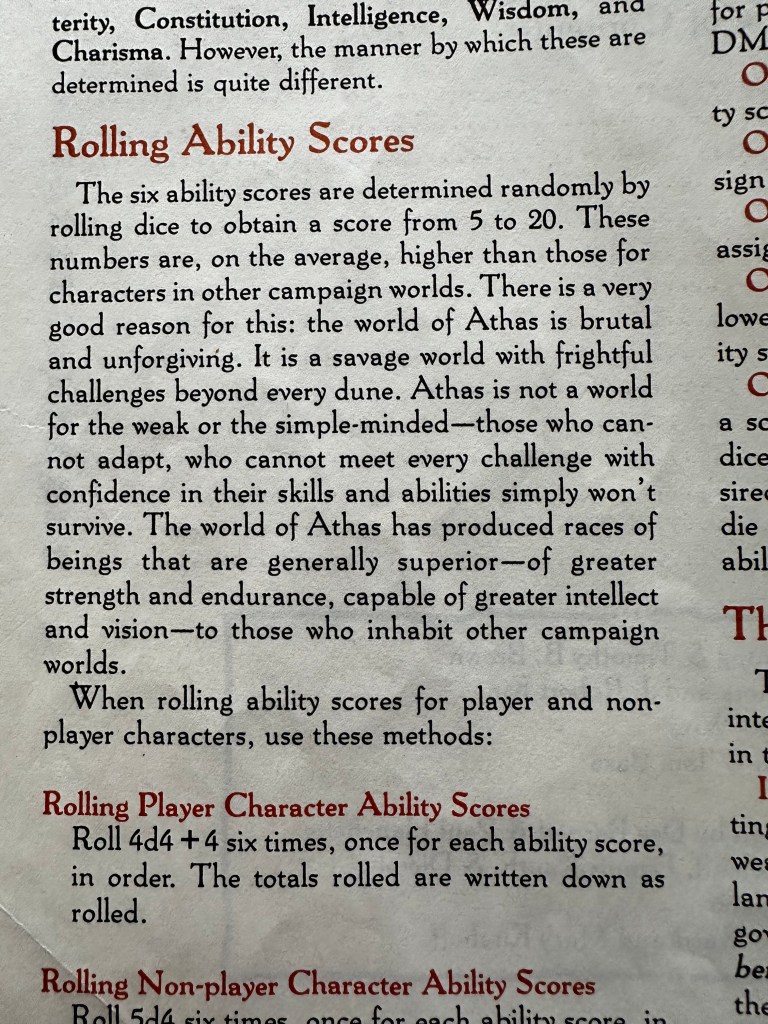
We see an immediate departure from AD&D norms with rolling your ability scores in Dark Sun. Because the setting is so brutal, your PCs get higher than average scores to reflect the hardness of life there. So, instead of the usual 3d6 for each score, you roll 4d4+4 for a minimum of 8 (even though the book claims the minimum is 5, which is numerically impossible) and a maximum of 20, unmodified. There are a bunch of optional methods for rolling included in the Dark Sun Rules Book but I am going to stick with the basic one. So, here we go:
- Strength: 13
- Dexterity: 16
- Constitution: 19 (Suck it Canon Fodder)
- Intelligence: 17
- Wisdom: 16
- Charisma: 10 (Oh well, they can’t all be winners)
First thoughts; obviously this method produces some high results. Also, I was very lucky. Also, these rolls mean that this character could choose almost any race or class.
Second thoughts; now that it comes to it, this is one of the reasons my players really liked this setting. They got to create some very powerful characters, even without cheating on their rolls (which was, I must be honest, the norm at the time)!
Step 2 – Player character race
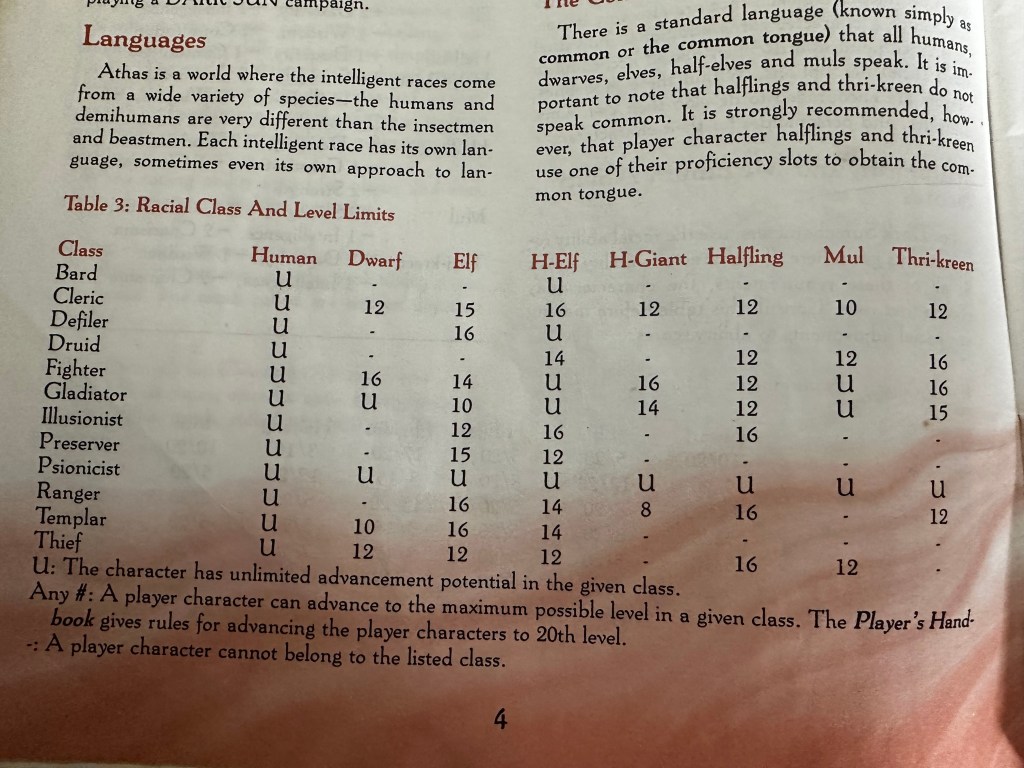
There are Racial Ability Requirements in this setting as there are in the base game, but some of them are very tough to achieve. The only one I think is ruled out is the Half-giant. If you want to be one of those big lads, you need to have a minimum strength score of 17. So here are the races I get to choose from:
- Dwarf
- Elf
- Half-elf
- Halfling
- Human
- Mul
- Thri-kreen
Pretty much none of the races in Dark Sun bear any resemblance to the standard D&D ones, with the possible exception of bland old humans. There are also a few new ones here.
Dwarves are all hairless and obsessed with a focus that gives them bonuses to saves and proficiencies when performing them in pursuit of that goal. They can choose to be Clerics, Fighters, Gladiators, Psioicists, Templars or Thieves. Although all of these have level caps below 20 except for Gladiator and Psionicists. Some of them are really low. A Dwarf can only get to level 10 as a Templar for instance! But they can multi-class. They get a +2 to CON, +1 to STR, -1 to DEX and -2 to CHA.
Elves are tall and lanky and weather-worn with an incredible stamina needed for running long distances across the Athasian deserts. They are very insular and tribal. They get bonuses with long swords and longbows made by their own tribes and to surprise rolls in the wilds. They can choose to be any class except Bard or Druid. They get +2 to DEX, +1 To INT, -1 to WIS and -2 to CON.
Half-elves have to deal with terrible intolerance from both elves and humans and have to do without basic connections or friends (this shit is in the text, ugh.) Anyway, it makes them very much self-reliant loners. They get a free Survival proficiency at 3rd level and can make a pet friend at 5th level! All classes are open to them and they get to multi-class if they want. They get a +1 bonus to DEX and a -1 to CON.
Half-giants are a thing in this setting. And, although I can’t choose them, here is a little bit about them. They are up to 12 feet tall and weigh up to 1600 lbs! They have no culture of their own as a very young and dull-witted race. Once again, the text is pretty bad about this kind of thing. It really underlines for me the need for the push-back this sort of thing rightly received in more recent times. Anyway, they getting bonuses to STR and CON and minuses to INT, WIS and CHA. They can only choose from 5 classes.

Halflings are small humanoids from the jungles at the fringes of civilisation in the Tablelands of Athas. Their culture is concerned mainly with appreciating their local natural world and complex interactions of a social sort between their various villages and clans. They are not really into war and wealth. They get bonuses to use slings and thrown weapons, to surprise opponents and to save against magic and poisons. They get a -2 to STR, -1 to CON, -1 to CHA, +2 to DEX and +2 to WIS. They can choose any class except Bard, Defiler, Preserver and Templar. They can choose to multi-class.
As a side note, I had a memory of Halflings all being cannibals in this setting but it is not mentioned in the character creation section so it might have just come up in certain adventures or something. Not sure.
Humans are much like humans in other settings except they generally have some weird little traits, like mutations. This is a post-apocalyptic setting after all. So players are given latitude to come up with some little physical idiosyncrasy that is purely for flavour. They can choose any class and can be dual-class, but cannot multi-class.
Muls are yet another “half-race.” Its genuinely so distasteful, this whole business. Anyway, here we are, they are half human, half dwarf. They are the product of slave-owners “ordering their births” for gladiatorial or labourers. They are born sterile. FFS. My stomach truly turns at this description of this race. It’s just so cruel. They also “live out their lives in servitude, driven by hatred and spite.” Give them a break! They are tall and well built. They get a +2 to STR and +1 to CON, but a -1 to INT and a -2 to CHA. They can work longer and harder than others as well. They have to choose, at the time of creation if they are considered human or Demi-human. If considered human they can have unlimited advancement in any class and become dual-classed. If the player chooses demi-human, they can, instead become multi-classed and can only choose from Cleric, Druid, Fighter, Gladiator, Psionicist and Thief. This really puts a great big question mark over the entire idea of class restrictions on Demi-human races, if you ask me. This suggests that the reason a demi-human can’t choose any class or get all the way to 20th level in it, is not because of a physiological, racial impediment, it’s only because human society says they can’t… I mean, what?
Finally, Thri-kreen. They’re big mantis guys who have a base AC of 5 but never wear armour. They don’t need to sleep but they can’t use most magical items as they are generally designed for use by human shaped people. Their hunting packs control much of the Tablelands. They have a well-known taste for elves (maybe I was mixing up the Thri-kreen and the Halflings.) They get natural bite and claw attacks and a powerful leap. They get venomous saliva at 5th level as well as a bonus proficiency with the Chatkcha, a thrown weapon. They can also dodge missiles at 7th level. They get a +1 to WIS and +2 to DEX, but -1 to INT and -2 to CHA. They can choose to be Clerics, Druids, Fighters, Gladiators, Psionicists or Rangers and they can multi-class too.
This post is already much longer than I had intended. I started going through the races and couldn’t stop commenting on them. It was like watching a car-crash in slow motion.
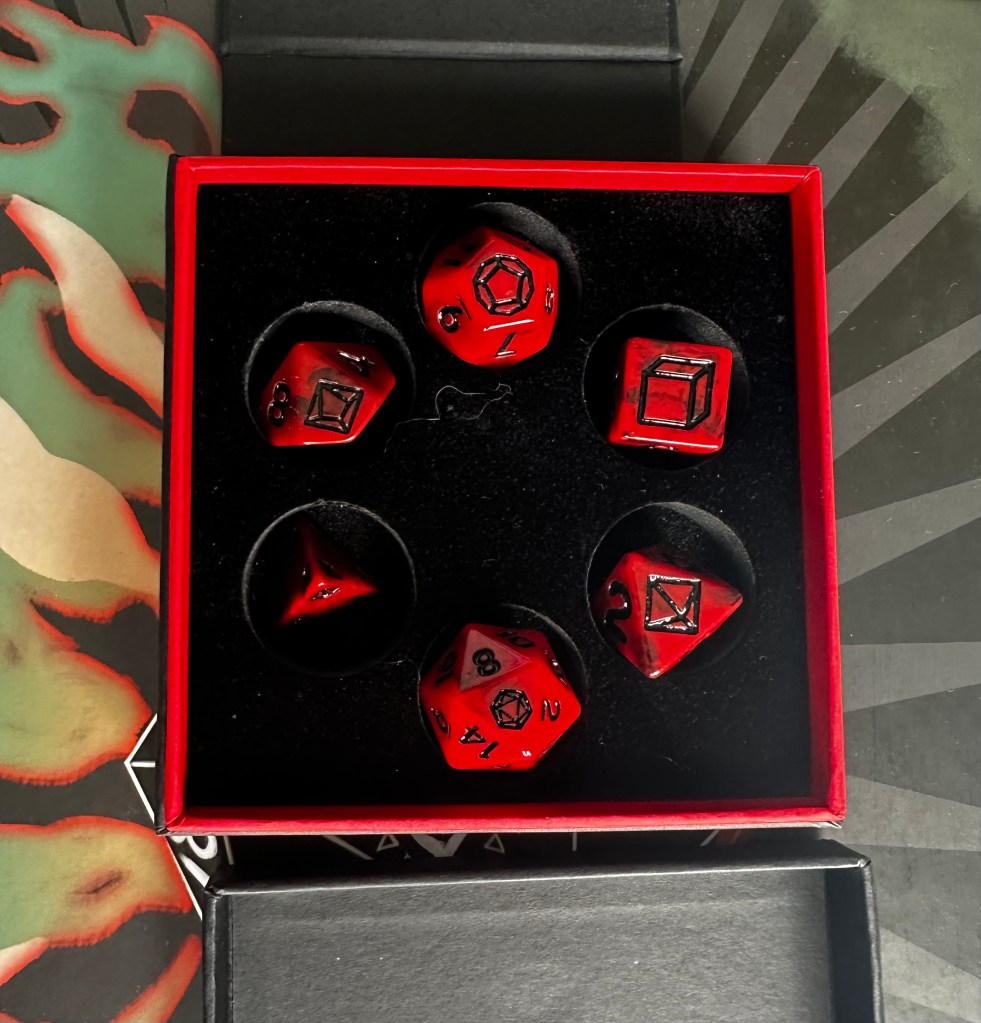
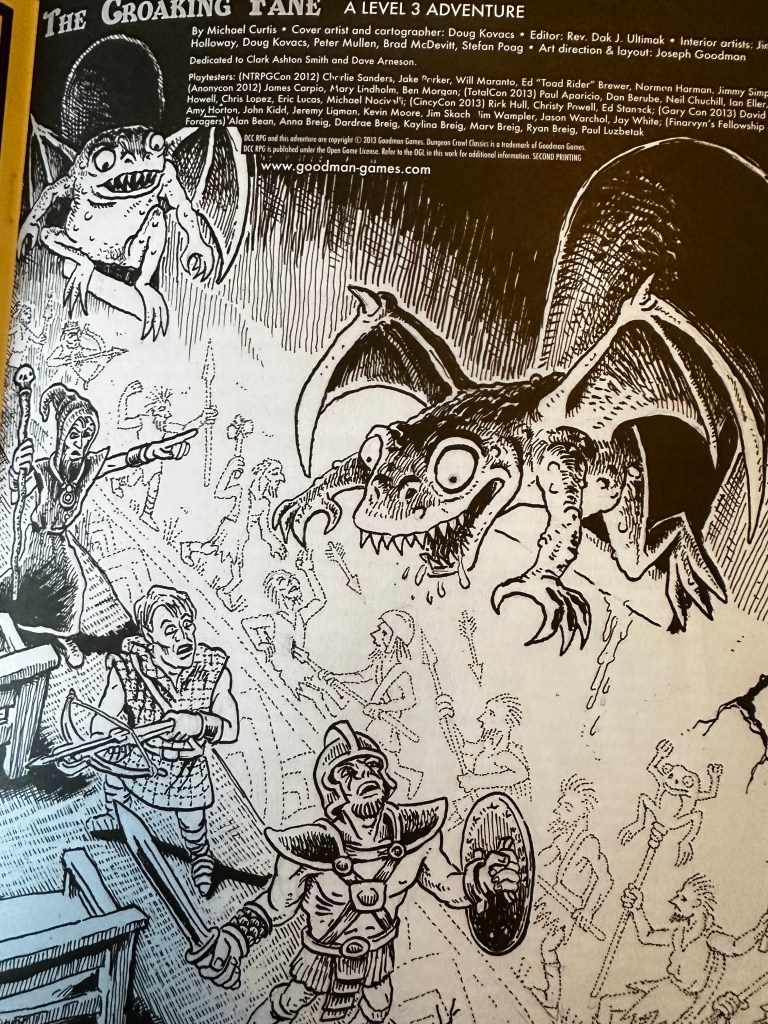
Anyway, I think I will have to continue this character creation process in another post tomorrow. But, before I go, I think I will have to complete the choice. Obviously, as always, the race you select will have a direct effect on the choice of class due to the ability score modifiers. But, since we have a tradition of randomness in the character creation posts, I think I will stick with it and roll for it. There are seven races available to me and, luckily, I do have a d7 to hand thanks to DCC. Here goes:
I rolled a 6 on a d7, dear reader, but I just can’t accept it because that would have been a Mul and that makes me too sad. So I re-rolled and got a 4, Halfling!
So, that leaves me with ability scores as follow:
- Strength: 11
- Hit probability: Normal, Dmg Adjustment: None, Weight allow.: 40lbs, Max press: 115lbs, Open Doors: 6, Bend Bars/Lift Gates: 2%
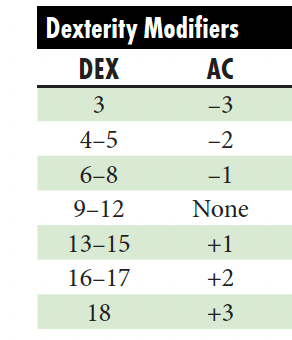
- Dexterity: 18
- Reaction Adj.: +2, Missile Attack Adj.: +2, Def Adj.: -4
- Constitution: 18
- HP Adj.: +2 (+4 for Warriors. This means Fighters, Rangers and Gladiators in Dark Sun), System Shock: 99%, Resurrection Survival: 100%, Poison Save: 0, Regeneration: Nil
- Intelligence: 17
- # of Lang: 6, Spell Level: 8th, Chance to learn spell: 75%, Max. # of Spells/Lvl: 14, Spell Immunity: –
- Wisdom: 18
- Magical Def Adj.: +4, Bonus Spells: 4th, Chance of Spell Failure: 0%, Spell Immunity: –
- Charisma: 9
- Max # of Henchmen: 4, Loyalty Base: 0, Reaction Adj.: 0
The final task for today is to flesh out this Halfling a bit. I am giving her the pronouns she/her and calling her Rezina.

She is 3ft 3in tall, 59lbs in weight, and 41 years of age.
Back tomorrow with the choice of class and probably everything else. See you then!











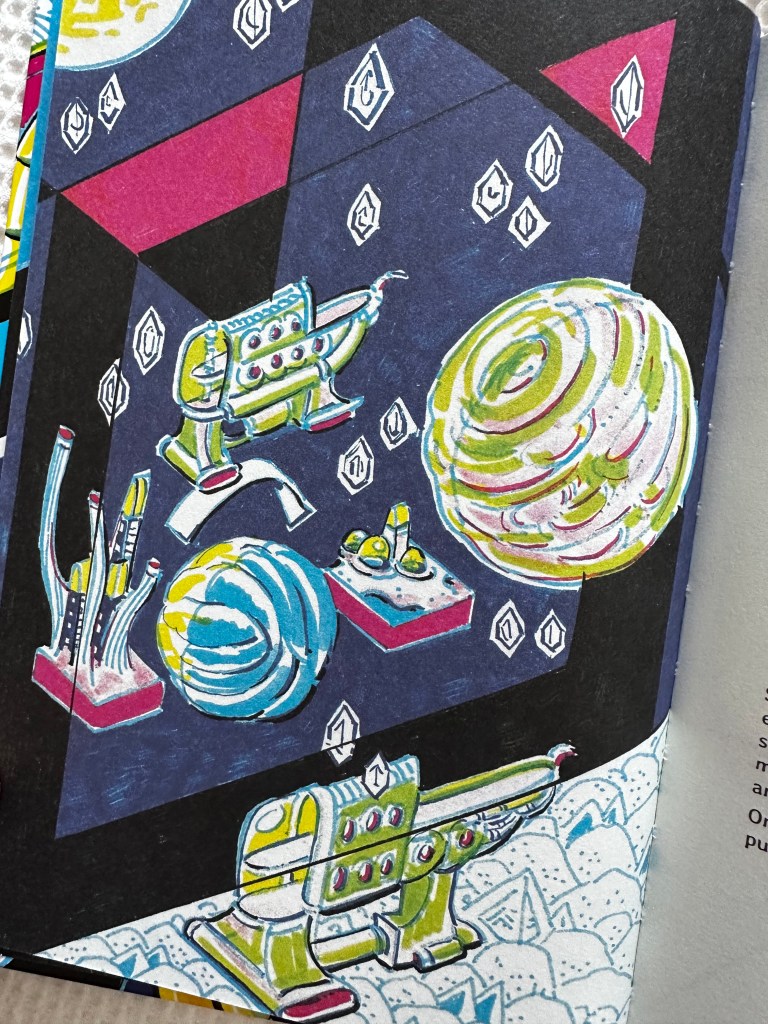




, do yourself a favour and go check them out. When I first encountered his work several years ago, it filed me with wonder. He created such a realistic depiction of a past that was largely recognisable to me from my own childhood, interspersed with or shockingly dominated by futuristic architectures and sci-fi wonders. His work excited my imagination like only RPGs had in the past. So when I discovered that Free League were producing a [Tales From the Loop game](https://freeleaguepublishing.com/games/tales-from-the-loop-rpg/), it didn’t take me long to pick it up. It took a little longer to get it to the table but when I did I discovered that the players loved it.
Tales from the Loop is a game about the 1980s that never was. It posits a world in which some astounding scientific breakthroughs occurred in the ‘50s and ‘60s so that, by the time in which the game is set, they are not considered so strange. You have your robots and your hovercraft and your infinitely renewable energy. But most of that stuff is considered mundane in Stålenhag’s world. Not only that, they exist alongside the ‘80s mainstay technologies like Walkmans, cassette tapes, VCRs and Soda Stream. In Stålenhag’s artwork this created some beautifully uncanny images. Most were set in the region of Sweden known as Mälaröarna, where the Loop project was based. This is where the world’s largest particle accelerator was built. Though it is not necessarily directly responsible for the many strange occurrences in the region, the people who populate such a scientifically rarified place usually are. Scientists and administrators and students flocked to the region and started families there. So many of Stålenhag’s paintings involved kids; a toe-headed child threatening an old Volkswagen van marked “Polis” with a giant robot under his control; a pair of woolly-hatted kids digging in the Swedish snow and gazing back at their homes, dwarfed by the cyclopean, other-worldly cooling towers used to release heat from the core of the Loop itself, the Gravitron; a little kid in cold weather coveralls leading his grandfather through the snow to a mysterious sphere, left abandoned in the countryside, its purpose and provenance forgotten. These were the inspirations for the RPG.
The game came out at the height of the popularity of Stranger Things, which helped it gain a lot of traction I think, and then it even had its own, unfortunately not so popular, spinoff [TV series](https://en.wikipedia.org/wiki/Tales_from_the_Loop), which I, at least, loved.
In the RPG you play kids between 10 and 15 years old. You get to choose a Type from such classics as the Computer Geek, the Hick and the Weirdo. You also have to choose some really fun things like your Iconic Item, your key relationships and your favourite 1980s song.
Once you have your Kid, you and your friends can go out and investigate weird shit on your bikes. Stuff like, where are all the birds gone? What are all the adults doing gathered around that weird machine in the field? What’s that dinosaur looking claw print in the snow? You know, normal kid shit.
## Roll mechanics
Tales from the Loop uses a version of the Year Zero engine, and, in fact, it was the first game I played using that system. It’s really straight-forward and intuitive, easy to learn and resolves situations quickly. “Situations” are generally and collectively referred to in the text as “Trouble” with a capital “T,” appropriately enough. For many, the Trouble you got into and out of when they were kids are some of the most enduring and treasured memories. In the game, you combine your ability dice and your skill dice into one dice pool and roll them all to try and get at least one 6. Since you only use d6s in this game, that’s the highest you can roll. The more 6s you roll the better, generally.
The only issue my players and I had with the rules is the Extended Trouble mechanic. The way this works is that, during the final showdown, encounter or whatever, every kid says what they are going to do and the GM tells them how many successes they will need to succeed fully. Then one player rolls all the dice in one enormous pool. Generally, if they don’t succeed fully but they still have a few successes, they might achieve what they were trying to but one or more kids will earn conditions or even become Broken. But, in play, we found this approach to be unsatisfying. Each player wanted their own cool moment to roll for and the all-or-nothing approach meant that they couldn’t attempt to take any rectifying actions if and when they saw things going wrong. Anyway, suffice it to say, we won’t be using the Extended Trouble rule next time.
## Mascots and Murder
Here are the very basics of the scenario I have planned:
Although the first Loop was in Sweden and much of the book is written as though it is the default setting, they do actually provide a second potential setting in it. That’s Boulder City, Nevada, the “Best city by a dam site,” which is a reference to its proximity to the Hoover Dam. There is another Loop in this region and all of the scenarios presented in the core book can be transposed very easily to the desert, believe it or not. This is where the kids in this scenario will be from. It is summer in Boulder City so it’s going to be so sizzling hot that you can fry an egg on the sidewalk. This will be a nice change as all the other Tales from the Loop games I have played were set in Sweden in autumn and winter.
Some teens have gone missing from Boulder City. Although their parents don’t seem too worried about it, our intrepid Kids are going to solve this mystery as they track down the source of the eerie, carnival-like music out in the Nevada desert and figure out what the connection is.
I have had fun writing this scenario, even though I have gone over it and over it to get it right. So, it’ll be ready to play in a few weeks.
The Tales from the Loop core book has some very useful advice for writing and structuring a scenario for it yourself. As long as you stick to that, you’re unlikely to go wrong. This is not actually the first one I have written myself, using these guidelines and, I can tell you, it works really well.
Have you played Tales from the Loop? What did you think of it? If you had to run a particular game for Indie Mascot Horror vibes, what would it be?](https://thedicepool.com/wp-content/uploads/2024/07/img_3376.jpeg?w=1024)
, do yourself a favour and go check them out. When I first encountered his work several years ago, it filed me with wonder. He created such a realistic depiction of a past that was largely recognisable to me from my own childhood, interspersed with or shockingly dominated by futuristic architectures and sci-fi wonders. His work excited my imagination like only RPGs had in the past. So when I discovered that Free League were producing a [Tales From the Loop game](https://freeleaguepublishing.com/games/tales-from-the-loop-rpg/), it didn’t take me long to pick it up. It took a little longer to get it to the table but when I did I discovered that the players loved it.
Tales from the Loop is a game about the 1980s that never was. It posits a world in which some astounding scientific breakthroughs occurred in the ‘50s and ‘60s so that, by the time in which the game is set, they are not considered so strange. You have your robots and your hovercraft and your infinitely renewable energy. But most of that stuff is considered mundane in Stålenhag’s world. Not only that, they exist alongside the ‘80s mainstay technologies like Walkmans, cassette tapes, VCRs and Soda Stream. In Stålenhag’s artwork this created some beautifully uncanny images. Most were set in the region of Sweden known as Mälaröarna, where the Loop project was based. This is where the world’s largest particle accelerator was built. Though it is not necessarily directly responsible for the many strange occurrences in the region, the people who populate such a scientifically rarified place usually are. Scientists and administrators and students flocked to the region and started families there. So many of Stålenhag’s paintings involved kids; a toe-headed child threatening an old Volkswagen van marked “Polis” with a giant robot under his control; a pair of woolly-hatted kids digging in the Swedish snow and gazing back at their homes, dwarfed by the cyclopean, other-worldly cooling towers used to release heat from the core of the Loop itself, the Gravitron; a little kid in cold weather coveralls leading his grandfather through the snow to a mysterious sphere, left abandoned in the countryside, its purpose and provenance forgotten. These were the inspirations for the RPG.
The game came out at the height of the popularity of Stranger Things, which helped it gain a lot of traction I think, and then it even had its own, unfortunately not so popular, spinoff [TV series](https://en.wikipedia.org/wiki/Tales_from_the_Loop), which I, at least, loved.
In the RPG you play kids between 10 and 15 years old. You get to choose a Type from such classics as the Computer Geek, the Hick and the Weirdo. You also have to choose some really fun things like your Iconic Item, your key relationships and your favourite 1980s song.
Once you have your Kid, you and your friends can go out and investigate weird shit on your bikes. Stuff like, where are all the birds gone? What are all the adults doing gathered around that weird machine in the field? What’s that dinosaur looking claw print in the snow? You know, normal kid shit.
## Roll mechanics
Tales from the Loop uses a version of the Year Zero engine, and, in fact, it was the first game I played using that system. It’s really straight-forward and intuitive, easy to learn and resolves situations quickly. “Situations” are generally and collectively referred to in the text as “Trouble” with a capital “T,” appropriately enough. For many, the Trouble you got into and out of when they were kids are some of the most enduring and treasured memories. In the game, you combine your ability dice and your skill dice into one dice pool and roll them all to try and get at least one 6. Since you only use d6s in this game, that’s the highest you can roll. The more 6s you roll the better, generally.
The only issue my players and I had with the rules is the Extended Trouble mechanic. The way this works is that, during the final showdown, encounter or whatever, every kid says what they are going to do and the GM tells them how many successes they will need to succeed fully. Then one player rolls all the dice in one enormous pool. Generally, if they don’t succeed fully but they still have a few successes, they might achieve what they were trying to but one or more kids will earn conditions or even become Broken. But, in play, we found this approach to be unsatisfying. Each player wanted their own cool moment to roll for and the all-or-nothing approach meant that they couldn’t attempt to take any rectifying actions if and when they saw things going wrong. Anyway, suffice it to say, we won’t be using the Extended Trouble rule next time.
## Mascots and Murder
Here are the very basics of the scenario I have planned:
Although the first Loop was in Sweden and much of the book is written as though it is the default setting, they do actually provide a second potential setting in it. That’s Boulder City, Nevada, the “Best city by a dam site,” which is a reference to its proximity to the Hoover Dam. There is another Loop in this region and all of the scenarios presented in the core book can be transposed very easily to the desert, believe it or not. This is where the kids in this scenario will be from. It is summer in Boulder City so it’s going to be so sizzling hot that you can fry an egg on the sidewalk. This will be a nice change as all the other Tales from the Loop games I have played were set in Sweden in autumn and winter.
Some teens have gone missing from Boulder City. Although their parents don’t seem too worried about it, our intrepid Kids are going to solve this mystery as they track down the source of the eerie, carnival-like music out in the Nevada desert and figure out what the connection is.
I have had fun writing this scenario, even though I have gone over it and over it to get it right. So, it’ll be ready to play in a few weeks.
The Tales from the Loop core book has some very useful advice for writing and structuring a scenario for it yourself. As long as you stick to that, you’re unlikely to go wrong. This is not actually the first one I have written myself, using these guidelines and, I can tell you, it works really well.
Have you played Tales from the Loop? What did you think of it? If you had to run a particular game for Indie Mascot Horror vibes, what would it be?](https://thedicepool.com/wp-content/uploads/2024/07/img_3375.jpeg?w=1024)

 The Dice Pool