The Theatre of Trophy Gold

Getting my flash in

Orlen, dusty, wide-brimmed chapeau drowning her alarming eyes in shadow, holds aloft her trophy, beaming. The bag of coin, pleasingly hefty, dangling from her dextrous digits. “‘Aah ‘baht ‘at ‘en?” Her companions, ensorcelled by something above her sturdy, sinister shoulder, point. A hiss, as a punctured bladder, sounds in her ear. Speculative, her left hand shoots up, ready to throttle the looming serpent. It narrowly misses losing its ring finger as a dagger, recently released by Rasei, skewers the snake to the formerly coin-concealing statue. Orlen chances a glance. The cold blood dribbles down the stone man’s shoulder, over the sickle he holds dramatically crossing his sword over his chest. Nima cries, “More snakes!” Time to go. The treasure hunters scarper down the path of the sickle, ignoring the sword’s point and the keep slouching beyond it on the horizon, hoping for Hester’s Mill.

A dramatic retelling of the opening scene of our recent game of Trophy Gold, run by friend of the blog, Isaac. To those who were there, apologies. I’m sure I got a few details wrong, either deliberately or by mistake. Drama seems appropriate for this fascinating game, defined as it is, within Sets.

Trophy

So, as you probably know, dear reader, if you have been with me for a while, here on the dice pool dot com, I am a more-or-less avid listener of the Fear of a Black Dragon podcast from the Gauntlet. I wrote a post on my appreciation for it and the Indie RPG Podcast last Summer. Our path to playing this incursion (as Trophy scenarios are called) leads very much from that. Jason Cordova, one of the podcast’s capable hosts, rarely ventures into the OSR’s hex-defined landscapes. Rather, you can generally find him in the narrative woods and trails of story-based games. On the podcast, he often discusses his experiences in running OSR (or just old tbh) modules in other systems. Back in the olden days of Fear of a Black Dragon, this generally meant either the incredibly rules-lite World of Dungeons or Dungeon World My last post on this blog was about the feelings Dungeon World made me feel. Go and have a look!) These both have PBTA DNA. Their mechanics lend themselves more to the application of imagined narrative than cut-and-dried, D&D-esque, result-binary systems. And this is really only because of the inclusion of a third option, a mixed success, or success at a cost. Since the implied consequence cannot be defined outside the context of the situation, it is usually left up to those at the table to invent it (although Dungeon World generally provides far more pre-written options than does the baldly efficient text of World of Dungeons.) And look, if you’re a PBTA maven, my deepest apologies for what is, no doubt, a faintly condescending and largely inaccurate paring down of a game system that is probably the most influential in the indie game space of the last decade and a half. But if you were raised on a distilled diet of Borgs in your old schools, you’re welcome.

I have gotten off track. The point I was trying to get to was that, a few years ago, Jason switched to running pretty much every module in Trophy Dark or Trophy Gold instead. Mostly Trophy Gold, in fact. Obviously, this got me very interested in the game. The idea of running D&D style modules in a more narrative style highlights a whole new facet of the hobby that I always thought would be very fun to explore. And, after reading a bit about the game and learning of its mechanical descent from Blades in the Dark I wanted to try it even more. It just turns out that, much like Tom (with Dungeon World,) before him, Isaac got there before me. I’m not complaining. I love being a player in these games.

So, to put it briefly, both Trophy games were written by Jesse Ross and published by Gauntlet Publishing. Elements of the rules have been adapted from Blades in the Dark by John Harper, who is also responsible for World of Dungeons and other elements were cribbed from Graham Walmsley’s seminal Cthulhu Dark. They are games about treasure hunters going out into the dark forest to find gold and bring it home so they can continue to survive in a hostile world. In Trophy Dark, your vile little adventurer is a goner; you’re not making it past the end of the session. Sorry. That’s the point of Trophy Dark. But in Trophy Gold you make a treasure hunter who might live to the end of the incursion if you’re lucky. They might even weasel their way through to another one. Speaking of which, I wrote a blog post about making a Trophy Gold character last summer. You may find it illuminating if you’re interested. Do bear in mind, though, the game I used in that post is not quite the same as the one presented in the book published in 2022. I used the game from the Codex Gold magazine, which you can pick up for a steal over on Drivethru. I don’t think there are any really drastic rule changes but we noticed some discrepancies in a few of the tables.
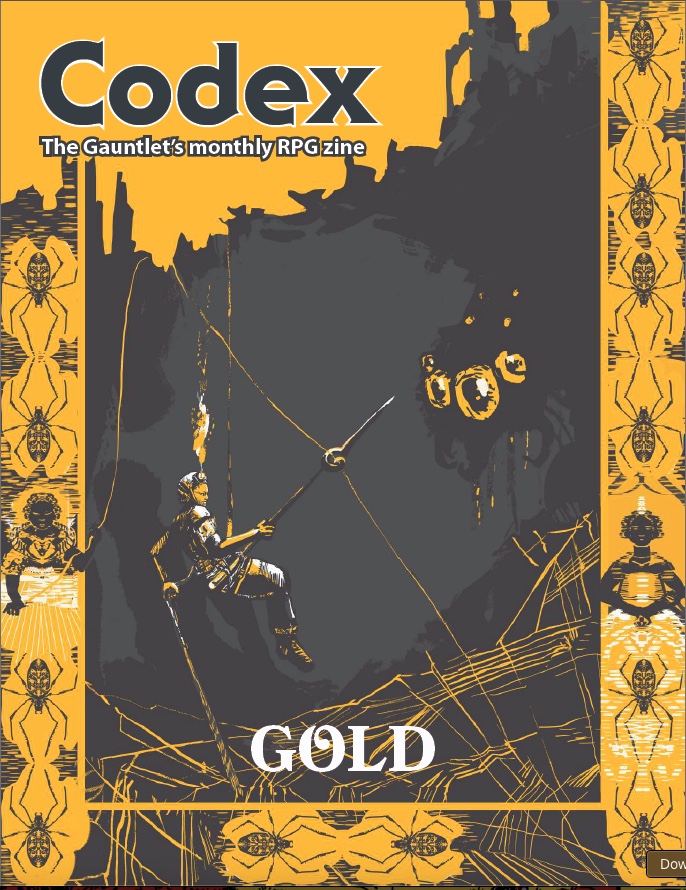
A gold and black illustration of an adventurer being lowered on a rope into a dark cave where a giant spider awaits. the cover is framed by stylised black spiders on a gold background. The words, Codex, The Gauntlet's monthly RPG zine appear in the top left of the cover.
The cover of Codex Gold from Gauntlet Publishing

Hester’s Mill

So, what’s all this about Sets? You didn’t think I remembered mentioning that earlier, did you, dear reader? Well, Incursions are formatted in a very particular way. Trophy Gold helpfully breaks it up and introduces the format like this:

  • Theme – much like any dramatic work that might be presented on the stage, a Trophy Gold incursion should be built around a theme, even if you are adapting it from another type of module. I would call the broad theme of Hester’s Mill to be “Harvest”
  • Sets – these are particular locations in which the treasure hunters will be presented with clear goals. I find it fascinating that the rules tell the GM to make the goal explicit to the players. I’m not giving away too much by telling you that the goal in the opening Set I wrote up in the intro is to find the way to Hester’s Mill. You complete the Set by achieving this goal and this is eminently important to the cycle of play. You may not wish to complete the goal of every Set. It might not be clever or necessary for you. Your character’s overall goal is to earn enough Gold to relieve them of their Burden, both of which are abstract scores on the character sheet. In other words, you know from the start how much you need to take home so you don’t die on the streets or get consumed by the evils of the world. I don’t think anyone would blame you for trying to convince the party to get the heck out of there once you had managed to collect enough money. But, just because you got your Benjamins, doesn’t mean everyone else did. This can lead to inter-personal conflict, unsurprisingly. But it might also lead to moments of support and kindness in these Sets. Drama, gettit? And guess what you call the things you find within the Sets… Yep, Props. It’s obvious, really. So the statue of the man with the sickle and sword in the intro? Yep, that’s a Prop. You also have Treasure and Traps as defined elements within Sets
  • Flowchart – What the holy business-process, Batman? Yep, it makes so much sense, when you think about it. When you are trying to play something like an OSR module, you might have a map which visually represents the location but that does not necessarily represent the decisions, actions and repercussions that might lead the PCs from one Set to the next. In many ways, the Flowchart is the more useful of the two. I’d like to give it a go in any game where I’m running a particular scenario, honestly. Not very theatrical though, disappointingly
  • Monsters – these are specifically mentioned because the section I am referring to in the Trophy Gold rules from Codex Gold is there to explain how you might convert an OSR module to be played using Trophy Gold instead. So, Jesse Ross has helpfully provided a lot of advice on converting Monsters, a staple of the genre, to be used in that system. One of the most fascinating aspects of the game is that the monsters do not come pre-named. That is left up to the party. This can be either cool AF or disastrous. The monsters we encountered in Hester’s Mill so far have been both bonkers and horrifying. And if it had been left up to me, they would have been called something stupid
  • Magic – Similar to Monsters, this includes advice on conversion. But, I will say that there is a very useful table of already converted D&D style spells presented in the rules for you to use.

Anyway, it should be clear that the Set is the main denomination of organisational structure within an Incursion. So far, I think we have interacted with three or four Sets in Hester’s Mill and achieved the Goal in two or three of them. You can use another highly abstracted currency, the Hunt Token, to complete a Set without having to actually face its dangers. You can receive (and also lose) these tokens on a Hunt Roll, one of the three types of rolls in the game. If you spend three Hunt Tokens like that, you simply draw the curtain across the stage and open again on the next Set and get to work on the new goal.

In general, rolls, of which you have Hunt, Combat and Risk, are made using a dice pool mechanic much like that used in Blades in the Dark. The D6 is the only die you need but you will need them in Dark and Light varieties. You will always roll a Dark Die in Combat and you can roll one to give you a better chance of success on a Risk Roll if you’re willing to risk mind or body… More drama.

The Combat Roll is particularly fascinating because it doesn’t work like a regular success/failure roll at all. Instead, you describe how your character exposes themselves to harm in the battle and then roll your Light Die. That number is your Weak Point. You then roll a Dark Die for each of the treasure hunters in the fight. Ostensibly, you’re rolling against the Endurance of the Monster, but, if any of them roll your Weak Point, that increases your Ruin, which is like a harm track. One you hit 6 Ruin, you are Lost… So dramaaaatic, right?

Add to this the Devil’s Bargain, nicked from Blades in the Dark and you have a recipe for some real dark character moments in Trophy games. You crowdsource the possible options for both Devil’s Bargains and unfortunate consequences of failed rolls from everyone around the table and this makes for some extremely fucked up inevitabilities on a lot of rolls.

In conclusion

We have yet to finish Hester’s Mill. I know we have at least one more Set to get to. I’m really looking forward to going back to it. We’ll be dealing with the aftermath of something pretty messed up and, hopefully, finding some more goodies. I have to say, the Incursion has been very pleasing in introducing us to a lot of lore and cool fantasy history while also giving us the opportunity to get into fights and burn down shrines so far. With any luck, there’ll be more of that as we wrap it up next time.

How about you, dear reader? Have you played Trophy Gold? Or Hester’s Mill? What did you think?

Trophy Gold – Character Creation

Old school play, new school rules

I have a post in which I write a little about a couple of the podcasts that most inspire me to play and write about RPGs. One of them is Fear of a Black Dragon from the Gauntlet. In it, Tom and Jason review a different OSR module each episode (more-or-less.) What I discovered early on, while listening to it was that they often did not use OSR rulesets to play the modules. Instead, they usually used Dungeon World, World of Dungeons or Trophy Gold. These are much more modern RPGs and, I think, they tend to use Powered by the Apocalypse and Forged in the Dark style rules. I have only just picked up Trophy Gold in the Codex-Gold magazine published by the Gauntlet back in 2019. So, I thought I would have a go at creating a character in this much more rules-lite game (compared to OSE anyway. To see how character creation went in that, go take a look at yesterday’s post.)

About the game

Essentially, Trophy Gold is doing the same stuff as Old School Essentials or D&D for that matter. It allows you to play an adventurer or treasure seeker who is drawn to dangerous, forbidden or haunted locales. The locales will push back. Unlike its predecessors, Trophy and Trophy Dark, which were made to play one-shots and tended towards the horror genre, Gold is more geared towards campaign play. It just doesn’t worry so much about your encumbrance or confuse you with bonuses that are actually negatives. It uses elements of Forged in the Dark games in its ruleset. It is described thus in the opening paragraph:
“Trophy Gold is a collaborative storytelling game about a group of treasure-hunters on an expedition to a haunted environment that doesn’t want them there.”

Character creation

So your character is called a Treasure Hunter in this game. This is because treasure is the aim of it. Your character is there to emerge from the dungeon or forest or ruins with heaps of Gold. But is it worth it? Will they even survive it?

A blank Trophy Gold character sheet from Codex Gold magazine, 2019, The Gauntlet.

Step 1 – Choose your Name, Occupation and Background

So, in direct opposition to OSE, we are starting with our name. I like this since, we all get named long before we know anything about ourselves, don’t we? The rules include tables for names, occupations (what you do in the party) and backgrounds (what you did before your treasure hunting days) So I am going to use them.

  • Name: Valen
  • Occupation: Smuggler. Skilled in dexterity, spontaneity, stealth
  • Background: Retired Soldier. Skilled in tactics.

The rules encourage you to think about your background profession, why you left it and why you can’t go back. As a retired soldier, I think Valen has tired of killing at the behest of others. He left to put his skills to work for his own enrichment instead. He could never go back to taking orders now that he has tasted independence.

Step 2 – Choose your Drive

This aspect has an element of Blades in the Dark peeking through. Each character will have their own motivation for treasure seeking and I am going to roll on a table for it. But first it explains that you can stash the gold you earn from it in your Hoard. Once you get to 100GP, you can retire your treasure hunter. Blades in the Dark has a similar conceit where you get to hide away your coin in a stash until you have enough to comfortably get out of the game for good.
So, here’s my roll:

  • Drive: Free the serfs of Bandung Prefecture

So, I don’t know where Bandung Prefecture is but it has fired my imagination. Perhaps my ex-soldier, while on a recent excursion to Bandung, discovered a village where the people were down-trodden and despairing due to the conditions caused by their lord’s treatment of them. There Valen met a man, a former soldier, who reminded him of himself to such an extent that he felt as though saving him and bringing down the cruel and selfish lord was essential. He just needs some funds to raise a rebellion.

Step 3 – Backpack Equipment and, if desired, Combat Equipment

There is an interesting approach to equipment here. You have three different categories, Backpack, Combat and Found equipment. You can roll on a table to see what your backpack starts with or you can choose from the table if you want stuff that suits your character. Importantly, your backpack starts with three items and three free slots. If and when you need something in a given situation, you check the table of Additional Backpack Equipment presented in the rules, and, if what you need is there, simply say it is occupying one of these slots. Then you write it down and mark off another slot. This reminds me of the loadout rules in blades in the Dark. These state that, when you are going on a score, you decide if you take a light, medium or heavy loadout. This determines how many items you can carry and also how much you stand out. But, importantly, you don’t have to say exactly what your items are until you need them in the fiction.

Anyway, I’m going to roll on the table for my

  • Backpack Equipment: Fishing net woven of silver (!), Bottles, lead (6), Magnet

When it comes to choosing Combat Equipment, there is another rule that comes into play. That is Burdens. You start the game with a Burdens score of 1. That’s the amount of Gold you need to keep yourself on a day-to-day basis in between incursions (that’s what Trophy calls adventures.) However, it increases for every piece of Combat Equipment you choose. It will go up further as you are playing too. What an interesting mechanic this is! Yes, your armour will hale to keep you alive on an incursion but you have to spend money to repair and maintain it. Can you afford that? I like it. But after yesterday’s debate, I am definitely getting Valen some nicer stuff.

  • Combat Equipment:
    • Armour – Breastplate, Helmet
    • Weapons – Crossbow, Dagger

So, I guess that increases my Burdens score to 5.

Step 4 – Choose your Rituals, if any

You don’t have to be a wizard or anything to perform these, all treasure hunters can learn and use rituals, dangerous magic that can perform “miraculous feats.” Now, I can have as many as three Rituals to start, but, it says here that, for each one I know, I must increase my starting Ruin by 1. Let’s see what that means, exactly.
Cryptically, the rules describe Ruin as:
“…how much the world has dug its claws into you, including the physical and mental harm you’ve suffered.”
Similar to Burdens, it starts at 1 but, as stated above, it increases commensurate with the number of Rituals known.

I have no experience playing this game so I don’t know the true consequences of choosing to increase my Ruin like this, but for fun, I’m going to take three random Rituals:

  • Beacon – nearby invisible beings or hidden objects shine with a fiery glow
  • Enliven – give flesh and breath to a human effigy (!)
  • Germinate – compel plants to furious growth

This, I suppose, increases my Ruin score to 4.

Finally, set your Ruin, Burdens and Hoard

Easy.

  • Ruin: 4
  • Burdens: 5
  • Hoard: 0 (this number is always 0 at the start.)

Comparison

It’s possibly unfair to compare this experience with that of making the OSE character yesterday since they are based on two such mechanically different games. But that’s what I am going to do.

Over all, I found that the character I created in the Trophy Gold system was never going to be compared negatively, or indeed, positively, to other characters in the same system. And that is purely because it does not rely on numbers so much. You will have noticed that Valen does not have attribute scores or hit points, for instance. Despite this, the Trophy Gold character is just as unique as the OSE character. It’s just that the differences between my ex-soldier/smuggler are more descriptive than numerical.

You will also have noticed that the character creation process encouraged me to think about the character’s background while making my treasure hunter. I don’t remember this ever coming up in the OSE process.

I did a lot of rolling on tables for this process, which I didn’t foresee when I went into it. In fact, I ended up with altogether more on the character sheet than I expected from such a rules-lite system. But I enjoyed the process and found the details provided by the tables fun and interesting.

One aspect that I liked, though, was that I had to choose the Combat Equipment and Rituals. These directly affected my Burdens and Ruin scores. These are the scores that will have the most impact on the way you play the character. I read on a bit and discovered that, if Valen does not come back from his incursion with Gold equal in value to his Burdens score, he’s done… He is left in penury or sent to the workhouse. As good as dead. Not only that, but, if his Ruin ever reaches 6, he is lost to the darkness, transforming into a monstrosity himself, or he is simply dead. Makes my decision to take three Rituals look a bit foolhardy now, eh?

Conclusion

Anyway, as I said, it is not really fair to compare the two systems. One is deliberate in its devotion to the OSR and its historical roots. It made a character that probably won’t last too long but mainly due to luck. The other is more interested in the story the players tell and the narrative beats produced by the characters created. My treasure hunter also probably won’t last long, but this time it is due to my choices.

Dear reader, do you have any experience playing Trophy Gold? How did you like it?

Fear of an Indie RPG Podcast

RPG podcasts

I suspect that when most people think of RPG podcasts, they think of actual play, where a bunch of nerdy voice actors/comedians/nerds get together around a table/microphone/Zoom app and record their games. It is such a common format that one of the more famous ones is called Not Another D&D Pocast (NADDPOD.) There are a number of these that I like and I might get into them in another post at some point. This post is not about them.

So, as you may have gathered, I enjoy not just playing RPGs but also talking about them, reading about them, listening to people talk about them. There are not many podcasts that I listen to regularly that do this. I just don’t gel with all of them. But today I wanted to highlight two that I get a lot out out of. Sometimes I get advice to be a better GM or player from them, sometimes they introduce me to new games or supplements, sometimes I just get to relish people chatting about a subject that is close to my heart and interests me too.

The Yes Indie’d Podcast

Thomas Manuel runs this little gem. I got into it when a friend suggested I sign up for the Indie RPG Newsletter, also run by Thomas. Please go and sign up for that too, by the way. I look forward to that turning up in my inbox every Sunday morning. It’s a really good way of keeping up with what is happening in the indie RPG scene and getting some fascinating insights into aspects of the hobby you might never have thought you needed to think about.

The usual format for the podcast is that Thomas will invite an indie RPG luminary on to the show and interview them. He always has a bunch of insightful questions for them and the discussions that emerge have a lot to offer, particularly if you have ever been interested in creating and publishing your own indie RPG material. There are lots of good episodes but I would recommend a specific few recent ones that I got a lot out of:

Meeting Games Where They’re at with Quinns, one of the most reliable and funny RPG reviewers out there

Getting Weirder than Lovecraft with Graham Walmsley, creator of Cthulhu Dark among other good stuff

Open Hearth’s Games of the Year 2023. This is a bit of a cheat since it is not technically a Yes Indie’d episode but it did appear on the Yes indie’d feed so I get to include it. It is also the thing that made me go and sign up for Open Hearth so it gets extra points for that.

Fantasy Non-Fiction with Tom McGrenery of the Fear of a Black Dragon podcast

Fear of a Black Dragon

Which brings me nicely on to Fear of a Black Dragon. For the umpteenth time, Thomas Manuel directed me to check out something that I ended up loving.

The Fear of a Black Dragon podcast is the venerable OSR module review show produced by the Gauntlet. The Gauntlet is responsible for several high quality, popular indie RPGs and other related publications and podcasts. Their best known products probably include Brindlewood Bay, Public Access and The Silt Verses RPG. These games are very much not OSR by nature but the modules Jason Cordova (author or co-author of the games listed above) and Tom McGrenery (of the paragraph-before-this-one fame and creator of several games himself) review very much are.

The format is simple and unchanging, the reviews go deep and are guaranteed tested at the table, the vibes are spot-on. I started on the first episode from 2017 and have been binging it relentlessly for the last couple of weeks. What’s nice about this is that all the modules they reviewed back then are still relevant and available. Another interesting point is that the hosts mostly do not use OSR systems to play the games they review, rather they usually use something like Trophy Gold or Dungeon World, Powered by the Apocalypse games that are much less crunchy and more interested in the narrative of a game than the number of dice you roll for damage. They provide a lot of expert advice on how to handle conversions like these as well as great ideas for introducing scenes, developing NPCs, doing sound effects and other fun stuff.

The episodes I have listed below made me go and purchase the items they reviewed. These links are to their website but you can listen on your pod-catcher of choice of course:

Ultraviolet Grasslands

Fever Swamp

Slumbering Ursine Dunes

But you should also check out this one, which was the first one I listened to and is much more recent:

Episode 100 Special

Go and subscribe to these podcasts and sign up for their Patreons if you can:

Indie RPG Newsletter/Yes Indie’d Podcast

The Gauntlet/Fear of a Black Dragon