Instead of a new post, please enjoy this one from last August. It deals with beginnings and how to manage them in RPGs. Its got some advice I must take into account as I embark on my recently decided upon campaign of Blades in the Dark.
A Short Rest
Once again, dear reader, I find myself a little under the weather. Maybe I just overindulged at the weekend, maybe I have been working too hard, maybe it’s the current wave of ‘rona. Whatever it is, I feel like I’ve been struck by a nasty disease and I failed my resistance check/saving throw etc. etc. So, I’m taking a break today.
Instead of a new post, please enjoy this one from last August. It deals with beginnings and how to manage them in RPGs. Its got some advice I must take into account as I embark on my recently decided upon campaign of Blades in the Dark.
This post is part of a blog bandwagon started on the Roll to Doubt blog.
Click on the link above to take in the blogpost that’s piloting this bandwagon. Wagon-jumpers abound. You can find a very nice read on the same topic and a handy list of related blogposts on the Among Cats and Books blog.
What’s clear from even a cursory glance at the other blogs is that no two people are prepping in precisely the same way, so advice and recommendations come with the notice that your way is probably the best way. The thing is, in my experience, you find your way only through trial and error. Here’s my effort to tell you about my trials and my errors.
Preponderance of prep
I used to spend hours and hours preparing my games when I was a kid. To be clear, I loved doing it. I would happily get lost in the world-building, the map-drawing, the character creation and the encounter balancing for hours when I should have been studying. I still often think that I gained more from the time I spent on RPG preparation than I did from learning off -by-heart lists of dates and events or theorems and proofs. But I digress.
My prep used to be pages upon pages of tightly packed hand-writing explaining the background of an adventure, the major NPCs involved, the probable goals of the PCs and far more history about the setting than the PCs would ever be able to interact with. I drew maps by hand as well, when I had to. I didn’t run a lot of published adventures but I did make liberal use of soucebooks. I would select the people, places and things I wanted from those books and elaboate on them wildly, writing more pages on how they would connect with our campaign and adding a lot of extra details.
I sometimes wish I had the time to do preparation like this these days. But, when I do find myself with the time, and I sit at the computer to start working on it, I find I would rather shortcut it. I’ve asked myself why this is on many occasions. I’m not sure I have the answer, or else there are several. It could be to do with the process of writing in a notebook and drawing by hand on grid-paper. I don’t want to prep like that these days because having all of my work backed up digitally is invaluable. Time is still a factor. Even when I feel like I have some extra time on a particular day, I can’t guarantee that I’ll continually have that as the campaign progresses. But I think the main difference for me now is the feeling I get from making the world, its people, the major events, the game, at the table with my players. When you are all on the same page, when everyone comes together to create something greater than I ever could on my own, that’s one of the real joys of this hobby.
So, I don’t really do that anymore.
Preplanned not prepared
It’s taken me a long time to make this change, though. Even looking back at the work I did in preparing for our current Spelljammer game, I had thousands of words written on setting, backgrounds, NPCs, over-arching plot etc. And I would write thousands of words of session preparation while going along too. What I have discovered during the last couple of years of trying to prepare this way, however, is that that sort of prep is close to unusable at the table. Even if I am the one who wrote that dense paragraph of text, I can’t find what I’m looking for in it in the couple of seconds I have to react to something at the table, or to answer a player’s question without delay to keep the flow of the game going. Now, it’s not always a waste of time, I will admit. Sometimes, the very act of writing something will help to embed it in my memory and imagination, so obviating the need to check it at all. But, then again, there is the other effect of writing something down. It has the effect of making something true.
Truth at the table should only come from play. The only real things in the game world are what the PCs experience. Everything else, even things the characters have learned or heard about, is pure conjecture. Until it’s not.
This doesn’t mean I don’t prepare anything of course. I make plans for events I would like to occur or NPCs I want the PCs to interact with. But in those cases, I will write down something about the event, just a few details about what happens, who might be involved, what effects it might have. Or I will give the NPC some quirks, desires, flaws and interesting characterisations to bring them to life. But I will keep them to be used when and where they seem to fit.
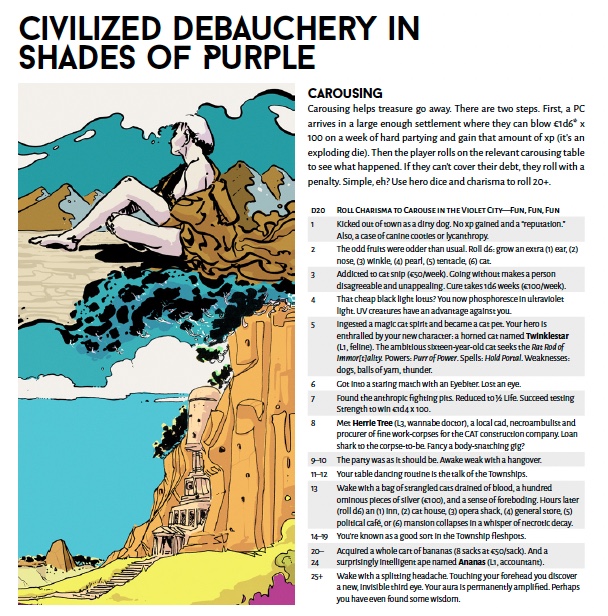
Otherwise, I revel in the joys of random tables. I use rumour tables and encounter tables quite judiciously these days. In a game like Ultraviolet Grasslands, I am spoiled with wonderful encounter tables, trade goods tables, carousing tables, and almost any other type of table I could desire. But when it comes to 5E, I am generally disdainful of the encounter tables provided. So I make my own. Made right and used right, these not only make for some interesting sessions, but also act to drive the game forward, introducing NPCs that become important to the plot, enemies that might defeat the PCs or might lead to vengeful associates pursuing them later. Importantly, I feel, they maintain an element of randomness and ensure that the players know their rolls have led them to the encounter, or not. It’s great if you can engineer it so that the players are rolling on random encounter tables at the end of a session. That allows you to take the result of their roll and make preparations for the specific encounter they rolled up for the next session. Usually, these days, I refer to Between the Skies for more tables and for inspiration to make the encounter really interesting.
Between the Skies does not limit encounters in space to just running into creatures, but also gives options for hazards the ship might run up against and problems that stem from the ship itself.
Here are the simple d6 and d4 tables I made to determine if the crew run into anything, and, if so, what it might be:
Wildspace encounter table d6
1-2 No encounter 3 Ship Hazard 4 Ship Problem 5-6 Encounter
3 Ship Hazards
Roll 1d4
Hazard 1 – Storm, Flood
Hazard 2 – Disorientation, Sphere
Hazard 3 – Obstruction, Cold
Hazard 4 – Trap, Haunting
4 Ship Problems
Roll 1d4
Problem 1 – Armament, Separation
Problem 2 – Quarters, Shrinkage
Problem 3 – Cargo, Disappearance
Problem 4 – Bridge (spelljammer helm), Error
5-6 Encounters
Isolationists – Confusion, Related Entity – Unknown NPC, Glittering, Prayers
Ship Parasite – Loss, Scales, Experiments
Ruins, Ancient – Mourning, Related Entity – Petty God, Knots, Miscommunications
Stowaway – Battle, Related Entity – Creature, Eggs, Blindspots
The descriptive words I listed beside each entry come from the spark tables in Between the Skies. These are invaluable resources that give you the inspiration to come up with truly unique situations, problems and obstructions. You should go and buy this book at the link above.
When I get the players to roll on these tables, I either make up the encounter/hazard/ship problem on the spot using the sparks of inspiration or I use the time between sessions to come up with something memorable.
A while ago, I realised the plot I came up with for the Spelljammer campaign was much less interesting to the players or their characters than the shenanigans that they got up to each session. They were more wrapped up in their own shit. And that was very cool. It made me want to make a sandbox for them to play around in instead of expecting them to interact with a plot they had little or no investment in. This goes back to the time I introduced a hex grid to the underside of the Rock of Bral. I did this to allow one of the PCs to drag the whole party with them to rescue their mother who was trapped in the prison down under. It did not serve the overall plot, really, but I had to have fun things for them to do while traversing this area so I made it a hex map and created some random encounter tables for each of the different types of terrain on the underside of the asteroid.
You know, it took me a long time to cop on to this though. The signs were all there. Dear reader, if your players never remember what is happening in the plot of your meticulously crafted campaign from one session to the next, you might be overloading them with plot. Maybe they just want to play their cool character and have fun moments between them and the other PCs and significant NPCs. Or maybe they are only interested in hitting things really hard. Or maybe all they have ever dreamed of is building their very own tower of necromancy built on the bones of their enemies. Or perhaps they just want to find their dad? Ever think of that? Maybe your plot is not that important to them. If you take nothing else away from this post, please take that.
I have drifted a little way away from the central theme of the post but I insist that, in actuality, you should be prepping for the sessions you want to have, and, more importantly, the sessions your players want to have.
Prepaid prep
Most of what I have been talking about is prep for D&D/OSR style games. Games that you can play as sandboxes without upsetting anyone. But, what, you might ask, dear reader, do I do to prepare for other types of RPGs?
I have some very specific examples here.
Free Leagues/Year Zero Engine Games
I have a few of these under my belt at this point. I can say that the type of prep I do for these is significantly different to what I have described above. The ones I can refer to are Tales from the Loop, Blade Runner and Alien. For me, the thing that holds these adventures together is the Countdown. This is something that’s rather integral to most Year Zero engine games. Below you can see the countdown from the Tales from the Loop adventure published in the core rule book, Summer Break and Killer Birds.
Once you get the timeline of events in place for one of these adventures everything can be positioned around it. Tales from the Loop adventures, in particular, I find, can be written with ease in the very specific format that Free League has presented to you in the book. They provide really valuable advice in all of their books for creating your own adventures. Blade Runner also provides lots of useful random tables to help you create your own case files for that game. When in comes to prep for this style of game, just make sure you know the countdown well, and you keep track of the shifts/days of activity for the PCs. After that, the published adventure or the one you have written in the provided format, will do the work for you. The rest is improv.
Resistance System, Spire/Heart
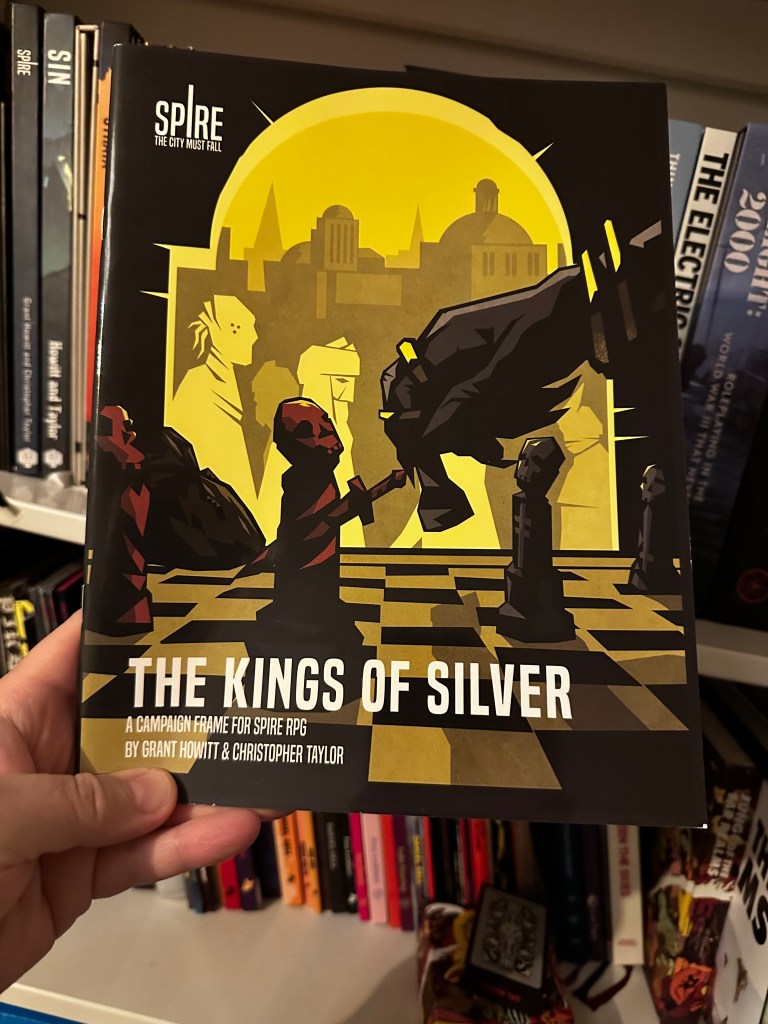
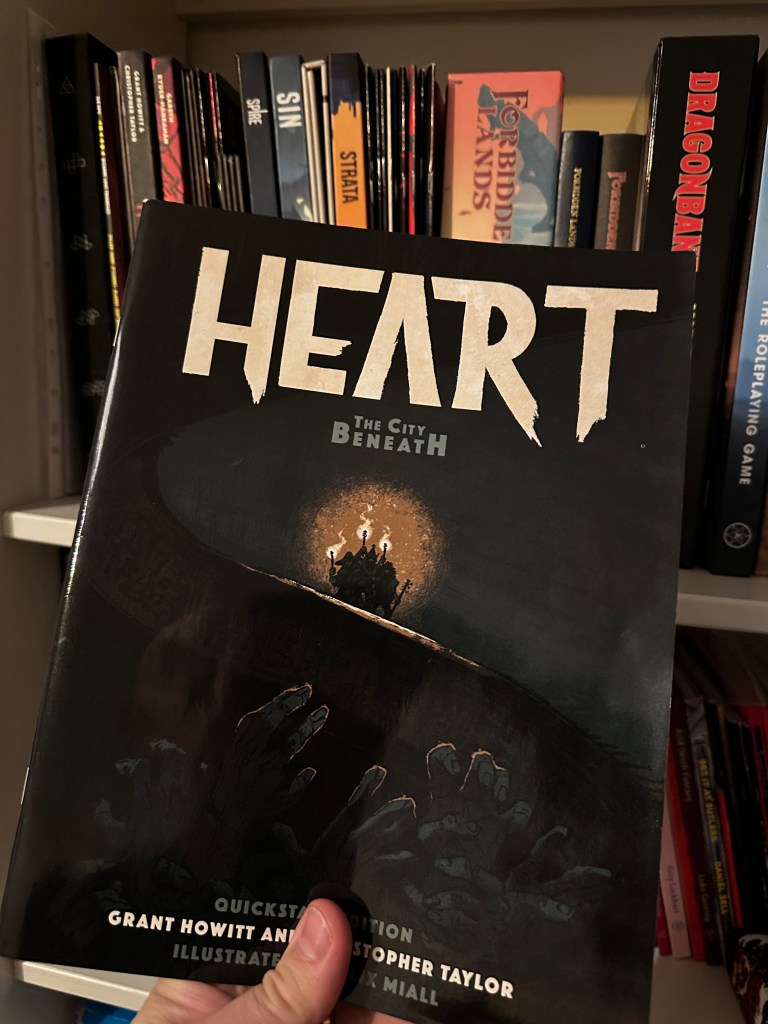
Resist the temptation to do anything other than read up on the specific areas the PCs are likely to interact with the next session and maybe jot down some NPC details/desires/stats. Resistance system games really thrive on improvising at the table and having the PCs drive the narrative forward with their actions and their fallouts. This is particularly true of Spire where most of the game occurs in NPC to PC interactions in my experience. In Heart, I think it’s a good idea to have some idea of the landmarks your PCs might end up in. In the last game of Heart I GMed, I made it specifically Vermissian themed so that I knew they would be visiting a lot of Vermissian stations on the way down to Tier 4.
Prewritten trad scenarios
I am thinking of the Dragon Age game I’m running right now but I think this is advice you can apply to most adventures that are presented in dozens/hundreds of pages in long dense paragraphs. Read the full adventure, then, read it again, but this time, take all the relevant information from each room description, encounter text or whatever and transcribe it into something more easily digestible and more useful at the table. I use bullet points as that’s what I’m used to. I also usually take the more relevant enemy stats like Health, Defence and Armour Rating and note them too. This is me applying the lessons I learned from the mistakes I made as a kid and applying them to the published adventures written by professionals, I realise that. And maybe that’s presumptuous of me, but, hey, it works. The second time you read it, you shouldn’t do it all at once. Just make those notes between sessions.
Conclusion
Prep can take many guises. It will be different for every GM. A lot of people use all sorts of apps and other technical solutions. All valid, but all I ever use is a wod processing app and a few dice. Whichever methods you use are probably going to be right for you, even if it takes you a while to figure out how you should do it.
So, how have I done with that list from earlier in the year? At the time I wrote that, on the 28th July, I thought, Time-shmime! Who needs it?! Not me, that’s who. I’ll breeze through this entire list of ten frikkin’ games. But, of course, that was assuming a lot.
Assumptions
The first assumption that was happily crushed was that we had a smaller number of GMs willing to run sessions in our little community, Tables and Tales. Up until then, only three of us had run anything so I assumed that would continue. When a fourth and even fifth GM raised their hands to take the helm, I was delighted. That’s what I had always wanted in our space. From what I can see, if GMs were water, most RPG communities would be dying of thirst. Even in the much larger Open Hearth community, you tend to see the same dozen or so members announcing new games all the time, despite there being a membership in the hundreds. Given the size of Tables and Tales, five active GMs represents a pretty large percentage of our total player-base. On top of that we have had a couple of board game nights too. The long awaited and pretty fun Darkest Dungeon board game is, honestly, very close to the video game (actually, I’m told by friend of the blog, Media Goblin it’s closer to Darkest Dungeon 2 in rules) but also pretty close to an RPG so we gave it a go.
Assumption number 2: I have a pretty stable schedule, which meant that I could run games almost every night of the week if I had the wherewithal. And there were weeks there when I was playing, either as GM or player, in four or five sessions. Turns out that was not sustainable. For one thing, obviously, I started writing this blog, dear reader. Now, don’t get me wrong, I love doing this and it’s not like it takes that long, but if I want to blog, I need to do it in the evening (even though I am typing this on the train to work right now because its a busy week for me and my evenings are taken up with pre-Christmas socialising.) Between that and various other work and family commitments that came up, it was simply impossible to maintain that sort of schedule.
Reality
Even taking these points into account, I managed to play a lot of games in the last few months, just mostly not the ones I expected to. So, let’s have another look at that list:
GM
Tales from the Loop – Mascots and Murder – Short Campaign – Nope, didn’t happen. This one is still simmering away on that back-burner, ready for promotion to the front of the stove-top any time now. It had to be shelved to make way for other games and other GMs. Like I said earlier, I was perfectly happy to do it.
Dungeon Crawl Classics – individual modules – Haven’t managed to get any of these to the table yet, I’m afraid. But, I have a plan for this one. I have had to re-arrange my schedule a bit to allow it. Our local game shop, Replay, has been undergoing a big refurbishment in the last few months. Once it’s done, they will expand their number of gaming tables a lot and I am hoping to get in there on a Wednesday night to run some DCC Level 0 funnels. My preference would be to get some newbies to sign up for these sessions and hopefully gain some new members for Tables and Tales in the process. The new year will be the perfect time for this, I think.
More Troika! – one-shots – Achievement unlocked! Although, technically, it was more like two sessions of the same game, rather than multiple one-shots. I did a blogpost on it! We went to Whalgravaak’s Warehouse, one of the Location based adventures made for Troika. So far it has been very fun. It’s a dungeon crawl, there’s no doubt about that, but it’s a warehouse. And the rooms and creatures and general vibe are beautifully weird in the way only Troika can do it. So far, the PCs, a Monkey Monger, a Wizard Hunter and a Gremlin Catcher (there was also a Landsknecht who has since moved to Spain) have murdered the Cacogen they were sent there to murder, made friends with a thin mutant, captured entire detachments of microscopic soldiers in gremlin catching jars, discovered a desert other-world on top of the warehouse and, um, set fire to a load of old rope. Brilliant craic altogether.
Death Match Island – one-shot – You know what, I just completed a rewatch (maybe not “rewatch” since I never watched the entire thing in the first place) of Lost, the whole thing. All six seasons. All 5000 episodes. I think I was in mourning for the lost Death Match Island one-shot that should have been. This one was a scheduling issue. Those of you out there who play RPGs (and if you don’t and you’re here, welcome! You must be confused…) will be aware of the difficulties one often encounters in getting four or five adults together in the same room at the same time. Honestly, I am surprised this problem doesn’t come up more often in Tables and Tales. Anyway, having just finished that Lost marathon, I am 1000% ready to play this game. It’s not quite the same and it would definitely not run for 678 sessions like Lost would if it were an RPG but it has the same heart and the same mystery box feel to it. And I want that. That’s what I want.
The Wildsea – campaign – Just go read my blogpost on My First Dungeon’s campaign of the Wildsea. I desperately want to play this game. Honestly, whether I got to be a player or a Firefly, I would be excited. But, really? I’m not sure when I was going to fit this one in this year. Another campaign? Dunno what I was thinking.
DIE RPG – one-shot – I finished listening to the My First Dungeon Wildsea campaign and just started listening to the DIE one. They have a great episode that is mainly Kieron Gillon being effusive for an hour about his, admittedly very cool, game and I enjoyed it. But then I got into the Session Zero episode and I immediately wanted to play it. I want to run this for my friends and have them play real-world people with real-world problems working it all out it in a fucked-up fantasy world of their own creation as characters of their own creation. I really want it. Maybe next year.
Player
Old School Essentials – campaign I think – So this one has not happened yet. I think it is, at least partly, due to the fact that Isaac, of Lost Path Publishing has been running other shit like crazy in the last few months instead. I hope it wasn’t my OSE character creation post that put him off running the game (I’m pretty sure it wasn’t. I’d really be flattering myself to imagine I had that much influence on anyone.)
Heart: The City Beneath – Open Hearth campaign – Our GM, Mike, brought a whole bunch of us together (There were six PCs at the start) to hopefully save the landmark known as Nowhere from being consumed by the Heart. This was a real learning experience for me as it was only my second time as a player in the Resistance System (see the section on Magus, Pike and Drum below for my first experience.) I discovered that, if left to our own devices, players (for “players” read “Ronan” but not just “Ronan”) are apt to take the hand when there is no form of initiative to govern the order or frequency of actions in combat. It was a lesson learned early in the campaign due to one player’s proper and timely use of Stars and Wishes after the very first session. Saying that, I had a brilliant time playing my Incarnadine, Priest of the God of Debt, alongside a Heretic, a Cleaver, a Deep Apiarist, a Vermissian Knight and a Deadwalker. We often had opposing desires and drives, which made the role-play fun, and the GM came up with lots of weird and interesting situations, NPCs, enemies and locations for us. Forgotten-Frost-Remembered, my Aelfir Incarnadine, got to reach Tier 4 of the Heart and retire(!) at least in his head.
Call of Cthulhu – Masks of Nyarlathotep – campaign – Not really sure if this was anything other than wishful thinking when I wrote this, to be honest. This post explains that it was always going to be a long shot to get this campaign started again. But someday, I would love to get Grant Mitchell back on the trail of the mystery in this thoroughly classic campaign.
Magus, Pike and Drum – Playtest – This is Isaac again. He has a great basis for a Resistance System game set in the English Civil War that never was, and this is it. There were four of us gathered around the table for this playtest at the end of the summer. I genuinely had so much fun with it. Gráinne was my character. She was an Irish noble and she had some very fun abilities (some of them were a bit too fun with a few too restrictions, it was decided, as a result of this playtest.) What was important in the game is that we solved the mystery in very short order, after scaring the shit out of the mayor and not blowing up the town. But what’s really important is that we provided Isaac a lot of valuable feedback to feed back into his new game. Can’t wait to play this one again, hopefully in the near future. I hope to write a lot more about this game as it develops.
Conclusions
So there you go. Three out of ten. Not great. But! I experienced so many other games instead of the ones I didn’t get to in that post! And I got something out of all of them. I’ll tell you about them in the next post (or the one after if I don’t have time to write the rest of the week and just post some more old fiction on Sunday instead.)
This is always the first question I ask myself when starting a new game. It doesn’t really matter if it’s a one-shot, a short series of sessions or an open-ended campaign; the beginning sets the tone for the whole thing. If you start your PCs off trapped in a haunted house with no prospect of escape and a murderous ghost hunting them, you have made a pretty firm statement about the kind of game you are all there to play (or your players will see it that way at least.) Equally, if you start with a scene from each character’s home life, interacting with their family members and discussing their everyday problems, you are establishing a sense that this is the type of game where that kind of thing will happen again (or you should be.)
You can use the start of your game to establish a theme too. Maybe its a horror game involving frog mutants who want to feed your players souls to their unholy tadpoles, you could start in their camp at night, describing a croaking, ribbiting chorus that grows in intensity and volume through the night, ensuring that none of the party get any rest. Embed in the cacophony the true name of a PC and you have the potential for fear and suspicion if not outright horror.
Control
Three sessions in, there’s one PC who has decided to attempt a bloodless coup on the streets of the town at the centre of your adventure, another who has set their heart on wooing one of your NPCs of lesser importance and a third who just wants to sit in the tavern and spread rumours about the sheriff being a cannibal. It can feel like you are out of the picture sometimes (and that’s not necessarily a bad thing, dear reader. The best sessions happen at the whims of the players.) At the start, though, you, as the GM, have control. It relates a little bit to the world building work you’ve been doing, or not doing. After all, you made up the place they start in, or at least, you read about it in a published sourcebook or module and interpreted it as you saw fit. You know the places involved, you know the relevant NPCs, you know the setup, even if you have no preconceived notions about how it’s all going to go down in the sessions to come. With that knowledge, you start with an advantage, for the time being, at least. Before long, you have to hand things over to your clever and inventive players and they’ll have burnt down half the Silver Quarter while introducing the roller skate to Spire.
But, more important than your behind the scenes knowledge, is the situation they start in. I’ve mentioned in medias res beginnings in the past. Frame the scene they find themselves in and make it tense or truly fantastical or horrific or action-packed or just evocative. Start in the middle! It is the one opportunity you have to do this. You set it all up and see how they react to it.
In the Death in Space one-shot I ran a few months ago, I started them off being ejected from cryo-sleep as they approached the main adventure location, a mysterious space-station. They each got to have a moment to describe their characters and I explained they were seeing the debris field surrounding the remains of a planet that was destroyed in the recently ended wars and that they had to guide the ship through it! But then I used a series of flash-back scenes to explain what they were even doing there. I don’t think that’s even the first time I have used the in-medias-res/flashback combo to get into the action as quickly as possible while also providing some much-needed context. It worked pretty well as I recall…
It’s a fun way to get them all rolling dice quickly and failing quickly too, which is usually pretty important in a one-shot horror game.
Intros
Tales from the Loop wants you to put the kids, the players’ characters, at the fore from the get-go. And deservedly so. These kids are created to have people who are important to them, problems that consume them in their regular lives, drives that motivate them and things they’re proud of. They’re rich and three dimensional characters before they ever get to the table. So, the game insists that you start a mystery (what TftL calls adventures) with a scene belonging to each and every kid in their home life or at school, with NPCs that are important to them, family, friends, mentors, that sort of thing. This is where the players get really invested in their characters. They have genuine and heartfelt interactions with the people of significance to them and they begin, immediately, to find their voice and their personality. It’s probably the best thing about a game that has a lot of good things going for it.
I stole the technique for the second campaign I ran in my Scatterhome world. It took place on the northern island of Erlendheim. The PCs all knew each other at the start since they began at 8th level and, in the fiction, had an adventuring party for many years, long ago. The adventuring life long behind them, I asked them to describe their mundane lives as a farmer, an advisor to the Jarl, a guard sergeant and a village priest and made sure to include people and places that were important to them. I focused on who and what they loved because I knew I was about to fuck with all that. I had learned a lesson, you see, dear reader. Oh yes. For those of you keeping studious notes, you will recall I described the start to the first campaign in Scatterhome, when I drowned the island nation and erstwhile homeland of the PCs, Galliver, off-screen, before the start of the game. They didn’t care about it, and I can’t blame them. I had never given them a reason to. In Erlendheim, they were more focused on saving the druid’s kids, ensuring the safety of their families and homes, protecting their futures. Tug on those heart-strings, GMs.
Scenic
There is a subtle art to the transition from the start of an adventure to the meat of it. Or there is if you don’t subscribe to the philosophy that adventures should happen in scenes.
Usually, the end of a scene is obvious in a movie or tv show. It normally shifts perspective or location or time. So, if you want to do something similar in a game, someone needs to just say it’s over and move to a new scene. Sometimes that’s the palyer who wanted the scene but usually its the GM. I would rarely have done something so bold as to declare the end of a scene in a game of D&D as a more trad DM but it’s so freeing to do it! Just like you framed that first scene at the beginning of your game, you soon realise that you can frame and end any scene at any time (within reason.)
Looking back at the Tales from the Loop example from earlier, I noted that each kid gets a scene about their home life. Together with the player, you describe the kind of scene it is going to be, improvise it and end it when it feels right. When you move on to the investigation part, you can cut to a scene with all the kids in it, where they are staking out the suspicious machine that appeared in the nearby field overnight to see who is responsible for it and end that scene when they have gotten everything from it they can. Easy.
Using scene structure is even built into some games. Spire and Heart use scenes, situations and sessions like other games use rounds, days and long-rests. They are left deliberately vague but some powers and abilities work only within the current scene or situation. I have embraced the vagueness and it didn’t even take any adjustment. It was instinctive.
In the next post I am going to write a bit about endings, which, in my experience, are so much more difficult.
How do you like to start your games, dear reader? Let me know in the comments.
Maybe I’m giving away a bit too much with the title of this scenario. What do you think? I mean, look, here’s the thing; when we set up Tables and Tales a few months ago, I was curious about the kinds of things new members were into. One of them said they liked Indie Mascot Horror. Now, let me tell you, dear reader, I did not know what that was. Since then, I have learned that it refers to video games like Five Nights at Freddie’s and Poppy’s Playtime. I had obviously not played these games but I looked into them a bit and got the vibe. I thought about the types of RPGs that would be good for those themes and tropes. It did not take me long to decide on Tales from the Loop.
Tales from the Loop
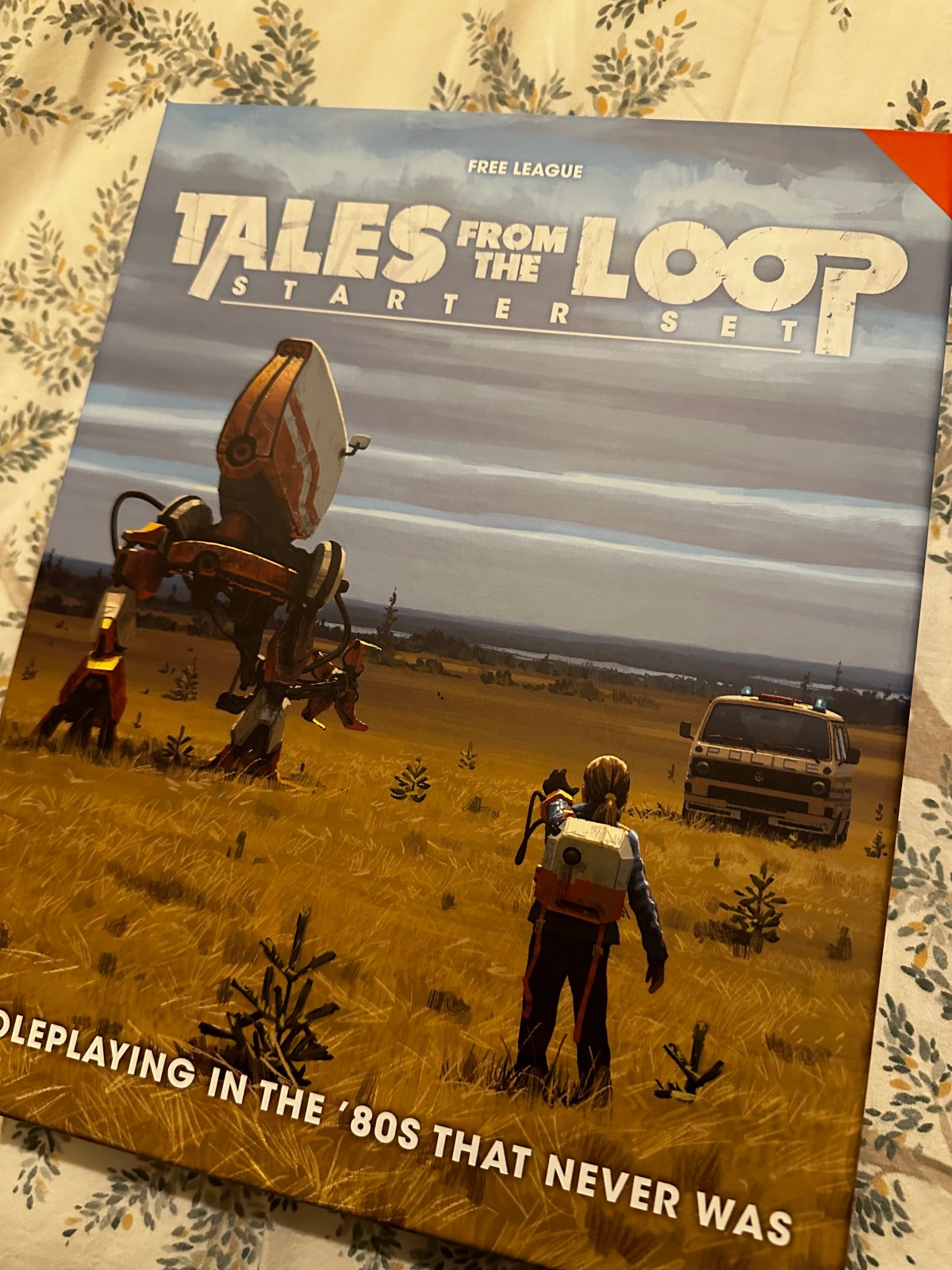
If you have never seen the artworks of Simon Stålenhag, do yourself a favour and go check them out. I have taken some photos of his work from his art book, Tales from the Loop and embedded them here but they don’t do the work justice. When I first encountered his work several years ago, it filed me with wonder. He created such a realistic depiction of a past that was largely recognisable to me from my own childhood, interspersed with or shockingly dominated by futuristic architectures and sci-fi wonders. His work excited my imagination like only RPGs had in the past. So when I discovered that Free League were producing a Tales From the Loop game, it didn’t take me long to pick it up. It took a little longer to get it to the table but when I did I discovered that the players loved it.
Tales from the Loop is a game about the 1980s that never was. It posits a world in which some astounding scientific breakthroughs occurred in the ‘50s and ‘60s so that, by the time in which the game is set, they are not considered so strange. You have your robots and your hovercraft and your infinitely renewable energy. But most of that stuff is considered mundane in Stålenhag’s world. Not only that, they exist alongside the ‘80s mainstay technologies like Walkmans, cassette tapes, VCRs and Soda Stream. In Stålenhag’s artwork this created some beautifully uncanny images. Most were set in the region of Sweden known as Mälaröarna, where the Loop project was based. This is where the world’s largest particle accelerator was built. Though it is not necessarily directly responsible for the many strange occurrences in the region, the people who populate such a scientifically rarified place usually are. Scientists and administrators and students flocked to the region and started families there. So many of Stålenhag’s paintings involved kids; a toe-headed child threatening an old Volkswagen van marked “Polis” with a giant robot under his control; a pair of woolly-hatted kids digging in the Swedish snow and gazing back at their homes, dwarfed by the cyclopean, other-worldly cooling towers used to release heat from the core of the Loop itself, the Gravitron; a little kid in cold weather coveralls leading his grandfather through the snow to a mysterious sphere, left abandoned in the countryside, its purpose and provenance forgotten. These were the inspirations for the RPG.
The game came out at the height of the popularity of Stranger Things, which helped it gain a lot of traction I think, and then it even had its own, unfortunately not so popular, spinoff TV series, which I, at least, loved.
In the RPG you play kids between 10 and 15 years old. You get to choose a Type from such classics as the Computer Geek, the Hick and the Weirdo. You also have to choose some really fun things like your Iconic Item, your key relationships and your favourite 1980s song.
Once you have your Kid, you and your friends can go out and investigate weird shit on your bikes. Stuff like, where are all the birds gone? What are all the adults doing gathered around that weird machine in the field? What’s that dinosaur looking claw print in the snow? You know, normal kid shit.
Roll mechanics
Tales from the Loop uses a version of the Year Zero engine, and, in fact, it was the first game I played using that system. It’s really straight-forward and intuitive, easy to learn and resolves situations quickly. “Situations” are generally and collectively referred to in the text as “Trouble” with a capital “T,” appropriately enough. For many, the Trouble you got into and out of when they were kids are some of the most enduring and treasured memories. In the game, you combine your ability dice and your skill dice into one dice pool and roll them all to try and get at least one 6. Since you only use d6s in this game, that’s the highest you can roll. The more 6s you roll the better, generally.
The only issue my players and I had with the rules is the Extended Trouble mechanic. The way this works is that, during the final showdown, encounter or whatever, every kid says what they are going to do and the GM tells them how many successes they will need to succeed fully. Then one player rolls all the dice in one enormous pool. Generally, if they don’t succeed fully but they still have a few successes, they might achieve what they were trying to but one or more kids will earn conditions or even become Broken. But, in play, we found this approach to be unsatisfying. Each player wanted their own cool moment to roll for and the all-or-nothing approach meant that they couldn’t attempt to take any rectifying actions if and when they saw things going wrong. Anyway, suffice it to say, we won’t be using the Extended Trouble rule next time.
Mascots and Murder
Here are the very basics of the scenario I have planned: Although the first Loop was in Sweden and much of the book is written as though it is the default setting, they do actually provide a second potential setting in it. That’s Boulder City, Nevada, the “Best city by a dam site,” which is a reference to its proximity to the Hoover Dam. There is another Loop in this region and all of the scenarios presented in the core book can be transposed very easily to the desert, believe it or not. This is where the kids in this scenario will be from. It is summer in Boulder City so it’s going to be so sizzling hot that you can fry an egg on the sidewalk. This will be a nice change as all the other Tales from the Loop games I have played were set in Sweden in autumn and winter.
Some teens have gone missing from Boulder City. Although their parents don’t seem too worried about it, our intrepid Kids are going to solve this mystery as they track down the source of the eerie, carnival-like music out in the Nevada desert and figure out what the connection is.
I have had fun writing this scenario, even though I have gone over it and over it to get it right. So, it’ll be ready to play in a few weeks.
The Tales from the Loop core book has some very useful advice for writing and structuring a scenario for it yourself. As long as you stick to that, you’re unlikely to go wrong. This is not actually the first one I have written myself, using these guidelines and, I can tell you, it works really well.
Have you played Tales from the Loop? What did you think of it? If you had to run a particular game for Indie Mascot Horror vibes, what would it be?
Having managed to get through so many games in the first 7 months of the year, you know what? I reckon, if I really make an effort, I think I can fit in up to ten more different games before New Year’s Day. I’m particularly looking forward to a few more one-shots. For those of you who’ve been keeping an eye on this space over the last couple of weeks, you’ll know I have a soft spot for them.
Lists 4
Here we go. Like previous lists, I’m just going to split them between those I want to run and those I want to play in.
To be honest, a bunch of these games are ones I already have in the schedule. I’m hoping to get Tales from the Loop started in a few weeks and I have Death Match Island in the calendar for next Friday. Even the ones I want to play in include a couple that are almost good to go.







, do yourself a favour and go check them out. When I first encountered his work several years ago, it filed me with wonder. He created such a realistic depiction of a past that was largely recognisable to me from my own childhood, interspersed with or shockingly dominated by futuristic architectures and sci-fi wonders. His work excited my imagination like only RPGs had in the past. So when I discovered that Free League were producing a [Tales From the Loop game](https://freeleaguepublishing.com/games/tales-from-the-loop-rpg/), it didn’t take me long to pick it up. It took a little longer to get it to the table but when I did I discovered that the players loved it.
Tales from the Loop is a game about the 1980s that never was. It posits a world in which some astounding scientific breakthroughs occurred in the ‘50s and ‘60s so that, by the time in which the game is set, they are not considered so strange. You have your robots and your hovercraft and your infinitely renewable energy. But most of that stuff is considered mundane in Stålenhag’s world. Not only that, they exist alongside the ‘80s mainstay technologies like Walkmans, cassette tapes, VCRs and Soda Stream. In Stålenhag’s artwork this created some beautifully uncanny images. Most were set in the region of Sweden known as Mälaröarna, where the Loop project was based. This is where the world’s largest particle accelerator was built. Though it is not necessarily directly responsible for the many strange occurrences in the region, the people who populate such a scientifically rarified place usually are. Scientists and administrators and students flocked to the region and started families there. So many of Stålenhag’s paintings involved kids; a toe-headed child threatening an old Volkswagen van marked “Polis” with a giant robot under his control; a pair of woolly-hatted kids digging in the Swedish snow and gazing back at their homes, dwarfed by the cyclopean, other-worldly cooling towers used to release heat from the core of the Loop itself, the Gravitron; a little kid in cold weather coveralls leading his grandfather through the snow to a mysterious sphere, left abandoned in the countryside, its purpose and provenance forgotten. These were the inspirations for the RPG.
The game came out at the height of the popularity of Stranger Things, which helped it gain a lot of traction I think, and then it even had its own, unfortunately not so popular, spinoff [TV series](https://en.wikipedia.org/wiki/Tales_from_the_Loop), which I, at least, loved.
In the RPG you play kids between 10 and 15 years old. You get to choose a Type from such classics as the Computer Geek, the Hick and the Weirdo. You also have to choose some really fun things like your Iconic Item, your key relationships and your favourite 1980s song.
Once you have your Kid, you and your friends can go out and investigate weird shit on your bikes. Stuff like, where are all the birds gone? What are all the adults doing gathered around that weird machine in the field? What’s that dinosaur looking claw print in the snow? You know, normal kid shit.
## Roll mechanics
Tales from the Loop uses a version of the Year Zero engine, and, in fact, it was the first game I played using that system. It’s really straight-forward and intuitive, easy to learn and resolves situations quickly. “Situations” are generally and collectively referred to in the text as “Trouble” with a capital “T,” appropriately enough. For many, the Trouble you got into and out of when they were kids are some of the most enduring and treasured memories. In the game, you combine your ability dice and your skill dice into one dice pool and roll them all to try and get at least one 6. Since you only use d6s in this game, that’s the highest you can roll. The more 6s you roll the better, generally.
The only issue my players and I had with the rules is the Extended Trouble mechanic. The way this works is that, during the final showdown, encounter or whatever, every kid says what they are going to do and the GM tells them how many successes they will need to succeed fully. Then one player rolls all the dice in one enormous pool. Generally, if they don’t succeed fully but they still have a few successes, they might achieve what they were trying to but one or more kids will earn conditions or even become Broken. But, in play, we found this approach to be unsatisfying. Each player wanted their own cool moment to roll for and the all-or-nothing approach meant that they couldn’t attempt to take any rectifying actions if and when they saw things going wrong. Anyway, suffice it to say, we won’t be using the Extended Trouble rule next time.
## Mascots and Murder
Here are the very basics of the scenario I have planned:
Although the first Loop was in Sweden and much of the book is written as though it is the default setting, they do actually provide a second potential setting in it. That’s Boulder City, Nevada, the “Best city by a dam site,” which is a reference to its proximity to the Hoover Dam. There is another Loop in this region and all of the scenarios presented in the core book can be transposed very easily to the desert, believe it or not. This is where the kids in this scenario will be from. It is summer in Boulder City so it’s going to be so sizzling hot that you can fry an egg on the sidewalk. This will be a nice change as all the other Tales from the Loop games I have played were set in Sweden in autumn and winter.
Some teens have gone missing from Boulder City. Although their parents don’t seem too worried about it, our intrepid Kids are going to solve this mystery as they track down the source of the eerie, carnival-like music out in the Nevada desert and figure out what the connection is.
I have had fun writing this scenario, even though I have gone over it and over it to get it right. So, it’ll be ready to play in a few weeks.
The Tales from the Loop core book has some very useful advice for writing and structuring a scenario for it yourself. As long as you stick to that, you’re unlikely to go wrong. This is not actually the first one I have written myself, using these guidelines and, I can tell you, it works really well.
Have you played Tales from the Loop? What did you think of it? If you had to run a particular game for Indie Mascot Horror vibes, what would it be?](https://thedicepool.com/wp-content/uploads/2024/07/img_3376.jpeg?w=1024)
, do yourself a favour and go check them out. When I first encountered his work several years ago, it filed me with wonder. He created such a realistic depiction of a past that was largely recognisable to me from my own childhood, interspersed with or shockingly dominated by futuristic architectures and sci-fi wonders. His work excited my imagination like only RPGs had in the past. So when I discovered that Free League were producing a [Tales From the Loop game](https://freeleaguepublishing.com/games/tales-from-the-loop-rpg/), it didn’t take me long to pick it up. It took a little longer to get it to the table but when I did I discovered that the players loved it.
Tales from the Loop is a game about the 1980s that never was. It posits a world in which some astounding scientific breakthroughs occurred in the ‘50s and ‘60s so that, by the time in which the game is set, they are not considered so strange. You have your robots and your hovercraft and your infinitely renewable energy. But most of that stuff is considered mundane in Stålenhag’s world. Not only that, they exist alongside the ‘80s mainstay technologies like Walkmans, cassette tapes, VCRs and Soda Stream. In Stålenhag’s artwork this created some beautifully uncanny images. Most were set in the region of Sweden known as Mälaröarna, where the Loop project was based. This is where the world’s largest particle accelerator was built. Though it is not necessarily directly responsible for the many strange occurrences in the region, the people who populate such a scientifically rarified place usually are. Scientists and administrators and students flocked to the region and started families there. So many of Stålenhag’s paintings involved kids; a toe-headed child threatening an old Volkswagen van marked “Polis” with a giant robot under his control; a pair of woolly-hatted kids digging in the Swedish snow and gazing back at their homes, dwarfed by the cyclopean, other-worldly cooling towers used to release heat from the core of the Loop itself, the Gravitron; a little kid in cold weather coveralls leading his grandfather through the snow to a mysterious sphere, left abandoned in the countryside, its purpose and provenance forgotten. These were the inspirations for the RPG.
The game came out at the height of the popularity of Stranger Things, which helped it gain a lot of traction I think, and then it even had its own, unfortunately not so popular, spinoff [TV series](https://en.wikipedia.org/wiki/Tales_from_the_Loop), which I, at least, loved.
In the RPG you play kids between 10 and 15 years old. You get to choose a Type from such classics as the Computer Geek, the Hick and the Weirdo. You also have to choose some really fun things like your Iconic Item, your key relationships and your favourite 1980s song.
Once you have your Kid, you and your friends can go out and investigate weird shit on your bikes. Stuff like, where are all the birds gone? What are all the adults doing gathered around that weird machine in the field? What’s that dinosaur looking claw print in the snow? You know, normal kid shit.
## Roll mechanics
Tales from the Loop uses a version of the Year Zero engine, and, in fact, it was the first game I played using that system. It’s really straight-forward and intuitive, easy to learn and resolves situations quickly. “Situations” are generally and collectively referred to in the text as “Trouble” with a capital “T,” appropriately enough. For many, the Trouble you got into and out of when they were kids are some of the most enduring and treasured memories. In the game, you combine your ability dice and your skill dice into one dice pool and roll them all to try and get at least one 6. Since you only use d6s in this game, that’s the highest you can roll. The more 6s you roll the better, generally.
The only issue my players and I had with the rules is the Extended Trouble mechanic. The way this works is that, during the final showdown, encounter or whatever, every kid says what they are going to do and the GM tells them how many successes they will need to succeed fully. Then one player rolls all the dice in one enormous pool. Generally, if they don’t succeed fully but they still have a few successes, they might achieve what they were trying to but one or more kids will earn conditions or even become Broken. But, in play, we found this approach to be unsatisfying. Each player wanted their own cool moment to roll for and the all-or-nothing approach meant that they couldn’t attempt to take any rectifying actions if and when they saw things going wrong. Anyway, suffice it to say, we won’t be using the Extended Trouble rule next time.
## Mascots and Murder
Here are the very basics of the scenario I have planned:
Although the first Loop was in Sweden and much of the book is written as though it is the default setting, they do actually provide a second potential setting in it. That’s Boulder City, Nevada, the “Best city by a dam site,” which is a reference to its proximity to the Hoover Dam. There is another Loop in this region and all of the scenarios presented in the core book can be transposed very easily to the desert, believe it or not. This is where the kids in this scenario will be from. It is summer in Boulder City so it’s going to be so sizzling hot that you can fry an egg on the sidewalk. This will be a nice change as all the other Tales from the Loop games I have played were set in Sweden in autumn and winter.
Some teens have gone missing from Boulder City. Although their parents don’t seem too worried about it, our intrepid Kids are going to solve this mystery as they track down the source of the eerie, carnival-like music out in the Nevada desert and figure out what the connection is.
I have had fun writing this scenario, even though I have gone over it and over it to get it right. So, it’ll be ready to play in a few weeks.
The Tales from the Loop core book has some very useful advice for writing and structuring a scenario for it yourself. As long as you stick to that, you’re unlikely to go wrong. This is not actually the first one I have written myself, using these guidelines and, I can tell you, it works really well.
Have you played Tales from the Loop? What did you think of it? If you had to run a particular game for Indie Mascot Horror vibes, what would it be?](https://thedicepool.com/wp-content/uploads/2024/07/img_3375.jpeg?w=1024)


 The Dice Pool