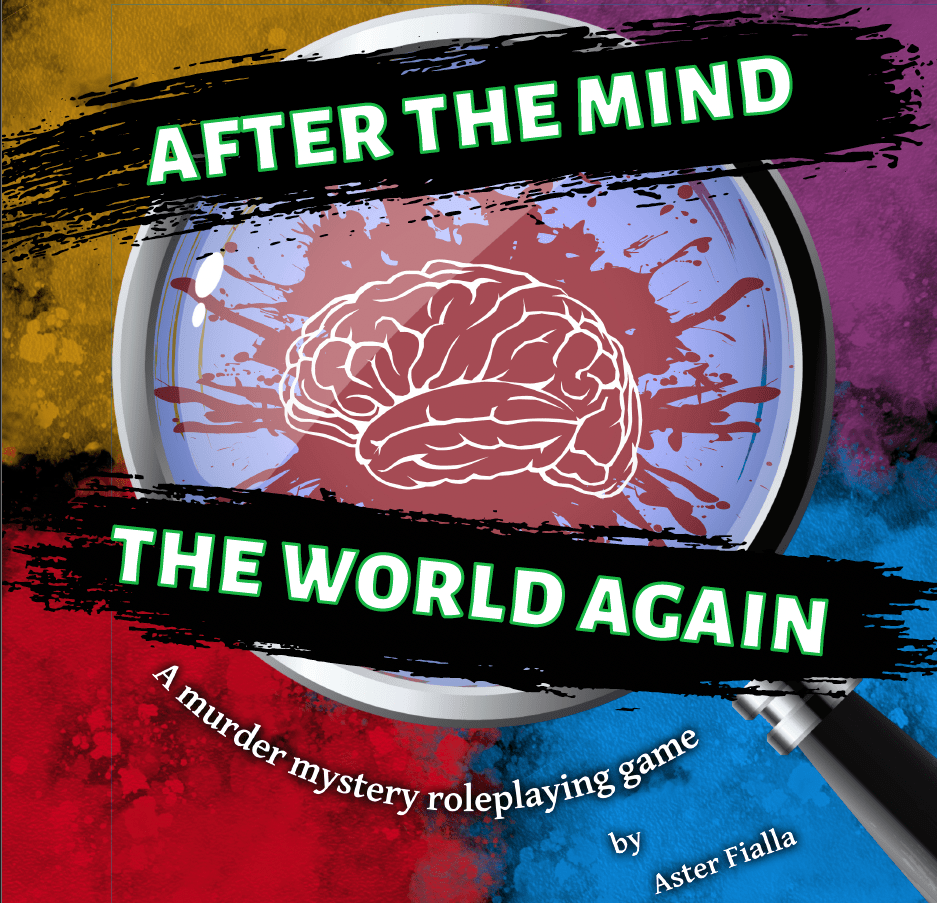
First Anniversary Blogpost: Crying at the Table

Each one of these moments brought tears to my eyes and became a part of the scene itself.

HBD TDP

That’s Happy Birth Day The Dice Pool, in case you’re wondering. Today is the dice pool dot com’s first birthday and I have invited a few friends over to jump in. It’s a pool party and a pot luck. So today, I have something a little different. For the first time ever, I have invited a guest author to the blog. Next week, I’ll have another. I’m hoping this will become a more regular occurrence as the blog grows and changes.

I’ll introduce the guest blogger in a moment but I just wanted to first take the opportunity to thank everyone who has supported this blog in the last year. A few of you have been here since day one and some of you are more recent readers; either way, I appreciate you. If you have only ever read a few words or if you somehow have the patience to peruse every post, you’re a scholar and a gentlebeing, in my book. I am still doing this for me, mainly. If that weren’t the case, I would have packed it in about eleven months ago. I find that, sometimes, when I’m writing for the blog, it focuses my thoughts about certain subjects like in my last post about the Quantum NPC. I refine my opinions while I type, like I did while writing my review of After the Mind the World Again. Doing this has been a challenge but in a good way. Still, it’s nice to feel the love sometimes too.

Now on to today’s special guest blogpost. Tom of the Media Goblin’s Hoard is a great friend and has been a stalwart of my gaming table for the last six years or so. They jumped at the chance to write a special anniversary blogpost for the dice pool dot com and they have chosen a wonderful subject for it, weaving an emotional narrative through retellings of some very memorable gaming moments. I also want to draw your attention to the artwork in this post, all of which was created by the talented and amazing members of our little RPG community, Tables and Tales.

Crying at the Table

by Tom Ball

Every week I will sit around the table with a group of friends, bring out the snacks and drinks, and live out some of the greatest stories I’ve ever heard. It’s in sharing and creating these stories that I feel a most genuine and strong connection with the others around the table, and it grows with each game played. Playing TTRPGs, I feel, has elevated my bond with my friends in a way I previously would not have known. It sounds cheesy but in the moments we play I feel myself step away from my own life and inhabit the life of my characters. Their ambitions, their bonds, their goal on the horizon and their friends and foes, all become real. For an evening we all step out of our lives into the stories of a shared adventure. Like all good things, it eventually comes to an end for the night and we step back into ourselves, the same as before except now with another shared experience together.

There’s a common phrase repeated by players in TTRPGs “never split the party” because we’re all stronger together. Our characters won’t make it to the end without each other no matter what background they come from, what they have done in their past, or even who they are as a person. In the end, they will rely on those closest to them in order to achieve the impossible. I feel this is a good analogy for life itself, I wouldn’t be where I am now without those closest to me and every week I get to see those I hold dear do the most incredible and creative feats.

Throughout the many stories told, there have been cheers of joy where what was thought to be an impossible feat becomes reality, and moments of tension so strong it’s impossible to cut through. Hidden between these are the instances of tender and emotional impacts that shake me to the core and have brought me to tears on multiple occasions. I am quite an emotional person as it is, and in the moments where the story shifts I look around and see everyone else, eyes glistening like a quiet lake on a star-filled night moments before the waters fall over the edge of the eyelid in a wave. We are all there riding that surf together. I’d like to mention below some of these highlights where I have been brought to tears and felt my bond with my friends grow ever stronger still.

A High Elf and his Humans

A High Elf Vermissian Knight, masked, sword by his side. Face unmasked in the top left corner.
Art by Isaac Wilcox @lostpathpublishing

Deep underneath the towering city of Spire is The Heart and an Aelfir, Crowns-Under-Heaven, suited in armour of scavenged trains, steaming and pumping to keep him alive. He was obsessed with the hopes of bringing back the ancient Vermissian transport network and he teamed up with two humans to complete this task. Though he loathed it, it seemed these two were just as close to the brink of insanity as he was. Perhaps they would make handy tools or servants, at least?

The Seeker, an esoteric man who spoke of prophecy in between mad ramblings. Once dead, now back alive dancing between purgatory and the mortal world, his own death now a forever companion, both of them cursed with an intoxicating song sung by The Heart itself beckoning him ever closer.

Riley Rollins, an eccentric person whose pursuit of arcane majesty and wanderlust for the winding deep corridors and depths of The Heart could take them and their companions to the very end, witness the impossible and entangle them with a Queen from another world…

The trio’s companionship was rocky, Crowns-Under-Heaven would expect the other two to act a lot like cannon fodder. Seeker would often vanish into The Gray, abandoning the group. On top of that, Riley had a connection to the Drowned Queen, an ancient and ferocious being hellbent on flooding the depths claiming The Heart as her own domain, becoming ever stronger. The team had a lot of growing to do together.

When the finale came around Riley went to face the Drowned Queen and Seeker went with Crowns-Under-Heaven to reactivate the network. However, he came face to face with his obsession and the truth. The Vermissian Network was doomed to die and fall into ancient myth. In a long forgotten city where the Heart lay just a cave away Crowns was gifted with the Heartseed for his travels, the last source of energy for the doomed network system. This source of wild and limitless power was able to power his armour and by extension himself to a status beyond living. His adventures underground and with his companions had changed his old steam powered heart. He would become an unstoppable force within the cities and tunnels below. travelling the winding depths saving those on the brink of Death and becoming a figure of myth and legend. He looked to his human companion and said his heartfelt goodbyes. Knowing this would be the last time that Crowns-Under-Heaven would lay eyes on his friends.

A Goblin and a Minotaur fall in love
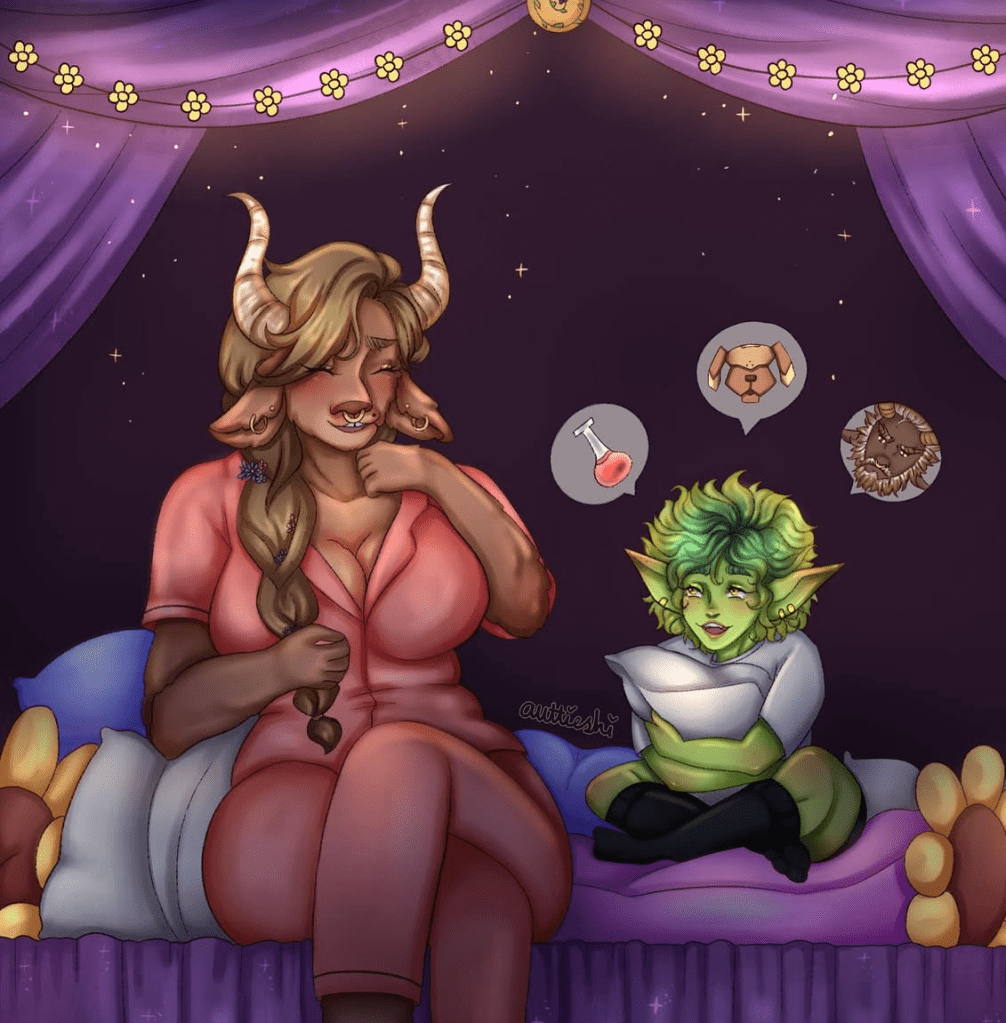
A goblin with big hair and a minotaur seated on a loveseat in a tent under the stars.
Art by @auttieshi (Instagram)

In the early days of her adventures, Vidris Pipp, a bombastic and spontaneous little Goblin, locked eyes for the first time with Birch Burley, a quiet, reserved and dignified Minotaur, and she knew she had fallen in love. The problem? Birch was the daughter of the leader of their town, Undercroft. Worse still, Vidris and her friends discovered that that self-same leader, Bryne Burley, had secrets to hide. He quickly became an adversary in their lives. The hope of a happily ever after between the two was far off. However, after a chance encounter of Vidris falling through the manor’s chimney and landing in Birch’s bedroom, they were able to have a one on one and quickly became close. It did not take long for the Minotaur to find that she shared the same feelings for the Goblin.

From there Birch became a part-time member of the party and ally to the group. However, their love for each other was to be kept secret. Vidris’ mother and grandfather already plotted to revolt against the leader alongside other citizens and Bryne was, at this time, not best pleased with Vidris’ meddling in his town and livelihood.

Months later dangerous secrets, far beyond the leader’s knowledge, of ancient cities were revealed far beneath the town of Undercroft. Birch was there side by side with Vidris as the party delved deep underground to face an ancient wizard that brought death to the world millennia ago. Meanwhile, the town of Undercroft and their new found allies in the peoples of the world around them prepared to face the encroaching wizard’s army of automatons.

Believing this could have been the last time Birch and Vidris might see their parents alive, they approached their parents, hand in hand and revealed their love for each other. Their parents accepted and acknowledged their love. Bryne gave Vidris his blessing and Vidris’s mother and Grandfather buried the hatchet with their leader and pulled them both in for a hug that felt to last a lifetime.

A family brought together
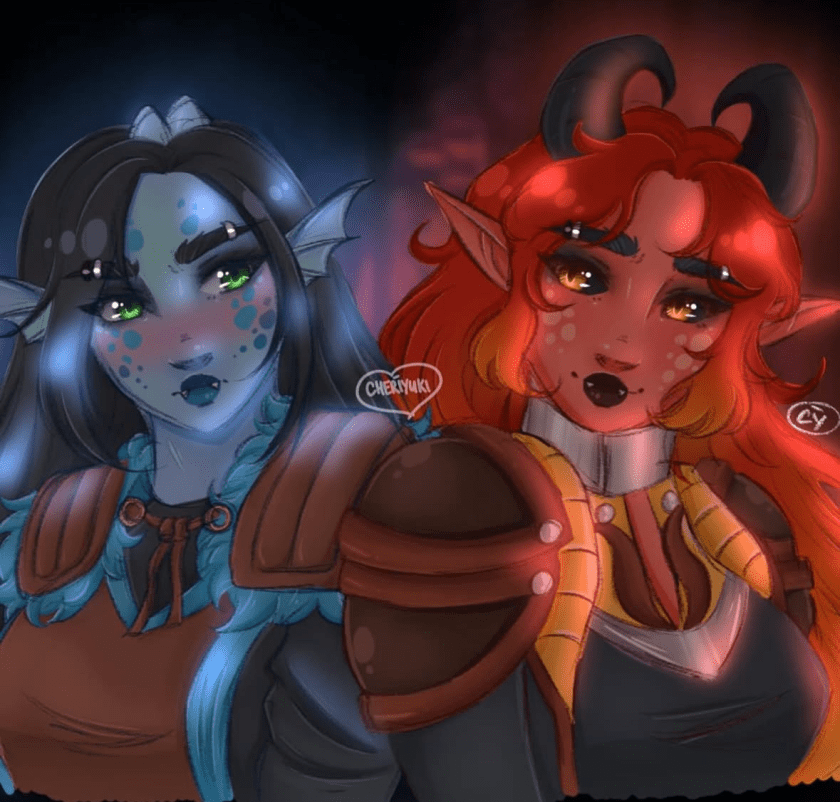
A femme tielfling in her two forms, one blue and aquatic, one red and demonic.
Art by @cheriyuki (Instagram)

Yulla Odasdottir nearly met her death at an incredibly young age when her father and mother wished to escape the forever storm that circled the island of Erlendheim. Believing the storm would destroy the island one day, they fled and were never seen again. Yulla, however, was saved by a mysterious entity from the deep dark depths of the ocean and sent back to the shores of Erlendheim, alongside the wreckage of her family’s boat. Her skin forever changed by this eldritch touch. What was once a rich scarlet topped with little black horns now shone blue, her face glistening with aquamarine scales and a large dorsal fin protruding from her head.

She was accepted by a fisherman and his wife who came across the wreckage and then raised Yulla as their own. Yulla grew up knowing she was not blood bound to her human parents. Her adventure would take place years later and through a series of extraordinary events the party would hear of a portal that lay on the seabed floor. This portal would be able to lead the party to Sigil, the city of doors, where the answers to their mysteries at the time would unravel further.

Once there, Yulla happened to hear the names of her parents. They were alive and were high up in a faction called The Believers of the Source. After a long search she was finally able to lay eyes on them, donned in the robes of The Source. There was a shocked moment of silence and they all slowly stepped forward, all of them in disbelief. Before the family embraced and wept.

Each one of these moments brought tears to my eyes and became a part of the scene itself. If I was crying real tears then my characters certainly were too. I like to think I put my whole heart into my characters and I wear that on my sleeve. I get lost in these stories and love every moment. It’s both a testament to the DMs who bring to life the world and to the players I’m with who build the most believable and real characters. I love being brought to tears by a game and I love sharing that moment with my friends.

I’m so thankful for those I get to share these adventures with.
Dragon Age: Duty Unto Death

The Basics

You might recall, dear reader, that last year, I threatened to put together a game of the Dragon Age RPG. I even wrote a couple of blog posts about the game which you can find here. Well, I’m back to tell you that I’m not just all talk. Sometimes I really follow through on plans to play games. Myself and four other members of Tables and Tales started playing the short scenario, Duty unto Death for the Dragon Age RPG a couple of weeks ago. We’ve had two sessions so far.

The first was mostly session 0 stuff. Only three of the players were able to make it to that one, but those that did make it all created their own characters. My post on Dragon Age Character Creation stood me in pretty good stead for this. We ended up with an Antivan Wayfarer warrior, a Dalish Elf (which my computer keeps autocorrecting to Danish Elf) rogue and a human Apostate Mage (who is short and hairy enough to pass for a dwarf, thus fooling the silly templars.) Our final player joined us for this week’s session so, in order to allow us to get started as quickly as possible, he selected one of the four pregens that came with the scenario. He chose another warrior, this time a Surface Dwarf who makes a decent tank.

The group has a varied experience of both RPGs and Dragon Age. We have at least one super-fan of the video games. They know the lore inside-out and knew exactly what they wanted to play when they signed up for the game. The others all have some knowledge and several have played Dragon Age Origins recently. As it turns out, the scenario I chose is set right before the events of that game and features at least one major character from it, so that’s worked out really well.

We’re using our newly renovated independent game store, Replay as the venue. I haven’t been back there with a group since about this time last year, but since they have greatly expanded their gaming space recently, and because they are open late on Wednesday nights I wanted to give it a go. As always, the staff were welcoming and the place was great. The renovations are still under way but they have done all they can to accommodate players all the same. I can’t wait to see it when it’s done.

Tabletop

Wil Wheaton's head and shoulders in front of the Tabletop logo on a red brick wall. He is a guy in his thirties with brown, short hair and beard. He is wearing a brown t-shirt with "the Guild" on it. The closed caption on the screen reads: "WIL WHEATON: In 1983, I played my first role playing game and"
A screenshot from the intro to Tabletop with Wil Wheaton.

Does anyone remember the Wil Wheaton Youtube show, Tabletop? It was part of the Geek and Sundry network for quite a while but it looks like the last video is about seven years old now. Anyway, it mainly focused on introducing people to board games but this one time, they got Chris Pramas, the creator of the Dragon Age RPG to write a scenario they could play on the show. So Wheaton wrangled up a bunch of his show-biz pals and they made two half-hour videos of it. This was eleven years ago so it was a pretty early example of an actual play. And it was really good! It taught you the basics of how to play the game and entertained you at the same time. You can find the first episode here, Tabletop: Dragon Age RPG. If you are one of my players and you’re reading this right now, please don’t click on that link!

The illustration is of three heroes, an elf with a bow, a dwarf with an axe and a human mage battling a horde of undead. The words Dragon Age are at the top and the title of the scenario, Duty unto Death is at the bottom where it also indicates that it is an adventure for characters of level 2-4.
The cover of the Duty unto Death adventure for the Dragon Age RPG.

So, the scenario he wrote for it was Duty unto Death. They released it sometime after the show went live. He has included in the published version a few notes on how the game went on the Tabletop show, where the players surprised him, how he improvised certain encounters, that sort of thing. They are fun and possibly useful little asides. It’s short, teaches the basics of the game’s rules well and has lots of Dragon Age flavour in it so it was perfect for my purposes. There are quite a few other published adventures for Dragon Age, but most of them were much longer and would have required a lot more prep time on my part, which I don’t have right now. Duty unto Death is about 8 pages long. It’s not especially involved and doesn’t get into some of the tenets of the game. There is not much in the way of exploration or, indeed, social encounters. But, I feel like it’s doing what it sets out to do very well.

So far, our heroes, a group of Grey Warden recruits, traveling in Ferelden, have been left to their own devices by their leader, Duncan. Fans of DAO will know the name. It was fun to drop it in the intro. Anyway, he had introduced them to the duties of the wardens, gave them a few lessons about darkspawn and the blight and that buggered of to the Circle of Magi. He asked the recruits to head to a village to meet another Warden from Orlais. On the way, they got into a fight with a couple of darkspawn, tipping them off to the possibility of a coming Blight.

Cunning stunts

The Combat Stunts table from the Dragon Age RPG. It has 15 entries including "Skirkish - You can move yourself or the target of your attack 2 yards in any direction for each SP you spend," "Defensive Stance - You attack sets you up for defense. You gain a +2 bonus to Defense until the beginning of your next turn," and "lethal bloW: You inflict an extra 2d6 damage on your attack." The table shows the Stunt Point cost of each stunt on the left hand side and has the descriptions on the right.
The Combat Stunts table from the Dragon Age RPG.

That first battle was very instructive. It was the first time any of us had really interacted with the rules so we were all learning a little. After the first round, they had barely scratched these two Shrieks. It felt bad, like the worst sort of D&D, attritional combat, except for the highlight of the mage casting Walking Bomb on one of the bad guys. In the second round, people started rolling doubles and the stunts started coming. Sandor, the Surface Dwarf, added two extra dice to his damage with a Lethal Blow, almost smashing one of the darkspawn, and we were away. The players started to play more tactically, utilising their minor actions to add bonuses to their attacks by aiming, or bonuses to their defence by getting their guard up. They were utilising their class features almost immediately. I was surprised and genuinely impressive to see how instinctively my, admittedly very savvy and clever players, took to the mechanics. The combat ended with that Walking Bomb paying off, the Shriek went boom and took the other one with it, covering the entire party in black gore.

By the time they got to their destination, and found themselves in another fight, this time with some Devouring Corpses making a nuisance of themselves in the inn, it felt like they were old hands. We had to leave it in the middle of that battle since Replay was closing and we all had to go home. All in all, it has left me wanting more! Can’t wait for the next session.

After the Mind the World Again

Disco Elysium

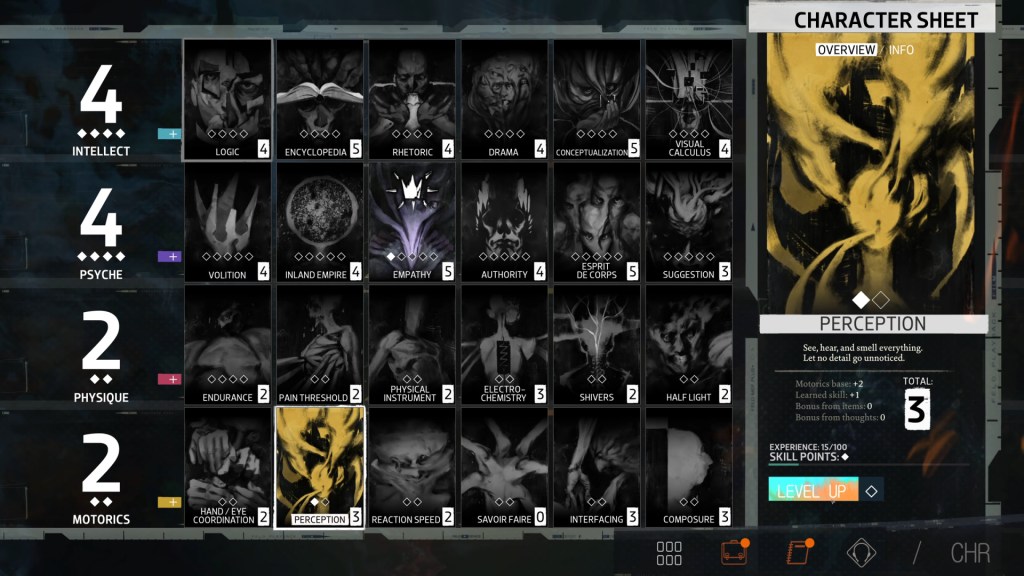
Have you played Disco Elysium from the much lamented Za/um studio, dear reader? It’s one of those seminal, cult-classic games that shifted my thinking on what video games could be. It’s a mystery game but, is it, really? Even if it is, is the mystery the one presented? Is the goal to find out who killed that guy hanging from the tree in the yard behind the Whirling-in-Rags? I suppose it is, but only up to a point. When playing it, you quickly meet and pass that point, much to the frustration of your ever-suffering partner, Kim Kitsuragi. Psychologically freed of the mundane requirements of your character’s job as a police detective, you can finally get to work on the real mystery; finding yourself. In many ways, the game is a protracted character creation session. You have to do everything from defining his political and romantic persuasions, coming to understand his opinions on art, exploring his relationship with vices of all kinds to just figuring out his name. How does the game handle these revelations? Well, largely through the personification of various aspects of your Detective’s personality. These take the form of his stats, Intellect, Psyche, Fysique and Motorics and the various skills associated with them. They speak to you, often in deranged or idiosyncratic voices representative of their own, niche fragment of his personality, and try to get you to look at the world from their highly rarified perspective or to act based on it.

It’s a unique game. It’s also a unique experience that left me with so many interesting thoughts and questions. One such question was, could you make a TTRPG out of this? The answer is, you can certainly try.

After the Mind…

The Character Sheet screen from Disco Elysium. It shows each of the four main stats, Intellect, Psyche, Physique and Motorics and all of the skills that are associated with them in a grid on a black screen with white text.
The Character Sheet screen from Disco Elysium. The TTRPG stats are not as complicated as this.

Last night, I got together with four other members of Tables and Tales to play a session of After the Mind the World Again by Aster Fialla. The front cover of the game uses the tagline, ‘A murder mystery role-playing game.’ This is not an inaccurate description. However, I feel like the subheading on the next page is getting closer to the facts:

A Disco Elysium-inspired murder mystery TTRPG about a
detective and the voices in his head

In this TTRPG, the inspiration comes not from the fascinating world or the city of Revachol, it doesn’t come from the richly drawn characters of the video game, or even its ubiquitous politics. It comes, instead, from the essentials of the gameplay. In other words, the shit that’s going on in the Detective’s head and how it affects the world around him. You see, this is a GMful game that requires five people exactly, one of which is the lone player with the other four acting as GMs. Each GM represents one of the four stats from Disco Elysium, Intellect, Psyche, Fysique and Motorics. They are collectively referred to as the Facets. One of their responsibilities is to describe various features of the world the Detective moves through. Intellect has responsibility for nerdy people, art pieces, journals, etc. Meanwhile, Fysique gets stuff like buildings, a good strong state, and brawny folks.

At the start of the game, the player comes up with a name, pronouns and presentation for their Detective, as well as their role (they might not be a cop, but a PI or an insurance adjuster or something else.) Each of the Facets also gets a turn here, though. Psyche gets to describe the Detective’s face, while Motorics comes up with aspects of their style and an unusual object in their possession, for instance. I found this very fun, as did everyone else at the table, I think. I even commented that having others make your character for you in other RPGs could be just as fun!

Once that’s done, each of the Facets answers a couple of questions designed to form a baseline for their relationships with other Facets at the table. After the Mind the World Again is Powered by the Apocalypse, so this sort of character building question should be familiar to anyone who has played a game like that before.

Then they get started making the Neighbourhood. You go around the table, starting with the person who most recently played Disco Elysium, and get everyone to answer one of the five questions presented in the book that should give you an idea of the type of area this murder has taken place in.

Once you’re done with that, the Detective tells us a little about the victim and then each of the Facets introduces a piece of evidence from the crime scene. Intellect tells us about any Prior knowledge that’s relevant to the situation, Psyche describes a Person of Interest at the scene, Fysique comes up with a Landmark, in this case, where the murder occurred, and Motorics gets to reveal a clue, something tangible at the scene.

From that point, the Detective starts the investigation, describing what they are doing in the fiction, triggering particular Moves, using the Facets’ stats to make rolls and making Deductions in an effort to solve the murder. This is in line with the Detective’s Agenda:

  1. Explore the world to its fullest.
  2. Make the most of your Facets.
  3. Play to find out the truth.

This is complicated by the fact that each of the Facets wants the Detective to act in different ways, offering sometimes conflicting options and sabotaging each-others’ efforts as they try to have the greater influence on the sleuth and the investigation. Facets’ stats can be boosted or reduced in various ways, often by the actions of the other Facets. Its important to note that the Facets’ Agenda is not focused on solving the murder, rather than constructing an interesting experience:

  1. Create an intriguing world for The Detective to explore.
  2. Highlight the differences between the Facets.
  3. Play to find out what happens.

The Detective investigates, and the Facets Declare Evidence as particular features are described in the world. It’s up to the Detective to combine two pieces of evidence to Make a Deduction. When it comes to that point, they ask the Facets for explanations as to how they fit together. Whichever Facet’s explanation is chosen is the truth and the Facet gets a +1 to their stat, while also getting the opportunity to reduce the stat of another Facet by the same amount.

The investigation is structured into a Deduction Pyramid, which is split into four tiers. On the bottom tier, there should be eight pieces of evidence. These should be combined when the Detective Makes a Deduction so that, you end up with four Minor Deductions on the next tier up. These Minor Deductions should then be combined to come up with two Major Deductions on the penultimate tier. Finally, those Majors need to be combined to come up with the Solution to the murder, sitting right there at the top of the Pyramid.

There are several other mechanics in the game, including one to ensure that the Detective does not simply always choose the explanation of the same Facet all the time, which is clever. A Facet’s stat cannot go above +3 or below -1. If that does happen, the Facet gives the Detective a Condition and goes back to the default value of 1.

…the World Again

A screenshot of the aftermath of the Detective from Disco Elysium punching a twelve year old kid. The scene is in the yard of the Whirling in Rags hostel. A man in a green jacket and yellow flares stands over a prone kid who he just punched. Kim Kitsuragi, dressed in an orange jacket and brown baggy, tapered trousers looks on.
A screenshot of the aftermath of the Detective from Disco Elysium punching a twelve year old kid.

None of us had ever played a game quite like this one before. Obviously, some of us had played PBTA games in the past, so the mechanics were nothing frighteningly new. At points, I even felt echoes of a game of Avery Adler’s The Quiet Year that most of us played last year as we took turns describing the world around our Detective. That Detective was an amateur sleuth named Bruce with a fabulous moustache, a flight jacket, an obsession with whiskey and a curious ability to identify any wooden model aircraft he might come across.

But, sharing GMing duties with three others at the table is a unique and sort of chaotic experience. At the start, it’s actually a little difficult to get into gear. I was playing Motorics and I found I had to be constantly checking my playbook sheet to remind myself what features of the world were within my domain, what my GM Moves were and when I should use them. There are features in there that you might not expect so you have to watch it and you can’t use your GM Moves just whenever. Since all four of us Facets were feeling like this, it kind of stuttered into life as a session, once the character creation bit and the initial set-up of the mystery were done. Meanwhile, Bruce, played ably by relative TTRPG noob, Jude, had to come to terms with the fact that, when it came to any of the really important decisions, he had to give up control and ask the Facets for options before settling on one version of the truth or selecting a course of action.

As we got into the flow of it, though, and as some of us became more lubricated by the liberal application of fine Spanish lager, we found the conversation that was the game began to come much more instinctively. We were interacting with the mechanics and deliberately fucking each other over for stat points, while Bruce began to explore the small, dead silent village of Battersfield and investigate the murder of local baker, Barbara Devons. Evidence has been declared in abundance and two deductions have been made! Bruce managed to finally make it out of the Bakery to explore the office, the bare flour cellar and even the gay bar across the road. Unfortunately, we had to leave the case unsolved after the four hour session. Hopefully we’ll be able to pick the trail back up again soon.

We ended up having a really fun time with After the Mind the World again. The stand out scene for me was when Bruce was interrogating Jenny at the crime scene and all four GMs jumped in to answer in particular ways that they thought reflected their own domain within the one NPC. It worked surprisingly well, even though I’m not sure that’s how it’s supposed to work at all.

I would say that there is no way to play a full investigation in a single three hour session without rushing through scenes and maintaining the sort of laser-focus that Harry Dubois does not exemplify in any way. The character creation and making the mystery section took over an hour alone before Bruce ever rolled a die in anger. If you’re going to give it a go, plan it for two sessions.

Do you think you would like to give this game a try, dear reader? Or would you rather go back to Martinaise and collect some tare in a plastic bag while pondering that old wall again?

Games I Got to Play This Year Part 1

A game at the table is worth two on the shelf

So, in the last post we discovered that I had played only three of the ten games I had wanted to in the last five months of the year. But, as everyone knows, it’s not about the number of games you play, it’s about the quality of them and the fun you have while playing (even if the fun is terror or sorrow.)

In this post, I’m going to get into the games I actually took part in in the last few months instead (apart from those I wrote about in the last post.) There were actually quite a few, mainly one-shots and mainly GMed by Isaac of Lost Path Publishing. By the by, Isaac is blogging again on his own site, linked above. Go and read the words he writes.

Ongoing Campaigns

  1. D&D 5E – Spelljammer. I’ve written quite a bit about this campaign. I like to mess around with the rules and try new things to keep it fresh. Here’s a post about hexcrawling the Rock of Bral. Here’s one about using an engagement roll type mechanic to improve the dungeon experience. We have recently finished a major campaign arc and it looks like the crew is about ready to take off into Wildspace again. They’ve had an extended shore leave on the Rock. After a short hiatus through the holiday season, the next session we play will be number 30 and they have been on the Rock since session number 11…that was over a year ago in real time. One of my players recently dropped the timely hint that they did not want to end up stuck on the Rock of Bral for the rest of the campaign and that prompted me to get them spelljamming again. Listen to your players, GMs!
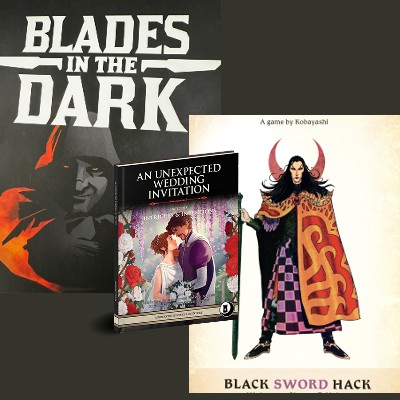
  2. D&D 5E – An Unexpected Wedding Invitation – Finished. My first foray into D&D as a player in many years was a murder mystery set at a wedding populated with beautiful and complicated NPCs. We had some issues with the use of 5E as a system for this one but we had a ball role-playing our characters. The link above will take you to my post-mortem of the game.
  3. Heart: The City Beneath – Home game, GM. Finished. Man, I miss this game already. The PCs all activated their Zenith Abilities in the last session and it was a thing of beauty. After 12 sessions of delving, the android they were searching for turned up in Terminus, and they discovered that he was a sort of proxy for the Heart. He was trying to make their Heart’s desire come true. But he was bound to do the same for another denizen of the City Beneath, The Drowned Queen, whom our heroes had trapped in the Grey in session 8. The Android freed her and released her into Terminus, which she quickly began to drown in salt water. The PCs realised she could drown, not only this one Landmark but both the City Beneath and the City Above as well, linked as it was to every line in the Vermissian network. And so the delvers combined their newly acquired Zenith abilities to defeat her, imprison her and ensure themselves a place in heaven afterwards. So satisfying.
  4. Black Sword Hack – Three of Blades. This is one of Isaac’s games. It is another long running campaign. I went into some detail about it in the post I linked above. Recently, it has been hard to find time to get together for more sessions of this. Can’t wait to get back into it. In the last few months, our group has discovered that if we recover three legendary weapons from the most unlikely of places (one of them is on the friggin’ moon, but that’s OK, because we nicked a spaceship/big sphere off a bunch of cultists a while ago) we can use them to defeat the Queen of the Dead. As players, however, we have realised that, if we want to advance, we have to complete more “stories,” or adventures, so pursuing these weapons has taken a back seat recently. Instead we had a moral crisis about killing a big ol’ wyvern, we dithered over how to rescue a town of people from the mercenaries we were, ostensibly, working for and we argued over how to deal with a native woman who was summoning harpies to murder the invaders who had killed her lover (apologies to Isaac if I am misremebering that one.) Isaac says we’re the ones inventing the ethical conundrums when all he does is lay out the situations, but I’m pretty sure he plans them that way.
  5. Blade Runner – Electric Dreams – Finished. The link will take you to the first post I wrote about this short campaign. I was enjoying it immensely at that time. Once we got to the end, I feel like it really shone, though. That last session had a proper climax. Both of the players found the ending satisfying and sort of unexpected and I found it fascinating to see how they dealt with everything the case file threw at them. It’s hard to go into specifics without spoilers here, so I won’t. Suffice it to say, the investigation took some twists in the best way. I wrote a bit more in this post, where I compared the experience of playing this game with the Unexpected Wedding Invitation. TLDR, I think Free League have done a great job creating an investigative game that is a lot more that just a cop simulator and that works significantly better than the 5E system for this sort of thing.

New Campaigns

  1. The One Ring – The Star of the Mist. I wrote briefly about this one in the post I linked above. It’s a shame that we have not played much more of it since that first session. Basically, unless it is not entirely clear from the long list of games in this post, we have been busy in Tables and Tales! Sometimes it is hard to schedule sessions around all the other sessions. Anyway, session 2 brought us very, very close to a TPK. We learned a few things about this game. Thing the first: it’s not like D&D 5E, your characters are tough, but they are not super heroes. Thing the second: some times you should run away when you keep getting knocked prone and you can’t seem to hit anything and you are surrounded by marsh zombies. Thing the third: use your head. We beat the zombies with brains instead of axes in the end, partly because Isaac, who also runs this game, was very generous to us. I think the next session, we’ll be a lot more circumspect about approaching encounters and I can’t wait to see how we get on.
  2. Mörk Borg – The Great Borgin’ Campaign. Isaac sure is running a lot of campaigns, isn’t he? The ones I have listed on this page aren’t even all of them, just the ones I’m in. This has been great fun. We have a regular every-second Wednesday game of Mörk Borg going now. It is a sort of a drop-in, drop-out game but the playership has actually remained fairly consistent. My character is a Sacrilegious Songbird, a class from the Heretic sourcebook. Coincidentally, that’s also where our first adventure was from. Merkari the Magnificent and his weird companions managed to survive Graven-Tosk, the sprawling graveyard setting of “Graves Left Wanting.” I loved this module. It was dark and filthy and involved some brilliantly shitty situations. I mean, we started the game by waking up in a charnel pit. Anyway, once we got out of there, we moved on and played through “Death Ziggurat.” This was a (mostly) hex-crawl that I found equal parts foul and hilarious. This was partly due to Isaac’s amazing character work and partly due to the non-stop comedy from the other players at the table who included friend of the blog and local Media Goblin, Tom, in one of their most brilliant roles yet. The wildly unhinged scatological, pyromaniac shit from Shannen and Jude has been an absolute delight too.

And I haven’t even gotten to the many one-shots I was part of in the last five months. If you have been hanging around the dice pool for a while, you have probably read about some of them, at least. But they deserve a proper review in this series as we approach the end of the year so tune in to the next post, dear reader.

Back to Troika with Tables and Tales

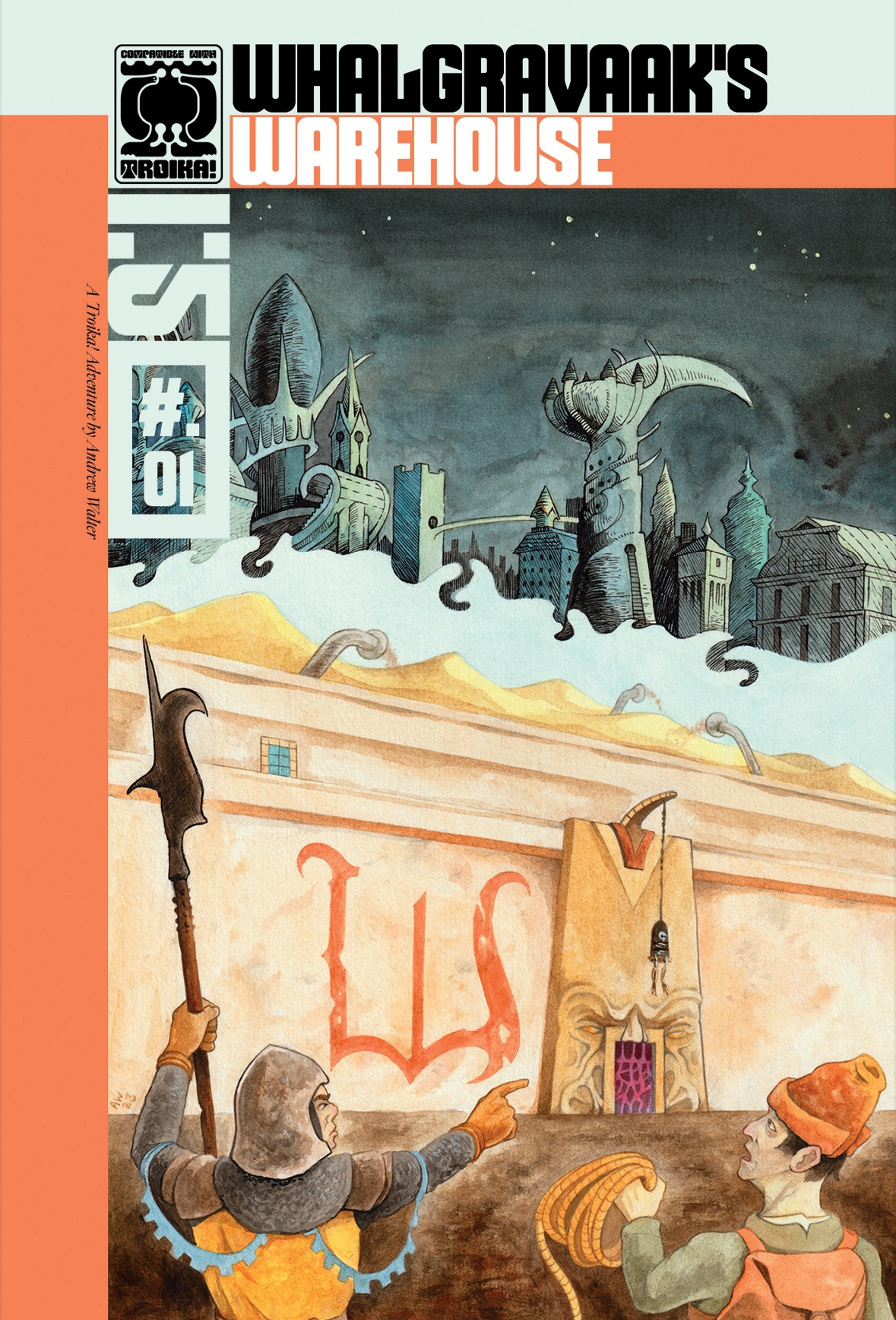
Whalgravaak’s Warehouse

We’re going back to Troika for another one-shot tonight! I’m very excited for a couple of reasons.
The first is that I finished reading through the Whalgravaak’s Warehouse book last night and it seems like a lot of (potentially very lethal) fun. I don’t think it was necessary to read the whole thing before beginning play, actually, but I was enjoying it so I kept going. That can rarely be said of RPG products so that’s a big tick in the plus column already.
How does it play? Only time, and my players, will tell, dear reader. But I will say, I love the setup of it. I think it has done enough, to lay the groundwork for a session full of strange and dangerous settings, fun and dangerous encounters and weird and dangerous NPCs.

They call it a Location-based adventure and, in the intro they admonish the DM to pay attention to
“the classic tenets of danger, resource management, exploration and player agency.”
This says a lot in just a few words I think. But it neglects to mention that it also involves elements of the classic dungeon crawl and a hex crawl in too!

New Tables and Tales members

The second reason for excitement is the introduction of a couple of new members to our little, local RPG community, Tables and Tales. We have been in existence only since February and after a small initial influx, recruitment died down somewhat. Our aim is to be able to have a few different games going on, in person, that interested players can get involved in and to continue to grow in our relatively small local community.
Although our growth has been modest, it has meant a lot to me, personally, to get to play with lots of people I would otherwise never even have games with. As a blow-in to the place I live, it’s also a great way to get to know people with similar interests and meet up face to face.
So, I love when I am able to share a table with some new tablers. Maybe talers is a better moniker? Hmmm. We’ll have to workshop that one.
I met these new recruits at the recent celebrated birthday party of one of our founding members. One was a friend of hers who has never tried TTRPGs before and one was the bar-tender, who just overheard me nerdily chatting about D&D while standing at the bar.

I think that shows that the RPG nerds are everywhere. If you want to find your people, just announce yourself loudly at the bar.

So it’s an exciting evening ahead. I hope I don’t end up frightening off the newbs…

Black Sword in the Dark at a Wedding

Player Freedom

I have never been the forever GM. Back in the olden days, me and my mates would spend entire Saturdays and Sundays just passing that GM baton. I’d run some Dark Sun for an hour or two, then my friend would try and blow us up in Rifts for a while and later, yet another pal would run us through some MERP. I don’t know if that was unusual in those days as I had no frame of reference. We kept our weird little hobby to ourselves for fear of bullying and humiliation from our peers. But that’s besides the point.

I have always enjoyed RPGs from both sides of the screen. In fact, in some games, I feel almost freer when I have the reins for just a single character instead of being burdened by a whole world. It depends on the game, for certain, but I love the process of establishing, advancing and developing a character over the course of weeks and months and years of play. In many ways, that’s my motivation when GMing too, it’s just more vicarious in that instance.

Anyway, here’s a little bit about each of the games I am playing in right now. Each of them is incredibly different to the others but I get something special and unique from every one.

Black Sword Hack

This is what I would call a home game. It’s just four of us, friends who make up the core of a role playing crew. We have been playing together for the last 5 years or so and it’s the exact same people who make up our Heart game.

Our GM for Black Sword Hack was very excited to run this when he got his copy of the book (I think he backed the Kickstarter for it but I might be wrong.) We played a memorable one-shot set in the village of Rust where we had to deal with some fucking wizard (those guys are the worst.) We all agreed that we liked it from that experience so he agreed to go ahead with a longer game.

But he took his time putting together something special before diving into the campaign. He made a stunningly beautiful map of the region we would be exploring, a loose history that included neighbouring cultures and ancient empires and some fantastical locales for adventuring in. So when we started off, we felt like we were in a living world, populated by recognisable people with a variety of extremely well acted voices and accents (our GM is a fully paid up member of the funny voice club.)

Until the Queen of the Dead turned up to kill all these people and transform them into the living dead. We escaped in a flying ship and have been more-or-less on the run from her ever since, attempting to curry favour with the bigwigs in the surviving lands so we can add their strength to ours in the fight against the zombie hordes.

Black Sword Hack is an OSR game (At some point, I’m definitely coming back to this term for what will probably be a long post. OSR stands for Old School Revival or Old School Renaissance, which confusingly, seem to mean two different things, or just many different things to different people) that’s very much based on the works of authors like Robert E Howard, Fritz Lieber and Michael Moorcock. It’s dark and slightly weird with the potential to become something grand and fantastical. But your characters are really just little guys. You do not play super powerful mages or unbeatable warriors, you start off with a bunch of probably not very impressive ability scores, a background and a culture and, when you gain a level, you don’t often get a bunch of new powers or anything. That’s fine. There are ways to improve your character through play, rather than through advancement and you are usually encouraged to seek those out. It’s fun!

My character is a former assassin of the Iron Horde. He has one friend who is a blue-arsed Pictish berserker and another who is a charismatic sword guy from the Northern Raiders, a mum he cares dearly for, an international drug dealing business and a dog variously named Dev Patel, Devandra Bernhardt and Devourer. He is known as Poppy. He has respect for life in general but not for most lives in particular. He talks with a slight rasp that hurts after a while. I love playing him.

Blades in the Dark

I’d imagine Blades in the Dark needs no introduction for most modern RPG players. It’s a phenomenon that has launched a thousand games with variations in its ruleset, know as “Forged in the Dark.” I had been curious about playing it for so long so I purchased the book and read it cover to cover. Became even more curious to play it. But my home group was busy with other games (see the other paragraphs in this post and the other posts in this series.) But, it just so happens that I have another option when it comes to play groups. The Open Hearth is an online gaming community. It is a welcoming and friendly place where you can find people to play almost any RPG you care to think of and many you have never heard of. Probably not D&D though. A fellow member in a similar timezone also wanted to get a Blades game going so he put it together!

Now this has been a refreshing experience from the get-go, largely because of our GM’s inventiveness and insistence on doing things differently. Before we ever started playing Blades we got together to design and populate the particular pocket of the city of Doskvol that our game would centre around. We did this using a couple of other games called, I’m Sorry, Did You Say Street Magic? and Clean Spirits and, let me tell you, reader, that worked like a charm. I immediately had a very clear picture in my head of not just the major locations and NPCs but also our crew’s HQ and our various relationships to one another.

Soon, we were interacting with the mechanics of the Blades in the Dark system itself; planning scores, having flashbacks, doing downtime actions, dealing with stress and heat and entanglements. We got involved with a bunch of other factions, mostly in the wrong ways but sometimes to our benefit.

And we certainly built a team, with what has become something of a revolving cast of characters and players from all over the world. Another benefit of the Open Hearth is that, if you know someone is going to miss a session or two in advance, you can usually get a replacement at short notice. This is obviously aided by the fact that we are playing online using Discord and Roll20.

I’ll be honest, it took me a while to get into the swing of the system but as time has gone on, I have not just gotten used to it but actually embraced its flexibility and its focus on the narrative. Everyone at the table really gets a chance to tell their part of what feels like a shared story every session and our GM has been incredible at drawing that out of us.

I’m playing a Skovlan Spider, a master of manipulation and centre of a web of contacts, informants and assets. He has been changed by his experiences of late; he was once called Red, but now he just goes by Finn. We are nearing the end of a twelve session run so, if he survives this one last score, he might just retire into the mundane life of a tavern keep, but probably not.

An Unexpected Wedding Invitation

I do not remember the last time I got to play D&D as a player. Honestly, it’s years ago for sure. So, when another member of our little gaming community, Tables and Tales, suggested a 5E adventure that she would DM, I jumped at the chance. I had a githzerai Oath of Redemption Paladin created the next night. Honestly, I probably could have come up with something a little less weird than a hippy knight alien from Limbo for the purposes of this adventure, but our DM is endlessly patient (as my Paladin would appreciate) and she has rolled with it beautifully.

I don’t think I need to go into any detail on the ruleset of D&D 5E but I will say that this adventure uses it in a unique and fascinating way. Don’t get me wrong, it’s not that we haven’t killed any monsters, or rescued any unfortunate travelers from the road, it’s just that that is very much not the point here. An Unexpected Wedding Invitation is going for Regency, it’s going for romance, it’s going for Austen. You’re trying to impress some wedding guests with your charm, or your hunting skills or your graciousness. The key, we are beginning to find out at this stage of the game, is to get to know the extensive cast of well-to-do NPCs and romance them or befriend them, all during the course of an elvish wedding.
This may be the whole and only point to this adventure, and I think, if that’s what you did as a party, you would come out feeling good about it. However, there is a sort of overarching mystery, the details of which, I will not go into here. So, even if you are not interested in romance, you won’t be left out.

This crew of Tables and Tales players is, far and away, the most impressive bunch of voice artistes I have ever played with. Our DM is another member of the funny voice club and can pull off almost any accent flawlessly, but everyone around the table is camping it the fuck up. It is hilarious every single session. So much fun to play this sort of game in person with a very full table (there are 6 of us altogether.) And this is the third game we have played as group together. I feel like we are all just pushing ourselves further with each game.

My little guy this time, as I said, is a githzerai Oath of Redemption Paladin of Zerthimon. He swears by patience and peace except that one time when he killed that goblin by accident and he has a bunch of madcap friends including a satyr party-cleric on the run from her mistress, a dour tiefling warlock who’s patron is the cleric’s mistress and was sent to bring her in, an orc rogue who is mates with the bride to be and a half-elf fighter who presents very much like a character from Blackadder Goes Fourth. I’m off to play another session of this tonight. Maybe Paxil Tramadol will make a new friend!

So, in hindsight, that probably could have been three different posts…