Jailbreak – A Spire One-shot

Break Time

Our Blades in the Dark campaign is going well. We’ve only had three sessions but the players are moving the plot forward all on their own and are developing their characters in unusual and gratifying ways. But, for reasons, we’ve had to move our recent sessions to the weekend. So that has left us with a Wednesday gap. I grew bored of wasting my Wednesday evenings on housework, dog-walking and reading so I cooked up a plan to go back to Spire. But, since the change to our Blades schedule is only temporary, I wanted to make this a short one. To be certain we could wrap up our game, I decided to make it a one-shot. A city-break, if you will.

Shadow Operations
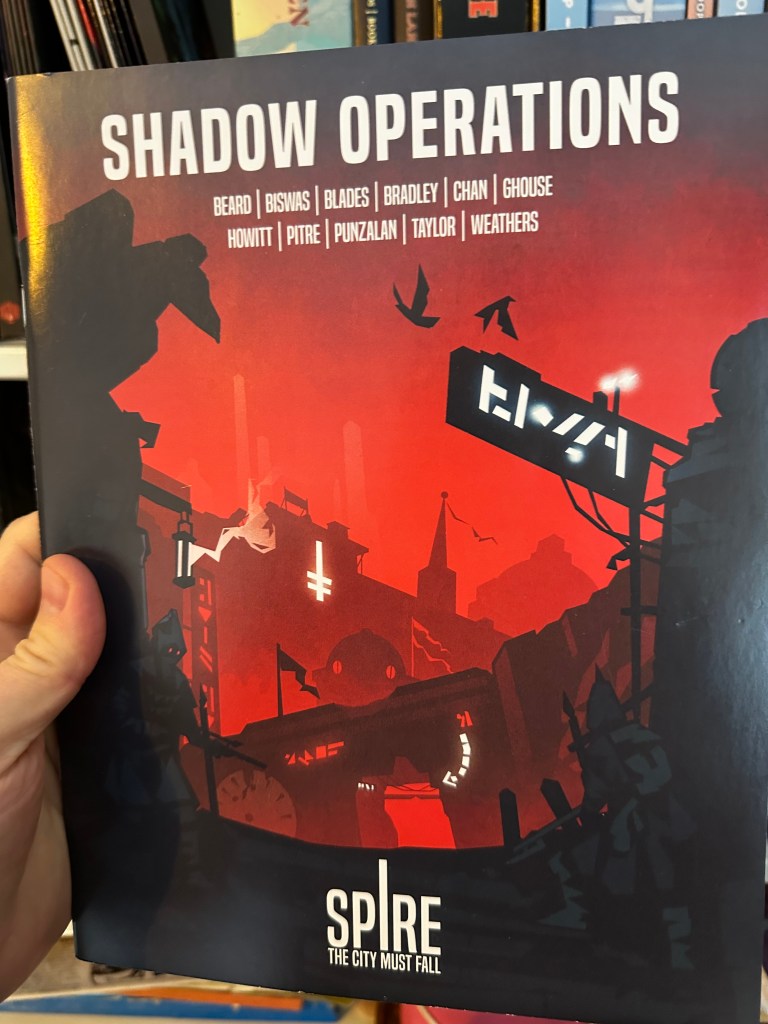
Cover of Shadow Operations - the city in red and black
Shadow Operations

A few years ago, Rowan Rook and Decard published a book called Shadow Operations. It’s a collection of eleven scenarios meant to be played in a single sitting, and it’s great.

It does a couple of things cleverly and well. The first thing is that it presents a template for a Spire one-shot and then has every scenario in the book stick to it. Not only does this make the reading and digestion of the scenarios easy for the GM, it also provides them with the basis for creating their own one-shots. You can see this Scenario Breakdown in the image below.
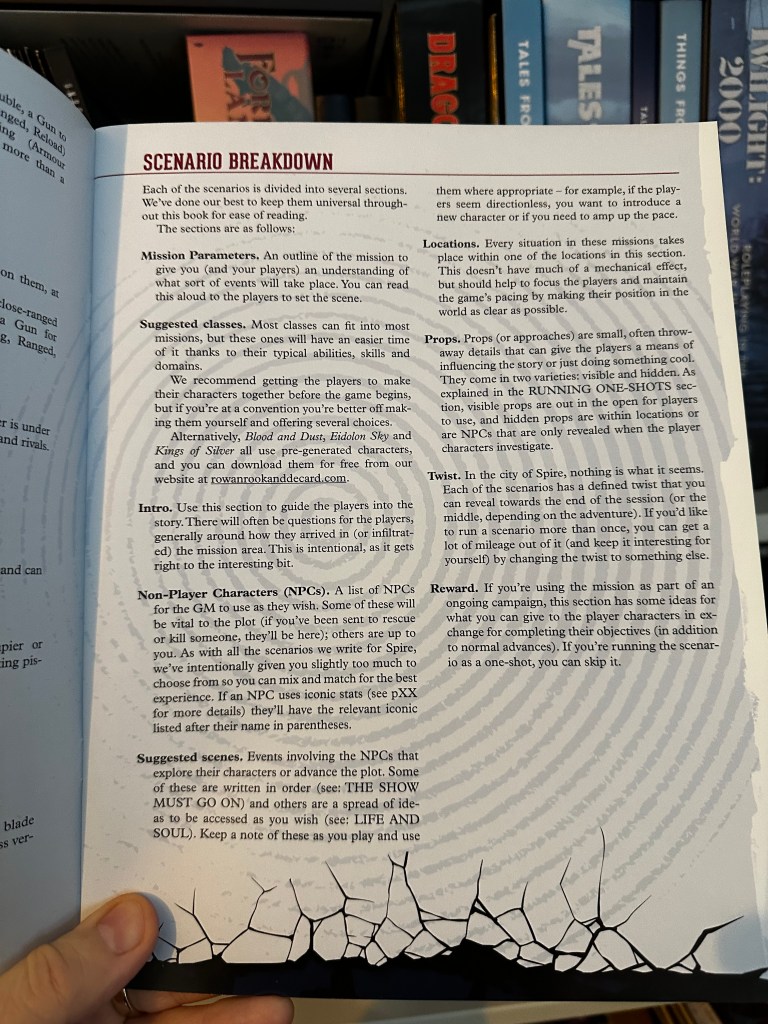
Scenario Breakdown
Scenario Breakdown

The other thing I really like about this book is the Iconic NPCs it provides. These are a list of statted out archetypes. They have titles such as “the Enforcer,” “the Queen,” and “the Vizier.” Then, throughout the book, each of the major NPCs presented in the scenarios fit into one of these archetypes. You don’t need stats for each NPC that way, you just use those iconic cookie cutters and refer to the handy reference page in the front if you need some stats for them. For a game like Spire, where there really isn’t anything like a bestiary or monster manual, and the enemies are just different types of people, this is a game changer. You can see the Iconic NPC stats in the image below.
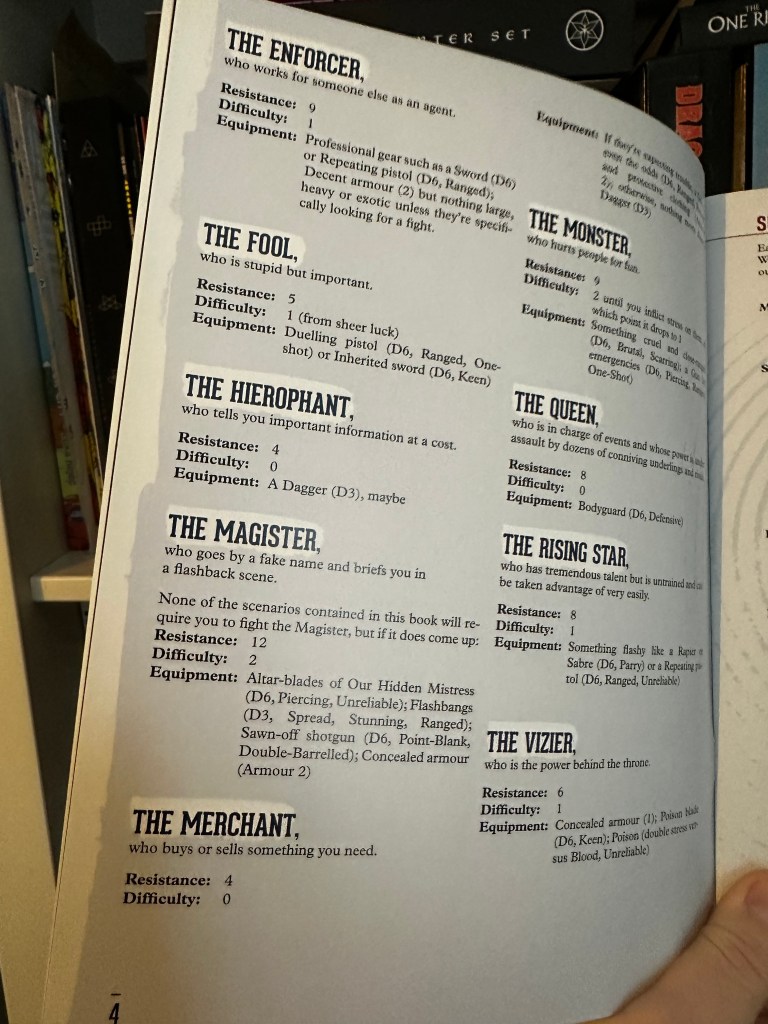
Iconic NPCs
Iconic NPCs

Other than these introductory sections, there is a page of advice on Running One-shots in the back. This is pretty bare-bones, to be honest. It does tell you its best to “be up-front with your players.” Which is a great advice. You won’t have time for hidden agendas, secrets and mysteries that require deep investigations to reveal. Just lay it all out for them or you will leave them frustrated and the scenario unfinished. I couldn’t agree with this more. But the main piece of advice is to use index cards to write down the various locations, NPCs, PCs and props on. Once you have done that, you can group them appropriately, kind of like a game of Cluedo (or Clue for my dear readers from across the Pond.) There is nothing wrong with this advice. As much as I could, I went with it, insofar as I could playing on Roll20. But, as it turned out, we never really used my virtual index cards. The players had no real problem remembering where their characters or any other NPCs were at any given time or where any particular location was in relation to any other. So, I can’t help but feel that this advice only scrapes the surface of what the prospective one-shot GM needs to know. So much better is the advice in Heart. In Heart we are told to pay particular attention to pacing, to start fast and keep the pace up as much as possible. A one-shot is a sprint, not a marathon. Provide necessary information in flashback or in summary and get the PCs started right in the middle of the action. Give them an achievable goal. I wrote a whole blogpost on this a while ago. You can check it out here. One thing I’ll say, however, is that much of the need for this advice is obviated by the structure of the scenarios in the book and the directions within each one on how, where and when to start, and what the PCs’ aim is.
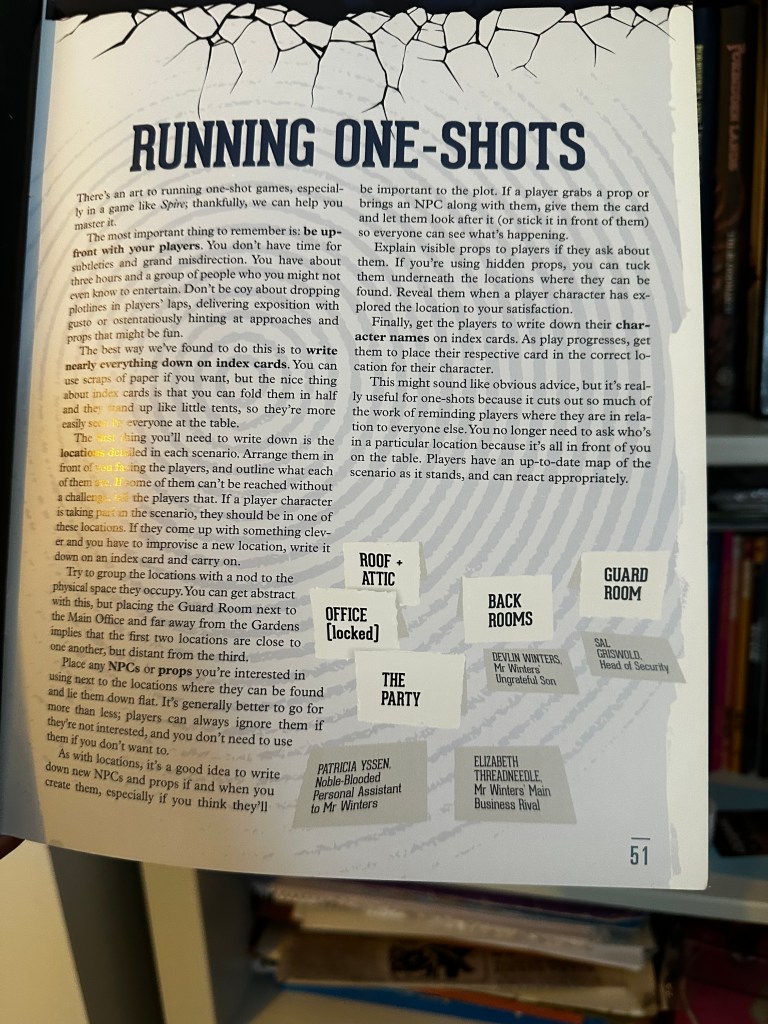
Running One-shots - advice page from the back of Shadow Operations
Running One-shots – advice page from the back of Shadow Operations

Speaking of the individual scenarios, I found it quite tough to choose the one I wanted to run, especially as I only left myself about three days to decide on it and prepare it.

Here are a few that I considered:

  • Life and Soul – Go kill Mr Winters, one of Spire’s most prominent gangsters, at his own birthday party
  • The Last Train – Get aboard the Last Train travelling the Vermissian and steal it or the tech that powers it
  • These Feral Saints – Find and recruit a newly reincarnated Hallow (drow saint) in Pilgrim’s Walk before some other cult does

But the one I went with was Jailbreak, a mission to infiltrate the Hive, Spire’s most notorious and terrifying prison, and, once there, ensure the aelfir can’t execute their prize prisoner, the Gnoll Warlord, Brakesh Gold-Tongue.

Jailbreak

There will be SPOILERS ahead, so, if you care about that sort of thing, look away now.

If you’re still here, welcome to the Hive. I’m going to discuss, briefly, my experience with Jailbreak as a scenario, playing Spire as a one-shot and whether or not I would recommend it.

I had four players for this one-shot and exactly three hours to complete it in. I like having time-constraints like this in some ways, as it gives me a very clear idea of how long I can spend in the various sections of the session. I was able to wrap it up within the time, although it was tight. We played online for convenience and because there was a gale-force wind and torrential rain that evening. We used Roll20, as I alluded to above. We found the Spire character sheets on that platform to be quite user-friendly and easy to navigate once you got used to them. It helps that Spire is a relatively rules-light game, certainly. There is a button you use to make rolls when necessary, which is handy as it combines your dice pool automatically. However, I will say that in instances where you have to apply a Difficulty to a roll you are forced to roll each d10 individually, because you can only see the highest die roll if you use the button. If an opponent has a Difficulty of 2, it means you have to take away your top two die rolls from the dice pool and go with the third highest. It’s a small thing but it did come a up a couple of times during play.

Suggested Classes
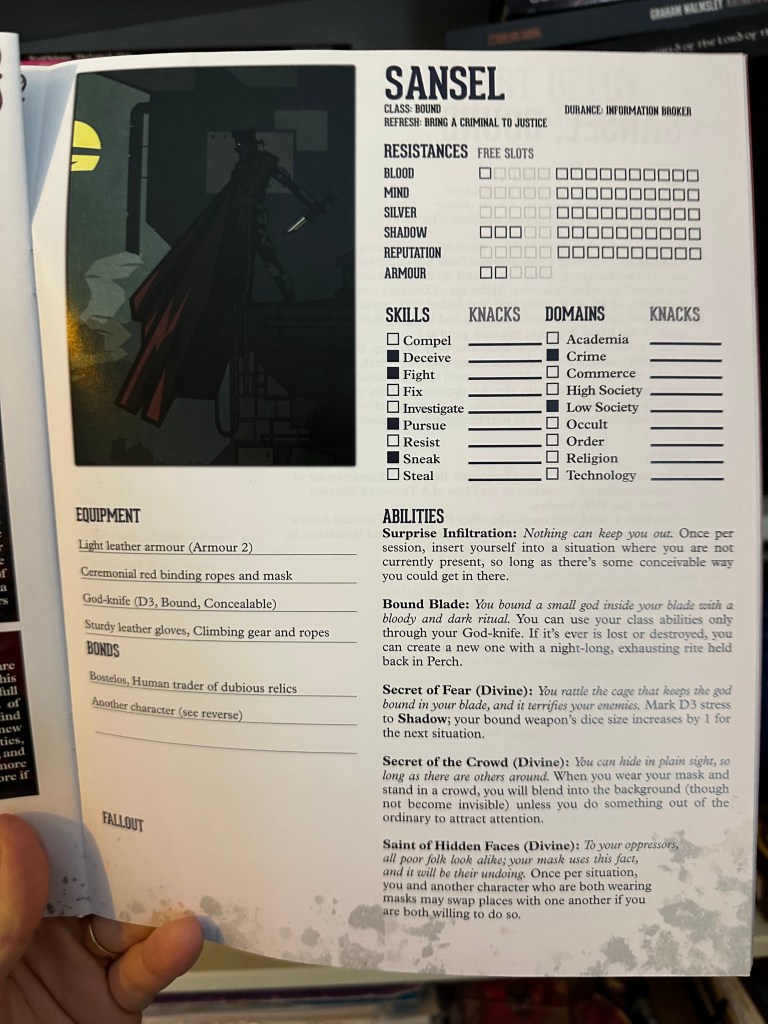
Character Sheet for the pregenerated Bound character, Sansel from the Spire Quickstart Guide.

Another piece of advice that I feel should be central to running a one-shot of Spire, much like my advice for a Heart one-shot, is to make sure you have pregenerated PCs. When time is of the essence, you can’t be spending an hour creating a set of custom characters. One of the most useful parts of the scenario structure provided is the Suggested Classes. For Jailbreak, these were Bound, Carrion Priest, Lajhan, Midwife and Shadow Agent. So I stole and tweaked a number of pregens from other Spire products such as the Quickstart and the campaign frame, Eidolon Sky. The only one I had to create from scratch was the Shadow Agent as I couldn’t find one already made in any of the Spire books I own. The most time-consuming element of this was just copying and pasting a bunch of stuff into the Roll20 character sheets. But there is no doubt about how much time it saved on the night. I could have done a better job with some of the characters to be honest, but when they are only in the spotlight for such a short period of time, a long and complicated backstory can be a hindrance, actually.

Finally we get down to the scenario itself. As I mentioned above, the central goal is to infiltrate the Hive and get Brackesh Gold-Tongue out. But, the Intro actually asks you to start the PCs already inside the prison. You then just ask them how they managed it! I loved this as it got them started right in the action and removed all the time-consuming planning that such an undertaking would usually require. My players went straight in the front door in disguise, in a meat cart or as a sort of chaplain for the drow guards and prisoners.

Intro
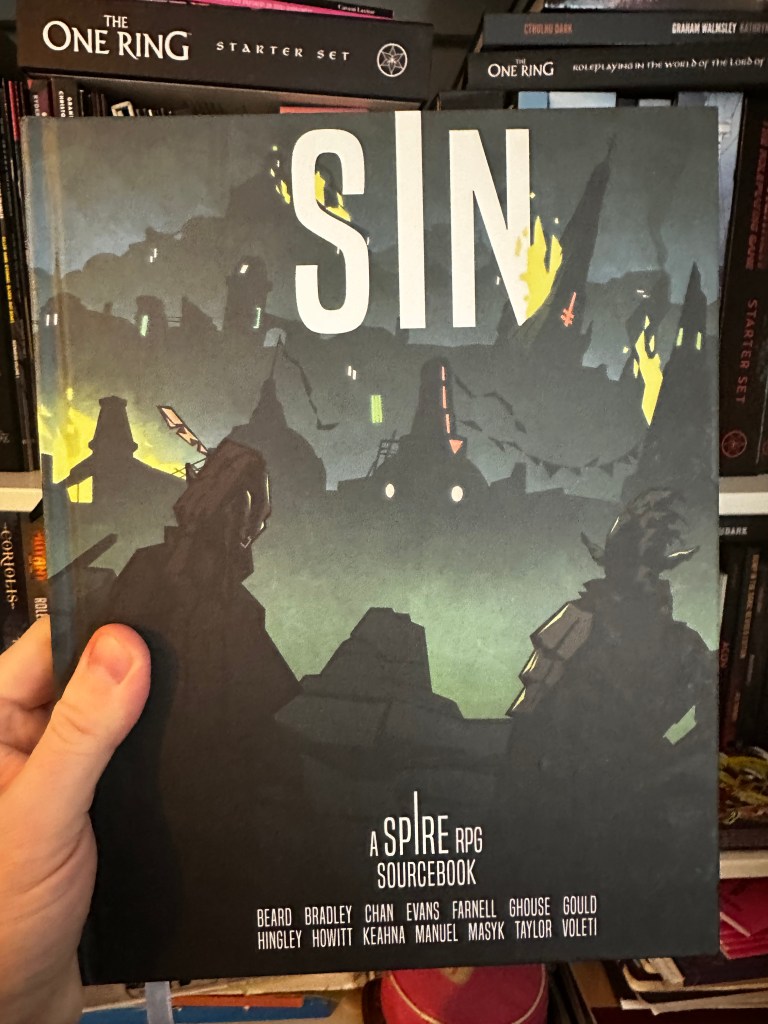
The Cover of Sin showing two drow looking out over a dark city in flames.
The Cover of Sin

You are then asked to describe the Hive. Now, there is minimal description of the prison in the main Spire book. It introduces it as a jail built into the living walls of Spire itself. It has rows of hexagonal cells which can be dropped individually from the wall in the event of an escape attempt. The unfortunate inmate would fall inside their cell all the way through the central abyss of the city, possibly all the way down to the Heart beneath. This is a terrifying prospect but, as I said, the description of the building, its inmates and staff etc, is brief. I was happy I had a copy of Sin. That book contains a much more evocative section on the Hive that was written, as it so happens, by Basheer Ghouse, the author of Jailbreak. It provides juicy tidbits like the way there are lots of walkways spanning the chasm below the prison, but they don’t have any handholds. Gulp. It also provides some great examples of the types of poor mutated experiments of creatures that are resident in the Menagerie. The Menagerie a part of the Hive where the aelfir send their old pets, experiments and art projects when they’re done with them. One of the main NPCs in Jailbreak is Dawn-Upon-Ice, a hobbling former aelfir who now acts as an information broker of sorts and can produce all sorts of nasty poisons in her guts for a price.

NPCs

Speaking of NPCs, Jailbreak has five, which is an easily manageable number. I will say, we didn’t interact with all of them, we skipped Qadiv Love-Fool, a sort of gnoll collaborator, purely due to the fact that the PCs did not pursue the information they gained about him. Brakesh Gold-Tongue, himself and Dew-In-Shattered-Mountains, the aelfir poet-interrogator, were my favourite to play. Neither lasted long against the PCs.

Suggested Scenes

After the NPCs section, there’s the suggested scenes. With the sort of structure you’ve got in these scenarios, this is really useful. Essentially, all you’re given to work with is a starting situation. The PCs are expected to push everything on from there. The suggested scenes allow the GM to pepper their descriptions of the infiltrators’ journey through the prison with interesting moments and opportunities to introduce the major NPCs. Here’s an example of one that I found particularly useful:

Smiling Kas spots the characters as she escorts Dew about the Deep Cells. She asks precisely no questions and accepts any excuse or alibi, no matter how ridiculous. If the characters have not threatened her and seem new to the Hive, she warns them not to stay in the Deep Cells too long.

I made liberal use of these suggested scenes.

Locations and Props

The next section describes the major Locations. I gave each one of these a little box drawn on the map on Roll20, thinking I would move the players’ tokens around from one to the next as their PCs moved. But, in practice, I didn’t really use them at all. Each of the Locations, which included the Menagerie, the Offices, the Guard Quarters, Watch Posts and The Deep Cells contain a brief description of the place, where it is in relation to at least one other place and the sorts of people and props that might be there. They are all short and to the point. Very easy to use on the fly. This section is supported by the prop section, which comes next. Props include unnamed NPCs like patrolling guards and menagerie experiments, by the way.

Twist

Each scenario has a Twist. Jailbreak’s twist is that Brakesh is a real asshole and has been going around the Hive murdering people, guards and prisoners alike. He was betrayed by his own side and left for dead before he was captured because he was kind of a psycho. He won’t leave with the PCs unless they either help him to kill each of the other named NPCs or offer him a shot at Snow-On-Stone, the aelfir commander who captured him. My players only encountered him about ten minutes before the end of the session. This worked out fine because their attempts to convince him to come with them failed so miserably that he attacked them and they were forced to kill him before escaping through an exploded front door to the prison. This worked out fine for them, as it happened. The Ministry wanted things to get messy to gain the attention of the papers and they were happy as long as the aelfir no longer had Brakesh as a source of information and didn’t get the opportunity to execute him publicly.

Conclusion

I love the way Shadow Operations is presented and it has a great variety of one-shot scenarios with an eclectic variety of settings and characters. Each of the scenarios is presented in only four pages, including one full page illustration. They are tight and easy to use because of the format. I do think it could do with some better advice on running a one-shot but, as I said above, if you follow the scenario structure, you’ll be alright.

Jailbreak was fun. It had a great setting. I loved describing a scene where the guards dropped one of the cells out of the wall and the PCs watched it plummet and the moment when they discovered one of Brakesh’s murder victims stuffed under the stairs was good too. But I found we had not enough time for the characters to shine as much as I would like. Maybe this is just one-shots in general, or maybe it’s how I handled it, but I would have liked a bit more room for the PCs’ characters to breathe.

I will definitely be going back to mine that rich seam of Shadow Operations in the future. It was so easy to pick up Jailbreak and run it with minimal prep. I would recommend it!

Throwback Wednesday: Beginnings

Instead of a new post, please enjoy this one from last August. It deals with beginnings and how to manage them in RPGs. Its got some advice I must take into account as I embark on my recently decided upon campaign of Blades in the Dark.

A Short Rest

Once again, dear reader, I find myself a little under the weather. Maybe I just overindulged at the weekend, maybe I have been working too hard, maybe it’s the current wave of ‘rona. Whatever it is, I feel like I’ve been struck by a nasty disease and I failed my resistance check/saving throw etc. etc. So, I’m taking a break today.

Instead of a new post, please enjoy this one from last August. It deals with beginnings and how to manage them in RPGs. Its got some advice I must take into account as I embark on my recently decided upon campaign of Blades in the Dark.

See you with a new post soon!

Homebrew Heart Landmarks 5

It was the kind of party that took its toll on a number of different organs, the brain being not the least of them.

Two-day Wedding

Dear reader, I returned yesterday from a trip to Cork where I attended the wedding of a dear friend of mine. It involved a great deal of time spent with very old friends in the most convivial of circumstances, accompanied often by a pint of Murphy’s and a lot of reminiscing. I’m still recovering. It was the kind of party that took its toll on a number of different organs, the brain being not the least of them.

But, you know, inspiration is a fickle mistress.

Pub Crawler

Name: Pub Crawler
Domains: Wild, Haven
Tier: 3
Default Stress: d6
Haunts: The Pub Crawler (d12 Mind)

Description:
Vansant Depwy, former Knight of the Lower Docks and Minister of Our Hidden Mistress fled the City Above many years before. Burned by the Ministry and broken by his former companions in the knighthood, he found himself wandering the arteries of the Heart, lamenting his lost companionship and honestly, just gagging for a pint. As always, the Heart provided.

The millipede of enormous proportions that is Pub Crawler came to Vansant when he was most desperate and dribbled ever so delicately into his open mouth as he lay directly in its path. It roused him immediately. The finest ice wines of the High Elves the flowing ichor seemed to him. The next moment a fine brandy from the Home Nations. He could not get enough, despite the dubious origins of the divine liquid. His head swam and he rejoiced. Immediately he hopped aboard the cyclopean insect and continued to ride it forevermore. Along the way he collected what salvage he could to hook the creatures glands up to rubber pipes to facilitate easier imbibing. He built a small structure and started filling casks while welcoming visitors to his little ramshackle hostelry. As time went on, he and the beast attracted the attention of more less-than-discerning travellers desperate for a decent drink so deep as they were in the Heart. Some of the visitors became residents and then publicans in their own right. The pubs stretch now from the great insectile head to its earwiggy tail. Vansant’s, of course, has pride of place between the two many-faceted, ale-gold eyes. Its name is synonymous with the creature itself these days, the Pub Crawler.

Special Rules
They say it’s a mile from one end of the Pub Crawler to the other. A visitor who wants to partake of the healing effects of the Haunt must work their way up from the tail, taking a drink in every pub on the way. In other words, it’s a pub crawl. The booze is not particularly strong at the tail end as the further they get from the mouth, the more they are forced to water it down. So each visitor is forced to make and Endure/Wild roll or take a d6 Mind stress as they begin to commune directly with the Pub Crawler itself. The first roll is Normal difficulty, the second at Risky and the third at Dangerous.

Fallout Tipsy (Minor, Mind) One more? One more. Doing anything but getting another drink is now Risky.

Fallout Well on it (Major, Mind) There is a constant clicking and clacking in your mind. You must now either try to kill the source of it (the Pub Crawler) or try to understand it.

Fallout Pallatic (Critical, Mind) You understand the Pub Crawler and its reason for being. You know why it secretes such delicious and delirious juices. And now that you know, you have no choice but to stay and set up shop yourself. Spread the booze and spread the word.

If you do manage to make it all the way to the magelight illuminated superpub known as the Pub Crawler, Vansant himself will come and serve you the most potent brew of all, purging you of all Mind stress and Fallout and bestowing on the lucky patron an honorary knighthood.

Prep

Preposition

This post is part of a blog bandwagon started on the Roll to Doubt blog.

Click on the link above to take in the blogpost that’s piloting this bandwagon. Wagon-jumpers abound. You can find a very nice read on the same topic and a handy list of related blogposts on the Among Cats and Books blog.

What’s clear from even a cursory glance at the other blogs is that no two people are prepping in precisely the same way, so advice and recommendations come with the notice that your way is probably the best way. The thing is, in my experience, you find your way only through trial and error. Here’s my effort to tell you about my trials and my errors.

Preponderance of prep

I used to spend hours and hours preparing my games when I was a kid. To be clear, I loved doing it. I would happily get lost in the world-building, the map-drawing, the character creation and the encounter balancing for hours when I should have been studying. I still often think that I gained more from the time I spent on RPG preparation than I did from learning off -by-heart lists of dates and events or theorems and proofs. But I digress.

My prep used to be pages upon pages of tightly packed hand-writing explaining the background of an adventure, the major NPCs involved, the probable goals of the PCs and far more history about the setting than the PCs would ever be able to interact with. I drew maps by hand as well, when I had to. I didn’t run a lot of published adventures but I did make liberal use of soucebooks. I would select the people, places and things I wanted from those books and elaboate on them wildly, writing more pages on how they would connect with our campaign and adding a lot of extra details.

I sometimes wish I had the time to do preparation like this these days. But, when I do find myself with the time, and I sit at the computer to start working on it, I find I would rather shortcut it. I’ve asked myself why this is on many occasions. I’m not sure I have the answer, or else there are several. It could be to do with the process of writing in a notebook and drawing by hand on grid-paper. I don’t want to prep like that these days because having all of my work backed up digitally is invaluable. Time is still a factor. Even when I feel like I have some extra time on a particular day, I can’t guarantee that I’ll continually have that as the campaign progresses. But I think the main difference for me now is the feeling I get from making the world, its people, the major events, the game, at the table with my players. When you are all on the same page, when everyone comes together to create something greater than I ever could on my own, that’s one of the real joys of this hobby.

So, I don’t really do that anymore.

Preplanned not prepared

It’s taken me a long time to make this change, though. Even looking back at the work I did in preparing for our current Spelljammer game, I had thousands of words written on setting, backgrounds, NPCs, over-arching plot etc. And I would write thousands of words of session preparation while going along too. What I have discovered during the last couple of years of trying to prepare this way, however, is that that sort of prep is close to unusable at the table. Even if I am the one who wrote that dense paragraph of text, I can’t find what I’m looking for in it in the couple of seconds I have to react to something at the table, or to answer a player’s question without delay to keep the flow of the game going. Now, it’s not always a waste of time, I will admit. Sometimes, the very act of writing something will help to embed it in my memory and imagination, so obviating the need to check it at all. But, then again, there is the other effect of writing something down. It has the effect of making something true.

Truth at the table should only come from play. The only real things in the game world are what the PCs experience. Everything else, even things the characters have learned or heard about, is pure conjecture. Until it’s not.

This doesn’t mean I don’t prepare anything of course. I make plans for events I would like to occur or NPCs I want the PCs to interact with. But in those cases, I will write down something about the event, just a few details about what happens, who might be involved, what effects it might have. Or I will give the NPC some quirks, desires, flaws and interesting characterisations to bring them to life. But I will keep them to be used when and where they seem to fit.

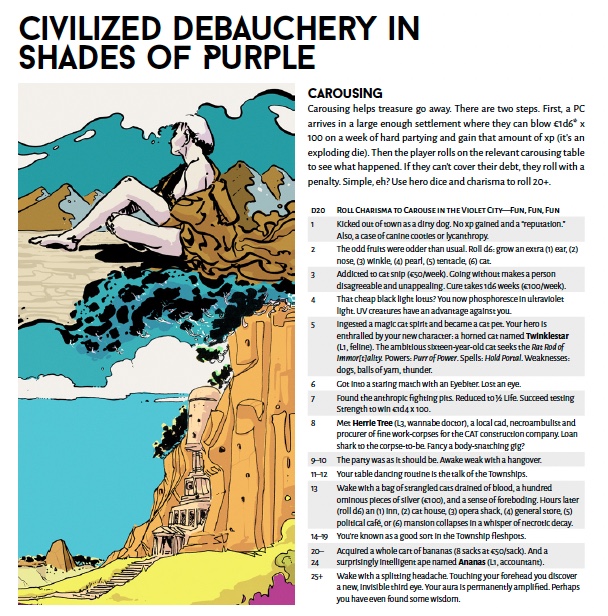
Otherwise, I revel in the joys of random tables. I use rumour tables and encounter tables quite judiciously these days. In a game like Ultraviolet Grasslands, I am spoiled with wonderful encounter tables, trade goods tables, carousing tables, and almost any other type of table I could desire. But when it comes to 5E, I am generally disdainful of the encounter tables provided. So I make my own. Made right and used right, these not only make for some interesting sessions, but also act to drive the game forward, introducing NPCs that become important to the plot, enemies that might defeat the PCs or might lead to vengeful associates pursuing them later. Importantly, I feel, they maintain an element of randomness and ensure that the players know their rolls have led them to the encounter, or not. It’s great if you can engineer it so that the players are rolling on random encounter tables at the end of a session. That allows you to take the result of their roll and make preparations for the specific encounter they rolled up for the next session. Usually, these days, I refer to Between the Skies for more tables and for inspiration to make the encounter really interesting.

Between the Skies does not limit encounters in space to just running into creatures, but also gives options for hazards the ship might run up against and problems that stem from the ship itself.

Here are the simple d6 and d4 tables I made to determine if the crew run into anything, and, if so, what it might be:

Wildspace encounter table d6

1-2 No encounter
3 Ship Hazard
4 Ship Problem
5-6 Encounter

3 Ship Hazards

Roll 1d4

  1. Hazard 1 – Storm, Flood
  2. Hazard 2 – Disorientation, Sphere
  3. Hazard 3 – Obstruction, Cold
  4. Hazard 4 – Trap, Haunting

4 Ship Problems

Roll 1d4

  1. Problem 1 – Armament, Separation
  2. Problem 2 – Quarters, Shrinkage
  3. Problem 3 – Cargo, Disappearance
  4. Problem 4 – Bridge (spelljammer helm), Error

5-6 Encounters

  1. Isolationists – Confusion, Related Entity – Unknown NPC, Glittering, Prayers
  2. Ship Parasite – Loss, Scales, Experiments
  3. Ruins, Ancient – Mourning, Related Entity – Petty God, Knots, Miscommunications
  4. Stowaway – Battle, Related Entity – Creature, Eggs, Blindspots

The descriptive words I listed beside each entry come from the spark tables in Between the Skies. These are invaluable resources that give you the inspiration to come up with truly unique situations, problems and obstructions. You should go and buy this book at the link above.

When I get the players to roll on these tables, I either make up the encounter/hazard/ship problem on the spot using the sparks of inspiration or I use the time between sessions to come up with something memorable.

A while ago, I realised the plot I came up with for the Spelljammer campaign was much less interesting to the players or their characters than the shenanigans that they got up to each session. They were more wrapped up in their own shit. And that was very cool. It made me want to make a sandbox for them to play around in instead of expecting them to interact with a plot they had little or no investment in. This goes back to the time I introduced a hex grid to the underside of the Rock of Bral. I did this to allow one of the PCs to drag the whole party with them to rescue their mother who was trapped in the prison down under. It did not serve the overall plot, really, but I had to have fun things for them to do while traversing this area so I made it a hex map and created some random encounter tables for each of the different types of terrain on the underside of the asteroid.

You know, it took me a long time to cop on to this though. The signs were all there. Dear reader, if your players never remember what is happening in the plot of your meticulously crafted campaign from one session to the next, you might be overloading them with plot. Maybe they just want to play their cool character and have fun moments between them and the other PCs and significant NPCs. Or maybe they are only interested in hitting things really hard. Or maybe all they have ever dreamed of is building their very own tower of necromancy built on the bones of their enemies. Or perhaps they just want to find their dad? Ever think of that? Maybe your plot is not that important to them. If you take nothing else away from this post, please take that.

I have drifted a little way away from the central theme of the post but I insist that, in actuality, you should be prepping for the sessions you want to have, and, more importantly, the sessions your players want to have.

Prepaid prep

Most of what I have been talking about is prep for D&D/OSR style games. Games that you can play as sandboxes without upsetting anyone. But, what, you might ask, dear reader, do I do to prepare for other types of RPGs?

I have some very specific examples here.

Free Leagues/Year Zero Engine Games

I have a few of these under my belt at this point. I can say that the type of prep I do for these is significantly different to what I have described above. The ones I can refer to are Tales from the Loop, Blade Runner and Alien. For me, the thing that holds these adventures together is the Countdown. This is something that’s rather integral to most Year Zero engine games. Below you can see the countdown from the Tales from the Loop adventure published in the core rule book, Summer Break and Killer Birds.

Once you get the timeline of events in place for one of these adventures everything can be positioned around it. Tales from the Loop adventures, in particular, I find, can be written with ease in the very specific format that Free League has presented to you in the book. They provide really valuable advice in all of their books for creating your own adventures. Blade Runner also provides lots of useful random tables to help you create your own case files for that game. When in comes to prep for this style of game, just make sure you know the countdown well, and you keep track of the shifts/days of activity for the PCs. After that, the published adventure or the one you have written in the provided format, will do the work for you. The rest is improv.

Resistance System, Spire/Heart

Resist the temptation to do anything other than read up on the specific areas the PCs are likely to interact with the next session and maybe jot down some NPC details/desires/stats. Resistance system games really thrive on improvising at the table and having the PCs drive the narrative forward with their actions and their fallouts. This is particularly true of Spire where most of the game occurs in NPC to PC interactions in my experience.
In Heart, I think it’s a good idea to have some idea of the landmarks your PCs might end up in. In the last game of Heart I GMed, I made it specifically Vermissian themed so that I knew they would be visiting a lot of Vermissian stations on the way down to Tier 4.

Prewritten trad scenarios

I am thinking of the Dragon Age game I’m running right now but I think this is advice you can apply to most adventures that are presented in dozens/hundreds of pages in long dense paragraphs. Read the full adventure, then, read it again, but this time, take all the relevant information from each room description, encounter text or whatever and transcribe it into something more easily digestible and more useful at the table. I use bullet points as that’s what I’m used to. I also usually take the more relevant enemy stats like Health, Defence and Armour Rating and note them too. This is me applying the lessons I learned from the mistakes I made as a kid and applying them to the published adventures written by professionals, I realise that. And maybe that’s presumptuous of me, but, hey, it works.
The second time you read it, you shouldn’t do it all at once. Just make those notes between sessions.

Conclusion

Prep can take many guises. It will be different for every GM. A lot of people use all sorts of apps and other technical solutions. All valid, but all I ever use is a wod processing app and a few dice. Whichever methods you use are probably going to be right for you, even if it takes you a while to figure out how you should do it.

Throwback Sunday?

I’m feeling dreadful today, dear reader. I don’t know what I’ve got but it’s kicking my arse. Anyway, I thought I would use my malady as an excuse to return to one of my very first blog posts, instead of trying to write a new one. Here it is, The GM Jukebox from last July, where I discuss the use of music at the RPG table, whether real or virtual. Hope you enjoy it!

Beginnings

Where shall we start?

This is always the first question I ask myself when starting a new game. It doesn’t really matter if it’s a one-shot, a short series of sessions or an open-ended campaign; the beginning sets the tone for the whole thing. If you start your PCs off trapped in a haunted house with no prospect of escape and a murderous ghost hunting them, you have made a pretty firm statement about the kind of game you are all there to play (or your players will see it that way at least.) Equally, if you start with a scene from each character’s home life, interacting with their family members and discussing their everyday problems, you are establishing a sense that this is the type of game where that kind of thing will happen again (or you should be.)

You can use the start of your game to establish a theme too. Maybe its a horror game involving frog mutants who want to feed your players souls to their unholy tadpoles, you could start in their camp at night, describing a croaking, ribbiting chorus that grows in intensity and volume through the night, ensuring that none of the party get any rest. Embed in the cacophony the true name of a PC and you have the potential for fear and suspicion if not outright horror.

Control

Three sessions in, there’s one PC who has decided to attempt a bloodless coup on the streets of the town at the centre of your adventure, another who has set their heart on wooing one of your NPCs of lesser importance and a third who just wants to sit in the tavern and spread rumours about the sheriff being a cannibal. It can feel like you are out of the picture sometimes (and that’s not necessarily a bad thing, dear reader. The best sessions happen at the whims of the players.) At the start, though, you, as the GM, have control. It relates a little bit to the world building work you’ve been doing, or not doing. After all, you made up the place they start in, or at least, you read about it in a published sourcebook or module and interpreted it as you saw fit. You know the places involved, you know the relevant NPCs, you know the setup, even if you have no preconceived notions about how it’s all going to go down in the sessions to come. With that knowledge, you start with an advantage, for the time being, at least. Before long, you have to hand things over to your clever and inventive players and they’ll have burnt down half the Silver Quarter while introducing the roller skate to Spire.

But, more important than your behind the scenes knowledge, is the situation they start in. I’ve mentioned in medias res beginnings in the past. Frame the scene they find themselves in and make it tense or truly fantastical or horrific or action-packed or just evocative. Start in the middle! It is the one opportunity you have to do this. You set it all up and see how they react to it.

In the Death in Space one-shot I ran a few months ago, I started them off being ejected from cryo-sleep as they approached the main adventure location, a mysterious space-station. They each got to have a moment to describe their characters and I explained they were seeing the debris field surrounding the remains of a planet that was destroyed in the recently ended wars and that they had to guide the ship through it! But then I used a series of flash-back scenes to explain what they were even doing there. I don’t think that’s even the first time I have used the in-medias-res/flashback combo to get into the action as quickly as possible while also providing some much-needed context. It worked pretty well as I recall…

It’s a fun way to get them all rolling dice quickly and failing quickly too, which is usually pretty important in a one-shot horror game.

Intros

Tales from the Loop wants you to put the kids, the players’ characters, at the fore from the get-go. And deservedly so. These kids are created to have people who are important to them, problems that consume them in their regular lives, drives that motivate them and things they’re proud of. They’re rich and three dimensional characters before they ever get to the table. So, the game insists that you start a mystery (what TftL calls adventures) with a scene belonging to each and every kid in their home life or at school, with NPCs that are important to them, family, friends, mentors, that sort of thing. This is where the players get really invested in their characters. They have genuine and heartfelt interactions with the people of significance to them and they begin, immediately, to find their voice and their personality. It’s probably the best thing about a game that has a lot of good things going for it.

I stole the technique for the second campaign I ran in my Scatterhome world. It took place on the northern island of Erlendheim. The PCs all knew each other at the start since they began at 8th level and, in the fiction, had an adventuring party for many years, long ago. The adventuring life long behind them, I asked them to describe their mundane lives as a farmer, an advisor to the Jarl, a guard sergeant and a village priest and made sure to include people and places that were important to them. I focused on who and what they loved because I knew I was about to fuck with all that.
I had learned a lesson, you see, dear reader. Oh yes. For those of you keeping studious notes, you will recall I described the start to the first campaign in Scatterhome, when I drowned the island nation and erstwhile homeland of the PCs, Galliver, off-screen, before the start of the game. They didn’t care about it, and I can’t blame them. I had never given them a reason to.
In Erlendheim, they were more focused on saving the druid’s kids, ensuring the safety of their families and homes, protecting their futures.
Tug on those heart-strings, GMs.

Scenic

There is a subtle art to the transition from the start of an adventure to the meat of it. Or there is if you don’t subscribe to the philosophy that adventures should happen in scenes.

Usually, the end of a scene is obvious in a movie or tv show. It normally shifts perspective or location or time. So, if you want to do something similar in a game, someone needs to just say it’s over and move to a new scene. Sometimes that’s the palyer who wanted the scene but usually its the GM. I would rarely have done something so bold as to declare the end of a scene in a game of D&D as a more trad DM but it’s so freeing to do it! Just like you framed that first scene at the beginning of your game, you soon realise that you can frame and end any scene at any time (within reason.)

Looking back at the Tales from the Loop example from earlier, I noted that each kid gets a scene about their home life. Together with the player, you describe the kind of scene it is going to be, improvise it and end it when it feels right. When you move on to the investigation part, you can cut to a scene with all the kids in it, where they are staking out the suspicious machine that appeared in the nearby field overnight to see who is responsible for it and end that scene when they have gotten everything from it they can. Easy.

Using scene structure is even built into some games. Spire and Heart use scenes, situations and sessions like other games use rounds, days and long-rests. They are left deliberately vague but some powers and abilities work only within the current scene or situation. I have embraced the vagueness and it didn’t even take any adjustment. It was instinctive.

In the next post I am going to write a bit about endings, which, in my experience, are so much more difficult.

How do you like to start your games, dear reader? Let me know in the comments.

Wildsea – Campaign

Give your players a home

It’s pretty difficult to give your journeying adventurers a particular place they need to look after. They are always schlepping off to the next dungeon or haunted house or wizard’s tower or whatever. There are ways around this. In one D&D campaign that we finished last year, the PC’s hometown was plonked right on top of a sort of nexus of worlds, an ancient tower, buried beneath a hill, containing dozens of portals to many different planes and other prime material locations. So, even when they popped off to Sigil or Mechanus or the Astral Plane or wherever, they were always going home eventually. Indeed, the focus of that campaign was to save their little island.

But I often find it gratifying to make the home they care about quite mobile. In the first of several interconnected campaigns, the PCs stole and adopted their own “turtling” vessel (like a whaling vessel but for giant turtles. You get the idea.) as the setting was a vast archipelago they needed the transport. Of course they took it and made it their home. Not much of their adventures revolved around that boat but I liked the idea that they had somewhere to return to, no matter where their travels took them.

A-thing-to-fuck-with

It was also a-thing-to-fuck-with. I never got the chance to seriously fuck with that boat since the campaign has been on a semi-permanent hiatus for a few years, but more recently, I got an opportunity to hassle their casino. I mean, this was a different set of characters but some of the same players and it was in Spire, not D&D. The Ministry of Our Hidden Mistress bequeathed to our “heroes” the poisoned chalice of a casino called the Manticore in the Silver Quarter. They put a lot of effort into it, hired entertainment and a succession of unlucky security guards. It did not end well for the Manticore or the staff. Threats to it made for real motivation and the fact that it was a public place meant their enemies could just walk in. That was a dream. Great stuff. But it veers wide of the mobile home to care about topic.

The most recent version of the mobile home in one of my campaigns is the Cadabra, a mirror-hulled squid ship in our Spelljammer game. It’s got a ready-made crew of spirits and a checkered past itself. They have had this ship since session 3 and they are now at the point where they are repairing it and upgrading it and even adding more boats! They’re going to have a frikkin’ armada! This is great because boats are a money-pit. They answer the question, “what are my characters going to do with all that gold?” As well as the “how shall I fuck with them?” question.

And I know the feeling of home-ownership within a game. In the Black Sword Hack game I’m in, we have a flying boat, called a slater. We are unreasonably paranoid about this thing getting stolen or burnt or otherwise becoming unusable by our characters. We park it miles from the locations we are trying to get to so no-one sees it. We always leave NPCs to guard it. It is our home and it’s where we store all our opium and it’s our greatest asset. I’ll be damned if any asshole wizard is going to take it from us!

A home in the canopy

A photo of a page from my copy of The Wildsea by Felix Isaac's. It shows a picture of a ship from the game.

So Wildsea is a good fit for me and my group. In it, the players make characters who crew a ship that plies the canopy of a world-blanketing forest under the power of chainsaws! Below the leafy waves, the poisonous substance, crezzerin makes descending into it just as dangerous as diving into watery sea. The characters are made up of a wild variety of bloodlines like the beings made up of a colony of spiders, cactus folk, spirits inhabiting the ruins of ship-parts and regular old humans. It is possible to start a campaign of Wildsea where the PCs do not have a ship, but I don’t think I would. In fact, the designer of the game, Felix Isaacs, recently suggested that the best way to start is by making your ship first, before your characters even! That way, the thinking goes, you can imagine them in place , posing upon the prow or hanging from the gunwale or climbing the mast. Also, the classes in this game equate to posts on a ship so it makes even more sense when you take that into account. I really like this idea and will probably ask my players to take this approach in session 0.

A photo of a picture of a Mesmer, one of the posts from the Wildsea book.

There is no doubt that this is a weird setting. In some ways, it should act like any other setting where you get around on a vehicle of some sort across a trackless expanse. There are plenty of sci-fi games where you have a spaceship to build and look after. Death in Space is like that. Then, of course, I have given a few examples in D&D above already. But this is pretty alien. Even the concept of the post-apocalypse that is so impossibly verdant that sentient life has had to scrabble for a foothold amongst all the greenery is unique and bold. Add to that the oddness of the playable bloodlines and the really setting-specific hazards and you would be hard-pressed to compare Wildsea usefully to any other single game on the market.

A photo of a picture an Ardent character from The Wildsea book.

On top of that, the mechanics are really interesting. It is known as the Wild Words Engine

From Wildsea, Chapter 2, Mechanics:
“It’s low on crunch, focusing instead on letting narrative, character and setting develop during play.”

Isaacs has said that, despite the similarity to certain other game systems, he came up with a lot of the rules independently or was influenced more by video games than other RPGs. The basic dice-rolling mechanic is very Blades in the Dark and he has, to be fair, indicated that he got it from that game. So, you build a dice pool to roll and take the highest roll (or two rolls in the case of a Twist). But there are elements such as the Twist, which happens when you roll doubles and adds a special little something to the effects of the roll, that feel new and fun.

Finally, it feels like the GM (or Firefly) and the players get to create the world together as they play, making a place with little magic or lots of it, with high technology levels or very low, with strictly faith based societies or entirely atheist ones. This is very appealing to me.

How about you? Have you had a chance to play Wildsea? If so, what were your favourite aspects of it?

The GM Jukebox

Murder on the dance-floor

So, in Spire, we played using the Kings of Silver campaign frame. This introduced a whole set of complications not often part of the average role playing group’s set of problems. They were given the keys and managerial responsibility for The Manticore, a casino and entertainment venue in the city’s Silver Quarter. Imagine Las Vegas but with more elves and feuding nobles.

Unsurprisingly, the players took it and ran with it, often leaving the main plot somewhat neglected as a result. As luck would have it, one of them played an Idol, a sort of magical enchantress/pop star with the ability to start a party anytime, anywhere. So that got the crowds in. They started off by opening a night club with dripping red meat hanging from hooks in the ceiling and a death metal band playing. They called it the Hardicore. In a totally unhinged and tactically questionable turn of events, the PCs decided to murder a group of nobles, the Quinns, who were working for their rival, Mr. So. They did this in the middle of their very busy nightclub, on opening night. Now that’s what I call Hardicore. Anyway, one of the cool things about that scene was that I handed over control of the Bluetooth speaker to one of the players at our table. The Hardicore was Isaac’s brainchild, really, so it only felt appropriate that he should control the music choices, for that scene. He made choices I never would have and made it more personal to the players.

Later, when the Hardicore underwent a full renovation and reboot as the far more disco Mantiskate or Glamcore. I can’t remember which one they went with in the end to be honest. They replaced the meat hooks with glitter balls and the death metal and Desang (a type of violent opera popular in Spire) with disco and roller skating. This time, I handed over the control to Thomas and Heather to allow them to choose the disco tracks they wanted to use as a backdrop for the Idol to ensorcel the heads of the noble families into working together. I did take back the reins later so I could blast Kung-fu Fighting when the inevitable battle broke out, though.

Moments like these truly exemplify the value of having music at the table when you play RPGs. And I also think it should not always be in the control exclusively of the GM, if you have one.

Mood music

Of course, when we use music, it’s normal to use it to establish an atmosphere. There are few tools at our disposal more immediately effective than music, I often think.

I mentioned previously that I used a playlist of the Blade Runner soundtrack while playing that game on Roll20. The atmospheric work you can do at a table is exponentially more difficult when all your players are sitting in potentially brightly lit rooms filled with distractions, in my opinion. But I felt that the use of the music in the Roll20 jukebox drew us all into the same moments. Conveniently, the soundtrack included tracks meant precisely for several of the locations shared by both the movie and that Case File, so, if you know the movie, it can really transport you to the place. Even if you don’t know the movie, of course, I think that incredible score by Vangelis will establish the right mood for the game, a sort of retro-future noir.

But movie soundtracks have a problem, if you want to use them for atmosphere in your game. In general, you can’t simply play them through because the tracks are designed with specific scenes in mind. In all likelihood the scene you’re playing at the table isn’t going to correspond to the music all the time. While playing the music for Blade Runner, I found myself hopping from one track to another almost constantly, and, honestly, it’s a lot of work when, as a GM, I already have a lot on my plate.

Lists 3.1: playlists

The answer, of course, is to make playlists for certain types of scenes. Here’s a list of the types of scenes I am thinking of:

  • Battle
  • Chase
  • Dungeon
  • Downtime
  • Montage
  • Mystery
  • Travel
  • Wonder

In the last week or so, while I have been writing these blogposts, I have also been listening to albums and soundtracks on Apple Music. This allows me to stop writing and pick out a particular track that I feel suits one of these playlists, when it comes up. In the past, I have tried to make playlists like these by just thinking about particular songs that I think fit the genre of the game without paying any mind to the types of scenes and the different music you want for them. This never worked satisfactorily. I am finding this new method much more successful.

Thanks to the influence of Jason Cordova and the Companion Adventures section at the end of every episode of the Fear of a Black Dragon podcast many of the songs in the playlists are from synth-wave and dungeon-synth albums. Mostly, I have discovered that you can find tracks from these genres to suit almost any of the above. I have added a few tracks from video game soundtracks too but each has been hand-picked for a given playlist.

I’m sure I’ll also realise I need to build playlists for more scene types as I continue using this method. But, I’m quite enjoying it as an exercise and I think it proved very useful in last night’s session of Heart, in which I got use Wonder, Downtime, Battle and Dungeon.

Do you use music at your table? If so, what kinds and how do you use it? And if you are one of my players, what did you think of my new playlists?

Games I Have Played So Far this Year, Part 1

Lists part 2.1

Also not a top ten, not by any means, but I do think this one is useful for me, especially. Even this time last year I could not has envisioned a seven month period where I got to experience so many different games with so many different people. Looking back on it, I don’t think there has ever been a period in my life where I have been involved in so many RPGs.

This got me thinking so I went to dig up some of my old prep books from the 90s (a few notebooks, filled largely with encounter stats.) In these ancient tomes I found prep notes and full scenarios that I wrote for no fewer than three AD&D campaigns (Dark Sun, Ravenloft and Planescape,) a Gamma World campaign, a Beyond the Supernatural campaign, a Robotech campaign, and a home-brewed Aliens game that I think I based largely on the Palladium ruleset. I know I ran a couple of other things too but not much more. I have run more different games in the last 7 months than I did throughout my teenage years! It is a golden age for me and I am loving it!

Anyway, on to the list. In this post I am only doing the games I have GMed/run/refereed. I will do the ones I played in in the next post:

Games I have run this year so far

  • Spire – Kings of Silver – Concluded Campaign. Far more epic in scope than it ever had any right to be. This was largely due to my choice at the start to make use of an optional rule that made the PCs much less likely to accrue fallout. At the time I did not realise exactly how crucial fallout is to pushing he campaign forward. I wouldn’t do that again. This campaign really got me into the products of Rowan Rook and Decard. You will find another couple of games on this list that they made too, in fact. It was a great experience and I know I’ll be going back to Spire sometime soon. I am also definitely going to do a more in-depth look at this one in a post all its own sometime soon.

  • Eat the Reich – short campaign. We started playing this shortly after I received my physical copy from the Kickstarter campaign, just because our regular game night fell through. And what a happy accident! If you too hate nazis and love making up inventive and ultra-violent ways to kill them with vampires, this is the game for you. Also, it is Ennie nominated right now, go vote for it! It is one of the most eye-catching RPG books I own, which is saying quite a lot. It is worth picking it up for that alone.

  • Never Tell Me The Odds – Rebel Scum – one-shot. I planned this one for Star Wars Day this year and really enjoyed it. We actually watched Star Wars: A New Hope before we played it too. This really helped because the premise of the whole one-shot was that the PCs were a rival band of rebels who were actually sent to the Death Star to rescue Leia at the same time as Luke and his pals were blundering about, getting captured and accidentally doing good. Great fun, would recommend this game for one-shots too. It’s all about the stakes and how you play them.

  • Troika! – The Blancmange and Thistle – one-shot. Possibly the most fun I have had in a one-shot all year. Everyone rolled on the random table in this OSR game and played what they got, a Rhino-Man, a Questing Knight and a Befouler of Ponds. Then we played the starter adventure from the Troika! Numinous Edition core book, where they went to their room in a hotel and attended a party. Fucking hilarious at almost every turn. 10/10 would play again, and I definitely will.

Check back for part 2 where I get into the ones I’ve been a player in so far this year.

Heart: The City Beneath

Spire

Ok, look, you do not need to have played Spire: The City Must Fall, before delving into Heart: The City Beneath, but it sure doesn’t hurt.
As it happens we finished a year long campaign of Spire earlier this year. We had a great time with it. It was a refreshing change of pace for us. As a group we had played a lot of D&D, a couple of Free League games and a bunch of Call of Cthulhu so this was quite a departure. The ruleset of the Resistance system was something we had to get to grips with throughout the course of that campaign but, once we embraced it, the speed, flexibility and the power of the fallout system, in particular, began to really work for us. Fallout is the consequences you have to endure when things go wrong. Like Powered by the Apocalypse and Forged in the Dark games, it works with a dice pool system, but in this case you roll a number of d10s dependant on your skills and domains in a given situation. The top roll is the only one that matters and it can give you a complete failure, a mixed result (a success with consequences) or a total success. There were a couple of niggling issues that we had with the system, mainly involving how you determined if you took fallout or just stress. These generally revolved around the stress/resistance protection mechanic.

I will not lie to you, dear reader, I was worried going into it. Spire does not encourage the GM to prepare much. I used a published campaign frame, so that helped, but much of the plot is supposed to be generated by the PCs. This was tough for the players too, at least for a while. The campaign frame and I put a stew of NPCs, locations and events in their bowls in the first session, asked them to separate out the individual elements and come up with a recipe for their own, different dish, using the same ingredients. It took a while and a lot of discussion to determine their preferred approach and that changed multiple times. But by the end of the campaign we all felt much more comfortable with this style of play and that stood to us going into Heart, which uses broadly the same system.

Still, I don’t know if we would have decided on a Heart campaign as the very next thing to replace Spire if it had not been for the setting. Rowan, Rook and Decard’s Grant Howitt and Chris Taylor brought to life a beautiful and terrible city-state in Spire. The high-elves, or Aelfir, came to the mile high city of Spire two centuries ago and took it from the dark elves, or Drow. The PCs in Spire are members of the Ministry of Our Hidden Mistress, the outlawed para-military wing of an outlawed Drow religion. They fight a losing battle to regain control of the city for the Drow while dealing with cannibal cults, dangerous human retro-technologists, demonologists and, of course, the Aelfir themselves and their loyal Drow.

The setting and the classes of this game are what drew us all back to the same world.

The Heart knows what you want

And Heart, as implied by the title, is in the same world. It is the fucked up and enigmatic city beneath Spire. The Heart itself, (the true Heart, the one at the centre of the City Beneath, the thing that imbues it with bizarre intelligence and a wish to fulfil the desires of those brave mortals who dare to tread it’s veins and arteries) much like Spire, could be whatever you and your table decide it is. Maybe it’s an alien intelligence stranded below Spire, maybe it’s a portal to an other dimensional world, maybe it’s the echo of a technological marvel from the future. In practice, I feel like answering that question is a trap you should avoid, even if it is the goal of the PCs.

The most important thing about the Heart as a setting is that it is, in some way, sentient, aware, alive. As well as that, as alluded to above, it would grant the desires of other sentients. It is clear, though, that the Heart has a different idea about what you want than you do. It will take your desires far too literally or take them too far or misunderstand them to comic/tragic effect. So what the PCs want overall and from session to session is especially important to the game and how it turns out.

Delvers

As for the PCs, unsurprisingly, they play characters with classes that are matched only by the Spire ones for sheer inventiveness and bonkersness. Unlike Spire, they are not rebels, they are not fighting the aelfir for control of the Heart, they are adventurers, or Delvers. They are drawn or forced to explore the Heart for their own reasons.

The Players get to choose a few important elements for their characters before they start, their Ancestry (human, drow, aelfir and gnoll,) their Calling and their Class.

Ancestry and Class are fairly self explanatory but Callings will be unfamiliar to most. A PC’s Calling is their motivation and their route to advancement and eventual death. You might have been Forced to travel the Heart by a master you dare not refuse. Or maybe you are a Penitent who feels the need to make amends by finding those in need in the City Beneath and aiding them. Perhaps you are simply in search of adventure or enlightenment or the echo of the Heartsong itself. Each of these Callings bestows on the PC a core ability but more importantly, it provides a long list of beats. A beat might be something you want your character to achieve or something they need to endure or have inflicted on them. They come in minor, major and zenith flavours. A PC has two active beats at any given time and together, the GM and the player are trying to make at least one of those happen every session. When you hit a beat, you get an ability of the corresponding type, minor, major and zenith. When you hit your zenith beat, you get your final ability, and when you use that ability, it’s curtains for that character.

In our game we have three PCs:

  • A human Junk Mage with the Adventure calling – There is an element of junk to the junk mage, they can fix stuff with magic, but there is also an element of the junkie to the Junk Mage, so magic is their fix. Get it? They are on a mission to reach greater and greater heights of magic in the Heart and it draws them into some interesting situations.
  • A human Deadwalker with the Heartsong calling – The Deadwalker has his Death, an aspect of a loved one, (?) which follows him around and, which only he can see. He can fold himself into another dimension called the Grey. This has led to some very entertaining moments and solutions. The Heart knows him and wants something for him. But what?
  • An aelfir Vermissian Knight with the Enlightenment calling – The knight has a suit of armour that he personally constructed out of trains. He is obsessed with resurrecting the long defunct Vermissian subway network to serve The City Above. This is mainly because he is partly responsible for the disaster that rendered it, not only useless, but actively dangerous.

From Haven to Terminus

I started the party off in the City Between, Derelictus, making liberal use of the Heart sourcebook, Burned and Broken, for descriptions and ways to use this, lowest of Spire’s districts as a delve. From there they were sent into the Heart to retrieve a robot duplicate of a guy based in Haven Station. They have to check all the Vermissian stations on the way down to find him. So I called the campaign, “From Haven to Terminus.”
We soon moved into the events of the beginners’ scenario, Drowned, which is featured in the Heart Quickstart. We’ve been delving for six sessions and expect three or four more.

Mechanically, Heart has improved on some of the rules that Spire introduced. The stress/resistance protection mechanic has been simplified and is much easier to understand and apply now. Determining whether or not your character takes fallout is more straight-forward. Healing is a lot easier and more accessible in general and even combat feels like it flows a bit better.

In play it feels like a procedurally generated mega-dungeon with pockets of hardy civilisation, or havens, eking out a living until the pathways and caverns of the Heart warp and change enough to wipe it out again. The PCs go on delves for one reason or another but a common side-effect of delves is that they establish connections between havens, making it much easier for the PCs and others to travel between them in the future. This is a cool way to have them make a significant impact on the world and, dare I say, have them feel some sense of responsibility for it.

My overall impression so far is that I love this game. I love the weirdness of it and the horror of it, I love the dungeon delve theme that does not require a new monster or puzzle in every numbered room, I love how it has made us think on our feet and tell a story that we could not have foreseen at the start of each session. I love the beats that give me and the players something to aim for every time we play and I love the looming rewards/threats that are the zenith beats and abilities. And I do almost no prep at all. I might write a couple of notes of the kinds of things they might encounter on a delve but the rest is improv. The me that was shaking in my boots about running my first Spire session would not recognise the me that is improvising entire dungeons on the fly in Heart.