“The Discourse (TM)” has been focusing on running published adventures/modules/campaigns as opposed to custom/homebrew/sandbox games for the last little while. First Quinns reviewed Impossible Landscapes, an epic and almost legendary campaign for the modern Cthulhu-ish game, Delta Green. This is the first time Quinns has reviewed a campaign/published adventure on his RPG review channel, Quinns’ Quest, so it was unusual enough to spark a significant amount of discussion all on its own. And then Thomas Manuel of the Indie RPG Newsletter and Rascal reviewed the same campaign. I believe this was purely coincidental, especially as Impossible Landscapes came out about five years ago now. Both are great reviews in their own right and are based on full play-throughs of the campaign so you know they’re of real value. You should check them both out.
I have opinions on the conversation, of course. I have shared a lot of them in other posts from the last year or so, actually. If you want the summary, though, I had a lot of bad experiences running D&D scenarios in the past, especially from the AD&D 2nd edition era. I found they were difficult or impossible to just pick up and run. In fact, they required maybe more preparation time than adventures and campaigns I wrote myself. The one published 5E campaign that I ran, Storm King’s Thunder suffered from the same issues, actually. This made me feel like it was a “me” thing. But, it turns out, a lot of GMs feel the same way, according to Bluesky, at least.
However, I have had my mind changed somewhat by running pre-written adventures for some other games, particularly Free League’s Blade Runner, Dungeon Crawl Classics and, to a lesser extent, the Dragon Age RPG from Green Ronin.
This is a link to my first post on Electric Dreams, the introductory Case File for Blade Runner:
I will say that, despite my generally favourable outlook on most of these modules, I still find I have to to do a lot of prep for them. The main fear I have is messing things up so bad that I essentially spoil the rest of the adventure. Although, I should really have more faith in my abilities as a GM at this stage. I feel like I can probably improv my way out of any hole, to be honest. But it does not change the fact that I spend hours rewriting long paragraphs presented in module texts into digestible bite-sized bullet-points. I am running another Dragon Age scenario right now. Amber Rage is from Blood in Ferelden, an anthology of scenarios for the game that came out in 2010. It suffers from verboseness and unnecessary detail and makes for a lot of work from the GM. I’m enjoying the contents of the scenario but its presentation is horrendously dated and needs a sprinkle of OSR magic to tighten it up, in my opinion.
I realise that none of the modules I have mentioned here are anywhere close to having the size and epic scope of something like Impossible Landscapes, but it doesn’t change the fact that they have largely changed my mind about running anything pre-published. The one I have my eye on right now is Dagger in the Heart for Heart: The City Beneath. Actually, I have a post about that right here too:
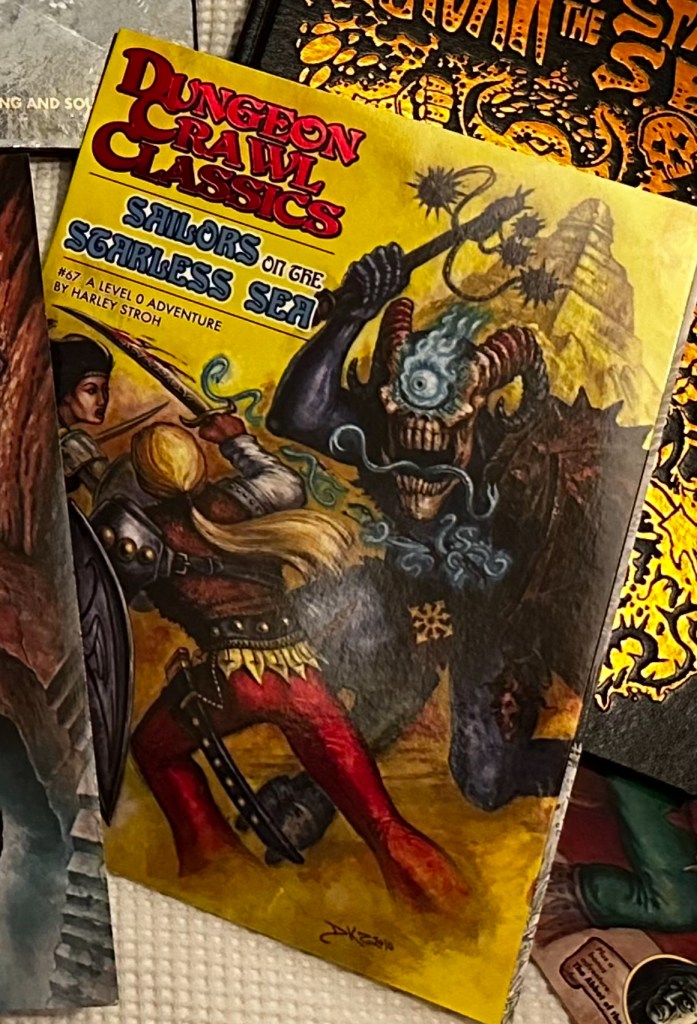
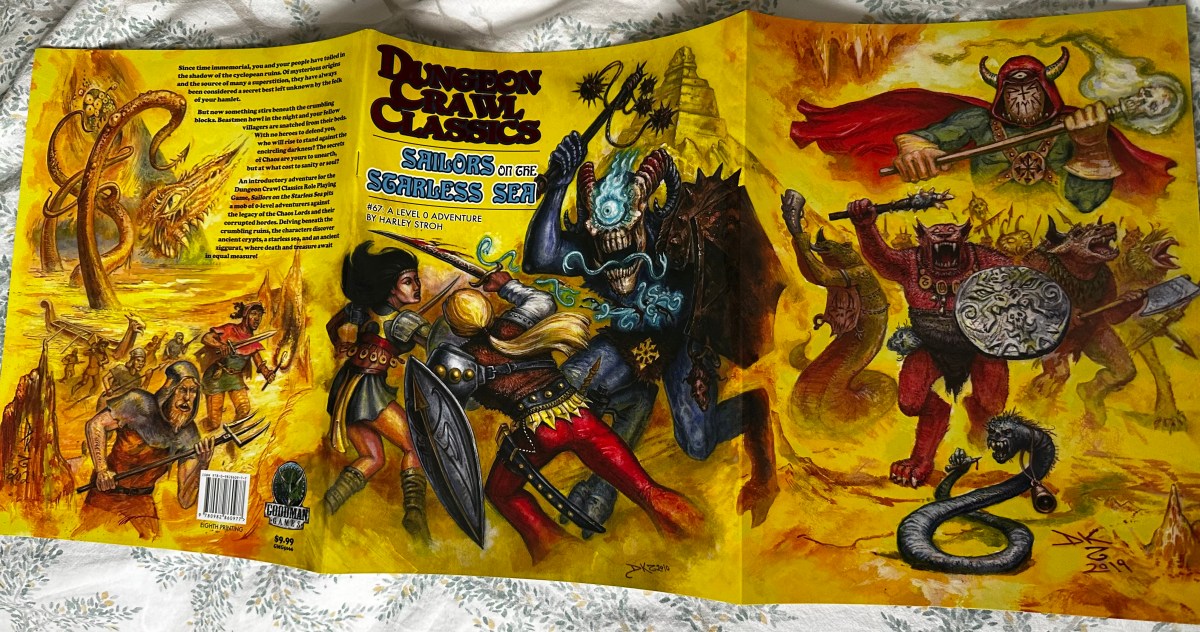
A few weeks back, I wrote up the fictionalised version of the events that occurred in the first session of Sailors on the Starless Sea, as played by the incredible members of our local in-person RPG community, Tables and Tales. They had just defeated the Beastman menace aboveground and were girding their collective loins to delve below the Keep of Chaos. Here’s part 2. Spoilers ahead if you plan to be a player in this module in the future!
The Starless Sea
In and in the darkness settled about the invaders and their new recruits, the doughtier of the captives they released from their chains in the charnel tower above. From the first landing in the stairwell, they gazed down and some saw the gleam of gold upon the steps below. Guðlaf, ever in pursuit of greater treasures, descended and found only a trio of lonely coins dropped and left where they lay. But, too, he noticed a curiosity in the one wall of the second landing. It appeared to stand…ajar. He and several of the others pushed through the revealed entrance to a chamber bedecked in antique cobwebs and festooned in the emptied carcasses of a treasure horde’s chests. While Marquis and some of the others gathered up what little coin still graced the grey stone floor, Hilda the Herbalist went to inspect the chests. One, she discovered, easily enough, had a hidden compartment in the bottom. Delighted with her discovery, she levered it open. The treasures inside were roundly ignored as a blade swung out, slicing away two of her earthy fingers. She cried out and bandaged the wounds as the others examined the find, tarnished silver jewelery, glittering emeralds of great worth, and a tabard of black, bearing upon it, the sigil of Chaos. As well, a brace of potions, oil of the black lotus according to Hilda. Imbibe it and gain great fortitude for a short time, but suffer for it later if found too weak to bear it.
Across the landing, another contingent of brave souls had found a great rend in the rocky wall. They had entered and found only another door. This one was surrounded in evil-looking runes. None of them could decipher their meaning, but they proceeded to attempt to enter nonetheless. They shoved and heaved and, eventually, shifted the great stone doors on their hinges. As they did, the magical wards fulfilled their fell purpose, exploding in unholy fire. Immediately, Ealdwine Dwerryhouse, the recently recruited Pádraig, elephant-eared Dainn and Ropert the rope maker were roasted like swine on spits, leaving only the girl known as Bear and Darik to enter the frozen tomb of the Chaos Lord Felan. He lay there still after years uncounted, perfectly preserved with his enormous axe and his glittering armour frozen with him in translucent funereal garb, a thick sheet of magical ice. Daric entered and tried his best to break through to retrieve the weapon but to no avail. Fearing for his life in the ice-clad chamber, he retreated.
Re-united on the fateful stair, the survivors gathered their courage and continued down into the darkness. They had come to rescue their neighbours and kinsmen and by the gods, they were going to do it.
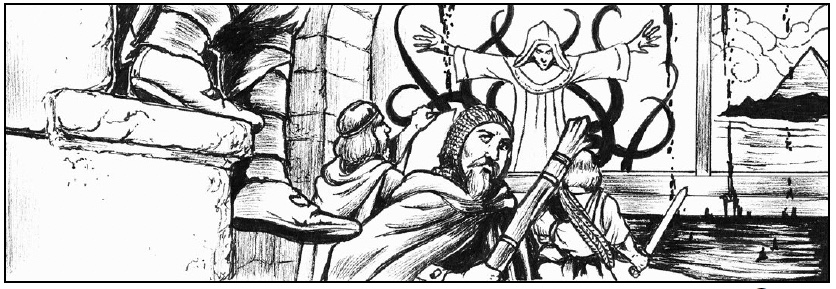
Soon they found a new chamber, this one richly decorated in tile mosaics. In the centre a long, deep pool stretched almost to the other end. Almost all of the survivors were gripped by an undeniable drive to gaze into the waters of that pool. They simply found themselves there, as though transported by an invisible hand. And as they looked, the skulls of men and women rose, like glowing, hideous bubbles until they floated there, awaiting their new owners. The villagers took the skulls offered by the pool and were released, then, from their compulsions. Free to examine the rest of the chamber they found several nooks containing the mouldering old robes of some sort of Chaos cultists. Two of their number, Lydia and Roric took the robes and donned them, perhaps to fool some future enemies. Others looked upon the mosaics. They depicted several subjects. The first was a hooded figure standing atop a tall, stone monument, seven tentacles waving from the dark waters of the lake below it. The second showed a pair of armour-clad warriors clutching a single flail and commanding an army of bestial fighters. The third revealed a golden ziggurat atop a small island and a tall figure atop it, in the process of sacrificing a maiden.
Leaving the Dread Hall behind, they went on, down and down a long set of wide stone steps all the way to an incongruous beach of black sand, occupied by a massive menhir and, beyond, in the misty waters of some starless sea, the majestic, draconic prow of a proud longship.
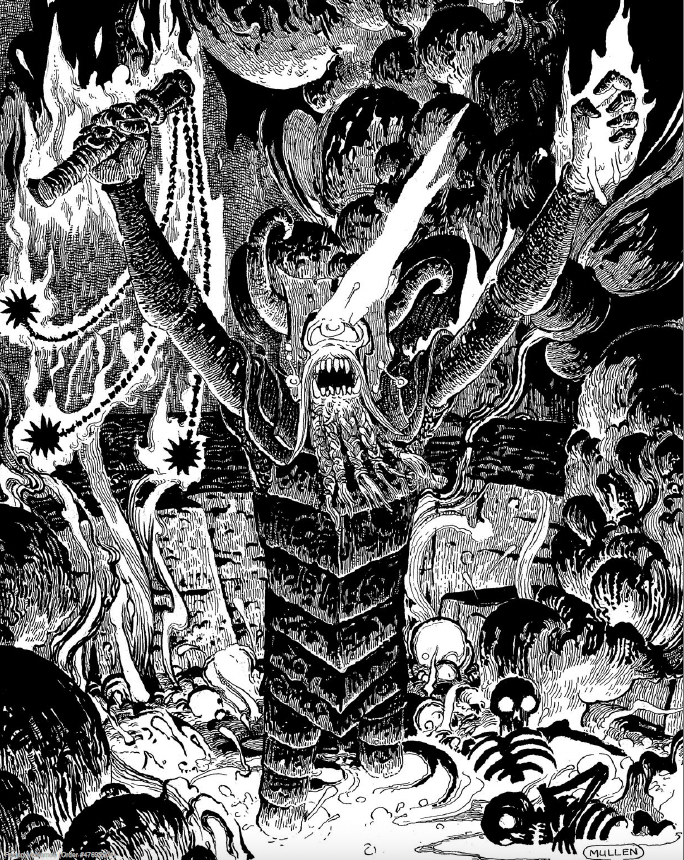
Marquis decided to take the reins, doffing his heavier clothes and items so he could swim out to the ship unburdened. The others tied rope to him and chain to that, to allow him to swim the whole way. The water froze him almost to paralysis, but he persisted, as though crawling through the blackness of the void where the Chaos Gods dwell. Almost had he reached the forbidding hull of the longship when he felt something even frostier than the waters wrap around first one leg then the other. Bubbles escaped his mouth as he was pulled down, down, down into the deep and the dark. Those left on the beach could only notice the rope streaking through their hands at a speed Marquis would be incapable of. They tried to hold on but soon gave up when they saw first Marquis’ left side and then his right, dangling from a pair of gargantuan tentacles, then dropped into the water, never to be seen again.
Determined to find a way to the ship, Peggy, the well-known, one-legged beggar of their village, led the rest across the sands towards the cursed obelisk, and attempted to decipher the meaning of the swirling, mystical carvings that adorned it. Anger, violence and a compulsion to cut out his companions hearts and sacrifice them to a being of pure chaos beneath the still, black waters washed over Peggy, but he pushed away, he resisted and, instead, climbed the narrow stairway that led to the top of the menhir. Already, Lydia, ever faithful and sworn to carry the burdens of others, stood on top, examining the melted remains of a red candle set into a stone bowl that she found there. “No more room up here, cripple. Go back down,” she said, heeding the beggar but little. This was enough to send the traumatised man into a rage. “Do not call me that!” he screamed, lashing out with his crutch and knocking Lydia from the summit of the stone. She fell and hit the sand with a sickening crunch. Peggy looked down from above as the others gathered around their neckbroke companion. He felt no regret, he felt no remorse. Instead, he lit the stump of the crimson candle and watched as the ship approached the shore.
If the others thought of vengeance or justice for the murdered Lydia, perhaps they decided it would be best to address the matter after their fellows were rescued from this hellish sea. They all climbed aboard the boat and it turned to face a golden glow out in the murk of the great cavern. Mu set the pace and the strongest of them took an oar each, rowing for their lives and the lives of their loved ones. On they went until they could easily make out the shape of an imposing golden ziggurat atop an island out there in the waters. It appeared just like in the mosaic. The subject of human sacrifice entered the minds of many of the villagers so they redoubled their pace.
Until the tentacles re-appeared. One wrapped itself quite securely around the stern of the ship and another attached itself with its strong, wine dark suckers to the gunwale, as five more burst from the water ahead, thrashing and threatening.
Guðlaf thought of the censer he carried in his bag, the one from the chapel of chaos in the keep above. Perhaps, if it could be used, the creature would recognise fellow worshippers of the Choas Lords and allow them passage. He retrieved the item, opened it up and remembered… he did not possess the incense. The rope maker, Ropert had it on his person when he was roasted by the flame ward trap in the tomb of the Chaos Lord, Felan. Curse his greed! He called for aid, holding up the useless censer and Hilda noticed. Cleverly, she carried always in her satchel a collection and mixture of herbs and ingredients that might come in useful in many situations. Here she attempted to recollect the smell of the incense Ropert had recovered from the chest in the chapel, and praying to the spirits of her fore-mothers, sprinkled them into the censer. Guðlaf sparked the herbs to flame and swung the censer madly on its chain across the deck of the ship and over the inky waters. The tentacles reacted immediately, retreating into the depths, their owner remembering, perhaps, the ancient compact between it and the Chaos Lords Felan and Molan.
On they rowed until they landed at a narrow strip of beach below the lowest steps of the great golden ziggurat. A hellish orange light burned through the cracks between its huge stone blocks. A ramp, long and straight, led up to the very utmost of the pyramid, flanked by beastmen of all varieties, baying and howling and crowing and hissing as a steady stream of villagers, tied and chained and gagged were forced up to their doom.
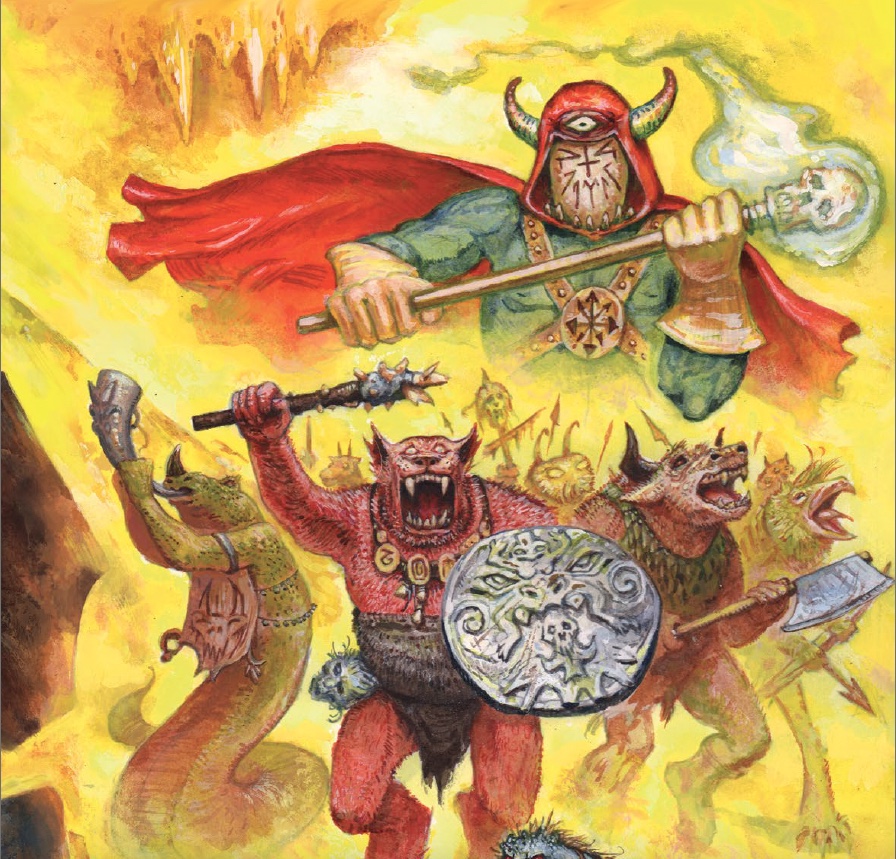
Realising their time was now very short, the sailors sent out a sortie to see what they could see, Bear and Lindon Lyndone crept around the outside of the imposing golden edifice and then up they went to spy on the top. Up there they could see several more Beastmen, shoving humans and treasure into a glowing pit, overseen by the effigy of a tall, one-eyed armour clad warrior with a flail. They went back to report what they had discovered and the sailors decided to break into two groups. The first would be led by those with the chaos cultist robes on, taking the others as sacrifices up the ramp, in the hope that they would not be noticed by the Beastmen who were so rampant in their worship. Meanwhile, the other team would creep around the ziggurat once again, in an attempt to make it all the way to the top and stop the sacrifices without angering the entire crowd of Beastmen.
In preparation, Mu and Guðlaf consumed the black lotus oil, danger of death be damned! Danger was all around!
And so they set off. The two in the robes, pushing and prodding their companions ahead to give the impression they were the capturers. All seemed to be going well until, Mu, unable to witness the cruelties being heaped on his people in silence uttered a single “mu,” and raised his head to better perceive the situation and a great, pug-faced beastman, noticing Mu’s human features, barked and yipped and grappled Mu. Then, the battle was truly joined. Around the other side of the ziggurat, Guðlaf, one of the stealthy team, dropped a bag of the coins he had been dutifully collecting through the keep and below it. It clanged and jingled with surprising volume, attracting the attention of a contingent of Beastmen from those lining the ramp. They wasted no time in attacking.
Combat proceeded and for a while, it looked hopeful for the villagers. They felled one unholy chaos creature after another, but when the Beastmen gathered their wits enough to launch a significant counter attack, peasant after peasant began to go down. Several of them were dragged to the top of the ziggurat where the great Beastman shaman was hurrying the end of the ritual to summon the Great Chaos Lord, Molan into the effigy set above all. But there, they managed to escape their fate at the bottom of the molten pit. Instead they attacked the shaman and his acolytes who fought back like animals. Bear, so lucky so far, found herself disembowelled on the end of the shaman’s blade as she bravely went into battle with him.
But the ritual had been completed now, the Chaos Lord inhabited a physical form once more. His skull-like head bore only a single blazing eye, his dark armour glistened in the remaining light now that the magma in the pit had been consumed by the ritual. His flail, glowed with a demonic fire, lashed out at all that approached. He laughed at the attempts to bring him down. But those who still stood, those not occupied by the Beastmen on the ramp, joined forces to do just that. Around him his forces dwindled as the villagers, urged on now that their fellows had been found and saved from sacrifice, brought low the shaman, his bestial acolytes and many of the forces on the pyramid below. Roric charged and was crushed by Molan’s flail, the halfling, Hamfast Harfoot, but recently rescued from the tower of the keep was undone by the skewer-like spear of a beastman, likewise, Lindon Lyndone found himself run through.
The attacks to the great Chaos Lord went on and on, many utilising the glowing skulls they had retrieved from the Dread Hall, which exploded in green fire when they struck. They had demanded to be used, glowing now more fiercely than ever in the presence of the hated Molan. It was one of these, flung by the wily and murderous Peggy that struck the Chaos Lord in the eye, setting his whole head ablaze and finally bringing him low. I cheer of triumph went up from the assembled villagers, both fighters and captives alike, as his body melted leaving only his accoutrements, flail and armour. Peggy wasted no time in lunging for the great flail, but it was a mistake. The hero of the hour found himself burned and destroyed by a magma golem’s fiery pseudopod as it generated from the Chaos Lord’s remains. Vargan, also, greedy to the last was left a burning husk by the golem as he had reached for the armour.
The rest of the villagers gathered some of the fallen coins that littered the top of the ziggurat and then ran for their lives. The cavern was collapsing around them and a great tidal wave rose from the west side of it, threatening to destroy them all in moments. All but Daric reached the ship in time and climbed aboard. He had insisted on remaining to gather even more riches and he was forced at the last moment, as the ship pushed off and the rowers began to row, to leap across the churning black waters of the Starless Sea, into the waiting hands of his comrades, forgiving as they were of his greed and foolishness.
The titanic wave hit them, drowning the evil island and propelled the dragon-prowed longship across to the far side of the sea and down a narrow tunnel and on and out into the waiting river beyond. They had escaped.
Guðlaf lay on the deck in the sunshine, breathing ragged and baleful breaths. He looked into the eyes of Mu, who was sprawled beside him and spoke the words “It is well.” Both had taken the black lotus oil knowing the risks. Mu looked into his companion’s eyes as the light left them. He shed a silent tear for him and looked about at his remaining friends, Dave, Hilda, Daric and Helfgott Hoffman, wondering where they would go from here. They had come through so much death and loss but had achieved the impossible. Surely they could more return to their old dull lives in their village than Guðlaf could return to life of any kind. Perhaps this ship would take them on to more adventure. He managed to express all this in a single elegant syllable as the sun blazed down upon him, “Mu.”
If you’re anything like me, dear reader you buy a lot of RPG books that you are unlikely to ever pick up and play. Sometimes, that’s the intention or at least, you don’t have a plan to plan to use it, you know? I have some in both categories. Some books I backed in their crowdfunding phases because I want their creators to continue to create cool stuff, even though I know it will be impossible to fit the actual final product into my ongoing campaigns or their new game into my frankly ridiculous gaming schedule. Some I picked up in PDF format through Bundle of Holding or Humble Bundle because the deal was so good I would have been stupid not to buy them. Some I purchased with the knowledge that they might enrich an ongoing campaign but then just never fit in anywhere.
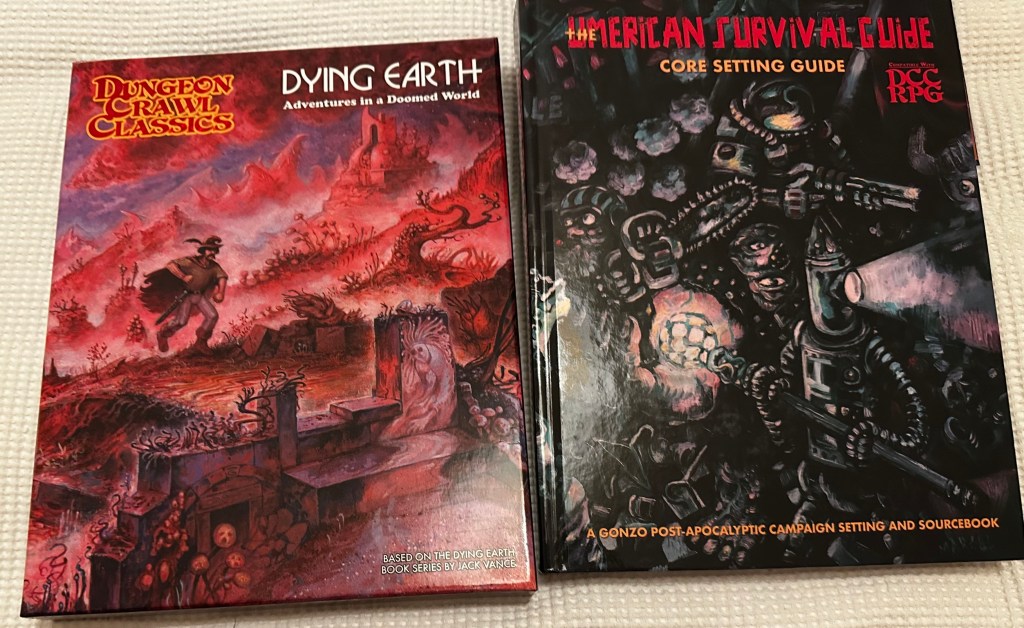
But DCC adventures are in a slightly different category. I have bought a truly obscene number of them, mostly as PDFs. I think this started after listening to a few of the reviews of DCC adventures by Fear of the a Black Dragon. Then I started to collect physical copies. My local independent game shop had copies of their Dying Earth setting box and the Umerica setting book, both of which I purchased. You know, a lot of the time, this was purely due to aesthetics. They are beautiful works of art, frankly. I love their style and their content, even if I hate their layout. But the real reason is because these have always been aspirational adventures for me to play. Genuinely, I feel at this point that, if I could, I would abandon D&D for DCC. Why? The adventures I have read are just effortlessly lacking in D&D’s corporatised humourlessness. They are not written in comedic fashion but in the last two sessions of DCC playing Sailors on the Starless Sea, I have had more genuine laughs and gasps of outrage and tears of sorrow and joy than I have had playing D&D since 2014. And that is not to demean the efforts of many of the wonderful creators of 5E products, it is simply to praise the work of the designers who created a game that I expected to bounce off due to crunchiness but which I, instead, embraced due to its flexibility. The philosophy of the adventure design also has a lot to do with this new attitude. To discuss that, let’s talk specifically about the module I just finished with my players tonight, Sailors on the Starless Sea.
Sailors on the Starless Sea: Endings and Beginnings
The surviving sailors sailed off to parts unknown at the end of our session tonight, each player with one remaining character. This is the ideal ending to a DCC 0 Level Funnel adventure. I am guessing that sometimes players end up with more than one 1st level character to begin their true career as a proper DCC adventurer, but it seems like the best possible outcome if you’re only looking after the one.
It was the getting there that was so much fun though. I wrote recently about character creation in Cosmic Dark being so much fun because the players play it, they role play the most developmentally significant moments of their PC’s lives up to that point in snippets and flashbacks with other players. The DCC funnel is surprisingly like that except its also involves a dungeon crawl, horrific death on a brutal scale and a boat load of shared trauma. Every one of the characters left at the end of the funnel knows precisely what the rest of the survivors are capable of and what they are not capable of. They know some terrible secrets about them and they know that they are keeping some terrible secrets about their own character too.
The survivors were not necessarily the ones you might have predicted at the start as 20 peasants ranged about before the Chaos Keep’s rusted portcullis, but they were the ones Luck favoured in the end. They survived traps, vine horrors, a shit-tonne of beastmen, a cursed well, a fire trap, a Chaos Leviathan, the return of a Chaos Lord to the plane of mortals and a literal tsunami… Someone powerful was smiling on them. And their players knew that by the end, that’s for sure. This made every death so much more terrible and every survival so much more precious. If it hadn’t been for that one critical hit that time, they might not have destroyed the Chaos Lord; if it hadn’t been for that fumble, maybe Gwydion would have made it past the chapel; if it hadn’t been for that successful Luck check, maybe Thomas would have been left with no surviving characters instead of the four he started the session with. There are so many of these death or glory moments woven into the text of this adventure that it is hard to overstate how much every roll and action seems loaded with meaning and significance, especially when the PCs generally have no more than 2 or 3 HP.
It’s easy to say that there were just so many PCs that their existence was cheapened. I even allowed them to restock a few peasants at one point. The adventure allows for this about half way through because they know exactly how lethal it is about to become on the second level of the dungeon. 23 PCs went into the dungeon in total. Six emerged alive, one succumbed to the effects of a potion once they had escaped, a poignant and fitting end point to the whole story. Every one of those deaths had an effect on the player who played the character.
They wondered from the start who might survive. Maybe they would be different. Maybe all their little darlings would make it through. Perhaps only the weakest would be culled. Repeatedly, tonight, the characters that the players expected to survive went down. It was still shocking to them, it was still sad to say goodbye to them, even though time was of the essence. It made for some of the most effective drama I have had the pleasure of being part of at a gaming table in years. And it was a DCC funnel adventure. An adventure designed as a way to whittle down your choices of character to play in a campaign in the most Darwinian fashion.
Harley Stroh wrote a great adventure filled with mystery and danger and conflict and true significance and then they play-tested the shit out of this thing. This is how I know: There was a moment at the very end when the last PC, who had stayed behind to loot some corpses, had to make a Luck check to secure his place on the Dragon Ship to escape the dungeon. This was the second last element of high drama in this game and it was all down to a single roll, DC 17 to leap to safety from the shore to the boat. Thomas thought he’d whiffed it. Thought he rolled a 9. But it was just one of those dice, white text on light background… turned out it was a 19. His character grabbed the gunwale of the longship and Hilda dragged him aboard just time for them to be ejected from the cavern by a tidal wave. The highs and lows! The regret and the relief!
Sailors was genuinely one of the highlights of my recent gaming experiences and the feedback I’ve had from the players so far has also been glowingly positive. If you haven’t played it, dear reader, do yourself a favour, go and find yourself 15 to 20 drunk peasants and get them to invade the ruined keep of the Chaos Lords, you won’t regret it.
Here’s my fictionalisation of our first session of the classic DCC 0-level funnel, Sailors on the Starless Sea. Six of us, members of Tables and Tales gathered last Sunday evening to play through the first half of the adventure. We had an absolute blast, both with the adventure and the DCC rules.
I may have taken a few liberties and used some artistic license here and there but the major beats are all as they occurred. Spoiler warning if you have not played or read Sailors on the Starless Sea and you want to be a player in a game of it, stop reading now!
The Keep of Chaos
The villagers gathered before the rusting gate of the ancient keep, as a blasphemous banner snapped above the crumbling, ebon walls. Behind the shivering mob, Betsy released a single, unenthusiastic moo as she shuffled in her protective circle. They had made surprisingly short work of the vine choked corpses on the causeway below. The burgeoning corpses of their fellows had shocked some into sobriety while only awakening a greed and opportunism in others that they had previously, perhaps, just imagined they possessed.
Only the half-raised portcullis stood between the no-longer inebriated gang and the rescue of their abducted friends and family. Edgar Hayward Blackburn Hathaway IV, assuming a leadership position, urged his fellows on into the black keep, while the gnoll-reared urchin, Bear scampered in and out, as though possessed by a great desire to poop. Stopping for nothing, most of them marched through, all but the three dwarves doubling over or crawling beneath the spiked portcullis. A few waited on the outside, curious perhaps to see how this entrance worked out for the majority. These were, perhaps, the clever few… just as the final row crossed the threshold, someone above released the portcullis to fall the rest of the way, pinning two of their number beneath. The renowned and beloved corn farmer, Maize, died instantly, skewered by one of the rusty spikes. The survivors would, for ever after, recall his broad, smiling face and his impaled body whenever they munched on a sweet, buttery cob. His little goat ran, unfettered and bleating into the be-brambled courtyard, as the remaining villagers heaved the portcullis up to release the cheesemaker, Gorgonzola, who had somehow survived the portcullis trap. Meanwhile, a bell rang out from above the gatehouse, pealing briefly, but alarmingly. The final few peasants, who had waited out front, joined the mob as they began to explore their hateful new surroundings.
Several of them circumnavigated the overgrown clearing contained within the castle’s broken and burnt walls. But two explored the well. The well seemed to call to Dáinn, his curiosity growing to almost physical strength, pulled him to it. Meanwhile, his companion pulled on the well’s sturdy chain to see what might be lurking below. Dáinn could not resist a peek over the edge, and, before he knew had pitched, headlong, into the darkness below! His companion scrambled to catch him, but it was too late… Luckily, Dáinn came to his senses as he plummeted and managed to grab the chain before he hit the undulating ooze at the bottom. The others pulled him up, but he was not exactly himself anymore… he now sported the flapping ears of a pinkish pachyderm.
Meanwhile, other villagers discovered part of the old wall in the back had utterly collapsed. They decided to leave it alone, nothing a potential for further collapse and possibly fatal accidents.
Nearby, an ancient capstone of some sort, runed and glowing slightly, was discovered. It had been concealed, deliberately or otherwise by thorny vines and scrubby grasses for years. Uncovered, the group’s scribe was able to take a look at it, but, unable to decipher the meaning of the rune, they decided it was best left as it was.
As this occurred, Mu, the monosyllabic Dwarven mushroom farmer, investigated the forbidding portal of the nearby chapel. The terrifying visages of hundreds of demons, screaming and howling had been hammered into its heavy bronze doors, which had been barred from the outside. Mu, heedless of possible dangers, tossed aside the ancient wooden bar and swung wide the doors. Inside, resting impossibly on a floor carpeted in crackling, glowing embers, a half-dozen skeletons still roasted, slowly, in their blackened chain hauberks. A charred chest, padlocked and tempting stood to one side of an elaborately carved fountain. The hellish amphibian likeness of a stone frog belched forth an endless spring of tarry ooze from a mouth seemingly filled with precious gems. Gwydion, the elven artisan, fascinated by the construction of the fountain approached, heedless of the embers. The ooze reacted, raising its undulating bulk up and over the lip of the fountain. It landed on the fiery floor and burst all into devilish flames as it flung a pseudopod, greasy and burning, in the direction of the elf! But Edgar Hayward Blackborne Hathaway IV, always on hand to defend his companions, leapt into the chapel and attempted to fling a dart at the fiery monstrosity. His aim failed him, the strength of his arm directing his attack, instead, to his own unarmored wrist as it escaped his grasp in the worst possible way. His blood gushed, hissing and dancing over the hot embers as he collapsed, lifeless into the sizzling coals. A moment later, despite several fine hits from the other gathered villagers, the ooze’s pseudopod finally connected with his elven target, immolating him. As Gwydion fell, the others fell upon the tar ooze, dousing it and destroying it. Weary now of all the senseless killing, the peasants armed and armoured themselves in what they could recover from the dead ones in the chapel and discovered a curious item of some chaotic deity, a blackened censer and several bales of unwholesome incense that had been locked in the chest. They stowed them for later use and proceeded with their explorations.
A sinkhole dominated the northeastern corner of the courtyard, spewing forth vapours that formed terrible shapes of writhing beasts and men in the air above it. Perhaps this was the way forward? Attaching a rope to the chain retrieved from he well, Darik the hunter braved the uneven and dangerous ground about the edge of the steaming pit to get a better look, his fellows holding on to keep him safe from falling to his death. The ground, indeed, collapsed below him and he dropped seventy feet into the poisonous spume, seemingly still nowhere near the bottom. His investigations revealed nothing of the bottom nor the source of the vapours. He climbed back out and the villagers continued on to the tower in the south east corner, the only area left to investigate…
Sir Chopsalot, the woodcutter, finding the door to the tower guarded by hideous gargoyles and locked tight against their attempts to enter, hoisted his axe and got to work. He worked up a sweat and brought down the portal. McTavish, the blacksmith, his blood up, charged into the tower and was a confronted with a sight and stench of charnel destruction unlike the worst tanner’s pit. The discarded hides and skins of beasts and humans covered the sticky, malodourous floor. Mites and flies buzzed about, biting and swarming over everything. High on the walls of the tower, hanging by their tied wrists from spikes, some of the abducted wriggled and thrashed when they saw him enter, eager for freedom. But he did not have time to act, From the steps above his head, an enormous brute of a beastman, cursed with the head and sharpened horns of a great bull, jumped onto McTavish’s back, crushing him into the ground with his dreadful battle-axe. Then he turned to the villagers arrayed outside and snorted while his beastmen approached from behind. The remaining peasants quickly formed a plan to distract the beastmen while Mira ran to the chapel to fill a steel helmet with scorching embers. Combined with the oil from a flask they had brought, this could cause a conflagration in the tower, destroying the arrayed abominations. As she ran to gather the coals, Sir Chopsalot, the woodcutter, found himself in the way of the charging, bovine beastman champion and was impaled on his great horns. Another monster, with the hideous head of a beagle, speared Gorgonzola, the cheesemaker, finishing the job the portcullis had earlier begun. Mira returned just in time to prevent the rest of the beastmen from emerging into the blood-soaked courtyard. She flung the embers into the awful tower where they set alight the lantern oil. The villagers took some satisfaction in watching the demons burn.
Victorious, the survivors doused the flames and rescued several of their neighbours from their captivity. They searched through the detritus in the tower and were able to discover a map to another keep along with a letter of employment, stitched into the hem of some poor unfortunate adventurer’s cloak. But, before long, they knew it was time to proceed once more. This time, the only way on was down a set of ancient, worn stone steps, down into the darkness below the keep…






 The Dice Pool