At the start, 87 posts ago, all the way back in July of this year, I wrote this:
I think I’ll write how I feel about some of the things I consume as a way to digest them (not the food and drink, I’ll do that in the traditional way.) But, mostly, I’ll be writing about my main creative outlet, playing, running and making things for tabletop role playing games. Let’s not be coy about this; the internet is not lacking for nerds going on about their games, or someone else’s games or games they watched other people play or games they hate or games they actually quite like, surprisingly enough. So, even knowing this, why would I have the gall to add to it? Good question, good question indeed. Maybe I will figure that out as I do it. The adventure is the journey and all that.
And, that’s pretty much what I’ve been doing. I am still doing it. I have learned a lot by doing it. This blog has genuinely been an enjoyable and useful outlet for me. It has allowed me to work through some game-related ideas that might otherwise have floated freely around my brain, temptingly close but always oh-so frustratingly out of reach. It has also given me the opportunity to express my feelings on more personal matters. Mainly, though, it has provided me the chance to write regularly about one of my favourite subjects, RPGs.
I have made a few changes over the last six months. I went from posting daily to every two days to every three days and then to twice a week. I feel like I have found the ideal schedule now and hope to continue with it. Thedicepool.com joined the woodpanelled.org web ring. I hope to see Woodpanelled grow even more in the new year. I started posting some of my own fiction pieces as well as the RPG-related posts. I’m hoping this will encourage me to write some new fiction soon! Finally, I have been sharing my posts more on social media, both Instagram and Bluesky. where I have made some connections with other people in the TTRPG sphere. I have had some great feedback from some of these interactions and that has encouraged me to put the blog out there a bit more.
The Bloggies Awards and a request
So here we are, it’s the end of the year and a good time to consider some of the things we liked from 2024. In this incredibly niche corner of the internet I find myself tucked away in, there is a way to show your appreciation for those things you liked, or that you found useful or inspirational or that just tickled your fancy. You can nominate a blogpost for the Bloggies Awards, which originated in 2022 on the Prismatic Wasteland blog.
The 2023 winner was Sacha (or sachagoat.) He won for the first part of an excellent series of posts about Re-inventing the Wilderness. You can check it out here along with an introduction to the Bloggies themselves. Basically, people nominate their favourite TTRPG blogposts within four categories:
Theory – I don’t really get into this area too much on the blog, although I may in time
Gameable – I also don’t have a lot of this sort of thing here. I have considered sharing some of my home-brew stuff, but I would need to do some more work on most of it first
Review – I would hesitate to call myself a proper reviewer of RPGs but there are several posts that fit into this category. I am thinking particularly of the posts on Liminal_, Cthulhu Dark, and the series on Between the Skies and Dragon Age. But a lot of my other posts dealing with games I have played would probably fit into this category too.
Sacha has introduced a couple of new categories for this year too:
Debut Series – This is me! Despite having 87 posts under my belt, this is still my debut year.
I won’t go into any more detail here. Sacha explains it all on his blog. Suffice it to say, if there are any of my posts from the past six months that have resonated with you I would appreciate a nomination. You can use this Google form to do it before December 31st. It only takes a couple of minutes and is pretty straight-forward.
Thanks
I appreciate all your support during the last six months, dear reader. At the start, I pretended like I would do this whether or not anyone read it, but the fact is, I do take great encouragement and motivation from the fact that others have read and gotten something from this blog. I would like to extend my gratitude to all of you who have taken a few minutes out of your day to read even a few of my words since July.
My experience with actual plays comes from an unexpected angle. D&D is for Nerds by the Australian Sanspants Radio network was the first one I listened to. I had heard tell of Critical Role but, even then, it intimidated me with its sheer length and the fact that it was in a visual medium. Listening to podcasts while out walking or commuting is one thing, sitting down to watch a four-hour episode is something entirely different. Although, during lockdown and the long period where I was working from home and didn’t go out much I did start to get into Dimension 20 on Dropout.tv. Honestly, it was the clips on Tik Tok that got me started on that. I’m glad I did get a Dropout subscription, in fact; it’s still the best value streaming service I’ve got. Anyway, The D&D is for Nerds nerds put together something much more manageable in length, that I could listen to on my pod-catcher of choice. It helped that it was funny and that I quickly developed an appreciation of the characters and the world that they inhabited. I don’t listen to these so much anymore. In fact, I don’t listen to a lot of actual play podcasts these days. I am far more likely to stick on a show about TTRPGs instead. I have introduced two of my favourites in the past, in a blog post. But here’s another, Talk of the Table is a production of Many Sided Media, who also produce Bitcherton.
Talk of the Table is presented by Brian Flaherty and Elliot Davis. These guys are RPG professionals and creators in their own right (Elliot Davis has a game on backerkit right now! Go check out, The Time We Have) but they use this platform, normally, to interview other creatives in the industry, whether they are game makers, artists, actual play performers or something else related to the hobby. Some of those I have enjoyed recently were episodes where they interviewed, Mörk Borg design genius, Johan Nohr, TTRPG video essayist and creator, Aaron Voigt, and Blades in the Dark forger, John Harper. Flaherty and Davis have a pleasant, approachable style and a genuine and excited interest in the works of their guests. It makes for a great “podcast hug,” as Blindboy Boatclub would put it.
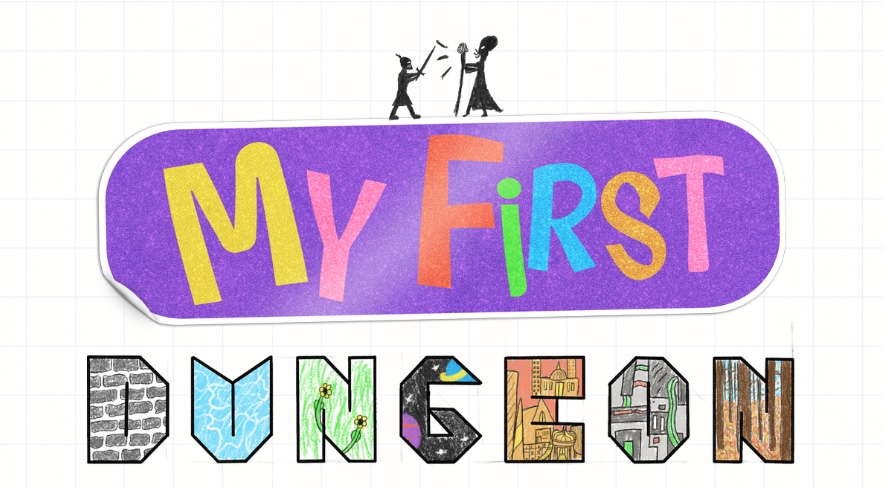
My First Dungeon: The Wildsea
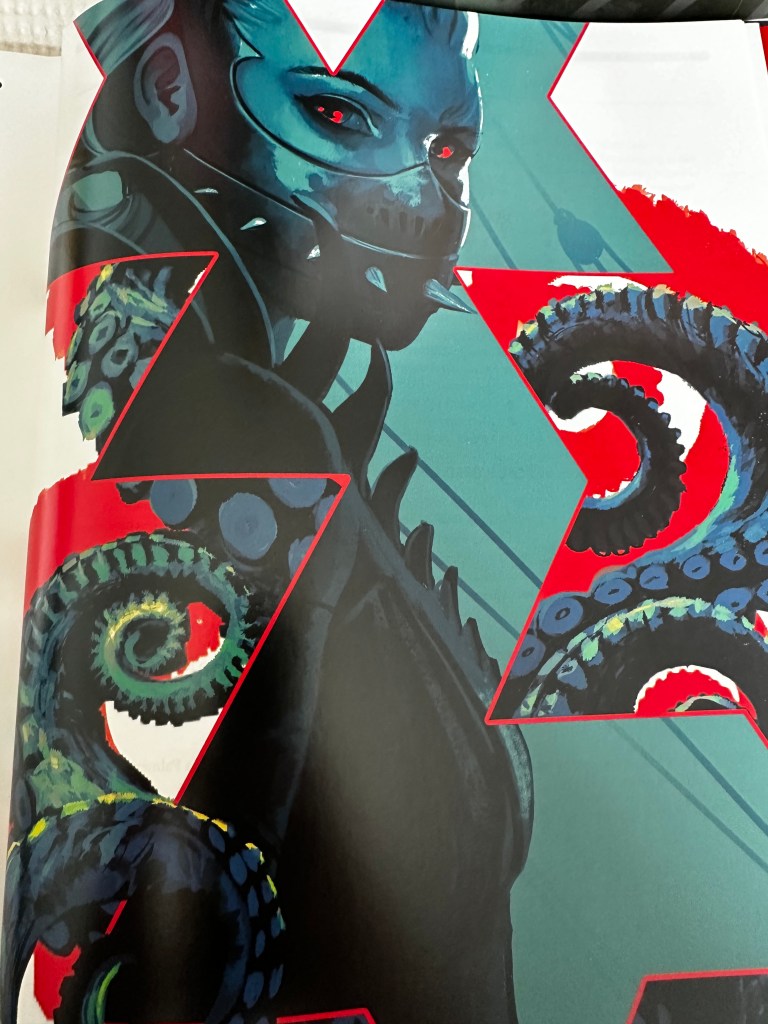
The Cover of the Wildsea Corebook by Felix Isaac
Anyway, listening to this show made me aware that they had an actual play podcast called My First Dungeon on their network. So, I thought to myself, I could listen to these guys playing RPGs, probably. It turned out they had a few seasons available when I went looking. These include seasons of DIE (which I will definitely be going back to listen to,) Orbital Blues, the sad space cowboy game, and Paint the Town Red, their most recent offering. But the one that caught my eye was their relatively recent season of the Wildsea.
If you have been around for a while on the blog, you might remember that the Wildsea was one of the games I was hoping to play before the end of this year. This vain hope has been utterly dashed at this stage of the year, but I am still interested in running it at some point. I have been reading through the book, on and off for a few months. What I have discovered while doing this is that it’s got a lot to it! There are so many different parts that go up to make each character, and each one of these parts brings with it a whole plethora of aspects and there’s a lot of new terminology to learn and the world is so wild and different… So, it has felt daunting to even know where to start with it.
Now, there’s one thing I think a good actual play can do, and that is teach the game. If they do it well, they can even tell a compelling story at the same time. Or maybe the compelling story is what helps you to learn. I feel like Dimension 20 had that effect on me when it came to learning to play 5E better. I knew it pretty well before I started watching those shows but by the time I had consumed like two or three seasons, I had a much more intimate knowledge of minutiae like spells and abilities that I did not previously feel I needed to have a keen grasp of as the DM. So, I went into My First Dungeon thinking I might, at the very least, get that experience from it. And you know what? I did.
From Session Zero of the Wildsea campaign, I was taking the elements I had only read about, the things that had seemed quite abstract, and I was applying them to the frame of the characters and the basics of the world.
From Session One, I already felt like I had a pretty good grasp on the way the mechanics worked. Tracks, aspects, dice pools, advantages, cut, twist: I understood them at a more than intellectual level.
And here’s the other thing about this series that grabbed me from the get-go, I liked these characters! I was invested in their rolls and the ways in which they used their aspects to express themselves and to succeed. I appreciated the players’ willingness to play to their characters’ weaknesses as well as their strengths, and the way they used the mechanics to bring about their failure when they thought that was narratively appropriate or necessary.
Finally, I think that each of the players in this actual play brought this game to life together. All of them put a lot of effort into building not only their characters, but also the shared world, through dialogue and backstory and by narrating the outcomes of their actions or negotiating with the other players for the best Twists. They do all this while maintaining a seemingly instinctive focus on the overall themes of the game, past lives, secrets of the lost world and secrets of the characters themselves, resurfacing.
I’m sure editing and production have a lot to do with this, too. If every table had an editor we could make it feel like our narrative beats and adherence to theme were foremost in our minds at all times. But seriously, I have to give a lot of credit to producer, Shenuque Tissera and Brian Flaherty who did the editing and sound design, while also being one of the players! There’s additional music and SFX courtesy of Artlist.io too. The voice effects and leitmotifs for the various characters are incredible and really work to spotlight individuals when that’s needed. Interestingly, this is a core part of gameplay in the Wildsea that has gone unmentioned on the show, as far as I remember, at least. Focus, “a sort of narrative spotlight,” according to the book, is a basic element of the Wild Words Engine and it is there to make players remember to pass the torch on to other players. I am sure the main reason it’s not mentioned is that these pros don’t need the reminder and that the sound design, editing and production are to such a high standard that it renders the concept unnecessary. Speaking of sound, there is also a musical surprise in every episode that I won’t spoil…
Do you listen to the Vintage RPG podcast, dear reader? Do you follow VintageRPG on Instagram? If you are reading this blog, the chances are good that you do both of those things. But, in case you have somehow never come across it, the podcast is presented by Stu Horvath and John “Hambone” McGuire. On it the lads chat about lots of RPG related subjects. As the name implies, they do talk about older games, like Fighting Fantasy and Beyond the Supernatural, which, as a gamer of a certain vintage, I very much appreciate. But many of the most interesting episodes involve newer games like Swyvers. They often have fascinating interviews with game makers. Their conversation with Swyvers creators, Luke Gearing and David Hoskins, convinced me to back the project and I’m so glad I did!
And on Instagram, Stu posts at least five days a week with details of old modules, game systems, books, accessories etc. It’s the exact kind of nostalgia I can enjoy. I am of the general opinion that most types of nostalgia are just gateway drugs to the sort of opinions that lead many people to vote for tangerine demagogues. But, Stu is under no illusions. He takes a critical look at each of the products he features and calls it out when they are problematic, poor quality or just nasty.
The point is, Vintage RPG is a wonderful source for news on the RPG scene, historical gaming facts and deep delves and has acted as an outlet for game creators and enthusiasts to push themselves, their work and their passions.
A webring (or web ring) is a collection of websites linked together in a circular structure, and usually organized around a specific theme, often educational or social
Woodpaneled
The Woodpaneled Webring was founded by Stu to help those participating in it to have an internet experience that is not entirely governed by the algorithms of social media companies or the advertisement driven peccadilloes of search engines. He put the call out on the show for artists, writers and designers with websites related in some way to a broad theme. Most of the sites that are part of the ring now are to do with RPGs or at least RPG-adjacent but some are more broadly about culture and art. Here is a link to the a short piece Stu wrote to explain why he started this thing. He explains it far better than I could, especially as I am pretty sure I have a very different relationship with wood panelling than he does!
Now, I don’t have much of a presence on social media. I have an Instagram account that I am fairly active on and I just started a Bluesky account @thedicepool.bsky.social which I have yet to even post on. I gave up on Facebook many years ago for the same reasons that I view nostalgia with suspicion, and I abandoned Twitter when the fash started to take over. Basically, the idea of a smaller, slower, less shouty and more contemplative internet appealed greatly to me. I thought this sounded like a perfect home for The Dice Pool, to be honest. So I contacted Stu to ask him about joining and he was so enthusiastic and sound about it! And so helpful. I am not terribly experienced when it comes to the technical side of running this website so I needed his assistance to jury-rig a solution to allow me to embed the Woodpaneled widget that you can see at the top of my main page (I am working on getting that to appear on every page. Like I said, I’m more of a tortoise than a hare when it comes to the backend stuff, but I’ll get there in the end.)
So, dear reader, I want to encourage you to go hit those “Next” and “Previous” buttons on the widget and have a dive into other sites on the webring. There are some fascinating and creative people involved!
They say that procrastination is the thief of time. Nope; its work. Work is stealing my time and there ain’t no time cops coming to recover my purloined hours or to clap Work in cuffs. This is the true crime of late-stage capitalism!
Seriously, though, I have a full time day job that has nothing to do with gaming, writing fun stuff or pretending to be other people. That’s how I can afford this luxury website (ooh la la) and all these RPGs I keep backing. Unfortunately, it does take up the majority of my waking hours. Very recently, I mentioned that I would be posting once every three days from now on. I have found this awkward in a few ways. Firstly, I often get mixed up as to what day I am supposed to be posting on this schedule. Secondly, it has meant a lack of a consistent day of the week that my posts appear. Lastly, it is still a bit of a struggle to keep up with this, I am finding, thanks to work and, you know, actually playing games.
So, instead, I have decided to switch to posting on Wednesdays and Sundays. I love writing this blog and do it mainly for my own satisfaction and I am going to continue to do that, just on a twice-weekly basis. To those of you who are regulars around here, thanks for bearing with my struggle to find the perfect schedule. I think this might be the one!
Anyway, on to the meat of the post. Our Halloween one-shot.
Roadhouse Feast
The trees loom above the rutted country road illuminated only by the staccato shudder of your headlights. This road will be the death of us, you say to your companions in the back seat of your Ford motor car. Just concentrate on getting back to Arkham, you think to yourself, as you trundle past Laura’s Roadhouse. A good, god-fearing woman, Laura. You know the family. You grew up not so far from here. You wonder how they’re doing now.
Crash, badump, badump
You shouldn’t have let your mind wander. You’ve hit something! The automobile! No! The Ford is pitched forward at an unnatural angle. The others have already bailed out. They’ve gone to inspect the carcass left on the road behind. One of them screams.
This is the opening, in my words, of the Cthulhu Dark module, Roadhouse Feast. It was written in 2023 by Linus Weber, with Monster-art by artgeek09 on Fiverr and cover-art by Eneida Nieves on Pexels although, the version I downloaded from itch.io did not have a cover to speak of.
I won’t go into the details of the module, the characters, the plot or the ending. Instead I want to write about our experience with it and general vibes.
The one-shot
There were four of us at the table on Halloween night for this one-shot, including me as Keeper. This was the ideal number, I believe. Numbers for a one-shot are critical to actually getting to the end of it. Any more than four and we would have struggled with that all-important goal. Instead, we played the module from start to finish with a little time over for epilogues. This is what I had been hoping for when I picked this module to run. The author designed it to be run in a single session of two to three hours and that’s exactly what it was. Tick!
The setup is pretty much as I narrated above. The investigators (this is a catch-all term for PCs in Cthulhu Dark. It does not necessarily imply that they are, in fact, in any way, detectives) are driving home to Arkham from a place called Thompson Village, late at night on 31st March 1923. They hit a deer on the road, damaging their car enough that they need to go and get help. This is all classic horror story setup stuff. The 1920s era and forest setting helps by removing the technological advantages of the present day and exuding a creepy, dark, dangerous atmosphere. Tick!
What do you want from a Cthulhu game of any kind? You want your PCs to experience some fucked up shit that has the potential to send them swirling down the plughole of madness at any moment. You want monstrous entities, cultists, forbidden philosophies and the mundane warped and twisted into something otherworldly and inconceivable. Roadhouse Feast has all this in a tidy little package. Tick!
The system
This was our first proper foray into a Cthulhu Dark game. This despite actually owning the book. Since we couldn’t actually find the book in time, I fell back on the original, playtest-style rules that Graham Walmsley published back in 2010 in the form of a 4 page pamphlet. All of the rules fit easily on those 4 pages with room to spare. It is the lightest of systems. I don’t think I have ever played anything lighter. Honey Heist approaches it, but I think Cthulhu Dark wins this contest by virtue of the fact that you only have one stat and no abilities of any kind. The one stat you have is called Insight (although in those original rules that I was using, it was called Insanity.) You can play this game sans character sheet by simply placing a d6 in front of you. It should show the 1 at the start of the game but every time you fail an Insight check, brought on mainly by seeing Mythos shit or using your Insight die to help succeed at actions, you gain a point and flip your die to the appropriate number. If it ever gets to 6, you’re screwed. Your investigator loses their marbles and is removed from the game. We had one investigator hit 6 Insight. She started a forest fire and stood in the road, worshiping the flames. It was a good time.
This mechanic was so good in a one-shot. It works perfectly to keep your investigators worried about what is just around the corner, or about having to use their Insight die to succeed at a check. Of course, the other great strength of the system is that, if they ever face an actual Cthulhu Mythos monster, they’re goners. They will not survive. This gives them the feeling of victims in a horror movie. You cannot fight, you can only run or hide or delay. In this scenario, delaying is a major part of survival and it led to some ingenious moments from the players.
In general, the lightness of the ruleset made for exceptional roleplaying throughout. There were no long breaks to add up dice rolls, no-one ever had to stop to look up rules and there were no character sheets or monster stats to worry about.
All in all, I would recommend the system and the scenario for a horrific one-shot experience, dear reader. Go pick them up if you would like that sort of thing.
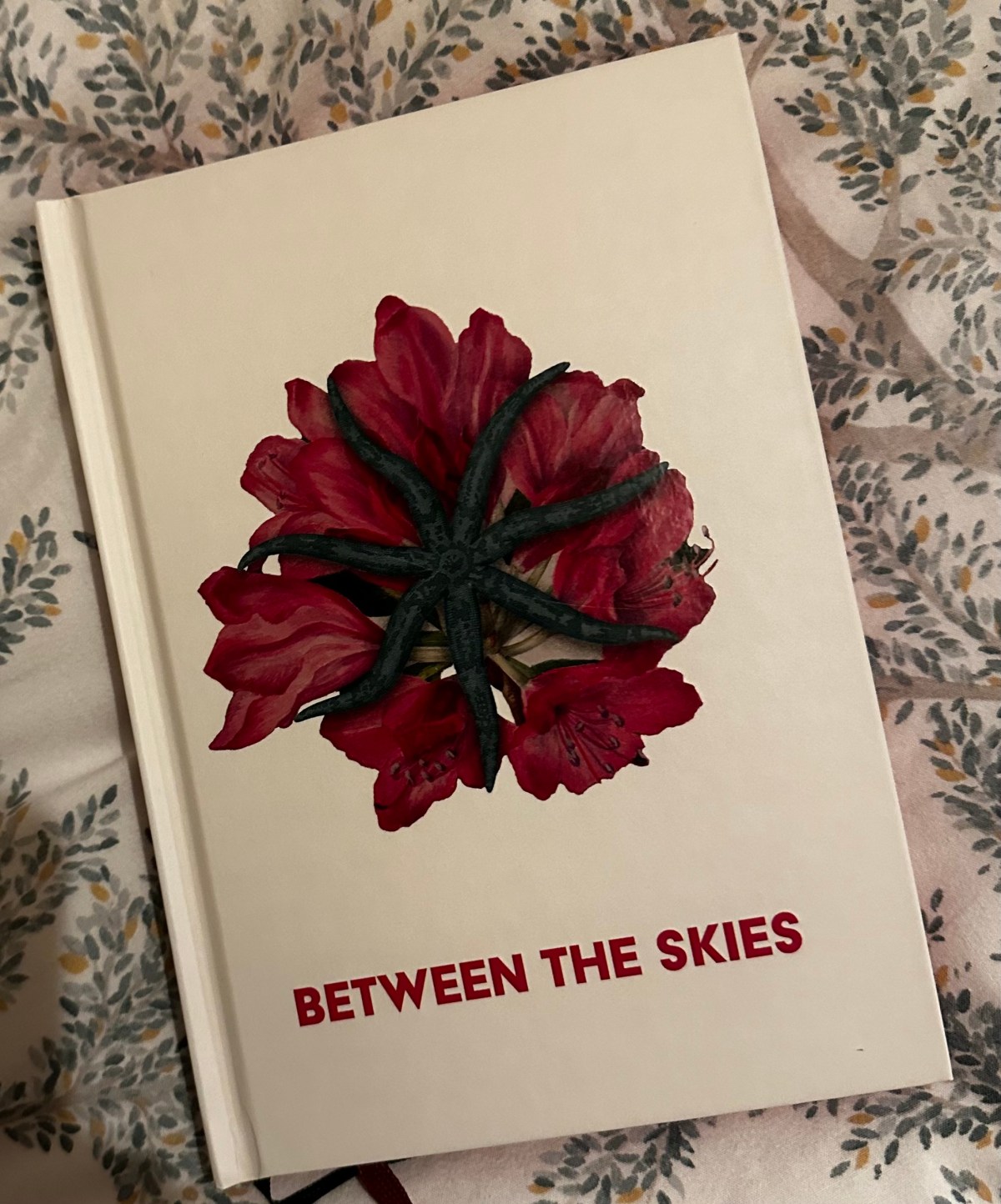
Between the Skies is such a beautiful and fascinating book that it is a pleasure just to read it. If anything, all this writing about it is just slowing me down! But I do feel the need to evangelise a bit more. So join me, dear reader in an exploration of the character generation options. Or, if you haven’t read the first of these posts, you can catch up here.
Character Generation
The “Approaches to Character Generation” section encourages you to decide on the approach you want to use and then to roll on the relevant tables to flesh out the description. It’s important to note that your interpretation of the table results is what’s important, rather than having a strict set of attributes or traits that have specific meanings in the game.
It also tells you to note all of the things you want known about your character. I love this point, actually. Rather than waiting till it comes up in play, when a GM might casually bring up an element of your character that you don’t want the other PCs to know, you make it clear at the outset the only parts of your character or background that others would be aware of. Or maybe it just means that there are things about your character that no-one knows and that will come up organically during play, at which point they will become a part of them. Either way, it is an important point.
Character sheet with character generation question page no.1. This is for a “Through the Looking Glass” type character.
This section also directs you to go and take a look at the character sheets in the back of the book. There are three types, which I will get into below. But, notably, on the page before each actual character sheet, you’ve got a few questions printed in large font, taking up an entire page, to build a basis for your character. For the Lifepath and Spark procedures these are:
“Who are you?” “What can you do?” “What do you have?” “What do you want?” “Who do you know?”
And for the Through the Looking Glass procedure they are:
“Who are you?” “What can you do?” “How did you get here?” “What are you searching for?” “What have you brought with you?”
It’s almost as if their significance cannot be over-stated. It feels like these big old questions and the spaces for you to fill with your own answers to them on these pages could act as the character sheets themselves. Perhaps, if you don’t want to be too bothered with specifics, if you don’t want to use numbers and die types and the like to describe your character, you could just write a few answers to the best of your ability beneath each of the questions. That would be a good basis for a character in a fictional story. Would it be a good character in an RPG? In the very loosest of story-games, I feel like that’s more-or-less the approach and it works well, but it does depend on the type of story you and your table are trying to tell. In a space-pirate, treasure-seeking, swashbuckling adventure game, it might not hold up. But if your aim is to tell the story of a group of people caught in a difficult situation, informed by their backgrounds and desires, complicated by their relationships and inner lives, and their development as people over the course of the game, sure, it would be perfect. Writing about this makes me want to try it…
Character sheet with character generation question page no.1. This is for a “Through the Looking Glass” type character.
So, next to each question page is a “Worksheet.” Even the word-choice here is significant. It indicates that this is where you will be performing the admin for your character. Filling it in will be an exercise that you may find tedious or satisfying, very much depending on the type of person you, the player, are.
Each worksheet helps us to encapsulate a character designed according to one of three (four, kind of) procedures.
I mentioned in the last Between the Skies post that the procedure you use here is related to your approach to weirdness. So, if you have decided to go with “All the Weird” you can probably use any of the methods described, but if you are going with a “Venturing Out Into the Weird” approach, and you want mundane characters, you should think about going with the Spark character creation procedure (with a few modifications.) Once again, it’s important to note, all of this is advice, none of it is mandated. Choose and use what you like and discard the rest.
Lifepath character generation
I have never played it but I have heard about this character creation method being used in Traveller. Essentially, you map out your character’s life up to the point of the start of the game and this process creates the PC. You roll on the tables provided for this character generation method to establish events in your character’s life that lead to the accumulation of “Skills, allies, enemies, Mutations and Debt, among other things.”
Let’s take a look at some of the tables used for Lifepath character creation.
You have a Type table that contains a pretty wide array of permutations. I rolled up a Swimming Avian. I’m thinking seagull.
The Descriptor tables are d66 so have a lot of options in them too. You might be described as Huge, Transformed, Dead, Nomadic, Staunch or Minimal. These single adjectives should ignite the imagination and lead you down paths to fill in the blanks on your character sheet, or just in your mind.
You roll twice on the Aptitude table (also d66) and take the adverb form first and then the adjective form. So a roll of 54 and 45 (which I genuinely just rolled) would be Inspiringly Commanding.
After this you enter the Life Events section. It explains the basics of using this method and then tells you to go and roll on the Life Events tables. There are three tables to roll on depending on whether you want have your major life events on a Surface (I guess like a planet or something similar,) in Space or out in the Planes. You can switch between them and sometimes have to depending on the events you roll. A sampling:
Quest for NPC completed, harmed – Roll powerful NPC for patron; Gain problem related to injury suffered by PC
Death, became undead – Create one Extraordinary Ability related to undeath; Create one Problem related to undeath; If already undead when this result is rolled, PC is destroyed, create new PC who has dead PC’s possessions.
Joined heresy – Joined heretical religious organisation; Gained ire of opposed religious organisation; Gained skill related to heresy
Became Hermit – Cannot roll any further life events; Gain skill related to hermeticism
Lost in the Planes – Cannot roll further life events
Became petty god – Roll or describe Focus; Gain Extraordinary Ability related to petty godhood; Petty gods are not necessarily more powerful than mortals
After this you have a bunch of tables to help you determine your Extraordinary Abilities, Skills, Mutations and Problems all of which will help to round out your character. There are some great entries in these tables but this blog post has already gotten away from me so I am going to have to skip on to the next method of character creation.
Spark character generation
ANother black and white illustration from Between the Skies. It shows a creepy person with no face except for two blank, white eyes. They open theirlong black coat as though they were selling hot watches, but inside are only toothy grins and gaping maws.
This is an entirely table based method, but, as the title suggests, the results you get from the tables should be used to spark the imagination of the player. As Huffa takes pains to point out more than once in the characters creation section, the tables might give you powers and abilities and they might even describe what you can do but they don’t tell you how your character does it. I think most of us assume this point without thinking about it in our games most of the time (my Magic Missile looks like three paper planes that explode when they hit!) but it’s a good thing to have it called out here formally. So the tables used for this method are very much based around the questions I listed above. Under the “Who are you?” section we have table after d666 table of descriptors to roll or choose from. Here are a few nice ones:
Sickle mender – fixing what cuts
Messmaker – joyous entropy
False smile – feelings turned inside out
Babysitter
For “What can you do?” you can go back and use the tables under the Lifepath method for Abilities, Aptitudes and Skills.
“What do you want?” – There are a couple of tables here. You are encouraged to use these to “inspire a few sentences describing what your character wants.” Examples:
Objects of Desire – Redemption, Surprise, More
Related to… – past self, rulers, daemons
When it comes to “Who do you know?” we have another trio of tables. These can be used to make two or three entities with whom you have a relationship of some kind. For instance:
Entity type – Creature
Relationship type – Debt holder
Relationship detail – Yearning
Once again, use these results as prompts to describe these relationships in a little more detail.
Finally, in the “What do you have?” section, you use the Starting Resources procedure with some changes. Generally this involves you having an alright weapon and some semi-decent armour, equipment needed for skills and maybe even a ship if that’s the sort of game you’ll be playing. You get to roll up an interesting object too! You will also possibly have some Assets or Debt to start with. There is, unsurprisingly, a table for that. Assets, Debt and Petty Cash are all rather abstracted in Between the Skies. You measure them in units where a unit of Petty Cash might buy you a nice meal and a unit of Asset or Debt would be the equivalent value of a house. I appreciate a system like this as counting gold pieces holds little or no interest for me. Also, Debt implies a Debt-holder and that could be an important relationship and could be used as motivation at some point.
Through the Looking Glass character generation
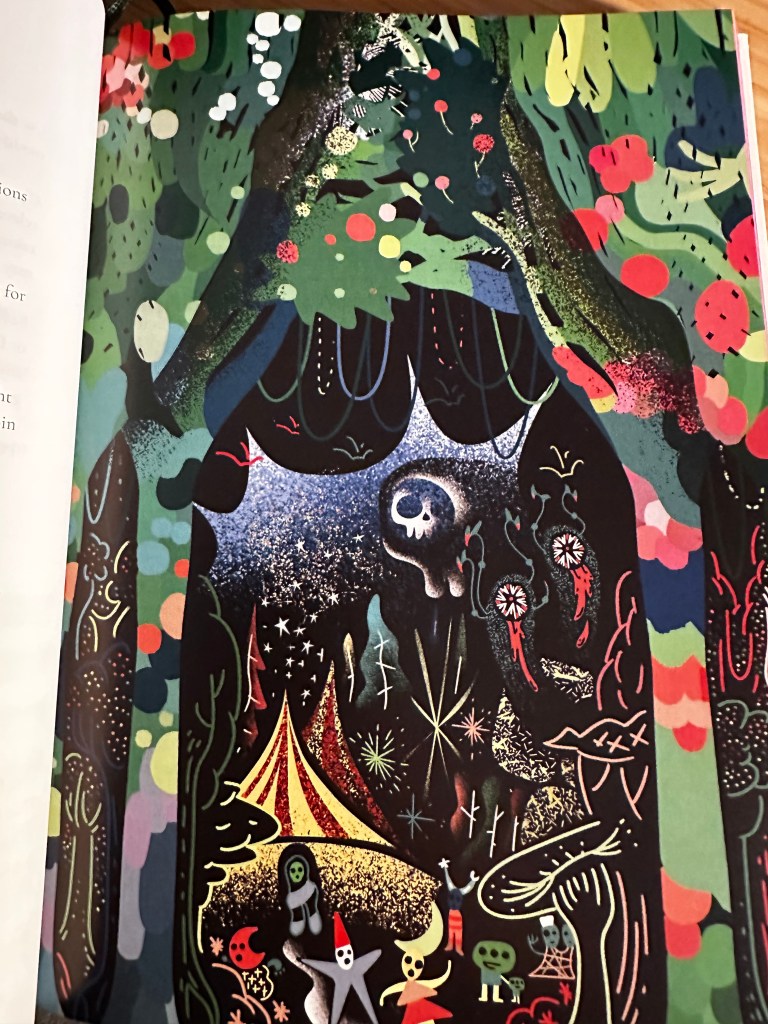
A full colour illustration from Between the Skies. The picture is of some strange characters, drawn in a deliberately childish style with funny hats heading towards some circus tents and away from a colourful bu threatening forest in the foreground.
Your character has done a full Alice and is now in a freaky other-world. Why are they there? What sort of personal disaster has led them to this point? What are they looking for in this isekai nightmare/dream realm? These are things you need to know about your Through the Looking Glass character.
Once again we have some tables to roll on. But interestingly,
It is assumed that Through the Looking Glass characters are mundane people from a world like our own, and that results are interpreted accordingly
A few sample descriptors from the tables:
Vengeful
Loopy
Ostentatious
Firefighter
Hack
Paparazzi
Avante Garde Hobby
Entrancing Dancing
On the “You (were) recently…” table we have a little more to shape your mundane character. You can roll on the d66 table to get these sorts of results:
Retired
Transitioned
Canceled
Under the “What can you do?” section, the abilities are a lot more “normal” than some of those in the previous character generation methods. They include stuff like:
Untapped Scholarly Education
Precocious Performative Love
Charming Spiritual Profession
One of the different questions belonging to this character generation method is “How did you get here?” This is, of course, of utmost importance to this type of character. Maybe you were trapped by an entity from another world. Perhaps you stumbled into it while intoxicated, seeking pleasure. Or was it that you were reincarnated after dying by a catastrophic event?
Even just reading the entries in these tables has my imagination all aglow with possibilities. They make me want to run this sort of game. I don’t think I have ever done that, not for such mundane PCs, at least. I want to see how such characters would be changed by such an impossible journey! Yum yum.
Another question that is specific to this character generation method is, “What are you searching for?” Ruby slippers? Aslan? That damned white rabbit? I suppose it could be any of those but why not roll on some tables instead?
The tables, interestingly, do not tell you exactly what you are looking for, just the type of thing you might be looking for (knowledge, person, object etc,) what that thing will provide (relief, comfort, affirmation) and what complicates it as a goal (explosive, famous, moving.) You should then get together and discuss the precise nature of the thing. The text suggests that, if you are all of a similar type of character, you should maybe all be striving for the same object but that you might each have a different motivation. This sounds like a wonderfully interesting potential grenade to throw into the works whenever the characters finally find the item they have wanted all this time. It smells like interpersonal conflict. Yum yum yum.
Lastly, for the Through the Looking Glass method, we are looking at the “What have you brought with you?” question. This is different to the “What do you have?” question common to the other two methods because your character is assumed to have been yoinked out of their own reality with only the items on their person. So they don’t get to have any Assets or Debt or any of the other starting equipment other types of characters might begin with, which is totally fair. Instead, they get a few basic items and maybe one Special Item. There is, as you might have guessed, a set of tables for that. Once again, these provide inspiration rather than outright answers to what that Special Item might be. So you might have an Alien Secret or a Mythical Key… This idea of only having what you had on you makes the prospect of the first few hours in a new world particularly enticing from a game perspective. How does one survive in a desert otherworld with nothing but a mobile phone, a wallet full of loyalty cards and used tissue? The answer could be that the locals are enchanted by the Spectral Device that you were handed just before being shoved through a portal.
Character generation using other games
There is a very interesting and useful section near the end of the Character Generation chapter. It provides a loose guide to using another system’s character creation method to make your Between the Skies character. Essentially, if you use this procedure, you will end up with a blended character. They will still consider the questions from the first two character generation methods but you will do your best to apply the answers to the character you have created using the other system. In some cases, this will mean that you are adding bits entirely from the question answering method as many systems do not consider things like what you want and who you know at the character creation step.
I am a big fan of Troika! so I am happy to see the practical example of using a Troika! background as the basis for a Between the Skies character here too. It makes it easier for me to picture using this method and elucidates the process in a practical way.
Character generation conclusions
All in all, I am impressed with the breadth of options presented in the chapter. You have no fewer than four different ways of making your character (and many more if you consider you could technically use the fourth method to use any other game’s mechanics to do it) a plethora of interesting tables to create some really weird or terribly mundane characters and a whole bunch of world-building before you have ever started playing the game in anger. The results you are likely to roll on things like the Life Events tables are going to haunt your game if the GM is paying any attention at all. You’re likely to establish the existence of certain NPCs, gods and demons, places, objects and catastrophic events that effect the whole world while rolling up your PC. I love this! It starts the whole table off with so many potential plots, grudges, vendettas, desires, loves, hates and motivations that the game should practically run itself from the moment you finish character creation.
As a process(es) it makes me excited to take part in it and even more excited to play the game, either as a GM or as a player.
What do you think, dear reader? Does this make you interested in Between the Skies? If not, perhaps I will continue to pursue this subject in another post in the near future so I can convince you. If so, maybe I’ll keep entertaining you with details and opinions of a subject you clearly enjoy! It’s a win-win!
We introduce informal rules on the fly in our games all the time. You need to figure out if someone can find a newspaper stand around here somewhere? Sure: odds, you find one, evens, you’re out of luck. Oh, you rolled a nat 20 on your investigation check? Well, that means you also get advantage on your next Thieves’ Tools check. You know what I’m saying. It’s not unusual. So, is it unusual to formalise this informality? Maybe, I suppose. But that is exactly what Huffa has done in her new book, Between the Skies.
I heard about this game from the Yes Indie’d podcast from Thomas Manuel. On the episode I linked above, you can hear him interviewing the writer and creator of Between the Skies, Huffa. You can get most of the background of the game from the podcast, if you’re interested, but if you need a TLDR, it started off as a digital release and then a series of zines you could get on itch.io until Exalted Funeral got involved and made it into a book. You can still get those there in free PDF format, by the way.
A couple of things struck me while listening to Huffa talk about her work. First was the subject matter of the game, which seemed rather Planescapey to me, the nineties one. Maybe cross that with some AD&D Spelljammer, a wee sprinkling of Troika! and just a little bit of Black Sword Hack. Strangeness in the spheres and across the planes of existence is the overall theme. It sounded both very old school and incredibly fresh at the same time. Where does the freshness come from, I hear you cry, dear reader! Well, that would be from the other thing that struck me about the interview; the ideas Huffa espouses when it comes to rules.
Why restrict yourself to one ruleset when there are so many out there to choose from?
A badly taken photo of the double-page spread before the At Play Between the Skies chapter of Between the Skies. There is an abstract monochrome picture in it.
So, like my very wordy sub-heading says, why go full Forged in the Dark all the time when certain situations might call for a Resistance System style roll with pre-established fallouts to hit them with? Why limit your game to using only Powered by the Apocalypse rules when you might also want to use adversity tokens sometimes? The point is, you should be able to play almost any game you want, using almost any rules that suit, not just the game but any given situation within a game. Is this dangerously anarchist? Maybe, but it also sounds like excellent fun. If you have been around here for a few months you’ll know that I like a good ludicrous mash-up. See my various attempts to introduce new and exciting elements to my D&D 5E game here and here. You might also remember me going on and on about how cool it was to use other games to establish the world and the city in a Blades in the Dark campaign I recently took part in.
If you’re interested in games and the rules of games and how they interact with the players, the setting, the events, this is an approach I think you might be able to appreciate.
Now, I will say that Huffa is not necessarily suggesting that you should abandon a single ruleset play style, but that you should open your mind to the idea of using the ruleset that most appeals to you when you pick up Between the Skies to play it.
Playtime is the name Huffa uses for the set of procedures presented in the book to allow for the style of play it espouses. It’s all about the “shared understanding of a fictional world.” And really, however you achieve that is the way to do it, with the understanding that this might look different for literally every table. Here are a couple of relevant quotes from the introduction: “Judgement based on shared common sense is the fundamental ‘rule.’” “All rules, methods and procedures can be used or ignored.” This type of play is related to the FKR or Free Kriegspiel Revolution. This is a movement that rejects the cumbersome mechanics prevalent in so many games, particularly from the war-game or “Kriegspiel” side of the hobby. In FKR, the game is very much a conversation, where a player may suggest a way of overcoming an obstacle and the referee or someone in a similar role will make a judgement, based very much on the table’s shared understanding of the world they are creating together, as to whether or not it would work. Dice rolls may occur but they will be minimal.
And yet, Huffa has provided here, in the At Play Between the Skies chapter, a plethora of potential rules. Here’s a brief collection of some of the suggestions.
All time is tracked by Turns but the time scale of the Turn is dependent on the situation, longer for travel and exploration, shorter for investigation and shorter still for combat.
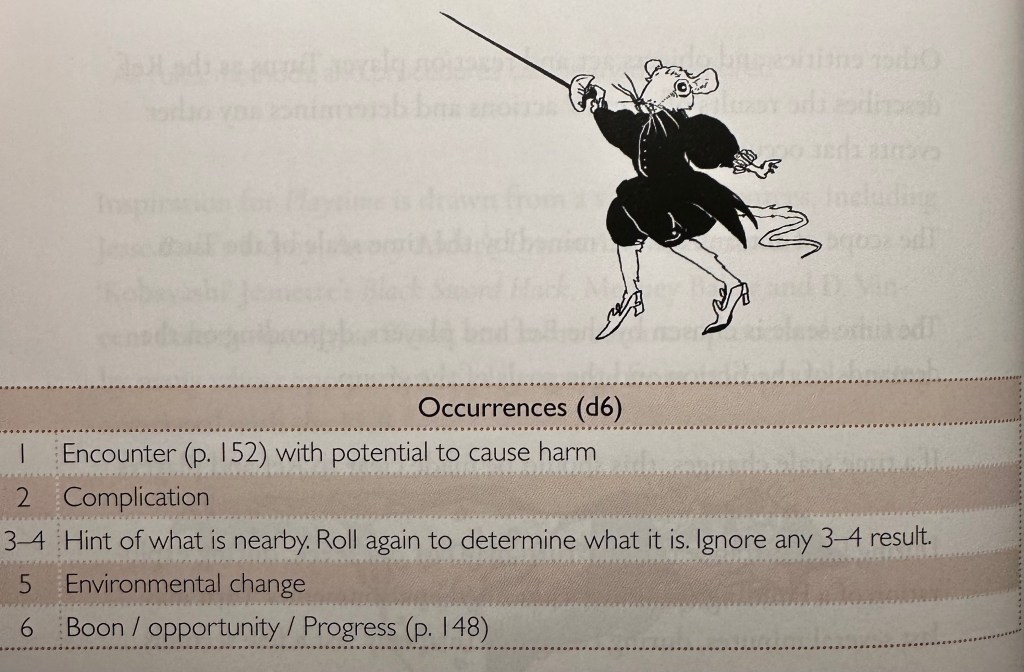
The Occurrences table on page 46 feels like the most basic denomination of the tables in this book. It is incredibly general but its presence and usage suggests at the way the whole game is to be played.
The Occurences table from Between the Skies. It is a d6 table. The possibilities are “Encounter,” “Complication,” “Hint of what is nearby,” “Environmental Change” and “Boon/opportunity/Progress.” There is also a small illustration of a well dressed mouse with a rapier above the table.
Use tokens to succeed at risky actions or extraordinary actions. Or! Choose a dice rolling mechanic from any of the bunch described in the book (coming from games like Blades in the Dark, Apocalypse World, Traveller, Electric Bastionland etc.) and see if you succeed, or if you succeed with consequences or if you just fail.
Or you can just play without dice!
Give your characters Conditions when they should get them. Let these conditions affect the riskiness of actions.
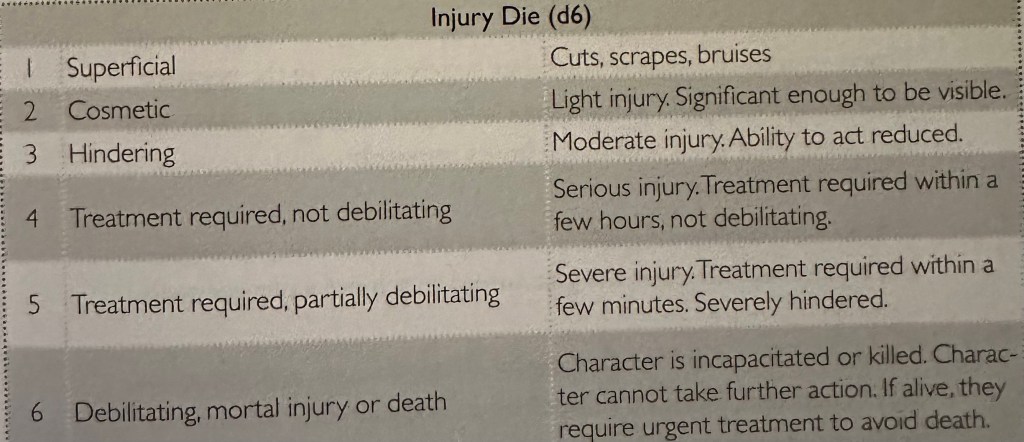
Injuries! Roll on the Injury table to really fuck them up. It’s a 1d6 table and the 6 is death or fatal wounds… So use this sparingly, I guess!
The Injury Die table from Between the Skies. it is a d6 table. the potential injuries are: “Superficial, “Cosmetic,” “Hindering,” “Treatment required, not debilitating,” “Treament required, partially debilitating,” “Debilitating, mortal injury or death.”
You can, as Huffa suggests, use all of these rules or none of them or you can add any other systems or subsystems you can think of where appropriate.
Approaches to Weirdness
In the Setting Up Your Worlds Chapter it is time to decide how strange you want this game to be.
“Between the Skies is filled with weirdness. Its tables, and its author, revel in the strange.”
Huffa provides some options here, broad categories of weirdness that will help to define exactly how weird things are likely to get. Of course, this might change during the course of play, depending on how you and your players get into it.
Go “All the Weird” for a setting and game where the characters are probably at home in a very strange and out-there place. The sky is not even the limit here.
With the “Venturing Out into the Weird” approach you play humans with a limited but very much real knowledge of other planes and spheres but who have never left their homes before. Everything will be new to them but high levels of weird are ok.
If you want to be the weird in everyone else’s world, take up the “Playing he Monsters” approach. Your characters will be the only magical, non-human, truly strange things in an otherwise normal world. You will probably be feared and hated.
In a “Through the Looking Glass” style game your characters will start the game having found themselves in a strange and magical new realm. But they themselves are relatively mundane and must figure things out as they go along.
The approach you decide on will also have an influence on the character creation method you use. So it is of primary importance to the type of game you are looking to play.
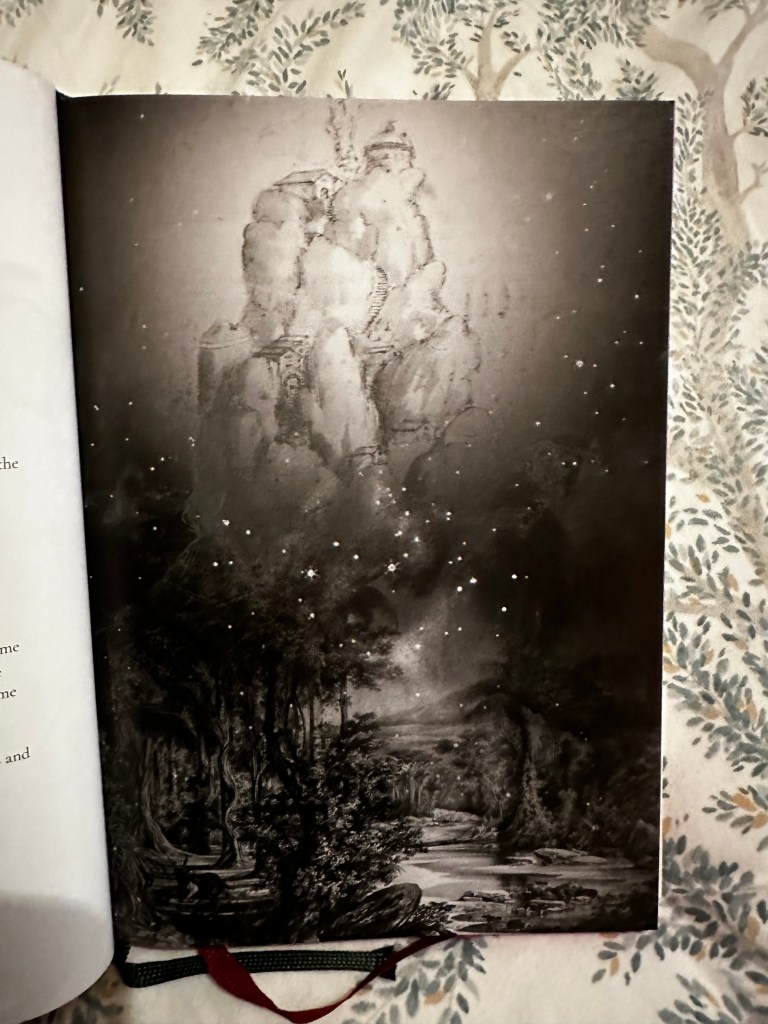
A photo of one of the black and white illustrations from Between the Skies. it depicts a forested land and a starry sky overwhelmed by a nebula of some sort.
This section of the book asks a lot of questions about how the planes and space work in the universe of your game. There are familiar touchstones here with Planescape and Spelljammer being the obvious ones. But it tries to get you to really think about important things like how PCs might travel through this weird space, how gravity works and the real difference between worlds, space and the planes, if any.
Next time, I am going to get into the Between the Skies approach to character generation, which is exactly as lassaiz faire as you might have come to expect by now.
I finished up two investigative scenarios in the last week or so. The experiences could not have been more different. I was the GM for one and a player in the other. They were in very different genres and systems too. I am going to have a go at dissecting them and trying to compare them, nonetheless.
D&D 5E – An Unexpected Wedding Invitation
I wrote a little about this short campaign here. At the time I wrote that, I didn’t even know it was a murder mystery, to be honest. It is a published, third-party 5E scenario so I could have looked it up, but I avoided reading anything about it online. Our wonderful DM was also the consummate host and was always wonderfully welcoming. She was a great DM too. We met in person over the space of eight sessions, more-or-less every two weeks. Our DM, who has run this scenario more than once previously, informed us afterwards that we took far longer to get through the scenario than other groups. Personally, I think that’s probably because of a couple of very important factors. Firstly, we had a fairly large group, five players and the DM. But, I think the second factor is what really pushed it so far beyond the normal length for the scenario. We were all chewing the scenery at every available opportunity. This group of players does not shy away from the first person, expansive, full-chested role-playing and it honestly does my withered heart good to see it every time we get together. We all had reasons for going ham as well. There was the promise of romance and, failing that, friendship. The possibility for court intrigue and drama was there as well. But, certain sections of the table were there to get their kisses in (in the infamous words of Lou Wilson.) The mystery was almost secondary to those folks.
As for the mystery itself; I won’t go into details. No spoilers except to say that there is a murder and we were not aware of that aspect going in. I don’t know if the DM advice is to keep that from the players until it happens but that was the case for us. Anyway, that was quite exciting actually. To discover there was an actual crime to figure out gave us all a shot in the arm! Up until then we had been essentially casing the wedding for curses and harassing the guests with weird, cryptic questions about the nature of one family’s bad luck. So, when we had a specific thing to investigate, it filled us with the sort of motivation that, I feel, the scenario failed to provide up to that point.
As for the investigation itself, it’s all about the NPCs in this adventure. That seems appropriate for a mystery game and this particular scenario was replete with well drawn NPCs who had distinct personalities, motivations, idiosyncrasies and voices (provided quite expertly by our DM.) You have the bride and groom, of course but you also have a cast of characters drawn mainly from the families on both sides. There are several set-piece scenes that are designed to allow the PCs to get to know the cast and our DM graciously provided us with portraits for all the main NPCs, hanging them on her DM screen. This was very helpful as there were a lot of them and without that constant visual aid, it would have been much harder to keep track. Our interactions with the NPCs seemed to give us positive or negative standing with them, leading to later conversations being more or less difficult for us.
The setting was integral, of course. An opulent country manse belonging to one of the families involved, surrounded by a generous estate on which they enjoyed hunting and picnicking. The adventure provided a couple of maps; more for reference than anything else as there was not a fight to be had at this affair.
As I said, I am not going into spoilers here about the murder, the suspects or the ending but there are a few things I can say. It seems as though the adventure comes with several prepared possible endings. The actions of the players, their standing with the major NPCs and their final pronouncement of who they figure did the murder all seemed to have an effect on that. This served to give it a slightly video-gamey feel, which was neither good nor bad but certainly leant a lot to the idea that everything was laid out in the adventure quite prescriptively.
Speaking of which, the actions of the PCs throughout felt a little restricted. This was purely a result of playing D&D 5E characters in a genre they were never meant to exist in. Few of our powers or abilities were of much use in this milieu and that felt a little frustrating at times.
Equally, there were several timed events that could not be prevented or changed in any real way by the PCs. Once again, this had the effect of making us feel more like spectators than active participants.
Questioning the NPCs, the most important part of the scenario, by far, and the only one where you could make inroads in your romantic or duelling ambitions, was difficult to say the least. Pretty much all of them could have done it, to be honest. That, by itself, is ok, but failing certain rolls here and there made the process feel fruitless at times. Without some mechanic to allow you to fail forward, it was always going to feel like this.
In the end, we failed to catch the killer. We fingered the wrong guy for the crime. This was due, in large part, to us interacting less with the killer than we might have, failing s couple of clutch rolls in interacting with them and the fact that we were left with too many potential culprits at the end that we couldn’t whittle down further with the evidence we had. Our failure was revealed to us in a sort of cut-scene right at the end. After all the effort we had put in, this felt like losing even though we had all enjoyed playing together around the table. The overall consensus from the players was that 5E was not the system for this scenario. It is not built for this sort of investigation and it led to an unsatisfying feeling from the result of the game even if we had a good time playing together, as we always do.
Blade Runner, Electric Dreams
A photo of the front of my copy of the Blade Runner Start Set box.
I wrote a little about this game here while we were still playing it. At the time of writing that, we were only two sessions in and I was greatly looking forward to the next one. There were two players, playing Detective Novak and Fenna. We did this online, using Zoom and Roll20. It took five sessions of two and a half to three hours each. Having checked out other groups’ experiences with the same case file, I can say that’s about average. I could absolutely see it taking both less or more time since it would be dependent on how quickly the blade runners discover the key clues and how quickly they act.
Electric Dreams is also a pre-written scenario but, I think, importantly, it was produced by Free League as the intro to the Blade Runner RPG. There was never going to be a mismatch of scenario and system like we saw in An Unexpected Wedding Invitation. In fact, it felt as though this scenario was close to perfectly designed to bring players into the world and the system at the same time.
If you are a Blade Runner fan but not familiar with the Year Zero engine or RPGs in general, its got elements from the movies for you to geek out over and allow you to feel part of the megacity of LA by referencing the media you know and love. Meanwhile, it holds your hand through the early interactions with the mechanics, kicking things off with a few basic Observation and Manipulation rolls, teaching you that the more successes you get on your dice rolls, the better the result. As time goes on, the references to the movies remain strong, keeping the whole thing feeling like a natural continuation of or bridge between those stories and establishing a consistent and immersive tone and atmosphere. But you get more and more in-depth interactions with the rules as it introduces you to chase mechanics, combat, use of more complicated investigative techniques and character advancement.
And if you are an old hand at Free League’s signature rules engine, you will be good to go from the start. I was somewhere in between when we started playing. I am a big fan of Blade Runner and I have run Tales from the Loop before so I knew how the system worked well enough. But it was a long time since I had played it and I definitely had to look some rules up in play. This was generally fine, and didn’t take too long. What we also found, was that, once we looked up those rules once, we grokked them and didn’t have to keep referring to the rulebook, which was a refreshing change of pace for a group of players who have mainly only played D&D 5E together before (at least in recent years.)
Now, down to the scenario itself. As with the Wedding mystery, this was largely based around really well drawn NPCs, all of whom were potentially important to the plot. But, from the start, it felt as though the PCs knew who their main suspect was. They were rarely dissuaded from that notion, despite (or perhaps because of) the powers-that-be forcefully reminding them about the way they would like to see the investigation go. Since the characters were playing blade runners, cops in the LAPD, there were a number of NPCs that were there purely to back them up or chivvy them along. You had Coco, the medical examiner (who you also meet in Blade Runner 2049) and Deputy Chief Holden (who got his chest punctured in an interaction with Leon the replicant in Blade Runner) as well as any number of ad-libbed beat cops and the AI LAPD Despatch. The Wallace Corp is represented by one of their replicant executives who was immense fun to play. You also had a few NPCs that were witnesses and were never going to be anything but witnesses. The investigation was not designed to send the detectives off on the wrong path. There was no more than one red herring and that was there more to reinforce a theme than as a real way of derailing things.
What we found was that most of the sessions involved them trying to track the one suspect and discover their motivations and whereabouts. This led them into a web of corporate intrigue and moral dilemmas. That’s what Blade Runner should be about, of course, and Free League nailed that. The PCs were able to use the abilities of their pregenerated characters to do that pretty well. In fact, I would say that they were implausibly successful most of the time. On a couple of occasions they rolled so well that I felt compelled to reward them with information that would not, otherwise, have come up until later in the investigation. Moments like these allowed them to make incredibly effective leaps. What I liked about this scenario is that it allowed for that. There is a timeline of events that will happen at particular points of the investigation, but only if the PCs do nothing to prevent them. So, that doesn’t stop you moving them two steps forward, instead of the usual one. I think it actually encourages that sort of thing, in fact, as the timed events are generally pretty bad for the investigators or the other major characters.
We got an ending that was equal parts satisfying and open-ended, with the PCs making the moral, rather than the legal choice after the corporation took the law into its own hands one too many times. We might return to Novak and Fenna someday, maybe in the next published case file, Fiery Angels. The first one ran so well that I would definitely be confident to play the next one.
Conclusion
It is almost unfair to compare these two games, but it has been impossible for me to do anything else. In blade runner, you had a scenario where any outcome the PCs reached was likely to be satisfying and a system that supported the sort of game you were playing, investigative, character driven and darkly themed. In the other, the scenario felt a little too restrictive and was hampered further by a system that was never designed to support the investigative nature or the regency feel. I had fun with both, but I know where I would turn first if someone asked to play a mystery game.
The DIE RPG was developed by Kieron Gillen, writer of the comic of the same name. I really loved the comic book, mainly because the premise spoke to me personally. The premise of the comic is that a bunch of young friends were brought together by the one guy who wants to GM a new game for them. He presents each of them with a special die, one d4, one d6, one d8, one d10, one d12 and one d20 for himself. In the course of play they find them selves transported to the game world. They are trapped there for months and come back changed, having left their GM friend behind. Cut to decades later, they are all grown, with families and traumas and problems. They are all drawn back into the world of DIE for various reasons and the comic basically goes from there, following their adventures to the metatextual unreality of this fantasy realm trying to find their friend and a way home again, or not. Meanwhile, they all deal with a melange of emotional issues that lead to some very high drama and high-stakes decisions. It is pretty fraught most of the time, very relatable to many, and despite my sub-heading it is funny sometimes.
DIE RPG
So Kieron Gillen got together with one of my favourite game publishers, Rowan Rook and Decard, to make the DIE RPG. I followed the process and remember checking out some of the early beta material. As a game, it is working to do what the comic did but at the table with your friends. You have to create a character, who is the player of the game, as well as the character they play, so there is a sort of Inceptionesque quality to it, which is dreamy and cool. Now, your player has to come loaded with various real-world problems and worries for you to work through in the game within the game as well.
I have not read much of the fully finished game, although it has spent a fair bit of time on my shelf. I recently discovered, while reading the Burn After Running blog, that it is ideal for one-shots so that’s why I really want to try to bring it to the table soon. I want to unearth some traumas for my player’s players and express them through my player’s player’s characters.
Also, please take a moment to appreciate the beauty of the products. Yum.
It’s pretty difficult to give your journeying adventurers a particular place they need to look after. They are always schlepping off to the next dungeon or haunted house or wizard’s tower or whatever. There are ways around this. In one D&D campaign that we finished last year, the PC’s hometown was plonked right on top of a sort of nexus of worlds, an ancient tower, buried beneath a hill, containing dozens of portals to many different planes and other prime material locations. So, even when they popped off to Sigil or Mechanus or the Astral Plane or wherever, they were always going home eventually. Indeed, the focus of that campaign was to save their little island.
But I often find it gratifying to make the home they care about quite mobile. In the first of several interconnected campaigns, the PCs stole and adopted their own “turtling” vessel (like a whaling vessel but for giant turtles. You get the idea.) as the setting was a vast archipelago they needed the transport. Of course they took it and made it their home. Not much of their adventures revolved around that boat but I liked the idea that they had somewhere to return to, no matter where their travels took them.
A-thing-to-fuck-with
It was also a-thing-to-fuck-with. I never got the chance to seriously fuck with that boat since the campaign has been on a semi-permanent hiatus for a few years, but more recently, I got an opportunity to hassle their casino. I mean, this was a different set of characters but some of the same players and it was in Spire, not D&D. The Ministry of Our Hidden Mistress bequeathed to our “heroes” the poisoned chalice of a casino called the Manticore in the Silver Quarter. They put a lot of effort into it, hired entertainment and a succession of unlucky security guards. It did not end well for the Manticore or the staff. Threats to it made for real motivation and the fact that it was a public place meant their enemies could just walk in. That was a dream. Great stuff. But it veers wide of the mobile home to care about topic.
The most recent version of the mobile home in one of my campaigns is the Cadabra, a mirror-hulled squid ship in our Spelljammer game. It’s got a ready-made crew of spirits and a checkered past itself. They have had this ship since session 3 and they are now at the point where they are repairing it and upgrading it and even adding more boats! They’re going to have a frikkin’ armada! This is great because boats are a money-pit. They answer the question, “what are my characters going to do with all that gold?” As well as the “how shall I fuck with them?” question.
And I know the feeling of home-ownership within a game. In the Black Sword Hack game I’m in, we have a flying boat, called a slater. We are unreasonably paranoid about this thing getting stolen or burnt or otherwise becoming unusable by our characters. We park it miles from the locations we are trying to get to so no-one sees it. We always leave NPCs to guard it. It is our home and it’s where we store all our opium and it’s our greatest asset. I’ll be damned if any asshole wizard is going to take it from us!
A home in the canopy
So Wildsea is a good fit for me and my group. In it, the players make characters who crew a ship that plies the canopy of a world-blanketing forest under the power of chainsaws! Below the leafy waves, the poisonous substance, crezzerin makes descending into it just as dangerous as diving into watery sea. The characters are made up of a wild variety of bloodlines like the beings made up of a colony of spiders, cactus folk, spirits inhabiting the ruins of ship-parts and regular old humans. It is possible to start a campaign of Wildsea where the PCs do not have a ship, but I don’t think I would. In fact, the designer of the game, Felix Isaacs, recently suggested that the best way to start is by making your ship first, before your characters even! That way, the thinking goes, you can imagine them in place , posing upon the prow or hanging from the gunwale or climbing the mast. Also, the classes in this game equate to posts on a ship so it makes even more sense when you take that into account. I really like this idea and will probably ask my players to take this approach in session 0.
There is no doubt that this is a weird setting. In some ways, it should act like any other setting where you get around on a vehicle of some sort across a trackless expanse. There are plenty of sci-fi games where you have a spaceship to build and look after. Death in Space is like that. Then, of course, I have given a few examples in D&D above already. But this is pretty alien. Even the concept of the post-apocalypse that is so impossibly verdant that sentient life has had to scrabble for a foothold amongst all the greenery is unique and bold. Add to that the oddness of the playable bloodlines and the really setting-specific hazards and you would be hard-pressed to compare Wildsea usefully to any other single game on the market.
On top of that, the mechanics are really interesting. It is known as the Wild Words Engine
From Wildsea, Chapter 2, Mechanics: “It’s low on crunch, focusing instead on letting narrative, character and setting develop during play.”
Isaacs has said that, despite the similarity to certain other game systems, he came up with a lot of the rules independently or was influenced more by video games than other RPGs. The basic dice-rolling mechanic is very Blades in the Dark and he has, to be fair, indicated that he got it from that game. So, you build a dice pool to roll and take the highest roll (or two rolls in the case of a Twist). But there are elements such as the Twist, which happens when you roll doubles and adds a special little something to the effects of the roll, that feel new and fun.
Finally, it feels like the GM (or Firefly) and the players get to create the world together as they play, making a place with little magic or lots of it, with high technology levels or very low, with strictly faith based societies or entirely atheist ones. This is very appealing to me.
How about you? Have you had a chance to play Wildsea? If so, what were your favourite aspects of it?
So, when I wrote the post listing the games I wanted to play during the remainder of this year, I had Deathmatch Island pencilled in for this Friday. I only had one session in my calendar so I thought, “oh! It must have been a one-shot that I had planned.” But no, reader, no.
First of all, I have had to put this one on the back burner for now. I only had three players for it and one is unable to attend so I decided it’s best to leave it to a more convenient time for everybody. These are the iniquities of arranging to play RPGs with adults. Thus has it ever been. I am determined to get to it at some point soon but it’s not happening this weekend, that’s for sure.
Second of all, Looking back at the original invitation I sent out to players within our little, local RPG community, Tables & Tales, I realised I had advertised it as a three session game with the possibility of stretching to six more sessions if the players were into it. Now this makes perfect sense. The core book suggests that you can complete a satisfying arc in three sessions but, if you wanted to make it to the end of the Death Match, as it were, you would probably need nine in total, if not more. It does provide guidance for making one-shots using the system and the structure of the game but I think it would be far less meaningful to do so.
Inspirations
No-one, I think, is going to be terribly surprised by the inspirations behind Deathmatch Island. You’ve got Battle Royale, The Hunger Games, Squid Game, even Survivor of course, but, slightly less predictably, Tim Denee, the designer, also references Severance and The White Lotus, two of my very favourite TV shows from the last few years. A couple of touchstones that are, surprisingly, absent from the list are the video games, Portal and Portal 2. Many of the design choices and even the arguably, most important, decision the player characters need to make align with the choices your character makes in those games, “play to win,” or “break the game.” Of course, in all of these pieces of media, this is the central and most important choice.
The game, not the-game-within-the-game
What I am trying to say is that I was always going to back a game like this when it popped up on Backerkit. I am a fan of all of those properties to one extent or another. And, to me, the themes are never going to get old. And, although I haven’t had a chance to actually play it yet, I think that, if you feel the same about any of the media I listed above, you could do a lot worse than picking up this game.
Remember – your followers are consumers, you are just the product.
Apart from anything else, it is slick. The production quality is high, as you would expect from Evil Hat Productions, and all of the extras I got from my pledge tier are great. They include booklets describing each of the Islands and each of the Casts (which, to a large extent determine the type of scenario you’ll be playing,) official-looking Competitor Registration forms that act as character sheets, player maps of each of the islands as well as rules glossaries for both Competitors (players) and Production (GM.)
Mechanically, Deathmatch Island is based on the Paragon system developed by John Harper of Blades in the Dark fame and Sean Nittner. I knew nothing about this system before I read the Deathmatch Island book, except that it originated with another game called AGON.
It is highly structured, with play occurring in clearly defined phases. It starts with Competitor Registration, in which the players create their characters, largely through rolling on a series of tables. Then you proceed to the first island. Each island is split into Phase One, where the Competitors explore, interact and collect resources and Phase Two which is the climax, in which the Battle Royale itself occurs. Even within each phase, there are only a few set actions that can be taken. There is a fair amount of leeway regarding how you achieve the actions within the narrative, but it essentially comes down to opposed rolls from the teams as they stand on the island. Although, the rolls themselves are of utmost importance to the outcome, the players get to do a Confessional after the rolls are all done, giving them each narrative control, as if describing their actions to a camera on a reality TV show. It’s a fun conceit and one I’d like to see in action.
Survival Gear
You play up to three islands. There is a phase of play between each island. This works a bit like downtime in Blades in the Dark and gives the PCs a chance to improve their characters, debrief, and come up with some theories about what the hell is going on. And then there is the End Game. I’m not going to go into that here.
From reading the book, the system feels sufficiently different from anything I have played before to have me really interested to find out how it plays at the table. One of the most fascinating parts is that I feel like you could replay this game on the same islands, with the same players, but choose different casts and have a very different experience each time.
I hope I get to try it out soon! Have any of my readers played Deathmatch Island? If so, what did you think?