New Character Options from Erlendheim Part 5

Late Addition to the Line-up

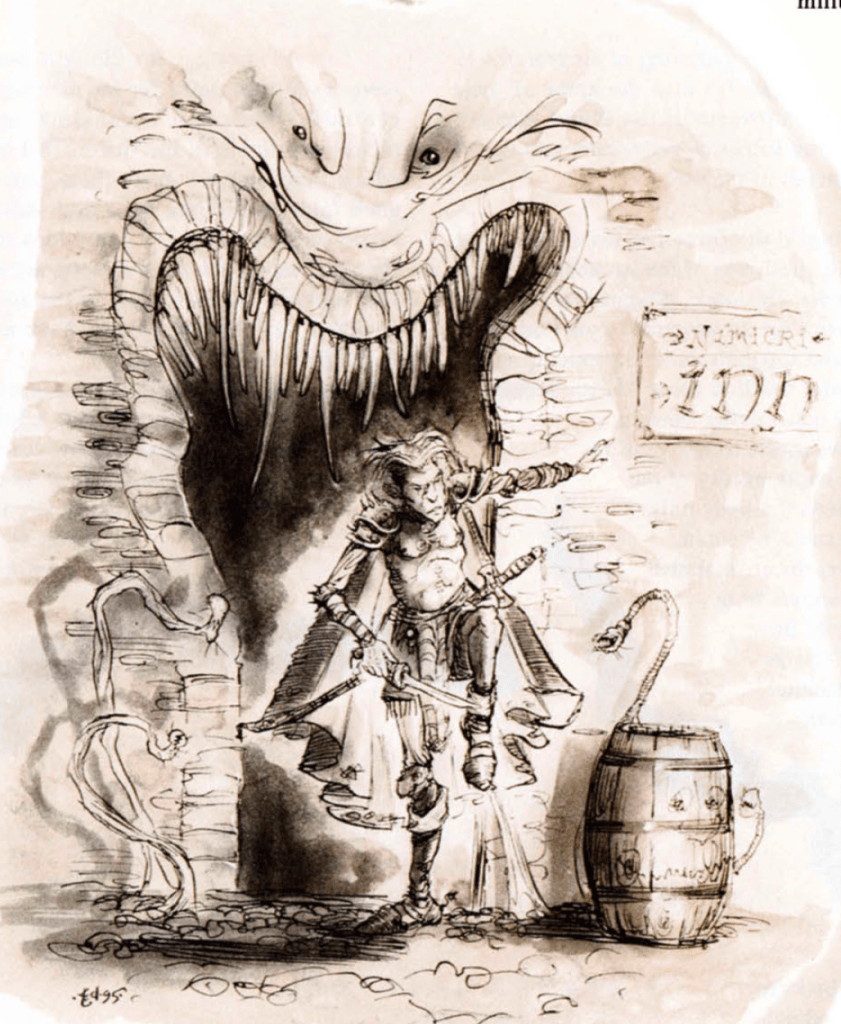
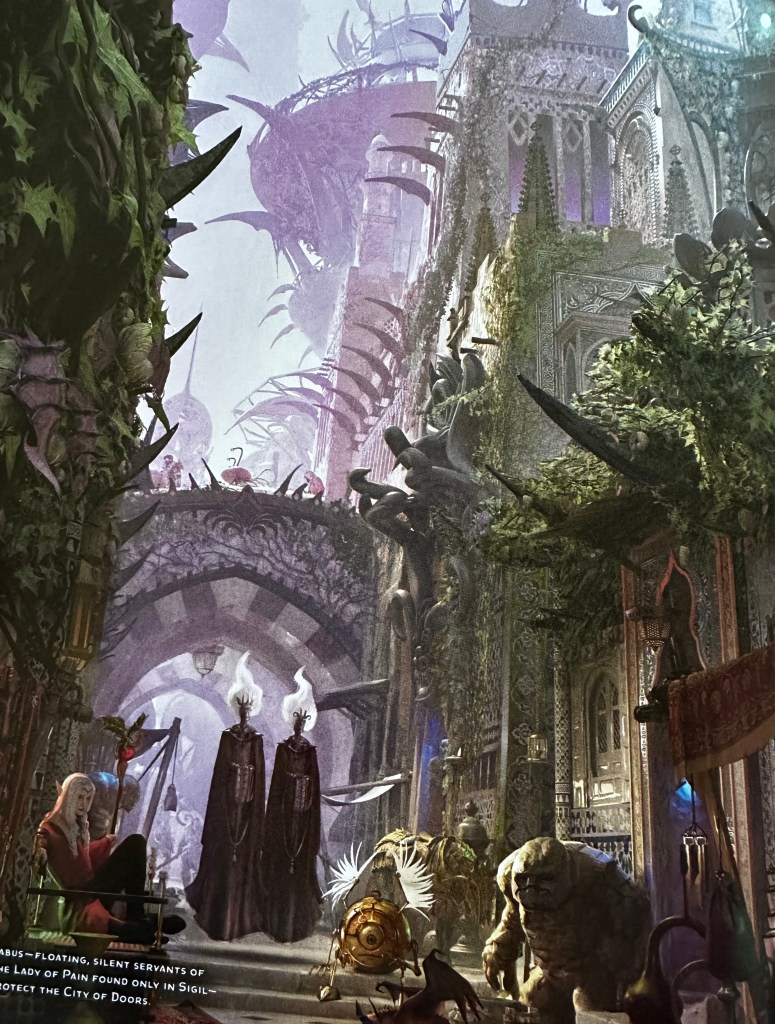
Heather joined our campaign a bit late. She decided to sign up about the time the rest of the party popped through their very first portal to Sigil. This worked out well because her character, Panasonic (no relation to the Japanese electronics manufacturer of the same name,) was already there. This Half-orc Bard hadn’t always been there but she had made a home in the city and even gained something of a reputation as a controversial singer/songwriter. She had written and performed a tune that was perceived as being particularly critical of the self-appointed police, the Harmonium, a Faction that was philosophically devoted to the notion of laws and the act of upholding them. Unsurprisingly, this made them less than popular with many of the city’s population. So, when Panasonic first performed her song “The Safety Dance,” (for copyright reasons, a song that is legally distinct from the 80s hit by Canadian icons, Men Without Hats) a riot erupted, followed by anti-Harmonium acts being perpetrated all over the city. So, on the night when the rest of the party emerged from the end of a pipe (other side of a portal) in the the swimming pool of the Gymnasium, Panasonic found herself taking a shortcut through that very place, with a squad of angry Hardheads (a nickname for the Harmonium) hot on her heels.

Luckily, the party came to her aid, and she, in turn, acted as a sort of guide/ally to them in the alien and bewildering city.

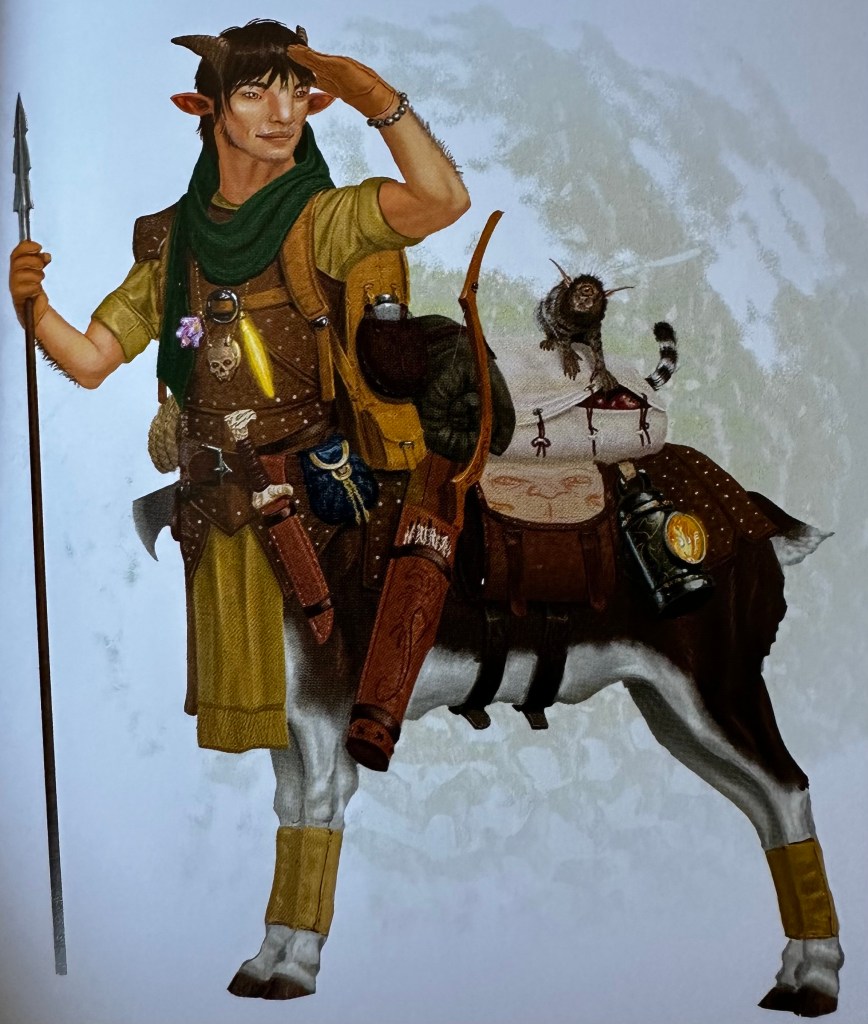
The thing about Panasonic was, she had a fascination for Sigil and the planes in general. She was fascinated by the doors, the portals, how they worked. She always felt there was something musical about them. Also, she had been trying to find a way home for a long time. She had been shanghaied in Sigil by her sister, Sony (once again, no relation.) Sony was jealous of Panasonic’s growing popularity and so got a wizard to send her off plane so she could take her place at the front of their band. When she ran into the party, who just-so-happened to come from the same prime material world, she latched onto them as her ride home.

So, the culmination of Panasonic’s story, unlike the rest of the party, came when she emerged through the portal to Erlendhaim with the others. It was a big moment for her! She even found her sister there and somehow made amends just before they were violently assaulted by a bunch of devils.

It was then that she gained her new bard features, having fulfilled all her major character beats.

As with all of these character options, I didn’t spend too much time considering the balance implications of these. But if you like them, and you feel like you could use them in some form or other, please feel free.

New Bard Feature – Music of the Planes

Magical Notes

From 3rd level; the Bard uses an action to strike a cord on their musical instrument and summons a tiny portal which projects, from the instrument, an ethereal glowing rune in the shape of a musical note. As the the Bard continues to play, notes emerge in a stream from a plane of pure, living music. This stream of notes can have one of several effects that the Bard must choose before using this feature.

  • Face-melter – Attack roll using the Bard’s spell attack bonus – Range: 60ft, Damage: 1d8 + Charisma modifier thunder damage. At 6th level this increases to 2d8, at 9th level to 3d8, at 12th level to 4d8 and at 15th level to 5d8.
  • Break/Dance – Affect a single creature in range (60ft) causing them to dance energetically unless they make a Charisma saving throw (using the Bard’s spell save DC.) On a failure, the creature’s AC is broken, reduced by 2 as they leave themselves open to attack. At 6th level the Bard can affect two creatures or reduce the AC of one creature by 3. At 9th level the Bard can affect three creatures or reduce the AC of one creature by 4. At 12th level the Bard can affect four creatures or reduce the AC of one creature by 5. At 15th level the Bard can affect five creatures or reduce the AC of one creature by 6.
  • Mosh Pit – From 12th level the Bard can affect a group of 1d8 + Charisma modifier creatures to attack the closest creature to them if they fail a Charisma saving throw (using the Bard’s spell save DC.) This effect lasts until the end of the Bard’s next turn.

Transported by the Melody

From 9th level, once between long rests, the Bard can use an action to play their instrument in harmony with the planes allowing them to cast the Contact Other Plane spell. From 13th level, once between long rests, the Bard can use an action to play their instrument in harmony with the planes allowing them to cast the teleport spell. From 15th level, once between long rests, the Bard can use an action to play their instrument in harmony with the planes allowing them to cast the Demiplane spell.

Monsters of Rock

From 7th level the Bard plays a melody that opens a portal to one of the outer or inner planes to summon an elemental, fae, celestial or fiendish creature of up to CR 2. 10th level, CR 3. 13th level CR 4. 16th level CR 5.

List of Elemental Creatures

  • Steam Mephit (CR 0.25)
  • Dust Mephit (CR 0.5)
  • Ice Mephit (CR 0.5)
  • Magma Mephit (CR 0.5)
  • Magmin (CR 0.5)
  • Azer (CR 2)
  • Air Elemental (CR 5)
  • Earth Elemental (CR 5)
  • Fire Elemental (CR 5)
  • Salamander (CR 5)
  • Water Elemental (CR 5)
  • Corn (CR 5)

List of Celestial Creatures

  • Couatl (CR 4)
  • Pegasus (CR 2)
  • Unicorn (CR 5)
  • Hollyphant (CR 5)

List of Fae Creatures

  • Sprite (CR 0.25)
  • Dryad (CR 1)
  • Sea hag (CR 2)
  • Green Hag (CR 3)

List of Fiendish Creatures

  • Lemure (CR 0)
  • Dretch (CR 0.25)
  • Imp (CR 1)
  • Quasit (CR 1)
  • Bearded Devil (CR 3)
  • Hell Hound (CR 3)
  • Nightmare (CR 3)
  • Barbed Devil (CR 5)
  • Night Hag (CR 5)

Conclusion

This is the last of my D&D character options from Erlendheim series, dear reader. I really enjoyed coming up with these options in collaboration with my players and it was a lot of fun introducing them to the campaign with big personal story moments for the characters. I highly recommend that as a way to make your players feel very special.
New Character Options from Erlendheim Part 4

Back to the characters

This is the latest in a series of posts on the new character options I introduced for the PCs in my D&D campaign known as Erlendheim. It was based on a home-brew world of my own but intersected with the 2nd Edition AD&D version of the Planescape setting. This was very special for me as I had always loved that setting and the Planescape products from that time. It was very exciting for me to explore it with my players and I wanted to make it special for them too. So, I created, with their help, new features and class options for each of them. They have little or nothing to do with balance in the game, and most of them are overpowered but that didn’t bother me. It just meant I could ramp up the challenge of the situations they ended up in. You can take a look at the previous entries in this series here.

How to Resurrect a God

So, at a point during their adventures through Sigil, the PCs in my D&D campaign of a few years ago discovered that the god to whom most of them owed their devotion, Helm, was, in fact, dead. Or, at the very least, gone. In the Parted Veil bookshop, the proprietor and confirmed atheist, Kesto Brighteyes, confirmed this for them. This shook our Bariaur cleric’s beliefs to their core. As a senior priest of Helm, Menuk had been praying to his god all his life, and receiving spells and other abilities in return. So, if his god was dead? Who had been answering his prayers? The answer was Aegir, the elemental spirit and Fathomless former patron of our Warlock. They had been intercepting the prayers of the people of Erlendheim and gathering power from them for centuries, posing as Helm and controlling the populace. This revelation rocked Menuk to his core and he immediately lost access to all his priestly spells and features. But at that moment, he also started to hear a noise, as of a plate gauntlet scraping against stone. Only he could perceive it. And it got him thinking there must be a connection to Helm.

This set the PCs off on an investigation, following the trail that began with the sound in Menuk’s head. They had already heard of a portal to the Astral Plane, where they might find the body of Helm floating forever through that wispy sea. It was in the Shattered Temple, headquarters of the Faction known as the Athar, a fiercely anti-deity group. So, they infiltrated the building and jumped through that portal onto the petrified body of a god. Here, the noise in Menuk’s head became clearer, beginning to sound like the words, “Pray, pray, pray, pray, pray to me.” They fought an Astral Dreadnought, which had taken up residence in the region, while Menuk used the power of prayer to awaken Helm.

I inserted a “god-resurrection” mini-game here. This gave the otherwise de-powered Menuk a goal and a focus for the fight while the others struggled with the Dreadnought.

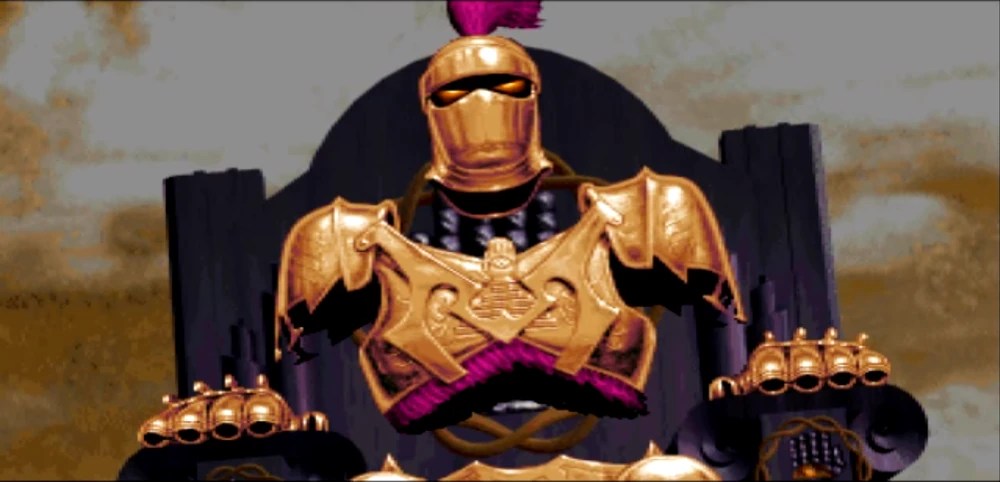
When his prayers finally woke the god, Helm’s great, mailed fist rose and crushed the Astral Dreadnought. He then transported the PCs back to his home plane, Mechanus, where he appeared to them, once more restored to his throne. And this was when he declared Menuk to be his new Right Hand, and imbued him with a new set of Clerical abilities along with all those he lost earlier.

This was one of the most epic and grand encounters and scenarios I have ever run and it was a joy to bring this chapter full circle.

New Cleric Features – Helm’s Right Hand

Below are the details of the new Cleric features that he got. As always, these were written specifically for this particular Life Domain Cleric of Helm so their usefulness might be limited. But, if any of them catch your eye, please feel free to customise and use as you want.

Channel Divinity: The Watcher Over the Fallen

From 2nd level the Life Domain Cleric can use this feature once between long rests. When any creature that is within the Cleric’s line of sight falls to 0 hit points, as a reaction, using Channel Divinity, they can choose to restore them to one hit point instead. This feature cannot be used to heal undead or constructs.

Tough Love

From 6th level, when the Life Domain Cleric summons a weapon using the Spiritual Weapon spell, it can be used to cast any of their healing spells.

Channel Divinity: Helm’s Shield

From 8th level, the Life Domain Cleric gains the ability to summon Helm’s protective power in the form of a shimmering bubble of light. Helm’s Shield surrounds them or any creature the Cleric chooses and can see within thirty feet.
The Shield has an AC of 10 and hit points equal to 10 + the Cleric’s level.

Helm’s Mailed Fist

From 14th level the Cleric gains the ability to transform into the physical embodiment of Helm in the world. They take on the form of a glowing, platinum warrior, adorned in full plate and standing 14 feet tall. The Cleric can take this form for a number of rounds equal to their wisdom modifier (minimum of 1.)
The form grants the following:
AC bonus: +3
Temporary Hit Points: 15 + Wis modifier
Spell Slots: 1 extra spell slot of any level available to the Cleric
Channel Divinity: 1 extra Channel Divinity
Attacks: Add +5 to hit and +5 to weapon damage (damage counts as magical damage)

D&D Planescape Resource – The Book of Doors and Keys

The Foundry Tower

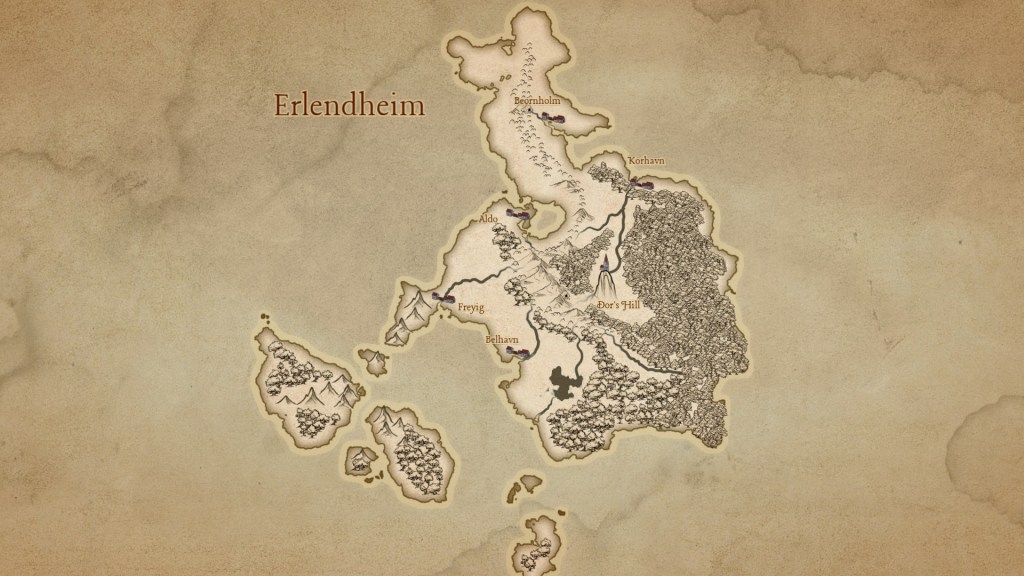
One of the central mysteries of my Erlendheim campaign was the PCs’ hometown. Dor’s Hill stood out like a boil on the perfect skin of an elf. The town stood atop a tall hill in the exact middle of the island of Erlendheim, surrounded by plains and forests. There was something else about it that was odd. A legend, or false history existed, indicating that, many generations ago, a number of very different people appeared in the vicinity of the hill, supposedly sent by the islanders’ primary deity, Helm, to act as guardians of the island. The native people were humans with a Nordic type of culture. The new people that appeared also included humans, though very different to the Erlendheimers, but there were also the goat-like Bariaur, a contingent of Githzerai and several Tieflings too. The legend told that they built the town of Dor’s Hill on top of the hill and swore to live in peace with the people of the island while acting to protect it at the behest of Helm.

As usual with such stories, there were elements of truth mixed into this largely fabricated tale. It was mostly made up or confused or deliberately mis-told over the centuries. In fact, the hill never existed prior to the coming of the new people. Because they arrived in it. It was a building, formerly of the city of Sigil, at the centre of the Outer Planes. It was the old headquarters of the Faction known as the Believers of the Source, or the Godsmen. It had been plane-shifted to the island by one of the Factions’ great rivals, along with everyone in it. When the Godsmen found themselves on Erlendheim, they also found there was no way back. So, rather than despair, they set themselves up on the island, allying themselves with the locals and assimilating.

The Foundry Tower, as it was known while situated in Sigil, had been rather brimming over with portals to other places and planes of existence. It had been renowned for being the most portal-dense building in a city filled with such portals. In Sigil, any door, window, pipe-opening, sewer grate or picture frame could also be home to a portal. You just had to know the key to activate it. So, although the PCs discovered the tower under the hill and uncovered the fact that it was home to dozens of portals that still worked, they had no way to activate them without some guide to the keys required. And they had to find them because the Druid’s kids had been kidnapped and transported through one of the doors. After losing access to the only extant copy of the book describing the keys on the island, they had no choice but to travel to Sigil in the hopes of finding another copy. So that’s what they did, through an underwater backdoor portal that happened to exist off the coast, conveniently.

Now, the fun thing about the doors in the City of Doors, was that the keys needed to open them could be almost anything, from a verse of poetry to the lost sword of a dead king. As a result, I thought I would let my imagination run wild with the keys needed for the doors in the tower. It turned out I didn’t need most of theses. I think they only ended up entering two or three of them in total, but it was still a fun exercise and I think it could stand to me in the future if I ever have another Planescape adjacent campaign.

So, as a break from the Erlendheim Character Options series, I thought I would present here “The Book of Doors and Keys.” If you can get any use out of this in your own Planescape campaign, that’s great! You may even be able to use them for some other purposes, I guess.

Bear in mind that the “Door” entries are specific to a map I was using for the tower. I’m not going to present it here as I think its usefulness to others is negligible, so you can just ignore those.

Also, please note that any destination with “Scatterhome” in it is from my own home-brew world, so you can safely substitute it for some other place.

The Book of Doors and Keys

Door: Doorway in Level 1, Room 3
Destination: Nidavellir, Ysgard
Key: The thought of your most beloved person

Door: Eastern Doorway in Level 1, Room 6
Destination: Abellio, Arcadia
Key: Eat a plate of ribs at the doorway

Door: Doorway in Level 1, Room 10
Destination: Dothion, Bytopia
Key: Turnip

Door: Doorway in Level 1, Room 11
Destination: Pandemonium
Key: Be drunk

Door: Doorway in Level 1, Room 13
Destination: The Shadowfell
Key: Whisper a secret to someone else which will make them think less of you

Door: Doorway in Level 1, Room 16
Destination: Para-elemental Plane of Smoke
Key: Smoke a strong joint

Door: Doorway in Level 1, Room 18
Destination: Chaste, Vitrean Empire, Scatterhome
Key: A symbol of Kaigun, God of the Sea, from a dead priest

Door: Well near Level 1, Room 20
Destination: Mechanus
Key: A gear from a magical construct from Sigil

Door: Doorway in Level 1, Room 22
Destination: Goldenfields, The Sword Coast, Faerûn
Key: A red ribbon tied into a knot

Door: Well near Level 1, Room 24
Destination: The Caverns of Thought, The Outlands
Key: The memory of a parent that is the most enraging

Door: Doorway in Level 1, Room 26
Destination, The Elemental Plane of Fire
Key: Dragon-breath

Door: Doorway in Level 1, Room 31
Destination: The Nords, The Outlands
Key: Crush a bunch of peck-berries (only obtainable from the Fae-wild) under foot before the door

Door: Doorway in Level 1, Room 33
Destination: Aquallor, Arborea
Key: Whistle the tune to the Hymn of the Mother

Door: Doorway in Level 2, Room 1
Destination: Elemental Plane of Air
Key: Eat a turtle cake and burp in the doorway

Door: North Archway leading to the statue of a Githzerai in Level 2, Area 2
Destination: The Astral Plane
Key: Break a bottle of healing potion in the doorway

Door: South Archway leading to the sculpture of a great palace in Level 2, Area 2
Destination: The Factol’s Palace, The Ethereal Plane
Key: Tell someone a secret that will cause emotional harm to them

Door: Doorway in Level 2, Room 4
Destination: Tír na nÓg, The Outlands
Key: Tell a joke

Door: Doorway in Level 2, Room 5
Destination: Khalas, Gehenna
Key: Stab yourself in the leg and spread the blood across the door before the doorway

Door: Northern Archway in Level 2, Room 6
Destination: Strixhaven University
Key: Frustration

Door: Doorway in Level 2, Room 8
Destination: Neverwinter, The Sword Coast, Faerûn
Key: Dance the Neverwinter Axe-dance

Door: Doorway in Level 2, Room 9
Destination: The Infinite Beerhall, Demiplane of Celebration
Key: Put a sausage somewhere it does not belong in front of the doorway

Door: Doorway in Level 2, Room 11
Destination: Elemental Plane of Water
Key: Speak the name of the person you would most like to have sex with

Door: Doorway in Level 2, Room 13
Destination: Malbolge, The Nine Hells
Key: Burn a book and throw it through the doorway

Door: Doorway in Level 2, Room 14
Destination: Minethys, Carceri
Key: Inscribe an arch around the doorway with the tip of a steel sword

Door: Doorway in Level 2, Room 15
Destination: The deepest dungeon of the Imperial Palace in Vitrea, Scatterhome
Key: Cut off a left hand and place it in the doorway

Door: Doorway in Level 3, Room 1
Destination: Krigala, The Beastlands
Key: Throw a beast’s tooth through the doorway

Door: Double doorway, Level 3, Room 3
Destination: The Arena, The City-state of Tyr, The Tablelands, Athas
Key: The tortoise blade of a Mul Gladiator left in the doorway

Door: Doorway in Level 3, Room 4
Destination: the Feywild
Key: Play the pan-pipes in front of the door

Door: Doorway in Level 3, Room 8
Destination: The Positive Energy Plane
Key: Roll two sixes on a pair of dice

Door: North Doorway of Level 3, Room 10
Destination: Krangath, Gehenna
Key: Wear a crown

Door: West Doorway in Level 3, Room 13
Destination: The Opera House, Rath an Croí, Scatterhome
Key: Place a diamond in the doorway

Door: Doorway in Level 3, Room 12
Negative Quasielemantal Plane of Ash
Key: A handful of Yugoloth ash poured on your head

Door: Doorway in Level 3, Room 15
Destination: Amoria, Elysium
Key: Pay a compliment to the person you find it most difficult to compliment

Door: East Doorway in Level 3, Room 16
Destination: Niflheim, Hades
Key: Cry genuine tears of sorrow

Door: Doorway in Level 3, Room 17a
Destination: Mercurua, Mount Celestia
Key: Tell a sad story in celestial

Door: Doorway in Level 3, Room 17b
Destination: The Mortuary, the Hive, Sigil
Key: Crush a cranium rat’s brain in your hand

Door: Doorway in Level 3, Room 17c
Destination: Limbo
Key: The memory of your most embarrassing moment

Door: Doorway in Level 3, Room 20
Destination: Avalas, Acheron
Key: Burn your skin and allow the heat from the burn to kill an insect

New Character Options from Erlendheim, Part 3

Erlendheim

I began a series of posts last week detailing the character options I introduced to my Planescape flavoured D&D campaign a few years ago. It was quite epic in scale and involved gods and legendary monstrosities and elemental powers as well as travelling across multiple planes of existence and saving the universe from the domination of a narcissistic sea spirit. I hadn’t planned it in advance but, at one point, the Warlock needed to switch her patron so I came up with a new one which you can read about here. After that, I was hooked. I started making new character options, features and powers for every PC in the party. You know when you max out your rep with your party members in CRPGs like Dragon Age and Mass Effect and they get access to new abilities? That’s the way I was thinking of it. As a result, these new character options were designed with our specific players, characters, shared world and story in mind. I left balance at the door. Balance was not relevant to what I wanted to achieve. In fact, I wanted the PCs to feel special, powerful and impacted in a very concrete way by the events of the campaign. I think I largely achieved that. Take a look, here, at the powers I gave the party’s Druid when he became a kind of a shitty god. I think it exemplifies my philosophy when designing these abilities.

Celebrating the Mundane

I think the next big character advancement arc to culminate was that of Xarune, our Githzerai Fighter. Xarune, despite his background as an adventurer in his younger days, had a solid view of the world. He believed in the shield in his hand, the guardsman at his side and the firmness of the ground beneath his feet. He had developed a dependable reputation in a position of some responsibility as a sergeant in the Yeomanry of the town of Dor’s Hill. Magic was anathema to him and, indeed, he went to extremes to explain away magical phenomena in entirely mundane terms. But then the ground beneath his feet turned out to be the ancient tower of an unknown faction from a city in the shape of a donut floating above the top of an infinitely tall spire at the centre of the Outer Planes. It became increasingly difficult for him to hand-wave the obvious magic in the world around him, especially once he ended up in Sigil. In fact, I instituted a special mechanic, specific to Xarune. Each time he witnessed something truly magical that he could not explain, he would roll a Wisdom Saving Throw. When he failed, he lost a point of Wisdom, making it more-and-more likely that he would fail with each successive failed save. My goal here was to get Xarune under 10 Wisdom. Once that happened, his aura of confusion and his inability to square his beliefs with the facts of reality brought him to the attention of a small, new Faction in Sigil. They were called the Mundane. When Xarune ran into their leader, another Githzerai warrior named Sarafem, who noticed his unique state of disorientation through her natural psychic abilities. We had another short mini-game at this point, after Sarafem introduced the Faction and its tenets. She presented to him her shield, with, emblazoned upon it, the emblem of a shield. She asked him to take and examine it.

Here is how I presented Xarune’s inner struggle in my notes:

Sarafem will encourage Xarune to use detect thoughts while examining the shield. In essence, this will allow Xarune to detect his own thoughts, to interrogate his own beliefs.
If he does so, he will replay some of the more recent encounters he has had with “magic.” Ask him to recount them and indicate that he is unable, in retrospect, to lie to himself and his own feelings. The truth is that the spells and magical effects did happen. In some cases he was able to shrug off the effects and in others he bore the full brunt of them. What becomes clear as he remembers these incidents is that, it is not objectively true that he or anything has to be subject to such effects. He begins to get so in touch with his feelings that he feels a new understanding blossom. He is able to apply the force of his will against this magic, a will that is every bit as strong as any wizard or demon thinks they are. For that is all it is in the end, a battle of wills.
He will want to fail his saving throw against detect thoughts. Give him three chances to fail it at various points through the process. Of course, it is a Wisdom saving throw but this time the DC will be 2 points higher than Xarune’s normal DC as it gains a bonus from the shield.
Whether he succeeds or fails, Sarafem will present to him the shield with a bow. It is a mundane +2 shield. There is nothing magical about it, but it is exceptionally well made from the hardest, lightest wood they have ever seen. (It is made of what she calls Steadfast.)
If he fails, with a barely perceptible twinkle in her eye she will ask him to join her budding faction, which she calls, “The Mundane.” She says they are still workshopping it. There are not many of them so far, but each of them has a very firm grasp of their true feelings and they know what is real. If he decides to take her up on her offer, they are usually to be found meeting in her house near the Statue of Bigby in the Lady’s Ward any evening.
Also, he will regain his lost points of Wisdom and he will gain the new abilities presented [in the section below]
If he succeeds, however, he will go on as before, he will not regain any points of Wisdom and he will continue to risk losing them. If he ever reaches 0 Wisdom, he will lose his mind completely and reject reality entirely, thus becoming an NPC.
However, he can continue to attempt the trick with the shield, trying to detect his own thoughts. He can do this whenever he has downtime using the same rules as are presented above.

Thankfully, he failed all his saves and his outlook and philosophy changed as a result. Not completely, it was still quite compatible with his no-magic stance from before, it just morphed into a more anti-magic one, bringing a few new abilities with it. And you can read about those below.

But that wasn’t all. Xarune’s player, Isaac, took the idea of the Mundane and ran with it. He quickly took the ideals of the Faction and began to codify them, even going so far as to write up a Mundane Manifesto! This did my withered old heart good to see. The campaign gave his character a concrete, mechanical advancement directly related to Xarune and the way he played him, and he gave back to the campaign and the world, adding to its story and its depth. Sigh so good.

New Fighter Features – Nullification (Anti-magic)

Erlendheim #DND

So, as I pointed out in the intro to this post, I created these features and options for, not only a specific class, but for a particular character. As a result, the features prestented below are unique to Xarune’s flavour of Fighter, a Battle Master who focused on using the Defense and Protection Fighting Styles. As always, if you think you could make use of any of this stuff, please feel free.

Fighting Style

Defense

Also add a +1 bonus to saving throws against magical effects

Protection

In addition to the regular advantage of this fighting style, if a creature you can see casts a spell that requires a saving throw against a target other than you within 5 ft of you, you can use your reaction to add your shield’s AC bonus (including magical or other bonuses if it has them) to their saving throw.

Martial Archetypes

Battle Master

Maneuvers
Deny

When another creature hits you with a spell attack or you fail a saving throw against a spell effect or magical effect, as a reaction you can expend a superiority die and reduce the amount of damage you take by the superiority die roll + Con modifier.

Reflect

When another creature hits you with a spell attack, as a reaction you can expend a superiority die to reflect the superiority die roll + Con modifier damage back at the spell caster.

Wake-up Call

When you take the attack action on your turn you can forego one of your attacks and instead use a bonus action to direct another creature who can hear you to make an immediate saving throw against a spell that they are currently affected by. You expend a superiority die and they can add the roll + your Con mod to their saving throw roll.

Indomitable

In addition to the regular benefits of this feature, starting at 9th level, if the Nullifying Fighter is subject to a magic spell or effect, they can roll any saving throw with advantage.

New Character Options from Erlendheim Part 2

Gods are superheroes too

In the last post, I wrote about how D&D 5E characters are basically superheroes by another name. I also introduced the new Warlock patron that we came up with for Yulla in our D&D 5E campaign, Erlendheim, a few years ago. She had abandoned her “Fathomless” patron and taken up with “The Source.” After Yulla got her groove back and started living up to her potential, it was our Druid’s turn.

Habjorn, played by David, had not wasted the years since their former adventuring days. He’d settled down with his wife, Lydia and started a little family which quickly ballooned into a sizeable troupe of children. There were seven in total, Habjornson, Sigrid, Gurt, Hogarth, Jankur, Flaarj and Yeet, the little one. But, as I noted last time, they, along with several of their neighbours, went and got themselves kidnapped by one of the antagonists. Lydia had already passed away a few years previous.

So, obviously, the party to go to great lengths to find them. Lengths that eventually led them to Sigil and beyond.

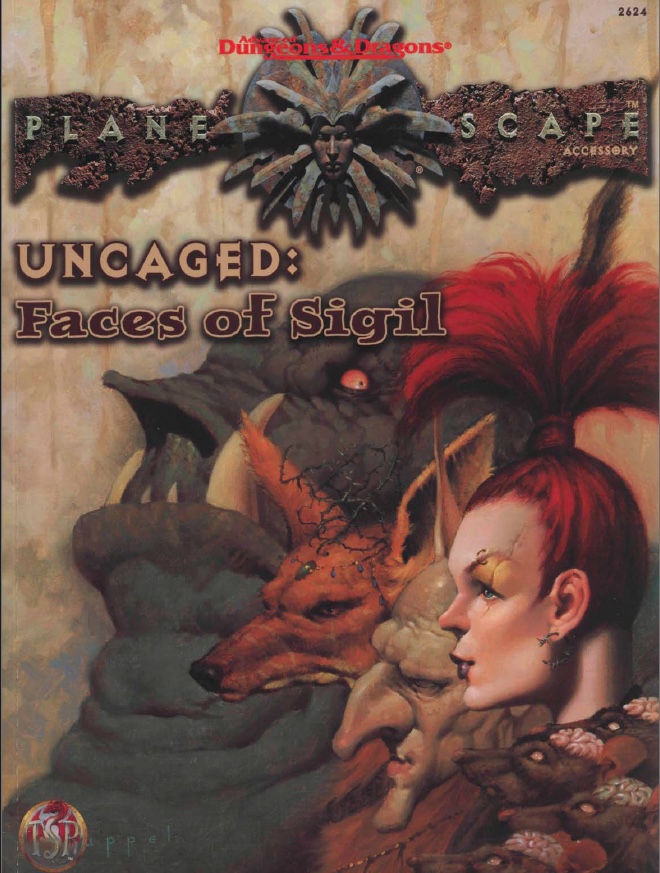
While the party were in the City of Doors, they got a job from Kesto Brighteyes, the gnomish owner of the Parted Veil, a bookshop where the PCs went to find the tome they were looking for. I found Kesto and everything about him in Uncaged: Faces of Sigil. This was an invaluable source-book for this campaign and provided at least three incredibly useful, well drawn and significant NPCs who were residents of the Cage with depth and interconnectedness.

Anyway, this quest led them off to the Lady’s Ward of the city, where they managed to defeat the object of their quest, a Gautierre. Upon the occasion of their victory, Habjorn the druid was approached by Lydia, his dead wife, in the form of a Petitioner. Petitioners are the souls of dead sentients, ascended to the Outer Planes who are, to all intents and purposes, reborn into new lives there with no memories of their old ones. They normally turn up on the plane where their gods lived or, at least, on a plane that matches their alignment. But, Lydia’s god, it turned out, was dead. So, she started wandering the planes looking for somewhere to belong. Until she felt a pull drawing her to her husband when he passed through a portal into Sigil.

Lacking a god or any sense of purpose, she felt a connection with Habjorn that she thought she should have had with her god, Helm, but didn’t due to his deceased state. So she started to believe in Habjorn like a god. She didn’t necessarily agree with him all the time or obey him at all, in fact, but she still had a strong enough belief in him to essentially grant him the status of a Minor Power, a godling out there on the Outer Planes.

It was actually pretty tragic. He was overjoyed/heartbroken to see her again but she didn’t recognise him and had no memory of their life together before her death. She knew nothing of their family and her motivations were totally different as a Petitioner.

But I digress. Before he knew it, Habjorn started hearing the prayers of his kids, held deep underground on the plane known as the Outlands, under the roots of one of the World Tree’s saplings. They were hoping and praying that he would come and save them and their belief began to compound the meagre abilities provided by Lydia’s own prayers.

And thus the Druidic Deity was born. So, like Thor and Hercules (kinda) before him, Habjorn became a superhero god!

Now, believe me, I understand that this stuff is totally unbalanced and potentially game-breaking. But I was throwing these characters up against some very tough situations, so I felt ok about it. I will point out, also, that, unlike the Warlock patron from the last post, this is not a subclass. Instead, its a couple of new features that work for Habjorn the Circle of the Land Druid/minor god, in particular. It is unlikely to work for anyone else in its current form but I think it was a fun addition to his set of abilities that allowed him to do some interesting stuff in particular situations and led to some truly fantastic character and story moments in our game. So, take it under advisement! But, if you want to use it or any part of it, please feel free!

New Druid Features: Druidic Deity

Grant Druidic Magic

The Druidic Deity can grant two cantrips and two first level spells from the Druid Spell List to their follower/s. The druidic deity can grant the cantrips and spells once and cannot do so again until they have completed a long rest.

The Power of Prayer

When a worshiper has prayed for spells to be granted the Druidic Deity gains a Prayer. There is no upper limit to the number of Prayers the Druidic Deity can be in possession of and if not spent before taking a long rest, they carry over. The Druidic Deity can spend a Prayer using a bonus action. This Prayer can be spent in several different ways:

  • Allow the Druidic Deity to regain an expended spell slot of any level they have access to
  • Allow the Druidic Deity to gain another use of Wild Shape
  • Allow the Druidic Deity to Wild Shape into any CR 2 Beast or Monstrosity that they have seen
  • Allow the Druidic Deity to remain in Wild Shape for double the normal length of time
  • Allow the Druidic Deity to cast spells while in Wild Shape
  • Allow the Druidic Deity to use the Natural Recovery feature to regain all used spell slots including 6th level ones and higher
  • Allow the Druidic Deity to cast one of their Circle Spells without expending a spell slot
  • Allow the Druidic Deity to empower their Land’s Stride ability , granting them the opportunity to pass into a plant of sufficient size and emerge from a similar plant of sufficient size within 200 ft
  • Allow the Druidic Deity to empower their Nature’s Ward feature, granting them immunity to one more damage type of their choice until they complete a long rest
  • Allow the Druidic Deity to empower their Nature’s Sanctuary feature so that beast and plant creatures cannot attempt to save against it.
  • Grant a worshiper another cantrip or first level spell

So, like I mentioned above, I know these features are potentially game-breaking and open to abuse. But my players took this sort of thing in good faith and David played his character as he thought he should react to becoming a slightly shitty kind of god. He was somewhat incredulous but used every ounce of his power to do the things his “worshipers” wanted of him. In other words, for Daddy to come and save them. And that’s what he did.

I would mention here as well, that balance, as a concept in D&D/TTRPGs in general is a concept that I take with extreme caution. I would rather chuck an unbeatable monster at them and have them figure out they need to run away or use their wits instead of charging headlong into the fray, then stick to Challenge Ratings most of the time. In this respect, I think the OSR has it right. But, I think this door swings both ways, if a challenge can be unbalanced due to an encounter’s difficulty, the PCs can also be a challenge due to their ability. They should get to feel like the superheoroes thery are. On the other hand, I also have the ability to keep piling on the difficulty as the party gets more and more powerful, so I see it as a win-win.

Let me know if you have any comments on these nutty druid features, dear reader.

New Character Options from Erlendheim Part 1

D&D Superheroes

There’s no doubt in my mind that the creators of the current version of D&D meant to make the PCs into superheroes. This goes for 5E 2014 as well as 2024.

You can have opinions about this. There are times when it frustrates the hell out of me as a DM just trying to introduce potentially deadly situations to our games. I usually overestimate the lethality of these situations, whether they might be traps, encounters or particularly difficult episodes of exploration. The players normally trounce these situations readily. They always have a feature or a spell or a power or a magic item or a special friend who will come to their rescue so that they emerge largely unscathed and only further emboldened. On the other hand, I do feel bad when a PC dies in one of my campaigns. I mean, of course! They spent hours designing and imagining and embodying this person… and they died… it can be devastating. It should be devastating. Not just for the player in question, but for every player in the game, including the DM. So I get it. I understand why the average D&D PC’s life expectancy has sky-rocketed in the last couple of decades. I also understand that if you want something more lethal, Troika! is right there. So, if you want more lethal play, there are plenty of options.

Anyway, when I finally realised the superheroness of the characters, we were playing one of my long-time RPG group’s more iconic campaigns. It was called Erlendheim and it was based on my home-brew world of Scatterhome. Here’s the TLDR for the campaign:

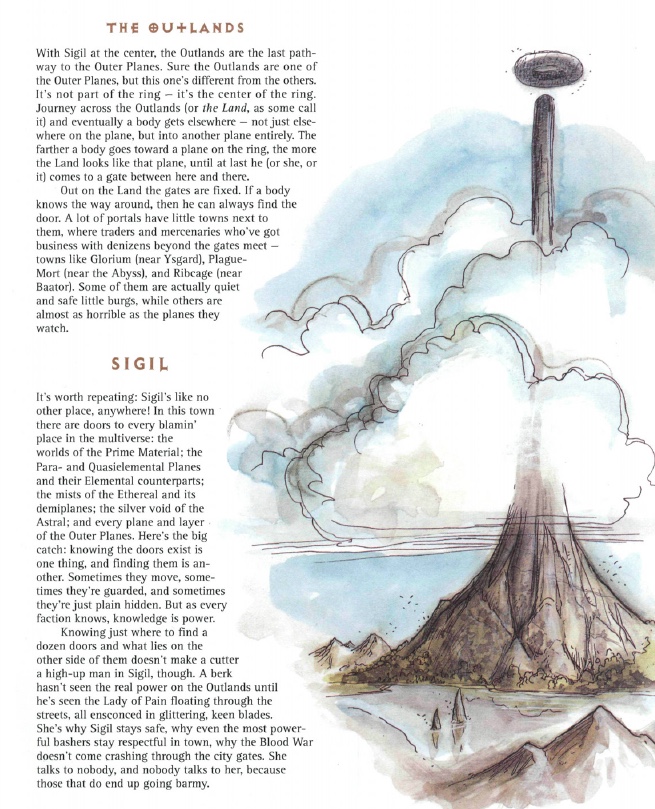
The PCs were all former adventurers living in or around their hometown of Dor’s Hill on the island of Erlendheim. The island was surrounded by a terrible and eternal storm meaning no-one could leave and no-one new ever turned up. The PCs started at level 8, but their adventuring days were behind them. Until one day, they were asked by the powers that be in Dor’s Hill to investigate some strange reports from an outlying fishing village. While they were off fighting what turned out to be Yugoloth fiends there, all six of the Druid’s kids were kidnapped by some more extraplanar beings. This, eventually and after much adventuring, roleplaying, schmoozing and drama, led them to Sigil, The City of Doors, The Cage. For the uninitiated, Sigil is the city at the centre of the Outlands, the plane at the centre of the Outer Planes in the D&D cosmology.

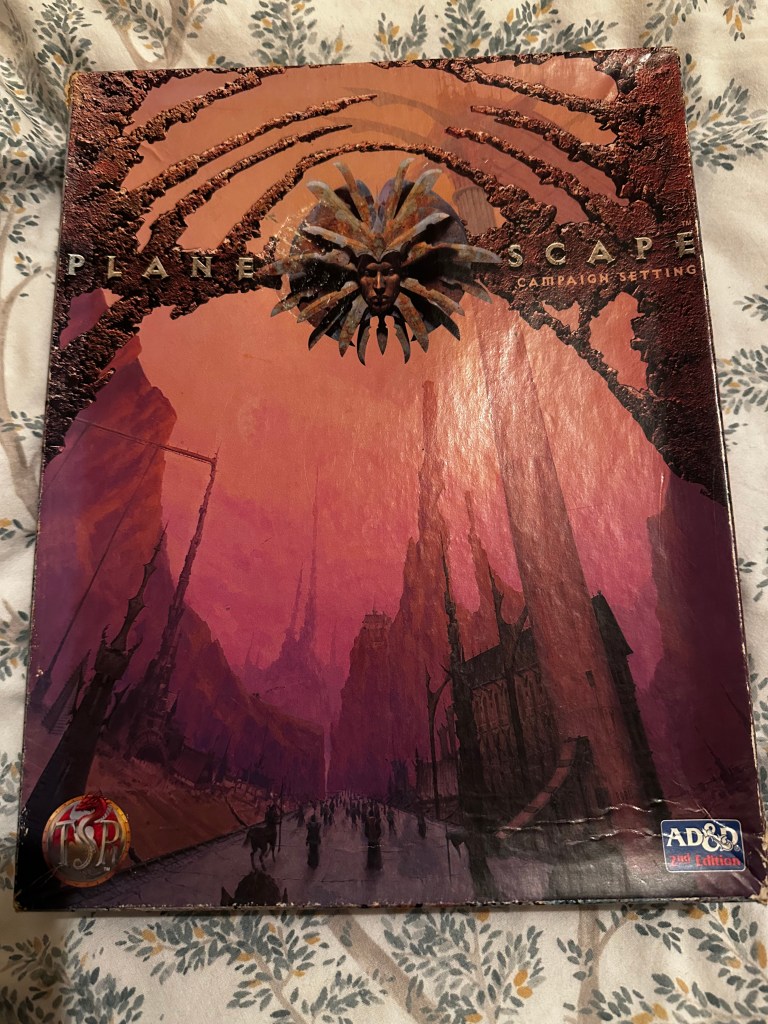
Now, as a die-hard AD&D 2nd Edition player of old, I was a massive fan of the original Planescape setting, the new shit it introduced to the game and the way it expanded our horizons as both DM and players when it came out in the nineties. But, I’ll be honest, I don’t think I knew how to use it as a 14 or 15 year old DM. It was just too massive. I wrote and ran adventures that were pretty much standard AD&D adventures except in a place in the Outlands instead of on the bog-standard fantasy world I had devised. So, in 2021, when I got the chance to send these PCs to Sigil!!! I grabbed that bull by both horns. It was so much better than I could have hoped. Even just the act of getting there was a major campaign milestone. And before long, both the players and the characters were knee-deep in planar weirdness. They didn’t know it, they didn’t understand most of it, but they still had goals. They were there for a reason (they had to find a book that explained the keys to all the planar doors in a mysterious tower beneath the town of Dor’s Hill back home.) So they pursued that. On the way, they all gained even more super powers than they already possessed. Why? Because, once you understand that D&D 5E is a superhero game, it’s a good idea to lean into it.

The first PC to get blessed in this manner was our warlock, Yulla (played by Tom.) Now, it just so happened that Yulla, up until this point, had a patron named Aegir, an elemental spirit that turned out to be the baddest guy of the entire campaign. So, when she went to Sigil her confidence in their patronage had taken a few knocks. When she then discovered her long lost, presumed dead parents there she was open to new possibilities. Now I was using the gorgeous, unimpeachable original version of the Planescape setting for this game. It was made for AD&D 2nd Edition but that was no impediment at all. (When I got the new 5E version I was a little shocked and affronted to find that they had done away with one of my favourite Sigil factions, the Believers of the Source. I understand that this actually happened way back in one of the nineties Planescape novels but I never read those so I had no way of knowing.) Anyway, the entirety of my Erlendheim campaign had been built around the Believers, their doctrines, their headquarters, etc. And it turned out that Yulla’s birth-parents had been members of the believers for decades since their supposed deaths. Anyway, this led Yulla to seek the Source as a patron, instead of the untrustworthy and, frankly quite evil Aegir.

And this is where the extra super powers come in. Tom and I designed a new Warlock Patron for Yulla, the Source itself. I based it around the philosophy of the Believers: you must try to reach your potential, your existence should be evolved as much as possible within your own lifetime, etc. Here is the result. If you like the look of it and you can find a way or reason to use this in your own campaign, please feel free.

New Warlock Patron – The Source V 2.1

Description

You have have made a pact with the ultimate creative and destructive power in the multiverse. The Source is that from which all things come and which all will someday rejoin. The members of Sigil’s faction, The Believers of the Source understand that all beings should be striving to evolve within their lifetimes to become one with the Source. To this patron, time and space have little meaning; sentients are beings of pure potential and a deep understanding of the planes of existence is essential.

Expanded Spell List

Spell LevelSpells
1stFind Familiar, Inflict Wounds
2ndWither and Bloom, Vortex Warp
3rdMotivational Speech, Life Transference
4thAura of Life, Vitriolic Sphere
5thDestructive Wave, Legend Lore

Features

1st Level Feature

Burst of Potential

From 1st level, as an action the warlock becomes a silhouette of themselves and emits a brief burst of soft yellow light. They draw on a fraction of the unlimited potential of the Source and grant it to those allies in a ten foot cube around them. Until the end of the Warlock’s next turn all within the aura gain advantage on a single ability check, attack roll or saving throw of their choice.
Once you use this feature you cannot use it again until you finish a short or long rest.

1st Level Feature

Fragment of the Source

From 1st level, using a bonus action, the Warlock of the Source gains the ability to summon a fragment of the Source in the shape of a softly glowing orb. It will appear at a chosen point anywhere within 60ft of the Warlock. The Fragment of the Source will remain for a number of rounds equal to the Warlock’s Charisma modifier. The Fragment can use its potential energy to allow a creature within 5 feet of it to roll with advantage or force a creature within 5 feet of it to roll with disadvantage on any attack roll, saving throw or ability check. As a bonus action on their turn, the Warlock can move the Fragment up to thirty feet. The Warlock can summon the Fragment a number of times equal to their proficiency bonus and regains all expended uses when they finish a long rest. The Fragment of the Source will act on the same initiative as the Warlock.

6th Level Feature

Aura of Potential

From 6th level, the Warlock of the Source’s Burst of Potential feature becomes an aura. The effects are the same as the Burst but apply to each ally that starts their turn in the aura. Also, the effect can be used to ensure maximum damage on an attack roll.
The Aura of Potential lasts a number of rounds equal to the Warlock’s Charisma modifier.
Once you use this feature you cannot use it again until you finish a short or long rest.

6th Level Feature

Wasted Potential

From 6th Level, as a reaction, the Warlock of the Source may fire a sparkling yellow orb at any creature taking an action, making an attack roll or rolling a saving throw within a 30ft range. The creature must make a Charisma saving throw against the Warlock’s spell save DC or apply disadvantage to their roll.

10th Level Feature

Mark of Potential

From 10th Level, the Warlock of the Source begins to gain benefits from the potential bestowed or denied by the Aura of Potential and Wasted potential features. Each time an ally succeeds on a roll which benefits from the advantage bestowed by the Aura of Potential the Warlock gains a Mark of Potential. Each time a creature fails on a roll affected by Wasted Potential, the Warlock gains a Mark of Potential. Gained Marks spark briefly into being around the Warlock’s head before fading into invisibility.
At 10th level the Warlock can hold up to a maximum of nine Marks of Potential. At 14th level the Warlock can hold up to ten Marks of Potential (See the “Evolution” feature below for how ten marks can be spent.)
The appearance of the Marks is up to the individual Warlock.
Marks of Potential may be held until spent.
Marks of Potential can be used in the following ways:

Marks SpentEffect 1Effect 2Effect 3
1Apply advantage to any attack roll, saving throw or ability checkDouble the range of Fragment of Potential
2Roll a hit die plus your Charisma modifier to regain hit points
3Maximise any damage effectInduce a critical success
4Roll two hit dice plus your Charisma modifier to regain hit points
5Double the area of Aura of PotentialDouble the number of targets affected by Wasted PotentialDouble the number of Fragments of Potential Summoned
6Roll three hit dice plus your Charisma modifier to regain hit points
7Increase the casting level of any appropriate spell by one
8Roll four hit dice plus your Charisma modifier to regain hit points
9Regain a Spell Slot

14th Level Feature

Evolution

At 14th level the Warlock of the Source gains the ability to use ten Marks of Potential to evolve into a form which brings them closer to the Source for a number of rounds equal to the Warlock’s Charisma modifier. For each level the Warlock gains above 14th, the duration of the evolution is increased by one round.
In their evolved form, the Warlock gains the following features:

  • 5 hit dice plus Charisma modifier of temporary hit points
  • Makes all attack rolls, ability checks and saving throws with advantage
  • Triples the area of Aura of Potential

The appearance of the evolved form is up to the individual Warlock.
Once you use this feature you cannot use it again until you finish a long rest.

Games I Have Played So Far this Year, Part 1

Lists part 2.1

Also not a top ten, not by any means, but I do think this one is useful for me, especially. Even this time last year I could not has envisioned a seven month period where I got to experience so many different games with so many different people. Looking back on it, I don’t think there has ever been a period in my life where I have been involved in so many RPGs.

This got me thinking so I went to dig up some of my old prep books from the 90s (a few notebooks, filled largely with encounter stats.) In these ancient tomes I found prep notes and full scenarios that I wrote for no fewer than three AD&D campaigns (Dark Sun, Ravenloft and Planescape,) a Gamma World campaign, a Beyond the Supernatural campaign, a Robotech campaign, and a home-brewed Aliens game that I think I based largely on the Palladium ruleset. I know I ran a couple of other things too but not much more. I have run more different games in the last 7 months than I did throughout my teenage years! It is a golden age for me and I am loving it!

Anyway, on to the list. In this post I am only doing the games I have GMed/run/refereed. I will do the ones I played in in the next post:

Games I have run this year so far

  • Spire – Kings of Silver – Concluded Campaign. Far more epic in scope than it ever had any right to be. This was largely due to my choice at the start to make use of an optional rule that made the PCs much less likely to accrue fallout. At the time I did not realise exactly how crucial fallout is to pushing he campaign forward. I wouldn’t do that again. This campaign really got me into the products of Rowan Rook and Decard. You will find another couple of games on this list that they made too, in fact. It was a great experience and I know I’ll be going back to Spire sometime soon. I am also definitely going to do a more in-depth look at this one in a post all its own sometime soon.

  • Eat the Reich – short campaign. We started playing this shortly after I received my physical copy from the Kickstarter campaign, just because our regular game night fell through. And what a happy accident! If you too hate nazis and love making up inventive and ultra-violent ways to kill them with vampires, this is the game for you. Also, it is Ennie nominated right now, go vote for it! It is one of the most eye-catching RPG books I own, which is saying quite a lot. It is worth picking it up for that alone.

  • Never Tell Me The Odds – Rebel Scum – one-shot. I planned this one for Star Wars Day this year and really enjoyed it. We actually watched Star Wars: A New Hope before we played it too. This really helped because the premise of the whole one-shot was that the PCs were a rival band of rebels who were actually sent to the Death Star to rescue Leia at the same time as Luke and his pals were blundering about, getting captured and accidentally doing good. Great fun, would recommend this game for one-shots too. It’s all about the stakes and how you play them.

  • Troika! – The Blancmange and Thistle – one-shot. Possibly the most fun I have had in a one-shot all year. Everyone rolled on the random table in this OSR game and played what they got, a Rhino-Man, a Questing Knight and a Befouler of Ponds. Then we played the starter adventure from the Troika! Numinous Edition core book, where they went to their room in a hotel and attended a party. Fucking hilarious at almost every turn. 10/10 would play again, and I definitely will.

Check back for part 2 where I get into the ones I’ve been a player in so far this year.