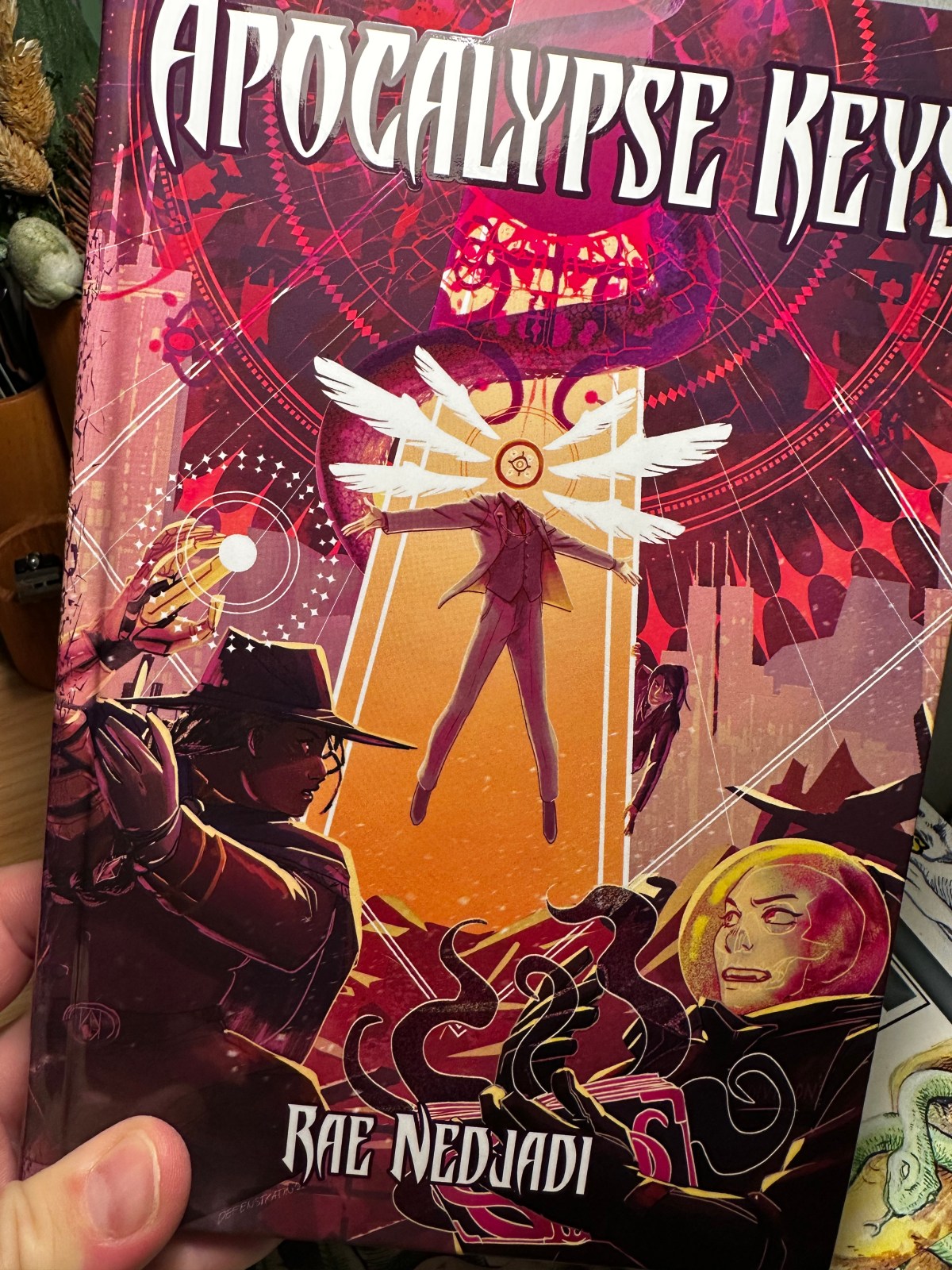
Apocalypse Keys Character Creation

it has a very specific flavour. The PCs are monsters in the vein of Doom Patrol or the X-men. There is a lot of significance to the emotions of the characters and there is a fair bit of angst and drama involved from what I can tell.

This is the eighth in a series of character creation posts I’m using to figure out which game I want to schedule for our next campaign. You can find the Triangle Agency one here. And you can find the Slugblaster one here. You can find the Blades in the Dark one here. We took a slight detour for this one, here’s the Wildsea Ship Creation post. And then got back on track with the Wildsea Character Creation post. This is where you can find the Deathmatch Island one. You will find the Orbital Blues character creation post here. Back in this post I named Apocalypse Keys as an outside contender for the new campaign. This will be the last post in the series so I’ll be forced to make a decision on the next campaign soon.

DIVISION and Conquer
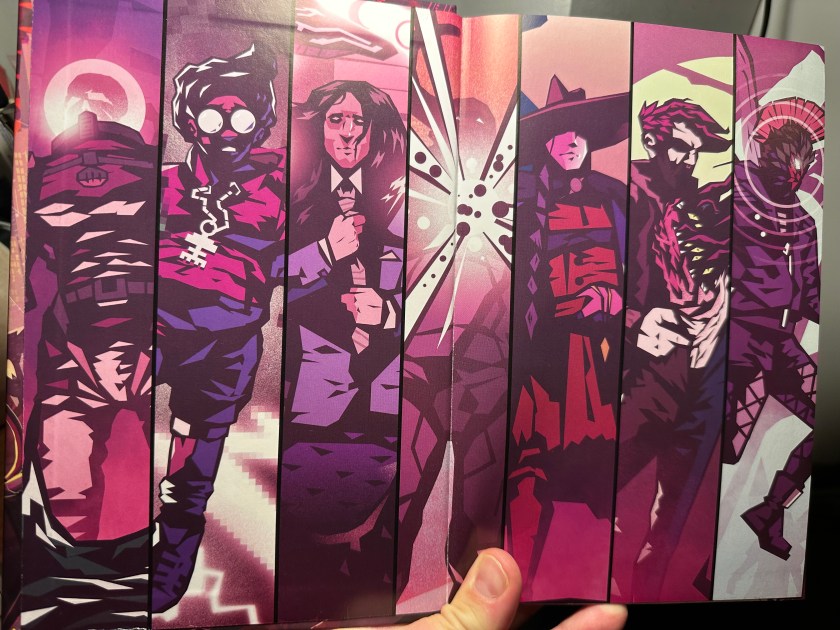
The illustrations of each of the Playbooks all together.

Apocalypse Keys by Rae Nedjadi is a Powered by the Apocalypse game in which you play members of a super-team of sorts. You are wielded like weapons by a shadowy organisation called DIVISION (which is an initialism, kinda like S.H.I.E.L.D.) in an effort to prevent apocalypses. How? Well, you gather Keys, which are essentially clues you will use to find and open Doom’s Door before the bad guy can. The bad guys are known as Harbingers and they are Omens, like you, but more world-endy.

The game is very much PBTA in its design, with a few extras. Although you roll 2d6 for most things, if you roll an 11 or higher, you overshoot, you blow the whole warehouse up instead of just the gates, your powers leave the security guard a blubbering mess instead of just plucking some thoughts from his head, you get the idea.

Also, it has some Carved from Brindlewood flavour to it too. The Keys you gather improve your chances of finding the Doom’s Door you’re looking for. For each one you get, you increase your chance that the theory you have come up with is correct and you know where to find it.

Ruin seems to have been taken from Trophy. Although it’s used a little differently. As you gain it, you get closer to becoming one of those bad guys, the Harbingers. It can also give you special Advances (abilities.)

One last thing: PCs gain Darkness Tokens as they make particular types of narrative choices that align with the emotional themes of the playbook. You spend these tokens to give you modifiers to rolls.

I think it’s important to know these things as we go into character creation for this game. Also, it has a very specific flavour. The PCs are monsters in the vein of Doom Patrol or the X-men. There is a lot of significance to the emotions of the characters and there is a fair bit of angst and drama involved from what I can tell.

Creating Monsters of DIVISION

The book provides us with a step by step guide to character creation which I love to see. It was something I missed from the process in Orbital Blues. Lets take a look:

  • Step 1: Choose a Playbook
  • Step 2: Bring Your Character to Life
  • Step 3: Refine Your Abilities
  • Step 4: Introduce Your Character to the Other Players
  • Step 5: Create Your Starting Bonds

As this is purely an exercise the last couple of steps probably won’t happen.

Choose a Playbook

Like other PBTA games, you choose a playbook to get started. Your character might decide to switch playbooks further down the line, depending on the narrative choices that are made at the table but most are likely to select one and stick with it. It’s like a character class in other games.

Here are the available playbooks in Apocalypse Keys:

  • The Summoned: a being summoned from another place. Violent, aggressive, antagonistic to prophecy, wants love more than anything
  • The Surge: Massively powerful but not in control. Wants help to contain it. “Explosive, uncontrollable and alienating.” Friendly fire and collateral damage and toxic relationships are the themes
  • The Found: Psychic amnesiac. They are very odd, but curious and highly emotional. They can have surprisingly intimate knowledge of other peoples’ inner lives and thoughts but do they know what’s best for others?
  • The Shade: A super intellect who cheated death. Thematically, they are for players who want to forge a difficult relationship with death and struggle with the costs of great knowledge
  • The Last: The last of their kind from another world. “Their power is reflective, sorrowful and hopeful.” Unsurprisingly the themes here are heavy, loss, tragedy and how these things are inevitable.
  • The Fallen: Elements of Lucifer, a fallen angel. “Their power is intoxicating, damaged, deceitful.” Thematically, hubris, the two sides of worship and an over-riding want for what was lost.
  • The Hungry: It is what it says. “Their power is intimate, transformative, and harrowing.” Getting big vampire vibes here. They are looking to feed, get truly close to someone and deal with the idea of body horror, unsurprisingly.

I could roll 1d7 to pick here, but there is one I’m drawn to most. That is the Fallen. They are all pretty goth but it feels gothiest to me.

The Fallen

The Fallen illustration from the book. A man in a suit with long, dark hair, a suit and tie ad a dragon coiled around him.
The Fallen illustration from the book

I am a pale reflection of the glory I once was
I embody the hubris and volatility of the Apocalypse
My power is faded, cracked, and deceitful
My heart yearns to worship and be worshipped

Bring Your Character to Life

I’ll be using a series of prompts provided in the playbook description to do this next part.

Your Name

There are four options here:

  • A name god gave me with love
  • a name I earned through fear and terror
  • a name that can never be said out loud
  • a name you need to give someone else one day

I choose the third one, because it’s cool, honestly. The name is Duma, after the Angel of Silence. In fact, I think this character will only communicate through signing.

Your Look

There are several options here. I won’t list them all, just the three I’m taking:

  • a multitude of wings made of light and sound
  • a cracked halo that bleeds
  • mismatched clothing hastily thrown together

I love these touches. I imagine the halo just constantly dripping blood onto Duma’s face, forcing him to close his eyes to the horrors of the world. The wings, once flapping silently, feathery and white, now buzz and flicker like an insect’s. The clothing, whatever he could find, an old army surplus jacket, some discarded cream chinos and a pair of scuffed tennis shoes.

Your Origin

I have to choose one of these four options for Duma’s origin:

  • I was once a mighty god of this Earth but I was killed by my worshipers
  • I once claimed hell for my own but I was betrayed
  • I was an angelic creature destroyed by my jealous god
  • something else that describes how far I have truly fallen and all I have lost

It’s nice to have that last option there for anyone who has their own idea of their character’s origin. For me, though, it has to be the third one. I think Duma was silent before as a way to show his devotion to his god, but is silent now because he has vowed never to speak until he regains the trust of his god or destroys him.

Who are the Gods Who Taunt You?

I only choose one of these:

  • those who I betrayed seek to destroy me once and for all
  • ancient gods who have lost their power and ache for what is left of my divinity
  • twisted gods I corrupted who are now monsters of myth and legend
  • divine servants who grow in power as I have weakened
  • something else that feeds my spite and sharpens my hubris

I like the idea of other bully angels coming down to tease Duma while he seethes and silently curses them so I’ll go for the fourth one.

Your Impulse

This is an interesting departure from other PBTA games I’ve played. Usually, you have particular character goals that mostly remain static, and if you manage to achieve them in a session, you gain 1 XP. In Apocalypse Keys, you choose one of the listed Impulses each session and work to explore it. If you do, you can gain 1 XP OR 1 Ruin. I’m not going to list them all, but here are a couple that I like:

  • Did you bless the weak with the immeasurable glory of your presence?
  • Did you taunt or seduce those who would seek to destroy you?

I think, as a starting Impulse, I would go with the first of those two, just to start things off as I meant to go on.

Your Powers of Darkness

These are largely thematic flavour for your character to throw on a standard move. They are pretty much open to interpretation every time you use them.
I can choose two from the following:

  • Soul Venom
  • Fae Glamour – Just so Duma can walk around town.
  • Fear Manipulation
  • Weapons of Light and Sound – This seems very angelic.
  • Many Forms of Mythic Animals

I’ll take Fae Glamour and Weapons of Light and Sound

What Does the Darkness Demand of You?

This is such an important question to the character and for the Keeper to know how to interact with them. There are quite a few, so I’m going to only list the two I am choosing:

  • To storm heaven
  • to curse the one I love

Man, that’s melodramatic!

Gaining Darkness Tokens

This is an important part of the process. It will define the way I play the character to a large extent. Duma will get 2-4 Darkness Tokens every time he does any of the following:

  • Feel others are beneath me
  • React with spite or arrogance
  • Ask someone to worship me
  • Ask someone to betray another
  • Embody a condition that effects me

Interestingly, the Conditions I might gain as the Fallen are different to those other playbooks might get.
Here are mine:

  • Lustful
  • Raging
  • Forlorn
  • Obsessed

All extremes of emotion. Unsurprising really.

Breaking Point

The Fallen's Breaking Point page. Also includes the Call Me Master move and an illustration of a glowing person bringing people under their control.
The Fallen’s Breaking Point page.

This is what happens when you are full up on Conditions. If you mark all four, you hit your Breaking Point. It is unique for each playbook and it serves to illustrate your character at their most emotionally overwhelmed. You just can’t take it anymore. You must have a scene to describe what happens. For your troubles you get to clear your Conditions and get a point of Ruin.

You were once beautiful and loved, perfect and beyond despair. You are gripped with how far you have fallen, how much of your glory was ripped away from you. You are unworthy of love, and your heart screams in anguish
Describe how you use what little power you have left to bring you painfully close to your former divinity, and how it twists and consumes everything around you. The Keeper will tell you what horrors you birth and what twisted shadow of a god escapes quietly into the world.

Ooof.

Playbook Moves

Each Playbook gets one move that is only for them. Normally when you advance, you can take moves from other playbooks, but not the signature one. The Fallen gets:

Call Me Master

This is a move designed to snare other beings into worshiping you, or at the very least, doing your bidding. If it goes wrong, it might make an old enemy act against the Fallen or maybe make you display your real being, forcing you to lose a Bond, or, at worst, awaken a sleeping horror.

One More

Other than Call Me Master, I get to choose one more from the playbook description. Here is a list of those I can choose from:

  • Mother of Monsters – Just imagine what could go wrong…
  • Fleeting Divinity – Relics with your power contained in them. Use them for modifiers to rolls
  • Honeyed Tongue and Clouded Minds – Use this to get extras when you Unleash the Dark, such as gaining more knowledge or making lies truth
  • You Loved Me Once – Make an NPC one of your former worshipers. They might still be, or they might serve your ancient enemies
  • The Lies that Serve Me – Your mistruths can become real for a time but if you fail… you might lose that part of you that made it.

I love the idea of just declaring a new NPC or faction were once your devotees and seeing what happens. Wow, that could go so wrong in so many interesting ways. But the ways it might go right are equally interesting so I am going for “You Loved Me Once.”

Ruin Moves

I only get to choose one of these. Another option is to choose a DIVISION move instead. And, although that is of interest, I’d rather stick to the stuff that’s specific to the playbook. Also, Ruin is just more interesting to me. Here are the Ruin Moves for the Fallen:

  • Tremble Before Me – One of the basic moves is Unleash the Dark. It is used when imposing your will on someone. Tremble Before Me allows you to mark a point of Ruin to get a better result when you do that.
  • My Beloved Nemesis – When you do this, you have two options, mark one Ruin and get to clear your Conditions while explaining how your betrayer is out in the world, or mark two Ruin and have them appear in the scene! You form a Bond with them either way. If you choose the second one you form a Bond with What the Darkness Demands of You.
  • Desire Dressed as Faith – You can make people want to do something or possess someone. Spend one or two Ruin for varying extremes of desire.
  • I Will Rise Again – When you work towards regaining your old glory, you make this Move. You get to choose from a long list of steps forward you can take which include doing things like avoiding all notice, imbuing your forces with magic weapons and killing the only one who could stop you. But the Keeper gets to screw you for it.

For me, the one that works most for the playbook and the character is that last one. It feels like the kind of thing the Fallen should be working towards from the start. So I will take I Will Rise Again as Duma’s Ruin Move.

Conclusion

This has turned into another monster post, pun very much intended. So I am going to skip the Bonds for this character, mainly because I don’t have any other PCs to Bond with anyway.

There are things about this game that I find too overwrought, too melodramatic for my tastes. But there are things in the character creation process that I enjoy. The moves are great and so imaginative and evocative of the genres this game is inspired by. But it’s similar enough to Triangle Agency to put them into direct competition with each other. Also, I’d like to actually play Duma, but I don’t know if I want to GM this game…
After the Mind the World Again

Disco Elysium

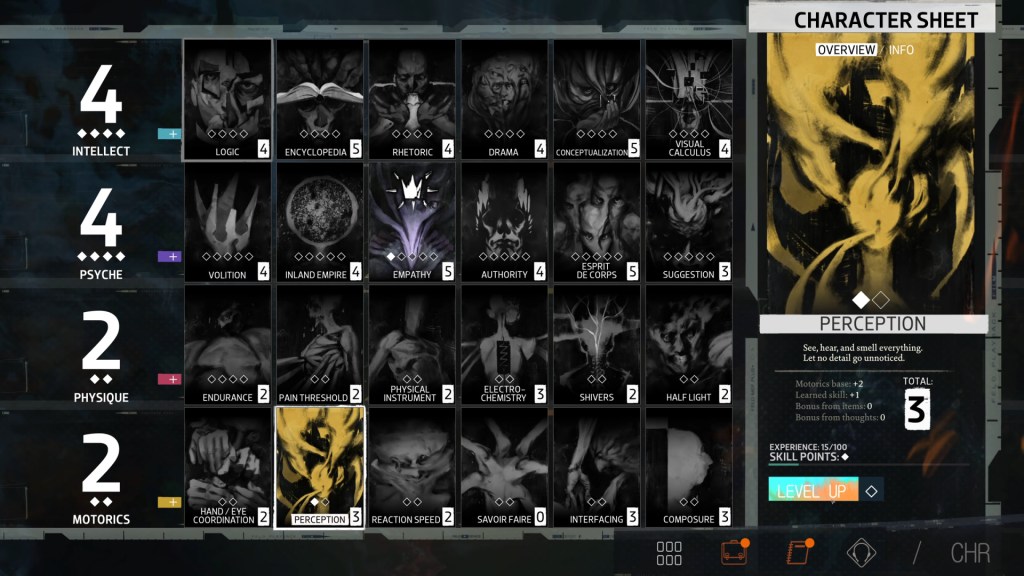
Have you played Disco Elysium from the much lamented Za/um studio, dear reader? It’s one of those seminal, cult-classic games that shifted my thinking on what video games could be. It’s a mystery game but, is it, really? Even if it is, is the mystery the one presented? Is the goal to find out who killed that guy hanging from the tree in the yard behind the Whirling-in-Rags? I suppose it is, but only up to a point. When playing it, you quickly meet and pass that point, much to the frustration of your ever-suffering partner, Kim Kitsuragi. Psychologically freed of the mundane requirements of your character’s job as a police detective, you can finally get to work on the real mystery; finding yourself. In many ways, the game is a protracted character creation session. You have to do everything from defining his political and romantic persuasions, coming to understand his opinions on art, exploring his relationship with vices of all kinds to just figuring out his name. How does the game handle these revelations? Well, largely through the personification of various aspects of your Detective’s personality. These take the form of his stats, Intellect, Psyche, Fysique and Motorics and the various skills associated with them. They speak to you, often in deranged or idiosyncratic voices representative of their own, niche fragment of his personality, and try to get you to look at the world from their highly rarified perspective or to act based on it.

It’s a unique game. It’s also a unique experience that left me with so many interesting thoughts and questions. One such question was, could you make a TTRPG out of this? The answer is, you can certainly try.

After the Mind…

The Character Sheet screen from Disco Elysium. It shows each of the four main stats, Intellect, Psyche, Physique and Motorics and all of the skills that are associated with them in a grid on a black screen with white text.
The Character Sheet screen from Disco Elysium. The TTRPG stats are not as complicated as this.

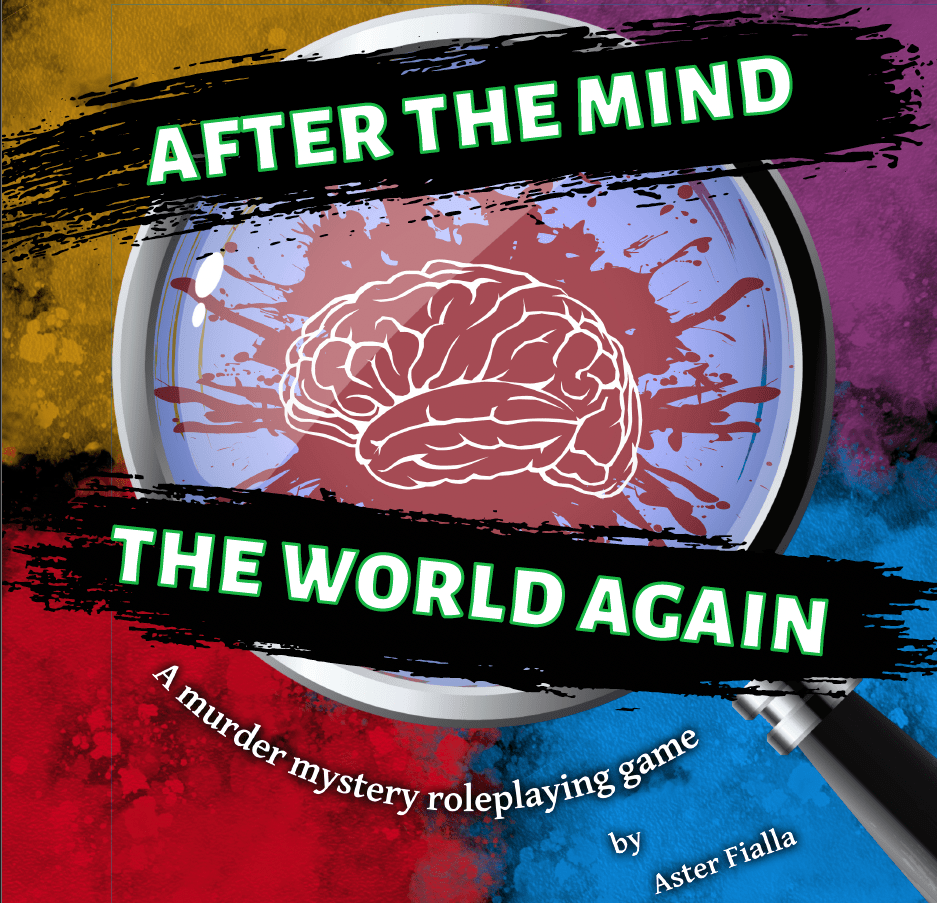
Last night, I got together with four other members of Tables and Tales to play a session of After the Mind the World Again by Aster Fialla. The front cover of the game uses the tagline, ‘A murder mystery role-playing game.’ This is not an inaccurate description. However, I feel like the subheading on the next page is getting closer to the facts:

A Disco Elysium-inspired murder mystery TTRPG about a
detective and the voices in his head

In this TTRPG, the inspiration comes not from the fascinating world or the city of Revachol, it doesn’t come from the richly drawn characters of the video game, or even its ubiquitous politics. It comes, instead, from the essentials of the gameplay. In other words, the shit that’s going on in the Detective’s head and how it affects the world around him. You see, this is a GMful game that requires five people exactly, one of which is the lone player with the other four acting as GMs. Each GM represents one of the four stats from Disco Elysium, Intellect, Psyche, Fysique and Motorics. They are collectively referred to as the Facets. One of their responsibilities is to describe various features of the world the Detective moves through. Intellect has responsibility for nerdy people, art pieces, journals, etc. Meanwhile, Fysique gets stuff like buildings, a good strong state, and brawny folks.

At the start of the game, the player comes up with a name, pronouns and presentation for their Detective, as well as their role (they might not be a cop, but a PI or an insurance adjuster or something else.) Each of the Facets also gets a turn here, though. Psyche gets to describe the Detective’s face, while Motorics comes up with aspects of their style and an unusual object in their possession, for instance. I found this very fun, as did everyone else at the table, I think. I even commented that having others make your character for you in other RPGs could be just as fun!

Once that’s done, each of the Facets answers a couple of questions designed to form a baseline for their relationships with other Facets at the table. After the Mind the World Again is Powered by the Apocalypse, so this sort of character building question should be familiar to anyone who has played a game like that before.

Then they get started making the Neighbourhood. You go around the table, starting with the person who most recently played Disco Elysium, and get everyone to answer one of the five questions presented in the book that should give you an idea of the type of area this murder has taken place in.

Once you’re done with that, the Detective tells us a little about the victim and then each of the Facets introduces a piece of evidence from the crime scene. Intellect tells us about any Prior knowledge that’s relevant to the situation, Psyche describes a Person of Interest at the scene, Fysique comes up with a Landmark, in this case, where the murder occurred, and Motorics gets to reveal a clue, something tangible at the scene.

From that point, the Detective starts the investigation, describing what they are doing in the fiction, triggering particular Moves, using the Facets’ stats to make rolls and making Deductions in an effort to solve the murder. This is in line with the Detective’s Agenda:

  1. Explore the world to its fullest.
  2. Make the most of your Facets.
  3. Play to find out the truth.

This is complicated by the fact that each of the Facets wants the Detective to act in different ways, offering sometimes conflicting options and sabotaging each-others’ efforts as they try to have the greater influence on the sleuth and the investigation. Facets’ stats can be boosted or reduced in various ways, often by the actions of the other Facets. Its important to note that the Facets’ Agenda is not focused on solving the murder, rather than constructing an interesting experience:

  1. Create an intriguing world for The Detective to explore.
  2. Highlight the differences between the Facets.
  3. Play to find out what happens.

The Detective investigates, and the Facets Declare Evidence as particular features are described in the world. It’s up to the Detective to combine two pieces of evidence to Make a Deduction. When it comes to that point, they ask the Facets for explanations as to how they fit together. Whichever Facet’s explanation is chosen is the truth and the Facet gets a +1 to their stat, while also getting the opportunity to reduce the stat of another Facet by the same amount.

The investigation is structured into a Deduction Pyramid, which is split into four tiers. On the bottom tier, there should be eight pieces of evidence. These should be combined when the Detective Makes a Deduction so that, you end up with four Minor Deductions on the next tier up. These Minor Deductions should then be combined to come up with two Major Deductions on the penultimate tier. Finally, those Majors need to be combined to come up with the Solution to the murder, sitting right there at the top of the Pyramid.

There are several other mechanics in the game, including one to ensure that the Detective does not simply always choose the explanation of the same Facet all the time, which is clever. A Facet’s stat cannot go above +3 or below -1. If that does happen, the Facet gives the Detective a Condition and goes back to the default value of 1.

…the World Again

A screenshot of the aftermath of the Detective from Disco Elysium punching a twelve year old kid. The scene is in the yard of the Whirling in Rags hostel. A man in a green jacket and yellow flares stands over a prone kid who he just punched. Kim Kitsuragi, dressed in an orange jacket and brown baggy, tapered trousers looks on.
A screenshot of the aftermath of the Detective from Disco Elysium punching a twelve year old kid.

None of us had ever played a game quite like this one before. Obviously, some of us had played PBTA games in the past, so the mechanics were nothing frighteningly new. At points, I even felt echoes of a game of Avery Adler’s The Quiet Year that most of us played last year as we took turns describing the world around our Detective. That Detective was an amateur sleuth named Bruce with a fabulous moustache, a flight jacket, an obsession with whiskey and a curious ability to identify any wooden model aircraft he might come across.

But, sharing GMing duties with three others at the table is a unique and sort of chaotic experience. At the start, it’s actually a little difficult to get into gear. I was playing Motorics and I found I had to be constantly checking my playbook sheet to remind myself what features of the world were within my domain, what my GM Moves were and when I should use them. There are features in there that you might not expect so you have to watch it and you can’t use your GM Moves just whenever. Since all four of us Facets were feeling like this, it kind of stuttered into life as a session, once the character creation bit and the initial set-up of the mystery were done. Meanwhile, Bruce, played ably by relative TTRPG noob, Jude, had to come to terms with the fact that, when it came to any of the really important decisions, he had to give up control and ask the Facets for options before settling on one version of the truth or selecting a course of action.

As we got into the flow of it, though, and as some of us became more lubricated by the liberal application of fine Spanish lager, we found the conversation that was the game began to come much more instinctively. We were interacting with the mechanics and deliberately fucking each other over for stat points, while Bruce began to explore the small, dead silent village of Battersfield and investigate the murder of local baker, Barbara Devons. Evidence has been declared in abundance and two deductions have been made! Bruce managed to finally make it out of the Bakery to explore the office, the bare flour cellar and even the gay bar across the road. Unfortunately, we had to leave the case unsolved after the four hour session. Hopefully we’ll be able to pick the trail back up again soon.

We ended up having a really fun time with After the Mind the World again. The stand out scene for me was when Bruce was interrogating Jenny at the crime scene and all four GMs jumped in to answer in particular ways that they thought reflected their own domain within the one NPC. It worked surprisingly well, even though I’m not sure that’s how it’s supposed to work at all.

I would say that there is no way to play a full investigation in a single three hour session without rushing through scenes and maintaining the sort of laser-focus that Harry Dubois does not exemplify in any way. The character creation and making the mystery section took over an hour alone before Bruce ever rolled a die in anger. If you’re going to give it a go, plan it for two sessions.

Do you think you would like to give this game a try, dear reader? Or would you rather go back to Martinaise and collect some tare in a plastic bag while pondering that old wall again?

One-shots

The campaign for one-shots

I mentioned in my last post that there is nothing I enjoy more than the development and advancement of a character. In D&D terms, I’m talking about levelling up, of course, but most games have some mechanic that allows characters to improve in a tangible way. You might get to pick a new advance, or a new ability or you might just get a few percentage points added to a skill. Normally, taken on their own, these are incremental and not earth-shaking in their effect on the character or the game. But when taken as a whole from the point of a character’s creation to the end of their adventures, they are often massive. More-so in some games than others, but always very noticeable (unless you’re playing something really lethal like a DCC funnel.) I do like to see my characters improve like this but in recent months I have been struck by how advancement is not necessarily the object of the exercise for me, it’s actually just change. You might need a longer campaign to give characters an opportunity to level up, but you don’t necessarily need one to change them. A one-shot can do that quite admirably, thank you!

If you remove the necessity for advancement and replace it with the necessity for change in PCs you can make it far more immediate. Horror games make great one-shots for this reason. So many of them involve some sort of sanity mechanic, meaning you have to change the way you play your character or else the character’s interaction with the world and the fiction is altered when they start to lose their grip. Other games introduce physical mutations from exposure to powerful forces. Still others have temporary effects that afflict or bless characters from the use of their own abilities. What I have discovered over the last while is that a successful one-shot will often involve leaning into one or all of these options, or other types of changes that I haven’t listed above.

Is this why players sign up for a one-shot game? Maybe not. Probably not, in fact. For me? I usually sign up to try out a game I have never played before, or a scenario I have never played before. Honestly, I rarely know enough about a game before I go into it to know whether or not it will involve any real character change in such a short format. But those that do it? Those ones live long in the memory.

Alien Dark

I’m immediately cheating by referencing a two-shot, but let’s not split hairs, eh?

Alien Dark was the first game I ever took part in as a member of the Open Hearth gaming community. Alun, the writer of this nasty and wonderful little game was our GM. Now, there’s a mechanic in this game that allows the GM to accrue Danger. They can then use that to just completely fuck your character over with Aliens, both physically and psychologically. This is something that has a tendency to leave you in Bill Paxton levels of panic real fast. And if you’re panicking, just imagine how your poor character feels.

Well, actually, there’s no need to tax your imagination, dear reader, I can tell you. You see, my character, Benny Doyle, a ne’er-do-well with a substance abuse problem, was really piling on the stress points. Within the fiction of the game, you are required to write a short line describing the effect of the increasing mental distress on your character. Benny got nuts. He went from meek and afraid and hiding behind the other PCs to roaring about needing GUNS and going, quite literally, toe-to-toe with an Alien. Man that was fun. Like, I just enjoyed this poor lad’s descent into drug-fuelled madness so much. And it didn’t happen all at once either, I got to draw it out, as Alun ramped up the tension and the Danger, over the course of one and a half sessions or so.

This is the sort of change I’m talking about.

Death in Space

Here’s another example, which, in the moment of typing this, oh, gentle blog-goggler, I just realised was also a two shot in the end. It had been designed as a one shot but sometimes, just sometimes, your players have too much fun creating their damn characters and your one shot divides, much like an amoeba, into two separate but equally awesome wholes.
Death in Space is a game by the Stockholm Kartel. It’s an OSR game of space horror, which, even at the best of times, I would imagine has a pretty high mortality rate. As a disclaimer, I have only ever run this game this one time so I can’t confirm that.

Anyway, I wrote this short scenario with inspiration from a couple of locations and NPCs from the core book. The idea was that the PCs visited this space station which orbited the ruins of a destroyed planet. They explore the claustrophobic, jungle like environment on this station and interact with the denizens, a void cult led by a grotesquely mutated woman.

Then I get them to roll some checks. With every roll they fail on the station they build up void points, which they can spend to do cool stuff. But when they do that, they open themselves up to the possibility of void corruptions. The Death in Space core book has a Void Corruption table. Here are some samples of the shit my players’ characters were inflicted with:

“Another you starts growing on you. The twin clone is fully grown and detaches after 1d20 days. It has its own will and purpose, decided by the referee.”

“A part of your body becomes shrouded in a cloud of darkness.”

“Flies and other insects crawl out of your body when you sleep. A small cloud of them surrounds you. Their buzzing is a constant static.” (Actually, since this was a one-shot, I made it so the flies just popped out all the time. Much more effective.)

I adjusted the rules slightly to make corruption more likely and, you know what? My players loved being corrupted! Their characters were going through intense and horrific changes while also learning more about themselves as they were tested psychologically.

Now, go play a one shot and corrupt some PCs!

Also, go and buy Alien Dark on itch.io; it’s PWYW! And Death in Space from here. It costs a specific amount of money but it’s a good game and a gorgeous product.