Hex-jammer

Messin’ with 5E

I’m sure those of you who have been around for a while are aware of how much I enjoy mucking around with my D&D campaign. It is a Spelljammer campaign of the 5E variety and it has been running for quite some time. About 25 sessions, I think. That makes it one of the longest running campaigns I have ever had. That’s probably what makes me want to keep messing with it. A while ago, I introduced the very FitD idea of Engagement rolls before big jobs/dungeons and that has worked pretty well. I also brought in the adversity token, which have come in handy for our heroes in a few clutch moments, let me tell you!

1E Throwback

This post is not so much introducing yet another rules hack or even anything home-brew. It’s more about utilising a style of play that went out of fashion in D&D a long time ago. Hexcrawling! A couple of the oldest D&D publications I own are from AD&D 1st Edition. One of those is UK5 Eye of the Serpent, written by Graeme Morris and released in 1984. This was designed for one DM and one PC! Specifically, it was made to be the first adventure for a druid, ranger or monk character. This is besides the point. I just thought it was unusual. Also, it reminds me of a Troika! adventure I just read, The Hand of God, mainly because it starts much the same way, with the characters being abducted by a powerful winged creature and dumped in their nest at the top of something very, very high up.

Anyway, the point is the hex map of the outdoor region, Hardway Mountain (the name of which, I think we can all agree, is a little on the nose.) Now, the use of this map was incredibly restricted in the text. If your PC was playing a druid, not only did they have to have a prescribed set of three NPCs with them, they should also be forced to take a particular selection of the marked “routings.” These would be distinct from the routings a ranger or monk character would be forced down. You can see this laid out in the unfeasibly complicated two-page spread below.

Now, I think this is really interesting in comparison to what you might deem a hexcrawl style game today. I think most OSR games that use a hex map are thinking along the lines of open-world or sandbox play where you go to a certain hex on the map to explore, with the understanding that the whole thing will be open to your PCs. There might be geographical or other obstacles they have to overcome but that’s up to them, they can either try them out or forget about them.

When it comes to encounters, places of interest, etc. a lot of the time these will be generated randomly and the GM is discovering along with the players in many cases. Even if the GM is the one who came up with the encounter table they’re rolling on, they are not to know what the roll will turn up in the moment or what the PCs will do with them! I realise I am probably teaching my grandmother to suck eggs here, but I want to point out that, although the hexcrawl is a pretty old school style, it wasn’t always necessarily as free a style as it is generally taken to be today.

One last thing. That Eye of the Serpent module has some fantastic art by Tim Sell. Just check these out.

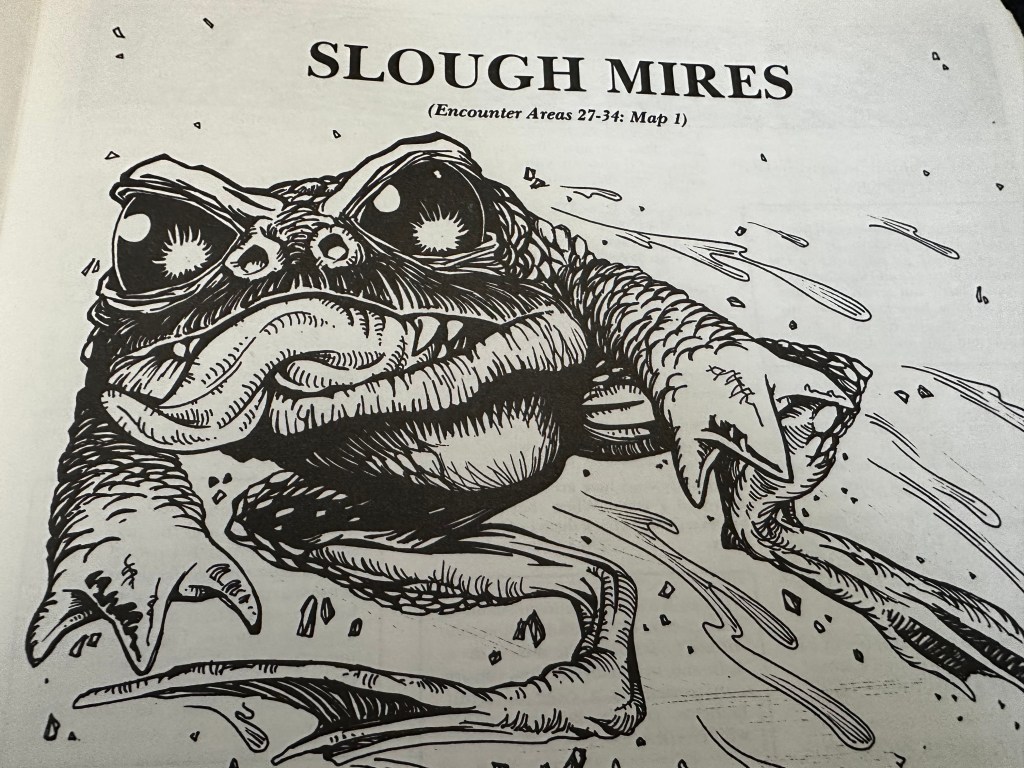
Hexing the Rock

The Spelljammer campaign may have gotten a bit bogged down on the Rock of Bral. Why? Is it because it is the only location described at all in the Spelljammer 5E set? Maybe. Is it because all the plot threads of the campaign led there? Partly. Is it because it takes a life age of the earth to get through a round of 5E combat? That’s a distinct possibility. Anyway, the crew have spent a lot of time exploring, murdering, stealing, negotiating, shopping, drinking and dating on the topside of the Rock already. But one of them has had a literal ooze-heart pulling them to the underside since they got there and they finally made it down. Now, to get them there, I invented a little something I like to call the Shaft of Bral. Stop sniggering! It is a shaft of pure void half a mile wide through which you can reach not just the top and under sides of the Rock but everything in between too. So they took a little row-boat called a spell-rudder down to the bottom and now they are crawling through the hexes underneath. I threw a few random encounters at them on the way down as well. I invented a few encounters for the Shaft of Bral and put them in a d6 table. I got the players to roll for those and they had fun getting hit by another spell-rudder in a hit-and-run and avoiding the sickly air of a boat full of corpses on their way down.

So far, using the encounter table in Boo’s Astral Menagerie (the Spelljammer Monster Manual,) I have been unimpressed. The first time I used it they got an encounter with a ship of aggressive Vampirates. Then there was a fight that lasted three full sessions. It wasn’t all bad, it just derailed things in a less than ideal way. So, I thought I would just make my own encounter tables from now on.
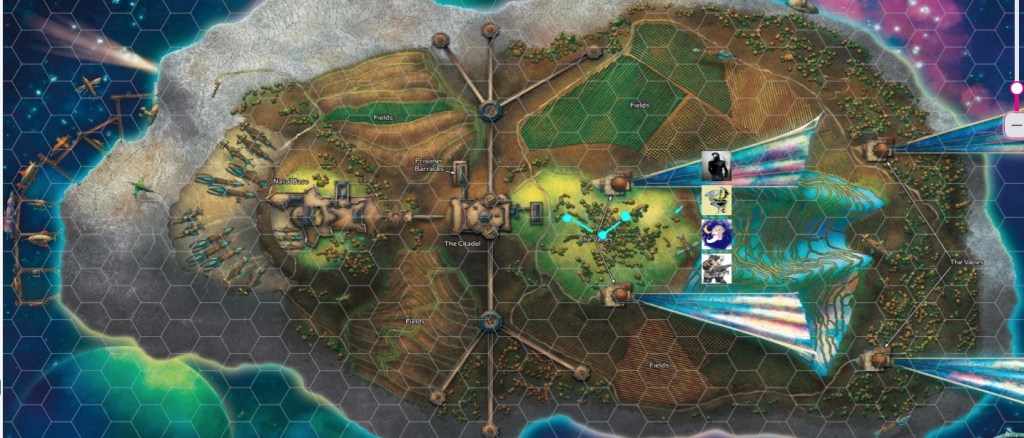
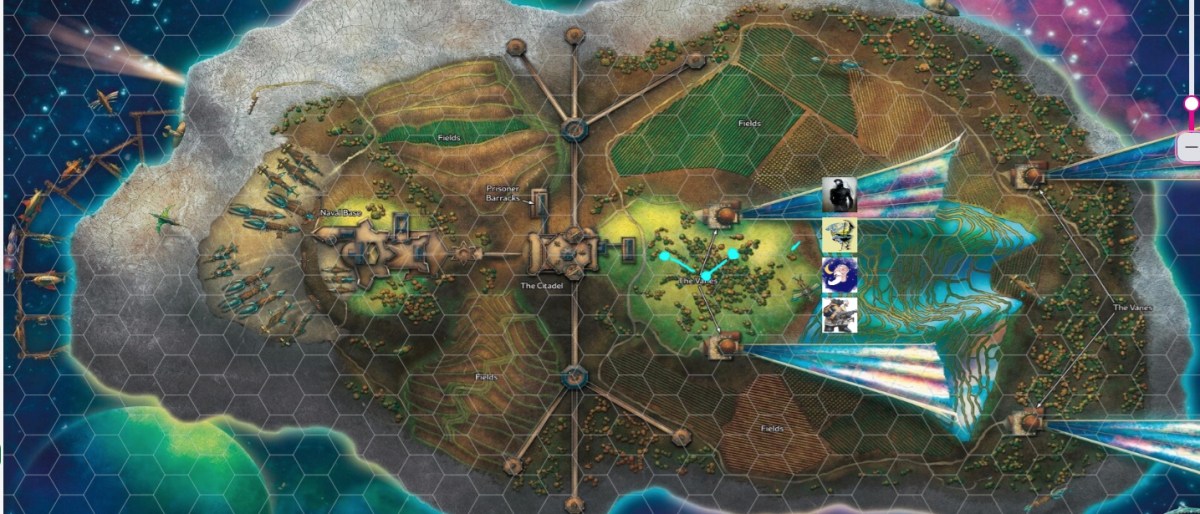
Once they were finally on the Underside of the Rock, I had to think about how I was going to handle it. It is a very large area, made up largely of farmland and forest and they were there to find one wee gnome. I could have just given them directions, but I wanted it to feel like they were exploring and finding their own way, so I took the map of the Underside of Bral and popped it into Roll 20. We are playing this game online so this worked out well. Then I set the map layer to have a hex grid, instead of the standard square one. Now, as they travel, each time they pass from one hex to another, we roll for an encounter. Some of these encounters are designed to beneficial, some are quite the opposite and others are what they make of them. They have been using their own skills, abilities and traits to push on towards their goals while getting the impression of uncovering things about this place as they move through it. I’m not sure how the creators of this version of the Rock imagined people using this map. Maybe this is exactly what they thought we would do! But, I doubt it. It doesn’t feel as though any thought went into that, in fact. As it is with so many recent D&D 5E products, you are given the bare minimum and expected to figure the rest out for yourself. Even a little advice to go along with the map would have been useful. I mean, even Eye of the Serpent did that in 1984.

Anyway, the last session we had was one of these hex crawl sessions and I can’t remember a funnier time. Genuinely laughed the whole way through. Now, I am incredibly loathe to take any credit for that. It was entirely the hilarious antics of the fantastic players I am blessed with. A couple of highlights:

  • Our Giff Charisma-Fighter/Paladin climbing a tree to hide from a patrol with his trousers ‘round his ankles because he thought his hairy grey arse-cheeks would help disguise him as a bunch of coconuts (didn’t work, it was an oak tree.)
  • Encountering a bunch of Hadozee who were on the run from the nearby prison but didn’t know how to escape the Underside. The party told them all about the secret hatch in that stump over there which led to the Shaft of Bral. What’s that? Do we have a boat there? Yep! On, ok, bye then! Good luck in the shaft!
  • Herbert Gũsfacher, ornithologist, the latest identity adopted by the party’s resident illusionist, Balthazar.
  • Gary, Son of Gary. Oh, are you based in the Garrison, Mr Gary-son? No, the Citadel, actually.

Anyway, these random encounters did help along the good times and, I hope, gave the players a sense of active exploration. They haven’t found what they were looking for yet (it’s Eccta, the plasmoid Mum) So I can’t go into any detail about what is in store but I will be using a lot more of my own home made hexcrawls and random encounter tables, that’s for sure.

Festive one-shot

Celebrate

It’s almost that time of year again, everyone’s favourite holiday where we all dress up as our favourite characters and talk funny. That’s right! Talk Like a Pirate Day is fast approaching! It falls on September 19th, as I am sure you all know. As is traditional, we’ll all be renting a parrot, donning an eyepatch, practicing our “yaaaar” and contracting scurvy to commemorate the joy and wonder brought to the world by that most under-rated of historical figures, the lowly pirate.

As well as that, this year, I thought it would be fun to run a pirate themed one-shot. Since an RPG named Pirate Borg exists, it seemed like the notions of a landlubber to choose any other game to use for the occasion.

There has been an unsettling number of Borgs released over the past number of years, certainly more than enough to make Jean-Luc Picard lose his temper. It can be hard to see the hacks as anything other than cashing in, however, and I will confess to thinking that way myself. But I hear very good things about Cy-Borg and Pirate Borg has been a pleasant surprise as I read through it. It is genuinely more fun and more entertaining than I was expecting. The art, design and layout are good and the vibe is perfect if you are looking for a horror pirate game.

I have really only just gotten into the character creation section so I thought I would do another character creation post! Everybody loves those, right?

Random pirate

I’m gonna roll for everything as is traditional around here. Luckily, this game is well set up to allow for that.

Here’s the step by step guide provided on page 27 of the core book:

A photo of the table from the Pirate Borg core book that illustrates the 5 steps to Create a Player Character (PC.)

Random tables

So, when it says to roll on the tables on this page, this is what it means:

  • Container table (d6) I rolled a 6! That means I get a friggin’ dinghy! Good start.
  • Cheap gear table (d12) Got a 4. That’s a shovel. Should be useful for digging up buried treasure or my own grave.
  • Fancy gear table (d12) 9 on a d12 = a worn out book. I imagine it to be the well-thumbed guide to the manners of the gentry in Paris and London 50 years ago.

Random scores

A pirate has 5 abilities, Strength, Agility, Presence, Toughness, Spirit. You roll 3d6 for each one and consult another table to determine what your score is. Here we go!

  • Strength: I rolled an 8 so that gives me a -1 (it could be worse)
  • Agility: That’s a 7, which is also a -1 (a pattern is forming)
  • Presence: 12! Phew! That makes the score an incredible 0!
  • Toughness: 6. Shit. That’s -2. This pirate is not an olympic athlete
  • Spirit: 10. OK, OK. That’s also a score of 0.
    Things might start to look up as I move on to a

Random class

You can choose to be a landlubber if you don’t want to take one of the 6 standard or two optional classes. But half the fun of this exercise is rolling everything up, I’m going to roll a d8 and take whatever class it gives me. In this case, I am including the optional classes.

Here are a list of the classes:

  1. Brute
  2. Rapscallion
  3. Buccaneer
  4. Swashbuckler
  5. Zealot
  6. Sorcerer
  7. Haunted Soul – there is another d6 roll here to decide the type of supernatural entity you might be. Includes vampire, zombie, skeleton. All the classics
  8. Tall Tale – if you get this one, you roll another d6 to determine what sort of tall tale your character is
    1-2. Merfolk
    3-4. Aquatic Mutant – this gets broken down even further. Lots of potential mutants out there, folks. If I roll this up, I’ll have to roll another d8 to find out which type of mutant I’ll be. Suffice it to state, Anglerfish is an option
    5-6. Sentient Animal – this one will involve another d6 roll to decide what animal my pirate is going to be…

Well, I rolled a 3. That means my character is going to be a Buccaneer.

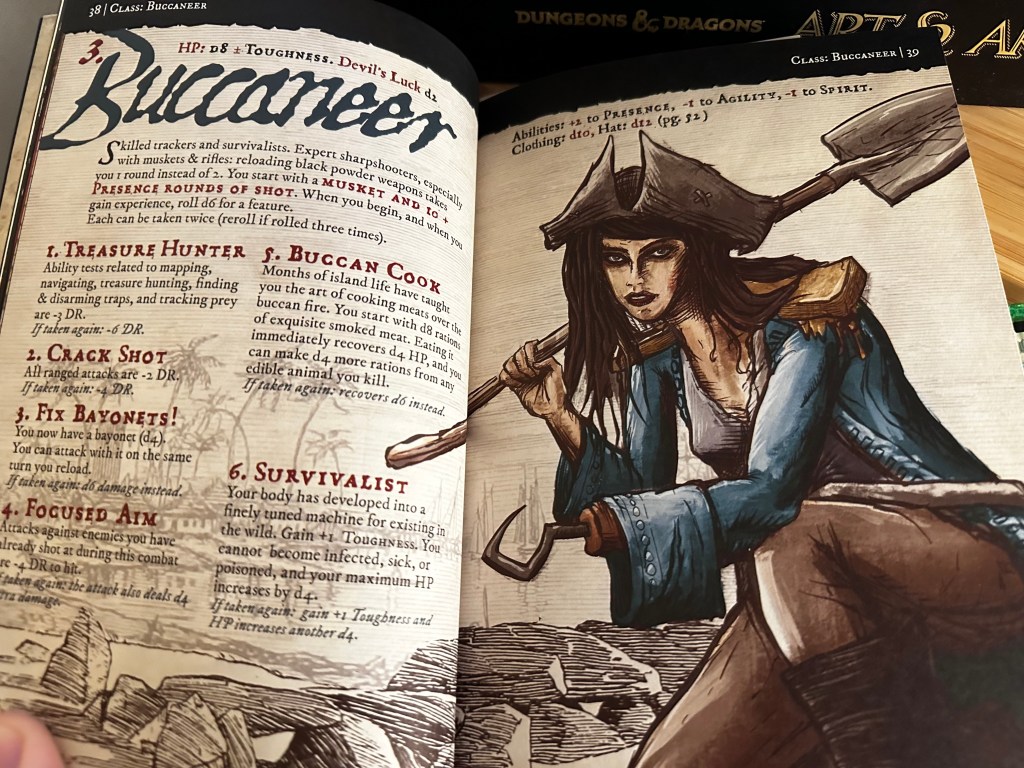
Skilled trackers and survivalists. Expert sharpshooters, especially with muskets and rifles

Buccaneers get a +2 to Presence, a -1 to Agility and a -1 to Spirit.
So that makes my Ability Scores:

  • Strength: -1
  • Agility: -2
  • Presence: +2
  • Toughness: -2
  • Spirit: -1
A photo of the two-page spread for the Buccaneer class in the Pirate Borg core book. The illustration on the second page shows a femme person wearing pirate gardb, including a tricorm hat. They have a hook instrad of a left hand and have a spade slung over the right shoulder.

For a Buccaneer, reloading a black powder weapon only takes one round instead of the usual two. I guess the hope is that you are far enough away from the bad guys that you have a round before they kill you or that they don’t have ranged weapons themselves.
I also start with a Musket and 10 + Presence rounds of shot. So that would be 12, then!

Random feature

I am going to now roll a d6 for my class feature. You do this when you first begin and then again each time you gain experience. Each feature can be taken twice, or so it says here in this book.

I rolled a 2! That is the feature, Crack Shot. That reduces the Difficulty Rating (DR) of all ranged attacks by 2. That’s pretty great actually. If taken again, the feature reduces that DR by another 2 points.

Random hit points

A Buccaneer gets to roll a d8 for hit points and add (or, in my case, subtract) my Toughness. Looks like d8 is the most common die for HP across the classes. I rolled a 7 so that leaves me with 5 HP. I am pleasantly surprised!

Random clothing and hat!

Now we’re on to the really important shit.
Buccaneers get to roll a d10 on the clothing table. The options range from Tier 0 rags to Tier 3 conquistador plate!

I rolled a frigging 10!! That’s the conquistador plate! -d6 damage. But it does add 4 to the DR for all agility tests and 2 to all defence test DRs. Also, the text goes out of its way to tell you you’re going to drown if you end up in the water…

Now for Hat! Have to roll a d12 for this.
You can get anything from “none” to “morion” on a d12.
I got a 6, bandanna, which I find acceptably piratical.

Random… Luck

A photo of the Devil's Luck page of the Pirate Borg core book. It shows an upsidedown five-pointed star with text describing the ways you can use a PC's Devil's Luck points in each of the five points and a pirate's skull in the middle. You can tell it belongs to a pirate because of the eyepatch over the left eye.
A photo of the Devil’s Luck page of the Pirate Borg core book. It shows an upsidedown five-pointed star with text describing the ways you can use a PC’s Devil’s Luck points in each of the five points and a pirate’s skull in the middle. You can tell it belongs to a pirate because of the eyepatch over the left eye.

Devil’s Luck is a resource that your character can use in Pirate Borg for the purposes of dealing max damage with an attack, lowering the damage done to you by d6, rerolling any die, neutralising a crit/fumble or lowering a test’s DR by 4. So it works like Omens in Mõrk Borg, basically.

Your class determines what you roll for your starting Devil’s Luck. The Buccaneer gets d2. For my purposes, I plucked the first die out of my dice bag and it turned out to be a glittery, turquoise d6. I rolled a 6! So that means I get 2 Devil’s Luck. Not too shabby, but not too great really, eh?

Random background

The next thing the step by step guide says to do is roll on the tables on pages 55 to 61. The first of those is a d100 table of backgrounds. These are more than just back story. They also determine your starting money and provide you with something significant like items, important NPCs and motivations.

I rolled a 97! That gives my pirate the “victim” background. That’s broad but might give me a spark for my actual backstory. It also gives me 2d6 x10 silver pieces and a haunted past (obvs.)

I rolled a 7 on my 2d6 so that’s 70 silver to begin. Along with the 200 I am likely to get for the conquistador armour, this buccaneer will be laughing all the way to the X.

Random flaw

Page 56 has the Distinctive Flaws table. It’s a d20 table of generally one-word personality traits. Some of these are only subjectively to be considered flaws in my opinion. I rolled a 9 and got “aggressive.” I would imagine that that is considered a good trait for a pirate in many situations. I’ll take it!

Equally, “2. Stubborn,” “6. Coward,” and “17. Paranoid” might all be considered beneficial to people in the pirating business at least some of the time.

Random trademark

I am rolling here for a Physical Trademark, rather than some sort of copyright or patent type deal. That would be a weird thing to include in the character creation section of a pirate game.

Another d20, here we go!
I rolled a 5… shit, I’m missing a hand; hook or claw instead. I’m thinking claw? Might be easier to handle my gun that way. Importantly, there is nothing in here about this causing any sort of mechanical drawback to your character, which I like.

Random idiosyncrasy

The full title of the table on page 58 is:

Idiosyncrasies one might have developed and will certainly never be rid of…Yet that certainly won’t stop you from trying.

It’s another d20 table. I have been using a different die for every single roll and I don’t see a reason to stop that now. It has been serving me semi-well thus far after all.
That’s a 12. Now this result might very well feed into the victim background I rolled up earlier:

You wronged and infamous pirate lord

I am beginning to think that the two are connected. My Buccaneer’s cat, Milly, tore out the throat of Captain Tall John Copper’s parrot, Butch. Milly jumped from the gunwale and swiped the emaciated bird off the shoulder of the famously bad-tempered pirate captain who had had men flayed alive and keel-hauled for less. As some sort of poetic justice, he made my pirate cook and eat poor Milly while the whole crew looked on, and then he chopped my hand off.

Random incidents

A photo of the Unfortunate Incidents & Conditions table from the Pirate Borg core book.  It includes a black and white illustration of an overloaded lifeboat on rough seas surrounded by debris and a d20 table beneath that.
A photo of the Unfortunate Incidents & Conditions table from the Pirate Borg core book. It includes a black and white illustration of an overloaded lifeboat on rough seas surrounded by debris and a d20 table beneath that.

This one has an incredibly long full title as well:

Unfortunate incidents & conditions having occurred or developed with or without one’s express consent, desire knowledge or general understanding

Guess what! It’s another d20 table. I rolled a 9 on this table. The result is unfortunate:

Your last crew was killed by undead. They left you alive on purpose

Shit. I hope my new crew doesn’t learn of this…
I am thinking that I made a deal with a necromancer to send his vitality-challenged minions to do in Captain Tall John Copper but they got a bit enthusiastic and did the whole ship instead, leaving me to take a dinghy (call back to the first roll of the character creation process!) to the nearest port and find some new gainful employment.

Random things

The last table in the list stretches right across from page 60 to page 61. It is entitled “Thing of Importance.” It is another d100 table.

I rolled a 79:

A long scar on your face

I think it is only fair that Milly gave me that just before I popped her in the stock pot.

Random name

There is only one thing left to do as part of this process, and that is the all important name. Now there is a table for names on the inside cover of the book so I think I will use that. It is a d12 table with three columns. I shall roll a d12 3 times and combine the names as I see fit:

Roll the first: 7 – Sam(uel) or Butch(er) or Philip
Roll the second: 3 – Robert(s) or Jack or Fernando
Roll the third: 11 – Genny or Isabel(la) or Jean

I imagine the name Butcher came from the Milly incident. It should go in the middle. So, it’s Isabella “Butcher” Fernando. That’s a bloody good pirate name if I do say so myself.

Random conclusion

Not really.
I thoroughly enjoyed the process of making his character. I am used, in more recent games of Mõrk Borg, to using their Skum Birther site to come up with a random character and that can be fun too, although I do think, when you are that far-removed from the process, you don’t have that strong an attachment to them. So, spending the time rolling up this pirate with you, dear reader, has been rewarding and has taught me quite a bit about the game as well. And that, after all, was the whole point of the exercise.

Have you played Pirate Borg, dear reader? Will you be celebrating Talk Like a Pirate Day this year? If so, what will you be doing for it?

Trophy Gold – Character Creation

Old school play, new school rules

I have a post in which I write a little about a couple of the podcasts that most inspire me to play and write about RPGs. One of them is Fear of a Black Dragon from the Gauntlet. In it, Tom and Jason review a different OSR module each episode (more-or-less.) What I discovered early on, while listening to it was that they often did not use OSR rulesets to play the modules. Instead, they usually used Dungeon World, World of Dungeons or Trophy Gold. These are much more modern RPGs and, I think, they tend to use Powered by the Apocalypse and Forged in the Dark style rules. I have only just picked up Trophy Gold in the Codex-Gold magazine published by the Gauntlet back in 2019. So, I thought I would have a go at creating a character in this much more rules-lite game (compared to OSE anyway. To see how character creation went in that, go take a look at yesterday’s post.)

About the game

Essentially, Trophy Gold is doing the same stuff as Old School Essentials or D&D for that matter. It allows you to play an adventurer or treasure seeker who is drawn to dangerous, forbidden or haunted locales. The locales will push back. Unlike its predecessors, Trophy and Trophy Dark, which were made to play one-shots and tended towards the horror genre, Gold is more geared towards campaign play. It just doesn’t worry so much about your encumbrance or confuse you with bonuses that are actually negatives. It uses elements of Forged in the Dark games in its ruleset. It is described thus in the opening paragraph:
“Trophy Gold is a collaborative storytelling game about a group of treasure-hunters on an expedition to a haunted environment that doesn’t want them there.”

Character creation

So your character is called a Treasure Hunter in this game. This is because treasure is the aim of it. Your character is there to emerge from the dungeon or forest or ruins with heaps of Gold. But is it worth it? Will they even survive it?

A blank Trophy Gold character sheet from Codex Gold magazine, 2019, The Gauntlet.

Step 1 – Choose your Name, Occupation and Background

So, in direct opposition to OSE, we are starting with our name. I like this since, we all get named long before we know anything about ourselves, don’t we? The rules include tables for names, occupations (what you do in the party) and backgrounds (what you did before your treasure hunting days) So I am going to use them.

  • Name: Valen
  • Occupation: Smuggler. Skilled in dexterity, spontaneity, stealth
  • Background: Retired Soldier. Skilled in tactics.

The rules encourage you to think about your background profession, why you left it and why you can’t go back. As a retired soldier, I think Valen has tired of killing at the behest of others. He left to put his skills to work for his own enrichment instead. He could never go back to taking orders now that he has tasted independence.

Step 2 – Choose your Drive

This aspect has an element of Blades in the Dark peeking through. Each character will have their own motivation for treasure seeking and I am going to roll on a table for it. But first it explains that you can stash the gold you earn from it in your Hoard. Once you get to 100GP, you can retire your treasure hunter. Blades in the Dark has a similar conceit where you get to hide away your coin in a stash until you have enough to comfortably get out of the game for good.
So, here’s my roll:

  • Drive: Free the serfs of Bandung Prefecture

So, I don’t know where Bandung Prefecture is but it has fired my imagination. Perhaps my ex-soldier, while on a recent excursion to Bandung, discovered a village where the people were down-trodden and despairing due to the conditions caused by their lord’s treatment of them. There Valen met a man, a former soldier, who reminded him of himself to such an extent that he felt as though saving him and bringing down the cruel and selfish lord was essential. He just needs some funds to raise a rebellion.

Step 3 – Backpack Equipment and, if desired, Combat Equipment

There is an interesting approach to equipment here. You have three different categories, Backpack, Combat and Found equipment. You can roll on a table to see what your backpack starts with or you can choose from the table if you want stuff that suits your character. Importantly, your backpack starts with three items and three free slots. If and when you need something in a given situation, you check the table of Additional Backpack Equipment presented in the rules, and, if what you need is there, simply say it is occupying one of these slots. Then you write it down and mark off another slot. This reminds me of the loadout rules in blades in the Dark. These state that, when you are going on a score, you decide if you take a light, medium or heavy loadout. This determines how many items you can carry and also how much you stand out. But, importantly, you don’t have to say exactly what your items are until you need them in the fiction.

Anyway, I’m going to roll on the table for my

  • Backpack Equipment: Fishing net woven of silver (!), Bottles, lead (6), Magnet

When it comes to choosing Combat Equipment, there is another rule that comes into play. That is Burdens. You start the game with a Burdens score of 1. That’s the amount of Gold you need to keep yourself on a day-to-day basis in between incursions (that’s what Trophy calls adventures.) However, it increases for every piece of Combat Equipment you choose. It will go up further as you are playing too. What an interesting mechanic this is! Yes, your armour will hale to keep you alive on an incursion but you have to spend money to repair and maintain it. Can you afford that? I like it. But after yesterday’s debate, I am definitely getting Valen some nicer stuff.

  • Combat Equipment:
    • Armour – Breastplate, Helmet
    • Weapons – Crossbow, Dagger

So, I guess that increases my Burdens score to 5.

Step 4 – Choose your Rituals, if any

You don’t have to be a wizard or anything to perform these, all treasure hunters can learn and use rituals, dangerous magic that can perform “miraculous feats.” Now, I can have as many as three Rituals to start, but, it says here that, for each one I know, I must increase my starting Ruin by 1. Let’s see what that means, exactly.
Cryptically, the rules describe Ruin as:
“…how much the world has dug its claws into you, including the physical and mental harm you’ve suffered.”
Similar to Burdens, it starts at 1 but, as stated above, it increases commensurate with the number of Rituals known.

I have no experience playing this game so I don’t know the true consequences of choosing to increase my Ruin like this, but for fun, I’m going to take three random Rituals:

  • Beacon – nearby invisible beings or hidden objects shine with a fiery glow
  • Enliven – give flesh and breath to a human effigy (!)
  • Germinate – compel plants to furious growth

This, I suppose, increases my Ruin score to 4.

Finally, set your Ruin, Burdens and Hoard

Easy.

  • Ruin: 4
  • Burdens: 5
  • Hoard: 0 (this number is always 0 at the start.)

Comparison

It’s possibly unfair to compare this experience with that of making the OSE character yesterday since they are based on two such mechanically different games. But that’s what I am going to do.

Over all, I found that the character I created in the Trophy Gold system was never going to be compared negatively, or indeed, positively, to other characters in the same system. And that is purely because it does not rely on numbers so much. You will have noticed that Valen does not have attribute scores or hit points, for instance. Despite this, the Trophy Gold character is just as unique as the OSE character. It’s just that the differences between my ex-soldier/smuggler are more descriptive than numerical.

You will also have noticed that the character creation process encouraged me to think about the character’s background while making my treasure hunter. I don’t remember this ever coming up in the OSE process.

I did a lot of rolling on tables for this process, which I didn’t foresee when I went into it. In fact, I ended up with altogether more on the character sheet than I expected from such a rules-lite system. But I enjoyed the process and found the details provided by the tables fun and interesting.

One aspect that I liked, though, was that I had to choose the Combat Equipment and Rituals. These directly affected my Burdens and Ruin scores. These are the scores that will have the most impact on the way you play the character. I read on a bit and discovered that, if Valen does not come back from his incursion with Gold equal in value to his Burdens score, he’s done… He is left in penury or sent to the workhouse. As good as dead. Not only that, but, if his Ruin ever reaches 6, he is lost to the darkness, transforming into a monstrosity himself, or he is simply dead. Makes my decision to take three Rituals look a bit foolhardy now, eh?

Conclusion

Anyway, as I said, it is not really fair to compare the two systems. One is deliberate in its devotion to the OSR and its historical roots. It made a character that probably won’t last too long but mainly due to luck. The other is more interested in the story the players tell and the narrative beats produced by the characters created. My treasure hunter also probably won’t last long, but this time it is due to my choices.

Dear reader, do you have any experience playing Trophy Gold? How did you like it?

Old School Essentials – Character Creation

Make an OSE character with me

So, in my last post, I was chatting about the fact that I’ll hopefully be taking part in an Old School Essentials game sometime soon. I thought I would familiarise myself with it by creating a character. Come and join me!

In the Creating a Character section of the OSE Rules Compendium it’s got a step by step guide to rolling up your new character. So I am going to follow that as best I can.

1. Roll Ability Scores

Just 3D6 for each one. No fancy alternative ability score rolling options here! Although there is a subheading here that says the referee might allow you to dump your sub-par character if you have less than 8 in every ability. I should frigging hope so!
Anyway, let’s see what I get:

  • STR 11
  • DEX 7
  • CON 8 (not looking brilliant at this point is it, dear reader?)
  • INT 11
  • WIS 13
  • CHA 14
    OK, it ended up not quite as bad as I feared, but this guy ain’t no Conan.

2. Choose a Class

I have to skip ahead a few pages to choose from the full list of classes. So, the available classes in this basic rules compendium that I have are Cleric, Dwarf, Elf, Fighter, Halfling, Magic-User and Thief. You will notice that some of these classes are races/species/bloodlines/ancestries. That’s taken directly from the basic D&D rules and they decided to stick with it. Now, it is important to note that there are ability score minimums for these classes so, I would imagine, with my less than stellar rolls, I’m going to be locked out of several options straight away.

  • Dwarf: CON 9
  • Elf: INT 9
  • Halfling: CON 9

The other classes do not have requirements, technically, but, let’s be honest, a Thief with a Dexterity score of 7 is going to spend a lot of time in prison.

Each class also has a prime requisite, or a most important ability to put it another way. My highest one is Charisma but, guess what? None of these classes have CHA as a prime requisite! No bards here. So, I think it is clear that I will have to go for the Cleric, which is the only one with Wisdom as a prime requisite, and that is my next highest ability.

3. Adjust Ability Scores

In this step, you can raise your prime requisite by one or more points. You do this by lowering another ability by two points for every one you want to give your prime. The only three abilities you can lower in this way are Strength, Intelligence and Wisdom though, and you can’t lower any below 9. Oof. I don’t think I can afford to lower any of those, really, and I couldn’t adjust Wisdom up high enough to achieve better than the +1 modifier that my 13 already gives me. So, forget it.

Speaking of which.

4. Note Ability Score Modifiers

  • STR 11 No melee modifier and a 2-in-6 chance to Open Doors
  • DEX 7 -1 to AC, Missile Attacks and Initiative
  • CON 8 -1 to Hit Points
  • INT 11 Spoken Languages – Native only, Literate? Yes
  • WIS 13 +1 to Magic Saves
  • CHA 14 +1 to NPC Reactions, Max # Retainers – 5 with a loyalty of 8

Also, as my Prime Requisite, Wisdom, is 13, I get +5% increase to all XP awards. Not bad.

5. Note Attack Values

I did not realise they used THAC0 in this game until just this very moment, dear reader. For the, mercifully, uninitiated, THAC0 stands for “To Hit Armour Class 0 (zero)” and it is represented by a number that you need to get on a d20 roll + your attack modifier, in order to hit an enemy with an AC value of 0, where the lower your AC is, the better. So, this was also the way things worked in the olden days of D&D and AD&D, so I guess they are sticking with that too. Okidoke.

So, at 1st level, my poor little Cleric has a THAC0 of 19. Meaning I would need a modified roll of 19 to hit AC 0, 18 to hit and AC of 1, 17 to hit an AC of 2 etc.

6. Note Saving Throws and Class Abilities

I have to say, I am not a big fan of using the word ability for both the character’s basic attributes and the classes’ features, but that’s just nit-picking.

Right, anyway, Saving Throws first

In the handy table you get in your class description it lists them thusly for a 1st level Cleric:

  • D: 11
  • W: 12
  • P: 14
  • B: 16
  • S: 15
    The key at the bottom of the table indicates what the letters stand for: D: Death/poison, W: Wands, P: Paralysis/petrify, B: Breath attacks, S: Spells/rods/staves. These are, once again, representative of the saving throws from the original D&D. Incredibly specific, aren’t they?

As far as abilities go, Clerics get access to Divine Magic:

  • Holy Symbol: yup
  • Deity Disfavour: not exactly an ability but good to know that can happen.
  • Magical Research: you can research new spells, effects and magic items!
  • Spell casting: Uh oh. I don’t get any Cleric spells at 1st level. Only 1 1st level spell at 2nd level. This guy is in serious trouble here.
  • Using Magic Items: can use magic scrolls as long as the spell is a cleric one.

Turning the Undead:

To turn undead, you roll 2D6 and the referee compares the roll against the monster hit dice on a table to see the number affected. It is possible to turn or just fully destroy undead this way, depending on the level of the Cleric.

That’s about it for “abilities” at 1st level.

7. Roll Hit Points

Generously, they tell me, my character has to start with at least one hit point. So, if I roll a 1 or a two, that’s what I will be starting on. Clerics roll 1D6 for this. Here we go!

  • Hit Points: rolled a 2 so due to my truly dreadful CON score, that’s a 1. Fuck.

Now, there is an option to re-roll 1s or 2s at the referee’s say-so. But my referee ain’t here. Going to just stick to the basic rules and hope I don’t kick any rubbish bins and die.

8. Choose Alignment

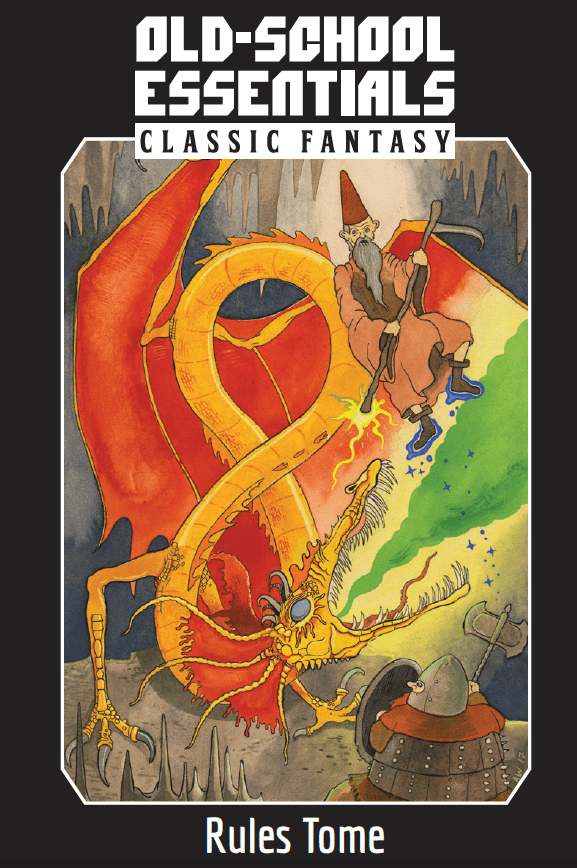
Illustration from the Alignment section of the OSE Rules Tome. It depicts a sphinx-like god on the left-hand side, holding a sword out towards a party of adventurers and a bearded, four-armed, muscle-bound god on the right, holding out a spike mace.

OSE don’t have no truck with your good and evil dichotomy. It’s Lawful, Neutral or Chaotic. Given this Cleric’s start in life, physically at a disadvantage, frail and weak prone to sickness, I think he is leaning towards Chaos. He is railing against the world and the laws of man and nature.

  • Alignment: Chaotic

There is a note in the Alignment section that if the referee does not think you are role-playing your alignment, then they can give you one that better suits your character. Interesting.

9. Note Known Languages

  • Known Languages: Common, Chaotic (Alignment Language)
    Another language, with my intelligence? No way buddy. I think the inclusion of the secret languages of gestures, signs and code words, known by all peoples of a given alignment is kind of cool and appropriate for the genre. Weird though.

10. By Equipment

I get 3D6 x 10 GP to start:

  • GP: 50 (that was two 1s and a 3 on 3d6. FML)
    Going to flip to p42 to check out the Equipment list. I must bear in mind what Clerics can use: any armour and shields but only blunt weapons.

Time to go shopping

  • Club 3GP (1d4 Dmg)
  • Leather Armour 20GP (AC 7 (12 this is if you decide to use ascending AC instead of the standard descending))
  • Holy Symbol 25GP
  • Sack (Small) 1GP
  • Torches (6) 1GP
  • Waterskin 1GP

So, because I have to buy a Holy Symbol, and I really want to have some armour to protect my 1 Hit Point, I cannot even afford rations. I feel as though my Cleric must have taken a vow of poverty.

11. Note Armour Class

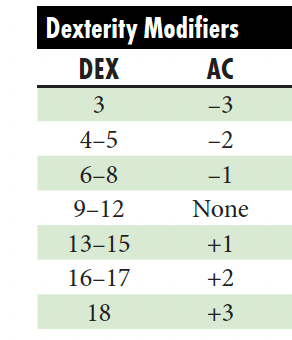
The Dex Modifiers table from the OSE Rules Tome. I am using it here to illustrate how odd it is to use negative numbers to indicate that a character's low Dex score can make their AC worse, when using a THAC0 system.
The Dex Modifiers table from the OSE Rules Tome. I am using it here to illustrate how odd it is to use negative numbers to indicate that a character’s low Dex score can make their AC worse, when using a THAC0 system.

Well, my Cleric, broke and pitiful as he is, is also clumsy as fuck. His Dexterity score is 7 and that gives him a -1 to his Armour Class. Now the wording here is extremely confusing. And I don’t know why they did this. So, as we discovered earlier, the lower your AC, the better when you are using THAC0, right? OK, in that case, if you get a negative modifier to your AC, that should be a good thing! But it is not. In the description of the Dexterity Ability Score they write: “a bonus lowers AC, a penalty raises it.” ! Like, what!? Why not just change the table so that a lower DEX score gives a +1 or +2 and a high score gives a -1 or -2?! Baffling. I need to point out that this is not the way they did it in my extremely old and battered copy of the AD&D 2nd Edition Player’s Handbook. As the picture below proves:

Table 2: Dexterity from the AD&D 2nd Edition Player's Handbook. I am using this to show how the AC modifiers in the OSE Dex Modifiers table above should have appeared, in my opinion.
Table 2: Dexterity from the AD&D 2nd Edition Player’s Handbook. I am using this to show how the AC modifiers in the OSE Dex Modifiers table above should have appeared, in my opinion.

Anyway, what this means is that my Cleric, in his leather armour has:

  • AC: 8

12. Note Level and XP

Pretty straight forward:

  • Level: 1
  • XP: 0

13. Name Character

  • Canon Fodder

That is all.
This disastrous character creation post has been brought to you by Old School Essentials and very bad luck.

Anyone else got a truly desperate OSE character to share?

Fear of an Indie RPG Podcast

RPG podcasts

I suspect that when most people think of RPG podcasts, they think of actual play, where a bunch of nerdy voice actors/comedians/nerds get together around a table/microphone/Zoom app and record their games. It is such a common format that one of the more famous ones is called Not Another D&D Pocast (NADDPOD.) There are a number of these that I like and I might get into them in another post at some point. This post is not about them.

So, as you may have gathered, I enjoy not just playing RPGs but also talking about them, reading about them, listening to people talk about them. There are not many podcasts that I listen to regularly that do this. I just don’t gel with all of them. But today I wanted to highlight two that I get a lot out out of. Sometimes I get advice to be a better GM or player from them, sometimes they introduce me to new games or supplements, sometimes I just get to relish people chatting about a subject that is close to my heart and interests me too.

The Yes Indie’d Podcast

Thomas Manuel runs this little gem. I got into it when a friend suggested I sign up for the Indie RPG Newsletter, also run by Thomas. Please go and sign up for that too, by the way. I look forward to that turning up in my inbox every Sunday morning. It’s a really good way of keeping up with what is happening in the indie RPG scene and getting some fascinating insights into aspects of the hobby you might never have thought you needed to think about.

The usual format for the podcast is that Thomas will invite an indie RPG luminary on to the show and interview them. He always has a bunch of insightful questions for them and the discussions that emerge have a lot to offer, particularly if you have ever been interested in creating and publishing your own indie RPG material. There are lots of good episodes but I would recommend a specific few recent ones that I got a lot out of:

Meeting Games Where They’re at with Quinns, one of the most reliable and funny RPG reviewers out there

Getting Weirder than Lovecraft with Graham Walmsley, creator of Cthulhu Dark among other good stuff

Open Hearth’s Games of the Year 2023. This is a bit of a cheat since it is not technically a Yes Indie’d episode but it did appear on the Yes indie’d feed so I get to include it. It is also the thing that made me go and sign up for Open Hearth so it gets extra points for that.

Fantasy Non-Fiction with Tom McGrenery of the Fear of a Black Dragon podcast

Fear of a Black Dragon

Which brings me nicely on to Fear of a Black Dragon. For the umpteenth time, Thomas Manuel directed me to check out something that I ended up loving.

The Fear of a Black Dragon podcast is the venerable OSR module review show produced by the Gauntlet. The Gauntlet is responsible for several high quality, popular indie RPGs and other related publications and podcasts. Their best known products probably include Brindlewood Bay, Public Access and The Silt Verses RPG. These games are very much not OSR by nature but the modules Jason Cordova (author or co-author of the games listed above) and Tom McGrenery (of the paragraph-before-this-one fame and creator of several games himself) review very much are.

The format is simple and unchanging, the reviews go deep and are guaranteed tested at the table, the vibes are spot-on. I started on the first episode from 2017 and have been binging it relentlessly for the last couple of weeks. What’s nice about this is that all the modules they reviewed back then are still relevant and available. Another interesting point is that the hosts mostly do not use OSR systems to play the games they review, rather they usually use something like Trophy Gold or Dungeon World, Powered by the Apocalypse games that are much less crunchy and more interested in the narrative of a game than the number of dice you roll for damage. They provide a lot of expert advice on how to handle conversions like these as well as great ideas for introducing scenes, developing NPCs, doing sound effects and other fun stuff.

The episodes I have listed below made me go and purchase the items they reviewed. These links are to their website but you can listen on your pod-catcher of choice of course:

Ultraviolet Grasslands

Fever Swamp

Slumbering Ursine Dunes

But you should also check out this one, which was the first one I listened to and is much more recent:

Episode 100 Special

Go and subscribe to these podcasts and sign up for their Patreons if you can:

Indie RPG Newsletter/Yes Indie’d Podcast

The Gauntlet/Fear of a Black Dragon

One-shots

The campaign for one-shots

I mentioned in my last post that there is nothing I enjoy more than the development and advancement of a character. In D&D terms, I’m talking about levelling up, of course, but most games have some mechanic that allows characters to improve in a tangible way. You might get to pick a new advance, or a new ability or you might just get a few percentage points added to a skill. Normally, taken on their own, these are incremental and not earth-shaking in their effect on the character or the game. But when taken as a whole from the point of a character’s creation to the end of their adventures, they are often massive. More-so in some games than others, but always very noticeable (unless you’re playing something really lethal like a DCC funnel.) I do like to see my characters improve like this but in recent months I have been struck by how advancement is not necessarily the object of the exercise for me, it’s actually just change. You might need a longer campaign to give characters an opportunity to level up, but you don’t necessarily need one to change them. A one-shot can do that quite admirably, thank you!

If you remove the necessity for advancement and replace it with the necessity for change in PCs you can make it far more immediate. Horror games make great one-shots for this reason. So many of them involve some sort of sanity mechanic, meaning you have to change the way you play your character or else the character’s interaction with the world and the fiction is altered when they start to lose their grip. Other games introduce physical mutations from exposure to powerful forces. Still others have temporary effects that afflict or bless characters from the use of their own abilities. What I have discovered over the last while is that a successful one-shot will often involve leaning into one or all of these options, or other types of changes that I haven’t listed above.

Is this why players sign up for a one-shot game? Maybe not. Probably not, in fact. For me? I usually sign up to try out a game I have never played before, or a scenario I have never played before. Honestly, I rarely know enough about a game before I go into it to know whether or not it will involve any real character change in such a short format. But those that do it? Those ones live long in the memory.

Alien Dark

I’m immediately cheating by referencing a two-shot, but let’s not split hairs, eh?

Alien Dark was the first game I ever took part in as a member of the Open Hearth gaming community. Alun, the writer of this nasty and wonderful little game was our GM. Now, there’s a mechanic in this game that allows the GM to accrue Danger. They can then use that to just completely fuck your character over with Aliens, both physically and psychologically. This is something that has a tendency to leave you in Bill Paxton levels of panic real fast. And if you’re panicking, just imagine how your poor character feels.

Well, actually, there’s no need to tax your imagination, dear reader, I can tell you. You see, my character, Benny Doyle, a ne’er-do-well with a substance abuse problem, was really piling on the stress points. Within the fiction of the game, you are required to write a short line describing the effect of the increasing mental distress on your character. Benny got nuts. He went from meek and afraid and hiding behind the other PCs to roaring about needing GUNS and going, quite literally, toe-to-toe with an Alien. Man that was fun. Like, I just enjoyed this poor lad’s descent into drug-fuelled madness so much. And it didn’t happen all at once either, I got to draw it out, as Alun ramped up the tension and the Danger, over the course of one and a half sessions or so.

This is the sort of change I’m talking about.

Death in Space

Here’s another example, which, in the moment of typing this, oh, gentle blog-goggler, I just realised was also a two shot in the end. It had been designed as a one shot but sometimes, just sometimes, your players have too much fun creating their damn characters and your one shot divides, much like an amoeba, into two separate but equally awesome wholes.
Death in Space is a game by the Stockholm Kartel. It’s an OSR game of space horror, which, even at the best of times, I would imagine has a pretty high mortality rate. As a disclaimer, I have only ever run this game this one time so I can’t confirm that.

Anyway, I wrote this short scenario with inspiration from a couple of locations and NPCs from the core book. The idea was that the PCs visited this space station which orbited the ruins of a destroyed planet. They explore the claustrophobic, jungle like environment on this station and interact with the denizens, a void cult led by a grotesquely mutated woman.

Then I get them to roll some checks. With every roll they fail on the station they build up void points, which they can spend to do cool stuff. But when they do that, they open themselves up to the possibility of void corruptions. The Death in Space core book has a Void Corruption table. Here are some samples of the shit my players’ characters were inflicted with:

“Another you starts growing on you. The twin clone is fully grown and detaches after 1d20 days. It has its own will and purpose, decided by the referee.”

“A part of your body becomes shrouded in a cloud of darkness.”

“Flies and other insects crawl out of your body when you sleep. A small cloud of them surrounds you. Their buzzing is a constant static.” (Actually, since this was a one-shot, I made it so the flies just popped out all the time. Much more effective.)

I adjusted the rules slightly to make corruption more likely and, you know what? My players loved being corrupted! Their characters were going through intense and horrific changes while also learning more about themselves as they were tested psychologically.

Now, go play a one shot and corrupt some PCs!

Also, go and buy Alien Dark on itch.io; it’s PWYW! And Death in Space from here. It costs a specific amount of money but it’s a good game and a gorgeous product.