Time for a Choice

From each genre, I’ll take a look at the games, their appeal, and, of course, their character creation posts to eliminate some. Hopefully, once I’ve done that, I’ll be able to come to a well-informed decision.

Decisions, Decisions

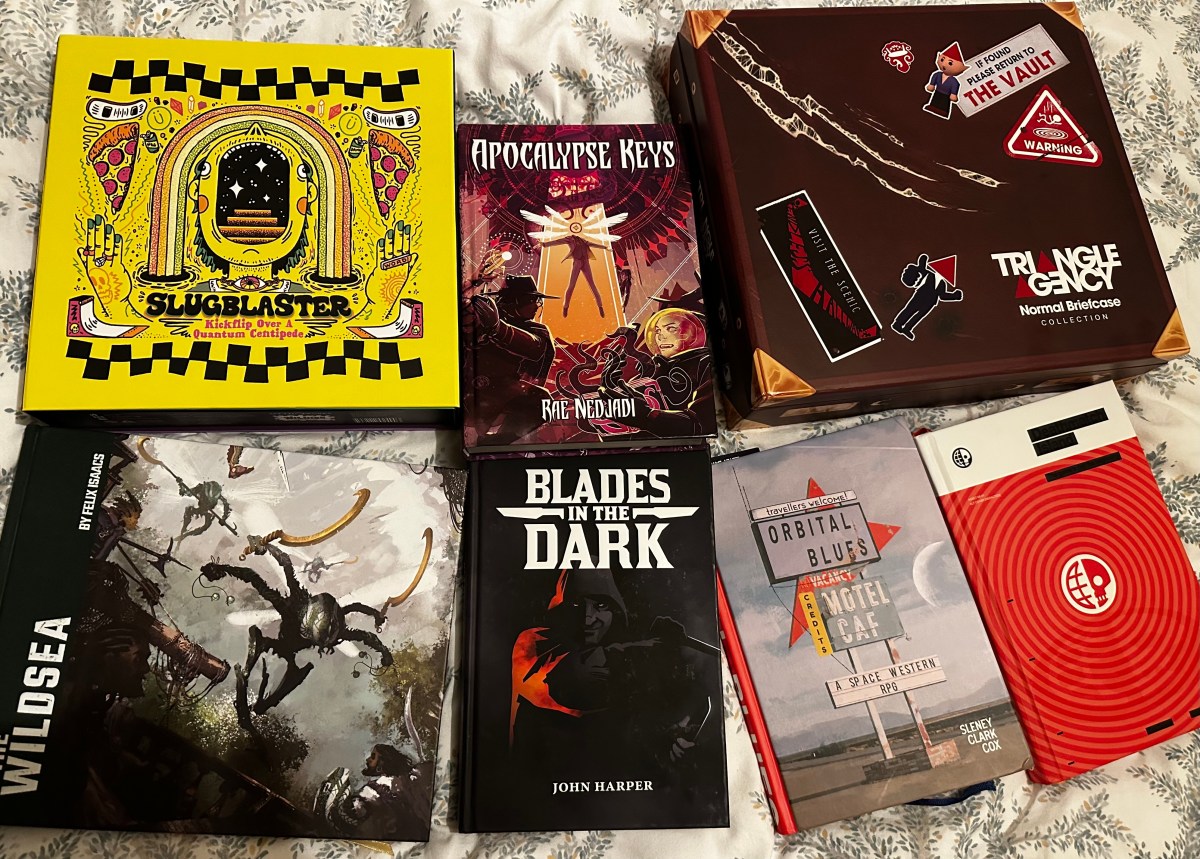
So, the characters have been created, the conclusions have been drawn, I am as familiar with the 7 games on offer as I’m going to get before actually playing them—its time to make a decision.

Before getting to that, though, I think it’s worth pointing out that this is, far and away, the most effort I’ve ever put into a decision of what game to play next. Since starting to write this blog I’ve spent a lot of time and not a little cash on new games. I’ve never had so many to choose from before. And I’m not even including the ones I’ve only got in PDF form. Long ago, as a teenager, I actually did run a variety of games; AD&D, of course, but also Gamma World, TMNT and Other Strangeness, Beyond the Supernatural, Robotech, Shadowrun. Back then, I just wanted to run the newest thing, the shiniest game, whatever had the bulk of my attention. But, I didn’t have so many to choose from, of course. There was no such thing as buying a game and never running it! I didn’t have that sort of money! These days, we are living in a golden age of tabletop games. There are so many RPGs of so many genres, utilising such an array of play styles and rulesets that it can be bewildering, overwhelming and paralysing. So, as I sail out of my majority-D&D era, navigate my way through the OSR and explore the unknown waters of the story-game, I have found this process incredibly helpful, if time-consuming. It has also been educational, interesting and fun. But there’s another aspect to this too: whatever game I choose, it’s one that my players and I will be with for weeks, hours of play and hours in between sessions thinking about. I want that to be good, or, hopefully, great!

The Competition

There are seven games to choose from, as laid out back in the original post. I could just take them one by one, as I did when writing their character creation posts, but, instead, I will separate them into genre groups. From each genre, I’ll take a look at the games, their appeal, and, of course, their character creation posts to eliminate some. Hopefully, once I’ve done that, I’ll be able to come to a well-informed decision.

Supernatural Investigations
We’ve got two games in this genre (I suppose this is more a of a sub-genre, but heigh-ho, it’s my blog-post.)

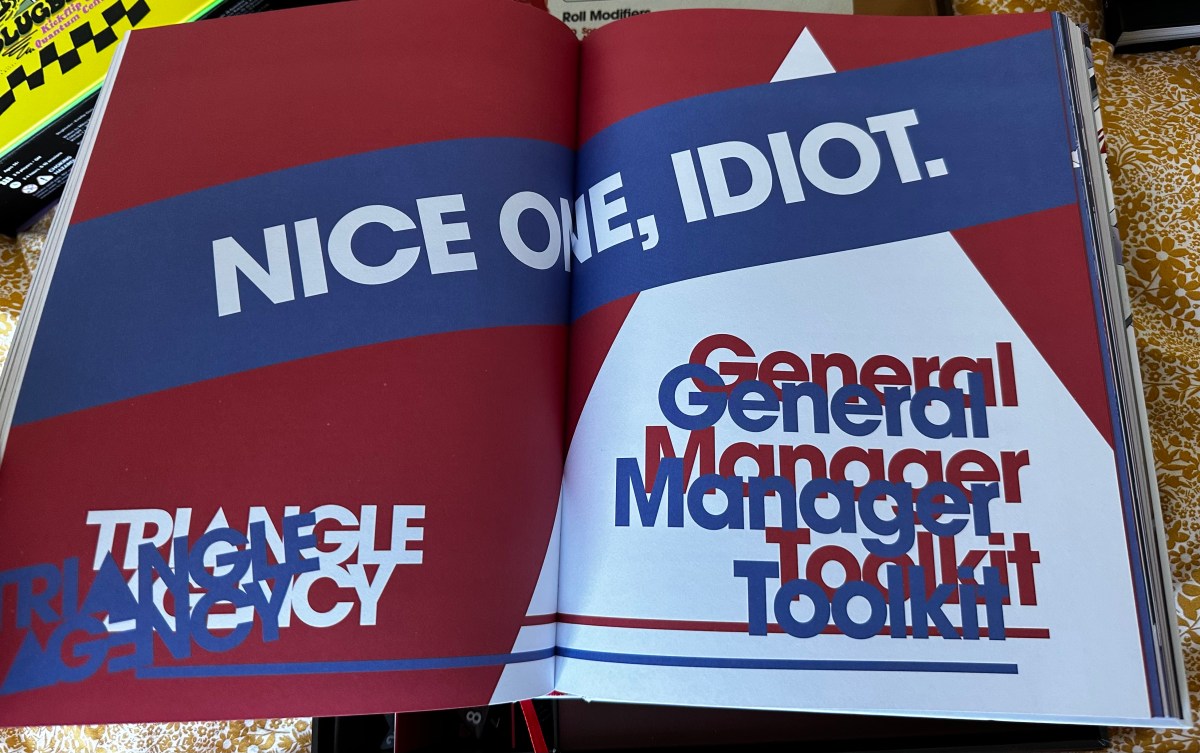
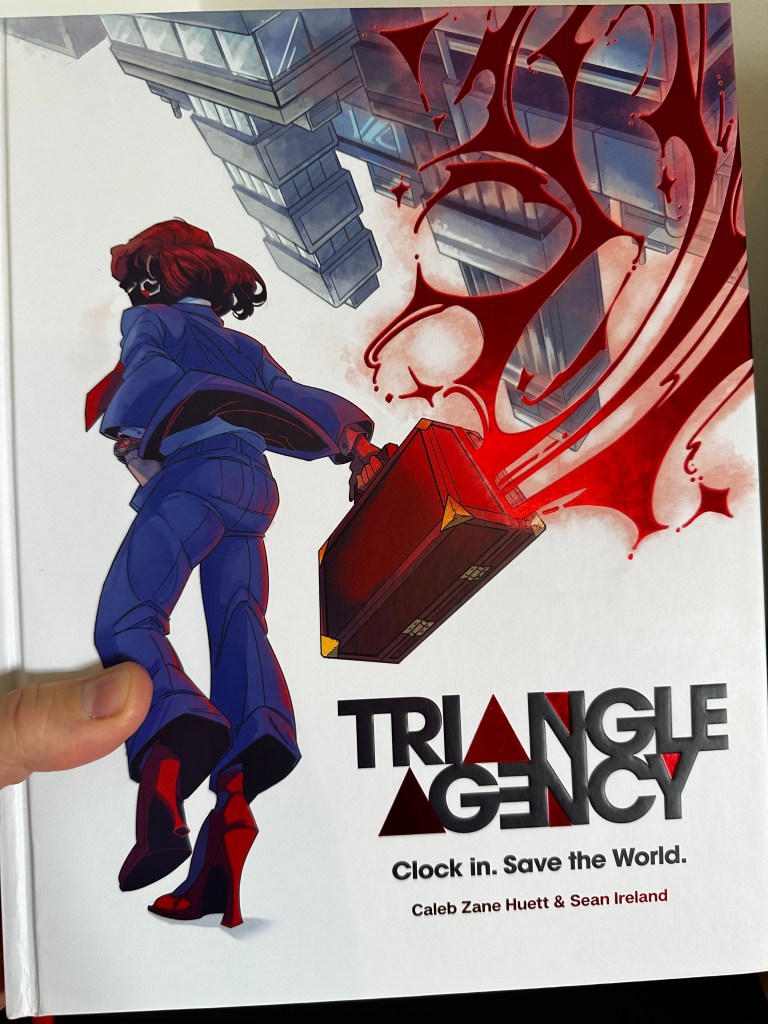
  • Triangle Agency – this was the first character creation post I made as part of this series. I think, at the time, that was because it was the game I was most interested in. It didn’t hurt that it came in a very impressive box. The presentation is altogether impeccable. This applies also to the text itself, which styles itself as the manual to a game to be played by actual agents of the Triangle Agency. The character creation process taught me a lot about how the game would be played and was particularly successful at making, not just a character, but a personality, history and motivation.
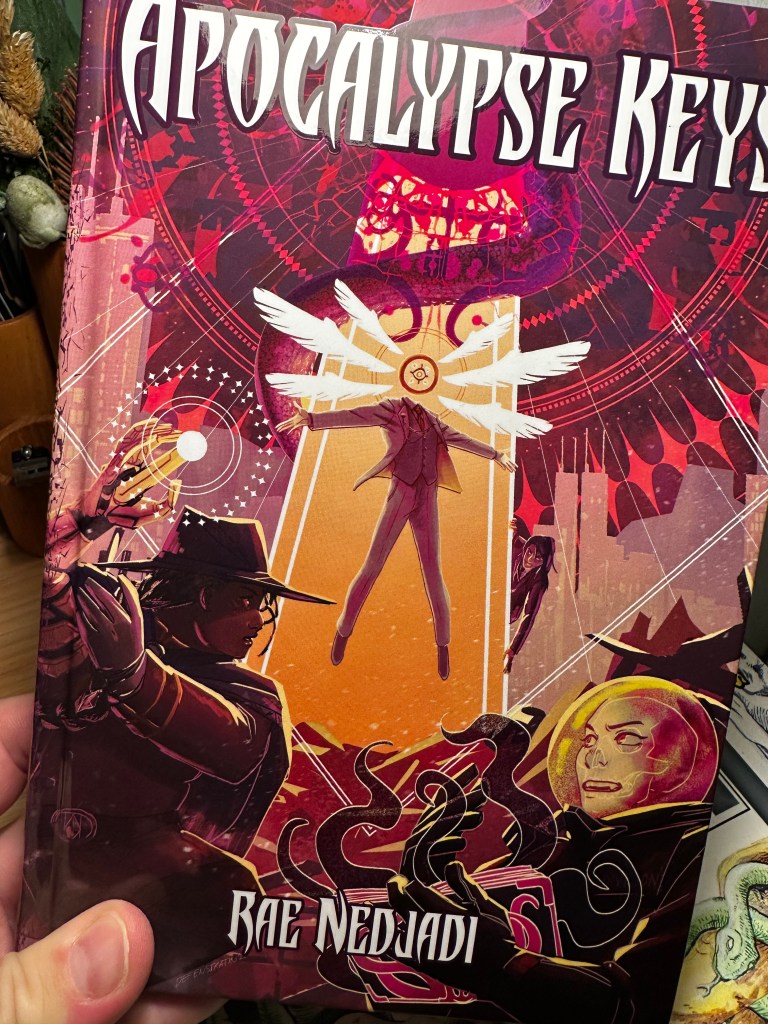
  • Apocalypse Keys – this, was the last of the character creation posts I did. I’m going to cut to the chase with Apocalypse Keys; I don’t think it’s for me. It might suit some of my players, but not others. I would rather the Triangle Agency’s tongue-in-cheek take on the genre than the melodrama inherent in Apocalypse Keys.

Triangle Agency wins!

Fantastic Voyages
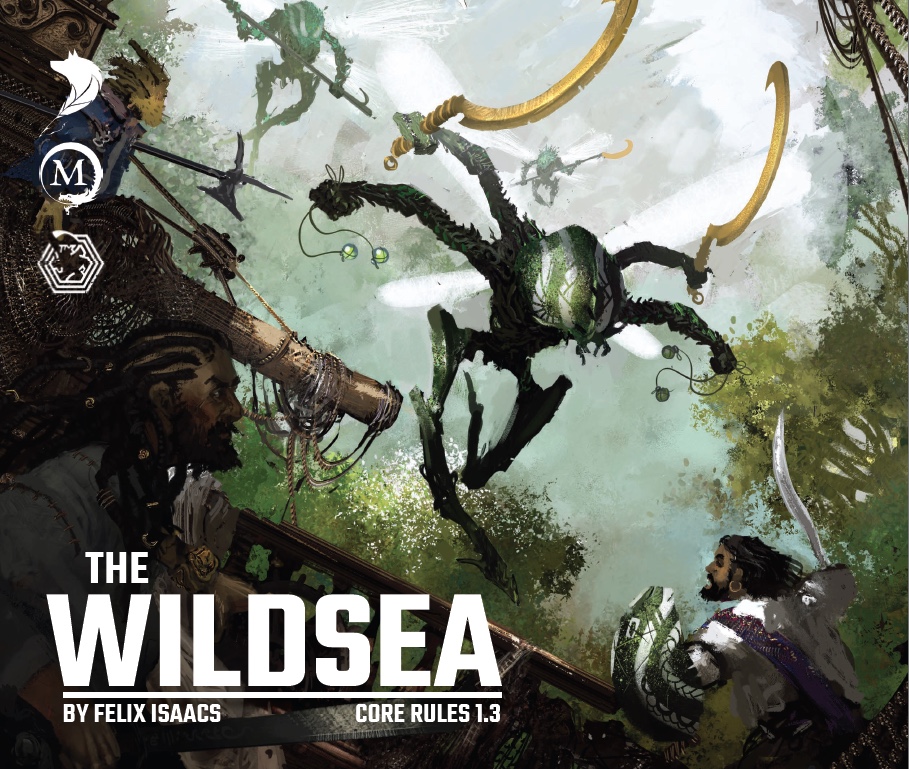
I’m stretching the term ‘genre’ here once again. But I’m adding two games to this one anyway. Both of these involve ship creation as part of the character creation process, and a crew of misfits to go with it.

  • The Wildsea – Its got a fascinating setting, a rich and engrossing vibe and a beautiful presentation. This is very much a fantasy game that’s determined to get you into trouble out on the emerald waves of the Wildsea. You will spend a long time making your character, as evidenced by the length of my character creation post. There are many, many choices to be made at every step and that doesn’t even take into account the ship creation process. For the campaign I’m imagining, a maximum of about ten sessions, I feel like this is too much. I’d rather spend the time playing than making Wildsailors. But, its definitely one that I might return to someday.
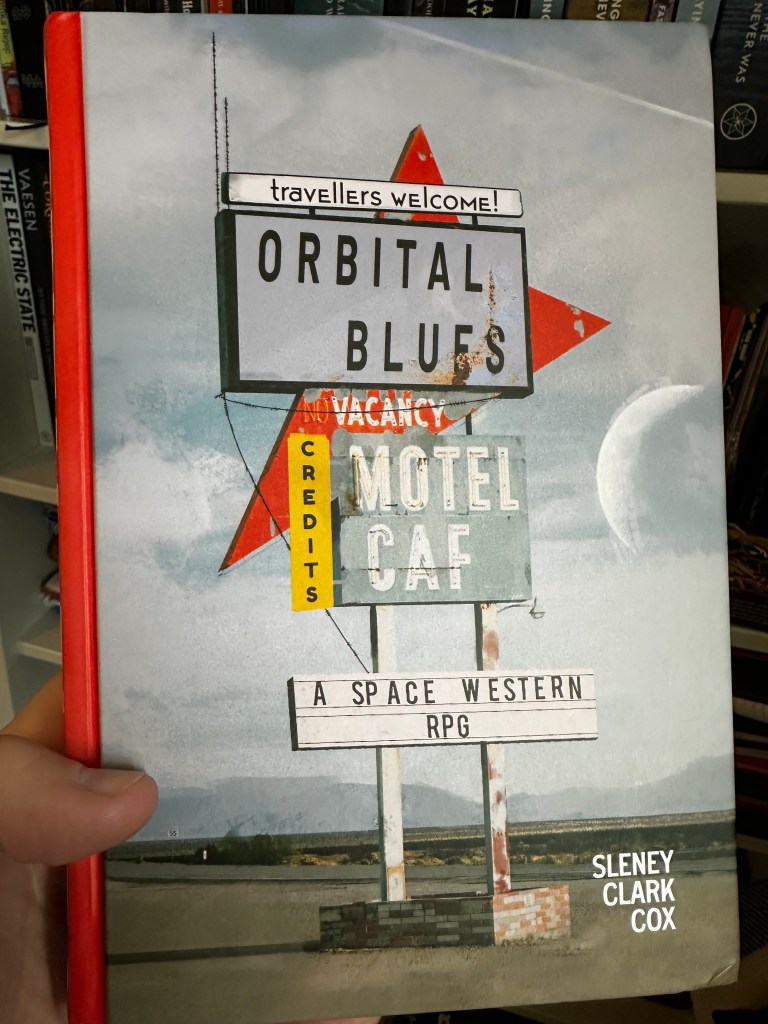
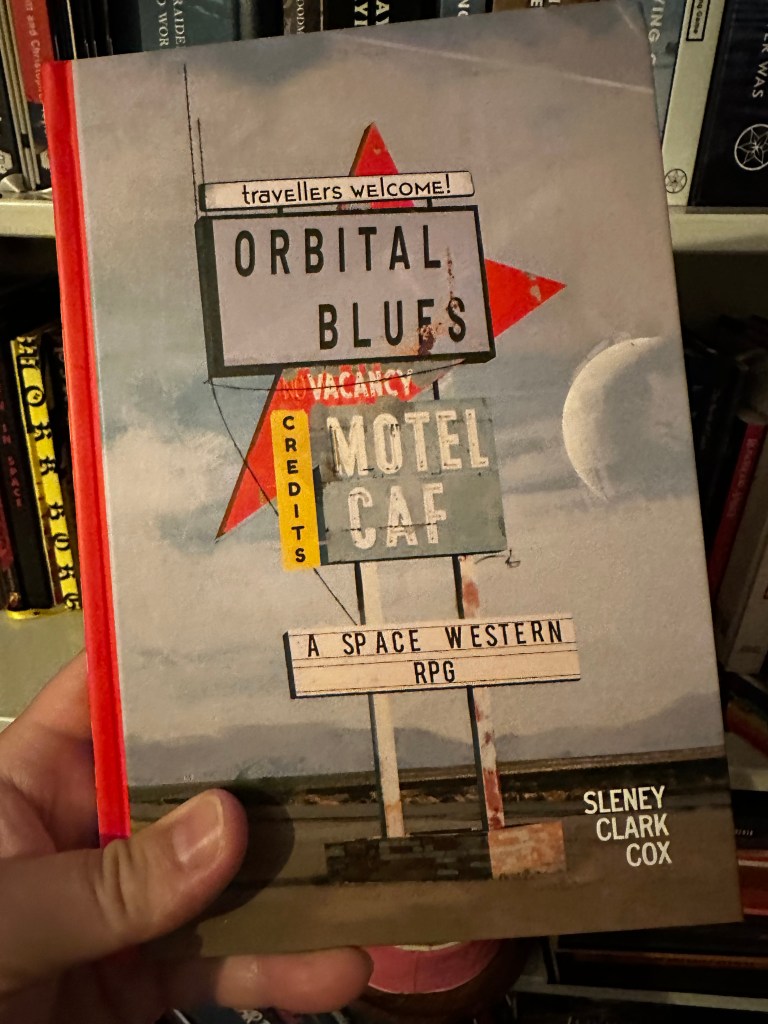
  • Orbital Blues – This is a game set in a far flung future where everyone has spaceships but its grimy, debt-ridden and kind of sad. Its a game that’s underpinned by themes that we can easily all understand, the hell of living in a late-stage capitalist economy, the mental health toll taken by the struggle to just survive from day-to-day in the gig economy etc. The character creation really stoked my imagination and conjured images of my sad space cowboy. And it was the exact opposite of the Wildsea in that it was just so quick and easy.

Orbital Blues wins!

The Others!
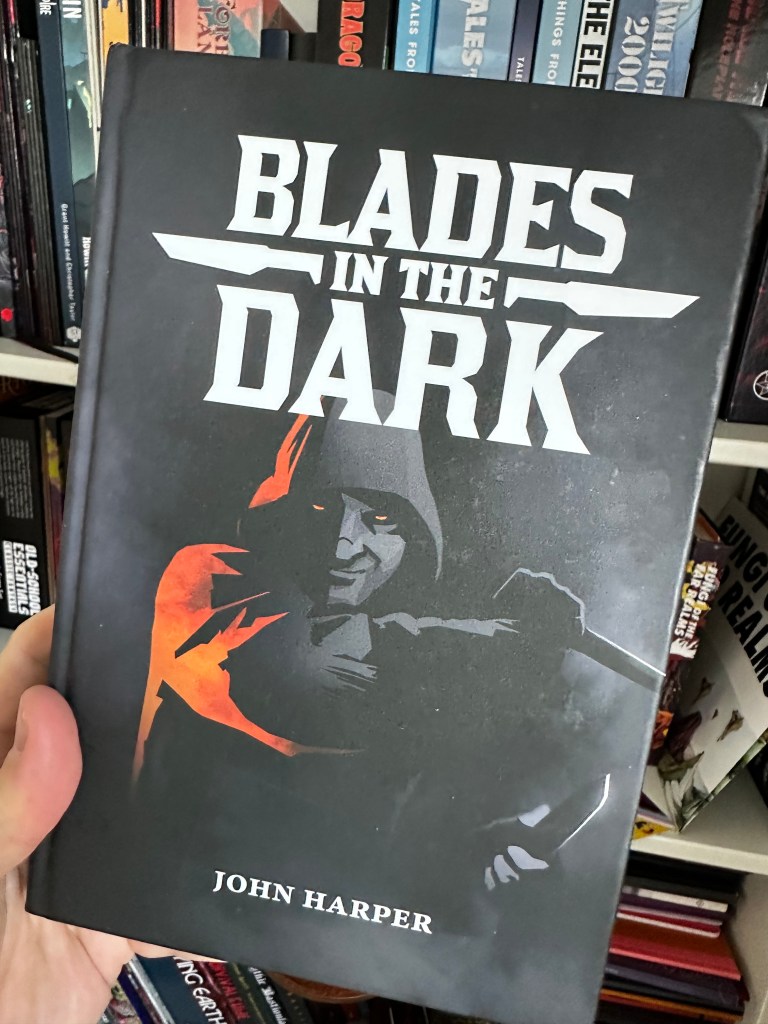
I gave up trying to come up with a way to link these final three games. Slugblaster and Blades in the Dark share a system, sort of, and Deathmatch Island is based on a system that was originally created by the author of Blades in the Dark, but that’s pretty tenuous. They all do have an important similarity in the way they are played in distinct phases, though.

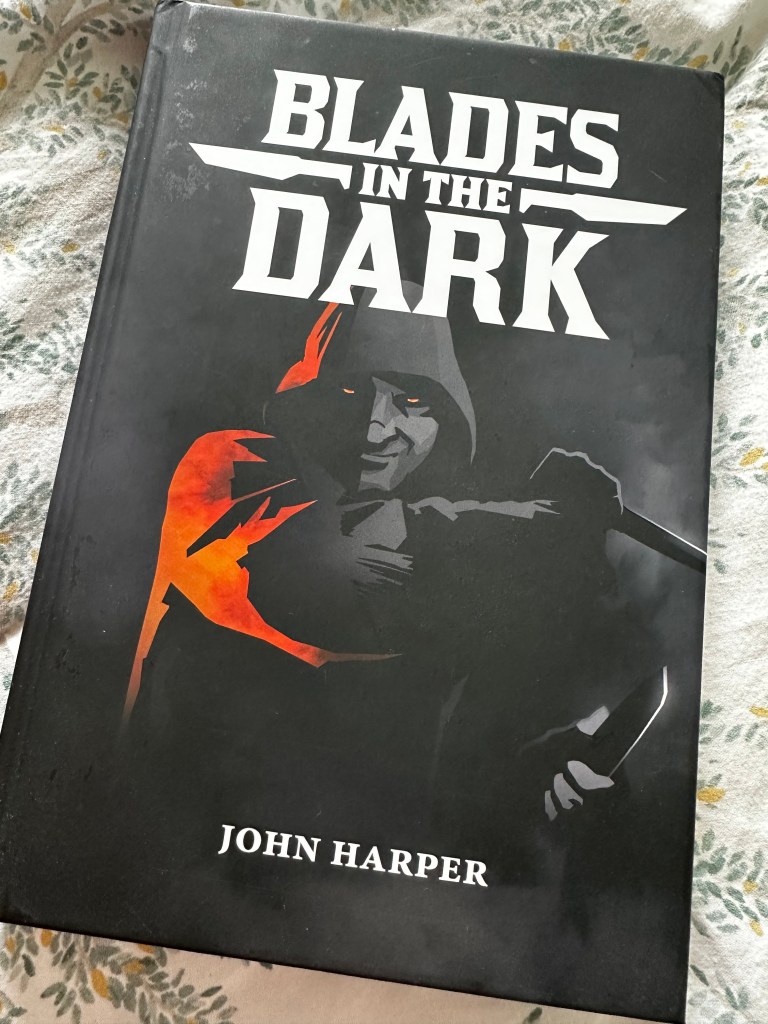
  • Blades in the Dark – This is such an iconic game and its the favourite of many an RPG enthusiast whose opinions I respect. The vibes of Blades are also perfect. Dark city, supernatural threats and heists. I think my players would love that shit. Also, the character creation is comparatively straight-forward and gives you a good idea of your character before you even start playing. This is the only game on the list that I have actually played before and, I’m not going to lie, it has an advantage because of that.
  • Deathmatch Island – This game is on the list because I finished a rewatch of Lost this year and because I backed it and got a lot of really cool materials for it. But it has so much more to recommend it. The premise is great, the fundamental decisions your characters have to make about the nature of their realities are compelling and the rules are simple enough to require very little time to master. However, its strength in this respect is also a weakness. I think I could easily get a small group together at short notice to play this game as a one-shot or very short campaign and I might consider it for that. But I’m not sure I want to run it for longer. Which is pretty much the conclusion I came to the first time I looked at it on this blog.
  • Slugblaster – Another gorgeously presented book. It has world-building oozing from every paragraph, illustration and fictional ad. The subject matter is not quite my bag though. I have no idea about skater culture. Although I am inspired by many of the touchstones Mikey Hamm names for Slugblaster, it doesn’t seem quite enough for me, I’m afraid. I also had some issues with the character creation process which I went into in that post. Maybe I’ll come back to this one someday. But, for now, it’s a no from me.

Blades in the Dark wins!

The Semis
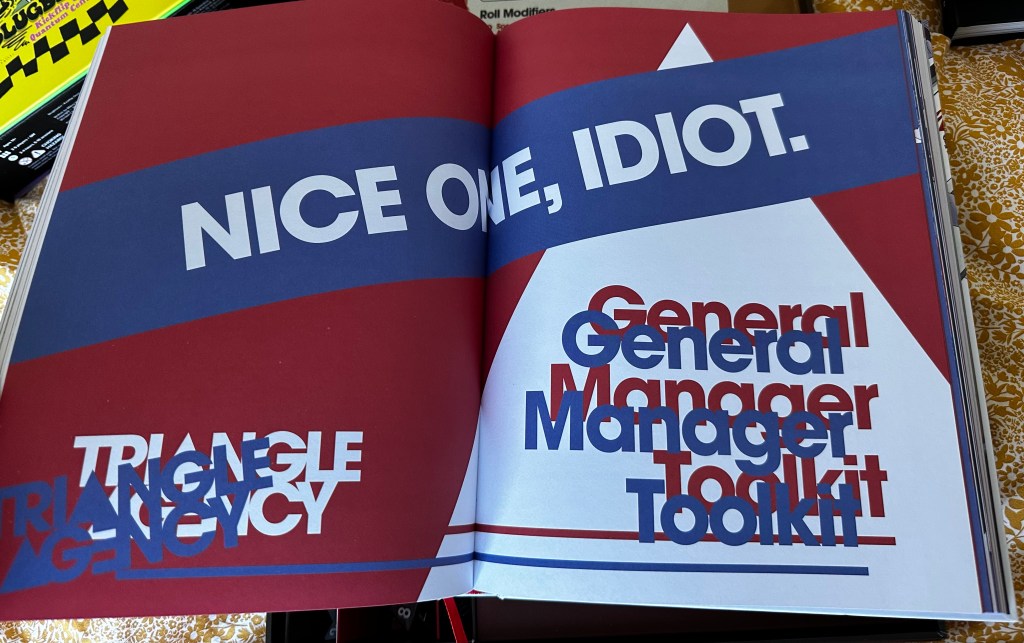
I’m glad to be dealing with a semifinal now after Ireland went out of the Women’s Rugby World Cup in devastating fashion at the quarter final stage earlier today. We’ll see a semifinal one day!

Anyway, we have three games left:

  • Triangle Agency – A unique take on the genre of supernatural investigation with an original ruleset and a lightly comedic vibe
  • Orbital Blues – A space cowboy sci-fi game of disillusionment with the universe and characters who grow through expressions of depression as they journey through the stars
  • Blades in the Dark – a classic supernatural, victorian heist game that has launched a thousand other games.

I have to eliminate Orbital Blues here. This is a bit disappointing, to be honest, but I have a good reason. I’m already running a Spelljammer game at the moment, as well as Ultraviolet Grasslands. That’s a lot of journeying from one place to another in a ship/caravan. I don’t want to start a new game with a similar format. Maybe if and when either of those two games comes to a conclusion, I’ll come back to Orbital Blues. But for now, it’s got to go, I’m afraid.

The Final
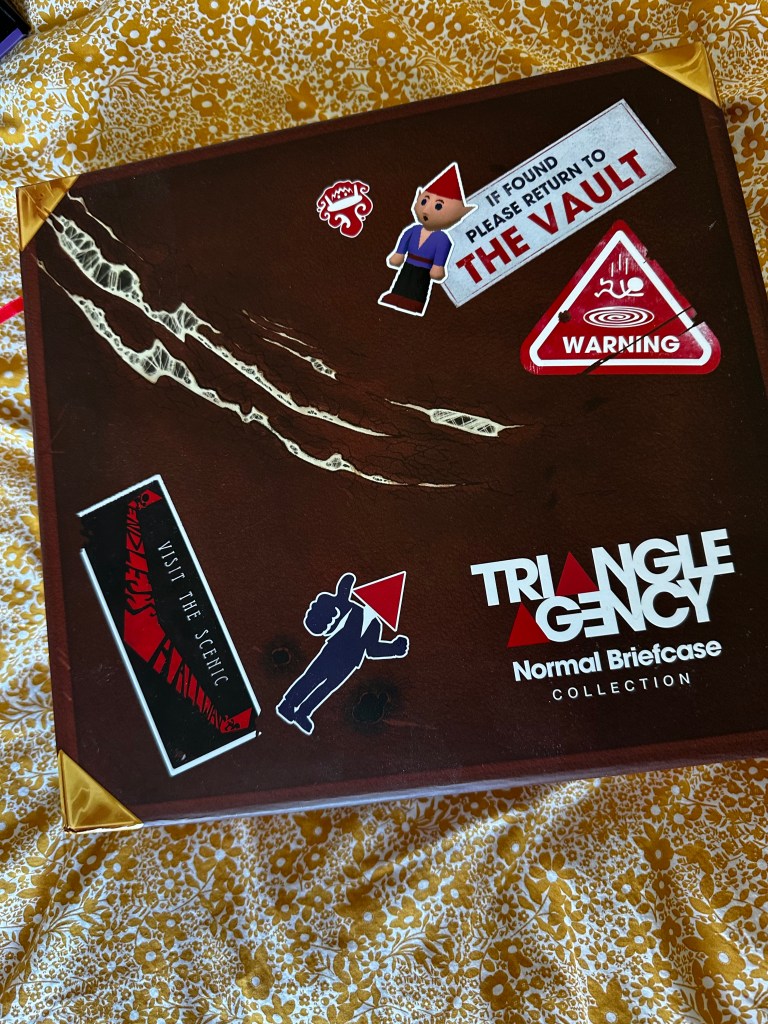
So we have two games to choose from in the end, as it should be.

  • Triangle Agency
  • Blades in the Dark

I can’t choose between them. I’d be very excited to run either one. If I could find the time, I would run both. If I could find the time, I’d run every game on this list! But as they say in Highlander, there can be only one. Fittingly, It’s going to come down to a dice roll. 1d6. 1 to 3, its Triangle Agency, 4 to 6, Blades in the Dark.

Here we go!

Its a 4!

It’s time to sharpen your blades and take that Devil’s Bargain with the rest of the crew. We’re off to Doskvol…

Orbital Blues Character Creation

I’ve played RPGs where your character is supposed to be weak, where they’re meant to be weird, where coolness or badassness is the point, but I have never before played one where the entire premise is that you are a sad, potentially depressed outlaw trying to get by in a universe that’s against them.

This is the seventh in a series of character creation posts I’m using to figure out which game I want to schedule for our next campaign. You can find the Triangle Agency one here. And you can find the Slugblaster one here. You can find the Blades in the Dark one here. We took a slight detour for this one, here’s the Wildsea Ship Creation post. And then got back on track with the Wildsea Character Creation post. This is where you can find the Deathmatch Island one. Back in this post I named Orbital Blues as an outsider in this process since I’d barely even cracked it open. This was good motivation to read the book. Since then, I have read most of it and I have to say, I’m generally impressed. It’s very much in the running now.

Sadness is the Point

I’ve played RPGs where your character is supposed to be weak, where they’re meant to be weird, where coolness or badassness is the point, but I have never before played one where the entire premise is that you are a sad, potentially depressed outlaw trying to get by in a universe that’s against them.

That’s Orbital Blues, by Sam Sleney and Zachary Cox, illustrated by Josh Clark and published by Soul Muppet. This is how it is described on the back of the beautifully realised book:

It is an intergalactic age of bounty hunters, vagrants and bleeding heart outlaws.
The galaxy is a lawless expanse, and you are an INTERSTELLAR OUTLAW. Together with your SHIP and your CREW, you must eke out a living in the frontier, and close down the intergalactic dream of freedom and success.

What this blurb doesn’t convey is that, for an Orbital Blues character, the sadder you are, the better (mechanically anyway.) Your PC is going to start with Troubles and they are going to give them the Blues and those two things just serve to compound each-other over the course of the game to give them more abilities as well as more narrative motivation.

Before I get into this, I would like to once again plug the My First Dungeon podcast. They have a complete season of an Orbital Blues actual play that has helped me to get to grips with the game, the system, the vibe and, of particular importance to this post, character creation. Go check it out here.

Start with the Concept

Character Creation chapter with poncho clad back of a space cowboy

I haven’t played a lot of games where the player is supposed to start with an idea of their character first. Never Tell Me the Odds does it, but I am struggling to think of another. Of course, a lot of players will go into every game with their concept in their heads already, but few demand it. Orbital Blues wants you to do some imaginative labour before moving on to stats and abilities.

So, let’s look at the touchstones for this game. What kinds of characters does this sort of game want you to make? Cowboy Bebop, Firefly and Guardians of the Galaxy are all pretty obvious sources of inspiration that are explicitly mentioned in the book, so I’m going to use the characters from those IPs as fodder too.

I remember watching Cowboy Bebop during its original run when I lived in Okinawa in the late 90s. It captivated me with its evocative and anachronistic world and its lowlife, flawed yet oh so sympathetic characters. I was obsessed with Spike. He was such an asshole and yet he could always surprise you with moments of genuine heart and kindness, while being forever haunted by his dark past. It’s a classic character archetype, of course, but that’s with good reason. We relate to their brokenness while we aspire to their ultra-competency.

Anyway, that’s my main point of reference, a slick-looking guy with a past he’d rather forget. I’m imagining him as a crack-shot and a card-sharp, not an arm-wrestler or a fist-fighter. This guy drinks too much and always has a cigarette between his lips.

Name

The very next thing in the process and the book, is to roll up or choose your name. There is an excellent d100 table here for this so I am not going to pass up the opportunity to roll on it. Now, this is not necessarily meant to be your PC’s full legal name. In fact, it is more likely to be a nickname or a persona and usually just a single name. There are some great names in here, including “Indiana,” “Ripley,” and “Valentine.”

I rolled a 34 so that’s Avery. Nice!

On the same page is an exhortation to “pull it together.” This means thinking about what brought the character to the life of an outlaw. What kinds of problems follow them and what might they do about them?

I’m thinking Avery, a former military sharpshooter, quit the space-corps to find his own way in life, only to end up working as a hitman for some bad people. The crime boss he worked for had some juicy blackmail material on Avery. Thinking about this from a game perspective, I would want to eke this story out during play rather than spilling it all in character creation. But I am thinking he killed the wrong person, someone known to his family, and he doesn’t want that to get back to his parents. But he left the employ of the crime boss by faking his own death. This was all before he started going by the name, Avery.

Stats

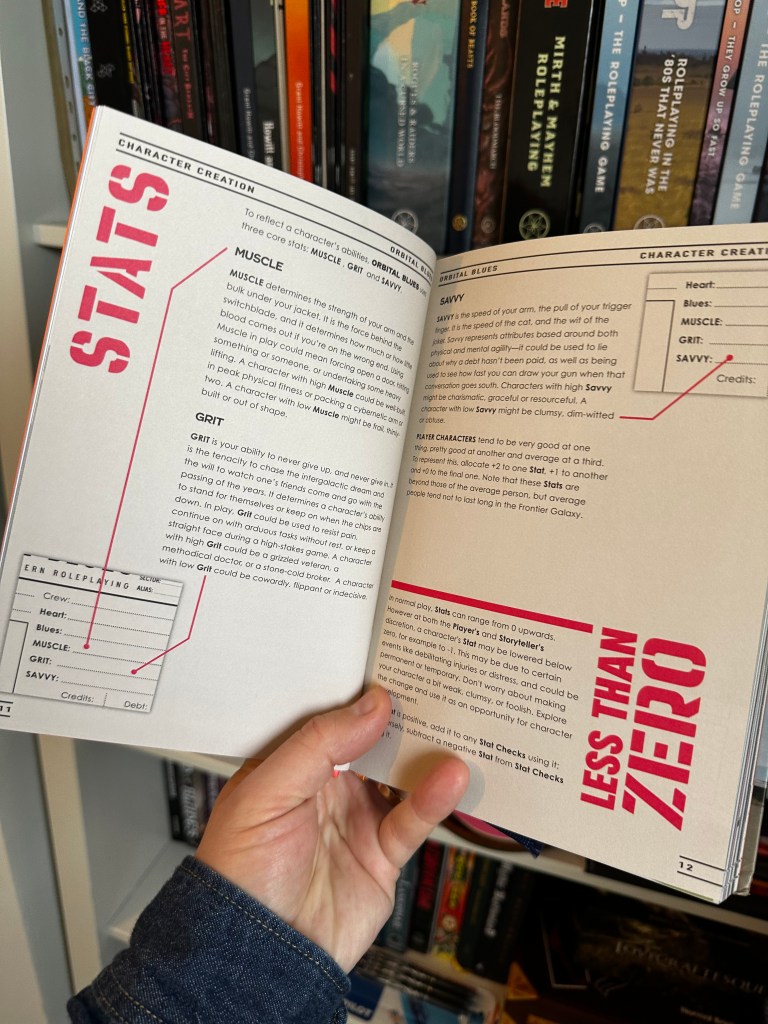
Stats: Muscle, Grit and Savvy

You only get three stats as an Orbital Blues character:

  • Muscle: speaks for itself really, Although it could be used for intimidation too. Also, it has a bearing on your Heart score, which is analogous to your hit points
  • Grit: How far will you go? How much can you take and keep on trucking? Your Grit determines that
  • Savvy: Quickness of mind and trigger finger. This is where I’ll be investing highly for Avery.

There is no dice-rolling involved in your stats. Instead, you choose one to be 0, one to be +1 and one to be +2. Simple.

Avery:

  • Muscle: 0
  • Grit: +1
  • Savvy: +2

This seems to suit the character concept I’ve come up with so far.

At this point, it’s worth noting that you do stuff in this game by rolling 2d6, usually, and add the relevant stat to the roll. The target is always 8.

Sometimes, if you are rolling with the Upper Hand you roll 3d6 and take the top two rolls. In contrast, if you are rolling Against the Odds you roll 3d6 and take the lowest two rolls.

You can use Exertion to spend points of Heart to add to your rolls too.

The Crew

Crew titles

This next part will be a little difficult for me since this is a Solo endeavour (that’s just a little space outlaw humour there.) But still, I can follow the advice presented to a certain extent. There is a colourful double-page spread of titles to help. I can adopt one of these for my own character. Once I have done that, I can choose at least one more title and decide how Avery might relate to another character with that title.

Avery has a lot of options here. There are titles such as “the Queen,” “the Freak,” “the Heart-breaker” and, of course, “the Cowboy.” But I think the one that suits him is “the Quick.” He’s fast on the draw, nimble-fingered and quick-witted.

I think there is another member of the crew who has “the Ace,” title. Let’s call them Rivers. They’re good and they know it. This pisses Avery off and wakens his competitive side.

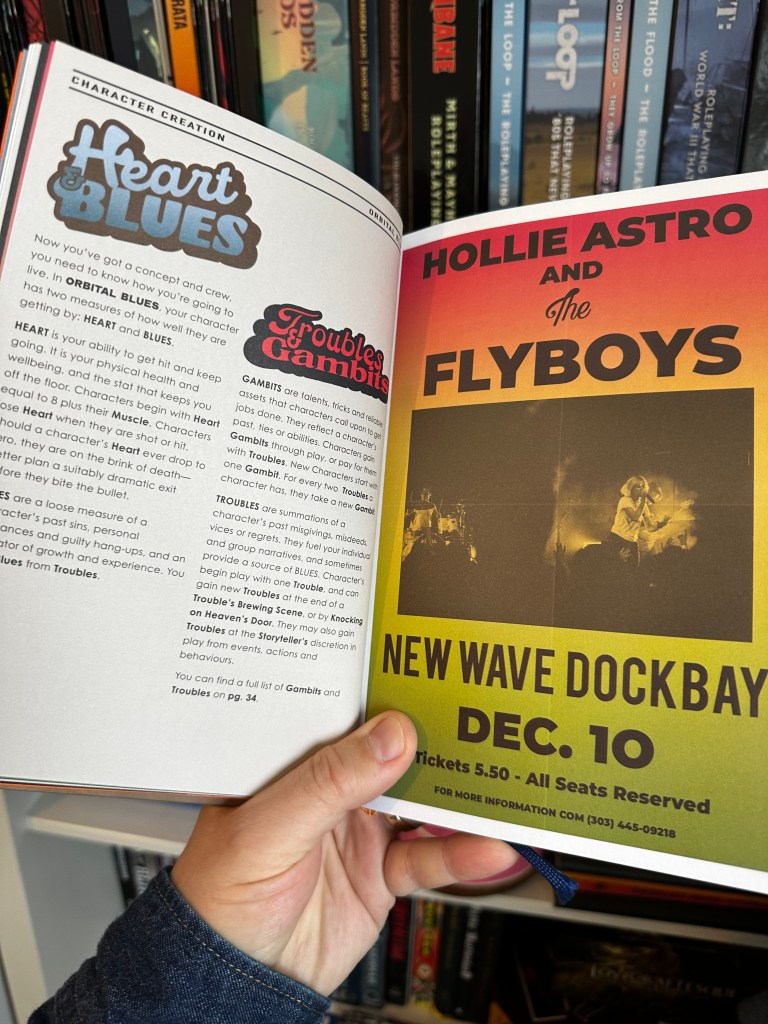
Heart and Blues

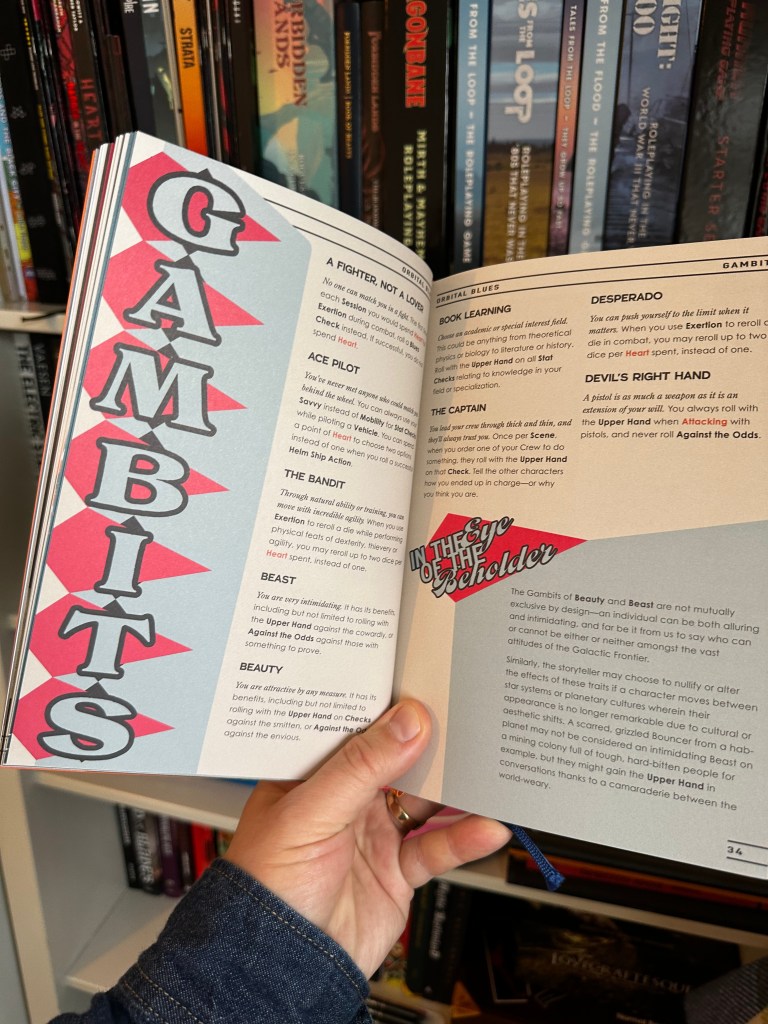
Heart and Blues, Gambits and Troubles

This is an easy one. Heart, which, as I noted, is the HP score, is calculated by adding 8 to your Muscle score. So:

  • Heart: 8

Blues are the way you measure the effects of your character’s “past sins, personal grievances and guilty hangups.” As you build Blues points, you get to improve your character. You gain Blues points, unsurprisingly, through your Troubles.

Troubles and Gambits

A space cowboy starts with one Gambit. It’s a talent, ability or resource that can help in all sorts of situations. You can gain more during play. For every 2 Troubles, you can get another Gambit. Here are a few that I might consider taking for Avery:

  • Devil’s Right Hand – Roll with the Upper Hand when using pistols
  • The Gambler – get two points for every point of Heart spent when using Exertion while gambling

But the one I’m going for is:

  • Marksman – Long range attacks ignore penalties from range etc. and always get the Upper Hand when taking time to aim. It’s the one that suits Avery’s story the most

You could be forgiven for thinking that a character’s Troubles are purely narrative, maybe coming from their backstory. But in this game, you have a set list of Troubles to choose from and they have specific mechanical effects. Avery will start with one Trouble although, he could resolve it and pick up some more during play. Here are a selection of Troubles to choose from:

  • Devil in the Bottle – You get to answer questions like, what was the worst thing you ever did while pissed, who’s your oldest drinking buddy and what’s your favourite booze. You get Blues whenever you have to deal with a hangover or go cold turkey for a couple of days.
  • On the Run – Some of your questions: Who are you on the run from and why? Who helped you get away? Who was left behind? You get Blues when evading a problem, and abandoning someone else to escape.

But Avery’s starting Trouble has to be

  • “In too Deep – You got involved with the wrong people and did things you ain’t proud of
    • Which underworld organisation did you get involved with? The Reno Snakes is a gang that’s mentioned in the scenario provided in the book, so that’s what I’ll go for
    • Who, in law enforcement remembers you? Galactic Marshall Dell Walker. He’s never believed Avery was really dead
    • I’ll get Blues when I:
      • rely on a talent I learned from an old friend
      • restrain myself from the familiar old violence
      • make someone do something they don’t wanna

Equipment and Mementos

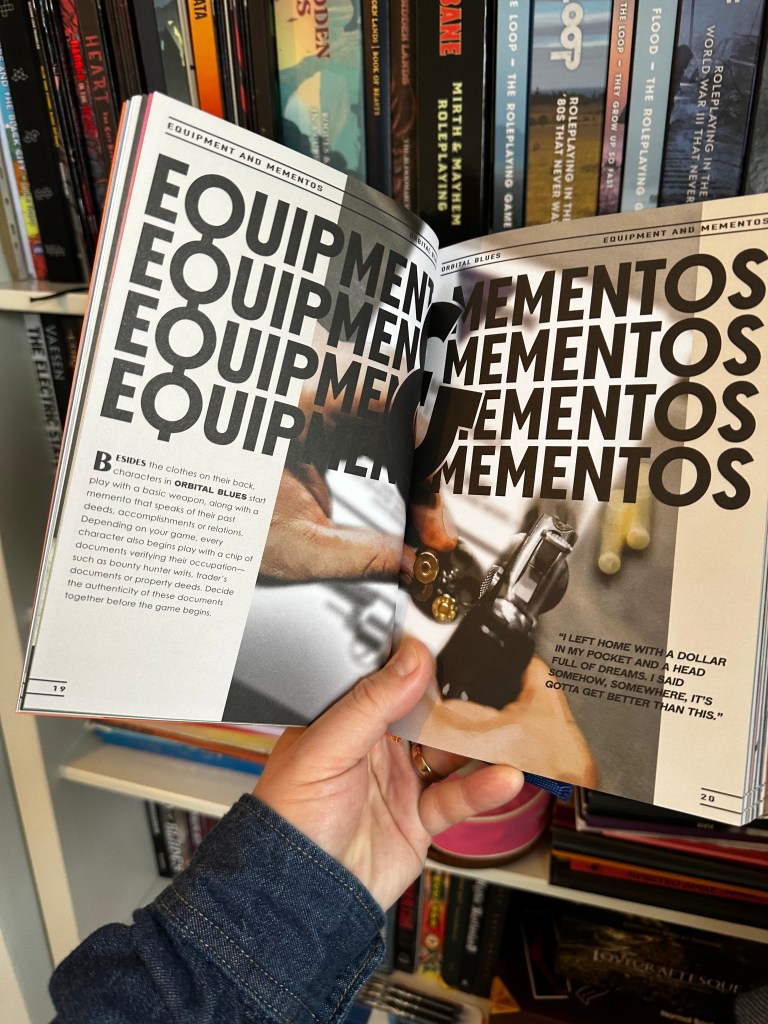
Equipment and Mementos

Avery gets one weapon, a memento and one piece of crew equipment.
I could roll a d12 to determine the starting weapon but I think it makes sense that Avery takes a sniper rifle given his background and gambit.

There is also a (1-18?) table for mementos but I spotted one on it that simply fits so well, its “Bounty on a former lover.” I would like to change it from “former lover” to “step-father,” though.

Finally, the piece of crew equipment: A night-vision scanner makes sense here, I think.

Soundtrack

Your Soundtrack
Your Soundtrack

Avery needs his own theme tune to act as a leitmotif for him at those most dramatic of moments. This is such a cool idea that reminds me of Tales from the Loop and the best actual plays. I think Avery’s soundtrack tune is Sweet Jane by Cowboy Junkies

Conclusion

I might actually come back and make a ship for Avery and his pals as well, but this post is already long enough. I’ve had fun making this character. The process asks some really interesting questions of the player to make a troubled and complex outlaw who is likely to get more and more troubled as time goes on. The rules are simple, and very easy to grasp. Character creation was also pretty straightforward, although I did find there was quite a lot of flipping back and forth through the book during character creation. But that is just a small quibble really.

For now, see you, space cowboy…

Time for a Change

If you had to choose one, dear reader, which one would it be? If you are one of my potential players, which one would you like to play?

Anniversary Posts

More anniversary guest posts coming soon. In the meantime, have some musings.

Old School Rut?

I’m not sure how it happened but, recently, all I have been playing is OSR, trad and adjacent games. With the exception of Dungeon World, which is about as close to D&D as you can get while also flying the PBTA banner, its been wall-to-wall, dragon games, Borgs and Troikas. And this week? It’s Dragon Age, DCC and maybe some Black Sword Hack or UVG (which is pretty trad in its ruleset to be quite honest.) Am I in a rut or have I just naturally gravitated towards these games? Maybe I have found my niche and I’m occupying it. I don’t think that’s it. I think it has more to do with the ease with which I can roll out one of these games, if I’m the GM, at least. It’s also pretty easy to fall into one of them as a player when you’re familiar with the overall concepts, rulesets and themes. And, don’t get me wrong, it’s not that I’m not enjoying them. But it is time for a change, I think.

Options

So, I have a few options of non-OSR, non-D&D, non-trad games to try out in the near future. My current game of Troika! will be coming to an end next week and Dragon Age probably only has a couple of sessions left in it, for a while. So, some calendar spots are opening up! I’d like to fill them with something completely different.

Triangle Agency – I’m reading this at the moment. I have to say, so far, I’m loving the way the game is presented, the really original ideas, the surprisingly bare-bones ruleset and the way it treats the GM (General Manager) as as much of a player as the Agents. It has gotten me excited to play it and I am trying to get potential players excited about it too. The downside is that I feel like I still have a lot to read before I can think about getting it to the table.

    Slugblaster – I got this great boxed set for Christmas and have yet to crack the spine of the rulebook in anger. But I have been listening to the excellent My First Dungeon actual play of the game over the last several weeks. It has made me want to try it out despite having little to no understanding of skate culture. I know at least one player who would be very interested in playing so I’m sure I could get a few more. Once again, the difficulty is that I have not even skimmed the rules yet. This is somewhat ameliorated by the fact that I’ve been learning how to play while listening to the podcast.

      Blades in the Dark – Although I was a player in a campaign of Blades last year, I still haven’t run it as the GM. I think I would enjoy doing it and it is such a classic, it would be a shame not to put a game of it together. And it is the basis for games like Slugblaster and The Wildsea, which also feature on this list. I have been nicking enough rules from it for my D&D game, also, that I feel confident I would mesh quite well with the ruleset. At least I have read this one cover to cover and played it before, so that’s a big tick in the “pro” column for Blades.

      The Wildsea – I wrote about this already last year and still haven’t managed to run it! Essentially, this game imagines a world where the entire surface has been covered in a vast forest and your players are sailors across the canopy, using boats with giant chainsaws attached to sail. Take a look at the last post about it if you want more info. I have rad a lot of this and could probably run it ok, but I am afraid of doing another game where my players are sailors as I am already doing that with Spelljammer and kind of, with UVG.

      Deathmatch Island – I also wrote about wanting to play this around this time last year. I having been feeling the urge to scratch the Lost, Severance type itch over the last few months. I watched both of those shows in the last half a year and they have stuck with me a lot. I think Deathmatch Island would be perfect for that. Also, I have read it completely and would be very excited to try out its mechanics. Here’s my post about it from last year.

        There are a couple of outsiders as well, Orbital Blues and Apocalypse Keys, both of which I purchased on something of a whim (and a sale.) I’m curious about them but have barely opened either. I know Apocalypse Keys is a PBTA game and that it is beautifully illustrated, but that’s about it. And I know Orbital Blues is a game of sad space cowboys ála Cowboy Bebop and Firefly so that is a big tick in its favour as far as I am concerned.

        If you had to choose one, dear reader, which one would it be? If you are one of my potential players, which one would you like to play?