I’m not traveling this time, dear reader, but I have a pretty busy week on my hands. Tonight, I have a Heart one-shot, specially requested by fellow Tables and Tales GM, Shannen. I have been beavering away at the preparations for that the last couple of days. This weekend, my nieces are visiting and I’m planning another one-shot for them, too. Also, honestly, after the last mammoth character creation post for the Wildsea, I was simply not able to dive right into another one straight away, anyway. So, I took a break, and decided to focus on the important things in life, finding ever more inventive ways of allowing the PCs in this Heart one-shot to bring poetic ends to themselves.
Death Match Throwback
The next character creation post on the agenda is for Death Match Island. So, as a consolation, please take a look at this post from last year where I go into the rewards from the Death Match Island crowdfunder and also the rules and stuff:
The book presents many, many options in each step, and that’s even using the Quickstart kits. Without the Quickstart rules, you can really choose any options from any bloodlines, origins and posts, to truly customise your character as you like.
This is the fifth in a series of character creation posts I’m using to figure out which game I want to schedule for our next campaign. You can find the Triangle Agency one here. And you can find the Slugblaster one here. You can find the Blades in the Dark one here. And most relevant to today’s post, here’s the Wildsea Ship Creation post.
A Character to Fit the Beacon
In my last post, I created a ship for my Wildsea character to pilot across the Thrash. The ship, it turned out, is a research vessel, fast and dangerous, but not very manoeuvrable or stealthy. It’s got a beehive for an engine and an acid-cannon for protection. It also has a colony of glow bugs that follow the crew around illuminating their surroundings for them. I named the ship the Beacon.
So, what kind of wildsailor am I going to come up with to match the vibes of the Beacon? Let’s find out, dear reader!
Character Creation Steps
Character Creation chapter illustration
There are three important choices to be made in this process:
Your Bloodline
Your Origin
Your Post
Now, while these choices are minimally restrictive, the beginning of the Character Elements chapter encourages you to build a narrative background around the framework of the mechanical choices. In fact, throughout character creation, you are encouraged to be creative and to make unique wildsailors that no-one else has ever made before.
Also, there are many other elements to a Wildsea character, it’s just that most of them hang off these three choices. All of these are explained in the Character Elements chapter.
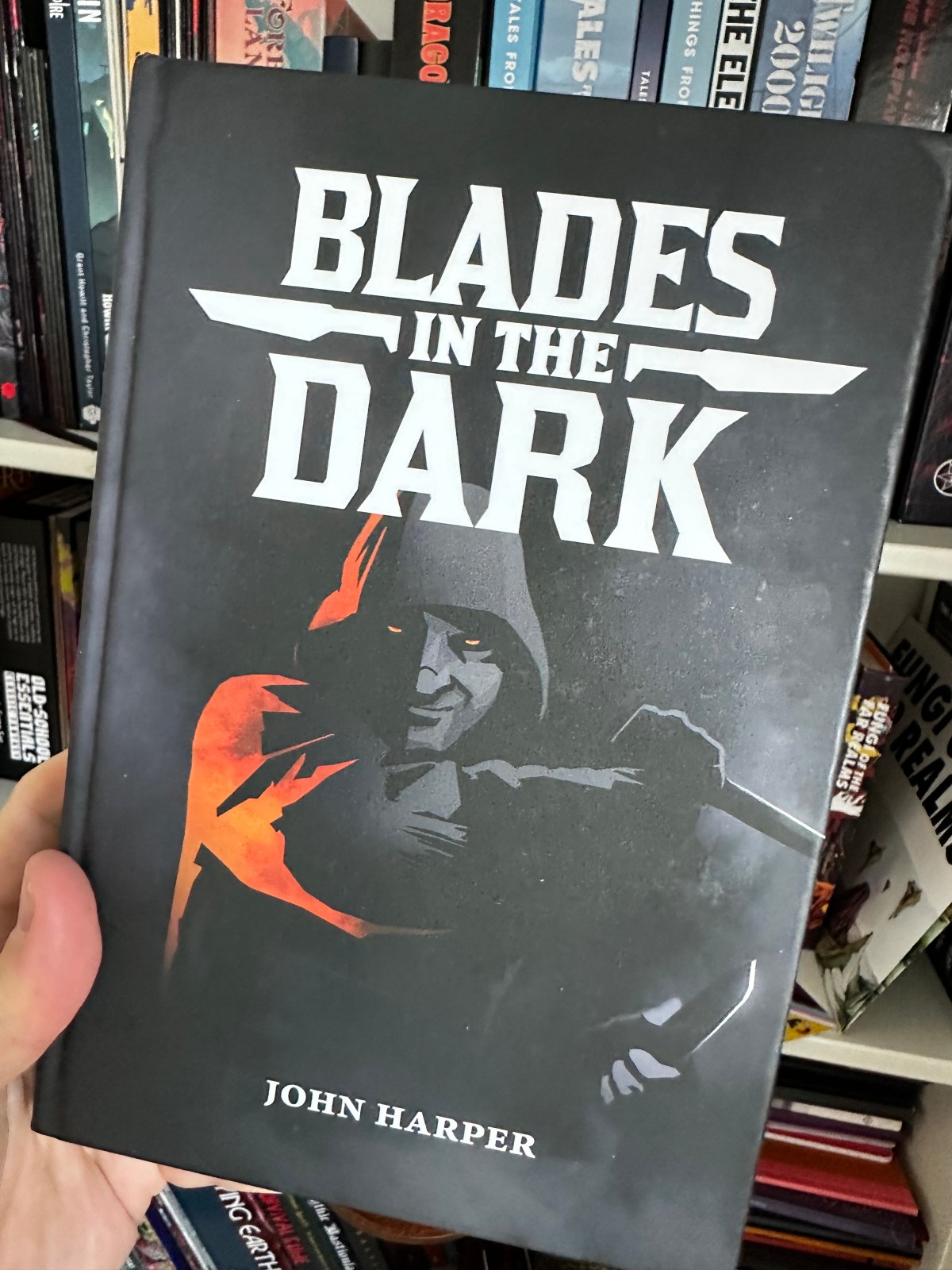
At this point, I think it’s important to point out that the Character Elements chapter is there only to explain those elements, not to help you create your actual character. That’s all in the following chapter. One thing I have found with the Wildsea is that it devotes a lot of space to explaining everything. Occasionally, I find that this is at the expense of functionality. The book goes to some lengths to inform you what the Cook skill allows you to do, when, in a storytelling game, this could usefully just be left up to the players around the table. It’s also because so many of the terms used in play are quite unique, Twist, Edges, Whispers, Cut etc. Although most of these bear some resemblance to elements of other games, the resistance to using those better known terms means they require more explanation. I found this also in Slugblaster, an ostensibly Forged in the Dark game that uses a lot of setting/genre-specific terminology for concepts that are more functionally named in Blades in the Dark.
Anyway, I’m going to move on from the Character Elements chapter immediately. If I need to explain anything, I’ll do it as I build the character.
Young Guns or Old Dogs
This is a welcome choice to start with. It reflects the type of game you’re preparing for. If you go for a Young Gun, you start with fewer skills, aspects and resources, leaving the character more room to grow. The Old Dog has more going for them, but is meant for one-shots or short campaigns. For my purposes, I’m going to create an Old Dog, to show off more of the character elements in this blog post. So, an Old Dog starts with the following:
1 Bloodline, 1 Origin, and 1 Post
3 edges
15 skill / language ranks (maximum starting rank 3)
6 aspects taken from any bloodlines, origins, or posts
6 resources
3 drives and 3 mires
Ardent Quickstart Kit
For ease of one-shot character creation, there is a Quickstart Kit presented in the section for each bloodline, origin and post. These break it down to a selection of easy choices.
In the interests of keeping this post below 2000 words, I’m going to use the Quickstart kits as and when I feel its appropriate.
Bloodline
Here are the options for Bloodline:
Ardent – human
Ektus – cactus-folk
Gau- fungus-folk
Ironbound – ship-ghosts with bodies of salvage
Ketra – gelatinous humanoids
Mothryn – moth people
Tzelicrae – hive-mind spider colonies in a human skin
A Ketra with a chart
Remember this is a Researcher we’re making here, so I think it would be useful for them to be good with technology. The Ketra are described in the book as “tech-savvy.” So, I think that’s what I will go for.
The ketra are the descendants of those fragments of ancient humanity trapped in tunnels and sturdy temple complexes, mineshafts, and mountain-seams. Like the ardent, they have adapted to face the post-Verdant world, but with a far more dramatic biological change – tentacular mantles, translucent fl esh, and swirling, ever-moving inkblot patternings are common. Many ketra reinforce their malleable forms with selfmade skeletons of salvaged driftwood or repurposed scrap-metal.
Questions
The first thing to do with your new ketra is answer the following questions:
Q: Have you spent any time in the ‘ancestral’ ketra places and, if so, how did you find their dark, crampled confines? A: Yes, my character spent the early part of their life below the waves. Only as a young adult did they venture above the Thrash where they were discovered by the original owner of the Beacon, an Ardent named Benida Hoffspring
Q: How original is your skeleton, and if you’ve replaced parts of it yourself, what new materials do you rely on for support? A: Many parts of their skeleton have been replaced, most notably, the lower jaw is shaped by a perfectly formed piece of Ironwood. It juts out more than it should. Other bones have been replaced with sturdy pieces of salvaged metal and ceramic.
Q: Were you passed down any stories of your family’s old human days, or is your preverdant lineage lost to history? A: There was an old album of photos, preserved in plastic. It revealed a world long gone, of Ardent cities and water-going ships. Their ancestors were sailors…
Bloodline Aspects
Aspects differentiate your character from another one with the same bloodline, origin or post. They make them unique. They can take the form of a physical trait, a companion, or a piece of gear. So, with the Old Gun type of character, you can choose 6 Aspects from bloodline, origin or post. As a Quickstart character, I’ll choose two from each step. If I list off every Aspect from every step, this post will be another giant. Instead, I am going to list only those that catch my eye for the character. Here are the bloodline aspects I want to choose from:
Scrapper Enzymes 3-Track Trait You can use salvage as a component when concocting a potion or chemical mixture, no matter its form.
Scrap-Metal Skeleton 3-Track Gear The internal structures you’ve collected can store biovoltaic energy. Use a task to create a resource, Scrap-Bone Battery.
Drone Attendant 3-Track Companion A simple punchcard-driven repair construct. Increase impact when repairing or tinkering with other machines.
From these three, I love the idea of this character brewing up potions and stuff on the fly so I am going choose Scrapper Enzymes for that. I also have simply got to choose a companion when available and narratively fitting, so Drone Attendant is coming too.
Bloodline Edges
Edges are areas of talent. They literally give your character an edge in certain situations, meaning you get an extra 1d6 in your dice pool if appropriate. They are rather poetically named, but mostly speak for themselves nonetheless. Here are the edges presented in the Ketra Quickstart kit:
Iron – “An edge of force, determination, & willpower”
Sharps – “An edge of logic, wit, & planning”
Veils – “An edge of shadows, ciphers, & secrecy”
For this ketra researcher who crawled out of the depths on their own, I’m going to choose Iron and Sharps.
Bloodline Skills and Languages
These get ranks. You start at rank one and go up to rank three. You get an extra d6 in your dice pool for each rank in the skill you are using when appropriate. I have to choose five of these. Here are the available skills in the Quickstart Kit:
I’m going to take Concoct, for sure, to go with the Scrapper Enzymes Aspect. I’m also going to take Delve, as someone show used to live in the ruins beneath the wildsea. And for my final Skill, I will take Scavenge, an important one for a scientific researcher/person who replaces their bones with random stuff.
And here are the available languages (you get a certain amount of lore with these too):
Chthonic – old human
Raka Spit – “The rapid patter of hunting-families and leviathaneers”
Signalling – inter-ship communication
Got to take Chthonic, probably their native tongue. Also, I just love the name of the language, Raka Spit, so I’ve got to take that too. Everyone gets a rank three skill in the trade-tongue, Low Sour, also.
Bloodline Resources
Resources can be used to get advantage on an action roll. They come in four different types as you can see below. I have to choose two of these to start with:
Salvage: Ceremonial Dynamite, Old Driftwood Specimens: Luminescent Bone, Curled Centipede Whispers: The Comforting Dark, All Tunnels End Charts: A Faded Schematic
As a researcher, I think I have to take at least one specimen and the “Luminescent Bone” is the most thematic for this character. Perhaps it’s one of their own old bones?
I love the concept of Whispers in this game. They are like memes that can be passed on, inherited or sold, but once they are used, they are gone forever. I’ll take “the Comforting Dark.”
Bloodline Drives and Mires
Before making this decision, we need to understand the concept of Milestones in this game. They come in minor and major flavours and you write them for yourself. They work a bit like Beats in Heart. Achieving a major milestone allows you to improve your character more than a minor one.
So Drives, then, are the goals your character works towards to gain milestones. You can also gain a Whisper, or clear a mark of Mire when you move towards your drive goals. It’s important to note that they can change over time too, particularly if and when you achieve one of them.
Mires, then, are the negative psychological and physical effects of long-term exposure to the Wildsea. They will cut one or two dice from your rolls whenever you act against the effect of the mire.
Here are my options: Drives
“Raise a pre-verdant structure” – this makes the most sense to me as a curious scientist
“Hoard treasures of the wider waves”Mires
“Sparks and jolts course through your extremities” – got metal bones, will take this one
“Your inkblot patterns whirl dizzyingly”
Origin
What were you before you were a wild sailor? The options:
Amberclad – like Captain America but in amber
Anchored – ghosts of the Wildsea returned to life
Ridgeback – mountain folk
Rootless – born on the waves
Shankling – raised in the tallest trees
Spit-Born – brought up in the safety of an island or ruin
For this scientifically minded wild sailor, with the sort of backstory I have already incorporated, I think it would be very fun if they were an Anchored!
An Ardent Anchored
the anchored, a tangible, physical presence on the waves despite being, by almost all definitions, very much dead. These souls are given substance by their anchor, a single physical object that was left at the surface when their body fell. It might be a memento, a favoured weapon, a chart pointing the way home – whatever it is, it was enough of a tether to keep them from passing over, and to confer a level of impressive material control.
Normally, this would mean they came from above and their body was lost below, but for this ketra, I think it would be the opposite. When their original body died, just as they first emerged from above the surface, they reformed around a tether, something they brought with them from home. That was when they were brought aboard the Beacon for the first time. Their Anchor was the only thing left of them when they died, that wooden jaw.
Anchored Questions
Q: Do you remember your death? If so, what caused it? A: No. The exact circumstances are hazy and plot-relevant Q: To what extent do you feel connected to the world around you, now that you don’t follow quite the same rules of physicality as most? A: They constantly strive to understand the world around them, scientifically, intellectually, and emotionally Q: Have you ever come close to losing your anchor? If so, what happened? A: No, as an integral part of the body, it has never been removed.
Anchored Aspects
Spectral Variance 3-Track Trait Mark to become insubstantial for a short time, allowing you to float and pass through solid objects.
Geist Hand 3-Track Trait You can manipulate nearby objects without touching them, though the heavier they are, the harder it is.
Tempered Anchor 5-Track Gear Your anchor to the world is reinforced against damage and tampering, a wise move for a fleeting ghost.
I’m going to go for Geist Hand as suitably spooky and Tempered Anchor for purely practical purposes.
Anchored Edges
Here are the options: Iron – already took this one Tides – “An edge of exploration, learning, & lore” Veils – “An edge of shadows, ciphers, & secrecy”
I guess it has to be Tides and Veils. Tides is particularly fitting for the researcher, I think.
Going to take lots of skills this time. Brace is a defensive skill that will be generally useful. Outwit is a good one for a ghost, Sense seems equally appropriate for the Anchored. Also Wavewalk, normally meaning the ability to navigate the wildsea without a ship, could mean gliding along it spectrally. Also going to take Old hand (sign language) as a language.
Anchored Resources
Salvage: Old Memento, Broken Locket Specimens: Glowing Plasm, Spectral Flower Whispers: Back from Beyond, Drowned and Not Charts: A Sketch of Shadowed Paths
Absolutely must take Back from Beyond as one of these. Also, a Broken Locket from Benida Hoffspring.
Anchored Drives and Mires
Drives
“Send other spirits to a peaceful rest”
“Reconnect with your friends and family” – This could be a fun adventure beneath the waves. I’ll take it!
Mires
“Your material control wavers erratically” – classic ghost-trope. Thanks.
“Visions of your past death are difficult to banish”
Post
Your Post is essentially your job on the ship. There are a lot of options here: Alchemist – speaks for itself Char – cook (sorta) Corsair – swashbuckler Crash – demolitions expert Dredger – scavenger Hacker – hacking through the wildsea Horizoneer – adventurer Hunter – ‘nuff said Mesmer – mind-controllers Navigator – yep Rattlehand – engineer Screw – Magnetos Slinger – ranged attackers Steep – tea-brewers Surgeon – you know what this is Tempest – Electro Wordbearer – postman
There are several that are very tempting, like the Tempest, the Mesmer and the Char, but I think there is only one logical answer here, Alchemist. Right?
Alchemist
Alchemists are masters of concoction and reaction, able to combine chemicals and arconautic knowledge with unexpected (and occasionally unstable) results. Some alchemists focus on the healing arts, some on transformation and understanding, and others on more… explosive pursuits.
Alchemist Questions
Q: Do you specialise in certain ingredients, or take whatever you find and do your best? A: They are curious about everything. Experimentation is key Q: What was the worst unexpected side-effect you (or an unfortunate crewmember) ever experienced from one of your alchemical creations? A: For a brief time, a crew mate died and became spectral like them, but just for a few minutes Q: What draws you to such a specialised field of study? The lure of knowledge and understanding, or the power to change the world to your own design? A: They are obsessed with the building of knowledge to understand this world and what they are doing in it still.
Alchemist Aspects
I will choose two from the following three:
Ulcerous Alembic 3-Track Trait You can swallow two alchemical components, keeping them safely in your stomach. You can concoct them internally when you choose, benefitting immediately from the results or spitting the resulting solution out.
Baseline 3-Track Trait Mark to briefly ignore any positive or negative effects stemming from a temporary benefit or injury. You are always immune to the negative effects of crezzerin.
Explosive Vials 3-Track Gear Not an endless supply, but potent and disorienting. Mark to deal LR Blast, Salt, Acid, or Toxin damage to multiple nearby foes.
I’m going to take Baseline, since it makes sense due to my bloodline and origins. I’m also going to take Explosive Vials for fun.
Alchemist Edges
These are the options:
Grace – “An edge of elegance, precision, & agility”
Sharps – got it
Tides – and this
So I will take Grace, but I will need to choose another that isn’t listed. There are only two more that I don’t already have. I will go with: Instinct – “An edge of sense, intuition, & reaction.” Which just feels right.
No doubt I’m taking Break, Harvest and Study as skills. And with my last two skill ranks, I am going to upgrade Concoct and Study to Rank 2.
Alchemist Resources
Salvage: Pouch of Vials, Rust Extract Specimens: Dried Locusts, Draketongue Root, Beast Blood, Poison Glands Whispers: A Tale of Choking Mists Charts: A Stained Snapograph
I will take one Salvage this time, Pouch of Vials, and also another Specimen, Poison Glands.
Alchemist Drives and Mires
Drives
“Discover a previously unknown alchemical effect”
“Gather bile from an ancient leviathan” – maybe on the way down to visit their family?
Mires
“You’re the perfect test subject for your own work”
“Explosives are unstable around you” – this is too funny to pass up.
Final Touches
Name: Dhalsim Goodbottle Pronouns: They/Them
Lets put it all together
Background
Bloodline: Ketra Origin: Anchored Post: Alchemist
Edges
Grace
Iron
Instinct
Sharps
Tides
Veils
Skills
Brace 1
Break 1
Concoct 2
Delve 1
Harvest 1
Outwit 1
Sense 1
Study 2
Wavewalk 1
Languages
Low Sour 3
Chthonic 1
Raka Spit 1
Old Hand 1
Resources
Salvage: A Broken Locket, a Pouch of Vials
Specimens: Luminescent Bone, Poison Glands
Whispers: The Comforting Dark, Back from Beyond
Aspects
Scrapper Enzymes 3-Track Trait You can use salvage as a component when concocting a potion or chemical mixture, no matter its form.
Drone Attendant 3-Track Companion A simple punchcard-driven repair construct. Increase impact when repairing or tinkering with other machines.
Geist Hand 3-Track Trait You can manipulate nearby objects without touching them, though the heavier they are, the harder it is.
Tempered Anchor 5-Track Gear Your anchor to the world is reinforced against damage and tampering, a wise move for a fleeting ghost.
Baseline 3-Track Trait Mark to briefly ignore any positive or negative effects stemming from a temporary benefit or injury. You are always immune to the negative effects of crezzerin.
Explosive Vials 3-Track Gear Not an endless supply, but potent and disorienting. Mark to deal LR Blast, Salt, Acid, or Toxin damage to multiple nearby foes.
Drives
“Raise a pre-verdant structure” “Reconnect with your friends and family” “Gather bile from an ancient leviathan”
Mires
“Sparks and jolts course through your extremities” “Your material control wavers erratically” “Explosives are unstable around you”
Conclusion
Well, that was pretty epic, wasn’t it, dear reader? Excepting only the Dark Sun character creation post, that was the longest one I’ve ever done. There are a lot of choices to be made in this process. The book presents many, many options in each step, and that’s even using the Quickstart kits. Without the Quickstart rules, you can really choose any options from any bloodlines, origins and posts, to truly customise your character as you like. I imagine that would be nigh on impossible to do without an encyclopaedic knowledge of the options presented in about 60 pages. I would not even attempt to do it without having made a Quickstart character or two first. On the plus side, it was quite fun. The options presented are incredibly evocative and helped me envision my character aboard the Beacon. The drives and mires, in particular gave me a peek into the heart of Dhalsim Goodbottle. The other options gave me an exceptionally good look into the world of this game.
Dear reader, have you had any experience with the Wildsea? Have you sailed its verdant waves? Have you plumbed its leafy depths?
Felix Isaacs has suggested that you start by creating your ship and only then move on to the creation of the characters who will crew it. And who am I to argue with Mr Isaacs?
This is the fourth in a series of character creation posts I’m using to figure out which game I want to schedule for our next campaign. You can find the Triangle Agency one here. And you can find the Slugblaster one here. You can find the Blades in the Dark one here.
Shipbuilding
I recently reposted a piece I wrote last year about the Wildsea and how it exemplifies the tradition of giving your PCs something to care about and then fucking with it. Please check it out for the basics of the game, the setting, and the ruleset. In that post, I pointed out that, creator of the Wildsea, Felix Isaacs, has suggested that you start by creating your ship and only then move on to the creation of the characters who will crew it. And who am I to argue with Mr Isaacs?
Stakes
How much do you have to spend on your new ship? Well, the buying process is abstracted out to a number of stakes. You don’t need to worry about defining the exact amount of currency required to outfit a new boat, you just split it up like a pie. Each crew starts with 6 stakes to spend on ship creation, with an additional 3 per PC who will be crewing it. Most options will cost a single stake but some more powerful ones will cost two or three. Since I don’t have a real party, I’m going to pretend I have a full compliment of three, leaving me with a total of 15 stakes.
You can’t get any more Stakes to improve your ship during play, but it is possible to trade cargo for the same upgrades later.
Next, in the Ships & Shipbuilding chapter, it has a short section on “Personal Touches.” I think these are important to making a ship feel like your own, but I think I’ll keep them to the end of the process.
Creating Your Ship
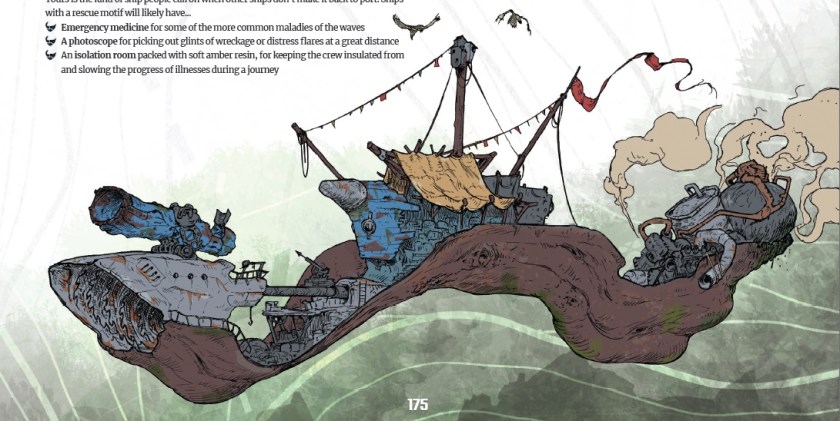
A Wildsea ship
The next page tells us about the steps to make your ship. There are three overall stages:
Design – you have to choose an option for each of the following:
Size
Frame
Hull
Bite
Engine
Fittings – these are all optional but they come in the following categories:
Motifs
Additions
Rooms
Armaments
Outriders
Undercrew – optional choices that come in the following types:
Officers
Gangs
Packs
On the same page, there is a helpful example ship statted out for us. It is essentially just a list of chosen options beneath each of the three stages. Beside each option is the cost in Stakes and the benefit it provides for the ship if appropriate.
It also lists the Ratings for the ship.
Ratings
These are tracks (tracks are like clocks in Blades in the Dark, in some instances and like health bars in others) that are used to record the current status of various aspects of the ship. Every ship will have all six of these:
Armour – speaks for itself
Seals – How well your ship keeps out the nastiness from the Wildsea
Speed – ‘nuff said
Saws – most ships use giant chainsaws or something similar to power their way through the waves of leaves and branches.
Stealth – how well can your ship pass undetected?
Tilt – this is your ship’s manoeuvrability
Each one of these Ratings starts as a 1-track but we’ll be adding to that as we progress. Keep these Ratings in mind as we go through the process!
Step One – Design
Normally, this would be done by committee. Every player should be involved in the decisions on which the foundations of the ship are built. But, obviously, in my case, that’s not possible. Anyway, here we go!
Size
There are four sizes available and they each cost 1 Stake:
Nano – big enough for one person and maybe a passenger. +1 Stealth
Small – can easily accommodate between two and four sailors. A good starter ship. +1 Speed
Standard – perfect for five to ten people. +1 Armour
Large – ideal for ten to twenty people. +1 Armour and -1 Stealth
I have a limited number of Stakes so I feel like a Small ship is the way to go. Also, it’s for a crew of up to four, so it’s just right.
Frame
The Frame, the book tells us, betrays a certain attitude that you want your ship to give off to other wild sailors. Your choice will also give Rating modifiers like Size does. Here are the six available Frames:
Sturdy – meant to weather storms and bombardments both. +1 Armour
Moulded – somehow constructed from a single piece of some material. +1 Seals
Light – lightweight and dainty. +1 Speed
Scything – all about cutting through the treetops as well as they can. +1 Saws
Sleek – Keeps you “low to the waves,” and as quiet as possible. +1 Stealth
Flexible – bend before breaking. +1 Tilt
I personally think that one of the coolest aspects of these wildsea vessels is the fact that they use enormous chainsaws to cut through the canopy. So, I’m going to lean into that and choose the Scything Frame, giving +1 Saws and costing 1 Stake.
Hull
Interestingly, you can have more than one of these, if you like, but you must have at least one, for obvious reasons. There are twelve Common Hulls and three more Unique ones listed here. The cost ranges from free to 3 Stakes. Here are the Common ones:
Reef-Iron – 1 Stake, +1 Armour
Leviathan Bone – 1 Stake, +1 Seals
Broadwood – 1 Stake, +1 Tilt
Rough Bark – 1 Stake, +1 Stealth
Chitinous – 1 Stake, +1 Speed
Razorscale – 1 Stake, +1 Saws
Beastback – 2 Stakes, +1 Seals, +1 Tilt, “A half-living hull of flesh and bone, flexible and unsettlingly warm.”
Ceramic – 2 Stakes, +1 Armour, +1 Seals
Chrysalid – 2 Stakes, +1 Seals, +1 Stealth, “A hull adapted from the cast-off chrysalis of a massive insect, excellent protection against the sea’s incursion.”
Ghost-Oak – 2 Stakes, +1 Armour, +1 Stealth
Arachnesque – 2 Stakes, +1 Tilt, +1 Stealth, “Less of a hull and more of a giant insect grown to fit the specifications of your frame, usually something spider-like.
Exile’s Copper – 2 Stakes, +1 Armour, +1 Speed
Here are the three Unique Hulls:
Junk-Strung – Free, +1 Armour, -1 Seals, can salvage parts from it
Monument – 3 Stakes, +2 Armour, +2 Seals, made from mountain stone so can’t “Forge-ahead during a journey”
I like the idea of adding a little Armour Rating at this stage but also building on the Speed I improved before so I am going to go with Exile’s Copper for the Hull giving me a +1 Armour and +1 Speed. It will cost 2 Stakes but I think its worth it.
Bite
This determines the way your ship is propelled. It will also have an effect on your ramming damage and the ease by which others might track you. There are twelve Common Bites listed, as well as several different types of sails and a trio of Unique Bites as well. Here are the Common ones:
Sawprow – 1 Stake, +1 Saws, big chainsaws! Close Quarters (CQ) Serrated damage
I am not going to go into all the Sail and Unique options here because there are too many already, to be honest, and I know I don’t want any of them. I need to stick to my guns, or my chainsaws in this instance. As I am worried about the number of Stakes I have left to spend, I won’t go for the Longjaw. Instead I’ll go for option number one, Sawprow, for 1 Stake, giving me +1 Saws.
Engine
This is the last bit in the Design stage. A few things to note about the ship’s Engine:
It can be used for more than just propulsion
It will require a specific type of fuel
In most instances, don’t worry about tracking the fuel
There are eleven Common Engines and four more Unique ones. Here are the Common ones:
Chemical Compressor – 1 Stake, +1 Speed. Fuel – crushed fruit and insect husks
Springwork – 1 Stake, +1 Saws. Fuel – manual labour
The Unique Engines are fun too. One of them is this:
Tamed Hive – 2 Stakes, +1 Speed, +1 Seals. It’s a massive hive and can produce honey. Fuel – flowers and pollen
I love the whimsy of the Tamed Hive so much that I must have it! That’s 2 Stakes but it adds +1 Speed and +1 Seals
There won’t be any more changes to the Ratings from the remaining steps so our final Ratings are:
Armour – 2
Seals – 2
Speed – 4
Saws – 3
Stealth – 1
Tilt – 1
A weird looking wildsea ship
Step Two – Fittings
Pretty much every part of this is optional, which is just as well because I only have eight Stakes left…
Motif
So this is the general theme and purpose of the ship. Choosing one can help the whole crew get a clear vision of the vessel and will also influence how others see you and it. They provide specific things like emergency medicine, gaudy appearance or a reinforced engine room. They do not provide mechanical effects but they may play a part narratively.
Here are the available Motifs. They each cost two Stakes:
Transport
Hauling
Hunting
Salvaging
Pathfinding
Raiding
Rescue
Research
Entertainment
You don’t have to choose a Motif for your ship but I am enamoured by the idea of a Research vessel out there on the wild waves. Perhaps the unconventional engine was something we discovered during a past expedition and we figured out how to make our ship go with it through the power of research!
A Research vessel:
has better tech on show than most ships
contains a research library
houses a snapograph arrangement. Its a sort of big camera
Additions
There are so many of these, most of them costing a single Stake. We’ve got Firefly Lanterns, a Cargo Crane, a Steam Whistle and lots more. But, as I am getting worried about how much I’ve spent already, I am only going to pick up:
Anchor System – Its Free!
Tethered Kitesail – 1 Stake – its a glider that is hooked to the deck. Lets us go up and get a bird’s eye view when the wind’s up
Rooms
On a Small Size vessel it’s not a great idea to split your already limited space up any further. You already have the following rooms on your ship:
A Pilot’s Cabin
A Main Deck
Crew Quarters
An Engine Room
A Cargo Bay
You can add a lot of different types of rooms like a Galley, a Navigational Suite, a Tap-Room or a Brig and they are all optional.
But this is a Research vessel now and I feel like we need a good way to observe stuff. We have the glider to allow us to watch from above. I would like to add a Cupola to the hull, near the rear of the ship, giving a great view of the Underthrash. That costs one Stake. I am down to just four Stakes left.
Armaments
Weapons are next on the Fittings list. These, too, are optional. In this case, they are either placed on deck or fixed to the Hull. I’m not crazy about the idea of armaments for a Research vessel, however, since our Stealth sucks, I think it’s prudent.
We have a lot of choices, from Trebuchet to Storm-Rail to Broadside Cannons and a Bladed Prow. But I’m going to pick up something suitably sciencey:
Viper’s Tooth – 2 Stakes, sprays an acid of some sort dealing Long Range Acid Damage.
Outriders
This is another option for defence. Honestly, with a Small ship, I don’t have the space for this and I also don’t have the Stakes to spend on it. You have to build an Outrider much like a ship, although it only has two components. You will also then need to add a way to store and deploy it from your actual ship. It seems like a fun extra but I can’t afford it.
Step Three – Undercrew
Octopus crew
These come in three varieties: Officers, Gangs and Packs. I’m not going to go into detail on each variety as this post is already way too long. Suffice it to say, the officers are Skilled, Experienced or Well-Travelled, the Gangs are not necessarily what you might think of when you think of Gangs (some of them are Tinkers, some are Spear-Fishers, but some are actual Marauders) and the Packs are animals…
You can have Spring-Foxes which leap along beside your ship to warn of danger, Rig-Ferrets who can do knots, Squirrel Flingers who will fight to defend your vessel. But what I want is one of the Insect Packs:
Glowbug Parade – 2 Stakes, they follow the crew members around and illuminate their surroundings for them!
Personal Touches
And so, with all Stakes spent, we come back to the start and our little idiosyncrasies. The book suggests describing the following, so I will:
Colour and Style – I think it was once a scientific grey and white, all straight lines but now it is a dark shade of honey as the insects crawled all over it. It’s all smeared and waxy. The crew have left it that way as they think it protects from parasites
Shape and Construction – I think this ship is quite blocky, almost as though it was constructed from prefab elements. But, once again, the engine bees have shored up all the joints and seams with wax and honey, making it look far more organic
Quarters Decoration – I don’t have my character created yet so I am going to revisit this when I have made them. I expect that all the crew sleep in a single chamber, though. They might each have a personalised corner
Quirk – Sometimes the bees go to sleep at night and we can’t get the engine to start
History – This has always been our ship. It has been on a mission of discovery and research for several years now. We were originally led by an old eccentric who built it and funded it. Now she’s gone, we carry on in her place
Research Motif (2 Stakes) Anchor System Addition (Free) Tethered Kitesail Addition (1 Stake) Cupola Room (1 Stake) Viper’s Tooth Armament (2 Stakes, Massive LR Acid Damage) No Outriders
Undercrew
No Officers No Gangs Glowing Parade Insect Pack (2 Stakes)
Conclusion
I’ll keep this short as that was very long. You should set aside a session just for this process, dear reader. There are a lot of choices and I can only imagine how much longer it would take with four or five people trying to come to agreement on it! However, it has given me a very clear idea of the Ship I just created and a few ideas for the type of character who might crew it.
You play a scoundrel…doing [heists] with your crew. The setting is Doskvol, a city in perpetual darkness beset by inter-faction strife, corrupt leaders, and supernatural entities. The end goal for the character is usually to retire from that life with enough coin in their stash to live safely and securely without worrying about rivals or the authorities.
This is the third in a series of character creation posts I’m using to figure out which game I want to schedule of our next campaign. You can find the Triangle Agency one here. And you can find the Slugblaster one here.
Forging a New Era
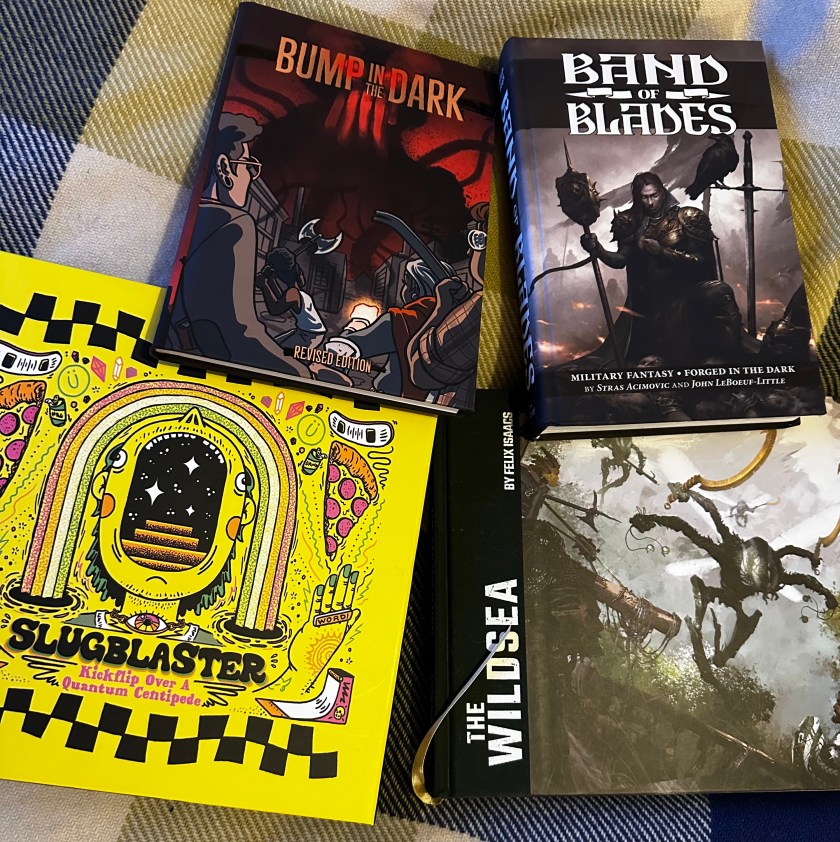
From top left, clockwise, the covers of Bump in the Dark, Band of Blades, The Wildsea and Slugblaster
Blades in the Dark, by John Harper has had such a profound impact on the TTRPG landscape since its release in 2017, that it’s hard to overstate it. It has a devoted following, it consistently appears on top ten RPG lists and it has spawned a bewildering array of games based on its system and setting. Forged in the Dark games like Band of Blades, Girl by Moonlight, Bump in the Dark, Slugblaster and Wildsea (debatably.) You can find a non-exhaustive list here.
The system is story-focused, encouraging players as well as GM to take a hand in building the narrative. Near the start of the book, it is pointed out that, “no-one is in charge of the story.” If I were to encourage you to take anything from this short summary, it would be that.
As in Slugblaster, you roll a D6 when attempting something. 1-3 is a failure, 4/5 is a success with consequences and 6 is a full success. The consequences from a failure or mixed success can come in the form of Stress, and thereby Harm and Trauma Conditions, which have more of an narrative effect on the story than a mechanical one (although they certainly have that too.) You can also add more dice to your roll and build a dice pool to give you more chance of rolling higher. You do this in several ways, by using pushing yourself, getting assistance or taking a Devil’s Bargain.
In all of these Forged in the Dark games, the rolls you make are highly abstracted. Instead of making a stealth roll, an investigation roll or a thieves’ tools roll, you describe what your character wants to do and then roll with the appropriate Action Rating. In most cases the Action encompasses a character’s whole part in a scene, rather than a single, explicit skill or combat thing like in D&D and similar games. The choice of the Action Rating used is explicitly left up to the player, but if the GM thinks it might be more effective to use a different one, they can reduce the impact of the action or increase the danger of the PC’s position, making the consequences for failure more severe.
Blades has several really cool mechanics, like the Flashback to go back and prepare something for the situation you find yourself in, but I don’t have the space to go into every rule here. Maybe I’ll do more of a deep-dive into the rules in another post. For now, let’s go about creating my Scoundrel.
Dark Heists
It’s important to remember the setting and the type of game this is. You play a scoundrel of some sort, doing jobs/heists/cons with your crew. The setting is Doskvol (or Duskwall), a city in perpetual darkness beset by inter-faction strife, corrupt leaders, and supernatural entities. The end goal for the character is usually to retire from that life with enough coin in their stash to live safely and securely without worrying about rivals or the authorities.
Blades in the Dark character creation steps
Playbooks
The types of characters available to play are suitably goth.
Cutter – violent and intimidating
Hound – crack-shot tracker
Leech – explosive alchemist
Lurk – shadowy sneak-thief
Slide – social and manipulative
Spider – factional mastermind
Whisper – magic and ghosts
There are seven of them, as you will have noticed. So, I’m breaking out the DCC zocchi dice again. I got a 4 on the d7 making this character a Lurk.
The Lurk
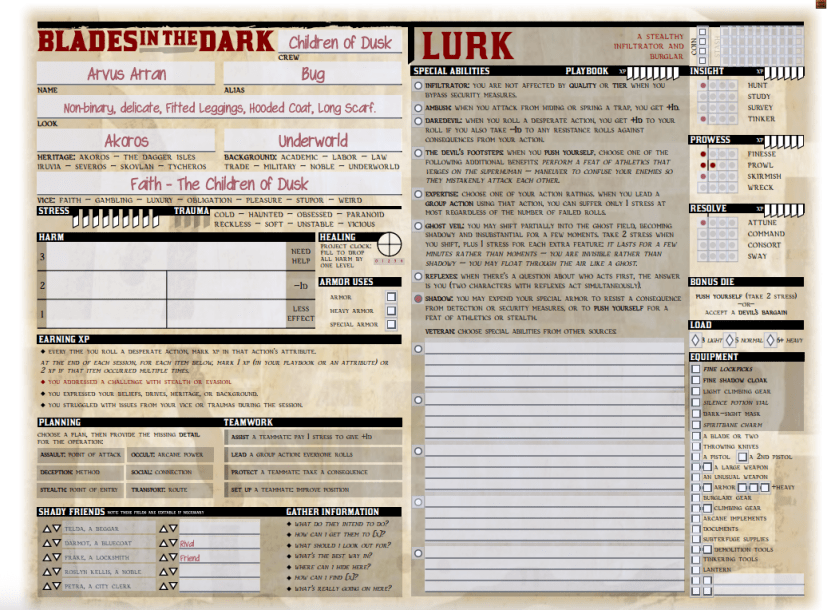
The Lurk playbook in Blades in the Dark
There is no longer any sunlight — the world is plunged into eternal night. There are scoundrels who live in the darkness, who prowl the underworld unseen, trespassing where they will. They are the burglars, the spies, the infiltrators, the cut-throats — commonly called Lurks.
After this pleasing intro, the playbook description tells me that my Lurk will gain xp whenever they “address a challenge with stealth or evasion.” Each of the playbooks have a different way to earn xp that’s individual to them.
Here also, it asks a couple of questions to get the player thinking, not just about the mechanics of the playbook, but about the personality and background of their character:
Q. How did you learn the stealthy arts of the Lurk? A. I was taken in at a young age by a band of pickpockets and sneak-thieves.
Q. Which Aspect are you drawn to most? The invisible watcher, spying on the unwary? The adroit acrobat, racing across rooftops? The deadly ambush predator, waiting for a victim in the darkness? A. The intimate knowledge of the city’s underworld, its back alleys and interconnected cellars, its rooftops and sewers. Where to spy from, where to approach a potential mark/victim from and how.
Starting Actions
Everyone has three Attributes:
Insight
Prowess
Resolve
Each of these has four Action Ratings hanging off it. Insight has
Hunt
Study
Survey
Tinker
Prowess has
Finesse
Prowl
Skirmish
Wreck
Resolve has
Attune
Command
Consort
Sway
You can have up to four points, or dots, in each Action Rating although you can only have up to two dots at the start. The Attribute Ratings will equal the number of associated Action Ratings they have any score in. So if you have any dots in Attune and any dots in Command, you will have a Resolve of 2. You use the Attribute Ratings to resist different types of stress.
In the case of the Lurk, I start off with 1 point in Finesse and 2 in Prowl. I will add four more points to Action Ratings at a later step.
Shady Friends/Rivals
Your connections to NPCs can be key to a successful or disastrous career as a scoundrel. There is a list of five in a table here. I’m going to roll my d5 once for a Friend and once for a Rival
Friend – 3 – Frake. This is a locksmith who has taught me everything I know about lock-picking. He has an encyclopaedic knowledge of every type of lock, chest, safe and safe room in the city
Rival – 2 – Darmot. Once, he was one of our band of pickpockets, now, he uses his knowledge against them. He’s busted me many times
Lurk Special Abilities
You only get one of the eight listed abilities to start with.
Infiltrator – you don’t suffer negative effects due to higher quality security measures employed by higher Tier enemies
Ambush – Gives you an extra d6 when attacking from hiding
Daredevil – get a bonus die if you take a desperate action as long as you take -1d6 to resist any consequences of it
The Devil’s Footsteps – push yourself to do the impossible. This ability has a variety of effects
Expertise – you have to choose an action rating and when you lead a group action with that, you can only take a maximum of 1 stress
Ghost Veil – go completely invisible by shifting into the ghost field. Just take some stress to do it
Reflexes – who should act first? You should, of course!
Shadow – use your special armour to resist consequences from security measures or pushing yourself in physical endeavours
The book suggests taking the first one listed if you can’t decide between them. However, I am going to roll a d8 to make the decision for me. That’s an 8!
Shadow
You may expend your special armor to resist a consequence from detection or security measures, or to push yourself for a feat of athletics or stealth. When you use this ability, tick the special armor box on your playbook sheet. If you “resist a consequence” of the appropriate type, you avoid it completely. If you use this ability to push yourself, you get one of the benefits (+1d, +1 effect, act despite severe harm) but you don’t take 2 stress. Your special armor is restored at the beginning of downtime.
I like this a lot. It matches the growing image of this character that I have in my mind.
Lurk Items
There is a section in the playbook description for items specific to the Lurk, but there is no need to choose anything at this stage. In Blades in the Dark, you simply indicate at the start of a Score how heavy a Loadout you have on you. That gives you a number of Load points to assign as the Score progresses. When you come across a situation in which you need “Dark-sight goggles” for instance, you write them down and mark the 1 Load that they take up. You never need to describe the items you have in your pack beforehand.
Heritages
The Shattered Isles map and description
There are six options here. Your Heritage is more akin to a real-world ethnicity or national background than a race or species. It is quite likely to shape your character’s politics, social circles and general way of thinking. It is unlikely to have any mechanical effect. Here are the Heritages:
Akoros – big, industrialised land. Like Europe. Duskwall is here.
Dagger Isles – peopled by corsairs and merchants who sail the seas between their isles and beyond
Iruvia – a desert kingdom to the south. Think Egypt.
Severos – a wild place with nomadic people who survive in the ruins of ages past
Skovlan – recently colonised by Doskvol. Many refugees from here have come to the city to look for opportunity
Tycheros – a far-away land where the people are part demon. These characters get demonic telltales that mark them physically
Rolling a d6 for this as well: That’s a 1! Akoros. This is a local person whose family fell on hard times. While their parents were out looking for work, this guy was out running around with their gang, stealing and sneaking.
Backgrounds
What did this character do before going their crew? There are 7 options:
Academic
Labour
Law
Trade
Military
Noble
Underworld
I would normally roll for this but I feel like I already have such a solid picture of this Lurk in my head that I am going to have to go for Underworld here. They were a street kid, a pickpocket within a network of urchins that spanned the city.
Assigning Action Dots
There are only a couple of rules to the way you can assign these dots (points) on your character sheet. You can’t start with more than two points in any one Action Rating. Also you should add one dot to an Action rating that reflects your Heritage and one dot to an Action Rating that reflects your Background.
I think, as a local in this industrial city, this character would get a dot in Tinker and as a wee guttersnipe, they would need a dot in Skirmish. I get two more dots to spend freely so I would like to add one to Hunt and one to Attune.
Vices
In your downtime between Scores, you might want to blow off some steam to relieve stress. That’s why you need a good vice!
Here are the options:
Faith
Gambling
Luxury
Obligation
Pleasure
Stupor
Weird
There is a great deal of leeway to describe the specifics of your vice within the confines of the category. I’m going to roll a d7 for this. That’s a 1, Faith. I think my Scoundrel has found his place amongst an underground cult in the city. In fact, I think the band of urchins they have been part of since childhood is led by a prophet, a visionary with the ability to speak to god through the dead.
Name, Alias and Look
Name: Arvus Arran (I chose this from the long list of names in the book) Alias: Bug (small, sneaky, seems to fly) Looks: Non-binary, delicate, Fitted Leggings, Hooded Coat, Long Scarf.
Just like in Slugblaster, you really need a crew to finish out a Blades in the Dark character, but this isn’t really possible here, except to say there are a few crew types:
Assassins
Bravos
Cult
Hawkers
Shadows
Smugglers
And Cult seems to make sense here, imagining that the rest of the crew are also members of Arvus’ gang.
Conclusion
This is such a straight-forward character creation process that involves very little flipping between sections of the book. With a new character, you don’t have too many decisions to make and you can begin to get a feel for the character you’re creating very quickly. You can also see the potential for future stories and drama in elements of the process such as the friends and rivals.
I have only played the one campaign of Blades in the Dark but writing this post has whetted my appetite for more!
But what is the aim of this game? Well, its to be the most teen teen you can been.
This is the second in a series of character creation posts I’m using to figure out which game I want to schedule of our next campaign. You can find the last one here.
Kick-flip Over a Quantum Centipede
That’s it. That’s the game. This is the kind of weird shit your character should be doing, or, at least, trying to be doing. “What is a Quantum Centipede?” I hear you ask. If you have to ask, you’re just proving you’re a dork. Not like me and my crew. We’re Slugblasters and we go Slugblasting across the frikkin’ multiverse on our boards. Or, like, it will be me, after I get finished making this character.
Slugblaster
Slugblaster GOTY boxed set cover
Slugblaster is a game by Mikey Hamm. It was released by Mythworks in 2024. It uses a Forged in the Dark system which means it’s based on Blades in the Dark. I will be making a Blades character as part of this series too, but for some perverse reason, I decided to do this one first.
Essentially, in a Forged in the Dark system you build a dice pool of D6s through various means. When you roll your dice pool to try and achieve something, the highest roll is generally the only one that counts. A 6 is a full success (and, actually, if you get more than one 6, in Slugblaster, it gives you 1 Style point.) A 4 or a 5 means you succeed but introduce a problem of some kind. Anything else is a failure.
There are other rules, of course, but that is the essence of it.
But what is the aim of this game? Well, its to be the most teen teen you can been. You have to do kick-ass tricks on your board, hack gear, get into drama with your teammates and rivals, and have “touching narrative downtime arcs.”
And the “classes” available to us reflect all of that so well.
Pick Your Personality
In this game, Personality is the closest thing to a character class or playbook. Here are the available Personalities:
The Grit
The Guts
The Smarts
The Heart
The Chill
As the book tells us, “Your personality isn’t about what you can do, it’s about how.” Which seems appropriate in a game about teenagers. It also means that any PC can do anything, as long as they describe it in terms of the way their Personality would handle it. I like this a lot. It’s a strong foundation for a heavily narrative game. Anyway, I’m going to roll a d5 to see which Personality I go with. I got a 5, which makes my character the Chill. This is, by far the most important decision/roll you make regarding your character. The Personality itself defines most of the things that make you you.
The Chill
The Chill description, extra gear, attitude and traitsThe Chill Beats and illustration
“Play as the Chill if you want to crack jokes, eat some snacks, let problems solve themselves, and not think too much.”
Maybe the Chill is just lucky or maybe they notice things the others never do. Things work out for the Chill, that’s all.
Here are some of the things the Chill gets:
Extra Gear
1-2 Something You Found on Your Way Here or 3-4 A Pet
I rolled a 2 on a d4 so I’m going to take Something I Found on My Way Here. That is incredibly wide open. Could be anything at all. I’m going to say it’s something that all adventurers should have, a long length of cabling. It was just lying there on the pavement in front of Old Swenson’s ‘shop, wrapped in plastic and taped up. It took a while to get it open with my Swiss Army knife to see what it was. It adorns my shoulder, cross-body.
I think, technically, this item is whatever you need at the time during the Run. I don’t think you need to actually decide what the item is until its needed.
Style Bonus
I get 1 Style after a run in which I express “ease or flow.” Style is a currency that you gain by doing cool stuff and playing to character. You can spend it during downtime to gain Beats, propelling the story in the way you want it to go.
Attitude
I get to add an extra d6 to all actions! Ad infinitum! This is massive. If I could otherwise only manage 1d6 for an action, this immediately doubles my chances of a favourable outcome. Don’t forget, it’s only the top result on your dice that matters.
Traits
You only get to pick one of these to start with. As you hit your Trait Beats, you get to choose more. For now, let’s take a look at what’s available. There are five to choose from:
Steezey – Gets me an extra style if I roll doubles
Umm… Guys – I happen across the stuff nobody else does
Button Masher – I can utilise a “locked mod” but only for one action. You can normally only mod your devices when you have the correct set of components for them. You can also normally only use mods that you have on your own Signature gear. This would let me momentarily yoink a crewmate’s mod and use it for my own nefarious purposes
Lucky – I can use this to have one thing go my way that otherwise would have gone south. But I could only use it once per Run
Quirk – I would get to choose one thing that I’m inexplicably proficient in doing. If I can relate it to the action I am taking, I can upgrade any 1-3 roll to a 4/5 instead. What am I good at? Could be practically anything.
It would obviously be better to choose the perfect starting trait for the character you want to build, but I’m going to roll for it again. I rolled a 4 on my d5! That makes me Lucky! I’m quite happy with that. It is very thematic for this Personality and can be used in almost any situation.
Beats
So, you don’t start with any of these, since they are all about the advancement of your Slugblaster. But, I thought it would be fun to introduce the concept and some of the Arcs they can lead to. This system of Beats is heavily inspired by its namesake in Heart the City Beneath, which I discussed in this post last year. In Slugblaster, the Beats are a little more focused and you have to spend currencies like Style and Trouble to buy them. That allows you to play out a scene and send the story off in a way that you and your character want it to. This might be something to do with your Traits, like introducing your Origin Story, it might be something to do with your Family, showing your Trouble at Home or the Final Straw for your parents. It might be more to do with your Personality. Here is the Chill Arc:
Caught in a Plot – this costs 1 Style. Wrong place at the wrong time? Right place at the right time? Somehow your luck makes sure you discover some sort of plot.
Serendipity – this costs 2 Style. The plot thickens. Your crew might have something to say about it. This one gives you +1 Legacy. Legacy goes towards your ultimate Epilogue, deciding the type of life your teen will have in the future.
In Too Deep – This one costs 4 Trouble, which is quite a lot. The corner you painted yourself into with this case of mistaken identity has gotten very narrow and claustrophobic. You get found out. Things are going bad and one of your teammates notices how bad. This one gives you +1 Doom, which has a similar, if more negative effect on your Epilogue.
Somehow Works Out – The last Beat in the Chill Arc costs 3 Style. As the Chill, everything always works out in the end. Why were you ever worried? -1 Doom, +1 Legacy and +1 Trait.
Like I said, I can’t pick any of these at this stage, I just wanted you to get a feel for the types of Beats available to a Slugblaster character, dear reader.
Vibes
This one is an actual d6 table. Nice. Here are the options: “
Space cadet
Just woke up
Laundry day
deadpan
Always eating a bag of chips
Kisses their mom on the lips and isn’t weird about it” (!)
Here we go! That’s a 3 on a d6. That gives my Laundry Day. Just out there wearing the punishment underwear and the ripped jeans.
Look
There is another table, this time a d6xd6 table that will help me define this Slugblaster’s looks. The first roll is a 1 and the second roll is a 5. That gives me the result, “ballcap.” I think this a baseball cap given to me by my brother, who has left for college.
I’m going to roll again on this table, because just “ballcap” isn’t much of a look. This time I get a 4 and a 4. That’s “chains.” I’m imaging a lot of different sized chains hanging off a thick leather belt connected to a bunch of different things like keys, that Swiss Army knife, a little flashlight, an oversized Garbage Pail Kid keyring.
Family
Another d6xd6 roll here: I get a 5 and a 4, which gives me “sheltered.” Maybe that means they are a family who distrusts the rest of society, and they just want to be left alone to do things their own way. I imagine this could lead to an interesting Family arc! You are supposed to roll on this table twice, so I rolled again and got a 6 and a 2, “relaxed.” This seems to be at odds with the first one, but maybe it just refines the story a bit. Maybe the family has been sheltered for so long that they have become complacent about the outside world. Maybe, when to comes back to bite them, things will change.
Bond
This one is not really possible for right now. It requires there to be other actual players. The book suggests that everyone should choose the PC of the player sitting to their right to have a bond with. This is a nice random way to conduct this sort of thing. Sometimes, you find that a player is most likely to choose the other player that they already know best for this sort of bond. In my car, I am going to just roll a d4 to decide the other Personality type that I am Bonded with. I rolled a 2, which gives me the Guts. That’s the Personality with lots of confidence and “sass.” There is a d6 table here that you can roll on to better define the type of relationship you both have. I rolled a 1, which means we were childhood friends.
Gear
Rayguns
Everyone starts with a phone, a raygun and a hoverboard as well as the extra gear provided in your Personality description.
Since the Phone section suggests that it doesn’t need to be phone shaped, I think I will go for a wrist-console
I get a Raygun… There are two steps to making it. Step A and Step B, each of which involves a d6xd6 table. I got a 1 and a 3 for Step A and a 3 and a 5 for Step B. This gives me a Particle Blaster.
And then there’s the Board. Obviously the average Slugblaster’s most price piece of kit. The “Your Board” section of the book has a nice intro to the origin of the Nth Gear Hoverboard and how it revolutionised the world. The section also has several tables to help you design your board. So here we go!:
Grip Colour – 2 and 3 gives me “red.” I’m thinking gaudy, tie-dyed red Grip Cut – 4 and 3 gives me “logo.” The stylised face of a little gremlin Deck Graphic – 2 and 5 give me “name of a sponsor.” The sponsor is called “Gremling” Type of board – I got a 5 and a 1, “oldschool”
You also get two pieces of gear from the list on page 66 of the book. I’m going to check that out right now.
Here are the two items I have selected from page 66:
Grappling Hook – it has 100 feet of cable, can stick to almost anything and has a handy winch
Pro Camera Gear – This could be anything from a decent DSLR camera and tripod to “shoulder-mounted 3D rigs”
Pick Your Signature
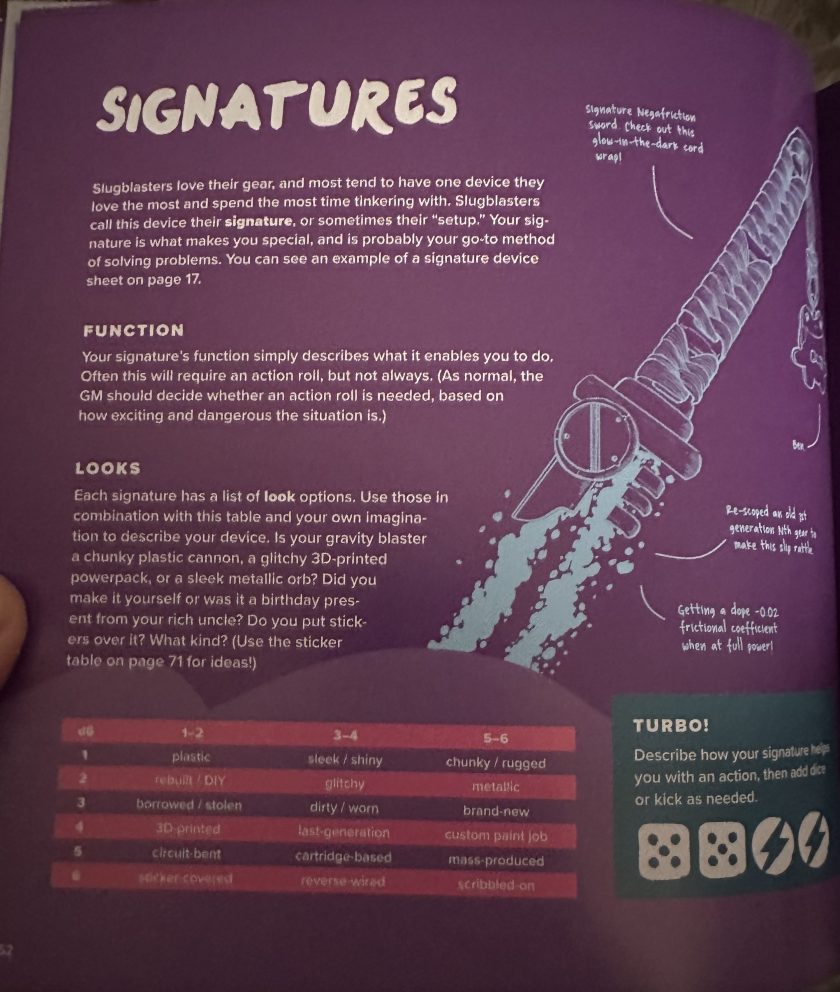
Signatures
This is the item you are probably going to use to solve most of your problems given half a chance. People know you by this item and it’s your most prized possession. I’m going to use the table to help me describe it! 3 and 3 means its dirty/worn.
But, what exactly is the item? There are twelve listed so I’m going to roll a d12 for it obviously. That’s a 10, which gives me a Kinetic Deck, which allows my oldschool board to go faster over solid ground and make it super-heavy at will.
I get one mod to start with, although there are five listed. I’m going to go for the Stasis Anchor which can make the board totally immovable until its deactivated.
You get some more tables to add flavour to your Signature.
Origin – 4 – made it myself
Form – 3 – There’s an enamel pin made by my best friend, the Guts, stuck to the front of the board
Slogan – 26 – “ALT” and its got a holographic face that keeps changing as the angle changes
Name Yourself
My parents know me as Benji McWhirter. My friends call me Bench and I call myself Alter.
Conclusion
And that’s it, that’s the whole character creation process. I imagine, if you’re not writing about every step, it is probably quite quick to roll up a new character. There are a lot of fun ways to customise the base character but the fun seems to be in advancing, gaining Beats and Traits, Doom and Legacy and Fracture (another type of currency which is used to break up the crew!) But it starts you off with the tools to make things really awesome and dramatic as the game goes on, and that’s what it’s all about. I have a couple of gripes and they involve the gear. What you get to start with is stated in a couple of different places, but in each one, the list of things you start with is different. Also, there is an element of confusion around the Signature still. I am not sure if my Signature is my oldschool board that has this Kinetic Deck upgrade, or is that another piece of equipment on top of my board? It’s not super clear.
Otherwise, I have one more mechanics-related complaint and that is about the jargon used in place of more (for me) understandable terms. Boost, kick, turbo, slam… is it because I’m not a skater? The meaning of these slides off my brain, unlike the terms used in Blades in the Dark: goal, action rating, position, effect, harm.
Maybe I would get used it in play.
It is a gorgeous book, I have to say. The artwork is colourful and creative and inspiring and the writing is witty and just right, theme-wise.
Have you any experience with Slugblasting, dear reader? I’d love to hear your thoughts.
Even the concept of the post-apocalypse that is so impossibly verdant that sentient life has had to scrabble for a foothold amongst all the greenery is unique and bold.
Traveling
Dear reader, I’m off on my travels again. This time, I’m in the east of England where the weather is beautiful and the swimming pool is indoors. Anyway, I’m using this razor-thin rationalisation to excuse reposting this post from about this time last year. It’s about giving PCs something they care about that you can fuck with, and Wildsea, which is one of the games I’m considering running in the near future. It’s also a game very much about journeying so it seemed appropriate.
“Triangle Agency is a tabletop role-playing game and exciting new job opportunity for humans like you.”
Be the change you want to play
I haven’t made any real progress in deciding what to run next. I asked the question here but have not enough feedback to be helpful. So I thought I would take a more practical approach to the problem. Several times over the last year or so, I’ve written up complete character creation posts for various games and systems to give me more of an insight into them, to see how I like them and to get me motivated to run them. You can read some of them here. I have always found these to be useful exercises and usually pretty entertaining for me too. So this will be the first in a series of character creation posts. I will do one for each of the games in the list in my aforementioned Time for a Change post. The first of those is one I am very interested in getting to grips with. I have been reading the rule book for a while and it’s one of the more unique and exciting on the list.
Triangle Agency
The back cover of Triangle Agency
Triangle Agency is a game by Caleb Zane Huett and Sean Ireland published by Haunted Table in 2024. Here is what the back cover has to say about it:
Triangle Agency is a tabletop role-playing game and exciting new job opportunity for humans like you.
Investigate supernatural Anomalies, wield tremendous power, and take advantage of our comprehensive life insurance benefits all from the comfort of your favourite table!
This book includes everything necessary for you to experience the chilling horror, wacky comedy, and emotional truth that can only come from working for Reality’s Most Trustworthy Corporation, 333 years running.
Welcome to the first job of the rest of your life!
I think that’s enough to go on for now.
Getting started
The book has more than fifty pages of material introducing the core concepts and rules of the game before it even dips its toes into the cool waters of character creation.
The first step into that stream would barely be considered part of character creation in most games (and I’m not entirely certain it is in this one, but that’s where I’m starting):
Identifying your Region
The book gives you a few options here, including your own hometown, a place you would like to be, a fictional place and Ternion City, the setting presented in the book as though it were a real place and so does not simply get included in the “fictional place” category.
I normally randomise everything in character creation posts but I’m not sure that will be helpful here. I’m going to go for Ternion City, which is, after all the location for the Agency’s primary HQ, a massive skyscraper that is “hard to miss and not included on maps.” In a real campaign, I’m sure this would have been decided upon through conversation with all the players or just by executive decision by the GM (General Manager.)
The same section wants you to determine the level of mundanity/reality of your setting, asking you to determine if a long list of phenomena are real or if they could be considered Anomalies. The list includes Ghosts, Artificial Intelligence and Debt. This is also probably something to be decided as a table or by GM decree.
Your agent’s ARC
The start of this section takes pains to remind you that you shouldn’t have skipped forward to this page. If you did, your agent will begin play with one demerit.
Essentially, your ARC is the set of components that makes up the essence of your agent. Each component is call an ARC piece. The A stands for your Anomaly, the R represents your Reality and the C is for your Competency.
Anomaly
As an agent of the Triangle Agency, you are bonded with one of the very Anomalies you are tasked with hunting down and dealing with. Such people are called Resonants.
There are nine Anomalies to choose from and I would expect the choice to be a hard one. Every one of them is split into three different abilities, each of which sounds like great fun to use in play.
They include:
Whisper: if you have Whisper abilities you can manipulate what people say, express the thoughts of others or silence your own noises
Catalogue: a Catalogue Resonant can create objects, change the properties of objects or even produce a duplicate of themselves
Timepiece: Timepieces can adjust time to suit their needs, help allies to overclock their own abilities and effect a target’s memory
Timepiece Anomaly page
There are several others that are just as compelling but I love the idea of time manipulation powers so that’s the one for me.
This gives my Agent three abilities. Each of these abilities comes with a survey question to help you build your character’s personality. This is a really nice touch and great way to link personality and ability traits.
We’ve Got Time, Q: I know A1: The deep magic
Overclock, Q: I’ll sleep when… A1: I’m tired
Remember When, Q: I’m more likely to ask… A: Where are they going?
Reality
Reality is as it says, really. It’s the regular, everyday shit we all have in our lives, family, relationships, background, etc.
I need to select one of nine Realities. They include:
Caretaker – devoted to a Dependent who they bring everywhere with them
Overbooked – Maintains a job (Vocation) in the mundane world as well as their Agency duties. Finds it hard to maintain Relationships.
Romantic – constantly distracted by the building of complex relationship webs. They fall in love easily and always want to please that person.
With the Timepiece Anomaly, Overbooked seems like a suitable Reality for my Agent.
Overbooked Reality page
Overbooked provides you with a Vocation. There is a d4 table for this so I am going to roll on it. I got a 1! That’s “Journalist.” Very Clark Kent.
Every Reality gets a “Reality Trigger.” You get a work phone for one of your Relationships to call you at any time. This is for the GM to fuck with you at the worst possible time. You get a 4 box track called “Something Gives.” Every time you fail to fulfil the requirements of your Vocation or lose the phone you mark a box on the track. If you mark them all, that’s it, you’re done. You have to choose a new Reality.
Every Reality gets a Burnout Release. This is something you can do that allows you to ignore all Burnout, which is great because Burnout reduces the number of successes you score when you roll your dice pool to do stuff. In the case of the Overbooked, the Burnout Release is Threading the Needle. It means you can do anything relating to your Vocation and ignore Burnout.
Burnout is something you accrue as you attempt actions using Qualities that you have no Quality Assurances in. Sometimes you lose QAs and sometimes you just don’t have any to start with. Your Competency determines the level of QA you have in any given Quality so we’ll consider them more in the next section.
We have some Onboarding Questions here in the description of the Overbooked too. Let’s look at them:
What is the most difficult decision you’ve ever made?
A: When I decided to take the position as an Agent, I knew it would severely impact the time and commitment I could give to my Vocation as a journalist. Even though I now know I was choosing between becoming an Agent and death, I sometimes regret my decision.
What terrible thing will happen if you give up your responsibilities?
A: No-one can report the news with the same degree of integrity as I can. The world will lose a ruthless truth-teller.
How do you celebrate victories?
A: I don’t. There’s no time for celebration. It’s just on to the next story or the next Anomaly.
I feel like I really learned a lot about this character in answering those questions. Very cool.
Finally, as part of my Reality, there’s the Relationship Matrix. You get three Relationships which you must identify by answering the questions provided.
Who is your other boss?
My editor, Sybill McPartland
Who cares the most about your health?
Mum
Who are you in charge of?
My rich kid intern, Hunter
I need to identify one of them as my closest Relationship. That will be my editor, Sybill. She gets 6 Connection. Mum and Hunter get 3 each.
If there were a full table of players for this, I would get three of them to portray each of my Relationships whenever a scene with them came up. These players would be chosen here. As it is, I will have to skip that step.
Competency
The final ARC piece is Competency. The book describes it as the most important aspect of your ARC (although, I have never before met a more unreliable narrator in an RPG book as the one in this section of Triangle Agency, so, you know, take it all with a pinch of salt.) Essentially, this is your role in the agency. It describes your responsibilities, code of conduct and equipment.
The available Competencies include:
R&D – The creatives who see what people really want and make it for them while also figuring out the universe’s enigmas
Gravedigger – These are the agents who are taking care of things no-one else wants to face in places they don’t want to be
Hotline – An ear to listen, a guide and a customer service professional
With this character, I think I’m going to go for Hotline.
Hotline Competency page
Here’s what the Hotline gets me:
Prime Directive – Never say, “unfortunately.” If I deliver bad news to someone, I get a demerit (demerits are used to negatively affect your standing in the Agency, while commendations have the opposite effect.)
Sanctioned Behaviours – I’ll get one commendation if I
Help someone unburden themselves
Take the blame for something I didn’t do
Connect someone to an unexpected fate
If I do all of these on a single mission, I’ll get three extra commendations!
Initial Requisition – Hold Music, Vol. 1 A fantastical tape player the bland music of which has the power to transport the agents to a safe waiting room for up to an hour!
Self-Assessment – I have to answer the three questions presented to determine the increases I will get to particular Quality Assurances.
A customer has a problem I have been unable to fix in my own life. I…
Share the approaches that have failed, to save them time (+3 Empathy)
A customer has a broken product and a convincing story. I…
Pull every string necessary to get their refund (+3 Persistence)
A customer’s call disconnected. I…
Call them back and submit an error report to IT (+3 to Professionalism)
Signature quote – “Your call is important to us. Your time is important to us. Everything you do, think, and are is important to us.” I think my Agent really takes this to heart.
Onboarding Questionnaire
The final part of character creation that I will be dealing with today. There are several more pages dealing with Competencies in detail, Requisitions, Work/Life Balance, etc. but the book insists that you leave this section until after your first mission.
The Questionnaire is a set of nine questions, the answers to which you should expect to be shared with the rest of your Field Team.
How did you come in contact with your Anomaly?
I was TAPped for fieldwork though the Triangle Academy Program. I was approached by another field agent who must have seen some potential in me. Once I had completed the program, I was left in a glass cell with an Anomaly that looked like an old egg-timer that kept spinning in the air until it fused with my body.
How did the Agency find you?
I found the Agency through a case I was reporting on. It was about the disappearance of a circle of trees in Trinity Park. When I went there to investigate, I discovered several field agents who were impressed with my professionalism and brought me on board.
What is your Annual Salary?
$80,000
What do you look like?
I’m a skinny, white guy who wears a lot of brown and beige coloured corduroy and polyester. I have thick rimmed glasses, brown hair and brown eyes. I look like I’m from the seventies.
Do your powers have a unique visual manifestation?
I sometimes leave little piles of sand behind after using my powers.
How do you take your coffee?
Black
Who among your Relationships is your primary contact, and why?
My editor, Sybill, because she would be the first one to miss me.
What do you bring to the table in a collaborative work environment?
I am a dogged investigator. When I am given a task, I will see it through to the end.
Finally, please list all prior work experience and level of familiarity with Adobe, Excel and the Google suite.
As a journalist, I have ten years experience working with all aspects of adobe software and most of the Google suite although I rarely use Excel for anything other than lists of things. Don’t ask me about formulas.
Two last things, I gave him the pronouns, he/him and the name Mark Dent for some reason.
This was a fairly involved process but one that got me thinking quite deeply about the type of person this Agent is and not just the type of character he is, if you see the distinction. I really liked doing it actually. I loved reading about the various Anomalies, in particular. If I was actually about to be a player in a game of Triangle Agency, I’d be eager to get to use them too! I feel like I learned a lot about how the game would be played as well. So, mission accomplished in that respect.
Here’s the story: hundreds of years ago, the city’s premier logistics wizard, Whalgravaak, abandoned his warehouse, having shredded the Manual of Operations for his Sphere Pool (a mechanism used to import and export goods across the cosmos) so that his rivals could never figure it out.
One-shot fun-shot to campaign of terror
You know what it’s like, dear reader: you want to introduce some noobs to RPGs or just to your group of players, you want to make a good impression but you don’t want to scare them off by plunging them into a multi-session campaign with a complicated, crunchy system. So you pick up a location-based adventure, thinking you can just use a small portion of it, just what you need, just enough for one session, one single shot. But, after that session, the curiosity gets the better of you all. That was a weird, but enjoyable experience, you tell each-other. I bet we could have fun exploring the rest of that odd locale, you tell the players, why not have some more sessions and see how it goes? So you do that. And then the bloodbath begins.
Whalgravaak’s Warehouse
SPOLIERS BELOW! If you are interested in being a player in Whalgravaak’s Warehouse, turn back now!
The 1:5 adventures that I own, Whalgravaak’s Warehouse, The Hand of God and Eye of the Aeons. All from Melsonian Arts Council
Whalgravaak’s Warehouse is a Location based adventure by Andrew Walter for Troika! The design is by Shuyi Zhang. It came out in 2023 and was the first of the Melsonian Arts Council’s 1:5, an ongoing series of location-based adventures for Troika! There are a couple more available now and another out very soon. You can find them all here. My somewhat rotating group of Tables and Tales members just had our last session in Whalgravaak’s Warehouse on Monday night, after spending a total of eight sessions there.
Here’s the story: hundreds of years ago, the city’s premier logistics wizard, Whalgravaak, abandoned his warehouse, having shredded the Manual of Operations for his Sphere Pool (a mechanism used to import and export goods across the cosmos) so that his rivals could never figure it out.
Since then, the strange nature of the warehouse, staffed by giants and stocked with oddities, has only grown stranger, and more dangerous. It houses a handful of physics defying, Tardis-like chambers, not least of which is the terrifying Deep Storage, a swirling mass containing several pocket dimensions and a wraith-like being who wants nothing more than to consume intruders. At least one cult has taken up residence, and they are often mutated into horrific Chaotic Spawnlets by the effects of the radiation still spilling from the Sphere Pool. The warehouse is sandwiched by a vast desert of dust occupying the roof, which is peopled by the descendants of Whalgravaak’s former employees and, underneath, the tunnels of a pack of unpredictable Worm-headed Hounds.
But entrance has been forbidden by the Autarch for centuries and, even if you were foolhardy enough to ignore a diktat like that, you would still need to be brave enough to face the unknown dangers within.
The Hook and the Party
The book suggests a few potential hooks for your PCs. Since my game started off as a one-shot, with brand new characters and no existing campaign to work it into, I went for one that seemed like the object might be achieved in one session. They, along with many other groups of mercenaries were contracted to return with the head of a Cacogen, known only as the Opportunist, to their patron, an Exultant of the Autarch’s court. But we dealt with that in flashback as they all sat in the weed-choked yard of the warehouse, dotted now with small encampments of adventurers and brigands all gathering their courage to gain entry. The PCs’ band consisted of a Monkey Monger (and monkeys), a Gremlin Catcher (and dog), a Wizard Hunter and a Landsknecht. They were, to put it bluntly, a motley crew.
That first session was all fun and games. Every encounter, except for the last one with the Cacogen, was resolved peacefully. This happened mainly due to the rolls I made on the Mien table for each encounter. The worm-headed Hounds they encountered wanted to play with the Monkey Mongers monkeys, they did not want to eat them. The Flat Serviceman was happy to follow the party around and clean up after them. The Segmented Crippler in the Pigeonholery, didn’t want to wake up, so they skipped that one entirely. This is a pretty standard mechanic in Troika but I think it gave the players a false sense of security. The session ended with this motley crew finding and defeating the Opportunist quite handily. And, at that point, we thought that would be it.
But a few months later we decided to continue with their explorations of the warehouse. Obviously, their original motivation to explore was gone. They had achieved their objective, but the players were all good sports. They decided between them that the motivation was purely one of curiosity and greed. They had spotted, through a bubble like window in one of the rooms they had traversed, a vast and terrifying pool of chaos and wonder in a room far too big to exist within the confines of the building. This was enough for them. Essentially, they went in search of adventure. Although, through the sessions that followed, I did introduce the idea that they might want to find that cult I mentioned earlier and that they should seek out the incredibly valuable Tome of the Sable Fields that was reported to be stored in the warehouse, somewhere. This gave them a little direction when I thought they might need it, but, honestly, I think my players just wanted to see what new wonder/horror the dungeon had in store in the next room.
The Dungeoncrawl
It was only from this point that I started to really treat this adventure like the dungeoncrawl it is very much meant to be. The book does a good job of introducing the concepts of tracking resources like lantern oil and provisions as the party explores. It also explains the concept of exploration turns and their effect on the game, i.e. the distance you can travel in that time, the amount of lantern oil you use per turn, and the likelihood of running into an encounter. I followed all these rules to the letter and they made for some interesting moments in the game. But, to be frank, the weirdness of the setting is the real draw here, not fiddling with rations and light levels. Also, few of the characters lived long enough for starvation or oil-skins to become a problem.
It also has rules for dealing with the spatially distorted, impossibly large areas within the warehouse. It suggests that the players should make Luck or Skill checks to avoid getting lost in these areas, but, in all honesty, I didn’t really require that sort of thing.
Mapping is also a part of the dungeon crawl format and this adventure does want the party to attempt to map the space for themselves. The thing is, when some rooms appear to be a kilometre wide and the next one is spatially normal, that map becomes effectively impossible for them to draw accurately after a relatively short period of time. Eventually, I gave up and just shared the one from the book with the players, trusting their ability to separate player knowledge and character knowledge. My advice, if you are doing this, try get your hands on the PDF version, since the one in the physical book stretches across two pages and the crease obscures part of it.
In fact, the adventure has four maps:
the warehouse floorpan, using 10ft squares to denote distance
a hex crawl for the desert on the roof, replete with points of interest
a map of the Worm-headed Hound tunnels beneath the warehouse, superimposed over the warehouse plan
a largely vibes-based map of Deep Storage
These are all great but usefulness will vary. In our game, the party spent several sessions trapped in Deep Storage but took one look at the desert and noped right out of there. This seems like a good point to note how good all the artwork is in this. There are plenty of colour and black and white illustrations but they leave me wanting even more!
Warehouse Workers and other Beasties
A warehouse is a dangerous place to work, especially when the correct safety protocols are not observed. It doesn’t help at all when you are trespassers and several of the residents are large enough to crush you with a single blow.
The giants are not what you might expect.
The giants are the main NPCs of the adventure and Whalgravaak’s only remaining employees. Each one is fabulously interesting, diverse and well-drawn. They have their own motivations and desires. I was gratified that the party managed to encounter all of them during the eight sessions we played. In fact, one player had two different characters killed by two different giants. I will point out that it is entirely possible to avoid violence when dealing with the giants, it’s just that, sometimes, the Monkey Monger on the team has monkeys who decide to fuck with them and one thing leads to another.
The wraith-like Gulf Man Roamer from the swirling vortex of Deep Storage is a potentially lethal foe who has a chance to show up each time the party moves through that already dangerous room. If it captures you in its bag, it’s going to spirit you away to eat you in its extra-dimensional lair.
No warehouse is complete without forklifts. Whalgravaak’s forklifts are humanoid constructs with the face of the wizard himself. They treat intruders like stock, and will attempt to whack them and pack them. They hit very very hard.
When you read the words, Worm-headed Hound, is this what you imagined?
There are also a bunch of random encounters, including the Worm-headed Hounds I mentioned before, desert nomads from the roof, and Bandits/Burglars/Bastards. These only turn up on the roll of a 1 on a 1d6 for each turn the party travels. It didn’t occur very often in my game. The Roof and the tunnels have their own random encounter tables as well, but I never used them as the party never spent any appreciable time there.
This is just a selection of the possible encounters you can have in this setting. I haven’t even mentioned the tiny army guys, the sentient crane parts, the Onion God or the Mulled Dead.
The Rooms
I have hinted at rooms that defy physics and rooms with pocket dimensions, and those are usually the big-ticket locations that contain some of the greatest set-pieces in the adventure. Deep Storage alone evoked some of the most inventive use of skills and spells and a great degree of fear and tension from the PCs. It killed one of them (two if you count the Rhinoman eaten by the Gulf Man Roamer.) The Roof could act as an entire short hex-crawl campaign and the Sphere Pool has some truly memorable and dangerous elements to it.
However, many of the other rooms have weird and wonderful contents as well. Some of them, the party will glance at and move on, while others will capture their imaginations and encourage them to interact. I never really knew which reaction I was going to get from them, actually. The room full of melting rope? They had to spend an hour trying to figure out how to set it on fire, the eternal battle between tiny armies playing out across a battlefield seemingly larger than the whole warehouse? Just popped their heads in and left with some captured little men.
Some of the rooms were relatively mundane warehouse style rooms with shelves and containers. The book has tables in the back to help you identify the state those rooms are in and the contents of the containers, which is useful.
One of my over-riding impressions by the end of our game, was that in some ways, the great variety of bonkers content in the rooms served to detract from any unifying theme. There were some elements that went together, such as the warehouse’s disdain for traditional dimensions. If my PCs had explored the Roof or even encountered any of the nomads who dwelt there, they might have found a distinction between those descendants of the ancient striking workers and the giants who continued to obsessively do their jobs even long after their employer had passed on. But, none of that is to say that the rooms weren’t endlessly fun and inventive.
A Note on Lethality
I recently wrote a post sharing some of the obituaries of the characters who met their ends in Whalgravaak’s Warehouse. You can check it out here. There are only three of them in that post. A few months previous to that, I wrote this post, which contained the obituaries of two more. The mathematicians amongst you will have summed those already. That’s five. In the final session, we lost another one. That makes six. That was three character deaths each for two particularly unfortunate/reckless players. Warehouse work is dangerous. Only one of the original party survived to the end. You have been warned.
Conclusions
Numinous or otherwise, its the same game.
There is so much to recommend in this adventure. It is endlessly entertaining, challenging and bonkers. It has such a variety of locations and such a diversity of encounters that you would need to work hard to get bored in Whalgravaak’s Warehouse. I think it works so well to show off Troika! as a system, too. The problems it asks the PCs to solve and the encounters they have to deal with utilise things like the Luck check really well and encourage players to invent their own unique Advanced Skills. But if they get into fights, especially with the incredibly random nature of Troika! initiative, there is a very high chance they are going to come out of it dead. There are a few opportunities for insta-kills throughout the warehouse too. I can’t overstate exactly how lethal this adventure is. Luckily, my players leaned into that, even when they were creating new characters to join in the same fight the original one died in (they got very quick at creating characters.)
I think it’s also flexible enough for many GMs to easily take it or part of it and fit it easily into their own ongoing Troika! campaign. As I said at the start, our game started as a one-shot and it could have ended there. But we were able to easily adapt it into a short campaign of its own.
Dear reader, let me know if you have played Whalgravaak’s Warehouse or if you would like to! I’d love to know your views on it.
At one stage, the Elf cast a Magic Missile and it caused a rain of frogs on the entire party and all their enemies, almost killing several on both sides!
DCC Day
I kind of knew it was DCC Day on the 19th of July. It had been advertised to me enough times on Instagram after all. But that was not why I had scheduled a DCC one-shot on the 20th of July. That just happened to be the best day for most of my players. As serendipity would have it, the module I planned to run was the Grinding Keep, an adventure designed by Marc Bruner, which appeared in the Adventure Pack for DCC Day 2024 along with the XCC RPG adventure, Tucson Death Storm!
Hook
I had introduced the hook for this adventure in our recent run of Sailors on the Starless Sea. The PCs discovered a map to a keep and a note hidden in the lining of a cloak in amongst the charnel remains of many butchered humanoids in that adventure’s tower. The note was from the patron of the poor unfortunate who lost their cloak and it indicated that their patron would pay 1000 gp for the safe return to them of a magical lantern. As budding adventurers, most of whom barely had two groats to rub together, this seemed to be motivation enough.
Each player had only one surviving character from the 0-level funnel and one of them was not able to make it to this latest game so I supplemented the four characters who advanced from 0-level to level 1 with a couple of pre-gens kindly provided for the Grinding Keep by Goodman Games themselves.
Big Party
So the party was made up of six level 1 PCs, a Warrior, a Wizard, a Cleric, a Dwarf, an Elf and a Halfling. Two of the players played two PCs each and two of them played one PC each. All of their abilities proved useful. I would say a varied party is very beneficial for this module. On the other hand, if I had to do it again, I probably would have left the players with one PC each even though the adventure calls for 4 to 6 level 1 PCs. They all survived easily enough, although there were a couple of close calls.
Starting the Adventure
SPOILERS! – If you are a player who might want to play this module, stop reading now!
To begin, I plonked them right at the door to the keep as the text suggests. The module wants you to do this. It is designed to be a one-shot by the gods, and it will be! No faffing around in town, shopping or gathering rumours. Just get them in there as quick as you can. I did have to utilise the handy, and essentially invulnerable Leaf Elemental that waits on the grounds of the estate for anyone foolish enough to hold up the proceedings of your one-shot by searching for herbs amongst the overgrown gardens which seem to be under the influence of all four seasons at once. The seasons are a recurring theme and I was gratified to note that the players realised this almost immediately.
Anyway, once they had been chased inside the keep, they were confronted by something that could only have been a magical effect that transformed the interior from a ruin to an immaculately decorated and lit hall. They were greeted by the white robed Host and eventually waited on at dinner by his veiled servants. All of this set up was important. It presented clues to the nature of the keep to the PCs and let their imaginations run with them. Enough strangenesses occur during dinner and upon their investigation of the ground floor of the keep that they should be suspicious. Indeed, before they had even left the dining room, one of my players joked, “the house is a mimic!” He didn’t know how spot on he was…
Of course, the keep is, in fact, an other planar entity who comes to the world to feed, in disguise. The PCs had seen windows and chimneys on the outside but could find no sign of them on the inside. The couldn’t get through any doors that the Host didn’t want them to enter, etc, etc. Clearly, there is enough evidence to allow your players to uncover the truth before things ever really get interesting.
One regret I have is how much time I allowed them to devote to this whole section before Event One occurs. They spent a lot of time searching, theorising, investigating, and it ate into the more adventuresome elements in the latter stages of the module. My advice would be to get them into the Guest Quarters and asleep as quickly as possible. The adventure does not provide much in the way of motivation for the characters to do this, however, so be prepared to improvise.
Event One
Event One is triggered when they wake up after a nights’ sleep in the keep. I was lucky enough that the players wanted to rest and one of them was rendered magically asleep, but without that, it would have been a struggle to get them to wait until the next morning. I probably would have triggered Event One early, if that had been a problem.
What “Event One” means is that the keep is waking up. It will soon be ready to consume a fresh meal of adventurers.
Mechanically, what it means is that every time they open a door, they will be confronted with an intersection of corridors that lead to two randomly determined rooms in the keep. These could be rooms they already visited in the first part of the adventure, or ones that would have been otherwise inaccessible up until this point.
The first room my players visited was the dining room again. This was satisfying as it gave them a chance to kill the Host and his servants from earlier (although, technically they just put the Host to sleep and dragged him around with them for the rest of the adventure.) After that, they encountered one of the three rooms that contained the organs of the keep. They had discovered the journal of a former prisoner/meal in their quarters that gave them hints as to how to deal with each of the organs; eyes, heart and lungs, and that proved useful in the encounter they had with the heart. It is significant that they identified several magic items that act as keys for the doors to these special rooms. But their first instinct was to destroy them if they could. Luckily they forgot about that plan and just kept ‘splorin’ instead. Eventually they managed to overcome the challenge in the heart room and at that point of our session, I realised I was running out of time to get my one-shot done in one shot so I focused things up a bit.
Event Two
The way it was supposed to work was this: every time they left a room, I would start marking that room off as no longer accessible on the random room table, until there was only one possible room left; the one that contained the Alien Intelligence itself. I didn’t have the time for all that. We were approaching the four hour mark at that point and people had work in the morning. So I just told them that, after they destroyed the fiery orb that acted as the keep’s heart, the entire place shook and when they re-opened the door to leave that place, the corridor beyond led to the last room. The players, unknowing, proceeded to their fate. Their fate, as it happened, was to murder the Alien Intelligence of the Grinding Keep, all its Animated Corpses and the Giant Animalcule Swarm that accompanied them. Destroying the heart had pretty much halved the creature’s HP so it wasn’t too difficult. In the end, they fled through the windows in the back of the room, utilising the Feather Fall spell (which two characters had, by coincidence) to safely land in the river at the bottom of the canyon beyond.
Conclusions
Perhaps you can see now why I think I should have made things a little harder for them by reducing their numbers. On the other hand, I am glad they all survived. They had all created and played such interesting and fun characters, even in the context of a game that is not RP-heavy, to say the least.
I was a little disappointed to reach the end of the adventure with so much cool content unexplored. They didn’t find the trap/treasure room where the magic lantern was stored, they didn’t find any of the other organ rooms, which all had really fun mechanics. On the other hand, I felt the adventure was designed to be flexible enough for a Judge to shortcut it exactly the way I did to get them to the end a little quicker, which seemed like good design to me.
This was only the second time any of us had played DCC and the first time with characters of anything other than 0-level. This was a different game to that first experience. PCs used magic and Mighty Deeds at every available opportunity and they got to roll on the crazy magic random tables a lot. At one stage, the Elf cast a Magic Missile and it caused a rain of frogs on the entire party and all their enemies, almost killing several on both sides! This is why we loved DCC. It’s the wonderful and potentially lethal randomness of it and the endless inventiveness of the adventures.
I would recommend the Grinding Keep as a one-shot DCC adventure, as long as you are willing to either cut out bits or extend it to two sessions.
If you had to choose one, dear reader, which one would it be? If you are one of my potential players, which one would you like to play?
Anniversary Posts
More anniversary guest posts coming soon. In the meantime, have some musings.
Old School Rut?
I’m not sure how it happened but, recently, all I have been playing is OSR, trad and adjacent games. With the exception of Dungeon World, which is about as close to D&D as you can get while also flying the PBTA banner, its been wall-to-wall, dragon games, Borgs and Troikas. And this week? It’s Dragon Age, DCC and maybe some Black Sword Hack or UVG (which is pretty trad in its ruleset to be quite honest.) Am I in a rut or have I just naturally gravitated towards these games? Maybe I have found my niche and I’m occupying it. I don’t think that’s it. I think it has more to do with the ease with which I can roll out one of these games, if I’m the GM, at least. It’s also pretty easy to fall into one of them as a player when you’re familiar with the overall concepts, rulesets and themes. And, don’t get me wrong, it’s not that I’m not enjoying them. But it is time for a change, I think.
Options
So, I have a few options of non-OSR, non-D&D, non-trad games to try out in the near future. My current game of Troika! will be coming to an end next week and Dragon Age probably only has a couple of sessions left in it, for a while. So, some calendar spots are opening up! I’d like to fill them with something completely different.
The Triangle Agency Normal Briefcase EditionInside The Triangle Agency Normal Briefcase EditionNice One Idiot
Triangle Agency – I’m reading this at the moment. I have to say, so far, I’m loving the way the game is presented, the really original ideas, the surprisingly bare-bones ruleset and the way it treats the GM (General Manager) as as much of a player as the Agents. It has gotten me excited to play it and I am trying to get potential players excited about it too. The downside is that I feel like I still have a lot to read before I can think about getting it to the table.
Slugblaster GOTY EditionInside the Slugblaster GOTY EditionPanic Energy DrinkName Your CrewSlugblaster Two Page Spread
Slugblaster – I got this great boxed set for Christmas and have yet to crack the spine of the rulebook in anger. But I have been listening to the excellent My First Dungeon actual play of the game over the last several weeks. It has made me want to try it out despite having little to no understanding of skate culture. I know at least one player who would be very interested in playing so I’m sure I could get a few more. Once again, the difficulty is that I have not even skimmed the rules yet. This is somewhat ameliorated by the fact that I’ve been learning how to play while listening to the podcast.
Blades in the Dark Front CoverThe Devil’s in the DetailsSilkshore
Blades in the Dark – Although I was a player in a campaign of Blades last year, I still haven’t run it as the GM. I think I would enjoy doing it and it is such a classic, it would be a shame not to put a game of it together. And it is the basis for games like Slugblaster and The Wildsea, which also feature on this list. I have been nicking enough rules from it for my D&D game, also, that I feel confident I would mesh quite well with the ruleset. At least I have read this one cover to cover and played it before, so that’s a big tick in the “pro” column for Blades.
The Wildsea Front CoverThe FoxloftThe Threat of Death
The Wildsea – I wrote about this already last year and still haven’t managed to run it! Essentially, this game imagines a world where the entire surface has been covered in a vast forest and your players are sailors across the canopy, using boats with giant chainsaws attached to sail. Take a look at the last post about it if you want more info. I have rad a lot of this and could probably run it ok, but I am afraid of doing another game where my players are sailors as I am already doing that with Spelljammer and kind of, with UVG.
Deathmatch Island Front CoverTrust BuildingCompetitor Registration Forms
Deathmatch Island – I also wrote about wanting to play this around this time last year. I having been feeling the urge to scratch the Lost, Severance type itch over the last few months. I watched both of those shows in the last half a year and they have stuck with me a lot. I think Deathmatch Island would be perfect for that. Also, I have read it completely and would be very excited to try out its mechanics. Here’s my post about it from last year.
Apocalypse Keys Front CoverThe ShadeThe Basic MovesOrbital Blues Front CoverThe Crew ShipRogues GalleryEasy care Galactic Wear
There are a couple of outsiders as well, Orbital Blues and Apocalypse Keys, both of which I purchased on something of a whim (and a sale.) I’m curious about them but have barely opened either. I know Apocalypse Keys is a PBTA game and that it is beautifully illustrated, but that’s about it. And I know Orbital Blues is a game of sad space cowboys ála Cowboy Bebop and Firefly so that is a big tick in its favour as far as I am concerned.
If you had to choose one, dear reader, which one would it be? If you are one of my potential players, which one would you like to play?