I’m off to Cork for the weekend so I won’t have time to come up with anything new today. Instead I thought I would share a couple of posts from last year. I wrote these at a time when I was first experimenting with some homespun rules and borrowed mechanics for our D&D 5E campaign.
This first post is preparatory to introducing a Blades in the Dark style engagement roll to our Spelljammer game.
China Miéville. Go read some of his books. Go on. I’ll wait. Need more? OK. I recommend the full Bas Lag trilogy. In my opinion each book in the series is better than the one before. Anyway, those should only take a month or two to get through. Once you’re done with those, immediately pick up “The City and the City.” Just trust me. You won’t regret it. Once you have finished getting your brain-digits around that, please relax your cerebellum and get ready for “Embassytown.” Read all of them. Please.
I still have a few of his books to catch up on. I’m a little late to the party. I picked up “Perdido Street Station” in a second hand book shop about 15 years ago and couldn’t quite get past the idea of a woman with a beetle for a head (not a beetle-head, that’s different. Her head is a beetle.) I gave it another go a few years ago and was immediately hooked. The so-very-alive city of New Crobuzon, its fascinating and beautifully realised inhabitants, the wonderful meshing of the steam-punk, the fantastical and the horrific all worked together to make me simply want more and more. Luckily, “Perdido Street Station” is about 1000 pages long and has two sequels so they kept me going for a while.
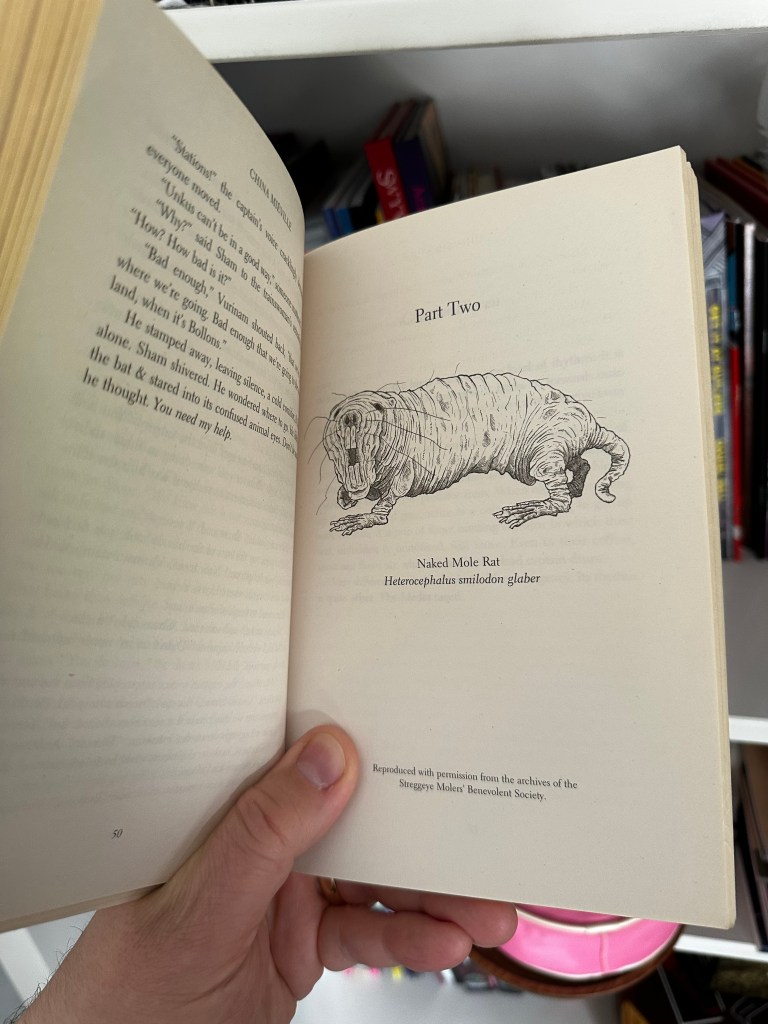
I’m currently reading “Railsea.” This is not a Bas Lag book, but it evokes a lot of the same feelings in me as his earlier work. It is set in another world, one where there is a literal sea of rails between the continents and islands, where trains are captained by Ahab-like characters who pursue Moldywarpes (giant moles) like sea-captains pursued whales in centuries past. The ground between the tangle of rails is not literal poison, oh no. Our main character, Sham, tells us that. But if you touch it, you’re courting death, or dancing with danger at least. The subterranean lifeforms, bugs, giant mammals, that sort of thing, they’ll come and drag you down or tear a leg off if you’re not careful.
I haven’t gotten very far into the book yet, but I am savouring it. I’m exclusively reading it on my train ride to and from work so it’s hard to get up a good head of steam as it were.
Anyway, it felt rather “Hearty” to me. You know, what I mean, reader? Got the old Heart Landmark juices flowing a bit. There’s so much about magical, inter-dimensional underground railways in Heart: the City Beneath. It felt appropriate to come up with a Heart Landmark inspired specifically by “Railsea.”
The Vermissian Graveyard
Name: The Vermissian Graveyard Domains: Technology, Cursed Tier: 3 Default Stress: d8 Haunts: The Engine (d8 Echo)
Description: Beneath a roiling crimson sky of steam clouds, a vast and silent plain of dry red earth, dotted here and there with scrubby trees and hardy grasses, whorled and tangled by an impossible rat’s nest of railway lines. At their final rest atop these lines, trains. So many rusting, curving, snake-like carriages and engines. Freight cars, passenger cars, entertainment and dining cars, all lifeless, dark, slowly falling to pieces. Maybe this is where the trains of your Vermissian went. It could be. Perhaps some of these vehicles once were meant for that cursed underground, but most are from some other Vermissian, some Vermissian that never had an “Incident.” Perhaps they came through Fractures, perhaps the Terminus directs all old hulks of rail-stock from across all realities to this place, this final resting place. Or maybe it’s the afterlife for these faithful old servants.
It’s certainly haunted enough to be a graveyard. Ghostly passengers walk the aisles of the cars seeking their seats, spectral engineers stand about in cabs, smoking cigarettes, conductors from beyond examine tickets to nowhere, on trains that will never move again.
The ghosts can’t do much to a living soul except maybe freak them out a bit. But don’t touch the ground. Do not touch that brick-red earth beneath the rails. Step down and you’ll understand why this place is devoid of all life. The slightest vibration will attract the stranded dead, grasping undead things, trapped here with their last trains, jealous of the life and wealth of the living, lying in wait below the earth. All they want is to strip you of your wealth. So, if your greatest wealth is your memories, they’ll take those, thank you very much. If your wealth lies, rather, in Queens and Stens from the City Above, they’ll leave you a pauper. If your most prized possession is your body or the blood in your veins, they’ll take that too. No matter what they take, they’ll try to take all of it, leaving nothing but a ghost behind, stuck on a train that’s never going to move again.
In what might be the centre of this mess of rolling stock, a single orange fire burns, fitfully and brightly, belching out spire-black smoke from the chimney of a single, shiny black engine. An old steam engine, kept polished to an unlikely shine houses the Engineer. They are a skeletal figure equipped with a spire-black shovel a set of neatly pressed denim overalls and a tall blue peaked cap. Fires burn in their eyes, emitting sparks occasionally, mirroring the hotly glowing fuel they keep the engine topped up with. When a stranger comes to the Engine, the Engineer hands them the shovel and gestures to the bunker full of spire-black and then to the fire. If they shovel a few loads, the Engineer will bow and point the way to the exit of the graveyard. They will leave feeling tired but fulfilled, as though having done a good days work. If they shovel in a suitable resource, the Engine will belch and shake and will bathe the worker in orange light, removing d8 Echo Stress from them as well. If they do not shovel, the Engineer will shrug, light a cigarette, and go back to shovelling himself.
Special Rules: Without the help of the Engineer, this Landmark becomes a delve with Resistance 12. Potential encounters with Signal-box Cultists (see the Heart core book page 196) abound on this delve. Other possible events include falling through the floor of a rusted wreck, having to avoid toxic freight and slipping off the rails onto the ground where the Stranded Dead await.
The Stranded Dead inflict d8 stress to whatever resistance is most important to the PC. This could be defined by the PC themselves or you could choose the one they have the most Protection in. Fallout Slight Delay (Minor, Any) You touched the ground in the Vermissian Graveyard and drew the attention of the Stranded Dead. They took something from you. Now you’re just ever so slightly translucent and the ghosts on the trains are asking you to sit next to them. All actions taken to escape the Graveyard are Risky. Fallout Major Disruption (Major, Any) You touched the ground in the Vermissian Graveyard and the Stranded Dead took so much from you. You’re hardly there anymore. You can understand the vapour talk of the ghosts on the trains. All actions taken to escape the Graveyard are Dangerous. Fallout Ghost of the Graveyard (Major, Any) You touched the ground in the Vermissian Graveyard and the Stranded Dead took everything from you. You join the other ghosts and take your seat on the dead train. Resources: Train parts, d8 Technology Train Ghost ectoplasm, d8 Cursed
Ways and Means: A Heart Sourcebook
To wrap things up, I thought I would let you know, dear reader, about the new Backerkit crowdfunding effort coming our way soon from the good people at Rowan Rook and Decard. It’s called Ways and Means and it looks like it’s going to be a great sourcebook for both players and GMs of Heart. It’s going to have new Classes and Callings as well as new Domains of the Heart and events to fill them with. You can sign up to support it here.
I don’t think it will be difficult to see where I drew inspiration from this week. It’s a story I have mixed feelings about but still, it introduced the world to one of the most enduring and influential fictional universes ever. Just remember, desire is the mind-killer.
The Heart Worm
Name: The Heart Worm Domains: Warren, Wild Tier: 2 and 3 Default Stress: d6 Haunts: The Waters of Life (Blood D8) Bernie Gallac, Terrible Warrior-Bard (Mind D6) The Prophet, AKA Moonlight-Falling-On-Glaciers (Fortune D6) The Herb, Mischung (Echo D8)
Description: Travellers in the deeper levels of the Heart, where all is flesh and warm and wet, sometimes pass from an artery into a wide open tunnel, resembling a damp cave with masses of tooth-like protrusions projecting from ceiling, walls and floor at the entrance. Many need no more excuse than that to run from the place, but many others know better. They have heard of the Heart Worm, and they know of the life-giving properties of its vital juices. Usually, these are the type of fool-hardy adventurers who have nothing to lose and who find the prospect of burrowing through the flesh of the Heart only to be deposited in another, unknown location, “exciting.” For that is what the Heart Worm does. A giant, parasitic entity that feeds off the multidimensional matter and energy of the Heart itself while digging through it and leaving cyclopean tunnels in its wake, the Worm picks up passengers and ejects them wherever it wants, seemingly randomly.
The Heart Worm has swallowed a few people and never let them go, however, perhaps due to the understanding that its passengers need support and services during their sojourn.
Bernie Gallac, a drow former soldier of the Allied Defence Forces, has been trapped for so long, he has forgotten the world outside. He spends his days composing sarcastic little ditties to comically roast the visitors who come his way. He has been surviving on the Herb, Mischung, which grows in abundance around the depths of the great worm’s mouth. It, along with his long imprisonment, has made him strange, one-dimensional, lacking anything but the desire to do what he does in the service of the Heart Worm and its passengers. His eyes and the eyes of all the inhabitants of the Heart Worm, are crimson from consuming the wine-dark Herb.
A passenger can gather and consume the Herb too. It must be cooked down until it is in the form of a red paste in order for it to be edible. It will slowly change the colour of their eyes to a deep red, but it will also make them feel more at home in the Heart as they become one with it (see Special Rules.)
The Prophet, Moonlight-Falling-On-Glaciers, is an aelfir noble scion, trapped these many years in the gullet of the Heart Worm. They desperately wish to exit and spread the news about the Worm to all the inhabitants of the Cities Above and Below. But, for whatever reason, the Worm has not allowed it. Perhaps it is not their time yet? Perhaps they do not wish to be worshipped like a god, maybe they do not want their presence truly confirmed. The Heart Worm does not confide in anyone its plans or reasons. The mask the Prophet wears resembles the face of the worm but for the two crimson eyes visible through the slits in it. They will speak to passengers in a voice to deep and resonant to be understood, to increase their fortune.
The flesh of the Heart, eaten by the Worm, travels down the peristalsis of the great gullet almost constantly. Those who exist inside, stick to the walls of the giant being. Some have tried to take parts of the Heart meat to sustain themselves. These unfortunates are invariably ejected by the Heart Worm at its first opportunity, in the most dangerous of regions. Passengers who wish to benefit from the Worm’s diet must travel further down its throat until they discover the crimson lake of the Waters of Life, the digestive juices caused by the enormous creature’s Heart-burn. If they can endure its acidic nature, a passenger who immerses themselves in the lake will have their old skin stripped away, only for it to be replaced with a new, deeply red skin. It will heal them of physical ailments. (See Special Rules.)
Eventually, the Heart Worm will find the perfect spot to deposit its passengers. When that time comes, they will be physically ejected by irresistible waves of muscular force, which leads to them being spat out at their destination. This could be anywhere in Tier 2 or 3 of the Heart.
Special Rules: Eating the Herb, Mischung has its dangers. It has the effect of bringing you closer to the Heart but this can also have the effect of making you like the Heart. When you consume the Herb, you must make an Endure/Wild or Warren roll or gain D6 Echo Stress. If this leads to fallout: Fallout: Heart’s Desire (Minor Echo.) The next time anyone voices a desire in your presence, you must do everything in your power to fulfil it for them.
Bathing in the Waters of Life can also be very dangerous. Roll Endure/Warren or Wild or take d8 Blood stress. If this leads to fallout: Fallout: Worm body (Major Blood) Your body begins to transform. Your new red skin sloughs off to reveal a ridged, wormlike one and you develop a taste for the Flesh of the Heart. If this is upgraded to critical, you fully change into a worm and disappear off into the Heart.
Resources: The Herb Mischung (D8, Echo) The Waters of Life (D8, Blood)
I have been reading Ultraviolet Grasslands recently (expect a post or three about this once I get done reading it.) I have been enjoying its format a lot. It tends to go into the big-ticket locations in the setting in some detail, maps, random encounters and occurrences, places of importance, how to get to and from the location. It’s usually built with enough randomness that your “Last Serai,” for instance, will be very different to the next party’s.
But there are a few locales described towards the end of each of these sections that branch out from the one central location, providing you with adventure spots in the surrounding area. Descriptions of these in UVG really depend on the type of area they are in. If it’s a heavily populated spot, you are likely to get a bunch of NPCs for the players to deal with, but in more remote places, it will probably mention more environmental hazards, enemies and traps. Importantly, it never goes into much detail on anything. The details, as with everything in the book, are left up to those gathered around the table. You just get a mention of a particular type of creature (and maybe a level and tag in parentheses beside it,) a monetary value for the treasure or resources you might find there, or a distance (in number of days’ travel) from the main location.
These really reminded me of something: Heart Landmarks. Not necessarily because of the format of the descriptions or the writing style or anything like that. It was mainly just due to the looseness of it. Heart Landmarks also provide you with a few sparks to light your imagination. They might tell you the type of haunts you have there and vaguely hint at a couple of NPCs, but it’s up to you to bring them to life at the table. I am aware this is not that unusual in modern RPGs but I have been reading and playing a lot of trad games recently, so the similarity really struck me here, in comparison.
Anyway, it got me thinking about something I started quite a while ago, before I even started my first Heart campaign. I have a file on my computer just called Heart Landmark Ideas. It had one entry in it, and even that was incomplete. So I thought I would make this a little series of blog posts.
DIY Heart Landmarks
What is a Landmark? In Heart, the City Beneath, the characters are delvers, idiotic adventurers who are compelled for one reason or another, to plunge into the red, wet heaven that is the Heart, the esoteric core of all weirdness. Nothing remains concrete or stationary in this underground “city” for very long, but, as long as a place has a sufficient number of sentients there to believe in it, to desire its safety, that will anchor it. These become Landmarks. Some of them are havens where delvers can rest and recuperate, some are terrifyingly dangerous lairs of nightmares and dark magic.
What does the Heart book tell us about making our own landmarks? Make sure your landmark includes one or more of the following:
SANCTUARY: Haunts are places within a landmark where PCs can relive themselves of stress or fallout and can often involve a major NPC to interact with.
MATERIALS: Resources can be procured here.
ADVANCEMENT: Not every chapter beat is achievable on a delve. Sometimes, landmarks are the perfect places to hit your beats.
EMPLOYMENT: NPCs, mysteries, required items etc. You get the idea.
DANGER: Not every landmark is restful and commercial. Sometimes you need to endure them to achieve your goals…
WONDER: Reveal something of the Heart of just dazzle the players with your imagination!
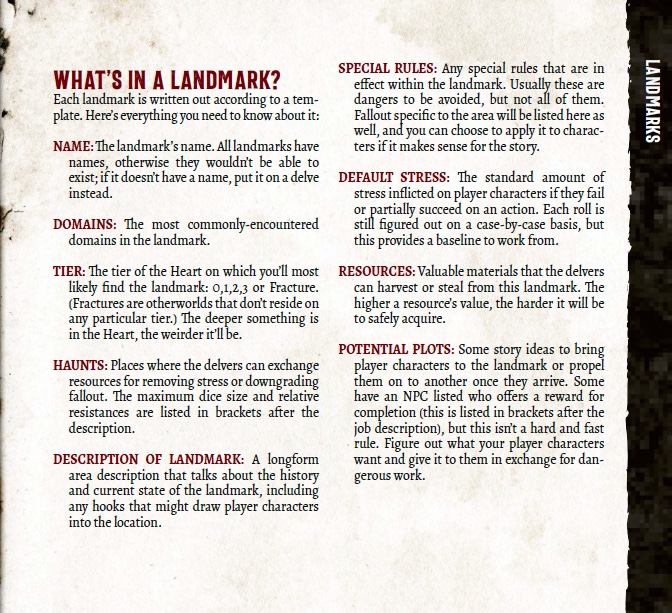
Other than that, the format of each Landmark entry is pretty much set:
NAME: ‘Nuff said
DOMAINS: These are broad areas of interest or influence: Cursed, Desolate, Haven, Occult, Religion, Technology, Warren, Wild
TIER: The Heart is split into tiers designated 0,1,2,3 and Fracture. 3 is much stranger than 0. Fracture is a movable feast of rumness.
HAUNTS: Places to rest and heal or people who will facilitate that. What kind of stress/fallout can be cured? Also, this should include the max dice size of healing.
DESCRIPTION OF LANDMARK: Part history, part current state of affairs. Maybe some hooks to bring the PCs there.
SPECIAL RULES: This could involve particular dangers or custom-fallouts.
DEFAULT STRESS: What is the normal amount of stress to inflict for action failures? Indicated by a die size.
RESOURCES: What type and die size of resources are available here.
The Blistered Basilica, a polyp on the inside of the blister. The devoted gather inside to worship (d8 Echo)
Rose’s, a restaurant with a good reputation and a worryingly good chowder (d8 Blood)
The Blister Pack, a general market that specialises in building and delving equipment (d6 Supplies)
Description: An enormous, fleshy blister on the inside of an enormous, fleshy chamber. Blister is pierced near the base by a hole that allows delvers to enter. From this hole there is a ramshackle wooden ramp that leads to a series of old platforms requiring constant repair. It has some residents, known as platformers, who are more or less permanent and mostly have no sense of smell.
At the base of the blister is a fetid lake of stinking pus. A whole ecosystem of pus creatures live in the lake. They generally leave the platformers alone.
The platformers worship the blister as though it were a god and as long as they do, they say the denizens of the pus will leave them be. But outsiders and heretics should not stay long, they say.
Special Rules: If you spend a bit of time in the Blistered Basilica in order to remove Echo fallout, make an Endure/Religion check. Consequences of failure as below: Fallout: Pus Magnet (Minor Mind) You have come to understand the Platformers’ devotion to the Blister and you feel a kinship with the pus-beings. They are there for your protection and you are there for theirs. You feel an urge to descend to the lake, befriend one of them and take them with you on your travels (Ongoing.)
Getting too close to the pus lake will require an Endure/Haven or Religion check. On failure/mixed result: Fallout: Blistering Barnacles (Major Blood) You’ve been infected by the pus. You are covered in hard, black blisters which hurt and stink. They make all social checks one difficulty rating higher (Standard becomes Risky, Risky becomes Dangerous etc.) (Ongoing.)
Resources:
Gathering Blister pus (d4 Religion) can be dangerous. See Special Rules.
Potential Plots:
Deacon Delicia of the Blistered Basilica has startling news for any PCs that visit. The Blister has revealed an existential danger to her. A stalactite-like calcium deposit has formed above Blister and a group of heretical pus-haters are preparing to climb up there and knock the spiky peril from its perch. This would spell the end for Blister, the Pus Lake and the Platformers. She is offering the church’s most prized possession as a reward to anyone who can stop the heretics. It is a wooden spike known only as the Splinter (Kill d8 Piercing, Debilitating)
Heather joined our campaign a bit late. She decided to sign up about the time the rest of the party popped through their very first portal to Sigil. This worked out well because her character, Panasonic (no relation to the Japanese electronics manufacturer of the same name,) was already there. This Half-orc Bard hadn’t always been there but she had made a home in the city and even gained something of a reputation as a controversial singer/songwriter. She had written and performed a tune that was perceived as being particularly critical of the self-appointed police, the Harmonium, a Faction that was philosophically devoted to the notion of laws and the act of upholding them. Unsurprisingly, this made them less than popular with many of the city’s population. So, when Panasonic first performed her song “The Safety Dance,” (for copyright reasons, a song that is legally distinct from the 80s hit by Canadian icons, Men Without Hats) a riot erupted, followed by anti-Harmonium acts being perpetrated all over the city. So, on the night when the rest of the party emerged from the end of a pipe (other side of a portal) in the the swimming pool of the Gymnasium, Panasonic found herself taking a shortcut through that very place, with a squad of angry Hardheads (a nickname for the Harmonium) hot on her heels.
Luckily, the party came to her aid, and she, in turn, acted as a sort of guide/ally to them in the alien and bewildering city.
The thing about Panasonic was, she had a fascination for Sigil and the planes in general. She was fascinated by the doors, the portals, how they worked. She always felt there was something musical about them. Also, she had been trying to find a way home for a long time. She had been shanghaied in Sigil by her sister, Sony (once again, no relation.) Sony was jealous of Panasonic’s growing popularity and so got a wizard to send her off plane so she could take her place at the front of their band. When she ran into the party, who just-so-happened to come from the same prime material world, she latched onto them as her ride home.
So, the culmination of Panasonic’s story, unlike the rest of the party, came when she emerged through the portal to Erlendhaim with the others. It was a big moment for her! She even found her sister there and somehow made amends just before they were violently assaulted by a bunch of devils.
It was then that she gained her new bard features, having fulfilled all her major character beats.
As with all of these character options, I didn’t spend too much time considering the balance implications of these. But if you like them, and you feel like you could use them in some form or other, please feel free.
New Bard Feature – Music of the Planes
Magical Notes
From 3rd level; the Bard uses an action to strike a cord on their musical instrument and summons a tiny portal which projects, from the instrument, an ethereal glowing rune in the shape of a musical note. As the the Bard continues to play, notes emerge in a stream from a plane of pure, living music. This stream of notes can have one of several effects that the Bard must choose before using this feature.
Face-melter – Attack roll using the Bard’s spell attack bonus – Range: 60ft, Damage: 1d8 + Charisma modifier thunder damage. At 6th level this increases to 2d8, at 9th level to 3d8, at 12th level to 4d8 and at 15th level to 5d8.
Break/Dance – Affect a single creature in range (60ft) causing them to dance energetically unless they make a Charisma saving throw (using the Bard’s spell save DC.) On a failure, the creature’s AC is broken, reduced by 2 as they leave themselves open to attack. At 6th level the Bard can affect two creatures or reduce the AC of one creature by 3. At 9th level the Bard can affect three creatures or reduce the AC of one creature by 4. At 12th level the Bard can affect four creatures or reduce the AC of one creature by 5. At 15th level the Bard can affect five creatures or reduce the AC of one creature by 6.
Mosh Pit – From 12th level the Bard can affect a group of 1d8 + Charisma modifier creatures to attack the closest creature to them if they fail a Charisma saving throw (using the Bard’s spell save DC.) This effect lasts until the end of the Bard’s next turn.
Transported by the Melody
From 9th level, once between long rests, the Bard can use an action to play their instrument in harmony with the planes allowing them to cast the Contact Other Plane spell. From 13th level, once between long rests, the Bard can use an action to play their instrument in harmony with the planes allowing them to cast the teleport spell. From 15th level, once between long rests, the Bard can use an action to play their instrument in harmony with the planes allowing them to cast the Demiplane spell.
Monsters of Rock
From 7th level the Bard plays a melody that opens a portal to one of the outer or inner planes to summon an elemental, fae, celestial or fiendish creature of up to CR 2. 10th level, CR 3. 13th level CR 4. 16th level CR 5.
List of Elemental Creatures
Steam Mephit (CR 0.25)
Dust Mephit (CR 0.5)
Ice Mephit (CR 0.5)
Magma Mephit (CR 0.5)
Magmin (CR 0.5)
Azer (CR 2)
Air Elemental (CR 5)
Earth Elemental (CR 5)
Fire Elemental (CR 5)
Salamander (CR 5)
Water Elemental (CR 5)
Corn (CR 5)
List of Celestial Creatures
Couatl (CR 4)
Pegasus (CR 2)
Unicorn (CR 5)
Hollyphant (CR 5)
List of Fae Creatures
Sprite (CR 0.25)
Dryad (CR 1)
Sea hag (CR 2)
Green Hag (CR 3)
List of Fiendish Creatures
Lemure (CR 0)
Dretch (CR 0.25)
Imp (CR 1)
Quasit (CR 1)
Bearded Devil (CR 3)
Hell Hound (CR 3)
Nightmare (CR 3)
Barbed Devil (CR 5)
Night Hag (CR 5)
Conclusion
This is the last of my D&D character options from Erlendheim series, dear reader. I really enjoyed coming up with these options in collaboration with my players and it was a lot of fun introducing them to the campaign with big personal story moments for the characters. I highly recommend that as a way to make your players feel very special.
Also not a top ten, not by any means, but I do think this one is useful for me, especially. Even this time last year I could not has envisioned a seven month period where I got to experience so many different games with so many different people. Looking back on it, I don’t think there has ever been a period in my life where I have been involved in so many RPGs.
This got me thinking so I went to dig up some of my old prep books from the 90s (a few notebooks, filled largely with encounter stats.) In these ancient tomes I found prep notes and full scenarios that I wrote for no fewer than three AD&D campaigns (Dark Sun, Ravenloft and Planescape,) a Gamma World campaign, a Beyond the Supernatural campaign, a Robotech campaign, and a home-brewed Aliens game that I think I based largely on the Palladium ruleset. I know I ran a couple of other things too but not much more. I have run more different games in the last 7 months than I did throughout my teenage years! It is a golden age for me and I am loving it!
Anyway, on to the list. In this post I am only doing the games I have GMed/run/refereed. I will do the ones I played in in the next post:
Spire – Kings of Silver – Concluded Campaign. Far more epic in scope than it ever had any right to be. This was largely due to my choice at the start to make use of an optional rule that made the PCs much less likely to accrue fallout. At the time I did not realise exactly how crucial fallout is to pushing he campaign forward. I wouldn’t do that again. This campaign really got me into the products of Rowan Rook and Decard. You will find another couple of games on this list that they made too, in fact. It was a great experience and I know I’ll be going back to Spire sometime soon. I am also definitely going to do a more in-depth look at this one in a post all its own sometime soon.
Eat the Reich – short campaign. We started playing this shortly after I received my physical copy from the Kickstarter campaign, just because our regular game night fell through. And what a happy accident! If you too hate nazis and love making up inventive and ultra-violent ways to kill them with vampires, this is the game for you. Also, it is Ennie nominated right now, go vote for it! It is one of the most eye-catching RPG books I own, which is saying quite a lot. It is worth picking it up for that alone.
Never Tell Me The Odds – Rebel Scum – one-shot. I planned this one for Star Wars Day this year and really enjoyed it. We actually watched Star Wars: A New Hope before we played it too. This really helped because the premise of the whole one-shot was that the PCs were a rival band of rebels who were actually sent to the Death Star to rescue Leia at the same time as Luke and his pals were blundering about, getting captured and accidentally doing good. Great fun, would recommend this game for one-shots too. It’s all about the stakes and how you play them.
Troika! – The Blancmange and Thistle – one-shot. Possibly the most fun I have had in a one-shot all year. Everyone rolled on the random table in this OSR game and played what they got, a Rhino-Man, a Questing Knight and a Befouler of Ponds. Then we played the starter adventure from the Troika! Numinous Edition core book, where they went to their room in a hotel and attended a party. Fucking hilarious at almost every turn. 10/10 would play again, and I definitely will.
This campaign is called Scatterjammer. When I started playing RPGs regularly again about eight years ago, I started up a 4th edition D&D game, since it was the most recent edition that I actually owned. When that campaign fizzled out, I switched to 5th edition and have been playing one campaign after another since then. I invented a homebrew world that I called Scatterhome. There are a few things about this place that I really liked and I will probably write a post all about it another time. For now, it’s enough to state that Scatterhome became the home base for the PCs in the Spelljammer campaign I had been planning for quite a long time before the Spelljammer 5E set came out a couple of years ago. That set was missing a lot. A characteristic of a lot of the 5E setting content, I’ve noticed, is that, unless it’s Forgotten Realms, they’re really only meant for a single campaign that probably came with the setting. That is certainly the case with Spelljammer. Boo’s Astral Menagerie is a solid enough Monster Manual supplement but the Astral Adventurer’s guide is too light on detail for my purposes.
The premise of Spelljammer is just fun and silly and I have tried to keep the vibe fun and silly too. I have five players and, due to geographical peculiarities, we play online using Zoom and Roll20. We have a session once every two weeks on Wednesday nights and we’ve been going for over a year now. I always enjoy playing this game with the people I play with. My wonderful and dependable wife has been in every D&D game I have run since 2016 so she’s player one, the rest are a mix of newer and older friends. We have such a laugh with this game that we brush off the cons of running online.
But I have to be honest, the D&D system really slows things down. In one instance we spent three entire sessions on a ship to ship battle. Elements of that battle were immense fun and some of the players’ moves will live in infamy but, for a random wildspace encounter… I just think a different system could have handled it in a less time-consuming manner. Now, I am sure that, had I approached it differently, I could have sped it up as well, but only if I didn’t use the rules of D&D. It is actually something I’m considering for the bigger set pieces in the future. Black Sword Hack has an impressive system for dealing with NPCs fighting NPCs, allowing single die rolls to determine the outcome of their battles each round. It has a tendency to be a bit more deadly, perhaps, but it moves things along more swiftly. Even 4th Edition D&D handled this sort of thing better. You could have waves of enemies in a fight. The sheer number of them would scare the living shit out of the PCs but the majority of them would be Minions. They could still do damage but they only had one hit point apiece, so the party could mow them down with spells and the like.
If I want to actually reach the meat of the story we are trying to tell and that my players have told me they want in their stars and wishes, I am going to have to do something to allow large scale battles to resolve themselves much more quickly, that’s for sure. It’s either that or eliminate ship to ship combat entirely, and that seems like a shame in game where adventuring in wildspace is the whole point!
The party consists of
A Gnome Battle-smith Artificer who abandoned a promising career in the navy for the faintest chance of adventure! Likes spiders. What happened to her uncle?
A Gnome Illusionist Wizard who has a peculiar plethora of puzzling personalities and disguises to choose from. The main spelljammer. What happened to his brother?
A Changeling Mastermind Rogue/Bard with a dark past and a mysterious identity (that’s a bit of a theme.) What happened to his dad?
A Plasmoid Open Hand Monk following her ooze-heart to who-know’s-where? Has an Auto-gnome sister. What happened to her mum?
A Giff Fighter/Oath of Vengeance Paladin who is the sole survivor from his family’s spelljamming vessel. Total Casanova. What happened to his dad?
I’m sure I’ll write a lot more about this campaign in the future. The players have come up with some fascinating and hilarious characters, who all have just enough back-story to allow me to get creative with how I weave it into the events of the game. Some of them are very keen on pursuing their personal story threads while others are more focused on the narrative I put in place at the start. DMing challenges and opportunities abound!
The internet loves a list. A top ten, preferably. I don’t have a top ten today. Sorry to disappoint you, dear reader. Instead, here I have gathered an unranked list of the six RPGs I am currently involved in. I’m running half of these and I’m a player in the other half, so it’s organised that way only.
This list does not represent the full catalogue of games I have been involved with so far this year. That will come in a separate post or series of posts in the near future. I guess this might seem like a lot of ongoing games to some. On the other hand, I’m quite sure it doesn’t seem like all that many to others. I usually fit in the odd one-shot into the schedule too, but other than that, this works well for me, especially as they are all fortnightly, pretty much.
I play two of these games in my house with my wife and friends, I play one with some members of our fledgling local RPG community, Tables and Tales. We play that in another friend’s house. Two more are online with friends and the last is played online with members of the international RPG community, The Open Hearth.
There’s no doubt that the ability to play online has opened a world of possibilities that, up until the start of the pandemic, I had not really even considered. It’s not the same as meeting around a table with snacks and drinks and banter. You can’t have cross-talk on Zoom. The chaos that is allowed to reign over the table in home games at times is to be treasured, in my opinion, and you really can’t recreate that on a video call. But when your mate you want to play with lives hundreds of miles away or when the only people you can get to play the little-known, esoteric story game you want to experience are located all across the world it’s definitely a boon.
Anyway, for now, I’m going to write a post on each of the games I’m running since I have more to write about each of those. I’ll do a single post for the games in which I am a player.








 The Dice Pool