One Shot to the Heart

Fallout is one of the most fun things about Heart. Players are sick little freaks who love getting lumbered with terrible burdens. Give them what they want, I say!

A Challenge

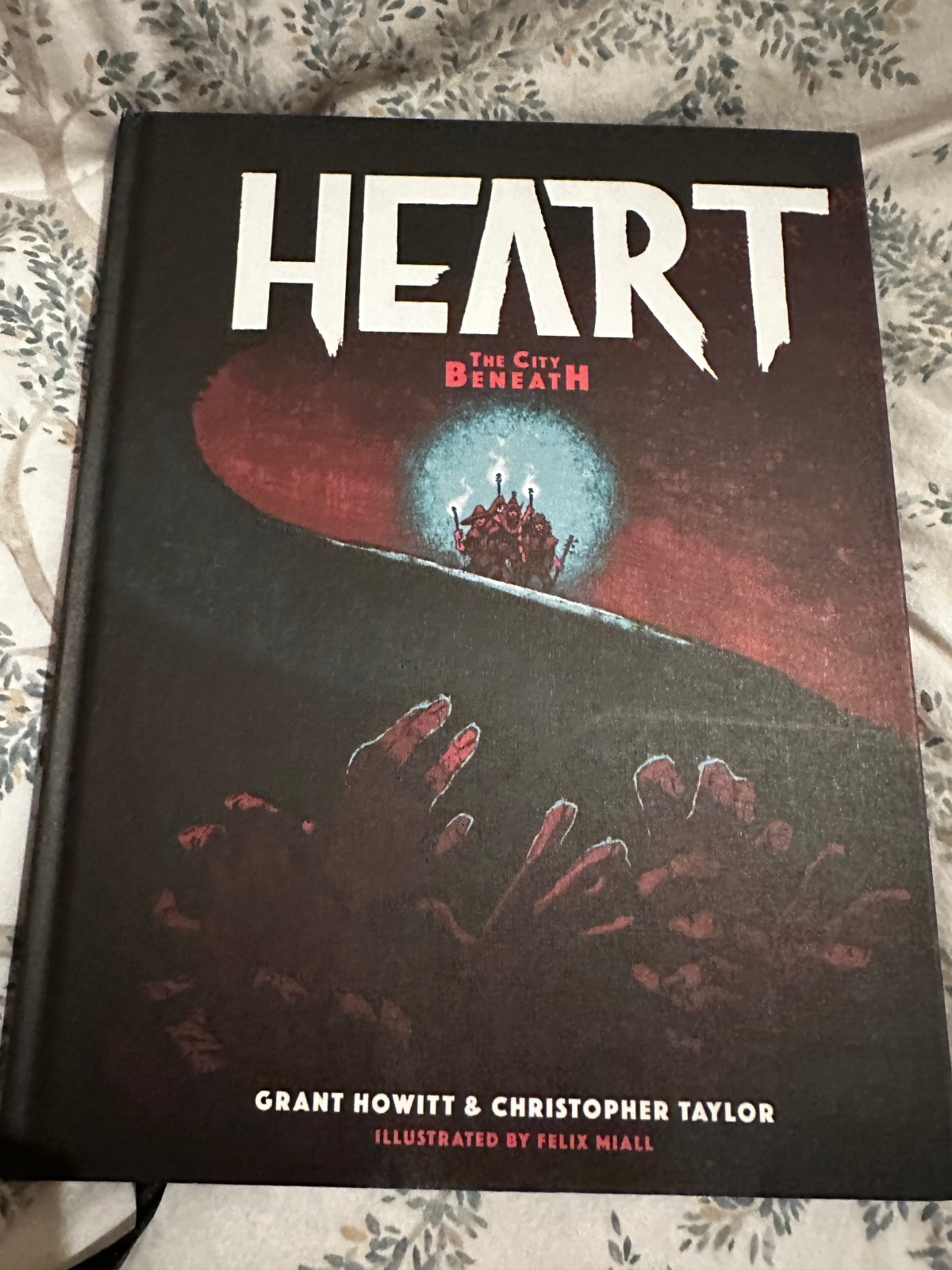
I have generally looked at Heart, The City Beneath as a campaign-play game. It’s made for it. It has a structure to the gameplay that rewards multi-session arcs. Your character’s beats beg you to spend time to seek out the opportunities to achieve them. And that Zenith ability; everyone perversely desires that big finale, their moment in the spotlight for one last time, that explosion of ‘themness’ right at the end so they can say they really went out in style.

So, when you are asked to run a Heart one-shot, what do you do? How can you replicate the uniquely satisfying journey that belongs to the delvers in a campaign, in just one session? The short answer, of course, is, you can’t. But, can you create a satisfactory one-shot with a slightly different feel? Yes, of course you can.

You will not be too surprised, dear reader, at this point, to discover that that was the exact situation I found myself in last week. I had a special request come from one of our founding Tables and Tales members to run a Heart one-shot, so I had to give it a go.

Heart Exam
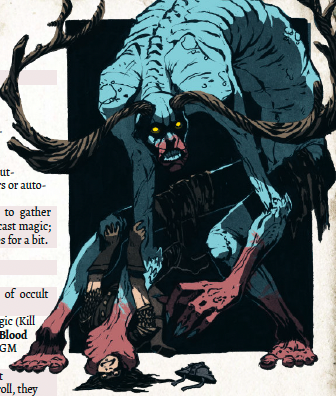
The Butcher, replete with antlers, haunted expression and meal

Grant Howitt and Chris Taylor know what they’re talking about when it comes to designing and running games, particularly their own games, I figured, so I started with them. Heart has a lot of useful tips for GMs in it. There’s advice for the novice and the veteran alike on how to run RPGs/story games/Heart. They also include separate sections for campaigns and one-shots. It’s worth noting that much of the general advice for running Heart is just as important in a one-shot context as in a campaign. The one-shot bit itself is minimal but useful.

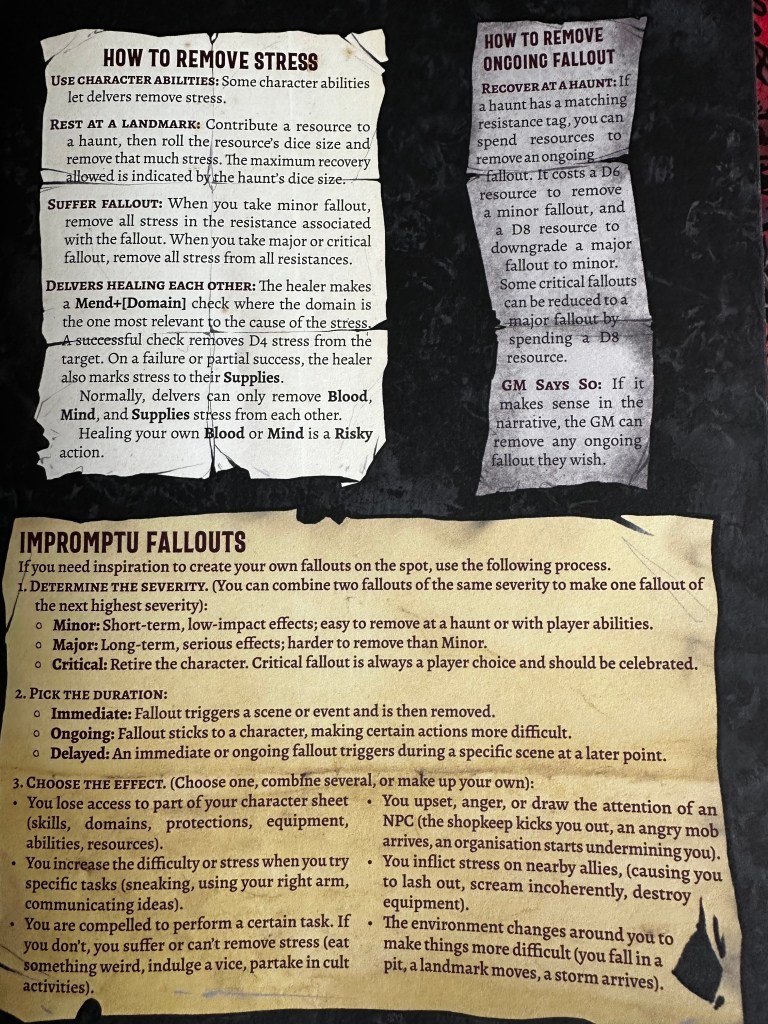
Running Heart as a one-shot is straightforward enough. The only changes you’ll have to make are around pacing and how you inflict stress and fallout.

Pace-maker

The Heartsong Calling sitting on the edge of the bed wondering where that music is coming from.

The advice around pacing is as true for a Heart one-shot as it is for any game, you have to start fast and keep it moving. No long-winded expositions, no character-development heart-to-hearts that take thirty minutes, no hanging about. Start in media res or as close to it as possible. Provide the necessary information in summary or in flashback and get to the action. Also, you have to give them something they can do in one session, a goal, a destination, a creature to kill or a thing to retrieve. All this sounds easy enough, but it can be tricky. It has taken me quite a while to develop my one-shot technique to a point where I feel like I am almost guaranteed to get it done in one shot. You start to figure out where you need to kill your darlings to make up the time. Working that sort of thing out on the fly is a skill I have made gratuitous use of recently.

In this one-shot, I had the PCs escaping Redcap Grove as a sort of mini-delve on the way to the entrance of the actual delve which would take them to Hang Station. They had a simple job to deliver some psychoactive fungus to a Vermissian Sage in the station. But, woah, were they rolling badly… and also being little nut-jobs. The Cleaver, predictably, decided to hunt the Druids who were hunting them and it turned into a stress and fallout ridden combat. This was fun, and horrific and hilarious. Almost everyone in the combat hulked out at some point, the Witch into her True Form, the Deep Apiarist into her Awarm Form, the Cleaver into his Chimeric Form and the one remaining Druid into their Cave-dweller Form. The players understood the one-shot assignment and did not hold back. There’s no point in saving your cool power till the end… it’s all end. Anyway, because this took a little longer than expected, I ended up combining this mini-delve with the longer inter-landmark delve that I had prepared between Redcap and Hang. I essentially just combined the remaining resistance of the mini-delve and the delve-proper on the fly. This worked well, even though it meant I had to cut out an encounter with the Butcher…

Stress and Fallout

The Penitent Calling on their knees, praying for forgiveness

Mssrs Howitt and Taylor also mention stress and fallout in the extract above. You can’t be afraid to hit them hard. Fallout is one of the most fun things about Heart. Players are sick little freaks who love getting lumbered with terrible burdens. Give them what they want, I say! Fallout is one of the key ways to push PCs to act in certain ways and that pushes the game forward so it’s win-win, innit?

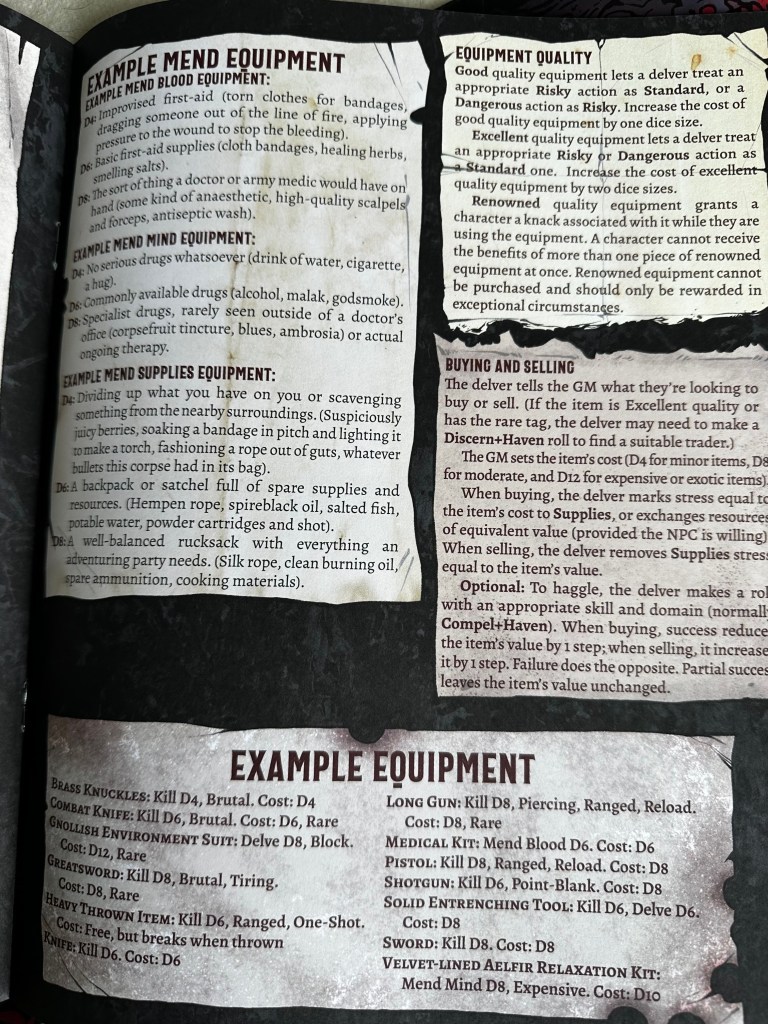
I took this quite literally. I made sure that the busted old crate they were transporting their dodgy mushrooms in was leaking the kind of spores that some sado-masochist might pay a large amount of coin for. Every time they rolled against the resistance of the delve or when they made any dangerous movements or just when nothing else was going on, I got them to roll Endure+Wild to resist the effects of the fungus. If they failed, they got Mind stress and if they got Fallout from that, they got one of the following:

FALLOUT: Traitor Brain, MINOR Mind – You relive a moment of regret ad nauseum. Always at the worst possible time. All actions increase in Difficulty by one step (ongoing.)

FALLOUT: What Did You Do? MAJOR Mind – You witness the effects of your worst mistake on those it affected. It is a gut-punch to the mind. When you mark Mind stress, roll two dice and take the highest (ongoing.)

This had exactly the effect I wanted. And if you engineer it right, you can use this sort of technique to bring about some really cool moments.

Pregens

Speaking of engineering things… making pregenerated characters for this game was the best decision I made. I had to combine it with a few tweaks to the rules, but, if I were to recommend doing one thing for your Heart one-shot, it would have to be creating and assigning pregens yourself as the GM.

I created three pregenerated characters, one Gnoll Cleaver with the Heartsong Calling, one Aelfir Deep Apiarist with the Enlightenment Calling and a Human Witch with the Penitent Calling. I gave them their starting abilities, picked their equipment, I even picked their names and answered some of the questions presented in the Calling and Ancestry sections that rounded them out as characters. I even chose their names and starting beats! I left a couple of answers up to the players, namely the ones to the questions about how their characters were associated with one another. Having them answer those gave them a sense of belonging and of fellowship with their adjacent weirdos.

Anyway, the character creation took the bulk of my prep-time, easily, but it was very much worth it. Here’s my thinking: I wanted to make sure we did this thing in one session so didn’t want anyone dithering over the details, and I didn’t want to have to explain all about every aspect of a Heart character before we even got started playing. I wanted to be able to have an inkling of the beats they would reach for to make it easier on myself to improvise them in the moment during play, I wanted to be able to plant connections to the PCs lives here and their and I wanted to be able to use the Heart itself, to make it feel like the Heart was reaching into their souls and coming out with their greatest desires. The Fallout that I wrote above? I wrote that with the idea in mind that the Penitent Witch might need that to confront her greatest regret, why? So I could introduce the last ace up a Heart GM’s sleeve, the Zenith Beats and Abilities.

The Zenith

They had been hitting both minor and major beats throughout the session and taking new abilities as appropriate. I allowed them to hit as many as they wanted. I had given them four each in their pregen character sheets. But that wasn’t enough for me.

Just as they were exiting the delve and entering Hang Station with their psychedelic cargo, I asked the players to refer to the book and take a look at their Zenith Beats and Abilities. I only pulled this out near the end so they wouldn’t know it was coming. Luckily each Calling only has two Zenith Beats available and each Class only has two or three abilities. So it wasn’t too much to look up in the moment, and, as soon as I told them this, I knew I had them (or two thirds of them anyway.)

I made it clear that I would be lenient in judging whether or not they met the conditions of the Beats because I know how good it is when a Heart PC hits their Zenith. So we made it happen. By the end of the session, each of them had brought about their own personal apocalypse and it was a thing of red, wet beauty. The Cleaver destroyed and replaced the Beast in the bottom of Hang Station, transforming the landmark into a swampy forest in the process, the Deep Apiarist summoned the Heart itself into the space just long enough to squash her into a red, wet stain and the Witch brought the Deep Apiarist back from the dead, sort of, as a clone made from the Heart itself, a clone that will always return no matter how many times it dies…

We wrapped the whole thing up neatly in about three hours. If I hadn’t cut the Butcher encounter and combined those two delves early on, it might have gone another half hour. Either way, a nice, diminutive package, I think you’ll agree.

Homebrew Heart Landmarks 5

It was the kind of party that took its toll on a number of different organs, the brain being not the least of them.

Two-day Wedding

Dear reader, I returned yesterday from a trip to Cork where I attended the wedding of a dear friend of mine. It involved a great deal of time spent with very old friends in the most convivial of circumstances, accompanied often by a pint of Murphy’s and a lot of reminiscing. I’m still recovering. It was the kind of party that took its toll on a number of different organs, the brain being not the least of them.

But, you know, inspiration is a fickle mistress.

Pub Crawler

Name: Pub Crawler
Domains: Wild, Haven
Tier: 3
Default Stress: d6
Haunts: The Pub Crawler (d12 Mind)

Description:
Vansant Depwy, former Knight of the Lower Docks and Minister of Our Hidden Mistress fled the City Above many years before. Burned by the Ministry and broken by his former companions in the knighthood, he found himself wandering the arteries of the Heart, lamenting his lost companionship and honestly, just gagging for a pint. As always, the Heart provided.

The millipede of enormous proportions that is Pub Crawler came to Vansant when he was most desperate and dribbled ever so delicately into his open mouth as he lay directly in its path. It roused him immediately. The finest ice wines of the High Elves the flowing ichor seemed to him. The next moment a fine brandy from the Home Nations. He could not get enough, despite the dubious origins of the divine liquid. His head swam and he rejoiced. Immediately he hopped aboard the cyclopean insect and continued to ride it forevermore. Along the way he collected what salvage he could to hook the creatures glands up to rubber pipes to facilitate easier imbibing. He built a small structure and started filling casks while welcoming visitors to his little ramshackle hostelry. As time went on, he and the beast attracted the attention of more less-than-discerning travellers desperate for a decent drink so deep as they were in the Heart. Some of the visitors became residents and then publicans in their own right. The pubs stretch now from the great insectile head to its earwiggy tail. Vansant’s, of course, has pride of place between the two many-faceted, ale-gold eyes. Its name is synonymous with the creature itself these days, the Pub Crawler.

Special Rules
They say it’s a mile from one end of the Pub Crawler to the other. A visitor who wants to partake of the healing effects of the Haunt must work their way up from the tail, taking a drink in every pub on the way. In other words, it’s a pub crawl. The booze is not particularly strong at the tail end as the further they get from the mouth, the more they are forced to water it down. So each visitor is forced to make and Endure/Wild roll or take a d6 Mind stress as they begin to commune directly with the Pub Crawler itself. The first roll is Normal difficulty, the second at Risky and the third at Dangerous.

Fallout Tipsy (Minor, Mind) One more? One more. Doing anything but getting another drink is now Risky.

Fallout Well on it (Major, Mind) There is a constant clicking and clacking in your mind. You must now either try to kill the source of it (the Pub Crawler) or try to understand it.

Fallout Pallatic (Critical, Mind) You understand the Pub Crawler and its reason for being. You know why it secretes such delicious and delirious juices. And now that you know, you have no choice but to stay and set up shop yourself. Spread the booze and spread the word.

If you do manage to make it all the way to the magelight illuminated superpub known as the Pub Crawler, Vansant himself will come and serve you the most potent brew of all, purging you of all Mind stress and Fallout and bestowing on the lucky patron an honorary knighthood.

Prep

Preposition

This post is part of a blog bandwagon started on the Roll to Doubt blog.

Click on the link above to take in the blogpost that’s piloting this bandwagon. Wagon-jumpers abound. You can find a very nice read on the same topic and a handy list of related blogposts on the Among Cats and Books blog.

What’s clear from even a cursory glance at the other blogs is that no two people are prepping in precisely the same way, so advice and recommendations come with the notice that your way is probably the best way. The thing is, in my experience, you find your way only through trial and error. Here’s my effort to tell you about my trials and my errors.

Preponderance of prep

I used to spend hours and hours preparing my games when I was a kid. To be clear, I loved doing it. I would happily get lost in the world-building, the map-drawing, the character creation and the encounter balancing for hours when I should have been studying. I still often think that I gained more from the time I spent on RPG preparation than I did from learning off -by-heart lists of dates and events or theorems and proofs. But I digress.

My prep used to be pages upon pages of tightly packed hand-writing explaining the background of an adventure, the major NPCs involved, the probable goals of the PCs and far more history about the setting than the PCs would ever be able to interact with. I drew maps by hand as well, when I had to. I didn’t run a lot of published adventures but I did make liberal use of soucebooks. I would select the people, places and things I wanted from those books and elaboate on them wildly, writing more pages on how they would connect with our campaign and adding a lot of extra details.

I sometimes wish I had the time to do preparation like this these days. But, when I do find myself with the time, and I sit at the computer to start working on it, I find I would rather shortcut it. I’ve asked myself why this is on many occasions. I’m not sure I have the answer, or else there are several. It could be to do with the process of writing in a notebook and drawing by hand on grid-paper. I don’t want to prep like that these days because having all of my work backed up digitally is invaluable. Time is still a factor. Even when I feel like I have some extra time on a particular day, I can’t guarantee that I’ll continually have that as the campaign progresses. But I think the main difference for me now is the feeling I get from making the world, its people, the major events, the game, at the table with my players. When you are all on the same page, when everyone comes together to create something greater than I ever could on my own, that’s one of the real joys of this hobby.

So, I don’t really do that anymore.

Preplanned not prepared

It’s taken me a long time to make this change, though. Even looking back at the work I did in preparing for our current Spelljammer game, I had thousands of words written on setting, backgrounds, NPCs, over-arching plot etc. And I would write thousands of words of session preparation while going along too. What I have discovered during the last couple of years of trying to prepare this way, however, is that that sort of prep is close to unusable at the table. Even if I am the one who wrote that dense paragraph of text, I can’t find what I’m looking for in it in the couple of seconds I have to react to something at the table, or to answer a player’s question without delay to keep the flow of the game going. Now, it’s not always a waste of time, I will admit. Sometimes, the very act of writing something will help to embed it in my memory and imagination, so obviating the need to check it at all. But, then again, there is the other effect of writing something down. It has the effect of making something true.

Truth at the table should only come from play. The only real things in the game world are what the PCs experience. Everything else, even things the characters have learned or heard about, is pure conjecture. Until it’s not.

This doesn’t mean I don’t prepare anything of course. I make plans for events I would like to occur or NPCs I want the PCs to interact with. But in those cases, I will write down something about the event, just a few details about what happens, who might be involved, what effects it might have. Or I will give the NPC some quirks, desires, flaws and interesting characterisations to bring them to life. But I will keep them to be used when and where they seem to fit.

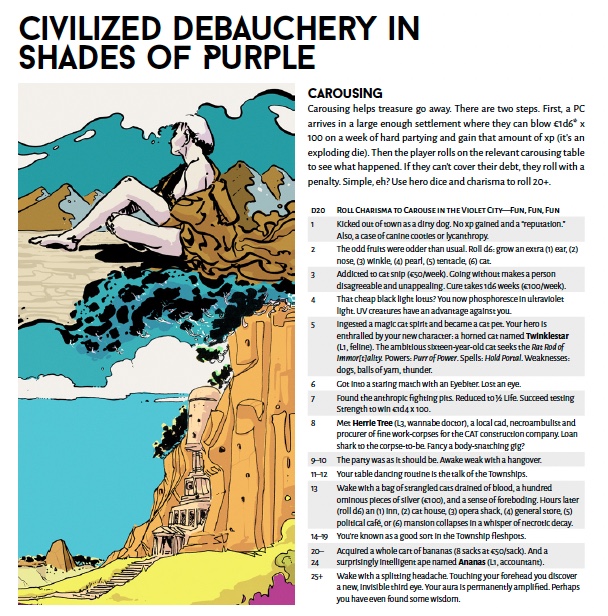
Otherwise, I revel in the joys of random tables. I use rumour tables and encounter tables quite judiciously these days. In a game like Ultraviolet Grasslands, I am spoiled with wonderful encounter tables, trade goods tables, carousing tables, and almost any other type of table I could desire. But when it comes to 5E, I am generally disdainful of the encounter tables provided. So I make my own. Made right and used right, these not only make for some interesting sessions, but also act to drive the game forward, introducing NPCs that become important to the plot, enemies that might defeat the PCs or might lead to vengeful associates pursuing them later. Importantly, I feel, they maintain an element of randomness and ensure that the players know their rolls have led them to the encounter, or not. It’s great if you can engineer it so that the players are rolling on random encounter tables at the end of a session. That allows you to take the result of their roll and make preparations for the specific encounter they rolled up for the next session. Usually, these days, I refer to Between the Skies for more tables and for inspiration to make the encounter really interesting.

Between the Skies does not limit encounters in space to just running into creatures, but also gives options for hazards the ship might run up against and problems that stem from the ship itself.

Here are the simple d6 and d4 tables I made to determine if the crew run into anything, and, if so, what it might be:

Wildspace encounter table d6

1-2 No encounter
3 Ship Hazard
4 Ship Problem
5-6 Encounter

3 Ship Hazards

Roll 1d4

  1. Hazard 1 – Storm, Flood
  2. Hazard 2 – Disorientation, Sphere
  3. Hazard 3 – Obstruction, Cold
  4. Hazard 4 – Trap, Haunting

4 Ship Problems

Roll 1d4

  1. Problem 1 – Armament, Separation
  2. Problem 2 – Quarters, Shrinkage
  3. Problem 3 – Cargo, Disappearance
  4. Problem 4 – Bridge (spelljammer helm), Error

5-6 Encounters

  1. Isolationists – Confusion, Related Entity – Unknown NPC, Glittering, Prayers
  2. Ship Parasite – Loss, Scales, Experiments
  3. Ruins, Ancient – Mourning, Related Entity – Petty God, Knots, Miscommunications
  4. Stowaway – Battle, Related Entity – Creature, Eggs, Blindspots

The descriptive words I listed beside each entry come from the spark tables in Between the Skies. These are invaluable resources that give you the inspiration to come up with truly unique situations, problems and obstructions. You should go and buy this book at the link above.

When I get the players to roll on these tables, I either make up the encounter/hazard/ship problem on the spot using the sparks of inspiration or I use the time between sessions to come up with something memorable.

A while ago, I realised the plot I came up with for the Spelljammer campaign was much less interesting to the players or their characters than the shenanigans that they got up to each session. They were more wrapped up in their own shit. And that was very cool. It made me want to make a sandbox for them to play around in instead of expecting them to interact with a plot they had little or no investment in. This goes back to the time I introduced a hex grid to the underside of the Rock of Bral. I did this to allow one of the PCs to drag the whole party with them to rescue their mother who was trapped in the prison down under. It did not serve the overall plot, really, but I had to have fun things for them to do while traversing this area so I made it a hex map and created some random encounter tables for each of the different types of terrain on the underside of the asteroid.

You know, it took me a long time to cop on to this though. The signs were all there. Dear reader, if your players never remember what is happening in the plot of your meticulously crafted campaign from one session to the next, you might be overloading them with plot. Maybe they just want to play their cool character and have fun moments between them and the other PCs and significant NPCs. Or maybe they are only interested in hitting things really hard. Or maybe all they have ever dreamed of is building their very own tower of necromancy built on the bones of their enemies. Or perhaps they just want to find their dad? Ever think of that? Maybe your plot is not that important to them. If you take nothing else away from this post, please take that.

I have drifted a little way away from the central theme of the post but I insist that, in actuality, you should be prepping for the sessions you want to have, and, more importantly, the sessions your players want to have.

Prepaid prep

Most of what I have been talking about is prep for D&D/OSR style games. Games that you can play as sandboxes without upsetting anyone. But, what, you might ask, dear reader, do I do to prepare for other types of RPGs?

I have some very specific examples here.

Free Leagues/Year Zero Engine Games

I have a few of these under my belt at this point. I can say that the type of prep I do for these is significantly different to what I have described above. The ones I can refer to are Tales from the Loop, Blade Runner and Alien. For me, the thing that holds these adventures together is the Countdown. This is something that’s rather integral to most Year Zero engine games. Below you can see the countdown from the Tales from the Loop adventure published in the core rule book, Summer Break and Killer Birds.

Once you get the timeline of events in place for one of these adventures everything can be positioned around it. Tales from the Loop adventures, in particular, I find, can be written with ease in the very specific format that Free League has presented to you in the book. They provide really valuable advice in all of their books for creating your own adventures. Blade Runner also provides lots of useful random tables to help you create your own case files for that game. When in comes to prep for this style of game, just make sure you know the countdown well, and you keep track of the shifts/days of activity for the PCs. After that, the published adventure or the one you have written in the provided format, will do the work for you. The rest is improv.

Resistance System, Spire/Heart

Resist the temptation to do anything other than read up on the specific areas the PCs are likely to interact with the next session and maybe jot down some NPC details/desires/stats. Resistance system games really thrive on improvising at the table and having the PCs drive the narrative forward with their actions and their fallouts. This is particularly true of Spire where most of the game occurs in NPC to PC interactions in my experience.
In Heart, I think it’s a good idea to have some idea of the landmarks your PCs might end up in. In the last game of Heart I GMed, I made it specifically Vermissian themed so that I knew they would be visiting a lot of Vermissian stations on the way down to Tier 4.

Prewritten trad scenarios

I am thinking of the Dragon Age game I’m running right now but I think this is advice you can apply to most adventures that are presented in dozens/hundreds of pages in long dense paragraphs. Read the full adventure, then, read it again, but this time, take all the relevant information from each room description, encounter text or whatever and transcribe it into something more easily digestible and more useful at the table. I use bullet points as that’s what I’m used to. I also usually take the more relevant enemy stats like Health, Defence and Armour Rating and note them too. This is me applying the lessons I learned from the mistakes I made as a kid and applying them to the published adventures written by professionals, I realise that. And maybe that’s presumptuous of me, but, hey, it works.
The second time you read it, you shouldn’t do it all at once. Just make those notes between sessions.

Conclusion

Prep can take many guises. It will be different for every GM. A lot of people use all sorts of apps and other technical solutions. All valid, but all I ever use is a wod processing app and a few dice. Whichever methods you use are probably going to be right for you, even if it takes you a while to figure out how you should do it.

Modular Gaming

Improbable hot-takes

“The Discourse (TM)” has been focusing on running published adventures/modules/campaigns as opposed to custom/homebrew/sandbox games for the last little while. First Quinns reviewed Impossible Landscapes, an epic and almost legendary campaign for the modern Cthulhu-ish game, Delta Green. This is the first time Quinns has reviewed a campaign/published adventure on his RPG review channel, Quinns’ Quest, so it was unusual enough to spark a significant amount of discussion all on its own. And then Thomas Manuel of the Indie RPG Newsletter and Rascal reviewed the same campaign. I believe this was purely coincidental, especially as Impossible Landscapes came out about five years ago now. Both are great reviews in their own right and are based on full play-throughs of the campaign so you know they’re of real value. You should check them both out.

Anyway, on Bluesky, Thomas Manuel went looking for recommendations of other modules to run and this spawned a lot of interesting answers and quote-bleets from RPG luminaries, such as this one, which I found interesting.

I have opinions on the conversation, of course. I have shared a lot of them in other posts from the last year or so, actually. If you want the summary, though, I had a lot of bad experiences running D&D scenarios in the past, especially from the AD&D 2nd edition era. I found they were difficult or impossible to just pick up and run. In fact, they required maybe more preparation time than adventures and campaigns I wrote myself. The one published 5E campaign that I ran, Storm King’s Thunder suffered from the same issues, actually. This made me feel like it was a “me” thing. But, it turns out, a lot of GMs feel the same way, according to Bluesky, at least.

However, I have had my mind changed somewhat by running pre-written adventures for some other games, particularly Free League’s Blade Runner, Dungeon Crawl Classics and, to a lesser extent, the Dragon Age RPG from Green Ronin.

This is a link to my first post on Electric Dreams, the introductory Case File for Blade Runner:

And this one compares the same module to a 5E murder mystery adventure I played in around the the same time:

Here’s my post about Sailor’s on the Starless Sea for DCC:

And this is my post on running Duty Unto Death, a short intro adventure for the Dragon Age RPG:

And finally, this post, although ostensibly an excuse to discuss DCC adventures, also includes my opinions on the one 5E campaign I ran:

I will say that, despite my generally favourable outlook on most of these modules, I still find I have to to do a lot of prep for them. The main fear I have is messing things up so bad that I essentially spoil the rest of the adventure. Although, I should really have more faith in my abilities as a GM at this stage. I feel like I can probably improv my way out of any hole, to be honest. But it does not change the fact that I spend hours rewriting long paragraphs presented in module texts into digestible bite-sized bullet-points. I am running another Dragon Age scenario right now. Amber Rage is from Blood in Ferelden, an anthology of scenarios for the game that came out in 2010. It suffers from verboseness and unnecessary detail and makes for a lot of work from the GM. I’m enjoying the contents of the scenario but its presentation is horrendously dated and needs a sprinkle of OSR magic to tighten it up, in my opinion.

I realise that none of the modules I have mentioned here are anywhere close to having the size and epic scope of something like Impossible Landscapes, but it doesn’t change the fact that they have largely changed my mind about running anything pre-published. The one I have my eye on right now is Dagger in the Heart for Heart: The City Beneath. Actually, I have a post about that right here too:

OK, I’m off to discuss the discourse on Discord of course!

Throwback Sunday?

I’m feeling dreadful today, dear reader. I don’t know what I’ve got but it’s kicking my arse. Anyway, I thought I would use my malady as an excuse to return to one of my very first blog posts, instead of trying to write a new one. Here it is, The GM Jukebox from last July, where I discuss the use of music at the RPG table, whether real or virtual. Hope you enjoy it!

Homebrew Heart Landmarks 4

Railsea

China Miéville. Go read some of his books. Go on. I’ll wait. Need more? OK. I recommend the full Bas Lag trilogy. In my opinion each book in the series is better than the one before. Anyway, those should only take a month or two to get through. Once you’re done with those, immediately pick up “The City and the City.” Just trust me. You won’t regret it. Once you have finished getting your brain-digits around that, please relax your cerebellum and get ready for “Embassytown.” Read all of them. Please.

I still have a few of his books to catch up on. I’m a little late to the party. I picked up “Perdido Street Station” in a second hand book shop about 15 years ago and couldn’t quite get past the idea of a woman with a beetle for a head (not a beetle-head, that’s different. Her head is a beetle.) I gave it another go a few years ago and was immediately hooked. The so-very-alive city of New Crobuzon, its fascinating and beautifully realised inhabitants, the wonderful meshing of the steam-punk, the fantastical and the horrific all worked together to make me simply want more and more. Luckily, “Perdido Street Station” is about 1000 pages long and has two sequels so they kept me going for a while.

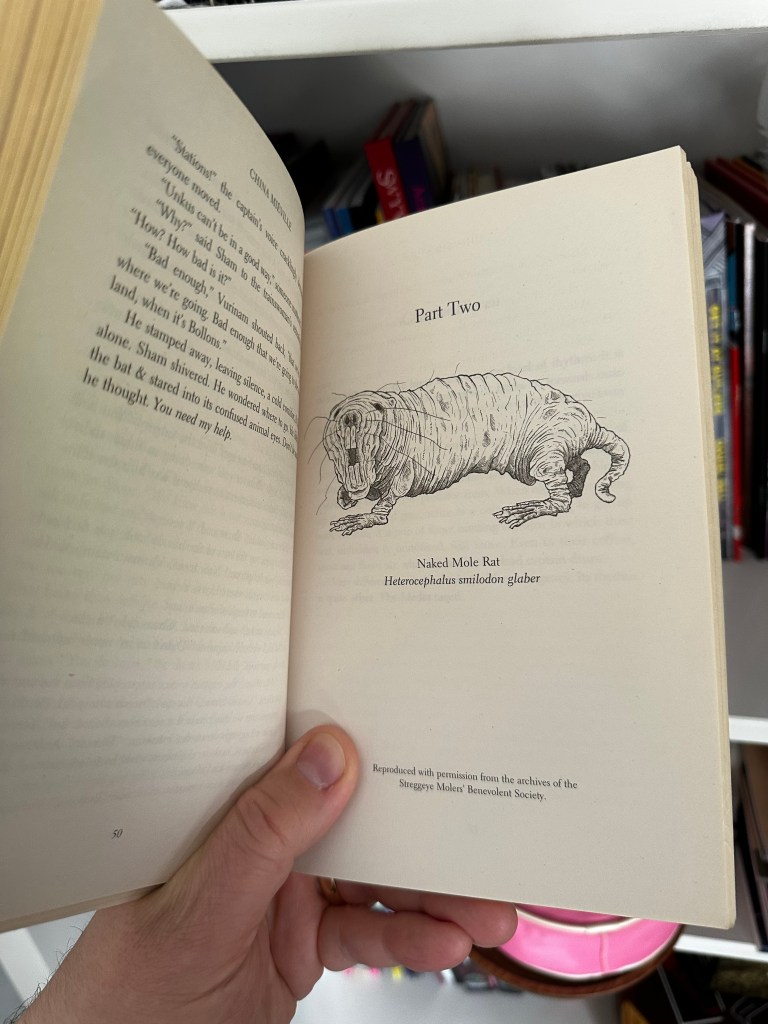
I’m currently reading “Railsea.” This is not a Bas Lag book, but it evokes a lot of the same feelings in me as his earlier work. It is set in another world, one where there is a literal sea of rails between the continents and islands, where trains are captained by Ahab-like characters who pursue Moldywarpes (giant moles) like sea-captains pursued whales in centuries past. The ground between the tangle of rails is not literal poison, oh no. Our main character, Sham, tells us that. But if you touch it, you’re courting death, or dancing with danger at least. The subterranean lifeforms, bugs, giant mammals, that sort of thing, they’ll come and drag you down or tear a leg off if you’re not careful.

I haven’t gotten very far into the book yet, but I am savouring it. I’m exclusively reading it on my train ride to and from work so it’s hard to get up a good head of steam as it were.

Anyway, it felt rather “Hearty” to me. You know, what I mean, reader? Got the old Heart Landmark juices flowing a bit. There’s so much about magical, inter-dimensional underground railways in Heart: the City Beneath. It felt appropriate to come up with a Heart Landmark inspired specifically by “Railsea.”

The Vermissian Graveyard

Name: The Vermissian Graveyard
Domains: Technology, Cursed
Tier: 3
Default Stress: d8
Haunts: The Engine (d8 Echo)

Description:
Beneath a roiling crimson sky of steam clouds, a vast and silent plain of dry red earth, dotted here and there with scrubby trees and hardy grasses, whorled and tangled by an impossible rat’s nest of railway lines. At their final rest atop these lines, trains. So many rusting, curving, snake-like carriages and engines. Freight cars, passenger cars, entertainment and dining cars, all lifeless, dark, slowly falling to pieces.
Maybe this is where the trains of your Vermissian went. It could be. Perhaps some of these vehicles once were meant for that cursed underground, but most are from some other Vermissian, some Vermissian that never had an “Incident.” Perhaps they came through Fractures, perhaps the Terminus directs all old hulks of rail-stock from across all realities to this place, this final resting place. Or maybe it’s the afterlife for these faithful old servants.

It’s certainly haunted enough to be a graveyard. Ghostly passengers walk the aisles of the cars seeking their seats, spectral engineers stand about in cabs, smoking cigarettes, conductors from beyond examine tickets to nowhere, on trains that will never move again.

The ghosts can’t do much to a living soul except maybe freak them out a bit. But don’t touch the ground. Do not touch that brick-red earth beneath the rails. Step down and you’ll understand why this place is devoid of all life. The slightest vibration will attract the stranded dead, grasping undead things, trapped here with their last trains, jealous of the life and wealth of the living, lying in wait below the earth. All they want is to strip you of your wealth. So, if your greatest wealth is your memories, they’ll take those, thank you very much. If your wealth lies, rather, in Queens and Stens from the City Above, they’ll leave you a pauper. If your most prized possession is your body or the blood in your veins, they’ll take that too. No matter what they take, they’ll try to take all of it, leaving nothing but a ghost behind, stuck on a train that’s never going to move again.

In what might be the centre of this mess of rolling stock, a single orange fire burns, fitfully and brightly, belching out spire-black smoke from the chimney of a single, shiny black engine. An old steam engine, kept polished to an unlikely shine houses the Engineer. They are a skeletal figure equipped with a spire-black shovel a set of neatly pressed denim overalls and a tall blue peaked cap. Fires burn in their eyes, emitting sparks occasionally, mirroring the hotly glowing fuel they keep the engine topped up with. When a stranger comes to the Engine, the Engineer hands them the shovel and gestures to the bunker full of spire-black and then to the fire. If they shovel a few loads, the Engineer will bow and point the way to the exit of the graveyard. They will leave feeling tired but fulfilled, as though having done a good days work. If they shovel in a suitable resource, the Engine will belch and shake and will bathe the worker in orange light, removing d8 Echo Stress from them as well. If they do not shovel, the Engineer will shrug, light a cigarette, and go back to shovelling himself.

Special Rules:
Without the help of the Engineer, this Landmark becomes a delve with Resistance 12. Potential encounters with Signal-box Cultists (see the Heart core book page 196) abound on this delve. Other possible events include falling through the floor of a rusted wreck, having to avoid toxic freight and slipping off the rails onto the ground where the Stranded Dead await.

The Stranded Dead inflict d8 stress to whatever resistance is most important to the PC. This could be defined by the PC themselves or you could choose the one they have the most Protection in.
Fallout Slight Delay (Minor, Any) You touched the ground in the Vermissian Graveyard and drew the attention of the Stranded Dead. They took something from you. Now you’re just ever so slightly translucent and the ghosts on the trains are asking you to sit next to them. All actions taken to escape the Graveyard are Risky.
Fallout Major Disruption (Major, Any) You touched the ground in the Vermissian Graveyard and the Stranded Dead took so much from you. You’re hardly there anymore. You can understand the vapour talk of the ghosts on the trains. All actions taken to escape the Graveyard are Dangerous.
Fallout Ghost of the Graveyard (Major, Any) You touched the ground in the Vermissian Graveyard and the Stranded Dead took everything from you. You join the other ghosts and take your seat on the dead train.
Resources:
Train parts, d8 Technology
Train Ghost ectoplasm, d8 Cursed

Ways and Means: A Heart Sourcebook

To wrap things up, I thought I would let you know, dear reader, about the new Backerkit crowdfunding effort coming our way soon from the good people at Rowan Rook and Decard. It’s called Ways and Means and it looks like it’s going to be a great sourcebook for both players and GMs of Heart. It’s going to have new Classes and Callings as well as new Domains of the Heart and events to fill them with. You can sign up to support it here.

Homebrew Heart Landmarks 3

May the fourth

The shows mostly deserve to be dropped into the Sarlacc’s maw, the fandom is more toxic than the bite of an Ewok (you just know those little guys are spreading rabies,) and the heyday of Star Wars was a Long Time Ago in a Galaxy Far, Far Away. But I do love a non-standard holiday as an excuse to play an RPG. Today, abiding by the Tables and Tales May the Fourth rule, Isaac is going to run us through a Star Wars themed adventure using Vaults of Vaarn (the rule is that we have to have a Star Wars themed game but we can’t use any official Star Wars games to do it.)

But not before I come up with a Star Wars themed Heart Landmark! You lucky readers!

Oddya’s Bog

Name: Oddya’s Bog
Domains: Religion, Cursed
Tier: 1
Default Stress: d4
Haunts: The Proving Cave (Echo/Mind d6)

Description:
All the inhabitants of Oddya’s Bog are one with it. Most of them have become one with it over the course of years and decades, adding their own energy to that of all living things in this place. I mean, they add their flesh too, but you can’t make an omelette etc. The Bog needs the bodies and life-force of the people and other animals who find themselves drawn here.

The bog, a treeless, stinking expanse of fetid, untrustworthy marshland, writhes and undulates, as some such places do due to the waters concealed beneath the turf surface. Oddya’s Bog moves in this way because it is made mostly of people and animals, living beings that are absorbed bodily by the landscape to add their essences to the entity known as the Compulsion. They live still, in a terrible mockery of life, slowly learning what it means to be both one and many under the sway of the Compulsion.

Master Oddya is the Compulsion’s greatest champion that has not been fully absorbed. He has existed in the forgotten bog for longer than he can remember. It is possible that he is nothing more than a creation of the Compulsion’s microscopic constituent parts, the chlorimediants. Either way, he is a sour old prune that many have mistaken for a Gutterkin. Perhaps he was once a drow; he shares their pallor and long ears; but he can reach no more than knee-height to most elves and he walks the discomforting bog, unclothed and usually sucking on a recently plucked eyeball or knucklebone.

Many come to the Bog in search of Oddya, believing him to be some sort of wiseman or priest of a forgotten god. The downtrodden and addled residents of the lower levels of Spire have a great need for a saint or a leader to believe in. Rumours have been circulated by a certain, rather smelly sect of blank-eyed, robed and hooded drow on the streets of Pilgrim’s Walk. They have been telling tales, in the voice of the earth itself, of a prophet and holy man named Oddya who holds the secret to oneness. They appear every few years before inevitably disintegrating into the bog-stuff that they are and slowly making their way through the waters back to Oddya’s Bog, where he will re-constitute them and send them back to the City Above again the recruit once more. The pilgrims who come are brought under the sway of the Compulsion as Oddya speaks his strange backwards sermons to them, urging them to surrender to the Compulsion, to trust it and to use it. Most are captured and merge with the bog. Some escape but Bog Folk will follow them to prevent them from spreading the truth of the Bog beyond its borders.

Only one cave at the edge of the Bog is free of the Compulsion, the Proving Cave. If you enter it, you will be forced to contend with the thing you are most desirous of. If you manage to resist it, you will be healed by the cave at the price of a D6 Resource. If you do not, you will gain the Fallout, Unproven. See the Special Rules section.
Special Rules:
Master Oddya – If he is allowed to speak his strange mystic mumbo-jumbo, he may ensnare the listener and bring them under the influence of the Compulsion. Endure/Religion or Cursed roll to resist or suffer d4 Echo Stress. If a PC suffers fallout from this, use the following:
Fallout There is No Try (Minor Echo.) Next time you might need to roll to do anything in Oddya’s Bog, you succeed automatically, but you lose a part of yourself to the Bog and the Complusion. All actions not directly in the service of the Compulsion are Risky.

Fallout I Have a Bad Feeling About This (Major Echo.) You are becoming one with the Bog and the Compulsion. All actions not taken directly in the service of the Compulsion are Dangerous.

Fallout Become Greater than You Can Possibly Imagine (Critical Echo.) Your body has become one with Oddya’s Bog and your essence serves only the Compulsion.

The Proving Cave – Ask the player what their character most desires if you need to. This thing will appear in the Cave as though it were the Heart itself. But it is fleeting and dangerous. If they attempt to take the thing or make it there own in any way, they will gain d6 Echo stress. If they get fallout from this, use the following:
Fallout Unproven (Minor, Echo) If they see the object of their desires again, they will be compelled to pursue it. If they resist, any other actions will be Risky. (Ongoing)

Resources:
Everything here is tainted but Oddya’s Bog Turf is a d4 Cursed Resource.

Homebrew Heart Landmarks 2

Guess the inspiration

I don’t think it will be difficult to see where I drew inspiration from this week. It’s a story I have mixed feelings about but still, it introduced the world to one of the most enduring and influential fictional universes ever. Just remember, desire is the mind-killer.

The Heart Worm

Name: The Heart Worm
Domains: Warren, Wild
Tier: 2 and 3
Default Stress: d6
Haunts: The Waters of Life (Blood D8)
Bernie Gallac, Terrible Warrior-Bard (Mind D6)
The Prophet, AKA Moonlight-Falling-On-Glaciers (Fortune D6)
The Herb, Mischung (Echo D8)

Description:
Travellers in the deeper levels of the Heart, where all is flesh and warm and wet, sometimes pass from an artery into a wide open tunnel, resembling a damp cave with masses of tooth-like protrusions projecting from ceiling, walls and floor at the entrance. Many need no more excuse than that to run from the place, but many others know better. They have heard of the Heart Worm, and they know of the life-giving properties of its vital juices. Usually, these are the type of fool-hardy adventurers who have nothing to lose and who find the prospect of burrowing through the flesh of the Heart only to be deposited in another, unknown location, “exciting.” For that is what the Heart Worm does. A giant, parasitic entity that feeds off the multidimensional matter and energy of the Heart itself while digging through it and leaving cyclopean tunnels in its wake, the Worm picks up passengers and ejects them wherever it wants, seemingly randomly.

The Heart Worm has swallowed a few people and never let them go, however, perhaps due to the understanding that its passengers need support and services during their sojourn.

Bernie Gallac, a drow former soldier of the Allied Defence Forces, has been trapped for so long, he has forgotten the world outside. He spends his days composing sarcastic little ditties to comically roast the visitors who come his way. He has been surviving on the Herb, Mischung, which grows in abundance around the depths of the great worm’s mouth. It, along with his long imprisonment, has made him strange, one-dimensional, lacking anything but the desire to do what he does in the service of the Heart Worm and its passengers. His eyes and the eyes of all the inhabitants of the Heart Worm, are crimson from consuming the wine-dark Herb.

A passenger can gather and consume the Herb too. It must be cooked down until it is in the form of a red paste in order for it to be edible. It will slowly change the colour of their eyes to a deep red, but it will also make them feel more at home in the Heart as they become one with it (see Special Rules.)

The Prophet, Moonlight-Falling-On-Glaciers, is an aelfir noble scion, trapped these many years in the gullet of the Heart Worm. They desperately wish to exit and spread the news about the Worm to all the inhabitants of the Cities Above and Below. But, for whatever reason, the Worm has not allowed it. Perhaps it is not their time yet? Perhaps they do not wish to be worshipped like a god, maybe they do not want their presence truly confirmed. The Heart Worm does not confide in anyone its plans or reasons. The mask the Prophet wears resembles the face of the worm but for the two crimson eyes visible through the slits in it. They will speak to passengers in a voice to deep and resonant to be understood, to increase their fortune.

The flesh of the Heart, eaten by the Worm, travels down the peristalsis of the great gullet almost constantly. Those who exist inside, stick to the walls of the giant being. Some have tried to take parts of the Heart meat to sustain themselves. These unfortunates are invariably ejected by the Heart Worm at its first opportunity, in the most dangerous of regions. Passengers who wish to benefit from the Worm’s diet must travel further down its throat until they discover the crimson lake of the Waters of Life, the digestive juices caused by the enormous creature’s Heart-burn. If they can endure its acidic nature, a passenger who immerses themselves in the lake will have their old skin stripped away, only for it to be replaced with a new, deeply red skin. It will heal them of physical ailments. (See Special Rules.)

Eventually, the Heart Worm will find the perfect spot to deposit its passengers. When that time comes, they will be physically ejected by irresistible waves of muscular force, which leads to them being spat out at their destination. This could be anywhere in Tier 2 or 3 of the Heart.

Special Rules:
Eating the Herb, Mischung has its dangers. It has the effect of bringing you closer to the Heart but this can also have the effect of making you like the Heart. When you consume the Herb, you must make an Endure/Wild or Warren roll or gain D6 Echo Stress. If this leads to fallout:
Fallout: Heart’s Desire (Minor Echo.) The next time anyone voices a desire in your presence, you must do everything in your power to fulfil it for them.

Bathing in the Waters of Life can also be very dangerous. Roll Endure/Warren or Wild or take d8 Blood stress. If this leads to fallout:
Fallout: Worm body (Major Blood) Your body begins to transform. Your new red skin sloughs off to reveal a ridged, wormlike one and you develop a taste for the Flesh of the Heart. If this is upgraded to critical, you fully change into a worm and disappear off into the Heart.

Resources:
The Herb Mischung (D8, Echo)
The Waters of Life (D8, Blood)

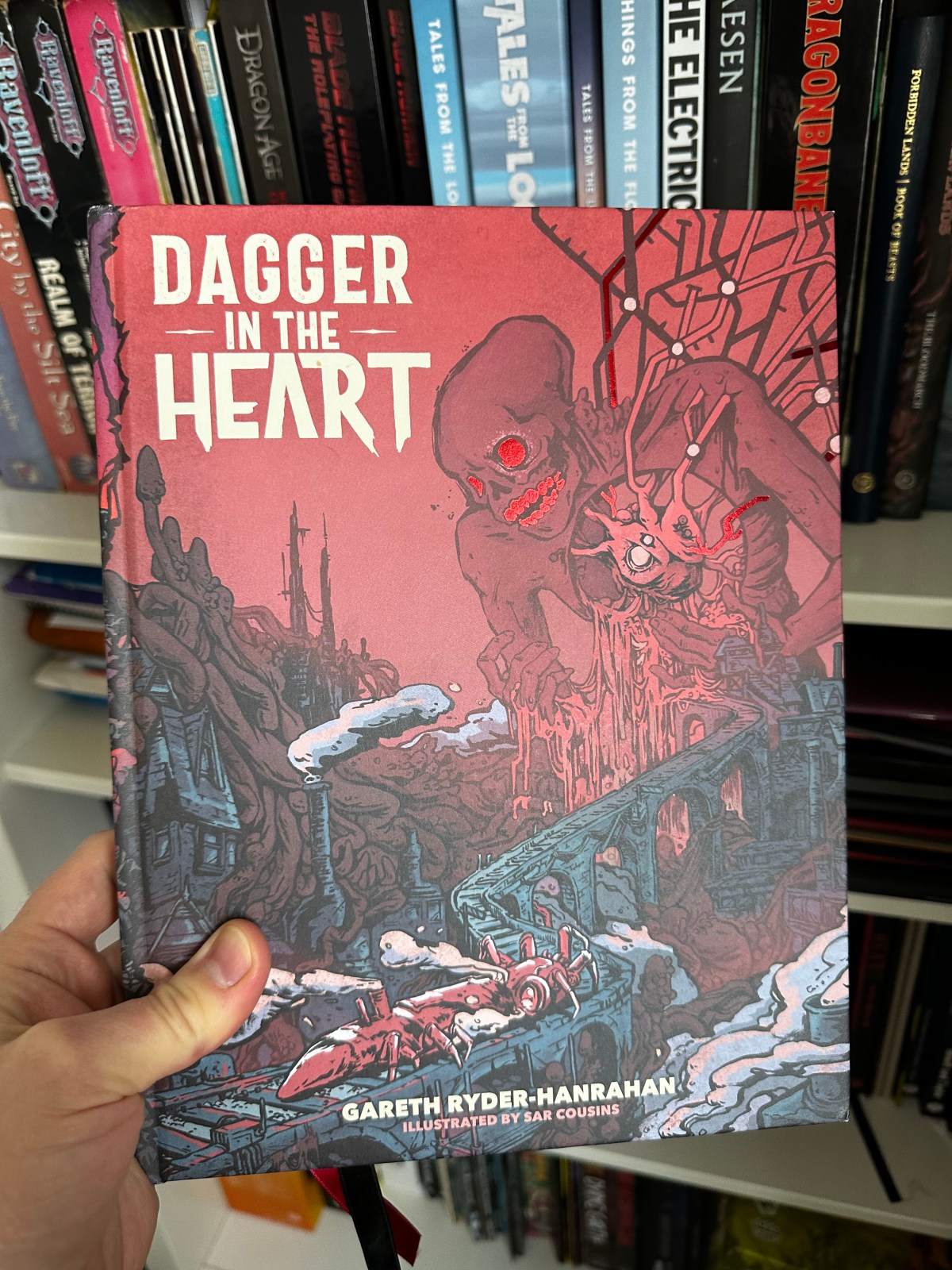
Dagger in the Heart

On Rails?

I recently finished reading through the new campaign book for Heart, the City Beneath. Dagger in the Heart from Rowan Rook and Decard was written by Gareth Ryder-Hanrahan and illustrated by Sar Cousins and came after a very successful crowdfunding effort last year. I backed it because I back everything from RRD but also because I was curious about how they were going to go about constructing a campaign for a game like Heart. In my experience, A campaign for Heart is something best dealt with one session at a time. Looseness and improvisational ability are qualities you will benefit from when GMing this game. The character beats that drive the events and the plot and the characters forward might have one PC searching for someone to kick off a tall building while another might be looking to get into a situation that’ll garner them some major Echo Fallout. So, maintaining any sort of direction can be a challenge. This is one of the game’s great strengths, of course. It makes it feel quite organic at the table and allows your players to feel as though they are the focus of the evolving story.

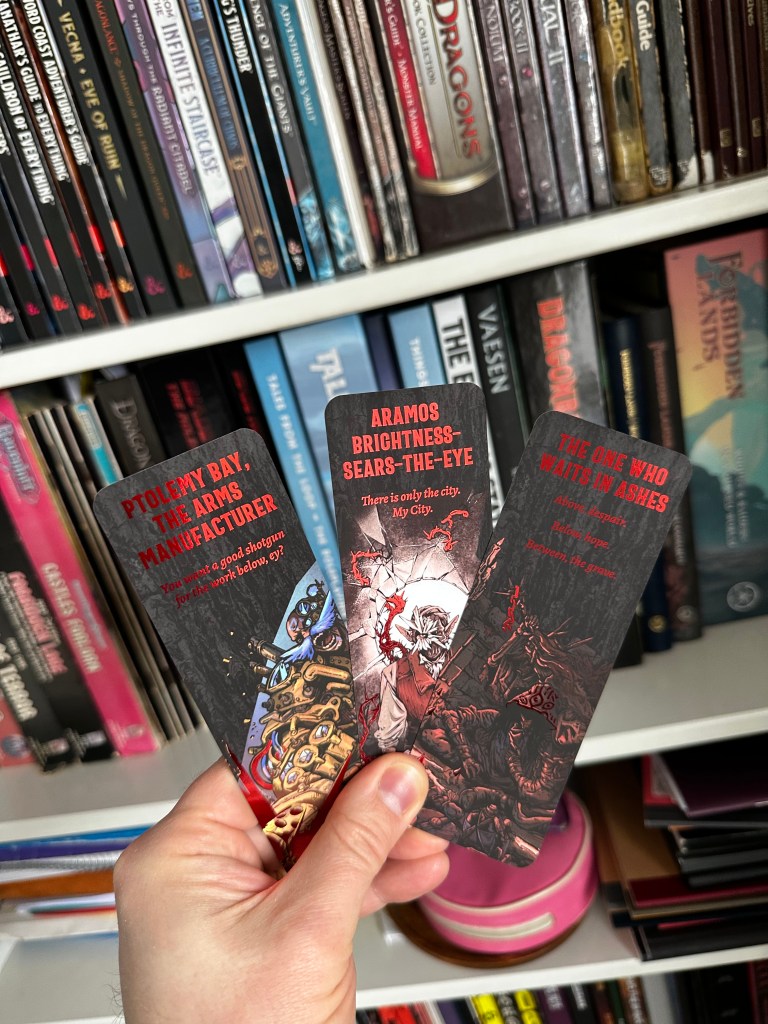
So, how to you translate that style of play into a coherent campaign? Well, you get Gareth Ryder-Hanrahan to write it for you, obviously. What he has done with Dagger in the Heart is provide the GM with a trio of inspired villains that I can imagine the PCs will love to hate and built the campaign around their plots and goals. In the introduction, he also gives you a guide on how to use these villains, depending on the length of campaign you want to run and some other factors. You don’t need to use them all, and, indeed, you are encouraged not to. Importantly, the campaign will work no matter which ones you use. They mostly act as foils to the PCs plans and actions and you are given suggestions, throughout the book, on how to use them in each area and during each major event. In Dagger in the Heart, the villains have their own beats they’re working towards, which helps in keeping track of what they are doing most of the time.

After the intro, you get seven chapters, each of which focuses on the areas of the Heart (or, indeed, the City Above) that are important at different points in the campaign. A chapter features an overview section which briefly explains what is contained in it and what the PCs are expected to be doing while they interact with the places, people and events contained in it. After that, you have a Staging section, which gives you options on how to get the PCs to move the overall plot forward while they do the usual Heart stuff of delving and hitting their Beats. This might include descriptions of major NPCs or stat blocks for enemies. After this, you get your Landmark and Delve descriptions. There are so many Landmarks in this book. I am pretty sure there are more Landmarks in this than in the Heart core book. But the delvers are not required to visit all of them. Instead there are just a lot of options. Indeed, because of the very loose nature of the campaign, the Landmarks can occur in any order, within any given Tier of the Heart, at least. In fact, they can mostly move quite freely between Tiers as well. So, despite the plot focusing so heavily on the occult and defunct underground train system known as the Vermissian, Dagger in the Heart is anything but Railroady. What it does, is provide you and your players with a plethora of options for how the story of the campaign could play out at your table and, indeed, how it might end, taking into account what your delvers might do.

After reading it, I was energised and inspired. I wanted to get some players around the table and send them back into the Heart as soon as possible. It will have to wait a little while, though, while other games come to an end. In the meantime, I get to read it again and prepare something really special.

Heart GM Screen

I also got the new Heart GM Screen from the Backerkit. It’s exactly what you would expect from RRD. Very high quality and totally over the top. There are no useful tables or common rules on the screen itself. Instead it comes with a booklet that you can rip the particular pages out of or, I suppose, photocopy and attach to the screen as you like. That way you can switch out the items you most need, when you most need them. It’s a nice idea and I think it will be useful.

Games I Got to Play This Year Part 1

A game at the table is worth two on the shelf

So, in the last post we discovered that I had played only three of the ten games I had wanted to in the last five months of the year. But, as everyone knows, it’s not about the number of games you play, it’s about the quality of them and the fun you have while playing (even if the fun is terror or sorrow.)

In this post, I’m going to get into the games I actually took part in in the last few months instead (apart from those I wrote about in the last post.) There were actually quite a few, mainly one-shots and mainly GMed by Isaac of Lost Path Publishing. By the by, Isaac is blogging again on his own site, linked above. Go and read the words he writes.

Ongoing Campaigns

  1. D&D 5E – Spelljammer. I’ve written quite a bit about this campaign. I like to mess around with the rules and try new things to keep it fresh. Here’s a post about hexcrawling the Rock of Bral. Here’s one about using an engagement roll type mechanic to improve the dungeon experience. We have recently finished a major campaign arc and it looks like the crew is about ready to take off into Wildspace again. They’ve had an extended shore leave on the Rock. After a short hiatus through the holiday season, the next session we play will be number 30 and they have been on the Rock since session number 11…that was over a year ago in real time. One of my players recently dropped the timely hint that they did not want to end up stuck on the Rock of Bral for the rest of the campaign and that prompted me to get them spelljamming again. Listen to your players, GMs!
  2. D&D 5E – An Unexpected Wedding Invitation – Finished. My first foray into D&D as a player in many years was a murder mystery set at a wedding populated with beautiful and complicated NPCs. We had some issues with the use of 5E as a system for this one but we had a ball role-playing our characters. The link above will take you to my post-mortem of the game.
  3. Heart: The City Beneath – Home game, GM. Finished. Man, I miss this game already. The PCs all activated their Zenith Abilities in the last session and it was a thing of beauty. After 12 sessions of delving, the android they were searching for turned up in Terminus, and they discovered that he was a sort of proxy for the Heart. He was trying to make their Heart’s desire come true. But he was bound to do the same for another denizen of the City Beneath, The Drowned Queen, whom our heroes had trapped in the Grey in session 8. The Android freed her and released her into Terminus, which she quickly began to drown in salt water. The PCs realised she could drown, not only this one Landmark but both the City Beneath and the City Above as well, linked as it was to every line in the Vermissian network. And so the delvers combined their newly acquired Zenith abilities to defeat her, imprison her and ensure themselves a place in heaven afterwards. So satisfying.
  4. Black Sword Hack – Three of Blades. This is one of Isaac’s games. It is another long running campaign. I went into some detail about it in the post I linked above. Recently, it has been hard to find time to get together for more sessions of this. Can’t wait to get back into it. In the last few months, our group has discovered that if we recover three legendary weapons from the most unlikely of places (one of them is on the friggin’ moon, but that’s OK, because we nicked a spaceship/big sphere off a bunch of cultists a while ago) we can use them to defeat the Queen of the Dead. As players, however, we have realised that, if we want to advance, we have to complete more “stories,” or adventures, so pursuing these weapons has taken a back seat recently. Instead we had a moral crisis about killing a big ol’ wyvern, we dithered over how to rescue a town of people from the mercenaries we were, ostensibly, working for and we argued over how to deal with a native woman who was summoning harpies to murder the invaders who had killed her lover (apologies to Isaac if I am misremebering that one.) Isaac says we’re the ones inventing the ethical conundrums when all he does is lay out the situations, but I’m pretty sure he plans them that way.
  5. Blade Runner – Electric Dreams – Finished. The link will take you to the first post I wrote about this short campaign. I was enjoying it immensely at that time. Once we got to the end, I feel like it really shone, though. That last session had a proper climax. Both of the players found the ending satisfying and sort of unexpected and I found it fascinating to see how they dealt with everything the case file threw at them. It’s hard to go into specifics without spoilers here, so I won’t. Suffice it to say, the investigation took some twists in the best way. I wrote a bit more in this post, where I compared the experience of playing this game with the Unexpected Wedding Invitation. TLDR, I think Free League have done a great job creating an investigative game that is a lot more that just a cop simulator and that works significantly better than the 5E system for this sort of thing.

New Campaigns

  1. The One Ring – The Star of the Mist. I wrote briefly about this one in the post I linked above. It’s a shame that we have not played much more of it since that first session. Basically, unless it is not entirely clear from the long list of games in this post, we have been busy in Tables and Tales! Sometimes it is hard to schedule sessions around all the other sessions. Anyway, session 2 brought us very, very close to a TPK. We learned a few things about this game. Thing the first: it’s not like D&D 5E, your characters are tough, but they are not super heroes. Thing the second: some times you should run away when you keep getting knocked prone and you can’t seem to hit anything and you are surrounded by marsh zombies. Thing the third: use your head. We beat the zombies with brains instead of axes in the end, partly because Isaac, who also runs this game, was very generous to us. I think the next session, we’ll be a lot more circumspect about approaching encounters and I can’t wait to see how we get on.
  2. Mörk Borg – The Great Borgin’ Campaign. Isaac sure is running a lot of campaigns, isn’t he? The ones I have listed on this page aren’t even all of them, just the ones I’m in. This has been great fun. We have a regular every-second Wednesday game of Mörk Borg going now. It is a sort of a drop-in, drop-out game but the playership has actually remained fairly consistent. My character is a Sacrilegious Songbird, a class from the Heretic sourcebook. Coincidentally, that’s also where our first adventure was from. Merkari the Magnificent and his weird companions managed to survive Graven-Tosk, the sprawling graveyard setting of “Graves Left Wanting.” I loved this module. It was dark and filthy and involved some brilliantly shitty situations. I mean, we started the game by waking up in a charnel pit. Anyway, once we got out of there, we moved on and played through “Death Ziggurat.” This was a (mostly) hex-crawl that I found equal parts foul and hilarious. This was partly due to Isaac’s amazing character work and partly due to the non-stop comedy from the other players at the table who included friend of the blog and local Media Goblin, Tom, in one of their most brilliant roles yet. The wildly unhinged scatological, pyromaniac shit from Shannen and Jude has been an absolute delight too.

And I haven’t even gotten to the many one-shots I was part of in the last five months. If you have been hanging around the dice pool for a while, you have probably read about some of them, at least. But they deserve a proper review in this series as we approach the end of the year so tune in to the next post, dear reader.