
What has come before
Well, yesterday I started by creating a brand new character to be played in Dark Sun, the AD&D 2nd Edition setting. Here’s what we’ve hot so far:
- Name: Rezina
- Pronouns: she/her
- Race: Halfling
- Ability Scores:
- Strength: 11
- Dexterity: 18
- Constitution: 18
- Intelligence: 17
- Wisdom: 18
- Charisma: 9
- 3ft 3in tall
- 59lbs in weight
- 41 years of age
What have we learned? Race is problem in these older books. The ways they refer to characters as “half-breeds” or inherently unintelligent or bred to be sterile are incredibly distasteful. It is all couched in very racist and unsympathetic language and I am glad that that sort of writing is a thing of the past.
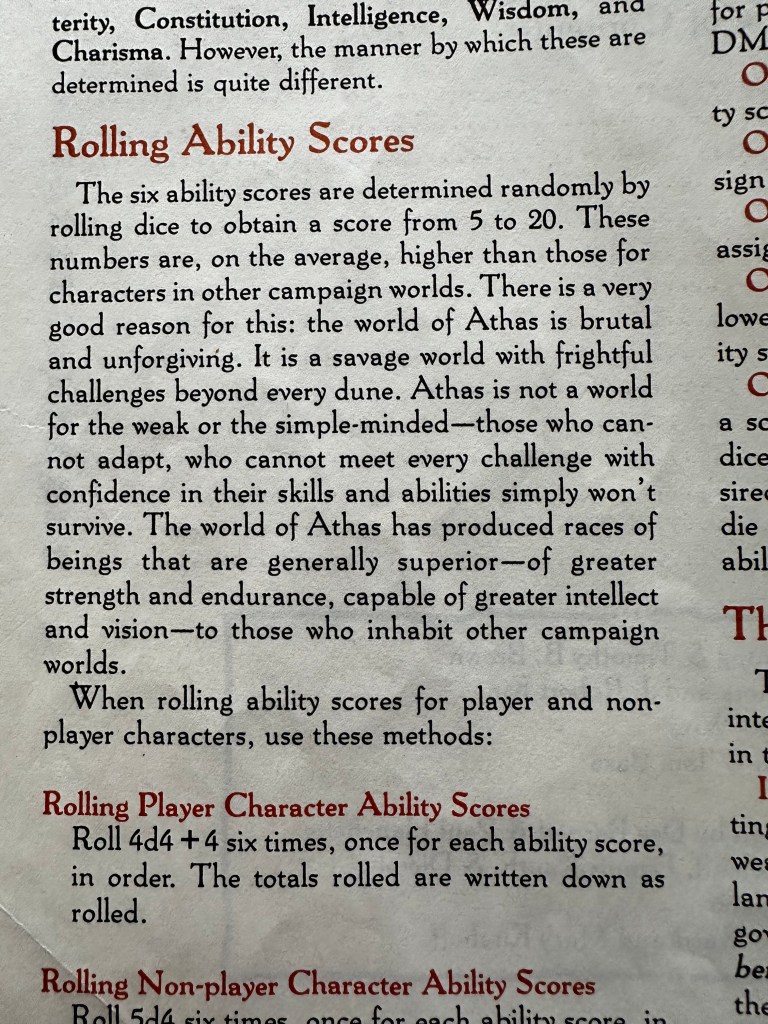
Also, Dark Sun characters come out powerful, with the new way of rolling up your ability scores and some really useful racial traits.
Stay classy
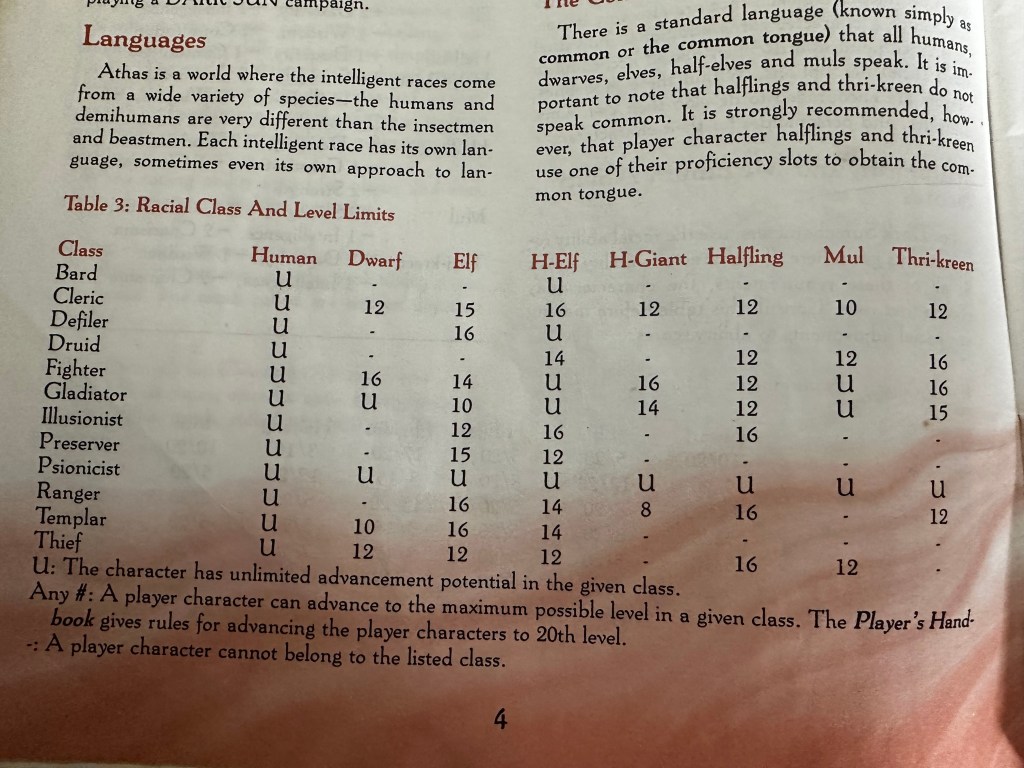
It’s time to look at classes in Dark Sun. There are many changes to the classes compared to the AD&D 2nd Ed Player’s Handbook. There are also a few new ones here. Dark Sun introduced the Defiler, the Gladiator, the Preserver, the Psionicist and the Templar to the game. Technically, Psionics were introduced in the Complete Psionics Handbook, though. I mentioned yesterday that Halflings can choose from the following classes: Cleric, Druid, Fighter, Gladiator, Illusionist, Psionicist, Ranger and Thief. But I will take a look at each of the new ones and the major changes to the existing classes too.
The Dark Sun Rules Book splits the classes into their categories of Warrior, Wizard, Priest and Rogue with Psionicist sort of tacked onto the end.

TSR really wanted you to use their Battle System mass-combat rules with Dark Sun. If I remember correctly, parts of the opening few official adventures contained full-scale battles where it expected you to have armies of miniatures fielded against each other. I don’t remember ever using them, despite having the book. Anyway, as a result of that, one of the main things that Fighters got in Dark Sun was a whole bunch of automatic followers. These people would just flock to you as a successful Fighter as you gained levels. They can also teach weapon proficiencies from 3rd level, operate heavy war machines from 4th level, supervise the construction of defences from 6th level, command large number of troops from 7th level and construct heavy war machines from 9th level. All of these very Battle System related abilities are in addition to the stuff they get in the PHB. Fighters have an ability requirement of 9 STR so Rezina could, technically take this class. Hit Dice: D10.
The Gladiator is a new class. They are the slave warriors of the Sorcerer Kings. The arena is a big part of life in the City States of the Tablelands. It is the main form of entertainment and a system of control for the masses. It’s also big industry as the slave trade is key to the economy of the region. Gladiators get a few nice benefits. They gain proficiency in all weapons and can specialise in multiple weapons too. Not only that, but they are expert in unarmed combat and get to optimise their armour, reducing their AC by 1 for every five levels. From 9th level, Gladiators also gain followers like the Fighter. They have some harsh ability score requirements though, STR 13, DEX 12 and CON 15. The Strength requirement disqualifies Rezina, I’m afraid. Hit Dice: D10.
Rangers are mostly unchanged from how they are described in the PHB. They have to decide on an elemental plane of worship at 8th level and can only cast cleric spells from that sphere and they gain followers of animal and humanoid type from 10th level. Required STR 13 means I can’t choose to be a Ranger. Hit Dice: D10.
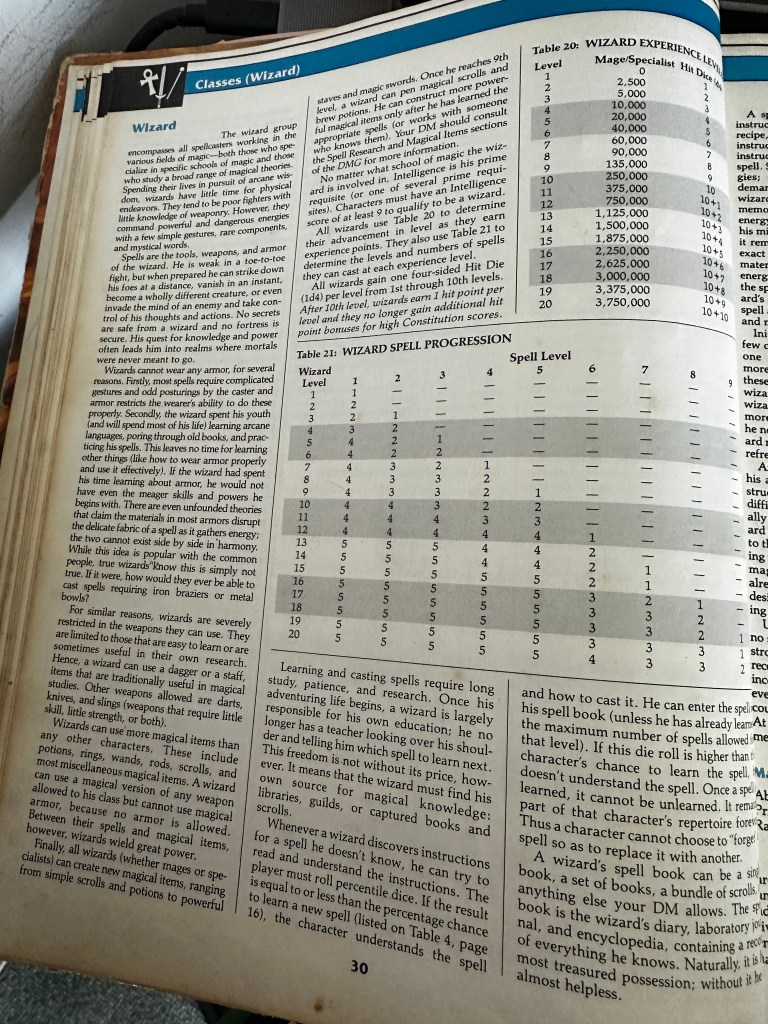
Onto the Wizards! Rezina can choose only Illusionist from this list but we’ll have a look at them anyway as they are so important to the overall lore of the world. Wizards work quite differently on Athas. The default magic user is the Defiler. These guys drain the life from the world around them to power their magic and, as a result of their disdain for the environment, they gain levels much faster than their Preserver counterparts. Preservers balance their consumption of magical energy to minimise or chancel the damage they do. Of course, this course makes them level up much slower. Finally, there is the Illusionist, a specialist wizard class who are treated exactly as they are in the PHB except that they have to choose to be either a preserver or defiler. Regular Preservers and Defilers only have an ability score requirement of INT 9, but if you want to be an Illusionist, you also need to have DEX 16. So, this is, in fact, an option for Rezina.
Priests are split into Clerics, Druids and Templars.
The Clerics are worshipers of a particular elemental plane, rather than of a deity or pantheon. Athas does not have its own gods and is considered separated somehow from the influence of the Outer Planes. It is very hard to get to and from Athas, in fact, through planar magic, portals or even spelljamming vessels. So, Clerics, although they may be flavoured differently depending on their backgrounds, gain power from the Inner Planes, the elements, instead. Their weapon restrictions are based on the elemental plane they worship, they can ignore the presence of the element they worship from level 5, they can gate material form their chosen plane at level 7. You need a WIS 9 to be a Cleric so that is an option.
Druids are out for Rezina due to their ability score requirements, WIS 12 and CHA 15. She’s just ain’t got that rizz. Druids have to choose an area known as their Guarded Lands and from 12th level on, they have to spend half their time there. They gain their powers from the spirits there. Usually, their spells are restricted to one or two spheres related to their guarded lands. They can speak with animals and plants as they gain levels, and get a whole bunch of powers from their lands.
Clerics and Druids are really only a thing outside the City States themselves. Inside, the priests who matter are the Templars, the priests of the Sorcerer-kings. They’re not good guys. In fact, a Templar PC has to be either Neutral or Evil. They enforce the edicts and laws of the Sorcerer-kings and are not above a little corruption. They have access to vast libraries that allow them to use spells from all spheres, though they progress slower than Clerics at lower levels. Unlike the other priests, Templars get their spells directly from their Sorcerer-king. They can raise and ally with undead but cannot turn them, they have the power of life and death over slaves (this is a class benefit…) they can legally enter the house of a free man and accuse them of disloyalty from 4th level and pass judgement on them from 7th level. They can start throwing their weight around with nobles from 10th level. They can can requisition soldiers from 3rd level, gain access to all areas of palaces from 5th level and draw on the city treasury for official investigations. From 17th level, they can pardon any condemned person, though, which is nice. Rarely do you see a class in RPGs that is as focused on civic matters and accusing people of shit to get their way. It’s a weird one and I don’t think anyone in my games ever chose to play one. Anyway, Rezina can’t be one because she is a Halfling.
Onto the Rogues.
Bards are out for Rezina as she is a Halfling. But they are pretty cool in Dark Sun. They are renowned, not only as entertainers, but also, assassins, blackmailers and thieves. They have all the benefits of the original Bard from the PHB but they also have a mastery of Poisons. One big difference is that they don’t get access to spells at all.
Thieves work basically the same as they do in the PHB but they also can find a patron from 10th level. These guys can give them jobs or protect them from others. With the only pre-requisite being DEX 9, Rezina could choose this class.

Finally, the Psionicist. Every character in Dark Sun rolls on a table to get a Wild Talent, an innate psionic ability that may or may not be particularly useful so the class is open to all races. But Psionicists have a whole raft of abilities that come with the class. Luckily I have a copy the Complete Psionics Handbook (TSR 1991.) Psionics were based on the idea that the powers were split into separate disciplines within which you get major powers called sciences and minor ones called devotions. Your character gets a pool of Psionic Strength Points, based on a relatively complicated equation involving WIS score and CON and INT modifiers. You spend these to use powers. They also learn Defense Modes which are used in psionic battles. They gain followers from 9th level. The ability requirements are CON 11, INT 12 and WIS 15 so Rezina could choose this class.
There are a few other points to consider before making the choice here. Halflings can choose to multiclass and Dark Sun characters start at 3rd level by default. I won’t multiclass, just to keep this a bit simpler.
Another characteristic of Dark Sun is that you are supposed to have a character tree, ie, a selection of 4 characters to choose from in between adventures or so there is backup in case one character dies in this very lethal setting. I won’t be doing this as I have spent so long making just a single character already!
Time to choose

My options are Fighter, Illusionist, Cleric, Thief and Psionicist. Should I roll for it? Yep. On a d5 (thanks again DCC) I rolled a 2. Illusionist!
Illusionists get a +1 on saves vs illusion spells and others get a -1 against their spells. They also get to memorise an extra illusion spell at each level. Researching new illusion spells is easier but conversely, researching the spells of other schools is harder. Of course, it also means that they can’t learn spells from Schools directly opposed by illusion, ie, necromancy, invocation/evocation and abjuration.
Ok, I am going to have to wrap this up here. This character creation process in Ad&d is pretty time intensive, especially when I go through every potential class candidate and critique them I will have to finish this off tomorrow. See you then!















 The Dice Pool