Tales from the Loop​ – Mascots and Murder

Indie mascot horror

Maybe I’m giving away a bit too much with the title of this scenario. What do you think? I mean, look, here’s the thing; when we set up Tables and Tales a few months ago, I was curious about the kinds of things new members were into. One of them said they liked Indie Mascot Horror. Now, let me tell you, dear reader, I did not know what that was. Since then, I have learned that it refers to video games like Five Nights at Freddie’s and Poppy’s Playtime. I had obviously not played these games but I looked into them a bit and got the vibe. I thought about the types of RPGs that would be good for those themes and tropes. It did not take me long to decide on Tales from the Loop.

Tales from the Loop

If you have never seen the artworks of Simon Stålenhag, do yourself a favour and go check them out. I have taken some photos of his work from his art book, Tales from the Loop and embedded them here but they don’t do the work justice. When I first encountered his work several years ago, it filed me with wonder. He created such a realistic depiction of a past that was largely recognisable to me from my own childhood, interspersed with or shockingly dominated by futuristic architectures and sci-fi wonders. His work excited my imagination like only RPGs had in the past. So when I discovered that Free League were producing a Tales From the Loop game, it didn’t take me long to pick it up. It took a little longer to get it to the table but when I did I discovered that the players loved it.

## Indie mascot horror
Maybe I’m giving away a bit too much with the title of this scenario. What do you think? I mean, look, here’s the thing; when we set up Tables and Tales a few months ago, I was curious about the kinds of things new members were into. One of them said they liked Indie Mascot Horror. Now, let me tell you, dear reader, I did not know what that was. Since then, I have learned that it refers to video games like Five Nights at Freddie’s and Poppy’s Playtime. I had obviously not played these games but I looked into them a bit and got the vibe. I thought about the types of RPGs that would be good for those themes and tropes. It did not take me long to decide on Tales from the Loop.

## Tales from the Loop
If you have never seen the artworks of [Simon Stålenhag](https://www.simonstalenhag.se/), do yourself a favour and go check them out. When I first encountered his work several years ago, it filed me with wonder. He created such a realistic depiction of a past that was largely recognisable to me from my own childhood, interspersed with or shockingly dominated by futuristic architectures and sci-fi wonders. His work excited my imagination like only RPGs had in the past. So when I discovered that Free League were producing a [Tales From the Loop game](https://freeleaguepublishing.com/games/tales-from-the-loop-rpg/), it didn’t take me long to pick it up. It took a little longer to get it to the table but when I did I discovered that the players loved it. 

Tales from the Loop is a game about the 1980s that never was. It posits a world in which some astounding scientific breakthroughs occurred in the ‘50s and ‘60s so that, by the time in which the game is set, they are not considered so strange. You have your robots and your hovercraft and your infinitely renewable energy. But most of that stuff is considered mundane in Stålenhag’s world. Not only that, they exist alongside the ‘80s mainstay technologies like Walkmans, cassette tapes, VCRs and Soda Stream. In Stålenhag’s artwork this created some beautifully uncanny images. Most were set in the region of Sweden known as Mälaröarna, where the Loop project was based. This is where the world’s largest particle accelerator was built. Though it is not necessarily directly responsible for the many strange occurrences in the region, the people who populate such a scientifically rarified place usually are. Scientists and administrators and students flocked to the region and started families there. So many of Stålenhag’s paintings involved kids; a toe-headed child threatening an old Volkswagen van marked “Polis” with a giant robot under his control; a pair of woolly-hatted kids digging in the Swedish snow and gazing back at their homes, dwarfed by the cyclopean, other-worldly cooling towers used to release heat from the core of the Loop itself, the Gravitron; a little kid in cold weather coveralls leading his grandfather through the snow to a mysterious sphere, left abandoned in the countryside, its purpose and provenance forgotten. These were the inspirations for the RPG.

The game came out at the height of the popularity of Stranger Things, which helped it gain a lot of traction I think, and then it even had its own, unfortunately not so popular, spinoff [TV series](https://en.wikipedia.org/wiki/Tales_from_the_Loop), which I, at least, loved.

In the RPG you play kids between 10 and 15 years old. You get to choose a Type from such classics as the Computer Geek, the Hick and the Weirdo. You also have to choose some really fun things like your Iconic Item, your key relationships and your favourite 1980s song.

Once you have your Kid, you and your friends can go out and investigate weird shit on your bikes. Stuff like, where are all the birds gone? What are all the adults doing gathered around that weird machine in the field? What’s that dinosaur looking claw print in the snow? You know, normal kid shit.

## Roll mechanics
Tales from the Loop uses a version of the Year Zero engine, and, in fact, it was the first game I played using that system. It’s really straight-forward and intuitive, easy to learn and resolves situations quickly. “Situations” are generally and collectively referred to in the text as “Trouble” with a capital “T,” appropriately enough. For many, the Trouble you got into and out of when they were kids are some of the most enduring and treasured memories. In the game, you combine your ability dice and your skill dice into one dice pool and roll them all to try and get at least one 6. Since you only use d6s in this game, that’s the highest you can roll. The more 6s you roll the better, generally.

The only issue my players and I had with the rules is the Extended Trouble mechanic. The way this works is that, during the final showdown, encounter or whatever, every kid says what they are going to do and the GM tells them how many successes they will need to succeed fully. Then one player rolls all the dice in one enormous pool. Generally, if they don’t succeed fully but they still have a few successes, they might achieve what they were trying to but one or more kids will earn conditions or even become Broken. But, in play, we found this approach to be unsatisfying. Each player wanted their own cool moment to roll for and the all-or-nothing approach meant that they couldn’t attempt to take any rectifying actions if and when they saw things going wrong. Anyway, suffice it to say, we won’t be using the Extended Trouble rule next time.

## Mascots and Murder
Here are the very basics of the scenario I have planned:
Although the first Loop was in Sweden and much of the book is written as though it is the default setting, they do actually provide a second potential setting in it. That’s Boulder City, Nevada, the “Best city by a dam site,” which is a reference to its proximity to the Hoover Dam. There is another Loop in this region and all of the scenarios presented in the core book can be transposed very easily to the desert, believe it or not. This is where the kids in this scenario will be from. It is summer in Boulder City so it’s going to be so sizzling hot that you can fry an egg on the sidewalk. This will be a nice change as all the other Tales from the Loop games I have played were set in Sweden in autumn and winter.

Some teens have gone missing from Boulder City. Although their parents don’t seem too worried about it, our intrepid Kids are going to solve this mystery as they track down the source of the eerie, carnival-like music out in the Nevada desert and figure out what the connection is.

I have had fun writing this scenario, even though I have gone over it and over it to get it right. So, it’ll be ready to play in a few weeks.

The Tales from the Loop core book has some very useful advice for writing and structuring a scenario for it yourself. As long as you stick to that, you’re unlikely to go wrong. This is not actually the first one I have written myself, using these guidelines and, I can tell you, it works really well.

Have you played Tales from the Loop? What did you think of it? If you had to run a particular game for Indie Mascot Horror vibes, what would it be?

Tales from the Loop is a game about the 1980s that never was. It posits a world in which some astounding scientific breakthroughs occurred in the ‘50s and ‘60s so that, by the time in which the game is set, they are not considered so strange. You have your robots and your hovercraft and your infinitely renewable energy. But most of that stuff is considered mundane in Stålenhag’s world. Not only that, they exist alongside the ‘80s mainstay technologies like Walkmans, cassette tapes, VCRs and Soda Stream. In Stålenhag’s artwork this created some beautifully uncanny images. Most were set in the region of Sweden known as Mälaröarna, where the Loop project was based. This is where the world’s largest particle accelerator was built. Though it is not necessarily directly responsible for the many strange occurrences in the region, the people who populate such a scientifically rarified place usually are. Scientists and administrators and students flocked to the region and started families there. So many of Stålenhag’s paintings involved kids; a toe-headed child threatening an old Volkswagen van marked “Polis” with a giant robot under his control; a pair of woolly-hatted kids digging in the Swedish snow and gazing back at their homes, dwarfed by the cyclopean, other-worldly cooling towers used to release heat from the core of the Loop itself, the Gravitron; a little kid in cold weather coveralls leading his grandfather through the snow to a mysterious sphere, left abandoned in the countryside, its purpose and provenance forgotten. These were the inspirations for the RPG.

## Indie mascot horror
Maybe I’m giving away a bit too much with the title of this scenario. What do you think? I mean, look, here’s the thing; when we set up Tables and Tales a few months ago, I was curious about the kinds of things new members were into. One of them said they liked Indie Mascot Horror. Now, let me tell you, dear reader, I did not know what that was. Since then, I have learned that it refers to video games like Five Nights at Freddie’s and Poppy’s Playtime. I had obviously not played these games but I looked into them a bit and got the vibe. I thought about the types of RPGs that would be good for those themes and tropes. It did not take me long to decide on Tales from the Loop.

## Tales from the Loop
If you have never seen the artworks of [Simon Stålenhag](https://www.simonstalenhag.se/), do yourself a favour and go check them out. When I first encountered his work several years ago, it filed me with wonder. He created such a realistic depiction of a past that was largely recognisable to me from my own childhood, interspersed with or shockingly dominated by futuristic architectures and sci-fi wonders. His work excited my imagination like only RPGs had in the past. So when I discovered that Free League were producing a [Tales From the Loop game](https://freeleaguepublishing.com/games/tales-from-the-loop-rpg/), it didn’t take me long to pick it up. It took a little longer to get it to the table but when I did I discovered that the players loved it. 

Tales from the Loop is a game about the 1980s that never was. It posits a world in which some astounding scientific breakthroughs occurred in the ‘50s and ‘60s so that, by the time in which the game is set, they are not considered so strange. You have your robots and your hovercraft and your infinitely renewable energy. But most of that stuff is considered mundane in Stålenhag’s world. Not only that, they exist alongside the ‘80s mainstay technologies like Walkmans, cassette tapes, VCRs and Soda Stream. In Stålenhag’s artwork this created some beautifully uncanny images. Most were set in the region of Sweden known as Mälaröarna, where the Loop project was based. This is where the world’s largest particle accelerator was built. Though it is not necessarily directly responsible for the many strange occurrences in the region, the people who populate such a scientifically rarified place usually are. Scientists and administrators and students flocked to the region and started families there. So many of Stålenhag’s paintings involved kids; a toe-headed child threatening an old Volkswagen van marked “Polis” with a giant robot under his control; a pair of woolly-hatted kids digging in the Swedish snow and gazing back at their homes, dwarfed by the cyclopean, other-worldly cooling towers used to release heat from the core of the Loop itself, the Gravitron; a little kid in cold weather coveralls leading his grandfather through the snow to a mysterious sphere, left abandoned in the countryside, its purpose and provenance forgotten. These were the inspirations for the RPG.

The game came out at the height of the popularity of Stranger Things, which helped it gain a lot of traction I think, and then it even had its own, unfortunately not so popular, spinoff [TV series](https://en.wikipedia.org/wiki/Tales_from_the_Loop), which I, at least, loved.

In the RPG you play kids between 10 and 15 years old. You get to choose a Type from such classics as the Computer Geek, the Hick and the Weirdo. You also have to choose some really fun things like your Iconic Item, your key relationships and your favourite 1980s song.

Once you have your Kid, you and your friends can go out and investigate weird shit on your bikes. Stuff like, where are all the birds gone? What are all the adults doing gathered around that weird machine in the field? What’s that dinosaur looking claw print in the snow? You know, normal kid shit.

## Roll mechanics
Tales from the Loop uses a version of the Year Zero engine, and, in fact, it was the first game I played using that system. It’s really straight-forward and intuitive, easy to learn and resolves situations quickly. “Situations” are generally and collectively referred to in the text as “Trouble” with a capital “T,” appropriately enough. For many, the Trouble you got into and out of when they were kids are some of the most enduring and treasured memories. In the game, you combine your ability dice and your skill dice into one dice pool and roll them all to try and get at least one 6. Since you only use d6s in this game, that’s the highest you can roll. The more 6s you roll the better, generally.

The only issue my players and I had with the rules is the Extended Trouble mechanic. The way this works is that, during the final showdown, encounter or whatever, every kid says what they are going to do and the GM tells them how many successes they will need to succeed fully. Then one player rolls all the dice in one enormous pool. Generally, if they don’t succeed fully but they still have a few successes, they might achieve what they were trying to but one or more kids will earn conditions or even become Broken. But, in play, we found this approach to be unsatisfying. Each player wanted their own cool moment to roll for and the all-or-nothing approach meant that they couldn’t attempt to take any rectifying actions if and when they saw things going wrong. Anyway, suffice it to say, we won’t be using the Extended Trouble rule next time.

## Mascots and Murder
Here are the very basics of the scenario I have planned:
Although the first Loop was in Sweden and much of the book is written as though it is the default setting, they do actually provide a second potential setting in it. That’s Boulder City, Nevada, the “Best city by a dam site,” which is a reference to its proximity to the Hoover Dam. There is another Loop in this region and all of the scenarios presented in the core book can be transposed very easily to the desert, believe it or not. This is where the kids in this scenario will be from. It is summer in Boulder City so it’s going to be so sizzling hot that you can fry an egg on the sidewalk. This will be a nice change as all the other Tales from the Loop games I have played were set in Sweden in autumn and winter.

Some teens have gone missing from Boulder City. Although their parents don’t seem too worried about it, our intrepid Kids are going to solve this mystery as they track down the source of the eerie, carnival-like music out in the Nevada desert and figure out what the connection is.

I have had fun writing this scenario, even though I have gone over it and over it to get it right. So, it’ll be ready to play in a few weeks.

The Tales from the Loop core book has some very useful advice for writing and structuring a scenario for it yourself. As long as you stick to that, you’re unlikely to go wrong. This is not actually the first one I have written myself, using these guidelines and, I can tell you, it works really well.

Have you played Tales from the Loop? What did you think of it? If you had to run a particular game for Indie Mascot Horror vibes, what would it be?

The game came out at the height of the popularity of Stranger Things, which helped it gain a lot of traction I think, and then it even had its own, unfortunately not so popular, spinoff TV series, which I, at least, loved.

In the RPG you play kids between 10 and 15 years old. You get to choose a Type from such classics as the Computer Geek, the Hick and the Weirdo. You also have to choose some really fun things like your Iconic Item, your key relationships and your favourite 1980s song.

Once you have your Kid, you and your friends can go out and investigate weird shit on your bikes. Stuff like, where are all the birds gone? What are all the adults doing gathered around that weird machine in the field? What’s that dinosaur looking claw print in the snow? You know, normal kid shit.

Roll mechanics

Tales from the Loop uses a version of the Year Zero engine, and, in fact, it was the first game I played using that system. It’s really straight-forward and intuitive, easy to learn and resolves situations quickly. “Situations” are generally and collectively referred to in the text as “Trouble” with a capital “T,” appropriately enough. For many, the Trouble you got into and out of when they were kids are some of the most enduring and treasured memories. In the game, you combine your ability dice and your skill dice into one dice pool and roll them all to try and get at least one 6. Since you only use d6s in this game, that’s the highest you can roll. The more 6s you roll the better, generally.

The only issue my players and I had with the rules is the Extended Trouble mechanic. The way this works is that, during the final showdown, encounter or whatever, every kid says what they are going to do and the GM tells them how many successes they will need to succeed fully. Then one player rolls all the dice in one enormous pool. Generally, if they don’t succeed fully but they still have a few successes, they might achieve what they were trying to but one or more kids will earn conditions or even become Broken. But, in play, we found this approach to be unsatisfying. Each player wanted their own cool moment to roll for and the all-or-nothing approach meant that they couldn’t attempt to take any rectifying actions if and when they saw things going wrong. Anyway, suffice it to say, we won’t be using the Extended Trouble rule next time.

Mascots and Murder

Here are the very basics of the scenario I have planned:
Although the first Loop was in Sweden and much of the book is written as though it is the default setting, they do actually provide a second potential setting in it. That’s Boulder City, Nevada, the “Best city by a dam site,” which is a reference to its proximity to the Hoover Dam. There is another Loop in this region and all of the scenarios presented in the core book can be transposed very easily to the desert, believe it or not. This is where the kids in this scenario will be from. It is summer in Boulder City so it’s going to be so sizzling hot that you can fry an egg on the sidewalk. This will be a nice change as all the other Tales from the Loop games I have played were set in Sweden in autumn and winter.

Photo from the book, Tales from the Loop by Simon Stålenhag.

Some teens have gone missing from Boulder City. Although their parents don’t seem too worried about it, our intrepid Kids are going to solve this mystery as they track down the source of the eerie, carnival-like music out in the Nevada desert and figure out what the connection is.

I have had fun writing this scenario, even though I have gone over it and over it to get it right. So, it’ll be ready to play in a few weeks.

The Tales from the Loop core book has some very useful advice for writing and structuring a scenario for it yourself. As long as you stick to that, you’re unlikely to go wrong. This is not actually the first one I have written myself, using these guidelines and, I can tell you, it works really well.

Have you played Tales from the Loop? What did you think of it? If you had to run a particular game for Indie Mascot Horror vibes, what would it be?

Games I Want to Play This Year

Five months to go

Having managed to get through so many games in the first 7 months of the year, you know what? I reckon, if I really make an effort, I think I can fit in up to ten more different games before New Year’s Day. I’m particularly looking forward to a few more one-shots. For those of you who’ve been keeping an eye on this space over the last couple of weeks, you’ll know I have a soft spot for them.

Lists 4

Here we go. Like previous lists, I’m just going to split them between those I want to run and those I want to play in.

To be honest, a bunch of these games are ones I already have in the schedule. I’m hoping to get Tales from the Loop started in a few weeks and I have Death Match Island in the calendar for next Friday. Even the ones I want to play in include a couple that are almost good to go.

GM

Player

I’m going to spend the next couple of days going through each of these games to explain why I’m so excited about playing them.

Stay tuned!

Also, what are you looking forward to play this year? Let me know in the comments!

Psycho-analyse Your Players for Fun

Sorry for the monsters

The murder-hobo days are largely done, I think. Although I’m sure there are still plenty of tables out there slaying every poor goblin that crosses their paths, it seems to be a pretty old-fashioned play style, uniquely and deliberately violent, especially when the “monsters” are sentient creatures with cultures and desires and rich inner lives. I didn’t know it when I was a kid but there’s no doubt that the impetus to enter an underground lair and kill every orc you found in there was a product of some highly colonial cultural fallout. Those guys are green so it’s ok to take their treasure and their lives, right? Or, my king/lord/boss/priest told me those guys were evil; better get them before they get us!
You are far more likely to be able to deal with an encounter without violence, and that’s cool.

Harpin’ on

Do my players do this? you ask, reader. Well, yes and no. The Deadwalker from our Heart game made friends with a Heartsblood beast the other night. It was a giant snail with the face of a drow (except for the eye stalks and the rows of sharp little teeth.) his name was Shelby. Of course, they sort of bonded over the killing of a harpy couple. Harpies in Heart are very interesting, by the way. They remind me of the Khepri in China Mieville’s Bas Lag books. The male harpy is just a big bird, about the size of a cat. Now, when he is looking for a mate, he’ll collect up a load of trinkets, bones, body parts, small creatures and occult relics and place them in a circle while, like a minah-bird, he speaks words he has heard others say. These tend to be words they have heard recently from people like the PCs, which is fun. Anyway, this ritual summons his potential mate through a portal from some dreadful, hellish dimension. And she is the terrifying figure of a woman but with talons where feet should be and wings instead of arms and the intestines of some poor bugger dripping, bloody from her beak-like maw. She is very violent and hungry. This encounter was only going to end one way. Luckily, it was the PCs who came out the victors, although it was touch and go. And hey, Seeker made a new friend in the process! Cute little Shelby.

Surprised to see it turn weird

The subtitle there is a reference to a star I got from Isaac in our last D&D session when they discovered the brainless hobgoblin body and the triplets with gossamer threads attaching them to something else in this dungeon they have just entered. They have been encountering a lot of other sailors, mostly humanoids and their servants recently. That’s often the type of game it is because they are dealing with other ships and their crews a lot. They have usually resorted to violence in most instances in this campaign so far. Maybe that’s my doing since the encounters have often started off violent from the monster side. And they did try to befriend that one Neogi sailor who had been left behind by his mates. So they get humanitarian points for that.

So, in this dungeon, I thought I would take the opportunity to make it a bit weirder. After all there should be alien things in a space game. I can’t go into too much detail, but suffice it to state that I am excited to see how the players and their characters react and what they do.

Spiteful owls and slug monarchs

What I find, in general, is that the weirder the monster you introduce, the more likely violence is gonna to be the answer. This is, I think, often a fear response. Or maybe it’s an assumption that, the weirder the monster looks, the less likely it is to be reasoned with. These are often understandable impulses, actually. I mean, there are also the monsters that are totally mundane, like the flock of owls in the Troika! Adventure, The Blancmange and Thistle. They had come in through a window and were harassing a hotel employee. My players did not hesitate to cull those wild birds. To be fair to them though, the text does name them “spiteful owls” and they attacked anyone who entered their stairwell. So maybe they deserved it.

A couple of floors further up in the. Blancmange and Thistle, they encountered a Slug Monarch trapped in the stairs, embarrassed and very much in the way. They used some demonic water to awake a terrible hunger in him and that got him moving. He was a bit more dangerous in this state so they did have to fight him off but then they just escaped up the stairs where he couldn’t follow. It was a relatively non-violent solution to a simple problem involving a rather gonzo monster. But maybe they just treated him better than the average slug because he was a monarch?

Maybe I should stop psycho-analysing my players and their characters.

Anybody else psycho-analyse their players?

Investigations

The detective dichotomy

We have been enjoying the Blade Runner RPG immensely in the last few weeks. The blade runners are into the second day of their investigation of the murder of Sandor, another member of the LAPD Rep Detect Unit who happened to be a Nexus 9 replicant. So far, it has gone pretty well for them. They have had some incredible luck with dice rolls that even revealed certain clues I was surprised about. Due to uncovering these, I think they are coming up with the basis of a solid theory for what happened.

Here’s the thing: this is an official case file, produced by Free League. I would imagine most people playing Blade Runner have run this scenario; it comes in the starter set. And the details of the scenario, the NPCs, the locations, even the events, to a certain extent, are set. There is a lot of freedom for the PCs to pursue leads when and how they want but the perpetrator/s, their reasons and motivations and the major players in the case are the same for every table.

Now don’t get me wrong, we are really enjoying this format. The setting and the themes and the ways the scenario intersects with them are very well done. But it is hard not to feel like it’s on rails, right? The answers will always be the same although each group might do something different with them.

Of course, maybe that’s true of any prewritten scenario, no matter the genre. There is always a lich at the end of Tomb of Horrors. Strahd is the big bad in Ravenloft. That kind of thing goes without saying. So, what is it about the mystery that makes this seem less free-form? I guess it’s that finding the answers is the whole point. In Ravenloft, the point for the players is probably the fun of exploring Barovia and the castle. They are enjoying the scares and the combat and all of that.

But in the end maybe it doesn’t matter. Of course, my players don’t know the ins and outs of the clues or the perps or the mystery until they find them. So it’s still mysterious to them.

Building with Brindlewood

Of course, there are other ways to do mystery games. The one that comes to mind is Brindlewood Bay by Jason Cordova, of course, and the games that have been Carved from Brindlewood, like Public Access and others. In these games, there are plenty of pre-written and published mysteries but, significantly, they don’t have solutions.

In an inventive and fascinating twist of game design, Brindlewood Bay’s solutions emerge during play. There are elements of investigation, role playing, narrative building and straight up dice rolling that result in your characters either coming up with the right answer or the wrong answer. Or, you have the familiar PBTA option of a correct answer but with some complication on a middling roll of the dice.

I have not yet had the chance to play one of these games but I would love to. I want to see if it is more satisfying than the sort of game where your solution is written in stone.

Have you played any mystery games that made you excited to play them again? Send me some recommendations!

Forged in the Dungeon, Part 2

Engage!

This is an update on how my last session of Spelljammer went. More specifically how it went when implementing some mechanics I nicked, unapologetically from Blades in the Dark. If you don’t know what I’m updating you about, oh valued and discerning reader, go take a look at this post right here.

It was touch-and-go last night, to be honest. We only had about 2 hours to play and we were on course for the session to fully be a shopping episode. But, in the last 45 minutes or so, we managed to get into the new technique of using information gathering rolls and an engagement roll before interacting with the dungeon.

I think it worked pretty well, once we got into it. I briefly explained the concept and everyone was on board with it. So we went ahead and they started making up the ways they would use their specialties to help boost their chances with the engagement roll. One character described a trip to the pub to try and identify some locals who might know the way to this secret hideout they were looking for, one followed a potential gang member to the entrance, one questioned some dock workers they were helping out, one went to ask her sister for help and one staked out the most likely spots along the docks. They all used different skills and only one of them failed the information gathering roll. I set the Information gathering DC pretty low for this first time, a mere DC 10. I gave them +2 to the engagement roll for each success so they ended up with a +8 for a total of 18 on the engagement roll.

Now, I had prepared three maps on Roll20 and a bunch of potential encounters, both combat and social, traps and dangerous environments. I did not regret dumping two of those locations in favour of jumping straight to the dungeon entrance. Did the old dump and jump, as it were.

I narrated their discovery of and arrival at the building that hid the staircase to the hideout. I explained how the intelligence they had gotten in their information gathering phase had allowed them to figure out the best time to enter. I described the way they were warned to avoid dangers and possible traps on the stairs and then, satisfyingly, they got to the front door. And that’s where the action started.

Straight Dunjin’

I asked for some feedback on the technique at the end of the session and it was broadly positive. There was a definite consensus that, if we had simply role-played each of the scenes I described above with multiple rolls in each scene for stealth, deception, persuasion, etc, it would have taken hours and they would not have gotten anywhere near the entrance to the dungeon last night.

One player, Thomas, told me today that, because there tends to be a lot of “admin” in this campaign (ship stuff, money stuff, shopping stuff etc.) that it was refreshing to get to the action without a lot of rigmarole. I agreed that it felt good to use the precious time we have together (only 2 hours every fortnight) in as fun a way as possible. Last night, that involved sending them to an underground lair where they discovered a guy with the top of his head sawn off and a bunch of identical hobgoblins with gossamer threads attached to their necks. You know, good old fashioned fun!

We also talked about how they were able to retain a sense of having achieved this “easier” path to the entrance of Ozamata’s hideout. Since we went around the “table” and every character had input to how they wanted to help gather information and got to narrate and role-play within those short scenes, it felt earned more than given.

On the more measured side, I did get some feedback from Trevor that, although it worked well in that particular situation, it might be more difficult to apply in others. I have to agree with that assessment too. It is easy to apply this method when the PCs are aware of the exact job they have to do, when they have time to seek out information about it and to prepare in lots of different ways. It is not going to work so well when an encounter is meant to take them by surprise. Maybe that’s ok though. It’s not Blades in the Dark that we’re playing and it never will be. D&D isn’t supposed to feel like that. But that doesn’t mean that we can’t try to make it feel less like a grind and more narratively satisfying whenever possible.

I’m very well aware that, for most gamers who are used to the story-game play style, all I’m describing is maybe some half-arsed version of their regular RPG experience. Maybe it’s not even that. But I will say that, for me, it is fixing a distinct issue in a campaign that I very much want to continue playing but definitely want to speed up bit. I mean they have been playing the last day and a half on the Rock of Bral since last November… so, I want to move things along without making my players feel like I’m rushing them or demanding they do something they don’t want to. Hopefully, this technique will help to accomplish that.

Has anyone else tried something like this with any degree of success in D&D?

AD&D 2nd Edition

Masochism?

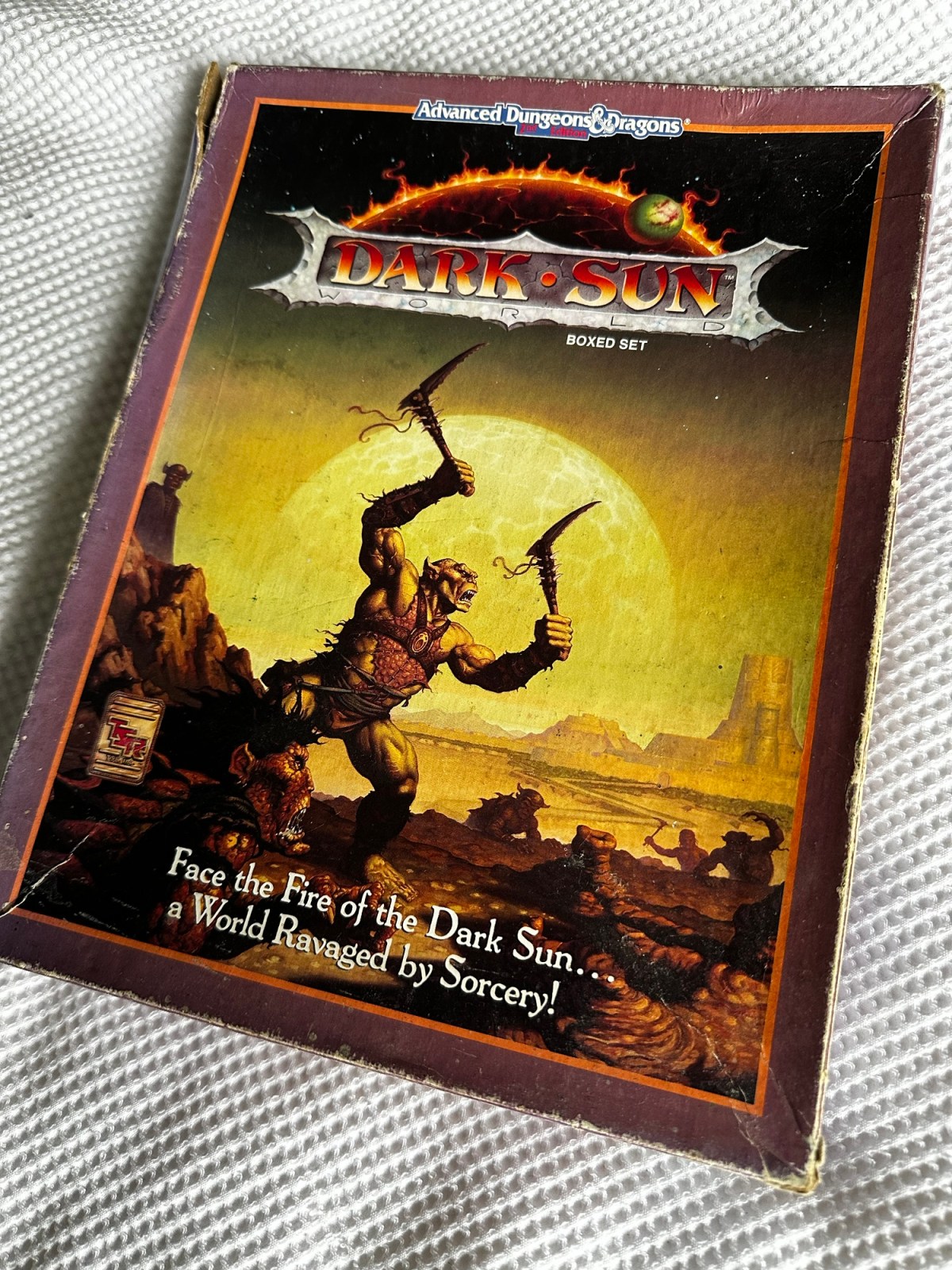
I have a hankering, beloved reader. I crave a little old school. Not revived or anything. No renaissance here. I’m talking, the original (at least for me.) I have been thinking about running an honest to goodness AD&D 2E campaign. That’s the system I cut my teeth on as a DM and I have a lot of the old books lying about on shelves, rarely picked up for any reason other than curiosity. I have a trio of my favourite settings from the old days, Planescape, Ravenloft and Dark Sun. But, is having them a good enough reason to want to run them? The rule set in 2E still involved THAC0, for crying out loud. Only certain races and certain alignments could play certain classes. Every rule seems over the top and over-worked when you look at them. So why? Why would I want to run it?

Nostalgia?

I ran the most successful campaign of my teenaged years in Dark Sun. I loved the setting. It was gritty and made life very difficult for your player characters. They had to start at 3rd level because a first level character wasn’t going to survive in the deserts of Athas too long. You were encouraged to create a “stable” of 5 characters and switch between them to level them all up, just because it was quite lethal. Most mages actively destroyed the land by casting spells and the Halflings were cannibals. It was fucking hardcore and we loved it. So, when I think about running AD&D again, I think I’m channeling the feelings from that time.

But I will admit there is also a sort of morbid curiosity to try it out. More as a historical research project than anything else. How would it compare to more modern systems like 5E or the Year Zero engine or even actual OSR systems?
And I think at least one of my players shares this sense of curiosity about this game and the legacy it spawned. He didn’t get to experience it so maybe it’s just his curiosity too. I mean, people really did love it, right? So, why?

Dark Sun

There is also another point, though. It might even be the main reason I want to do it. Dark Sun itself. WOTC have indicated in the past that they are never likely to revive Dark Sun as a setting for D&D. It just has too many slightly problematic elements. There is a lot about slavery in it. There’s a very strong theme of climate disaster and despotism and evil capitalists. I think it is generally safe to say that Wizards is not interested in picking up any political hot potatoes these days. They will keep it light and breezy whenever possible. So Dark Sun is never likely to come back. Now, I know that enterprising individuals have made some impressive 5E conversions of the setting and I have explored that option. But they don’t give me what the original did. I think Dark Sun benefits from the cruel and crunchy 2E system as much as it does from the grittiness of its world building. And I think that is the main reason I want to run it again.

Anyone out there running any old versions of D&D? If so, why?

The GM Jukebox

Murder on the dance-floor

So, in Spire, we played using the Kings of Silver campaign frame. This introduced a whole set of complications not often part of the average role playing group’s set of problems. They were given the keys and managerial responsibility for The Manticore, a casino and entertainment venue in the city’s Silver Quarter. Imagine Las Vegas but with more elves and feuding nobles.

Unsurprisingly, the players took it and ran with it, often leaving the main plot somewhat neglected as a result. As luck would have it, one of them played an Idol, a sort of magical enchantress/pop star with the ability to start a party anytime, anywhere. So that got the crowds in. They started off by opening a night club with dripping red meat hanging from hooks in the ceiling and a death metal band playing. They called it the Hardicore. In a totally unhinged and tactically questionable turn of events, the PCs decided to murder a group of nobles, the Quinns, who were working for their rival, Mr. So. They did this in the middle of their very busy nightclub, on opening night. Now that’s what I call Hardicore. Anyway, one of the cool things about that scene was that I handed over control of the Bluetooth speaker to one of the players at our table. The Hardicore was Isaac’s brainchild, really, so it only felt appropriate that he should control the music choices, for that scene. He made choices I never would have and made it more personal to the players.

Later, when the Hardicore underwent a full renovation and reboot as the far more disco Mantiskate or Glamcore. I can’t remember which one they went with in the end to be honest. They replaced the meat hooks with glitter balls and the death metal and Desang (a type of violent opera popular in Spire) with disco and roller skating. This time, I handed over the control to Thomas and Heather to allow them to choose the disco tracks they wanted to use as a backdrop for the Idol to ensorcel the heads of the noble families into working together. I did take back the reins later so I could blast Kung-fu Fighting when the inevitable battle broke out, though.

Moments like these truly exemplify the value of having music at the table when you play RPGs. And I also think it should not always be in the control exclusively of the GM, if you have one.

Mood music

Of course, when we use music, it’s normal to use it to establish an atmosphere. There are few tools at our disposal more immediately effective than music, I often think.

I mentioned previously that I used a playlist of the Blade Runner soundtrack while playing that game on Roll20. The atmospheric work you can do at a table is exponentially more difficult when all your players are sitting in potentially brightly lit rooms filled with distractions, in my opinion. But I felt that the use of the music in the Roll20 jukebox drew us all into the same moments. Conveniently, the soundtrack included tracks meant precisely for several of the locations shared by both the movie and that Case File, so, if you know the movie, it can really transport you to the place. Even if you don’t know the movie, of course, I think that incredible score by Vangelis will establish the right mood for the game, a sort of retro-future noir.

But movie soundtracks have a problem, if you want to use them for atmosphere in your game. In general, you can’t simply play them through because the tracks are designed with specific scenes in mind. In all likelihood the scene you’re playing at the table isn’t going to correspond to the music all the time. While playing the music for Blade Runner, I found myself hopping from one track to another almost constantly, and, honestly, it’s a lot of work when, as a GM, I already have a lot on my plate.

Lists 3.1: playlists

The answer, of course, is to make playlists for certain types of scenes. Here’s a list of the types of scenes I am thinking of:

  • Battle
  • Chase
  • Dungeon
  • Downtime
  • Montage
  • Mystery
  • Travel
  • Wonder

In the last week or so, while I have been writing these blogposts, I have also been listening to albums and soundtracks on Apple Music. This allows me to stop writing and pick out a particular track that I feel suits one of these playlists, when it comes up. In the past, I have tried to make playlists like these by just thinking about particular songs that I think fit the genre of the game without paying any mind to the types of scenes and the different music you want for them. This never worked satisfactorily. I am finding this new method much more successful.

Thanks to the influence of Jason Cordova and the Companion Adventures section at the end of every episode of the Fear of a Black Dragon podcast many of the songs in the playlists are from synth-wave and dungeon-synth albums. Mostly, I have discovered that you can find tracks from these genres to suit almost any of the above. I have added a few tracks from video game soundtracks too but each has been hand-picked for a given playlist.

I’m sure I’ll also realise I need to build playlists for more scene types as I continue using this method. But, I’m quite enjoying it as an exercise and I think it proved very useful in last night’s session of Heart, in which I got use Wonder, Downtime, Battle and Dungeon.

Do you use music at your table? If so, what kinds and how do you use it? And if you are one of my players, what did you think of my new playlists?

Games I Have Played So Far this Year, Part 1

Lists part 2.1

Also not a top ten, not by any means, but I do think this one is useful for me, especially. Even this time last year I could not has envisioned a seven month period where I got to experience so many different games with so many different people. Looking back on it, I don’t think there has ever been a period in my life where I have been involved in so many RPGs.

This got me thinking so I went to dig up some of my old prep books from the 90s (a few notebooks, filled largely with encounter stats.) In these ancient tomes I found prep notes and full scenarios that I wrote for no fewer than three AD&D campaigns (Dark Sun, Ravenloft and Planescape,) a Gamma World campaign, a Beyond the Supernatural campaign, a Robotech campaign, and a home-brewed Aliens game that I think I based largely on the Palladium ruleset. I know I ran a couple of other things too but not much more. I have run more different games in the last 7 months than I did throughout my teenage years! It is a golden age for me and I am loving it!

Anyway, on to the list. In this post I am only doing the games I have GMed/run/refereed. I will do the ones I played in in the next post:

Games I have run this year so far

  • Spire – Kings of Silver – Concluded Campaign. Far more epic in scope than it ever had any right to be. This was largely due to my choice at the start to make use of an optional rule that made the PCs much less likely to accrue fallout. At the time I did not realise exactly how crucial fallout is to pushing he campaign forward. I wouldn’t do that again. This campaign really got me into the products of Rowan Rook and Decard. You will find another couple of games on this list that they made too, in fact. It was a great experience and I know I’ll be going back to Spire sometime soon. I am also definitely going to do a more in-depth look at this one in a post all its own sometime soon.

  • Eat the Reich – short campaign. We started playing this shortly after I received my physical copy from the Kickstarter campaign, just because our regular game night fell through. And what a happy accident! If you too hate nazis and love making up inventive and ultra-violent ways to kill them with vampires, this is the game for you. Also, it is Ennie nominated right now, go vote for it! It is one of the most eye-catching RPG books I own, which is saying quite a lot. It is worth picking it up for that alone.

  • Never Tell Me The Odds – Rebel Scum – one-shot. I planned this one for Star Wars Day this year and really enjoyed it. We actually watched Star Wars: A New Hope before we played it too. This really helped because the premise of the whole one-shot was that the PCs were a rival band of rebels who were actually sent to the Death Star to rescue Leia at the same time as Luke and his pals were blundering about, getting captured and accidentally doing good. Great fun, would recommend this game for one-shots too. It’s all about the stakes and how you play them.

  • Troika! – The Blancmange and Thistle – one-shot. Possibly the most fun I have had in a one-shot all year. Everyone rolled on the random table in this OSR game and played what they got, a Rhino-Man, a Questing Knight and a Befouler of Ponds. Then we played the starter adventure from the Troika! Numinous Edition core book, where they went to their room in a hotel and attended a party. Fucking hilarious at almost every turn. 10/10 would play again, and I definitely will.

Check back for part 2 where I get into the ones I’ve been a player in so far this year.

Fear of an Indie RPG Podcast

RPG podcasts

I suspect that when most people think of RPG podcasts, they think of actual play, where a bunch of nerdy voice actors/comedians/nerds get together around a table/microphone/Zoom app and record their games. It is such a common format that one of the more famous ones is called Not Another D&D Pocast (NADDPOD.) There are a number of these that I like and I might get into them in another post at some point. This post is not about them.

So, as you may have gathered, I enjoy not just playing RPGs but also talking about them, reading about them, listening to people talk about them. There are not many podcasts that I listen to regularly that do this. I just don’t gel with all of them. But today I wanted to highlight two that I get a lot out out of. Sometimes I get advice to be a better GM or player from them, sometimes they introduce me to new games or supplements, sometimes I just get to relish people chatting about a subject that is close to my heart and interests me too.

The Yes Indie’d Podcast

Thomas Manuel runs this little gem. I got into it when a friend suggested I sign up for the Indie RPG Newsletter, also run by Thomas. Please go and sign up for that too, by the way. I look forward to that turning up in my inbox every Sunday morning. It’s a really good way of keeping up with what is happening in the indie RPG scene and getting some fascinating insights into aspects of the hobby you might never have thought you needed to think about.

The usual format for the podcast is that Thomas will invite an indie RPG luminary on to the show and interview them. He always has a bunch of insightful questions for them and the discussions that emerge have a lot to offer, particularly if you have ever been interested in creating and publishing your own indie RPG material. There are lots of good episodes but I would recommend a specific few recent ones that I got a lot out of:

Meeting Games Where They’re at with Quinns, one of the most reliable and funny RPG reviewers out there

Getting Weirder than Lovecraft with Graham Walmsley, creator of Cthulhu Dark among other good stuff

Open Hearth’s Games of the Year 2023. This is a bit of a cheat since it is not technically a Yes Indie’d episode but it did appear on the Yes indie’d feed so I get to include it. It is also the thing that made me go and sign up for Open Hearth so it gets extra points for that.

Fantasy Non-Fiction with Tom McGrenery of the Fear of a Black Dragon podcast

Fear of a Black Dragon

Which brings me nicely on to Fear of a Black Dragon. For the umpteenth time, Thomas Manuel directed me to check out something that I ended up loving.

The Fear of a Black Dragon podcast is the venerable OSR module review show produced by the Gauntlet. The Gauntlet is responsible for several high quality, popular indie RPGs and other related publications and podcasts. Their best known products probably include Brindlewood Bay, Public Access and The Silt Verses RPG. These games are very much not OSR by nature but the modules Jason Cordova (author or co-author of the games listed above) and Tom McGrenery (of the paragraph-before-this-one fame and creator of several games himself) review very much are.

The format is simple and unchanging, the reviews go deep and are guaranteed tested at the table, the vibes are spot-on. I started on the first episode from 2017 and have been binging it relentlessly for the last couple of weeks. What’s nice about this is that all the modules they reviewed back then are still relevant and available. Another interesting point is that the hosts mostly do not use OSR systems to play the games they review, rather they usually use something like Trophy Gold or Dungeon World, Powered by the Apocalypse games that are much less crunchy and more interested in the narrative of a game than the number of dice you roll for damage. They provide a lot of expert advice on how to handle conversions like these as well as great ideas for introducing scenes, developing NPCs, doing sound effects and other fun stuff.

The episodes I have listed below made me go and purchase the items they reviewed. These links are to their website but you can listen on your pod-catcher of choice of course:

Ultraviolet Grasslands

Fever Swamp

Slumbering Ursine Dunes

But you should also check out this one, which was the first one I listened to and is much more recent:

Episode 100 Special

Go and subscribe to these podcasts and sign up for their Patreons if you can:

Indie RPG Newsletter/Yes Indie’d Podcast

The Gauntlet/Fear of a Black Dragon

One-shots

The campaign for one-shots

I mentioned in my last post that there is nothing I enjoy more than the development and advancement of a character. In D&D terms, I’m talking about levelling up, of course, but most games have some mechanic that allows characters to improve in a tangible way. You might get to pick a new advance, or a new ability or you might just get a few percentage points added to a skill. Normally, taken on their own, these are incremental and not earth-shaking in their effect on the character or the game. But when taken as a whole from the point of a character’s creation to the end of their adventures, they are often massive. More-so in some games than others, but always very noticeable (unless you’re playing something really lethal like a DCC funnel.) I do like to see my characters improve like this but in recent months I have been struck by how advancement is not necessarily the object of the exercise for me, it’s actually just change. You might need a longer campaign to give characters an opportunity to level up, but you don’t necessarily need one to change them. A one-shot can do that quite admirably, thank you!

If you remove the necessity for advancement and replace it with the necessity for change in PCs you can make it far more immediate. Horror games make great one-shots for this reason. So many of them involve some sort of sanity mechanic, meaning you have to change the way you play your character or else the character’s interaction with the world and the fiction is altered when they start to lose their grip. Other games introduce physical mutations from exposure to powerful forces. Still others have temporary effects that afflict or bless characters from the use of their own abilities. What I have discovered over the last while is that a successful one-shot will often involve leaning into one or all of these options, or other types of changes that I haven’t listed above.

Is this why players sign up for a one-shot game? Maybe not. Probably not, in fact. For me? I usually sign up to try out a game I have never played before, or a scenario I have never played before. Honestly, I rarely know enough about a game before I go into it to know whether or not it will involve any real character change in such a short format. But those that do it? Those ones live long in the memory.

Alien Dark

I’m immediately cheating by referencing a two-shot, but let’s not split hairs, eh?

Alien Dark was the first game I ever took part in as a member of the Open Hearth gaming community. Alun, the writer of this nasty and wonderful little game was our GM. Now, there’s a mechanic in this game that allows the GM to accrue Danger. They can then use that to just completely fuck your character over with Aliens, both physically and psychologically. This is something that has a tendency to leave you in Bill Paxton levels of panic real fast. And if you’re panicking, just imagine how your poor character feels.

Well, actually, there’s no need to tax your imagination, dear reader, I can tell you. You see, my character, Benny Doyle, a ne’er-do-well with a substance abuse problem, was really piling on the stress points. Within the fiction of the game, you are required to write a short line describing the effect of the increasing mental distress on your character. Benny got nuts. He went from meek and afraid and hiding behind the other PCs to roaring about needing GUNS and going, quite literally, toe-to-toe with an Alien. Man that was fun. Like, I just enjoyed this poor lad’s descent into drug-fuelled madness so much. And it didn’t happen all at once either, I got to draw it out, as Alun ramped up the tension and the Danger, over the course of one and a half sessions or so.

This is the sort of change I’m talking about.

Death in Space

Here’s another example, which, in the moment of typing this, oh, gentle blog-goggler, I just realised was also a two shot in the end. It had been designed as a one shot but sometimes, just sometimes, your players have too much fun creating their damn characters and your one shot divides, much like an amoeba, into two separate but equally awesome wholes.
Death in Space is a game by the Stockholm Kartel. It’s an OSR game of space horror, which, even at the best of times, I would imagine has a pretty high mortality rate. As a disclaimer, I have only ever run this game this one time so I can’t confirm that.

Anyway, I wrote this short scenario with inspiration from a couple of locations and NPCs from the core book. The idea was that the PCs visited this space station which orbited the ruins of a destroyed planet. They explore the claustrophobic, jungle like environment on this station and interact with the denizens, a void cult led by a grotesquely mutated woman.

Then I get them to roll some checks. With every roll they fail on the station they build up void points, which they can spend to do cool stuff. But when they do that, they open themselves up to the possibility of void corruptions. The Death in Space core book has a Void Corruption table. Here are some samples of the shit my players’ characters were inflicted with:

“Another you starts growing on you. The twin clone is fully grown and detaches after 1d20 days. It has its own will and purpose, decided by the referee.”

“A part of your body becomes shrouded in a cloud of darkness.”

“Flies and other insects crawl out of your body when you sleep. A small cloud of them surrounds you. Their buzzing is a constant static.” (Actually, since this was a one-shot, I made it so the flies just popped out all the time. Much more effective.)

I adjusted the rules slightly to make corruption more likely and, you know what? My players loved being corrupted! Their characters were going through intense and horrific changes while also learning more about themselves as they were tested psychologically.

Now, go play a one shot and corrupt some PCs!

Also, go and buy Alien Dark on itch.io; it’s PWYW! And Death in Space from here. It costs a specific amount of money but it’s a good game and a gorgeous product.