More Troika! – One-shots

Appendectomy

When was the last time your mind was genuinely blown by an idea, a concept, a creature or a situation presented to you when you played a fantasy role playing game? Because I don’t think D&D is providing opportunities for that sort of thing these days. I don’t necessarily blame the writers of D&D books for that; Wizards of the Coast has painted themselves into a corner that they are very comfortable occupying. In fact, because D&D is responsible for much of the public image of fantasy games for the last half century, they have dragged a lot of the hobby with them. As a result you have endless polished and glittering iterations of elves and dwarves and dragons and wizards with spell levels and clerics with devotion to individual deities and all the same monsters repeated ad nauseam. It is particularly interesting when you look at Appendix N, the appendix to the original D&D, in which Gary Gygaxstated his inspirations for the game. It has a few names you would expect to see: JRR Tolkien, Robert E Howard, Fritz Leiber and Poul Anderson but you also have a few that might make you wonder about the connection to the D&D of today.

HP Lovecraft is well known as the author of The Call of Cthulhu and other cosmic horror stories but his influence on D&D might not be obvious to all. Jack Vance wrote fantasy novels but they were tinged with an element of science fiction and gonzo world building in his Dying Earth books. In fact, many of the authors represented in Appendix N were famous for science fantasy rather than straight fantasy books, just look at Roger Zelazny and Edgar Rice Burroughs. You can still see bits of that influence in Wizards of the Coast’s D&D if you think of Spelljammer and Eberron but they always feel little too clean and sanitised compared to the books those ideas came from.

What I am getting at is that the true spiritual successors to the game developed with Appendix N in mind are part of the OSR. I wrote just yesterday on this very blog about Dungeon Crawl Classics and that very much embraces those influences, but it’s Troika! from the Melsonian Arts Council that truly embodies them for me.

Stretching those imagination muscles

The cover of my copy of Troika! Numinous Edition.

From Acid Death Fantasy by Luke Gearing:
“To the East lies the Plastic Sea, a miraculous main of liquid plastic. Upon contact with living skin it solidifies, covering the coast with Coated Men dueling each other in elegant, fatal contests, having made the choice to die young and glorious, sealed in flexible plastic armour.”

From Fronds of Benevolence by Andrew Walter:
Fletherfalloon is a floating Thinking Engine of a very basic sort, dating from a bygone age. Festooned with rotting ribbons and rusty curlicues, it hovers at varying altitudes burbling and whistling to itself.”

From Slow Sleigh to Plankton Downs by Ezra Claverie:
“Water: three billion years old, frozen by the perpetual
night at the edge of the Galaxy, compressed into glaciers
of midnight blue. Taste the weight of time and solitude,
darkness and purity. With Djajadiningrat.
Hear it crackle in your favorite spirit. The sound of time
calving into an ocean of premium flavor.
Cut by natural-born hand, never by machine, never by clone.
At night’s edge, taste the infinity. Only from Djajadiningrat.
— advertisement in Ice Tomorrow (trade magazine)”

Troika! Is a city at the centre of everything, and around it gathers a host of bizarre and fantastical settings dotted throughout the cosmos. Perhaps you traverse this universe in a space-ship, perhaps it’s a Golden Barge you use. Maybe your character is a Displacement Prosthesist, maybe they are a Hyenaman Scavenger. The possibilities are truly endless and the strangenesses abound.

A page from Acid Death Fantasy by Luke Gearing. It details of the background you can choose to play in that setting, the Hyenaman Scavenger.

We had the chance to play a single one-shot of Troika! A couple of months ago and it did nothing but whet my appetite for more oddness. The adventure we played was a published one, The Blancmange and Thistle, in which the PCs encounter a hotel. Saying any more would involve spoilers but suffice it to say, if you are a fan of the unusual, that hotel is the place to stay.

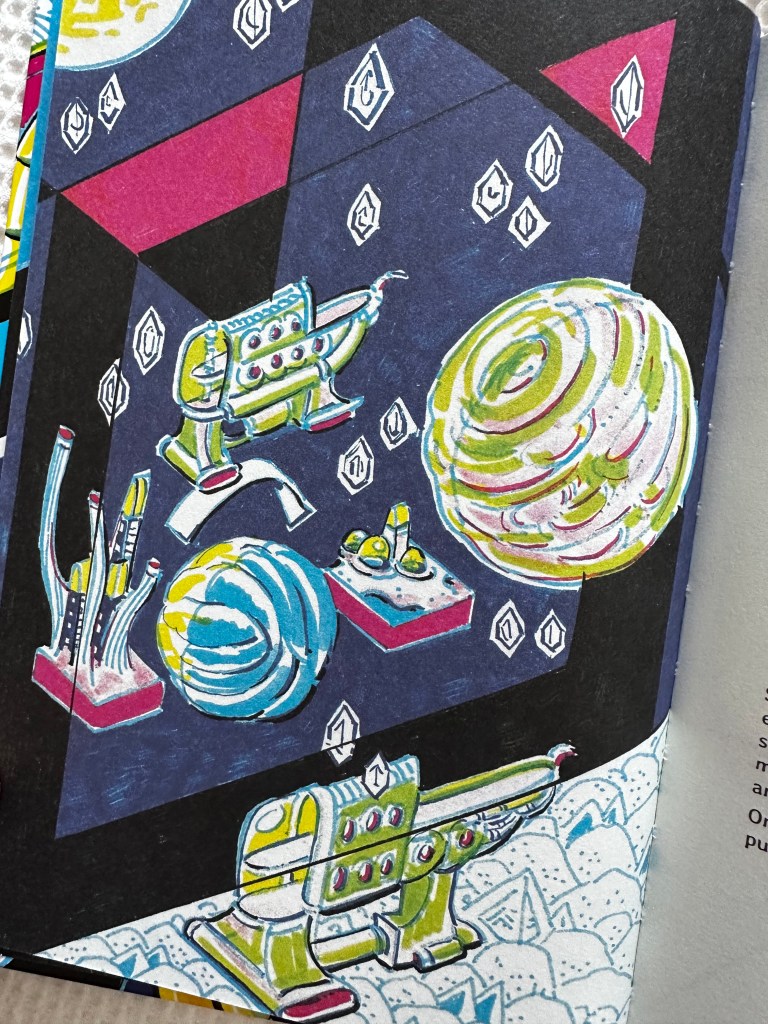
The inside front cover of my copy of Slow Sleigh to Plankton Downs by Ezra Claverie.

From that, I fed the PCs a hook that should, someday, when I find the time, lead them to the world of Myung’s Mis-step and the whodunnit adventure at the centre of Slow Sleigh to Plankton Downs.

But I have a few others too:

Some lads on a page from Frond of Benevolence by Andrew Walter.
  • Fronds of Benevolence is a short, point-crawl where the PCs journey in search of an item of great importance to their friend/ruler/patron/deity, Duke DeCorticus, which will lead them “to the Rainbow Badlands, across the precipitous face of The Wall and in the very vaults of the hump-backed sky!
  • Acid Death Fantasy is more of a setting book but could equally be used as a point-crawl adventure. It contains elements from Dune, Planet of the Apes, others from dying earth genre books and still others from classic fantasy.
  • Whalgravaak’s Warehouse also by Andrew Walter is an adventure “that centres the play experience on the classic tenets of danger, resource management, exploration and player engagement agency.”

And given the fact that I will probably only get to run these once every few months, these will no doubt last me a while!

Have you had any experience playing Troika!? If you met a Slug Monarch in an awkward situation, would you help them or attack them?

Dungeon Crawl Classics – Individual Modules

Dropped modules

I have a few adventure modules from the early days of my D&D career. A couple that hark back all the way to AD&D first edition and several more for specific settings like Dark Sun, Ravenloft and Planescape. I have a few for D&D 5E as well. But the thing is, I have never been that enamoured of them. Almost from the start I found it too restrictive to run a pre-written adventure. I had the feeling that I had to get everything right, according to the text and that, if I put a foot wrong, I would mess up the whole experience for the players. To be fair, that was absolutely the case in some instances.

Instead, after I had read a few published modules and run some of them, I was able to see how it was done. So, I wrote my own adventures. Usually these were pretty loose things with nothing but a beginning, a main villain and some encounters filling the middle but only a vague idea of where it was going. Honestly, my method has not changed all that much in the intervening years. Anyway, this approach allowed me to improvise much more freely and I think my players generally felt they could do as they wished, within the constraints of the setting, rather than the strictures of a preset narrative.

I still don’t run published D&D scenarios or campaigns much, even if I do occasionally buy them. I ran Storm King’s Thunder a few years ago and was equal parts appalled and underwhelmed by it. It’s a full campaign that took us the guts of two years to finish. During that time much of our play-time was spent farting around the Sword Coast, trying to remember what the PCs’ motivation was while having more-or-less random encounters and a few pre-written, essential ones. It was meant to be a sandbox but the area felt too vast and the individual locations too ill-explained to be easily useable without a huge amount of work by the DM. And so little of it felt important to the overall plot! On the other hand, when it gave me the chance to be creative, and come up with content that was entirely my own, I loved it. And, generally, those were the most memorable moments from that campaign, even if I do say so myself.

Modular construction

A photo of the front cover of my copy of the Dungeon Crawl Classics RPG.

So why do I want to run individual modules for the Dungeon Crawl Classics RPG from Goodman Games? More masochism? Could be, oh reader mine, could be. It might actually be a mistake. I probably won’t know until I try it out.

But here’s the thing, the modules I am thinking of have been written some time in the last ten years for the most part. They are modern, with modern themes and sensibilities in mind. They are structured for a modern RPG player and they are, generally, nice and short.

So, they are modern, meaning they have plenty of opportunities for the PCs to make important and potentially game-changing choices and very few instances of railroading. Also, they assume that the players, at least, have all agreed to be there to play the game and so they are not written with the utmost consideration given to how to get the PCs to do what the adventure wants them to do.

Themes and sensibilities are important. A lot of the older adventures make colonialism look good and normalise a sort of fantasy racism that is simply unacceptable. It wasn’t acceptable then and it isn’t now. But now, at least, the consumer won’t put up with it.

Structure and length kind of work hand-in-hand. A lot of these have a fairly loose structure where many events can occur at any time within the beginning middle and end portions of the modules. And they are short enough to play in an evening or two for the most part. Here are the page lengths for a sampling of the DCC adventures I own:

The Sorcerer’s Tower of Sanguine Slant – 25 pages
The Laughing Idol of Lar-Shan – 17 pages
Blades Against Death – a massive 32 pages
The Croaking Fane – 16 pages

Easy to read and easy to prepare with great maps and fun artwork too.

Also, these things are metal AF.
Here are a few extracts:

From DCC # 77 The Croaking Fane

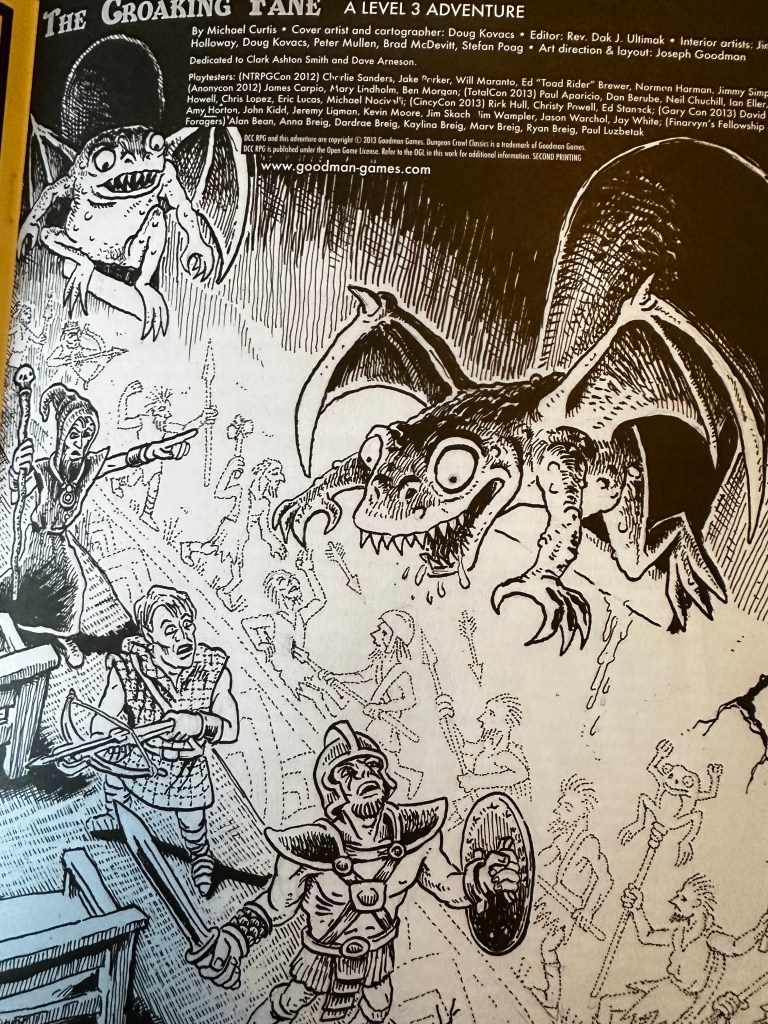
A page from the DCC adventure module, The Croaking Fane.

“The transept ends in a small altar, atop which sits an idol depicting a grotesque frog with razor-sharp teeth and talons. Its mouth is full of the mangled bodies of sentient races – humans, elves, dwarves, orcs, and even ogres hang askew in it maw; limbs dangling between the giant’s teeth.”

From DCC # 74 Blades Against Death

A page from the DCC adventure module, Blades Against Death.

“You draw aside the clacking curtain to reveal an emaciated crone, her white eyes staring into nothingness. A third eye is tattooed on her forehead and seems to blink when she wrinkles her face.

From DCC # 77.5 The Tower Out of Time

“A grotesque wonder occupies this bright chamber. Three fleshy slabs stand at acute angles around a monstrous, bulbous mass that resembles an exotic jungle flower. Each slab bears a small, hairy anthropoid creature. Numerous crimson tubes extend from the horrible flower, greedily siphoning the life blood from these creatures.”

Finally, DCC has this rather unique phenomenon called Level 0 Funnels. I am mildly obsessed with them and am itching to get one to the table. You play one of these adventures in lieu of traditional character creation. Your players each roll up 4 or 5 0 level characters, essentially peasants with no special abilities or magic or anything (they might have a pitchfork or a pig) and you send them all into a dungeon. Any that survive the experience get promoted to first level. And some of these modules are pitting 0 level characters against the sort of things the average D&D party might think about facing at like, 10th level.

I haven’t even gotten into the rules of DCC really. Suffice it to say that they are close enough to D&D that most players will not have a hard time learning them. I’ll probably do a deeper dive on the rules another time.

So, have you played DCC? If you did, did you play any of the published modules for it? What did you think?

Psycho-analyse Your Players for Fun

Sorry for the monsters

The murder-hobo days are largely done, I think. Although I’m sure there are still plenty of tables out there slaying every poor goblin that crosses their paths, it seems to be a pretty old-fashioned play style, uniquely and deliberately violent, especially when the “monsters” are sentient creatures with cultures and desires and rich inner lives. I didn’t know it when I was a kid but there’s no doubt that the impetus to enter an underground lair and kill every orc you found in there was a product of some highly colonial cultural fallout. Those guys are green so it’s ok to take their treasure and their lives, right? Or, my king/lord/boss/priest told me those guys were evil; better get them before they get us!
You are far more likely to be able to deal with an encounter without violence, and that’s cool.

Harpin’ on

Do my players do this? you ask, reader. Well, yes and no. The Deadwalker from our Heart game made friends with a Heartsblood beast the other night. It was a giant snail with the face of a drow (except for the eye stalks and the rows of sharp little teeth.) his name was Shelby. Of course, they sort of bonded over the killing of a harpy couple. Harpies in Heart are very interesting, by the way. They remind me of the Khepri in China Mieville’s Bas Lag books. The male harpy is just a big bird, about the size of a cat. Now, when he is looking for a mate, he’ll collect up a load of trinkets, bones, body parts, small creatures and occult relics and place them in a circle while, like a minah-bird, he speaks words he has heard others say. These tend to be words they have heard recently from people like the PCs, which is fun. Anyway, this ritual summons his potential mate through a portal from some dreadful, hellish dimension. And she is the terrifying figure of a woman but with talons where feet should be and wings instead of arms and the intestines of some poor bugger dripping, bloody from her beak-like maw. She is very violent and hungry. This encounter was only going to end one way. Luckily, it was the PCs who came out the victors, although it was touch and go. And hey, Seeker made a new friend in the process! Cute little Shelby.

Surprised to see it turn weird

The subtitle there is a reference to a star I got from Isaac in our last D&D session when they discovered the brainless hobgoblin body and the triplets with gossamer threads attaching them to something else in this dungeon they have just entered. They have been encountering a lot of other sailors, mostly humanoids and their servants recently. That’s often the type of game it is because they are dealing with other ships and their crews a lot. They have usually resorted to violence in most instances in this campaign so far. Maybe that’s my doing since the encounters have often started off violent from the monster side. And they did try to befriend that one Neogi sailor who had been left behind by his mates. So they get humanitarian points for that.

So, in this dungeon, I thought I would take the opportunity to make it a bit weirder. After all there should be alien things in a space game. I can’t go into too much detail, but suffice it to state that I am excited to see how the players and their characters react and what they do.

Spiteful owls and slug monarchs

What I find, in general, is that the weirder the monster you introduce, the more likely violence is gonna to be the answer. This is, I think, often a fear response. Or maybe it’s an assumption that, the weirder the monster looks, the less likely it is to be reasoned with. These are often understandable impulses, actually. I mean, there are also the monsters that are totally mundane, like the flock of owls in the Troika! Adventure, The Blancmange and Thistle. They had come in through a window and were harassing a hotel employee. My players did not hesitate to cull those wild birds. To be fair to them though, the text does name them “spiteful owls” and they attacked anyone who entered their stairwell. So maybe they deserved it.

A couple of floors further up in the. Blancmange and Thistle, they encountered a Slug Monarch trapped in the stairs, embarrassed and very much in the way. They used some demonic water to awake a terrible hunger in him and that got him moving. He was a bit more dangerous in this state so they did have to fight him off but then they just escaped up the stairs where he couldn’t follow. It was a relatively non-violent solution to a simple problem involving a rather gonzo monster. But maybe they just treated him better than the average slug because he was a monarch?

Maybe I should stop psycho-analysing my players and their characters.

Anybody else psycho-analyse their players?

AD&D 2nd Edition

Masochism?

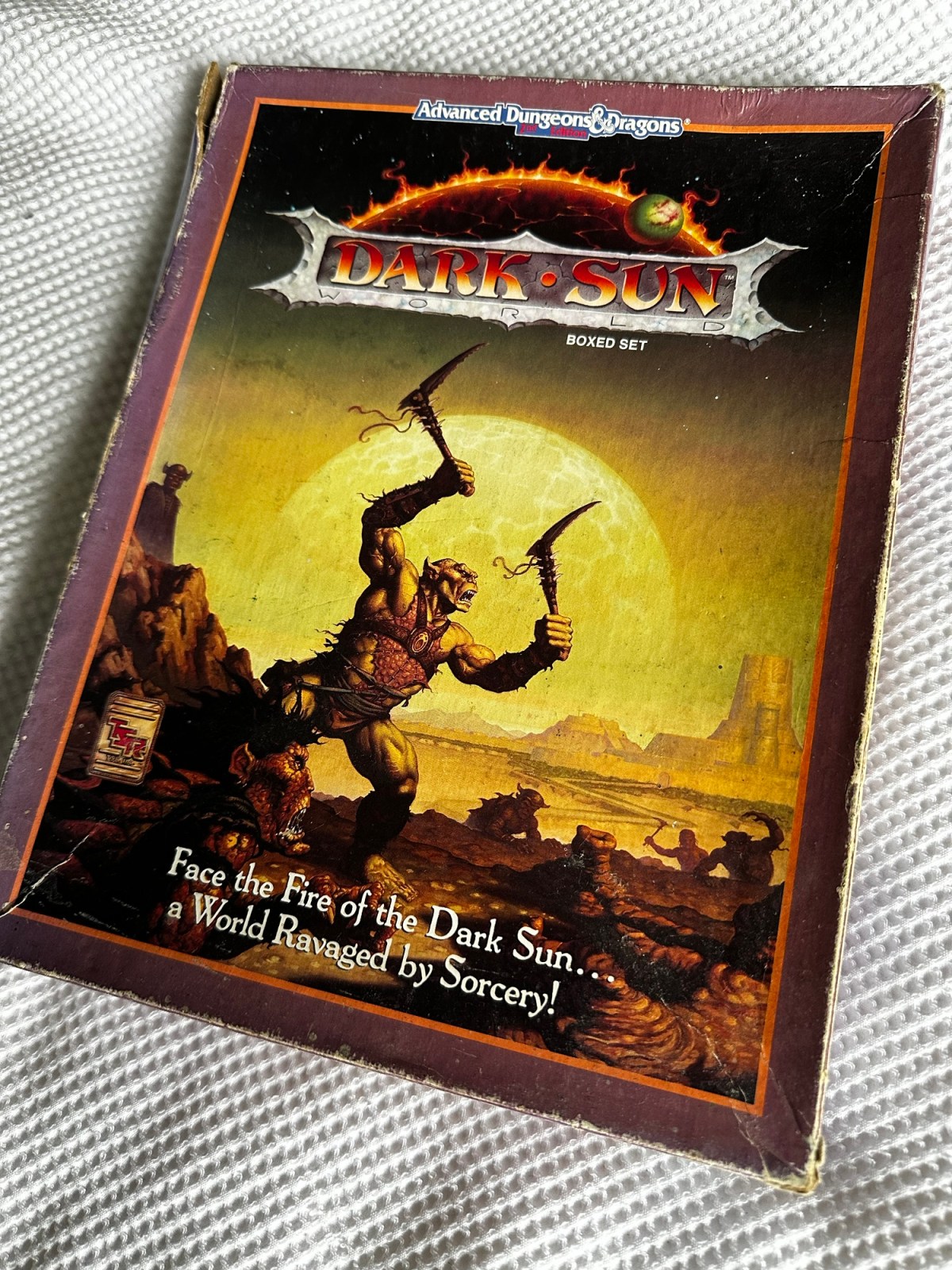
I have a hankering, beloved reader. I crave a little old school. Not revived or anything. No renaissance here. I’m talking, the original (at least for me.) I have been thinking about running an honest to goodness AD&D 2E campaign. That’s the system I cut my teeth on as a DM and I have a lot of the old books lying about on shelves, rarely picked up for any reason other than curiosity. I have a trio of my favourite settings from the old days, Planescape, Ravenloft and Dark Sun. But, is having them a good enough reason to want to run them? The rule set in 2E still involved THAC0, for crying out loud. Only certain races and certain alignments could play certain classes. Every rule seems over the top and over-worked when you look at them. So why? Why would I want to run it?

Nostalgia?

I ran the most successful campaign of my teenaged years in Dark Sun. I loved the setting. It was gritty and made life very difficult for your player characters. They had to start at 3rd level because a first level character wasn’t going to survive in the deserts of Athas too long. You were encouraged to create a “stable” of 5 characters and switch between them to level them all up, just because it was quite lethal. Most mages actively destroyed the land by casting spells and the Halflings were cannibals. It was fucking hardcore and we loved it. So, when I think about running AD&D again, I think I’m channeling the feelings from that time.

But I will admit there is also a sort of morbid curiosity to try it out. More as a historical research project than anything else. How would it compare to more modern systems like 5E or the Year Zero engine or even actual OSR systems?
And I think at least one of my players shares this sense of curiosity about this game and the legacy it spawned. He didn’t get to experience it so maybe it’s just his curiosity too. I mean, people really did love it, right? So, why?

Dark Sun

There is also another point, though. It might even be the main reason I want to do it. Dark Sun itself. WOTC have indicated in the past that they are never likely to revive Dark Sun as a setting for D&D. It just has too many slightly problematic elements. There is a lot about slavery in it. There’s a very strong theme of climate disaster and despotism and evil capitalists. I think it is generally safe to say that Wizards is not interested in picking up any political hot potatoes these days. They will keep it light and breezy whenever possible. So Dark Sun is never likely to come back. Now, I know that enterprising individuals have made some impressive 5E conversions of the setting and I have explored that option. But they don’t give me what the original did. I think Dark Sun benefits from the cruel and crunchy 2E system as much as it does from the grittiness of its world building. And I think that is the main reason I want to run it again.

Anyone out there running any old versions of D&D? If so, why?

Games I Have Played So Far this Year, Part 2

Lists part 2.2

You will notice a trend in this list. More than half of them are Open Hearth one-shot games. I just joined the community in January of this year and I thought the best way to ease my way into it would be to sign up for a short game or two. So I started with Alien Dark. Not long after that another member in a similar timezone started posting one-shots of a bunch of games I wanted to try out, and that accounts for almost all the other Open Hearth one-shots listed below. I wasn’t new to Mörk Borg, admittedly, but it is usually a gritty good time and it was at a time that suited me so I joined up. Honestly, sometimes, that’s all the impetus you need.

Games I have played in so far this year

  • Root – The Nightmare Before Winterfest – Concluded Campaign. Root is the PBTA RPG of the board game where you play anthropomorphic denizens of the forest, traveling from Clearing to Clearing getting into trouble, making friends and enemies of various factions and having prolonged Christmas episodes. Good friend and esteemed character-actor, Thomas GMed this “festive” campaign for our little Tables and Tales gaming crew. The quotes are only partially ironic. It did start around Christmas but then it kept going right through Easter and out the other side! Don’t get me wrong, I’m not complaining. This campaign was a laugh. I got to play a German badger named Beagan, known to one and all in the Clearing of Lindor. Beagan and his companions busted open the people-in-the-chocolate mystery, demolished the local police station, repelled the siege of Lindor’s famous Winterfest market from the branches of its festive tree and unmasked Ebenmeowser Scrooge as the ultimate villain of the piece. Good times.

  • Remembrance – Open Hearth one-shot. Remembrance is a GMless story game designed by a fellow Open Hearth member and this was a play-test of it. All the characters start off as members of the Irish Republican Army during the Irish War of Independence, brothers in arms and valued friends too. But, as those who know about Irish history of the early twentieth century will be able to tell you, the War of Independence was followed quickly by the Irish Civil War. This was fought between those forces who wanted to accept independence for all but the six counties in the North of Ireland and those who would only accept freedom for all thirty-two counties. The three act structure of this one-shot was split between the time of fraternity in the first act, the tragic split into two opposing camps in the second act and a sort of epilogue, or maybe denouement in the third. The story we constructed over the space of three hours is something I won’t soon forget and an experience that stuck with me as an Irish person and someone who lives in those six counties.

  • Mörk Borg – Rot Black Sludge – Open Hearth one-shot. Open Hearth community member, Dom ran this one. This was actually the second time I had played through this scenario. The second time went significantly better than the first, partly because of the very limited time-slot we had to play it in, I think. Rather than stupidly investigating every bloody thing that was definitely a trap of some kind, we pressed on looking for the ultimate goal, finding some kid or something. My character was Joachim the Devoted, a Dead God’s Prophet, who, paradoxically, was a nihilist who insisted on telling everyone he was a nihilist. He survived this scenario despite being largely useless!

  • Mothership – Sandalphon and the Sleeping Angels – Open Hearth one-shot. The second one-shot I was a part of that was run by Dom. This was my first taste of Mothership. In this scenario, you dock with an asteroid/space station and try to discover what is going on there. Spoiler: it gets fucked up and scary pretty fast. The Mothership system is mostly based on d100 rolls and, if you are familiar with Call of Cthulhu at all, you will know that that means you fail, a lot. This leads to horror in a good way of course, setting up scenes of panic and fear as you face the increasingly unsettling and gross realities of the setting. Somehow, my character Burt Connery, ever-suffering Teamster from New York City survived this one too!

  • Cohors Cthulhu – Rude Awakening – Open Hearth one-shot. The third and final one-shot that Dom ran in the list. Cohors Cthulhu is a game that imagines Cthulhu type mysteries and scenarios set in the Roman Empire. Out of all of the one-shots we played this year, I found that this one possibly suited the format the least. It is definitely interesting as a game and a setting but is more designed for campaign play I think. Each character was pre-generated but a little too complex to really get to grips with over the course of a single three hour session. That being said, I enjoyed the speed run we did of this scenario where my character, Herodion the Schemer narrowly avoided being ritually sacrificed to an old god and had fun with the other players. I’d be interested to try the game in a longer form.

  • The Quiet Year – one-shot. This is an unusual game to put on this list really. It is not an RPG to be honest but it is RPG-adjacent. It is a map-making game that uses cards and lists of prompts to allow a group of players to design a settlement that is recovering from some sort of apocalypse or disaster. You have one year to do it and the game is split into four periods represented by the seasons represented by the suits in a pack of regular old playing cards. It was so interesting that each of the players around our table started to embody certain sections of the fledgeling community that had often conflicting priorities and ideas about how to build it. I enjoyed this as an exercise in understanding the difficulties in being one part of a community that is, ostensibly, working towards common goals where other factions have very different plans to you. It has conflict built in to it due to requirements for always having some level of scarcity of necessary resources and this can lead to some, surprisingly fraught interactions above the table. I have heard of a lot of people using this game to create the starting state of a setting for a new RPG and I love that idea.

So, that’s it for my list of games played so far this year. I am looking forward to adding a few more to this list in the coming months. I’ll probably do a post about that in fact. How about you? What games have you played/enjoyed this year?

Games I Have Played So Far this Year, Part 1

Lists part 2.1

Also not a top ten, not by any means, but I do think this one is useful for me, especially. Even this time last year I could not has envisioned a seven month period where I got to experience so many different games with so many different people. Looking back on it, I don’t think there has ever been a period in my life where I have been involved in so many RPGs.

This got me thinking so I went to dig up some of my old prep books from the 90s (a few notebooks, filled largely with encounter stats.) In these ancient tomes I found prep notes and full scenarios that I wrote for no fewer than three AD&D campaigns (Dark Sun, Ravenloft and Planescape,) a Gamma World campaign, a Beyond the Supernatural campaign, a Robotech campaign, and a home-brewed Aliens game that I think I based largely on the Palladium ruleset. I know I ran a couple of other things too but not much more. I have run more different games in the last 7 months than I did throughout my teenage years! It is a golden age for me and I am loving it!

Anyway, on to the list. In this post I am only doing the games I have GMed/run/refereed. I will do the ones I played in in the next post:

Games I have run this year so far

  • Spire – Kings of Silver – Concluded Campaign. Far more epic in scope than it ever had any right to be. This was largely due to my choice at the start to make use of an optional rule that made the PCs much less likely to accrue fallout. At the time I did not realise exactly how crucial fallout is to pushing he campaign forward. I wouldn’t do that again. This campaign really got me into the products of Rowan Rook and Decard. You will find another couple of games on this list that they made too, in fact. It was a great experience and I know I’ll be going back to Spire sometime soon. I am also definitely going to do a more in-depth look at this one in a post all its own sometime soon.

  • Eat the Reich – short campaign. We started playing this shortly after I received my physical copy from the Kickstarter campaign, just because our regular game night fell through. And what a happy accident! If you too hate nazis and love making up inventive and ultra-violent ways to kill them with vampires, this is the game for you. Also, it is Ennie nominated right now, go vote for it! It is one of the most eye-catching RPG books I own, which is saying quite a lot. It is worth picking it up for that alone.

  • Never Tell Me The Odds – Rebel Scum – one-shot. I planned this one for Star Wars Day this year and really enjoyed it. We actually watched Star Wars: A New Hope before we played it too. This really helped because the premise of the whole one-shot was that the PCs were a rival band of rebels who were actually sent to the Death Star to rescue Leia at the same time as Luke and his pals were blundering about, getting captured and accidentally doing good. Great fun, would recommend this game for one-shots too. It’s all about the stakes and how you play them.

  • Troika! – The Blancmange and Thistle – one-shot. Possibly the most fun I have had in a one-shot all year. Everyone rolled on the random table in this OSR game and played what they got, a Rhino-Man, a Questing Knight and a Befouler of Ponds. Then we played the starter adventure from the Troika! Numinous Edition core book, where they went to their room in a hotel and attended a party. Fucking hilarious at almost every turn. 10/10 would play again, and I definitely will.

Check back for part 2 where I get into the ones I’ve been a player in so far this year.

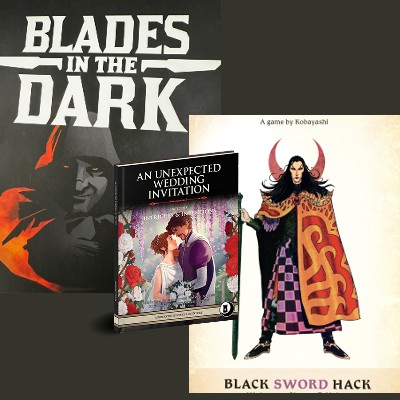
Black Sword in the Dark at a Wedding

Player Freedom

I have never been the forever GM. Back in the olden days, me and my mates would spend entire Saturdays and Sundays just passing that GM baton. I’d run some Dark Sun for an hour or two, then my friend would try and blow us up in Rifts for a while and later, yet another pal would run us through some MERP. I don’t know if that was unusual in those days as I had no frame of reference. We kept our weird little hobby to ourselves for fear of bullying and humiliation from our peers. But that’s besides the point.

I have always enjoyed RPGs from both sides of the screen. In fact, in some games, I feel almost freer when I have the reins for just a single character instead of being burdened by a whole world. It depends on the game, for certain, but I love the process of establishing, advancing and developing a character over the course of weeks and months and years of play. In many ways, that’s my motivation when GMing too, it’s just more vicarious in that instance.

Anyway, here’s a little bit about each of the games I am playing in right now. Each of them is incredibly different to the others but I get something special and unique from every one.

Black Sword Hack

This is what I would call a home game. It’s just four of us, friends who make up the core of a role playing crew. We have been playing together for the last 5 years or so and it’s the exact same people who make up our Heart game.

Our GM for Black Sword Hack was very excited to run this when he got his copy of the book (I think he backed the Kickstarter for it but I might be wrong.) We played a memorable one-shot set in the village of Rust where we had to deal with some fucking wizard (those guys are the worst.) We all agreed that we liked it from that experience so he agreed to go ahead with a longer game.

But he took his time putting together something special before diving into the campaign. He made a stunningly beautiful map of the region we would be exploring, a loose history that included neighbouring cultures and ancient empires and some fantastical locales for adventuring in. So when we started off, we felt like we were in a living world, populated by recognisable people with a variety of extremely well acted voices and accents (our GM is a fully paid up member of the funny voice club.)

Until the Queen of the Dead turned up to kill all these people and transform them into the living dead. We escaped in a flying ship and have been more-or-less on the run from her ever since, attempting to curry favour with the bigwigs in the surviving lands so we can add their strength to ours in the fight against the zombie hordes.

Black Sword Hack is an OSR game (At some point, I’m definitely coming back to this term for what will probably be a long post. OSR stands for Old School Revival or Old School Renaissance, which confusingly, seem to mean two different things, or just many different things to different people) that’s very much based on the works of authors like Robert E Howard, Fritz Lieber and Michael Moorcock. It’s dark and slightly weird with the potential to become something grand and fantastical. But your characters are really just little guys. You do not play super powerful mages or unbeatable warriors, you start off with a bunch of probably not very impressive ability scores, a background and a culture and, when you gain a level, you don’t often get a bunch of new powers or anything. That’s fine. There are ways to improve your character through play, rather than through advancement and you are usually encouraged to seek those out. It’s fun!

My character is a former assassin of the Iron Horde. He has one friend who is a blue-arsed Pictish berserker and another who is a charismatic sword guy from the Northern Raiders, a mum he cares dearly for, an international drug dealing business and a dog variously named Dev Patel, Devandra Bernhardt and Devourer. He is known as Poppy. He has respect for life in general but not for most lives in particular. He talks with a slight rasp that hurts after a while. I love playing him.

Blades in the Dark

I’d imagine Blades in the Dark needs no introduction for most modern RPG players. It’s a phenomenon that has launched a thousand games with variations in its ruleset, know as “Forged in the Dark.” I had been curious about playing it for so long so I purchased the book and read it cover to cover. Became even more curious to play it. But my home group was busy with other games (see the other paragraphs in this post and the other posts in this series.) But, it just so happens that I have another option when it comes to play groups. The Open Hearth is an online gaming community. It is a welcoming and friendly place where you can find people to play almost any RPG you care to think of and many you have never heard of. Probably not D&D though. A fellow member in a similar timezone also wanted to get a Blades game going so he put it together!

Now this has been a refreshing experience from the get-go, largely because of our GM’s inventiveness and insistence on doing things differently. Before we ever started playing Blades we got together to design and populate the particular pocket of the city of Doskvol that our game would centre around. We did this using a couple of other games called, I’m Sorry, Did You Say Street Magic? and Clean Spirits and, let me tell you, reader, that worked like a charm. I immediately had a very clear picture in my head of not just the major locations and NPCs but also our crew’s HQ and our various relationships to one another.

Soon, we were interacting with the mechanics of the Blades in the Dark system itself; planning scores, having flashbacks, doing downtime actions, dealing with stress and heat and entanglements. We got involved with a bunch of other factions, mostly in the wrong ways but sometimes to our benefit.

And we certainly built a team, with what has become something of a revolving cast of characters and players from all over the world. Another benefit of the Open Hearth is that, if you know someone is going to miss a session or two in advance, you can usually get a replacement at short notice. This is obviously aided by the fact that we are playing online using Discord and Roll20.

I’ll be honest, it took me a while to get into the swing of the system but as time has gone on, I have not just gotten used to it but actually embraced its flexibility and its focus on the narrative. Everyone at the table really gets a chance to tell their part of what feels like a shared story every session and our GM has been incredible at drawing that out of us.

I’m playing a Skovlan Spider, a master of manipulation and centre of a web of contacts, informants and assets. He has been changed by his experiences of late; he was once called Red, but now he just goes by Finn. We are nearing the end of a twelve session run so, if he survives this one last score, he might just retire into the mundane life of a tavern keep, but probably not.

An Unexpected Wedding Invitation

I do not remember the last time I got to play D&D as a player. Honestly, it’s years ago for sure. So, when another member of our little gaming community, Tables and Tales, suggested a 5E adventure that she would DM, I jumped at the chance. I had a githzerai Oath of Redemption Paladin created the next night. Honestly, I probably could have come up with something a little less weird than a hippy knight alien from Limbo for the purposes of this adventure, but our DM is endlessly patient (as my Paladin would appreciate) and she has rolled with it beautifully.

I don’t think I need to go into any detail on the ruleset of D&D 5E but I will say that this adventure uses it in a unique and fascinating way. Don’t get me wrong, it’s not that we haven’t killed any monsters, or rescued any unfortunate travelers from the road, it’s just that that is very much not the point here. An Unexpected Wedding Invitation is going for Regency, it’s going for romance, it’s going for Austen. You’re trying to impress some wedding guests with your charm, or your hunting skills or your graciousness. The key, we are beginning to find out at this stage of the game, is to get to know the extensive cast of well-to-do NPCs and romance them or befriend them, all during the course of an elvish wedding.
This may be the whole and only point to this adventure, and I think, if that’s what you did as a party, you would come out feeling good about it. However, there is a sort of overarching mystery, the details of which, I will not go into here. So, even if you are not interested in romance, you won’t be left out.

This crew of Tables and Tales players is, far and away, the most impressive bunch of voice artistes I have ever played with. Our DM is another member of the funny voice club and can pull off almost any accent flawlessly, but everyone around the table is camping it the fuck up. It is hilarious every single session. So much fun to play this sort of game in person with a very full table (there are 6 of us altogether.) And this is the third game we have played as group together. I feel like we are all just pushing ourselves further with each game.

My little guy this time, as I said, is a githzerai Oath of Redemption Paladin of Zerthimon. He swears by patience and peace except that one time when he killed that goblin by accident and he has a bunch of madcap friends including a satyr party-cleric on the run from her mistress, a dour tiefling warlock who’s patron is the cleric’s mistress and was sent to bring her in, an orc rogue who is mates with the bride to be and a half-elf fighter who presents very much like a character from Blackadder Goes Fourth. I’m off to play another session of this tonight. Maybe Paxil Tramadol will make a new friend!

So, in hindsight, that probably could have been three different posts…

Dungeons and Dragons 5E, Spelljammer

This campaign is called Scatterjammer. When I started playing RPGs regularly again about eight years ago, I started up a 4th edition D&D game, since it was the most recent edition that I actually owned. When that campaign fizzled out, I switched to 5th edition and have been playing one campaign after another since then. I invented a homebrew world that I called Scatterhome. There are a few things about this place that I really liked and I will probably write a post all about it another time. For now, it’s enough to state that Scatterhome became the home base for the PCs in the Spelljammer campaign I had been planning for quite a long time before the Spelljammer 5E set came out a couple of years ago. That set was missing a lot. A characteristic of a lot of the 5E setting content, I’ve noticed, is that, unless it’s Forgotten Realms, they’re really only meant for a single campaign that probably came with the setting. That is certainly the case with Spelljammer. Boo’s Astral Menagerie is a solid enough Monster Manual supplement but the Astral Adventurer’s guide is too light on detail for my purposes.

The premise of Spelljammer is just fun and silly and I have tried to keep the vibe fun and silly too. I have five players and, due to geographical peculiarities, we play online using Zoom and Roll20. We have a session once every two weeks on Wednesday nights and we’ve been going for over a year now. I always enjoy playing this game with the people I play with. My wonderful and dependable wife has been in every D&D game I have run since 2016 so she’s player one, the rest are a mix of newer and older friends. We have such a laugh with this game that we brush off the cons of running online.

But I have to be honest, the D&D system really slows things down. In one instance we spent three entire sessions on a ship to ship battle. Elements of that battle were immense fun and some of the players’ moves will live in infamy but, for a random wildspace encounter… I just think a different system could have handled it in a less time-consuming manner. Now, I am sure that, had I approached it differently, I could have sped it up as well, but only if I didn’t use the rules of D&D. It is actually something I’m considering for the bigger set pieces in the future. Black Sword Hack has an impressive system for dealing with NPCs fighting NPCs, allowing single die rolls to determine the outcome of their battles each round. It has a tendency to be a bit more deadly, perhaps, but it moves things along more swiftly. Even 4th Edition D&D handled this sort of thing better. You could have waves of enemies in a fight. The sheer number of them would scare the living shit out of the PCs but the majority of them would be Minions. They could still do damage but they only had one hit point apiece, so the party could mow them down with spells and the like.

If I want to actually reach the meat of the story we are trying to tell and that my players have told me they want in their stars and wishes, I am going to have to do something to allow large scale battles to resolve themselves much more quickly, that’s for sure. It’s either that or eliminate ship to ship combat entirely, and that seems like a shame in game where adventuring in wildspace is the whole point!

The party consists of

  • A Gnome Battle-smith Artificer who abandoned a promising career in the navy for the faintest chance of adventure! Likes spiders. What happened to her uncle?
  • A Gnome Illusionist Wizard who has a peculiar plethora of puzzling personalities and disguises to choose from. The main spelljammer. What happened to his brother?
  • A Changeling Mastermind Rogue/Bard with a dark past and a mysterious identity (that’s a bit of a theme.) What happened to his dad?
  • A Plasmoid Open Hand Monk following her ooze-heart to who-know’s-where? Has an Auto-gnome sister. What happened to her mum?
  • A Giff Fighter/Oath of Vengeance Paladin who is the sole survivor from his family’s spelljamming vessel. Total Casanova. What happened to his dad?

I’m sure I’ll write a lot more about this campaign in the future. The players have come up with some fascinating and hilarious characters, who all have just enough back-story to allow me to get creative with how I weave it into the events of the game. Some of them are very keen on pursuing their personal story threads while others are more focused on the narrative I put in place at the start. DMing challenges and opportunities abound!

What I’m playing, July 2024

Lists

The internet loves a list. A top ten, preferably. I don’t have a top ten today. Sorry to disappoint you, dear reader.
Instead, here I have gathered an unranked list of the six RPGs I am currently involved in. I’m running half of these and I’m a player in the other half, so it’s organised that way only.

This list does not represent the full catalogue of games I have been involved with so far this year. That will come in a separate post or series of posts in the near future. I guess this might seem like a lot of ongoing games to some. On the other hand, I’m quite sure it doesn’t seem like all that many to others. I usually fit in the odd one-shot into the schedule too, but other than that, this works well for me, especially as they are all fortnightly, pretty much.

I play two of these games in my house with my wife and friends, I play one with some members of our fledgling local RPG community, Tables and Tales. We play that in another friend’s house. Two more are online with friends and the last is played online with members of the international RPG community, The Open Hearth.

There’s no doubt that the ability to play online has opened a world of possibilities that, up until the start of the pandemic, I had not really even considered. It’s not the same as meeting around a table with snacks and drinks and banter. You can’t have cross-talk on Zoom. The chaos that is allowed to reign over the table in home games at times is to be treasured, in my opinion, and you really can’t recreate that on a video call. But when your mate you want to play with lives hundreds of miles away or when the only people you can get to play the little-known, esoteric story game you want to experience are located all across the world it’s definitely a boon.

Anyway, for now, I’m going to write a post on each of the games I’m running since I have more to write about each of those. I’ll do a single post for the games in which I am a player.