Dragon Age RPG: Amber Rage Review

So, off they went, following a magic raven, through the rain and the swamp, fording rivers, defeating enemies and stabling horses, until they got to the appointed place and the raven dropped dead.

Blood in Ferelden

There have not been a lot of supplements for the Dragon Age RPG from Green Ronin. Other than a quickstart guide, a GM’s Kit and Faces of Thedas, a sourcebook filled with fan-favorite characters from the video game series, Blood in Ferelden is pretty much it. It’s a collection of adventures designed by Walt Ciechanowski, Kevin Kulp, T.S. Luikart and it came out in 2010. It contains three full scenarios and a few adventure seeds all of which take place in and showcase various regions of the land that played host to Dragon Age Origins.

It came out at a time before the Dragon Age core book collected all the rules from Dragon Age boxed sets 1, 2 and 3. Dragon Age set 1 only dealt with levels 1-5 and, indeed, Blood in Ferelden’s adventures are designed to get characters from 1st to 5th level.

I discussed another published adventure, Duty Unto Death previously. That was the first Dragon Age adventure I ran for my group and it assumed the PCs started at level 3. So that’s what we did. Not only that, but they progressed to level 4 and became fully fledged Grey Wardens before we moved on to the first adventure from Blood in Ferelden, Amber Rage. I made only a few adjustments to Target Numbers (like DCs in D&D) and enemy stats to increase the difficulty. Despite this, this level 1 adventure proved quite challenging enough at times.

SPOILER ALERT! This review is absolutely packed with spoilers. Turn back now, potential players!

Overview

Amber Rage!
Amber Rage!

Amber Rage is a 39 page adventure. It’s split into six distinct parts, each of which presents its own unique challenges for the PCs, a variety of enemies, NPCs and moral dilemmas for them to wrestle with. All of these are of varying quality.

Here’s the summary: The PCs find themselves in Sothmere, a village near the Korcari Wilds. Our group of newly minted Grey Wardens had been sent south by Duncan, their commander, to determine the strength of the Darkspawn force amassing in the south, preparing for the Fifth Blight. Sothmere was just a pitstop for them. There was a festival happening there to celebrate the building of a new fort, which gave the PCs a chance to take part in some axe-throwing, mud-wrestling, archery competition mini-games. While this was going on, the village was attacked by a band of crazed Chasind stalkers. These lads had been infected with the eponymous Amber Rage and were spreading it all over town. If no-one did anything about it, all the infected villagers were going to transform into mindless Ragers in three days! After some debate amongst the NPCs, it was decided that the Grey Wardens should go and find an ingredient in a grotto in the Korcari Wilds. This shadowmoss could be used to cure the infected.

So, off they went, following a magic raven, through the rain and the swamp, fording rivers, defeating enemies and stabling horses, until they got to the appointed place and the raven dropped dead. There they boiled up a stew and this attracted the firesprites. These guys lived in the grotto of the shadowmoss, so the PCs followed them home. Kind of creepy, when you think about it. Not only that, but they then went ahead and murdered the firesprites’ Guardian Serpent. I mean, the serpent didn’t leave them much choice, but they were invading its home after all. The real problem with this, as the wardens discovered in a sort of psychic vision provided by the firesprites later, was that the firesprites consumed the shadowmoss for sustenance, and the Serpent, ahem, excreted the shadowmoss. So, with the serpent dead, if the PCs collected all the shadowmoss they would need to cure the infected, they would be condemning the firesprites to starvation and extinction. But if they left them with the shadowmoss they had, that would give them enough time for a new Guardian Serpent to mature (this weird symbiotic arrangement was further compounded but the revelation that one of the firesprites would transform into the Serpent itself!) This was the central moral conundrum of the scenario, save the villagers or allow the firesprites to live.

The blackhaller and the burning of the villagers

Once this decision was made, they had to make their way back to Sothmere where a local judge, known as a blackhaller, had been helicoptered in to force the issue of the infected villagers. As the PCs got back to Sothmere, they had the sick ones tied to stakes, ready to be barbecued. The PCs had to make another big decision here, and, perhaps, try to convince the blackhaller to back down.

Thus ends the adventure. I skipped over some middle bits, but that is the essence of it.

Layout, artwork and maps

The layout of this thing is kind of all over the place. There are NPC descriptions separated from their stat blocks by entire pages in some instances. There are some which have the stat blocks of one NPC associated with the description of another, making it really hard to find what you need in a pinch. It’s the same with the enemy stat blocks, which are sometimes so far removed from the encounter descriptions as to make them seem as though they belong to another encounter altogether. I think one of the problems here is the massive parcels of real estate demanded by the standard Dragon Age RPG stat blocks, which presents some serious layout headaches. I had to do a lot of prep to make sure I had all of the relevant info and stat blocks on hand for any given encounter, social or combat.

Statblock Nightmares

The splitting of the adventure into parts, like chapters in a novel, was something I found useful. I tried to aim for completing one part each session. In the end, it did take 6 sessions to complete it.

The artwork is nice, although much of it was clearly supposed to be full colour but was presented in black and white, which was a shame.

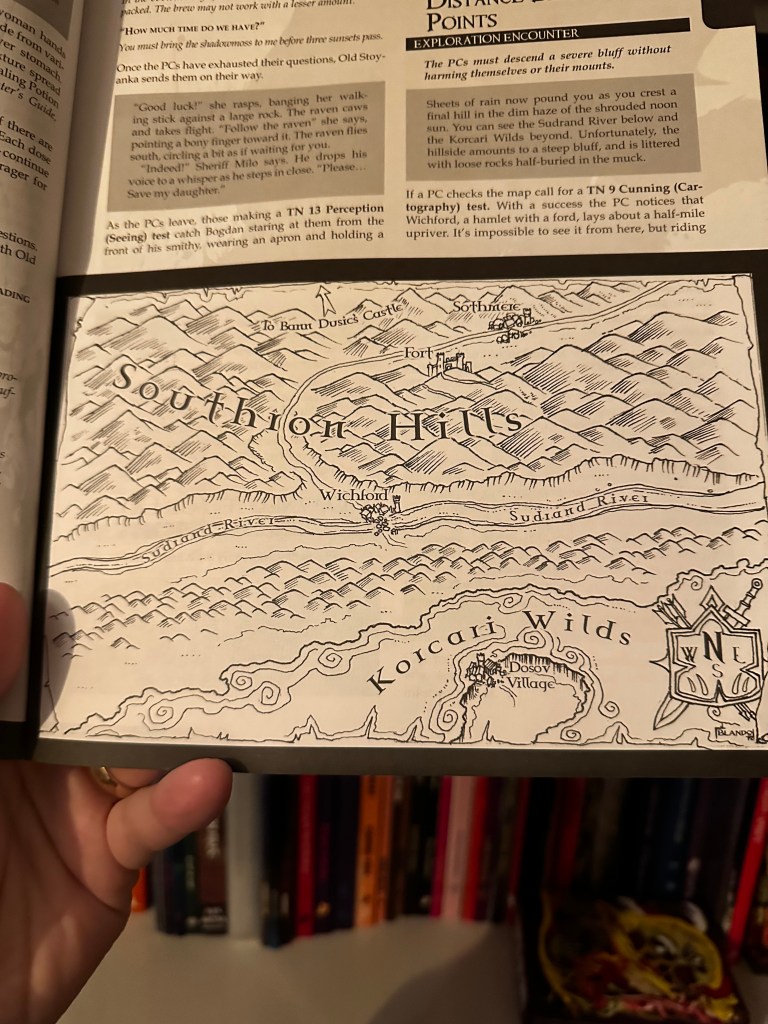
The maps are great. I really liked the small regional map and the one of the grotto. I used both at the table, revealing parts of the grotto map to the players as they discovered more of it.

Decisions, Decisions

Dragon Age is built upon difficult decisions, choices that matter and have lasting consequences and you can see that’s what the writers are trying to present as the frame that Amber Rage is built on. Should they allow the little boy be killed by ragers, or his sister? Should they kill the leatherworker who’s been infected but hasn’t turned yet, or should they give him their brew that slows the infection, endangering themselves? And, ultimately, should they condemn the firesprites to extinction or save the villagers?
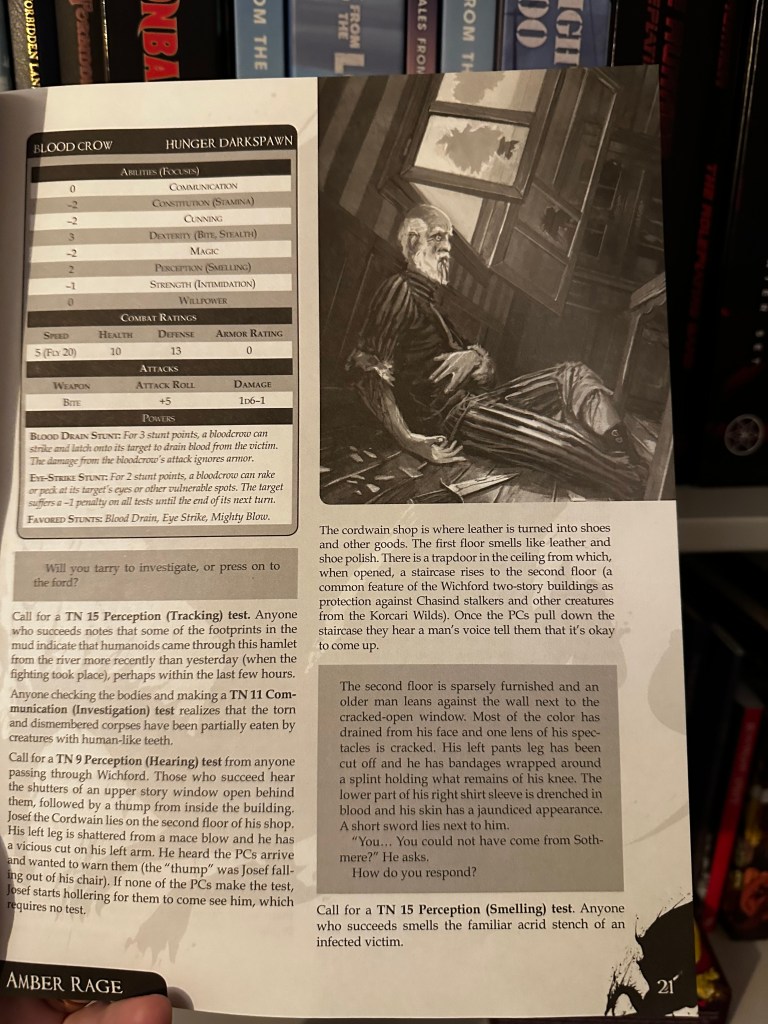
Josef the Leatherworker - poor bastard
Josef the Leatherworker – poor bastard

Now, this is an adventure that is written with some trad sensibilities. There are long paragraphs that examine each and every option available to the PCs in any given situation (or so the designers thought.) It presents you with the sorts of ability tests the PCs will need to make, their target numbers, the modifiers applied due to darkness or marshiness or stinkyness etc, etc. But, in almost every situation, my PCs found another alternative. They saved both children by the clever application of (checks notes) ranged weapons, They debated over the fate of the leatherworker so long that he turned Rager while they were still talking, and the shadowmoss problem? Well, they took the long view, what if they stole all the shadowmoss, killing all the firesprites in the process, and saved the villagers, but then there was another infection later and there was no Shadowmoss to help them? So they said, screw you Sothmere, we’ll only bring enough of this shit back to cure one individual fucking villager and then leave you to decide who should get it! The firesprites were happy, but no-one else was.

What particularly annoyed me about the text was this, it assumes that the party would choose to take the Shadowmoss. Almost all of the events described after the grotto involve the “fact” that they have a potential cure for the Amber Rage and others want it or others don’t want it used or something along those lines. So, those were largely useless to me. At least this allowed me to cut out swathes of what was always going to be the least interesting portion of the adventure, the trip back to town, which was staged as a series of encounters. There is a box on one page entitled, “Sustaining Drama and Varying Beats on the Journey Back.” The text in this is there to advise you to switch things up and vary the encounters because otherwise they might seem a bit samey… Could have just left them out, in my humble opinion.

They also present a number of NPCs that are either sympathetic or not, though. I can’t imagine anyone really liking Bogdan, the blacksmith, or even agreeing with him, in fact. Everyone is going to like the personable and honourable Sherrif Milo, though. So, when the players are asked to choose between the two, it’s no choice at all.

Some of the more sympathetic NPCs were the elven performers, the brother and sister duo, Oleg and Dielza. Our very own elven Grey Warden, Halvari, developed a closeness to them early on, so when Oleg was infected and Dielza was not, she promised to save him… But of course, in the end, she couldn’t. She had had to send over the single portion of shadowmoss and the good people of Sothmere were never going to cure the elf with it, so Halvari was left with no choice but to take Ole’g life before he turned and before the villagers could burn him. This was a truly sad moment that was always a possibility in the text but which was brought alive by the player in some outstanding role-play.

Conclusion

I loved the set-up for this, the festival, the mini-games (I forgot to mention a drinking mini-game from later in the adventure that was also very fun,) the moral dilemmas. But, throughout, I found myself wishing to be freed of the constraints of the text. I wanted to have been presented with the overall situation, the NPCs and some potential encounters and locations, and then let the PCs just go and figure it out. I guess I have been playing a lot of OSR recently, and it’s had an effect on my brain. In my thinking though, this would have solved the problem of the designers assuming the decisions the PCs would make, that I pointed out above.

I also don’t feel like it was quite Dragon Agey enough. It was missing abominating mages, darkspawn, spirits and demons. It could have been set in almost any generic fantasy setting without making almost any changes.

Finally, our crew of fourth level grey wardens had a very tough time with some of the only slightly upgraded combat encounters. They were lucky to have survived the evil giant crab attack and don’t even mention the marsh wolves, the mage went down twice… Actual 1st level characters would have been completely buggered, in my opinion.

Marsh Wolves – watch out!

Despite all my gripes with this adventure, we had a great time with it. This had a lot more to do with the fantastic bunch of Tables and Tales members and Dragon Age fans we’ve gathered, who have gotten into the game, the system, the stunts and the potential for heartache, than it had to do with the scenario itself.

My advice, dear reader, is, if you’re still interested in running this adventure, go through each part of it and prepare it your own way first. Think of potential consequences for decisions the PCs might make that the text does not prepare for, and feel free to cut out large parts of the journey back to the village.

Dragon Age Character Creation

Dragon AGE

I’ve recently been playing through Dragon Age Origins again. It’s been a long time since I have played that particular game although, I have played a lot of Inquisition and even Dragon Age II since then. Playing Origins has put me in a nostalgic frame of mind but also, I thought it might be a good incentive to try something new, TTRPG-wise. The Dragon Age RPG has been out for some time, about ten years I think. Green Ronin published it and it is based on the AGE (Adventure Game Engine,) which is maybe better known for being used by their Fantasy AGE game. I got both of those on a Bundle of Holding years ago but have never even gotten around to reading them. So, I asked in the Tables and Tales discord if anyone would be interested in trying the Dragon Age RPG and I was surprised and delighted to discover that I am not the only DA fan in the community!

If I needed an excuse, I could also say this is all in preparation for the new DA game, “Veilguard,” which is due out soon. But, honestly, it has more to do with replaying the old game than waiting for the new one.

Anyway, I have had some decent success in getting to know new systems by creating characters on here in recent posts, so I thought I would do that again today. Off to Thedas with us!

The steps

So, I am doing this using the Dragon Age RPG Core Rulebook published in 2015. I have it in PDF format. I would like to start by praising it for having a comprehensive set of internal links from the table of contents. For a book of over 400 pages, this is invaluable.

So, what are the steps to creating a Dragon Age character? Having a quick look at them, there are similarities with the video games but with some flourishes and differences presented by the AGE system.

A screenshot of the Dragon Age Character Creation Steps table from the Daraon Age RPG core book. The table includes the 8 steps you need to complete to create a PC for the game.

As you can see from the screenshot, the first step is coming up with your character concept. I quite like this as a starting point, although, I do wonder if it might be rather a tall first hurdle for some players. I often find myself coming to know the concept of my characters in other games during the process of creating them. But, let’s give the game and its designers the benefit of the doubt and go with it.

1. Step 1: Character concept

This section in the book urges you to go and read through Chapter 7: Welcome to Thedas, if you’re not terribly familiar with the setting, and maybe haven’t played the video games. Now, chapter 7 is almost fifty pages long and covers everything from the major nations and races to the cultural significance of the Dwarven Paragons. You would want to be pretty invested in the game before you ever start to read that whole thing, as interesting and even pleasurable as it might be to do so (the writing is not bad but the illustrations are very good indeed.) As I have played through all the games multiple times, and even stopped to read all the books I picked up off bookshelves and desks as I played, I feel like I am already well enough equipped to get away with not reading it before embarking on the character concept step here.

  • An adventurous youth who has finally found a way to escape their home.

That’s it, that’s the concept. I will say, I don’t think a thorough knowledge of the game’s setting is required to make this sort of thing up. Most of the example concepts they provide in the book are vague enough that they could belong in any traditional fantasy setting, in fact.

Step 2: Determine abilities

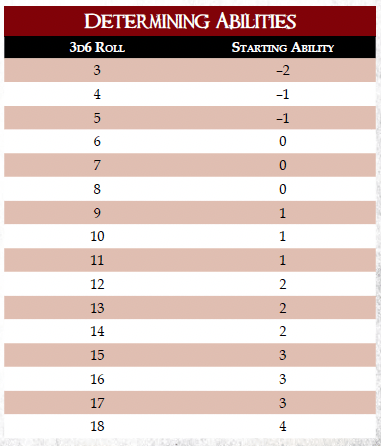
You’ve got a whopping eight abilities in this system: Communication, Constitution, Cunning, Dexterity, Magic, Perception, Strength and Willpower. Other than Perception and Communication these match up pretty well with the stats in Origins. We are rolling 3d6 for each one of these and then we record the modifier from the table below, not the sum of the dice, much like your average Borg game.

A screenshot of the Determining Abilities table from the Dragon Age RPG core book. It is a 3d6 table, which indicates what your starting ability score will be depanding on your roll. It goes from -3 to 4.

Communication: Rolled an 8 so that’s a score of 0
Constitution: Rolled a 13 so that’s a score of 2
Cunning: Another 13 for this one, so, 2 again
Dexterity: That’s a 10, which equates to a 1 on the table
Magic: I rolled a 12, so that is 2 yet again
Perception: Not wonderful. That’s a 6, which is another 0
Strength: A below average 9. Still, it gives me a 1
Willpower: That’s a 7 on the dice. And that gives me my third 0

The book does give options to either roll the scores and assign them to abilities as you see fit, or to do use point buy system instead. But, I think I will continue the tradition of randomising the process that I started way back in the OSE character creation post.

Step 3: Backgrounds

So, in this game, your choice of background also determines your race and has some pretty major mechanical effects, as well as the obvious cementing of your character concept from earlier. Here are the effects they generally have:

A screenshot of the list of features a PC's Background gives them in the Dragon Age RPG. These include ability score increses, ability focuses, race, class choices and languages.
A screenshot of the list of features a PC’s Background gives them in the Dragon Age RPG. These include ability score increses, ability focuses, race, class choices and languages.

Now, the book says nothing about rolling for your background randomly. In fact, I believe it encourages you to choose based on your original character concept and the ability scores you rolled. But I’m not here to play by the book (actually, that’s not true, really. I just enjoy the thrill of the roll!)

So, there are a total of thirty, 30, backgrounds (!) in the core book. It just so happens that I have a 30-sided die thanks to my flirtation with Dungeon Crawl Classics. So here we go!

That’s a 28! This means my character’s background will be:

Tevinter Laetan

And that is pretty cool! So, it means that I will necessarily take the mage class as the Laetans in Tevinter society are magic users from the mundane classes who are identified at a young age and trained to serve the Imperium. It fits quite nicely with my character concept, too. I can imagine a young Tevinter mage, disillusioned with the unfair system under which their own class of people toils while the upper class mages reap all the benefits. Not to mention the binding of so many elven slaves in general society.

Here are the benefits gained from this background.

  • +1 to Cunning – this makes my Cunning score 3 now!
  • One ability focus, either Communication (Deception,) or Cunning (Arcane Lore) – I rolled again on a d2 for this and got Cunning (Arcane Lore)
  • Languages – Tevinter and the Trade Tongue
  • Take the Mage class
  • Roll twice on the Tevinter Laetan table:
The Tevinter Laetan Benefit table from the Dragon Age RPG core book. It is a 2d6 table. Depending on wht you roll you will get a particular benefit such as +1 Consititution, Focus: Communication (Deception) and +1 Magic.

First roll – 11 Focus: Cunning (Cultural Lore)
Second roll – 9 Focus: Communication (Persuasion)

Step 4: Classes

A screenshot of the page from the Dragon Age core book that describes the Mage class. It includes an illustration of a femme human in red robes with long blonde hair, a staff with a blue stone on top, three bluish potions at her hip and some magical enegy emanating from her outstretched fingertips.

This game, much like the video games, only has three classes:

  • Mage
  • Rogue
  • Warrior

But within these classes you have a selection of specialisation options. I often wonder that there is no Priest class in this relatively traditional fantasy world. They gave the healing duties to mages and that is one specialisation option you can take as a mage. You can’t take Bard as a class but if you are a Rogue, you can choose to specialise as a Bard. And Barbarian isn’t an option in the Class list, but Warriors can go down that sort of route if they want.

Anyway, all that is academic as I am required to choose the mage class due the background I rolled.

The Class section starts off with an explanation of the broadness of the classes as I said above and then tells us a little about character advancement. You start at Level 1 and can get up to Level 20. There are options for XP and milestone leveling and it explains how you improve with a new level. Suffice it to say, ability score improvement is one of the main ways you gain in power, but you also get more Health, new ability focuses (which I don’t understand yet,) new class powers and “stunt points” (which I also don’t understand yet.) I just know you start with 6 Stunt Points. Everybody does.

It’s important to note that you don’t get a specialization until level 6.

As a mage, my character starts with three spells but can’t wear armour or use many types of weapons.

They have three Primary Abilities (as do all classes.) For a mage that’s Cunning, Magic and Willpower. The first two are not bad for me but that last one is a 0. Oh well.

All the others are Secondary Abilities.

Starting health is 20 + Con + 1d6. I rolled a 5 so that means it’s 27! Not too shabby.

My Weapon Groups are Brawling and Staves.

At Level 1, my Class Powers are

  • Arcane Lance, which means I can send a burst of magical energy from a staff
  • Magic Training allows me to cast spells. Here are the spells I’ve got:
    • Arcane Bolt
    • Arcane Shield
    • Daze
  • Mana Points. I start with 10 + Magic + 1d6. That’s a 4 on the d6 so a total of 16.
  • Starting Talent. I choose one talent from Chirurgy, Linguistics and Lore. Can’t get Chirurgy because it has a requirement that I don’t have. Gonna go for Lore, which seems the most generally useful.

Step 5: Equipment

You don’t get a lot to start with to be honest. I’ve got a backpack, some traveling clothes and a water skin as well as a staff and another weapon. I can only use staves or Brawling weapons. The Staves group includes clubs and morning-stars, I guess I’ll take a morning star then!
I also get 50 + 3d6 silver pieces to buy other gear. I rolled 10 on the 3d6. So that’s 60 silver.

I guess I’ll pick up a bedroll for 10 sp and a blanket for 6 sp. I’m not going to get into any more shopping right now.

Step 6: Defense and Speed

Your Defense score is, unsurprisingly, a measure of how hard it is to hit your character. It is 10 + Dex + Shield Bonus (if you have one.) So, that’s an 11 for me.

You can move up to a number of yards equal to your Speed when taking move actions. For a human, that’s 10 + Dex – Armour Penalty. I don’t have any armour so that’s not an issue. So essentially my Speed and Defense are the same, 11.

Step 7: Name

They have a long list of sample names in the book. Not just for Dwarves, Elves, Qunari and Humans but for the full variety of cultures and backgrounds (actually this mainly applies to the various human cultures) that they might come from. First, I need to decide what this character’s pronouns might be. I think I will go with he/him this time. As a Tevinter character, I can choose from some pretty cool names, including Dorian, Florian and Ether. But I have decided to go with Amatus. Amatus the Tevinter Laetan Mage.

Step 8: Goals and Ties

I like that they have included this step in character creation. Just go and take a look at my Motivation post to see why I think that, at least about Goals.
Anyway, I have to pick three Goals, a mix of long a shorter term ones.

  • Find the only friend I ever knew, an Elf named, Adanna, who was once a slave who belonged to his family in Tevinter, but escaped to Ferelden a year ago.
  • Try to make a name as an adventurer in Ferelden while staying out of the hands of the Templars.
  • To earn some coin and find some companions.

The other part of this is the Ties part. Now this specifically refers to other PCs. Since I don’t have any of those, I’ll have to skip that part.

I think I will have to do another post on the general AGE system and particularly how it relates to this game as there are still several elements that are a mystery to me but I feel like I have gone on long enough for one post.