Dragon Age RPG: Amber Rage Review

So, off they went, following a magic raven, through the rain and the swamp, fording rivers, defeating enemies and stabling horses, until they got to the appointed place and the raven dropped dead.

Blood in Ferelden

There have not been a lot of supplements for the Dragon Age RPG from Green Ronin. Other than a quickstart guide, a GM’s Kit and Faces of Thedas, a sourcebook filled with fan-favorite characters from the video game series, Blood in Ferelden is pretty much it. It’s a collection of adventures designed by Walt Ciechanowski, Kevin Kulp, T.S. Luikart and it came out in 2010. It contains three full scenarios and a few adventure seeds all of which take place in and showcase various regions of the land that played host to Dragon Age Origins.

It came out at a time before the Dragon Age core book collected all the rules from Dragon Age boxed sets 1, 2 and 3. Dragon Age set 1 only dealt with levels 1-5 and, indeed, Blood in Ferelden’s adventures are designed to get characters from 1st to 5th level.

I discussed another published adventure, Duty Unto Death previously. That was the first Dragon Age adventure I ran for my group and it assumed the PCs started at level 3. So that’s what we did. Not only that, but they progressed to level 4 and became fully fledged Grey Wardens before we moved on to the first adventure from Blood in Ferelden, Amber Rage. I made only a few adjustments to Target Numbers (like DCs in D&D) and enemy stats to increase the difficulty. Despite this, this level 1 adventure proved quite challenging enough at times.

SPOILER ALERT! This review is absolutely packed with spoilers. Turn back now, potential players!

Overview

Amber Rage!
Amber Rage!

Amber Rage is a 39 page adventure. It’s split into six distinct parts, each of which presents its own unique challenges for the PCs, a variety of enemies, NPCs and moral dilemmas for them to wrestle with. All of these are of varying quality.

Here’s the summary: The PCs find themselves in Sothmere, a village near the Korcari Wilds. Our group of newly minted Grey Wardens had been sent south by Duncan, their commander, to determine the strength of the Darkspawn force amassing in the south, preparing for the Fifth Blight. Sothmere was just a pitstop for them. There was a festival happening there to celebrate the building of a new fort, which gave the PCs a chance to take part in some axe-throwing, mud-wrestling, archery competition mini-games. While this was going on, the village was attacked by a band of crazed Chasind stalkers. These lads had been infected with the eponymous Amber Rage and were spreading it all over town. If no-one did anything about it, all the infected villagers were going to transform into mindless Ragers in three days! After some debate amongst the NPCs, it was decided that the Grey Wardens should go and find an ingredient in a grotto in the Korcari Wilds. This shadowmoss could be used to cure the infected.

So, off they went, following a magic raven, through the rain and the swamp, fording rivers, defeating enemies and stabling horses, until they got to the appointed place and the raven dropped dead. There they boiled up a stew and this attracted the firesprites. These guys lived in the grotto of the shadowmoss, so the PCs followed them home. Kind of creepy, when you think about it. Not only that, but they then went ahead and murdered the firesprites’ Guardian Serpent. I mean, the serpent didn’t leave them much choice, but they were invading its home after all. The real problem with this, as the wardens discovered in a sort of psychic vision provided by the firesprites later, was that the firesprites consumed the shadowmoss for sustenance, and the Serpent, ahem, excreted the shadowmoss. So, with the serpent dead, if the PCs collected all the shadowmoss they would need to cure the infected, they would be condemning the firesprites to starvation and extinction. But if they left them with the shadowmoss they had, that would give them enough time for a new Guardian Serpent to mature (this weird symbiotic arrangement was further compounded but the revelation that one of the firesprites would transform into the Serpent itself!) This was the central moral conundrum of the scenario, save the villagers or allow the firesprites to live.

The blackhaller and the burning of the villagers

Once this decision was made, they had to make their way back to Sothmere where a local judge, known as a blackhaller, had been helicoptered in to force the issue of the infected villagers. As the PCs got back to Sothmere, they had the sick ones tied to stakes, ready to be barbecued. The PCs had to make another big decision here, and, perhaps, try to convince the blackhaller to back down.

Thus ends the adventure. I skipped over some middle bits, but that is the essence of it.

Layout, artwork and maps

The layout of this thing is kind of all over the place. There are NPC descriptions separated from their stat blocks by entire pages in some instances. There are some which have the stat blocks of one NPC associated with the description of another, making it really hard to find what you need in a pinch. It’s the same with the enemy stat blocks, which are sometimes so far removed from the encounter descriptions as to make them seem as though they belong to another encounter altogether. I think one of the problems here is the massive parcels of real estate demanded by the standard Dragon Age RPG stat blocks, which presents some serious layout headaches. I had to do a lot of prep to make sure I had all of the relevant info and stat blocks on hand for any given encounter, social or combat.

Statblock Nightmares

The splitting of the adventure into parts, like chapters in a novel, was something I found useful. I tried to aim for completing one part each session. In the end, it did take 6 sessions to complete it.

The artwork is nice, although much of it was clearly supposed to be full colour but was presented in black and white, which was a shame.

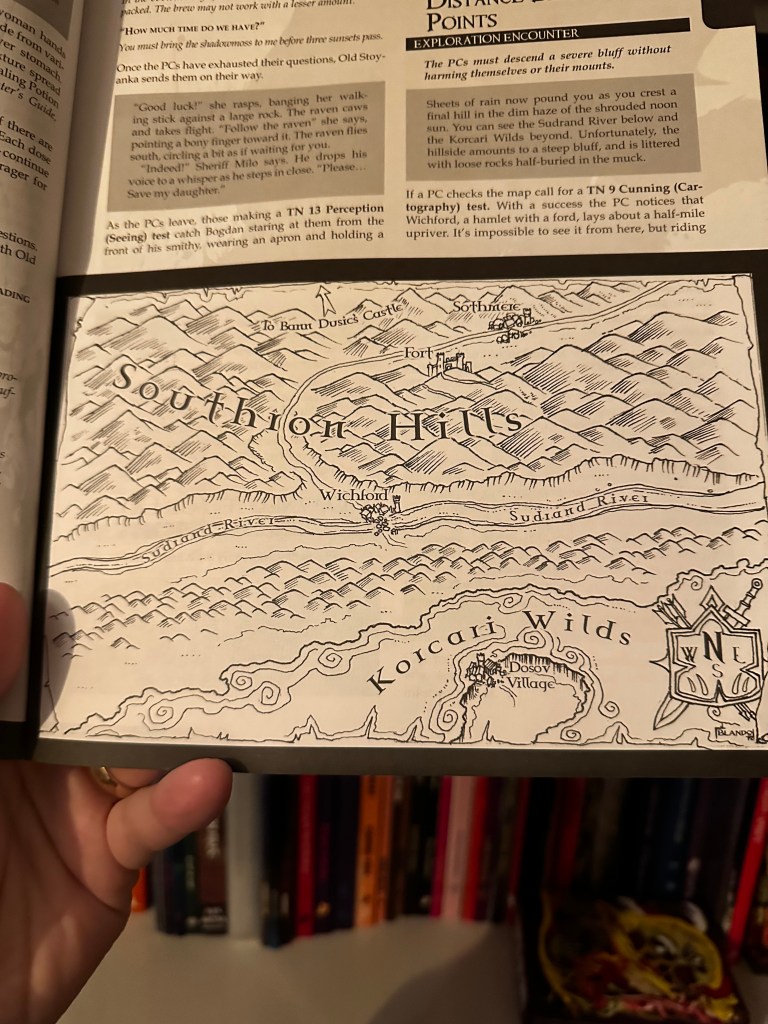
The maps are great. I really liked the small regional map and the one of the grotto. I used both at the table, revealing parts of the grotto map to the players as they discovered more of it.

Decisions, Decisions

Dragon Age is built upon difficult decisions, choices that matter and have lasting consequences and you can see that’s what the writers are trying to present as the frame that Amber Rage is built on. Should they allow the little boy be killed by ragers, or his sister? Should they kill the leatherworker who’s been infected but hasn’t turned yet, or should they give him their brew that slows the infection, endangering themselves? And, ultimately, should they condemn the firesprites to extinction or save the villagers?
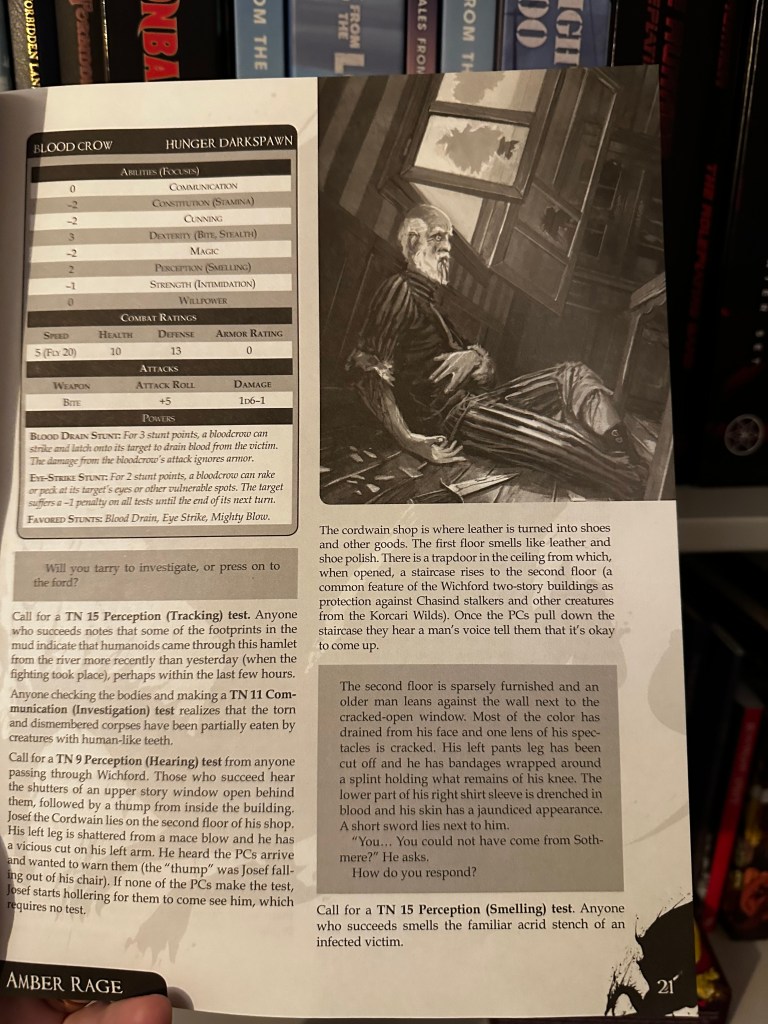
Josef the Leatherworker - poor bastard
Josef the Leatherworker – poor bastard

Now, this is an adventure that is written with some trad sensibilities. There are long paragraphs that examine each and every option available to the PCs in any given situation (or so the designers thought.) It presents you with the sorts of ability tests the PCs will need to make, their target numbers, the modifiers applied due to darkness or marshiness or stinkyness etc, etc. But, in almost every situation, my PCs found another alternative. They saved both children by the clever application of (checks notes) ranged weapons, They debated over the fate of the leatherworker so long that he turned Rager while they were still talking, and the shadowmoss problem? Well, they took the long view, what if they stole all the shadowmoss, killing all the firesprites in the process, and saved the villagers, but then there was another infection later and there was no Shadowmoss to help them? So they said, screw you Sothmere, we’ll only bring enough of this shit back to cure one individual fucking villager and then leave you to decide who should get it! The firesprites were happy, but no-one else was.

What particularly annoyed me about the text was this, it assumes that the party would choose to take the Shadowmoss. Almost all of the events described after the grotto involve the “fact” that they have a potential cure for the Amber Rage and others want it or others don’t want it used or something along those lines. So, those were largely useless to me. At least this allowed me to cut out swathes of what was always going to be the least interesting portion of the adventure, the trip back to town, which was staged as a series of encounters. There is a box on one page entitled, “Sustaining Drama and Varying Beats on the Journey Back.” The text in this is there to advise you to switch things up and vary the encounters because otherwise they might seem a bit samey… Could have just left them out, in my humble opinion.

They also present a number of NPCs that are either sympathetic or not, though. I can’t imagine anyone really liking Bogdan, the blacksmith, or even agreeing with him, in fact. Everyone is going to like the personable and honourable Sherrif Milo, though. So, when the players are asked to choose between the two, it’s no choice at all.

Some of the more sympathetic NPCs were the elven performers, the brother and sister duo, Oleg and Dielza. Our very own elven Grey Warden, Halvari, developed a closeness to them early on, so when Oleg was infected and Dielza was not, she promised to save him… But of course, in the end, she couldn’t. She had had to send over the single portion of shadowmoss and the good people of Sothmere were never going to cure the elf with it, so Halvari was left with no choice but to take Ole’g life before he turned and before the villagers could burn him. This was a truly sad moment that was always a possibility in the text but which was brought alive by the player in some outstanding role-play.

Conclusion

I loved the set-up for this, the festival, the mini-games (I forgot to mention a drinking mini-game from later in the adventure that was also very fun,) the moral dilemmas. But, throughout, I found myself wishing to be freed of the constraints of the text. I wanted to have been presented with the overall situation, the NPCs and some potential encounters and locations, and then let the PCs just go and figure it out. I guess I have been playing a lot of OSR recently, and it’s had an effect on my brain. In my thinking though, this would have solved the problem of the designers assuming the decisions the PCs would make, that I pointed out above.

I also don’t feel like it was quite Dragon Agey enough. It was missing abominating mages, darkspawn, spirits and demons. It could have been set in almost any generic fantasy setting without making almost any changes.

Finally, our crew of fourth level grey wardens had a very tough time with some of the only slightly upgraded combat encounters. They were lucky to have survived the evil giant crab attack and don’t even mention the marsh wolves, the mage went down twice… Actual 1st level characters would have been completely buggered, in my opinion.

Marsh Wolves – watch out!

Despite all my gripes with this adventure, we had a great time with it. This had a lot more to do with the fantastic bunch of Tables and Tales members and Dragon Age fans we’ve gathered, who have gotten into the game, the system, the stunts and the potential for heartache, than it had to do with the scenario itself.

My advice, dear reader, is, if you’re still interested in running this adventure, go through each part of it and prepare it your own way first. Think of potential consequences for decisions the PCs might make that the text does not prepare for, and feel free to cut out large parts of the journey back to the village.

Prep

Preposition

This post is part of a blog bandwagon started on the Roll to Doubt blog.

Click on the link above to take in the blogpost that’s piloting this bandwagon. Wagon-jumpers abound. You can find a very nice read on the same topic and a handy list of related blogposts on the Among Cats and Books blog.

What’s clear from even a cursory glance at the other blogs is that no two people are prepping in precisely the same way, so advice and recommendations come with the notice that your way is probably the best way. The thing is, in my experience, you find your way only through trial and error. Here’s my effort to tell you about my trials and my errors.

Preponderance of prep

I used to spend hours and hours preparing my games when I was a kid. To be clear, I loved doing it. I would happily get lost in the world-building, the map-drawing, the character creation and the encounter balancing for hours when I should have been studying. I still often think that I gained more from the time I spent on RPG preparation than I did from learning off -by-heart lists of dates and events or theorems and proofs. But I digress.

My prep used to be pages upon pages of tightly packed hand-writing explaining the background of an adventure, the major NPCs involved, the probable goals of the PCs and far more history about the setting than the PCs would ever be able to interact with. I drew maps by hand as well, when I had to. I didn’t run a lot of published adventures but I did make liberal use of soucebooks. I would select the people, places and things I wanted from those books and elaboate on them wildly, writing more pages on how they would connect with our campaign and adding a lot of extra details.

I sometimes wish I had the time to do preparation like this these days. But, when I do find myself with the time, and I sit at the computer to start working on it, I find I would rather shortcut it. I’ve asked myself why this is on many occasions. I’m not sure I have the answer, or else there are several. It could be to do with the process of writing in a notebook and drawing by hand on grid-paper. I don’t want to prep like that these days because having all of my work backed up digitally is invaluable. Time is still a factor. Even when I feel like I have some extra time on a particular day, I can’t guarantee that I’ll continually have that as the campaign progresses. But I think the main difference for me now is the feeling I get from making the world, its people, the major events, the game, at the table with my players. When you are all on the same page, when everyone comes together to create something greater than I ever could on my own, that’s one of the real joys of this hobby.

So, I don’t really do that anymore.

Preplanned not prepared

It’s taken me a long time to make this change, though. Even looking back at the work I did in preparing for our current Spelljammer game, I had thousands of words written on setting, backgrounds, NPCs, over-arching plot etc. And I would write thousands of words of session preparation while going along too. What I have discovered during the last couple of years of trying to prepare this way, however, is that that sort of prep is close to unusable at the table. Even if I am the one who wrote that dense paragraph of text, I can’t find what I’m looking for in it in the couple of seconds I have to react to something at the table, or to answer a player’s question without delay to keep the flow of the game going. Now, it’s not always a waste of time, I will admit. Sometimes, the very act of writing something will help to embed it in my memory and imagination, so obviating the need to check it at all. But, then again, there is the other effect of writing something down. It has the effect of making something true.

Truth at the table should only come from play. The only real things in the game world are what the PCs experience. Everything else, even things the characters have learned or heard about, is pure conjecture. Until it’s not.

This doesn’t mean I don’t prepare anything of course. I make plans for events I would like to occur or NPCs I want the PCs to interact with. But in those cases, I will write down something about the event, just a few details about what happens, who might be involved, what effects it might have. Or I will give the NPC some quirks, desires, flaws and interesting characterisations to bring them to life. But I will keep them to be used when and where they seem to fit.

Otherwise, I revel in the joys of random tables. I use rumour tables and encounter tables quite judiciously these days. In a game like Ultraviolet Grasslands, I am spoiled with wonderful encounter tables, trade goods tables, carousing tables, and almost any other type of table I could desire. But when it comes to 5E, I am generally disdainful of the encounter tables provided. So I make my own. Made right and used right, these not only make for some interesting sessions, but also act to drive the game forward, introducing NPCs that become important to the plot, enemies that might defeat the PCs or might lead to vengeful associates pursuing them later. Importantly, I feel, they maintain an element of randomness and ensure that the players know their rolls have led them to the encounter, or not. It’s great if you can engineer it so that the players are rolling on random encounter tables at the end of a session. That allows you to take the result of their roll and make preparations for the specific encounter they rolled up for the next session. Usually, these days, I refer to Between the Skies for more tables and for inspiration to make the encounter really interesting.

Between the Skies does not limit encounters in space to just running into creatures, but also gives options for hazards the ship might run up against and problems that stem from the ship itself.

Here are the simple d6 and d4 tables I made to determine if the crew run into anything, and, if so, what it might be:

Wildspace encounter table d6

1-2 No encounter
3 Ship Hazard
4 Ship Problem
5-6 Encounter

3 Ship Hazards

Roll 1d4

  1. Hazard 1 – Storm, Flood
  2. Hazard 2 – Disorientation, Sphere
  3. Hazard 3 – Obstruction, Cold
  4. Hazard 4 – Trap, Haunting

4 Ship Problems

Roll 1d4

  1. Problem 1 – Armament, Separation
  2. Problem 2 – Quarters, Shrinkage
  3. Problem 3 – Cargo, Disappearance
  4. Problem 4 – Bridge (spelljammer helm), Error

5-6 Encounters

  1. Isolationists – Confusion, Related Entity – Unknown NPC, Glittering, Prayers
  2. Ship Parasite – Loss, Scales, Experiments
  3. Ruins, Ancient – Mourning, Related Entity – Petty God, Knots, Miscommunications
  4. Stowaway – Battle, Related Entity – Creature, Eggs, Blindspots

The descriptive words I listed beside each entry come from the spark tables in Between the Skies. These are invaluable resources that give you the inspiration to come up with truly unique situations, problems and obstructions. You should go and buy this book at the link above.

When I get the players to roll on these tables, I either make up the encounter/hazard/ship problem on the spot using the sparks of inspiration or I use the time between sessions to come up with something memorable.

A while ago, I realised the plot I came up with for the Spelljammer campaign was much less interesting to the players or their characters than the shenanigans that they got up to each session. They were more wrapped up in their own shit. And that was very cool. It made me want to make a sandbox for them to play around in instead of expecting them to interact with a plot they had little or no investment in. This goes back to the time I introduced a hex grid to the underside of the Rock of Bral. I did this to allow one of the PCs to drag the whole party with them to rescue their mother who was trapped in the prison down under. It did not serve the overall plot, really, but I had to have fun things for them to do while traversing this area so I made it a hex map and created some random encounter tables for each of the different types of terrain on the underside of the asteroid.

You know, it took me a long time to cop on to this though. The signs were all there. Dear reader, if your players never remember what is happening in the plot of your meticulously crafted campaign from one session to the next, you might be overloading them with plot. Maybe they just want to play their cool character and have fun moments between them and the other PCs and significant NPCs. Or maybe they are only interested in hitting things really hard. Or maybe all they have ever dreamed of is building their very own tower of necromancy built on the bones of their enemies. Or perhaps they just want to find their dad? Ever think of that? Maybe your plot is not that important to them. If you take nothing else away from this post, please take that.

I have drifted a little way away from the central theme of the post but I insist that, in actuality, you should be prepping for the sessions you want to have, and, more importantly, the sessions your players want to have.

Prepaid prep

Most of what I have been talking about is prep for D&D/OSR style games. Games that you can play as sandboxes without upsetting anyone. But, what, you might ask, dear reader, do I do to prepare for other types of RPGs?

I have some very specific examples here.

Free Leagues/Year Zero Engine Games

I have a few of these under my belt at this point. I can say that the type of prep I do for these is significantly different to what I have described above. The ones I can refer to are Tales from the Loop, Blade Runner and Alien. For me, the thing that holds these adventures together is the Countdown. This is something that’s rather integral to most Year Zero engine games. Below you can see the countdown from the Tales from the Loop adventure published in the core rule book, Summer Break and Killer Birds.

Once you get the timeline of events in place for one of these adventures everything can be positioned around it. Tales from the Loop adventures, in particular, I find, can be written with ease in the very specific format that Free League has presented to you in the book. They provide really valuable advice in all of their books for creating your own adventures. Blade Runner also provides lots of useful random tables to help you create your own case files for that game. When in comes to prep for this style of game, just make sure you know the countdown well, and you keep track of the shifts/days of activity for the PCs. After that, the published adventure or the one you have written in the provided format, will do the work for you. The rest is improv.

Resistance System, Spire/Heart

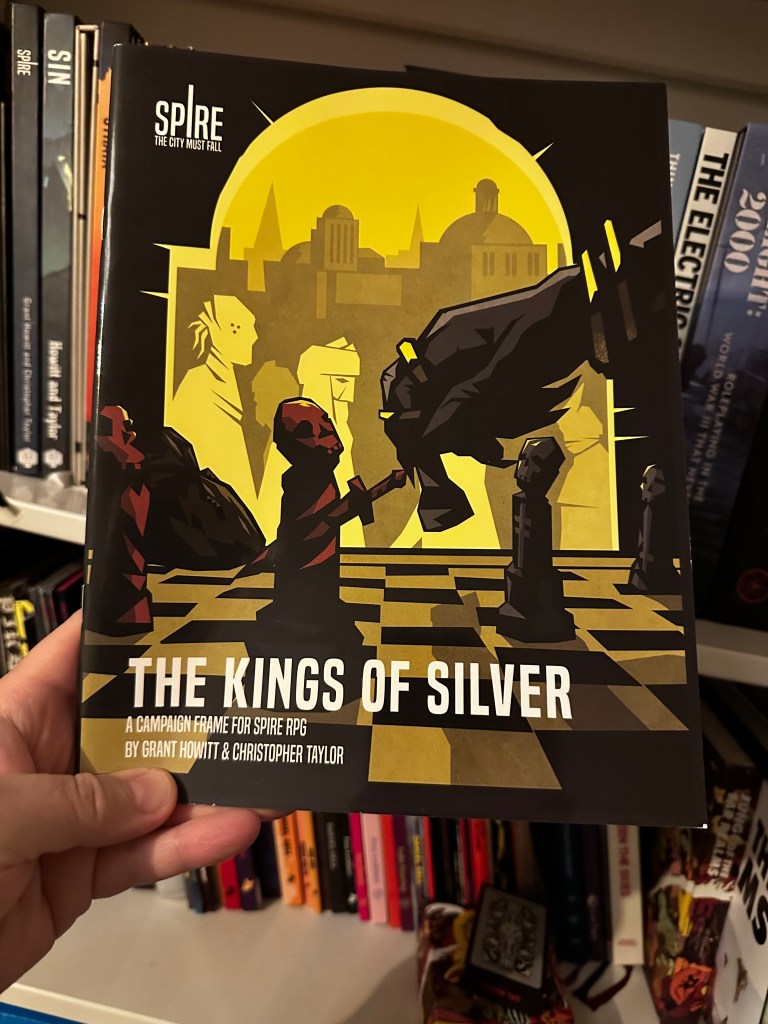
Resist the temptation to do anything other than read up on the specific areas the PCs are likely to interact with the next session and maybe jot down some NPC details/desires/stats. Resistance system games really thrive on improvising at the table and having the PCs drive the narrative forward with their actions and their fallouts. This is particularly true of Spire where most of the game occurs in NPC to PC interactions in my experience.
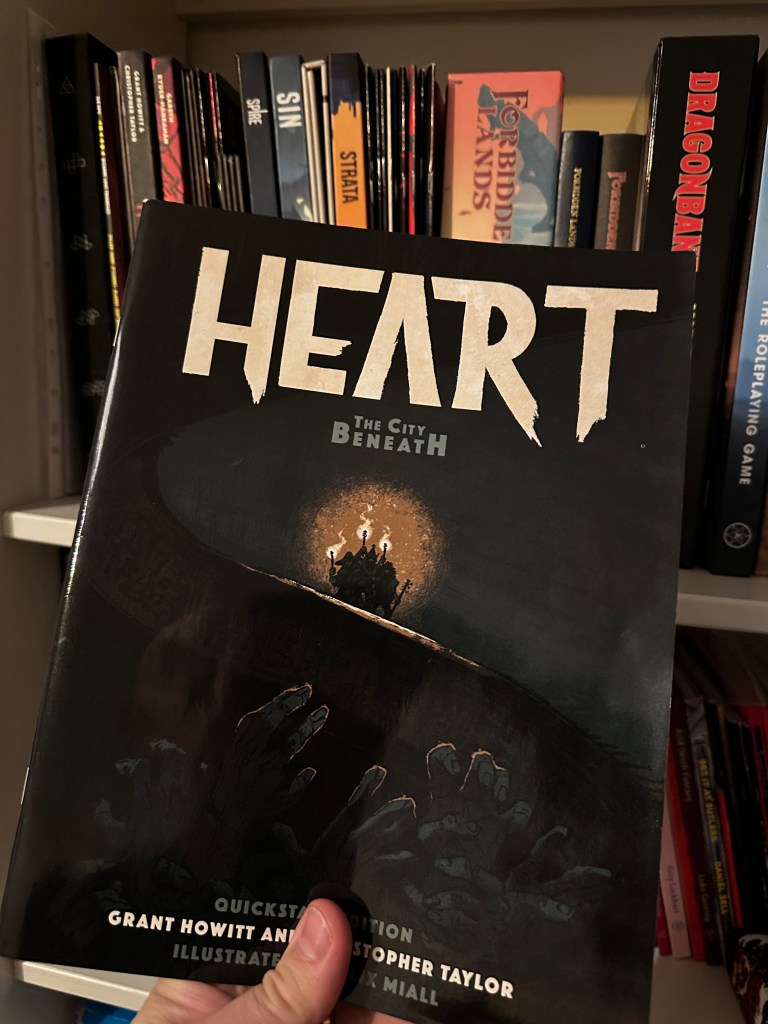
In Heart, I think it’s a good idea to have some idea of the landmarks your PCs might end up in. In the last game of Heart I GMed, I made it specifically Vermissian themed so that I knew they would be visiting a lot of Vermissian stations on the way down to Tier 4.

Prewritten trad scenarios

I am thinking of the Dragon Age game I’m running right now but I think this is advice you can apply to most adventures that are presented in dozens/hundreds of pages in long dense paragraphs. Read the full adventure, then, read it again, but this time, take all the relevant information from each room description, encounter text or whatever and transcribe it into something more easily digestible and more useful at the table. I use bullet points as that’s what I’m used to. I also usually take the more relevant enemy stats like Health, Defence and Armour Rating and note them too. This is me applying the lessons I learned from the mistakes I made as a kid and applying them to the published adventures written by professionals, I realise that. And maybe that’s presumptuous of me, but, hey, it works.
The second time you read it, you shouldn’t do it all at once. Just make those notes between sessions.

Conclusion

Prep can take many guises. It will be different for every GM. A lot of people use all sorts of apps and other technical solutions. All valid, but all I ever use is a wod processing app and a few dice. Whichever methods you use are probably going to be right for you, even if it takes you a while to figure out how you should do it.

Modular Gaming

Improbable hot-takes

“The Discourse (TM)” has been focusing on running published adventures/modules/campaigns as opposed to custom/homebrew/sandbox games for the last little while. First Quinns reviewed Impossible Landscapes, an epic and almost legendary campaign for the modern Cthulhu-ish game, Delta Green. This is the first time Quinns has reviewed a campaign/published adventure on his RPG review channel, Quinns’ Quest, so it was unusual enough to spark a significant amount of discussion all on its own. And then Thomas Manuel of the Indie RPG Newsletter and Rascal reviewed the same campaign. I believe this was purely coincidental, especially as Impossible Landscapes came out about five years ago now. Both are great reviews in their own right and are based on full play-throughs of the campaign so you know they’re of real value. You should check them both out.

Anyway, on Bluesky, Thomas Manuel went looking for recommendations of other modules to run and this spawned a lot of interesting answers and quote-bleets from RPG luminaries, such as this one, which I found interesting.

I have opinions on the conversation, of course. I have shared a lot of them in other posts from the last year or so, actually. If you want the summary, though, I had a lot of bad experiences running D&D scenarios in the past, especially from the AD&D 2nd edition era. I found they were difficult or impossible to just pick up and run. In fact, they required maybe more preparation time than adventures and campaigns I wrote myself. The one published 5E campaign that I ran, Storm King’s Thunder suffered from the same issues, actually. This made me feel like it was a “me” thing. But, it turns out, a lot of GMs feel the same way, according to Bluesky, at least.

However, I have had my mind changed somewhat by running pre-written adventures for some other games, particularly Free League’s Blade Runner, Dungeon Crawl Classics and, to a lesser extent, the Dragon Age RPG from Green Ronin.

This is a link to my first post on Electric Dreams, the introductory Case File for Blade Runner:

And this one compares the same module to a 5E murder mystery adventure I played in around the the same time:

Here’s my post about Sailor’s on the Starless Sea for DCC:

And this is my post on running Duty Unto Death, a short intro adventure for the Dragon Age RPG:

And finally, this post, although ostensibly an excuse to discuss DCC adventures, also includes my opinions on the one 5E campaign I ran:

I will say that, despite my generally favourable outlook on most of these modules, I still find I have to to do a lot of prep for them. The main fear I have is messing things up so bad that I essentially spoil the rest of the adventure. Although, I should really have more faith in my abilities as a GM at this stage. I feel like I can probably improv my way out of any hole, to be honest. But it does not change the fact that I spend hours rewriting long paragraphs presented in module texts into digestible bite-sized bullet-points. I am running another Dragon Age scenario right now. Amber Rage is from Blood in Ferelden, an anthology of scenarios for the game that came out in 2010. It suffers from verboseness and unnecessary detail and makes for a lot of work from the GM. I’m enjoying the contents of the scenario but its presentation is horrendously dated and needs a sprinkle of OSR magic to tighten it up, in my opinion.

I realise that none of the modules I have mentioned here are anywhere close to having the size and epic scope of something like Impossible Landscapes, but it doesn’t change the fact that they have largely changed my mind about running anything pre-published. The one I have my eye on right now is Dagger in the Heart for Heart: The City Beneath. Actually, I have a post about that right here too:

OK, I’m off to discuss the discourse on Discord of course!

Dragon Age: Duty Unto Death

The Basics

You might recall, dear reader, that last year, I threatened to put together a game of the Dragon Age RPG. I even wrote a couple of blog posts about the game which you can find here. Well, I’m back to tell you that I’m not just all talk. Sometimes I really follow through on plans to play games. Myself and four other members of Tables and Tales started playing the short scenario, Duty unto Death for the Dragon Age RPG a couple of weeks ago. We’ve had two sessions so far.

The first was mostly session 0 stuff. Only three of the players were able to make it to that one, but those that did make it all created their own characters. My post on Dragon Age Character Creation stood me in pretty good stead for this. We ended up with an Antivan Wayfarer warrior, a Dalish Elf (which my computer keeps autocorrecting to Danish Elf) rogue and a human Apostate Mage (who is short and hairy enough to pass for a dwarf, thus fooling the silly templars.) Our final player joined us for this week’s session so, in order to allow us to get started as quickly as possible, he selected one of the four pregens that came with the scenario. He chose another warrior, this time a Surface Dwarf who makes a decent tank.

The group has a varied experience of both RPGs and Dragon Age. We have at least one super-fan of the video games. They know the lore inside-out and knew exactly what they wanted to play when they signed up for the game. The others all have some knowledge and several have played Dragon Age Origins recently. As it turns out, the scenario I chose is set right before the events of that game and features at least one major character from it, so that’s worked out really well.

We’re using our newly renovated independent game store, Replay as the venue. I haven’t been back there with a group since about this time last year, but since they have greatly expanded their gaming space recently, and because they are open late on Wednesday nights I wanted to give it a go. As always, the staff were welcoming and the place was great. The renovations are still under way but they have done all they can to accommodate players all the same. I can’t wait to see it when it’s done.

Tabletop

Wil Wheaton's head and shoulders in front of the Tabletop logo on a red brick wall. He is a guy in his thirties with brown, short hair and beard. He is wearing a brown t-shirt with "the Guild" on it. The closed caption on the screen reads: "WIL WHEATON: In 1983, I played my first role playing game and"
A screenshot from the intro to Tabletop with Wil Wheaton.

Does anyone remember the Wil Wheaton Youtube show, Tabletop? It was part of the Geek and Sundry network for quite a while but it looks like the last video is about seven years old now. Anyway, it mainly focused on introducing people to board games but this one time, they got Chris Pramas, the creator of the Dragon Age RPG to write a scenario they could play on the show. So Wheaton wrangled up a bunch of his show-biz pals and they made two half-hour videos of it. This was eleven years ago so it was a pretty early example of an actual play. And it was really good! It taught you the basics of how to play the game and entertained you at the same time. You can find the first episode here, Tabletop: Dragon Age RPG. If you are one of my players and you’re reading this right now, please don’t click on that link!

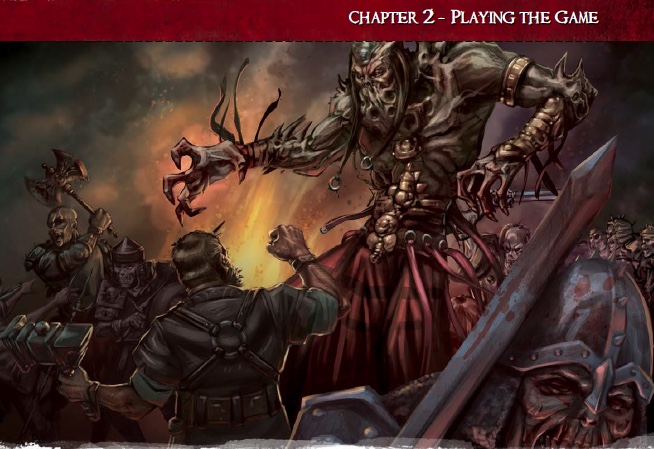
The illustration is of three heroes, an elf with a bow, a dwarf with an axe and a human mage battling a horde of undead. The words Dragon Age are at the top and the title of the scenario, Duty unto Death is at the bottom where it also indicates that it is an adventure for characters of level 2-4.
The cover of the Duty unto Death adventure for the Dragon Age RPG.

So, the scenario he wrote for it was Duty unto Death. They released it sometime after the show went live. He has included in the published version a few notes on how the game went on the Tabletop show, where the players surprised him, how he improvised certain encounters, that sort of thing. They are fun and possibly useful little asides. It’s short, teaches the basics of the game’s rules well and has lots of Dragon Age flavour in it so it was perfect for my purposes. There are quite a few other published adventures for Dragon Age, but most of them were much longer and would have required a lot more prep time on my part, which I don’t have right now. Duty unto Death is about 8 pages long. It’s not especially involved and doesn’t get into some of the tenets of the game. There is not much in the way of exploration or, indeed, social encounters. But, I feel like it’s doing what it sets out to do very well.

So far, our heroes, a group of Grey Warden recruits, traveling in Ferelden, have been left to their own devices by their leader, Duncan. Fans of DAO will know the name. It was fun to drop it in the intro. Anyway, he had introduced them to the duties of the wardens, gave them a few lessons about darkspawn and the blight and that buggered of to the Circle of Magi. He asked the recruits to head to a village to meet another Warden from Orlais. On the way, they got into a fight with a couple of darkspawn, tipping them off to the possibility of a coming Blight.

Cunning stunts

The Combat Stunts table from the Dragon Age RPG. It has 15 entries including "Skirkish - You can move yourself or the target of your attack 2 yards in any direction for each SP you spend," "Defensive Stance - You attack sets you up for defense. You gain a +2 bonus to Defense until the beginning of your next turn," and "lethal bloW: You inflict an extra 2d6 damage on your attack." The table shows the Stunt Point cost of each stunt on the left hand side and has the descriptions on the right.
The Combat Stunts table from the Dragon Age RPG.

That first battle was very instructive. It was the first time any of us had really interacted with the rules so we were all learning a little. After the first round, they had barely scratched these two Shrieks. It felt bad, like the worst sort of D&D, attritional combat, except for the highlight of the mage casting Walking Bomb on one of the bad guys. In the second round, people started rolling doubles and the stunts started coming. Sandor, the Surface Dwarf, added two extra dice to his damage with a Lethal Blow, almost smashing one of the darkspawn, and we were away. The players started to play more tactically, utilising their minor actions to add bonuses to their attacks by aiming, or bonuses to their defence by getting their guard up. They were utilising their class features almost immediately. I was surprised and genuinely impressive to see how instinctively my, admittedly very savvy and clever players, took to the mechanics. The combat ended with that Walking Bomb paying off, the Shriek went boom and took the other one with it, covering the entire party in black gore.

By the time they got to their destination, and found themselves in another fight, this time with some Devouring Corpses making a nuisance of themselves in the inn, it felt like they were old hands. We had to leave it in the middle of that battle since Replay was closing and we all had to go home. All in all, it has left me wanting more! Can’t wait for the next session.

Dragon Age Rules

Basics

So, it looks pretty straightforward as a system, if I am honest. The basics, at least. I do believe that, from what I have read in the past, there is one major innovation in the AGE system and I will get to that later. For now, let’s just get a grip of the basis of the whole thing, ability tests.

Ability tests

You need to roll an ability test to do any sort of action in the game. In general, you can try to do anything, even if you don’t have the appropriate ability focus, which is kind of like a skill or proficiency in D&D and similar games. Sometimes, the fiction of the game or the situation might require you to have a particular ability focus to even attempt a roll, but this seems to be the exception and not the rule.

Anyway, the way it works out is you roll 3d6 when you want to try to do something. One of these dice needs to be identified as the Dragon Die, more on that later. Then you add the ability you are rolling and another 2 if you have the right focus.

3d6 + Ability + 2 for Focus

Obviously, the intention is to roll high. The GM sets a Target Number depending on difficulty and circumstances. The higher that number is, the harder the action is. If you roll the Target Number or higher, you succeed. Simple enough.

They identify the Opposed Test as a separate type in the rules but essentially they work the same way, except, instead of having a Target Number, both characters roll their opposing ability tests to see who rolls higher. Also, if your scores are tied, you use the number on the Dragon Die to decide who wins.

It also makes it clear that you will need to use tests, in some situations, as if they are saving throws. So, you would make a Dexterity test to avoid falling off an unexpected cliff. That sort of thing.

There is a short section here on degrees of success. But, honestly, it doesn’t make an awful lot of sense and I would be loath to include it. Essentially, it seems to be a narrative tool, only. It allows you to show off how well you succeeded in a test, or how you only just scraped by. You do this by referring to the result on the Dragon Die. The higher the Dragon Die roll, the more spectacular the action. But, from my point of view, it’s still a success and, if you want to see how well a character did in their success, can’t you just look at the number you beat the Target Number by? (Since I wrote this, I was chatting with a mutual on Instagram, @otherstuffrpg about this very subject. They were a big fan of this mechanic! They felt it was a unique aspect of the rules that added a lot to the game. It might be one of those things that comes alive in play.)

Time and Actions

So, time is explicitly divided into Narrative Time and Action Time. It’s pretty much always Narrative Time until the Action starts, is more or less how they put it in the book. There’s not a lot to explore regarding Narrative Time, to be honest.

Action Time happens when you get into any scene that requires the rolling of initiative. Once that happens you are dealing with rounds. Each round is 15 seconds. Within a round you can take one Major Action and one Minor Action or two minor actions. There is a list of major and minor actions that are possible within a round. Major ones include stuff like All-out Attack, Heal, Melee Attack and Ranged Attack. Meanwhile, Minor Action examples are Aim, Guard Up, Ready and Press the Attack. I’m not going to get into the description of each and every action. Suffice it to say there is quite a lot of detail here. I imagine a cheat-sheet would be all but essential at the table to help players remember what they can do in a round and how each action works.

Initiative is sorted by everyone making a Dexterity (Initiative) roll. Ties are broken by the result on the Dragon Die and only PCs and major NPCs get their own individual initiative rolls. Minor NPCs act together in a group. You only roll initiative at the top of an encounter, not every turn.

Combat

I realise I already started the combat stuff above but that is the way it’s presented in the book. Also, it does suggest that the initiative and Action Time rules can be used in any situation that could be an action scene in a movie. You could lump chases, hunts, and other similar activities in there too.

Anyway, here’s how you do violence in Dragon Age:

  • Make and attack roll. That’s a test using the ability associated with your weapon type, Strength or Dexterity.
  • Add any bonuses from focuses, magic etc
  • Compare the result to your enemy’s Defense rating
  • If your roll is equal to or higher than that Defense rating, you hit! Well done!
  • Then you inflict damage. Everyone’s favourite part
  • You roll the damage dice of your weapon and add the relevant ability to it. This is usually Strength, but, interestingly, you add your Perception score to a ranged attack roll, rather than your Dexterity.
  • If your attack is Penetrating skip this step, otherwise, subtract your opponents armour rating from the damage roll
  • The result is the damage you do to the enemy’s Health

@Otherstuffrpg suggested an interesting house rule for damage, which I thought was a pretty fun way to speed up combat a little and beef up the Dragon Die. Instead of rolling damage for every hit, you take the result of the Dragon die and add a +4 for each damage die your weapon normally has. So, if you roll a 3 on your Dragon Die on your attack roll and you are using a longsword, which normally does 2d6 damage, you get 11 damage, 3 + 4 + 4 (plus whatever other miscellaneous bonuses you might have.) Sounds good, right?

There are a bunch of other rules around how you deal with dying characters, pulling killing plows and coups-de-grace but I am not going to get into them here. Most of them are the sorts of things you are more likely to tackle using your own judgement at as a GM anyway.

Stunts

This is the part I was most interested in getting to. It is also the mechanic that I feel provides the most uniqueness to the system, was I hinted at earlier.

Here, I am only referring to Combat Stunts but the game has Exploration, Roleplaying and Magic Stunts too, which is interesting.

Essentially, in combat, if you roll doubles on any of your dice in your attack roll, you get Stunt Points. You get a number of Stunt Points equal to the number on your Dragon Die, so, you want to roll high on that too. If you want to do a stunt, you have to use those points immediately or they disappear. Now, different stunts cost different numbers of points. There is a table of stunts and their SP costs.

You can see from the table that it includes some pretty cool little tricks and actions. I particularly like the Set Up one, that allows you to help another PC on the battlefield and Seize the Initiative, which means you literally move to the top of the initiative table.

But, when I first heard about stunts I was imagining something a lot more freeform. I guess, even when restricted to the items on this table, you are relatively free to describe how you achieve the results. I think I would almost certainly play stunts much looser at the table, allowing players to come up with their own stunts on the fly and assigning the required stunt points to what they are trying to do.

Healing

You can recover a few Health points by taking a Breather, like a five minute break, you can recover more by sleeping for a solid 6 hours or you can gain some back instantly by using the Heal action or the wizard spell of the same name.

Magic

I am skipping the chapters on focuses, talents, specialisations and equipment, mainly because I touched on them in the character creation post, but also because I just want to get to the section on Magic.

Magic in Dragon Age the video games, while not necessarily very different o to other games in how it is presented on screen, is such an interesting and integral part of the lore and story of the setting. With most mages being controlled by the Chantry, or church, due to their volatility and the potential for them to become possessed by demons and turned into violent abominations, you have a fascinating dynamic in place already. If you then throw in the apostate mages on the run for the chantry and their enforcers, the Templars, the existence of the Magocracy in the Tevinter Imperium and the fully enslaved and tightly controlled magic users of the Qunari, things get pretty explosive. It is always at the centre of the stories in Dragon Age games and I am hoping they have retained a lot of that flavour here.

The chapter on Magic does take quite a few pages to cement your understanding of the subject in the setting, which is good, although, once again, potentially a bit too much for the beginner.

It then gets into the rules, starting by suggesting several basic mage builds that equate largely to those from the video games, Creation Mage, Entropy Mage, Spirit Mage etc. These are essentially just the selection of three spells that you should start off with if you have a preference for the type of magic you would like your mage to cast.

Mana

We then get into Mana Points. Once again, I got into this a little during character creation. A mage gets a 10 + Magic + 1d6 MP to start. You have to spend MP to cast spells. Each spell has a set cost but this cost can be increased if you are wearing armour, the heavier the armour, the higher the cost. Once you run out of MP, you are done casting spells until you recover some. Resting/meditation or sleeping will regain you some or all of your MP. Pretty straightforward there.

Casting Spells

You have to make a Magic ability test to cast any spell. Every spell will have a Target Number in the spell block and you have to hit that number or the spell fizzles, taking your mana with it. This seems pretty rough. You only have so many MP and even if your spell fails you lose them. This smacks of the spell casting rules in Dungeon Crawl Classics. There are even a number of tables in here describing specific Spell Stunts and Magical Mishaps that might happen depending on the results of your rolls. Magical Mishaps happen on a failed casting roll where the Dragon Die shows a 1. Here’s the table:

You can see there, that the mage risks becoming an abomination on a roll of 6!

Spellpower

This is another one of those rules that makes me wonder why they have bothered with it. Some spells will require a character to make a test against your Spellpower. Now your Spellpower is calculated like this:

10 + Magic + Focus (if applicable)

So, it is not a constant, like a D&D magic user’s Spell Save DC. What I don’t understand is, why not just use the roll you made to cast the spell and make your opponent roll against that? This whole Spellpower business seems like an unnecessary mechanic.

Spell Stunts

These work just like Combat Stunts. If you roll doubles on your spell casting test, you get the number of spell stunt points that shows on the Dragon Die. You have to use them straight away and you do so by spending them according to the cost of the spell stunt. See the table below:

I really like Fast Casting and Imposing Casting. No surprise really since they are the most powerful.

There are also Spell Stunt tables for each type of magic, like Creation, Primal, Spirit etc. And, if you want, you can include the optional Advanced Spell Stunts but only at higher levels.

I like the stunts a lot. It feels like something really special that I could imagine players hoping and praying for sometimes. I can imagine the burst of excitement at the table whenever doubles are rolled!

Spells

The spells themselves, I am not going to get into. I think it’s enough to state that the spells accurately reflect those presented in the video games. As a piece of flavour and lore, I really appreciate that. Spells like, Death Magic, Crushing Prison, Frost Weapons and others are very evocative of the Dragon Age games for me so I am glad they have chosen to stick so closely to them.

Also, the most iconic of the magic specialisations in Dragon Age, Blood Magic, is very much an option here, but to emphasise its otherness, the Blood Magic spells have all been listed separately. They’re pretty horrific, most of them, too.

Although there is no level requirement for the spells, as such, many of them have another spell as a requirement. I like this as it will force mage players to take a certain path through the spell lists if they want powerful, top tier ones. Just like in the video games, once again.

Conclusion

So, thems the rules for Dragon Age, pretty much. They are not as crunchy as I was expecting given the size of the tome but there are definitely a few mechanics that I would probably just not use. I would also definitely consider @Otherstuffrpg’s home-brew damage rules.
I am a fan of the stunt mechanic overall, but I would probably be quite happy to allow a lot of improvisation of stunts at the table too.

I didn’t expect this, but getting to grips with the rules has made me excited to play it!

How about you, dear reader, have you ever played this game? Would you be interested to give it a try now that you know a bit more about the rules?

Dragon Age Character Creation

Dragon AGE

I’ve recently been playing through Dragon Age Origins again. It’s been a long time since I have played that particular game although, I have played a lot of Inquisition and even Dragon Age II since then. Playing Origins has put me in a nostalgic frame of mind but also, I thought it might be a good incentive to try something new, TTRPG-wise. The Dragon Age RPG has been out for some time, about ten years I think. Green Ronin published it and it is based on the AGE (Adventure Game Engine,) which is maybe better known for being used by their Fantasy AGE game. I got both of those on a Bundle of Holding years ago but have never even gotten around to reading them. So, I asked in the Tables and Tales discord if anyone would be interested in trying the Dragon Age RPG and I was surprised and delighted to discover that I am not the only DA fan in the community!

If I needed an excuse, I could also say this is all in preparation for the new DA game, “Veilguard,” which is due out soon. But, honestly, it has more to do with replaying the old game than waiting for the new one.

Anyway, I have had some decent success in getting to know new systems by creating characters on here in recent posts, so I thought I would do that again today. Off to Thedas with us!

The steps

So, I am doing this using the Dragon Age RPG Core Rulebook published in 2015. I have it in PDF format. I would like to start by praising it for having a comprehensive set of internal links from the table of contents. For a book of over 400 pages, this is invaluable.

So, what are the steps to creating a Dragon Age character? Having a quick look at them, there are similarities with the video games but with some flourishes and differences presented by the AGE system.

A screenshot of the Dragon Age Character Creation Steps table from the Daraon Age RPG core book. The table includes the 8 steps you need to complete to create a PC for the game.

As you can see from the screenshot, the first step is coming up with your character concept. I quite like this as a starting point, although, I do wonder if it might be rather a tall first hurdle for some players. I often find myself coming to know the concept of my characters in other games during the process of creating them. But, let’s give the game and its designers the benefit of the doubt and go with it.

1. Step 1: Character concept

This section in the book urges you to go and read through Chapter 7: Welcome to Thedas, if you’re not terribly familiar with the setting, and maybe haven’t played the video games. Now, chapter 7 is almost fifty pages long and covers everything from the major nations and races to the cultural significance of the Dwarven Paragons. You would want to be pretty invested in the game before you ever start to read that whole thing, as interesting and even pleasurable as it might be to do so (the writing is not bad but the illustrations are very good indeed.) As I have played through all the games multiple times, and even stopped to read all the books I picked up off bookshelves and desks as I played, I feel like I am already well enough equipped to get away with not reading it before embarking on the character concept step here.

  • An adventurous youth who has finally found a way to escape their home.

That’s it, that’s the concept. I will say, I don’t think a thorough knowledge of the game’s setting is required to make this sort of thing up. Most of the example concepts they provide in the book are vague enough that they could belong in any traditional fantasy setting, in fact.

Step 2: Determine abilities

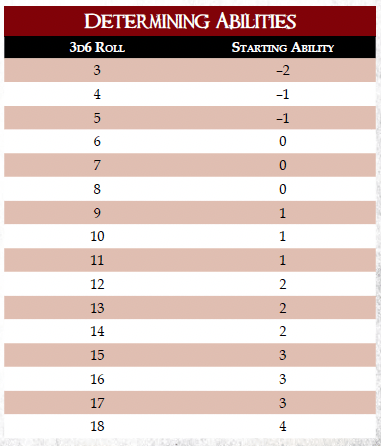
You’ve got a whopping eight abilities in this system: Communication, Constitution, Cunning, Dexterity, Magic, Perception, Strength and Willpower. Other than Perception and Communication these match up pretty well with the stats in Origins. We are rolling 3d6 for each one of these and then we record the modifier from the table below, not the sum of the dice, much like your average Borg game.

A screenshot of the Determining Abilities table from the Dragon Age RPG core book. It is a 3d6 table, which indicates what your starting ability score will be depanding on your roll. It goes from -3 to 4.

Communication: Rolled an 8 so that’s a score of 0
Constitution: Rolled a 13 so that’s a score of 2
Cunning: Another 13 for this one, so, 2 again
Dexterity: That’s a 10, which equates to a 1 on the table
Magic: I rolled a 12, so that is 2 yet again
Perception: Not wonderful. That’s a 6, which is another 0
Strength: A below average 9. Still, it gives me a 1
Willpower: That’s a 7 on the dice. And that gives me my third 0

The book does give options to either roll the scores and assign them to abilities as you see fit, or to do use point buy system instead. But, I think I will continue the tradition of randomising the process that I started way back in the OSE character creation post.

Step 3: Backgrounds

So, in this game, your choice of background also determines your race and has some pretty major mechanical effects, as well as the obvious cementing of your character concept from earlier. Here are the effects they generally have:

A screenshot of the list of features a PC's Background gives them in the Dragon Age RPG. These include ability score increses, ability focuses, race, class choices and languages.
A screenshot of the list of features a PC’s Background gives them in the Dragon Age RPG. These include ability score increses, ability focuses, race, class choices and languages.

Now, the book says nothing about rolling for your background randomly. In fact, I believe it encourages you to choose based on your original character concept and the ability scores you rolled. But I’m not here to play by the book (actually, that’s not true, really. I just enjoy the thrill of the roll!)

So, there are a total of thirty, 30, backgrounds (!) in the core book. It just so happens that I have a 30-sided die thanks to my flirtation with Dungeon Crawl Classics. So here we go!

That’s a 28! This means my character’s background will be:

Tevinter Laetan

And that is pretty cool! So, it means that I will necessarily take the mage class as the Laetans in Tevinter society are magic users from the mundane classes who are identified at a young age and trained to serve the Imperium. It fits quite nicely with my character concept, too. I can imagine a young Tevinter mage, disillusioned with the unfair system under which their own class of people toils while the upper class mages reap all the benefits. Not to mention the binding of so many elven slaves in general society.

Here are the benefits gained from this background.

  • +1 to Cunning – this makes my Cunning score 3 now!
  • One ability focus, either Communication (Deception,) or Cunning (Arcane Lore) – I rolled again on a d2 for this and got Cunning (Arcane Lore)
  • Languages – Tevinter and the Trade Tongue
  • Take the Mage class
  • Roll twice on the Tevinter Laetan table:
The Tevinter Laetan Benefit table from the Dragon Age RPG core book. It is a 2d6 table. Depending on wht you roll you will get a particular benefit such as +1 Consititution, Focus: Communication (Deception) and +1 Magic.

First roll – 11 Focus: Cunning (Cultural Lore)
Second roll – 9 Focus: Communication (Persuasion)

Step 4: Classes

A screenshot of the page from the Dragon Age core book that describes the Mage class. It includes an illustration of a femme human in red robes with long blonde hair, a staff with a blue stone on top, three bluish potions at her hip and some magical enegy emanating from her outstretched fingertips.

This game, much like the video games, only has three classes:

  • Mage
  • Rogue
  • Warrior

But within these classes you have a selection of specialisation options. I often wonder that there is no Priest class in this relatively traditional fantasy world. They gave the healing duties to mages and that is one specialisation option you can take as a mage. You can’t take Bard as a class but if you are a Rogue, you can choose to specialise as a Bard. And Barbarian isn’t an option in the Class list, but Warriors can go down that sort of route if they want.

Anyway, all that is academic as I am required to choose the mage class due the background I rolled.

The Class section starts off with an explanation of the broadness of the classes as I said above and then tells us a little about character advancement. You start at Level 1 and can get up to Level 20. There are options for XP and milestone leveling and it explains how you improve with a new level. Suffice it to say, ability score improvement is one of the main ways you gain in power, but you also get more Health, new ability focuses (which I don’t understand yet,) new class powers and “stunt points” (which I also don’t understand yet.) I just know you start with 6 Stunt Points. Everybody does.

It’s important to note that you don’t get a specialization until level 6.

As a mage, my character starts with three spells but can’t wear armour or use many types of weapons.

They have three Primary Abilities (as do all classes.) For a mage that’s Cunning, Magic and Willpower. The first two are not bad for me but that last one is a 0. Oh well.

All the others are Secondary Abilities.

Starting health is 20 + Con + 1d6. I rolled a 5 so that means it’s 27! Not too shabby.

My Weapon Groups are Brawling and Staves.

At Level 1, my Class Powers are

  • Arcane Lance, which means I can send a burst of magical energy from a staff
  • Magic Training allows me to cast spells. Here are the spells I’ve got:
    • Arcane Bolt
    • Arcane Shield
    • Daze
  • Mana Points. I start with 10 + Magic + 1d6. That’s a 4 on the d6 so a total of 16.
  • Starting Talent. I choose one talent from Chirurgy, Linguistics and Lore. Can’t get Chirurgy because it has a requirement that I don’t have. Gonna go for Lore, which seems the most generally useful.

Step 5: Equipment

You don’t get a lot to start with to be honest. I’ve got a backpack, some traveling clothes and a water skin as well as a staff and another weapon. I can only use staves or Brawling weapons. The Staves group includes clubs and morning-stars, I guess I’ll take a morning star then!
I also get 50 + 3d6 silver pieces to buy other gear. I rolled 10 on the 3d6. So that’s 60 silver.

I guess I’ll pick up a bedroll for 10 sp and a blanket for 6 sp. I’m not going to get into any more shopping right now.

Step 6: Defense and Speed

Your Defense score is, unsurprisingly, a measure of how hard it is to hit your character. It is 10 + Dex + Shield Bonus (if you have one.) So, that’s an 11 for me.

You can move up to a number of yards equal to your Speed when taking move actions. For a human, that’s 10 + Dex – Armour Penalty. I don’t have any armour so that’s not an issue. So essentially my Speed and Defense are the same, 11.

Step 7: Name

They have a long list of sample names in the book. Not just for Dwarves, Elves, Qunari and Humans but for the full variety of cultures and backgrounds (actually this mainly applies to the various human cultures) that they might come from. First, I need to decide what this character’s pronouns might be. I think I will go with he/him this time. As a Tevinter character, I can choose from some pretty cool names, including Dorian, Florian and Ether. But I have decided to go with Amatus. Amatus the Tevinter Laetan Mage.

Step 8: Goals and Ties

I like that they have included this step in character creation. Just go and take a look at my Motivation post to see why I think that, at least about Goals.
Anyway, I have to pick three Goals, a mix of long a shorter term ones.

  • Find the only friend I ever knew, an Elf named, Adanna, who was once a slave who belonged to his family in Tevinter, but escaped to Ferelden a year ago.
  • Try to make a name as an adventurer in Ferelden while staying out of the hands of the Templars.
  • To earn some coin and find some companions.

The other part of this is the Ties part. Now this specifically refers to other PCs. Since I don’t have any of those, I’ll have to skip that part.

I think I will have to do another post on the general AGE system and particularly how it relates to this game as there are still several elements that are a mystery to me but I feel like I have gone on long enough for one post.