Apocalypse Keys Character Creation

it has a very specific flavour. The PCs are monsters in the vein of Doom Patrol or the X-men. There is a lot of significance to the emotions of the characters and there is a fair bit of angst and drama involved from what I can tell.

This is the eighth in a series of character creation posts I’m using to figure out which game I want to schedule for our next campaign. You can find the Triangle Agency one here. And you can find the Slugblaster one here. You can find the Blades in the Dark one here. We took a slight detour for this one, here’s the Wildsea Ship Creation post. And then got back on track with the Wildsea Character Creation post. This is where you can find the Deathmatch Island one. You will find the Orbital Blues character creation post here. Back in this post I named Apocalypse Keys as an outside contender for the new campaign. This will be the last post in the series so I’ll be forced to make a decision on the next campaign soon.

DIVISION and Conquer
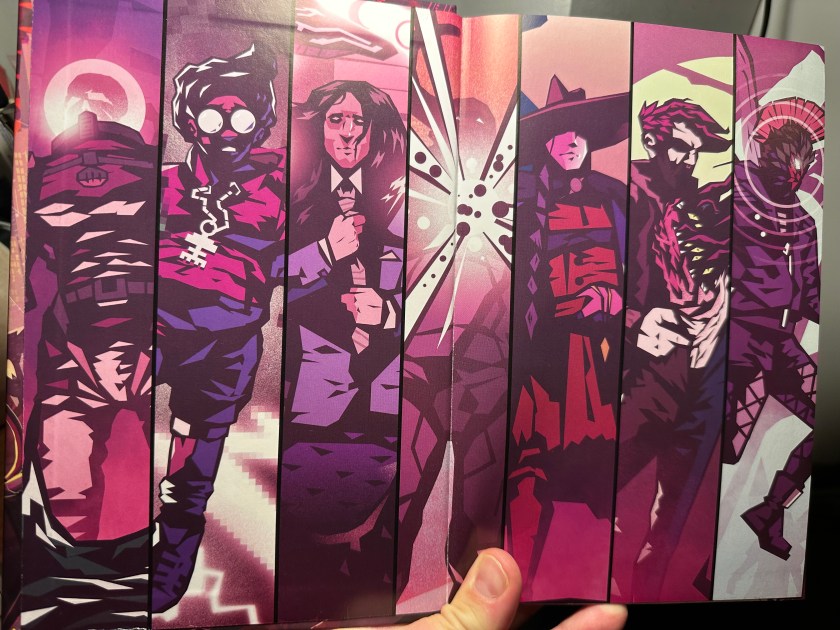
The illustrations of each of the Playbooks all together.

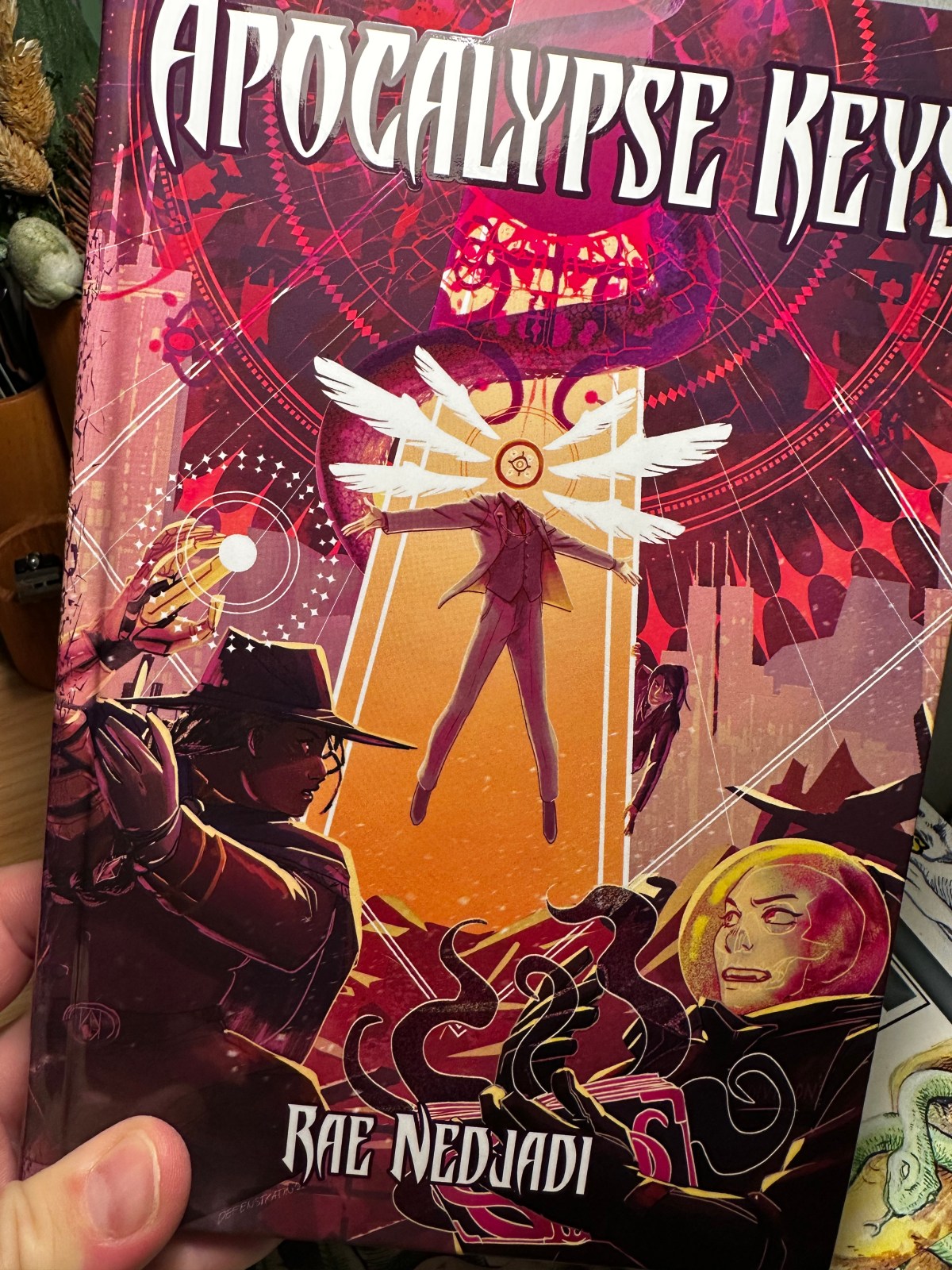
Apocalypse Keys by Rae Nedjadi is a Powered by the Apocalypse game in which you play members of a super-team of sorts. You are wielded like weapons by a shadowy organisation called DIVISION (which is an initialism, kinda like S.H.I.E.L.D.) in an effort to prevent apocalypses. How? Well, you gather Keys, which are essentially clues you will use to find and open Doom’s Door before the bad guy can. The bad guys are known as Harbingers and they are Omens, like you, but more world-endy.

The game is very much PBTA in its design, with a few extras. Although you roll 2d6 for most things, if you roll an 11 or higher, you overshoot, you blow the whole warehouse up instead of just the gates, your powers leave the security guard a blubbering mess instead of just plucking some thoughts from his head, you get the idea.

Also, it has some Carved from Brindlewood flavour to it too. The Keys you gather improve your chances of finding the Doom’s Door you’re looking for. For each one you get, you increase your chance that the theory you have come up with is correct and you know where to find it.

Ruin seems to have been taken from Trophy. Although it’s used a little differently. As you gain it, you get closer to becoming one of those bad guys, the Harbingers. It can also give you special Advances (abilities.)

One last thing: PCs gain Darkness Tokens as they make particular types of narrative choices that align with the emotional themes of the playbook. You spend these tokens to give you modifiers to rolls.

I think it’s important to know these things as we go into character creation for this game. Also, it has a very specific flavour. The PCs are monsters in the vein of Doom Patrol or the X-men. There is a lot of significance to the emotions of the characters and there is a fair bit of angst and drama involved from what I can tell.

Creating Monsters of DIVISION

The book provides us with a step by step guide to character creation which I love to see. It was something I missed from the process in Orbital Blues. Lets take a look:

  • Step 1: Choose a Playbook
  • Step 2: Bring Your Character to Life
  • Step 3: Refine Your Abilities
  • Step 4: Introduce Your Character to the Other Players
  • Step 5: Create Your Starting Bonds

As this is purely an exercise the last couple of steps probably won’t happen.

Choose a Playbook

Like other PBTA games, you choose a playbook to get started. Your character might decide to switch playbooks further down the line, depending on the narrative choices that are made at the table but most are likely to select one and stick with it. It’s like a character class in other games.

Here are the available playbooks in Apocalypse Keys:

  • The Summoned: a being summoned from another place. Violent, aggressive, antagonistic to prophecy, wants love more than anything
  • The Surge: Massively powerful but not in control. Wants help to contain it. “Explosive, uncontrollable and alienating.” Friendly fire and collateral damage and toxic relationships are the themes
  • The Found: Psychic amnesiac. They are very odd, but curious and highly emotional. They can have surprisingly intimate knowledge of other peoples’ inner lives and thoughts but do they know what’s best for others?
  • The Shade: A super intellect who cheated death. Thematically, they are for players who want to forge a difficult relationship with death and struggle with the costs of great knowledge
  • The Last: The last of their kind from another world. “Their power is reflective, sorrowful and hopeful.” Unsurprisingly the themes here are heavy, loss, tragedy and how these things are inevitable.
  • The Fallen: Elements of Lucifer, a fallen angel. “Their power is intoxicating, damaged, deceitful.” Thematically, hubris, the two sides of worship and an over-riding want for what was lost.
  • The Hungry: It is what it says. “Their power is intimate, transformative, and harrowing.” Getting big vampire vibes here. They are looking to feed, get truly close to someone and deal with the idea of body horror, unsurprisingly.

I could roll 1d7 to pick here, but there is one I’m drawn to most. That is the Fallen. They are all pretty goth but it feels gothiest to me.

The Fallen

The Fallen illustration from the book. A man in a suit with long, dark hair, a suit and tie ad a dragon coiled around him.
The Fallen illustration from the book

I am a pale reflection of the glory I once was
I embody the hubris and volatility of the Apocalypse
My power is faded, cracked, and deceitful
My heart yearns to worship and be worshipped

Bring Your Character to Life

I’ll be using a series of prompts provided in the playbook description to do this next part.

Your Name

There are four options here:

  • A name god gave me with love
  • a name I earned through fear and terror
  • a name that can never be said out loud
  • a name you need to give someone else one day

I choose the third one, because it’s cool, honestly. The name is Duma, after the Angel of Silence. In fact, I think this character will only communicate through signing.

Your Look

There are several options here. I won’t list them all, just the three I’m taking:

  • a multitude of wings made of light and sound
  • a cracked halo that bleeds
  • mismatched clothing hastily thrown together

I love these touches. I imagine the halo just constantly dripping blood onto Duma’s face, forcing him to close his eyes to the horrors of the world. The wings, once flapping silently, feathery and white, now buzz and flicker like an insect’s. The clothing, whatever he could find, an old army surplus jacket, some discarded cream chinos and a pair of scuffed tennis shoes.

Your Origin

I have to choose one of these four options for Duma’s origin:

  • I was once a mighty god of this Earth but I was killed by my worshipers
  • I once claimed hell for my own but I was betrayed
  • I was an angelic creature destroyed by my jealous god
  • something else that describes how far I have truly fallen and all I have lost

It’s nice to have that last option there for anyone who has their own idea of their character’s origin. For me, though, it has to be the third one. I think Duma was silent before as a way to show his devotion to his god, but is silent now because he has vowed never to speak until he regains the trust of his god or destroys him.

Who are the Gods Who Taunt You?

I only choose one of these:

  • those who I betrayed seek to destroy me once and for all
  • ancient gods who have lost their power and ache for what is left of my divinity
  • twisted gods I corrupted who are now monsters of myth and legend
  • divine servants who grow in power as I have weakened
  • something else that feeds my spite and sharpens my hubris

I like the idea of other bully angels coming down to tease Duma while he seethes and silently curses them so I’ll go for the fourth one.

Your Impulse

This is an interesting departure from other PBTA games I’ve played. Usually, you have particular character goals that mostly remain static, and if you manage to achieve them in a session, you gain 1 XP. In Apocalypse Keys, you choose one of the listed Impulses each session and work to explore it. If you do, you can gain 1 XP OR 1 Ruin. I’m not going to list them all, but here are a couple that I like:

  • Did you bless the weak with the immeasurable glory of your presence?
  • Did you taunt or seduce those who would seek to destroy you?

I think, as a starting Impulse, I would go with the first of those two, just to start things off as I meant to go on.

Your Powers of Darkness

These are largely thematic flavour for your character to throw on a standard move. They are pretty much open to interpretation every time you use them.
I can choose two from the following:

  • Soul Venom
  • Fae Glamour – Just so Duma can walk around town.
  • Fear Manipulation
  • Weapons of Light and Sound – This seems very angelic.
  • Many Forms of Mythic Animals

I’ll take Fae Glamour and Weapons of Light and Sound

What Does the Darkness Demand of You?

This is such an important question to the character and for the Keeper to know how to interact with them. There are quite a few, so I’m going to only list the two I am choosing:

  • To storm heaven
  • to curse the one I love

Man, that’s melodramatic!

Gaining Darkness Tokens

This is an important part of the process. It will define the way I play the character to a large extent. Duma will get 2-4 Darkness Tokens every time he does any of the following:

  • Feel others are beneath me
  • React with spite or arrogance
  • Ask someone to worship me
  • Ask someone to betray another
  • Embody a condition that effects me

Interestingly, the Conditions I might gain as the Fallen are different to those other playbooks might get.
Here are mine:

  • Lustful
  • Raging
  • Forlorn
  • Obsessed

All extremes of emotion. Unsurprising really.

Breaking Point

The Fallen's Breaking Point page. Also includes the Call Me Master move and an illustration of a glowing person bringing people under their control.
The Fallen’s Breaking Point page.

This is what happens when you are full up on Conditions. If you mark all four, you hit your Breaking Point. It is unique for each playbook and it serves to illustrate your character at their most emotionally overwhelmed. You just can’t take it anymore. You must have a scene to describe what happens. For your troubles you get to clear your Conditions and get a point of Ruin.

You were once beautiful and loved, perfect and beyond despair. You are gripped with how far you have fallen, how much of your glory was ripped away from you. You are unworthy of love, and your heart screams in anguish
Describe how you use what little power you have left to bring you painfully close to your former divinity, and how it twists and consumes everything around you. The Keeper will tell you what horrors you birth and what twisted shadow of a god escapes quietly into the world.

Ooof.

Playbook Moves

Each Playbook gets one move that is only for them. Normally when you advance, you can take moves from other playbooks, but not the signature one. The Fallen gets:

Call Me Master

This is a move designed to snare other beings into worshiping you, or at the very least, doing your bidding. If it goes wrong, it might make an old enemy act against the Fallen or maybe make you display your real being, forcing you to lose a Bond, or, at worst, awaken a sleeping horror.

One More

Other than Call Me Master, I get to choose one more from the playbook description. Here is a list of those I can choose from:

  • Mother of Monsters – Just imagine what could go wrong…
  • Fleeting Divinity – Relics with your power contained in them. Use them for modifiers to rolls
  • Honeyed Tongue and Clouded Minds – Use this to get extras when you Unleash the Dark, such as gaining more knowledge or making lies truth
  • You Loved Me Once – Make an NPC one of your former worshipers. They might still be, or they might serve your ancient enemies
  • The Lies that Serve Me – Your mistruths can become real for a time but if you fail… you might lose that part of you that made it.

I love the idea of just declaring a new NPC or faction were once your devotees and seeing what happens. Wow, that could go so wrong in so many interesting ways. But the ways it might go right are equally interesting so I am going for “You Loved Me Once.”

Ruin Moves

I only get to choose one of these. Another option is to choose a DIVISION move instead. And, although that is of interest, I’d rather stick to the stuff that’s specific to the playbook. Also, Ruin is just more interesting to me. Here are the Ruin Moves for the Fallen:

  • Tremble Before Me – One of the basic moves is Unleash the Dark. It is used when imposing your will on someone. Tremble Before Me allows you to mark a point of Ruin to get a better result when you do that.
  • My Beloved Nemesis – When you do this, you have two options, mark one Ruin and get to clear your Conditions while explaining how your betrayer is out in the world, or mark two Ruin and have them appear in the scene! You form a Bond with them either way. If you choose the second one you form a Bond with What the Darkness Demands of You.
  • Desire Dressed as Faith – You can make people want to do something or possess someone. Spend one or two Ruin for varying extremes of desire.
  • I Will Rise Again – When you work towards regaining your old glory, you make this Move. You get to choose from a long list of steps forward you can take which include doing things like avoiding all notice, imbuing your forces with magic weapons and killing the only one who could stop you. But the Keeper gets to screw you for it.

For me, the one that works most for the playbook and the character is that last one. It feels like the kind of thing the Fallen should be working towards from the start. So I will take I Will Rise Again as Duma’s Ruin Move.

Conclusion

This has turned into another monster post, pun very much intended. So I am going to skip the Bonds for this character, mainly because I don’t have any other PCs to Bond with anyway.

There are things about this game that I find too overwrought, too melodramatic for my tastes. But there are things in the character creation process that I enjoy. The moves are great and so imaginative and evocative of the genres this game is inspired by. But it’s similar enough to Triangle Agency to put them into direct competition with each other. Also, I’d like to actually play Duma, but I don’t know if I want to GM this game…

Orbital Blues Character Creation

I’ve played RPGs where your character is supposed to be weak, where they’re meant to be weird, where coolness or badassness is the point, but I have never before played one where the entire premise is that you are a sad, potentially depressed outlaw trying to get by in a universe that’s against them.

This is the seventh in a series of character creation posts I’m using to figure out which game I want to schedule for our next campaign. You can find the Triangle Agency one here. And you can find the Slugblaster one here. You can find the Blades in the Dark one here. We took a slight detour for this one, here’s the Wildsea Ship Creation post. And then got back on track with the Wildsea Character Creation post. This is where you can find the Deathmatch Island one. Back in this post I named Orbital Blues as an outsider in this process since I’d barely even cracked it open. This was good motivation to read the book. Since then, I have read most of it and I have to say, I’m generally impressed. It’s very much in the running now.

Sadness is the Point

I’ve played RPGs where your character is supposed to be weak, where they’re meant to be weird, where coolness or badassness is the point, but I have never before played one where the entire premise is that you are a sad, potentially depressed outlaw trying to get by in a universe that’s against them.

That’s Orbital Blues, by Sam Sleney and Zachary Cox, illustrated by Josh Clark and published by Soul Muppet. This is how it is described on the back of the beautifully realised book:

It is an intergalactic age of bounty hunters, vagrants and bleeding heart outlaws.
The galaxy is a lawless expanse, and you are an INTERSTELLAR OUTLAW. Together with your SHIP and your CREW, you must eke out a living in the frontier, and close down the intergalactic dream of freedom and success.

What this blurb doesn’t convey is that, for an Orbital Blues character, the sadder you are, the better (mechanically anyway.) Your PC is going to start with Troubles and they are going to give them the Blues and those two things just serve to compound each-other over the course of the game to give them more abilities as well as more narrative motivation.

Before I get into this, I would like to once again plug the My First Dungeon podcast. They have a complete season of an Orbital Blues actual play that has helped me to get to grips with the game, the system, the vibe and, of particular importance to this post, character creation. Go check it out here.

Start with the Concept

Character Creation chapter with poncho clad back of a space cowboy

I haven’t played a lot of games where the player is supposed to start with an idea of their character first. Never Tell Me the Odds does it, but I am struggling to think of another. Of course, a lot of players will go into every game with their concept in their heads already, but few demand it. Orbital Blues wants you to do some imaginative labour before moving on to stats and abilities.

So, let’s look at the touchstones for this game. What kinds of characters does this sort of game want you to make? Cowboy Bebop, Firefly and Guardians of the Galaxy are all pretty obvious sources of inspiration that are explicitly mentioned in the book, so I’m going to use the characters from those IPs as fodder too.

I remember watching Cowboy Bebop during its original run when I lived in Okinawa in the late 90s. It captivated me with its evocative and anachronistic world and its lowlife, flawed yet oh so sympathetic characters. I was obsessed with Spike. He was such an asshole and yet he could always surprise you with moments of genuine heart and kindness, while being forever haunted by his dark past. It’s a classic character archetype, of course, but that’s with good reason. We relate to their brokenness while we aspire to their ultra-competency.

Anyway, that’s my main point of reference, a slick-looking guy with a past he’d rather forget. I’m imagining him as a crack-shot and a card-sharp, not an arm-wrestler or a fist-fighter. This guy drinks too much and always has a cigarette between his lips.

Name

The very next thing in the process and the book, is to roll up or choose your name. There is an excellent d100 table here for this so I am not going to pass up the opportunity to roll on it. Now, this is not necessarily meant to be your PC’s full legal name. In fact, it is more likely to be a nickname or a persona and usually just a single name. There are some great names in here, including “Indiana,” “Ripley,” and “Valentine.”

I rolled a 34 so that’s Avery. Nice!

On the same page is an exhortation to “pull it together.” This means thinking about what brought the character to the life of an outlaw. What kinds of problems follow them and what might they do about them?

I’m thinking Avery, a former military sharpshooter, quit the space-corps to find his own way in life, only to end up working as a hitman for some bad people. The crime boss he worked for had some juicy blackmail material on Avery. Thinking about this from a game perspective, I would want to eke this story out during play rather than spilling it all in character creation. But I am thinking he killed the wrong person, someone known to his family, and he doesn’t want that to get back to his parents. But he left the employ of the crime boss by faking his own death. This was all before he started going by the name, Avery.

Stats

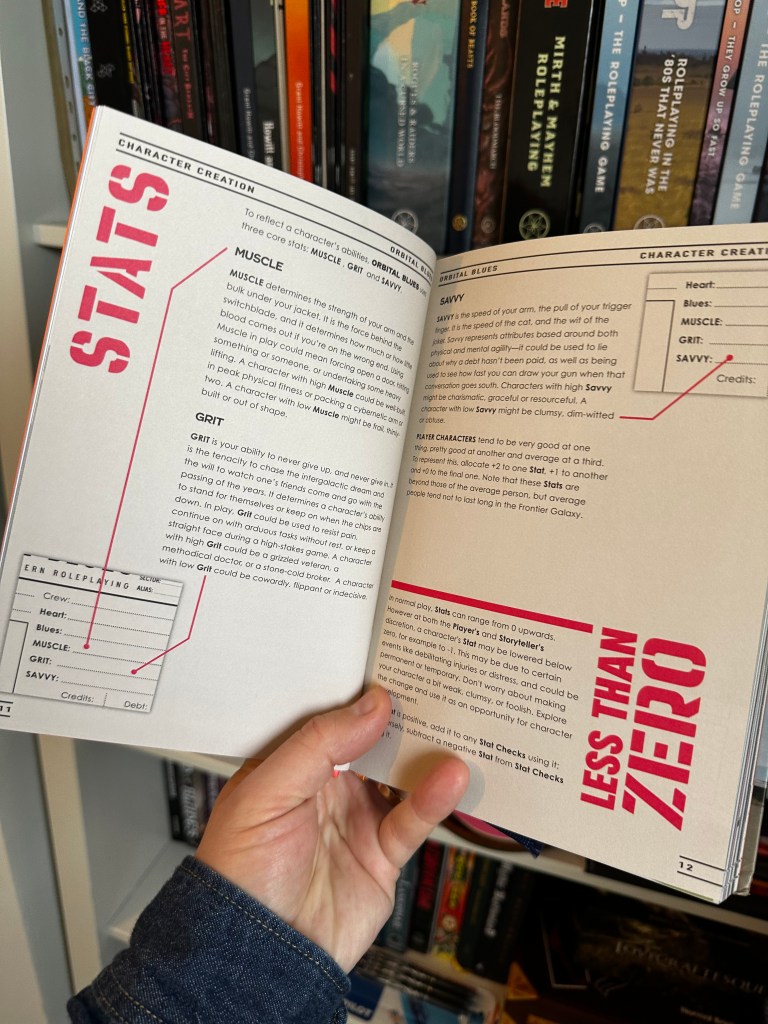
Stats: Muscle, Grit and Savvy

You only get three stats as an Orbital Blues character:

  • Muscle: speaks for itself really, Although it could be used for intimidation too. Also, it has a bearing on your Heart score, which is analogous to your hit points
  • Grit: How far will you go? How much can you take and keep on trucking? Your Grit determines that
  • Savvy: Quickness of mind and trigger finger. This is where I’ll be investing highly for Avery.

There is no dice-rolling involved in your stats. Instead, you choose one to be 0, one to be +1 and one to be +2. Simple.

Avery:

  • Muscle: 0
  • Grit: +1
  • Savvy: +2

This seems to suit the character concept I’ve come up with so far.

At this point, it’s worth noting that you do stuff in this game by rolling 2d6, usually, and add the relevant stat to the roll. The target is always 8.

Sometimes, if you are rolling with the Upper Hand you roll 3d6 and take the top two rolls. In contrast, if you are rolling Against the Odds you roll 3d6 and take the lowest two rolls.

You can use Exertion to spend points of Heart to add to your rolls too.

The Crew

Crew titles

This next part will be a little difficult for me since this is a Solo endeavour (that’s just a little space outlaw humour there.) But still, I can follow the advice presented to a certain extent. There is a colourful double-page spread of titles to help. I can adopt one of these for my own character. Once I have done that, I can choose at least one more title and decide how Avery might relate to another character with that title.

Avery has a lot of options here. There are titles such as “the Queen,” “the Freak,” “the Heart-breaker” and, of course, “the Cowboy.” But I think the one that suits him is “the Quick.” He’s fast on the draw, nimble-fingered and quick-witted.

I think there is another member of the crew who has “the Ace,” title. Let’s call them Rivers. They’re good and they know it. This pisses Avery off and wakens his competitive side.

Heart and Blues

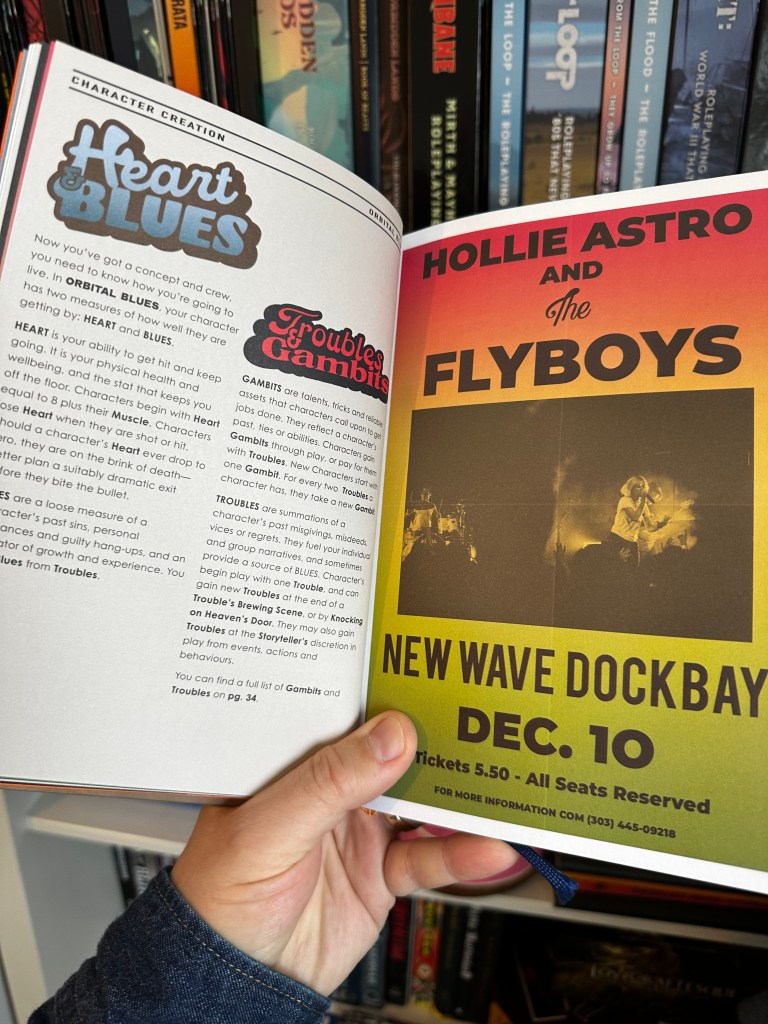
Heart and Blues, Gambits and Troubles

This is an easy one. Heart, which, as I noted, is the HP score, is calculated by adding 8 to your Muscle score. So:

  • Heart: 8

Blues are the way you measure the effects of your character’s “past sins, personal grievances and guilty hangups.” As you build Blues points, you get to improve your character. You gain Blues points, unsurprisingly, through your Troubles.

Troubles and Gambits

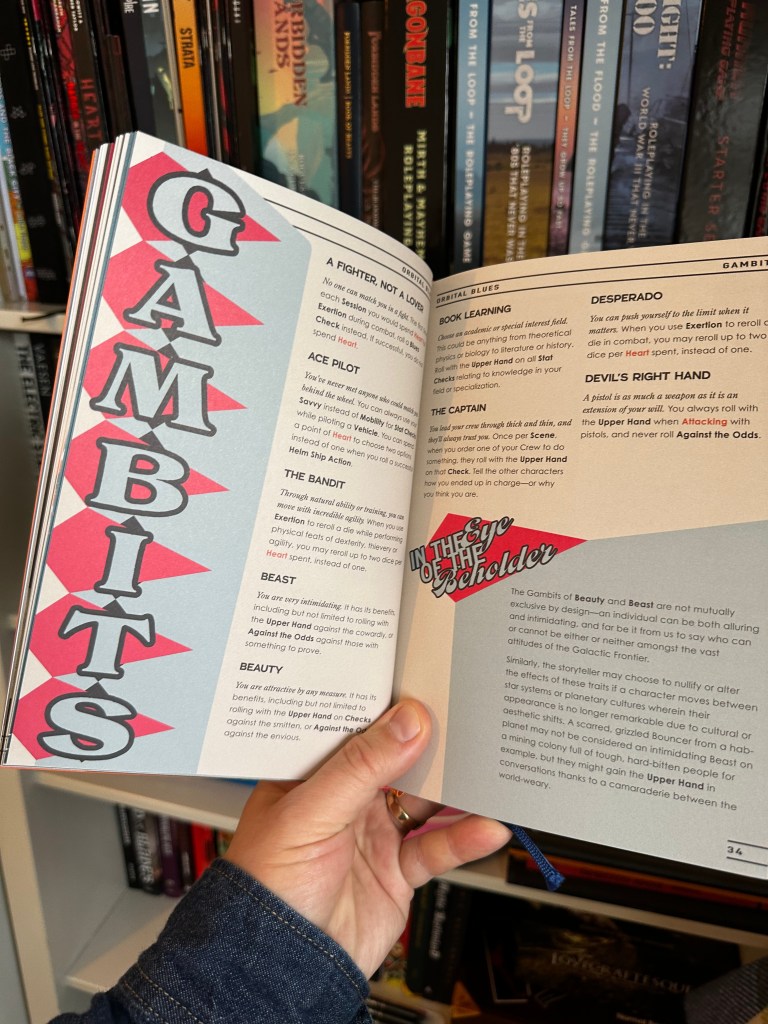
A space cowboy starts with one Gambit. It’s a talent, ability or resource that can help in all sorts of situations. You can gain more during play. For every 2 Troubles, you can get another Gambit. Here are a few that I might consider taking for Avery:

  • Devil’s Right Hand – Roll with the Upper Hand when using pistols
  • The Gambler – get two points for every point of Heart spent when using Exertion while gambling

But the one I’m going for is:

  • Marksman – Long range attacks ignore penalties from range etc. and always get the Upper Hand when taking time to aim. It’s the one that suits Avery’s story the most

You could be forgiven for thinking that a character’s Troubles are purely narrative, maybe coming from their backstory. But in this game, you have a set list of Troubles to choose from and they have specific mechanical effects. Avery will start with one Trouble although, he could resolve it and pick up some more during play. Here are a selection of Troubles to choose from:

  • Devil in the Bottle – You get to answer questions like, what was the worst thing you ever did while pissed, who’s your oldest drinking buddy and what’s your favourite booze. You get Blues whenever you have to deal with a hangover or go cold turkey for a couple of days.
  • On the Run – Some of your questions: Who are you on the run from and why? Who helped you get away? Who was left behind? You get Blues when evading a problem, and abandoning someone else to escape.

But Avery’s starting Trouble has to be

  • “In too Deep – You got involved with the wrong people and did things you ain’t proud of
    • Which underworld organisation did you get involved with? The Reno Snakes is a gang that’s mentioned in the scenario provided in the book, so that’s what I’ll go for
    • Who, in law enforcement remembers you? Galactic Marshall Dell Walker. He’s never believed Avery was really dead
    • I’ll get Blues when I:
      • rely on a talent I learned from an old friend
      • restrain myself from the familiar old violence
      • make someone do something they don’t wanna

Equipment and Mementos

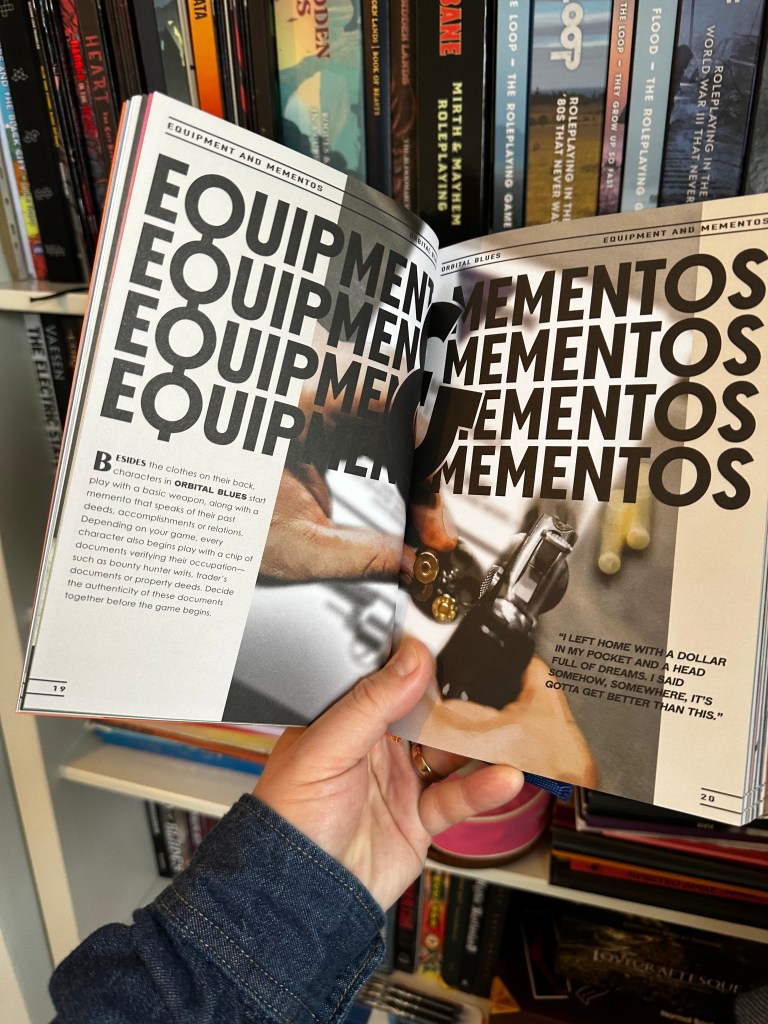
Equipment and Mementos

Avery gets one weapon, a memento and one piece of crew equipment.
I could roll a d12 to determine the starting weapon but I think it makes sense that Avery takes a sniper rifle given his background and gambit.

There is also a (1-18?) table for mementos but I spotted one on it that simply fits so well, its “Bounty on a former lover.” I would like to change it from “former lover” to “step-father,” though.

Finally, the piece of crew equipment: A night-vision scanner makes sense here, I think.

Soundtrack

Your Soundtrack
Your Soundtrack

Avery needs his own theme tune to act as a leitmotif for him at those most dramatic of moments. This is such a cool idea that reminds me of Tales from the Loop and the best actual plays. I think Avery’s soundtrack tune is Sweet Jane by Cowboy Junkies

Conclusion

I might actually come back and make a ship for Avery and his pals as well, but this post is already long enough. I’ve had fun making this character. The process asks some really interesting questions of the player to make a troubled and complex outlaw who is likely to get more and more troubled as time goes on. The rules are simple, and very easy to grasp. Character creation was also pretty straightforward, although I did find there was quite a lot of flipping back and forth through the book during character creation. But that is just a small quibble really.

For now, see you, space cowboy…

Blades in the Dark Character Creation

You play a scoundrel…doing [heists] with your crew. The setting is Doskvol, a city in perpetual darkness beset by inter-faction strife, corrupt leaders, and supernatural entities. The end goal for the character is usually to retire from that life with enough coin in their stash to live safely and securely without worrying about rivals or the authorities.

This is the third in a series of character creation posts I’m using to figure out which game I want to schedule of our next campaign. You can find the Triangle Agency one here. And you can find the Slugblaster one here.

Forging a New Era

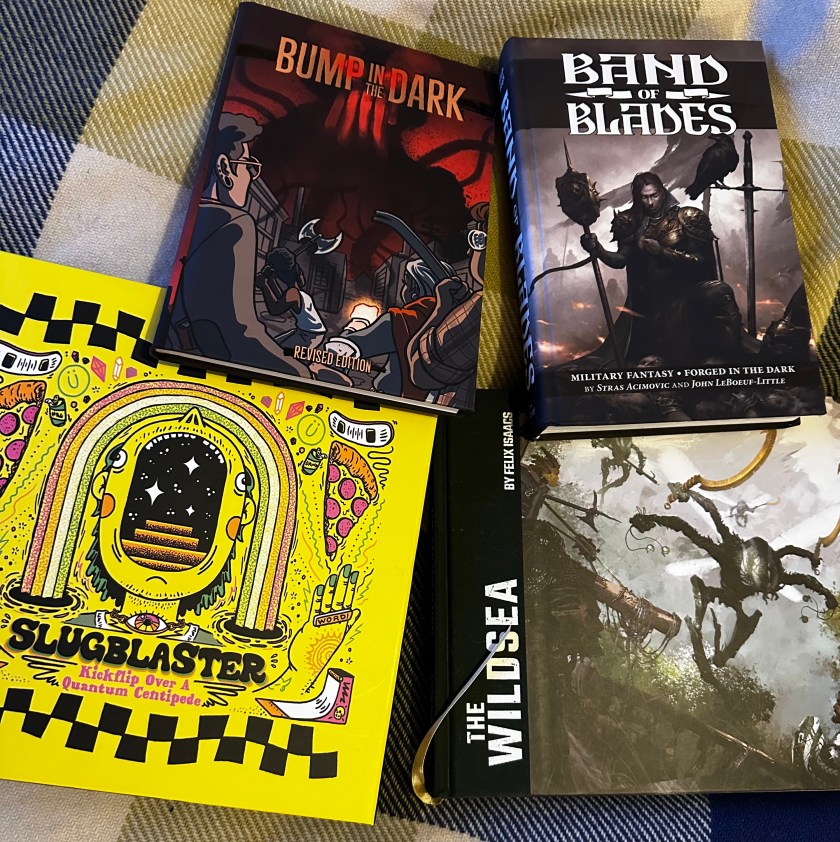
From top left, clockwise, the covers of Bump in the Dark, Band of Blades, The Wildsea and Slugblaster

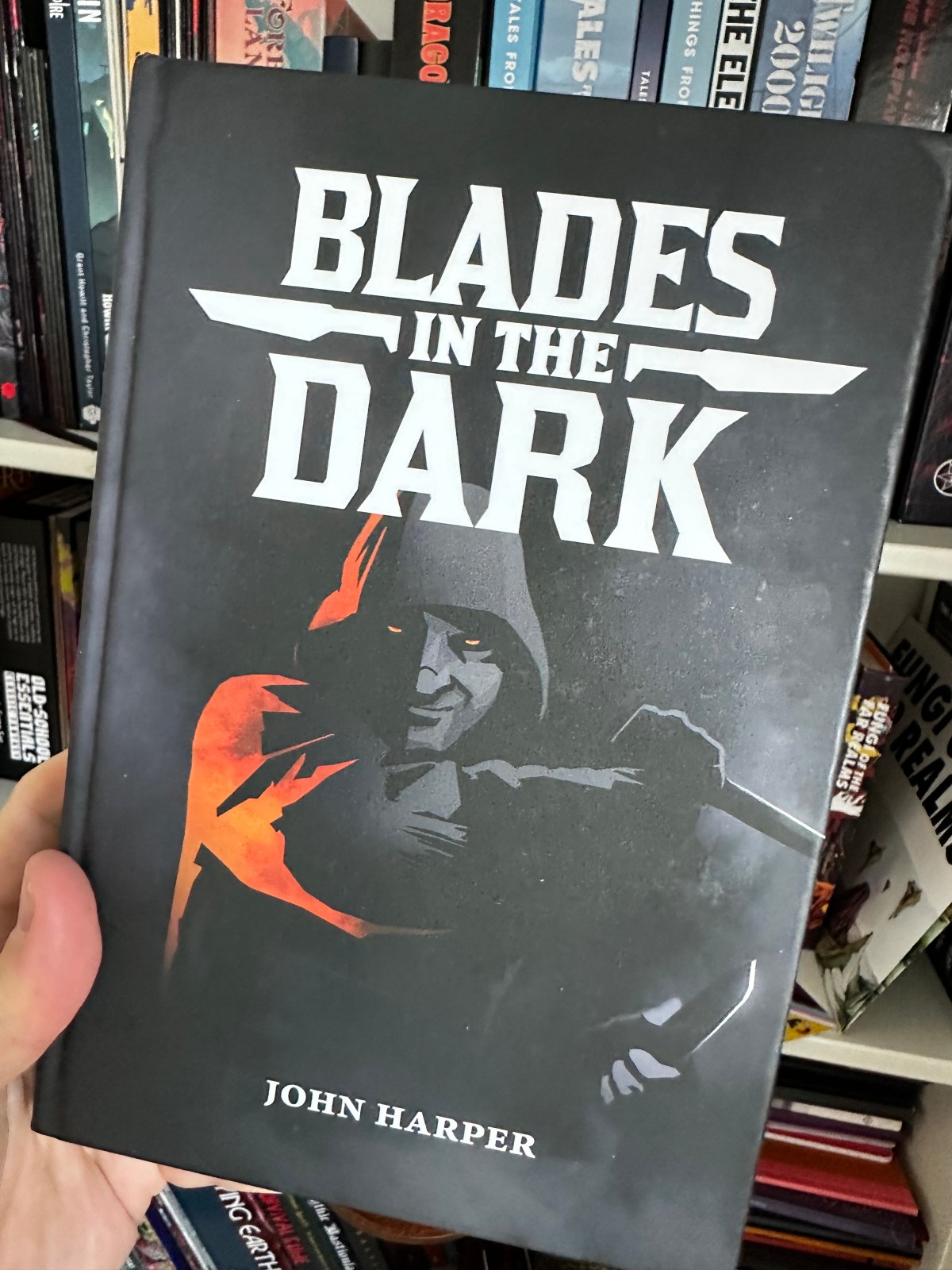
Blades in the Dark, by John Harper has had such a profound impact on the TTRPG landscape since its release in 2017, that it’s hard to overstate it. It has a devoted following, it consistently appears on top ten RPG lists and it has spawned a bewildering array of games based on its system and setting. Forged in the Dark games like Band of Blades, Girl by Moonlight, Bump in the Dark, Slugblaster and Wildsea (debatably.) You can find a non-exhaustive list here.

The system is story-focused, encouraging players as well as GM to take a hand in building the narrative. Near the start of the book, it is pointed out that, “no-one is in charge of the story.” If I were to encourage you to take anything from this short summary, it would be that.

As in Slugblaster, you roll a D6 when attempting something. 1-3 is a failure, 4/5 is a success with consequences and 6 is a full success. The consequences from a failure or mixed success can come in the form of Stress, and thereby Harm and Trauma Conditions, which have more of an narrative effect on the story than a mechanical one (although they certainly have that too.) You can also add more dice to your roll and build a dice pool to give you more chance of rolling higher. You do this in several ways, by using pushing yourself, getting assistance or taking a Devil’s Bargain.

In all of these Forged in the Dark games, the rolls you make are highly abstracted. Instead of making a stealth roll, an investigation roll or a thieves’ tools roll, you describe what your character wants to do and then roll with the appropriate Action Rating. In most cases the Action encompasses a character’s whole part in a scene, rather than a single, explicit skill or combat thing like in D&D and similar games. The choice of the Action Rating used is explicitly left up to the player, but if the GM thinks it might be more effective to use a different one, they can reduce the impact of the action or increase the danger of the PC’s position, making the consequences for failure more severe.

Blades has several really cool mechanics, like the Flashback to go back and prepare something for the situation you find yourself in, but I don’t have the space to go into every rule here. Maybe I’ll do more of a deep-dive into the rules in another post. For now, let’s go about creating my Scoundrel.

Dark Heists

It’s important to remember the setting and the type of game this is. You play a scoundrel of some sort, doing jobs/heists/cons with your crew. The setting is Doskvol (or Duskwall), a city in perpetual darkness beset by inter-faction strife, corrupt leaders, and supernatural entities. The end goal for the character is usually to retire from that life with enough coin in their stash to live safely and securely without worrying about rivals or the authorities.

Blades in the Dark character creation steps

Playbooks

The types of characters available to play are suitably goth.

  1. Cutter – violent and intimidating
  2. Hound – crack-shot tracker
  3. Leech – explosive alchemist
  4. Lurk – shadowy sneak-thief
  5. Slide – social and manipulative
  6. Spider – factional mastermind
  7. Whisper – magic and ghosts

There are seven of them, as you will have noticed. So, I’m breaking out the DCC zocchi dice again. I got a 4 on the d7 making this character a Lurk.

The Lurk

The Lurk playbook in Blades in the Dark

There is no longer any sunlight — the world is plunged into eternal night. There are scoundrels who live in the darkness, who prowl the underworld unseen, trespassing where they will. They are the burglars, the spies, the infiltrators, the cut-throats — commonly called Lurks.

After this pleasing intro, the playbook description tells me that my Lurk will gain xp whenever they “address a challenge with stealth or evasion.” Each of the playbooks have a different way to earn xp that’s individual to them.

Here also, it asks a couple of questions to get the player thinking, not just about the mechanics of the playbook, but about the personality and background of their character:

Q. How did you learn the stealthy arts of the Lurk?
A. I was taken in at a young age by a band of pickpockets and sneak-thieves.

Q. Which Aspect are you drawn to most? The invisible watcher, spying on the unwary? The adroit acrobat, racing across rooftops? The deadly ambush predator, waiting for a victim in the darkness?
A. The intimate knowledge of the city’s underworld, its back alleys and interconnected cellars, its rooftops and sewers. Where to spy from, where to approach a potential mark/victim from and how.

Starting Actions

Everyone has three Attributes:

  • Insight
  • Prowess
  • Resolve

Each of these has four Action Ratings hanging off it.
Insight has

  • Hunt
  • Study
  • Survey
  • Tinker

Prowess has

  • Finesse
  • Prowl
  • Skirmish
  • Wreck

Resolve has

  • Attune
  • Command
  • Consort
  • Sway

You can have up to four points, or dots, in each Action Rating although you can only have up to two dots at the start.
The Attribute Ratings will equal the number of associated Action Ratings they have any score in. So if you have any dots in Attune and any dots in Command, you will have a Resolve of 2. You use the Attribute Ratings to resist different types of stress.

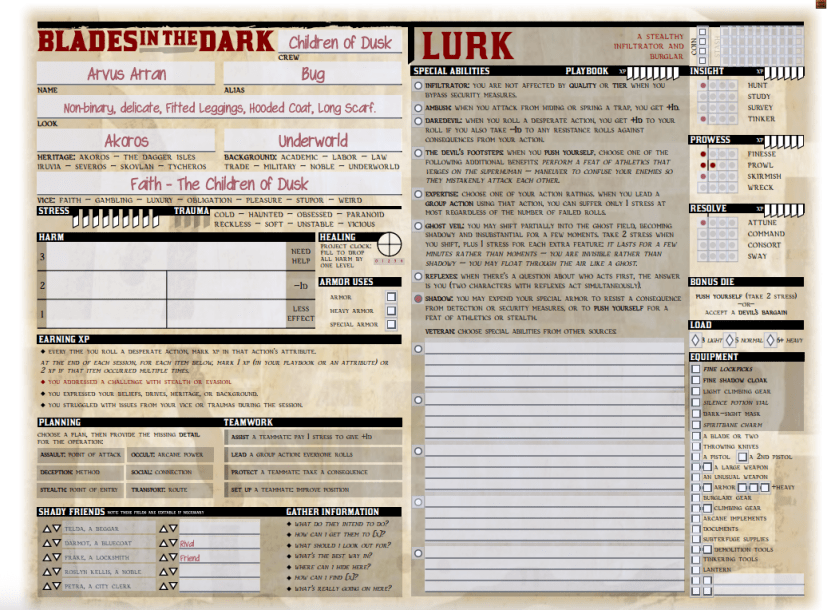
In the case of the Lurk, I start off with 1 point in Finesse and 2 in Prowl. I will add four more points to Action Ratings at a later step.

Shady Friends/Rivals

Your connections to NPCs can be key to a successful or disastrous career as a scoundrel. There is a list of five in a table here. I’m going to roll my d5 once for a Friend and once for a Rival

  • Friend – 3 – Frake. This is a locksmith who has taught me everything I know about lock-picking. He has an encyclopaedic knowledge of every type of lock, chest, safe and safe room in the city
  • Rival – 2 – Darmot. Once, he was one of our band of pickpockets, now, he uses his knowledge against them. He’s busted me many times

Lurk Special Abilities

You only get one of the eight listed abilities to start with.

  1. Infiltrator – you don’t suffer negative effects due to higher quality security measures employed by higher Tier enemies
  2. Ambush – Gives you an extra d6 when attacking from hiding
  3. Daredevil – get a bonus die if you take a desperate action as long as you take -1d6 to resist any consequences of it
  4. The Devil’s Footsteps – push yourself to do the impossible. This ability has a variety of effects
  5. Expertise – you have to choose an action rating and when you lead a group action with that, you can only take a maximum of 1 stress
  6. Ghost Veil – go completely invisible by shifting into the ghost field. Just take some stress to do it
  7. Reflexes – who should act first? You should, of course!
  8. Shadow – use your special armour to resist consequences from security measures or pushing yourself in physical endeavours

The book suggests taking the first one listed if you can’t decide between them. However, I am going to roll a d8 to make the decision for me. That’s an 8!

Shadow

You may expend your special armor to resist a consequence from detection or security measures, or to push yourself for a feat of athletics or stealth.
When you use this ability, tick the special armor box on your playbook sheet. If you “resist a consequence” of the appropriate type, you avoid it completely. If you use this ability to push yourself, you get one of the benefits (+1d, +1 effect, act despite severe harm) but you don’t take 2 stress. Your special armor is restored at the beginning of downtime.

I like this a lot. It matches the growing image of this character that I have in my mind.

Lurk Items

There is a section in the playbook description for items specific to the Lurk, but there is no need to choose anything at this stage. In Blades in the Dark, you simply indicate at the start of a Score how heavy a Loadout you have on you. That gives you a number of Load points to assign as the Score progresses. When you come across a situation in which you need “Dark-sight goggles” for instance, you write them down and mark the 1 Load that they take up. You never need to describe the items you have in your pack beforehand.

Heritages

The Shattered Isles map and description

There are six options here. Your Heritage is more akin to a real-world ethnicity or national background than a race or species. It is quite likely to shape your character’s politics, social circles and general way of thinking. It is unlikely to have any mechanical effect.
Here are the Heritages:

  1. Akoros – big, industrialised land. Like Europe. Duskwall is here.
  2. Dagger Isles – peopled by corsairs and merchants who sail the seas between their isles and beyond
  3. Iruvia – a desert kingdom to the south. Think Egypt.
  4. Severos – a wild place with nomadic people who survive in the ruins of ages past
  5. Skovlan – recently colonised by Doskvol. Many refugees from here have come to the city to look for opportunity
  6. Tycheros – a far-away land where the people are part demon. These characters get demonic telltales that mark them physically

Rolling a d6 for this as well: That’s a 1! Akoros. This is a local person whose family fell on hard times. While their parents were out looking for work, this guy was out running around with their gang, stealing and sneaking.

Backgrounds

What did this character do before going their crew? There are 7 options:

  1. Academic
  2. Labour
  3. Law
  4. Trade
  5. Military
  6. Noble
  7. Underworld

I would normally roll for this but I feel like I already have such a solid picture of this Lurk in my head that I am going to have to go for Underworld here. They were a street kid, a pickpocket within a network of urchins that spanned the city.

Assigning Action Dots

There are only a couple of rules to the way you can assign these dots (points) on your character sheet. You can’t start with more than two points in any one Action Rating. Also you should add one dot to an Action rating that reflects your Heritage and one dot to an Action Rating that reflects your Background.

I think, as a local in this industrial city, this character would get a dot in Tinker and as a wee guttersnipe, they would need a dot in Skirmish. I get two more dots to spend freely so I would like to add one to Hunt and one to Attune.

Vices

In your downtime between Scores, you might want to blow off some steam to relieve stress. That’s why you need a good vice!

Here are the options:

  1. Faith
  2. Gambling
  3. Luxury
  4. Obligation
  5. Pleasure
  6. Stupor
  7. Weird

There is a great deal of leeway to describe the specifics of your vice within the confines of the category. I’m going to roll a d7 for this. That’s a 1, Faith. I think my Scoundrel has found his place amongst an underground cult in the city. In fact, I think the band of urchins they have been part of since childhood is led by a prophet, a visionary with the ability to speak to god through the dead.

Name, Alias and Look

Name: Arvus Arran (I chose this from the long list of names in the book)
Alias: Bug (small, sneaky, seems to fly)
Looks: Non-binary, delicate, Fitted Leggings, Hooded Coat, Long Scarf.

Arvus Arran Lurk Character Sheet
Arvus Arran Lurk Character Sheet: Get yours here: https://ad1066.com/bens-character-sheets/blades-in-the-dark-playbooks

Crew Creation

Just like in Slugblaster, you really need a crew to finish out a Blades in the Dark character, but this isn’t really possible here, except to say there are a few crew types:

  • Assassins
  • Bravos
  • Cult
  • Hawkers
  • Shadows
  • Smugglers

And Cult seems to make sense here, imagining that the rest of the crew are also members of Arvus’ gang.

Conclusion

This is such a straight-forward character creation process that involves very little flipping between sections of the book. With a new character, you don’t have too many decisions to make and you can begin to get a feel for the character you’re creating very quickly. You can also see the potential for future stories and drama in elements of the process such as the friends and rivals.

I have only played the one campaign of Blades in the Dark but writing this post has whetted my appetite for more!

Triangle Agency: Character Creation

“Triangle Agency is a tabletop role-playing game and exciting new job opportunity for humans like you.”

Be the change you want to play

I haven’t made any real progress in deciding what to run next. I asked the question here but have not enough feedback to be helpful. So I thought I would take a more practical approach to the problem. Several times over the last year or so, I’ve written up complete character creation posts for various games and systems to give me more of an insight into them, to see how I like them and to get me motivated to run them. You can read some of them here. I have always found these to be useful exercises and usually pretty entertaining for me too. So this will be the first in a series of character creation posts. I will do one for each of the games in the list in my aforementioned Time for a Change post. The first of those is one I am very interested in getting to grips with. I have been reading the rule book for a while and it’s one of the more unique and exciting on the list.

Triangle Agency

The back cover of Triangle Agency

Triangle Agency is a game by Caleb Zane Huett and Sean Ireland published by Haunted Table in 2024. Here is what the back cover has to say about it:

Triangle Agency is a tabletop role-playing game and exciting new job opportunity for humans like you.

Investigate supernatural Anomalies, wield tremendous power, and take advantage of our comprehensive life insurance benefits all from the comfort of your favourite table!

This book includes everything necessary for you to experience the chilling horror, wacky comedy, and emotional truth that can only come from working for Reality’s Most Trustworthy Corporation, 333 years running.

Welcome to the first job of the rest of your life!

I think that’s enough to go on for now.

Getting started

The book has more than fifty pages of material introducing the core concepts and rules of the game before it even dips its toes into the cool waters of character creation.

The first step into that stream would barely be considered part of character creation in most games (and I’m not entirely certain it is in this one, but that’s where I’m starting):

Identifying your Region

The book gives you a few options here, including your own hometown, a place you would like to be, a fictional place and Ternion City, the setting presented in the book as though it were a real place and so does not simply get included in the “fictional place” category.

I normally randomise everything in character creation posts but I’m not sure that will be helpful here. I’m going to go for Ternion City, which is, after all the location for the Agency’s primary HQ, a massive skyscraper that is “hard to miss and not included on maps.” In a real campaign, I’m sure this would have been decided upon through conversation with all the players or just by executive decision by the GM (General Manager.)

The same section wants you to determine the level of mundanity/reality of your setting, asking you to determine if a long list of phenomena are real or if they could be considered Anomalies. The list includes Ghosts, Artificial Intelligence and Debt. This is also probably something to be decided as a table or by GM decree.

Your agent’s ARC

The start of this section takes pains to remind you that you shouldn’t have skipped forward to this page. If you did, your agent will begin play with one demerit.

Essentially, your ARC is the set of components that makes up the essence of your agent. Each component is call an ARC piece. The A stands for your Anomaly, the R represents your Reality and the C is for your Competency.

Anomaly

As an agent of the Triangle Agency, you are bonded with one of the very Anomalies you are tasked with hunting down and dealing with. Such people are called Resonants.

There are nine Anomalies to choose from and I would expect the choice to be a hard one. Every one of them is split into three different abilities, each of which sounds like great fun to use in play.

They include:

  • Whisper: if you have Whisper abilities you can manipulate what people say, express the thoughts of others or silence your own noises
  • Catalogue: a Catalogue Resonant can create objects, change the properties of objects or even produce a duplicate of themselves
  • Timepiece: Timepieces can adjust time to suit their needs, help allies to overclock their own abilities and effect a target’s memory
Timepiece Anomaly page

There are several others that are just as compelling but I love the idea of time manipulation powers so that’s the one for me.

This gives my Agent three abilities. Each of these abilities comes with a survey question to help you build your character’s personality. This is a really nice touch and great way to link personality and ability traits.

  • We’ve Got Time, Q: I know A1: The deep magic
  • Overclock, Q: I’ll sleep when… A1: I’m tired
  • Remember When, Q: I’m more likely to ask… A: Where are they going?

Reality

Reality is as it says, really. It’s the regular, everyday shit we all have in our lives, family, relationships, background, etc.

I need to select one of nine Realities. They include:

  • Caretaker – devoted to a Dependent who they bring everywhere with them
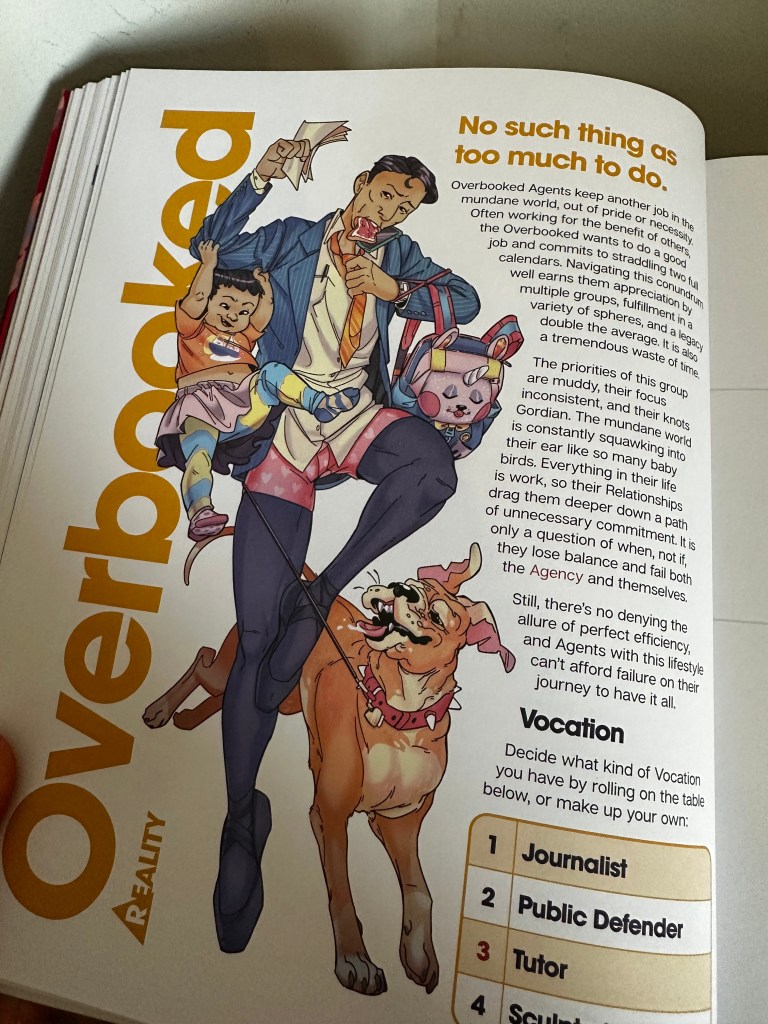
  • Overbooked – Maintains a job (Vocation) in the mundane world as well as their Agency duties. Finds it hard to maintain Relationships.
  • Romantic – constantly distracted by the building of complex relationship webs. They fall in love easily and always want to please that person.

With the Timepiece Anomaly, Overbooked seems like a suitable Reality for my Agent.

Overbooked Reality page

Overbooked provides you with a Vocation. There is a d4 table for this so I am going to roll on it. I got a 1! That’s “Journalist.” Very Clark Kent.

Every Reality gets a “Reality Trigger.” You get a work phone for one of your Relationships to call you at any time. This is for the GM to fuck with you at the worst possible time. You get a 4 box track called “Something Gives.” Every time you fail to fulfil the requirements of your Vocation or lose the phone you mark a box on the track. If you mark them all, that’s it, you’re done. You have to choose a new Reality.

Every Reality gets a Burnout Release. This is something you can do that allows you to ignore all Burnout, which is great because Burnout reduces the number of successes you score when you roll your dice pool to do stuff. In the case of the Overbooked, the Burnout Release is Threading the Needle. It means you can do anything relating to your Vocation and ignore Burnout.

Burnout is something you accrue as you attempt actions using Qualities that you have no Quality Assurances in. Sometimes you lose QAs and sometimes you just don’t have any to start with. Your Competency determines the level of QA you have in any given Quality so we’ll consider them more in the next section.

We have some Onboarding Questions here in the description of the Overbooked too. Let’s look at them:

  • What is the most difficult decision you’ve ever made?
    • A: When I decided to take the position as an Agent, I knew it would severely impact the time and commitment I could give to my Vocation as a journalist. Even though I now know I was choosing between becoming an Agent and death, I sometimes regret my decision.
  • What terrible thing will happen if you give up your responsibilities?
    • A: No-one can report the news with the same degree of integrity as I can. The world will lose a ruthless truth-teller.
  • How do you celebrate victories?
    • A: I don’t. There’s no time for celebration. It’s just on to the next story or the next Anomaly.

I feel like I really learned a lot about this character in answering those questions. Very cool.

Finally, as part of my Reality, there’s the Relationship Matrix. You get three Relationships which you must identify by answering the questions provided.

  1. Who is your other boss?
    • My editor, Sybill McPartland
  2. Who cares the most about your health?
    • Mum
  3. Who are you in charge of?
    • My rich kid intern, Hunter

I need to identify one of them as my closest Relationship. That will be my editor, Sybill. She gets 6 Connection. Mum and Hunter get 3 each.

If there were a full table of players for this, I would get three of them to portray each of my Relationships whenever a scene with them came up. These players would be chosen here. As it is, I will have to skip that step.

Competency

The final ARC piece is Competency. The book describes it as the most important aspect of your ARC (although, I have never before met a more unreliable narrator in an RPG book as the one in this section of Triangle Agency, so, you know, take it all with a pinch of salt.) Essentially, this is your role in the agency. It describes your responsibilities, code of conduct and equipment.

The available Competencies include:

  • R&D – The creatives who see what people really want and make it for them while also figuring out the universe’s enigmas
  • Gravedigger – These are the agents who are taking care of things no-one else wants to face in places they don’t want to be
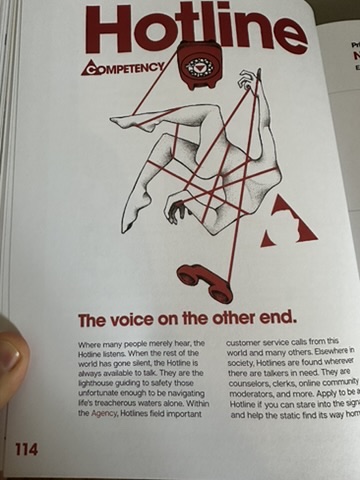
  • Hotline – An ear to listen, a guide and a customer service professional

With this character, I think I’m going to go for Hotline.

Hotline Competency page

Here’s what the Hotline gets me:

Prime Directive – Never say, “unfortunately.” If I deliver bad news to someone, I get a demerit (demerits are used to negatively affect your standing in the Agency, while commendations have the opposite effect.)

Sanctioned Behaviours – I’ll get one commendation if I

  • Help someone unburden themselves
  • Take the blame for something I didn’t do
  • Connect someone to an unexpected fate

If I do all of these on a single mission, I’ll get three extra commendations!

Initial Requisition – Hold Music, Vol. 1
A fantastical tape player the bland music of which has the power to transport the agents to a safe waiting room for up to an hour!

Self-Assessment – I have to answer the three questions presented to determine the increases I will get to particular Quality Assurances.

  1. A customer has a problem I have been unable to fix in my own life. I…
    • Share the approaches that have failed, to save them time (+3 Empathy)
  2. A customer has a broken product and a convincing story. I…
    • Pull every string necessary to get their refund (+3 Persistence)
  3. A customer’s call disconnected. I…
    • Call them back and submit an error report to IT (+3 to Professionalism)

Signature quote – “Your call is important to us. Your time is important to us. Everything you do, think, and are is important to us.” I think my Agent really takes this to heart.

Onboarding Questionnaire

The final part of character creation that I will be dealing with today. There are several more pages dealing with Competencies in detail, Requisitions, Work/Life Balance, etc. but the book insists that you leave this section until after your first mission.

The Questionnaire is a set of nine questions, the answers to which you should expect to be shared with the rest of your Field Team.

  1. How did you come in contact with your Anomaly?
  • I was TAPped for fieldwork though the Triangle Academy Program. I was approached by another field agent who must have seen some potential in me. Once I had completed the program, I was left in a glass cell with an Anomaly that looked like an old egg-timer that kept spinning in the air until it fused with my body.
  1. How did the Agency find you?
  • I found the Agency through a case I was reporting on. It was about the disappearance of a circle of trees in Trinity Park. When I went there to investigate, I discovered several field agents who were impressed with my professionalism and brought me on board.
  1. What is your Annual Salary?
  • $80,000
  1. What do you look like?
  • I’m a skinny, white guy who wears a lot of brown and beige coloured corduroy and polyester. I have thick rimmed glasses, brown hair and brown eyes. I look like I’m from the seventies.
  1. Do your powers have a unique visual manifestation?
  • I sometimes leave little piles of sand behind after using my powers.
  1. How do you take your coffee?
  • Black
  1. Who among your Relationships is your primary contact, and why?
  • My editor, Sybill, because she would be the first one to miss me.
  1. What do you bring to the table in a collaborative work environment?
  • I am a dogged investigator. When I am given a task, I will see it through to the end.
  1. Finally, please list all prior work experience and level of familiarity with Adobe, Excel and the Google suite.
  • As a journalist, I have ten years experience working with all aspects of adobe software and most of the Google suite although I rarely use Excel for anything other than lists of things. Don’t ask me about formulas.

Two last things, I gave him the pronouns, he/him and the name Mark Dent for some reason.

Here’s the first page of the form fillable character sheet for Mark Dent:

The character sheet of Mark Dent

Conclusion

This was a fairly involved process but one that got me thinking quite deeply about the type of person this Agent is and not just the type of character he is, if you see the distinction. I really liked doing it actually. I loved reading about the various Anomalies, in particular. If I was actually about to be a player in a game of Triangle Agency, I’d be eager to get to use them too!
I feel like I learned a lot about how the game would be played as well. So, mission accomplished in that respect.

Dragon Age Character Creation

Dragon AGE

I’ve recently been playing through Dragon Age Origins again. It’s been a long time since I have played that particular game although, I have played a lot of Inquisition and even Dragon Age II since then. Playing Origins has put me in a nostalgic frame of mind but also, I thought it might be a good incentive to try something new, TTRPG-wise. The Dragon Age RPG has been out for some time, about ten years I think. Green Ronin published it and it is based on the AGE (Adventure Game Engine,) which is maybe better known for being used by their Fantasy AGE game. I got both of those on a Bundle of Holding years ago but have never even gotten around to reading them. So, I asked in the Tables and Tales discord if anyone would be interested in trying the Dragon Age RPG and I was surprised and delighted to discover that I am not the only DA fan in the community!

If I needed an excuse, I could also say this is all in preparation for the new DA game, “Veilguard,” which is due out soon. But, honestly, it has more to do with replaying the old game than waiting for the new one.

Anyway, I have had some decent success in getting to know new systems by creating characters on here in recent posts, so I thought I would do that again today. Off to Thedas with us!

The steps

So, I am doing this using the Dragon Age RPG Core Rulebook published in 2015. I have it in PDF format. I would like to start by praising it for having a comprehensive set of internal links from the table of contents. For a book of over 400 pages, this is invaluable.

So, what are the steps to creating a Dragon Age character? Having a quick look at them, there are similarities with the video games but with some flourishes and differences presented by the AGE system.

A screenshot of the Dragon Age Character Creation Steps table from the Daraon Age RPG core book. The table includes the 8 steps you need to complete to create a PC for the game.

As you can see from the screenshot, the first step is coming up with your character concept. I quite like this as a starting point, although, I do wonder if it might be rather a tall first hurdle for some players. I often find myself coming to know the concept of my characters in other games during the process of creating them. But, let’s give the game and its designers the benefit of the doubt and go with it.

1. Step 1: Character concept

This section in the book urges you to go and read through Chapter 7: Welcome to Thedas, if you’re not terribly familiar with the setting, and maybe haven’t played the video games. Now, chapter 7 is almost fifty pages long and covers everything from the major nations and races to the cultural significance of the Dwarven Paragons. You would want to be pretty invested in the game before you ever start to read that whole thing, as interesting and even pleasurable as it might be to do so (the writing is not bad but the illustrations are very good indeed.) As I have played through all the games multiple times, and even stopped to read all the books I picked up off bookshelves and desks as I played, I feel like I am already well enough equipped to get away with not reading it before embarking on the character concept step here.

  • An adventurous youth who has finally found a way to escape their home.

That’s it, that’s the concept. I will say, I don’t think a thorough knowledge of the game’s setting is required to make this sort of thing up. Most of the example concepts they provide in the book are vague enough that they could belong in any traditional fantasy setting, in fact.

Step 2: Determine abilities

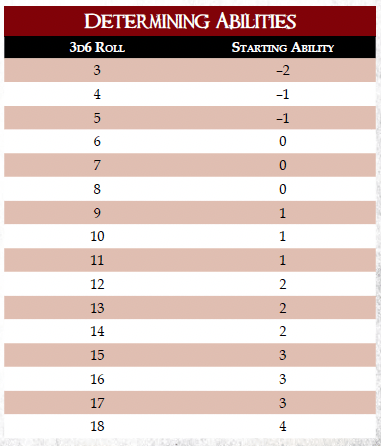
You’ve got a whopping eight abilities in this system: Communication, Constitution, Cunning, Dexterity, Magic, Perception, Strength and Willpower. Other than Perception and Communication these match up pretty well with the stats in Origins. We are rolling 3d6 for each one of these and then we record the modifier from the table below, not the sum of the dice, much like your average Borg game.

A screenshot of the Determining Abilities table from the Dragon Age RPG core book. It is a 3d6 table, which indicates what your starting ability score will be depanding on your roll. It goes from -3 to 4.

Communication: Rolled an 8 so that’s a score of 0
Constitution: Rolled a 13 so that’s a score of 2
Cunning: Another 13 for this one, so, 2 again
Dexterity: That’s a 10, which equates to a 1 on the table
Magic: I rolled a 12, so that is 2 yet again
Perception: Not wonderful. That’s a 6, which is another 0
Strength: A below average 9. Still, it gives me a 1
Willpower: That’s a 7 on the dice. And that gives me my third 0

The book does give options to either roll the scores and assign them to abilities as you see fit, or to do use point buy system instead. But, I think I will continue the tradition of randomising the process that I started way back in the OSE character creation post.

Step 3: Backgrounds

So, in this game, your choice of background also determines your race and has some pretty major mechanical effects, as well as the obvious cementing of your character concept from earlier. Here are the effects they generally have:

A screenshot of the list of features a PC's Background gives them in the Dragon Age RPG. These include ability score increses, ability focuses, race, class choices and languages.
A screenshot of the list of features a PC’s Background gives them in the Dragon Age RPG. These include ability score increses, ability focuses, race, class choices and languages.

Now, the book says nothing about rolling for your background randomly. In fact, I believe it encourages you to choose based on your original character concept and the ability scores you rolled. But I’m not here to play by the book (actually, that’s not true, really. I just enjoy the thrill of the roll!)

So, there are a total of thirty, 30, backgrounds (!) in the core book. It just so happens that I have a 30-sided die thanks to my flirtation with Dungeon Crawl Classics. So here we go!

That’s a 28! This means my character’s background will be:

Tevinter Laetan

And that is pretty cool! So, it means that I will necessarily take the mage class as the Laetans in Tevinter society are magic users from the mundane classes who are identified at a young age and trained to serve the Imperium. It fits quite nicely with my character concept, too. I can imagine a young Tevinter mage, disillusioned with the unfair system under which their own class of people toils while the upper class mages reap all the benefits. Not to mention the binding of so many elven slaves in general society.

Here are the benefits gained from this background.

  • +1 to Cunning – this makes my Cunning score 3 now!
  • One ability focus, either Communication (Deception,) or Cunning (Arcane Lore) – I rolled again on a d2 for this and got Cunning (Arcane Lore)
  • Languages – Tevinter and the Trade Tongue
  • Take the Mage class
  • Roll twice on the Tevinter Laetan table:
The Tevinter Laetan Benefit table from the Dragon Age RPG core book. It is a 2d6 table. Depending on wht you roll you will get a particular benefit such as +1 Consititution, Focus: Communication (Deception) and +1 Magic.

First roll – 11 Focus: Cunning (Cultural Lore)
Second roll – 9 Focus: Communication (Persuasion)

Step 4: Classes

A screenshot of the page from the Dragon Age core book that describes the Mage class. It includes an illustration of a femme human in red robes with long blonde hair, a staff with a blue stone on top, three bluish potions at her hip and some magical enegy emanating from her outstretched fingertips.

This game, much like the video games, only has three classes:

  • Mage
  • Rogue
  • Warrior

But within these classes you have a selection of specialisation options. I often wonder that there is no Priest class in this relatively traditional fantasy world. They gave the healing duties to mages and that is one specialisation option you can take as a mage. You can’t take Bard as a class but if you are a Rogue, you can choose to specialise as a Bard. And Barbarian isn’t an option in the Class list, but Warriors can go down that sort of route if they want.

Anyway, all that is academic as I am required to choose the mage class due the background I rolled.

The Class section starts off with an explanation of the broadness of the classes as I said above and then tells us a little about character advancement. You start at Level 1 and can get up to Level 20. There are options for XP and milestone leveling and it explains how you improve with a new level. Suffice it to say, ability score improvement is one of the main ways you gain in power, but you also get more Health, new ability focuses (which I don’t understand yet,) new class powers and “stunt points” (which I also don’t understand yet.) I just know you start with 6 Stunt Points. Everybody does.

It’s important to note that you don’t get a specialization until level 6.

As a mage, my character starts with three spells but can’t wear armour or use many types of weapons.

They have three Primary Abilities (as do all classes.) For a mage that’s Cunning, Magic and Willpower. The first two are not bad for me but that last one is a 0. Oh well.

All the others are Secondary Abilities.

Starting health is 20 + Con + 1d6. I rolled a 5 so that means it’s 27! Not too shabby.

My Weapon Groups are Brawling and Staves.

At Level 1, my Class Powers are

  • Arcane Lance, which means I can send a burst of magical energy from a staff
  • Magic Training allows me to cast spells. Here are the spells I’ve got:
    • Arcane Bolt
    • Arcane Shield
    • Daze
  • Mana Points. I start with 10 + Magic + 1d6. That’s a 4 on the d6 so a total of 16.
  • Starting Talent. I choose one talent from Chirurgy, Linguistics and Lore. Can’t get Chirurgy because it has a requirement that I don’t have. Gonna go for Lore, which seems the most generally useful.

Step 5: Equipment

You don’t get a lot to start with to be honest. I’ve got a backpack, some traveling clothes and a water skin as well as a staff and another weapon. I can only use staves or Brawling weapons. The Staves group includes clubs and morning-stars, I guess I’ll take a morning star then!
I also get 50 + 3d6 silver pieces to buy other gear. I rolled 10 on the 3d6. So that’s 60 silver.

I guess I’ll pick up a bedroll for 10 sp and a blanket for 6 sp. I’m not going to get into any more shopping right now.

Step 6: Defense and Speed

Your Defense score is, unsurprisingly, a measure of how hard it is to hit your character. It is 10 + Dex + Shield Bonus (if you have one.) So, that’s an 11 for me.

You can move up to a number of yards equal to your Speed when taking move actions. For a human, that’s 10 + Dex – Armour Penalty. I don’t have any armour so that’s not an issue. So essentially my Speed and Defense are the same, 11.

Step 7: Name

They have a long list of sample names in the book. Not just for Dwarves, Elves, Qunari and Humans but for the full variety of cultures and backgrounds (actually this mainly applies to the various human cultures) that they might come from. First, I need to decide what this character’s pronouns might be. I think I will go with he/him this time. As a Tevinter character, I can choose from some pretty cool names, including Dorian, Florian and Ether. But I have decided to go with Amatus. Amatus the Tevinter Laetan Mage.

Step 8: Goals and Ties

I like that they have included this step in character creation. Just go and take a look at my Motivation post to see why I think that, at least about Goals.
Anyway, I have to pick three Goals, a mix of long a shorter term ones.

  • Find the only friend I ever knew, an Elf named, Adanna, who was once a slave who belonged to his family in Tevinter, but escaped to Ferelden a year ago.
  • Try to make a name as an adventurer in Ferelden while staying out of the hands of the Templars.
  • To earn some coin and find some companions.

The other part of this is the Ties part. Now this specifically refers to other PCs. Since I don’t have any of those, I’ll have to skip that part.

I think I will have to do another post on the general AGE system and particularly how it relates to this game as there are still several elements that are a mystery to me but I feel like I have gone on long enough for one post.

Character Creation – Advanced Dungeons & Dragons 2nd Edition, Dark Sun, Part 3

Rezina carried over

Here’s what we’ve got so far, mainly from the post two days ago. The only thing I managed to do yesterday, pretty much was spend an inordinate amount of time waffling about all the classes and finally, roll a die to find out which one she was going to be. Turned out, it was Illusionist:

  • Name: Rezina
  • Pronouns: she/her
  • Race: Halfling
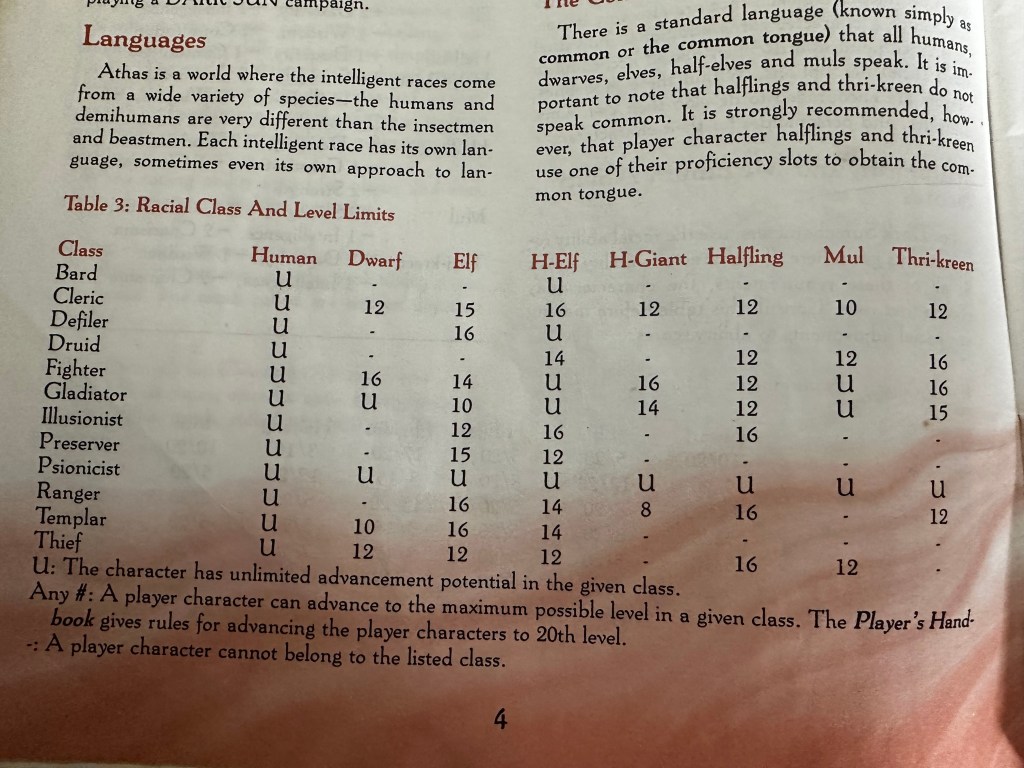
  • Class: Illusionist
  • Ability Scores:
    • Strength: 11
    • Dexterity: 18
    • Constitution: 18
    • Intelligence: 17
    • Wisdom: 18
    • Charisma: 9
  • 3ft 3in tall
  • 59lbs in weight
  • 41 years of age

Let’s move this along, shall we?

So, let’s get her sorted, remembering that she starts at 3rd level. I found a form-fillable AD&D 2nd Ed character sheet online so I am going to go down through that, addressing each element I need to consider since neither the PHB nor the Dark Sun Rules Book have anything so prosaic as a step by step guide on character creation.

Preserver or Defiler?

As it turns out, the first thing to decide is not on the character sheet which was meant for a more generic setting.
I like our little Rezina and I don’t think it would be in keeping with the Halfling culture to have her defiling the land with her spells so I am going to make her a Preserver for the purposes of casting spells.

Alignment

I’ve always liked the Chaotic Good alignment and it seems to fit our little Preserver Illusionist, in that she doesn’t ascribe to the rules and laws of the sorcerer-kings and she would rather project benevolence both onto and into the world around her.

Patron/Deity/Religion

Not Applicable in this setting

Place of Origin

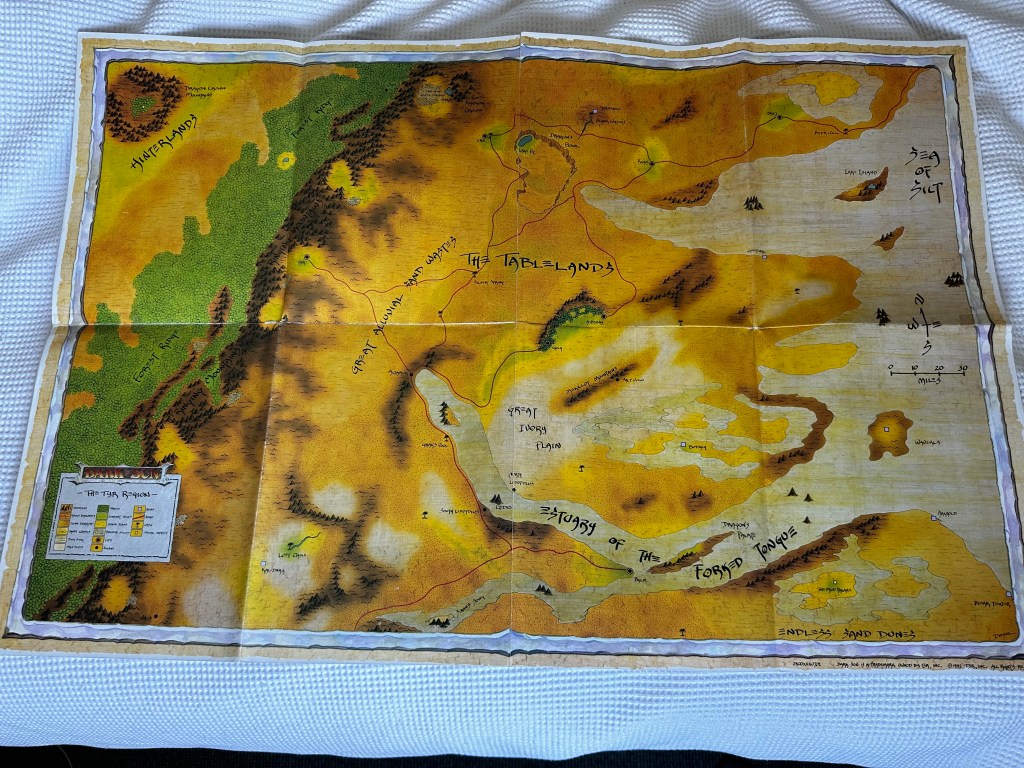
A photo of the map of the Tablelands from the AD&D 2nd Edition Dark Sun Boxed Set.

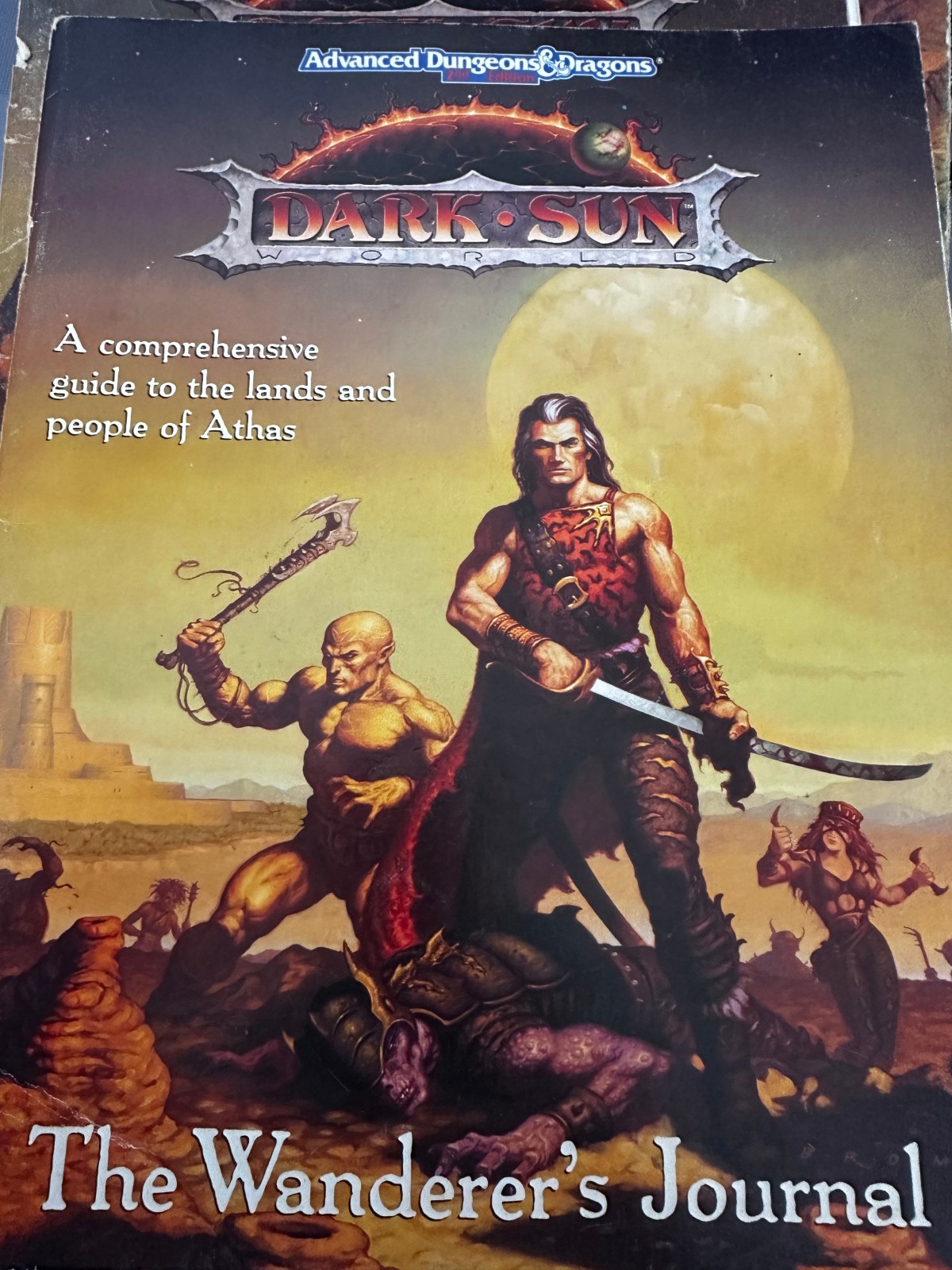
Traditionally, the Halflings of this region of Athas come form the Forest Ridge off to the west of the map, beyond the Ringing Mountains. Now, looking at the description of the Forest Ridge in the Wanderer’s Journal, the setting guide that comes in the Dark Sun boxed set, I can see where I got the idea that Halflings were cannibals. Travellers in the forest need to watch out for being ambushed and caught by Halfling tribes. If presented to their king, he is likely to eat them alive! Anyway, this is where Rezina is from. Why has she made her way to the Tablelands? Perhaps she heard about the reputation of the secret Preserver’s organisation, the Veiled Alliance, and wanted to join.

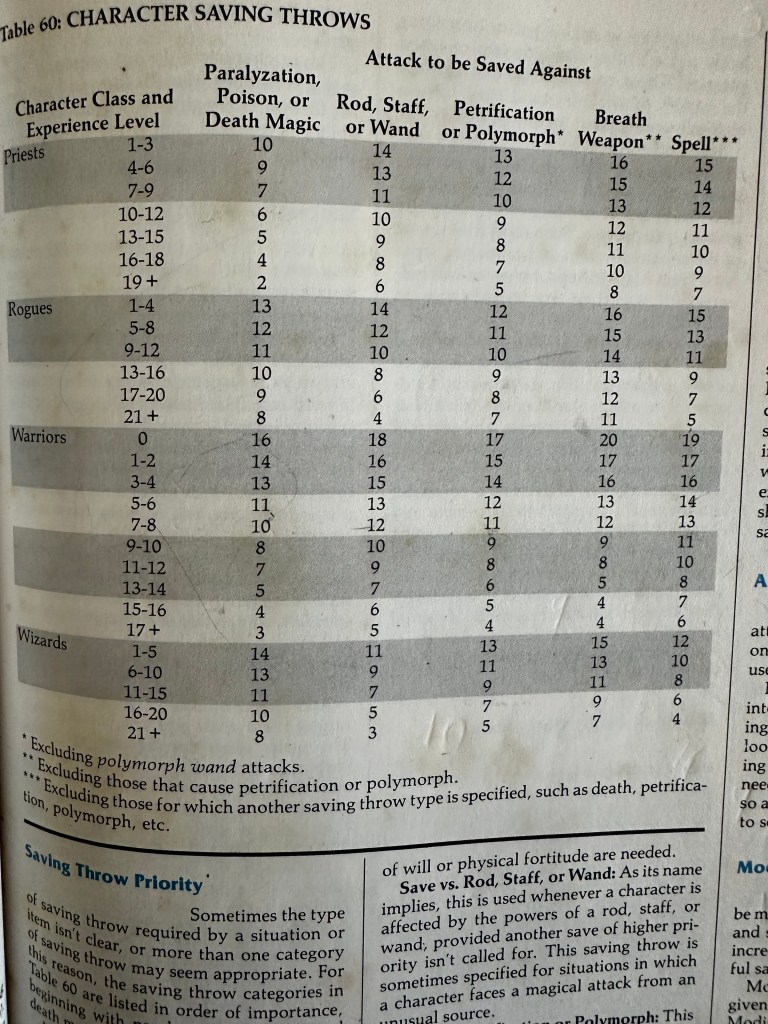
Saving Throws

A photo of Table 60: Character Saving Throws from the AD&D 2nd Edition Player’s Handbook.

Technically, the next thing on the sheet would be the ability scores but I have covered those completely so I am moving on to Saves.
The Character Saving Throws table is unreasonably hard to find. They have stuck it in the Combat chapter, instead of the Character Creation one. Bonkers. Also, it’s so complicated. Why? Whyyyyy?

Anyway, she is a Wizard of sorts so these are her base Saving Throws at 3rd level:
Paralyzation, Poison or Death Magic: 14
Rod, Staff or Wand: 11
Petrification or Polymorph: 13
Breath Weapon: 15
Spell: 12
But she also gets +1 against rods, staves, wands, spells and poison for every 3 1/2 points of CON… so that’s an extra +5 for Rezina.

Armour Class

No armour allowed for our Illusionist, but, with DEX 18 she gets a -4 modifier, leaving her with a respectable base AC of 6, but a Surprised AC of 10, a Shieldless AC of 6 and Rear AC of 10.

DEX checks, vision checks, hearing checks

There is a section beside AC on this character sheet that includes these three things. I have no memory of these scores or modifiers and I am not sure where to look to find them (the index does nothing.) I will fill in the DEX Checks one with a +2, though as it seems to make sense as a reaction adjustment so save against falling or something similar. Moving on!

Hit Points

I rolled a 4, a 4 and a 3 on my 3d4 since she is 3rd level and added 6, +2 from her Constitution each level, to make 17.

THAC0

To Hit Armour Class 0. The most arcane thing about this complicated process, perhaps? Anyway, all Wizards of 1st to 3rd level have a THAC0 of 20. So, Rezina needs to get a modified attack roll of 20 to hit something with AC 0. Thankfully, this PDF calculates all the rest of the table for you!

Combat Modifiers

Once again, as a type of Wizard, Rezina has a non-proficiency modifier of -5 to an attack roll. That means that using a weapon she is not proficient, she is much less likely to hit.
But she does have a +1 to hit with slings (her one weapon proficiency) and thrown weapons.
She has no damage bonus due to her 11 STR and she has a -4 to AC from her DEX as stated earlier.

Weapon Combat

I mapped out here the details of the sling and her chosen ammo, the sling stone. She gets one attack with it per round, it’s size is small, has a speed of 6 (this has an affect on your initiative score), it has the blunt damage type, she has a +1 to hit with it, it does 1d4 damage and finally it has short/medium/long ranges of 4/8/16. There is so much to note and keep track of here it is honestly bewildering. Glad I didn’t get a class with more than one weapon proficiency, honestly.

Proficiencies

So, these are the non-weapon proficiencies and include languages. My INT 17 gives me 6 slots to play with. On top of my free language, Halfling, I took two more, the common tongue and Gith, the tongue of the desert raiders. I also took some Dark Sun specific ones, Somatic Concealment allows spell-casters to hide the somatic components of their spells. Being an unsanctioned wizard in one of the city-states is a dangerous business you see. Heat protection seems important to survival in this setting. Sign language looked for someone who is potentially part of a secret rebellion. Finally, boring old Reading/writing from the

Equipment

Money is a bit different on Athas compared to other D&D settings. Metal is incredibly rare here so the most common coin is the ceramic piece, which can be further broken Doen into ceramic bits. 1000 ceramic bits = 100 ceramic pieces = 10 silver pieces = 2 electrum pieces = 1 gold piece = 1/5 platinum piece.

A Wizard starts off with 1d4+1 x 30 cp. Of course I rolled a 1 so that’s 60 cp. yes. Not a lot to start with.

According to the Dark Sun Rules Book nonmetal items cost one percent of he price listed in the PHB and all metal items cost the price listed. This puts most metal items out of my price range. But at least a sling is affordable along with a few stones.

But this exchange rate means the price of the sling, 5cp in the PHB, would be 1/2 a ceramic bit so this is kind of a pain. I will round it up to one bit. And get 100 stones for another bit.
Down to 59cp and 8 bits. I’m also going to buy a fire kit for 2 bits, a tun of water for 1 sp (10cp,) a common robe for 1cp, some sandals for 5 bits, a backpack for 2 cp, a small belt pouch for 1cp, 50ft go hempen rope for 1 cp and a week’s worth of dry rations for 10cp. I’ve rounded up or down here or there because the maths was doing my head in. But, basically, I’ve got 34 CP and 1 bit left after that.

Movement

As a Halfling, Rezina is not the fastest thing on two legs. Her movement is 6, this means she can move 60 yards in a single round. In this game, a combat round is approximately one minute long. WTF? I did not remember that. That seems like a huge gulf of time! I think the current rules in 5E have a round at like 6 seconds. So, ten times less. Anyway, her movement rate of 6 means she can also walk 12 miles in a day.

Encumbrance

Just no. Honestly, I couldn’t be bothered with it in 1991 and I can’t be bothered now.

Character Class information

Special Powers/benefits

  • Wizard spells
  • 10% bonus to XP due to INT 17
  • +1 to saves against illusions
  • enemies have -1 to saves against my illusions
  • Extra illusion spell at each level
  • Easier to research new illusion spells (I don’t know how this works exactly)

Special hindrances

  • Harder to research new non-illusion spells
  • Cannot learn spells from the schools of necromancy, invocation/evocation or abjuration

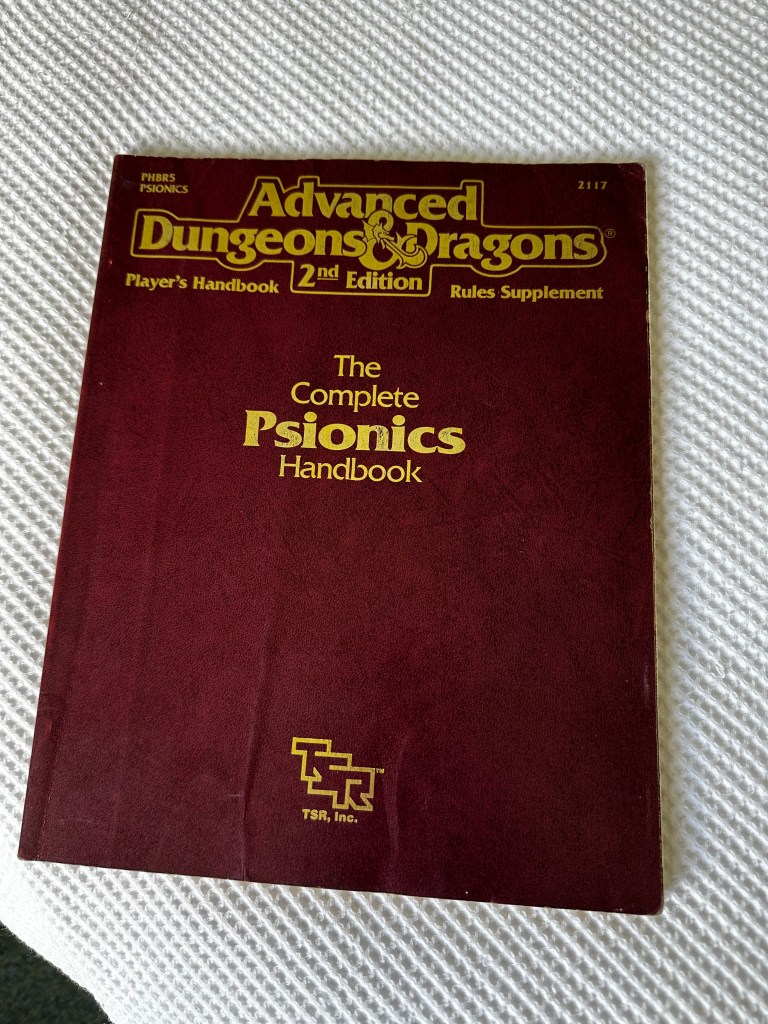
Psionics

A photo of the front cover of the Advanced Dungeons & Dragons 2nd Edition of the Complete Psionics Handbook from TSR.

All characters in Dark Sun have a psionic wild talent, a minor or major power that they get for free! I’m going to roll on the Wild Devotion table in the complete Psionics Handbook to see what I get. I rolled a 100! Unbelievable. What that means is that I get to choose any devotion (minor power) from the table and then roll again on the Wild Science (major power) table. I think I will choose Flesh Armour for my squishy Illusionist from the Wild Devotion table and then I roll a 36 on the Wild Sciences table, which gives me the Death Field psychometabolic power. This power is going to gradually turn Rezina evil. Oops. It costs 40 PSP and, when I sacrifice a certain number of HP, everyone else I the filed loses the same amount if they fail their save v Death. Flesh Armour has a table you have to roll on when you use the power. That determines the level of armour you get from it. It costs 8 PSP.
AS for Psionic Strength Points, Rezina starts with 31 thanks to the table in the Complete Psionics Handbook where it’s based on her Wisdom score and modifiers from CON and INT. This of course means that she will never be able to use Death Field…

Wizard Spells

Finally, onto spells. My Illusionist has three 1st level and two 2nd level spells. And here they are:

  • Colour Spray – Blinds creatures
  • Change Self – self explanatory really
  • Audible Glamer – can make a noise equivalent of that made by 4 men…
  • Blur – gives enemies penalties to hit her
  • Invisibility – makes you invisible, dunnit

Conclusion

When I went into this, I thought I would get through it in a couple of hours. Here I am, three days later, and I finally have a fully formed Dark Sun Halfling Illusionist PC. It is not an easy process. It is very difficult to find all the information you need to make your character. I had to use at least three different books and had to go searching through them to find things like Saving Throw and THAC0 tables that should be easy to find. I ended up with a character I would happily play but was it worth it? Honestly, I’m not sure. It was educational alright. It taught me that it might be not such a great idea to try to start up a new Dark Sun campaign using the old Ad&D rules, for certain.

What do you think of this whole process? Do you enjoy a protracted character creation process? If you were one of my players, would you want to go through all this?

Get in the comments!

Character Creation – Advanced Dungeons & Dragons 2nd Edition, Dark Sun

Showing some character

So the character creation posts have had some good feedback. People mainly seem to like it when it goes disastrously wrong for some reason. Schadenfreude maybe? Anyway, I thought I would continue the series with another one. This time, I thought I would go back to the game I think of when I think of my teenage years, AD&D 2nd Edition (TSR 1989), and, more specifically, the Dark Sun setting (TSR 1991). I have never been a player in a Dark Sun game, I was always the DM, so this will be interesting. Also, Dark Sun characters need to be pretty hardy to survive the scorching wastes of the magic-blasted world of Athas. So, if I roll bad, you sadists out there should get a kick out of it.

Step 1 – Ability scores

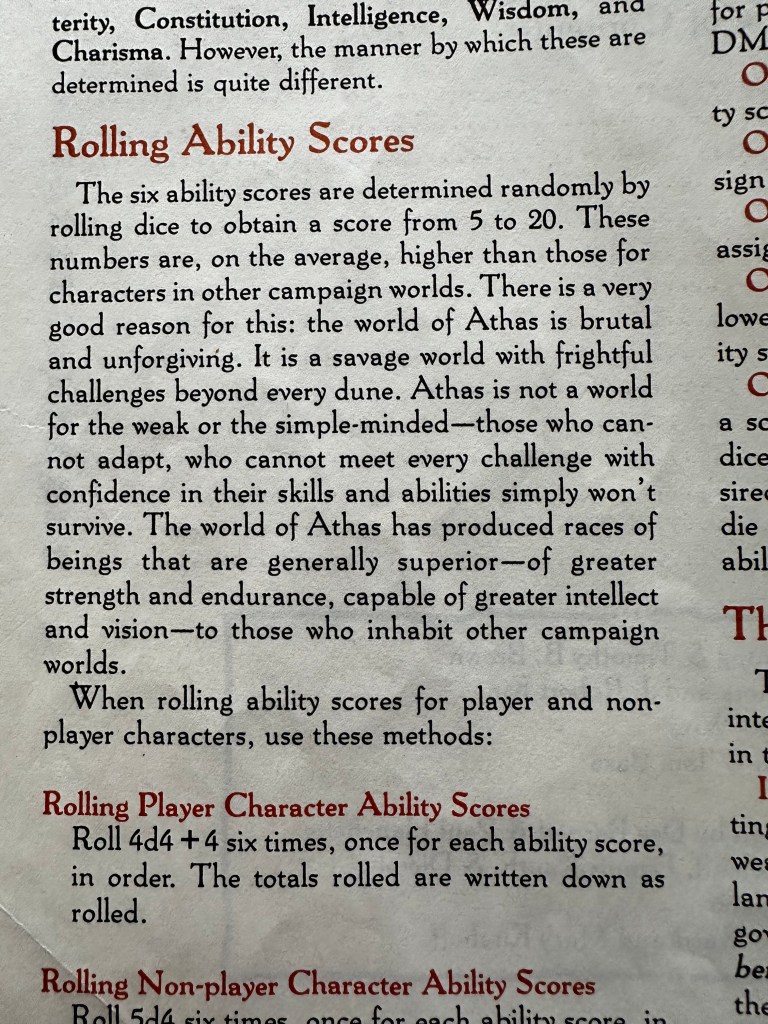
A photo of the “Rolling Ability Scores” section of the AD&D 2nd Edition Dark Sun Rules Book.

We see an immediate departure from AD&D norms with rolling your ability scores in Dark Sun. Because the setting is so brutal, your PCs get higher than average scores to reflect the hardness of life there. So, instead of the usual 3d6 for each score, you roll 4d4+4 for a minimum of 8 (even though the book claims the minimum is 5, which is numerically impossible) and a maximum of 20, unmodified. There are a bunch of optional methods for rolling included in the Dark Sun Rules Book but I am going to stick with the basic one. So, here we go:

  • Strength: 13
  • Dexterity: 16
  • Constitution: 19 (Suck it Canon Fodder)
  • Intelligence: 17
  • Wisdom: 16
  • Charisma: 10 (Oh well, they can’t all be winners)

First thoughts; obviously this method produces some high results. Also, I was very lucky. Also, these rolls mean that this character could choose almost any race or class.
Second thoughts; now that it comes to it, this is one of the reasons my players really liked this setting. They got to create some very powerful characters, even without cheating on their rolls (which was, I must be honest, the norm at the time)!

Step 2 – Player character race

A photo of Table 3: Racial Class and Level Limits from the AD&D 2nd Dark Sun Rules Book.

There are Racial Ability Requirements in this setting as there are in the base game, but some of them are very tough to achieve. The only one I think is ruled out is the Half-giant. If you want to be one of those big lads, you need to have a minimum strength score of 17. So here are the races I get to choose from:

  • Dwarf
  • Elf
  • Half-elf
  • Halfling
  • Human
  • Mul
  • Thri-kreen

Pretty much none of the races in Dark Sun bear any resemblance to the standard D&D ones, with the possible exception of bland old humans. There are also a few new ones here.

Dwarves are all hairless and obsessed with a focus that gives them bonuses to saves and proficiencies when performing them in pursuit of that goal. They can choose to be Clerics, Fighters, Gladiators, Psioicists, Templars or Thieves. Although all of these have level caps below 20 except for Gladiator and Psionicists. Some of them are really low. A Dwarf can only get to level 10 as a Templar for instance! But they can multi-class. They get a +2 to CON, +1 to STR, -1 to DEX and -2 to CHA.

Elves are tall and lanky and weather-worn with an incredible stamina needed for running long distances across the Athasian deserts. They are very insular and tribal. They get bonuses with long swords and longbows made by their own tribes and to surprise rolls in the wilds. They can choose to be any class except Bard or Druid. They get +2 to DEX, +1 To INT, -1 to WIS and -2 to CON.

Half-elves have to deal with terrible intolerance from both elves and humans and have to do without basic connections or friends (this shit is in the text, ugh.) Anyway, it makes them very much self-reliant loners. They get a free Survival proficiency at 3rd level and can make a pet friend at 5th level! All classes are open to them and they get to multi-class if they want. They get a +1 bonus to DEX and a -1 to CON.

Half-giants are a thing in this setting. And, although I can’t choose them, here is a little bit about them. They are up to 12 feet tall and weigh up to 1600 lbs! They have no culture of their own as a very young and dull-witted race. Once again, the text is pretty bad about this kind of thing. It really underlines for me the need for the push-back this sort of thing rightly received in more recent times. Anyway, they getting bonuses to STR and CON and minuses to INT, WIS and CHA. They can only choose from 5 classes.

A photo of the Halflings section of the AD&D 2nd Edition Dark Sun Rules Book including an illustration by Brom depicting two tattooed halflings with long, wild hair emerging from a cave.

Halflings are small humanoids from the jungles at the fringes of civilisation in the Tablelands of Athas. Their culture is concerned mainly with appreciating their local natural world and complex interactions of a social sort between their various villages and clans. They are not really into war and wealth. They get bonuses to use slings and thrown weapons, to surprise opponents and to save against magic and poisons. They get a -2 to STR, -1 to CON, -1 to CHA, +2 to DEX and +2 to WIS. They can choose any class except Bard, Defiler, Preserver and Templar. They can choose to multi-class.
As a side note, I had a memory of Halflings all being cannibals in this setting but it is not mentioned in the character creation section so it might have just come up in certain adventures or something. Not sure.

Humans are much like humans in other settings except they generally have some weird little traits, like mutations. This is a post-apocalyptic setting after all. So players are given latitude to come up with some little physical idiosyncrasy that is purely for flavour. They can choose any class and can be dual-class, but cannot multi-class.

Muls are yet another “half-race.” Its genuinely so distasteful, this whole business. Anyway, here we are, they are half human, half dwarf. They are the product of slave-owners “ordering their births” for gladiatorial or labourers. They are born sterile. FFS. My stomach truly turns at this description of this race. It’s just so cruel. They also “live out their lives in servitude, driven by hatred and spite.” Give them a break! They are tall and well built. They get a +2 to STR and +1 to CON, but a -1 to INT and a -2 to CHA. They can work longer and harder than others as well. They have to choose, at the time of creation if they are considered human or Demi-human. If considered human they can have unlimited advancement in any class and become dual-classed. If the player chooses demi-human, they can, instead become multi-classed and can only choose from Cleric, Druid, Fighter, Gladiator, Psionicist and Thief. This really puts a great big question mark over the entire idea of class restrictions on Demi-human races, if you ask me. This suggests that the reason a demi-human can’t choose any class or get all the way to 20th level in it, is not because of a physiological, racial impediment, it’s only because human society says they can’t… I mean, what?

Finally, Thri-kreen. They’re big mantis guys who have a base AC of 5 but never wear armour. They don’t need to sleep but they can’t use most magical items as they are generally designed for use by human shaped people. Their hunting packs control much of the Tablelands. They have a well-known taste for elves (maybe I was mixing up the Thri-kreen and the Halflings.) They get natural bite and claw attacks and a powerful leap. They get venomous saliva at 5th level as well as a bonus proficiency with the Chatkcha, a thrown weapon. They can also dodge missiles at 7th level. They get a +1 to WIS and +2 to DEX, but -1 to INT and -2 to CHA. They can choose to be Clerics, Druids, Fighters, Gladiators, Psionicists or Rangers and they can multi-class too.

This post is already much longer than I had intended. I started going through the races and couldn’t stop commenting on them. It was like watching a car-crash in slow motion.

Anyway, I think I will have to continue this character creation process in another post tomorrow. But, before I go, I think I will have to complete the choice. Obviously, as always, the race you select will have a direct effect on the choice of class due to the ability score modifiers. But, since we have a tradition of randomness in the character creation posts, I think I will stick with it and roll for it. There are seven races available to me and, luckily, I do have a d7 to hand thanks to DCC. Here goes:

I rolled a 6 on a d7, dear reader, but I just can’t accept it because that would have been a Mul and that makes me too sad. So I re-rolled and got a 4, Halfling!

So, that leaves me with ability scores as follow:

  • Strength: 11
    • Hit probability: Normal, Dmg Adjustment: None, Weight allow.: 40lbs, Max press: 115lbs, Open Doors: 6, Bend Bars/Lift Gates: 2%
  • Dexterity: 18
    • Reaction Adj.: +2, Missile Attack Adj.: +2, Def Adj.: -4
  • Constitution: 18
    • HP Adj.: +2 (+4 for Warriors. This means Fighters, Rangers and Gladiators in Dark Sun), System Shock: 99%, Resurrection Survival: 100%, Poison Save: 0, Regeneration: Nil
  • Intelligence: 17
    • # of Lang: 6, Spell Level: 8th, Chance to learn spell: 75%, Max. # of Spells/Lvl: 14, Spell Immunity: –
  • Wisdom: 18
    • Magical Def Adj.: +4, Bonus Spells: 4th, Chance of Spell Failure: 0%, Spell Immunity: –
  • Charisma: 9
    • Max # of Henchmen: 4, Loyalty Base: 0, Reaction Adj.: 0

The final task for today is to flesh out this Halfling a bit. I am giving her the pronouns she/her and calling her Rezina.

A page from the AD&D 2nd Edition Dark Sun Rules Book showing the Height, Weight, Age and Aging Effects tables for PC races.

She is 3ft 3in tall, 59lbs in weight, and 41 years of age.

Back tomorrow with the choice of class and probably everything else. See you then!

Trophy Gold – Character Creation

Old school play, new school rules

I have a post in which I write a little about a couple of the podcasts that most inspire me to play and write about RPGs. One of them is Fear of a Black Dragon from the Gauntlet. In it, Tom and Jason review a different OSR module each episode (more-or-less.) What I discovered early on, while listening to it was that they often did not use OSR rulesets to play the modules. Instead, they usually used Dungeon World, World of Dungeons or Trophy Gold. These are much more modern RPGs and, I think, they tend to use Powered by the Apocalypse and Forged in the Dark style rules. I have only just picked up Trophy Gold in the Codex-Gold magazine published by the Gauntlet back in 2019. So, I thought I would have a go at creating a character in this much more rules-lite game (compared to OSE anyway. To see how character creation went in that, go take a look at yesterday’s post.)

About the game

Essentially, Trophy Gold is doing the same stuff as Old School Essentials or D&D for that matter. It allows you to play an adventurer or treasure seeker who is drawn to dangerous, forbidden or haunted locales. The locales will push back. Unlike its predecessors, Trophy and Trophy Dark, which were made to play one-shots and tended towards the horror genre, Gold is more geared towards campaign play. It just doesn’t worry so much about your encumbrance or confuse you with bonuses that are actually negatives. It uses elements of Forged in the Dark games in its ruleset. It is described thus in the opening paragraph:
“Trophy Gold is a collaborative storytelling game about a group of treasure-hunters on an expedition to a haunted environment that doesn’t want them there.”

Character creation

So your character is called a Treasure Hunter in this game. This is because treasure is the aim of it. Your character is there to emerge from the dungeon or forest or ruins with heaps of Gold. But is it worth it? Will they even survive it?

A blank Trophy Gold character sheet from Codex Gold magazine, 2019, The Gauntlet.

Step 1 – Choose your Name, Occupation and Background

So, in direct opposition to OSE, we are starting with our name. I like this since, we all get named long before we know anything about ourselves, don’t we? The rules include tables for names, occupations (what you do in the party) and backgrounds (what you did before your treasure hunting days) So I am going to use them.

  • Name: Valen
  • Occupation: Smuggler. Skilled in dexterity, spontaneity, stealth
  • Background: Retired Soldier. Skilled in tactics.

The rules encourage you to think about your background profession, why you left it and why you can’t go back. As a retired soldier, I think Valen has tired of killing at the behest of others. He left to put his skills to work for his own enrichment instead. He could never go back to taking orders now that he has tasted independence.

Step 2 – Choose your Drive

This aspect has an element of Blades in the Dark peeking through. Each character will have their own motivation for treasure seeking and I am going to roll on a table for it. But first it explains that you can stash the gold you earn from it in your Hoard. Once you get to 100GP, you can retire your treasure hunter. Blades in the Dark has a similar conceit where you get to hide away your coin in a stash until you have enough to comfortably get out of the game for good.
So, here’s my roll:

  • Drive: Free the serfs of Bandung Prefecture

So, I don’t know where Bandung Prefecture is but it has fired my imagination. Perhaps my ex-soldier, while on a recent excursion to Bandung, discovered a village where the people were down-trodden and despairing due to the conditions caused by their lord’s treatment of them. There Valen met a man, a former soldier, who reminded him of himself to such an extent that he felt as though saving him and bringing down the cruel and selfish lord was essential. He just needs some funds to raise a rebellion.

Step 3 – Backpack Equipment and, if desired, Combat Equipment

There is an interesting approach to equipment here. You have three different categories, Backpack, Combat and Found equipment. You can roll on a table to see what your backpack starts with or you can choose from the table if you want stuff that suits your character. Importantly, your backpack starts with three items and three free slots. If and when you need something in a given situation, you check the table of Additional Backpack Equipment presented in the rules, and, if what you need is there, simply say it is occupying one of these slots. Then you write it down and mark off another slot. This reminds me of the loadout rules in blades in the Dark. These state that, when you are going on a score, you decide if you take a light, medium or heavy loadout. This determines how many items you can carry and also how much you stand out. But, importantly, you don’t have to say exactly what your items are until you need them in the fiction.

Anyway, I’m going to roll on the table for my

  • Backpack Equipment: Fishing net woven of silver (!), Bottles, lead (6), Magnet

When it comes to choosing Combat Equipment, there is another rule that comes into play. That is Burdens. You start the game with a Burdens score of 1. That’s the amount of Gold you need to keep yourself on a day-to-day basis in between incursions (that’s what Trophy calls adventures.) However, it increases for every piece of Combat Equipment you choose. It will go up further as you are playing too. What an interesting mechanic this is! Yes, your armour will hale to keep you alive on an incursion but you have to spend money to repair and maintain it. Can you afford that? I like it. But after yesterday’s debate, I am definitely getting Valen some nicer stuff.

  • Combat Equipment:
    • Armour – Breastplate, Helmet
    • Weapons – Crossbow, Dagger

So, I guess that increases my Burdens score to 5.

Step 4 – Choose your Rituals, if any

You don’t have to be a wizard or anything to perform these, all treasure hunters can learn and use rituals, dangerous magic that can perform “miraculous feats.” Now, I can have as many as three Rituals to start, but, it says here that, for each one I know, I must increase my starting Ruin by 1. Let’s see what that means, exactly.
Cryptically, the rules describe Ruin as:
“…how much the world has dug its claws into you, including the physical and mental harm you’ve suffered.”
Similar to Burdens, it starts at 1 but, as stated above, it increases commensurate with the number of Rituals known.

I have no experience playing this game so I don’t know the true consequences of choosing to increase my Ruin like this, but for fun, I’m going to take three random Rituals:

  • Beacon – nearby invisible beings or hidden objects shine with a fiery glow
  • Enliven – give flesh and breath to a human effigy (!)
  • Germinate – compel plants to furious growth

This, I suppose, increases my Ruin score to 4.

Finally, set your Ruin, Burdens and Hoard

Easy.

  • Ruin: 4
  • Burdens: 5
  • Hoard: 0 (this number is always 0 at the start.)

Comparison

It’s possibly unfair to compare this experience with that of making the OSE character yesterday since they are based on two such mechanically different games. But that’s what I am going to do.

Over all, I found that the character I created in the Trophy Gold system was never going to be compared negatively, or indeed, positively, to other characters in the same system. And that is purely because it does not rely on numbers so much. You will have noticed that Valen does not have attribute scores or hit points, for instance. Despite this, the Trophy Gold character is just as unique as the OSE character. It’s just that the differences between my ex-soldier/smuggler are more descriptive than numerical.

You will also have noticed that the character creation process encouraged me to think about the character’s background while making my treasure hunter. I don’t remember this ever coming up in the OSE process.

I did a lot of rolling on tables for this process, which I didn’t foresee when I went into it. In fact, I ended up with altogether more on the character sheet than I expected from such a rules-lite system. But I enjoyed the process and found the details provided by the tables fun and interesting.

One aspect that I liked, though, was that I had to choose the Combat Equipment and Rituals. These directly affected my Burdens and Ruin scores. These are the scores that will have the most impact on the way you play the character. I read on a bit and discovered that, if Valen does not come back from his incursion with Gold equal in value to his Burdens score, he’s done… He is left in penury or sent to the workhouse. As good as dead. Not only that, but, if his Ruin ever reaches 6, he is lost to the darkness, transforming into a monstrosity himself, or he is simply dead. Makes my decision to take three Rituals look a bit foolhardy now, eh?

Conclusion

Anyway, as I said, it is not really fair to compare the two systems. One is deliberate in its devotion to the OSR and its historical roots. It made a character that probably won’t last too long but mainly due to luck. The other is more interested in the story the players tell and the narrative beats produced by the characters created. My treasure hunter also probably won’t last long, but this time it is due to my choices.

Dear reader, do you have any experience playing Trophy Gold? How did you like it?

Old School Essentials – Character Creation

Make an OSE character with me

So, in my last post, I was chatting about the fact that I’ll hopefully be taking part in an Old School Essentials game sometime soon. I thought I would familiarise myself with it by creating a character. Come and join me!

In the Creating a Character section of the OSE Rules Compendium it’s got a step by step guide to rolling up your new character. So I am going to follow that as best I can.

1. Roll Ability Scores

Just 3D6 for each one. No fancy alternative ability score rolling options here! Although there is a subheading here that says the referee might allow you to dump your sub-par character if you have less than 8 in every ability. I should frigging hope so!
Anyway, let’s see what I get:

  • STR 11
  • DEX 7
  • CON 8 (not looking brilliant at this point is it, dear reader?)
  • INT 11
  • WIS 13
  • CHA 14
    OK, it ended up not quite as bad as I feared, but this guy ain’t no Conan.

2. Choose a Class

I have to skip ahead a few pages to choose from the full list of classes. So, the available classes in this basic rules compendium that I have are Cleric, Dwarf, Elf, Fighter, Halfling, Magic-User and Thief. You will notice that some of these classes are races/species/bloodlines/ancestries. That’s taken directly from the basic D&D rules and they decided to stick with it. Now, it is important to note that there are ability score minimums for these classes so, I would imagine, with my less than stellar rolls, I’m going to be locked out of several options straight away.

  • Dwarf: CON 9
  • Elf: INT 9
  • Halfling: CON 9

The other classes do not have requirements, technically, but, let’s be honest, a Thief with a Dexterity score of 7 is going to spend a lot of time in prison.

Each class also has a prime requisite, or a most important ability to put it another way. My highest one is Charisma but, guess what? None of these classes have CHA as a prime requisite! No bards here. So, I think it is clear that I will have to go for the Cleric, which is the only one with Wisdom as a prime requisite, and that is my next highest ability.

3. Adjust Ability Scores

In this step, you can raise your prime requisite by one or more points. You do this by lowering another ability by two points for every one you want to give your prime. The only three abilities you can lower in this way are Strength, Intelligence and Wisdom though, and you can’t lower any below 9. Oof. I don’t think I can afford to lower any of those, really, and I couldn’t adjust Wisdom up high enough to achieve better than the +1 modifier that my 13 already gives me. So, forget it.

Speaking of which.

4. Note Ability Score Modifiers

  • STR 11 No melee modifier and a 2-in-6 chance to Open Doors
  • DEX 7 -1 to AC, Missile Attacks and Initiative
  • CON 8 -1 to Hit Points
  • INT 11 Spoken Languages – Native only, Literate? Yes
  • WIS 13 +1 to Magic Saves
  • CHA 14 +1 to NPC Reactions, Max # Retainers – 5 with a loyalty of 8

Also, as my Prime Requisite, Wisdom, is 13, I get +5% increase to all XP awards. Not bad.

5. Note Attack Values

I did not realise they used THAC0 in this game until just this very moment, dear reader. For the, mercifully, uninitiated, THAC0 stands for “To Hit Armour Class 0 (zero)” and it is represented by a number that you need to get on a d20 roll + your attack modifier, in order to hit an enemy with an AC value of 0, where the lower your AC is, the better. So, this was also the way things worked in the olden days of D&D and AD&D, so I guess they are sticking with that too. Okidoke.

So, at 1st level, my poor little Cleric has a THAC0 of 19. Meaning I would need a modified roll of 19 to hit AC 0, 18 to hit and AC of 1, 17 to hit an AC of 2 etc.

6. Note Saving Throws and Class Abilities

I have to say, I am not a big fan of using the word ability for both the character’s basic attributes and the classes’ features, but that’s just nit-picking.

Right, anyway, Saving Throws first

In the handy table you get in your class description it lists them thusly for a 1st level Cleric:

  • D: 11
  • W: 12
  • P: 14
  • B: 16
  • S: 15
    The key at the bottom of the table indicates what the letters stand for: D: Death/poison, W: Wands, P: Paralysis/petrify, B: Breath attacks, S: Spells/rods/staves. These are, once again, representative of the saving throws from the original D&D. Incredibly specific, aren’t they?

As far as abilities go, Clerics get access to Divine Magic:

  • Holy Symbol: yup
  • Deity Disfavour: not exactly an ability but good to know that can happen.
  • Magical Research: you can research new spells, effects and magic items!
  • Spell casting: Uh oh. I don’t get any Cleric spells at 1st level. Only 1 1st level spell at 2nd level. This guy is in serious trouble here.
  • Using Magic Items: can use magic scrolls as long as the spell is a cleric one.

Turning the Undead:

To turn undead, you roll 2D6 and the referee compares the roll against the monster hit dice on a table to see the number affected. It is possible to turn or just fully destroy undead this way, depending on the level of the Cleric.

That’s about it for “abilities” at 1st level.

7. Roll Hit Points

Generously, they tell me, my character has to start with at least one hit point. So, if I roll a 1 or a two, that’s what I will be starting on. Clerics roll 1D6 for this. Here we go!

  • Hit Points: rolled a 2 so due to my truly dreadful CON score, that’s a 1. Fuck.

Now, there is an option to re-roll 1s or 2s at the referee’s say-so. But my referee ain’t here. Going to just stick to the basic rules and hope I don’t kick any rubbish bins and die.

8. Choose Alignment

Illustration from the Alignment section of the OSE Rules Tome. It depicts a sphinx-like god on the left-hand side, holding a sword out towards a party of adventurers and a bearded, four-armed, muscle-bound god on the right, holding out a spike mace.

OSE don’t have no truck with your good and evil dichotomy. It’s Lawful, Neutral or Chaotic. Given this Cleric’s start in life, physically at a disadvantage, frail and weak prone to sickness, I think he is leaning towards Chaos. He is railing against the world and the laws of man and nature.

  • Alignment: Chaotic

There is a note in the Alignment section that if the referee does not think you are role-playing your alignment, then they can give you one that better suits your character. Interesting.

9. Note Known Languages

  • Known Languages: Common, Chaotic (Alignment Language)
    Another language, with my intelligence? No way buddy. I think the inclusion of the secret languages of gestures, signs and code words, known by all peoples of a given alignment is kind of cool and appropriate for the genre. Weird though.

10. By Equipment

I get 3D6 x 10 GP to start:

  • GP: 50 (that was two 1s and a 3 on 3d6. FML)
    Going to flip to p42 to check out the Equipment list. I must bear in mind what Clerics can use: any armour and shields but only blunt weapons.

Time to go shopping

  • Club 3GP (1d4 Dmg)
  • Leather Armour 20GP (AC 7 (12 this is if you decide to use ascending AC instead of the standard descending))
  • Holy Symbol 25GP
  • Sack (Small) 1GP
  • Torches (6) 1GP
  • Waterskin 1GP

So, because I have to buy a Holy Symbol, and I really want to have some armour to protect my 1 Hit Point, I cannot even afford rations. I feel as though my Cleric must have taken a vow of poverty.

11. Note Armour Class

The Dex Modifiers table from the OSE Rules Tome. I am using it here to illustrate how odd it is to use negative numbers to indicate that a character's low Dex score can make their AC worse, when using a THAC0 system.
The Dex Modifiers table from the OSE Rules Tome. I am using it here to illustrate how odd it is to use negative numbers to indicate that a character’s low Dex score can make their AC worse, when using a THAC0 system.

Well, my Cleric, broke and pitiful as he is, is also clumsy as fuck. His Dexterity score is 7 and that gives him a -1 to his Armour Class. Now the wording here is extremely confusing. And I don’t know why they did this. So, as we discovered earlier, the lower your AC, the better when you are using THAC0, right? OK, in that case, if you get a negative modifier to your AC, that should be a good thing! But it is not. In the description of the Dexterity Ability Score they write: “a bonus lowers AC, a penalty raises it.” ! Like, what!? Why not just change the table so that a lower DEX score gives a +1 or +2 and a high score gives a -1 or -2?! Baffling. I need to point out that this is not the way they did it in my extremely old and battered copy of the AD&D 2nd Edition Player’s Handbook. As the picture below proves:

Table 2: Dexterity from the AD&D 2nd Edition Player's Handbook. I am using this to show how the AC modifiers in the OSE Dex Modifiers table above should have appeared, in my opinion.
Table 2: Dexterity from the AD&D 2nd Edition Player’s Handbook. I am using this to show how the AC modifiers in the OSE Dex Modifiers table above should have appeared, in my opinion.

Anyway, what this means is that my Cleric, in his leather armour has:

  • AC: 8

12. Note Level and XP

Pretty straight forward:

  • Level: 1
  • XP: 0

13. Name Character

  • Canon Fodder

That is all.
This disastrous character creation post has been brought to you by Old School Essentials and very bad luck.

Anyone else got a truly desperate OSE character to share?