The Apprentice, Chapter 16 and Epilogue

The end

I’m under no illusions about what this story is. It was my very first attempt at writing anything log form. The quality of the writing (or lack thereof,) the self-indulgence and the repetition of tropes and cliches are all too clear to me. In fact, it’s been so long since I wrote this (more than 12 or 13 years, I think) that it no longer feels like I was the one who wrote it. This makes it easier for me to be critical of it, but it also allows me to see the parts that shine. The plot and the character of Maryk still work for me, and there are elements of the world I built here that I used in later writings too.

I decided to share the story here as something of an exercise, but also as a form of motivation. I would like to be a better writer, and I think, laying this book out here for the world to see (or whatever tiny proportion of the world visit my humble blog at any rate) has forced me to look at my writing from a very different perspective. And I can see the flaws and the areas for improvement. And, hopefully, that will push me to write more and to write better.

Anyway, dear reader, I hope you enjoy this finalé to the Apprentice. Let me know what you thought of the story in the comments if you like.

Chapter 16: Dead is Dead

Delegation of duties for the dead was surprisingly easy. I had already discovered in my work with the ancient dead that talents and predispositions still existed within their decaying bodies. Therefore, some were excellent farmers, some builders of notable skill and others natural warriors. In the case of the skeletons I had to just figure out which were which by assigning them the tasks and ascertaining whether they did them well or poorly. In the case of the recent dead of Pitch Springs they were readily categorised for me. The graveyard was already split into guilds’ sections so all the masons were buried together, all the smiths were in one section, all the cooks in another. Of course, a corpse’s previous profession was not the only consideration. Stage of decomposition as well as completeness or otherwise of body were also important. I separated them as best I could, sending a hundred or more farmer’s corpses into the countryside to begin working on the land, a trio of dead smiths into town to begin working at the forge, a score of shambling masons to begin construction of a much needed wall for the town, two dozen ex-quarrymen to the quarry to begin extracting stone for the wall, a baker’s dozen of deceased coachmen to liberate some of the town’s carts and start transporting the stone from the quarry. There were a few other small groups and individuals: I put Grey Greta back to work but not before I’d had her picked of all her flesh (a rotting, stinky washerwoman would never do.) Ditto the three cooks I found and sent to start cooking up a feast in the Town Square. A single sculptor’s corpse I put to work sculpting a statue of my father in the middle of Saint Frackas’ Square. My father’s empty corpse did end up at my side after all, grasping his bastard sword in two hands and standing to attention as much as one can when one’s head is lolling over one’s right shoulder like the knot on a tied up sack.

Duties assigned, I returned to my fortress to make plans for the next stage of my plan. I walked with my last skeleton guard and my father flanking me all the way back. By the time I reached my home the sun had come up and I could see many of my new servants out in the fields, hard at work. I knew there would be a backlash against them but I decided I would not allow it. Hurrying back to the fortress I gathered the remaining ancient skeletons and ordered them to wound anyone who tried to interfere with the work of the newer dead and then I sent them out to guard the workers wherever they were. This left the fortress all but undefended. I was not worried about an attack from town. There was a force of peace-keepers, certainly, but they were not particularly well regarded. The constabulary of Pitch Springs was never trained to a very high standard and were generally considered to be layabouts. I could not imagine them planning and executing a siege or infiltration, in fact, I doubt they could imagine it themselves. They had seemed to work effectively enough during the incident when I returned the mayor to town, to be fair to them, but even then it was my father who had landed the fatal blow. The only man I might have feared now stood at my side. I felt perfectly safe ensconced, once more, in my study.

I watched the happenings in the town and the surrounding country by the use of several Farsee mirrors all hung side by side on the wall of my study. There was unrest. The Pitch Springers mostly stayed indoors and avoided the few of the dead that I had sent to work there. I wondered if any of them would partake of the feast being prepared in the centre of town. When I saw a pair of constables attack the cooks I was appalled. Couldn’t they see that all they were trying to do was prepare a meal? Why would you assault cooks, whether living or dead? The skeleton guard made short work of the constables, though it was, perhaps, a little too efficient, removing a whole hand from one and shattering the kneecap of the other. On the Markinson’s farm, Old Father Markinson launched a single-handed assault on the rotting corpse of his former neighbour, Farmer Yantzi which had been cleaning his farmyard while the dogs cowered under the chicken coop. An attempted defense by the skeleton guard went awry and it ended up with a shattered skull at the end of the spade in Markinson’s hands. it crumbled into bones and dust and then the head came off Farmer Yantzi’s corpse too. I watched as the old man burned the body and the head. A number of other such incidents ended up with the dismemberment, decapitation or cremation of the dead servants I had sent out to help. The skeletons that were left after my father’s ambush were not warriors and it showed.

Most folk on the farms simply left the dead servants to it, however, and I began to hope that they were coming around to my way of thinking. Then I noticed that they were not just leaving the dead to their work, they were leaving the farms to the dead. A congregation had begun in the Temple of Mictus where it had all started. All the people of the town had gathered there and as the farmers arrived in Pitch Springs they made straight for it too. Undoubtedly, they were plotting against me. They thought me some sort of villain and they did not see the truth behind my actions. With them all gathered in one place, I was tempted to launch an assault of my own. After all, it seemed the only people I could trust and rely on were the dead ones. I looked at my father’s corpse standing nearby and wondered what the man would have done in my position. I laughed then, “You would never have been in this situation, would you?” Wholesale slaughter, though? No. There was no situation in which he would have condoned it. None. I would have to achieve my goals the hard way, as if any of this had been easy.

Before proceeding, however, I had to find out what they were doing in the temple. I could not penetrate its walls, however. I imagined it was the power of Mictus which kept me out. I consulted the Book of Royal Magic to find out what alternatives to Farsee were available to me. Every few moments, I looked up at the mirrors to see if anything had changed. It took about an hour, but eventually, there was movement. Six constables emerged from the temple’s front doors and saddled up the horses that they had left outside before riding off towards the bridge out of town. A pair of burly townsmen, bearing torches despite the bright daylight pulled the doors shut again after they had gone. Undoubtedly, the constables were coming to me. Maybe they had a plan to infiltrate the fortress and kill me. They would find that exceedingly difficult. I considered calling in some of the remaining ancient dead but quickly decided against it and sent the corpse of my father out to defend the gate and the walls. I was sure he would be more than capable, and so it proved. In fact, if the attack I was expecting had come from where I expected it to, I would be safe and well today.

I returned to my search for the spell I needed, secure in the knowledge that I was well defended. Some time later I heard the clatter of hooves on the paving stones of the little road up to the fortress gates and I knew the constables had arrived. Out of my window I could see nothing but the corpse of Korl Scharpetzi atop the battlements, looking down at his enemy as they shouted vowels at him from below.

Turning my back on the window, I returned to the book and the mirrors. “I have often wished, Maryk, that this was not you,” said a very familiar voice. I raised my hands and turned, “Master Gedholdt!” He was slowly walking towards me now, skinny as ever but much greyer than I remembered him and had he always had that limp? I do not think I had spared this man more than a passing thought since I ran away, taking his most prized possession with me. I certainly never expected him to turn up here, with an expression of sadness and determination on his face. “It is you, though, Maryk. What happened that transformed you into this?” He gestured to me and then the surrounding study and, by implication, the fortress. “I met someone and she opened my eyes to my responsibilities. Someone of my great abilities has an obligation to help others. That is all I have been trying to do: to improve my people’s lives.” Looking down at his boots he shook his head, “Improve your people’s lives by raising their dearly departed relatives to build armies of the dead?! You’re talking madness. You learned nothing when you were apprenticed to me! I taught you to use magic sparingly and for the best of reasons.” He was angry now, he felt betrayed. “Master I-” “Don’t call me that! I was never your master. I was just your mark, wasn’t I? You drew me in until you saw the opportunity to take what you wanted and go. You’re a trickster, a thief and a murderer.” He shouted the last word and threw out his hands in a magical movement. A wall hit me, I felt my nose burst and my chest crack and my legs lift off the floor; another wall hit me from behind, this time the real, solid wall of the study. I knocked the back of my head off it and my vision took a break again. Falling to the floor, I hurt all over but particularly in my chest where I was quite certain one of my lungs had deflated. I sucked breaths in at a rapid pace without much success in obtaining air from them. I looked up at my attacker. Never had I seen the man look like this, he looked dangerous. I inhaled deeply, once and shouted as best as my one remaining lung would allow, “Poppa!”

My father’s corpse would be coming but it would take time. How was I going to survive this? I had to think quickly and act quickly. The fastest spell I could remember was the first one I had ever performed, the first one that Master Gedholdt had taught me to perform. I said the word quietly and made the movements painfully. A sphere of light encapsulated the head of my old master, causing him to stumble back and fall over an ornate cherry-wood chair. I made for the door while he was blinded. I heard him roar the words of a cancellation spell as he struggled back to his feet behind me. I hobbled down the corridor and then down the stairs to my father and his protection. Where was he anyway? It should not have taken him so long to respond to the summons. I had expected to meet him on the stair but he was not there, nor was he in the entrance hall of the keep. Master Gedholdt had regained his feet and his vision, at least partially. I heard him cry out as he came to the stairs and fall down several of them before catching the bannister and regaining his balance. “Maryk! Maryk, this is pointless. You cannot escape this fate. You are accursed. This is the final fulfilment of those curses. Stop running and accept it.” I ran on. “Maryk! You don’t understand! I’m not alone here!” What did he mean by that? The constables posed no danger, that was for sure. Who else, then? Who-

I exited the great main doors of the keep and looked into the courtyard. The third of my masters stood there before the gates on the opposite side: the Fae-Mother. She stood at her full height, the hair on her head fluttering around the brickwork on the underside of the gate’s arch. A glow of dark, living green emanated from her uncovered face and hands, but her eyes, looking through me as usual were black holes in the glow and seemed to belong to the shadows behind her. My father’s headless body lay on the flagstones before her, broken and twisted bastard sword beneath it. I sobbed, it felt more like losing a father this time for some reason. Also, her presence filled me with an unconquerable fear. I fell to my knees at the top of the steps. Gedholdt stumbled awkwardly out the main door behind me. “I tried to warn you Maryk. I did not come here on my own,” he said as he came to stand beside me, “She sought me out.”
“I will speak for myself, Gedholdt.” The sound of her voice made all the stones which constituted my fortress vibrate at an incredible frequency, it made my eyes feel like they were being crushed. Even Gedholdt was having difficulty staying upright under the assault of the ancient Fae’s words. “You mentioned Gedholdt to me, do you remember?” I nodded. Pain in my chest and nose made it impossible to speak. “I knew he would understand what you were doing much better than I. I realised and released your potential and perhaps even pushed you in the direction you eventually took. I watched you and listened to your voices, inner and outer, for a time before you met me. I knew you already then, much better than you did yourself, and I saw a waste of a mind and a life. You humans and your butterfly lives, you must live them fully every second to make them worth while. The Fae can sit and contemplate or sleep for hundreds of years if we like but you…your people are different. I saw what you could become with the right desires in place and a sense of responsibility. I gave you those things when I touched you. When you started to raise the dead, your logic, I thought, was faultless. It was the perfect solution for all your people. When I saw the reaction of the townspeople to your creations, I was surprised. Why? Why could they not accept the servants you sent them? I had no inkling. That is why I sought out your Master Gedholdt. He explained it to me.” The Fae-Mother nodded to Gedholdt who started down the steps even as I cowered there at the top of them. “Folk should stay dead. Human folk that is,” he bowed to the Fae-Mother who tipped her head at him demurely. “We cannot come back whole from the other side. We cannot stop the progress of time on our bodies. No-one wants to see their dead wife or child or grandfather walking about town, faces rotting, stinking to high heaven. Dead is dead, Maryk. It is an unwritten rule and you broke it. But it’s even worse than that. So much worse.” Gedholdt had taken up a position at the right hand of the Fae-Mother and looked up the two feet to her eyes.
“Your servants. Their souls yet inhabit their bodies. Or rather, they were pulled back from the Aether to fill the empty spaces in their rotting corpses by your spell. This spell of yours required the revived bodies to have a force within them. But, cleverly, you changed the spell too, did you not? You altered it so that they would have to obey you or someone like you. So, even though these souls occupied their old bodies they could do nothing to control them.” She stopped talking, mercifully and looked down at the body of my father, sprawled on the ground before her.

I reeled and and covered my eyes as I lay on my back trying to breathe, trying to talk, trying to refute this, trying not to imagine the existence suffered by a mind trapped in a body it could not control. “No,” was all I could manage. “On the contrary. Where do you think the energy came from to do what you did? You? You are more foolish than I realised or I would not have given you my gift. Progress is all I ever strove for, as you know, for my people and yours. It is too late for my people now. Yet I thought you could do what I could not. But I cannot condone this. You have corrupted the very notion of progress by trying to achieve it in this way.” I heard her coming closer, both of them approaching.

“I didn’t know,” I wheezed.
“Ignorance is no excuse.” She was heartless. “The souls you stole to power the corpses which were at the very heart of your plans did not know what you had in store for them and yet you trapped them and used their energy without their consent.” The Fae-Mother stood over me now, her power rolling off her in terrible waves. I uncovered my eyes and looked up at her and Gedholdt beside her.

“There is only one punishment fit for the crime you have committed, Maryk,” Gedholdt’s voice cracked as he knelt by my shoulder, “ I think you know what it is.” A tear in his eye made my breathing catch. He turned away then and the Fae-Mother reached down to touch me again with her glowing fingertip, as she had done that day in my little cabin in Creakwood. That day she gave my life purpose, this day, she took it away.

Epilogue

So I died. I died and yet my life went on. Life, perhaps is not the correct word for this state. I exist as a presence inside my own rotting corpse. I can see after a fashion through the eyes of this body, well, eye, there is only the one left. If it were not for that, I think this existence might just be bearable.
The Fae-Mother briefly became my mistress again, well the mistress of my animated corpse. On the first day of my death, after she killed me on the steps of my fortress, she ordered me into my study. My body climbed the stairs back to the room where I had spent so much of my time doing such wondrous work and discovering such amazing things in my studies. I felt like a passenger on a carriage-ride on the way there. When I got there the Fae-Mother ordered my body to stop in front of one of the larger mirrors I used to use to Farsee. I stood there and then she left and Gedholdt went with her. I have not seen them or anyone else for a very long time.

I often used to wonder how long it had been since they left me there alone. I drove myself to distraction trying to keep track of the passing of the days. My mind went away for a while and when you are just mind, that is a serious thing. When finally I came back I knew not how long it had been so I gave up measuring days and weeks and months and years. I measured the passage of time, instead, by the rotting of limbs, the nibbling of rats, the decomposition of the body I was trapped in. There is no escaping it. But to try, I started to entertain myself with stories.

As I explained, my favourite one is the tale of the Man who Killed Sheep with a Stare and I told myself that one often, embellishing the tale in a variety of ways, adding more excitement or a new twist now and again. I had taken, more recently, to reciting to myself the tale of my own life. Once again I often changed it to please myself but it always began the same way. Perhaps I’ll start it again now and this time maybe I’ll let Cobbles live.

I don’t remember it, of course, but I killed my mother as a newborn. I did not learn this from my father. I was not aware of it at all until my sister told me. She has never forgiven me for it.

The Apprentice, Chapter 11

Crabby

Maryk has seen better days. He has found himself living in the woods in a leaky old shack and subsisting on conjured fruit. For three years. He’s bored of it, and what’s more, he’s clearly not looking after himself. He needs a good meal, maybe one of those tasty crabs that live in the fens? And someone to look after him. That’d be nice too, wouldn’t it?

Chapter 11: Fen-crabs and Little Toes

Years passed. I grew up, not very much actually but nonetheless, I became a young man. By the time I was fifteen years old I possessed the face of a man far older, grey and white and blue in splotches as well. I spent most of my time in amongst the trees of Creakwood, the colour of which matched my own quite well. “I could blend in here like a twig-bug if I went around these woods in the nip,” I often said to myself, “never even need Invisible.” Sometimes I went out into the Crabfen, if for no other reason than to catch myself a couple of the eponymous crabs for dinner when I tired of fruit and berries. Sometimes I visited the old quarry not so very far from my old world to gather chalk for my homemade blackboard since I had no paper. I never saw anyone else. People did not go to the places I went. This satisfied me. That was the purpose of my new life. I could do no-one any harm out in these forgotten places, these abandoned houses and weathered graveyards. Well, no-one other than myself, of course.

For instance, came the day I lost my other little toe. The Crabfen had called me out again. My diet of water-fruit, grubs and occasional squirrel had begun to take its toll on my mood as it always did. “Oh! Water-fruit, so nourishing, oh, water-fruit, so dull, oh water-fruit, so boring, I want to smash my skull,” was a verse I penned all on my own and could often be heard to sing sitting under the glowing leaves of the water-fruit bush, in between tired chomps of unwelcome fruit. I had tried a number of other spells, which I thought might produce food of different varieties. They resulted in the creation of a number of poisonous toadstools (I spent two days over a pit behind my cabin after trying those,) the skeletal remains of a chicken unsuitable even to make stock, and a leather purse which has, admittedly, come in handy for the collection of berries and grubs. I came to the conclusion that the Fomori Emperor who wrote the book or, at least, had it written for him, had no need for spells to feed him; he had slaves for that. The water-fruit spell was, no doubt, no more than a novelty.

The weather was the type reserved for the days when your emotions are felt so strongly that they must surely be affecting it with their deep, bog-misery and their thunderous angers. Unsuitable for crab hunting in the fens, as the day may have been, I could not have put it off ‘till another one without, as the song suggested, smashing my skull. Rain fell, not in drops so much as in waves, drowning the fens. I could see not ten paces in front of me and the sheer weight of my conjured, sodden, cotton clothing weighed my emaciated body down so much that I considered simply doffing them. Of course the bitterness of the wind across the open bog might have done for me so I decided to keep them on. I performed the Umbrella spell to stave off a small fraction of the torrents. So, I squelched my way on through the Crabfen, determined to find a crustacean or two for my supper. “Crab, crab, crabbie, crabbie, crab crab,” I would call, counter to the effect that I wished it to achieve. “Where are you, my tasty little beauties,” I used to sing, thinking that it might entice them into my supper sack. It didn’t, not that day. I did encounter one but it avoided the sack.
It felt like days that I had been creeping and hunting and calling and singing for crabs. My boots, a hardy pair of conjured crocodile skin ones, went up to my knees and I was sure they were more than up to the task of crab hunting. On any other day, they would have been. But on this hellish, rain-soaked nightmare of a day the bog attempted to suck me down into it with each step. It did not get me, it almost did. It had me and it lost me.

A step in the wrong spot was all it took. I knew the fen quite well, I thought, but it transformed on that day. the whole thing was a trap and I was the prey. One step, as I said, was almost my undoing. The boot went thigh-deep into a patch of ground I had stood upon many times to seek out my own prey. I struggled and wiggled and pulled at my own leg and finally dislodged myself, leaving the boot there, in a grave of its own construction. My bare foot came out at speed and I fell back into the bog. Dirty, brown water crept into every opening and crevice both in myself and my clothing; my crab sack was gone; I spluttered and coughed up a lungful of bog in an attempt to right myself and that’s when I felt it; a slice, a thin, hard pressure and a crunch. I felt the warmth of the blood rolling down my foot and calf as they stuck up in the air like birch saplings. I spat and gurgled into a scream. “Bastard! Bastard, clawing, tearing, toe-clipper! Bastard!” I got my hand to my face to free eyes, mouth and nose completely of mud and bog water. I took a deep breath to shout some further obscenities at the little aquatic bastard that had shorn me of my last remaining little toe when I looked up. I used the breath for another scream instead.

Straight out of a fireside story had she come, and there she stood before me. I had no doubt about her identity. The Fae-Mother stood tall and spindly like a trellis supporting her clothes, most of which did, in fact, resemble plants. Stuck in the bog as I was I could not even guess at her true height but it was certainly taller than the tallest man I had ever met. The face she showed me was grey and swathed in shadows thrown by the leaf-like hood she used to keep the rain off. It seemed to do just that and better, I might add, than my Umbrella cantrip did. Her arms hung limply at her sides, hands twig-fingered and pendulous by her knees even when standing unbent. Her wrists, neck and ankles were adorned in layered circlets of black and bronze. The very surface of the fen is where she walked, disturbing neither bog pool nor grass blade. Feet spotless, she stepped and glided.

“You are in some distress, old man. Would you like some help? Perhaps I could assist you with your wound…” The voice which vibrated from her reminded me greatly of a lark’s song and a bear’s roar.

“I am no old man!” I said, foolishly indignant as the blood poured freely from the stump of my former little toe and wallowed in a bog more foul than the famed dung pits of Arampour, “I’m a fifteen year old young man!”

“Maybe it has been too long since I have seen a human, your kind have changed if all young men look as you do.” This time the sound on the air which formed these words was the blowing of a summer breeze and the the rumble and crack of a rockslide. I looked her in the eye as she spoke and I saw her in there. Eyes so old are not to be found anywhere else in the world. Her grey and shimmering green orbs looked back into my own eyes. “I can explain later about my looks; I would be more than happy to, Fae-Mother. Right now, I would like to graciously accept your offer of aid. I am in dire need.” Being polite was difficult. It had not been necessary for more than three years. I don’t care if I am spoken to politely when I am my only conversation partner.

She reached down with her long fingers and I grasped them. They were so long and slender that I almost feared to grip too tight but then, as I did, I could feel the fingers like thin iron rods pull me easily to my feet. Once upright, I found myself atop the grass like my saviour was. “Please follow me, old young man, and I will attend to your foot.” I limped along behind the Fae-Mother all the way to the edge of the Creakwood. Below a particularly wide-canopied weeping-willow bordering the bog and the wood we were totally protected from the elements. In fact, once the tree’s curtain of leaves had closed behind us I could hear neither wind nor rain and the light which filtered through from outside was that of a hazy summer’s day. The ground beneath us was firm and dry and I gratefully threw myself upon it before removing my shirt to expose my ribs and sagging-skinned belly. It was surprisingly warm also.

My saviour, the Fae-Mother, took my newly deformed foot in her iron grip and looked at it. She removed my other boot and compared the foot to the injured one. “It seems you are careless with your toes,” she said. In this place her voice reminded me of the whisper of tree leaves in a light wind and the echo one discovers in the boles of hollowed out trees.

“I have often been unlucky,” I said. She penetrated my soul with those timeless eyes of hers and spoke again, “Unlucky? I think you would say there is more than mere misfortune involved in the story of your short life’s troubles. You are a boy who resembles a man of advanced years as your race reckons such things; you have lost two toes; you are nothing short of emaciated and you live by yourself in the Creakwood where no people come any longer. It would take one person many more years to accrue that degree of bad luck.” Those eyes kept me pinned and I answered her because I had no choice.

“My name is Maryk Sharpetzi. I am accursed for the murder of my mother and twice accursed for the murder of my first mistress and thrice accursed for the murder of my own sister. My mistress, Old Aggie, cursed me to look the way I do but everything else that has happened in my life has been as a direct result of the curses I gained at birth when I killed my mother and three years ago when my sister died by my hand.” She continued to simply hold my foot in her hand. I started to worry that it was incredibly filthy (a young boy without a mother or governess to tell him when to do it can easily fail to wash himself regularly.) I wriggled it a little but she simply held on firmly. “Yes, that makes sense. Curses, of course I can see them rising off of your shoulders and head like fumes and smoke, two black, one red. It was not such a bad thing to kill Old Aggie, I think. She was a lying, devious, selfish, murderous human as so many of you are. It was not the act that cursed you in that case, it seems, but the woman herself. The other deaths and several other acts of lesser evil have become a part of your soul. They are terrible things to live with, curses such as those you labour under, and you have suffered greatly for them.”

Laying my foot back on the ground, she continued to speak while I looked in wonder at the wound. The flow of blood was totally stemmed, the stump seemed cauterised (I remember still the dreadful searing of the hot poker used to seal the stump of the toe on the other foot) and I felt no pain.) “But I think I know some things about curses that you do not. I would like you to find me again when you need to know more about this. Now, you need to go back to your shack and rest. You must be exhausted. Here, you may want one of these to help you recuperate.” She reached around behind her and drew out a sack, my sack. Inside, wriggling and snapping, was a brace of fen-crabs. She placed the sack on the ground before me and I grabbed it before my supper could escape.
“Thank y-” I looked up and the Fae-Mother was gone.

Perhaps I should explain a little about the Fae-Mother.

And you’ll get to read all about her in Chapter 12 in a few days, dear reader!

The Apprentice, Chapter 4

Feelings

Did you ever have a feeling that, no matter how good things seem to be, everything’s about to turn to shit? Our protagonist lives with that constant knowledge. Things started off pretty bad for him and only continued in that vein, a chain of misfortune and karmic justice interspersed with periods of seeming normality. Almost as soon as life seems to have reached a plateau, he begins to look ahead to the potential for disaster on the horizon. Welcome to Pitch Springs.

Chapter 4: Life in Pitch Springs

My father went to war (“What war?” I recall innocently asking the day he told us of his plans. “Whichever one will have me,” he replied and laughed grimly) and left us in the care of a governess.

His governess, it turned out. Her name was Mrs Blanintzi (although, strangely enough, I never heard a single word nor saw hide nor hair of a Mr Blanintzi.) She was a tiny woman who had used to be very tall indeed, or, at least so my father told my sister and me. Of course, it occurred to me that he had used to think her tall because when he knew her, he was a wee lad, himself. Still there was no denying that her stature seemed to be affected by her extreme age. When first I was introduced to her I cringed a little and fell back before her. She had reminded me of the evil sorceress, Valenna Gretzi from the Tale of the Dead Count. I never totally overcame that first impression though our governess was far from evil. Admittedly, I could not call her kind-hearted either. Her defining characteristic was her sternness. She balanced my sister’s stupidly happy nature by never smiling, at least never in my presence. This may have had more to do with a dentally challenged nature, I realise now, but at the time I imagined it was due to a strict seriousness which I appreciated and even admired. I would not like to give the impression that Mrs Blanintzi was anything other than devoted to her young charges, however. Unsmiling and hard though she might have been, Mrs Blanintzi’s only concern was the welfare of my sister and me. She cooked and cleaned for us, mended our clothes and trained us to fend for ourselves as much as possible. Meanwhile she tried to procure for me a suitable education and, for my sister, a suitable suitor.

Now, by this time in my life I was aware of what had happened to our farm life and why and who was responsible: me. I do not think that my family had guessed it or at least not all of it. My father felt it, though, of that I am sure. His feelings never steered him wrong, not until the end, at least. He used to often tell us of feelings he’d had which had saved his life.

A true story (as opposed to the likes of the Man who Stared at Sheep and the Tale of the Dead Count) that he once told us illustrated the value he placed on his “feelings.” He had been in the top field watching Greysteel chew on the long-grown grass under the great old chestnut tree near the edge of his land. The weather was fine and warm and my father was sitting in the shade of the tree himself when this occurred. The scene seemed so tranquil, he said, that he even began to drift off as his trusty steed ate his fill in the shade beside him. There was no cause for unease, my father told us, and yet as he lay there, back to chestnut, his stomach fluttered and he awoke wholly from his doze. He looked around, sniffed the air and held his breath to listen for danger. He heard, smelled and saw nothing, but the “feeling” grew worse until he felt so uneasy that he gathered Greysteel’s bridle in his hand and led him down towards the farmhouse. The feeling, he said, grew still worse until he felt close to nauseous so he mounted the horse bareback and galloped all the way to the house. He locked Greysteel in the stable and went into the house himself, urging my mother to do the same (this was before either Primula or I were born.) Ten minutes after he had done this the stampede came upon the Sharpetzi farm. A herd of four hundred wild buffalo destroyed the top field in a sea of flesh. Many of the sheep were killed and many more scattered, fences were torn away as if made of paper and many of the farm’s outbuildings needed repairs afterwards.

So, you can easily see, it stood to reason that he would have felt something about my hand in our fate, in the disaster and disappointment of our lives. He must have had a feeling about my curse. Perhaps it even drove him away to his unspecified war, leaving my sister and me in our new home in Pitch Springs.

Our new home was a townhouse that slotted between a shoemaker’s and a pie-shop. The house appeared to have been built later than these two businesses, filling the gap between them perfectly. Perhaps once it had been a darkened alleyway where unknown rascals picked pockets and murderers garrotted their victims. Such thoughts often passed through my mind as a boy growing into a young man in that house. I learned much later and rather disappointingly that there had never been an alleyway in that spot and that before our house was balanced perfectly between shoes and pies a small garden had stood in that place, brightening the otherwise dull square on which it stood. The square was called Saint Frackas’ Square. Saint Frackas is the patron saint, rather fittingly, of all soldiers and warriors, which is why my father bought the house where he did. He was not an especially religious man but he treasured his own well cultivated beliefs and superstitions.

My sister; you might be wondering by now what had happened to her. Nothing, is the answer. Not a thing happened in my sister’s life. Even before moving to Pitch Springs she seemed to lead an incredibly dull existence. She would wake each morning, prepare a meagre breakfast for herself and then leave the house, off to work for Grey Greta, the washer woman who so feared the wrath of my father (It had always been common practice in our region to prefix a person’s name with their most noticeable physical characteristic: there was Tall Merchyn, Stick-skinny Glyndi, Elephant-ears Tomanz and Eyebrows Maryk (that last one is me. I have been afflicted with more than one curse and the eyebrows which move about my forehead of their own volition are the second most terrible of them.) Her employer, as I believe I have already illustrated, treated Primula abominably; beating her when she was unhappy with the standard of her work or if she was tardy, calling her names (she called her “Miss Flimula” which apparently filled Grey Greta with vicious mirth and left her employee baffled but unaccountably insulted) and worked her like a mule twelve to sixteen hours each day. Despite all of this, Primula remained irrepressibly cheery. She was pretty, everyone said so, and she had an exceptionally fine set of teeth which she delighted in displaying as often and for as long as possible. This penchant for smiling often led her to look rather stupid. Once, in the farm days, when the Meat Man came to the house, my father invited him in. When he was left alone with just us children in the parlour he began to regale us with what passed for funny slaughterhouse anecdotes. I was only five years old at the time and I knew enough to laugh at all the right junctures and ask questions in the right places (I was an unusually bright and well-mannered child, it’s true.) Meanwhile, Primmy sat there smiling the same blank-faced smile. Even after the Meat Man had asked her a pointed question about her preference for liver or tongue. I saved her bacon by answering the query myself, indicating my personal preference for kidney which sent him into gales of laughter. I remember watching the Meat Man leave our house that evening shaking his head and chuckling to himself and repeating “Kidney! Hah! Kidney!”

I envied Primula. No matter what the World and events conspired to inflict upon her, from my mother’s murder at my infant hands to the twice-weekly thrashings from the bully who employed her, her chin never slumped and she never, ever cried. I never saw her cry at least, so I assume she didn’t. She clearly took after my good father very strongly (apart from the smarts, my father was an uneducated but very intelligent man.) But I knew where she drew her unmitigated happiness from and it was from a mean place inside her heart. She would forever be smugly certain that, no matter what she did or how bad things seemingly got, she would never have to live with the burden of being a Mother-Killer. I often spotted her watching me and smiling her stupid, wide-mouthed smile like the wood-carving of an ass and then suddenly looking away and becoming occupied by an invisible stain on her dress or a non-existent cobweb when she became aware that I knew she was looking at me.

When we moved to town things did become a little easier for Primula. Her place of work was much closer so she no longer had to wake before the break of dawn. Also, she began to meet other people her own age and her prettiness was admired the town over. My sister was five years my elder. (My own birth was a mistake in more ways than one: my parents had never been expecting another child when I came along; Mother had been very ill for several years previous to my birth and the wise-woman I mentioned earlier, Old Aggie, told her she’d never live to see another child. She was, of course correct but not in the way my parents expected.) She was beginning to attract male attention. One day in spring when I was nine or ten years of age, while Primula was in the square outside our house talking with the other adolescent girls and grinning her inane grin at the group of boys on the other side of the square, our governess, Mrs Blanintzi, told me, “Your father only wants a good man for young Miss Sharpetzi (she was referring to my sister), a good match.” This was the first I had heard of this, in fact I had never heard my father express any wishes about either of us except that we be looked after and that I gain some degree of education (I shall come to that presently (are these constant parenthetical interruptions becoming distracting? They seem to be the only way I can convey these interesting but narratively unnecessary tidbits so I believe I will continue to use them where I deem it fitting.)) Indeed, I doubt very much that Primula, herself, was any more aware of our father’s plans for her than I had been. I decided to keep the knowledge to myself. It made me feel good to know this thing when she did not. It was petty, I am aware of this, and yet I will not deny it. After Mrs Blanintzi told me of the marital designs my father was formulating for my sister I began to watch more closely the behaviour both of our governess and of Primula and how the actions of the younger frustrated and annoyed the older repeatedly.

This became important later in the relationship I had with Primula. Up until that point I had almost no relationship with her. I was probably the only thing in this dreadful world which could dampen her otherwise unflappable happiness so she avoided me as much as possible. I still rose early because it was necessary for me to do so, meanwhile Primmy slept late; I returned home early while she worked as late as possible; on our free days she would dance about the town with her gaggle of friends from morning, late into the evening. Meanwhile I stayed at home and studied even though that’s what I did most of the week anyway.

Still, one day I discovered something that she wanted more than anything else and told her I could help her get it. This is how I was to do it.

To be continued…

The Apprentice, Chapter 1

Fiction

I have been thinking a lot about inspiration today. Why? Well, mainly because I did not feel particularly inspired to write a post. Usually, I am bubbling over with ideas and topics I want to discuss here on the Dice Pool. But I was out late last night. Went to see the Pixies in concert. If you have never seen them live, and you get the opportunity, go! They played wall-to-wall hits.

Anyway, I digress. Inspiration is what I am talking about. Unsurprisingly, I have always drawn inspiration from the writings of fantasy and sci-fi authors. When I was young these included Tolkien, Le Guin, Banks, Asimov, Carroll, Eddings (long before I knew he locked his kids in cages,) Weis and Hickman etcetera etcetera. It is unlikely there is a single person involved in the RPG hobby that is unaffected by the books they read and the ones they read as children.

But when I was in my late teens, I dropped the hobby more-or-less completely. I didn’t have the desire to get involved when I was in university as I was more interested in other pursuits. For a decade or so I didn’t do any role-playing. Instead, I got interested in writing short stories and novels. I think I mentioned here before that I used to take part in the National Novel Writing Month every year. I wrote five full books that way; all fantasy novels.

But I also wrote one before I ever knew about NaNoWriMo. It has gone through a lot of edits over the years and it has had three very different titles. It started off being call “Pitch Springs” but it just didn’t work for me. Then I changed it again to something that just gave the game away too early, like a bad movie trailer. I have changed it again in preparation for sharing the first chapter of it with you, dear reader. It’s just, “the Apprentice” (for now, at least. I welcome feedback on the title, especially as it potentially brings to mind a certain TV show.)

Chapter 1: Of My Birth and My World

I don’t remember it, of course, but I killed my mother as a newborn. How would you feel to discover such a fact? I had always watched the other local children in the arms of smiling women or being scolded by scowling ladies. Either way, I envied them. I wondered constantly why I didn’t have a mother of my own. My father never thought it worth his while to explain to me why I was motherless. Or, perhaps, he had not the emotional resources to have such a conversation with his son. He never even told me that she was dead and buried. I was not aware of it at all until my sister told me. She has never forgiven me for it.

“You made her scream and scream and scream tryin’ to get you out of her. Your huge head…your big ugly turnip…You came out all wrong and she screamed until the very moment you tore your way free, bathed in her blood and wailing. She never even held you, you know. She just faded away as her life’s blood drained. It was the only time I ever saw Poppa weep but once he started he didn’t stop for days. Old Aggie came to collect jars of his tears, said they was magic, mad old biddy.”
I remember answering her, “But…I didn’t mean it. I didn’t mean to kill her. She was my Momma too! Why would I want to? I was only a wee babby. it wasn’t my fault.”

“It don’t matter whether or not you meant it. You killed her so you’re cursed. You can’t go around killing your own parents and not expect to get cursed, you just can’t.”
So, there you are, Mother-killer and Accursed too. It was a lot to shoulder for a young lad. I was six when Primmy predicted the life of death I had to look forward to. A six-year-old cannot pretend to understand such a concept. Up until that point the worst thing I had to worry about was the neighbour’s mutt.

The Markinson’s had an ancient mongrel bitch which they had whipped and beaten and starved into raving insanity. They let it loose around their farmyard. I would often watch it from our lower field, which looked onto the road and the gate of the Markinson Farm. That hound circled the yard with a high-shouldered, low-headed gait. Clouds of chickens and squawks erupted sometimes as it patrolled, round-and-round all day long. If the Farmer Markinson or one of his huge sons loped stupidly across her path the dog would retreat, tuck-tailed, to the safety of a rotten, upturned wagon, which served as her doghouse. She would watch them until she had the yard to herself again and she could continue her rounds.

I approached the gate once, when I was no more than three or four years old. My sister had thrown a pig’s bladder ball for me to catch. My clumsy, toddler’s efforts inevitably failed me and it came to rest on the dirt road outside Markinson’s gate. At my sister’s cruel urging, I waddled over to retrieve it, oblivious and unwary. The dog hit the iron gate as if magnetised to it; clatter, bark, growl, bark, clatter, clatter, clatter! The terrible din bowled me off my tiny feet. Fear gripped me so tightly that I remember my throat constricting and my bowels loosening. In my memory I can smell the breath of that scarred and enormous monster; it was a sick odour, rotten flesh and shit. Death was upon me, I was certain of it. Of course, death did not come, the gate held and, in the end, the farmer came dashing out of his barn, pitchfork in hand, swinging it at that bitch and shouting nonsense at her. He struck her a glancing blow in the ribs with the shaft and she dashed for the safety of her wagon-house, yelping and yipping.

The damage had been done, however; that hell-hound haunted my nightmares for years afterwards. She was always there at the end of those dreams, breath stinking and teeth tearing me to shreds as my sister stood in that field weeping with laughter. That nightmare sister continued to laugh long after the real Primmy stopped.

In my first years our farm was my world. My father had little or no time for us children so we were largely left to our own devices. Equally, my sister, for reasons I believe I have already illustrated, wanted little to do with me, murderer that I was. I spent a great deal of time on my own, exploring my world, spying on beasts of land and air. I saw their whole lives, I thought. I saw their births; lambing season was a harrowing time for a small child. As many of the wee sheep died screaming or disappeared down the gullets of wolves as survived to make it to market or to our table. Their screams; I often fancy I can hear them even now, even when I know there is not a living sheep within earshot. I hated it and wandered even further in those days to escape it. Out in the far top field I walked and spotted burrowing moles and hiding hedgehogs, egg-full nests and forgotten feathers. I watched the rodents raid the nests and kestrels catch the rodents; I once saw a wild-cat tear the wings off a kestrel just before it was shot itself by Cunard, the poacher. Cunard was a satisfied man that day.

Of course, I told my father that evening at the supper table, what I had seen. He was indignant. My father was a great believer in law and living by it. Justice also, was important to him. I heard, a week later when the local magistrate was invited to our home for a spiced lamb dinner, that the poacher’s cabin had been searched after my father had reported what I saw. Of course they discovered not only the wild-cat but a whole locker full of ill-gotten gains.

“This is a good lesson, boy!” I recall the magistrate said to me, “You steal and you will be punished appropriately. We took old Cunard’s right hand. He’ll find it difficult to cock a crossbow now!” This, obviously had a profound effect on me, instilling in me the very sense of law and justice my father wished it to. I learned much later that old Cunard the no-longer-poacher passed away in agony and delirium when his stump festered and a fever took him.

My father worked hard. He worked so very hard that, as I have explained, my sister and I would often go days without ever seeing him. He relied on Primmy on those days to take care of us; make sure we ate food, donned proper clothing; washed ourselves. She was five years my senior and usually perfectly capable of doing this for us. But I will admit that it often occurred to me to ask where my father had gone. Why did he leave us, his own two children to fend for ourselves? Why was I to be left eating nothing but porridge for three meals a day when I knew that he could cook us something so much better? Why did I have to put up with the incessant bullying and psychic torture at the hands of Primula when, were my father there, he would have put a stop to it as soon as it began?
The answer is the same to all of the questions above: because he was a small farmer who lived from month to month and could not afford to pay himself anything extra, never mind a farmhand. It was a harder life than I had any concept of at that age. So, obviously, I asked why he couldn’t be there for me. Invariably, my sister would answer that my father had gone away because he could no longer bear to be near me, that the very stench of me drove him to violent thoughts and that he was afraid at all times that he might smash my child’s skull in the stove’s heavy, glossy, black door or hold me face down in the muddy water trough out in the back yard or throw me over the fence to face my worst nightmare, the Markinson bitch.

I didn’t believe her. At least, I mostly didn’t. My father did always have a certain bubbling anger under his surface calm. I was often able to see it in behind his eyes; I think many people could see it, in fact, for I happened to know that he intimidated many of our neighbours and acquaintances.

Once, when Primmy’s employer, Grey Greta came to our house to demand money back from Primmy for allegedly missed hours of work, I got to see the effect he had on others.

Grey Greta was a contemptible old bag of bones at her best but on that day she was very much at her worst, her greediest and her most spiteful. She knew, as everyone in the area did, that Father spent most of his day and very often his night too, out on the farm working to see his children fed and his house maintained. I am certain that, armed with this knowledge, she came that day to take advantage of my father’s absence. I don’t recall exactly what drove her all the way out to our house to collect Primmy’s couple of schillings back off her but I later heard that the woman was an inveterate gambler. Apparently she regularly stayed up till the birds awoke with a bunch of the other village women in the common room of the inn playing some friendly hands of Bruschian Luck. Perhaps that night, the Luck had not been hers. Anyway, the point of this aside was to illuminate exactly how intimidating my father was capable of being, not to describe the inadequacies of Grey Greta.

The dreadful old harridan had come in our back door and was sitting at our kitchen table with her feet up on a stool and her hand in a jar of crackers when I returned from one of my jaunts. I recall it was early evening, but must have been summer as it was still bright outside. My sister, who had finished work for the day, was fussing around Greta, clearly trying to make a good impression by wiping surfaces and tidying away crockery and scraps of food. Indeed, Father had been missing for a couple of days by then and we had no reason to expect him home that evening so the place was, perhaps, not quite as clean as it should have been.
“Scrawny little beast, aincha?” said Grey Greta, looking, with some disgust, in my direction. Now, at this point in life I was timid and had no means to defend myself but I remember thinking how unfair such an assessment was coming from Grey Greta, the under-stuffed scarecrow. Of course, I did not say it. Instead, Primmy decided to side with her repulsive boss, “Oh, he is, and ever so lazy as well, Ma’am.” I glared at her, hurt and confused. I should never have expected anything better from her though. Still, as I have mentioned, Primmy was far from clever and had just given Greta the opening she was looking for.
“Must run in the family, Prim, eh?” said Grey Greta. Primmy stood, visibly shaking for a moment and stared at the floor, smiling all the while. “You see, I haven’t come on no social call like the ladies in St Frackasburg. I’m ‘ere for a reason, young Sharpetzi, ain’t I?”

I recall watching the proceedings from the space between the sideboard and the wall and hoping that Grey Greta would not decide to pick on me again, that she would just stick to bullying Primmy.

“I been noticin’ you recently, Primula. I been watchin’ you watchin’ them boys out the back, in the yard. I been watchin’ you lollygaggin’ when you should be scrubbin’ and moonin’ when you should be foldin’ too. You shouldn’t be doin’ that, Prim, no you shouldn’t. You’re too young to start thinkin’ with that bit o’ your anatomy.” Here, I remembered being surprised she knew the word.

“But, what you do is your business except if you do it on my time, understand me?” She stuffed a cracker in her gob and stared at Primmy, who flinched away even as she smiled her stupid smile.

“So, I was down the Millers’ Pride and Kassie says to me I should come and get some of my generous pay back off you. Teach you a lesson, like. And I said I should so then I did!” At this Primmy looked up at Grey Greta, still smiling but with tears welling in her doe eyes. The money she brought into the household, while meagre by anyone’s standards, was important to us since most of the crowns Father made went back into the farm. I will credit her for being aware of that fact even then. But she was in no position to negotiate with her boss so she nodded her understanding and marched off towards the stairs to fetch her coins from their hidey-hole. Grey Greta sat and stuffed another cracker into her rotten mouth, watching her go. Just as Primmy passed the front door it opened and Father came in backwards, kicking his boots off into the porch.

“I’m back, Primula! Let’s get some potatoes on the go, eh? I could eat a whole goat, horns and all! Primmy-“ He stopped with his mouth open as he turned to see Primmy’s erstwhile extortionist lounging at our table eating our food. He said nothing; just reached his hand out to place it on Primmy’s shoulder before pulling her in towards him, protectively. Grey Greta rose, pushing back her chair with an embarrassed scrape, and dusted cracker crumbs off of her bodice. She was already flustered.

“Can I help you, Greta?” asked my father. I think it was the first time I had ever heard him use this particular tone of voice; it put me in mind of a dog’s low growl just to let you know that it’s there and is big enough to rip your throat out in one bite. Greta reversed away towards the back door and crashed into the chair which scraped again across the stone floor and then fell over.

“Me? No! No! Mr Sharpetzi, I don’t need nothin.’ I was just passin’ by, like, and thought I should pay you all a visit. Y- y- you…” She fell silent as my father continued to stare at her.

“Thank you for stopping by,” was all he said but what Grey Greta seemed to hear was, “I’m going to cook you your own liver and watch as you eat it.” She simply turned and ran out the back door, still trailing cracker crumbs and, once again, stumbling and almost breaking her neck falling over her chair.

I was impressed and so was Primmy. She idolised Father, of course, but I never saw her look at him like that before. Her eyes had saints and heroes in them when they looked at his face. He was her hero then. I wondered what it must feel like to be anyone’s hero.

In the Western pastures I trod the sheep pellets into the grass as my father’s beasts chewed all around me. I heard a story once of a man who stared into the eyes of a sheep for so long that he stopped the poor creature’s heart. “Untrue!” you might well cry; “Why?” you might wonder. I recall very clearly thinking of this story as I strolled between those sheep and pondered not the veracity of the tale or the reason behind it but the practicalities of it. “How?” was the question I posed those ill-fated animals. “How can a person kill you with just a stare?” The question fascinated me. I was a young lad still when I became obsessed with this idea and it never once occurred to me that it might be nothing more than a story.

“Was it magic? Was the man a sorcerer? A demon in the form of a man? Was it sheer force of will? The superiority of our species over theirs impressed on the sheep in a terrifically lethal way? Whatever it was, I decided that I had to know about it. Bearing in mind that I could not even write my own name at this point in my life you might be able to understand that the likelihood of a lad like me learning anything other than agriculture was almost non-existent.

The Story of the Man Who Killed a Sheep with a Stare was my personal favourite but there were many others. My father would tell these tales as we sat around the hearth in the cold, dark winter evenings. He would sit in his ancient rocking chair, taking his ease with a pipe in one hand and an old cat under the other and do his best to scare us white-haired as he used to say happened to him. In fact he told us the story that he said aged his hair prematurely. Needless to say, it did no such thing to us. This was The Tale of the Dead Count.

To be continued!

The Black Iron Legacy

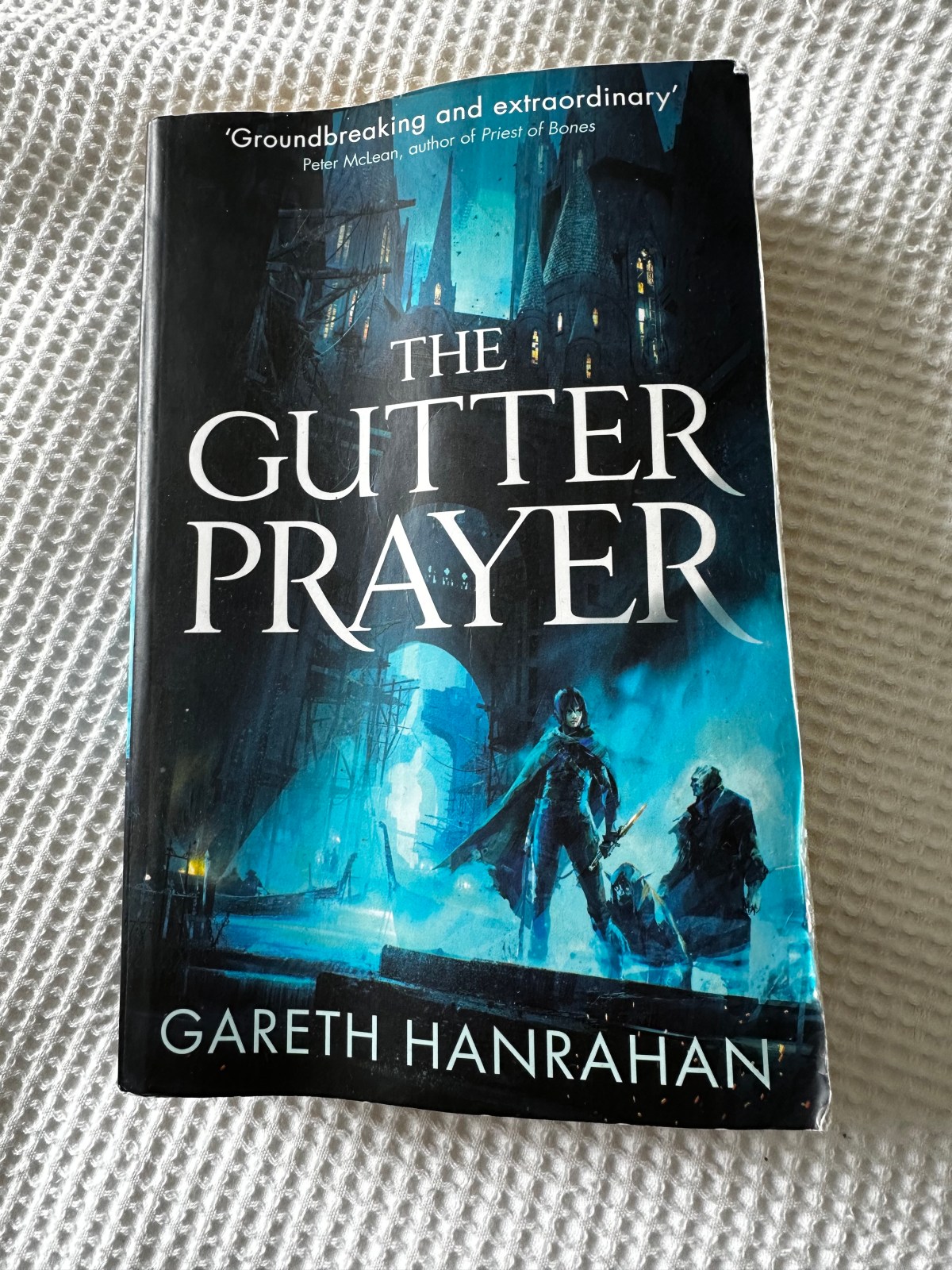
The Gutter Prayer

I am in a sci-fi and fantasy book club, surprising absolutely no-one. We take turns picking the book we read. We usually give ourselves a month to read, meeting at the halfway point to discuss how it’s going and then again when we have finished the book. It’s fun, we spend a lot of time delightfully dunking on duds but, thankfully we also have plenty of time for praising the good ones. The Gutter Prayer by Gareth Hanrahan (AKA Gareth Ryder-Hanrahan) is one of those. It is rich and evocative and full of cool and interesting characters that you either hope won’t die or hope will die.

The author has a long and storied history as an incredibly prolific RPG designer. You can check out what he has written here. I personally only just encountered him through the recently crowd-funded Heart sourcebook/scenario, Dagger in the Heart, which he wrote. When I went and looked him up, I was intrigued to see that he was also the author of several novels. Since it was my turn to choose a book for book club, I decided to go for his first, The Gutter Prayer.

He has designed a city that is alive and full of fantasical and very dark elements. Guerdon is based partly on Cork city (Hanrahan’s home town,) Edinburgh and New York and you can feel the influences of all three in the writing. The story revolves around three scoundrels, Carillon, heir to a murdered aristocracy, Rat, a ghoul who is trying to fit in on the surface and Spar, a stone man, inflicted with a terrible disease and the son of a famous thief and revolutionary figure. They are the unlikely trio who find themselves embroiled in intrigue, the battles of saints and the magic of the crawling ones, fighting for the city itself against the most unforeseen of divine threats.

It reminded me so much of China Mieville’s Bas Lag trilogy and his own rich and lived-in city of New Crobuzon. It’s also got a lot of Cthulhu references what with the ghouls and the crawling ones and the menacing ancient gods and all. In our latest book club meeting we also talked about how it felt like a book written by a game designer. It was something about the richness of the locations, the depth of the “NPCs” and the deft construction of the set-pieces. Please go and read it! I can’t wait to start on the next one in the trilogy, The Shadow Saint.

The Book, the game

Also, he made a game based on these books! I mean, of course he did. You can get it for free on his blog:

The Walking Wounded

It’s only 17 pages long and contains both the rules and a one-shot adventure to play. Go check it out!

Are you a Gareth Ryder-Hanrahan fan? If so, have you played any of the games he has written?