
Dropped modules
I have a few adventure modules from the early days of my D&D career. A couple that hark back all the way to AD&D first edition and several more for specific settings like Dark Sun, Ravenloft and Planescape. I have a few for D&D 5E as well. But the thing is, I have never been that enamoured of them. Almost from the start I found it too restrictive to run a pre-written adventure. I had the feeling that I had to get everything right, according to the text and that, if I put a foot wrong, I would mess up the whole experience for the players. To be fair, that was absolutely the case in some instances.
Instead, after I had read a few published modules and run some of them, I was able to see how it was done. So, I wrote my own adventures. Usually these were pretty loose things with nothing but a beginning, a main villain and some encounters filling the middle but only a vague idea of where it was going. Honestly, my method has not changed all that much in the intervening years. Anyway, this approach allowed me to improvise much more freely and I think my players generally felt they could do as they wished, within the constraints of the setting, rather than the strictures of a preset narrative.
I still don’t run published D&D scenarios or campaigns much, even if I do occasionally buy them. I ran Storm King’s Thunder a few years ago and was equal parts appalled and underwhelmed by it. It’s a full campaign that took us the guts of two years to finish. During that time much of our play-time was spent farting around the Sword Coast, trying to remember what the PCs’ motivation was while having more-or-less random encounters and a few pre-written, essential ones. It was meant to be a sandbox but the area felt too vast and the individual locations too ill-explained to be easily useable without a huge amount of work by the DM. And so little of it felt important to the overall plot! On the other hand, when it gave me the chance to be creative, and come up with content that was entirely my own, I loved it. And, generally, those were the most memorable moments from that campaign, even if I do say so myself.
Modular construction

So why do I want to run individual modules for the Dungeon Crawl Classics RPG from Goodman Games? More masochism? Could be, oh reader mine, could be. It might actually be a mistake. I probably won’t know until I try it out.
But here’s the thing, the modules I am thinking of have been written some time in the last ten years for the most part. They are modern, with modern themes and sensibilities in mind. They are structured for a modern RPG player and they are, generally, nice and short.
So, they are modern, meaning they have plenty of opportunities for the PCs to make important and potentially game-changing choices and very few instances of railroading. Also, they assume that the players, at least, have all agreed to be there to play the game and so they are not written with the utmost consideration given to how to get the PCs to do what the adventure wants them to do.
Themes and sensibilities are important. A lot of the older adventures make colonialism look good and normalise a sort of fantasy racism that is simply unacceptable. It wasn’t acceptable then and it isn’t now. But now, at least, the consumer won’t put up with it.
Structure and length kind of work hand-in-hand. A lot of these have a fairly loose structure where many events can occur at any time within the beginning middle and end portions of the modules. And they are short enough to play in an evening or two for the most part. Here are the page lengths for a sampling of the DCC adventures I own:
The Sorcerer’s Tower of Sanguine Slant – 25 pages
The Laughing Idol of Lar-Shan – 17 pages
Blades Against Death – a massive 32 pages
The Croaking Fane – 16 pages
Easy to read and easy to prepare with great maps and fun artwork too.
Also, these things are metal AF.
Here are a few extracts:
From DCC # 77 The Croaking Fane
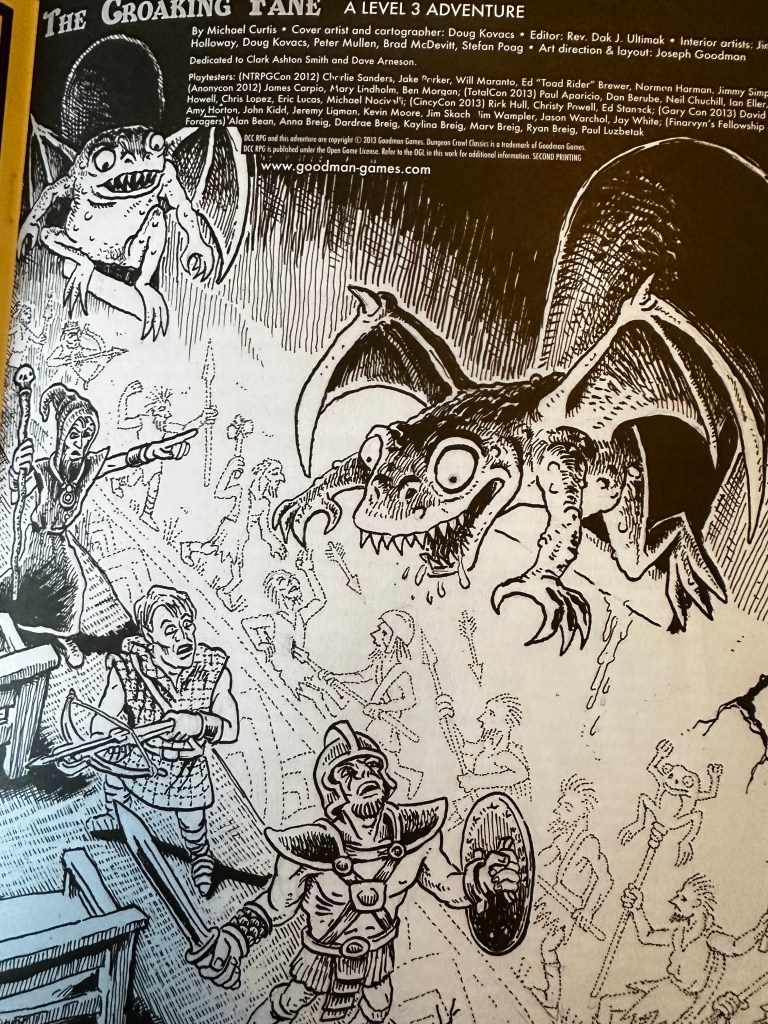
“The transept ends in a small altar, atop which sits an idol depicting a grotesque frog with razor-sharp teeth and talons. Its mouth is full of the mangled bodies of sentient races – humans, elves, dwarves, orcs, and even ogres hang askew in it maw; limbs dangling between the giant’s teeth.”
From DCC # 74 Blades Against Death

“You draw aside the clacking curtain to reveal an emaciated crone, her white eyes staring into nothingness. A third eye is tattooed on her forehead and seems to blink when she wrinkles her face.
From DCC # 77.5 The Tower Out of Time
“A grotesque wonder occupies this bright chamber. Three fleshy slabs stand at acute angles around a monstrous, bulbous mass that resembles an exotic jungle flower. Each slab bears a small, hairy anthropoid creature. Numerous crimson tubes extend from the horrible flower, greedily siphoning the life blood from these creatures.”
Finally, DCC has this rather unique phenomenon called Level 0 Funnels. I am mildly obsessed with them and am itching to get one to the table. You play one of these adventures in lieu of traditional character creation. Your players each roll up 4 or 5 0 level characters, essentially peasants with no special abilities or magic or anything (they might have a pitchfork or a pig) and you send them all into a dungeon. Any that survive the experience get promoted to first level. And some of these modules are pitting 0 level characters against the sort of things the average D&D party might think about facing at like, 10th level.
I haven’t even gotten into the rules of DCC really. Suffice it to say that they are close enough to D&D that most players will not have a hard time learning them. I’ll probably do a deeper dive on the rules another time.
So, have you played DCC? If you did, did you play any of the published modules for it? What did you think?
 The Dice Pool