Modular Gaming

Improbable hot-takes

“The Discourse (TM)” has been focusing on running published adventures/modules/campaigns as opposed to custom/homebrew/sandbox games for the last little while. First Quinns reviewed Impossible Landscapes, an epic and almost legendary campaign for the modern Cthulhu-ish game, Delta Green. This is the first time Quinns has reviewed a campaign/published adventure on his RPG review channel, Quinns’ Quest, so it was unusual enough to spark a significant amount of discussion all on its own. And then Thomas Manuel of the Indie RPG Newsletter and Rascal reviewed the same campaign. I believe this was purely coincidental, especially as Impossible Landscapes came out about five years ago now. Both are great reviews in their own right and are based on full play-throughs of the campaign so you know they’re of real value. You should check them both out.

Anyway, on Bluesky, Thomas Manuel went looking for recommendations of other modules to run and this spawned a lot of interesting answers and quote-bleets from RPG luminaries, such as this one, which I found interesting.

I have opinions on the conversation, of course. I have shared a lot of them in other posts from the last year or so, actually. If you want the summary, though, I had a lot of bad experiences running D&D scenarios in the past, especially from the AD&D 2nd edition era. I found they were difficult or impossible to just pick up and run. In fact, they required maybe more preparation time than adventures and campaigns I wrote myself. The one published 5E campaign that I ran, Storm King’s Thunder suffered from the same issues, actually. This made me feel like it was a “me” thing. But, it turns out, a lot of GMs feel the same way, according to Bluesky, at least.

However, I have had my mind changed somewhat by running pre-written adventures for some other games, particularly Free League’s Blade Runner, Dungeon Crawl Classics and, to a lesser extent, the Dragon Age RPG from Green Ronin.

This is a link to my first post on Electric Dreams, the introductory Case File for Blade Runner:

And this one compares the same module to a 5E murder mystery adventure I played in around the the same time:

Here’s my post about Sailor’s on the Starless Sea for DCC:

And this is my post on running Duty Unto Death, a short intro adventure for the Dragon Age RPG:

And finally, this post, although ostensibly an excuse to discuss DCC adventures, also includes my opinions on the one 5E campaign I ran:

I will say that, despite my generally favourable outlook on most of these modules, I still find I have to to do a lot of prep for them. The main fear I have is messing things up so bad that I essentially spoil the rest of the adventure. Although, I should really have more faith in my abilities as a GM at this stage. I feel like I can probably improv my way out of any hole, to be honest. But it does not change the fact that I spend hours rewriting long paragraphs presented in module texts into digestible bite-sized bullet-points. I am running another Dragon Age scenario right now. Amber Rage is from Blood in Ferelden, an anthology of scenarios for the game that came out in 2010. It suffers from verboseness and unnecessary detail and makes for a lot of work from the GM. I’m enjoying the contents of the scenario but its presentation is horrendously dated and needs a sprinkle of OSR magic to tighten it up, in my opinion.

I realise that none of the modules I have mentioned here are anywhere close to having the size and epic scope of something like Impossible Landscapes, but it doesn’t change the fact that they have largely changed my mind about running anything pre-published. The one I have my eye on right now is Dagger in the Heart for Heart: The City Beneath. Actually, I have a post about that right here too:

OK, I’m off to discuss the discourse on Discord of course!

Throwback Sunday?

I’m feeling dreadful today, dear reader. I don’t know what I’ve got but it’s kicking my arse. Anyway, I thought I would use my malady as an excuse to return to one of my very first blog posts, instead of trying to write a new one. Here it is, The GM Jukebox from last July, where I discuss the use of music at the RPG table, whether real or virtual. Hope you enjoy it!

Investigations

The detective dichotomy

We have been enjoying the Blade Runner RPG immensely in the last few weeks. The blade runners are into the second day of their investigation of the murder of Sandor, another member of the LAPD Rep Detect Unit who happened to be a Nexus 9 replicant. So far, it has gone pretty well for them. They have had some incredible luck with dice rolls that even revealed certain clues I was surprised about. Due to uncovering these, I think they are coming up with the basis of a solid theory for what happened.

Here’s the thing: this is an official case file, produced by Free League. I would imagine most people playing Blade Runner have run this scenario; it comes in the starter set. And the details of the scenario, the NPCs, the locations, even the events, to a certain extent, are set. There is a lot of freedom for the PCs to pursue leads when and how they want but the perpetrator/s, their reasons and motivations and the major players in the case are the same for every table.

Now don’t get me wrong, we are really enjoying this format. The setting and the themes and the ways the scenario intersects with them are very well done. But it is hard not to feel like it’s on rails, right? The answers will always be the same although each group might do something different with them.

Of course, maybe that’s true of any prewritten scenario, no matter the genre. There is always a lich at the end of Tomb of Horrors. Strahd is the big bad in Ravenloft. That kind of thing goes without saying. So, what is it about the mystery that makes this seem less free-form? I guess it’s that finding the answers is the whole point. In Ravenloft, the point for the players is probably the fun of exploring Barovia and the castle. They are enjoying the scares and the combat and all of that.

But in the end maybe it doesn’t matter. Of course, my players don’t know the ins and outs of the clues or the perps or the mystery until they find them. So it’s still mysterious to them.

Building with Brindlewood

Of course, there are other ways to do mystery games. The one that comes to mind is Brindlewood Bay by Jason Cordova, of course, and the games that have been Carved from Brindlewood, like Public Access and others. In these games, there are plenty of pre-written and published mysteries but, significantly, they don’t have solutions.

In an inventive and fascinating twist of game design, Brindlewood Bay’s solutions emerge during play. There are elements of investigation, role playing, narrative building and straight up dice rolling that result in your characters either coming up with the right answer or the wrong answer. Or, you have the familiar PBTA option of a correct answer but with some complication on a middling roll of the dice.

I have not yet had the chance to play one of these games but I would love to. I want to see if it is more satisfying than the sort of game where your solution is written in stone.

Have you played any mystery games that made you excited to play them again? Send me some recommendations!

Games I Have Played So Far this Year, Part 1

Lists part 2.1

Also not a top ten, not by any means, but I do think this one is useful for me, especially. Even this time last year I could not has envisioned a seven month period where I got to experience so many different games with so many different people. Looking back on it, I don’t think there has ever been a period in my life where I have been involved in so many RPGs.

This got me thinking so I went to dig up some of my old prep books from the 90s (a few notebooks, filled largely with encounter stats.) In these ancient tomes I found prep notes and full scenarios that I wrote for no fewer than three AD&D campaigns (Dark Sun, Ravenloft and Planescape,) a Gamma World campaign, a Beyond the Supernatural campaign, a Robotech campaign, and a home-brewed Aliens game that I think I based largely on the Palladium ruleset. I know I ran a couple of other things too but not much more. I have run more different games in the last 7 months than I did throughout my teenage years! It is a golden age for me and I am loving it!

Anyway, on to the list. In this post I am only doing the games I have GMed/run/refereed. I will do the ones I played in in the next post:

Games I have run this year so far

  • Spire – Kings of Silver – Concluded Campaign. Far more epic in scope than it ever had any right to be. This was largely due to my choice at the start to make use of an optional rule that made the PCs much less likely to accrue fallout. At the time I did not realise exactly how crucial fallout is to pushing he campaign forward. I wouldn’t do that again. This campaign really got me into the products of Rowan Rook and Decard. You will find another couple of games on this list that they made too, in fact. It was a great experience and I know I’ll be going back to Spire sometime soon. I am also definitely going to do a more in-depth look at this one in a post all its own sometime soon.

  • Eat the Reich – short campaign. We started playing this shortly after I received my physical copy from the Kickstarter campaign, just because our regular game night fell through. And what a happy accident! If you too hate nazis and love making up inventive and ultra-violent ways to kill them with vampires, this is the game for you. Also, it is Ennie nominated right now, go vote for it! It is one of the most eye-catching RPG books I own, which is saying quite a lot. It is worth picking it up for that alone.

  • Never Tell Me The Odds – Rebel Scum – one-shot. I planned this one for Star Wars Day this year and really enjoyed it. We actually watched Star Wars: A New Hope before we played it too. This really helped because the premise of the whole one-shot was that the PCs were a rival band of rebels who were actually sent to the Death Star to rescue Leia at the same time as Luke and his pals were blundering about, getting captured and accidentally doing good. Great fun, would recommend this game for one-shots too. It’s all about the stakes and how you play them.

  • Troika! – The Blancmange and Thistle – one-shot. Possibly the most fun I have had in a one-shot all year. Everyone rolled on the random table in this OSR game and played what they got, a Rhino-Man, a Questing Knight and a Befouler of Ponds. Then we played the starter adventure from the Troika! Numinous Edition core book, where they went to their room in a hotel and attended a party. Fucking hilarious at almost every turn. 10/10 would play again, and I definitely will.

Check back for part 2 where I get into the ones I’ve been a player in so far this year.

Blade Runner

IP

These days I don’t play a lot of games based on an IP. At least not ones as big as Blade Runner. That wasn’t always the case, of course. When I was kid I played Palladium’s TMNT and Robotech quite a bit. To be fair, I don’t think Robotech really counts as a “big IP.” I also played a bit of Middle Earth Role Playing (MERP).

Speaking of Lord of the Rings, maybe the only major IP based game I played in the last few years was the One Ring from Free League. Now, as a player who had been liberally punished by the unforgiving and gruesome crit tables in MERP, I had my reservations going into another Middle Earth game, but I shouldn’t have worried. We played the introductory One Ring adventure as a bunch of Hobbits wandering around the Shire getting into relatively innocent shenanigans. It wasn’t brutal and it wasn’t unforgiving, it was fun!

This wasn’t the first Free League game I had played. I had also run a few sessions of Tales from the Loop, which is a game based on the art books of Simon Stålenhag, where you play kids solving mysteries in the sci-fi 80s that never was. It was almost universally loved by my players and was fun and engaging for all of us.
So, when I saw that Free League were Kickstarting a Blade Runner RPG I smashed that “Back this Project” button. Unsurprisingly, it ended up 16,153% funded…

You know what? They put that money to good use. The core book looks gorgeous with the sort of noirish artwork that draws you into the future megalopolis of LA, its rainy streets, its crumbling facades, its neon drenched midnights. It lays out a version of Free League’s by now familiar Year Zero Engine rules that is specific to this iconic setting. The focus is very much on the dramatic juxtaposition of human and replicant, the mega-corps and the working stiffs, the thriving off-world colonies and the decaying Earth, the LAPD and everyone else. The focus is on those things and the investigation.

Electric Dreams

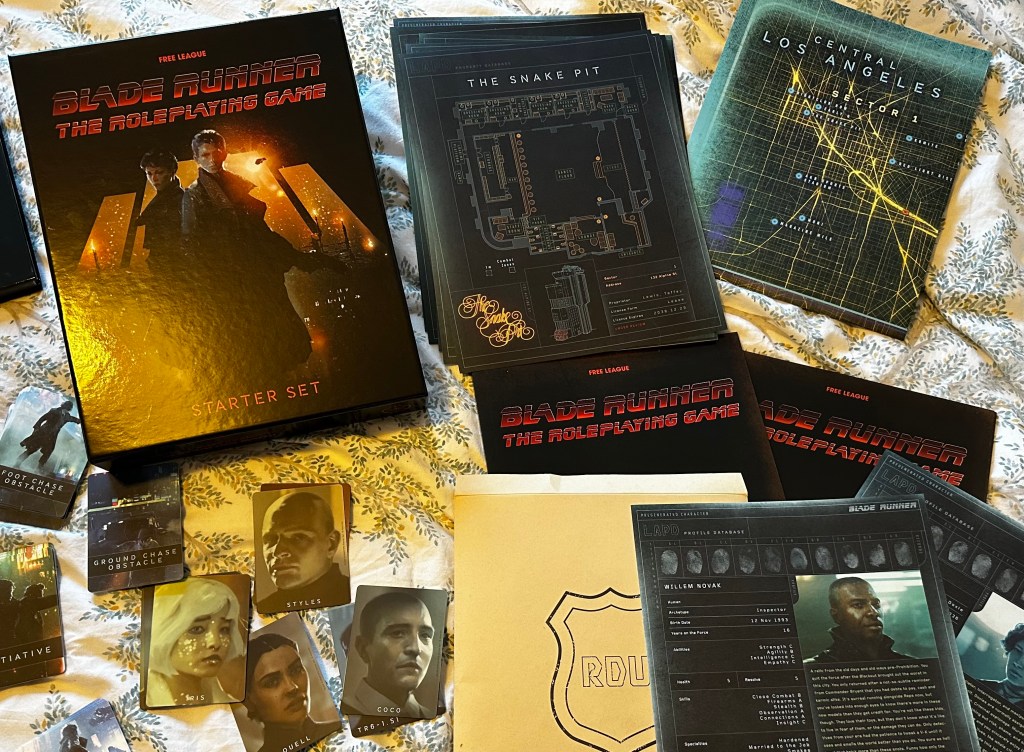
And that’s where Case File 001: Electric Dreams comes in. This is the scenario you get in the Blade Runner Starter Set and it’s fair to say that this box is all about the investigation. Oh, and you can see all those sweet, sweet Kickstarter krona in it too. It is full to the brim with beautifully rendered handouts, mugshot cards, initiative and chase manoeuvre cards, detailed and evocative character sheets for the pre-generated characters and maps maps maps. chef’s kiss

This case file is meant as a starter scenario, easing players and Game Runner into the style of play in Blade Runner as well as the rules and unique aspects of the game. I really think it does a great job of that. Everything is laid out efficiently and yet beautifully, with the same type of high quality artwork from the core book throughout. It introduces the ideas of Shifts, 6 to 10 hour periods of time that your days are split into, and Downtime, which you generally have to take after 3 Shifts on the job. It does an excellent job of guiding you through the LAPD, the hierarchy, the resources and the characters there and the ways the Blade Runners can use their abilities and skills to investigate their case. It takes you to a nice selection of areas in the city, too, without overwhelming.

And it does all this while hitting some major touchstones from both Blade Runner movies. My players and I were all delighted by the cameos and the familiar locations, the flying cars and the replicant cats. But none of it feels forced or wedged into the scenario. It feels natural and serves to bring a familiar world even further to life.

Mechanically, it uses the Year Zero system, where you build a dice pool and count up the number of successes. Unlike in Tales from the Loop where the system relied entirely on d6s, and only 6s counted as successes, Blade Runner uses every dice from d6 to d12. 6 or above is still a success but if you roll 10 or over, it counts double. The introduction of the different types of dice in this is quite satisfying and makes for more interesting mathematical permutations when players are trying to figure out who should do what actions, we have found.

Working the case

This game was always going to be a bit different. For one thing, it’s only me as the Game Runner and two friends as the players. For another, they decided to use two of the pre-generated characters, which is unusual in my experience but got us playing as soon as we could. We are spread pretty far and wide around the country so we are using Zoom and Roll20 to play it. It’s not ideal because it means I get to use my beautiful boxed set props only sparingly. However, I have to say, having purcased the Roll20 version of the module, it works really well. I would recommend it. The character sheets are top notch and all the hand outs are there at the tip of my fingers. An added bonus is that I recently figured out how to use the juke box feature so it’s nice to have the Blade Runner soundtrack in the background too.

Our player characters are:
– Willem Novak, a human Inspector. He is an old timer whose back-story says he doesn’t trust replicants, though that is not currently the way the player has decided to go with him, which I love.
– FN9-2.39 “Fenna,” a replicant Doxie (I am really not sure about this particular archetype name, to be honest. I think it might be a case of sticking a little too closely to the source material.) Fenna is a Nexus 9 Blade Runner who has only been alive for about a year. It’s a weird situation and the player is making the most of that.

We are only two sessions in and most of the first session was an intro to the game, the system and the characters. I would expect anywhere from two to four more sessions, depending on how quickly they figure things out.
It’s going well, so far they have been to the morgue, the Esper wall, the LAPD mainframe, Wallace Corp HQ and the crime scene. There have been precisely zero fights and no action scenes of any kind but I feel like the investigation and the NPCs involved in it have a hold of the players already. They are making connections and coming up with theories and it is all very cool.

As for me, I am loving going ham as the Deputy Chief with the synthetic lungs, the traumatised replicant dancer and the inconvenienced club owner and I genuinely can’t wait for session number 3 next week.