
World’s first Alien RPG
Imagine you’re twelve years old and you have an obsession with something. I would imagine this is a relatively trivial task for most of the nerds reading this blog post. Anyway, You have an obsession and you generally want to express your love for your obsessions through the medium of role playing games. Once again, I’m sure you’re all still on board. I had several of these, Lord of the Rings x MERP, check, Star Wars x West End Games Star Wars the RPG, check, Robotech x Palladium’s Robotech RPG, check. You get the idea. But there was one missing. It was an important one. It related to a sci-fi movie series that I was far too young to watch legally (sorry Mum!) It was Alien(s.) The first I even heard about this franchise was from a friend on the playground. He and his brother had managed to stay up way past their bedtime and watch it with the sound turned way down so as not to wake up their parents, on a satellite TV channel (which I did not have.) Anyway, he told me literally the entire plot of Aliens from start to finish during break time one morning, leaving pretty much nothing out. And I knew I had to see it. It was some time later that I managed to get someone to rent me a VHS copy to watch myself. And thus was the obsession kindled. The hardware, the badasses, the gunfire, the nuclear explosion, the Xenomorph itself. It was all perfectly concocted to appeal to the mind of a twelve year old boy. It was frankly cruel to prevent me from seeing it! It wasn’t until quite some time later that I even got to watch Alien. And seeing it, that first John Hurt chestburster scene, the slow whittling of the crew, the hiss and the creep of the monster, the silence and the horror of it. Still gives me goosebumps to watch that film.
By that point, I was well into RPGs, had been playing D&D for a couple of years, had played Gamma World, Twilight 2000, Shadowrun, all the games I mentioned above and more. But there was one missing, an Alien(s) game. Why? Because it did not exist at that point. It was still a couple of years before the Aliens Adventure Game would be published by Leading Edge Games. Even with how badly that game was received, I would have taken it. But it didn’t exist, so I made my own…
I actually remember writing a full rule-book for it. I did some drawings and cut and pasted some movie stills from magazines for the more complicated stuff. I remember being quite proud of my work, which was contained in a three ring binder and held together otherwise by sellotape and glue. I can’t find that binder now. It’s been more than thirty-five years, so I was particularly pleased to be able to discover even a small piece of evidence of this first Alien RPG. I found a hardback science notebook that contained the first (and, I think, only) adventure for my Alien RPG. Here are some pages from it.
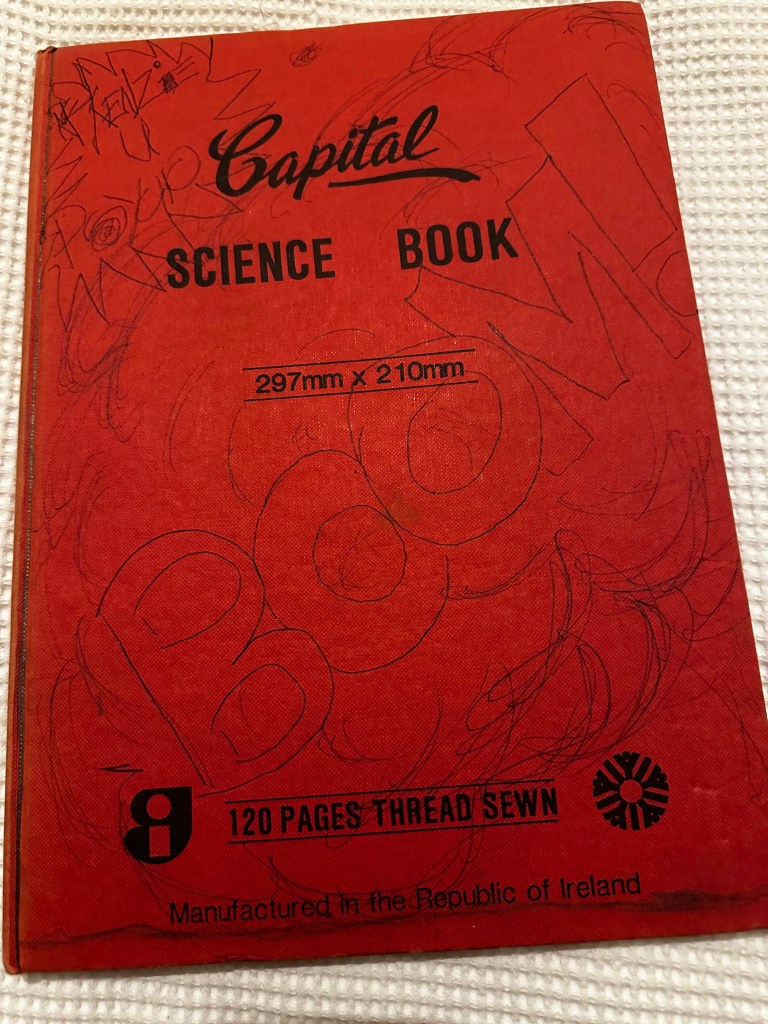

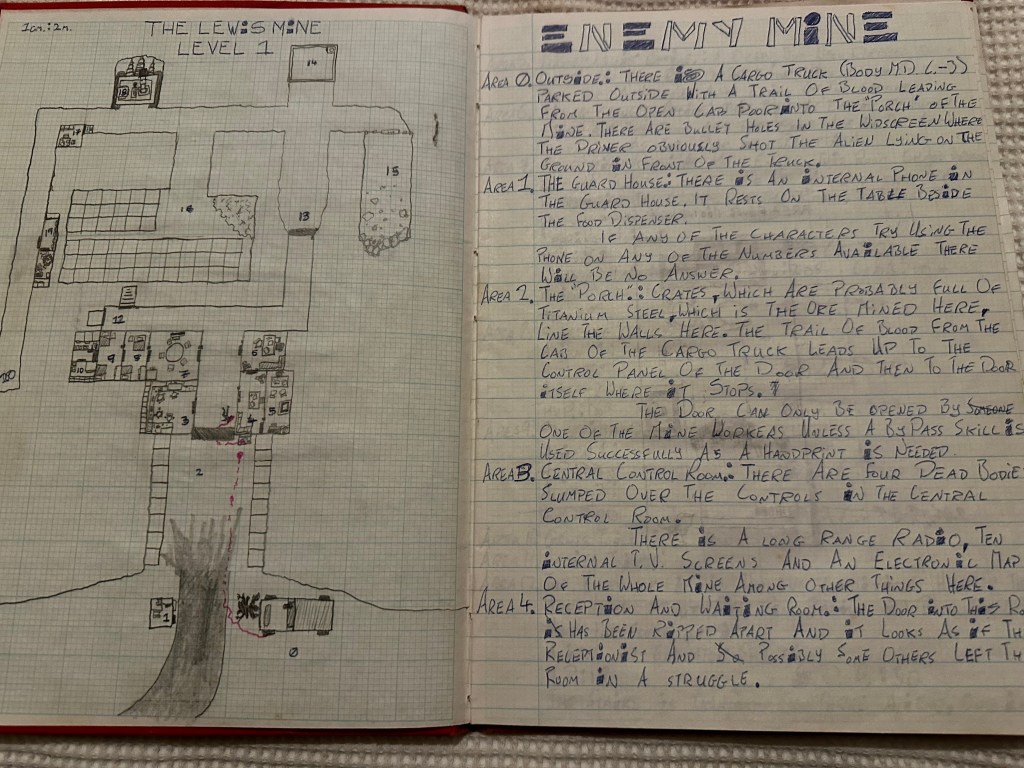
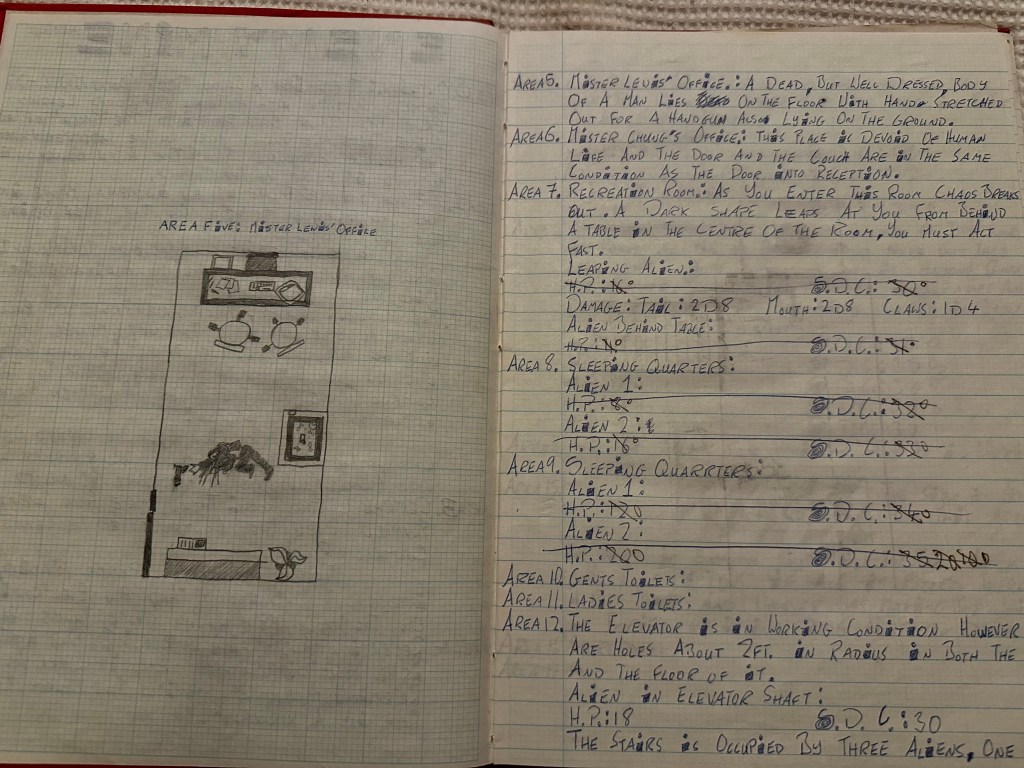
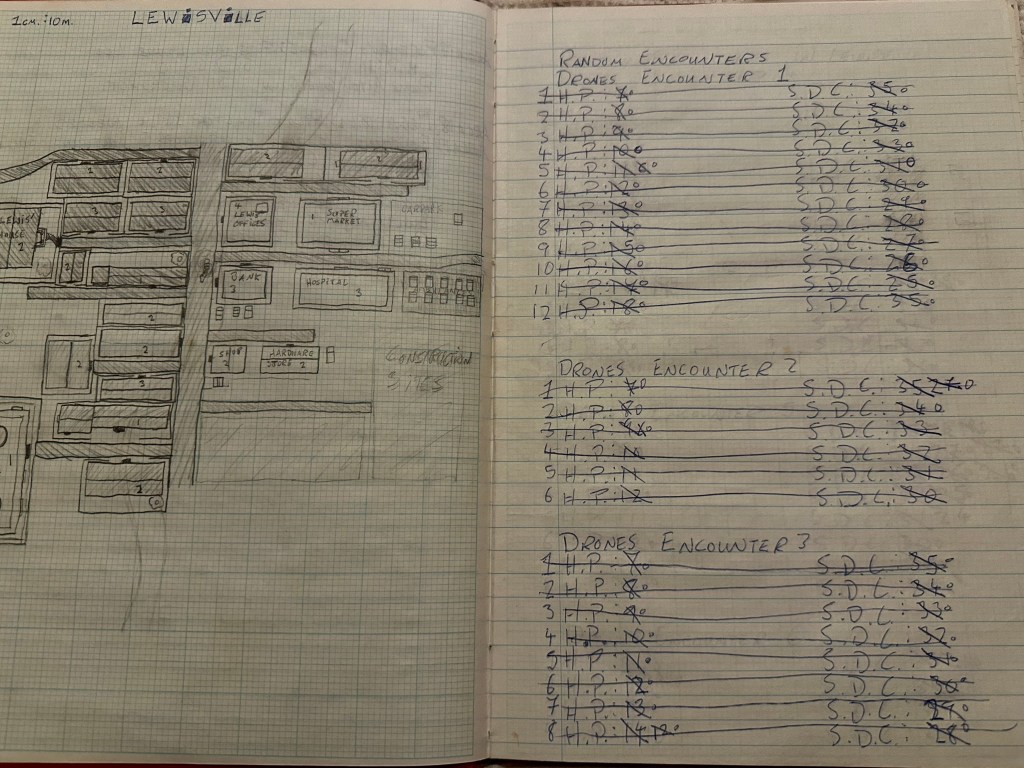

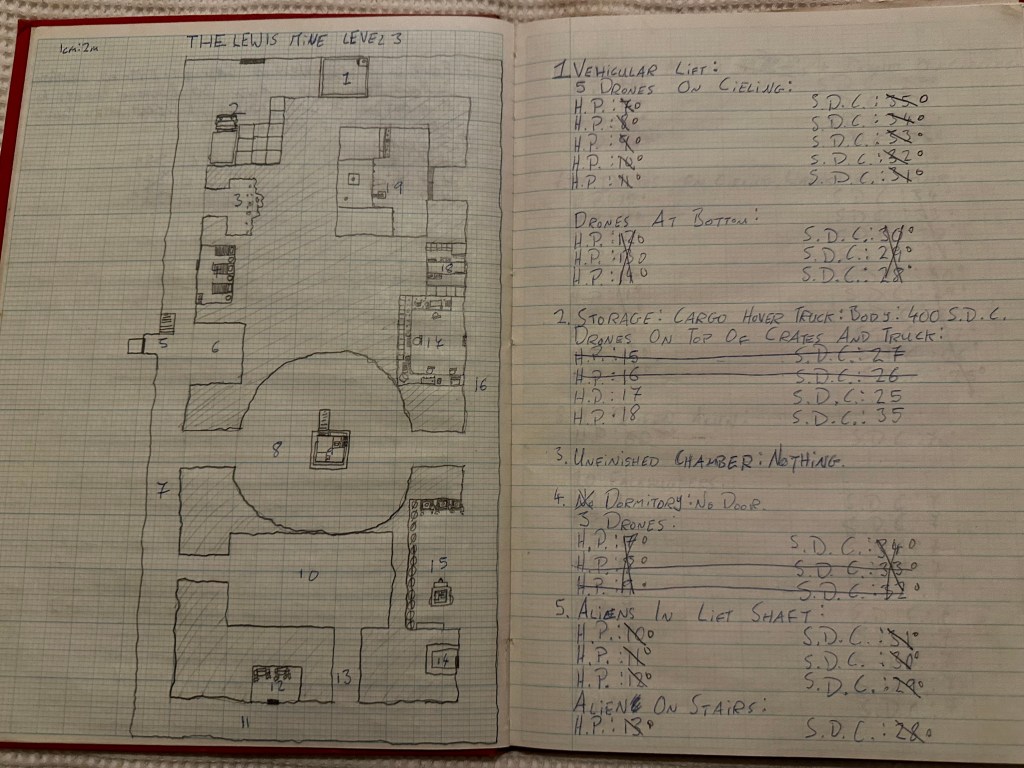
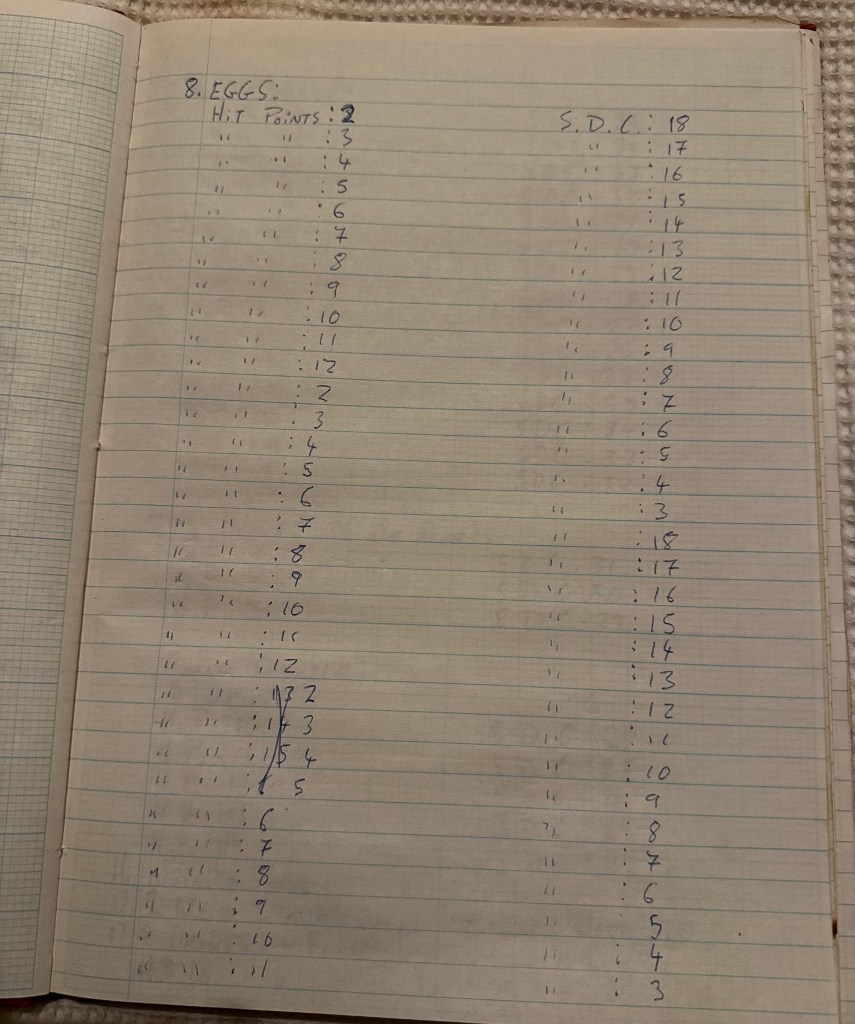
Unsurprisingly, it was a sort of dungeon crawl set in a “titanium steel” mine (the irony that I wrote this in a science notebook, of all things, is not lost on me), with a point crawl in a town called Lewisville attached to it. I used a sort of cursed chimera of D&D and Palladium rulesets to run it. As I remember, this worked well for my friends and me. We had played so much of both, they were second nature to us. The PCs were all colonial marines on a bug hunt. It didn’t lean into the themes of the movies or evoke much of an atmosphere BUT, the marines got to shoot a LOT of Xenomorphs. And that, for us, at that age, was all that mattered.
World’s latest Alien RPG
Alien Evolved Edition is Free League’s latest incarnation of their 2019 Alien RPG. It had a really successful kickstarter, which I backed at the last minute. I wasn’t going to. I mean, I still had the first edition on my shelf, it’s only a few years old, and I hadn’t even played it yet. Not only that, they were at pains to point out that this is not a big overhaul of the game, more like some rules-clarification, the addition of solo rules, and a glow-up. But then, they showed me the special edition of the core book… and I caved.

I don’t regret it though. Free League is almost guaranteed to produce a true piece of art every time. And this book has art and design by Johann Nohr of Mörk Borg and Into the Odd fame. I received the Beta versions of the PDFs today and I am not disappointed.
Anyway, I thought it was probably about time I pulled the first edition off my bookcase and dusted it off. I have been reading it for a few days, prompted, I think by the fact that it was Alien Day on April 26th.

Much of this RPG will be very familiar to anyone who has played any of Free League’s Year Zero Engine games over the last few years. When you try to do something, you make a dice pool from your ability score and your skill score with additions from items or circumstances. Alien uses exclusively D6s so all you’re looking for is a single 6 for a success. But there are a couple of differences with Blade Runner and Tales from the Loop, with which I’m more familiar.
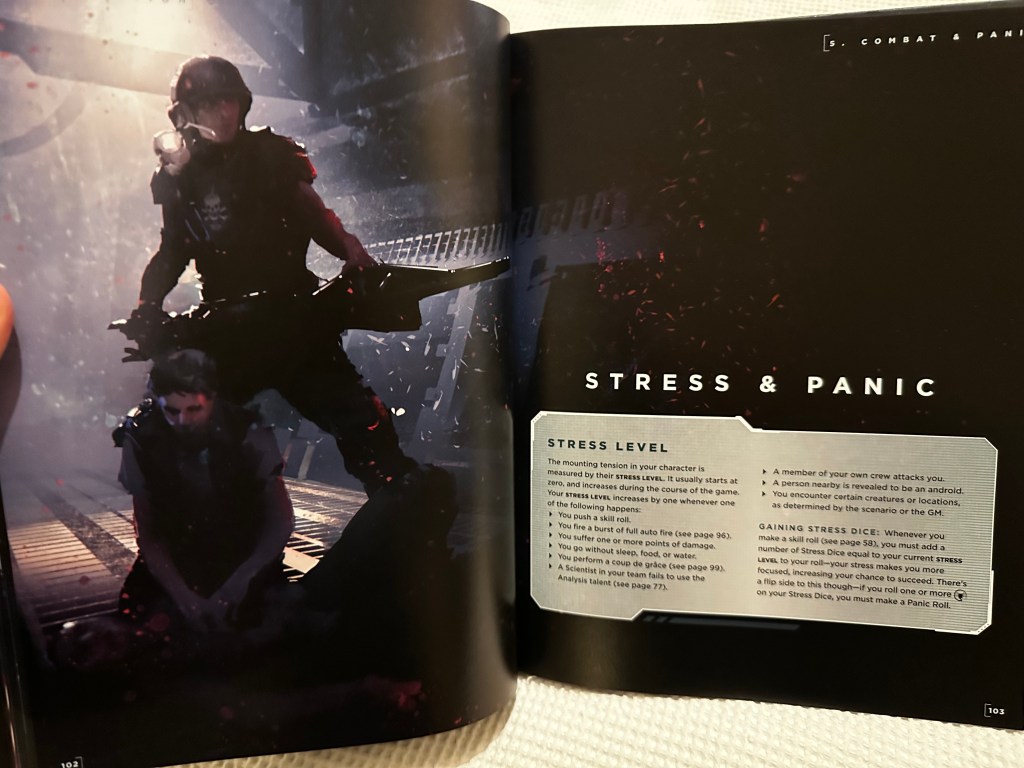
Firstly, you also add to your pool, Stress Dice equal to your current Stress score (which you can gain mainly from pushing rolls.) This gives you a better chance at success but also introduces the potential for your character to Panic, if you roll a 1 on one of those dice. This is usually not good for you. The effects can range from a mere tremble in the extremities, to a berserker rage or full catatonia. Sounds fun, right?
Secondly, you get to add stunt effects when you score more than one 6 on your roll. This feels like it was yoinked directly from Green Ronin’s Fantasy AGE game system, which Dragon Age uses. However, it utilises specific stunts for each skill. I imagine this necessitates a lot of book-checking when stunts come up, but its still a nice feature, which I appreciate.
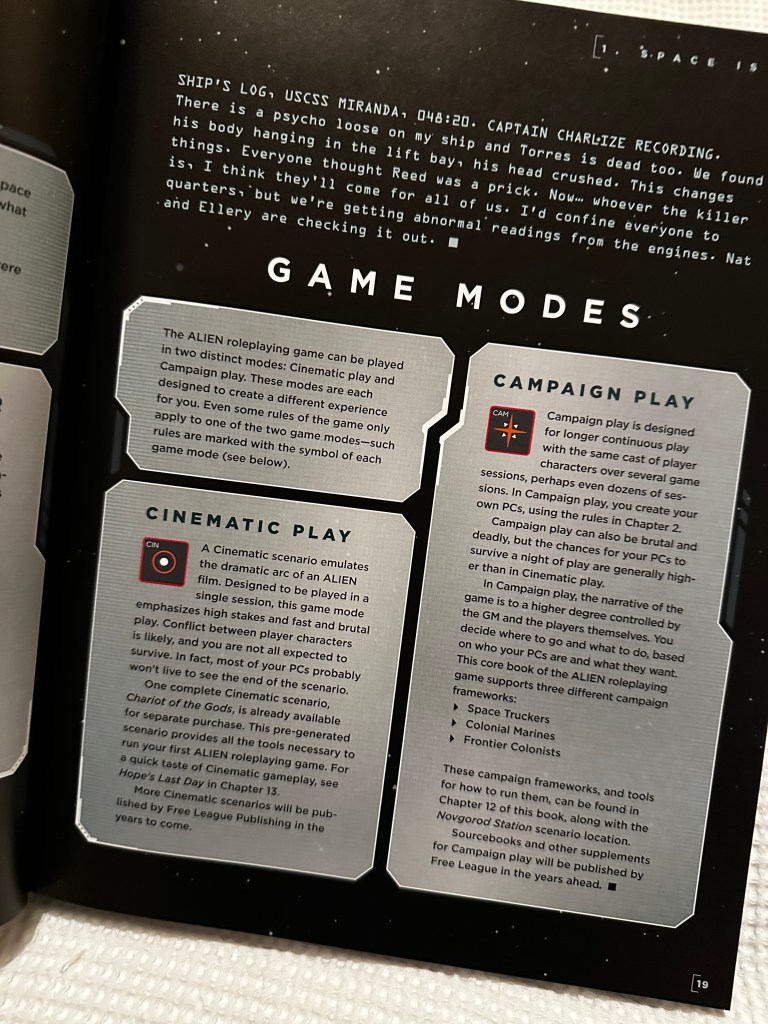
There is another attractive element to the game as well. I like the very clear delineation between Campaign and “Cinematic” play. Campaign play is exactly what it sounds like. You create your character as you would in any other RPG and you and your friends hope they survive through a multi-session story as things probably spiral slowly out of control. The book includes some useful resources for creating planets and start systems, as well as thematic NPCs to help with this style of game. Cinematic play is designed for one-shots, or, at least a short series of sessions. The events of it are probably a little less flexible and fit into an appropriate three-act structure. The PCs are chosen from a few pregenerated characters. And let’s face it, if you’re talking about Cinematic and Alien, you are not expecting them to survive, or, at least, not very many of them.
Alien Day delayed
I was so annoyed that I had missed an opportunity to play an RPG on a non-standard holiday that relates to it, that I felt like I had to play it anyway, in penance. So, I announced a one-shot of the first edition of the Alien RPG today on our Tables and Tales Discord, and I have a couple of sign-ups already. I have a few published Cinematic options and a few days to decide which one to play. I am leaning towards the one from the core book, which relates directly to the events of the movies, as an introduction for the players. But there are also the scenarios in the Starter Set and the Destroyer of Worlds boxed set that could be contenders.

I’ll be back probably next week with a report on how it went! I might just do a round up of that and our Star Wars themed Vaults of Vaarn one-shot from May the fourth. See you then, dear reader.

 The Dice Pool