
Weird Hope Engines
Earlier this year, in Nottingham, England, David Blandy, Rebecca Edwards and Jamie Sutcliffe brought together a selection of RPG creatives and artists to make an exhibition.
From the Bonington Gallery website:
Weird Hope Engines embraces the culture of tabletop roleplaying games (TTRPGs) to explore play as a site of projection, simulation, communal myth-making, distorted temporality, and alternate possibility.
Zedeck Siew, Amanda Lee Franck and Scrapworld were all major contributors to the exhibition but they lived far, far away from Nottingham. The trip would be costly. So, being TTRPG creators, they launched a project in the hopes that it would fund well enough to pay their way. It worked, and A Perfect Wife is the result.
Disclaimers
Dear reader, I have not run or played in this adventure. I received it recently in the post and I wanted to write about it. This is a review but only from a read-through.
There will be some spoilers so if you think you might want to be a player in this adventure, turn back now! Or don’t, I’m not the boss of you.
The Product
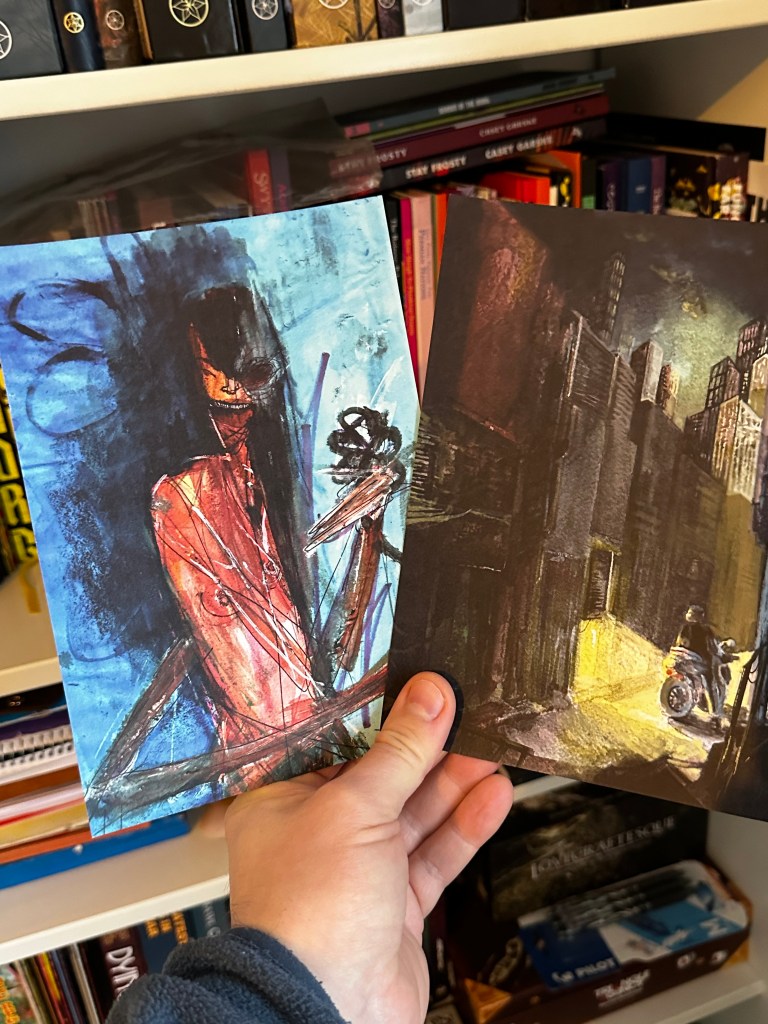
A Perfect Wife is a 43 page OSR-style adventure from Copy/paste Co-op. I backed the Kickstarter for it and received a physical copy, along with a printed map of the adventure location and some art prints.
Speaking of art, that’s what this is. The writing is subtle and considered and evocative, the layout is spare but adds so much to the adventure as a thing to read and there is beautiful, idiosyncratic artwork throughout. All three creators contributed illustrations and all three styles are distinct but never clashing.
The Adventure

We start with an explanation of the recent disappearances in this inner-city Malaysian (actually I don’t think its explicitly spelled out anywhere in the body of the adventure that its set in Malaysia but its heavily implied) neighbourhood. What it boils down to is the following three points, what the locals have learned:
Head indoors if dogs are whining
Walk on by if your name is called
Do not search for the baby crying
It’s pretty clear that something unusual is happening in the area. Already the mood, the setting, the premise are very different to any other OSR adventure I’ve ever read.
We move on to character creation next. The PC outlines are based on how they know Sara, the woman they’re meeting in front of the Desa Damai Wet Market. They know they are meeting her before they even know who they’re playing.
They get six choices. There’s a journalist (interesting skill: speed-reading), a social worker (eavesdropping), a private investigator (knife use), a security consultant (joking), a faith healer (bargaining) and a barrister (drinking.) Each has a few skills, and maybe a weapon or a useful contact, not to mention a wonderful line-drawn portrait.
So, the players choose their PCs and the opening scene moves on…
Basic rules are included on page 9. These are almost identical to Into the Odd. In the front of the adventure there is a “Mechanically Inspired by” section that lists Into the Odd but also includes Liminal Horror and the Lost Bay. I don’t know those games and I am not sure how they inspired the mechanics but there is no doubt that, essentially, rolling works the same as in Chris McDowell’s game.
The next scene introduces two major NPCs at the Peaceful Heart Community Centre. It is not spelled out, but assumed that Sara led the PCs there to meet Yinyin. Then we learn what the PCs are being recruited for. Sara wants them to find out what happened to Tet, a refugee and father to young Yinyin. Sara and Yinyin are described in their own NPC section, but the mysteries only deepen…
This adventure deals with some themes of supernatural horror, class inequality, the plight of refugees, violence against women and children, pregnancy and miscarriage. You get the first hints of these, let’s be honest, pretty heavy subjects here. A GM and their players will have to have a frank discussion about this before starting to play A Perfect Wife.
Beautiful keyed map and encounter tables (day and night) for Desa Damai. Point crawl location.
The daytime encounters are a delight. I’ve been to Malaysia only once and that was on holiday on Lankawi Island. I can only imagine how different an inner city neighbourhood of a metropolis like Kuala Lumpur is to that so I don’t have any real frame of reference for this, but the occurrences in this table have feel genuine. I can picture the old man feeding the stray dogs from styrofoam containers on the side of a crowded, narrow street with no footpaths and not enough shade. I can feel the tension created by gang kids surrounding you and shaking you down for whatever cash you’ve got on you, while you sweat and make excuses.
These encounters also serve to also introduce factions and NPCs of note although they are described in greater detail later.
The nighttime encounters are far more threatening and sad. Even the direction on how to use the table seems designed to put you on edge. In the daytime, you roll whenever you walk down a new street. But at night…
Whenever you turn a corner, roll
Just reading them makes me uncomfortable. Machete wielding, motorbike riding gang members are so much worse than the kids from earlier in the day. And what is a baby doing crying behind that pile of rubbish in the middle of the night?
Straight fter a short description of the two main gangs, the combat rules crop up… just in time. The gangs are described beautifully and succinctly. The combat rules are brief and equally Odd-like. They include more than one admonition regarding the dangers of violence, especially gun-violence, which is likely to draw the attention of the authorities.
The next ten pages are devoted to introducing us to the people and locations of Desa Damai. We get a gorgeously illustrated selection of refugees, police, witnesses, thieves and one particularly supernatural and disturbing infant. These represent the people you might run into on the encounter table as well as those your PCs might want to talk to in relation to their investigation. Each of them can help or hinder in some way and they all have their own motivations.
Sara’s baby, illustrated on page 23 with thick, black, childlike lines over a wash of dirty scarlet, is a true horror, the kind of creature that could only have sprung from the collective trauma of folk beset by the tragedies and indignities experienced by generations of women and children. It is both heartbreakingly sad and terrifyingly obscene at once. It only serves to illustrate, yet again, the importance of discussing tone and content as a group before setting out on this adventure. Be warned.
Pages 30 to 33 describe the Pontianak, the nightmare creature at the heart of the adventure as well as the initial encounter with her. Where the baby is a tragic and sadly pathetic entity, the Pontianak herself is actively menacing, dangerous and hidden in plain sight. She also has a tragic origin of course, and that’s central to the adventure, but there is no doubt this is an enemy to fear too. There’s more creepy and horrific illustrations here, one depicting the creature in her human guise and one showing her monstrous form. Again, the art in this module is doing a lot of the heavy lifting. Its remarkable.
As terrible as the Pontianak is, oh so much worse is the husband, the architect of this situation. Rich, well educated, greedy, I imagine him a delight for a lucky GM to get to role-play.
In the appendix, Siew introduces the non-Malaysian reader to the concept of the Pontianak, the symbology that is inherent in the creature, how she has been portrayed in media, the way she is perceived in Malaysia and the role of the weird and supernatural in Malaysian life. This is all fascinating stuff and feels incredibly useful in allowing the GM especially to do justice to playing the NPCs in this adventure. It is of the utmost importance to understand that locals would not be rolling sanity checks when encountering ghosts.
Here, ghost stories do not function as supernatural or speculative fiction. Ghost stories are realist. They do not belong to the Weird; they are not designed to arouse a sense of the uncanny or numinous.
I feel like I can sympathise with this point of view to an extent. Growing up in Ireland, no matter how atheist you are or scientific you claim your brain to be, deep down, you would still instinctively avoid a Fairy Fort and take tales of banshee wails predicting deaths at face value.
Tucked away at the back are the optional gods. I guess I can see why they are optional; they introduce a level of spiritual and religious superstition that some tables might prefer to avoid. But, in my opinion these gods and offerings are all gold, some of the best stuff in the adventure. It has the potential to heighten the PCs’ dedication to the plot and may even provide ways for them to boost a flagging investigation.
Conclusion

I really want to run this now that I’ve read it fully. It’s different enough from the normal sorts of scenarios I would play that it has greatly piqued my interest. The NPCs, the creature and the situation are compelling and fascinating. Also, the real-world setting is incredibly evocative and, though presented and described sparsely by these artists, I feel like it still shines.
My players and I definitely enjoy a set of pre-generated characters that are tailor-made for the game we’re going to play. You get that in this, but you also get the pleasure of rolling up elements of them and defining important personal characteristics yourself.
I’m a fan of the incredibly rules-lite mechanics at use in A Perfect Wife, and, although I think they can be used to conduct an investigation like this, I’m not certain that a system designed for investigators wouldn’t have been better. A lot of the work is left up to the GM to ensure the leads keep coming as many of the connections between NPCs, locations and events are implied rather than fully spelled out, but I would like to think that also allows for a great deal of leeway to be given and for flexibility when necessary.
Finally, I’ll reiterate the need to discuss safety tools and tone and content before starting. I know several players, me included, who have been personally affected by themes in this adventure. Some will be happy to play anyway, some won’t, but we’ll have to talk it out first.
 The Dice Pool