D&D Planescape Resource – The Book of Doors and Keys

The Foundry Tower

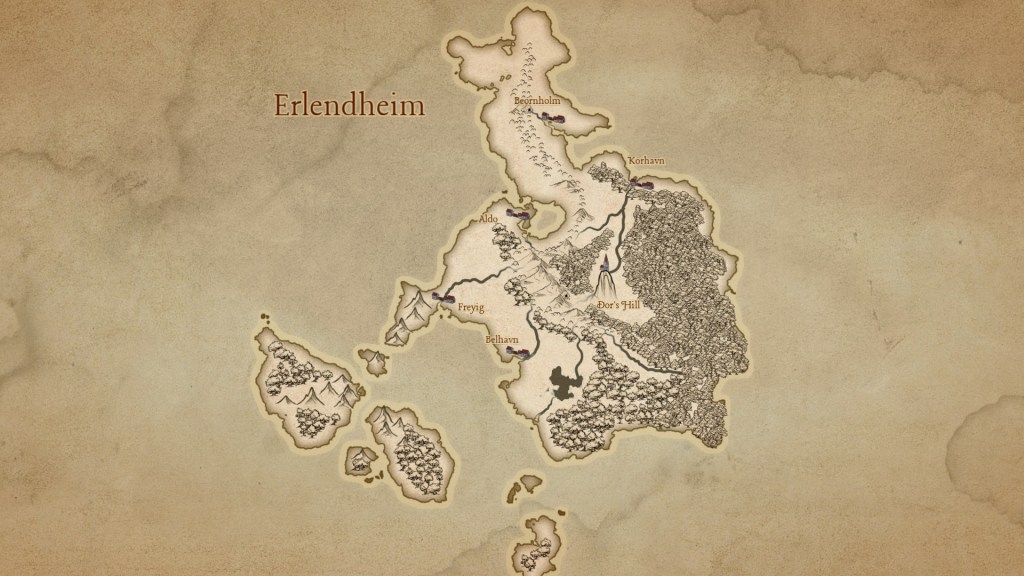
One of the central mysteries of my Erlendheim campaign was the PCs’ hometown. Dor’s Hill stood out like a boil on the perfect skin of an elf. The town stood atop a tall hill in the exact middle of the island of Erlendheim, surrounded by plains and forests. There was something else about it that was odd. A legend, or false history existed, indicating that, many generations ago, a number of very different people appeared in the vicinity of the hill, supposedly sent by the islanders’ primary deity, Helm, to act as guardians of the island. The native people were humans with a Nordic type of culture. The new people that appeared also included humans, though very different to the Erlendheimers, but there were also the goat-like Bariaur, a contingent of Githzerai and several Tieflings too. The legend told that they built the town of Dor’s Hill on top of the hill and swore to live in peace with the people of the island while acting to protect it at the behest of Helm.

As usual with such stories, there were elements of truth mixed into this largely fabricated tale. It was mostly made up or confused or deliberately mis-told over the centuries. In fact, the hill never existed prior to the coming of the new people. Because they arrived in it. It was a building, formerly of the city of Sigil, at the centre of the Outer Planes. It was the old headquarters of the Faction known as the Believers of the Source, or the Godsmen. It had been plane-shifted to the island by one of the Factions’ great rivals, along with everyone in it. When the Godsmen found themselves on Erlendheim, they also found there was no way back. So, rather than despair, they set themselves up on the island, allying themselves with the locals and assimilating.

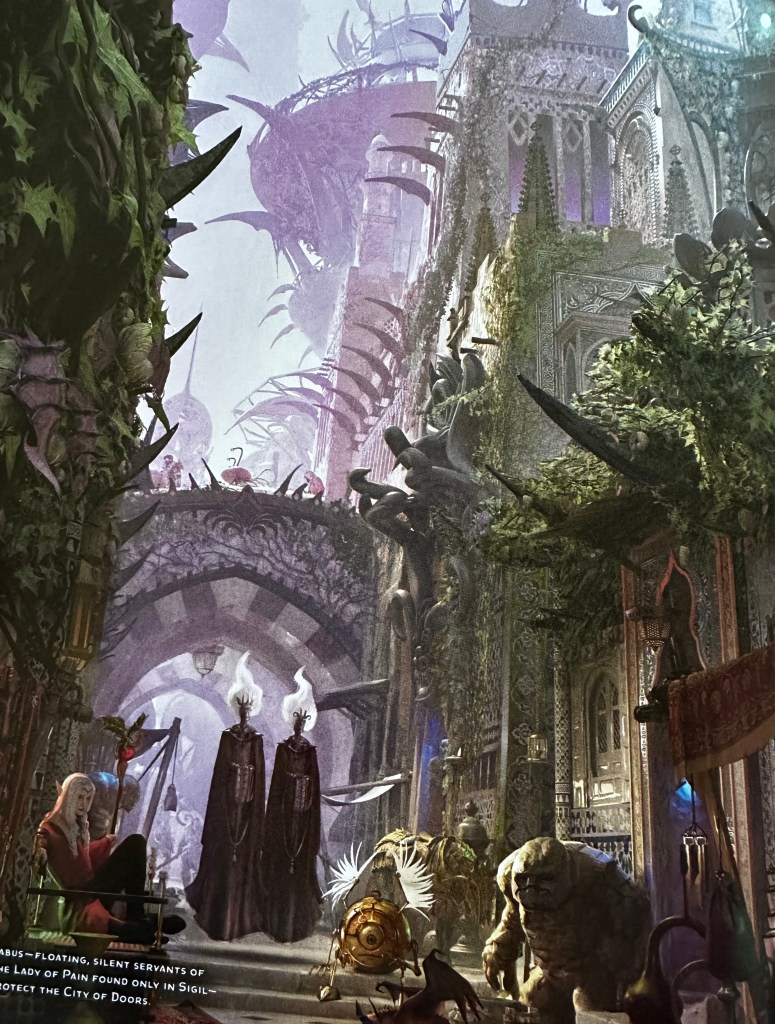
The Foundry Tower, as it was known while situated in Sigil, had been rather brimming over with portals to other places and planes of existence. It had been renowned for being the most portal-dense building in a city filled with such portals. In Sigil, any door, window, pipe-opening, sewer grate or picture frame could also be home to a portal. You just had to know the key to activate it. So, although the PCs discovered the tower under the hill and uncovered the fact that it was home to dozens of portals that still worked, they had no way to activate them without some guide to the keys required. And they had to find them because the Druid’s kids had been kidnapped and transported through one of the doors. After losing access to the only extant copy of the book describing the keys on the island, they had no choice but to travel to Sigil in the hopes of finding another copy. So that’s what they did, through an underwater backdoor portal that happened to exist off the coast, conveniently.

Now, the fun thing about the doors in the City of Doors, was that the keys needed to open them could be almost anything, from a verse of poetry to the lost sword of a dead king. As a result, I thought I would let my imagination run wild with the keys needed for the doors in the tower. It turned out I didn’t need most of theses. I think they only ended up entering two or three of them in total, but it was still a fun exercise and I think it could stand to me in the future if I ever have another Planescape adjacent campaign.

So, as a break from the Erlendheim Character Options series, I thought I would present here “The Book of Doors and Keys.” If you can get any use out of this in your own Planescape campaign, that’s great! You may even be able to use them for some other purposes, I guess.

Bear in mind that the “Door” entries are specific to a map I was using for the tower. I’m not going to present it here as I think its usefulness to others is negligible, so you can just ignore those.

Also, please note that any destination with “Scatterhome” in it is from my own home-brew world, so you can safely substitute it for some other place.

The Book of Doors and Keys

Door: Doorway in Level 1, Room 3
Destination: Nidavellir, Ysgard
Key: The thought of your most beloved person

Door: Eastern Doorway in Level 1, Room 6
Destination: Abellio, Arcadia
Key: Eat a plate of ribs at the doorway

Door: Doorway in Level 1, Room 10
Destination: Dothion, Bytopia
Key: Turnip

Door: Doorway in Level 1, Room 11
Destination: Pandemonium
Key: Be drunk

Door: Doorway in Level 1, Room 13
Destination: The Shadowfell
Key: Whisper a secret to someone else which will make them think less of you

Door: Doorway in Level 1, Room 16
Destination: Para-elemental Plane of Smoke
Key: Smoke a strong joint

Door: Doorway in Level 1, Room 18
Destination: Chaste, Vitrean Empire, Scatterhome
Key: A symbol of Kaigun, God of the Sea, from a dead priest

Door: Well near Level 1, Room 20
Destination: Mechanus
Key: A gear from a magical construct from Sigil

Door: Doorway in Level 1, Room 22
Destination: Goldenfields, The Sword Coast, Faerûn
Key: A red ribbon tied into a knot

Door: Well near Level 1, Room 24
Destination: The Caverns of Thought, The Outlands
Key: The memory of a parent that is the most enraging

Door: Doorway in Level 1, Room 26
Destination, The Elemental Plane of Fire
Key: Dragon-breath

Door: Doorway in Level 1, Room 31
Destination: The Nords, The Outlands
Key: Crush a bunch of peck-berries (only obtainable from the Fae-wild) under foot before the door

Door: Doorway in Level 1, Room 33
Destination: Aquallor, Arborea
Key: Whistle the tune to the Hymn of the Mother

Door: Doorway in Level 2, Room 1
Destination: Elemental Plane of Air
Key: Eat a turtle cake and burp in the doorway

Door: North Archway leading to the statue of a Githzerai in Level 2, Area 2
Destination: The Astral Plane
Key: Break a bottle of healing potion in the doorway

Door: South Archway leading to the sculpture of a great palace in Level 2, Area 2
Destination: The Factol’s Palace, The Ethereal Plane
Key: Tell someone a secret that will cause emotional harm to them

Door: Doorway in Level 2, Room 4
Destination: Tír na nÓg, The Outlands
Key: Tell a joke

Door: Doorway in Level 2, Room 5
Destination: Khalas, Gehenna
Key: Stab yourself in the leg and spread the blood across the door before the doorway

Door: Northern Archway in Level 2, Room 6
Destination: Strixhaven University
Key: Frustration

Door: Doorway in Level 2, Room 8
Destination: Neverwinter, The Sword Coast, Faerûn
Key: Dance the Neverwinter Axe-dance

Door: Doorway in Level 2, Room 9
Destination: The Infinite Beerhall, Demiplane of Celebration
Key: Put a sausage somewhere it does not belong in front of the doorway

Door: Doorway in Level 2, Room 11
Destination: Elemental Plane of Water
Key: Speak the name of the person you would most like to have sex with

Door: Doorway in Level 2, Room 13
Destination: Malbolge, The Nine Hells
Key: Burn a book and throw it through the doorway

Door: Doorway in Level 2, Room 14
Destination: Minethys, Carceri
Key: Inscribe an arch around the doorway with the tip of a steel sword

Door: Doorway in Level 2, Room 15
Destination: The deepest dungeon of the Imperial Palace in Vitrea, Scatterhome
Key: Cut off a left hand and place it in the doorway

Door: Doorway in Level 3, Room 1
Destination: Krigala, The Beastlands
Key: Throw a beast’s tooth through the doorway

Door: Double doorway, Level 3, Room 3
Destination: The Arena, The City-state of Tyr, The Tablelands, Athas
Key: The tortoise blade of a Mul Gladiator left in the doorway

Door: Doorway in Level 3, Room 4
Destination: the Feywild
Key: Play the pan-pipes in front of the door

Door: Doorway in Level 3, Room 8
Destination: The Positive Energy Plane
Key: Roll two sixes on a pair of dice

Door: North Doorway of Level 3, Room 10
Destination: Krangath, Gehenna
Key: Wear a crown

Door: West Doorway in Level 3, Room 13
Destination: The Opera House, Rath an Croí, Scatterhome
Key: Place a diamond in the doorway

Door: Doorway in Level 3, Room 12
Negative Quasielemantal Plane of Ash
Key: A handful of Yugoloth ash poured on your head

Door: Doorway in Level 3, Room 15
Destination: Amoria, Elysium
Key: Pay a compliment to the person you find it most difficult to compliment

Door: East Doorway in Level 3, Room 16
Destination: Niflheim, Hades
Key: Cry genuine tears of sorrow

Door: Doorway in Level 3, Room 17a
Destination: Mercurua, Mount Celestia
Key: Tell a sad story in celestial

Door: Doorway in Level 3, Room 17b
Destination: The Mortuary, the Hive, Sigil
Key: Crush a cranium rat’s brain in your hand

Door: Doorway in Level 3, Room 17c
Destination: Limbo
Key: The memory of your most embarrassing moment

Door: Doorway in Level 3, Room 20
Destination: Avalas, Acheron
Key: Burn your skin and allow the heat from the burn to kill an insect

New Character Options from Erlendheim, Part 3

Erlendheim

I began a series of posts last week detailing the character options I introduced to my Planescape flavoured D&D campaign a few years ago. It was quite epic in scale and involved gods and legendary monstrosities and elemental powers as well as travelling across multiple planes of existence and saving the universe from the domination of a narcissistic sea spirit. I hadn’t planned it in advance but, at one point, the Warlock needed to switch her patron so I came up with a new one which you can read about here. After that, I was hooked. I started making new character options, features and powers for every PC in the party. You know when you max out your rep with your party members in CRPGs like Dragon Age and Mass Effect and they get access to new abilities? That’s the way I was thinking of it. As a result, these new character options were designed with our specific players, characters, shared world and story in mind. I left balance at the door. Balance was not relevant to what I wanted to achieve. In fact, I wanted the PCs to feel special, powerful and impacted in a very concrete way by the events of the campaign. I think I largely achieved that. Take a look, here, at the powers I gave the party’s Druid when he became a kind of a shitty god. I think it exemplifies my philosophy when designing these abilities.

Celebrating the Mundane

I think the next big character advancement arc to culminate was that of Xarune, our Githzerai Fighter. Xarune, despite his background as an adventurer in his younger days, had a solid view of the world. He believed in the shield in his hand, the guardsman at his side and the firmness of the ground beneath his feet. He had developed a dependable reputation in a position of some responsibility as a sergeant in the Yeomanry of the town of Dor’s Hill. Magic was anathema to him and, indeed, he went to extremes to explain away magical phenomena in entirely mundane terms. But then the ground beneath his feet turned out to be the ancient tower of an unknown faction from a city in the shape of a donut floating above the top of an infinitely tall spire at the centre of the Outer Planes. It became increasingly difficult for him to hand-wave the obvious magic in the world around him, especially once he ended up in Sigil. In fact, I instituted a special mechanic, specific to Xarune. Each time he witnessed something truly magical that he could not explain, he would roll a Wisdom Saving Throw. When he failed, he lost a point of Wisdom, making it more-and-more likely that he would fail with each successive failed save. My goal here was to get Xarune under 10 Wisdom. Once that happened, his aura of confusion and his inability to square his beliefs with the facts of reality brought him to the attention of a small, new Faction in Sigil. They were called the Mundane. When Xarune ran into their leader, another Githzerai warrior named Sarafem, who noticed his unique state of disorientation through her natural psychic abilities. We had another short mini-game at this point, after Sarafem introduced the Faction and its tenets. She presented to him her shield, with, emblazoned upon it, the emblem of a shield. She asked him to take and examine it.

Here is how I presented Xarune’s inner struggle in my notes:

Sarafem will encourage Xarune to use detect thoughts while examining the shield. In essence, this will allow Xarune to detect his own thoughts, to interrogate his own beliefs.
If he does so, he will replay some of the more recent encounters he has had with “magic.” Ask him to recount them and indicate that he is unable, in retrospect, to lie to himself and his own feelings. The truth is that the spells and magical effects did happen. In some cases he was able to shrug off the effects and in others he bore the full brunt of them. What becomes clear as he remembers these incidents is that, it is not objectively true that he or anything has to be subject to such effects. He begins to get so in touch with his feelings that he feels a new understanding blossom. He is able to apply the force of his will against this magic, a will that is every bit as strong as any wizard or demon thinks they are. For that is all it is in the end, a battle of wills.
He will want to fail his saving throw against detect thoughts. Give him three chances to fail it at various points through the process. Of course, it is a Wisdom saving throw but this time the DC will be 2 points higher than Xarune’s normal DC as it gains a bonus from the shield.
Whether he succeeds or fails, Sarafem will present to him the shield with a bow. It is a mundane +2 shield. There is nothing magical about it, but it is exceptionally well made from the hardest, lightest wood they have ever seen. (It is made of what she calls Steadfast.)
If he fails, with a barely perceptible twinkle in her eye she will ask him to join her budding faction, which she calls, “The Mundane.” She says they are still workshopping it. There are not many of them so far, but each of them has a very firm grasp of their true feelings and they know what is real. If he decides to take her up on her offer, they are usually to be found meeting in her house near the Statue of Bigby in the Lady’s Ward any evening.
Also, he will regain his lost points of Wisdom and he will gain the new abilities presented [in the section below]
If he succeeds, however, he will go on as before, he will not regain any points of Wisdom and he will continue to risk losing them. If he ever reaches 0 Wisdom, he will lose his mind completely and reject reality entirely, thus becoming an NPC.
However, he can continue to attempt the trick with the shield, trying to detect his own thoughts. He can do this whenever he has downtime using the same rules as are presented above.

Thankfully, he failed all his saves and his outlook and philosophy changed as a result. Not completely, it was still quite compatible with his no-magic stance from before, it just morphed into a more anti-magic one, bringing a few new abilities with it. And you can read about those below.

But that wasn’t all. Xarune’s player, Isaac, took the idea of the Mundane and ran with it. He quickly took the ideals of the Faction and began to codify them, even going so far as to write up a Mundane Manifesto! This did my withered old heart good to see. The campaign gave his character a concrete, mechanical advancement directly related to Xarune and the way he played him, and he gave back to the campaign and the world, adding to its story and its depth. Sigh so good.

New Fighter Features – Nullification (Anti-magic)

Erlendheim #DND

So, as I pointed out in the intro to this post, I created these features and options for, not only a specific class, but for a particular character. As a result, the features prestented below are unique to Xarune’s flavour of Fighter, a Battle Master who focused on using the Defense and Protection Fighting Styles. As always, if you think you could make use of any of this stuff, please feel free.

Fighting Style

Defense

Also add a +1 bonus to saving throws against magical effects

Protection

In addition to the regular advantage of this fighting style, if a creature you can see casts a spell that requires a saving throw against a target other than you within 5 ft of you, you can use your reaction to add your shield’s AC bonus (including magical or other bonuses if it has them) to their saving throw.

Martial Archetypes

Battle Master

Maneuvers
Deny

When another creature hits you with a spell attack or you fail a saving throw against a spell effect or magical effect, as a reaction you can expend a superiority die and reduce the amount of damage you take by the superiority die roll + Con modifier.

Reflect

When another creature hits you with a spell attack, as a reaction you can expend a superiority die to reflect the superiority die roll + Con modifier damage back at the spell caster.

Wake-up Call

When you take the attack action on your turn you can forego one of your attacks and instead use a bonus action to direct another creature who can hear you to make an immediate saving throw against a spell that they are currently affected by. You expend a superiority die and they can add the roll + your Con mod to their saving throw roll.

Indomitable

In addition to the regular benefits of this feature, starting at 9th level, if the Nullifying Fighter is subject to a magic spell or effect, they can roll any saving throw with advantage.

The Heart of the Matter

Not entirely seat of your pants

A portion of the inside cover of my copy of Heart: The City Beneath from Rowan Rook and Decard. Illustrations by Felix Miall

The philosophy for some Heart GMs seems to be, don’t you dare plan your Heart campaign or sessions. Like, just sit down with your players, make some weirdos to do some delves and then decide on a starting place. That might be in media res, as the PCs meet one another while hopelessly lost in Labyrinth or it might be at home in their shabby-chic apartment in Derelictus. From there you might just ask them what they want to do next and, when they tell you, just try to keep up with them! This is a valid way to play the game, I think, as long as you have either an exhaustive knowledge of the landmarks, adversaries, plot hooks and people of the Heart, or an effective and suitably weird set of random tables. If you approach it from this direction, the players are going to have the most input but the GM is going to have to improv a lot and do a great deal of work on the fly. It also presupposes a certain degree of setting knowledge on the players’ part, I think. This can be stressful and a lot to expect of everyone but I am pretty sure this is the preferred method of a lot of Heart GMs.

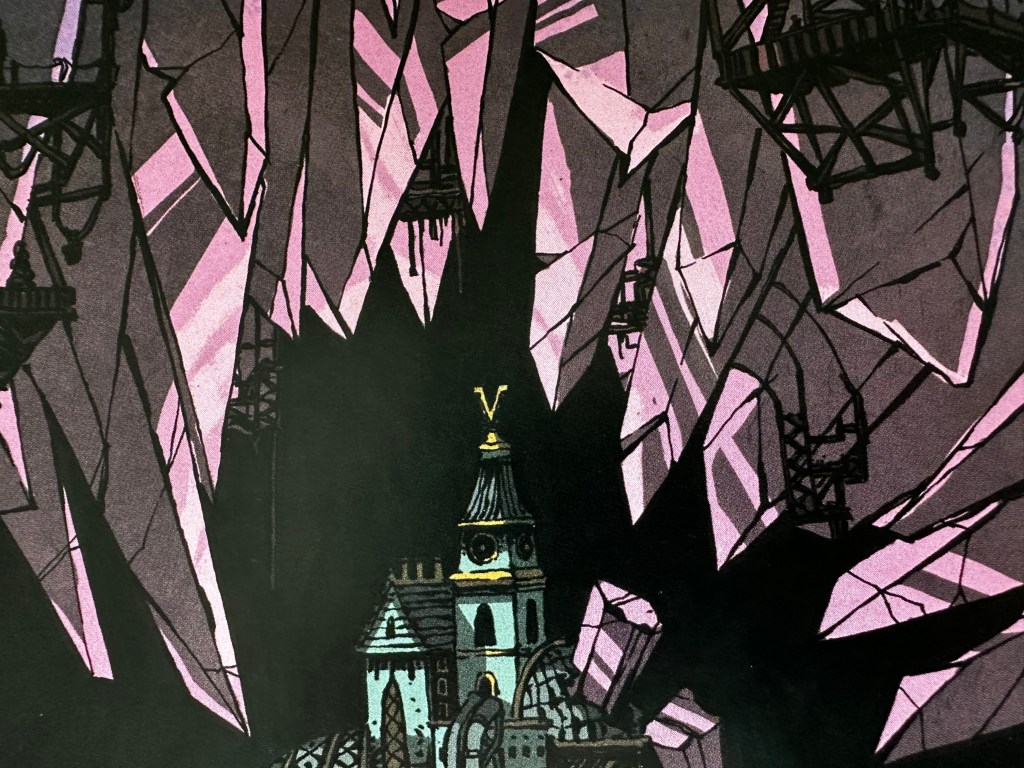
A portion of an illustration of Derelictus, the City Between by Felix Miall. Heart: The City Beneath, page 136.

Another option, of course, is to plan everything, start, middle and end. This is totally do-able. The book provides plenty of fodder to feed your hungry campaign. It describes dozens of landmarks and provides you with lots of plot hooks to get the PCs interested in pursuing the thing you want them to. So you can have them all meet in a Derelictus tavern where they overhear something about a plot by some Gryndel to pursue a valuable quarry into the Heart, plan the first delve to take them after the Gryndels only to find the quarry in Grip Station, near death but with a dire warning for the whole city that an army of Angels rises from below and a request for the delvers to spread the news to the Temple of the Moon Beneath, plan out the next delve to there, etc. etc. This sounds very much like a traditional adventure module for the likes of D&D. And that is all well and good. It allows a very strict control on the part of the GM and makes for a plot the PCs can uncover. But it will certainly lead to some railroading and could well make for potential dissatisfaction for the players and the PCs as they feel they have taken a back seat to the narrative planned out so perfectly by the GM. This method will ignore the great strength of Heart, it’s freeform potential, the loose structure inherent in the Beats system and the story being told by the delvers’ choices and their rolls and the Fallout that comes out of them.

A portion of an illustration of delvers planning a delve by Felix Miall. From Heart: The City Beneath, page 103.

So, how about somewhere in between? It seems sensible to meet in the middle. You make your weirdos, then you all discuss what sort of game you would like for them, GM and players together. Or you could take those two steps the other way around. Either way, you have an idea of the sort of story you all want to tell together and you all take responsibility for making that happen. This is with the understanding that what you think you want at the start might very well change after one or two or five sessions. That’s when you realise that, while you thought you wanted to help out that Haven you came across at the end of your first delve, it turned out what you actually wanted all along was to physically explode in such a way as to take out as much of the surrounding entities as possible so you could all travel to the afterlife together, an offering to your Goddess. And in pursuit of these elastic goals, the GM comes up with a loose web of places, people and objects that the PCs might have a chance to interact with. The GM will probably do this, at most, in between each session, with several ideas of where the story might go in the two or three sessions afterwards, but with no expectations.

A portion of an illustration by Felix Miall, of Grip Station, a Tier 1 Landmark. From Heart: The City Beneath, page 138.

Here’s what Messrs Howitt and Taylor have to say about it under the section entitled, “Stop Planning” on page 109 of the Heart core book:

Flexibility and adaptiveness are the keys to success. When you prepare, think in terms of characters, broad concepts, motivations, snatches of ideas that you want to play with. The world doesn’t exist until you speak about it at the table. Sure, you might have thought about it – you might even have written it down in a notebook – but until the players interact with it, it’s in total flux. The players just turn up every week and make it up as they go along. Why can’t you?

The quantum campaign made up of Shrödinger’s delves. And this about sums up the type and degree of prep I have been doing before each Heart session more recently. It’s more fun for me to do it this way too. I get to be surprised by what the players do and I get to discover the Heart along with them a lot of the time.

From Haven to Terminus

Yeah, that’s the name of our Heart campaign. It’s coming to an end this week. I guess the name gives away quite a lot of my thinking behind it. I was finding it hard to let go of the traditional module style of prep at the start. Yep, I decided to make a bold statement about, not only where the campaign would start, but also where it would end up. Now, this wasn’t as bad as it sounded. I had a very vague idea of a Campaign Frame for the game, that’s all. I used one of the plot hooks described in the Derelictus section of the Heart core book. Verrex, a retro-technologist with his tumble-down workshop situated on one of the platforms of Haven Station wanted the delvers to track down his robotic double, V01. The construct had expressed an interest in visiting all the Vermissian stations in the City Beneath, so he suggested the PCs use that as a guide to finding him. That was it. Everything in between was entirely up in the air, but it gave them a loose path and a potential final goal.

A portion of the illustration of a Gnoll Incursion Team by Felix Miall. From Heart: The City Beneath, page 188.

That was, of course, until I decided to employ the adventure presented in the Heart Quickstart guide, Drowned. Now, I am not going to spoil any of this adventure here but what I will say is that it lays out a very particular path ahead of the PCs, with the havens they will reach at the end of each of the numbered delves, the NPCs that will push them on from one place to the next and a big old final set piece. Now, since all I had before making this decision was a loose Campaign Frame, a little concreteness was actually welcome. It allowed me to see how to do things like come up with my own delves, use Haven NPCs to best advantage to help drive narrative and try to attach the PCs to someone or something only for them to find a way to betray or deceive them. But, after five or six sessions of following the adventure, I became aware of how the campaign had ended up on rails. I wasn’t providing them with options, I was forcing them down the path laid out by Drowned. I have found it hard to get out of this frame of mind since then, although I have tried to follow the advice from the book that I quoted above.

The delvers just reached Terminus, having taken a near-lethal shortcut through The Source, one of the Eight Heavens. The Junk Mage is banking everything on a meeting with a gnoll in Terminus who can teach them how to use the Nexus Device there to enact their will upon the entire city, The Vermissian Knight has pumped his mystical train armour full of soul power, the better to resurrect the entire inter-dimensional subway network, and the Deadwalker has just had his Zenith wish to combine his essence with that of the Heart itself thwarted by the Vermissian Knight who says he will not stand for his “human servants” abandoning him until his work is done (he’s an aelfir obvs.)

How will it end up? We’ll find out soon. But whatever happens, I am now pretty sure that these amazing players are going to surprise me yet again.

Between the Skies Part 3

How to begin

I’ve written about beginnings in RPGs before. I think they are crucial to establishing tone, theme, genre and expectations to the whole game, long or short. Many RPG books lay out pretty well, the genre and themes they explore, many providing starting adventures or scenarios to help you set the tone. Few do as good a job at helping you to begin as Between the Skies.

Now, as I’ve written in the previous entries in this series, Between the Skies by Huffa provides a whole lot of advice and options collected into a loosely defined game. It exists to help the players (including the GM) create the play-style and world they want. The text assumes that you will be using a set of rules that suits your table so, by necessity, the advice and tools it provides to help you begin playing are applicable in almost any game. Having read the Beginning Your Travels chapter, I can say it’s brimming with what is just plain good advice.

How and why

The why is an often overlooked element of an RPG character. What the hell are they doing any of this crazy shit for? Why are they travelling across the planes or through wild-space, in the specific example of Between the Skies. I wrote more about character motivation here. Obviously, this book has tables that help you to answer that question. They are wonderfully vague, as you might have come to expect. The vagueness allows your own imagination to combine with the generalities of the game already established by you and your group.

The How and Why do You Travel tables from Between the Skies. These include a "Who are you Traveling For? " d6 table, a "How do you travel?" d66 table and a "why are you traveling" d66 table
The How and Why do You Travel tables from Between the Skies. These include a “Who are you Traveling For? ” d6 table, a “How do you travel?” d66 table and a “why are you traveling” d66 table

You will notice there are three sub-tables there.

  • Who are you Traveling for?
  • How do you travel?
  • Why are you traveling?

Once again, it is important that they are incredibly general. You will find yourself building your world as you fill in the gaps around the results of this table.

It’s telling, isn’t it, that the how is also considered here? And that it’s randomised? This is one of the most fundamental questions to answer in establishing the setting, and, in many ways, the type of game you’re preparing to play and it’s left up to random chance. If you think of it from the perspective of a D&D game, there are not too many tables who are rolling the dice on running a Planescape, Spelljammer, Dark Sun or Forgotten Realms campaign next. But using this table gives you all the power. It allows you and your group to put down roots in the world you are going to play together in, and grow whatever you want out of them. You’re going to need a lot more than just the single result from the table but Huffa trusts that you can come up with that, and not only that you can do that, but that you will enjoy doing it. Luckily there are also a butt-load more tables in here to fire the imagination and get you moving in a direction.

How about this for a situation?

The Starting Site Recipe list from Between the Skies. It has 7 points.

Huffa would like you to start your first session in media res. That’s also what I always say. Clearly, she’s a genius. The great thing about the advice as presented in the Starting Situation section is that, once again, the in media res beginning has been formalised into a procedure. You are presented here with a series of steps required to create your Starting Site, what is called the “Starting Site Recipe.” After that you have bevvy of tables to help you in sorting out what type of situation it’s to be, what or who precipitated it, what type of site it is, its inhabitants and a some more trickle down tables that allow you to flesh out the various site types.

The Starting Situation tables from between the Skies. There is a "Starting Situation Type" d6 table with "precipitated by" 2d6 table attached. There are also two more 2d6 tables, "PCs aligned with..." and "PCs antagonistic towards..."
The Starting Situation tables from between the Skies. There is a “Starting Situation Type” d6 table with “precipitated by” 2d6 table attached. There are also two more 2d6 tables, “PCs aligned with…” and “PCs antagonistic towards…”

It makes it feel like, if you used this method, you would have your starting situation and location prepared in minutes and only need to write a short description of a few of the items you rolled up. As usual, when I read any part of this book, it just makes me want to give it a go.

How it looks

Luckily, there is a great little example Starting Situation presented in this chapter as well. It has been generated using the method described earlier and it is called “The Godshambles.” The entire situation is described in only a few short paragraphs, a couple of handy tables, a route map and particularly evocative illustration by Coll Acopian.

If you wanted, you could just use the Godshambles as your own starting situation and no-one could blame you. But, I think one of the beautiful things about the Starting Site Recipe is that the prompts you roll up on the tables will help you to imagine a situation that is fitting for the kind of game you have conjured together when you were creating characters and rolling on the how and why tables before. So, it is likely to feel a little loose around the hips or too baggy around the ankles compared to one you generated yourselves.

How it goes

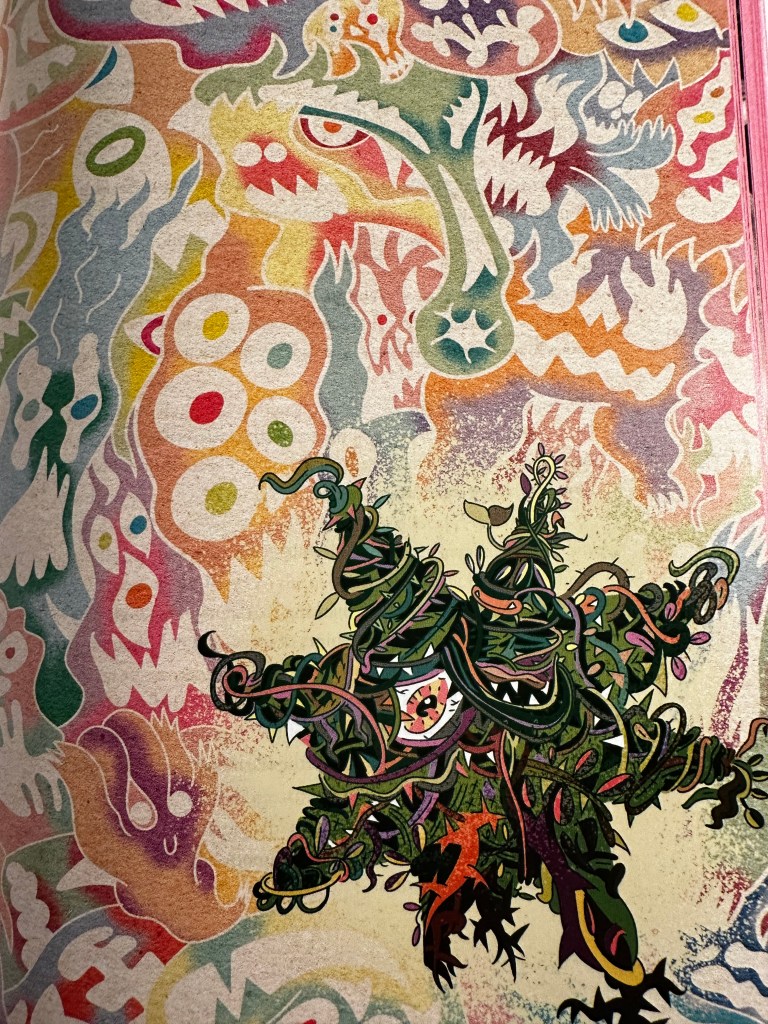
A full colour illustration from Between the Skies. It shows a star-shped being that seems to be made of an entaglement of vines and other plants floating through a multicoloured, psychadelic dreamscape.

Like I stated earlier, I am a big fan of the methods described in this chapter for beginning your game. I am excited to try it out and invite my players to be as big as part of the world building as I am, or bigger, from the very get-go.

Between the Skies has a lot more to offer. I have not even made it half way yet. But I think, for now, at least until I start actually playing it, I will pause this series of posts for now. I’ll bring them back when I have some more practical experience I think. See you then, dear reader!

Between the Skies, Part 2

Back to the skies

Between the Skies is such a beautiful and fascinating book that it is a pleasure just to read it. If anything, all this writing about it is just slowing me down! But I do feel the need to evangelise a bit more. So join me, dear reader in an exploration of the character generation options. Or, if you haven’t read the first of these posts, you can catch up here.

Character Generation

The “Approaches to Character Generation” section encourages you to decide on the approach you want to use and then to roll on the relevant tables to flesh out the description. It’s important to note that your interpretation of the table results is what’s important, rather than having a strict set of attributes or traits that have specific meanings in the game.

It also tells you to note all of the things you want known about your character. I love this point, actually. Rather than waiting till it comes up in play, when a GM might casually bring up an element of your character that you don’t want the other PCs to know, you make it clear at the outset the only parts of your character or background that others would be aware of. Or maybe it just means that there are things about your character that no-one knows and that will come up organically during play, at which point they will become a part of them. Either way, it is an important point.

Character sheet with character generation question page no.1. This is for a "Through the Looking Glass" type character.
Character sheet with character generation question page no.1. This is for a “Through the Looking Glass” type character.

This section also directs you to go and take a look at the character sheets in the back of the book. There are three types, which I will get into below. But, notably, on the page before each actual character sheet, you’ve got a few questions printed in large font, taking up an entire page, to build a basis for your character. For the Lifepath and Spark procedures these are:

“Who are you?”
“What can you do?”
“What do you have?”
“What do you want?”
“Who do you know?”

And for the Through the Looking Glass procedure they are:

“Who are you?”
“What can you do?”
“How did you get here?”
“What are you searching for?”
“What have you brought with you?”

It’s almost as if their significance cannot be over-stated. It feels like these big old questions and the spaces for you to fill with your own answers to them on these pages could act as the character sheets themselves. Perhaps, if you don’t want to be too bothered with specifics, if you don’t want to use numbers and die types and the like to describe your character, you could just write a few answers to the best of your ability beneath each of the questions. That would be a good basis for a character in a fictional story. Would it be a good character in an RPG? In the very loosest of story-games, I feel like that’s more-or-less the approach and it works well, but it does depend on the type of story you and your table are trying to tell. In a space-pirate, treasure-seeking, swashbuckling adventure game, it might not hold up. But if your aim is to tell the story of a group of people caught in a difficult situation, informed by their backgrounds and desires, complicated by their relationships and inner lives, and their development as people over the course of the game, sure, it would be perfect. Writing about this makes me want to try it…

Character sheet with character generation question page no.1. This is for a "Through the Looking Glass" type character.
Character sheet with character generation question page no.1. This is for a “Through the Looking Glass” type character.

So, next to each question page is a “Worksheet.” Even the word-choice here is significant. It indicates that this is where you will be performing the admin for your character. Filling it in will be an exercise that you may find tedious or satisfying, very much depending on the type of person you, the player, are.

Each worksheet helps us to encapsulate a character designed according to one of three (four, kind of) procedures.

I mentioned in the last Between the Skies post that the procedure you use here is related to your approach to weirdness. So, if you have decided to go with “All the Weird” you can probably use any of the methods described, but if you are going with a “Venturing Out Into the Weird” approach, and you want mundane characters, you should think about going with the Spark character creation procedure (with a few modifications.) Once again, it’s important to note, all of this is advice, none of it is mandated. Choose and use what you like and discard the rest.

Lifepath character generation

I have never played it but I have heard about this character creation method being used in Traveller. Essentially, you map out your character’s life up to the point of the start of the game and this process creates the PC. You roll on the tables provided for this character generation method to establish events in your character’s life that lead to the accumulation of “Skills, allies, enemies, Mutations and Debt, among other things.”

Let’s take a look at some of the tables used for Lifepath character creation.

You have a Type table that contains a pretty wide array of permutations. I rolled up a Swimming Avian. I’m thinking seagull.

The Descriptor tables are d66 so have a lot of options in them too. You might be described as Huge, Transformed, Dead, Nomadic, Staunch or Minimal. These single adjectives should ignite the imagination and lead you down paths to fill in the blanks on your character sheet, or just in your mind.

You roll twice on the Aptitude table (also d66) and take the adverb form first and then the adjective form. So a roll of 54 and 45 (which I genuinely just rolled) would be Inspiringly Commanding.

After this you enter the Life Events section. It explains the basics of using this method and then tells you to go and roll on the Life Events tables. There are three tables to roll on depending on whether you want have your major life events on a Surface (I guess like a planet or something similar,) in Space or out in the Planes. You can switch between them and sometimes have to depending on the events you roll.
A sampling:

  • Quest for NPC completed, harmed – Roll powerful NPC for patron; Gain problem related to injury suffered by PC
  • Death, became undead – Create one Extraordinary Ability related to undeath; Create one Problem related to undeath; If already undead when this result is rolled, PC is destroyed, create new PC who has dead PC’s possessions.
  • Joined heresy – Joined heretical religious organisation; Gained ire of opposed religious organisation; Gained skill related to heresy
  • Became Hermit – Cannot roll any further life events; Gain skill related to hermeticism
  • Lost in the Planes – Cannot roll further life events
  • Became petty god – Roll or describe Focus; Gain Extraordinary Ability related to petty godhood; Petty gods are not necessarily more powerful than mortals

After this you have a bunch of tables to help you determine your Extraordinary Abilities, Skills, Mutations and Problems all of which will help to round out your character. There are some great entries in these tables but this blog post has already gotten away from me so I am going to have to skip on to the next method of character creation.

Spark character generation

ANother black and white illustration from Between the Skies. It shows a creepy person with no face except for two blank, white eyes. They open theirlong black coat as though they were selling hot watches, but inside are only toothy grins and gaping maws.

This is an entirely table based method, but, as the title suggests, the results you get from the tables should be used to spark the imagination of the player. As Huffa takes pains to point out more than once in the characters creation section, the tables might give you powers and abilities and they might even describe what you can do but they don’t tell you how your character does it. I think most of us assume this point without thinking about it in our games most of the time (my Magic Missile looks like three paper planes that explode when they hit!) but it’s a good thing to have it called out here formally. So the tables used for this method are very much based around the questions I listed above. Under the “Who are you?” section we have table after d666 table of descriptors to roll or choose from.
Here are a few nice ones:

  • Sickle mender – fixing what cuts
  • Messmaker – joyous entropy
  • False smile – feelings turned inside out
  • Babysitter

For “What can you do?” you can go back and use the tables under the Lifepath method for Abilities, Aptitudes and Skills.

“What do you want?” – There are a couple of tables here. You are encouraged to use these to “inspire a few sentences describing what your character wants.”
Examples:

  • Objects of Desire – Redemption, Surprise, More
  • Related to… – past self, rulers, daemons

When it comes to “Who do you know?” we have another trio of tables. These can be used to make two or three entities with whom you have a relationship of some kind. For instance:

  • Entity type – Creature
  • Relationship type – Debt holder
  • Relationship detail – Yearning

Once again, use these results as prompts to describe these relationships in a little more detail.

Finally, in the “What do you have?” section, you use the Starting Resources procedure with some changes. Generally this involves you having an alright weapon and some semi-decent armour, equipment needed for skills and maybe even a ship if that’s the sort of game you’ll be playing. You get to roll up an interesting object too! You will also possibly have some Assets or Debt to start with. There is, unsurprisingly, a table for that. Assets, Debt and Petty Cash are all rather abstracted in Between the Skies. You measure them in units where a unit of Petty Cash might buy you a nice meal and a unit of Asset or Debt would be the equivalent value of a house. I appreciate a system like this as counting gold pieces holds little or no interest for me. Also, Debt implies a Debt-holder and that could be an important relationship and could be used as motivation at some point.

Through the Looking Glass character generation

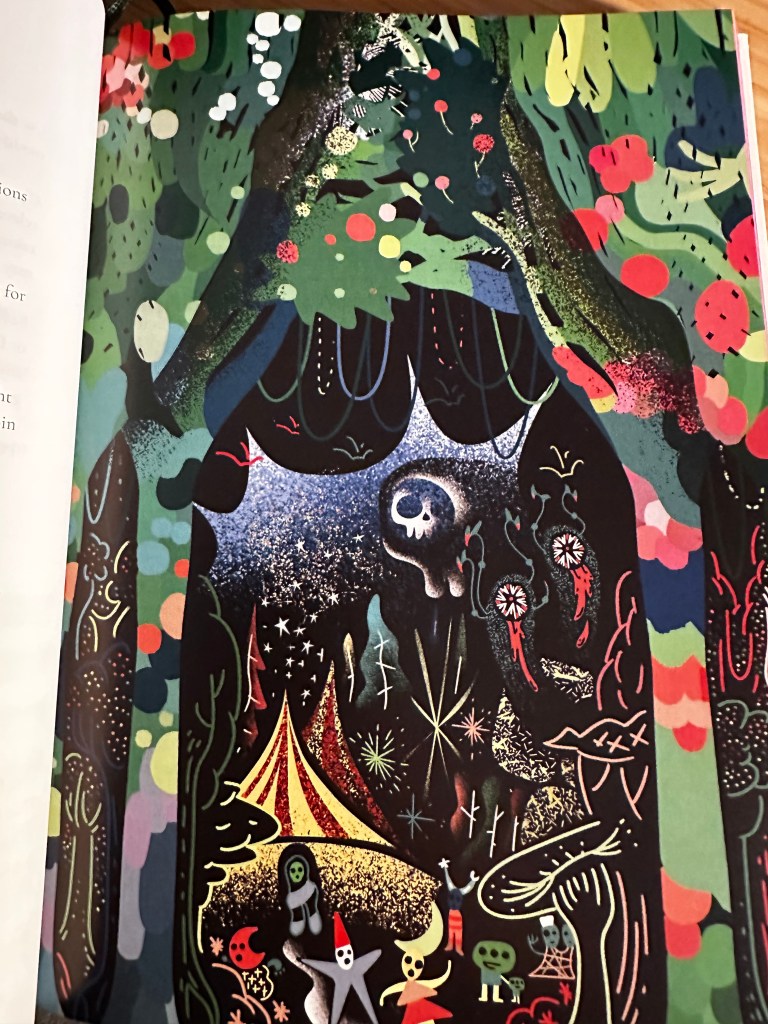
A full colour illustration from Between the Skies. The picture is of some strange characters, drawn in a deliberately childish style with funny hats heading towards some circus tents and away from a colourful bu threatening forest in the foreground.

Your character has done a full Alice and is now in a freaky other-world. Why are they there? What sort of personal disaster has led them to this point? What are they looking for in this isekai nightmare/dream realm? These are things you need to know about your Through the Looking Glass character.

Once again we have some tables to roll on. But interestingly,

It is assumed that Through the Looking Glass characters are mundane people from a world like our own, and that results are interpreted accordingly

A few sample descriptors from the tables:

  • Vengeful
  • Loopy
  • Ostentatious
  • Firefighter
  • Hack
  • Paparazzi
  • Avante Garde Hobby
  • Entrancing Dancing

On the “You (were) recently…” table we have a little more to shape your mundane character. You can roll on the d66 table to get these sorts of results:

  • Retired
  • Transitioned
  • Canceled

Under the “What can you do?” section, the abilities are a lot more “normal” than some of those in the previous character generation methods. They include stuff like:

  • Untapped Scholarly Education
  • Precocious Performative Love
  • Charming Spiritual Profession

One of the different questions belonging to this character generation method is “How did you get here?” This is, of course, of utmost importance to this type of character. Maybe you were trapped by an entity from another world. Perhaps you stumbled into it while intoxicated, seeking pleasure. Or was it that you were reincarnated after dying by a catastrophic event?

Even just reading the entries in these tables has my imagination all aglow with possibilities. They make me want to run this sort of game. I don’t think I have ever done that, not for such mundane PCs, at least. I want to see how such characters would be changed by such an impossible journey! Yum yum.

Another question that is specific to this character generation method is, “What are you searching for?” Ruby slippers? Aslan? That damned white rabbit? I suppose it could be any of those but why not roll on some tables instead?

The tables, interestingly, do not tell you exactly what you are looking for, just the type of thing you might be looking for (knowledge, person, object etc,) what that thing will provide (relief, comfort, affirmation) and what complicates it as a goal (explosive, famous, moving.) You should then get together and discuss the precise nature of the thing. The text suggests that, if you are all of a similar type of character, you should maybe all be striving for the same object but that you might each have a different motivation. This sounds like a wonderfully interesting potential grenade to throw into the works whenever the characters finally find the item they have wanted all this time. It smells like interpersonal conflict. Yum yum yum.

Lastly, for the Through the Looking Glass method, we are looking at the “What have you brought with you?” question. This is different to the “What do you have?” question common to the other two methods because your character is assumed to have been yoinked out of their own reality with only the items on their person. So they don’t get to have any Assets or Debt or any of the other starting equipment other types of characters might begin with, which is totally fair. Instead, they get a few basic items and maybe one Special Item. There is, as you might have guessed, a set of tables for that. Once again, these provide inspiration rather than outright answers to what that Special Item might be. So you might have an Alien Secret or a Mythical Key… This idea of only having what you had on you makes the prospect of the first few hours in a new world particularly enticing from a game perspective. How does one survive in a desert otherworld with nothing but a mobile phone, a wallet full of loyalty cards and used tissue? The answer could be that the locals are enchanted by the Spectral Device that you were handed just before being shoved through a portal.

Character generation using other games

There is a very interesting and useful section near the end of the Character Generation chapter. It provides a loose guide to using another system’s character creation method to make your Between the Skies character. Essentially, if you use this procedure, you will end up with a blended character. They will still consider the questions from the first two character generation methods but you will do your best to apply the answers to the character you have created using the other system. In some cases, this will mean that you are adding bits entirely from the question answering method as many systems do not consider things like what you want and who you know at the character creation step.

I am a big fan of Troika! so I am happy to see the practical example of using a Troika! background as the basis for a Between the Skies character here too. It makes it easier for me to picture using this method and elucidates the process in a practical way.

Character generation conclusions

All in all, I am impressed with the breadth of options presented in the chapter. You have no fewer than four different ways of making your character (and many more if you consider you could technically use the fourth method to use any other game’s mechanics to do it) a plethora of interesting tables to create some really weird or terribly mundane characters and a whole bunch of world-building before you have ever started playing the game in anger. The results you are likely to roll on things like the Life Events tables are going to haunt your game if the GM is paying any attention at all. You’re likely to establish the existence of certain NPCs, gods and demons, places, objects and catastrophic events that effect the whole world while rolling up your PC. I love this! It starts the whole table off with so many potential plots, grudges, vendettas, desires, loves, hates and motivations that the game should practically run itself from the moment you finish character creation.

As a process(es) it makes me excited to take part in it and even more excited to play the game, either as a GM or as a player.

What do you think, dear reader? Does this make you interested in Between the Skies? If not, perhaps I will continue to pursue this subject in another post in the near future so I can convince you. If so, maybe I’ll keep entertaining you with details and opinions of a subject you clearly enjoy! It’s a win-win!

The Apprentice, Chapter 4

Feelings

Did you ever have a feeling that, no matter how good things seem to be, everything’s about to turn to shit? Our protagonist lives with that constant knowledge. Things started off pretty bad for him and only continued in that vein, a chain of misfortune and karmic justice interspersed with periods of seeming normality. Almost as soon as life seems to have reached a plateau, he begins to look ahead to the potential for disaster on the horizon. Welcome to Pitch Springs.

Chapter 4: Life in Pitch Springs

My father went to war (“What war?” I recall innocently asking the day he told us of his plans. “Whichever one will have me,” he replied and laughed grimly) and left us in the care of a governess.

His governess, it turned out. Her name was Mrs Blanintzi (although, strangely enough, I never heard a single word nor saw hide nor hair of a Mr Blanintzi.) She was a tiny woman who had used to be very tall indeed, or, at least so my father told my sister and me. Of course, it occurred to me that he had used to think her tall because when he knew her, he was a wee lad, himself. Still there was no denying that her stature seemed to be affected by her extreme age. When first I was introduced to her I cringed a little and fell back before her. She had reminded me of the evil sorceress, Valenna Gretzi from the Tale of the Dead Count. I never totally overcame that first impression though our governess was far from evil. Admittedly, I could not call her kind-hearted either. Her defining characteristic was her sternness. She balanced my sister’s stupidly happy nature by never smiling, at least never in my presence. This may have had more to do with a dentally challenged nature, I realise now, but at the time I imagined it was due to a strict seriousness which I appreciated and even admired. I would not like to give the impression that Mrs Blanintzi was anything other than devoted to her young charges, however. Unsmiling and hard though she might have been, Mrs Blanintzi’s only concern was the welfare of my sister and me. She cooked and cleaned for us, mended our clothes and trained us to fend for ourselves as much as possible. Meanwhile she tried to procure for me a suitable education and, for my sister, a suitable suitor.

Now, by this time in my life I was aware of what had happened to our farm life and why and who was responsible: me. I do not think that my family had guessed it or at least not all of it. My father felt it, though, of that I am sure. His feelings never steered him wrong, not until the end, at least. He used to often tell us of feelings he’d had which had saved his life.

A true story (as opposed to the likes of the Man who Stared at Sheep and the Tale of the Dead Count) that he once told us illustrated the value he placed on his “feelings.” He had been in the top field watching Greysteel chew on the long-grown grass under the great old chestnut tree near the edge of his land. The weather was fine and warm and my father was sitting in the shade of the tree himself when this occurred. The scene seemed so tranquil, he said, that he even began to drift off as his trusty steed ate his fill in the shade beside him. There was no cause for unease, my father told us, and yet as he lay there, back to chestnut, his stomach fluttered and he awoke wholly from his doze. He looked around, sniffed the air and held his breath to listen for danger. He heard, smelled and saw nothing, but the “feeling” grew worse until he felt so uneasy that he gathered Greysteel’s bridle in his hand and led him down towards the farmhouse. The feeling, he said, grew still worse until he felt close to nauseous so he mounted the horse bareback and galloped all the way to the house. He locked Greysteel in the stable and went into the house himself, urging my mother to do the same (this was before either Primula or I were born.) Ten minutes after he had done this the stampede came upon the Sharpetzi farm. A herd of four hundred wild buffalo destroyed the top field in a sea of flesh. Many of the sheep were killed and many more scattered, fences were torn away as if made of paper and many of the farm’s outbuildings needed repairs afterwards.

So, you can easily see, it stood to reason that he would have felt something about my hand in our fate, in the disaster and disappointment of our lives. He must have had a feeling about my curse. Perhaps it even drove him away to his unspecified war, leaving my sister and me in our new home in Pitch Springs.

Our new home was a townhouse that slotted between a shoemaker’s and a pie-shop. The house appeared to have been built later than these two businesses, filling the gap between them perfectly. Perhaps once it had been a darkened alleyway where unknown rascals picked pockets and murderers garrotted their victims. Such thoughts often passed through my mind as a boy growing into a young man in that house. I learned much later and rather disappointingly that there had never been an alleyway in that spot and that before our house was balanced perfectly between shoes and pies a small garden had stood in that place, brightening the otherwise dull square on which it stood. The square was called Saint Frackas’ Square. Saint Frackas is the patron saint, rather fittingly, of all soldiers and warriors, which is why my father bought the house where he did. He was not an especially religious man but he treasured his own well cultivated beliefs and superstitions.

My sister; you might be wondering by now what had happened to her. Nothing, is the answer. Not a thing happened in my sister’s life. Even before moving to Pitch Springs she seemed to lead an incredibly dull existence. She would wake each morning, prepare a meagre breakfast for herself and then leave the house, off to work for Grey Greta, the washer woman who so feared the wrath of my father (It had always been common practice in our region to prefix a person’s name with their most noticeable physical characteristic: there was Tall Merchyn, Stick-skinny Glyndi, Elephant-ears Tomanz and Eyebrows Maryk (that last one is me. I have been afflicted with more than one curse and the eyebrows which move about my forehead of their own volition are the second most terrible of them.) Her employer, as I believe I have already illustrated, treated Primula abominably; beating her when she was unhappy with the standard of her work or if she was tardy, calling her names (she called her “Miss Flimula” which apparently filled Grey Greta with vicious mirth and left her employee baffled but unaccountably insulted) and worked her like a mule twelve to sixteen hours each day. Despite all of this, Primula remained irrepressibly cheery. She was pretty, everyone said so, and she had an exceptionally fine set of teeth which she delighted in displaying as often and for as long as possible. This penchant for smiling often led her to look rather stupid. Once, in the farm days, when the Meat Man came to the house, my father invited him in. When he was left alone with just us children in the parlour he began to regale us with what passed for funny slaughterhouse anecdotes. I was only five years old at the time and I knew enough to laugh at all the right junctures and ask questions in the right places (I was an unusually bright and well-mannered child, it’s true.) Meanwhile, Primmy sat there smiling the same blank-faced smile. Even after the Meat Man had asked her a pointed question about her preference for liver or tongue. I saved her bacon by answering the query myself, indicating my personal preference for kidney which sent him into gales of laughter. I remember watching the Meat Man leave our house that evening shaking his head and chuckling to himself and repeating “Kidney! Hah! Kidney!”

I envied Primula. No matter what the World and events conspired to inflict upon her, from my mother’s murder at my infant hands to the twice-weekly thrashings from the bully who employed her, her chin never slumped and she never, ever cried. I never saw her cry at least, so I assume she didn’t. She clearly took after my good father very strongly (apart from the smarts, my father was an uneducated but very intelligent man.) But I knew where she drew her unmitigated happiness from and it was from a mean place inside her heart. She would forever be smugly certain that, no matter what she did or how bad things seemingly got, she would never have to live with the burden of being a Mother-Killer. I often spotted her watching me and smiling her stupid, wide-mouthed smile like the wood-carving of an ass and then suddenly looking away and becoming occupied by an invisible stain on her dress or a non-existent cobweb when she became aware that I knew she was looking at me.

When we moved to town things did become a little easier for Primula. Her place of work was much closer so she no longer had to wake before the break of dawn. Also, she began to meet other people her own age and her prettiness was admired the town over. My sister was five years my elder. (My own birth was a mistake in more ways than one: my parents had never been expecting another child when I came along; Mother had been very ill for several years previous to my birth and the wise-woman I mentioned earlier, Old Aggie, told her she’d never live to see another child. She was, of course correct but not in the way my parents expected.) She was beginning to attract male attention. One day in spring when I was nine or ten years of age, while Primula was in the square outside our house talking with the other adolescent girls and grinning her inane grin at the group of boys on the other side of the square, our governess, Mrs Blanintzi, told me, “Your father only wants a good man for young Miss Sharpetzi (she was referring to my sister), a good match.” This was the first I had heard of this, in fact I had never heard my father express any wishes about either of us except that we be looked after and that I gain some degree of education (I shall come to that presently (are these constant parenthetical interruptions becoming distracting? They seem to be the only way I can convey these interesting but narratively unnecessary tidbits so I believe I will continue to use them where I deem it fitting.)) Indeed, I doubt very much that Primula, herself, was any more aware of our father’s plans for her than I had been. I decided to keep the knowledge to myself. It made me feel good to know this thing when she did not. It was petty, I am aware of this, and yet I will not deny it. After Mrs Blanintzi told me of the marital designs my father was formulating for my sister I began to watch more closely the behaviour both of our governess and of Primula and how the actions of the younger frustrated and annoyed the older repeatedly.

This became important later in the relationship I had with Primula. Up until that point I had almost no relationship with her. I was probably the only thing in this dreadful world which could dampen her otherwise unflappable happiness so she avoided me as much as possible. I still rose early because it was necessary for me to do so, meanwhile Primmy slept late; I returned home early while she worked as late as possible; on our free days she would dance about the town with her gaggle of friends from morning, late into the evening. Meanwhile I stayed at home and studied even though that’s what I did most of the week anyway.

Still, one day I discovered something that she wanted more than anything else and told her I could help her get it. This is how I was to do it.

To be continued…

The Apprentice, Chapter 3

This poor kid

I’m back today with another instalment of the Apprentice, the fantasy novel that I wrote a number of years ago. Our protagonist is in the throes of a difficult childhood, which he compares to the life of a cursed Count, surrounded by death and being the cause of the misfortunes of his loved ones. We all feel a bit like that sometimes, I think. It can seem like, no matter what we do, everything turns out badly, or that disaster follows in our wake. That is certainly how this poor kid sees things. Is he right?

Chapter 3: Greysteel and the Birds

We moved to the town of Pitch Springs when I was nine years old. I had a hand in the reason for that too. As I explained earlier, the farm where we lived in my youth was my whole world and it really was big enough to seem like that to a little boy. My world began to decay around the time of my eighth birthday.

When I arrived back to the farmyard after one of my daily chores, feeding the sheep in the western field, I came upon my father arguing hotly with a man I knew only as the Meat Man. He was the man who would normally pay my father for the sheep who were ready for slaughter. He came around several times during the season to pay my father for the sheep that had been driven to him. He was holding a bag of coins up to my father and my father was shaking his head. The Meat Man indicated one of the scrawny beasts which stared through the fence at them, chewing, chewing, chewing. Then he pointed to the yellow and brown pastures beyond the yard and proffered the bag again. My father’s gaze followed his pointing finger and then he looked up to heaven, closed his eyes and held out his hand to receive his meagre payment.

The Meat Man left that day and we did not see him again. The state of the farm declined further and further after that. The very grass died and the fields dried up and blew away. The animals had to be sold off piecemeal just to keep body and soul together. My father began to sell off the farm field by field in the end, until all we had left was our farmhouse and no form of income other than that brought in by my sister working for a local washerwoman. My world was falling apart and so was my father. A man weaker than he might have turned to gambling or drink but his belief in justice and the law was so absolute that he accepted the misfortunes that had befallen him since the death of his beloved wife and my murderous birth; he accepted it and found a way to support his family without his farm.

It emerged that there were many things that I did not know about my father’s past. It became clear that my father was not always the meek farmer and caring husband and parent the casual glance might mistake him for. It transpired that my father was a warrior of some skill and renown who had hacked, shot and strategised his way in and out of the worst battles of the War of the Twins long before I or even my sister was born. He had hidden this well. There was not a single weapon in our house used to fight anything more sinister than a fox or a bail of hay. There were no ornamental shields or plundered loot. He never once spoke of this former life to us. When he determined that he would return to soldiering after all these years and told us of his decision, I could not have been more gobsmacked if he had told me he intended to take a fish for a bride and honeymoon under the waves.

The last day of our lives as farmers was marked by a terrible event. My father had been transporting all our worldly possessions on a wagon to our newly purchased townhouse for the last three days. The final load was a large and precarious one containing a dresser, father’s rocking chair, several crates of crockery and metal goods, a saddle, four candlesticks and the kitchen sink. I was to sit atop it all the way to town, a great adventure which I had been eagerly anticipating. When I attempted to place my foot on a candlestick to heft myself up on top of the rocking chair which sat on the top of the load it shifted and caused the sink to fall off the back of the wagon. It took an hour to rearrange the contents of the wagon to a state of stability and father told me I could not sit on top. I was downcast and walked around the farmyard that was no longer ours, lightly kicking stones and fences and troughs. My father, noting my reaction, decided to make it up to me.

“Come up on Greysteel with me. We shall ride into town, father and son together on my stallion. You will be the tallest boy in Pitch Springs when you arrive. The other boys will never forget such an entrance.” My jaw dropped. My father had previously never even allowed me to touch his great grey mount. He was his prize possession. His compassion overcame his protectiveness, I suppose. I never felt more love for him than I did then. So, he reached down to me and hoisted me up onto the horse’s back, just in front of him on the saddle. I felt like a knight atop his proud steed. I remember looking back and up at my father, grinning as though I had just found my sister’s stash of boiled sweets. My father looked on, head held high. Even after everything, he never lost his sense of pride in himself and his family. I don’t think he ever did, at least not until the very end.

Now Greysteel was a well trained beast. He had trotted and galloped through everything from summer breezes to a tornado once. He never lost his nerve. I had never seen it happen and my father described him as the least skittish horse he had ever had. So why did he rear up on the road to Pitch Springs? What caused him to lose his fabled nerve? Me…it was always me. The old curse. The life of death. The Dead Count wandering the halls of his dead castle could tell you how that felt, feeling that everything bad that happened was his own fault.

Here is what happened. The day was fair and warm despite it being autumn now. We had left farmland behind and trotted steadily along the forest road, the last leg of the trip to Pitch Springs. My backside was sore from the saddle and I could not feel my thighs but I did not even consider complaining when my father had done me such a great service. So, to distract myself from the pain I started to whistle. It was a tuneless sort of whistle but melodic enough. I have always had a certain flair for music and even have a rather fetching tenor singing voice that some have admired. “Listen,” my father said as he stopped Greysteel under a darkening canopy. I stopped my noise and listened to that of the forest. A bird was mimicking my amateurish whistle, note for note. I started again when the bird’s call stopped. Once again the bird made an exact copy of my tune and another one took it up afterwards and another and another. It was quite the most wonderful thing I had ever heard. I began to whistle again when my father clamped a callused hand over my mouth. It smelled of leather and oil. That is how I always remember my father smelling even now. “Quiet,” he whispered. “That is the call of the razor-beaked minah. They are in numbers in these trees and you have woken them.”

Of course I had heard stories of this bird. One of the genuinely frightening stories that my father told us at the fireside was about the razor-beaked minah and how they would lure unsuspecting wood-walkers off the path by imitating human sounds and even speech. Once they were good and lost, the flock would attack. They were as large as a house-cat but much more ferocious and they hid in the all-year cover of evergreens until they swooped down to slice their prey to bloody gobs before feasting on the flesh, even as the victims still breathed. It was their common strategy to slice the tendons and peck out the eyes of their dinner to prevent escape. I had never even considered the possibility that the stories could be true and yet here we were faced by that very mythical beast.

“Just be quiet, now, son. They have failed to fool us but when they realise that we are on to them they may try to attack…if they are hungry enough.” He removed his hand from my mouth and I actually slapped my own over my face to stop a single sound from escaping. Tears streamed from my eyes in grief and terror, so certain was I that we were done for. My father felt me convulse as I tried to suppress the sobs. “We are not dead yet, lad. Greysteel here will spirit us away from this trouble faster than you can say “lickety-split.”” He was almost right.
He drove his heels into the stallion’s sides and Greysteel threw himself down the forest path and us, of course, with him. On and on we went, faster and ever faster. Greysteel’s acceleration seemed impossible as did the length of this minah bedevilled forest road. They whistled away, taunting me, I felt, with the childishness of my own inane whistle and then they attacked! They dove and swooped and plummeted in some cases, straight down from the forest. But they were all too slow for my father’s great beast. Greysteel was just about to beat them and emerge into dazzling sunlight when a razorbeak passed right beneath him. It took the little toe from my own left foot but more seriously, it took the tendons from the backs of Greysteel’s front legs. The horse reared up in an effort to stay upright but he had had it. My father tried to hang on but the weight of the two of us forced us off the stallion’s back. I watched the horse fall, ever so slowly, it seemed. maybe it was just in comparison to the impossibly swift escape run he had just attempted. His head hit the muddy ground with a heart-breaking thud and it was followed by the rest of his body. in seconds, the minah birds had swarmed all over my father’s prize stallion and consumed him.

Greysteel’s transformation from steed to meal provided us the distraction we required to escape. My father lifted me as though I were a rag, threw me over his shoulder and ran as fast as though he were unburdened by his treacherous son. When we stopped running, we were not far from the town. It was dark but the road was torchlit. He had let me down to make my own hobbling way. He said nothing but I looked at his face and saw the tracks in the dirt caking it, from his eyes to his clean-shaven jaw.

On Kickstarter

Kicking things off

I mean that’s what it was all about, yeah? Just, like, getting things started? Kickstarter might have changed its policies enough that more and more creators are jumping ship to Backerkit but it doesn’t change the impact it has had on the RPG scene (as well as many other indie scenes.) Many, many projects would not have existed without Kickstarter connecting their instigators with people who wanted them to instigate. I think we can all be grateful for that.

Swedish Machines

This is not the first Free League product that I have backed on Kickstarter and it probably won’t be the last. Right now, I’m waiting for the Replicant Rebellion Blade Runner boxed set and, another Simon Stålenhag project, the Electric State Roleplaying Game, for which I am rather excited.

But Swedish Machines is not an RPG book at all. In fact, if it is anything like the Tales from the Loop art book I received as a Christmas gift a few years ago, it is going to be a loose narrative related to the artworks presented in it. Together, in Tales from the Loop, at least, the art and the text tell the story of this strange, alternate 1980s where technology developed in a very different way than in the real world. That fact leads to some fascinating and terrifying occurrences that appear in a kind if vignette consisting of art and short fictional pieces.

I have every reason to believe that’s exactly what it will be. And I can’t wait to see what his mind has come up with this time.

Here is a short extract from the Kickstarter page to give us an idea:

Stålenhag’s most personal work yet, Swedish Machines explores masculinity, friendship, and sexuality in a queer science fiction tale about two young men stuck in the past – and in each other’s orbit. Their story spans decades, as fleeting moments become defining memories, and they set out to explore a mysterious forbidden zone together.

Set in his native Sweden and based in an alternate version of Mälaröarna outside of Stockholm, the place where he grew up, and still lives to this day, Swedish Machines juxtaposes giant futuristic machines and vehicles against the inner turmoil of the characters facing a social dystopia.

It makes me think Tales from the Loop and his other books must be related to this one. The setting, Mälaröarna, is also the setting for the Tales from the Loop RPG if you set your game in Sweden, rather than Nevada (the other option from the core book.) And, as well as that, the existence of giant futuristic machines makes it sound like this is in the same universe. I think it’s also really exciting that the book is focusing on this queer couple and their story. I have not read all of his books, but, certainly, Tales from the Loop had a much more ensemble tinge to its cast of characters.

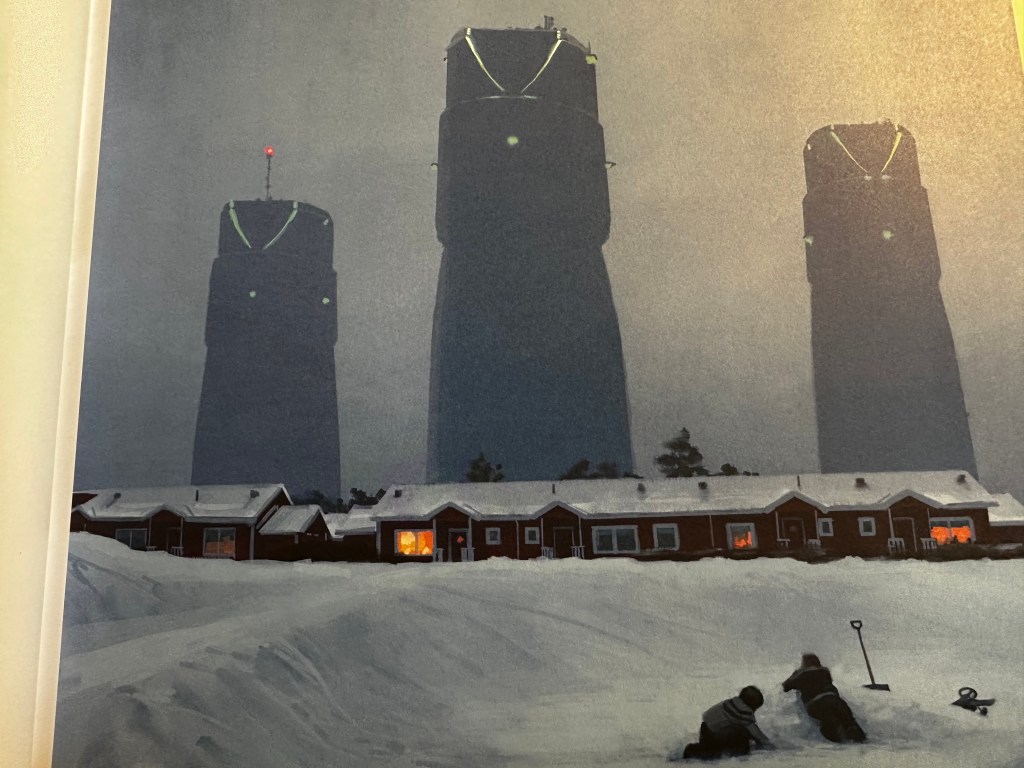
And let’s just focus on the art for a moment. I don’t have the vocabulary to fully do it justice but I love how Stålenhag goes for realistic depictions of the world at a very specific time and in a very specific place but inserts the impossible into them. These impossible things, like the huge cooling towers with blinking lights in Tales from the Loop, or the giant cat mascot collapsing an overpass in Electric State are ignored or, at the very most, treated as mundane, by the characters in it. And the characters? Almost all have their backs to you, encouraging you to see the world through their eyes or to take their place in it. It’s great.

I believe that, once again, I am just a day too late posting this as the Kickstarter campaign finished up on September 5th. Still, it’s worth keeping an eye out for and picking up a copy when it is released more generally.

Kal-Arath

Slaps the roof of Kal-Arath This baby’s got everything your average OSR gamer could ever want or need. You want to drive Kal-Arath solo? No problemo. You want a co-driver, just you and them out on the open hexes? Kal-Arath’s got you. You want to take a group of four or five passengers out on a road-trip to who-knows-where with no preparation and hankering for some adventure on the highway of fantasy? DONE!

I became aware of Kal-Arath as a project by following Castle Grief on Instagram. And it is one of the projects I am most excited to receive. It has a wonderfully indie, hand-made quality to it and it’s telling us it’s going to do a lot of the work for us at the table:

Oracles, Starting Adventure Seeds, Points of Interest, Encounters, Settlements, NPCs, Dungeons, Items – all of these have their own tables for generation, and combined together create a setting flavorful setting that emerges from the tables themselves

That was actually an extract from the Castle Grief itch page, which you should also go and check out, dear reader!

The rules are purportedly a combo of elements from a number of other games. It uses 2d6 and employs at least some aspects from two games I have played before, Mörk Borg and Black Sword Hack. I am a big fan of both of these OSR games and really enjoy a 2d6 system in general. I know the actual dice you chuck don’t really make that much difference at the table, but 2d6 just feels good. OK?

Also, it’s got a lot of gnarly hand-drawn art too. It fits the idea of this game so well. I love it.

Anyway, Kal-Arath is definitely still live so go back it!

And, if you’re interested in Simon Ståhlenhag’s art, you should still be able to pick up a copy of Tales from the Loop.

The Apprentice, Chapter 1

Fiction

I have been thinking a lot about inspiration today. Why? Well, mainly because I did not feel particularly inspired to write a post. Usually, I am bubbling over with ideas and topics I want to discuss here on the Dice Pool. But I was out late last night. Went to see the Pixies in concert. If you have never seen them live, and you get the opportunity, go! They played wall-to-wall hits.

Anyway, I digress. Inspiration is what I am talking about. Unsurprisingly, I have always drawn inspiration from the writings of fantasy and sci-fi authors. When I was young these included Tolkien, Le Guin, Banks, Asimov, Carroll, Eddings (long before I knew he locked his kids in cages,) Weis and Hickman etcetera etcetera. It is unlikely there is a single person involved in the RPG hobby that is unaffected by the books they read and the ones they read as children.

But when I was in my late teens, I dropped the hobby more-or-less completely. I didn’t have the desire to get involved when I was in university as I was more interested in other pursuits. For a decade or so I didn’t do any role-playing. Instead, I got interested in writing short stories and novels. I think I mentioned here before that I used to take part in the National Novel Writing Month every year. I wrote five full books that way; all fantasy novels.

But I also wrote one before I ever knew about NaNoWriMo. It has gone through a lot of edits over the years and it has had three very different titles. It started off being call “Pitch Springs” but it just didn’t work for me. Then I changed it again to something that just gave the game away too early, like a bad movie trailer. I have changed it again in preparation for sharing the first chapter of it with you, dear reader. It’s just, “the Apprentice” (for now, at least. I welcome feedback on the title, especially as it potentially brings to mind a certain TV show.)

Chapter 1: Of My Birth and My World

I don’t remember it, of course, but I killed my mother as a newborn. How would you feel to discover such a fact? I had always watched the other local children in the arms of smiling women or being scolded by scowling ladies. Either way, I envied them. I wondered constantly why I didn’t have a mother of my own. My father never thought it worth his while to explain to me why I was motherless. Or, perhaps, he had not the emotional resources to have such a conversation with his son. He never even told me that she was dead and buried. I was not aware of it at all until my sister told me. She has never forgiven me for it.

“You made her scream and scream and scream tryin’ to get you out of her. Your huge head…your big ugly turnip…You came out all wrong and she screamed until the very moment you tore your way free, bathed in her blood and wailing. She never even held you, you know. She just faded away as her life’s blood drained. It was the only time I ever saw Poppa weep but once he started he didn’t stop for days. Old Aggie came to collect jars of his tears, said they was magic, mad old biddy.”
I remember answering her, “But…I didn’t mean it. I didn’t mean to kill her. She was my Momma too! Why would I want to? I was only a wee babby. it wasn’t my fault.”

“It don’t matter whether or not you meant it. You killed her so you’re cursed. You can’t go around killing your own parents and not expect to get cursed, you just can’t.”
So, there you are, Mother-killer and Accursed too. It was a lot to shoulder for a young lad. I was six when Primmy predicted the life of death I had to look forward to. A six-year-old cannot pretend to understand such a concept. Up until that point the worst thing I had to worry about was the neighbour’s mutt.

The Markinson’s had an ancient mongrel bitch which they had whipped and beaten and starved into raving insanity. They let it loose around their farmyard. I would often watch it from our lower field, which looked onto the road and the gate of the Markinson Farm. That hound circled the yard with a high-shouldered, low-headed gait. Clouds of chickens and squawks erupted sometimes as it patrolled, round-and-round all day long. If the Farmer Markinson or one of his huge sons loped stupidly across her path the dog would retreat, tuck-tailed, to the safety of a rotten, upturned wagon, which served as her doghouse. She would watch them until she had the yard to herself again and she could continue her rounds.

I approached the gate once, when I was no more than three or four years old. My sister had thrown a pig’s bladder ball for me to catch. My clumsy, toddler’s efforts inevitably failed me and it came to rest on the dirt road outside Markinson’s gate. At my sister’s cruel urging, I waddled over to retrieve it, oblivious and unwary. The dog hit the iron gate as if magnetised to it; clatter, bark, growl, bark, clatter, clatter, clatter! The terrible din bowled me off my tiny feet. Fear gripped me so tightly that I remember my throat constricting and my bowels loosening. In my memory I can smell the breath of that scarred and enormous monster; it was a sick odour, rotten flesh and shit. Death was upon me, I was certain of it. Of course, death did not come, the gate held and, in the end, the farmer came dashing out of his barn, pitchfork in hand, swinging it at that bitch and shouting nonsense at her. He struck her a glancing blow in the ribs with the shaft and she dashed for the safety of her wagon-house, yelping and yipping.

The damage had been done, however; that hell-hound haunted my nightmares for years afterwards. She was always there at the end of those dreams, breath stinking and teeth tearing me to shreds as my sister stood in that field weeping with laughter. That nightmare sister continued to laugh long after the real Primmy stopped.

In my first years our farm was my world. My father had little or no time for us children so we were largely left to our own devices. Equally, my sister, for reasons I believe I have already illustrated, wanted little to do with me, murderer that I was. I spent a great deal of time on my own, exploring my world, spying on beasts of land and air. I saw their whole lives, I thought. I saw their births; lambing season was a harrowing time for a small child. As many of the wee sheep died screaming or disappeared down the gullets of wolves as survived to make it to market or to our table. Their screams; I often fancy I can hear them even now, even when I know there is not a living sheep within earshot. I hated it and wandered even further in those days to escape it. Out in the far top field I walked and spotted burrowing moles and hiding hedgehogs, egg-full nests and forgotten feathers. I watched the rodents raid the nests and kestrels catch the rodents; I once saw a wild-cat tear the wings off a kestrel just before it was shot itself by Cunard, the poacher. Cunard was a satisfied man that day.

Of course, I told my father that evening at the supper table, what I had seen. He was indignant. My father was a great believer in law and living by it. Justice also, was important to him. I heard, a week later when the local magistrate was invited to our home for a spiced lamb dinner, that the poacher’s cabin had been searched after my father had reported what I saw. Of course they discovered not only the wild-cat but a whole locker full of ill-gotten gains.

“This is a good lesson, boy!” I recall the magistrate said to me, “You steal and you will be punished appropriately. We took old Cunard’s right hand. He’ll find it difficult to cock a crossbow now!” This, obviously had a profound effect on me, instilling in me the very sense of law and justice my father wished it to. I learned much later that old Cunard the no-longer-poacher passed away in agony and delirium when his stump festered and a fever took him.

My father worked hard. He worked so very hard that, as I have explained, my sister and I would often go days without ever seeing him. He relied on Primmy on those days to take care of us; make sure we ate food, donned proper clothing; washed ourselves. She was five years my senior and usually perfectly capable of doing this for us. But I will admit that it often occurred to me to ask where my father had gone. Why did he leave us, his own two children to fend for ourselves? Why was I to be left eating nothing but porridge for three meals a day when I knew that he could cook us something so much better? Why did I have to put up with the incessant bullying and psychic torture at the hands of Primula when, were my father there, he would have put a stop to it as soon as it began?
The answer is the same to all of the questions above: because he was a small farmer who lived from month to month and could not afford to pay himself anything extra, never mind a farmhand. It was a harder life than I had any concept of at that age. So, obviously, I asked why he couldn’t be there for me. Invariably, my sister would answer that my father had gone away because he could no longer bear to be near me, that the very stench of me drove him to violent thoughts and that he was afraid at all times that he might smash my child’s skull in the stove’s heavy, glossy, black door or hold me face down in the muddy water trough out in the back yard or throw me over the fence to face my worst nightmare, the Markinson bitch.

I didn’t believe her. At least, I mostly didn’t. My father did always have a certain bubbling anger under his surface calm. I was often able to see it in behind his eyes; I think many people could see it, in fact, for I happened to know that he intimidated many of our neighbours and acquaintances.

Once, when Primmy’s employer, Grey Greta came to our house to demand money back from Primmy for allegedly missed hours of work, I got to see the effect he had on others.

Grey Greta was a contemptible old bag of bones at her best but on that day she was very much at her worst, her greediest and her most spiteful. She knew, as everyone in the area did, that Father spent most of his day and very often his night too, out on the farm working to see his children fed and his house maintained. I am certain that, armed with this knowledge, she came that day to take advantage of my father’s absence. I don’t recall exactly what drove her all the way out to our house to collect Primmy’s couple of schillings back off her but I later heard that the woman was an inveterate gambler. Apparently she regularly stayed up till the birds awoke with a bunch of the other village women in the common room of the inn playing some friendly hands of Bruschian Luck. Perhaps that night, the Luck had not been hers. Anyway, the point of this aside was to illuminate exactly how intimidating my father was capable of being, not to describe the inadequacies of Grey Greta.

The dreadful old harridan had come in our back door and was sitting at our kitchen table with her feet up on a stool and her hand in a jar of crackers when I returned from one of my jaunts. I recall it was early evening, but must have been summer as it was still bright outside. My sister, who had finished work for the day, was fussing around Greta, clearly trying to make a good impression by wiping surfaces and tidying away crockery and scraps of food. Indeed, Father had been missing for a couple of days by then and we had no reason to expect him home that evening so the place was, perhaps, not quite as clean as it should have been.
“Scrawny little beast, aincha?” said Grey Greta, looking, with some disgust, in my direction. Now, at this point in life I was timid and had no means to defend myself but I remember thinking how unfair such an assessment was coming from Grey Greta, the under-stuffed scarecrow. Of course, I did not say it. Instead, Primmy decided to side with her repulsive boss, “Oh, he is, and ever so lazy as well, Ma’am.” I glared at her, hurt and confused. I should never have expected anything better from her though. Still, as I have mentioned, Primmy was far from clever and had just given Greta the opening she was looking for.
“Must run in the family, Prim, eh?” said Grey Greta. Primmy stood, visibly shaking for a moment and stared at the floor, smiling all the while. “You see, I haven’t come on no social call like the ladies in St Frackasburg. I’m ‘ere for a reason, young Sharpetzi, ain’t I?”

I recall watching the proceedings from the space between the sideboard and the wall and hoping that Grey Greta would not decide to pick on me again, that she would just stick to bullying Primmy.

“I been noticin’ you recently, Primula. I been watchin’ you watchin’ them boys out the back, in the yard. I been watchin’ you lollygaggin’ when you should be scrubbin’ and moonin’ when you should be foldin’ too. You shouldn’t be doin’ that, Prim, no you shouldn’t. You’re too young to start thinkin’ with that bit o’ your anatomy.” Here, I remembered being surprised she knew the word.

“But, what you do is your business except if you do it on my time, understand me?” She stuffed a cracker in her gob and stared at Primmy, who flinched away even as she smiled her stupid smile.

“So, I was down the Millers’ Pride and Kassie says to me I should come and get some of my generous pay back off you. Teach you a lesson, like. And I said I should so then I did!” At this Primmy looked up at Grey Greta, still smiling but with tears welling in her doe eyes. The money she brought into the household, while meagre by anyone’s standards, was important to us since most of the crowns Father made went back into the farm. I will credit her for being aware of that fact even then. But she was in no position to negotiate with her boss so she nodded her understanding and marched off towards the stairs to fetch her coins from their hidey-hole. Grey Greta sat and stuffed another cracker into her rotten mouth, watching her go. Just as Primmy passed the front door it opened and Father came in backwards, kicking his boots off into the porch.

“I’m back, Primula! Let’s get some potatoes on the go, eh? I could eat a whole goat, horns and all! Primmy-“ He stopped with his mouth open as he turned to see Primmy’s erstwhile extortionist lounging at our table eating our food. He said nothing; just reached his hand out to place it on Primmy’s shoulder before pulling her in towards him, protectively. Grey Greta rose, pushing back her chair with an embarrassed scrape, and dusted cracker crumbs off of her bodice. She was already flustered.

“Can I help you, Greta?” asked my father. I think it was the first time I had ever heard him use this particular tone of voice; it put me in mind of a dog’s low growl just to let you know that it’s there and is big enough to rip your throat out in one bite. Greta reversed away towards the back door and crashed into the chair which scraped again across the stone floor and then fell over.

“Me? No! No! Mr Sharpetzi, I don’t need nothin.’ I was just passin’ by, like, and thought I should pay you all a visit. Y- y- you…” She fell silent as my father continued to stare at her.

“Thank you for stopping by,” was all he said but what Grey Greta seemed to hear was, “I’m going to cook you your own liver and watch as you eat it.” She simply turned and ran out the back door, still trailing cracker crumbs and, once again, stumbling and almost breaking her neck falling over her chair.

I was impressed and so was Primmy. She idolised Father, of course, but I never saw her look at him like that before. Her eyes had saints and heroes in them when they looked at his face. He was her hero then. I wondered what it must feel like to be anyone’s hero.

In the Western pastures I trod the sheep pellets into the grass as my father’s beasts chewed all around me. I heard a story once of a man who stared into the eyes of a sheep for so long that he stopped the poor creature’s heart. “Untrue!” you might well cry; “Why?” you might wonder. I recall very clearly thinking of this story as I strolled between those sheep and pondered not the veracity of the tale or the reason behind it but the practicalities of it. “How?” was the question I posed those ill-fated animals. “How can a person kill you with just a stare?” The question fascinated me. I was a young lad still when I became obsessed with this idea and it never once occurred to me that it might be nothing more than a story.

“Was it magic? Was the man a sorcerer? A demon in the form of a man? Was it sheer force of will? The superiority of our species over theirs impressed on the sheep in a terrifically lethal way? Whatever it was, I decided that I had to know about it. Bearing in mind that I could not even write my own name at this point in my life you might be able to understand that the likelihood of a lad like me learning anything other than agriculture was almost non-existent.

The Story of the Man Who Killed a Sheep with a Stare was my personal favourite but there were many others. My father would tell these tales as we sat around the hearth in the cold, dark winter evenings. He would sit in his ancient rocking chair, taking his ease with a pipe in one hand and an old cat under the other and do his best to scare us white-haired as he used to say happened to him. In fact he told us the story that he said aged his hair prematurely. Needless to say, it did no such thing to us. This was The Tale of the Dead Count.

To be continued!

Motivation Part 1

Player vs character

Are you always wanting to play an RPG? I’m not. I mean, I like them, I write about them, I talk about them and post about them on social media, but do I always want to play them? No, of course not. Sometimes I’d prefer to be cooking, or walking or reading. Sometimes I’d rather be doing literally anything else.

So, how do we ever end up getting everybody to the table all at the same time? When at least one of the players in your group who isn’t busy or sick or traveling is probably just not feeling it that night? Oof…

And when you do get them all there to your table and you have this great idea for an adventure, a couple of hooks to get the PCs to take interest and some of the smartest, most memorable NPCs they are ever likely to meet in store for them, how do you make sure that they take the bait and go the way you are hoping they will? How do you ensure that the motivations of the PCs align with the goals of the adventure?

OK, so these are two different problems, really. The first suggests that the players may not want to be playing at all, and the second suggests that they want to play, they just can’t see their characters doing what you hoped they would. Still, we are going to discuss both because that is the central conceit of this short series of posts.

Player motivation

Open door

This is so tricky that, I am tempted to say, don’t try to tackle it at all. I mean, if you don’t want to be at a party and someone drags you along to it anyway, there are only two potential outcomes, really. Either you do that thing that your mum always said, i.e. enjoy it once you get there, or you will have a terrible time, confirm your own biases and bring down the average vibe score of the entire occasion just enough that you feel even worse about it and leave early.

An RPG session is not likely to be this drastic. In most cases, if you are not feeling it, you probably just don’t contribute as much as usual. Of course, the other players will notice this and maybe try to draw you into it a bit more or make more allowances for you than you really want. After all, you are probably happy being a bit quieter that day.

This is one of the reasons I appreciate one of the Open Hearth community’s policies. The Open Door policy says that you can drop out at any time from any session without the need to explain or excuse yourself. They only ask that you let the game facilitator know that you won’t be there or, if it’s mid-session, that you won’t be coming back. I think this policy is more to account for unforeseen life shit but it works equally well for those who are just not feeling it that day. And let’s be clear, mental health has to be a priority too. Some of us struggle with mental health issues of all stripes and on days where those issues flare up or are particularly serious, you have to take care of yourself first. I, myself, have struggled more with physical ailments a lot, in the last couple of years post-Covid and I have had to take advantage of the Open Door more than once, and was always grateful when, upon my return, that no-one had any blame to dish out for my not being there or any guilt to trip me with.

I guess, what this comes down to for me is, if you are not feeling it on a particular day, don’t do it! Go do the thing you really want to do instead or just curl up in the foetal position on the couch with a steady stream of rom-coms and popcorn being fed intravenously into you. You don’t need to make any excuses. You don’t even have to provide an explanation. In fact, I don’t think you should. After all, it’s just a game. We should all treat it as such.

Hype

All of that being said, I don’t think it’s impossible to hype people up to play the next session of a game. We do this in lots of ways, don’t we? In our Tables and Tales community we use the discord chat to chat about what happened in the last session, dissect the events, talk shit about the NPCs behind their backs, develop plans and share stupid memes and puns. I love this sort of inter-session banter. It definitely makes me excited to play the next session and, if I’m the GM, it often gives me ideas for stupid bits to introduce into the game itself, just for laughs or tears.

Homework

Our DM in An Unexpected Wedding Invitation 5E game likes to give us homework! She has asked us to do things like:

  • have a conversation with another player, in character, in DMs, that you haven’t had much interaction with yet
  • provide feedback privately to her that you wouldn’t in front of the whole group
  • discuss our theories about what is going on in the plot.

This has made the discord chat really entertaining and makes me want to get back to the table to keep going.

World-building on discord

Another GM, this time from Blades in the Dark, went above and beyond. He would not only write up a summary of the events of each session in an entertaining and enjoyable narrative style, but he would also compose entire articles from the Duskwall Observer, the city’s Newspaper of record, letting us know about the happenings in the rest of the city both in the heights of the ruling classes and the depths of the crime-ridden underworld. On top of all that, he would come up with new rumours after every session so that we had something to work with when planning with our own scores and downtime activities. Truly herculean efforts there, and they certainly made me excited to meet up with the rest of my crew every Friday evening and start inhabiting the, very much living, city that he so adroitly created under our feet.

I’m afraid this is not an area that I excel at as a GM. The most I am likely to do in between sessions is ask if people are free to come on the usual evening or share a social media post that seemed summed up a character or event from the game. There are definitely techniques I can learn from my learned GMs. Maybe I should start handing out homework too!

Tune in to the next post in a couple of days if you’re interested in character motivation within the game.

Meanwhile, is there anything you do to motivate your fellow players in between sessions or even before the first one? Let me know in the comments so I can steal your ideas!