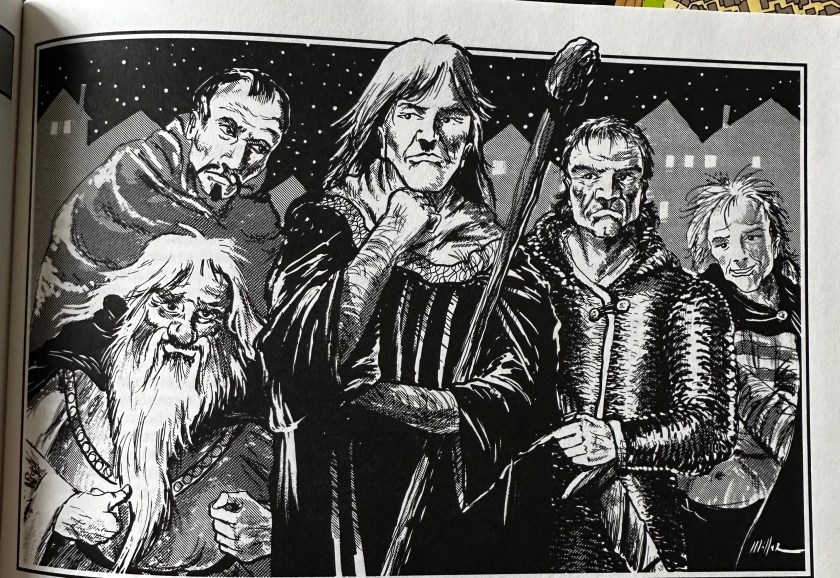
This works even better through the medium of TTRPGs than TV to be honest, because your imagination simply works around them, never focusing on their details.
Star Trek
I’ve been watching a lot of Star Trek the Next Generation lately. I hadn’t seen it in many years, although I watched the whole thing as it came out in the eighties and nineties. I have obviously been watching it with different eyes this time around. I have noticed things in it that I don’t think I could have seen before. I wonder, for instance, about Mr Data. Would he have been such a sympathetic character today, as an AI in humanoid form? I think about how many of the episodes had no action, how many were just talking heads and techno-babble and whether Sci-fi TV shows today could get away with that. I ponder the special effects and make-up and marvel at how well they stand up 35 years later. But I have also been looking at these episodes with TTRPGs in mind. Now, of course, Star Trek has been made into a number of role playing games. I have never played any of them and this post isn’t about them. This post is about the crew of the Enterprise. Not Picard and Riker and Troi and Worf, but the ones who you see occasionally pass the bridge crew on one of the ship’s many lushly carpeted corridors, the ones having their own conversations in the background in Ten Forward, even the ones who so consistently took the con after Wesley Crusher left. They would get names sometimes and every so often, they’d even get lines! There are a couple of those that are recurring characters, such as Ensign McKnight and Robin Lefler. The most iconic of these, Chief O’Brien, went on to enjoy a major role in two Star Trek shows. But when he first appeared on the Enterprise, he was an unnamed bridge officer. Total NPC. He only became someone when the show creators decided he had to be someone.
The Quantum NPC
So this is what I have started doing for crews in my Spelljammer campaign. I think it would work in any game where you have a lot of NPCs that hang around in close proximity to the PCs all the time. So it works particularly well for ship crews.
In the main campaign, the party lost their original crew in the best possible circumstances. The crew, a bunch of spirits who had lost their memories and were not initially aware they were dead at all, finally fulfilled their goals and were able to shuffle off to whichever outer plane would have them. So, the PCs were forced to hire a whole new crew to take care of rigging and swabbing and whatnot. Now, I did not want to spend an entire session where they press-ganged or interviewed eight or nine NPCs that I would then have to name, outline and give voices to. That kind of thing can be fun but I don’t want to spend two full hours at it. Instead I told them that they picked up eight new competent crew members and that we would come up with their characters as and when they were needed.
So this is how that works, you imagine the scene where the PCs are on deck, in the foreground talking about something like how to defeat the weird root creatures that have invaded the ship from some eldritch, otherworldly space. In the background, just like in Star Trek, you have a few crewmembers, maybe they are even in uniform, but they are ill-defined and unremarkable. This works even better through the medium of TTRPGs than TV to be honest, because your imagination simply works around them, never focusing on their details. But then! They need one of the NPCs to be good at something, a specialist, an expert. Or maybe they just need a buddy, someone to talk to, or someone to listen. That’s when the players get to stretch those imagination muscles!
Pulling the NPC Out of Their Quantum State
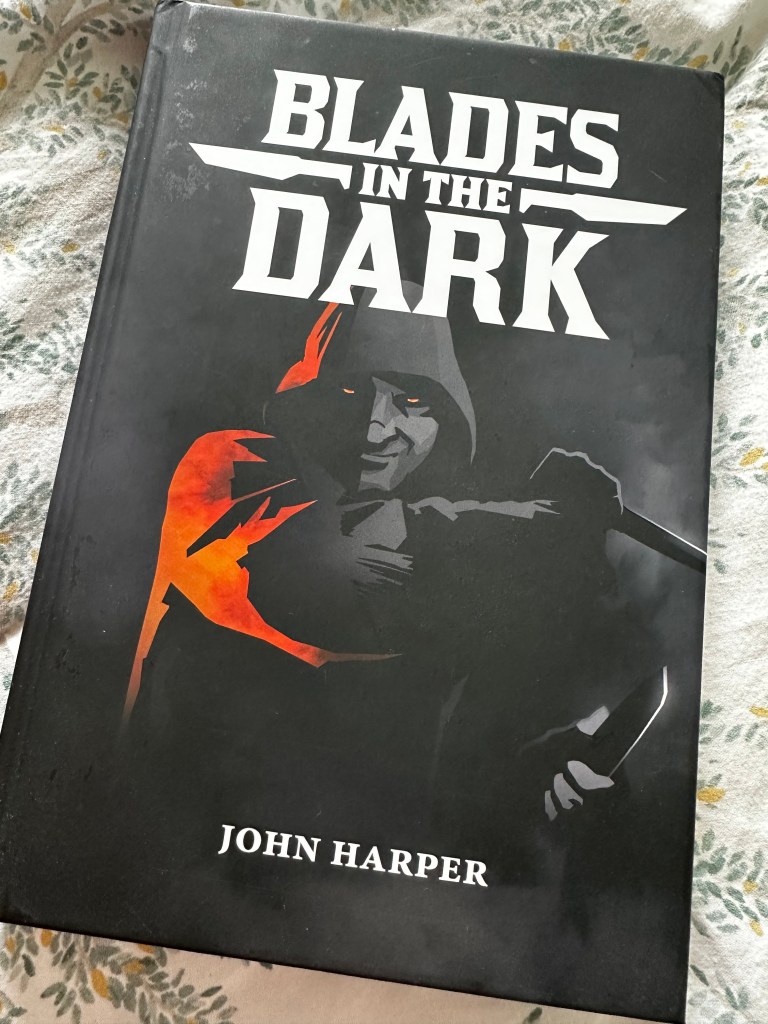
The NPC existed in theory but not in practice. They were always there as a number, but not as a person, not as a character. Until the players make them up. The GM asks a player who this NPC is, what their name is, their ancestry, their job, what their personality is like. The players generally end up working together to do this but I usually start by asking the player who decided they wanted one of the quantum NPCs to become real for some reason. I ask that particular player the type of character they want in this situation with the understanding that, once they have been defined, they will forever be part of the crew, taking up one of those eight spots. It’s just like Blades in the Dark items. You know how many slots you have to fill when your PC is out on a Score but you don’t define the items until you need them in the narrative. Once you have said you have “A Blade or Two,” though, those blades are filling one of those slots. Same-same but different.
In this manner we got these three NPCs:
Deckhand Dewey – kobold, he/him, spry and wiry and can fit in little places.
Cook – Barry Keoghan (this is the consequence of allowing the players to name NPCs) – orc, he/him, big guy with big arms, beer belly, loves food and loves cooking. His chef hat does not fit very well. Apron always slightly dirty. Has a space rat companion.
Mr Cannon – Halfling he/him – weapon-master.
As you can see some of them got more detailed description than others. Barry Keoghan was described thoroughly partly because of who I asked to describe him and partly because of the moment I asked for his description, i.e. a quiet moment aboard ship where they had some time to talk about provisions and joke about silly Disney movie references. Meanwhile, Mr Cannon was created in the literal heat of battle. But that was ok, because the idea was always to flesh these NPCs out as time went on. We did, for instance, in subsequent sessions, discover that Mr Cannon had a wife waiting for him at home and that Barry Keoghan had some sort of tragic love-affair in his past.
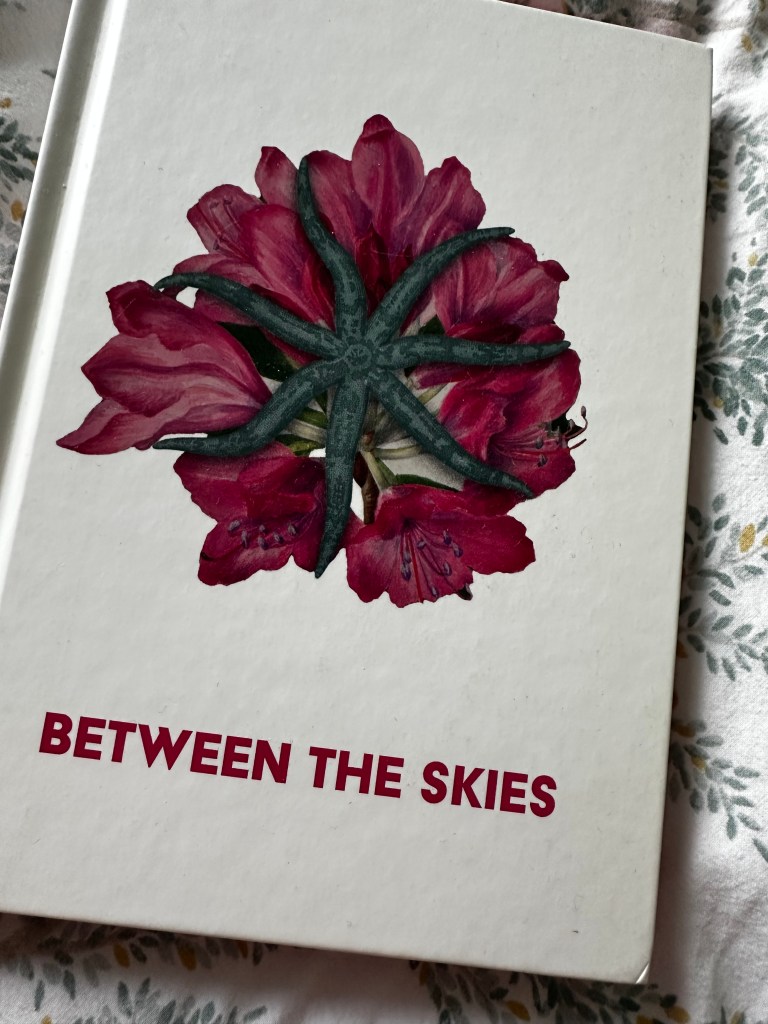
I think, in future I will bring Between the Skies to bear on the Quantum NPCs as they are being birthed by the players, giving them desires, bonuses, hindrances, quirks and all the rest. Time allowing, of course.
The Quantum NPC method has the added advantage of endearing the newly created NPCs to the players from the off. They are, after all, fully their own creations. From the players’ point of view, I believe it was also quite devastating when both Mr Cannon and Deckhand Dewey got breath weaponed into oblivion by a lunar dragon along with the rest of the NPC crew (apart for Barry Keoghan who was in the galley at the time of the attack.) Unforgettable.
Dad-quest
Dad-quest is getting under way tomorrow night. Our resident Giff Fighter-Paladin, Azimuth is rounding up a crew of misfits (the other players with their new characters that I discussed here) and a few more Quantum NPCs and spelljamming out to the Amos Expanse to find his Dad. Can’t wait to see what new crew-members the players come up with this time!
It was the kind of party that took its toll on a number of different organs, the brain being not the least of them.
Two-day Wedding
Dear reader, I returned yesterday from a trip to Cork where I attended the wedding of a dear friend of mine. It involved a great deal of time spent with very old friends in the most convivial of circumstances, accompanied often by a pint of Murphy’s and a lot of reminiscing. I’m still recovering. It was the kind of party that took its toll on a number of different organs, the brain being not the least of them.
Description: Vansant Depwy, former Knight of the Lower Docks and Minister of Our Hidden Mistress fled the City Above many years before. Burned by the Ministry and broken by his former companions in the knighthood, he found himself wandering the arteries of the Heart, lamenting his lost companionship and honestly, just gagging for a pint. As always, the Heart provided.
The millipede of enormous proportions that is Pub Crawler came to Vansant when he was most desperate and dribbled ever so delicately into his open mouth as he lay directly in its path. It roused him immediately. The finest ice wines of the High Elves the flowing ichor seemed to him. The next moment a fine brandy from the Home Nations. He could not get enough, despite the dubious origins of the divine liquid. His head swam and he rejoiced. Immediately he hopped aboard the cyclopean insect and continued to ride it forevermore. Along the way he collected what salvage he could to hook the creatures glands up to rubber pipes to facilitate easier imbibing. He built a small structure and started filling casks while welcoming visitors to his little ramshackle hostelry. As time went on, he and the beast attracted the attention of more less-than-discerning travellers desperate for a decent drink so deep as they were in the Heart. Some of the visitors became residents and then publicans in their own right. The pubs stretch now from the great insectile head to its earwiggy tail. Vansant’s, of course, has pride of place between the two many-faceted, ale-gold eyes. Its name is synonymous with the creature itself these days, the Pub Crawler.
Special Rules They say it’s a mile from one end of the Pub Crawler to the other. A visitor who wants to partake of the healing effects of the Haunt must work their way up from the tail, taking a drink in every pub on the way. In other words, it’s a pub crawl. The booze is not particularly strong at the tail end as the further they get from the mouth, the more they are forced to water it down. So each visitor is forced to make and Endure/Wild roll or take a d6 Mind stress as they begin to commune directly with the Pub Crawler itself. The first roll is Normal difficulty, the second at Risky and the third at Dangerous.
Fallout Tipsy (Minor, Mind) One more? One more. Doing anything but getting another drink is now Risky.
Fallout Well on it (Major, Mind) There is a constant clicking and clacking in your mind. You must now either try to kill the source of it (the Pub Crawler) or try to understand it.
Fallout Pallatic (Critical, Mind) You understand the Pub Crawler and its reason for being. You know why it secretes such delicious and delirious juices. And now that you know, you have no choice but to stay and set up shop yourself. Spread the booze and spread the word.
If you do manage to make it all the way to the magelight illuminated superpub known as the Pub Crawler, Vansant himself will come and serve you the most potent brew of all, purging you of all Mind stress and Fallout and bestowing on the lucky patron an honorary knighthood.
I’m still feeling unwell, dear reader. It’s a feeling that returns me, quite unwanted, to the bad old years of the pandemic. So, I would rather think and write about something more recent and more delightful. Even if my current malady will not allow me to produce anything terribly beautiful or very long, I can rely on my players to help me out.
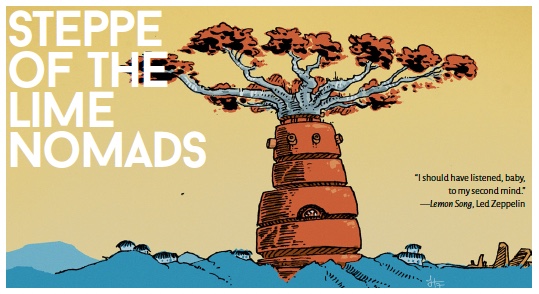
In our most recent session of Ultraviolet Grasslands, our caravan, Isosceles Inc., made it as far as their first proper destination, the Steppe of the Lime Nomads. I knew they were going to reach this place a week in advance so I had time to prepare for it. But what I ended up focusing my preparations on was not that destination but a couple of discoveries that they had rolled for the previous session. I had only the vaguest idea of what they might encounter at the watering hole I assigned as the current gathering place of the Lime Nomads. I knew they would have somewhere to trade, some way to perform market research and that was about it. The descriptions, I left to the three players, using a method called “paint the scene.”
Now anyone who has ever listened to a Jason Cordova podcast or read one of his games, knows this term. It’s a method he developed for use as a GM but is something he has since incorporated beautifully into several games. Go check out the current run of the Between on the Ain’t Slayed Nobody podcast for some truly wonderful examples of it.
Paint the scene serves several purposes at the table. The most important of these are allowing the GM to share the load of world building and description with the rest of the table and, related to that, allowing the other players into the fun and responsibility of bringing the world to life. Why should the GM have all the fun/work?
It’s a simple technique. You ask the players something about a person place or thing that helps bring them to life. It is important to craft the questions you ask to reinforce the theme you are trying to bring to the fore, though. It’s not enough to simply ask them, “what do you see in the village square?” Rather you should ask, “what about the village square shows us that this place was recently abandoned?”
Here are a few of the answers I got from my paint the scene questions when the caravan approached the great camp of the Lime Nomads last weekend:
What about this place shows us that the nomads return here year after year? This one was answered by Stebra, the Lime Nomad character. She was able to tell us a lot about her people and homeland: A river flows down from the mountains at this time of year, though it is often dried up – the nomads settle at the river for a while. They construct their temporary accommodations on stilts for safety. They transport these buildings around with them by folding them up into flatpack. There are larger towers that they use as shelter and to gather around. these towers are relics of ancient times and they stand tall, much higher than anything else in the region. The nomads migrate east to west take advantage of seasonal grazing and foraging. They use water wheels for power and they fish for particular little river fish while they can, cooking them on a spit. A seasonal speciality.
What evidence of the the misty time known by the Saffron City Opiate Priests as the Best Forgotten Ages can be seen in this land? Imssi, the tactician and puppet actor answered this one: Out of the ground the only occasional rock formations in this otherwise grassy plain, are the tips of fingers and toes of colossal statues or calcified giants. In the oasis, when the waters are low and the day is clear, you can see the great nose poking up from the azure depths.
How do you know the nomads welcome traders here? Phaedred Ping-noun, our Acolyte of the Business answered this one, as seemed appropriate: Such a gathering of the Lime Nomads is a moment for traders from all over to get in there and sell. There is a marketplace that is bustling and busy. There are lots of colourful wagons and colourful people gathered. Travellers, not just from the Lime Nomads clans, but from all over the Ultraviolet Grasslands have come to attend the markets.
Conclusion
I am trying to make more liberal use of the technique at the table these days. I find it really gets everyone more involved and engaged in the world. They feel an ownership of their little parts of it and I feel a deep gratitude for them adding the sort of little details and flair that I would never have thought of. If you haven’t given it a go, dear reader, I encourage you to!
Check out this blog post from 2018 on the Gauntlet for an explanation of the techniques from the man himself.
At the end of the last post I wrote about my current Ultraviolet Grasslands campaign, I noted that the caravaners were on the cusp of an encounter with some Armadilloids. The section of the book describing the Steppe of the Lime Nomads has a list of random encounters just like all the other sections do. And, just like the other ones, the detail you get about an encounter is minimal, to say the very least. You might get a level for the creatures or NPCs encountered, and maybe a word or two of description. This leaves quite a lot in the hands of the GM and, potentially, the other players at the table. Perhaps the characteristics of the encountered entity would emerge organically in play. Maybe the GM will have prepared specifics for each potential encounter, with regards to physical descriptions, motivations, weaknesses and strengths for instance. In the case of this encounter. I knew I did not want it to be an automatically violent one. I wanted the Armadilloids to be sentient but different enough as to be inscrutable. I could probably have just written a description, but I have Between the Skies, so why should I?
I took to the Entities chapter of the book and started rolling. I started with a roll on the Size, substance and form table. I rolled a 7 for size. That gave me Very large (giant-size.) I liked this. It immediately brought to mind the Armadillo super villain first encountered way back in Marvel Secret Wars II some time in the 80s. So I had a picture in my mind.
Next, I rolled a 6 on the Substance table, meaning they were Animal. That corresponded with my general idea so far, which was cool. On the Form table, I got a 13 on the d66 roll. That made them Bipedal (which is a word, that, when you say it out loud, sounds weird, we discovered.) It was still matching the picture I had in my head at this stage, except for the fact that these bipeds also had wings. For my purposes I thought it best that they be stubby vestigial wings. It’s the Grasslands, it’s not safe to fly there.
This next bit was so good. On the Weaknesses and Needs tables, I started to see the situation emerge. I rolled a 34 on the Weakness table, which meant they were Confined. Now in the previous session the players had rolled on the encounter tables in UVG and we had established already that there were ten or so of them and they were merely silhouettes on the horizon. They could see the Armadilloids so they were not obscured by any sort of physical trap. But a pretty cool phenomenon in UVG is “stuck-force.” These are invisible barriers and shapes and containers of nothing but force. They litter mainly the skies of the UVG, left over from a time long gone, when fantascience and magic dominated and their practitioners left these eternal artefacts dotted all over, making flying an incredibly dangerous prospect (as I hinted at above.) So, I came up with the situation where the Armadilloids had been trapped in a sphere of this stuck-force and had been unable to free themselves. The next table was Needs. I rolled a 62 on that, which gave me Directions. But I didn’t like this one so I opted for 26 instead, Escape. Perfect.
Next was Characteristics and details. These tables round out the looks and important idiosynchacies of these creatures. First I rolled a 21 on the Notable characteristics table. You know those big ol’ Armadilloids are rolling around like Sonic (I know Sonic is a hedgehog, ok? Just roll with it.) On the detail table, I got a 34, Tatooed. Adding a little more to this, we see that they are tattooed all over with the pictographic stories of their lives. I love this detail.
Next come a pair of Behaviour tables. I rolled on the Social behaviour table, which indicates their numbers, even though I already knew how many there were from our roll on the UVG tables. Why? Well, it also suggests the type of groups they habitually congregate in: Couple, Family, Herd, etc. I rolled a 6 and got Pack. This fit perfectly as well. I actually skipped the behaviour and current demeanour tables because I already had a good idea that they would be eager to be freed, some of them going stir crazy, rolling around inside the sphere, some simply sitting in the grass, and one of them standing with his hands raised against the stuck-force sphere trying to will his way out.
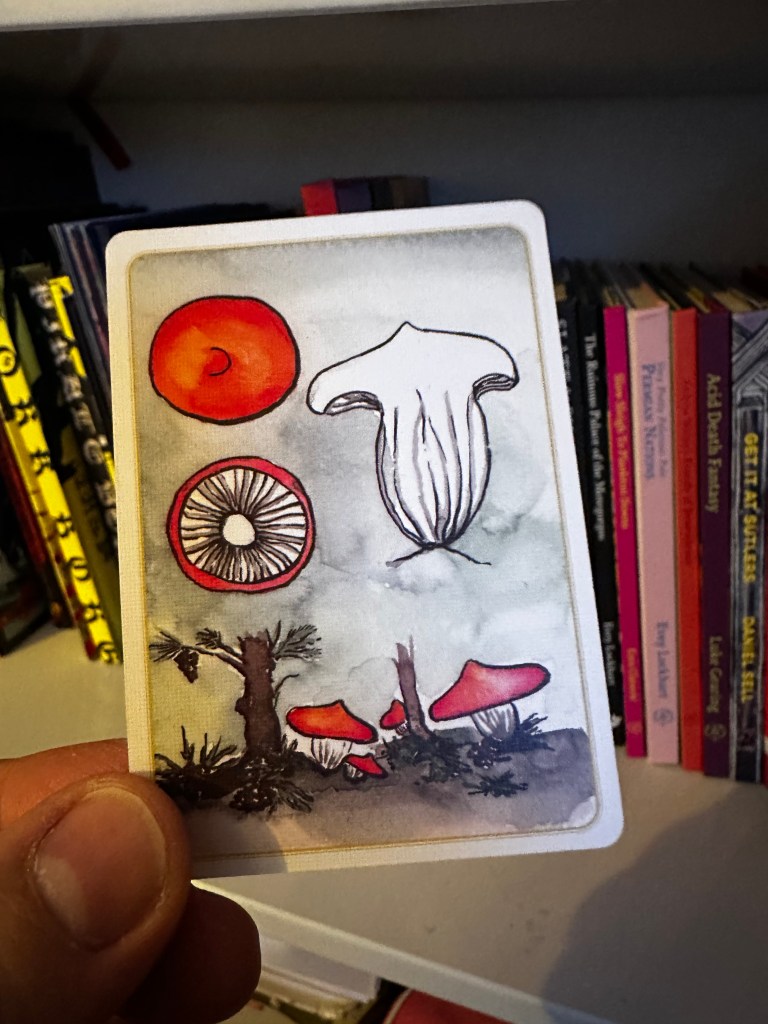
This next one was fun: Attacks! I rolled a 6 on the Mechanism of attack table, making it a Blast. The Attack keyword I rolled up was 33, Draining. So, from these words, I decided they would have a Charisma Draining Psychic Blast power. It never came up in play, thankfully. Why? Because the PCs figured out how to free them and then were invited back to their mushroom growing burros where they were rewarded with three sacks of Regular Mushrooms.
They also spent the night there around the Armadilloids fire, despite the fact the big orange guys could only speak in some brand of “meep meep” language. They all consumed copious amounts of magic mushrooms and got high as fuck using the wonderful tables in the appendix of Fungi of the Far Realms.
Since I rarely get much time to prep sessions these days, this method was really valuable. It allowed me to do what I needed to do on the train on the way to work, using the pdf of Between the Skies, an online dice roller and the word processor on my phone. I have been using Between the Skies for some other games too in the last few months, most notably our Spelljammer campaign. It has made for enormously memorable and unique encounters in that case. I can’t recommend it highly enough. Go get it on itchio or on Exalted Funeral!
Final Plug: Shadows Return
I backed a project from Ian Hickey of Gravity Realms last year, The Price of Apocrypha. It was a really successful Kickstarter, especially for a small, indie, Irish creator, and it was fulfilled and delivered incredibly promptly.
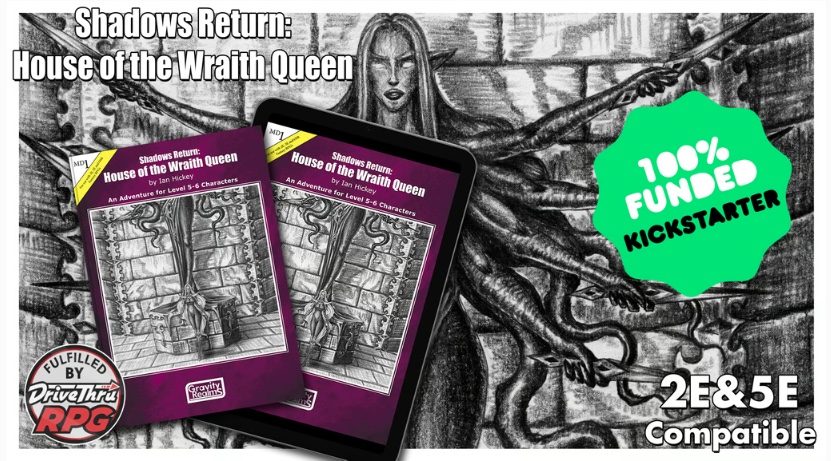
Well, Ian has another great project in the works on Kickstarter right now, Shadows Return: House of the Wraith Queen. Its a mega dungeon style adventure for use with Ad&D 2nd Edition, D&D 5E and OSR games. It’s fully funded but there are only a couple of days left of the campaign and you could still help it reach some stretch goals! Go back it!
As a final note, I have recommended a lot of books and products recently and I like to think I always do here on the dice pool dot com. I do this purely because I believe in the books, the products, the creators, not for monetary or other rewards!
China Miéville. Go read some of his books. Go on. I’ll wait. Need more? OK. I recommend the full Bas Lag trilogy. In my opinion each book in the series is better than the one before. Anyway, those should only take a month or two to get through. Once you’re done with those, immediately pick up “The City and the City.” Just trust me. You won’t regret it. Once you have finished getting your brain-digits around that, please relax your cerebellum and get ready for “Embassytown.” Read all of them. Please.
I still have a few of his books to catch up on. I’m a little late to the party. I picked up “Perdido Street Station” in a second hand book shop about 15 years ago and couldn’t quite get past the idea of a woman with a beetle for a head (not a beetle-head, that’s different. Her head is a beetle.) I gave it another go a few years ago and was immediately hooked. The so-very-alive city of New Crobuzon, its fascinating and beautifully realised inhabitants, the wonderful meshing of the steam-punk, the fantastical and the horrific all worked together to make me simply want more and more. Luckily, “Perdido Street Station” is about 1000 pages long and has two sequels so they kept me going for a while.
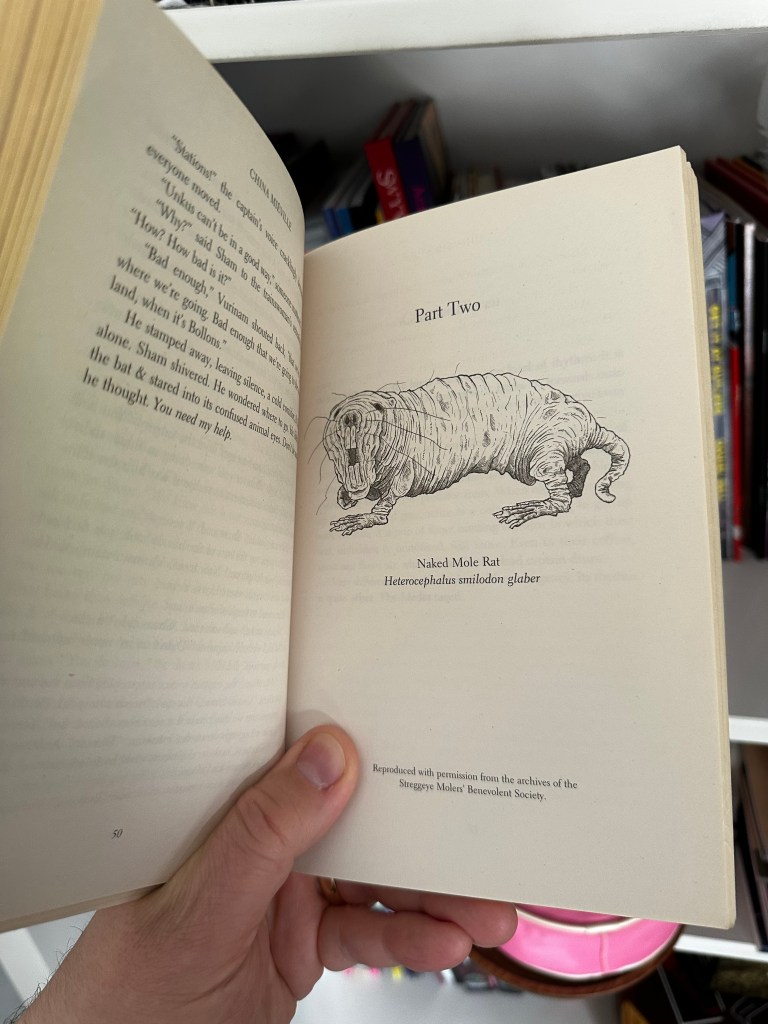
I’m currently reading “Railsea.” This is not a Bas Lag book, but it evokes a lot of the same feelings in me as his earlier work. It is set in another world, one where there is a literal sea of rails between the continents and islands, where trains are captained by Ahab-like characters who pursue Moldywarpes (giant moles) like sea-captains pursued whales in centuries past. The ground between the tangle of rails is not literal poison, oh no. Our main character, Sham, tells us that. But if you touch it, you’re courting death, or dancing with danger at least. The subterranean lifeforms, bugs, giant mammals, that sort of thing, they’ll come and drag you down or tear a leg off if you’re not careful.
I haven’t gotten very far into the book yet, but I am savouring it. I’m exclusively reading it on my train ride to and from work so it’s hard to get up a good head of steam as it were.
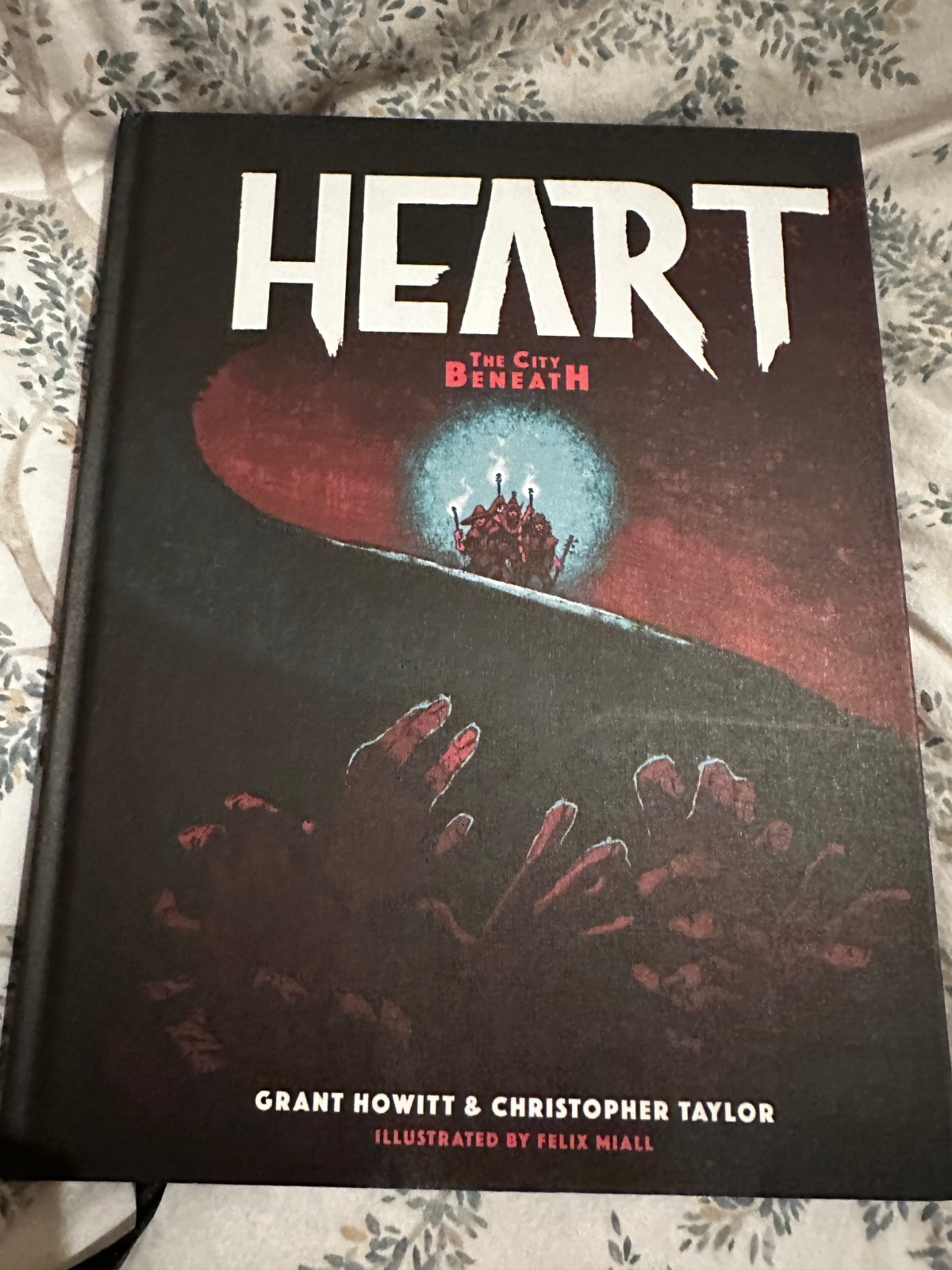
Anyway, it felt rather “Hearty” to me. You know, what I mean, reader? Got the old Heart Landmark juices flowing a bit. There’s so much about magical, inter-dimensional underground railways in Heart: the City Beneath. It felt appropriate to come up with a Heart Landmark inspired specifically by “Railsea.”
The Vermissian Graveyard
Name: The Vermissian Graveyard Domains: Technology, Cursed Tier: 3 Default Stress: d8 Haunts: The Engine (d8 Echo)
Description: Beneath a roiling crimson sky of steam clouds, a vast and silent plain of dry red earth, dotted here and there with scrubby trees and hardy grasses, whorled and tangled by an impossible rat’s nest of railway lines. At their final rest atop these lines, trains. So many rusting, curving, snake-like carriages and engines. Freight cars, passenger cars, entertainment and dining cars, all lifeless, dark, slowly falling to pieces. Maybe this is where the trains of your Vermissian went. It could be. Perhaps some of these vehicles once were meant for that cursed underground, but most are from some other Vermissian, some Vermissian that never had an “Incident.” Perhaps they came through Fractures, perhaps the Terminus directs all old hulks of rail-stock from across all realities to this place, this final resting place. Or maybe it’s the afterlife for these faithful old servants.
It’s certainly haunted enough to be a graveyard. Ghostly passengers walk the aisles of the cars seeking their seats, spectral engineers stand about in cabs, smoking cigarettes, conductors from beyond examine tickets to nowhere, on trains that will never move again.
The ghosts can’t do much to a living soul except maybe freak them out a bit. But don’t touch the ground. Do not touch that brick-red earth beneath the rails. Step down and you’ll understand why this place is devoid of all life. The slightest vibration will attract the stranded dead, grasping undead things, trapped here with their last trains, jealous of the life and wealth of the living, lying in wait below the earth. All they want is to strip you of your wealth. So, if your greatest wealth is your memories, they’ll take those, thank you very much. If your wealth lies, rather, in Queens and Stens from the City Above, they’ll leave you a pauper. If your most prized possession is your body or the blood in your veins, they’ll take that too. No matter what they take, they’ll try to take all of it, leaving nothing but a ghost behind, stuck on a train that’s never going to move again.
In what might be the centre of this mess of rolling stock, a single orange fire burns, fitfully and brightly, belching out spire-black smoke from the chimney of a single, shiny black engine. An old steam engine, kept polished to an unlikely shine houses the Engineer. They are a skeletal figure equipped with a spire-black shovel a set of neatly pressed denim overalls and a tall blue peaked cap. Fires burn in their eyes, emitting sparks occasionally, mirroring the hotly glowing fuel they keep the engine topped up with. When a stranger comes to the Engine, the Engineer hands them the shovel and gestures to the bunker full of spire-black and then to the fire. If they shovel a few loads, the Engineer will bow and point the way to the exit of the graveyard. They will leave feeling tired but fulfilled, as though having done a good days work. If they shovel in a suitable resource, the Engine will belch and shake and will bathe the worker in orange light, removing d8 Echo Stress from them as well. If they do not shovel, the Engineer will shrug, light a cigarette, and go back to shovelling himself.
Special Rules: Without the help of the Engineer, this Landmark becomes a delve with Resistance 12. Potential encounters with Signal-box Cultists (see the Heart core book page 196) abound on this delve. Other possible events include falling through the floor of a rusted wreck, having to avoid toxic freight and slipping off the rails onto the ground where the Stranded Dead await.
The Stranded Dead inflict d8 stress to whatever resistance is most important to the PC. This could be defined by the PC themselves or you could choose the one they have the most Protection in. Fallout Slight Delay (Minor, Any) You touched the ground in the Vermissian Graveyard and drew the attention of the Stranded Dead. They took something from you. Now you’re just ever so slightly translucent and the ghosts on the trains are asking you to sit next to them. All actions taken to escape the Graveyard are Risky. Fallout Major Disruption (Major, Any) You touched the ground in the Vermissian Graveyard and the Stranded Dead took so much from you. You’re hardly there anymore. You can understand the vapour talk of the ghosts on the trains. All actions taken to escape the Graveyard are Dangerous. Fallout Ghost of the Graveyard (Major, Any) You touched the ground in the Vermissian Graveyard and the Stranded Dead took everything from you. You join the other ghosts and take your seat on the dead train. Resources: Train parts, d8 Technology Train Ghost ectoplasm, d8 Cursed
Ways and Means: A Heart Sourcebook
To wrap things up, I thought I would let you know, dear reader, about the new Backerkit crowdfunding effort coming our way soon from the good people at Rowan Rook and Decard. It’s called Ways and Means and it looks like it’s going to be a great sourcebook for both players and GMs of Heart. It’s going to have new Classes and Callings as well as new Domains of the Heart and events to fill them with. You can sign up to support it here.
I mentioned recently that I had been reading Luka Rejec’s Ultraviolet Grasslands. I had, in fact, just been reading it for fun, but, about 50 pages in, I decided the best use for all its tables was in some sort of role-playing game. So, I got my trusty team together and started a campaign. We’ve had a session 0 and two sessions of play so far. It’s still early days. The caravan has not even managed to complete a full week of travel yet but we’re all enjoying the psychedelic vibes and the raw potential of the game and the setting.
I also wrote up character creation and caravan creation posts, which were not directly related to the campaign but were useful to me in getting to grips with some of the rules and the setting.
This post is about one element of the game that gets only a cursory mention in the book, and how I approached its use. That’s Caravan Quests.
Needy Naturalists
It might be a little ungenerous to suggest that the Caravan Quests section gets any less treatment than it deserved in the core UVG 2E book. It has a full page to itself, including illustration. Ten quests grace the page, everything from “Big Game Hunting” to “Ascending into the Sky Like the Shamans of Old.” And there are some great ideas there to spark events in your campaign. Since UVG is very much a play-to-find-out sort of game, very few things are explicitly labelled as quests. The encounter tables and the randomly discovered locations generally contain all the inspiration or trouble or opportunity the players or referee need to fill a session without picking up tasks from question-mark bedecked NPCs.
But I liked the idea of using one of them to further spur the PCs to do stuff on the road that wasn’t just trading and foraging. The one I settled on was 3. Glorious Naturalists. So, before their caravan ever set off, I had them encounter a band of scientists in L’ultim Gastrognôme, one of the most exclusive eateries in the Violet City. These scientists had been hanging around in the city for a while, looking for a group just like the PCs. They had been assigned a task by their Decapolitan university to discover a bunch of new plants, animals and minerals. They had a decent budget but, as academics, had little taste for roughing it in the trackless steppes and Vome-ridden wilderness of the Ultraviolet Grasslands. So obviously, our caravaners, Imssi, Stebra and Phaedred were the ideal choice to get out there and collect evidence of some undiscovered species! This coincided nicely with the drive of one PC. Stebra Osta, a forager and surgeon, is on the hunt for a special vegetable or fungus with incredible curative properties. She’s sure it’s out in the Grasslands somewhere so she wanted to take the scientists’ job as the perfect one to fund her own search. It also added quite a bit to their funds.
Were there more interesting or weirder quests in the list? Absolutely. Would it have been fun for them to have to 8. Witness the End of Time? Well, of course. But then, I wouldn’t have had such a good excuse to crack open a new prized possession.
Fungi of the Far Realms
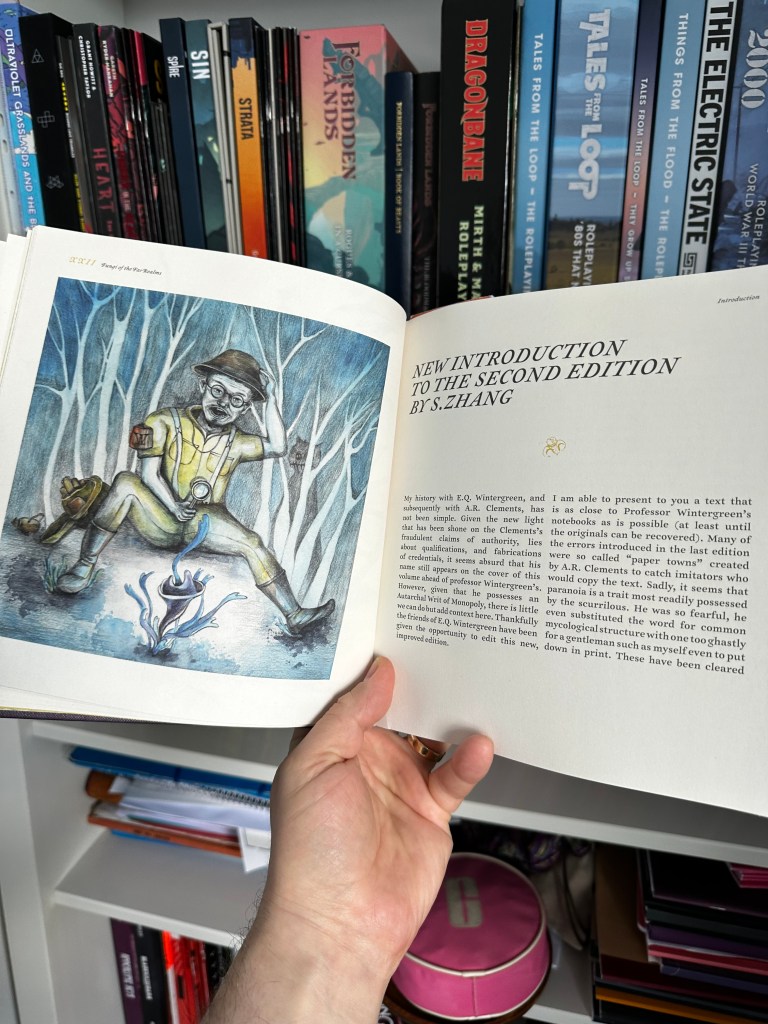
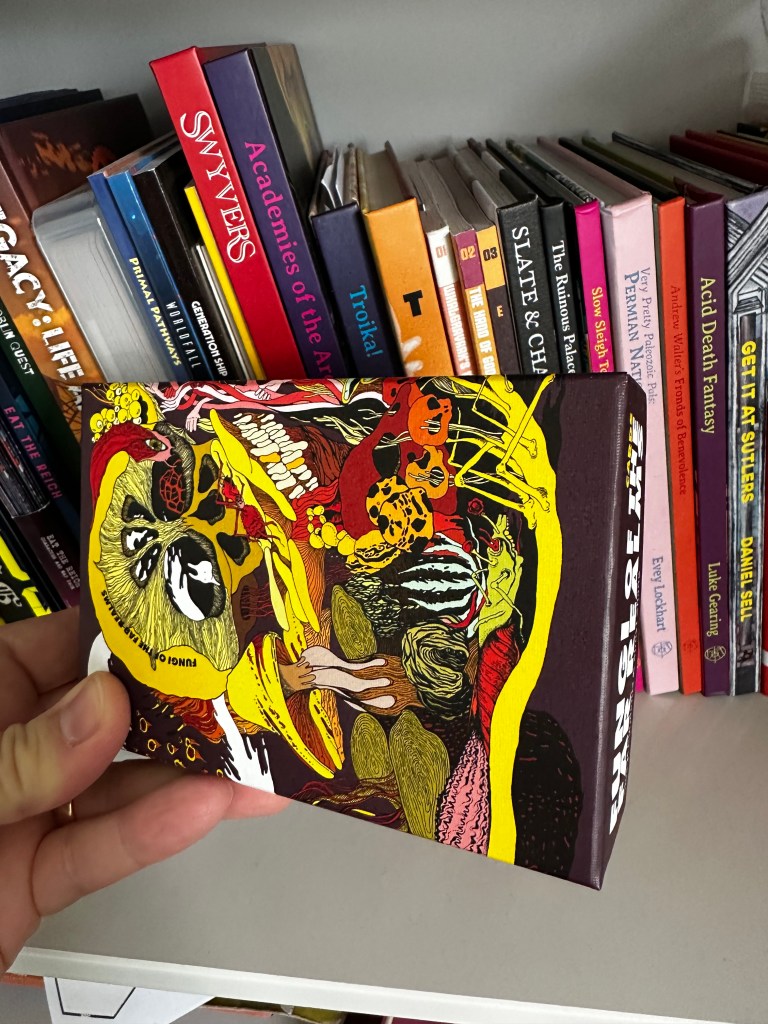
Just look at this book… Go on. Look at it. These illustrations by Shuyi Zhang are just breath-taking. The concepts of some of these funguses, written by Alex R Clements, are fun and bonkers. I remember thinking to myself, how am I ever going to use this in a game? before backing it. Idiotic question. I backed it because it is a work of art, not for its usefulness. But, I guess a thing can be both useful and beautiful.
The Caravan Quest in UVG never mentioned anything about fungi. I added that myself, just so I could get Fungi of the Far Realms and its attendant cards out at the table and have my players oooh and aaah at it. I was able to hand them their very first fungus card last weekend. They discovered a ka-zombie beneath The Last Chair Salon. It was feeding Crystal Puffballs to an imprisoned, limbless Vome-Mother. The Vome-Mother was hooked up by rubber tubing to a Fermentation Golem which turned her milk(?) into Yellow Beer, which the Salon’s unscrupulous proprietor was selling to her customers. Once they had dealt with that whole situation they discovered a nearby lush garden of tulip-like flowers, which was also dotted with dozens of the puffball fungi. I was able to hand over the relevant card to Stebra the Forager and let her know that a sack of these was worth quite bit to the right customer. What a wonderful alternative to the usual type of treasure!
There are a few valid ways to use this book at the table in many different games. I utilised the wonderful fold-out map that I received as a crowd-funding reward. I knew the type of environment I wanted the PCs to find the fungus in, so I used the grid system pictured above to locate a similar habitat. Unfortunately, there does not seem to be an index of fungus per grid-square but each entry in the book highlights the areas of the map that you might find them in. You could also just make a d666 roll and see which entry turns up for you! That’s fun, even if it doesn’t match your needs. The appendices also have tables for afflictions like hallucinogenic effects and fungal infections. If you don’t feel like freaking the PCs out or make them sick, every entry has practical world-building notes like flavour/mouthfeel and aroma. I loved these details in our recent session because it allowed the PCs to know that they had been consuming the fermented Vome-mother milk flavoured with the Crystal Puffball (Flavour/mouthfeel: rotten apples, Aroma: fresh rain.)
And there is another fungus-related adventure afoot already! Stebra, ever on the lookout for foraging opportunities, heard a rumour from a fellow Lime Nomad, that the Great Armadilloids of the Steppes were cultivating mushrooms. Then, as their caravan pushed on across those self-same Steppes they rolled a random encounter. Guess who? That’s right! Armadilloids!
The shows mostly deserve to be dropped into the Sarlacc’s maw, the fandom is more toxic than the bite of an Ewok (you just know those little guys are spreading rabies,) and the heyday of Star Wars was a Long Time Ago in a Galaxy Far, Far Away. But I do love a non-standard holiday as an excuse to play an RPG. Today, abiding by the Tables and Tales May the Fourth rule, Isaac is going to run us through a Star Wars themed adventure using Vaults of Vaarn (the rule is that we have to have a Star Wars themed game but we can’t use any official Star Wars games to do it.)
But not before I come up with a Star Wars themed Heart Landmark! You lucky readers!
Oddya’s Bog
Name: Oddya’s Bog Domains: Religion, Cursed Tier: 1 Default Stress: d4 Haunts: The Proving Cave (Echo/Mind d6)
Description: All the inhabitants of Oddya’s Bog are one with it. Most of them have become one with it over the course of years and decades, adding their own energy to that of all living things in this place. I mean, they add their flesh too, but you can’t make an omelette etc. The Bog needs the bodies and life-force of the people and other animals who find themselves drawn here.
The bog, a treeless, stinking expanse of fetid, untrustworthy marshland, writhes and undulates, as some such places do due to the waters concealed beneath the turf surface. Oddya’s Bog moves in this way because it is made mostly of people and animals, living beings that are absorbed bodily by the landscape to add their essences to the entity known as the Compulsion. They live still, in a terrible mockery of life, slowly learning what it means to be both one and many under the sway of the Compulsion.
Master Oddya is the Compulsion’s greatest champion that has not been fully absorbed. He has existed in the forgotten bog for longer than he can remember. It is possible that he is nothing more than a creation of the Compulsion’s microscopic constituent parts, the chlorimediants. Either way, he is a sour old prune that many have mistaken for a Gutterkin. Perhaps he was once a drow; he shares their pallor and long ears; but he can reach no more than knee-height to most elves and he walks the discomforting bog, unclothed and usually sucking on a recently plucked eyeball or knucklebone.
Many come to the Bog in search of Oddya, believing him to be some sort of wiseman or priest of a forgotten god. The downtrodden and addled residents of the lower levels of Spire have a great need for a saint or a leader to believe in. Rumours have been circulated by a certain, rather smelly sect of blank-eyed, robed and hooded drow on the streets of Pilgrim’s Walk. They have been telling tales, in the voice of the earth itself, of a prophet and holy man named Oddya who holds the secret to oneness. They appear every few years before inevitably disintegrating into the bog-stuff that they are and slowly making their way through the waters back to Oddya’s Bog, where he will re-constitute them and send them back to the City Above again the recruit once more. The pilgrims who come are brought under the sway of the Compulsion as Oddya speaks his strange backwards sermons to them, urging them to surrender to the Compulsion, to trust it and to use it. Most are captured and merge with the bog. Some escape but Bog Folk will follow them to prevent them from spreading the truth of the Bog beyond its borders.
Only one cave at the edge of the Bog is free of the Compulsion, the Proving Cave. If you enter it, you will be forced to contend with the thing you are most desirous of. If you manage to resist it, you will be healed by the cave at the price of a D6 Resource. If you do not, you will gain the Fallout, Unproven. See the Special Rules section. Special Rules: Master Oddya – If he is allowed to speak his strange mystic mumbo-jumbo, he may ensnare the listener and bring them under the influence of the Compulsion. Endure/Religion or Cursed roll to resist or suffer d4 Echo Stress. If a PC suffers fallout from this, use the following: Fallout There is No Try (Minor Echo.) Next time you might need to roll to do anything in Oddya’s Bog, you succeed automatically, but you lose a part of yourself to the Bog and the Complusion. All actions not directly in the service of the Compulsion are Risky.
Fallout I Have a Bad Feeling About This (Major Echo.) You are becoming one with the Bog and the Compulsion. All actions not taken directly in the service of the Compulsion are Dangerous.
Fallout Become Greater than You Can Possibly Imagine (Critical Echo.) Your body has become one with Oddya’s Bog and your essence serves only the Compulsion.
The Proving Cave – Ask the player what their character most desires if you need to. This thing will appear in the Cave as though it were the Heart itself. But it is fleeting and dangerous. If they attempt to take the thing or make it there own in any way, they will gain d6 Echo stress. If they get fallout from this, use the following: Fallout Unproven (Minor, Echo) If they see the object of their desires again, they will be compelled to pursue it. If they resist, any other actions will be Risky. (Ongoing)
Resources: Everything here is tainted but Oddya’s Bog Turf is a d4 Cursed Resource.
I don’t think it will be difficult to see where I drew inspiration from this week. It’s a story I have mixed feelings about but still, it introduced the world to one of the most enduring and influential fictional universes ever. Just remember, desire is the mind-killer.
The Heart Worm
Name: The Heart Worm Domains: Warren, Wild Tier: 2 and 3 Default Stress: d6 Haunts: The Waters of Life (Blood D8) Bernie Gallac, Terrible Warrior-Bard (Mind D6) The Prophet, AKA Moonlight-Falling-On-Glaciers (Fortune D6) The Herb, Mischung (Echo D8)
Description: Travellers in the deeper levels of the Heart, where all is flesh and warm and wet, sometimes pass from an artery into a wide open tunnel, resembling a damp cave with masses of tooth-like protrusions projecting from ceiling, walls and floor at the entrance. Many need no more excuse than that to run from the place, but many others know better. They have heard of the Heart Worm, and they know of the life-giving properties of its vital juices. Usually, these are the type of fool-hardy adventurers who have nothing to lose and who find the prospect of burrowing through the flesh of the Heart only to be deposited in another, unknown location, “exciting.” For that is what the Heart Worm does. A giant, parasitic entity that feeds off the multidimensional matter and energy of the Heart itself while digging through it and leaving cyclopean tunnels in its wake, the Worm picks up passengers and ejects them wherever it wants, seemingly randomly.
The Heart Worm has swallowed a few people and never let them go, however, perhaps due to the understanding that its passengers need support and services during their sojourn.
Bernie Gallac, a drow former soldier of the Allied Defence Forces, has been trapped for so long, he has forgotten the world outside. He spends his days composing sarcastic little ditties to comically roast the visitors who come his way. He has been surviving on the Herb, Mischung, which grows in abundance around the depths of the great worm’s mouth. It, along with his long imprisonment, has made him strange, one-dimensional, lacking anything but the desire to do what he does in the service of the Heart Worm and its passengers. His eyes and the eyes of all the inhabitants of the Heart Worm, are crimson from consuming the wine-dark Herb.
A passenger can gather and consume the Herb too. It must be cooked down until it is in the form of a red paste in order for it to be edible. It will slowly change the colour of their eyes to a deep red, but it will also make them feel more at home in the Heart as they become one with it (see Special Rules.)
The Prophet, Moonlight-Falling-On-Glaciers, is an aelfir noble scion, trapped these many years in the gullet of the Heart Worm. They desperately wish to exit and spread the news about the Worm to all the inhabitants of the Cities Above and Below. But, for whatever reason, the Worm has not allowed it. Perhaps it is not their time yet? Perhaps they do not wish to be worshipped like a god, maybe they do not want their presence truly confirmed. The Heart Worm does not confide in anyone its plans or reasons. The mask the Prophet wears resembles the face of the worm but for the two crimson eyes visible through the slits in it. They will speak to passengers in a voice to deep and resonant to be understood, to increase their fortune.
The flesh of the Heart, eaten by the Worm, travels down the peristalsis of the great gullet almost constantly. Those who exist inside, stick to the walls of the giant being. Some have tried to take parts of the Heart meat to sustain themselves. These unfortunates are invariably ejected by the Heart Worm at its first opportunity, in the most dangerous of regions. Passengers who wish to benefit from the Worm’s diet must travel further down its throat until they discover the crimson lake of the Waters of Life, the digestive juices caused by the enormous creature’s Heart-burn. If they can endure its acidic nature, a passenger who immerses themselves in the lake will have their old skin stripped away, only for it to be replaced with a new, deeply red skin. It will heal them of physical ailments. (See Special Rules.)
Eventually, the Heart Worm will find the perfect spot to deposit its passengers. When that time comes, they will be physically ejected by irresistible waves of muscular force, which leads to them being spat out at their destination. This could be anywhere in Tier 2 or 3 of the Heart.
Special Rules: Eating the Herb, Mischung has its dangers. It has the effect of bringing you closer to the Heart but this can also have the effect of making you like the Heart. When you consume the Herb, you must make an Endure/Wild or Warren roll or gain D6 Echo Stress. If this leads to fallout: Fallout: Heart’s Desire (Minor Echo.) The next time anyone voices a desire in your presence, you must do everything in your power to fulfil it for them.
Bathing in the Waters of Life can also be very dangerous. Roll Endure/Warren or Wild or take d8 Blood stress. If this leads to fallout: Fallout: Worm body (Major Blood) Your body begins to transform. Your new red skin sloughs off to reveal a ridged, wormlike one and you develop a taste for the Flesh of the Heart. If this is upgraded to critical, you fully change into a worm and disappear off into the Heart.
Resources: The Herb Mischung (D8, Echo) The Waters of Life (D8, Blood)
I have been reading Ultraviolet Grasslands recently (expect a post or three about this once I get done reading it.) I have been enjoying its format a lot. It tends to go into the big-ticket locations in the setting in some detail, maps, random encounters and occurrences, places of importance, how to get to and from the location. It’s usually built with enough randomness that your “Last Serai,” for instance, will be very different to the next party’s.
But there are a few locales described towards the end of each of these sections that branch out from the one central location, providing you with adventure spots in the surrounding area. Descriptions of these in UVG really depend on the type of area they are in. If it’s a heavily populated spot, you are likely to get a bunch of NPCs for the players to deal with, but in more remote places, it will probably mention more environmental hazards, enemies and traps. Importantly, it never goes into much detail on anything. The details, as with everything in the book, are left up to those gathered around the table. You just get a mention of a particular type of creature (and maybe a level and tag in parentheses beside it,) a monetary value for the treasure or resources you might find there, or a distance (in number of days’ travel) from the main location.
These really reminded me of something: Heart Landmarks. Not necessarily because of the format of the descriptions or the writing style or anything like that. It was mainly just due to the looseness of it. Heart Landmarks also provide you with a few sparks to light your imagination. They might tell you the type of haunts you have there and vaguely hint at a couple of NPCs, but it’s up to you to bring them to life at the table. I am aware this is not that unusual in modern RPGs but I have been reading and playing a lot of trad games recently, so the similarity really struck me here, in comparison.
Anyway, it got me thinking about something I started quite a while ago, before I even started my first Heart campaign. I have a file on my computer just called Heart Landmark Ideas. It had one entry in it, and even that was incomplete. So I thought I would make this a little series of blog posts.
DIY Heart Landmarks
What is a Landmark? In Heart, the City Beneath, the characters are delvers, idiotic adventurers who are compelled for one reason or another, to plunge into the red, wet heaven that is the Heart, the esoteric core of all weirdness. Nothing remains concrete or stationary in this underground “city” for very long, but, as long as a place has a sufficient number of sentients there to believe in it, to desire its safety, that will anchor it. These become Landmarks. Some of them are havens where delvers can rest and recuperate, some are terrifyingly dangerous lairs of nightmares and dark magic.
What does the Heart book tell us about making our own landmarks? Make sure your landmark includes one or more of the following:
SANCTUARY: Haunts are places within a landmark where PCs can relive themselves of stress or fallout and can often involve a major NPC to interact with.
MATERIALS: Resources can be procured here.
ADVANCEMENT: Not every chapter beat is achievable on a delve. Sometimes, landmarks are the perfect places to hit your beats.
EMPLOYMENT: NPCs, mysteries, required items etc. You get the idea.
DANGER: Not every landmark is restful and commercial. Sometimes you need to endure them to achieve your goals…
WONDER: Reveal something of the Heart of just dazzle the players with your imagination!
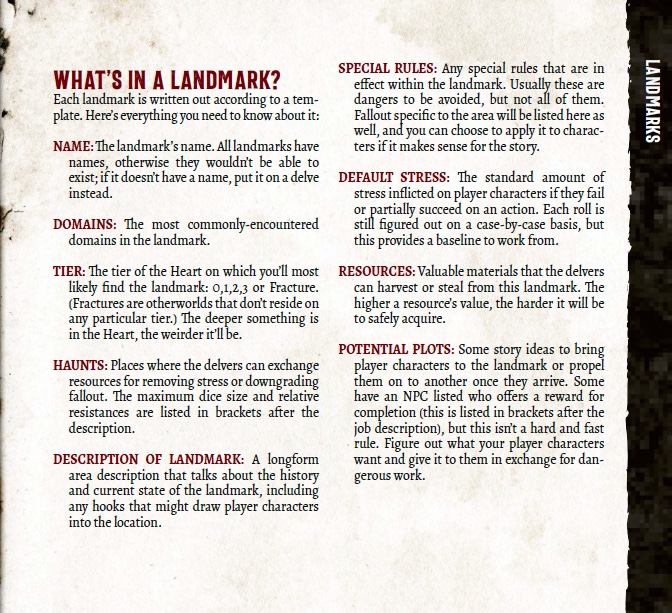
Other than that, the format of each Landmark entry is pretty much set:
NAME: ‘Nuff said
DOMAINS: These are broad areas of interest or influence: Cursed, Desolate, Haven, Occult, Religion, Technology, Warren, Wild
TIER: The Heart is split into tiers designated 0,1,2,3 and Fracture. 3 is much stranger than 0. Fracture is a movable feast of rumness.
HAUNTS: Places to rest and heal or people who will facilitate that. What kind of stress/fallout can be cured? Also, this should include the max dice size of healing.
DESCRIPTION OF LANDMARK: Part history, part current state of affairs. Maybe some hooks to bring the PCs there.
SPECIAL RULES: This could involve particular dangers or custom-fallouts.
DEFAULT STRESS: What is the normal amount of stress to inflict for action failures? Indicated by a die size.
RESOURCES: What type and die size of resources are available here.
The Blistered Basilica, a polyp on the inside of the blister. The devoted gather inside to worship (d8 Echo)
Rose’s, a restaurant with a good reputation and a worryingly good chowder (d8 Blood)
The Blister Pack, a general market that specialises in building and delving equipment (d6 Supplies)
Description: An enormous, fleshy blister on the inside of an enormous, fleshy chamber. Blister is pierced near the base by a hole that allows delvers to enter. From this hole there is a ramshackle wooden ramp that leads to a series of old platforms requiring constant repair. It has some residents, known as platformers, who are more or less permanent and mostly have no sense of smell.
At the base of the blister is a fetid lake of stinking pus. A whole ecosystem of pus creatures live in the lake. They generally leave the platformers alone.
The platformers worship the blister as though it were a god and as long as they do, they say the denizens of the pus will leave them be. But outsiders and heretics should not stay long, they say.
Special Rules: If you spend a bit of time in the Blistered Basilica in order to remove Echo fallout, make an Endure/Religion check. Consequences of failure as below: Fallout: Pus Magnet (Minor Mind) You have come to understand the Platformers’ devotion to the Blister and you feel a kinship with the pus-beings. They are there for your protection and you are there for theirs. You feel an urge to descend to the lake, befriend one of them and take them with you on your travels (Ongoing.)
Getting too close to the pus lake will require an Endure/Haven or Religion check. On failure/mixed result: Fallout: Blistering Barnacles (Major Blood) You’ve been infected by the pus. You are covered in hard, black blisters which hurt and stink. They make all social checks one difficulty rating higher (Standard becomes Risky, Risky becomes Dangerous etc.) (Ongoing.)
Resources:
Gathering Blister pus (d4 Religion) can be dangerous. See Special Rules.
Potential Plots:
Deacon Delicia of the Blistered Basilica has startling news for any PCs that visit. The Blister has revealed an existential danger to her. A stalactite-like calcium deposit has formed above Blister and a group of heretical pus-haters are preparing to climb up there and knock the spiky peril from its perch. This would spell the end for Blister, the Pus Lake and the Platformers. She is offering the church’s most prized possession as a reward to anyone who can stop the heretics. It is a wooden spike known only as the Splinter (Kill d8 Piercing, Debilitating)
Character options in D&D 5e have always felt pretty thin on the ground to me. Official ones at least. Of course there are hundreds of subclasses, species/races, backgrounds etc. out there from third party creators but it has always seemed as though WotC have deliberately limited the number of official options they put out. I sometimes wonder if I only feel that way because 5e is not my first edition of the game. Because, in comparison 2e, the various classes and species are woefully underserved in my opinion.
In the late 80s and early 90s TSR released a set of books designed to complement the basic character options presented in the 1989 Player’s Handbook for 2nd Edition Ad&d. there was one for each of the classes. These generally focused on fleshing out the possibilities for the classes with “kits” background options, class-based campaigns, new abilities and features, class-based organisations like thieve’s guilds. There were also several supplements that dealt with AD&D races. The elves got one, the gnomes and the halflings got lumped together in their own book and they even had one called The Complete Book of Humanoids, which featured a plethora of “monstrous” races as PC options.
Back in those days, my table got a lot of use out of most of these books. The character kits from the class books became standard choices in many cases and the extra racial options were very popular for rounding out PCs. But my favourite, by a pretty long way, was the Complete Book of Dwarves. I had been a fully paid up member of team-dwarf since I read the Hobbit as a kid. I loved their aesthetic, their toughness, their curmudgeonliness, and, of course, their beards. I had a few dwarven characters over the years across multiple games and systems but I don’t think I ever got to have one in AD&D as I was almost always the DM. So, instead, I used the Complete Book of Dwarves to make up Dwarven societies, kingdoms, mythologies, NPCs and Strongholds. The book contains chapters on the mythical origins of the dwarves, dwarven subraces, “Your Life as a Dwarf,” Character Creation, Proficiencies, Dwarf Kits, Role Playing and Personalities, Mining, Equipment and Designing Dwarf Campaigns. I remember getting fully immersed in dwarven world-building in a way that my players probably did not entirely appreciate. But, if I’m honest, that was for me anyway, not for them.
Stronghold Creation
So the Complete Book of Dwarves has a whole chapter devoted to generating your own Dwarven Strongholds and I have a distinct memory of being wrapped up, sick, in a duvet on the couch rolling up stronghold after stronghold. I must have recorded them somewhere but those records have been lost to the mists of time along with Cold War and white dog poop.
Now, I haven’t had a copy of the book in years. I’m not really sure what happened to the one I had, but there is a good chance it was borrowed by one of my good friends a mere thirty years ago and they haven’t gotten around to returning it yet. Understandable. Anyway, it was my birthday on Tuesday and my friends Tom and Isaac gifted me a copy of it! I had recently been going on about my particular love for this book and they’d actually listened to me!! True, true friends.
So I thought we could create a stronghold together now that I’ve got it. Strap in! According to the opening section of the chapter:
Strongholds are the homes and workplaces of the dwarves. They can range from simple family residences to huge subterranean cities. The stronghold design sequence allows you to design a stronghold, either by making a series of choices, or by random die rolling. You may also combine the two methods.
Dear reader, if you have been here for any of my character creation posts, I think you will know which way we are going. Random all the way!
Here’s the Dwarf Stronghold Design Sheet:
You can see that we are going to start with the name. Now this actually requires us to turn back to Chapter 4 first and locate the Dwarf Name Generator.
We then roll 1d4 to determine the number of syllables in the stronghold’s name – that’s a 2.
That means we roll 1d20 twice on the Dwarf Name Generator Prefixes table – that’s a 7, Dal- and a 16, Nor-
We go ahead and combine those in the most pleasing sounding configuration, I think that would have to be “Nordal” for me
Then we flip back to Chapter Ten and roll 1d20 once more on the Stronghold Suffix Table – 15, -lode
Put em all together! Nordallode! It definitely has the sound of a place name made up for D&D but we are going with it
Next! Subraces Present. Ugh. Yep. This is the bit where it becomes a little problematic. Obviously, the whole subrace business in D&D is slightly odd. If you applied it to humans you would be talking about different ethnicities, but D&D doesn’t do that with humans, does it (I mean thank fuck, right?) (I’m deliberately skirting around the variant human unearthed arcana options because I think it’s best to do that.) Anyway, the Subraces Present section wants us to make sure we know which is the main subrace (i.e. the most numerous,) the dominant subrace, and which other subraces exist there. This section also includes a table that tells you how many of the dominant subrace are in your stronghold, while pointing out that this only refers to the number of male dwarves. The number of females is, for some reason, half this number and the number of wee dwarflings is half that again. Look, I don’t know. How they came to such decisions is beyond me and clearly did not even strike my tweenaged mind as something noteworthy at the time.
OK, so, I’m going to roll on the Subrace Table to figure out which is the Main Subrace in Nordallode. The same table determines their numbers. Once again, the table has different potential populations of subrace for each (Deep Dwarves can have 3d100+50, whereas Gully Dwarves can only have 1d100+50.) As for numbers of males to females, I see no reason to abide by the nutty, unexplained logic in this section. I’m not even going to split them up.
Ok, Subrace Table, roll 1 – 32 – Gully Dwarves.
Number – 1d100+50 = 108
Now to find out which is the dominant subrace and how many other dwarves subraces live in the stronghold. Let’s roll on the Dominant Subraces Table.
61, Hill Dwarves
This means there are 1d4 Other Subraces in the stronghold according to this table. I rolled a 2.
I’m beginning to get confused and frustrated by this whole subrace business. The first table got me to roll to determine which was the main subrace and how many of them were in the stronghold. Now, I’m told to roll on a different table to find out which is the dominant subrace (is this not the main subrace?) and then roll to find out how many other sub races are in the stronghold? But, so far, I have rolled two different types of dwarf for main and dominant…
If I continue on to the next page, it tells me to reduce the number of the dominant subrace by a percentage depending on how many other subraces are present. But, I have not actually rolled the number of the dominant subrace yet.
Forget it. I am scrapping the Hill Dwarves. Long stand Nordallode, home of the Gully Dwarves!
I will keep everything else the same. Now, with 2 other sub races sharing their home with them, the Gully Dwarves must reduce their numbers by 25%. That brings them down to a mere 81.
I’m now going to find out how many and what type of other subraces are present.
I roll 1d100 on the Gully Dwarves Subraces Table and get 74 – Mountain Dwarves. I roll 2d10 to determine their numbers and get 14.
I roll again for the second minor subrace and get 52 – Hill Dwarves. There are 3d12 of these beardoes – 20
New population of Nordallode – 115
From the book:
Hill and mountain dwarves may be found at any depth and living with any other subrace. They are clannish and keep to themselves. They are likely to be the employers of other sub races. While these others will likely be in the stronghold on a fixed term contract, it is not unusual for a stronghold to have enclaves of other dwarves who have been there for generations.
Time to figure out the stronghold’s overall alignment. This does not determine the alignment of every member, just the general outlook.
2d6 – Obviously this table has each of the sub races along the top as some of them are more likely to be evil than others (aaaagh.) Nordallode turns out to be Chaotic Neutral.
Let’s move swiftly on from all that nonsense.
Let’s figure out the Type of Stronghold we are building:
Another d100 roll and I get a 14, which means it is a Secondary Stronghold and gets to increase its population by 100%
New population of Nordallode – 230
Secondary Strongholds are second only to Major Strongholds and can be independent or allied with a Major one. I think we will call Nordallode an independent stronghold!
How old is our stronghold? Good question!
For Secondary Strongholds we roll 2d6 to find out how many generations of age Nordallode is – That’s 8. Pretty old… except, there is a Racial Modifier. Gully Dwarves subtract 2 from that number. So its 6 generations (no fucking idea.)
And how old can the dwarves of Nordallode live to be? No roll here:
Gully Dwarves – 250 years (this is the lowest possible life expectancy and its determined entirely by subrace…)
What type of government does our stronghold have?
It’s back to the d100 rolls – 89 – Oligarchy! Why, of course! How fitting! (Wah!) Oh wait, there are more modifiers here. Gully Dwarves add 10 (for whatever reason) and we have to add another 10 for being of Chaotic alignment! That makes it 109. It’s Anarchy baby!
Time to roll on the Attitude Table to find out what our problem is.
It’s a d20 roll this time. That’s a 112 – Isolationist. Lock those gates!
This means that 75 – 100% of the population is in the frikking militia.
What are our major resources in Nordallode? Well, the book shies away from telling you exactly what you’re rich in, instead, just giving you an idea of its monetary value.
It’s 1d20 on the Stronghold Resources Table and I got a natural 20! WOOHOO! Things are looking up for my poor little Gullies. That means it’s Rich!
There is an optional part of this table – the starting gold modifier, that applies to PCs who come from this stronghold. So, if your character did come from Nordallode, they would start with an extra 1d10x10gp. Pretty sweet. But wait! Another racial modifier means that you take away 10 from the original d20 roll because Nordallode is a Gully Dwarf stronghold… Born to lose. So, this actually means that my downtrodden dwarves start at Average Resources and so get no starting gold modifier at all. FFS. There is a +1 to the roll for being a Secondary Stronghold, but that doesn’t improve it from Average anyway.
OK, time to find out what Nordallode’s Relationship with Other PC Races is. We need to roll 1d20 four times on the table of that name. I am going to factor in the modifiers at the start this time. I get a +1 for being Chaotic Neutral and, for being Isolationist, I must treat any roll of 4 or less as a 9:
Elves – 12 – Threatening
Gnomes – 13 – Cautious
Halflings – Nat 20, becomes 21 – AT WAR!
Humans – 12 – Cautious
Nordallode, not friendly to outsiders.
Properly, this should only be rolled for the races that live nearby but since this is entirely experimental, I rolled for all of them
OK, we have figured out who we hate above ground, time to go to war or peace with someone underground too. Love the War/Peace Table:
Its another d20 roll – That’s a 1 which actually means Nordallode is at peace!
The next table allows us to see how long that unlikely situation has persisted
Peace Table – 1d10 – 7 – 2d6 generations! – That’s 4 generations of peace! Just not with those fucking Halflings obvs.
There is a War table as well but I think we have just determined that we don’t need to roll on that.
Nordallode has to defend itself from the depredations of those vicious, hairy-toed bastards. How do we do that? With our Military Forces!
Gully Dwarves have an Unsteady Morale (7)
Apparently the first reaction of Gully Dwarves to danger or conflict is to run away, whether they are members of the militia or not…
Their weapons are… “any they can scavenge,” which is not great for a militia but may make sense in a stronghold where anarchy reigns
With 230 dwarves in the stronghold, I’ll assume that 200 are in the armed forces. That means that, of their Leaders, there are 50 Thieves (level 2-6), 40 Warriors (level 2-4), 20 Warriors (level 2-6), 4 Warriors (level 8), 2 Warriors (level 10) and 2 Priests (level 1-10)
Special Forces – It says 10 to 20% of the militia have some of the specialised Class Kits from the book. I’m not going to get into that right now though as it would require the sort of dive into more general AD%D rules that I’m not prepared for. But, numbers wise, that’s at least 20.
War Machine Table! – We get 4 rolls on this because of the size of the militia and we get a +1 to our rolls because of our cool Isolationist attitude. It’s a d10 table – that makes 11 for the first roll giving Nordallode 3 War Machines, 8 for the second roll for another 1 War Machine and finally a 6 for 1 more. That’s 5 War Machines, total. Noice.
You can have Animals to defend your stronghold. The specific animal depends on your subrace, unsurprisingly. Let’s a have a cadre of Giant Beetles for the Gully Dwarves of Nordallode. That’ll scare the bejeezus out of those pipe-smoking tyrants!
let’s figure out our Total Strength
That’s Number of Leaders in the Military (118) + Special Forces (20) + Number of Dwarves in the stronghold (230) = 458. I am not sure what this number means. It seems incredibly abstract.
Conclusion
Every time I revisit one of these old AD&D 2E books, the realities of the western world, the industry, our polluted minds and questionable thought-processes of the writers of game materials largely marketed to children, smack me around the face again. When I first read this, I didn’t see anything wrong with it. In fact, I specifically remember deriding the mere idea of playing a Gully Dwarf when I was 12 years old. But I am giving that me a pass. He was a child. So, it’s harder to hand out the get-out-of-jail-free card to the creators of the books. They, perhaps unthinkingly, used their creations to perpetuate racist ideas. And I know they are fantasy races but there’s no excuse. Those subraces, as I wrote above, are the same as human ethnicities. According to the writers of this material, only some of them are fit to be the employers of the others, some of them consort with beetles and are cowardly and some are inherently evil… Need I say more?
I had a lot less fun with this process than I remembered having when I was a kid but there are still elements that spark the imagination. I like to imagine the Gully Dwarf heroes! Those few high level Thieves, Warriors and Priests, perhaps riding out on their War Beetles. It makes me wonder about the generations that came before, the founders of Nordallode, and what their lofty goals were. Would they be disappointed in their descendents or proud?
What’s your opinion on these old, race obsessed books, dear reader? Do you just shake it off or do you embrace the stereotyping and run with it?