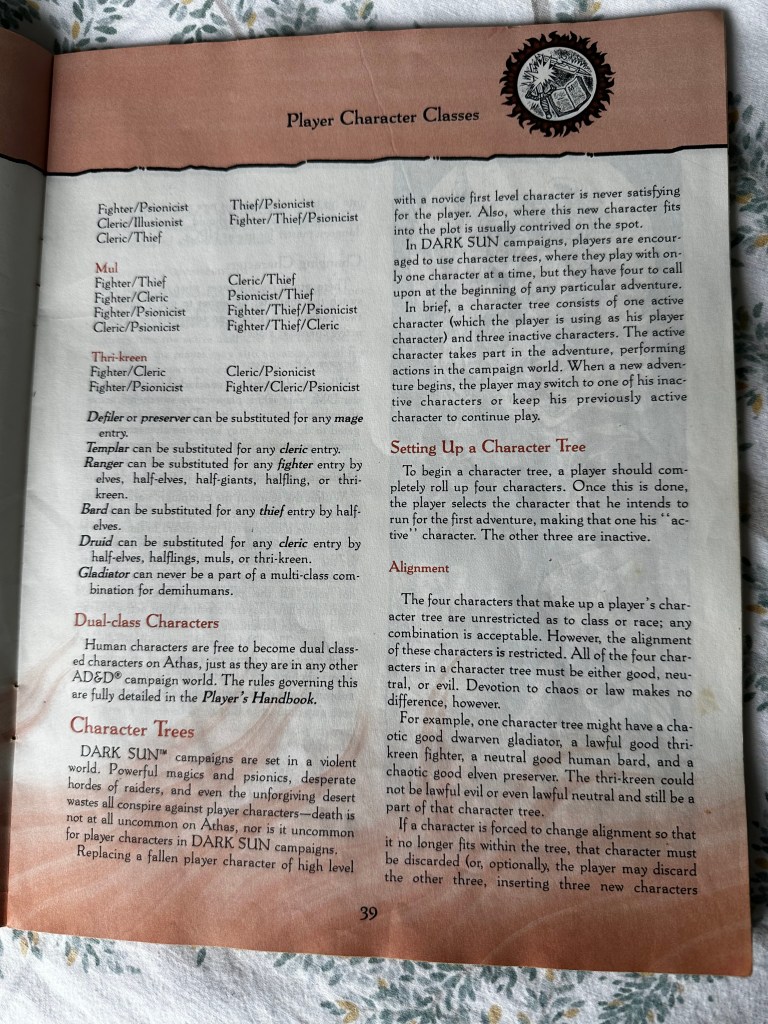
I’m considering an option that harks back to Dark Sun. In 2nd Edition Dark Sun, a player started, not with just one PC, but a whole stable of them, called a character tree.
Mid-season finale
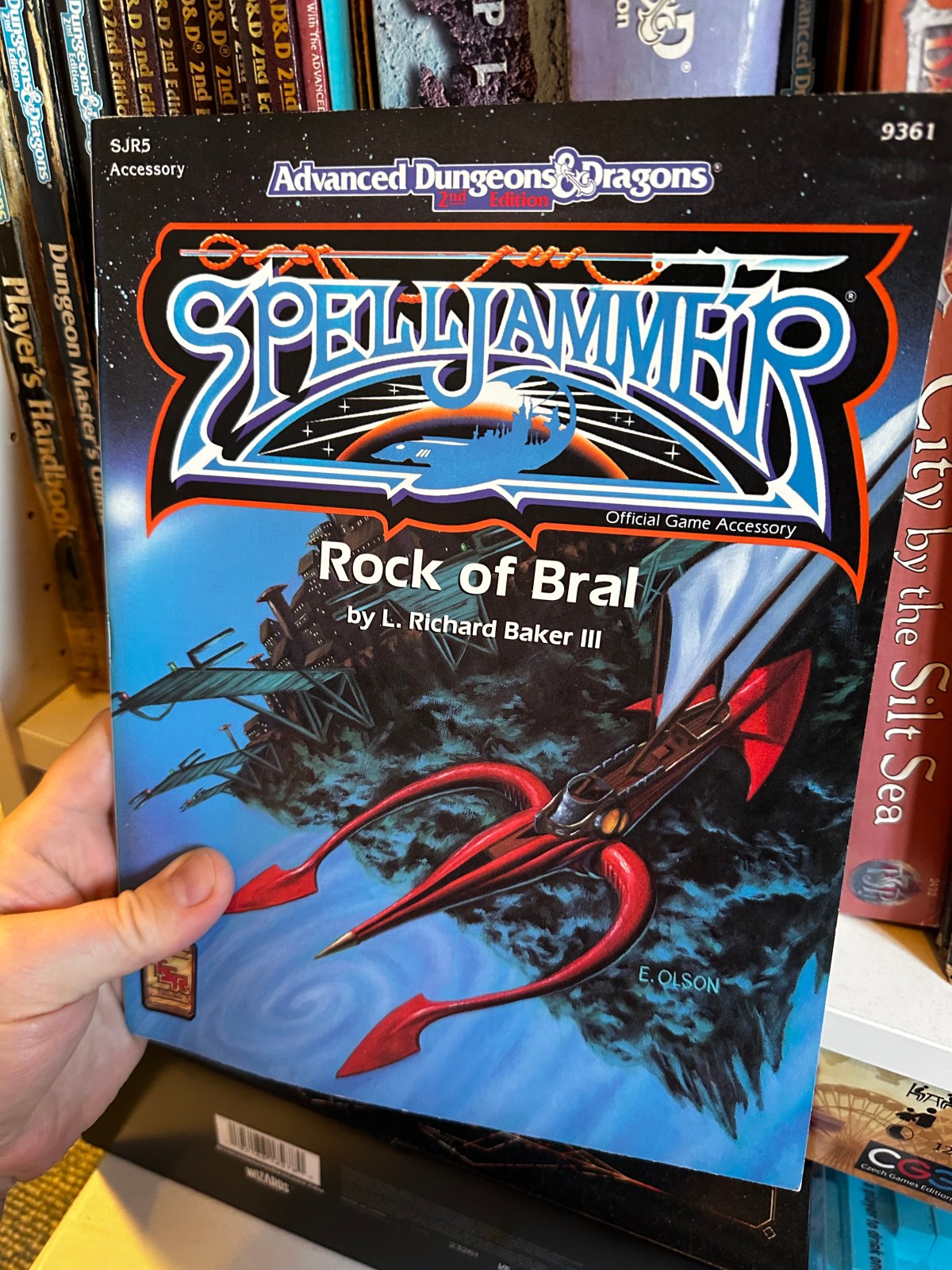
The crew of the Cadabra were going home. After weeks of adventure across Scatterspace and all over the Rock of Bral, they have arrived back at First Home, the asteroid/inn/shipyard that was their first stop after leaving their world behind in the first place. They could justifiably expect a warm welcome since they freed the shipyard from a Neogi infestation last time. But they weren’t expecting to be confronted with a crew of kobolds from their home island to be there. Kobolds who probably thought the PCs had murdered their queen. They also weren’t expecting to find Becky Fullpockets’ personal spelljamming vessel there. They had been struggling against the machinations of the technomagical billionaire ever since they fled their planet. It looked like they were stuck between a rock and a hard place, with no escape!
No better place to end part of a season than on a cliffhanger. And that’s what we did right there. We have been on a break from our Spelljammer campaign for a couple of months now. It’s given me a break from 5E and allowed us to play some other great games in the meantime. But now, it’s time to come back, sort of.
Spin Off
A few months (IRL months, that is) before the crew of the Cadabra reached First Home for the second time, they said goodbye to one of their number. Giff Fighter-Paladin, Azimuth, who had to be rescued from two ship-wrecks in quick succession might have been labelled a Jonah by many crews, but the Cadabra was different. They welcomed him on board with open arms and he adventured with them for a while. But, eventually, he was always going to go back to look for the father who went missing from the first of those two ship-wrecks. Now, while his erstwhile comrades are heading back to their homeworld, Azimuth is armed with a little knowledge about the stretch of Wildspace Papa might be found in and a ship stolen from Becky Fullpockets. He’s preparing an expedition of his own to go find his real dad… Not that gnome who pretended to be his dad during that short period where he’d lost his memory (long story, dear reader.)
The rest of the players are coming back too, but they’ll be playing new characters for this spin-off. Azimuth needs a crew for his ship, after all. We are getting together tomorrow night for a session-0 type thing. I think everyone is looking forward to trying some different classes/backgrounds/species compared to the ones they have been playing for over two years in the main campaign. Although, Azimuth’s player, David, doesn’t get a new character, he does get to pursue his PC’s main drive and its a great welcome back to the group for him.
As for me; I’m looking forward to yet another shake-up in this game. I’m planning to use the progress-based travel rules that I mentioned in my Prep Part 2 post last week. And, as well as that, I have something very special up my sleeve for the meat of the adventure, which I can’t reveal here and now (my players read this blog sometimes.) I’m definitely going to write about it after the fact, though.
Change of Cast?
The introduction of new PCs into the campaign, even though its a spin-off, raises the question of what happens once Azimuth joins back up with the main crew again. I’m considering an option that harks back to Dark Sun. In 2nd Edition Dark Sun, a player started, not with just one PC, but a whole stable of them, called a character tree. I believe you were supposed to begin with four characters. This was to help counter the lethality of the setting, giving a player back-ups in the inevitable event of a PC death. This made a lot of sense, especially considering the amount of time it took to create characters. Go check out my Dark Sun character Creation series to witness exactly how long that took.
So, my thinking is that, once this spin-off is done, if they want, the players will be able to swap PCs in or out as they like. This should have the double benefit of providing the players with a bit of variety and allowing them to almost fully crew their ship with their own characters, rather than just NPCs. I’m currently thinking through how I’ll handle character advancement if I do allow this. In Dark Sun, if I remember correctly, the PC only gained experience when they were actually played. No vicarious levelling. I think this makes a lot of sense, but it might be more difficult to adjudicate with milestone levelling.
What do you think of these ideas, dear reader? Have you ever run a spin-off campaign like this? Would you be happy for your players to switch between active PCs like I’ve described?
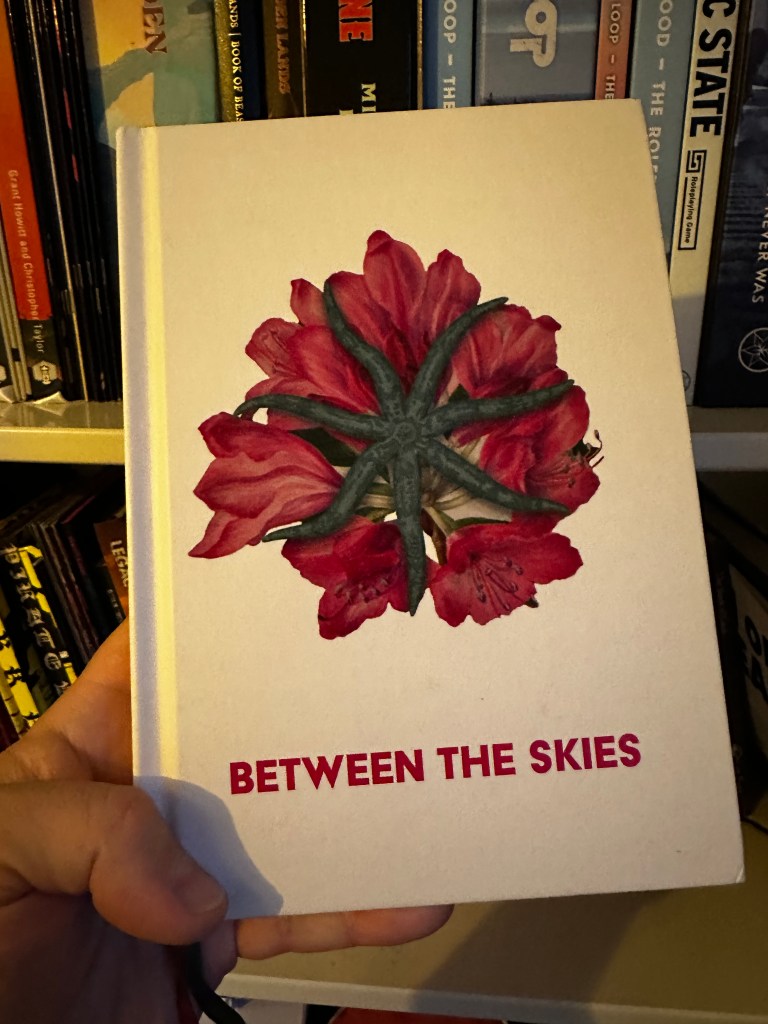
I am an unapologetic shill for Huffa’s Between the Skies. It’s one of my most used and most valuable RPG books. I use it constantly in lots of contexts. But I love using it to prepare for sessions.
Still Prepping
This post is part of a blog bandwagon started on the Roll to Doubt blog.
Click on the link above to take in the blogpost that’s piloting this bandwagon. Wagon-jumpers abound. You can find a very nice read on the same topic and a handy list of related blogposts on the Among Cats and Books blog.
And here’s a link to the first post on this topic on the dice pool dot com.
Between the Sessions
I am an unapologetic shill for Huffa’s Between the Skies. It’s one of my most used and most valuable RPG books. I use it constantly in lots of contexts. But I love using it to prepare for sessions. Its approach to random encounters in particular is one I highly recommend. The encounters are built, not just to make your session interesting, but to introduce potential allies and enemies, recurring characters, locations, objects. In short, they help you to truly build your campaign without relying on GM-written plots that the players may or may not want to interact with.
The methods and tables introduced in the book make for interesting, impactful characters and occurrences. And they have depth, too, enough to hook your players and keep them hooked. You know that old story that your players would die for the unnamed goblin you just made up on the spot but won’t give a shit about the NPC you spent two weeks crafting an elaborate back story for? I feel like the techniques in Between the Skies are almost designed to prevent that. Why? Well, firstly because, if used as your main way to drive the game forward, you are not going to be spending so long lovingly hand-crafting those NPCs, you are just going to roll them up on the tables provided and not worry about whether or not the PCs run into them, because whatever they run into will be interesting and fun enough to capture their imaginations. So, all the NPCs are more like the loveable nameless goblin and you don’t feel the need to make sure the PCs interact with any of them in particular. This has the effect of allowing the players to dictate the direction of the game to a large extent. This is a good thing!
Let’s Interact with the Mechanics
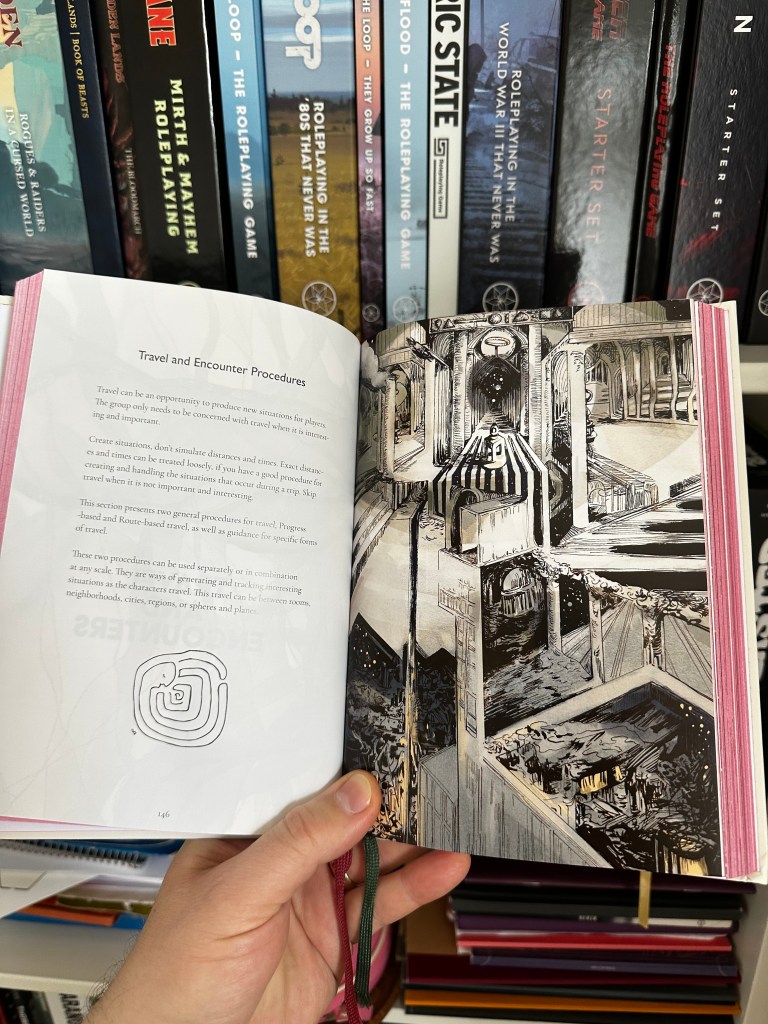
So, Huffa’s advice when it comes to travel is that, unless it is going to be interesting or important, skip it. I can get behind this approach. Recently, I have tended towards the idea of the journey being the game, but sometimes, when you know the next scene you need to play is across the city and its a relatively safe place, just skip to it, or montage it if there is something interesting to see along the way or if its a good opportunity for conversation between characters.
If and when you want to play the travel, though, Between the Skies presents you with two options, progress-based travel and route-based travel.
Route-based travel
Using this method, you use a map, just a basic one that includes routes and locations along them. You roll once on the Encounter die between locations and resolve that before arriving at the next place. Simple. The book includes several ways to generate route maps and destinations but I won’t concern myself with that here.
Your route map should have options, different ways of getting from A to B with more locations in between your starting point and the final destination depending on how long you want the journey to last.
This gives me the impression of beating the resistance of a delve in Heart. Before the journey starts, determine the journey length. There is a helpful table that indicates the amount of Progress points required to reach the destination depending on how long the journey is. You record progress through the resolution of Encounter Die rolls.
The Encounter die works as follows:
Encounter
Something Approaches
Environmental hazard
Complication
Hint as to what is nearby
Progress/breakthrough/boon
So you only get progress points on a 6.
What I did
As with everything in Between the Skies, you can take it or leave it. I have used a combination of the two methods, where I decided that a spelljammer ship journey from the Rock of Bral to the First Home asteroid would take three days and I would have them roll on an encounter table once per day. So this is the table I used:
Wildspace encounter table d6
1-2 No encounter 3 Environmental/Ship Hazard 4 Ship Problem 5-6 Encounter
When you only have three days and so, three possible rolls on the table, I felt it was better to increase the chances of actual encounters/problems/hazards occurring. If it was a more exploratory journey, I would use the progress-based method as described in the book.
Now, using the tables in this book, of which there are many, you should be able to create a fascinating encounter on the fly, but, if you can, I think its nice to prepare a few beforehand, at least one of each kind. So let’s do that here.
I thought it would be a good idea to roll up some options on the spark tables in the book and add them to a d4 table for each encounter type (environmental/ship hazard, ship problem and ship travel encounter.)
Environmental/Ship Hazard
We’ll start with the hazards. For each hazard you want to prepare, you roll 1d6 to determine the hazard type and then d66 to generate a hazard keyword on the Environmental Hazards during ship travel table in Between the Skies.
I shared this table in the last post so lets use the results I rolled up on that.
3 Ship Hazards
Roll 1d4
Hazard 1 – Storm, Flood
Hazard 2 – Disorientation, Sphere
Hazard 3 – Obstruction, Cold
Hazard 4 – Trap, Haunting
I then go ahead and prepare a few details of the hazards. Here’s the first one as an example.
Hazard 1
A solar storm rolls in from the direction of the sun.
The gusts of solar winds batter the ship
The deck is flooded in light and other solar radiation
All those on deck risk blindness
There is also a chance of taking radiant damage
All on deck must make a Dexterity save, DC 15 to avoid blindness
If they are afflicted with blindness it lasts 1d4-1 days. If you roll a 1, Roll 2d12-1 for the number of hours it lasts
Even if they saved against blindness they must make a Constitution save, DC 15, against radiant damage. If they fail they take 4d6 radiant damage. If they succeed they take none.
This goes for the ship too, if the damage roll beats the damage threshold
You can see that I took the hazard type fairly literally but moved it into a wildspace context. A solar storm seemed obvious but also pretty cool. The keyword, “flood,” took me a little while to work out but I thought flooding the deck with light seemed both like a cool, spacey event and something that could present a real problem for the PCs.
Obviously, you can prepare the details for each entry in the table. They don’t have to involve a lot of work but putting a little extra preparation in at this stage can remove the need for it at the table.
Ship Problem
Similar to the hazards, you simply roll up a problem type and a problem keyword on the Ship Problems tables in Between the Skies. I did this four times and created the d4 table below.
4 Ship Problems
Roll 1d4
Problem 1 – Armament, Separation
Problem 2 – Quarters, Shrinkage
Problem 3 – Cargo, Disappearance
Problem 4 – Bridge (spelljammer helm), Error
Here’s the detail on one of these entries:
Problem 2
One of the crew has stowed something large and awkward in the crew quarters. It is limiting the amount of space available to sling hammocks and the rest of the NPC crew is unhappy about it. This crew member refuses to be parted from their huge steamer chest as it contains something of extreme personal significance. The PCs will need to resolve the interpersonal issue.
You can see that the details here are left deliberately vague. You Ould ask the players to decide which member of the crew is the problem, what’s in the chest that’s so important and, most importantly, how the resolve the issue.
Encounters
And finally we have encounters. There are a lot of different encounter tables in the book. You can choose the one that best describes the surroundings of the PCs at the time. There are two space encounter tables, one for known space and one for wildspace. They are d66 tables. Once you have done rolled on them, you can get some more inspiration by rolling on the encounter keyword, detail and related entities tables. Once you have rolled on the Encounter distance and awareness tables in Between the Skies to determine how far away the encounter is and how much attention they are paying to the PCs you can roll on the d4 table below.
You’ll note that the results on the table below are not all similar. For instance, encounter 2 doesn’t have a related entity. In general, such entities, as generated by the tables in Between the Skies, are sentient NPCs so I didn’t think it necessary for the parasite I rolled up. But mostly each of them includes an encounter keyword, a related entity, and two encounter details.
5-6 Encounters
Isolationists – Confusion, Related Entity – Unknown NPC, Glittering, Prayers
Ship Parasite – Loss, Scales, Experiments
Ruins, Ancient – Mourning, Related Entity – Petty God, Knots, Miscommunications
Stowaway – Battle, Related Entity – Creature, Eggs, Blindspots
Stowaway
Size, substance and form table: Very small biota, piecemeal. Weakness: True name Needs: Brains Characteristics and details: Pacifist, stalks Behaviour: Social: Family: 5 appearing Demeanor and current behaviour: Protective, healing Attacks: Blast – teleporting
For the final example, I’m using the creature generation tables in the Entities chapter of Between the Skies. You can see all the details and keywords that I rolled up above.
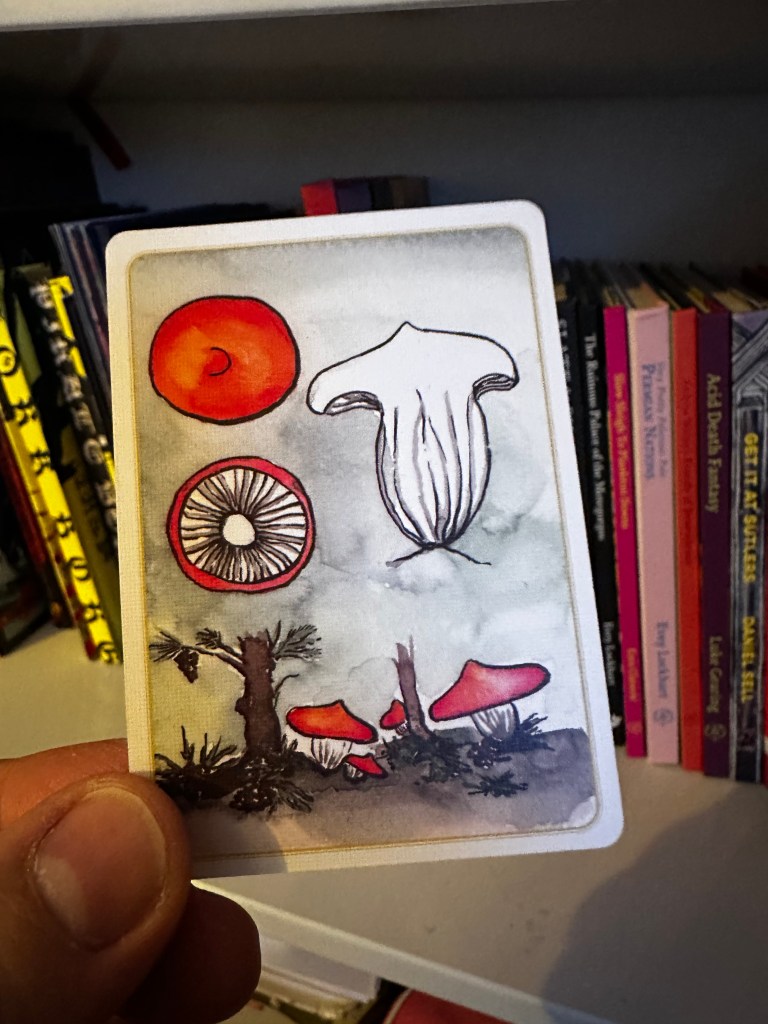
Along with the keywords, battle, eggs and blindspots, that came from the original encounter detail rolls, these will make for a fascinating encounter with some sort of very small fungal entity that has escaped a battle to find refuge aboard the PCs’ ship. The mushroom creature has a desperate need for brains to help heal its young but will not take them by force. Perhaps they only consume the brains of dead beings. Perhaps they have a blindspot that means they cannot sense constructs. And maybe, also, they have crawled into the ship’s stores to try to feed on the eggs, mistaking them for heads containing brains. I like the idea of them lashing out with a teleporting blast to deposit attackers some way off the deck of the ship, leaving them to perish in wildspace. If the PCs can figure out the creatures’ true names, they’ll be able to get them off the ship, but how?
Conclusion
I think you can see the fun you can have preparing encounters and encounter tables using Between the Skies. Once again, dear reader, I can only urge you to go and purchase it. It’s so useful and you won’t regret it!
“The Discourse (TM)” has been focusing on running published adventures/modules/campaigns as opposed to custom/homebrew/sandbox games for the last little while. First Quinns reviewed Impossible Landscapes, an epic and almost legendary campaign for the modern Cthulhu-ish game, Delta Green. This is the first time Quinns has reviewed a campaign/published adventure on his RPG review channel, Quinns’ Quest, so it was unusual enough to spark a significant amount of discussion all on its own. And then Thomas Manuel of the Indie RPG Newsletter and Rascal reviewed the same campaign. I believe this was purely coincidental, especially as Impossible Landscapes came out about five years ago now. Both are great reviews in their own right and are based on full play-throughs of the campaign so you know they’re of real value. You should check them both out.
I have opinions on the conversation, of course. I have shared a lot of them in other posts from the last year or so, actually. If you want the summary, though, I had a lot of bad experiences running D&D scenarios in the past, especially from the AD&D 2nd edition era. I found they were difficult or impossible to just pick up and run. In fact, they required maybe more preparation time than adventures and campaigns I wrote myself. The one published 5E campaign that I ran, Storm King’s Thunder suffered from the same issues, actually. This made me feel like it was a “me” thing. But, it turns out, a lot of GMs feel the same way, according to Bluesky, at least.
However, I have had my mind changed somewhat by running pre-written adventures for some other games, particularly Free League’s Blade Runner, Dungeon Crawl Classics and, to a lesser extent, the Dragon Age RPG from Green Ronin.
This is a link to my first post on Electric Dreams, the introductory Case File for Blade Runner:
I will say that, despite my generally favourable outlook on most of these modules, I still find I have to to do a lot of prep for them. The main fear I have is messing things up so bad that I essentially spoil the rest of the adventure. Although, I should really have more faith in my abilities as a GM at this stage. I feel like I can probably improv my way out of any hole, to be honest. But it does not change the fact that I spend hours rewriting long paragraphs presented in module texts into digestible bite-sized bullet-points. I am running another Dragon Age scenario right now. Amber Rage is from Blood in Ferelden, an anthology of scenarios for the game that came out in 2010. It suffers from verboseness and unnecessary detail and makes for a lot of work from the GM. I’m enjoying the contents of the scenario but its presentation is horrendously dated and needs a sprinkle of OSR magic to tighten it up, in my opinion.
I realise that none of the modules I have mentioned here are anywhere close to having the size and epic scope of something like Impossible Landscapes, but it doesn’t change the fact that they have largely changed my mind about running anything pre-published. The one I have my eye on right now is Dagger in the Heart for Heart: The City Beneath. Actually, I have a post about that right here too:
I’m still feeling unwell, dear reader. It’s a feeling that returns me, quite unwanted, to the bad old years of the pandemic. So, I would rather think and write about something more recent and more delightful. Even if my current malady will not allow me to produce anything terribly beautiful or very long, I can rely on my players to help me out.
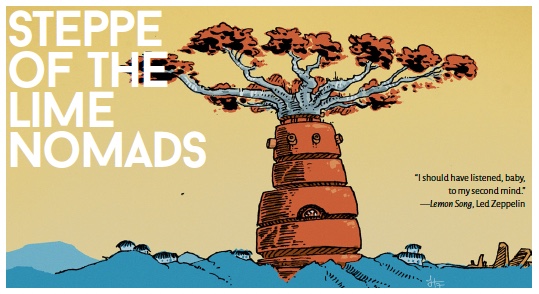
In our most recent session of Ultraviolet Grasslands, our caravan, Isosceles Inc., made it as far as their first proper destination, the Steppe of the Lime Nomads. I knew they were going to reach this place a week in advance so I had time to prepare for it. But what I ended up focusing my preparations on was not that destination but a couple of discoveries that they had rolled for the previous session. I had only the vaguest idea of what they might encounter at the watering hole I assigned as the current gathering place of the Lime Nomads. I knew they would have somewhere to trade, some way to perform market research and that was about it. The descriptions, I left to the three players, using a method called “paint the scene.”
Now anyone who has ever listened to a Jason Cordova podcast or read one of his games, knows this term. It’s a method he developed for use as a GM but is something he has since incorporated beautifully into several games. Go check out the current run of the Between on the Ain’t Slayed Nobody podcast for some truly wonderful examples of it.
Paint the scene serves several purposes at the table. The most important of these are allowing the GM to share the load of world building and description with the rest of the table and, related to that, allowing the other players into the fun and responsibility of bringing the world to life. Why should the GM have all the fun/work?
It’s a simple technique. You ask the players something about a person place or thing that helps bring them to life. It is important to craft the questions you ask to reinforce the theme you are trying to bring to the fore, though. It’s not enough to simply ask them, “what do you see in the village square?” Rather you should ask, “what about the village square shows us that this place was recently abandoned?”
Here are a few of the answers I got from my paint the scene questions when the caravan approached the great camp of the Lime Nomads last weekend:
What about this place shows us that the nomads return here year after year? This one was answered by Stebra, the Lime Nomad character. She was able to tell us a lot about her people and homeland: A river flows down from the mountains at this time of year, though it is often dried up – the nomads settle at the river for a while. They construct their temporary accommodations on stilts for safety. They transport these buildings around with them by folding them up into flatpack. There are larger towers that they use as shelter and to gather around. these towers are relics of ancient times and they stand tall, much higher than anything else in the region. The nomads migrate east to west take advantage of seasonal grazing and foraging. They use water wheels for power and they fish for particular little river fish while they can, cooking them on a spit. A seasonal speciality.
What evidence of the the misty time known by the Saffron City Opiate Priests as the Best Forgotten Ages can be seen in this land? Imssi, the tactician and puppet actor answered this one: Out of the ground the only occasional rock formations in this otherwise grassy plain, are the tips of fingers and toes of colossal statues or calcified giants. In the oasis, when the waters are low and the day is clear, you can see the great nose poking up from the azure depths.
How do you know the nomads welcome traders here? Phaedred Ping-noun, our Acolyte of the Business answered this one, as seemed appropriate: Such a gathering of the Lime Nomads is a moment for traders from all over to get in there and sell. There is a marketplace that is bustling and busy. There are lots of colourful wagons and colourful people gathered. Travellers, not just from the Lime Nomads clans, but from all over the Ultraviolet Grasslands have come to attend the markets.
Conclusion
I am trying to make more liberal use of the technique at the table these days. I find it really gets everyone more involved and engaged in the world. They feel an ownership of their little parts of it and I feel a deep gratitude for them adding the sort of little details and flair that I would never have thought of. If you haven’t given it a go, dear reader, I encourage you to!
Check out this blog post from 2018 on the Gauntlet for an explanation of the techniques from the man himself.
At the end of the last post I wrote about my current Ultraviolet Grasslands campaign, I noted that the caravaners were on the cusp of an encounter with some Armadilloids. The section of the book describing the Steppe of the Lime Nomads has a list of random encounters just like all the other sections do. And, just like the other ones, the detail you get about an encounter is minimal, to say the very least. You might get a level for the creatures or NPCs encountered, and maybe a word or two of description. This leaves quite a lot in the hands of the GM and, potentially, the other players at the table. Perhaps the characteristics of the encountered entity would emerge organically in play. Maybe the GM will have prepared specifics for each potential encounter, with regards to physical descriptions, motivations, weaknesses and strengths for instance. In the case of this encounter. I knew I did not want it to be an automatically violent one. I wanted the Armadilloids to be sentient but different enough as to be inscrutable. I could probably have just written a description, but I have Between the Skies, so why should I?
I took to the Entities chapter of the book and started rolling. I started with a roll on the Size, substance and form table. I rolled a 7 for size. That gave me Very large (giant-size.) I liked this. It immediately brought to mind the Armadillo super villain first encountered way back in Marvel Secret Wars II some time in the 80s. So I had a picture in my mind.
Next, I rolled a 6 on the Substance table, meaning they were Animal. That corresponded with my general idea so far, which was cool. On the Form table, I got a 13 on the d66 roll. That made them Bipedal (which is a word, that, when you say it out loud, sounds weird, we discovered.) It was still matching the picture I had in my head at this stage, except for the fact that these bipeds also had wings. For my purposes I thought it best that they be stubby vestigial wings. It’s the Grasslands, it’s not safe to fly there.
This next bit was so good. On the Weaknesses and Needs tables, I started to see the situation emerge. I rolled a 34 on the Weakness table, which meant they were Confined. Now in the previous session the players had rolled on the encounter tables in UVG and we had established already that there were ten or so of them and they were merely silhouettes on the horizon. They could see the Armadilloids so they were not obscured by any sort of physical trap. But a pretty cool phenomenon in UVG is “stuck-force.” These are invisible barriers and shapes and containers of nothing but force. They litter mainly the skies of the UVG, left over from a time long gone, when fantascience and magic dominated and their practitioners left these eternal artefacts dotted all over, making flying an incredibly dangerous prospect (as I hinted at above.) So, I came up with the situation where the Armadilloids had been trapped in a sphere of this stuck-force and had been unable to free themselves. The next table was Needs. I rolled a 62 on that, which gave me Directions. But I didn’t like this one so I opted for 26 instead, Escape. Perfect.
Next was Characteristics and details. These tables round out the looks and important idiosynchacies of these creatures. First I rolled a 21 on the Notable characteristics table. You know those big ol’ Armadilloids are rolling around like Sonic (I know Sonic is a hedgehog, ok? Just roll with it.) On the detail table, I got a 34, Tatooed. Adding a little more to this, we see that they are tattooed all over with the pictographic stories of their lives. I love this detail.
Next come a pair of Behaviour tables. I rolled on the Social behaviour table, which indicates their numbers, even though I already knew how many there were from our roll on the UVG tables. Why? Well, it also suggests the type of groups they habitually congregate in: Couple, Family, Herd, etc. I rolled a 6 and got Pack. This fit perfectly as well. I actually skipped the behaviour and current demeanour tables because I already had a good idea that they would be eager to be freed, some of them going stir crazy, rolling around inside the sphere, some simply sitting in the grass, and one of them standing with his hands raised against the stuck-force sphere trying to will his way out.
This next one was fun: Attacks! I rolled a 6 on the Mechanism of attack table, making it a Blast. The Attack keyword I rolled up was 33, Draining. So, from these words, I decided they would have a Charisma Draining Psychic Blast power. It never came up in play, thankfully. Why? Because the PCs figured out how to free them and then were invited back to their mushroom growing burros where they were rewarded with three sacks of Regular Mushrooms.
They also spent the night there around the Armadilloids fire, despite the fact the big orange guys could only speak in some brand of “meep meep” language. They all consumed copious amounts of magic mushrooms and got high as fuck using the wonderful tables in the appendix of Fungi of the Far Realms.
Since I rarely get much time to prep sessions these days, this method was really valuable. It allowed me to do what I needed to do on the train on the way to work, using the pdf of Between the Skies, an online dice roller and the word processor on my phone. I have been using Between the Skies for some other games too in the last few months, most notably our Spelljammer campaign. It has made for enormously memorable and unique encounters in that case. I can’t recommend it highly enough. Go get it on itchio or on Exalted Funeral!
Final Plug: Shadows Return
I backed a project from Ian Hickey of Gravity Realms last year, The Price of Apocrypha. It was a really successful Kickstarter, especially for a small, indie, Irish creator, and it was fulfilled and delivered incredibly promptly.
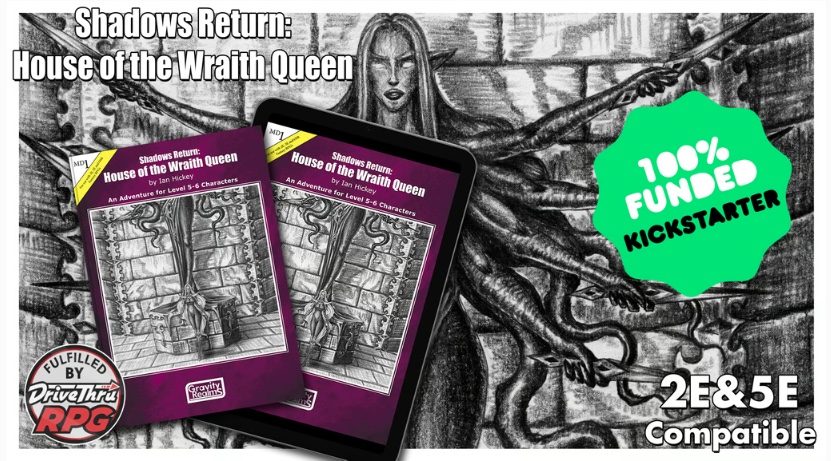
Well, Ian has another great project in the works on Kickstarter right now, Shadows Return: House of the Wraith Queen. Its a mega dungeon style adventure for use with Ad&D 2nd Edition, D&D 5E and OSR games. It’s fully funded but there are only a couple of days left of the campaign and you could still help it reach some stretch goals! Go back it!
As a final note, I have recommended a lot of books and products recently and I like to think I always do here on the dice pool dot com. I do this purely because I believe in the books, the products, the creators, not for monetary or other rewards!
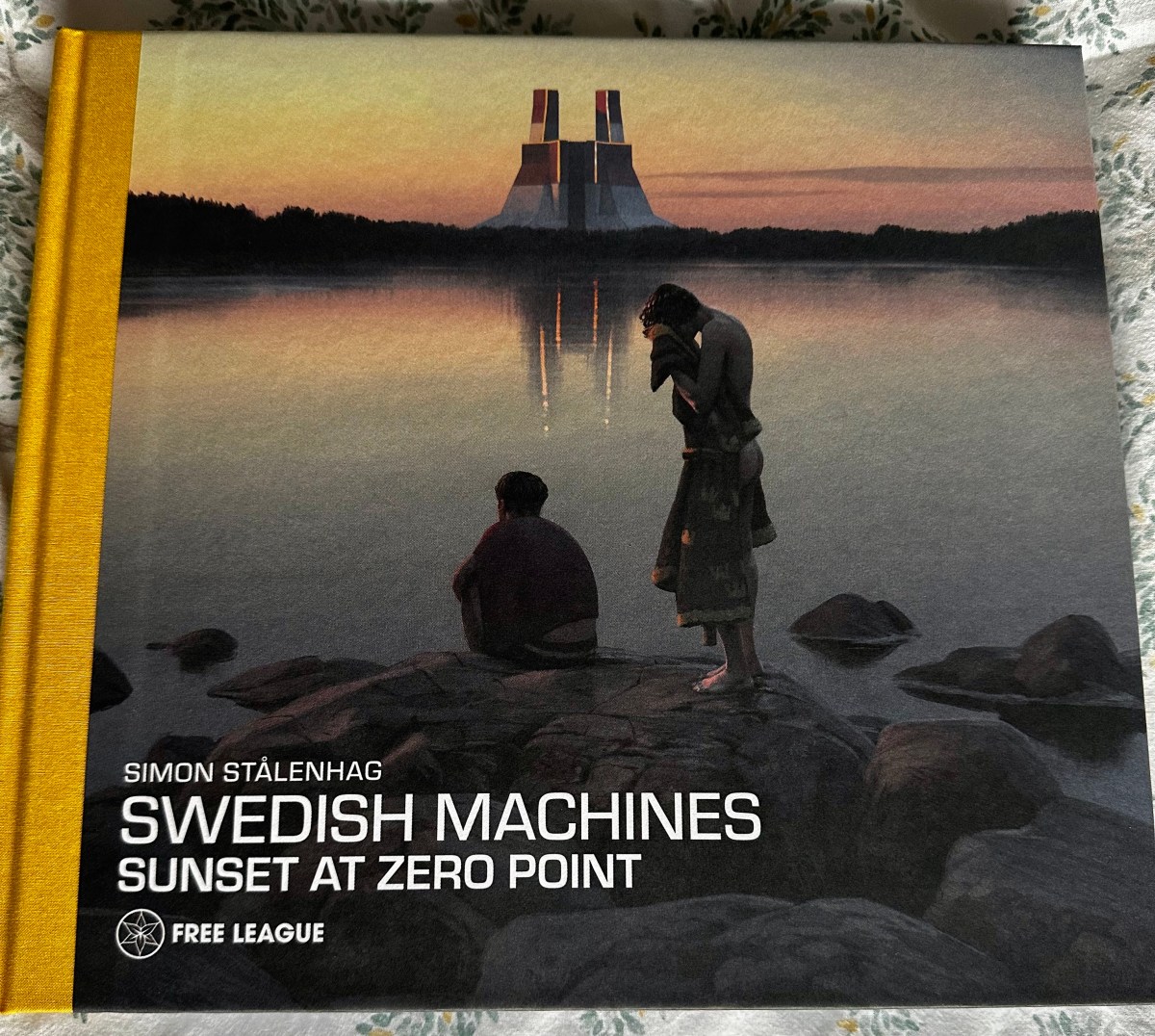
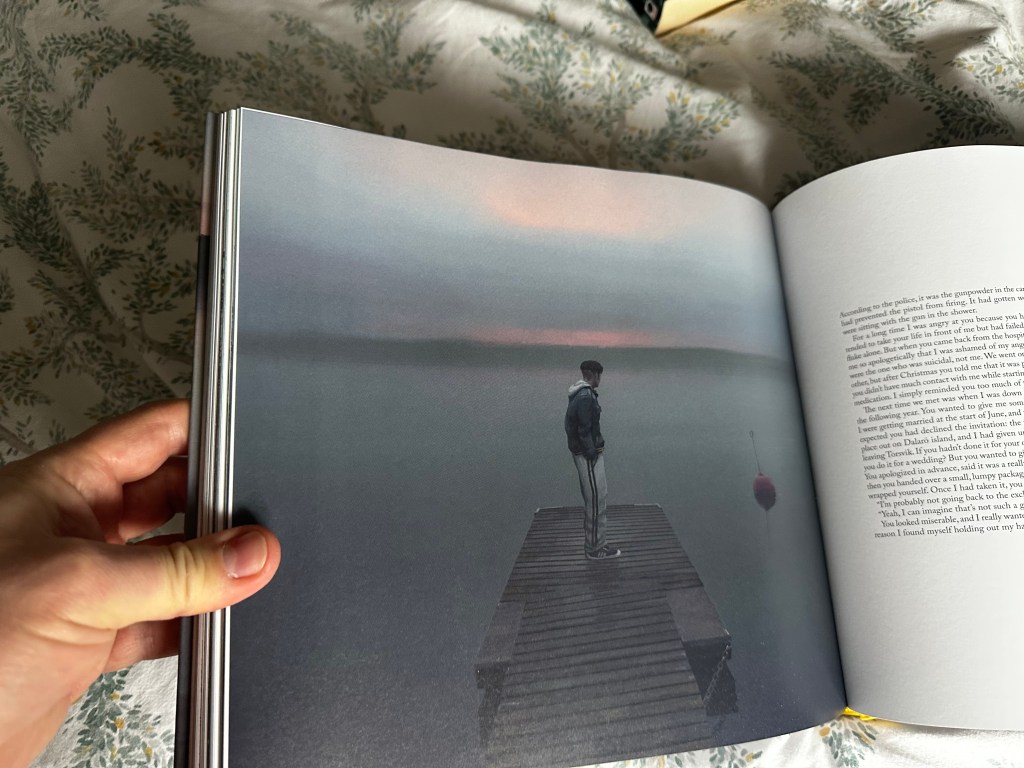
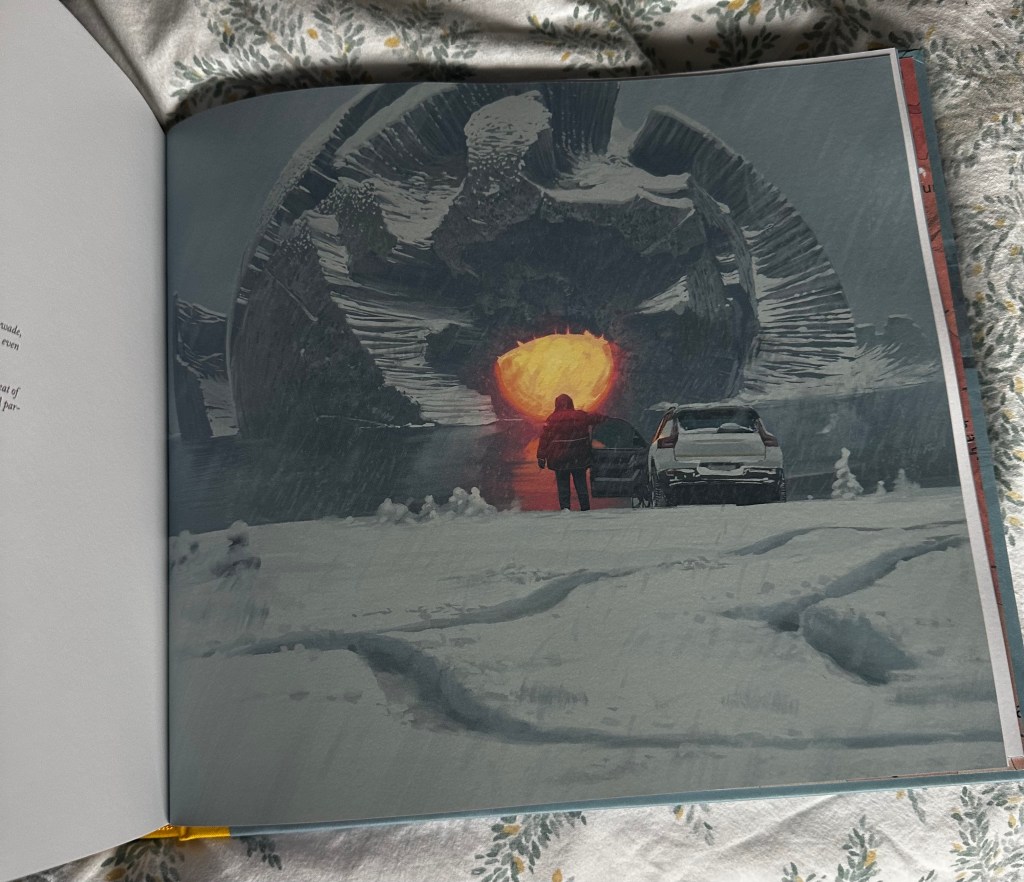
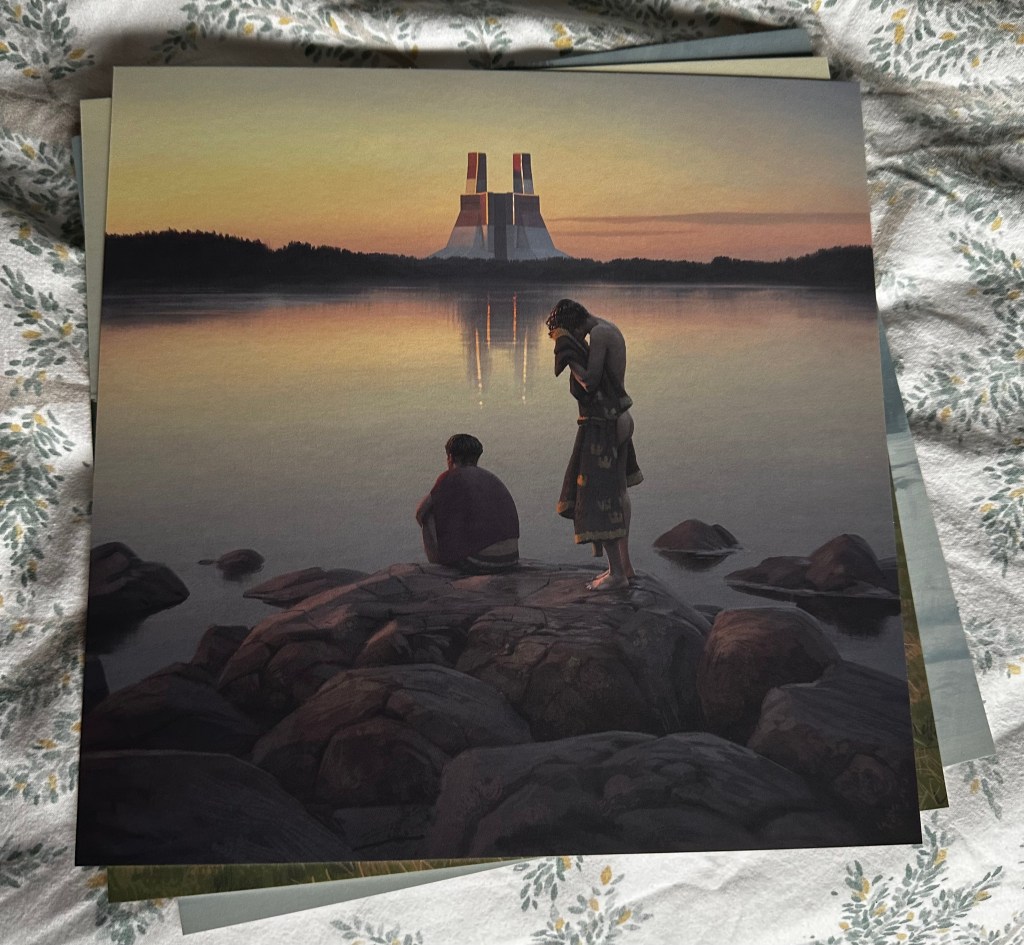
I came home from work on Friday to discover a wonderful surprise in my porch. I wrote about the Kickstarter campaign for Swedish Machines, Simon Stålenhag’s new art book way back in September of last year and ‘lo it has arrived! This was particularly pleasant because I didn’t realise they were shipping already (I have backed a lot of projects and, honestly, I can’t keep up with the updates for all of them, dear reader.) Just feast your hungry little eyeballs on this:
Digital Surprise(s)!
Fifth Season RPG
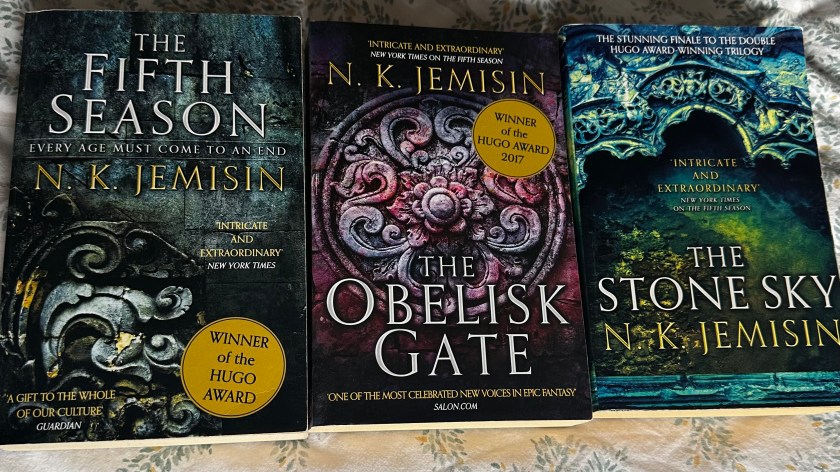
Another major surprise came yesterday when I checked my inbox and found a link to the PDF Preview of the Fifth Season Roleplaying Game. This one has been in development by Green Ronin for more than two years and has been hit with delay after delay so to finally have a version of it stored away in my overstuffed RPG documents folder was a pleasure unlooked for. It was literally the first project I ever backed on Backerkit so I forgot it was there entirely.
As many of you will be aware, I have an ongoing Dragon Age RPG campaign going right now (we recently picked up again for Act II of the campaign, using a published adventure, which will get a post of its own when we are done.) The Fifth Season RPG uses essentially the same rules engine, Green Ronin’s own AGE (Adventure Game Engine) system originally developed for their generic Fantasy AGE game.
The game is, of course, based on the incredibly successful series of novels by modern master of the SFF craft, NK Jemisin. The Broken Earth trilogy tells the story of a dark fantasy world where a feared and reviled underclass of people with the power to manipulate the earth itself are employed/enslaved in the interests of everyone else. The earth itself, on the continent known as the Stillness, is a constant danger to its populace and the orogenes use their powers to calm it and make it safe. But every so often, the earth rebels so strongly against its inhabitants that it becomes uncontrollable, unleashing terrifying earthquakes, erupting volcanoes and tsunamis of dreadful power, seemingly in an effort to end all life. This is known as a Season, the Fifth Season of the title. The story follows the trials of a small number of these orogenes and the people closest to them as they attempt to survive a Season and discover some hidden truths of this harsh world.
The books have won a lot of awards and deservedly so. They are some of my favourite SFF books of the last ten years. If you haven’t read, them, dear reader, do yourself a favour. You can easily find them in your local secondhand bookshop these days but the audio-books are also a pleasure to listen to.
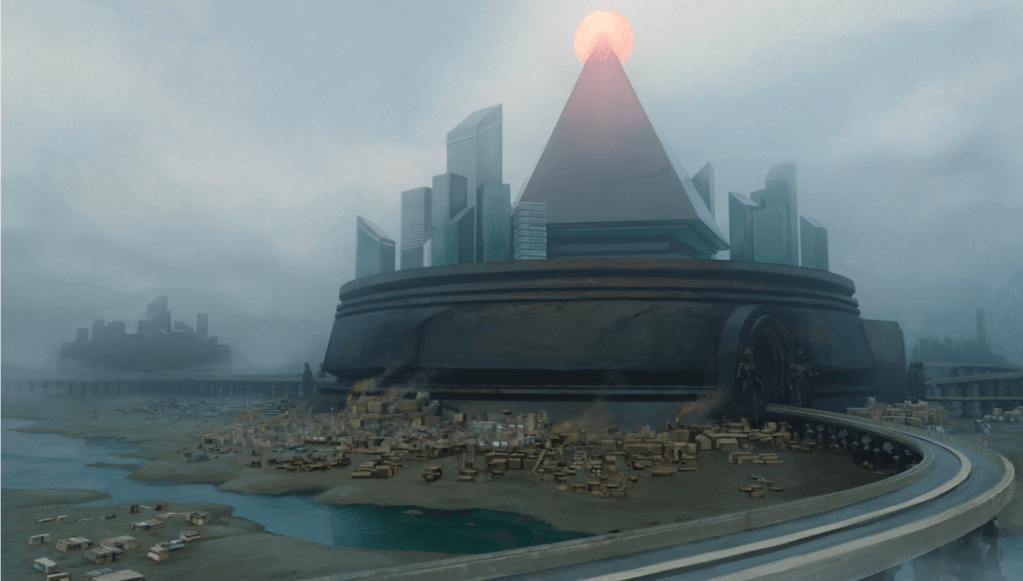
Anyway, when the RPG was announced I didn’t hesitate to back it. But, despite Green Ronin’s long experience of producing licensed games like Dragon Age, and the Expanse (I have also backed the new version of this game, The Transport Union Edition, which I’m eagerly awaiting) this one seems to have suffered a few setbacks and delays. They have tried their best to alleviate the issues by keeping in touch with the backers and offering a 10% discount on their webstore, and I think a lot of the problems were out of their hands, to be fair, so I am giving them the benefit of the doubt. Also, I’m loving what I have seen of the preview PDF so far. The artwork is gorgeous and it makes liberal use of the source material. As its a preview, I won’t share much, but here are a few shots of the illustrations:
The Vastlands Guidebook and Our Golden Age
I’ve been writing a lot about Ultraviolet Grasslands recently. We’ve just completed the third session of our campaign and we’re all loving it so far. Rarely have I run a game that has so sparked the imaginations of the players, both at the table and in between sessions. My wife, who plays forager-surgeon and Lime Nomad, Stebra Osta, explained to me today so much about the character’s people, how their nomadic encampments are set up, the importance of water in their culture, their dress and food, the way they braid their llamas’ hair… The breadth of the unknown in UVG is truly its greatest strength. Its staunchly anti-canon stance has given the players explicit permission to make the world the way they want it to be. So, do we really need more source-books for it? If they are written the way UVG was written? Absolutely. I mean, the random spark tables, the loosely described peoples, the maps with gaps, the mysterious origins of everything: they all come together to make a wonderful frame for you to fill up with your fellow players. I have no reason to believe Mr Rejec wouldn’t produce more work with the same structure and content. Well, this week, I am getting to see the beta of one of the two books in this crowd-funder and a whole section of the other.
The Vastlands Guidebook is the full set of Synthetic Dream Machine rules to play a campaign of UVG. It is very similar to the UVG Player Guide Book that I mentioned in my UVG Character Creation post but with far more detail and some very tasty art. It has full character creation rules, including a whole bunch of new Paths, eg. Barbarian, Purplelander, Tourist and Skeleton. There are mechanics for everything you could want to do in your game. It’s got powers, random NPC creation tables, corruptions, more vehicles and mounts etc. etc. I’m already thinking of ways I can get some of this new stuff to our table.
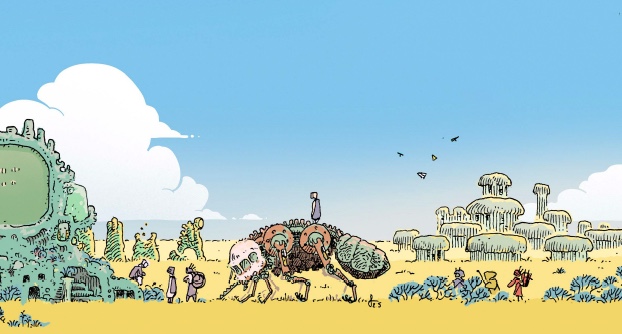
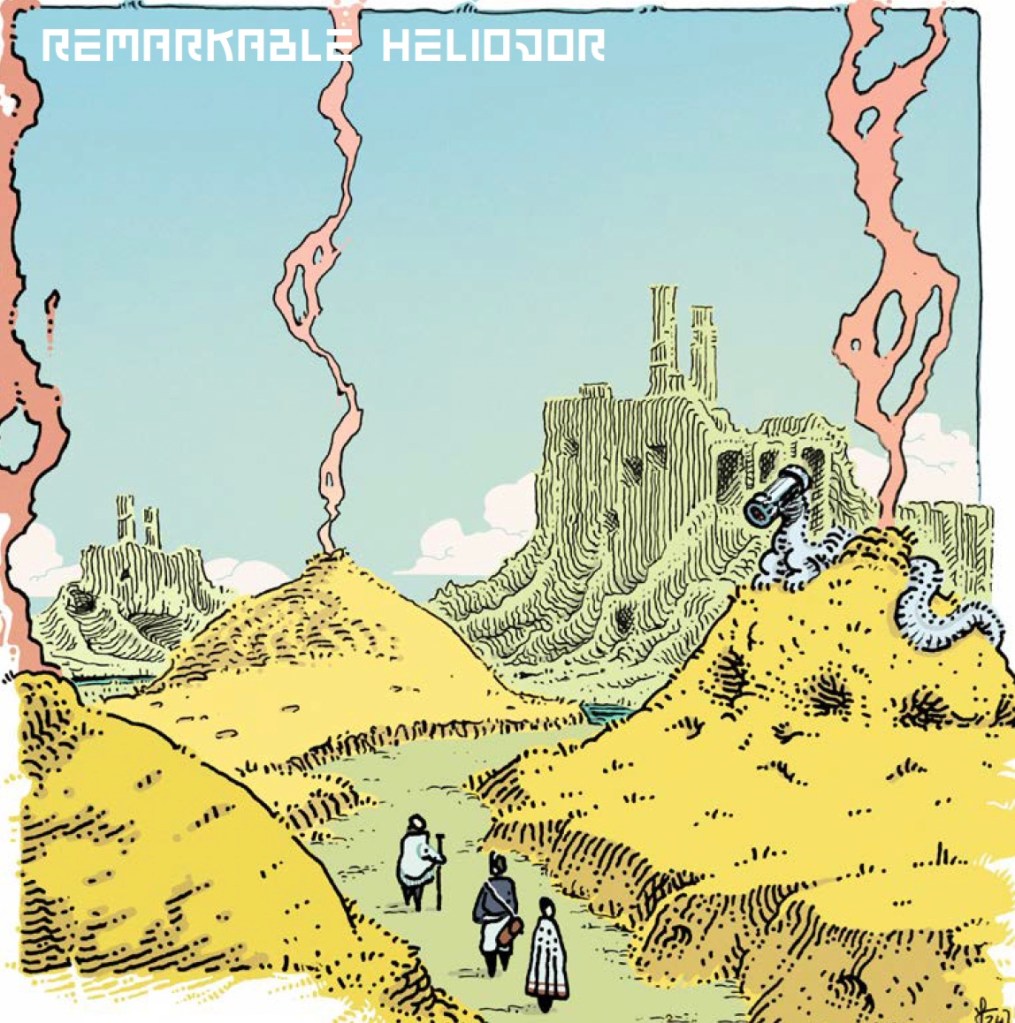
Our Golden Age is a setting book for the Circle Sea area of the Vastlands, the part of the world your average caravan in UVG is leaving behind at the start of their adventure. Luka Rejec released a teaser for the Yellow Land section of the book and it looks just as sumptuous and bonkers as you would expect from the creator of the Ultraviolet Grasslands. After a brief overview of the geography, climate, government, economy etc. you get some very fun tables. Events tables, travel tables, very unusual merchant tables, fashion tables. Then we have some interesting factions with eminently usable NPC members, a page about the Géants, enormous and unstoppable biomechanical soil farmers left over from another era, and into a section about the cities and places of interest in the region. These include Safranj, the Saffron City, with its key control of the drug/spice, saffron and vibrant opera scene. The Refining Plain: “Autorefineries of livingstone linked by arteries of basalt and tentacles of shipmetal, sinews of standardstone and great mushroom vent-mounds stud the plain below the voidtouching mountain Vulkana.”
The Yellow Land very much gives me Nausicäa vibes. It has an environmental disaster theme and even has Orms (like the Ohmu in Miyazaki’s masterpiece) dangerous animals that tear up the land.
A warning for the unwary traveler:
The Automatic Tourist Entity (A.T.E.) has compiled a list of must-see places in the Yellow Land for centuries. Recently, many warn it keeps suggesting destinations with a terrifying preponderance of surprisingly cannibalistic local practices.
I cannot wait to see the finished product and get it in my grubby little mitts.
I mentioned recently that I had been reading Luka Rejec’s Ultraviolet Grasslands. I had, in fact, just been reading it for fun, but, about 50 pages in, I decided the best use for all its tables was in some sort of role-playing game. So, I got my trusty team together and started a campaign. We’ve had a session 0 and two sessions of play so far. It’s still early days. The caravan has not even managed to complete a full week of travel yet but we’re all enjoying the psychedelic vibes and the raw potential of the game and the setting.
I also wrote up character creation and caravan creation posts, which were not directly related to the campaign but were useful to me in getting to grips with some of the rules and the setting.
This post is about one element of the game that gets only a cursory mention in the book, and how I approached its use. That’s Caravan Quests.
Needy Naturalists
It might be a little ungenerous to suggest that the Caravan Quests section gets any less treatment than it deserved in the core UVG 2E book. It has a full page to itself, including illustration. Ten quests grace the page, everything from “Big Game Hunting” to “Ascending into the Sky Like the Shamans of Old.” And there are some great ideas there to spark events in your campaign. Since UVG is very much a play-to-find-out sort of game, very few things are explicitly labelled as quests. The encounter tables and the randomly discovered locations generally contain all the inspiration or trouble or opportunity the players or referee need to fill a session without picking up tasks from question-mark bedecked NPCs.
But I liked the idea of using one of them to further spur the PCs to do stuff on the road that wasn’t just trading and foraging. The one I settled on was 3. Glorious Naturalists. So, before their caravan ever set off, I had them encounter a band of scientists in L’ultim Gastrognôme, one of the most exclusive eateries in the Violet City. These scientists had been hanging around in the city for a while, looking for a group just like the PCs. They had been assigned a task by their Decapolitan university to discover a bunch of new plants, animals and minerals. They had a decent budget but, as academics, had little taste for roughing it in the trackless steppes and Vome-ridden wilderness of the Ultraviolet Grasslands. So obviously, our caravaners, Imssi, Stebra and Phaedred were the ideal choice to get out there and collect evidence of some undiscovered species! This coincided nicely with the drive of one PC. Stebra Osta, a forager and surgeon, is on the hunt for a special vegetable or fungus with incredible curative properties. She’s sure it’s out in the Grasslands somewhere so she wanted to take the scientists’ job as the perfect one to fund her own search. It also added quite a bit to their funds.
Were there more interesting or weirder quests in the list? Absolutely. Would it have been fun for them to have to 8. Witness the End of Time? Well, of course. But then, I wouldn’t have had such a good excuse to crack open a new prized possession.
Fungi of the Far Realms
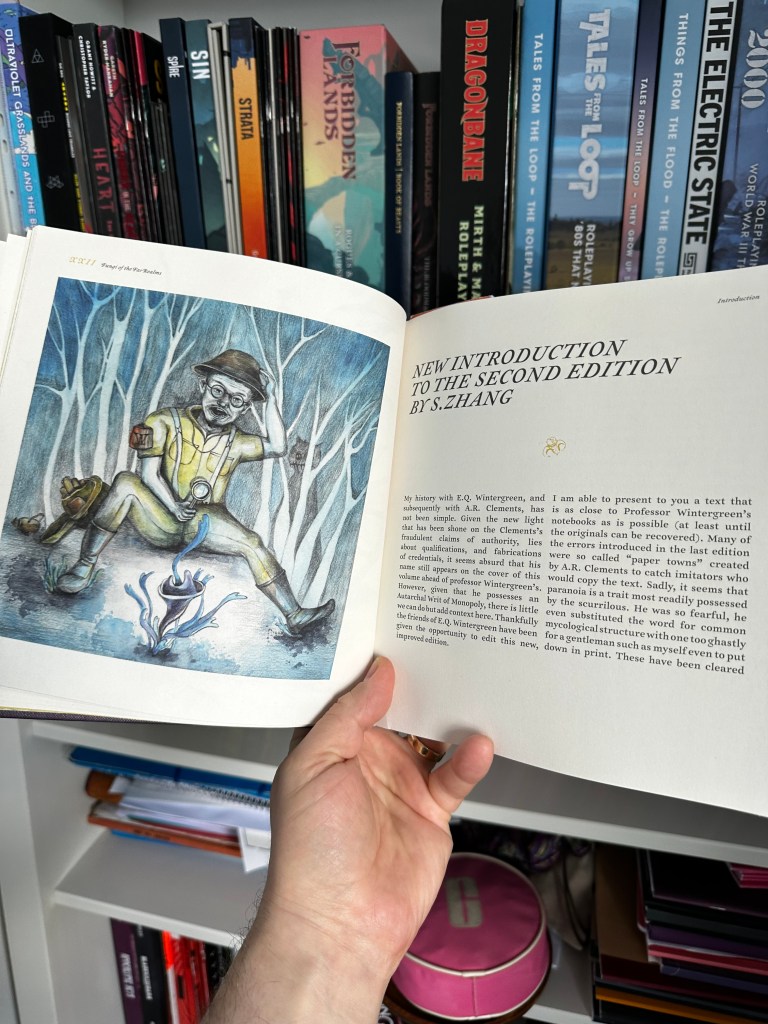
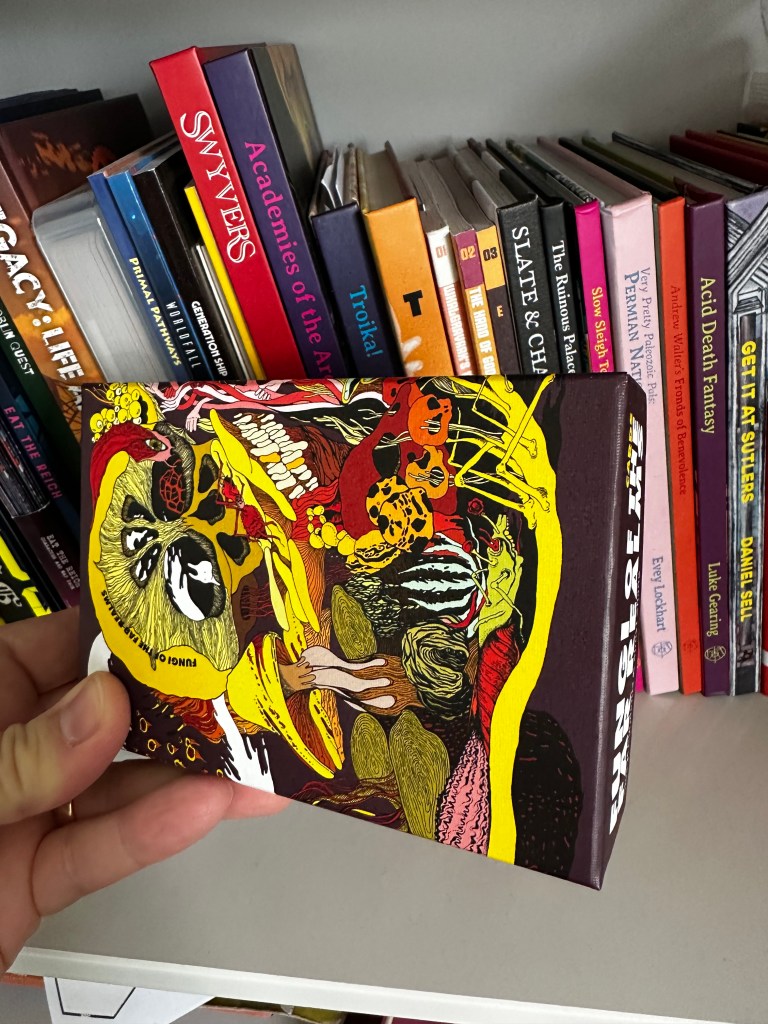
Just look at this book… Go on. Look at it. These illustrations by Shuyi Zhang are just breath-taking. The concepts of some of these funguses, written by Alex R Clements, are fun and bonkers. I remember thinking to myself, how am I ever going to use this in a game? before backing it. Idiotic question. I backed it because it is a work of art, not for its usefulness. But, I guess a thing can be both useful and beautiful.
The Caravan Quest in UVG never mentioned anything about fungi. I added that myself, just so I could get Fungi of the Far Realms and its attendant cards out at the table and have my players oooh and aaah at it. I was able to hand them their very first fungus card last weekend. They discovered a ka-zombie beneath The Last Chair Salon. It was feeding Crystal Puffballs to an imprisoned, limbless Vome-Mother. The Vome-Mother was hooked up by rubber tubing to a Fermentation Golem which turned her milk(?) into Yellow Beer, which the Salon’s unscrupulous proprietor was selling to her customers. Once they had dealt with that whole situation they discovered a nearby lush garden of tulip-like flowers, which was also dotted with dozens of the puffball fungi. I was able to hand over the relevant card to Stebra the Forager and let her know that a sack of these was worth quite bit to the right customer. What a wonderful alternative to the usual type of treasure!
There are a few valid ways to use this book at the table in many different games. I utilised the wonderful fold-out map that I received as a crowd-funding reward. I knew the type of environment I wanted the PCs to find the fungus in, so I used the grid system pictured above to locate a similar habitat. Unfortunately, there does not seem to be an index of fungus per grid-square but each entry in the book highlights the areas of the map that you might find them in. You could also just make a d666 roll and see which entry turns up for you! That’s fun, even if it doesn’t match your needs. The appendices also have tables for afflictions like hallucinogenic effects and fungal infections. If you don’t feel like freaking the PCs out or make them sick, every entry has practical world-building notes like flavour/mouthfeel and aroma. I loved these details in our recent session because it allowed the PCs to know that they had been consuming the fermented Vome-mother milk flavoured with the Crystal Puffball (Flavour/mouthfeel: rotten apples, Aroma: fresh rain.)
And there is another fungus-related adventure afoot already! Stebra, ever on the lookout for foraging opportunities, heard a rumour from a fellow Lime Nomad, that the Great Armadilloids of the Steppes were cultivating mushrooms. Then, as their caravan pushed on across those self-same Steppes they rolled a random encounter. Guess who? That’s right! Armadilloids!
If you’re interested, go check out my post previewing this game here.
A Bad Call?
Burke, Carter J “confessed” to Ripley that he had made a bad call in sending them to a colony on the moon, LV-426. But did he mean it? No. He was a scumbag of the highest order. He was just fucking someone else over for a percentage. I sent my players to LV-426 too. I wasn’t looking to fuck them over for a percentage, but, at the very least, I expected most of their characters to get impregnated by facehuggers, ripped to shreds by drones or melted by acid blood. Did any of that happen? Did I make a bad call in choosing the Cinematic Alien RPG scenario, Hope’s Last Day, from the core book, rather than the one from the Starter Set? Well, dear reader, why not come with me on a trip through our one-shot and my thoughts on it, and you’ll find out.
Shake and Bake
These two scenarios couldn’t really be much more different. The one from the Starter Set, Chariot of the Gods, is set on a ship out in space, you know, where no-one can hear you scream? It’s also very much a full scenario with an entire three act structure. They say it would take three sessions to play but I have my doubts about that estimate, having played Hope’s Last Day.
Speaking of which, Hope’s Last Day is a scenario that’s set totally on the moon where Ripley and the Nostromo’s crew found the Alien eggs in the first movie and the setting for the action of the second. This scenario was not even a full Cinematic experience. It is billed as a taster, since it really only encompasses what would be the third act in a normal Cinematic scenario. The book confidently asserts that it could easily be played in under two hours.
Frankly, duration was the deciding factor for me. I only had one night to get through a whole scenario. I don’t have a lot of wiggle-room in my schedule due to the fact that I have at least seven other ongoing games at any given time, so it really had to get wrapped up in one shot. So, I shook it and baked it.
Shaking
Shaking, essentially, meant reading through the scenario a couple of times. It’s very short, so this was not a problem. I also took notes on the various major beats and summarised the contents of the various blocks and rooms into bullet points. Most of the scenario consists of these location descriptions so this was key for me. Also, they are all presented in what I consider to be unwieldy blocks of text in the book, and I prefer referring to bullet points at the table. This work helped me to keep things flowing a little more smoothly on the night. I also screenshot handed the pregenerated characters out to the players I thought they would suit best a couple of days before. This part was fun, and the players were left to wonder how I decided who should play which character. Each character had an agenda that was generally meant to be kept secret from the others. Now these were fun. Stuff like, being willing to sacrifice themselves for the others, wanting to acquire an alien and escape with it or just to keep the company’s actions a secret at all costs. You know, normal stuff. Anyway, I examined these agendas and assigned the characters purely out of a desire to see each player pursue that secret agenda. Other than this fairly sparse preparation, I got a couple of copies of the map of Hadley’s Hope printed and a few character sheets. I familiarised myself with the relevant rules as much as I could and that was it for the shaking.
Baking
At the table, we baked. And, I will say most of the time this one-shot spent in the oven, there were no issues at all. Was I ready to nuke the site from orbit by the end? Not quite, thankfully. I’m mixing my metaphors quite egregiously at this point so I’ll abandon them both and just tell you what happened.
I started exactly as the scenario suggests you start, with the four PCs inside the West airlock of Hadley’s Hope. They had just returned from a day or more outside the settlement and were not aware the Aliens had already decimated the population. I let them investigate a bit, try and get an intercom working, and generally futz around. The scenario calls for an Alien attack whenever the PCs dawdle but I didn’t want to lose anybody so early on. I think this was a mistake on my part. Their first encounter with an Alien occurred a little later after they had made their way to another block of the station and messed around looking at eggs and facehuggers and whatnot. This gave one character the opportunity to collect an egg and another to sacrifice himself to keep the others safe and made them all start running to find the way out. This was more like it. Things really started moving then. The one who sacrificed himself turned out to be an artificial person as Bishop would have us call them. So, the alien just left him, innards outed, on the floor and unable to move, but not dead. Luckily there was an extra pregen for that player to take over so we continued on.
Later they encountered a couple of facehuggers after finding a few weapons. They made short work of them and moved on again. They spent much of the last part of the session effectively split into two parties running from two different drones towards the only way off the planet, a shuttle. And you know what? They all made it! Except the android, who, I can only assume was caught in the conflagration when the nuclear reactor in the processing plant went up as Ripley and the others escaped. Also, they didn’t all make it, because the pilot turned out to be the company plant and she spaced everyone else as soon as they left the atmosphere. I guess that made her the winner?
Game Over, Man
So, what was the verdict? It’s a mixed bag, to be honest.
I think our main complaint was that this was mislabeled as an under-two-hour scenario. I mean, ok, it was our first time playing the Alien RPG so we did have to spend a little extra time referring to the rules and figuring out what all the stats meant, but that does not account for the fact that this thing took us almost four hours. Even then, I had to abandon some integral rules to allow us to make it to the end in that time. I don’t honestly know how anyone gets five people around a table, people who want to role-play, who want to fuck around and find out, people for whom the joy is in the playing, not in the finishing, and have them get through this scenario in anything less than four and a half hours if you stick to all the rules of the game.
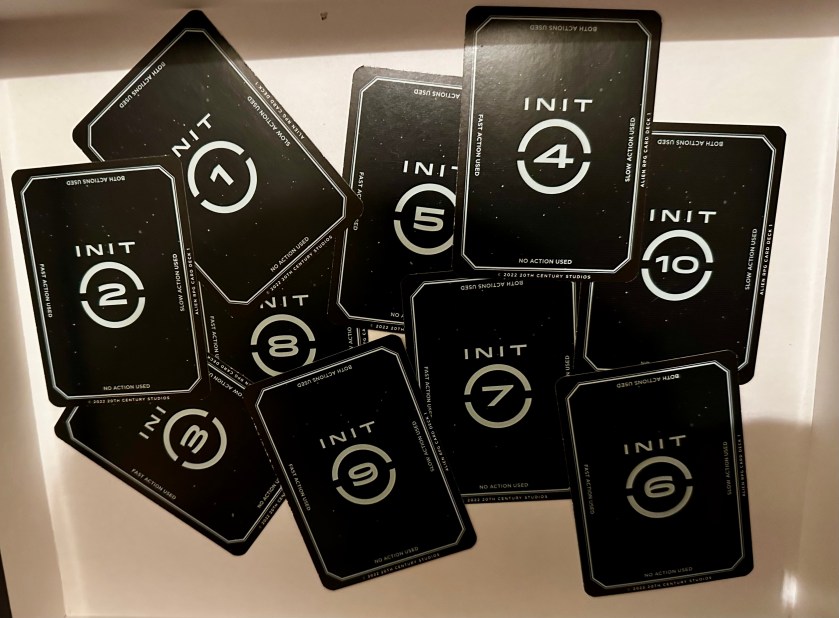
As for the rules. The main negative was the initiative system. Alien, like other Free League games, uses an initiative card system. We generally found it a little difficult to keep track of things using this and found it slowed the action down significantly. One of the main issues was that the PCs kept getting into initiative, running away from fights, getting out of initiative, getting caught again and getting into initiative again! So we were shuffling and picking those cards a lot. In fact, as time ran out on our session, I just left the cards to one side and did it narrative style. I got each player in turn to tell me what they were doing and told them how the Aliens or the environment reacted or acted against them. This really sped things up and drew the evening to a very exciting close, in fact. Would I use the initiative system as-is if I played again? I think I would give it a go as long as I had more time to play with but I would be ready to give up on it in a second if it started to get in the way again.
One more issue for me was the system used to figure out how the Aliens attack. Every time it’s their turn, the Game Mother has to roll on a table to determine which of their special attacks they use. This started off as a fun activity, but quickly got frustrating. It felt like each time the Alien had one of the PCs in their grasp, I would roll up an attack that allowed them the chance to escape. Now, if this happens a couple of times, it adds a nice dramatic element to the chase. But this is literally how they all managed to get away in the end. If I had been just choosing the attacks for the Aliens, there would not have been so many occupied seats on the shuttle when it took off. I feel like there is a better way to adjudicate the moves they make. Admittedly, you would not want every attack to be lethal, either, but it felt as though far too many of them were underpowered.
One element that worked well but felt like it was under-utilised or tacked on was the Stunt mechanic. Each skill had a stunt table that told you how you could spend your excess successes (each 6 you get when you roll your dice pool is a success and you gnerally only need one to succeed at your task,) but the players almost exclusively went for one of two options, at least in combat situations: they added extra damage or they pinned the enemy down to prevent them from taking as many actions on their next turn. This was fine but it feels like this needs more work. Perhaps the new edition will deal with this.
You know, there were plenty of mechanics we liked in the game too. The main mechanic in the Alien RPG, the thing you would lean on to sell the system, is Panic. Like other Year Zero Engine games, you roll a dice pool consisting of a number of dice equal to your score in a given skill plus the number of dice equal to your score in the related ability. So, if you have a 1 in Mobility and a 2 in Agility, you roll 3 dice. But, as you play, your character gains Stress for all sorts of awful reasons. For every point of Stress you gain, you get to add another die to every dice pool. This gives you a greater chance of success but also gives you a chance that you’ll have to roll on the Panic Table. This happens if you roll a facehugger (a 1) on the official Alien RPG Stress Dice. There are other ways of panicking. Usually, if one of your companions does something unhinged or crazy or if you see an Alien for the first time. That kind of thing. By the end of the session, everyone had so much Stress that they were rolling obscene numbers of dice and there were Panic rolls happening almost constantly. One Panic roll would often lead to another from someone else because of the result they would get. Also, because, each time you roll on the Panic table, you have to add your Stress Score to the roll and the shit at the bottom of the table is way worse than the shit at the top, the results got very bad as time went on. For example, this is what you get for rolling a 7 gets you:
NERVOUS TWITCH. Your STRESS LEVEL, and the STRESS LEVEL of all friendly PCs in SHORT range of you, increases by one.
This is what you get if you roll a 15+:
CATATONIC. You collapse to the floor and can’t talk or move, staring blankly into oblivion.
This did happen to one character but they were already at the shuttle at that stage and someone was able to drag them inside.
The feedback I got in stars and wishes from the session indicated that the players also loved the agendas they were given with their PCs. This was a worry for me before we started. I mean, not only did they not get to create their own characters, I didn’t even give them the choice of which one to pick. Obviously, this was because I didn’t want to reveal the secret agendas to everyone before play started. And I’m so glad I did it this way! Everyone had pretty much figured out who was the android in under an hour, but no-one, and I mean even me, because I forgot what the pilot’s agenda was, expected to be spaced by one of their own when they were on the verge of escape. Incredible scenes. This element of the game is specific to the short Cinematic Play scenarios. And, indeed, normally, in a full scenario, your PC’s agenda changes as you move through the three acts. I can’t account for how well this works, obviously, but it sounds great.
As for the scenario itself, there is not a lot to it. This is definitely a good thing. If you play it, you’re not going to get to most of the compound. A lot of those areas I summarised into bullet points remained completely unexplored. Once the drones were after them, the PCs soon discovered a sense of urgency and a definite goal, i.e. escaping on the shuttle. There was a bit more to it than that, but not much. Like I said, this was fine, especially as the PCs’ agendas took the place of a set plot most of the time anyway.
It was also cool that the scenario was so closely related to Aliens, the movie. I watched it the night before running the session, and that definitely helped me to picture the place and to describe it at the table. I’d recommend doing that if you do intend to run Hope’s Last Day. I’d also recommend leaving yourself at least four hours to do it justice.
So, was it a bad call? No, but if I went into it again, knowing what I know now, I would have made a few alterations to my expectations.
What about you, dear reader? Have you played this scenario or this RPG? Are you looking forward to the Alien Evolved Edition? Get in the comments?
A few weeks back, I wrote up the fictionalised version of the events that occurred in the first session of Sailors on the Starless Sea, as played by the incredible members of our local in-person RPG community, Tables and Tales. They had just defeated the Beastman menace aboveground and were girding their collective loins to delve below the Keep of Chaos. Here’s part 2. Spoilers ahead if you plan to be a player in this module in the future!
The Starless Sea
In and in the darkness settled about the invaders and their new recruits, the doughtier of the captives they released from their chains in the charnel tower above. From the first landing in the stairwell, they gazed down and some saw the gleam of gold upon the steps below. Guðlaf, ever in pursuit of greater treasures, descended and found only a trio of lonely coins dropped and left where they lay. But, too, he noticed a curiosity in the one wall of the second landing. It appeared to stand…ajar. He and several of the others pushed through the revealed entrance to a chamber bedecked in antique cobwebs and festooned in the emptied carcasses of a treasure horde’s chests. While Marquis and some of the others gathered up what little coin still graced the grey stone floor, Hilda the Herbalist went to inspect the chests. One, she discovered, easily enough, had a hidden compartment in the bottom. Delighted with her discovery, she levered it open. The treasures inside were roundly ignored as a blade swung out, slicing away two of her earthy fingers. She cried out and bandaged the wounds as the others examined the find, tarnished silver jewelery, glittering emeralds of great worth, and a tabard of black, bearing upon it, the sigil of Chaos. As well, a brace of potions, oil of the black lotus according to Hilda. Imbibe it and gain great fortitude for a short time, but suffer for it later if found too weak to bear it.
Across the landing, another contingent of brave souls had found a great rend in the rocky wall. They had entered and found only another door. This one was surrounded in evil-looking runes. None of them could decipher their meaning, but they proceeded to attempt to enter nonetheless. They shoved and heaved and, eventually, shifted the great stone doors on their hinges. As they did, the magical wards fulfilled their fell purpose, exploding in unholy fire. Immediately, Ealdwine Dwerryhouse, the recently recruited Pádraig, elephant-eared Dainn and Ropert the rope maker were roasted like swine on spits, leaving only the girl known as Bear and Darik to enter the frozen tomb of the Chaos Lord Felan. He lay there still after years uncounted, perfectly preserved with his enormous axe and his glittering armour frozen with him in translucent funereal garb, a thick sheet of magical ice. Daric entered and tried his best to break through to retrieve the weapon but to no avail. Fearing for his life in the ice-clad chamber, he retreated.
Re-united on the fateful stair, the survivors gathered their courage and continued down into the darkness. They had come to rescue their neighbours and kinsmen and by the gods, they were going to do it.
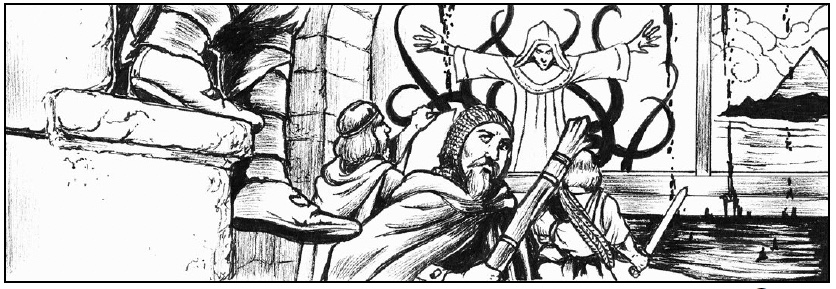
Soon they found a new chamber, this one richly decorated in tile mosaics. In the centre a long, deep pool stretched almost to the other end. Almost all of the survivors were gripped by an undeniable drive to gaze into the waters of that pool. They simply found themselves there, as though transported by an invisible hand. And as they looked, the skulls of men and women rose, like glowing, hideous bubbles until they floated there, awaiting their new owners. The villagers took the skulls offered by the pool and were released, then, from their compulsions. Free to examine the rest of the chamber they found several nooks containing the mouldering old robes of some sort of Chaos cultists. Two of their number, Lydia and Roric took the robes and donned them, perhaps to fool some future enemies. Others looked upon the mosaics. They depicted several subjects. The first was a hooded figure standing atop a tall, stone monument, seven tentacles waving from the dark waters of the lake below it. The second showed a pair of armour-clad warriors clutching a single flail and commanding an army of bestial fighters. The third revealed a golden ziggurat atop a small island and a tall figure atop it, in the process of sacrificing a maiden.
Leaving the Dread Hall behind, they went on, down and down a long set of wide stone steps all the way to an incongruous beach of black sand, occupied by a massive menhir and, beyond, in the misty waters of some starless sea, the majestic, draconic prow of a proud longship.
Marquis decided to take the reins, doffing his heavier clothes and items so he could swim out to the ship unburdened. The others tied rope to him and chain to that, to allow him to swim the whole way. The water froze him almost to paralysis, but he persisted, as though crawling through the blackness of the void where the Chaos Gods dwell. Almost had he reached the forbidding hull of the longship when he felt something even frostier than the waters wrap around first one leg then the other. Bubbles escaped his mouth as he was pulled down, down, down into the deep and the dark. Those left on the beach could only notice the rope streaking through their hands at a speed Marquis would be incapable of. They tried to hold on but soon gave up when they saw first Marquis’ left side and then his right, dangling from a pair of gargantuan tentacles, then dropped into the water, never to be seen again.
Determined to find a way to the ship, Peggy, the well-known, one-legged beggar of their village, led the rest across the sands towards the cursed obelisk, and attempted to decipher the meaning of the swirling, mystical carvings that adorned it. Anger, violence and a compulsion to cut out his companions hearts and sacrifice them to a being of pure chaos beneath the still, black waters washed over Peggy, but he pushed away, he resisted and, instead, climbed the narrow stairway that led to the top of the menhir. Already, Lydia, ever faithful and sworn to carry the burdens of others, stood on top, examining the melted remains of a red candle set into a stone bowl that she found there. “No more room up here, cripple. Go back down,” she said, heeding the beggar but little. This was enough to send the traumatised man into a rage. “Do not call me that!” he screamed, lashing out with his crutch and knocking Lydia from the summit of the stone. She fell and hit the sand with a sickening crunch. Peggy looked down from above as the others gathered around their neckbroke companion. He felt no regret, he felt no remorse. Instead, he lit the stump of the crimson candle and watched as the ship approached the shore.
If the others thought of vengeance or justice for the murdered Lydia, perhaps they decided it would be best to address the matter after their fellows were rescued from this hellish sea. They all climbed aboard the boat and it turned to face a golden glow out in the murk of the great cavern. Mu set the pace and the strongest of them took an oar each, rowing for their lives and the lives of their loved ones. On they went until they could easily make out the shape of an imposing golden ziggurat atop an island out there in the waters. It appeared just like in the mosaic. The subject of human sacrifice entered the minds of many of the villagers so they redoubled their pace.
Until the tentacles re-appeared. One wrapped itself quite securely around the stern of the ship and another attached itself with its strong, wine dark suckers to the gunwale, as five more burst from the water ahead, thrashing and threatening.
Guðlaf thought of the censer he carried in his bag, the one from the chapel of chaos in the keep above. Perhaps, if it could be used, the creature would recognise fellow worshippers of the Choas Lords and allow them passage. He retrieved the item, opened it up and remembered… he did not possess the incense. The rope maker, Ropert had it on his person when he was roasted by the flame ward trap in the tomb of the Chaos Lord, Felan. Curse his greed! He called for aid, holding up the useless censer and Hilda noticed. Cleverly, she carried always in her satchel a collection and mixture of herbs and ingredients that might come in useful in many situations. Here she attempted to recollect the smell of the incense Ropert had recovered from the chest in the chapel, and praying to the spirits of her fore-mothers, sprinkled them into the censer. Guðlaf sparked the herbs to flame and swung the censer madly on its chain across the deck of the ship and over the inky waters. The tentacles reacted immediately, retreating into the depths, their owner remembering, perhaps, the ancient compact between it and the Chaos Lords Felan and Molan.
On they rowed until they landed at a narrow strip of beach below the lowest steps of the great golden ziggurat. A hellish orange light burned through the cracks between its huge stone blocks. A ramp, long and straight, led up to the very utmost of the pyramid, flanked by beastmen of all varieties, baying and howling and crowing and hissing as a steady stream of villagers, tied and chained and gagged were forced up to their doom.
Realising their time was now very short, the sailors sent out a sortie to see what they could see, Bear and Lindon Lyndone crept around the outside of the imposing golden edifice and then up they went to spy on the top. Up there they could see several more Beastmen, shoving humans and treasure into a glowing pit, overseen by the effigy of a tall, one-eyed armour clad warrior with a flail. They went back to report what they had discovered and the sailors decided to break into two groups. The first would be led by those with the chaos cultist robes on, taking the others as sacrifices up the ramp, in the hope that they would not be noticed by the Beastmen who were so rampant in their worship. Meanwhile, the other team would creep around the ziggurat once again, in an attempt to make it all the way to the top and stop the sacrifices without angering the entire crowd of Beastmen.
In preparation, Mu and Guðlaf consumed the black lotus oil, danger of death be damned! Danger was all around!
And so they set off. The two in the robes, pushing and prodding their companions ahead to give the impression they were the capturers. All seemed to be going well until, Mu, unable to witness the cruelties being heaped on his people in silence uttered a single “mu,” and raised his head to better perceive the situation and a great, pug-faced beastman, noticing Mu’s human features, barked and yipped and grappled Mu. Then, the battle was truly joined. Around the other side of the ziggurat, Guðlaf, one of the stealthy team, dropped a bag of the coins he had been dutifully collecting through the keep and below it. It clanged and jingled with surprising volume, attracting the attention of a contingent of Beastmen from those lining the ramp. They wasted no time in attacking.
Combat proceeded and for a while, it looked hopeful for the villagers. They felled one unholy chaos creature after another, but when the Beastmen gathered their wits enough to launch a significant counter attack, peasant after peasant began to go down. Several of them were dragged to the top of the ziggurat where the great Beastman shaman was hurrying the end of the ritual to summon the Great Chaos Lord, Molan into the effigy set above all. But there, they managed to escape their fate at the bottom of the molten pit. Instead they attacked the shaman and his acolytes who fought back like animals. Bear, so lucky so far, found herself disembowelled on the end of the shaman’s blade as she bravely went into battle with him.
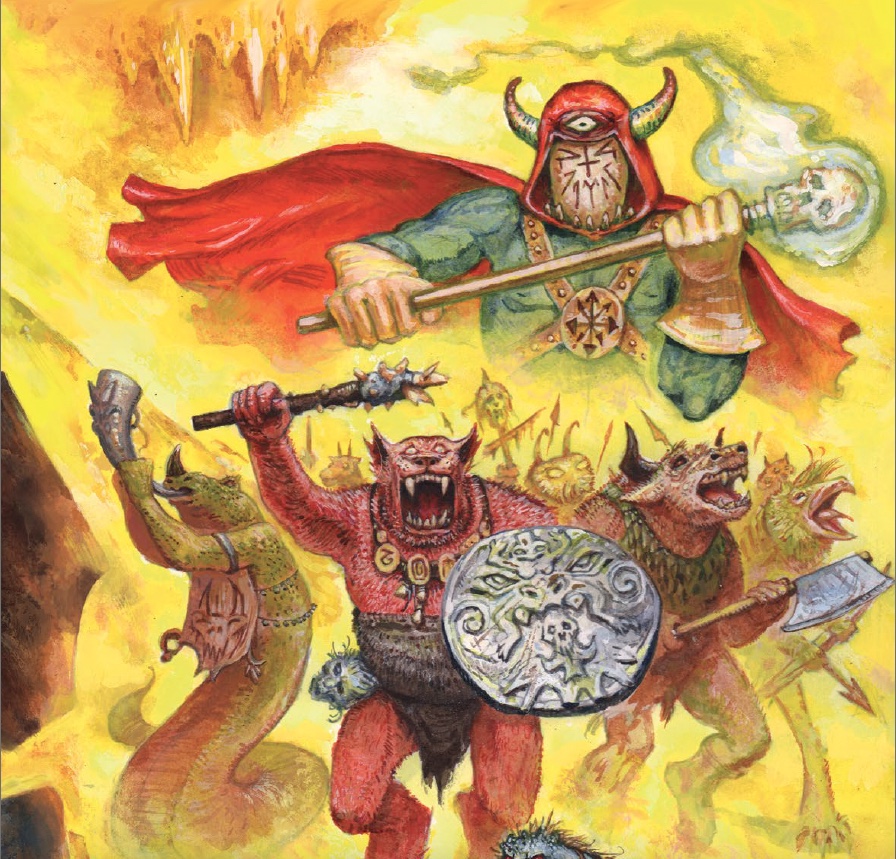
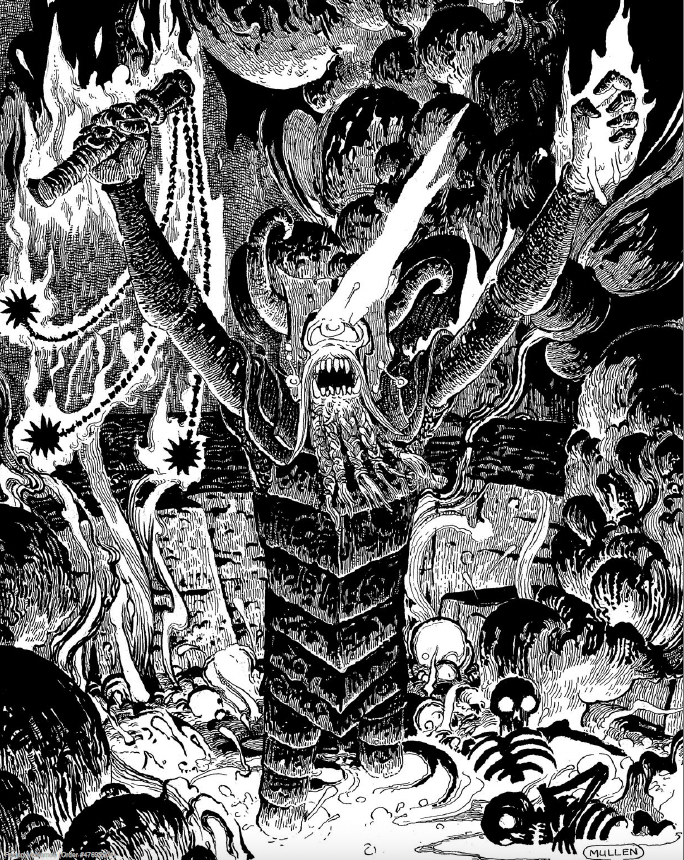
But the ritual had been completed now, the Chaos Lord inhabited a physical form once more. His skull-like head bore only a single blazing eye, his dark armour glistened in the remaining light now that the magma in the pit had been consumed by the ritual. His flail, glowed with a demonic fire, lashed out at all that approached. He laughed at the attempts to bring him down. But those who still stood, those not occupied by the Beastmen on the ramp, joined forces to do just that. Around him his forces dwindled as the villagers, urged on now that their fellows had been found and saved from sacrifice, brought low the shaman, his bestial acolytes and many of the forces on the pyramid below. Roric charged and was crushed by Molan’s flail, the halfling, Hamfast Harfoot, but recently rescued from the tower of the keep was undone by the skewer-like spear of a beastman, likewise, Lindon Lyndone found himself run through.
The attacks to the great Chaos Lord went on and on, many utilising the glowing skulls they had retrieved from the Dread Hall, which exploded in green fire when they struck. They had demanded to be used, glowing now more fiercely than ever in the presence of the hated Molan. It was one of these, flung by the wily and murderous Peggy that struck the Chaos Lord in the eye, setting his whole head ablaze and finally bringing him low. I cheer of triumph went up from the assembled villagers, both fighters and captives alike, as his body melted leaving only his accoutrements, flail and armour. Peggy wasted no time in lunging for the great flail, but it was a mistake. The hero of the hour found himself burned and destroyed by a magma golem’s fiery pseudopod as it generated from the Chaos Lord’s remains. Vargan, also, greedy to the last was left a burning husk by the golem as he had reached for the armour.
The rest of the villagers gathered some of the fallen coins that littered the top of the ziggurat and then ran for their lives. The cavern was collapsing around them and a great tidal wave rose from the west side of it, threatening to destroy them all in moments. All but Daric reached the ship in time and climbed aboard. He had insisted on remaining to gather even more riches and he was forced at the last moment, as the ship pushed off and the rowers began to row, to leap across the churning black waters of the Starless Sea, into the waiting hands of his comrades, forgiving as they were of his greed and foolishness.
The titanic wave hit them, drowning the evil island and propelled the dragon-prowed longship across to the far side of the sea and down a narrow tunnel and on and out into the waiting river beyond. They had escaped.
Guðlaf lay on the deck in the sunshine, breathing ragged and baleful breaths. He looked into the eyes of Mu, who was sprawled beside him and spoke the words “It is well.” Both had taken the black lotus oil knowing the risks. Mu looked into his companion’s eyes as the light left them. He shed a silent tear for him and looked about at his remaining friends, Dave, Hilda, Daric and Helfgott Hoffman, wondering where they would go from here. They had come through so much death and loss but had achieved the impossible. Surely they could more return to their old dull lives in their village than Guðlaf could return to life of any kind. Perhaps this ship would take them on to more adventure. He managed to express all this in a single elegant syllable as the sun blazed down upon him, “Mu.”
If you’re anything like me, dear reader you buy a lot of RPG books that you are unlikely to ever pick up and play. Sometimes, that’s the intention or at least, you don’t have a plan to plan to use it, you know? I have some in both categories. Some books I backed in their crowdfunding phases because I want their creators to continue to create cool stuff, even though I know it will be impossible to fit the actual final product into my ongoing campaigns or their new game into my frankly ridiculous gaming schedule. Some I picked up in PDF format through Bundle of Holding or Humble Bundle because the deal was so good I would have been stupid not to buy them. Some I purchased with the knowledge that they might enrich an ongoing campaign but then just never fit in anywhere.
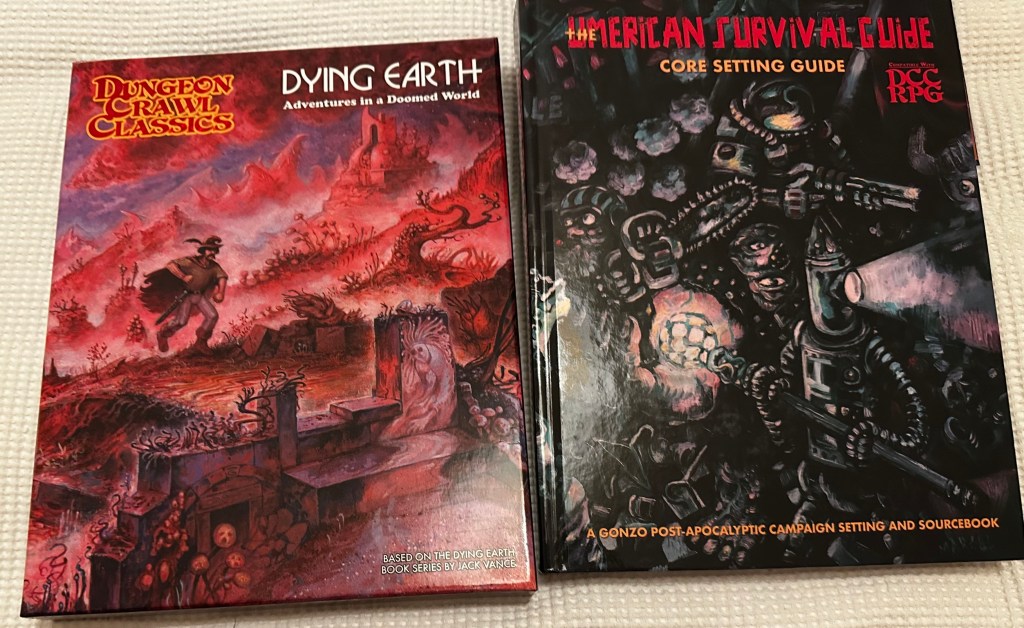
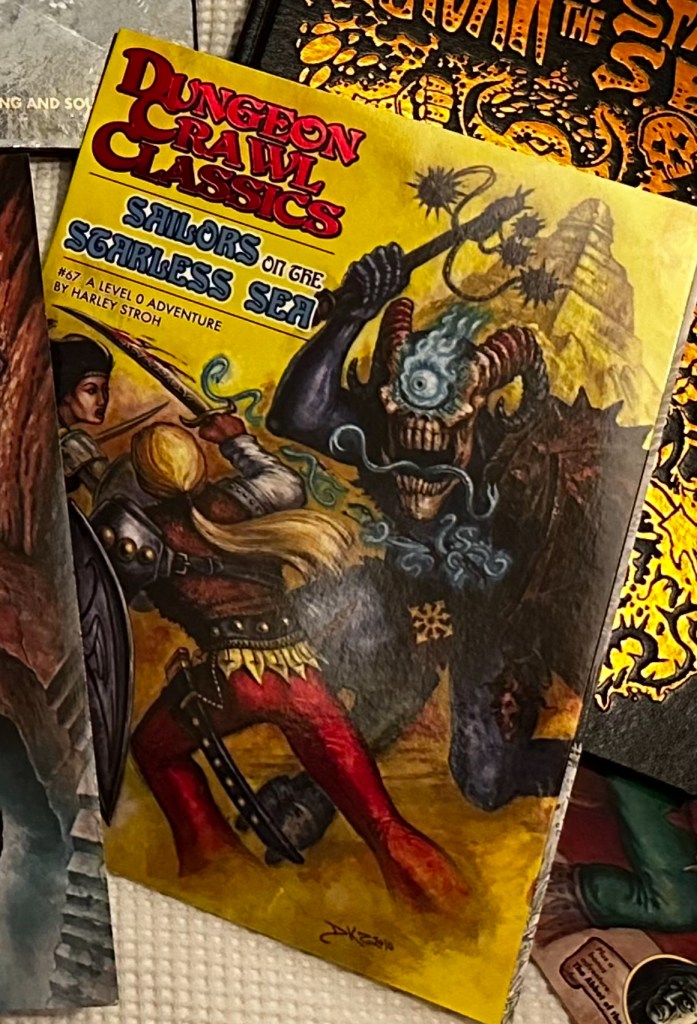
But DCC adventures are in a slightly different category. I have bought a truly obscene number of them, mostly as PDFs. I think this started after listening to a few of the reviews of DCC adventures by Fear of the a Black Dragon. Then I started to collect physical copies. My local independent game shop had copies of their Dying Earth setting box and the Umerica setting book, both of which I purchased. You know, a lot of the time, this was purely due to aesthetics. They are beautiful works of art, frankly. I love their style and their content, even if I hate their layout. But the real reason is because these have always been aspirational adventures for me to play. Genuinely, I feel at this point that, if I could, I would abandon D&D for DCC. Why? The adventures I have read are just effortlessly lacking in D&D’s corporatised humourlessness. They are not written in comedic fashion but in the last two sessions of DCC playing Sailors on the Starless Sea, I have had more genuine laughs and gasps of outrage and tears of sorrow and joy than I have had playing D&D since 2014. And that is not to demean the efforts of many of the wonderful creators of 5E products, it is simply to praise the work of the designers who created a game that I expected to bounce off due to crunchiness but which I, instead, embraced due to its flexibility. The philosophy of the adventure design also has a lot to do with this new attitude. To discuss that, let’s talk specifically about the module I just finished with my players tonight, Sailors on the Starless Sea.
Sailors on the Starless Sea: Endings and Beginnings
The surviving sailors sailed off to parts unknown at the end of our session tonight, each player with one remaining character. This is the ideal ending to a DCC 0 Level Funnel adventure. I am guessing that sometimes players end up with more than one 1st level character to begin their true career as a proper DCC adventurer, but it seems like the best possible outcome if you’re only looking after the one.
It was the getting there that was so much fun though. I wrote recently about character creation in Cosmic Dark being so much fun because the players play it, they role play the most developmentally significant moments of their PC’s lives up to that point in snippets and flashbacks with other players. The DCC funnel is surprisingly like that except its also involves a dungeon crawl, horrific death on a brutal scale and a boat load of shared trauma. Every one of the characters left at the end of the funnel knows precisely what the rest of the survivors are capable of and what they are not capable of. They know some terrible secrets about them and they know that they are keeping some terrible secrets about their own character too.
The survivors were not necessarily the ones you might have predicted at the start as 20 peasants ranged about before the Chaos Keep’s rusted portcullis, but they were the ones Luck favoured in the end. They survived traps, vine horrors, a shit-tonne of beastmen, a cursed well, a fire trap, a Chaos Leviathan, the return of a Chaos Lord to the plane of mortals and a literal tsunami… Someone powerful was smiling on them. And their players knew that by the end, that’s for sure. This made every death so much more terrible and every survival so much more precious. If it hadn’t been for that one critical hit that time, they might not have destroyed the Chaos Lord; if it hadn’t been for that fumble, maybe Gwydion would have made it past the chapel; if it hadn’t been for that successful Luck check, maybe Thomas would have been left with no surviving characters instead of the four he started the session with. There are so many of these death or glory moments woven into the text of this adventure that it is hard to overstate how much every roll and action seems loaded with meaning and significance, especially when the PCs generally have no more than 2 or 3 HP.
It’s easy to say that there were just so many PCs that their existence was cheapened. I even allowed them to restock a few peasants at one point. The adventure allows for this about half way through because they know exactly how lethal it is about to become on the second level of the dungeon. 23 PCs went into the dungeon in total. Six emerged alive, one succumbed to the effects of a potion once they had escaped, a poignant and fitting end point to the whole story. Every one of those deaths had an effect on the player who played the character.
They wondered from the start who might survive. Maybe they would be different. Maybe all their little darlings would make it through. Perhaps only the weakest would be culled. Repeatedly, tonight, the characters that the players expected to survive went down. It was still shocking to them, it was still sad to say goodbye to them, even though time was of the essence. It made for some of the most effective drama I have had the pleasure of being part of at a gaming table in years. And it was a DCC funnel adventure. An adventure designed as a way to whittle down your choices of character to play in a campaign in the most Darwinian fashion.
Harley Stroh wrote a great adventure filled with mystery and danger and conflict and true significance and then they play-tested the shit out of this thing. This is how I know: There was a moment at the very end when the last PC, who had stayed behind to loot some corpses, had to make a Luck check to secure his place on the Dragon Ship to escape the dungeon. This was the second last element of high drama in this game and it was all down to a single roll, DC 17 to leap to safety from the shore to the boat. Thomas thought he’d whiffed it. Thought he rolled a 9. But it was just one of those dice, white text on light background… turned out it was a 19. His character grabbed the gunwale of the longship and Hilda dragged him aboard just time for them to be ejected from the cavern by a tidal wave. The highs and lows! The regret and the relief!
Sailors was genuinely one of the highlights of my recent gaming experiences and the feedback I’ve had from the players so far has also been glowingly positive. If you haven’t played it, dear reader, do yourself a favour, go and find yourself 15 to 20 drunk peasants and get them to invade the ruined keep of the Chaos Lords, you won’t regret it.






























 The Dice Pool