
Not Over Yet
I had a great plan for today’s post. It was all coming together perfectly. We were due to finish of the Call of Cthulhu “one-shot,” the Derelict last night, but, due to various unforeseen circumstances, we were forced to postpone. So, the review of the scenario that I had been planning will have to wait too.
Still, I’m not short of subjects to write about.
Stay Frosty Remastered
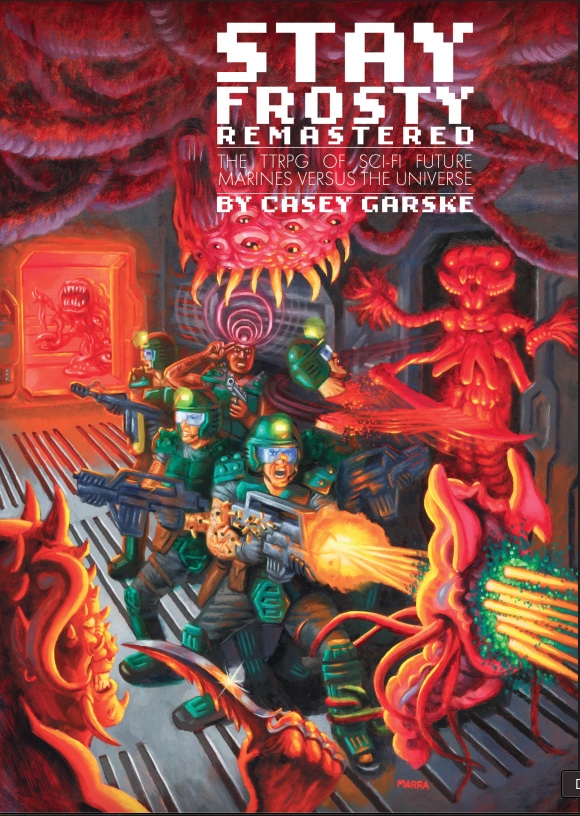
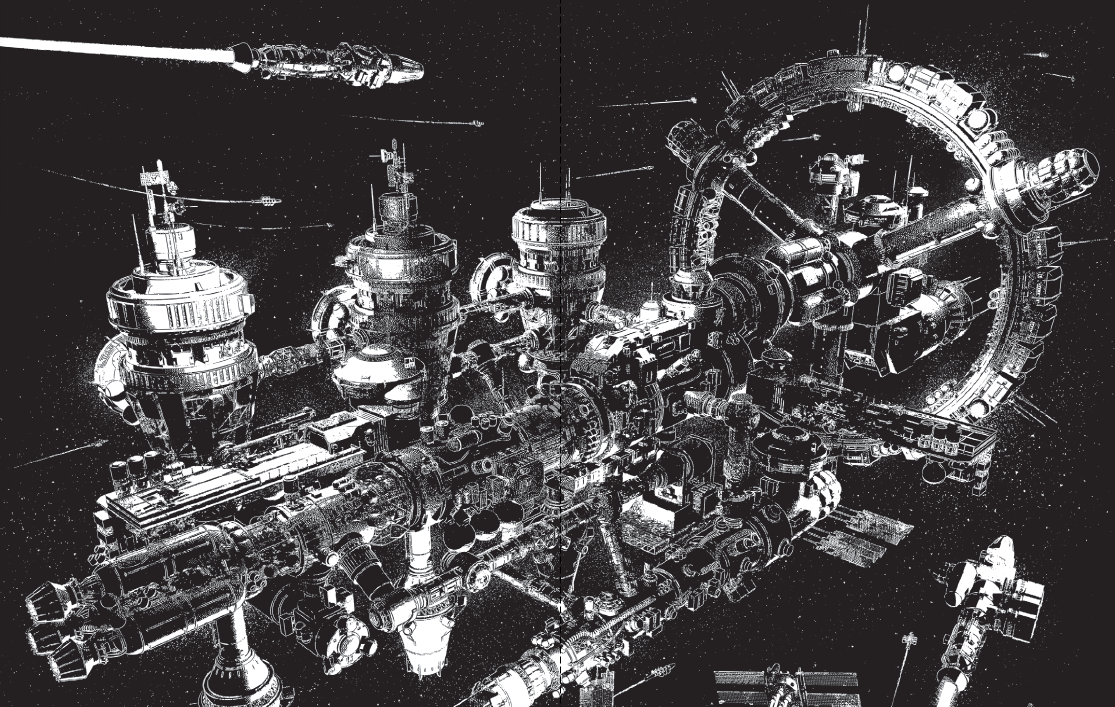
I’m going to take this opportunity to take a look at one of the games I received recently as a Kickstarter fulfilment. Stay Frosty Remastered from the Melsonian Arts Council and written by Casey Garske is an old school RPG of sci-fi marines in situations of extreme tension where they face monsters, demons and aliens with nothing but a shotgun and a bad attitude. Think Doom crossed with Aliens. Obviously, a game like this is going to draw comparisons with the Alien RPG and Mothership given the subject matter but, from even a cursory look, it seems to be approaching the genre from a slightly different direction.
It’s worth noting that “Remastered” in the title. Casey Garske first released Stay Frosty back in 2017 so it’s been around longer than either of the two games I mentioned above. I first learned about the original before I ever backed the remaster. Co-host of the Fear of a Black Dragon podcast, Tom McGrenery used it several times as the ruleset in which he ran some rather unlikely scenarios. I never read the original, though it is still possible to get it here.
Basics
Roll a d20 greater than or equal to your attribute for a success. Otherwise fail. Sometimes you get another die for advantage or disadvantage. That’s it.
Obviously, this implies that, even though you roll your attributes up the same way as you do in D&D, lower numbers are better!
Badassery

You get to play some of the galaxy’s badest asses in Stay Frosty. Character creation seems very straight forward. You get some attributes (Brains, Brawn, Dexterity and Willpower,) and MOS (military Operations Specialty,) hit points, rank and some equipment. Then it’s “Oorah” and into the bug’s nest to rend some carapace. Character creation starts on page 5 and just about stretches to page 8. All the better to roll up a new badass when the first one bites it.
Gear
I like that the rules around gear are abstracted so far as to make theatre of the mind nice and easy. Ranges, as they apply to combat and weapons are expressed by bands:
Hand-to-hand -> Close -> Short -> Medium -> Long -> Extreme
Your weapon’s description indicates its max range of course.
Another touch I appreciate is the use of supply dice for ammo that you use in a combat situation. If you used it, roll the ammo die for it at the end of the fight, If you roll a 1 or a 2, it reduces the die size until it’s gone. There is a similar rule for other gear that can be depleted.
Combat

I described the essentials of it in the Basics section above. But there are a few idiosyncracies that I enjoy:
One of the actions you can take in a round is called Battle of Wills. If you succeed on a Willpower roll against a chosen target, they will get disadvantage on their next attack. You just scare them into fucking up because of your badassness.
If you get a critical or a fumble, you roll on the appropriate FUBAR table. Either “Fuck Yes, Natural 20” or “Oh Fuck, Natural 1.”

There are Psi-powers. These are restricted to PCs with the Psi-ops MOS. There aren’t too many powers in the book but here’s a selection:
- Brain Bleed (although the book seems to be missing the actual Effect of this one)
- Interface – lets you take control of machines
- Mind Stab – mind stab
There’s a little more to the system than just these points, but not much.
Mostly these other rules are introduced in the chapter,
Other Crap Every Game Has
Which has the sub-sub-title,
Jesus Christ, I guess we have to spell everything out.
Danger, Frostiness and Tension
These are the mechanics that make the game what it is. You will see some similarities to the Stress and Panic mechanics in both Mothership and the Alien RPG.
Firstly, the Danger die is rolled whenever the PCs move from one area to another, whenever they are in really dodgy locations or just whenever they’re dawdling. It’s a good way to ramp up the Tension. It works much like an encounter die in other games so can lead to location-appropriate baddies turning up, environmental challenges and loss of resources, but it can also add Tension or cause it to be released explosively!
Which brings us neatly on to the Tension mechanics. So, the PCs gain Tension through the Danger die rolls I described above.
Tension can be good for you. Forget simply staying frosty, Tension will actually build your frostiness level. It starts at “Warm” when your Tension is at a 1 and goes all the way up thru “Chill” (gives the agile tag to ranged attacks) and “Frozen” (Advantage on saves) to “Ice-Cold” (extra attack) when you reach 6 Tension points. There is a danger of course, when your that tense. When the Danger die comes up 6, “Tension Explodes!” And every PC has to make a Willpower save. If they succeed, they can reduce their Tension by one but if they fail, they take their Tension score x their level in damage. If this reduces them to 0 or lower HP, they roll on the Going Apeshit table. If you get a 1 on this table you’re on Overkill, advantage on damage rolls but having to roll your ammo die every round instead of after the combat. If you roll a 6, though, you’re on Last Stand, abandoning weapons and armour to face the enemy mano-a-mano.
This is pretty close to the stress mechanics in Alien, which is also all governed by tables. I’d be incredibly surprised if it wasn’t inspired by this game.
The Rest

Most of the rest of the book consists of a couple of missions to send your frosty fighters on. But there are also a couple of pages of random tables to allow you to easily and quickly construct your own missions and a few basic stat blocks for bad guys like Amoeboids, Demons and Robotic Assassins.
Conclusion
Isaac ran myself and Tom through a dungeon in the Black Hack the other night. None of us had ever played it before and even Isaac had barely looked at the rules. It was so easy, though, that we had characters created, hirelings hired and a dungeon explored before you could say the unlikely word, “Prolch” (my slow-witted fighter’s unfortunate name.) Stay Frosty gives me a very similar vibe. I only just opened it for the first time to write this post and I feel like I could run it now. Maybe I will! Unsurprisingly, the Black Hack is listed in Stay Frosty’s Appendix A: Influences. Garske tells us here that his game was originally a Black Hack hack but he ended up totally rewriting it. You can still see the Black bones of it though.







 The Dice Pool