Ultraviolet Grasslands Character Creation

Ultraviolet Grasslands

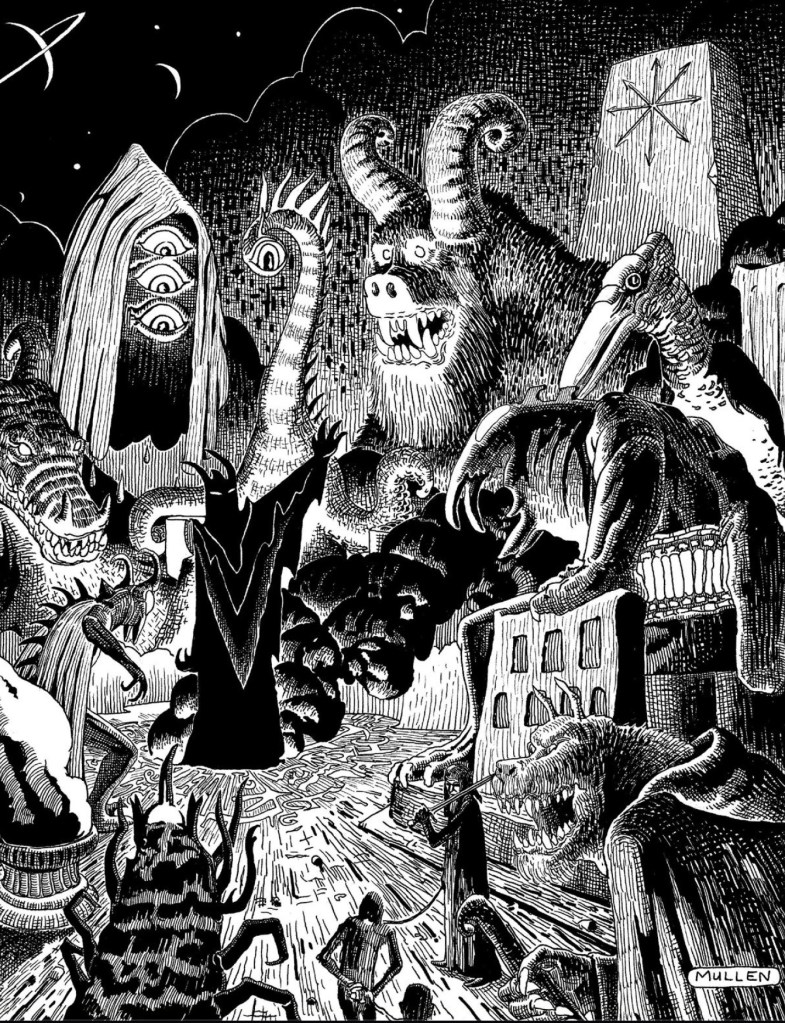
I have been reading Luka Rejec’s polychromatic point crawl, Ultraviolet Grasslands and the Black City 2E for a while now. It’s a remarkably attractive and inspirational piece of work. Luka is responsible for the artwork, writing and design. He really brought his vision to life in this book and he has continued to support it for the last six or seven years since the first edition came out. Most recently, in the form of a massive crowd funder for no fewer than two books to expand the world, Our Golden Age and the Vastlands Guidebook, which I wrote about last year, here. But, there have also been a number of other supplements in the meantime. I picked up a bunch of them on a recent Bundle of Holding deal. The files included the invaluable UVG Guidebook. This details the Synthetic Dream Machine rules devised by Luka. Most useful for my purposes here, is the guide to character creation for UVG 2E. So, I’m going to use it to create my own character, and my own caravan too!

Here’s a little bit about the setting, taken from the UVG Guidebook:

The UVG is a point-crawl setting inspired by psychedelic heavy metal, the Dying Earth genre, and Oregon Trail games. It is a world colored by new wave science fiction and inspired by artists from Moebius to Miyazaki.
The characters, referred to as “heroes,” begin, generally, in the Violet City. This place is ruled by Cat Lords with little human hands and big human servants/pets. It is also the last outpost of human dominion on the shores of the Circle Sea. Beyond the city, to the East, stretch the irradiated, largely uninhabited, weird, vome-infested Ultraviolet Grasslands. The PCs are headed out there, probably at the head of their own caravan, hopefully with some goods to trade at the next stop, which might be the Porcelain Citadel or the Last Serai or some other magical-sounding destination along the Low Road and the High, which, if you follow it long enough, will take you all the way to the eternal sunset and the Black City.

New Campaign, New Character Creation Post

This is all in preparation for starting a new campaign of UVG on Sunday. It’ll be a small caravan of just three PCs and it’ll be a tight, friendly group, but I always find the experience of creating a character myself helps me to guide them through the process so, here we go!

My Hero

So, in the finest tradition of, well, my other character creation posts, I’m going to roll this one up as randomly as possible. Anticipating my requirements in this respect, Mr Rejec has helpfully furnished me with many a table in this book. So, without further ado:

Ability Scores – SEACAT

That stands for Strength, Endurance, Agility, Charisma, Aura and Thought. I have a few options for this process but I am going to take the most random, the d100 roll.

  • Strength – I rolled an 18 on the d100. This translates to an entirely unremarkable 0. I guess I should be grateful there are no negative attributes in this system
  • Endurance – 96! This translates to an excellent and amazing 4!
  • Agility – 62. This gives me a talented 2
  • Charisma – interestingly, this is not like D&D Charisma, more like the Ancient Greek meaning, which encompasses fortune. Anyway, I rolled a 49, giving my character a promising 1 in this ability
  • Aura – This can help your character “to use powers beyond mortal ken longer than usual.” I got a 19, giving my second 0.
  • Thought – “the mental dynamic ability. It captures how a character absorbs, processes, and manipulates information.” I rolled a 47. This makes my score another 1.

So, at this point my ability scores are:

  • Strength – 0
  • Endurance – 4
  • Agility – 2
  • Charisma – 1
  • Aura – 0
  • Thought – 1

Background Trait

I like the method of determining your capacity for learning traits. You get an inventory for this, just like for physical objects. You can’t overload your trait inventory without suffering from encumbrance, anymore than you can physically carry too much without the same issue arising.
I get 7 + Thought inventory slots for traits. So that’s 8 slots then. It won’t come into it at this stage, of course. As a level 1 character, my hero will only have three traits.

A starting trait gives you a +3 bonus to actions that can utilise it. Although you can upgrade it from Skilled, which is the starting point for all traits, to Expert, which provides a +6 and Master, which bumps you up to a +9.

Now to the fun part. Rolling a d50 to determine my Background. (So, in the UVG Guidebook, this table is actually a d40 one. But there is another version of it in the core UVG 2E book, so I’m using that for this bit, as well as to answer the following two questions below.) For this unusual die roll, I’m going to roll another d100 and divide by 2.

I rolled a 65, so half that and round down, I get a 32:

  • “Tumult Fisher Wizard” (?) This acts as my first trait and, I guess determines my Path (see below)

Why are they on the Road?

What is my Tumult Fishing WIzard’s motivation for heading off into the dangers of the Ultraviolet Grasslands? Well, the same table is going to tell me that. I rolled a 29, making it 14 this time:

  • “Pursued by Loving Enemies.” This sparks a lot of potential background stories for my wizard.

What Do They Bear?

You always start off with one strange item. It might be valuable or it might be important or it might be sentimental. I guess we’ll find out. I rolled a 6, so that’s 3 on the table:

  • “Green brick with the light and warmth of a candle.” Some sort of Oldtech item maybe?

Path Trait

So, in the UVG Guidebook, you do things a bit differently than you do if you’re just using the core book to make your character. If you use the Guidebook you will be led, carefully and systematically through the process, starting with ability scores, moving onto background traits and then to path traits. In these rules, your characters path can one of three broad categories, Wizard, Traveller and Fighter. They are not classes; they’re only used to determine one of your starting traits. After that, you are free to choose traits from any path you like as you level up.

The whole character creation section of the core book is quite compact, and, in fact, the entirety of the rules are squeezed onto a single page. The core book is, first and foremost, a setting book. It can easily be adapted for use with almost any OSR or D20 system and, indeed, with just a little work, could work very well with a PBTA or other ruleset too. So, I think the decision to pare down the rules, particularly for character creation, makes sense, especially when the Synthetic Dream Machine rules were already available in other publications.

Anyway, what I’m getting at here is that the core book does not refer to Paths at all. Instead, it seems to fold them into many of the backgrounds on its d50 “Who is this Hero?” table. A good example is my “Tumult Fisher Wizard” result from the d50 table earlier. It includes something that could be a background trait, i.e. Tumult Fisher as well as one of the paths, wizard.

So, by default, my first Path trait will be from the Wizard path list in the UVG Guidebook. There is a list of six options so I’ll roll a d6 for it.

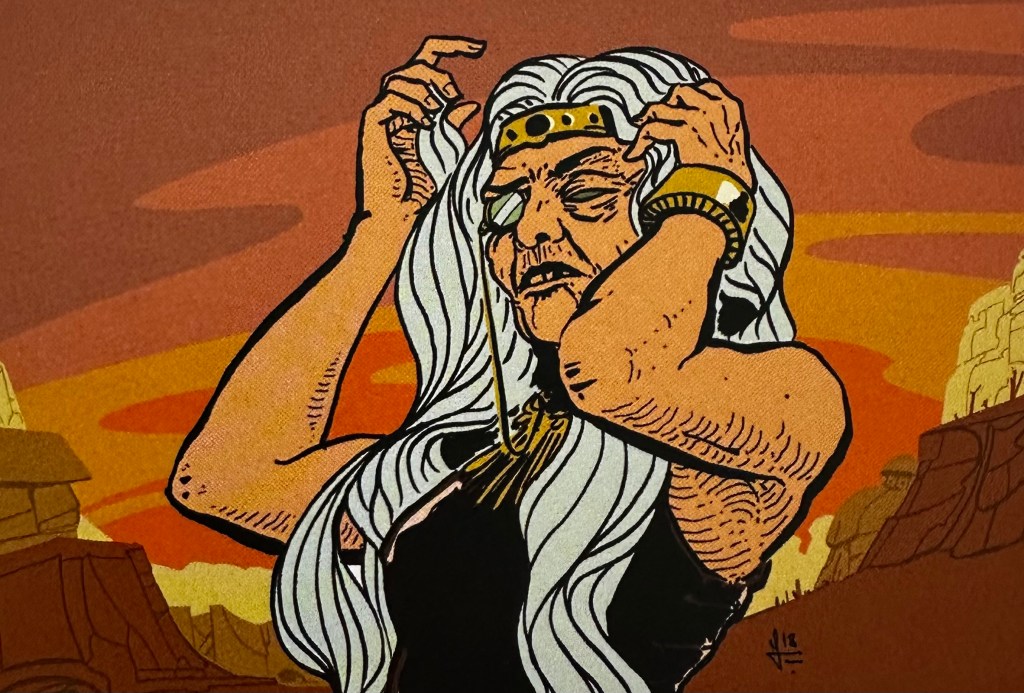
  • That’s a 3. “Exuberant. Each of your life points is worth double when paying for powers.” It’s worth noting at this point, that Life is analogous to hit points and you spend Life to cast spells, so this is quite handy.
Generate a Third Trait

So, you then get to choose one more trait. There is a random trait table. Depending on the result of the roll, you could get another background trait, a wizard trait, a traveller trait or a fighter trait. So, here we go, it’s 5! Which means a Traveller Path trait. Another d6 roll on that table, and that’s a 6!

  • “Swift, Spend one life or one hero die to get one more action this round.” That is an amazing trait for any hero!

Equip your Character

Similar to trait inventory slots, I get 7 + Strength inventory slots for items. With my 0 strength, that’s going to make it a 7…

You start at level one having two items and some cash (denoted with a €, pronounced cash, not euro.) One of your two items is a kit useful to one of your background traits. In this case, I guess it might contain fishing rod, net, lures, wizarding items, that sort of thing. But, as the guidebook states, “You don’t need to choose in advance exactly what is in your character’s kit — the items are in a quantum superposition until you define them as you play.” This should include a civilian weapon that deals no more than 1d6 damage.

The other thing you get is the Strange item I rolled up earlier, “Green brick with the light and warmth of a candle.”

I also automatically start off with €100 in cash. This sounds like a lot but a week of carousing will cost the average character 1d6 x €100!

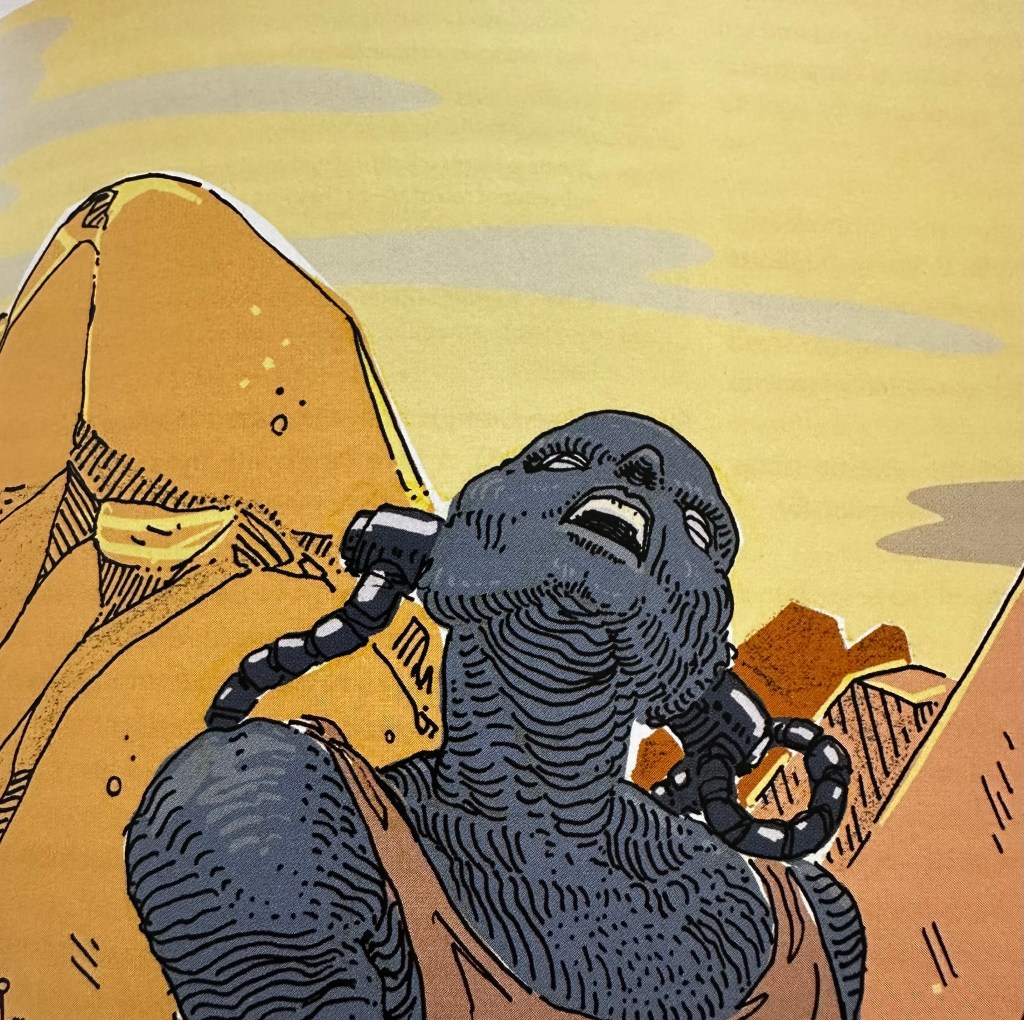
It’s also worth mentioning Burdens at this stage. It is possible to take items or traits as burdens rather than have them in your regular inventory, perhaps because those inventories or full or for some other narrative reason. Each Burden you carry (you can have up to 20) gives you a -1 to all checks though.
Last Few Attributes

Level: 1
Life: 8 (all level 1 characters start with 8 Life.)
Hero Dice: 1d6 (these come and go quite often in play. You can use them to adjust a die roll or recover Life. You also get one per session and every couple of hours of play!)
Save: 13 (all level 1 characters get a Save of 13. You have to roll over your Save score in dire situations. You can add an ability bonus from Endurance or Aura to help you out. Interestingly, you can’t use Agility to save. Instead, it is considered an action roll.)
Melee Attack: d20 + ability (strength) + skill (if applicable.) I’ve got a 0 here.
Ranged Attack: d20 + ability (agility) + skill (if applicable.) My agility gives me a +2 to ranged attacks
Oldtech Attack: d20 + ability (thought) + skill (if applicable.) My Thought score gives me a +1 for Oldtech attacks
Fantascience Attack: d20 + ability (charisma) + skill (if applicable.) Another +1 here.
Damage: I imagine my fishing wizard has a little fishing knife. That’s 1d4 damage.
Defense: Here’s the formula, 7 + ability (agility) + bonus (if skill applies) + armour. No armour yet, so it’s going to be a 9 for now.

Name Your Character

The Guidebook has a table of names. The table lists them under particular cultures of the Vastlands, so, in all likelihood, the name you choose will also decide the culture you’re from. It’s a 12 point list so I’m going to roll a d12 on it. That’s a 10.

  • D.W.A.R.F. Names: There are 8 listed. Let’s roll a d8. That’s a 2 – Del ‘Machinist. Very practical, I’m sure. Lets also give them the pronouns they/them.
    Here’s the Dwarf glossary entry from the UVG 2E core book:

Dwarf: Backronym from ‘De Werker Aristocratiscee Revolutie Fraternitie,’ Dwarfs are a distinct culture-class of selectively biomanced people. They have effectively fought the traditional aristoi of the Red and Orange lands to a standstill and now form a major industrialist society of the Rainbowlands. A famously bureaucratic and collectivist faction, they are the only one staunchly opposing the bureaucratic and individualist Emerald City Cogflower Corporation (actually a coin church).

Looks like my fisher wizard is a communist. Love it.
Conclusion

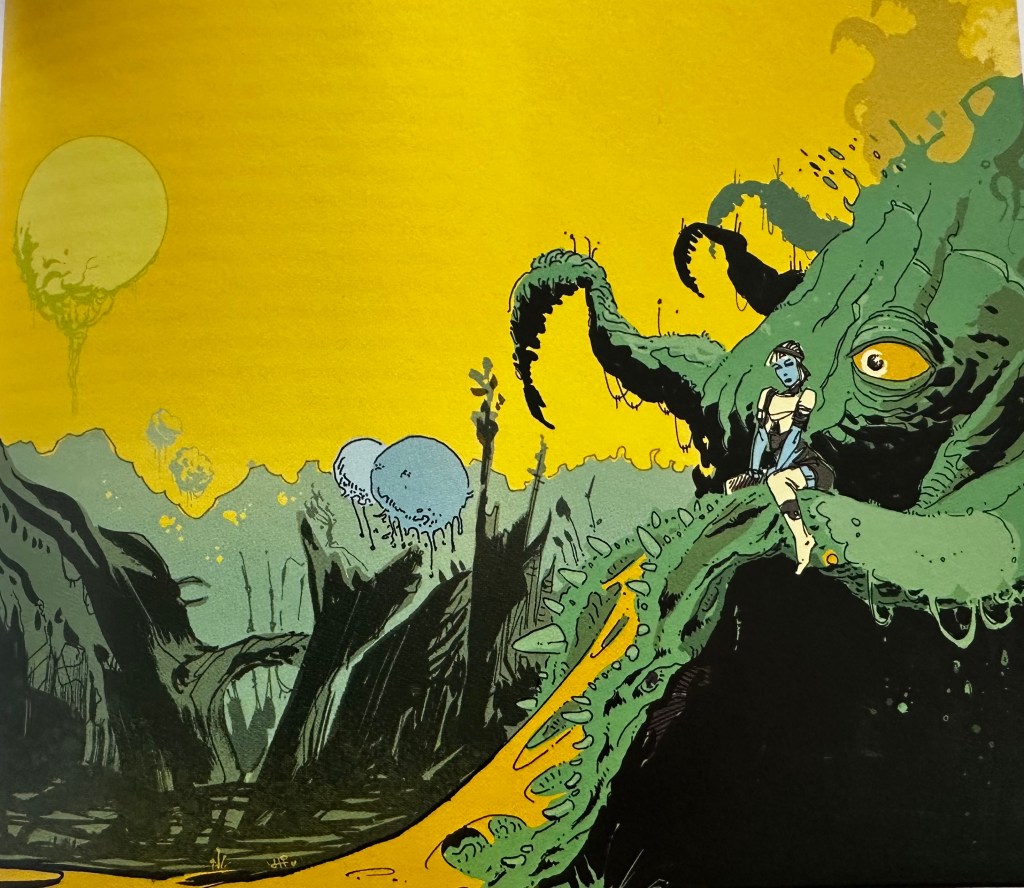
So, that’s my D.W.A.R.F. Tumult Fisher Wizard, Del ‘Machinist. They have great endurance and very average strength. Despite having rather low Aura, they have a wizard trait which allows them to double the effectiveness of the Life points they spend on their spells and another trait from the Traveller path that allows them to spend a Hero die or Life point to get a second action in a round. And he comes with a green brick that has the light and heat of a candle. I have a pretty good idea of them in my head.

I will say that, if I were to do it all over again, I would have just stuck to the UVG Guidebook to shepherd me through the character creation process. Switching to the UVG core book for that one table roll complicated things unnecessarily. My advice would be to do the same, if you are determined to use the Synthetic Dream Machine rules for your game of UVG. Otherwise, use a different system and utilise the tables in the core book for flavour.
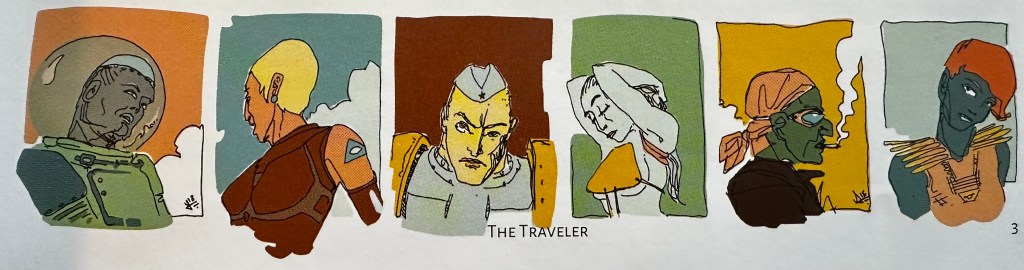
I think the next post will be Caravan creation so tune back in then, dear reader!

Dungeon Crawl Classics Character Creation

Learning to Crawl

It’s been quite a while since I’ve done one of these posts. I think my Dragon Age Character Creation post was the last one. And it was very useful to me in figuring out how that game worked before I started a campaign of it (which is ongoing. The PCs have all just become Grey Wardens without dying during the Joining!) Well, I’ve got a short game of Dungeon Crawl Classics coming up this weekend so I thought this would be a good opportunity to create a character using the DCC rules to help familiarise myself with them.

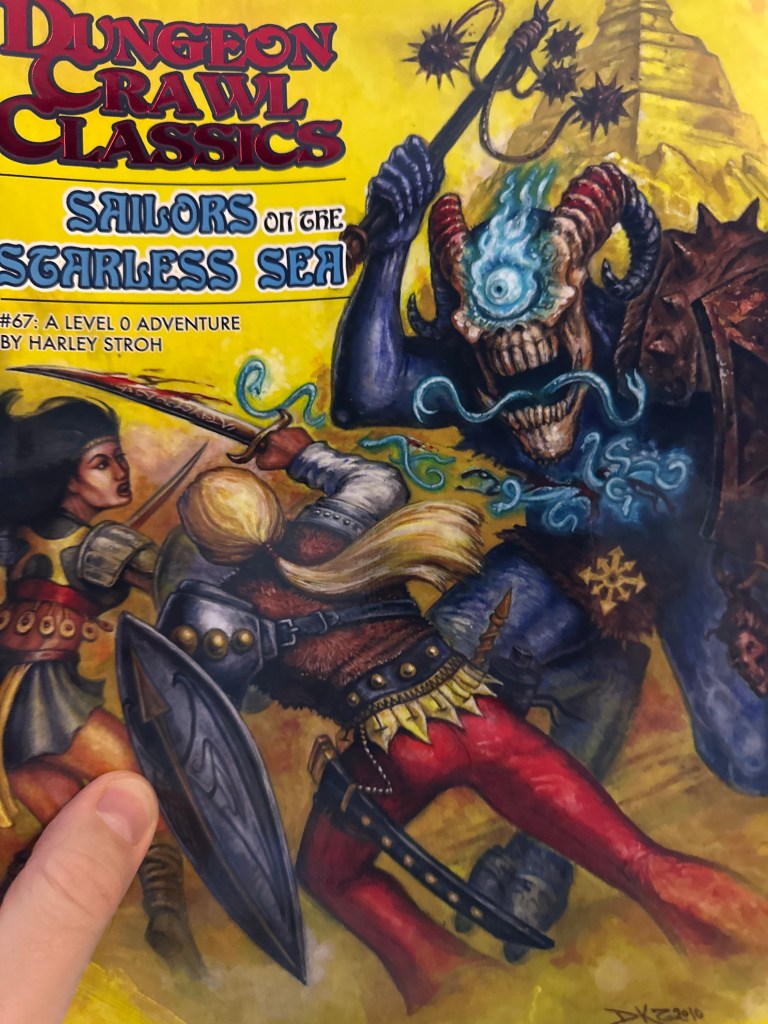
I’ll be running the iconic DCC #67 Sailors on the Starless Sea for a group of four or five players. To be honest, I don’t expect any of the PCs who survive this 0-level funnel (this is a module where the players play three or four 0-level peasants who delve into a dungeon. Whichever of their PCs survive get to advance to 1st level in their chosen class, normally) to go on to choose a class or progress to 1st level as its more of a one-shot deal. But, you never know! If it proves to be popular or any of them get particularly attached to one of their characters, maybe I’ll brew up a campaign for them. I certainly have enough DCC resources and modules to run campaigns for the next ten years straight!
Anyway, the point is, I think I’ll still get something out of creating an actual character using these rules. So here we go!

Funnelling

For the purposes of this post, I am going to roll up four 0-level characters and then roll 1d20 for each of them. The character that rolls the highest will progress to 1st level while the rest are assumed to have died a gristly and unfortunate death in some stinking hole beneath a castle or in the gullet of some demon lord.
To roll up the 0-level characters, I’m going to use the fabulously useful purple sorcerer, which will do it automatically for me. This is what I expect my players to use when generating their own PCs.

But first, a note on what’s being generated:

  1. Ability Scores – These are Strength, Agility, Stamina, Personality, Intelligence and Luck. All DCC ability scores are generated by rolling 3d6. There are no alternate methods of generating them, no point-buy, no 4d6 and drop the lowest… it’s brutal.
  2. 0-level Occupation – there is a d100 table that covers a page and a half of the book to determine this. Your Occupation also determines your starting Trained Weapon and which Trade Goods you begin with. It will also indicate the type of skills you are trained in.
  3. Money and Purchased Equipment – a 0-level character starts with 5d12 copper pieces. On top of the weapon they start with, they can use these to purchase other stuff
  4. 1d4 hit points, modified by Stamina
  5. A +0 modifier to attack rolls and saving throws
  6. A Lucky Sign – DCC characters begin with a Lucky Sign, which you roll for on a table. This can give the character a +1 to a particular type of roll forever!

One thing that’s not generated is alignment. For D&D type games, I don’t normally bother with alignment. But I think it is so integral to so many of the mechanics of DCC, that I can’t avoid it. The available alignments are Chaotic, Neutral and Lawful. I am going to roll for this on 1d3. I rolled a 2, so this character, whoever they turn out to be is going to be Neutral in alignment.
So, without further ado:

I rolled up one Dwarven blacksmith, a Minstrel, a Herbalist and a Butcher. I’ll quickly go through the high points and low points of each:

  • Dwarven blacksmith – I’ll name them Grund. Grund has a Personality score of 13! That’s his highest. However, his Strength, which would be one of the main abilities of the Dwarf class, is just an 8. Even more alarming is that they have the approximate intelligence of a fence-post, with a score of just 3. Since their Luck modifier is 0 they don’t get any Lucky Sign bonus
  • Minstrel – I’ll name them Flor. Flor’s ability scores are generally very high, strength 12, stamina 14, personality 14 and Luck 15. Only Agility lets them down with a score of 7. They start with 5 HP! Also, Flor as the Lucky Sign, Raised by Wolves, which gives them a +1 to Unarmed Attacks.
  • Herbalist – I’ll name them Bud. Bud’s ability scores are incredibly average. Only Luck gives any kind of bonus (+1) and only Agility gives a minus (-1.) They do have the Four Leafed Clover Lucky Sign, which provides a +1 to Find secret doors. Only starting with 1 hit point, though…
  • Butcher – I’ll name them Cutter. Cutter is weak, (strength 7) clumsy, (agility 8) and unpleasant to be around, (personality 5) but is pretty smart, (intelligence 15) so they’re probably pretty annoying. Luck provides a 0 modifier so no Lucky Sign bonus here.

OK, I’m not going to lie, I’m holding out for Flor to survive the funnel but it’s entirely random so there’s really no telling…

“Funnel” Rolls

So, it all comes down to a single d20 roll for each PC. In case of a tie, I’ll just re-roll both.

  1. Grund the Dwarven blacksmith – 17 (oh no)
  2. Flor the Minstrel – 4 (wah!)
  3. Bud the Herbalist – 18 (a reprieve!)
  4. Cutter the butcher – 6

So, Bud, alone, bleeding and traumatised, crawls out of the crumbling remains of the ancient temple having, with the help of the heroic and now deceased Grund, Flor and Cutter, defeated the ancient evil beneath it. Grabs some treasure on the way out too!

Choosing a Class

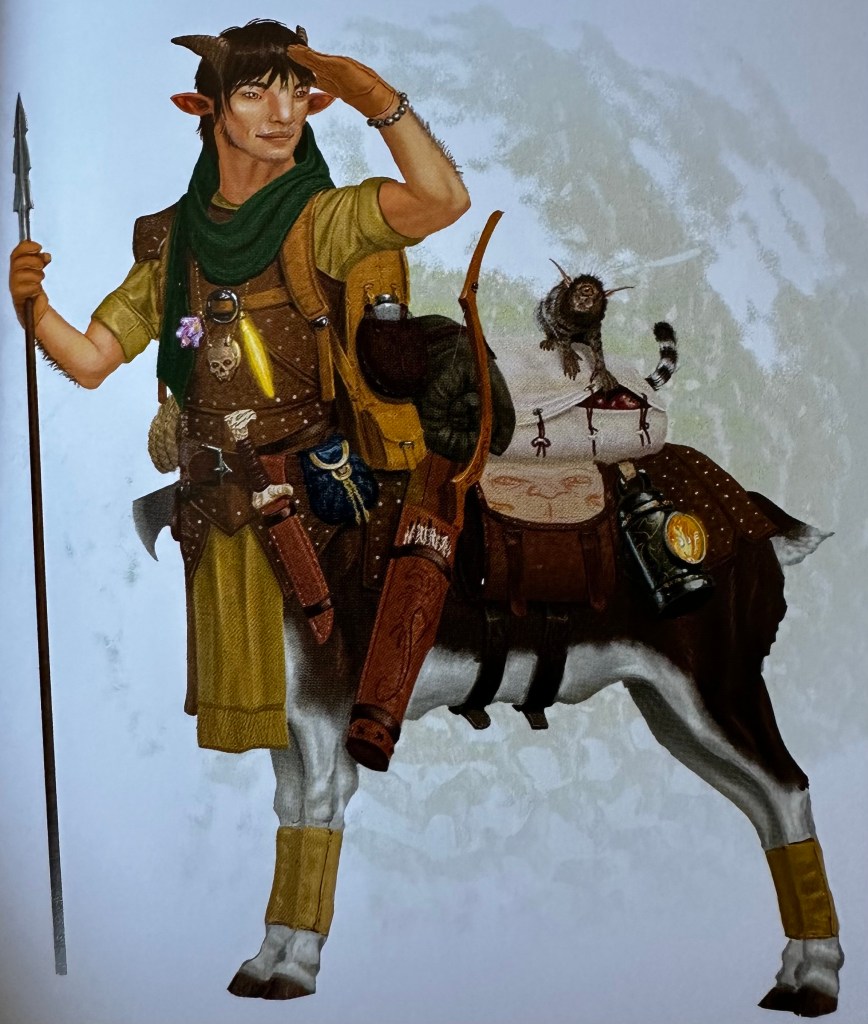
So, since Bud is a human (all 0-level characters are assumed to be human unless it’s clearly stated in their title, i.e. Dwarven blacksmith) they can choose from any of the classes except Elf, Dwarf and Halfling, for obvious reasons. Yes, this is another one of those old school games in which “Demi-human” races are treated as classes, kind of like in Old School Essentials. You can check out my disastrous OSE character creation post here.

Anyway, that leaves the following classes to choose from:

  • Cleric
  • Thief
  • Warrior
  • Wizard

Now, Bud’s ability scores are as follows:

  • Str: 9 (0)
  • Agi: 8 (-1)
  • Sta: 12 (0)
  • Per: 11 (0)
  • Int: 9 (0)
  • Luck: 13 (+1)

Normally you would go with the class that matches your highest ability score, right? Well, I could do that, but Bud’s highest is 13 for Luck, which is useful for all classes. Next is Stamina, on 12, but, once again, no one class relies on that. You could argue for Warrior there, but with a Strength score of 9, I don’t think it makes sense. So, instead, I think I will go for Cleric, since they use Personality to cast their spells and that’s Bud’s next highest Ability score, at 11. They don’t get a bonus from it, but it’s as good a reason as any to choose a class, I think. Oh, also, the Herbalist already started with a Holy Symbol, so it seems fitting.

From the DCC book:

An adventuring cleric is a militant servant of a god,
often part of a larger order the faithful, they wield the
weapons of their faith: physical, spiritual, and magical.
Physically, they are a skilled fighter when using their
god’s chosen weapons. Spiritually, they are a vessel for
the expression of their god’s ideals, able to channel holy
powers that harm their god’s enemies. Magically, they
are able to call upon their god to perform amazing feats.

Hit Points

Each class rolls a different die for hit points, just like in D&D and OSE. If you’re a Cleric, you roll 1d8 per level.

Bud rolls a 6 on their 1d8 and adds it to their 1 hit point from level 0 to make 9.

  • HP: 9

Choosing a God

If you choose to be a Cleric, you have to choose to worship a God of similar alignment to you. In Bud’s case, that Neutral. I am going to consult the Gods of Eternal Struggle table and choose one of the Neutral deities from that.
I have recreated the Neutral gods section of the table below:

AlignmentGodsWeaponsUnholy Creatures
NeutralAmun Tor, god of mysteries and riddles. Ildavir, goddess of nature. Pelagia, goddess of the sea. Cthulhu, priest of the Old OnesDagger, mace, sling, staff, sword (any)Mundane animals, un-dead, demons, devils, monsters (e.g., basilisk or medusa), lycanthropes, perversions of nature (e.g., otyughs and slimes)

With their background in herbalism, I feel as though Bud would lean towards the worship of Ildavir, goddess of nature. As you can see from the table above, they get a semi-decent selection of weapons they can use. It is also interesting to note at this point that Clerics can wear any armour and it won’t affect their spell-checks. Finally, you can see they are able to turn an array of interesting creatures, not just undead.

Magic

In DCC, when you want to cast a spell, you have to roll a spell-check. This is an obvious departure from D&D. Another difference is that they don’t get spell slots. However, there is a downside here. If you fail in your spell-check roll, you risk the ire of your deity. In the normal state of affairs, if you are trying to cast a spell and you roll a nat 1 on your spell-check, the spell auto-fails and you get to roll on the Disapproval Table. This can lead to consequences ranging from this:

The cleric must atone for their sins. They must do nothing but utter chants and intonations for the next 10 minutes, starting as soon as they are able (i.e., if they are in combat, they can wait until the danger is over).

To this

The cleric’s ability to lay on hands is restricted. The ability works only once per day per creature healed – no single character can be healed more than once per day. After 24 hours, the ability’s use reverts to normal.

Worse still, your chance of auto-failing goes up by one, meaning auto-failure and a Disapproval Table roll on a 1 or a 2. It gets worse; for every spell-check failure in the same day after this, that auto-failure range increases by another 1, with no real upper limit.

You can also piss off your deity by “sinning,” e.g. acting in a way that contradicts the god’s teachings or benefits one of their enemies.

Now, there is a way to offset these consequences: sacrifice. Yep, all you have to do is destroy or give away 50gp worth of wealth in your god’s name to reduce the failure range by 1 point. They might also accept a great quest of undertaking of faith instead.

Spells

Anyway, back to the spells! Bud starts knowing four Level 1 Cleric Spells, according to Table 1-5: Cleric. So, let’s choose them!

  1. Blessing – this can be used to bestow all sorts of boons on the cleric themself, an ally or even an object. Since every spell in the game comes with its own table to determine the exact results, I’m not going to get into it here. Suffice it to state that you can get anything from a +1 to attack rolls for a round, right up to getting a permanent +1 for the whole party to any actions to do with a sacred endeavour they have undertaken.
  2. Holy Sanctuary – this creates a place of safety for the Cleric and their allies. It might simply make it harder for enemies to hit them in that space, or it might allow the Cleric to create a permanent place of sanctuary, such as a temple, where powerful enemies cannot attack the faithful at all.
  3. Second Sight – the Cleric gains divine insights into the results of their own actions. It might be a +4 bonus to a single action roll or it might be able to divine the outcomes of great events for a month and also receive a +1 bonus to all actions taken during that period!
  4. Word of Command – Use a single word to command a creature to do something. The effects range from just that to it targeting all desired creatures they can see, who must obey it for a number of days.

All Cleric spell checks are made like this: 1d20 + Personality modifier + caster level

Turn Unholy

You saw above the range of creatures that Bud can turn with a Turn Unholy roll. This roll works the same as a spell check, so 1d20 + Personality Modifier + caster level. However, when Turning, the cleric can also add their Luck modifier. In Bud’s case, this is good because they have a +1 in that.

Failing a check can incur the Disapproval of their deity just like failing to cast a spell.

On a success, there is a fairly complicated set of potential outcomes depending on your turn check roll and the Hit Dice of the creatures you’re trying to turn.

Lay on Hands

Bud is a healer as well, of course. In fact, the Lay on Hands power is the only real way they have to heal anyone. But! They can use that to heal them of hit point damage, disease, poison, broken limbs etc. They can use it to deal with pretty much any condition.

Of course, just like with Turn Unholy, you have to make a spell check to use this power, 1d20 + Personality modifier + caster level.

The dice you use to heal someone depends on their class/type of hit dice they use. So, for a Warrior, who uses a d12 for their HD, healing is also rolled on a d12, which I think is neat. Although you can never roll more dice to heal than your target has in HD already.

Alignment is a factor in healing. If you try to heal someone of different or even opposing alignment to your character, you are going to probably do less healing than if you were healing someone of a similar alignment. As a Neutral Cleric, Bud is probably in the best position in this respect, as both Chaotic and Lawful creatures are considered adjacent to him on the alignment table, which I have reproduced below:

Spell checkSameAdjacentOpposed
1-11FailureFailureFailure
12-132 dice1 die1 die
14-193 dice2 dice1 die
20-214 dice3 dice2 dice
22+5 dice4 dice3 dice

Divine Aid

You can just ask your god for anything really. But it must be a truly extraordinary act to get them to intervene on your behalf so directly, when they are already giving you spells and other powers. So, to achieve this, you make a spell check as normal, and, even if you succeed, you are lumped with a cumulative +10 penalty to future Disapproval range… the Judge (DM) gets to decide the exact DC and effect of the request depending on what the intention was, what the god might want and how big the intervention needs to be. This seems like it could be used in some really clutch moments though.

There are a couple of notes right at the end of the Cleric class description. One relates to Luck and how their Luck modifier can be added to Turn Unholy rolls. The other indicates that their Action Dice can be used to attack or cast spells.

Equipment

The Equipment Chapter starts with a table that indicates how much gold your character stats with if you decide not to opt for the 0-level funnel method of character creation. If a Cleric starts at level 1, they get 4d20 gp. So let’s roll that:

  • 20 (yep, out of a possible 60 gp)

At least I can add the 48cp I rolled up on their level-0 character sheet. Well, let’s make the best of it. I am going to buy a decent weapon, since Bud started with nothing but a club, and hopefully some armour.

I think I am going to go for a modest

  • mace (1d6 dmg)

and back it up with a

  • sling (1d4 dmg)

That’s a total of 7gp. I had also better get some

  • sling stones

for another 1gp.

Finally, the only armour poor Bud can afford is

  • padded armour (+1 AC)
    That makes Bud’s AC 10 because of the -1 Agility modifier.

That costs 5gp. So, Bud has 7gp and 48cp left.

So, let’s grab a

  • Backpack for 2gp
  • Flint and steel for 15cp
  • 10 torches for 10cp
  • 5 days of rations for 25cp
  • a waterskin for 5sp
  • 50’ rope for 25cp
  • A grappling hook for 1gp

For a total cost of 3gp, 5sp and 75cp.
Which leaves Bud with 3gp 2sp and 3cp.

So, that’s pretty much it for Bud the Witness (that’s their title as per the Cleric Table) I like Bud. They’re a survivor and a true devotee of Ildavir, goddess of nature, but they will never forget their humble beginnings as a herbalist, nor their old companions, Grund, Flor and Cutter.

Thanks to Soxzilla2 on reddit for the form fillable character sheet! You can find that here.

New Character Options from Erlendheim Part 5

Late Addition to the Line-up

Heather joined our campaign a bit late. She decided to sign up about the time the rest of the party popped through their very first portal to Sigil. This worked out well because her character, Panasonic (no relation to the Japanese electronics manufacturer of the same name,) was already there. This Half-orc Bard hadn’t always been there but she had made a home in the city and even gained something of a reputation as a controversial singer/songwriter. She had written and performed a tune that was perceived as being particularly critical of the self-appointed police, the Harmonium, a Faction that was philosophically devoted to the notion of laws and the act of upholding them. Unsurprisingly, this made them less than popular with many of the city’s population. So, when Panasonic first performed her song “The Safety Dance,” (for copyright reasons, a song that is legally distinct from the 80s hit by Canadian icons, Men Without Hats) a riot erupted, followed by anti-Harmonium acts being perpetrated all over the city. So, on the night when the rest of the party emerged from the end of a pipe (other side of a portal) in the the swimming pool of the Gymnasium, Panasonic found herself taking a shortcut through that very place, with a squad of angry Hardheads (a nickname for the Harmonium) hot on her heels.

Luckily, the party came to her aid, and she, in turn, acted as a sort of guide/ally to them in the alien and bewildering city.

The thing about Panasonic was, she had a fascination for Sigil and the planes in general. She was fascinated by the doors, the portals, how they worked. She always felt there was something musical about them. Also, she had been trying to find a way home for a long time. She had been shanghaied in Sigil by her sister, Sony (once again, no relation.) Sony was jealous of Panasonic’s growing popularity and so got a wizard to send her off plane so she could take her place at the front of their band. When she ran into the party, who just-so-happened to come from the same prime material world, she latched onto them as her ride home.

So, the culmination of Panasonic’s story, unlike the rest of the party, came when she emerged through the portal to Erlendhaim with the others. It was a big moment for her! She even found her sister there and somehow made amends just before they were violently assaulted by a bunch of devils.

It was then that she gained her new bard features, having fulfilled all her major character beats.

As with all of these character options, I didn’t spend too much time considering the balance implications of these. But if you like them, and you feel like you could use them in some form or other, please feel free.

New Bard Feature – Music of the Planes

Magical Notes

From 3rd level; the Bard uses an action to strike a cord on their musical instrument and summons a tiny portal which projects, from the instrument, an ethereal glowing rune in the shape of a musical note. As the the Bard continues to play, notes emerge in a stream from a plane of pure, living music. This stream of notes can have one of several effects that the Bard must choose before using this feature.

  • Face-melter – Attack roll using the Bard’s spell attack bonus – Range: 60ft, Damage: 1d8 + Charisma modifier thunder damage. At 6th level this increases to 2d8, at 9th level to 3d8, at 12th level to 4d8 and at 15th level to 5d8.
  • Break/Dance – Affect a single creature in range (60ft) causing them to dance energetically unless they make a Charisma saving throw (using the Bard’s spell save DC.) On a failure, the creature’s AC is broken, reduced by 2 as they leave themselves open to attack. At 6th level the Bard can affect two creatures or reduce the AC of one creature by 3. At 9th level the Bard can affect three creatures or reduce the AC of one creature by 4. At 12th level the Bard can affect four creatures or reduce the AC of one creature by 5. At 15th level the Bard can affect five creatures or reduce the AC of one creature by 6.
  • Mosh Pit – From 12th level the Bard can affect a group of 1d8 + Charisma modifier creatures to attack the closest creature to them if they fail a Charisma saving throw (using the Bard’s spell save DC.) This effect lasts until the end of the Bard’s next turn.

Transported by the Melody

From 9th level, once between long rests, the Bard can use an action to play their instrument in harmony with the planes allowing them to cast the Contact Other Plane spell. From 13th level, once between long rests, the Bard can use an action to play their instrument in harmony with the planes allowing them to cast the teleport spell. From 15th level, once between long rests, the Bard can use an action to play their instrument in harmony with the planes allowing them to cast the Demiplane spell.

Monsters of Rock

From 7th level the Bard plays a melody that opens a portal to one of the outer or inner planes to summon an elemental, fae, celestial or fiendish creature of up to CR 2. 10th level, CR 3. 13th level CR 4. 16th level CR 5.

List of Elemental Creatures

  • Steam Mephit (CR 0.25)
  • Dust Mephit (CR 0.5)
  • Ice Mephit (CR 0.5)
  • Magma Mephit (CR 0.5)
  • Magmin (CR 0.5)
  • Azer (CR 2)
  • Air Elemental (CR 5)
  • Earth Elemental (CR 5)
  • Fire Elemental (CR 5)
  • Salamander (CR 5)
  • Water Elemental (CR 5)
  • Corn (CR 5)

List of Celestial Creatures

  • Couatl (CR 4)
  • Pegasus (CR 2)
  • Unicorn (CR 5)
  • Hollyphant (CR 5)

List of Fae Creatures

  • Sprite (CR 0.25)
  • Dryad (CR 1)
  • Sea hag (CR 2)
  • Green Hag (CR 3)

List of Fiendish Creatures

  • Lemure (CR 0)
  • Dretch (CR 0.25)
  • Imp (CR 1)
  • Quasit (CR 1)
  • Bearded Devil (CR 3)
  • Hell Hound (CR 3)
  • Nightmare (CR 3)
  • Barbed Devil (CR 5)
  • Night Hag (CR 5)

Conclusion

This is the last of my D&D character options from Erlendheim series, dear reader. I really enjoyed coming up with these options in collaboration with my players and it was a lot of fun introducing them to the campaign with big personal story moments for the characters. I highly recommend that as a way to make your players feel very special.

New Character Options from Erlendheim Part 4

Back to the characters

This is the latest in a series of posts on the new character options I introduced for the PCs in my D&D campaign known as Erlendheim. It was based on a home-brew world of my own but intersected with the 2nd Edition AD&D version of the Planescape setting. This was very special for me as I had always loved that setting and the Planescape products from that time. It was very exciting for me to explore it with my players and I wanted to make it special for them too. So, I created, with their help, new features and class options for each of them. They have little or nothing to do with balance in the game, and most of them are overpowered but that didn’t bother me. It just meant I could ramp up the challenge of the situations they ended up in. You can take a look at the previous entries in this series here.

How to Resurrect a God

So, at a point during their adventures through Sigil, the PCs in my D&D campaign of a few years ago discovered that the god to whom most of them owed their devotion, Helm, was, in fact, dead. Or, at the very least, gone. In the Parted Veil bookshop, the proprietor and confirmed atheist, Kesto Brighteyes, confirmed this for them. This shook our Bariaur cleric’s beliefs to their core. As a senior priest of Helm, Menuk had been praying to his god all his life, and receiving spells and other abilities in return. So, if his god was dead? Who had been answering his prayers? The answer was Aegir, the elemental spirit and Fathomless former patron of our Warlock. They had been intercepting the prayers of the people of Erlendheim and gathering power from them for centuries, posing as Helm and controlling the populace. This revelation rocked Menuk to his core and he immediately lost access to all his priestly spells and features. But at that moment, he also started to hear a noise, as of a plate gauntlet scraping against stone. Only he could perceive it. And it got him thinking there must be a connection to Helm.

This set the PCs off on an investigation, following the trail that began with the sound in Menuk’s head. They had already heard of a portal to the Astral Plane, where they might find the body of Helm floating forever through that wispy sea. It was in the Shattered Temple, headquarters of the Faction known as the Athar, a fiercely anti-deity group. So, they infiltrated the building and jumped through that portal onto the petrified body of a god. Here, the noise in Menuk’s head became clearer, beginning to sound like the words, “Pray, pray, pray, pray, pray to me.” They fought an Astral Dreadnought, which had taken up residence in the region, while Menuk used the power of prayer to awaken Helm.

I inserted a “god-resurrection” mini-game here. This gave the otherwise de-powered Menuk a goal and a focus for the fight while the others struggled with the Dreadnought.

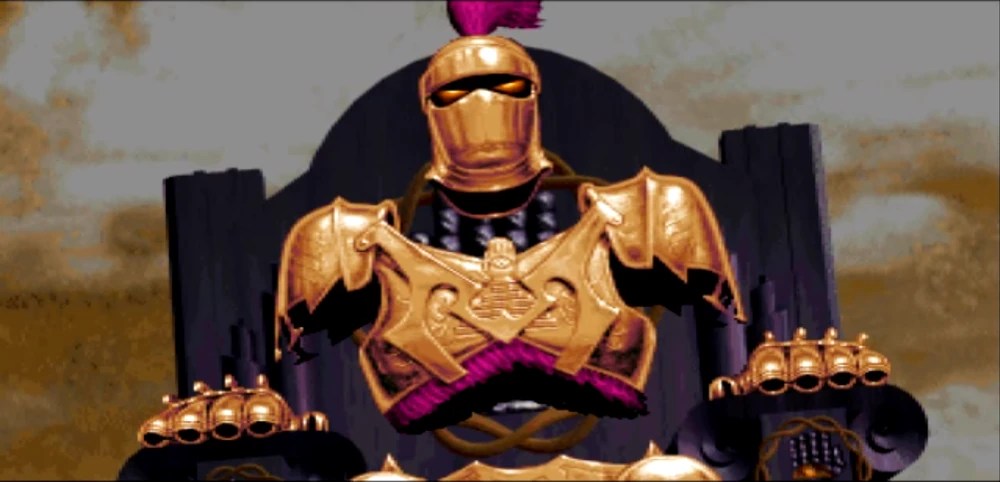
When his prayers finally woke the god, Helm’s great, mailed fist rose and crushed the Astral Dreadnought. He then transported the PCs back to his home plane, Mechanus, where he appeared to them, once more restored to his throne. And this was when he declared Menuk to be his new Right Hand, and imbued him with a new set of Clerical abilities along with all those he lost earlier.

This was one of the most epic and grand encounters and scenarios I have ever run and it was a joy to bring this chapter full circle.

New Cleric Features – Helm’s Right Hand

Below are the details of the new Cleric features that he got. As always, these were written specifically for this particular Life Domain Cleric of Helm so their usefulness might be limited. But, if any of them catch your eye, please feel free to customise and use as you want.

Channel Divinity: The Watcher Over the Fallen

From 2nd level the Life Domain Cleric can use this feature once between long rests. When any creature that is within the Cleric’s line of sight falls to 0 hit points, as a reaction, using Channel Divinity, they can choose to restore them to one hit point instead. This feature cannot be used to heal undead or constructs.

Tough Love

From 6th level, when the Life Domain Cleric summons a weapon using the Spiritual Weapon spell, it can be used to cast any of their healing spells.

Channel Divinity: Helm’s Shield

From 8th level, the Life Domain Cleric gains the ability to summon Helm’s protective power in the form of a shimmering bubble of light. Helm’s Shield surrounds them or any creature the Cleric chooses and can see within thirty feet.
The Shield has an AC of 10 and hit points equal to 10 + the Cleric’s level.

Helm’s Mailed Fist

From 14th level the Cleric gains the ability to transform into the physical embodiment of Helm in the world. They take on the form of a glowing, platinum warrior, adorned in full plate and standing 14 feet tall. The Cleric can take this form for a number of rounds equal to their wisdom modifier (minimum of 1.)
The form grants the following:
AC bonus: +3
Temporary Hit Points: 15 + Wis modifier
Spell Slots: 1 extra spell slot of any level available to the Cleric
Channel Divinity: 1 extra Channel Divinity
Attacks: Add +5 to hit and +5 to weapon damage (damage counts as magical damage)

New Character Options from Erlendheim, Part 3

Erlendheim

I began a series of posts last week detailing the character options I introduced to my Planescape flavoured D&D campaign a few years ago. It was quite epic in scale and involved gods and legendary monstrosities and elemental powers as well as travelling across multiple planes of existence and saving the universe from the domination of a narcissistic sea spirit. I hadn’t planned it in advance but, at one point, the Warlock needed to switch her patron so I came up with a new one which you can read about here. After that, I was hooked. I started making new character options, features and powers for every PC in the party. You know when you max out your rep with your party members in CRPGs like Dragon Age and Mass Effect and they get access to new abilities? That’s the way I was thinking of it. As a result, these new character options were designed with our specific players, characters, shared world and story in mind. I left balance at the door. Balance was not relevant to what I wanted to achieve. In fact, I wanted the PCs to feel special, powerful and impacted in a very concrete way by the events of the campaign. I think I largely achieved that. Take a look, here, at the powers I gave the party’s Druid when he became a kind of a shitty god. I think it exemplifies my philosophy when designing these abilities.

Celebrating the Mundane

I think the next big character advancement arc to culminate was that of Xarune, our Githzerai Fighter. Xarune, despite his background as an adventurer in his younger days, had a solid view of the world. He believed in the shield in his hand, the guardsman at his side and the firmness of the ground beneath his feet. He had developed a dependable reputation in a position of some responsibility as a sergeant in the Yeomanry of the town of Dor’s Hill. Magic was anathema to him and, indeed, he went to extremes to explain away magical phenomena in entirely mundane terms. But then the ground beneath his feet turned out to be the ancient tower of an unknown faction from a city in the shape of a donut floating above the top of an infinitely tall spire at the centre of the Outer Planes. It became increasingly difficult for him to hand-wave the obvious magic in the world around him, especially once he ended up in Sigil. In fact, I instituted a special mechanic, specific to Xarune. Each time he witnessed something truly magical that he could not explain, he would roll a Wisdom Saving Throw. When he failed, he lost a point of Wisdom, making it more-and-more likely that he would fail with each successive failed save. My goal here was to get Xarune under 10 Wisdom. Once that happened, his aura of confusion and his inability to square his beliefs with the facts of reality brought him to the attention of a small, new Faction in Sigil. They were called the Mundane. When Xarune ran into their leader, another Githzerai warrior named Sarafem, who noticed his unique state of disorientation through her natural psychic abilities. We had another short mini-game at this point, after Sarafem introduced the Faction and its tenets. She presented to him her shield, with, emblazoned upon it, the emblem of a shield. She asked him to take and examine it.

Here is how I presented Xarune’s inner struggle in my notes:

Sarafem will encourage Xarune to use detect thoughts while examining the shield. In essence, this will allow Xarune to detect his own thoughts, to interrogate his own beliefs.
If he does so, he will replay some of the more recent encounters he has had with “magic.” Ask him to recount them and indicate that he is unable, in retrospect, to lie to himself and his own feelings. The truth is that the spells and magical effects did happen. In some cases he was able to shrug off the effects and in others he bore the full brunt of them. What becomes clear as he remembers these incidents is that, it is not objectively true that he or anything has to be subject to such effects. He begins to get so in touch with his feelings that he feels a new understanding blossom. He is able to apply the force of his will against this magic, a will that is every bit as strong as any wizard or demon thinks they are. For that is all it is in the end, a battle of wills.
He will want to fail his saving throw against detect thoughts. Give him three chances to fail it at various points through the process. Of course, it is a Wisdom saving throw but this time the DC will be 2 points higher than Xarune’s normal DC as it gains a bonus from the shield.
Whether he succeeds or fails, Sarafem will present to him the shield with a bow. It is a mundane +2 shield. There is nothing magical about it, but it is exceptionally well made from the hardest, lightest wood they have ever seen. (It is made of what she calls Steadfast.)
If he fails, with a barely perceptible twinkle in her eye she will ask him to join her budding faction, which she calls, “The Mundane.” She says they are still workshopping it. There are not many of them so far, but each of them has a very firm grasp of their true feelings and they know what is real. If he decides to take her up on her offer, they are usually to be found meeting in her house near the Statue of Bigby in the Lady’s Ward any evening.
Also, he will regain his lost points of Wisdom and he will gain the new abilities presented [in the section below]
If he succeeds, however, he will go on as before, he will not regain any points of Wisdom and he will continue to risk losing them. If he ever reaches 0 Wisdom, he will lose his mind completely and reject reality entirely, thus becoming an NPC.
However, he can continue to attempt the trick with the shield, trying to detect his own thoughts. He can do this whenever he has downtime using the same rules as are presented above.

Thankfully, he failed all his saves and his outlook and philosophy changed as a result. Not completely, it was still quite compatible with his no-magic stance from before, it just morphed into a more anti-magic one, bringing a few new abilities with it. And you can read about those below.

But that wasn’t all. Xarune’s player, Isaac, took the idea of the Mundane and ran with it. He quickly took the ideals of the Faction and began to codify them, even going so far as to write up a Mundane Manifesto! This did my withered old heart good to see. The campaign gave his character a concrete, mechanical advancement directly related to Xarune and the way he played him, and he gave back to the campaign and the world, adding to its story and its depth. Sigh so good.

New Fighter Features – Nullification (Anti-magic)

Erlendheim #DND

So, as I pointed out in the intro to this post, I created these features and options for, not only a specific class, but for a particular character. As a result, the features prestented below are unique to Xarune’s flavour of Fighter, a Battle Master who focused on using the Defense and Protection Fighting Styles. As always, if you think you could make use of any of this stuff, please feel free.

Fighting Style

Defense

Also add a +1 bonus to saving throws against magical effects

Protection

In addition to the regular advantage of this fighting style, if a creature you can see casts a spell that requires a saving throw against a target other than you within 5 ft of you, you can use your reaction to add your shield’s AC bonus (including magical or other bonuses if it has them) to their saving throw.

Martial Archetypes

Battle Master

Maneuvers
Deny

When another creature hits you with a spell attack or you fail a saving throw against a spell effect or magical effect, as a reaction you can expend a superiority die and reduce the amount of damage you take by the superiority die roll + Con modifier.

Reflect

When another creature hits you with a spell attack, as a reaction you can expend a superiority die to reflect the superiority die roll + Con modifier damage back at the spell caster.

Wake-up Call

When you take the attack action on your turn you can forego one of your attacks and instead use a bonus action to direct another creature who can hear you to make an immediate saving throw against a spell that they are currently affected by. You expend a superiority die and they can add the roll + your Con mod to their saving throw roll.

Indomitable

In addition to the regular benefits of this feature, starting at 9th level, if the Nullifying Fighter is subject to a magic spell or effect, they can roll any saving throw with advantage.

New Character Options from Erlendheim Part 2

Gods are superheroes too

In the last post, I wrote about how D&D 5E characters are basically superheroes by another name. I also introduced the new Warlock patron that we came up with for Yulla in our D&D 5E campaign, Erlendheim, a few years ago. She had abandoned her “Fathomless” patron and taken up with “The Source.” After Yulla got her groove back and started living up to her potential, it was our Druid’s turn.

Habjorn, played by David, had not wasted the years since their former adventuring days. He’d settled down with his wife, Lydia and started a little family which quickly ballooned into a sizeable troupe of children. There were seven in total, Habjornson, Sigrid, Gurt, Hogarth, Jankur, Flaarj and Yeet, the little one. But, as I noted last time, they, along with several of their neighbours, went and got themselves kidnapped by one of the antagonists. Lydia had already passed away a few years previous.

So, obviously, the party to go to great lengths to find them. Lengths that eventually led them to Sigil and beyond.

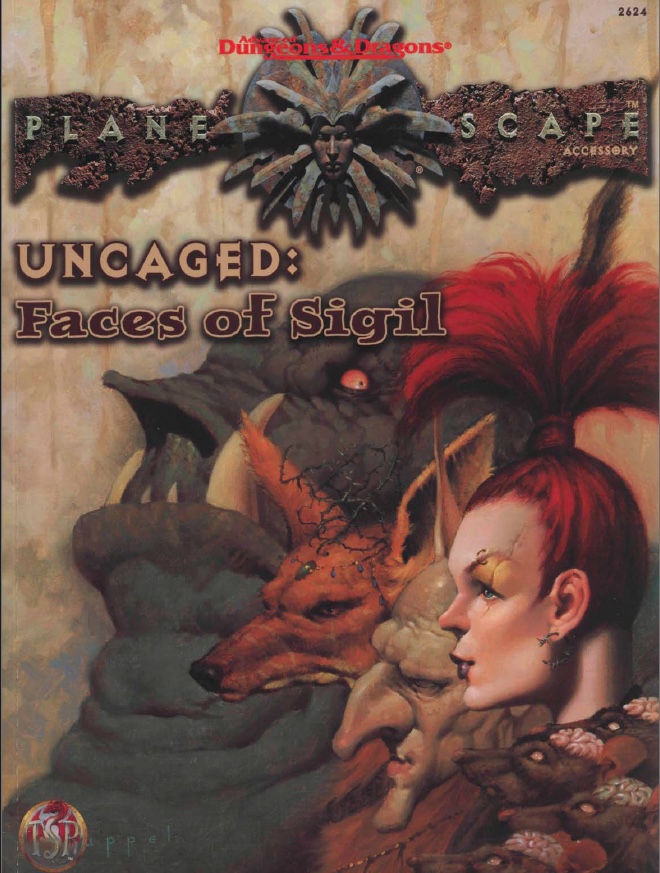
While the party were in the City of Doors, they got a job from Kesto Brighteyes, the gnomish owner of the Parted Veil, a bookshop where the PCs went to find the tome they were looking for. I found Kesto and everything about him in Uncaged: Faces of Sigil. This was an invaluable source-book for this campaign and provided at least three incredibly useful, well drawn and significant NPCs who were residents of the Cage with depth and interconnectedness.

Anyway, this quest led them off to the Lady’s Ward of the city, where they managed to defeat the object of their quest, a Gautierre. Upon the occasion of their victory, Habjorn the druid was approached by Lydia, his dead wife, in the form of a Petitioner. Petitioners are the souls of dead sentients, ascended to the Outer Planes who are, to all intents and purposes, reborn into new lives there with no memories of their old ones. They normally turn up on the plane where their gods lived or, at least, on a plane that matches their alignment. But, Lydia’s god, it turned out, was dead. So, she started wandering the planes looking for somewhere to belong. Until she felt a pull drawing her to her husband when he passed through a portal into Sigil.

Lacking a god or any sense of purpose, she felt a connection with Habjorn that she thought she should have had with her god, Helm, but didn’t due to his deceased state. So she started to believe in Habjorn like a god. She didn’t necessarily agree with him all the time or obey him at all, in fact, but she still had a strong enough belief in him to essentially grant him the status of a Minor Power, a godling out there on the Outer Planes.

It was actually pretty tragic. He was overjoyed/heartbroken to see her again but she didn’t recognise him and had no memory of their life together before her death. She knew nothing of their family and her motivations were totally different as a Petitioner.

But I digress. Before he knew it, Habjorn started hearing the prayers of his kids, held deep underground on the plane known as the Outlands, under the roots of one of the World Tree’s saplings. They were hoping and praying that he would come and save them and their belief began to compound the meagre abilities provided by Lydia’s own prayers.

And thus the Druidic Deity was born. So, like Thor and Hercules (kinda) before him, Habjorn became a superhero god!

Now, believe me, I understand that this stuff is totally unbalanced and potentially game-breaking. But I was throwing these characters up against some very tough situations, so I felt ok about it. I will point out, also, that, unlike the Warlock patron from the last post, this is not a subclass. Instead, its a couple of new features that work for Habjorn the Circle of the Land Druid/minor god, in particular. It is unlikely to work for anyone else in its current form but I think it was a fun addition to his set of abilities that allowed him to do some interesting stuff in particular situations and led to some truly fantastic character and story moments in our game. So, take it under advisement! But, if you want to use it or any part of it, please feel free!

New Druid Features: Druidic Deity

Grant Druidic Magic

The Druidic Deity can grant two cantrips and two first level spells from the Druid Spell List to their follower/s. The druidic deity can grant the cantrips and spells once and cannot do so again until they have completed a long rest.

The Power of Prayer

When a worshiper has prayed for spells to be granted the Druidic Deity gains a Prayer. There is no upper limit to the number of Prayers the Druidic Deity can be in possession of and if not spent before taking a long rest, they carry over. The Druidic Deity can spend a Prayer using a bonus action. This Prayer can be spent in several different ways:

  • Allow the Druidic Deity to regain an expended spell slot of any level they have access to
  • Allow the Druidic Deity to gain another use of Wild Shape
  • Allow the Druidic Deity to Wild Shape into any CR 2 Beast or Monstrosity that they have seen
  • Allow the Druidic Deity to remain in Wild Shape for double the normal length of time
  • Allow the Druidic Deity to cast spells while in Wild Shape
  • Allow the Druidic Deity to use the Natural Recovery feature to regain all used spell slots including 6th level ones and higher
  • Allow the Druidic Deity to cast one of their Circle Spells without expending a spell slot
  • Allow the Druidic Deity to empower their Land’s Stride ability , granting them the opportunity to pass into a plant of sufficient size and emerge from a similar plant of sufficient size within 200 ft
  • Allow the Druidic Deity to empower their Nature’s Ward feature, granting them immunity to one more damage type of their choice until they complete a long rest
  • Allow the Druidic Deity to empower their Nature’s Sanctuary feature so that beast and plant creatures cannot attempt to save against it.
  • Grant a worshiper another cantrip or first level spell

So, like I mentioned above, I know these features are potentially game-breaking and open to abuse. But my players took this sort of thing in good faith and David played his character as he thought he should react to becoming a slightly shitty kind of god. He was somewhat incredulous but used every ounce of his power to do the things his “worshipers” wanted of him. In other words, for Daddy to come and save them. And that’s what he did.

I would mention here as well, that balance, as a concept in D&D/TTRPGs in general is a concept that I take with extreme caution. I would rather chuck an unbeatable monster at them and have them figure out they need to run away or use their wits instead of charging headlong into the fray, then stick to Challenge Ratings most of the time. In this respect, I think the OSR has it right. But, I think this door swings both ways, if a challenge can be unbalanced due to an encounter’s difficulty, the PCs can also be a challenge due to their ability. They should get to feel like the superheoroes thery are. On the other hand, I also have the ability to keep piling on the difficulty as the party gets more and more powerful, so I see it as a win-win.

Let me know if you have any comments on these nutty druid features, dear reader.

New Character Options from Erlendheim Part 1

D&D Superheroes

There’s no doubt in my mind that the creators of the current version of D&D meant to make the PCs into superheroes. This goes for 5E 2014 as well as 2024.

You can have opinions about this. There are times when it frustrates the hell out of me as a DM just trying to introduce potentially deadly situations to our games. I usually overestimate the lethality of these situations, whether they might be traps, encounters or particularly difficult episodes of exploration. The players normally trounce these situations readily. They always have a feature or a spell or a power or a magic item or a special friend who will come to their rescue so that they emerge largely unscathed and only further emboldened. On the other hand, I do feel bad when a PC dies in one of my campaigns. I mean, of course! They spent hours designing and imagining and embodying this person… and they died… it can be devastating. It should be devastating. Not just for the player in question, but for every player in the game, including the DM. So I get it. I understand why the average D&D PC’s life expectancy has sky-rocketed in the last couple of decades. I also understand that if you want something more lethal, Troika! is right there. So, if you want more lethal play, there are plenty of options.

Anyway, when I finally realised the superheroness of the characters, we were playing one of my long-time RPG group’s more iconic campaigns. It was called Erlendheim and it was based on my home-brew world of Scatterhome. Here’s the TLDR for the campaign:

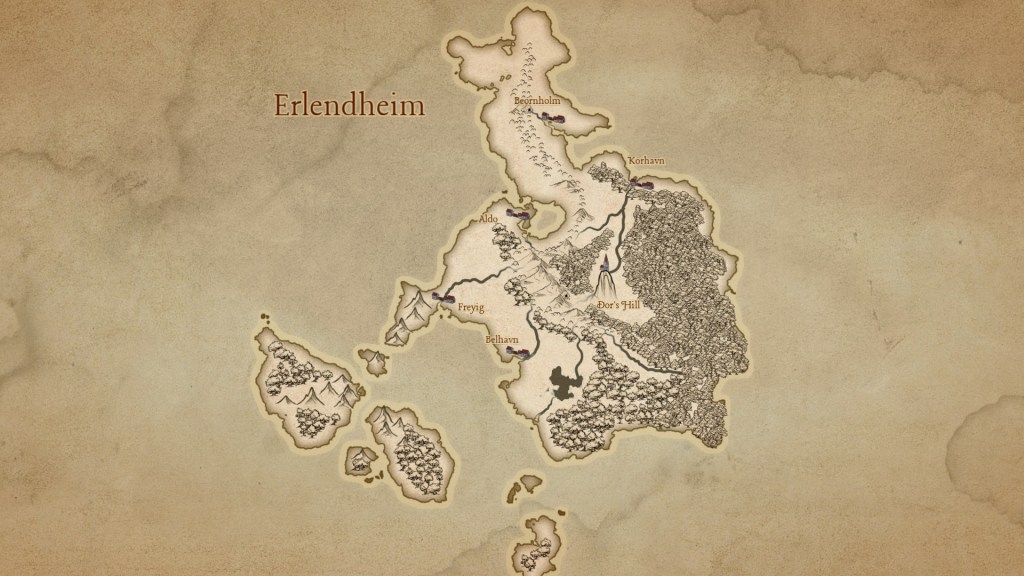
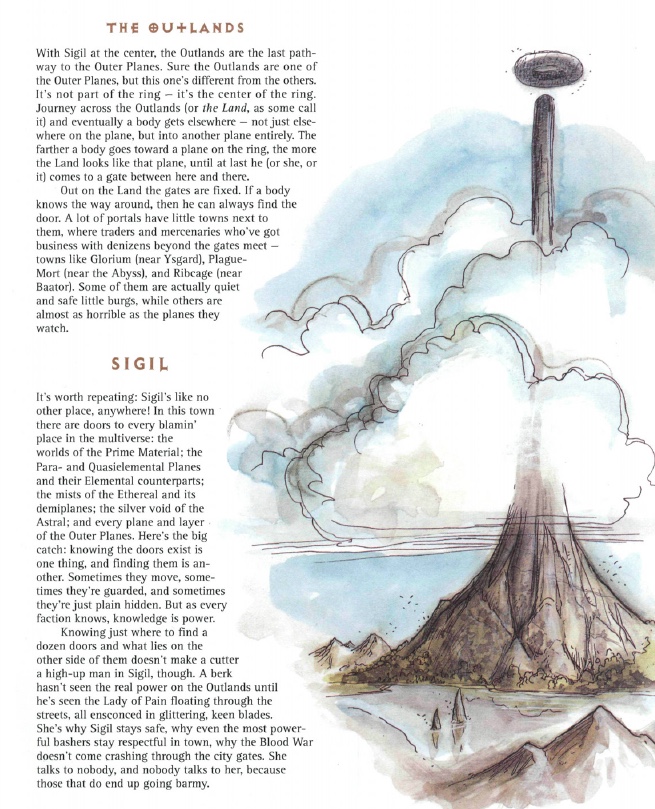
The PCs were all former adventurers living in or around their hometown of Dor’s Hill on the island of Erlendheim. The island was surrounded by a terrible and eternal storm meaning no-one could leave and no-one new ever turned up. The PCs started at level 8, but their adventuring days were behind them. Until one day, they were asked by the powers that be in Dor’s Hill to investigate some strange reports from an outlying fishing village. While they were off fighting what turned out to be Yugoloth fiends there, all six of the Druid’s kids were kidnapped by some more extraplanar beings. This, eventually and after much adventuring, roleplaying, schmoozing and drama, led them to Sigil, The City of Doors, The Cage. For the uninitiated, Sigil is the city at the centre of the Outlands, the plane at the centre of the Outer Planes in the D&D cosmology.

Now, as a die-hard AD&D 2nd Edition player of old, I was a massive fan of the original Planescape setting, the new shit it introduced to the game and the way it expanded our horizons as both DM and players when it came out in the nineties. But, I’ll be honest, I don’t think I knew how to use it as a 14 or 15 year old DM. It was just too massive. I wrote and ran adventures that were pretty much standard AD&D adventures except in a place in the Outlands instead of on the bog-standard fantasy world I had devised. So, in 2021, when I got the chance to send these PCs to Sigil!!! I grabbed that bull by both horns. It was so much better than I could have hoped. Even just the act of getting there was a major campaign milestone. And before long, both the players and the characters were knee-deep in planar weirdness. They didn’t know it, they didn’t understand most of it, but they still had goals. They were there for a reason (they had to find a book that explained the keys to all the planar doors in a mysterious tower beneath the town of Dor’s Hill back home.) So they pursued that. On the way, they all gained even more super powers than they already possessed. Why? Because, once you understand that D&D 5E is a superhero game, it’s a good idea to lean into it.

The first PC to get blessed in this manner was our warlock, Yulla (played by Tom.) Now, it just so happened that Yulla, up until this point, had a patron named Aegir, an elemental spirit that turned out to be the baddest guy of the entire campaign. So, when she went to Sigil her confidence in their patronage had taken a few knocks. When she then discovered her long lost, presumed dead parents there she was open to new possibilities. Now I was using the gorgeous, unimpeachable original version of the Planescape setting for this game. It was made for AD&D 2nd Edition but that was no impediment at all. (When I got the new 5E version I was a little shocked and affronted to find that they had done away with one of my favourite Sigil factions, the Believers of the Source. I understand that this actually happened way back in one of the nineties Planescape novels but I never read those so I had no way of knowing.) Anyway, the entirety of my Erlendheim campaign had been built around the Believers, their doctrines, their headquarters, etc. And it turned out that Yulla’s birth-parents had been members of the believers for decades since their supposed deaths. Anyway, this led Yulla to seek the Source as a patron, instead of the untrustworthy and, frankly quite evil Aegir.

And this is where the extra super powers come in. Tom and I designed a new Warlock Patron for Yulla, the Source itself. I based it around the philosophy of the Believers: you must try to reach your potential, your existence should be evolved as much as possible within your own lifetime, etc. Here is the result. If you like the look of it and you can find a way or reason to use this in your own campaign, please feel free.

New Warlock Patron – The Source V 2.1

Description

You have have made a pact with the ultimate creative and destructive power in the multiverse. The Source is that from which all things come and which all will someday rejoin. The members of Sigil’s faction, The Believers of the Source understand that all beings should be striving to evolve within their lifetimes to become one with the Source. To this patron, time and space have little meaning; sentients are beings of pure potential and a deep understanding of the planes of existence is essential.

Expanded Spell List

Spell LevelSpells
1stFind Familiar, Inflict Wounds
2ndWither and Bloom, Vortex Warp
3rdMotivational Speech, Life Transference
4thAura of Life, Vitriolic Sphere
5thDestructive Wave, Legend Lore

Features

1st Level Feature

Burst of Potential

From 1st level, as an action the warlock becomes a silhouette of themselves and emits a brief burst of soft yellow light. They draw on a fraction of the unlimited potential of the Source and grant it to those allies in a ten foot cube around them. Until the end of the Warlock’s next turn all within the aura gain advantage on a single ability check, attack roll or saving throw of their choice.
Once you use this feature you cannot use it again until you finish a short or long rest.

1st Level Feature

Fragment of the Source

From 1st level, using a bonus action, the Warlock of the Source gains the ability to summon a fragment of the Source in the shape of a softly glowing orb. It will appear at a chosen point anywhere within 60ft of the Warlock. The Fragment of the Source will remain for a number of rounds equal to the Warlock’s Charisma modifier. The Fragment can use its potential energy to allow a creature within 5 feet of it to roll with advantage or force a creature within 5 feet of it to roll with disadvantage on any attack roll, saving throw or ability check. As a bonus action on their turn, the Warlock can move the Fragment up to thirty feet. The Warlock can summon the Fragment a number of times equal to their proficiency bonus and regains all expended uses when they finish a long rest. The Fragment of the Source will act on the same initiative as the Warlock.

6th Level Feature

Aura of Potential

From 6th level, the Warlock of the Source’s Burst of Potential feature becomes an aura. The effects are the same as the Burst but apply to each ally that starts their turn in the aura. Also, the effect can be used to ensure maximum damage on an attack roll.
The Aura of Potential lasts a number of rounds equal to the Warlock’s Charisma modifier.
Once you use this feature you cannot use it again until you finish a short or long rest.

6th Level Feature

Wasted Potential

From 6th Level, as a reaction, the Warlock of the Source may fire a sparkling yellow orb at any creature taking an action, making an attack roll or rolling a saving throw within a 30ft range. The creature must make a Charisma saving throw against the Warlock’s spell save DC or apply disadvantage to their roll.

10th Level Feature

Mark of Potential

From 10th Level, the Warlock of the Source begins to gain benefits from the potential bestowed or denied by the Aura of Potential and Wasted potential features. Each time an ally succeeds on a roll which benefits from the advantage bestowed by the Aura of Potential the Warlock gains a Mark of Potential. Each time a creature fails on a roll affected by Wasted Potential, the Warlock gains a Mark of Potential. Gained Marks spark briefly into being around the Warlock’s head before fading into invisibility.
At 10th level the Warlock can hold up to a maximum of nine Marks of Potential. At 14th level the Warlock can hold up to ten Marks of Potential (See the “Evolution” feature below for how ten marks can be spent.)
The appearance of the Marks is up to the individual Warlock.
Marks of Potential may be held until spent.
Marks of Potential can be used in the following ways:

Marks SpentEffect 1Effect 2Effect 3
1Apply advantage to any attack roll, saving throw or ability checkDouble the range of Fragment of Potential
2Roll a hit die plus your Charisma modifier to regain hit points
3Maximise any damage effectInduce a critical success
4Roll two hit dice plus your Charisma modifier to regain hit points
5Double the area of Aura of PotentialDouble the number of targets affected by Wasted PotentialDouble the number of Fragments of Potential Summoned
6Roll three hit dice plus your Charisma modifier to regain hit points
7Increase the casting level of any appropriate spell by one
8Roll four hit dice plus your Charisma modifier to regain hit points
9Regain a Spell Slot

14th Level Feature

Evolution

At 14th level the Warlock of the Source gains the ability to use ten Marks of Potential to evolve into a form which brings them closer to the Source for a number of rounds equal to the Warlock’s Charisma modifier. For each level the Warlock gains above 14th, the duration of the evolution is increased by one round.
In their evolved form, the Warlock gains the following features:

  • 5 hit dice plus Charisma modifier of temporary hit points
  • Makes all attack rolls, ability checks and saving throws with advantage
  • Triples the area of Aura of Potential

The appearance of the evolved form is up to the individual Warlock.
Once you use this feature you cannot use it again until you finish a long rest.

Dragon Age: Duty Unto Death

The Basics

You might recall, dear reader, that last year, I threatened to put together a game of the Dragon Age RPG. I even wrote a couple of blog posts about the game which you can find here. Well, I’m back to tell you that I’m not just all talk. Sometimes I really follow through on plans to play games. Myself and four other members of Tables and Tales started playing the short scenario, Duty unto Death for the Dragon Age RPG a couple of weeks ago. We’ve had two sessions so far.

The first was mostly session 0 stuff. Only three of the players were able to make it to that one, but those that did make it all created their own characters. My post on Dragon Age Character Creation stood me in pretty good stead for this. We ended up with an Antivan Wayfarer warrior, a Dalish Elf (which my computer keeps autocorrecting to Danish Elf) rogue and a human Apostate Mage (who is short and hairy enough to pass for a dwarf, thus fooling the silly templars.) Our final player joined us for this week’s session so, in order to allow us to get started as quickly as possible, he selected one of the four pregens that came with the scenario. He chose another warrior, this time a Surface Dwarf who makes a decent tank.

The group has a varied experience of both RPGs and Dragon Age. We have at least one super-fan of the video games. They know the lore inside-out and knew exactly what they wanted to play when they signed up for the game. The others all have some knowledge and several have played Dragon Age Origins recently. As it turns out, the scenario I chose is set right before the events of that game and features at least one major character from it, so that’s worked out really well.

We’re using our newly renovated independent game store, Replay as the venue. I haven’t been back there with a group since about this time last year, but since they have greatly expanded their gaming space recently, and because they are open late on Wednesday nights I wanted to give it a go. As always, the staff were welcoming and the place was great. The renovations are still under way but they have done all they can to accommodate players all the same. I can’t wait to see it when it’s done.

Tabletop

Wil Wheaton's head and shoulders in front of the Tabletop logo on a red brick wall. He is a guy in his thirties with brown, short hair and beard. He is wearing a brown t-shirt with "the Guild" on it. The closed caption on the screen reads: "WIL WHEATON: In 1983, I played my first role playing game and"
A screenshot from the intro to Tabletop with Wil Wheaton.

Does anyone remember the Wil Wheaton Youtube show, Tabletop? It was part of the Geek and Sundry network for quite a while but it looks like the last video is about seven years old now. Anyway, it mainly focused on introducing people to board games but this one time, they got Chris Pramas, the creator of the Dragon Age RPG to write a scenario they could play on the show. So Wheaton wrangled up a bunch of his show-biz pals and they made two half-hour videos of it. This was eleven years ago so it was a pretty early example of an actual play. And it was really good! It taught you the basics of how to play the game and entertained you at the same time. You can find the first episode here, Tabletop: Dragon Age RPG. If you are one of my players and you’re reading this right now, please don’t click on that link!

The illustration is of three heroes, an elf with a bow, a dwarf with an axe and a human mage battling a horde of undead. The words Dragon Age are at the top and the title of the scenario, Duty unto Death is at the bottom where it also indicates that it is an adventure for characters of level 2-4.
The cover of the Duty unto Death adventure for the Dragon Age RPG.

So, the scenario he wrote for it was Duty unto Death. They released it sometime after the show went live. He has included in the published version a few notes on how the game went on the Tabletop show, where the players surprised him, how he improvised certain encounters, that sort of thing. They are fun and possibly useful little asides. It’s short, teaches the basics of the game’s rules well and has lots of Dragon Age flavour in it so it was perfect for my purposes. There are quite a few other published adventures for Dragon Age, but most of them were much longer and would have required a lot more prep time on my part, which I don’t have right now. Duty unto Death is about 8 pages long. It’s not especially involved and doesn’t get into some of the tenets of the game. There is not much in the way of exploration or, indeed, social encounters. But, I feel like it’s doing what it sets out to do very well.

So far, our heroes, a group of Grey Warden recruits, traveling in Ferelden, have been left to their own devices by their leader, Duncan. Fans of DAO will know the name. It was fun to drop it in the intro. Anyway, he had introduced them to the duties of the wardens, gave them a few lessons about darkspawn and the blight and that buggered of to the Circle of Magi. He asked the recruits to head to a village to meet another Warden from Orlais. On the way, they got into a fight with a couple of darkspawn, tipping them off to the possibility of a coming Blight.

Cunning stunts

The Combat Stunts table from the Dragon Age RPG. It has 15 entries including "Skirkish - You can move yourself or the target of your attack 2 yards in any direction for each SP you spend," "Defensive Stance - You attack sets you up for defense. You gain a +2 bonus to Defense until the beginning of your next turn," and "lethal bloW: You inflict an extra 2d6 damage on your attack." The table shows the Stunt Point cost of each stunt on the left hand side and has the descriptions on the right.
The Combat Stunts table from the Dragon Age RPG.

That first battle was very instructive. It was the first time any of us had really interacted with the rules so we were all learning a little. After the first round, they had barely scratched these two Shrieks. It felt bad, like the worst sort of D&D, attritional combat, except for the highlight of the mage casting Walking Bomb on one of the bad guys. In the second round, people started rolling doubles and the stunts started coming. Sandor, the Surface Dwarf, added two extra dice to his damage with a Lethal Blow, almost smashing one of the darkspawn, and we were away. The players started to play more tactically, utilising their minor actions to add bonuses to their attacks by aiming, or bonuses to their defence by getting their guard up. They were utilising their class features almost immediately. I was surprised and genuinely impressive to see how instinctively my, admittedly very savvy and clever players, took to the mechanics. The combat ended with that Walking Bomb paying off, the Shriek went boom and took the other one with it, covering the entire party in black gore.

By the time they got to their destination, and found themselves in another fight, this time with some Devouring Corpses making a nuisance of themselves in the inn, it felt like they were old hands. We had to leave it in the middle of that battle since Replay was closing and we all had to go home. All in all, it has left me wanting more! Can’t wait for the next session.

After the Mind the World Again

Disco Elysium

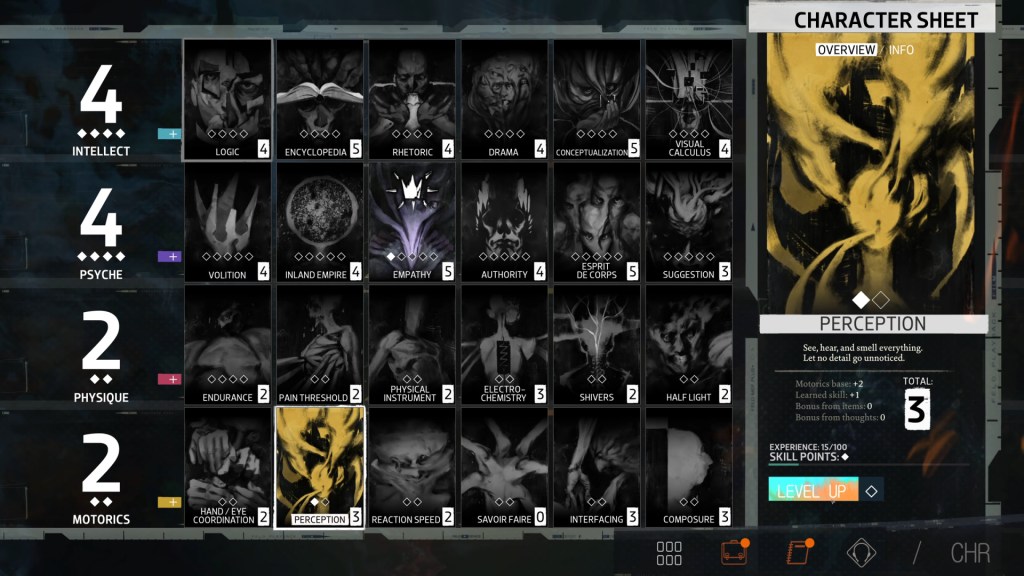
Have you played Disco Elysium from the much lamented Za/um studio, dear reader? It’s one of those seminal, cult-classic games that shifted my thinking on what video games could be. It’s a mystery game but, is it, really? Even if it is, is the mystery the one presented? Is the goal to find out who killed that guy hanging from the tree in the yard behind the Whirling-in-Rags? I suppose it is, but only up to a point. When playing it, you quickly meet and pass that point, much to the frustration of your ever-suffering partner, Kim Kitsuragi. Psychologically freed of the mundane requirements of your character’s job as a police detective, you can finally get to work on the real mystery; finding yourself. In many ways, the game is a protracted character creation session. You have to do everything from defining his political and romantic persuasions, coming to understand his opinions on art, exploring his relationship with vices of all kinds to just figuring out his name. How does the game handle these revelations? Well, largely through the personification of various aspects of your Detective’s personality. These take the form of his stats, Intellect, Psyche, Fysique and Motorics and the various skills associated with them. They speak to you, often in deranged or idiosyncratic voices representative of their own, niche fragment of his personality, and try to get you to look at the world from their highly rarified perspective or to act based on it.

It’s a unique game. It’s also a unique experience that left me with so many interesting thoughts and questions. One such question was, could you make a TTRPG out of this? The answer is, you can certainly try.

After the Mind…

The Character Sheet screen from Disco Elysium. It shows each of the four main stats, Intellect, Psyche, Physique and Motorics and all of the skills that are associated with them in a grid on a black screen with white text.
The Character Sheet screen from Disco Elysium. The TTRPG stats are not as complicated as this.

Last night, I got together with four other members of Tables and Tales to play a session of After the Mind the World Again by Aster Fialla. The front cover of the game uses the tagline, ‘A murder mystery role-playing game.’ This is not an inaccurate description. However, I feel like the subheading on the next page is getting closer to the facts:

A Disco Elysium-inspired murder mystery TTRPG about a
detective and the voices in his head

In this TTRPG, the inspiration comes not from the fascinating world or the city of Revachol, it doesn’t come from the richly drawn characters of the video game, or even its ubiquitous politics. It comes, instead, from the essentials of the gameplay. In other words, the shit that’s going on in the Detective’s head and how it affects the world around him. You see, this is a GMful game that requires five people exactly, one of which is the lone player with the other four acting as GMs. Each GM represents one of the four stats from Disco Elysium, Intellect, Psyche, Fysique and Motorics. They are collectively referred to as the Facets. One of their responsibilities is to describe various features of the world the Detective moves through. Intellect has responsibility for nerdy people, art pieces, journals, etc. Meanwhile, Fysique gets stuff like buildings, a good strong state, and brawny folks.

At the start of the game, the player comes up with a name, pronouns and presentation for their Detective, as well as their role (they might not be a cop, but a PI or an insurance adjuster or something else.) Each of the Facets also gets a turn here, though. Psyche gets to describe the Detective’s face, while Motorics comes up with aspects of their style and an unusual object in their possession, for instance. I found this very fun, as did everyone else at the table, I think. I even commented that having others make your character for you in other RPGs could be just as fun!

Once that’s done, each of the Facets answers a couple of questions designed to form a baseline for their relationships with other Facets at the table. After the Mind the World Again is Powered by the Apocalypse, so this sort of character building question should be familiar to anyone who has played a game like that before.

Then they get started making the Neighbourhood. You go around the table, starting with the person who most recently played Disco Elysium, and get everyone to answer one of the five questions presented in the book that should give you an idea of the type of area this murder has taken place in.

Once you’re done with that, the Detective tells us a little about the victim and then each of the Facets introduces a piece of evidence from the crime scene. Intellect tells us about any Prior knowledge that’s relevant to the situation, Psyche describes a Person of Interest at the scene, Fysique comes up with a Landmark, in this case, where the murder occurred, and Motorics gets to reveal a clue, something tangible at the scene.

From that point, the Detective starts the investigation, describing what they are doing in the fiction, triggering particular Moves, using the Facets’ stats to make rolls and making Deductions in an effort to solve the murder. This is in line with the Detective’s Agenda:

  1. Explore the world to its fullest.
  2. Make the most of your Facets.
  3. Play to find out the truth.

This is complicated by the fact that each of the Facets wants the Detective to act in different ways, offering sometimes conflicting options and sabotaging each-others’ efforts as they try to have the greater influence on the sleuth and the investigation. Facets’ stats can be boosted or reduced in various ways, often by the actions of the other Facets. Its important to note that the Facets’ Agenda is not focused on solving the murder, rather than constructing an interesting experience:

  1. Create an intriguing world for The Detective to explore.
  2. Highlight the differences between the Facets.
  3. Play to find out what happens.

The Detective investigates, and the Facets Declare Evidence as particular features are described in the world. It’s up to the Detective to combine two pieces of evidence to Make a Deduction. When it comes to that point, they ask the Facets for explanations as to how they fit together. Whichever Facet’s explanation is chosen is the truth and the Facet gets a +1 to their stat, while also getting the opportunity to reduce the stat of another Facet by the same amount.

The investigation is structured into a Deduction Pyramid, which is split into four tiers. On the bottom tier, there should be eight pieces of evidence. These should be combined when the Detective Makes a Deduction so that, you end up with four Minor Deductions on the next tier up. These Minor Deductions should then be combined to come up with two Major Deductions on the penultimate tier. Finally, those Majors need to be combined to come up with the Solution to the murder, sitting right there at the top of the Pyramid.

There are several other mechanics in the game, including one to ensure that the Detective does not simply always choose the explanation of the same Facet all the time, which is clever. A Facet’s stat cannot go above +3 or below -1. If that does happen, the Facet gives the Detective a Condition and goes back to the default value of 1.

…the World Again

A screenshot of the aftermath of the Detective from Disco Elysium punching a twelve year old kid. The scene is in the yard of the Whirling in Rags hostel. A man in a green jacket and yellow flares stands over a prone kid who he just punched. Kim Kitsuragi, dressed in an orange jacket and brown baggy, tapered trousers looks on.
A screenshot of the aftermath of the Detective from Disco Elysium punching a twelve year old kid.

None of us had ever played a game quite like this one before. Obviously, some of us had played PBTA games in the past, so the mechanics were nothing frighteningly new. At points, I even felt echoes of a game of Avery Adler’s The Quiet Year that most of us played last year as we took turns describing the world around our Detective. That Detective was an amateur sleuth named Bruce with a fabulous moustache, a flight jacket, an obsession with whiskey and a curious ability to identify any wooden model aircraft he might come across.

But, sharing GMing duties with three others at the table is a unique and sort of chaotic experience. At the start, it’s actually a little difficult to get into gear. I was playing Motorics and I found I had to be constantly checking my playbook sheet to remind myself what features of the world were within my domain, what my GM Moves were and when I should use them. There are features in there that you might not expect so you have to watch it and you can’t use your GM Moves just whenever. Since all four of us Facets were feeling like this, it kind of stuttered into life as a session, once the character creation bit and the initial set-up of the mystery were done. Meanwhile, Bruce, played ably by relative TTRPG noob, Jude, had to come to terms with the fact that, when it came to any of the really important decisions, he had to give up control and ask the Facets for options before settling on one version of the truth or selecting a course of action.

As we got into the flow of it, though, and as some of us became more lubricated by the liberal application of fine Spanish lager, we found the conversation that was the game began to come much more instinctively. We were interacting with the mechanics and deliberately fucking each other over for stat points, while Bruce began to explore the small, dead silent village of Battersfield and investigate the murder of local baker, Barbara Devons. Evidence has been declared in abundance and two deductions have been made! Bruce managed to finally make it out of the Bakery to explore the office, the bare flour cellar and even the gay bar across the road. Unfortunately, we had to leave the case unsolved after the four hour session. Hopefully we’ll be able to pick the trail back up again soon.

We ended up having a really fun time with After the Mind the World again. The stand out scene for me was when Bruce was interrogating Jenny at the crime scene and all four GMs jumped in to answer in particular ways that they thought reflected their own domain within the one NPC. It worked surprisingly well, even though I’m not sure that’s how it’s supposed to work at all.

I would say that there is no way to play a full investigation in a single three hour session without rushing through scenes and maintaining the sort of laser-focus that Harry Dubois does not exemplify in any way. The character creation and making the mystery section took over an hour alone before Bruce ever rolled a die in anger. If you’re going to give it a go, plan it for two sessions.

Do you think you would like to give this game a try, dear reader? Or would you rather go back to Martinaise and collect some tare in a plastic bag while pondering that old wall again?

Gaming Resolutions 2025

New Years’ Resolutions

‘What do I want to change about myself?’
That’s the question I think most people are trying to answer when they come up with their New Years’ resolutions. The answers? Invariably, they are something like, I want to lose weight, I want to be healthier, I want to learn a new skill, I want to pick up a good habit, I want to read more, I want to watch less TV. Right?

For me, this kind of thing rarely works. The failure has little, if anything, to do with the challenge itself, usually. It’s about the arbitrary nature of it. You decide to make this change on New Years Day because its a new year, not due to any external or internal catalyst. To me, it robs the resolution of the weight of a meaningful promise to myself. And it’s not just me. By the the second or third week of January, the ruins of broken and abandoned resolutions litter the landscapes of our lives.

So, here’s another question, that you might be asking at this stage?
‘Why are you writing a blogpost entitled “Gaming Resolutions 2025” then, Ronan?’
It’s a very good question, dear reader, and you deserve an answer. To answer, I’m going to examine my gaming resolution of 2024. It was, in fact, my only resolution. At the close of the year I had been working on a Resistance System game for a few months. It didn’t have a name but the idea was that players would play magic users in the modern era. They would form a party and work together to achieve certain goals for their secret magical society while also attempting to outdo each other in power, reputation and knowledge. The central mechanic was centred around sacrifice and I was going to design Fallouts appropriate to that. I’d come up with some classes, skills, domains, resistances and the idea for unique mechanics by December 2023. So, my resolution was to finish working on that game and move on to the next one. That was, pretty much, the death-knell of my work on that game. I think the last work I did on that was in April, 2024. And that work was token, cursory at best. One thing I know for certain is that that promise to myself was too big. The game was too big, the amount of work it demanded of me was too much and the prospect of doing it was a little too stressful.

So, instead, this year, I am going to commit to getting a bit better at certain things, instead of committing a lot of time and effort to complete a project I didn’t even really know how to start. And these are all things that I have been thinking about for some time, stuff I have wanted to implement for a while to improve my play and the games I am involved in. So, it doesn’t feel so arbitrary.

So, without further ado, here are my…

Gaming Resolutions 2025

  1. Make those stars sparkle and make those wishes come true: I was first exposed to Stars and Wishes this year when I took part in my first Open Hearth games. For the uninitiated, at the end of a session, a GM might ask their players for their Stars, i.e. stand out moments, moves, characters, players etc. and Wishes, in other words, what they would like to have seen happen in the session, what they wanted more of or less of or what they would like to see in future sessions. For a GM, this is an incredibly useful tool. It allows you to see what your players like and what they dislike. But, I find, too often, I don’t always re-integrate the stuff that came up in players’ Stars and Wishes. And I know, for certain, that when I do manage to apply what I learned from feedback, it has made my games better. So, how am I going to do this? I have an idea, that I literally just came up with, to create a spreadsheet to record each player’s Stars and each player’s Wishes from every session of every game. I’ll add in some columns to record potential ways to add more of the good stuff and ways to fix the problems that were revealed. Another column will summarise players’ reactions to the solutions. If it needs more tweaking, another column will detail that. I think this could be an invaluable tool to improve my games and will be there as a record so I don’t forget.
  2. Brighter stars, wiser wishes: Sticking with the Stars and Wishes theme, I’d like to get more useful feedback from it. One of Tables and Tales’ fantastic founding members, Shannen, used a few methods to get more valuable feedback from her players in a game earlier this year. She requested feedback through DMs on our Discord. Why? Well, most people are pretty nice, actually. They tend to not want to offend anyone or say something in front of a group that might embarrass somebody. So, if you take the process away from the table, they might be more likely to tell you what they really think in private. We were just discussing this last night and, along with that, we all agreed that Stars and Wishes in the Discord chat for the game is way more valuable than having people just tell you them at the end of a session, when players are often pushed for time, or before they have had a chance to think about it and provide something really useful. So, my second resolution is to get written and private Stars and Wishes from now on.
  3. Summaries in the chat: I don’t know why I don’t already do this for every game. It proved pretty useful in the Blade Runner game I ran earlier this year. In that one, I had a single document that I updated after each session so the players could easily keep track of what happened session by session. I always write up a summary after every session anyway, so taking the extra step to share it with the players is obvious really.
  4. Take bigger swings: As a player, it can be tempting to take the safe route. After all, you don’t want your precious little guy to get hurt, right? WRONG! I have decided that it is far more interesting if your character makes the decision to put themselves on the line to save a friend in dire need, or to make the foolish decision to prioritise monetary gain over their own safety or to just do something cool instead of something sensible. I don’t necessarily think this style works in every game (I’m thinking of our current game of the One Ring, for instance) but where it does fit, I think it’s far more rewarding.
  5. Get out of my comfort zone: I have a type; the gruff voiced, slightly grizzled veteran. That’s who I’m playing in two different ongoing campaigns right now and I am beginning to think I’m predictable. I don’t always play that, but it happens often enough that I can recognise it as a pattern. So, I have decided to make a conscious effort to play other types of characters. I am convinced it will lead to more fun and surprising experience for me and hopefully for my fellow players.

What about you, dear reader? Do you have any habits you want to break or strings you’d like to add to you role-playing bow? Let me know in the chat!

And finally, Happy New Year! Here’s to many more sessions and great experiences around the gaming table in 2025!