
The Sutra Continues
This is the sixth in a series of posts on the Sutra of Pale Leaves, the Call of Cthulhu campaign set in 1980s Japan. Go check out my previous posts on the subject here.
Cyberspace, Sort Of
As usual, SPOILERS AHEAD! If you want to take part in Wonderland as a player, go read another post! I’ve got loads. If, however, you want to play as Keeper, stick around. You might find this useful.
Wonderland is probably the most old-fashioned horrific scenario presented as part of the Sutra of Pale Leaves so far. It’s got body horror, mutilation, mutation and teens in danger. And that’s just what happens in the real world. But this scenario centres around a computer game that is more addictive than World of Warcraft (just speaking from personal experience there.) Of course, that’s because it connects the real world to an aspect of the Pale Prince in the form of 不思議の国 or Wonderland, as in Alice in… The background section explains how Charles Lutwidge Dodgson, aka Lewis Carroll, came in contact with the Sutra while out of his gourd on opium, causing him to pen the Alice books, which gained a fanatical following in Japan. So much so, that, decades later, a talented computer scientist, named Nishikado Kazunori came up with a new game, named Wonderland, a MUD in which players could reimagine themselves as whatever they wanted and interact with each-other and the White Rabbit, the Cheshire Cat, Tweedledum and Tweedledee and all the other characters from Carroll’s novels. Of course, the longer they spent there, the more they would be consumed by the Prince himself, leaving nothing but a shell of a body behind in the real world for the Prince to inhabit and do with whatever he pleased.
There are a few other weirdnesses here. Like, if you have spent enough time in Wonderland by accessing it through the game, you don’t even need a computer to access it anymore. Instead, you just need to stare into a mirror and you will be transported. Also, if you’re juiced enough by Wonderland and the Prince, the physical persona you take on in the game can become real, in a most disturbing way. As well, the location of the studio where the game is being made is important, in a spiritual, and occult sense to the power behind the game, as it occupies the same spot where an old, blasphemous sect had their temple before it was burned down by some heroic monks.
Anyway, this is all just the setup to this lengthy scenario. Wonderland takes up about 43 pages and provides a plethora of new NPCs, locations, and rules. There’s a lot to take in, but if you understand the opening situation, you should be good. It’s worth noting that much like The Pallid Masks of Tokyo, this scenario would prefer if the investigators had a particular type of occupation. In Pallid Masks, it was cops, in Wonderland, its teachers. This makes sense when you consider the inciting incident.
Face-off
So, as I mentioned above, this one’s properly horrific. Just to prove it, author of Wonderland, Andrew Logan Montgomery, starts us off with a high school kid carving his own face off with a piece of broken mirror in the school toilets. If the PCs are teachers, they will be among the first on the scene when the screams ring out across the campus. Immediate sanity rolls. Now, that’s the way to start a Call of Cthulhu scenario! This is the first of the hooks provided. In fact, it’s a well thought out section to play, rather than just some read-aloud text to set the PCs on the case. We also get a couple of Lore Sheets here, one on Japanese Schools in general and one on this school in particular. The general one was clearly written by someone who has spent significant amounts of time in both the classroom and the teachers’ room in a Japanese high-school. It all rings true and jibes with my own experiences as an ALT on the JET programme. The one on the Kagaminuma High School is short but provides a good overview of the type of school it is and the students that attend it.
If the players are not playing teachers, they only find out about this bloody example of self-mutilation after the fact, probably from their confidant, such as the Fed, the Abbott, or the Heiress, all described in the Campaign Background chapter at the start of both this book and the previous one. Hook Four: “An Electronic Opium…” brings back Madam Inaba, the fortune teller from the first scenario in the campaign, Dream Eater, which is cool.
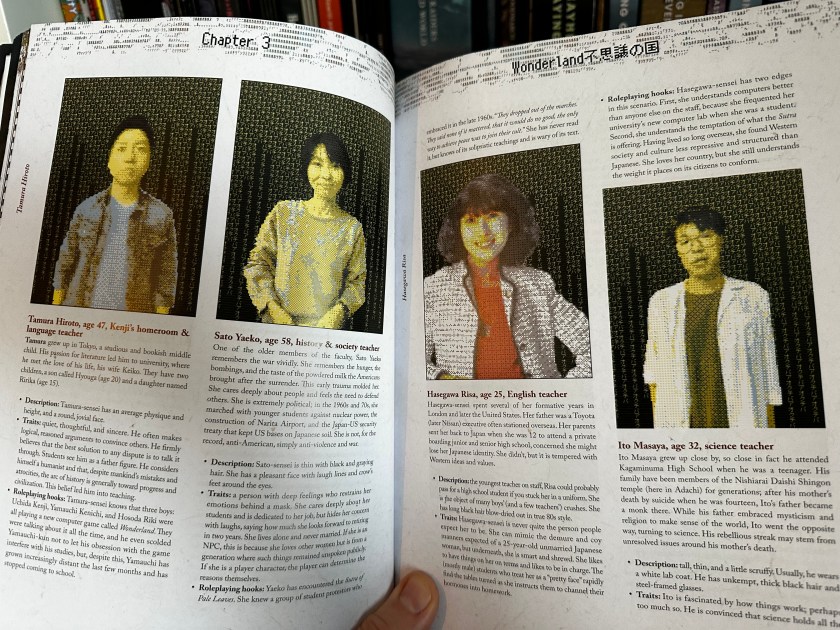
I can’t emphasise enough how much easier this scenario is if your PCs are teachers. The author, Mr Montgomery, even provides us with a number of well-drawn teacher NPCs that can double as PCs to get you started quickly and easily. But what I really mean is that in many instances, where other investigators would need to make some sort of social roll just to get past the door in many sections, a teacher need not roll at all. This checks out to me. The role of a teacher in Japanese students’ lives is much greater than in other countries. It is not unusual for them to make home visits to talk to parents, in fact, it’s part of the job. The homeroom teacher is very familiar with all of their students and is there to support them in all sorts of ways. There is also a level of automatic respect attributed in the culture to a teacher, which allows them a little more leeway than the average citizen, although I think that’s taken to extremes in some instances in this scenario.
Anyway, back to the plot. This kid is sent to hospital and this is where the mystery begins. It is assumed by everyone that this is Uchida Kenji, since he was wearing that boy’s uniform. However, it’s actually Hosoda Riki, his “friend.” Kenji convinced Riki to swap uniforms and then to mutilate himself, with a little help from the Pale Prince and the Wonderland game, which has turned his mind to Swiss cheese. With this cover, Kenji disappears fully into the game, himself, becoming his own avatar, a sort of big wolf. Meanwhile, his body is occupied by the Pale Prince, who hangs out in the offices of White King Studios, the makers of Wonderland.
White Rabbit
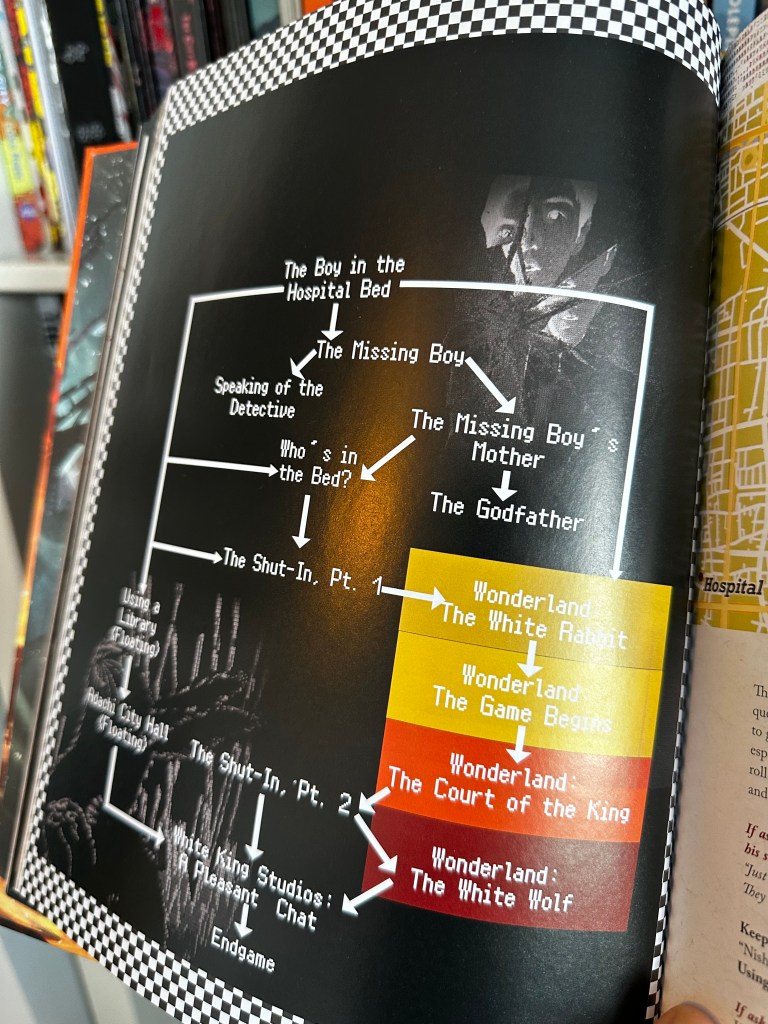
This is the investigators’ white rabbit. They’ll follow the trail from the incident in the school to the other missing boy, eventually figuring out that everybody has them mixed up. They are very likely to figure out that Kenji, quite apart from his current supernatural status, was a psychopath all along, and that he tricked his friends into playing the game until they were largely subsumed by the Prince. Not to mention the old face-carving shenanigans.
Another of Kenji’s friends, Yamauchi Kenichi, (I’m not sure why it was decided to give this kid a name that was so close to Kenji. It confused me while reading the scenario, constantly. You just know it’s going to get mixed up in players’ heads too) has become a shut-in, so addicted has he become to Wonderland. In fact, he no longer needs the computer to access it. Instead he can just stare into a mirror and lose himself for hours. We get another Lore Sheet here. This one’s about Hikikomori, the ever deepening phenomenon in Japanese society of people withdrawing entirely from it to occupy a single room and interact with no-one, often playing video games addictively. This lore sheet admits the slight anachronism here, as the term was not coined until the 1990s. Still, the phenomenon was present even in the ‘80s. Obviously, most instances of it were not caused by the encroaching influence of some elder god in the form of a memetic virus, however, as it was in Kenichi’s case. Kenichi is a very tragic case. The investigators are likely to learn that he feels he’s lost most of himself to the Prince. His story is likely to end with him taking his own life. It was something a of a shock for me to read that this is likely to happen, no matter what the investigators do. I don’t believe I would run it this way. To be fair, though, there is an optional section near the end of the scenario, “The White Wolf.” In it, a brave investigator can enter Wonderland to rescue Kenichi and, hopefully, bring him back to the real world.
Montgomery is really delving into some of the darkest social phenomena in Japan here. We also discover, as the investigators follow the trail, that Riki’s father has a crippling gambling addiction, which he satisfies by playing pachinko. I only ever entered a pachinko parlour once, out of curiosity. Sensory overload is the best way to describe the experience. All those tiny little metal balls being propelled around the insides of hundreds of machines makes an almighty clangour, the lights flash and the faux silver of the interiors gleam, the stink of tobacco smoke and old coffee. I couldn’t get out fast enough. But many people are hooked on it and they often go into debt with some unsavoury characters to feed their demon. That’s where Mr Goto, the local yakuza oyabun comes in in this scenario. He likes to consider himself a servant of the people in Tokyo’s Adachi Ward. If the PCs are teachers, he sees them as fellow public servants, and so treats them as colleagues. He’s one of my favourite characters in this scenario. He’s well-drawn and can be manipulated if the investigators recognise how to push his buttons.
Through the Looking Glass
Eventually, one of the investigators is likely to log into Wonderland. Obviously, this being the mid-eighties, this is easier said than done. You need a compatible computer with a modem and internet connection. Such things were few and far between back then. But eventually, they’ll probably find a way, maybe even in Kenji’s house where it’s all set up and ready to go. However, it is unlikely that more than one of the PCs will be able to do this at a time, unless they manage to find a number of internet-capable machines to log into at once. The scenario is written with the assumption that only one investigator is taking the delve. I think I would run it differently, however. This is a lengthy portion of the scenario and probably the most fascinating aspect of it, why not involve any and all players who want to get in on it? There are already several minor anachronisms in this scenario, so why not?
Although Wonderland is a text based game, they soon find themselves sucked into another world, which they can experience through their own senses. They will find themselves on the other side of the looking glass and interacting with the honest-to-goodness White Rabbit. When they realise they are using their own skills to make checks, even in the game-world, they will be confronted with a sanity-defying fact… They, themselves, are fully immersed in Wonderland. They will be able to conjure items and effect changes to their surroundings similar to the way they were able to in Dream Eater. But there are, of course, negative consequences to Wonderland exposure, on top of the effects of Exposure points, even. The game will begin to seep into their real lives and eventually they will be utterly consumed by it, leaving their body a shell in the real world. I’m honestly not sure that this campaign needed yet another set of exposure/infection/insanity rules for the Keeper to keep track of. I feel like all of this could be dealt with by the existing sanity rules, with a little creativity.
The trip through Wonderland will lead them inexorably to an audience with the White King himself. Little do they know it, at this point, but this is Nishikado Kazunori himself. After this, they get ejected from Wonderland.
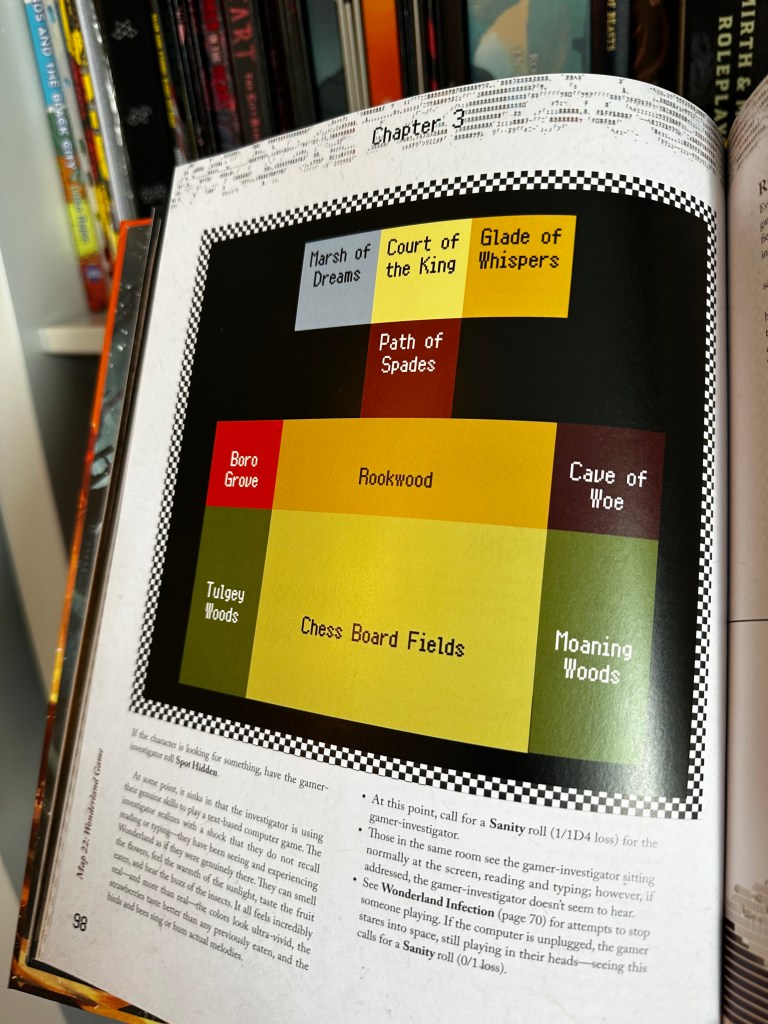
I generally like this section of the scenario. It’s well described and I feel like it would be fun to see the players’ reactions to it. But I do have an issue. You are provided with a bare-bones “map” of the world that includes whimsical locations like the Cave of Woe, the Moaning Woods, etc. But you can only interact with a few of them. The experience is quite railroaded from the Chess Board Fields to the Court of the King allowing for no deviation. Those other areas are not even described in the text.
Of course, it’s always possible the PCs won’t play Wonderland, considering what they have discovered about the game so far. In that case, we are provided with a short section on what the Keeper should do… We’re given the option of simply going with it. The scenario will lose something if no-one decides to enter the game, but it can still be brought to a satisfying end. The other option is to kind of… force them in. This is supposed to work only if a PC has accrued a number of Exposure Points already, maybe in the course of other scenarios. In that case, simple proximity to a computer running the game will affect them, sucking them in in their dreams.
Checkmate
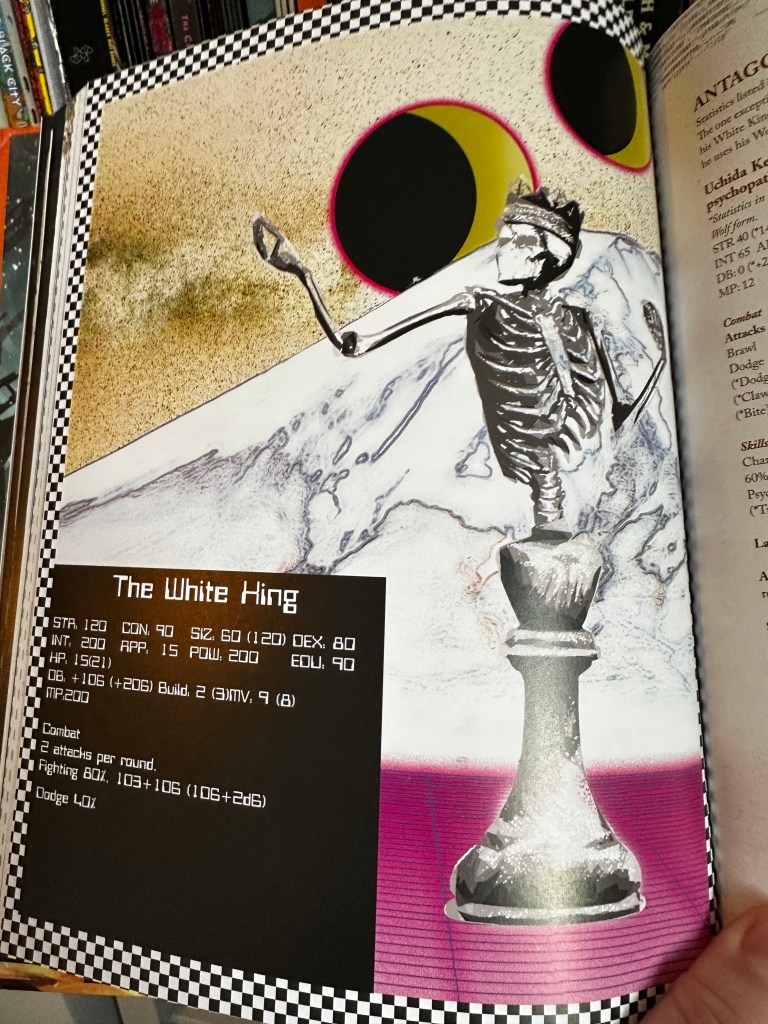
The finale comes down to a physical confrontation between the investigators and the White King/Pale Prince who has taken over Nishikado’s body. White King Studios is the venue for this showdown. In all likelihood, the PCs will be there to burn the place to the ground, in a fairly predictable mirroring of the events surrounding the temple that once stood on the same ground hundreds of years before. The White King begins as a diseased, but human looking man (although, he’s missing his genitals, according to the text. Not sure why we needed to know that, since it is a detail only the Keeper is likely to ever discover.) But during the final encounter, he will transform into a horrific, real-life chess-piece. He will speak like Lewis Carroll might write him, with lots of alliteration and self-satisfied word-play. Sounds difficult to play for the Keeper, if I’m honest. They’ll also find Kenji here, or, at least, his body, occupied by the Pale Prince, who acts as the mouthpiece for the White King.
Endings
Only three potential endings in this one:
- Party Wipe
- Just a Game (they solve the mystery but fail to destroy all copies of the game before its released)
- Twisted Firestarter (they defeat the White King and burn the place to the ground with all the copies of Wonderland inside.)
Conclusion
This was a long write-up dear reader, but it is one of the longer scenarios in the Sutra of Pale Leaves campaign. It is a complex scenario with a lot of NPCs, a number of events and locations and even a trip to another dimension, sort of. I have some issues with it, which I enumerated throughout. My main problems are the introduction of yet more Exposure-based mechanics to what is already a slightly bloated system and a slightly rail-roady tendency in a few places. But, in general, I’d be excited to run Wonderland, with a few tweaks.
We are closing in on the end of this campaign, now, dear reader. Only two scenarios to go! Next time, we catch up again with Umezono Kaho for the Bridge Maiden, Part Two.
Discover more from The Dice Pool
Subscribe to get the latest posts sent to your email.

 The Dice Pool