The Sutra Continues
This is the fourth in a series of posts on the Sutra of Pale Leaves, the Call of Cthulhu campaign set in 1980s Japan. Go check out my previous posts on the subject here.
Insanity
This is the third scenario in Twin Suns Rising, the first of two books that make up the Sutra of Pale Leaves Rising campaign for Call of Cthulhu. Its written by Jason Sheets.
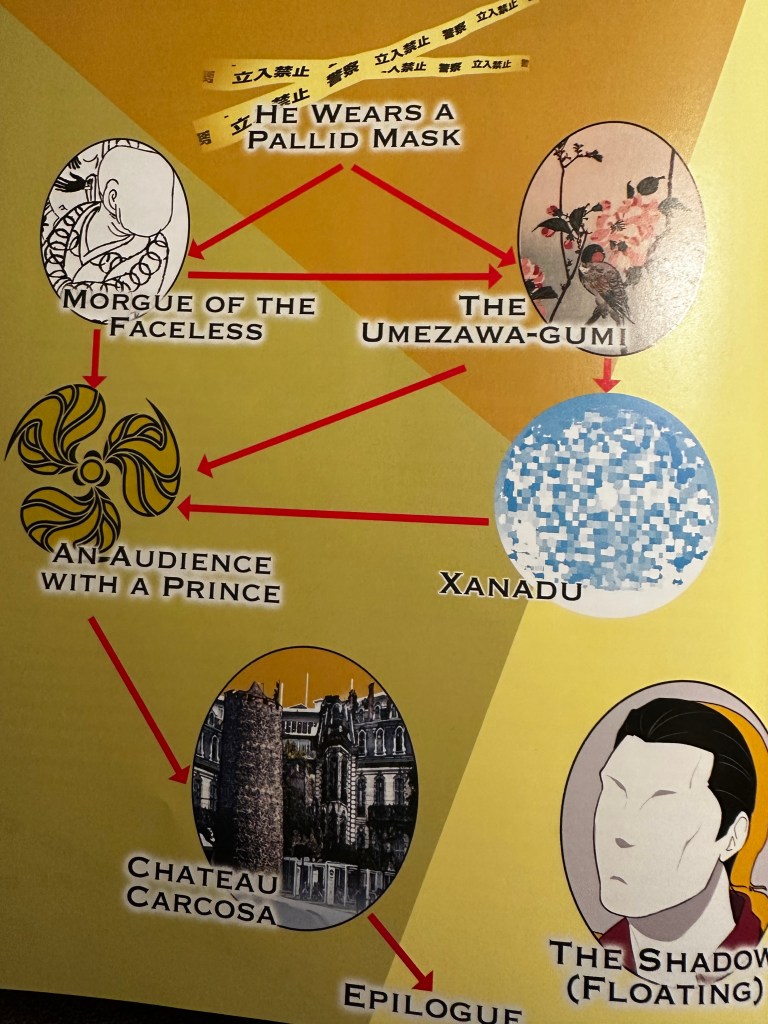
This scenario is somewhat shorter than Fanfic, coming in at only 32 pages. Its format more-or-less matches the other adventures in this book. It has a scenario flow diagram, although it is less easily identifiable in theme this time. We get a larger number of NPCs introduced near the start than in previous scenarios. The plot feels like it’s quite reliant on the actions and reactions of these NPCs and some of them act as redundancies should the more important ones meet their end prematurely. Some of them can also be used as fill-in PCs, in case the worst should happen.
WARNING! Spoilers ahead! If you want to take part in the Sutra of Pale Leaves campaign or even just this scenario as a player, you might want to refrain from reading further. I’m going to write about stuff you would rather was revealed during the course of play.
Appropriately for a Call of Cthulhu scenario, The Pallid Masks of Tokyo partially takes place in a psychiatric facility. It also involves that perennial favourite of Japanese 1980s stories, the Yakuza. Crime and insanity seem to be the two main themes of this scenario, which also makes a lot of assumptions regarding the PCs occupations. It really wants them to be cops or cop-adjacent, at the very least. We are told this in the “Involving the investigators” section, which presents three hooks. Only the first one assumes your PCs are police and we are told, if you don’t use this one it will make, “dealing with officialdom considerably more difficult.” The Campaign Background section at the start of the book told us that it was not necessary to play the same investigators the whole way through, and the Pallid Masks of Tokyo seem to actively encourage your players to switch their old PCs out for a more law-enforcement based character. Perhaps the authors did not expect any of the investigators from earlier scenarios to survive, or expected them to be assimilated by the Prince by now. After all, one of the notes presented in the opening pages of this one suggests switching out the main villain of the piece, a psychiatric patient called Yamamoto Minoru for a PC that had been taken by the Prince of Pale Leaves in an earlier scenario. I love this idea. If anything, I think it would be far preferable to using Yamamoto, but, of course, there’s no guarantee that you’ve lost an investigator in this manner so its good to have the NPC instead.
Beginnings
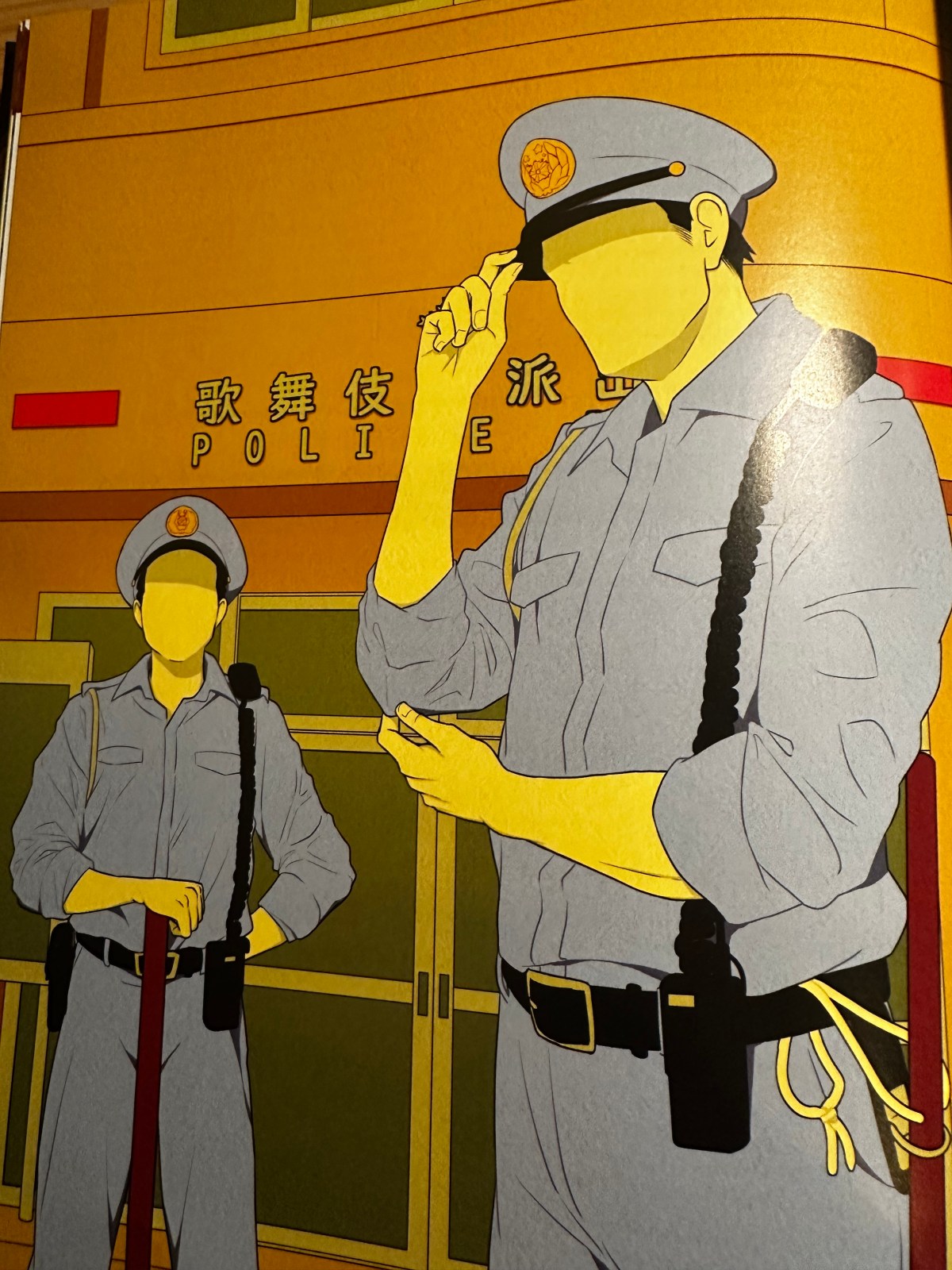
Like I stated above, it’ll be a lot easier to involve the investigators if they’re cops in this instance, because it starts with a murder scene. A body with no face has been found in a Tokyo back-alley, so, obviously, if they have badges, it’ll be a cinch to go there and inspect body and crime-scene. But there are ways around this if they are just librarians or salary-men or whatever.
Anyway, one of the beat cops will immediately tell the PCs he thinks the body is that of a Noppera-bō, a type of mythical Japanese monster with no face.
And, he’s not wrong. Yamamoto and his pal, Crazy Kazu (a member of the Yakuza) have been tattooing gangsters with part of the Tale of Pale Leaves (The manga from Fanfic.) This allows the Prince to take them over completely and all in one go. These lads have all been turned into these Noppera-bō. Kazu was the first, and he has gone rogue from his clan, conducting business of his own. Thematically, this is all great. It retains the relationship to Japanese mythology while tying it to the Mythos and the Yakuza and the loss of self and sanity.
Anyway, I love this as a starting point. It’s iconic and designed to draw the investigators in immediately.
Leads
This scenario has a very investigatory nature. Most of the rolls that are called for are in that vein and involve interrogation or detecting in one way or another. While this is true for many Call of Cthulhu adventures, the format, the theme and the major NPCs in this one add up to give it the feeling of a police procedural or an episode of the X-Files.
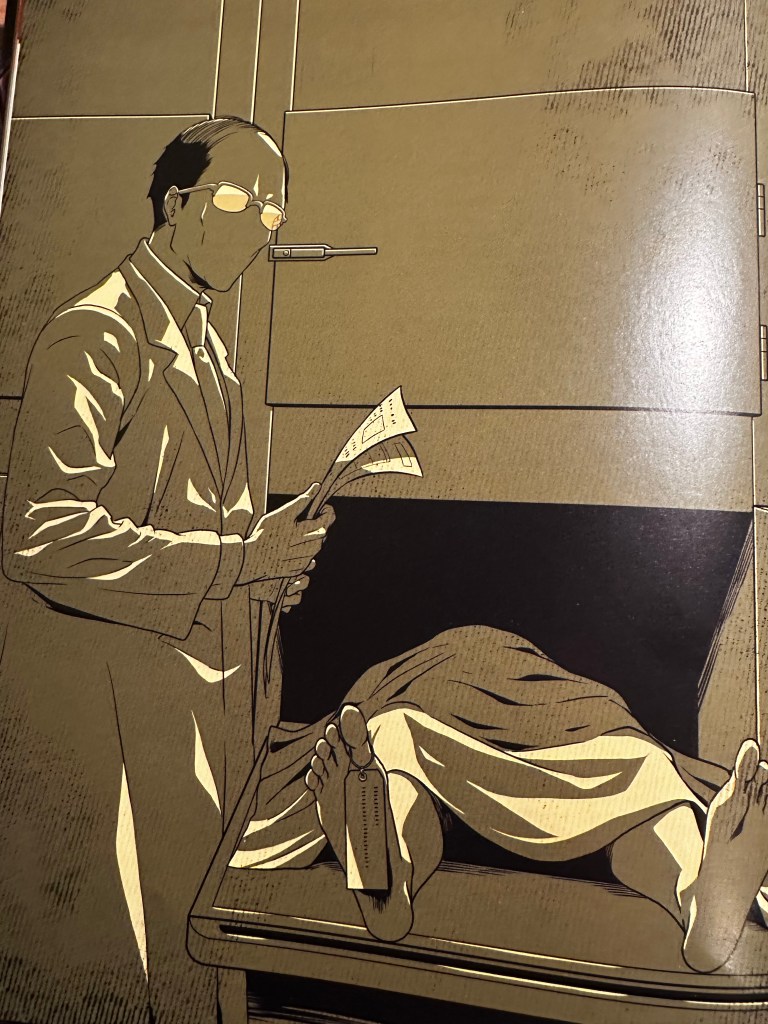
So, from the crime scene, leads can take the investigators to the morgue where they will encounter a medical examiner who is being repeatedly exposed to the sutra via the tattoos of the dead Yakuza, or to the headquarters of the the Umezawa-gumi clan, where they can question the head of the Yakuza group. There is even a scene in the nightclub, Xanadu, run by Crazy Kazu, where my former profession gets a shout-out.
…the clubbers, who include a mix of subcultures, from college students and Japan Exchange Teachers (JET) to newly minted salarymen.
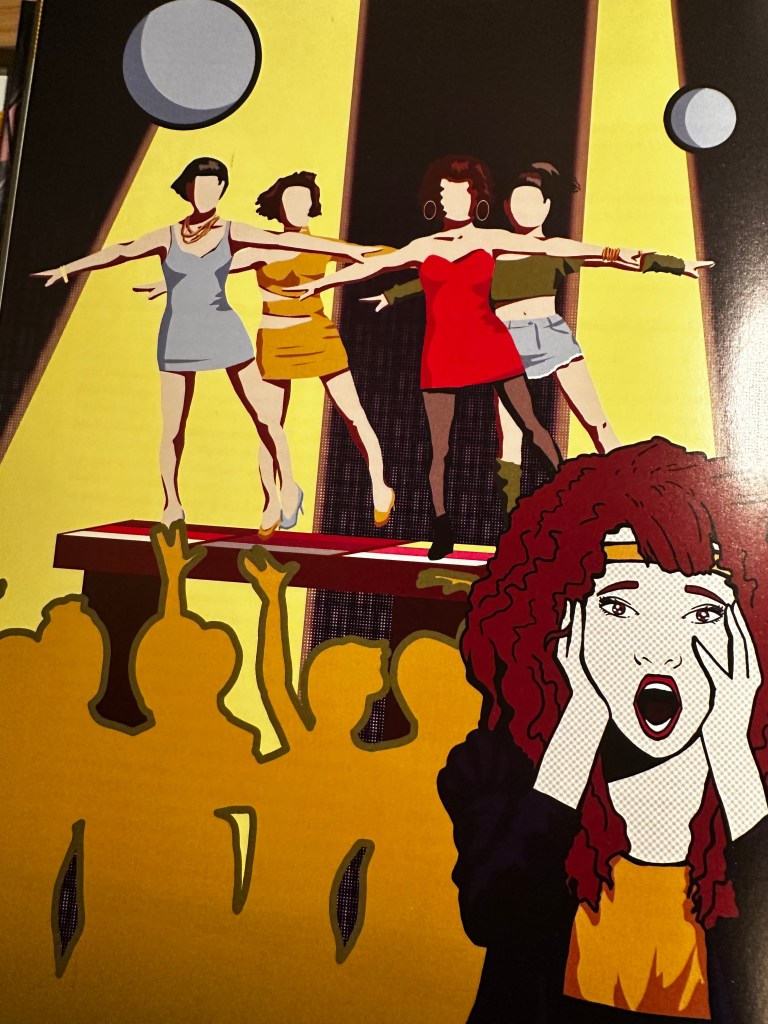
Much later than the time this adventure is set, I was in the Japan Exchange Teachers (JET) program. And it’s quite true to say that we partied a lot in places, if not exactly like the club, Xanadu, then very much like it, every weekend. (Those in the know will also remember a night-club in my hometown of Sligo in the 90s called Xanadu, in another surprising cross-contamination with my own life!) The nightclub scene, of course, is a classic staple of ’80s detective and action fiction, and this one is special. A dance troupe of Noppera-bō ladies take to the stage, constantly changing their faces, sometimes appearing without any features at all, moving to the backing track of “the Litany of Wearing the Empty Mask,” thus exposing the club-goers to the Sutra.
But eventually, they will be led to the central location of the scenario, the Tokyo Metropolitan Psychiatric Hospital Secure Unit. Here they will encounter Yamamoto or or that former PC who was over-exposed to the Sutra. In either case, if an investigator has sufficient EP themselves, they will see this person as an embodiment of the Pale Prince, on a throne, surrounded by his Yojimbo warriors, rather than the shaven-headed psychiatric patient on a hospital chair looked over by orderlies. I love this vignette, especially if only some of the investigators see the Prince in this instant. It’s possible, in this instant that those PCs might be overcome by devotion to the Prince. They could even give themselves over to become a Noppera-Bō themselves.
The Shadow
This is a special scene for the Keeper to drop into the scenario at an appropriate point. Essentially, it should act as the retelling of the classic Noppera-bō story from legends, with the PCs as the victims. Essentially, this would involve them interacting with someone who reveals themselves to have no face, only to run, looking for help from someone like a police officer who then reveals themselves to also have no face.
The Keeper would have to take notes and do some prep to make this encounter work in the context of their game. I also think that, if it were perpetrated on a full team of investigators, it would be unlikely to work the way the text wants it to. An individual confronted by this would be far more likely to run and look for help. But if you can pull it off it would be be awesome.
The scenario does give you some advice on how to run it and provides a table of Nopper-bō encounter locations and individuals who could fulfil the necessary roles. So, it’s definitely doable!
Château Carcosa
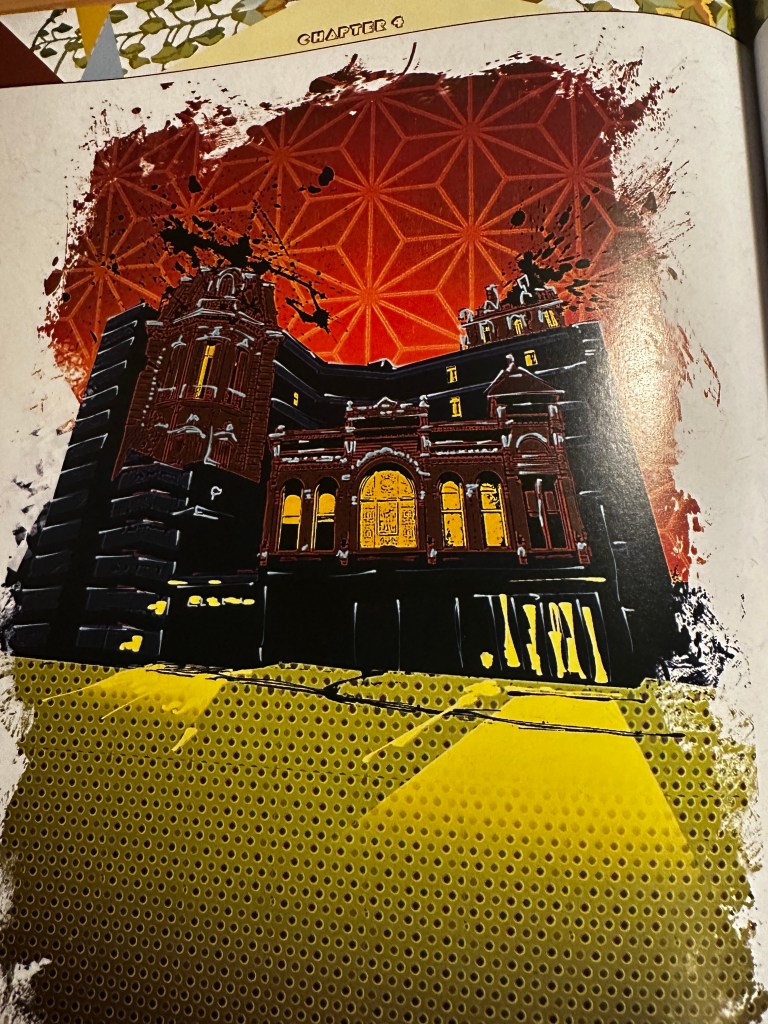
This is the location for the finale of our scenario. It’s actually the same psychiatric facility the investigators visited earlier, but transformed. Now, it’s the residence of the Prince of Pale Leaves, transplanted from Carcosa. The Royal Palace is very different from the building the PCs will remember:
The floor is polished rosewood. The scent of spring blossom fills the air, but the sweet scent occasionally shifts to that of rotting leaves. Yellow-furred bats roost in the angles of ancient roof-beams. Plaintive music, played on traditional stringed instruments, wafts through doorways, while the faint sound of laughter, and then a scream, can sometimes be heard.
From what I know of the second book of this campaign, Carcosa Manifest, this section is an appropriate pre-cursor to some of the events in the scenarios contained within that. The investigators can get a glimpse at the alien world of Carcosa through the windows of Château Carcosa, while two of the later scenarios, the Bridge Maiden, Parts 1 and 2, involve the cult building a literal bridge between our world and that dark one.
Endings
The investigators are likely to end up in three different situations:
- Defeated completely by the Noppera-bō, by whom they are utterly out-numbered in the palace. Even PCs who die in the final confrontation may, however, awaken later, as patients in the hospital themselves and might even see action in later scenarios!
- Some of them will become Noppera-bō themselves, unbeknownst to the other players, and will attempt a Noppera-bō scare (as described in The Shadow section above) on their fellow investigators in later sessions. Love this one.
- They defeat Yamamoto somehow, killing him or stopping him in some other way. In this case, the hospital immediately reverts, as do the people who had been transformed by his tattoos.
Conclusion
The Pallid Masks of Tokyo is probably my favourite of the three scenarios presented in this book. It has some great locations, fascinating and horrifying monsters and well-realised themes and motifs. I do feel like Yamamoto/The Pale Prince, could be better drawn, though. Even the final confrontation with him in the Château seems hastily wrapped up. I was expecting more from the scene in the throne room than we’re given here.
I think this is a great concluding scenario for the Twin Suns Rising portion of the campaign and a great bridge into the next part, which I will discuss in coming posts about the scenarios contained in Carcosa Manifest.
Discover more from The Dice Pool
Subscribe to get the latest posts sent to your email.

 The Dice Pool
2 thoughts on “The Sutra of Pale Leaves, The Pallid Masks of Tokyo”