Japanese FLGS Visit

Sayonara Nihon

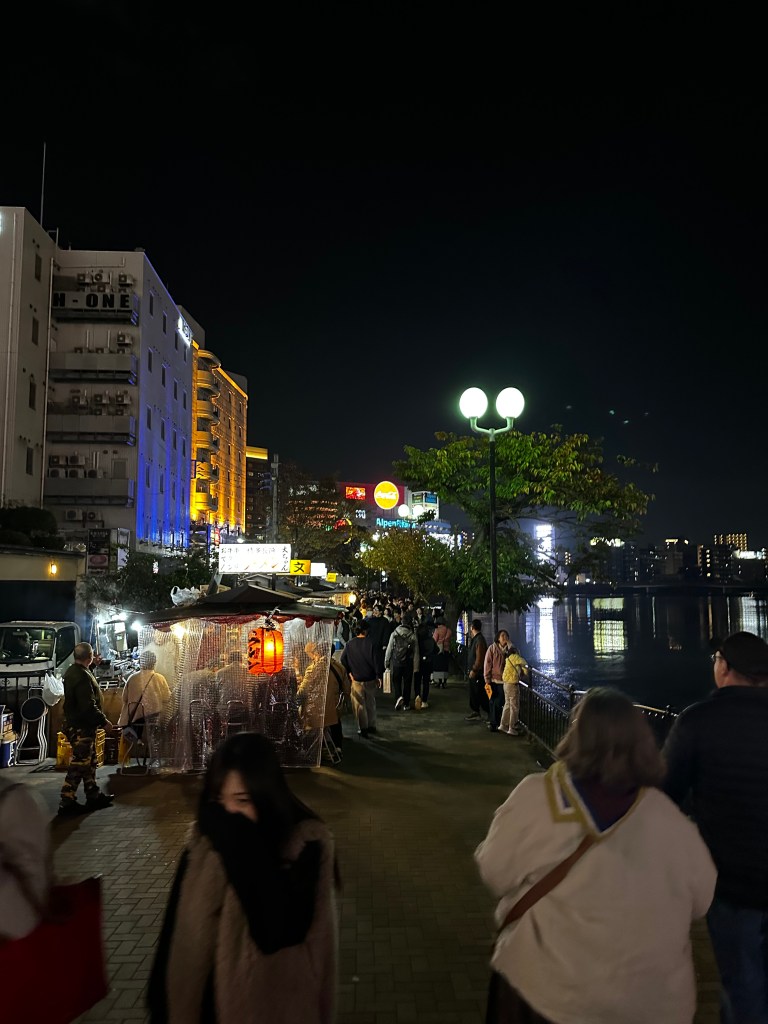
I’m still coming to terms with the fact that I’m home. I’m not fully on board with the situation, to be honest. I guess I can continue to dream that I’m back in Japan again, walking though the riverside yattai food stalls of Fukuoka, sampling the okonomiyaki of Hiroshima, slurping ramen at the counter in Oita. But it’s no substitute for the real thing. I used to live there a long time ago, dear reader, and my feeling about the second-hand experience can be summed up thusly. I have been consuming below-par sushi from a little place near my office in Ireland for years, fooling myself into thinking it was quite good, actually. But our generous friends and hosts took us out for the most affordable conveyor-belt sushi in Oita City last weekend and when I popped that first maguro nigiri into my gob, I realised I had forgotten how good it could be. I almost cried. I’ll never be able to return to that little lunchtime sushi place without the sure knowledge that they have been hoodwinking me for years.

Yellow Submarine

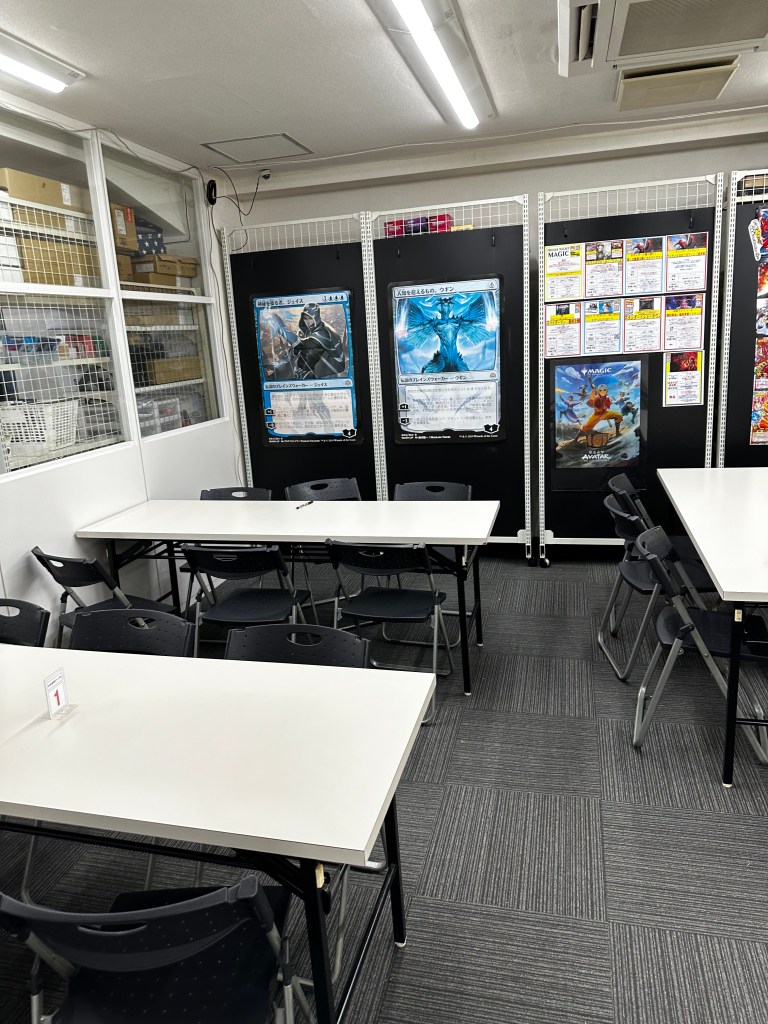
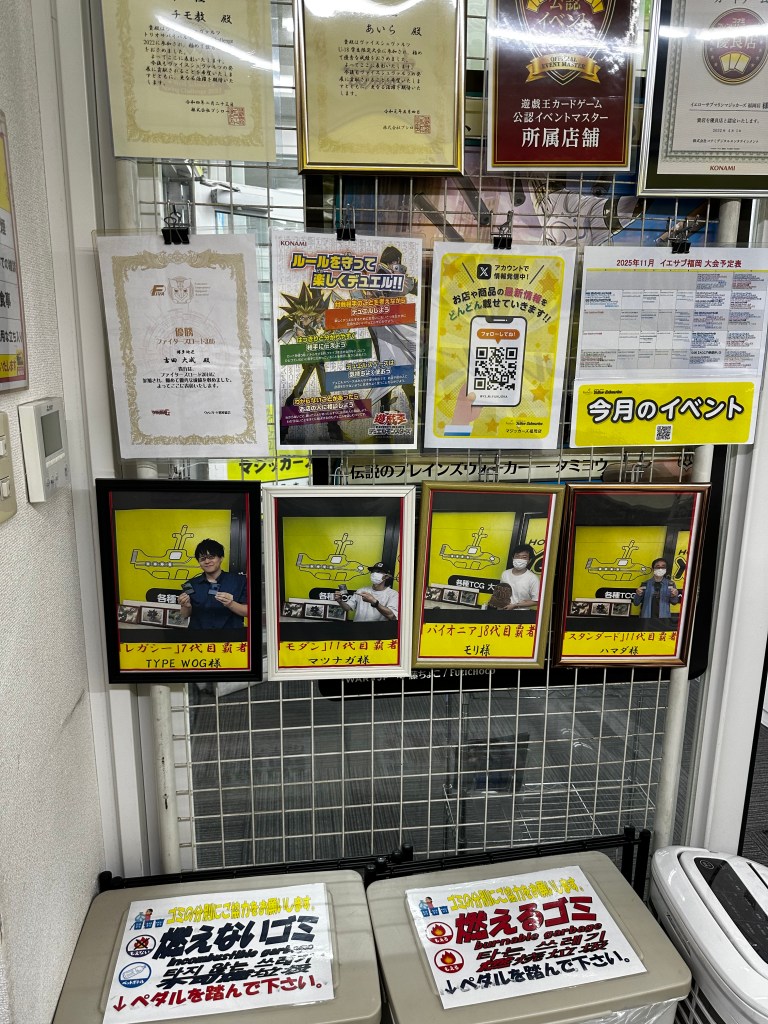
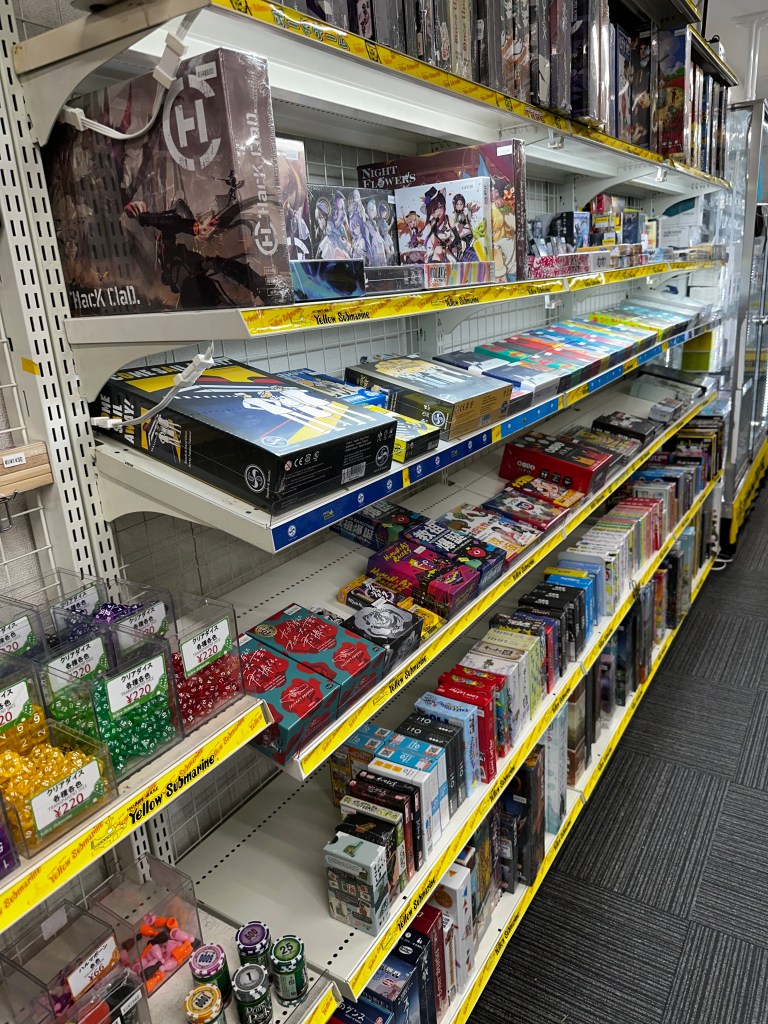
Anyway, I visited a branch of the Japan-wide chain of table-top and card game store, Yellow Submarine, while I was in Fukuoka for a couple of days. It was not easy to find! It occupied the third floor of a narrow building sandwiched in between a dentist and a beauty salon and it only opened at 12 pm, which seemed like a good idea, in fact. In addition to being, what appeared to be the only specialist store in the city, it also runs TCG games and tournaments in its decently sized play space. It was very quiet when I got there just after opening, which made it a bit easier for me to get some photos. The majority of the display areas were dedicated to glass cases filled with row after row of Pokemon, Digimon and Magic cards as well as several I had never heard of. It did have a small, but perfectly formed TRPG コーナー, or TTRPG Corner, though. Since it was so quiet, I got to spend quite a bit of time exploring it.

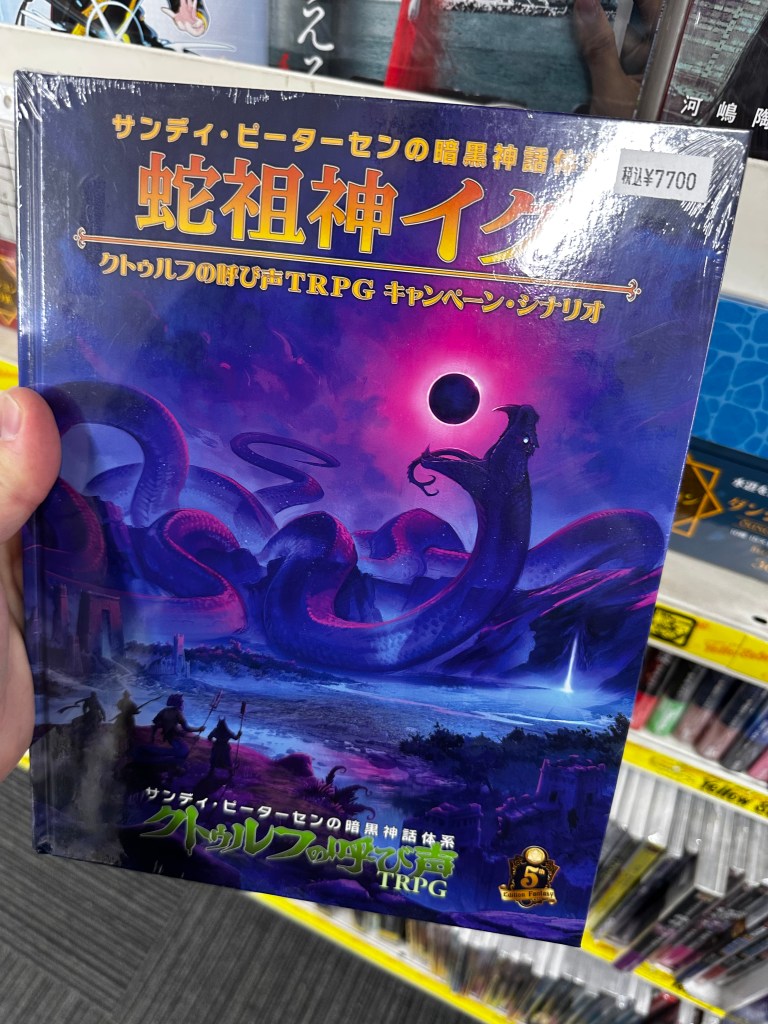
What I discovered, might, I think, surprise some Western TTRPGers. Call of Cthulhu is massive, it occupied pride of place, at eye-level (the buy-level, as anyone who has worked retail will be aware.) There were easily twice as many CoC books as there were for any other game and they looked so good. I wished I could have picked up the core book in Japanese but my suitcases were already creaking under the wait of the stuff I was taking home as it was. I did get a nice picture of the cover though. Look at that metal af artwork!
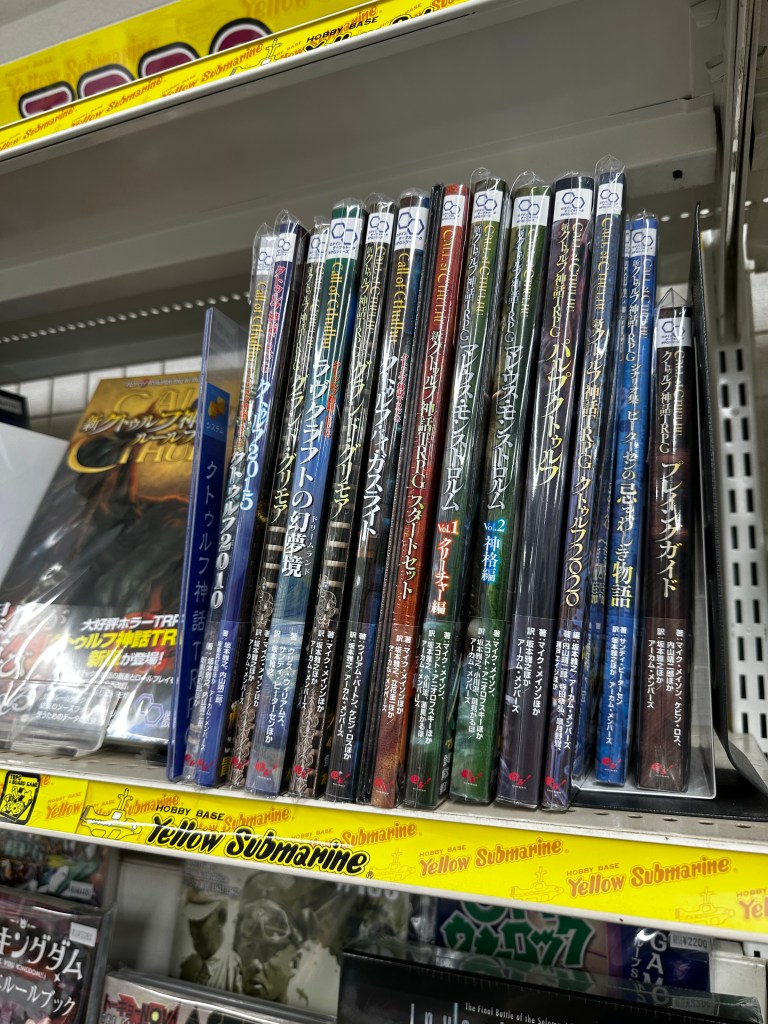
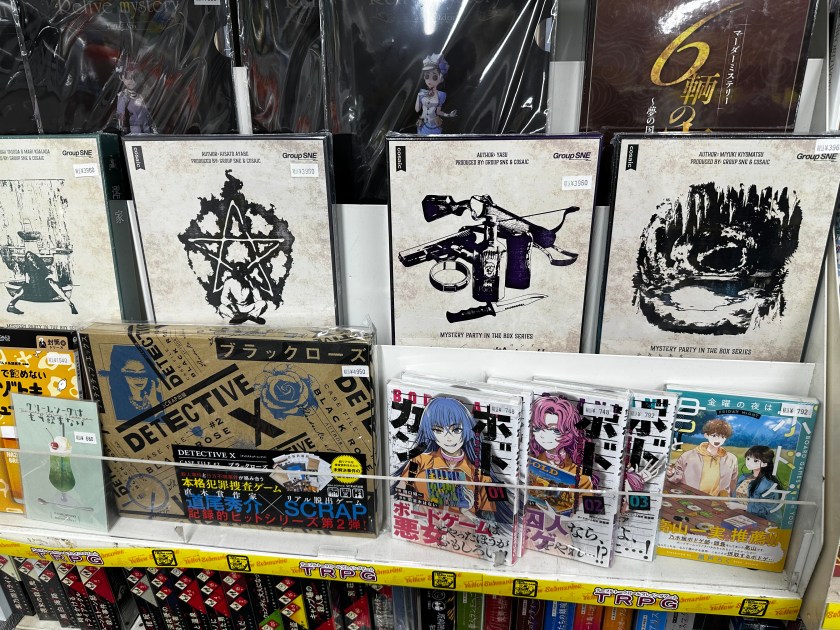
I think its a relatively well known fact, at this point, that Call of Cthulhu outsells most other RPGs in Japan quite substantially, in fact, but I wasn’t prepared for the amount of Jubensha on sale here. They were stocked in magazine racks and there was an impressive variety of them. They were not noticeably referred to by that term as far as I could tell, but I am not surprised by that. While we were in Japan, yet another spat broke out between the Japanese and Chinese governments over something relatively innocuous. Chinese people started cancelling holidays in Japan and the Japanese said they didn’t want them coming over anyway… This sort of thing goes on a lot and it’s no secret that there is generally no love lost between the two peoples who have had a troubled and violent history since the 19th century. So that’s why I was surprised to see the popularity of this Chinese LARP game format in Japan.
I think it’s also fairly well known that D&D and other such games has never done particularly well in Japan, despite numerous attempts by both TSR and Wizards of the Coast to push it. They had a massive publicity campaign for the most recent edition of the which involved this pretty incredible ad:

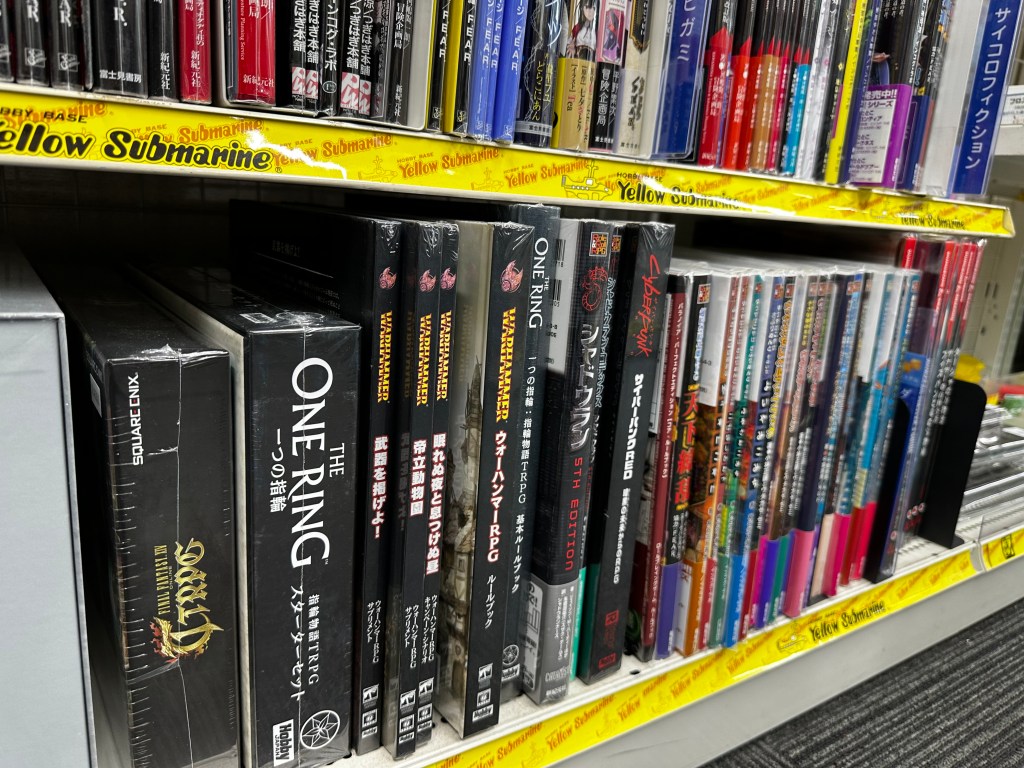
Maybe it’s doing better in other parts of the country, but in Fukuoka, 5E is relegated to the bottom-most shelf along with most of the other foreign games like the One Ring and Cyberpunk Red. Not only that, they didn’t have a single copy of any of the 2024 rulebooks. So, I’m guessing the ad campaign didn’t really work too well.
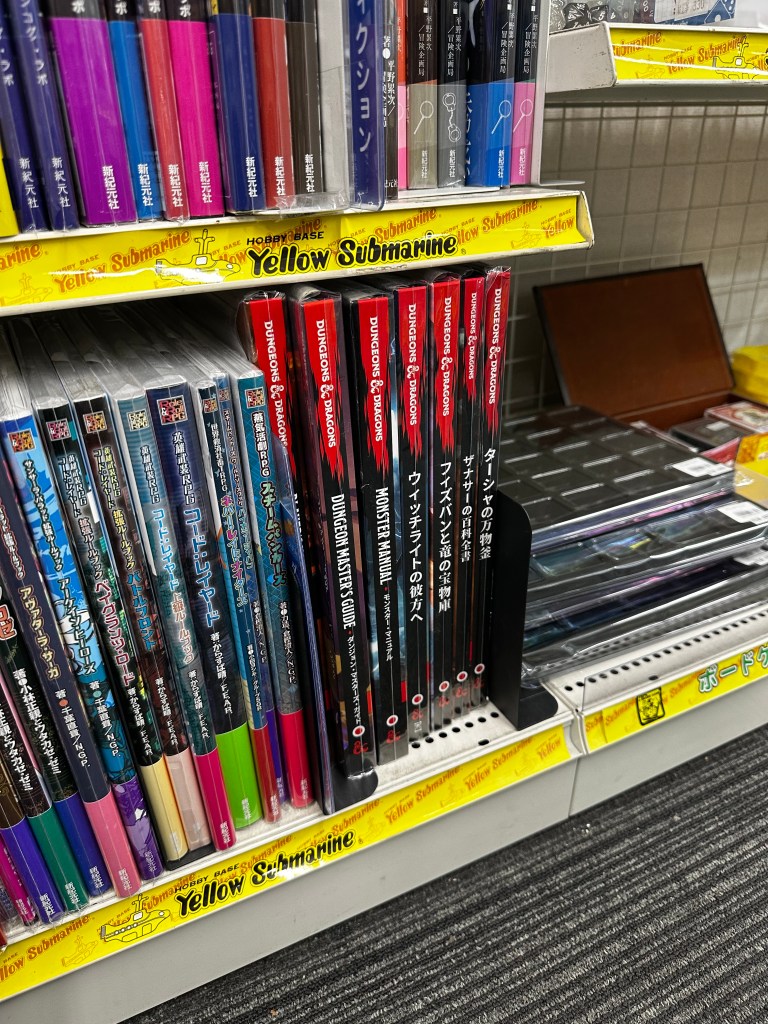
Meanwhile, the big Japanese fantasy adventure game, Sword World had a pretty generous degree of real estate on the shelves (I somehow managed not to take any photos of it, sorry!) It had a couple of editions there, the most recent of which has all the rules contained in a single tome (it usually comes in three books.) Once again, I really wanted to purchase it, but my bags objected. Luckily, it looks like there’s an English-language version in the works so I will be looking at backing that when it gets going.

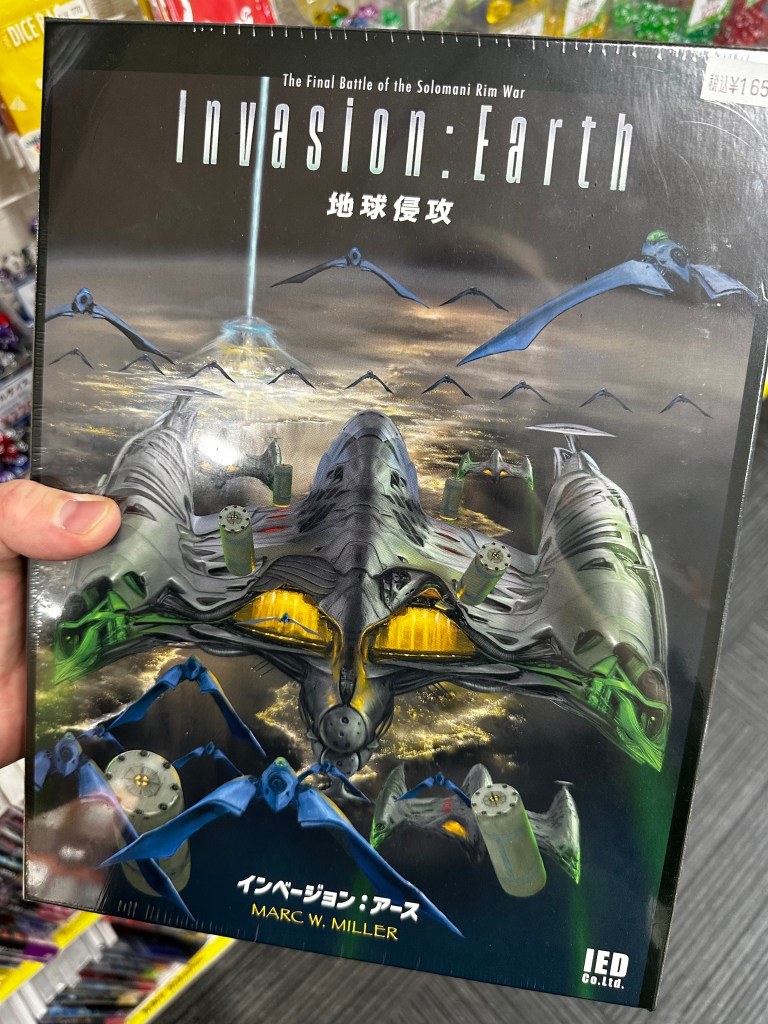
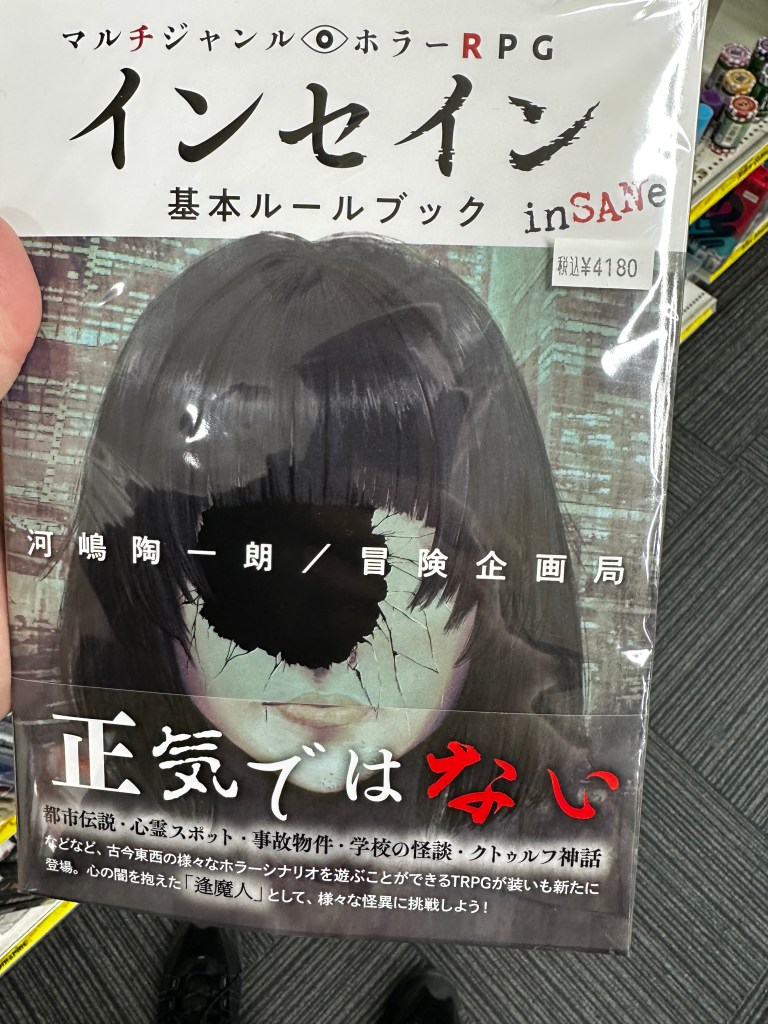
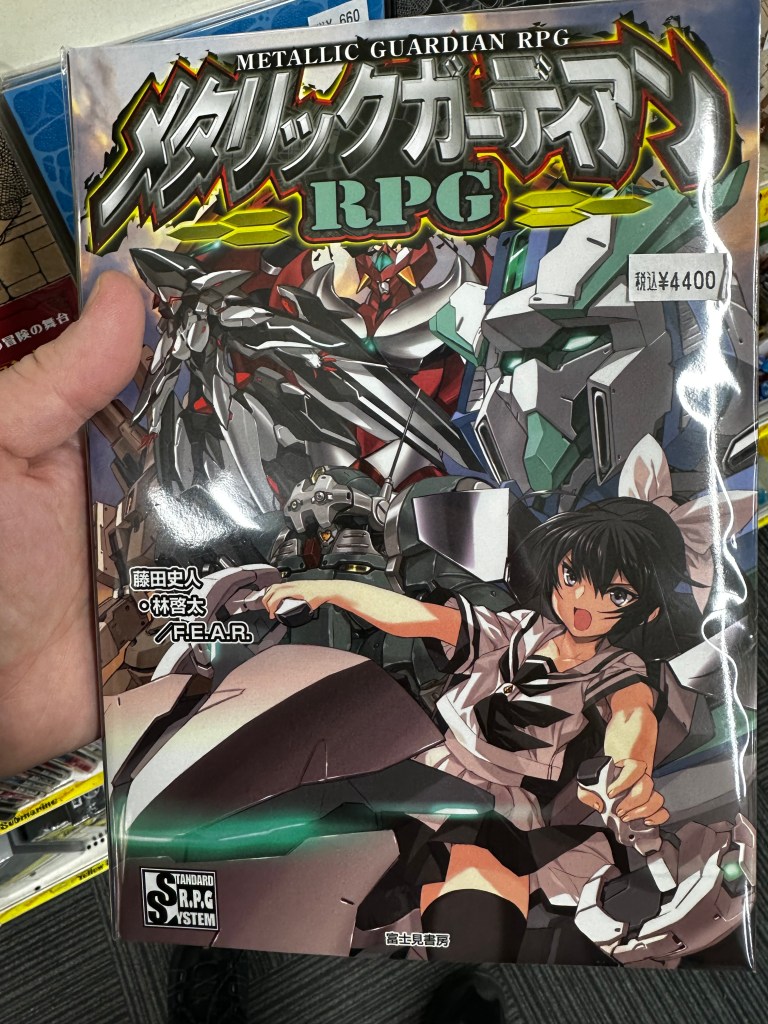
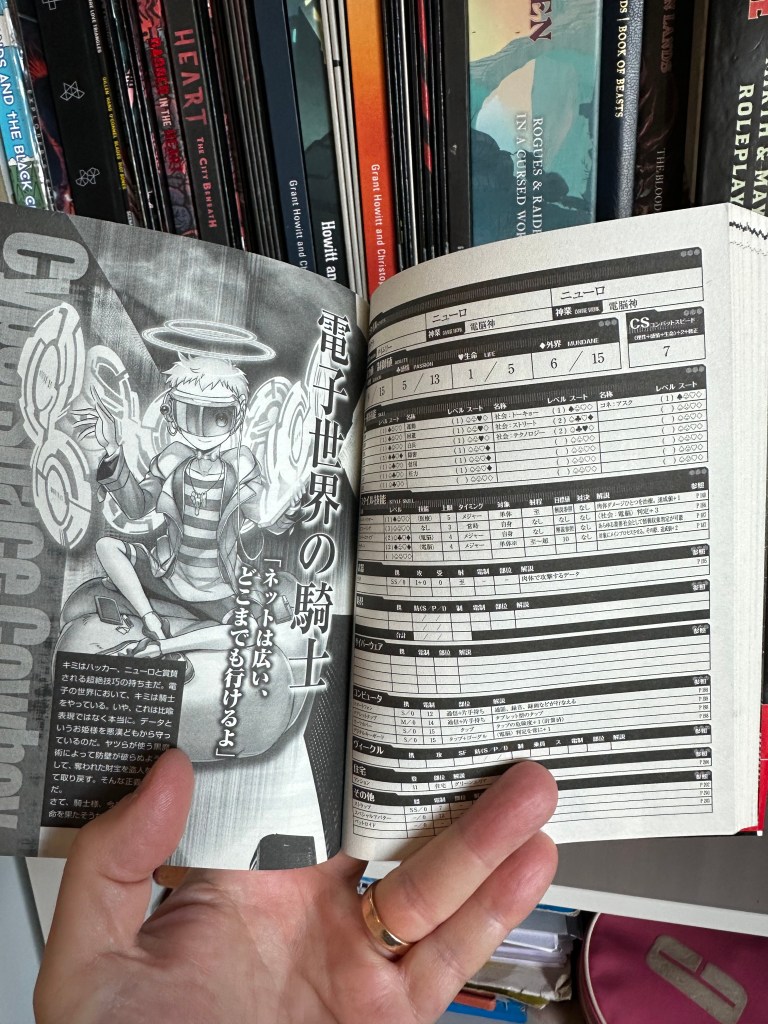
A very pleasant surprise was that there were just so many Japanese TRPGs here that I had never heard of. They have never been translated to English to my knowledge and they represent a bewildering variety of themes, genres, styles and rulesets. Please enjoy the small selection of covers in the gallery below that I was able to take photos of. I wish I had the time and the bag-space to buy more of these.

TRPG + Accessory Getto!

Here’s what I picked up for myself.
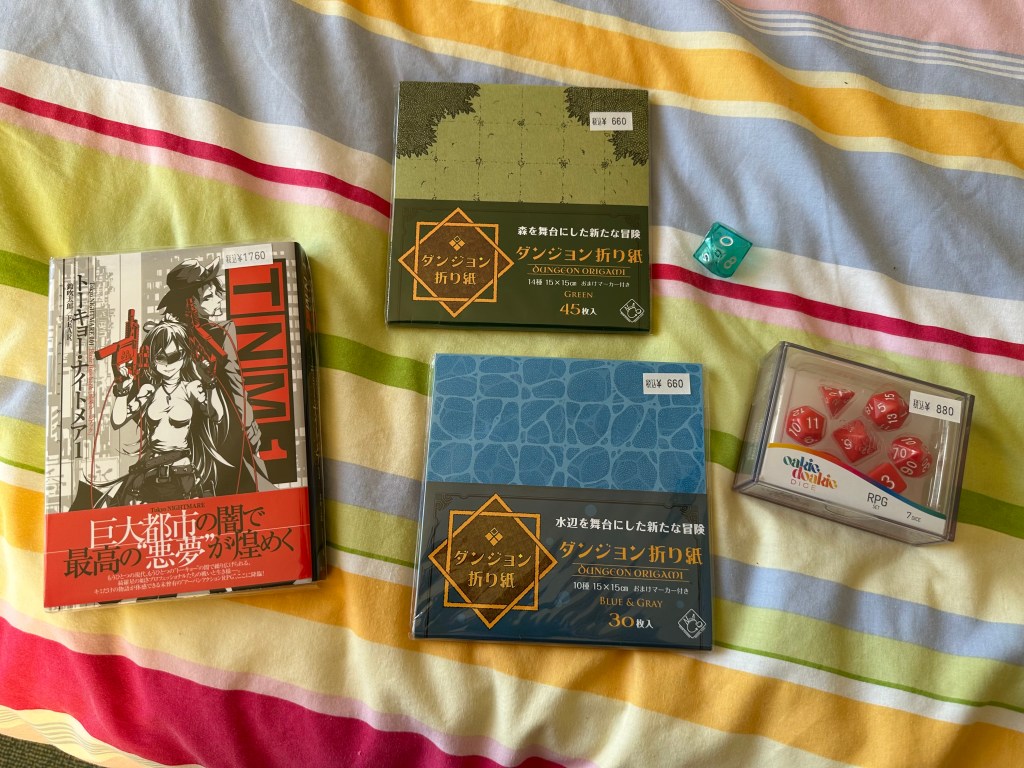
  • Tokyo Nightmare 001 Basic Rulebook – this is the rulebook for the Urban Action TRPG, Tokyo Nightmare, from now on referred to as TNM. It only cost about 1700 Yen (around £8.50 or $10.50.) There were a number of other books in this series but this one seems to have everything you might need to run a game of it. Contained in it are the basic rules, which are based, not on dice rolls but on playing cards. You also have a “Replay” section, which presents a comprehensive example of play. Interestingly, this is the first section of the book. After that you have the Rules Section, a World Section, a “Ruler” (that’s what they GM is called in this game) Section, a Scenario and several sheets including Character, Act and Battle. As a whole, TNM’s really interesting especially with its card-based rules and I’m looking forward to testing my Japanese language skills while exploring it. In fact, I was determined to get at least one RPG book from the start to help me improve my Japanese, which has been getting worse and worse for years.
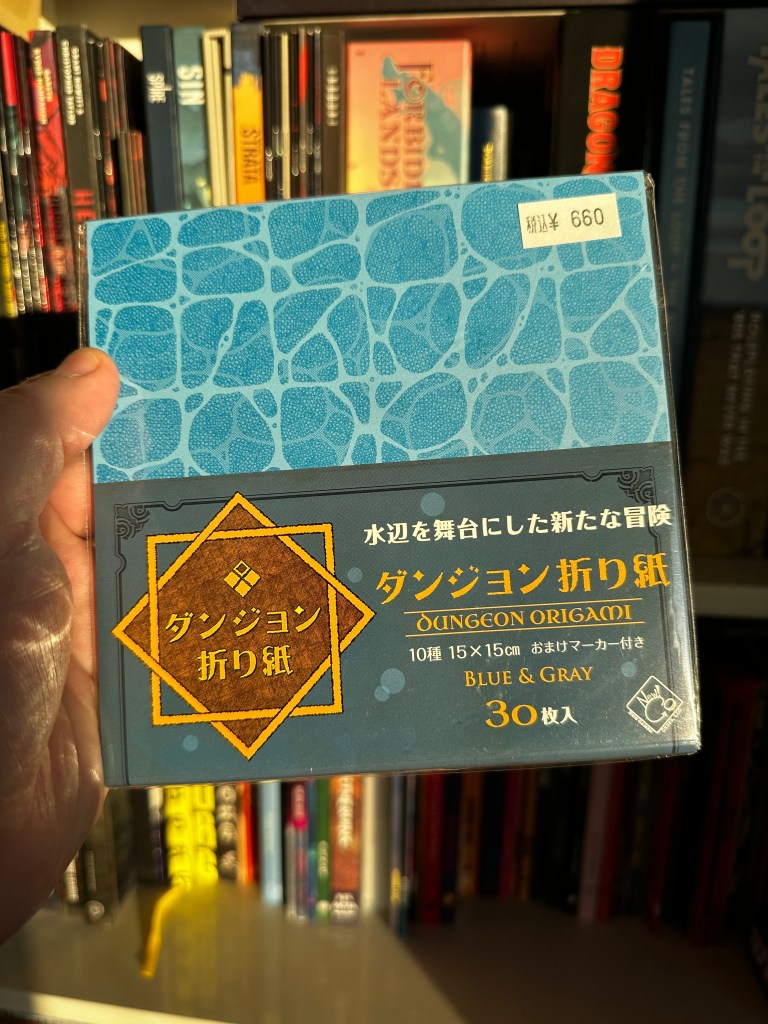
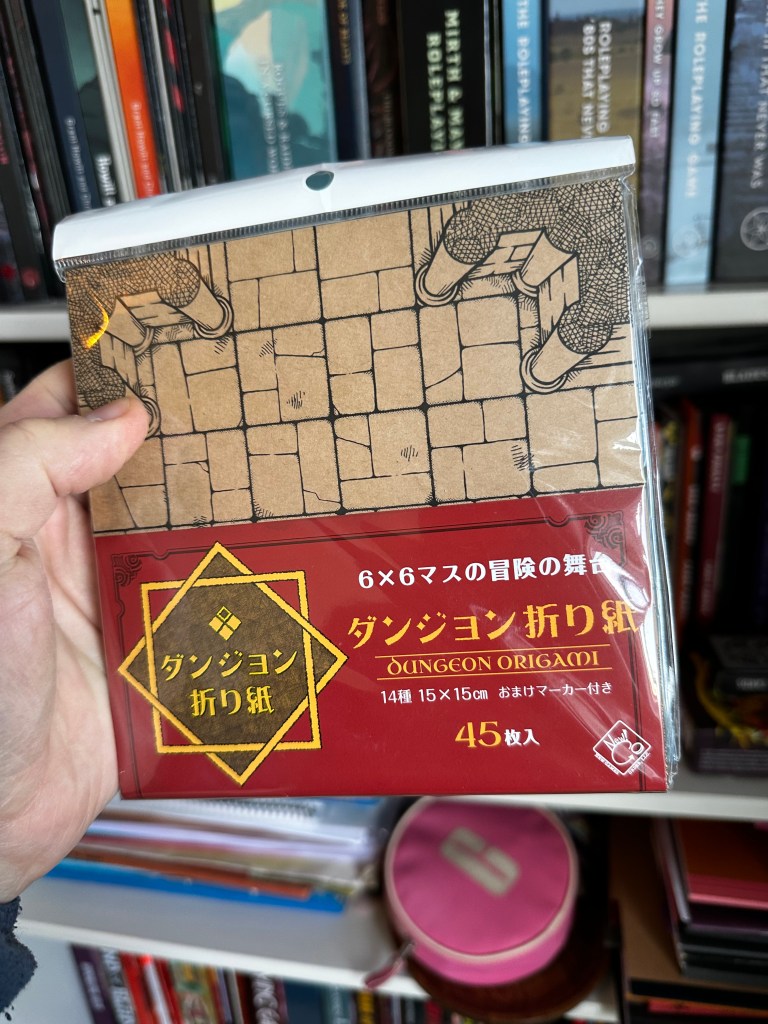
  • Dungeon Origami Tiles – I loved these things as soon as I saw them. I don’t use a lot of battle maps these days but these little collections of paper tiles that you can use to create maybe a randomly generated terrain or dungeon seemed so ingenious and cost-effective that I couldn’t resist. Each pack contains 45 sheets of top-down dungeon or terrain tiles. There are three or more copies of each tile in a pack, along with a thicker one with items (what they call markers) like logs and doors that you can cut out and place where you like. These are so versatile and useful I couldn’t believe they were so cheap! Only about 660 Yen per set! (that’s about £3.30 or $4.20!)
  • Cheap-ass red dice – These come from a German company call Oakey-Doakey Dice. They come in a plastic drawer that can be used as a case/dice tray in a pinch. Very handy and very cheap. Only 880 Yen (£4.40 or $5.60!) The d20, upon testing, however, is only good in roll-under games.
  • An incredibly clever d100 – There is a little d10 inside the bigger, transparent d10. Much less unwieldy than using one of those baseball sized d100s that actually has 100 sides, if you want to make a roll with a single die.

Conclusion

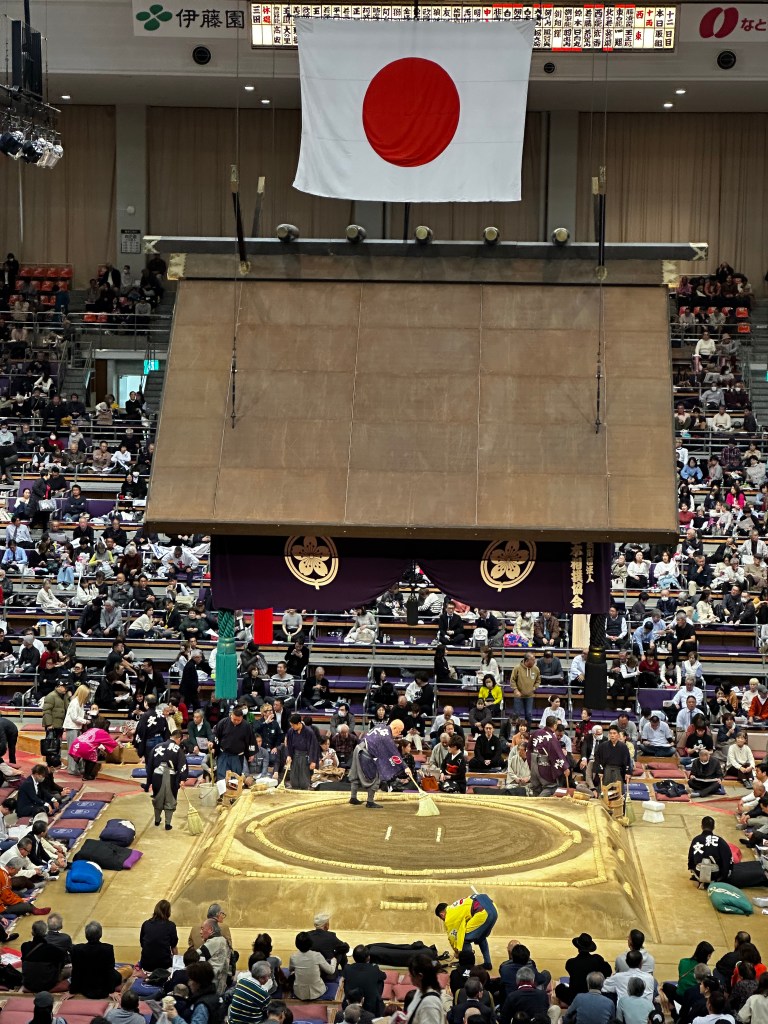
I’m going to be moping around dreaming of Miyajima, Katsu Curry and Sumo for the next couple of weeks, but at least I’ll have these few meagre Japanese TRPG items to cheer me up and keep me busy for a while.

I hope you enjoyed my report on a trip to a Japanese FLGS, dear reader! What’s your experience with Japanese role playing games, if any? And what do you think of them?
Sleighed

You might remember a few weeks ago… I reviewed Slow Sleigh to Plankton Downs. Well, the disclaimer on that review, that I had not played or run it is no longer valid.

Nun too soon for an update

Just a short one this week, dear reader.

You might remember a few weeks ago, for my Halloween post, I reviewed Slow Sleigh to Plankton Downs. Well, the disclaimer on that review, that I had not played or run it is no longer valid. Sister Majid, the Misstep Monastic (a type of nun) and Lee Tuluk, the Scud Miller (meat grinder) formed an unlikely friendship through a misallocated cabin and a game of chance and before you know it they were investigating a murder!

We played one session on Halloween and just finished it up last night. It took about six hours altogether, although there was some time spent on character creation in the first session.

Take a butcher’s at this!

A nun with an ice adze dressed in gold

Here are some things I loved about running this adventure:

  1. The new backgrounds are great. Most of them are really far out there but the two that my players chose were obviously quite mundane. They still had some incredible Advanced Skills that got milked for all they were worth. Somehow, our nun used “Reconcile God’s Glory with the Failings of Mortals” constantly. Meanwhile, the Scud Miller managed to use “Fix Anything, Not Necessarily Well, Even with the Wrong Tools” on everything, including relationships. Use the backgrounds if you’re going to play this.
  2. It’s so easy to prepare and run. The keyed descriptions are short enough to easily use on the fly, the premise of the adventure is straight-forward and there are only a couple of unavoidable events that are not difficult to get to grips with. I read it through once, fully, and then reviewed particular sections such as basics of the adventure and the murders before actually running it. It doesn’t take long to do this; its a svelte little scenario.
  3. I really got into describing the aftermaths of the murders and the effects they had on the crew and other NPCs. As rumours spread I had nuns moving in pods and whispering about terrible occurences while blessing themselves, while the porters and mates dealt with grief at the passing of their colleague. Upon the discovery of the second victim, the security guards were puking in corners and staring blankly at blood-soaked toilet stalls. The creature has a silly name, which my players refused to say right, but the murders are gruesome and horrific. It felt important to play into that.
  4. The map of the Nantucket Sleigh Ride. We used this work of art throughout. It was so useful to help the players orient themselves on the hovercraft and it was a genuine pleasure to refer to it. Its beautiful.
  5. The Weather table. I got the players to roll for weather right before the final encounter and they rolled us up a storm. The ship was forced to drop its robotic anchors and ride it out just after the second murder. They figured out who the murderer was and that they were outside on the Observation Deck. What a setup for the final showdown. It was poetic.
A victim, missing its maxilla in a toilet stall. The Maxillary Uslurper in the air vent above.
Aftermath

Conclusion

Dear reader, I would highly recommend you take the Nantucket Sleigh Ride on a trip to Plankton Downs. If you have a couple of evenings to spare and a couple of friends who might enjoy a who-nunnit, as it were, you could do a lot worse. It’s not your typical Troika fare but I am beginning to think there may not be such a thing. You will have horror, you will have laughs and you will definitely have fun.

Call of Cthulhu: The Derelict Review

[My players] didn’t find the book of norse legends, the handwritten notes that presented possible ways to defeat the Sciapod, the silver items that would allow people to actually see the creature, etc, etc.

Two-part One-shot

SPOLIERS BELOW, ME HEARTIES! Turn back now if you want to be a player in the Derelict!

You know how it is, dear reader, when you board your luxury yacht and expect to make excellent time crossing the North Atlantic? And then you start to run into complications? Almost everyone gets drunk, you come across a seemingly abandoned reefer ship washed up on an iceberg, you decide to explore the possibility of rescuing anyone from it or maybe even salvaging it for vast profits, you board it and find its covered in blood and the controls have been deliberately sabotaged, you’re hunted by a towering monstrosity with a crystalline bow and only one weird leg, which is visible only to about half of your number, your own yacht’s controls are smashed to bits and the captain is eviscerated and several of your number begin to lose their grip on sanity?

Of course you do! Anyway, when I write it out like that, quite a lot did happen in the first session of the Derelict. It took so long, in fact, that we had to stretch it to two. We played it out in about five hours in total, I’d say, but there was plenty left undone as far as this scenario goes. You could easily stretch it out to three sessions of three hours each, I’d say.

The Scenario

A busted up dining room on the Groenland Tropisch.
What a mess!

In this post from about a month ago I introduced the premise of the Call of Cthulhu scenario I ran as part of our Tables & Tales October Event, during which we ran a bunch of horror/spooky/halloween themed games especially for our newbies. Today, I’m going to look at how it went and how I think it could have gone better.

The Derelict is a 28 page adventure for Call of Cthulhu. It appears in Petersen’s Abominations, published in 2015 by Chaosium. It was written by Sandy Petersen with Mike Mason.

It seems Petersen got the idea for this adventure while reading about Viking explorers and this particular encounter that was described quite matter-of-factly as a Sciapod, a one-legged creature with a crystal bow. The conceit is that such creatures were not necessarily taken as supernatural by people of by-gone ages so the encounter was recorded as a relatively mundane occurrence. I like that this theme jibes with Zedeck Siew’s observations about the attitude many Malaysians would have to signs of the Pontianak in his scenario, A Perfect Wife, as well as my own personal experience of growing up in Ireland. Of course, when the Investigators encounter the Sciapod in the Derelict, they are not likely to react the same way at all.

The portrait of Siren/Lori Washington, a femme presenting person with long dark hair and a bright dangling earring in one ear.
Siren/Lori Washinton

The Derelict was clearly designed as a one-shot or very short campaign. It would be hard to work it into an ongoing campaign, I think, given the rarefied circumstances and setting, so if you want to run it, I would suggest taking it at face value and go for something short and self-contained. I would also recommend using the pre-generated characters. They are all rich/famous arseholes of one stripe or another. You know, the type of people you would expect to have on a luxury yacht. But they also have their own motives, some are having money troubles, some are looking for sponsors, some are party animals, that sort of thing. They are relatively well painted and designed to be easy to pick up and play. There is a second option presented in the scenario: the PCs could be members of a rescue team sent to investigate the Derelict, but this option lacks the horror movie energy you get from the rich yachters, in my opinion.

The formatting is useable and fairly presentable. It starts with the intro and a brief description of our cast of characters before a short section on Starting the Scenario, under which we also get a useful Sequence of Events. I say “useful,” but my players exited the sequence pretty quickly and I was forced to improvise liberally from that point on.

The bulk of the scenario is taken up with descriptions of the main areas of the Derelict ship and the iceberg it’s stuck on. It does go into a fair amount of detail even about the areas that are of little or no interest. It will tell you where to find the clues and items of interest within these descriptions. This is the greatest weakness of the adventure, to be honest. My players spent almost no time exploring the ship. They were incredibly goal oriented, going to Engineering to find things to help them fix their own boat and to the radio room for a way to contact someone. So, they didn’t find the book of norse legends, the handwritten notes that presented possible ways to defeat the Sciapod, the silver items that would allow people to actually see the creature, etc, etc. I wish I had started just transplanting some of the more important clues and things to the rooms they did explore earlier. In the end, I did do that but we had played the bulk of the game by then.

It has some great maps and illustrations throughout. The maps of both boats were particularly useful. We were playing on Roll20. So I used the maps a lot. In the first session I used fog of war on the map of the Derelict, but I found this led to too much player confusion about the location of everything and too much time spent by me on descriptions. It was supposed to be a one-shot! So, in the second session I turned off fog of war under the pretence that they found a full map in Engineering. That made things a lot easier. The players were able to see where they might want to explore and they started to do that.

One of the strengths of this scenario is that, even though it provides you with a sequence of events, it encourages you to play it quite free-form. Simply allow the PCs to look around, discovering clues as to what happened here and maybe how to defeat the monster, and then start picking off characters with the Sciapod as they go, NPCs first. They’ll start getting injured and insane and the scenario should blossom from that. In many ways, this is what led to our game going quickly off the rails. The sequence of events expects the players to start trying to find ways to kill or drive off the Sciapod but that’s not what happened at all. As I started to kill them off and ship away at their sanity, they began to look only for alternative ways of escape. But, of course, along the way they saw some some pretty disturbing things and one of them lost the plot completely, going full axe-murderer before eventually getting it together while they all bundled into the last remaining lifeboat. Except for looking for firearms on board, they never considered finding a way to kill it. And, of course, this was great! I loved it and the players had fun. But I will admit to, at times, trying to get them to take the route that was expected of them. I think I would have had more fun if I had lust loosened my grip on the reins a bit more.

Still, if your players do get so far as to start coming up with ways to beat the bad guy, there is a useful section at the end of the scenario devoted to potential plans that they might come up with, using lots of things my player never even discovered. They could use the CO2 stores, the bulldozer or forklift that was in the hold, etc.

The Appendix

The Sciapod. A bluish tinged, armoured humanoid with only one thick leg, which ends in a wide, umbrella-like foot with claws all around the outside of it. it holds a crystaline bow and has a single green glowing eye.
Hawkeye? You’ve changed.

In the Appendix, you get stats for the two NPCs and the Sciapod itself.

The NPC stats could be particularly useful if a player loses their PC early and they need a replacement. This did happen in my game but only after both NPCs were already dead so it didn’t help.

When it comes to stats for the Sciapod, I don’t think it should matter really. It is designed to be undefeatable by normal means. The PCs are supposed to have to come up with some big, brash, loud plan to kill it, after all. But there are elements to the creature that are of real interest. For instance, it is visible only to those who have silver touching skin for some reason. This proved to be a weird and scary element of the PCs encounters with the monster. It directly led to the death of one of them but it is a strange addition to the abilities of what is already an odd adversary. It is utterly silent too, and it wields this weird crystalline bow with enormous glass like arrows. This last bit feels very un-Cthulhu to me. It adds more of a D&D flavour to this monster but it did allow it to attack from a distance, which I made use of. This led to two memorable moments of gameplay, in fact. First, our pop-star character, Siren stood on the deck and had a showdown with the Sciapod, she with her little .22 pistol and it with its giant glass bow. Second, the creature launched one of its enormous arrows into the hull of the lifeboat they were escaping on right at the end, ushering in their deaths and the end of the game.

Conclusion

This was a fun one-shot/two-shot. It had great pre-generated characters and a fascinating premise and setting. (Although I have to stop running one-shots on boats. Apparently its become a trend…) But I question whether the monster that’s central to it is really Cthulhu-mythosy enough. It’s strange but not necessarily horrific in and of itself. Also, the adventure involved a lot of prep for something that could be designed to be run with little or no preparation. But you have to read the descriptions to familiarise yourself with the setting, the clues, the origin stories, hidden history etc, etc. and that all takes time.

Kanabo

The best part of the whole How to Play section is the list of Best Practices…We have gems like, “Ask questions. Take Notes. Draw diagrams. Write in pen” and “Fight unfairly. Lay ambushes. Hit below the belt. Run away.” And familiar old favourites like “Play to find out what happens, and how it happens” and “Strive for victory, but revel in your defeats.”

Waku Waku

Dear reader, my excitement is threatening to overwhelm me. As some of you may know, I studied Japanese in university and lived and worked in Japan for about three years in total. It’s hard to put into words exactly how I feel knowing that, this weekend (probably yesterday by the time I publish this post), I’ll be going to see the Ireland vs Japan rugby match in Dublin and next weekend I’ll be finally going back to Japan for the first time in eight years! I think the right word is probably わくわく (waku waku, loosely translated as excited.)

Anyway, as a build up to that, I thought I would look at an RPG based on a Japanese historical period.

Kanabo: Fantasy Role-Playing Adventure in Tokugawa-Era Japan

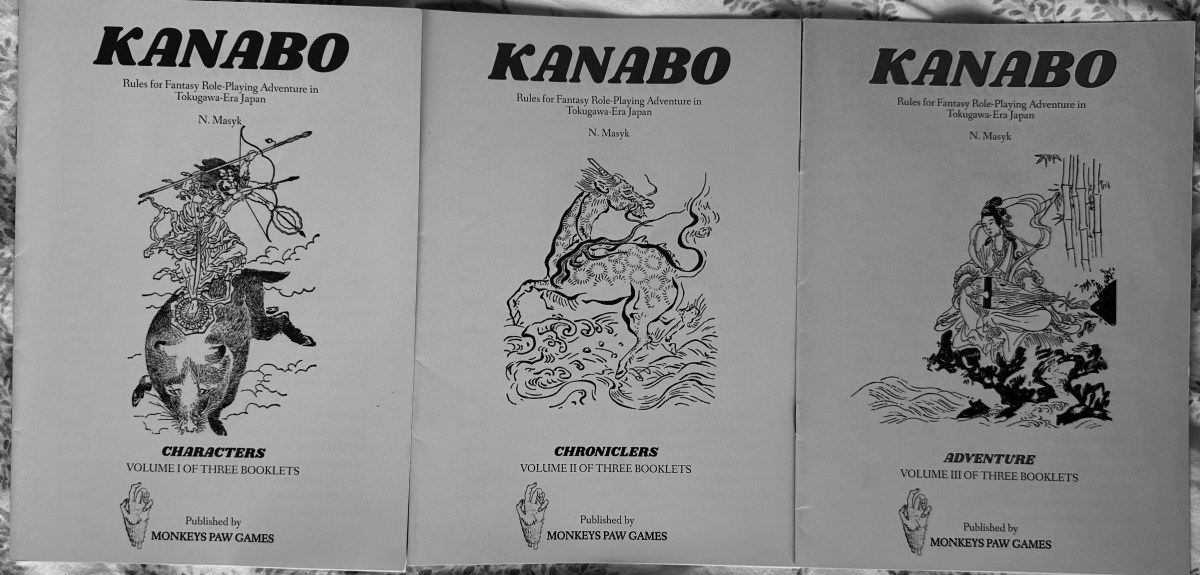
A Kanabo is a Japanese weapon, a long metal club, adorned with spikes or studs. The game, Kanabo by N Masyk, is an RPG published by Monkey’s Paw Games. It comes in the form of three neat booklets, Volume 1, Characters, Volume 2, Chroniclers and Volume 3, Adventure. It was gifted to me by friends and all round good eggs, Tom and Isaac several years ago. I can’t remember which year exactly and I don’t see a publication date on any of the booklets so I am going to guess and say it was sometime between 2020 and 2022.

These booklets truly are only wee. The longest of them is 21 pages of A5. But they pack a lot into each one.

Volume 1, Characters

The cover of Kanabo, Volume 1, Characters. It has a mythical Japanese warrior wielding a spear and a bow at once, while dancing on the back of a great black boar, possibly in the clouds.
Magic Man on Magic Boar

This booklet, as is the case for each one, begins with the credits. N Masyk did the words and the layout, “Dead People” did the artwork and the Hexmap uses the Highland Paranormal Society Cartography Kit, by Nate Treme. Finally, consulting was done by James Mendez Hodes. I think you will notice a peculiarly Western bent to the people associated with this project, other than the Dead People who are all Japanese (by the looks of their artistic styles) but remain conspicuously unnamed.

It starts off with an intro section that explains briefly what the game is about and suggests the use of safety tools such as Lines and Veils and the X Card. The “What is this?” section tells us that this is a game set in the Tokugawa period of Japanese history. It informs us that this is the time after the Warring States Period when the country is united but many wandering Travelers are abroad, “seeking fame, fortune, justice, revenge, or simply the freedom to roam.” That’s the PCs! I like this as a time period and setting. The Tokugawa era was long, more than 250 years. It was a time when Japan was cut off from the rest of the world, guarded its coast jealously and avoided the great changes that engulfed the other regions during the same time. The role of the Samurai was slowly being eroded, nobles were forced to pilgrimage from their lands to the capital under their own expense to keep them in line, the Shogun ruled the land and Japanese culture deepened. But I also like that there is a paragraph here on historical accuracy. Masyk takes pains to explain that, despite the potential realities of the place and time, as players of a game, we must strive to be inclusive before being accurate. Japan of this time was a place of terrible inequality, Kanabo at the table does not have to be.

The introduction section is reprinted in Volume 2, Chroniclers and Volume 3, Adventure. I wonder, in a set of booklets of such limited page-count, if this was necessary. Perhaps it was felt that the Characters booklet, meant largely for the players, and the Chroniclers booklet, meant only for the Chronicler had to both have it to refer back to regularly, but I would question that, especially as the Adventure booklet is also meant for the Chronicler exclusively. Maybe its so the kid who finds one of these booklets all on its own, tucked into a box in the dark reaches of a secondhand bookshop thirty years from now, knows what it is they’ve found.

Stats

The Stats section actually introduces the entire character creation process. Stats themselves are only one part of that. You roll 2d10+20 for each stat, for a maximum of 40.

I was expecting this ruleset to be a D&D clone or maybe an Odd-like but I was surprised to discover this is a percentile system. When you want to do something you roll a d100 and hope for a result equal to or under the stat you are rolling on. You will notice that this makes it necessary to roll really rather low to succeed, but there are several ways to gain a +10 to your rolls, such as using the right piece of equipment, possessing just the right skill, spending a filled segment of your Fate Clock or, in battle, gaining Advantage. There are three specific ways to accumulate +10s in a battle. If you want to disengage from combat safely, you can expend all of them and do so.

The Stats themselves are incredibly and deliberately abstract:

  • Fire: confrontation, aggression, force
  • Water: tranquility, inquisitiveness, exploration
  • Earth: stoicism, calculation, discipline
  • Wind: intuition, reflection, grace

As such, there is a lot of potential leeway in the decision on which stat to roll in any given situation. I like this sort of thing. I imagine Blades in the Dark style negotiations occurring as to how they might work out in play. However, I struggle a little with the whimsicality of the naming convention. It has a sort of mah-jong flavour to it, I’ll admit, which is not, in itself a bad thing. But, if you were to choose particular Chinese characters from the available mah-jong tiles, there are others that really describe human traits that might work better. I am thinking of things like 力, chikara (strength,) 心, kokoro (heart) etc. The use of the four elements makes it feel a little more like Avatar than any of the sword-fighting movies that inspired this game. It is a stylistic choice, though, and I’m sure it would work just fine at the table.

There are other elements to character creation, of course. Some of them remind me, quite delightfully of making a DCC character. Others have an Into the Odd feeling which I enjoy.

You can roll for your Chinese Zodiac sign. Whatever sign you roll, you can take it and apply a +5 to a stat that you think it reflects positively on. It would have been fun to have to apply a -5 to a different stat in this step I think.

When you roll on the Birthplace table, you will get somewhere like “Fishing Village,” “Hill Fort,” or even “Haunted Ruin.” Depending on what you get here, you will start with a different piece of equipment, such as a “fishing rod,” “spear,” or “lucky charm.”

Next up you roll on the Career table, which will give you another piece of equipment. Soldiers start with a matchlock pistol but Farmers only get a straw hat!

Your birthplace and career also allow you to list two things you know about or are skilled in. These can give you +10 to rolls in certain situations.

By rolling on the Curio table you might find yourself starting with a lucky cricket, a mask or maybe some rice balls. Each curio comes with a question that might help to round out your character.

After this you have a bunch of tables that will help you describe your PC. You have Mannerisms, Clothes, Face, Names etc. There should be plenty here to give you a very clear picture of your Traveler.

How to Play

This section lays out the rules quite economically. I’ve given you the basics already and there isn’t too much more to them than that, which is great.

There is a PBTA element to the rolls. You only roll when there is some risk, of course, but if you succeed, you do so without consequence. If you fail, you can still succeed, but with consequences. In combat, this means that you trade harm.

Kanabo character sheet on the back of the Characters booklet. There are spaces for Name, stats, zodia, career, birthplace, curio, description, Knowledge & Skills, Inventory, Wounds and a Fate clock split into eight wedges.
Kanabo Character Sheet

You get a Fate Clock on your character sheet. It has eight segments, which you will be filling and erasing as you gain and spend them. You gain a segment whenever you roll doubles on a d100 roll. I choose to interpret this as 11, 22, 33 etc. You can choose to erase a segment to give yourself +10 to a roll, prevent 1 Harm, recover 1d10 wounds or survive past your 5th wound. It’s a bit like stress in Blades in the Dark, a superpower that these Travelers have that allows them to contend against terrible odds and powerful forces.

Some few paragraphs are devoted to the idea of Travel. Kanabo assumes you will be hex-crawling and lays out the rules for that in relation to time, encounters, foraging, rest & healing etc. This is presented in a way that is player friendly and does not blind anyone with science. I appreciate it.

Character Advancement gets one very short section. Characters can choose one of two options at the end of each session, “increase a stat by 1” or “write down a new skill or piece of knowledge.” It’s neat and lacks frills. No room for confusion at all.

The booklet is rounded off with sections on hiring help, common equipment and refreshments. They are presented in several short and entirely non-exhaustive lists that are merely starting points for the interested player to do some research on what stuff might have been available in Tokugawa-era Japan.

The best part of the whole How to Play section is the list of Best Practices. Many of these will be familiar to the those of you who have been reading my series on Blades in the Dark recently. We have gems like, “Ask questions. Take Notes. Draw diagrams. Write in pen” and “Fight unfairly. Lay ambushes. Hit below the belt. Run away.” And familiar old favourites like “Play to find out what happens, and how it happens” and “Strive for victory, but revel in your defeats.”

Volume 2, Chroniclers

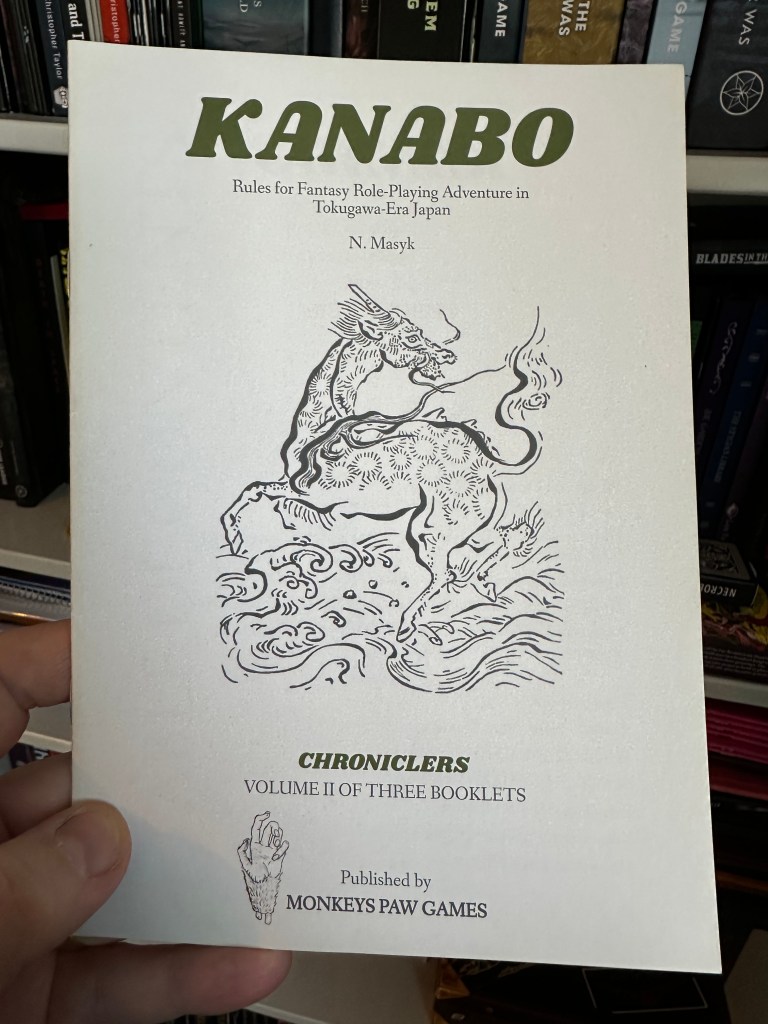
Kanabo Volume 2, Chroniclers has the image of mythical Japanese creature, the Kirin, across between a dragon, a horse and a giraffe, dancing across the waves.
This is a Kirin. Interestingly, the Japanese word for giraffe is also Kirin. It’s also a good beer.

After the repeated intro section we get straight into a section on how to run the game. Let me reproduce here the entirety of that section:

You control the world around the Travelers and the people within in, and the places they have built for themselves. Fill that world with adventure, danger and magic.
There are no further words by witch I might describe or prepare you for the journey ahead.
The contents of this tome, much like the contents of the Universe, are mostly lies.

I think this is probably one of the most uniquely unhelpful such sections I have ever read. I understand that the author is trying for poetry instead of boring old instruction, but it reads as though they want you to think there is no advice that might help a prospective Chronicler. There is something to be said for the idea that a GM/referee/judge/whatever should trust their instincts, but it is certainly not always true. Also, there is an enormous wealth of real advice out there, both in printed books and for free on the internet. I understand the author had limited room here, so, perhaps they could have directed the newbie GM to the blogosphere, or a particular publication that they thought aligned with their own design ethos.

Anyway, as soon as they have described everything in the “tome” as lies, they go on to provide guidance on how to run the game… and it’s useful! It’s practical and answers the sorts of questions that would definitely come up at the table when playing Kanabo! Things like discussing the possible consequences of rolls before making them, determining the effectiveness of successes etc. So, my main takeaway from all this is don’t believe the bit that tells you its lying to you…

There are a couple of pages here devoted to describing very Japanese-themed encounters, we have Kappa, Oni, Kitsune etc, without ever using those words. I like the pared down descriptions and the minimal stats presented, and I can see the idea of removing the Japanese names so as to allow a Chronicler to set their game of Kanabo in a non-Japanese context. Or maybe it’s done to for localisation purposes. I don’t know really, but, personally, I would prefer to use the Japanese names. It feels wrong to me to do otherwise.

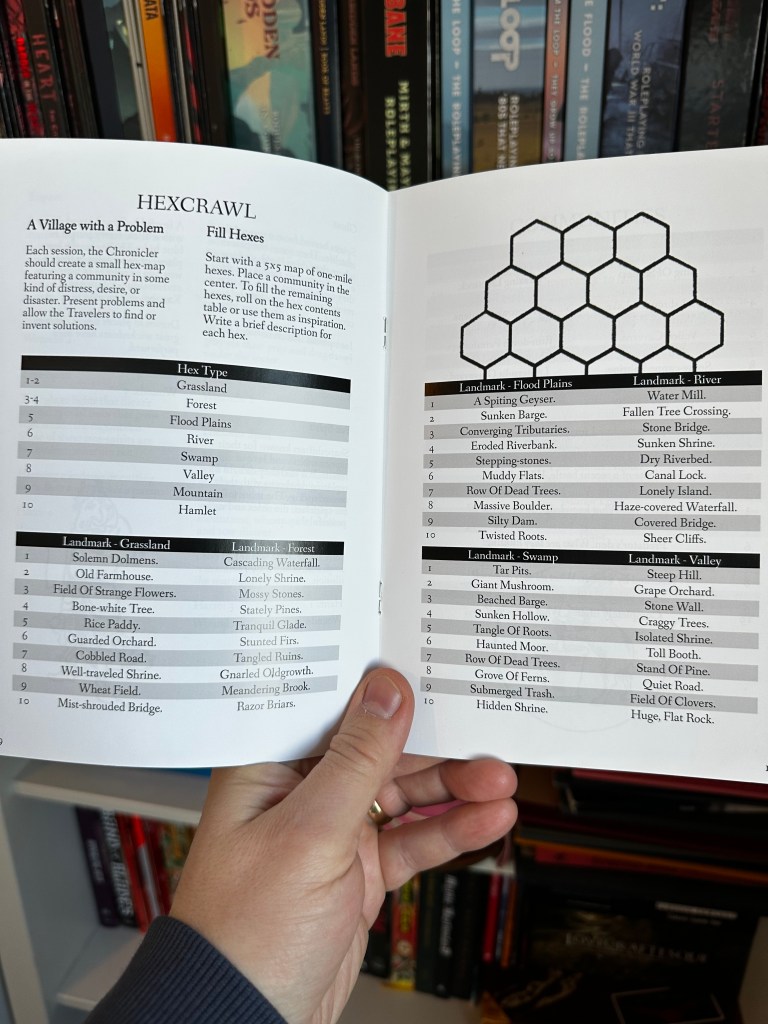
Hexcrawl section from Chroniclers booklet. There are several landmark and terrain tables and the top half of a hex rose here.
Hexcrawl

I think another very interesting element to this game is that, despite its semi-PBTA roots, you are expected to run it Old School. We have Weather tables, advice on rolling for encounters, an encounter reaction table and a whole bunch of tables to help you build your once-a-session hex map. These are, honestly, great. They are extremely practical and useful with lots of tables of landmarks for a variety of terrain types from Grassland to Hamlet. There are more tables for Factions, Communities, and Adventure Sites that would allow a Chronicler to build an engaging monster-of-the-week-style adventure with little to no prep required.

But, the advice for doing all this is limited within the booklet itself. The third of the the three booklets, however, serves to illustrate how it should work!

Volume 3, Adventure

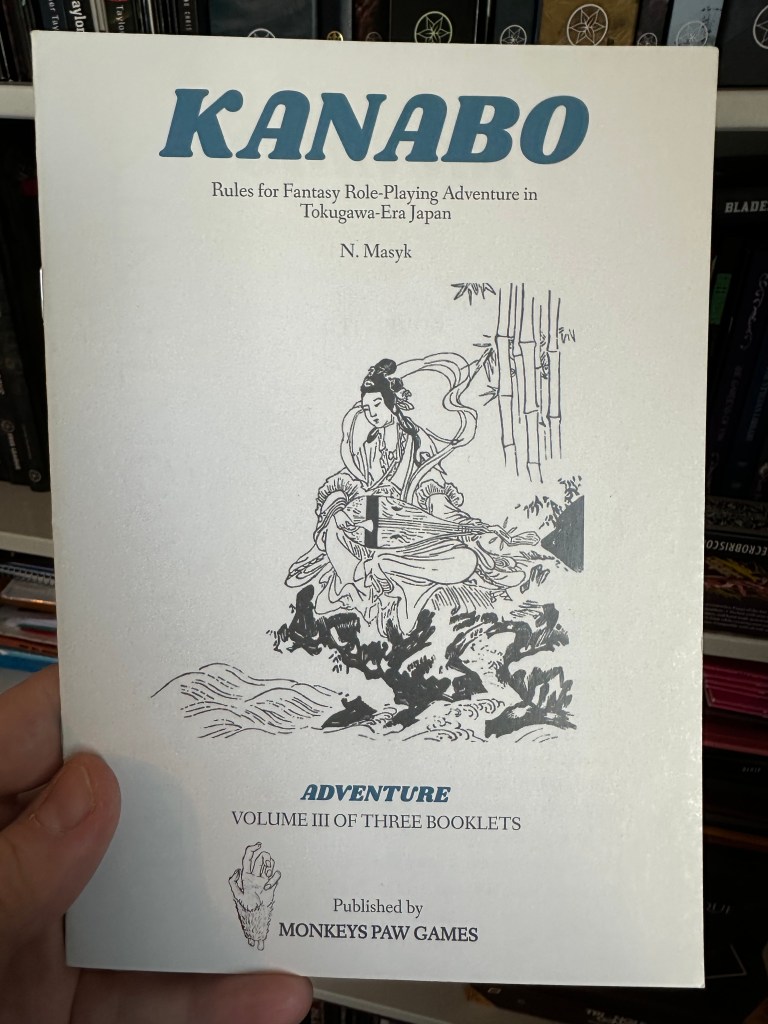
The cover of Kanabo Volume 3, Adventure. It shows the image of a woman, or maybe a bodhisatva playing a shamisen on the edge of a cliff.
Magic music

This one if incredibly short, only eight pages, two of which have the intro again. After that, we get a bunch of ten point lists, which come together to create Peach Trees Village. The list of Locals describes each one in a single line, provides a piece of their dialogue and outlines an adventure hook. Here’s the first one:

Asuka. A farmer. So forgetful; “did my apprentice bring the cattle in?” Needs someone to go check. Something’s been at the cattle.

I love this way of presenting information. It’s incredibly efficient and is just enough to spark the imagination. You get something similar from the Shops and the Rumours lists.

Next, we have The Surrounding Wilderness section. This kicks off with a hex rose, already filled in to give the Chronicler an idea of how it’s done. Each of the 19 hexes is described in a similar way to the Locals above. Here’s no. 10:

Frozen wood. Snow-blanketed trees. A dead mile where nothing grows. Strange lights at night. What is causing the lights?

Once again, it’s just enough to spark the imaginations of both Chronicler and Travelers to perhaps pursue the mystery of the lights in the woods, without bogging you down with established fiction.

A “Searching, you find…” D100 table rounds this adventure booklet out.

Conclusion

All in all, I think this little RPG punches above its weight. I question some of the choices made regarding naming conventions, use of space and GM advice but otherwise, I am quietly impressed. I would like to try running it, but it will have to wait till after my own adventure in Japan!

Blades Out!

Since I didn’t know for sure that the PCs would back the Lampblacks until the very moment they answered Baz in the opening scene, I couldn’t plan for what might come next.

Housekeeping

Dear reader, another change is afoot. I have been running this blog for about 17 months. In that time I have published 175 posts, including this one. That’s hundreds of thousands of words, some of them good words, some of them not so good, but all of them worthwhile. For the first month, I wrote one post a day! That seems incredible to me, looking back at it now. I soon dropped down to three a week and then to two. Even that has been a struggle lately. Partly that struggle comes from the fact that I’m playing more RPGs than ever, partly it’s the exigencies of life in general. What I’m getting at is that I’m planning to drop down to a single post a week, probably on a Saturday or Sunday. I still love doing this and I appreciate you, dear reader, for popping by to give some purpose to my ramblings, so I’m not going to stop. I’m just going to take it a bit easier on myself. I might revisit this decision in the new year and I reserve the right to post more often if I find a subject I absolutely must blog about. For now though, on to the meat of the post!

A Murder of Crows

We finally had session one of our Blades in the Dark campaign! Last Wednesday, five of us got together for our first score. To make things a little easier on myself as a first-time GM of this game, I decided to use the starting situation presented in the book. Roric, the leader of the premier gang in Crow’s Foot, has been murdered, and rumour has it, Lyssa, his erstwhile second-in-command, did the murdering. This has opened the floodgates to inter-gang rivalries across the district, that had previously been kept in check by Roric.

The Score

Guns and a knife.
Guns and a knife.

The Opening Scene was set in the old coal warehouse belonging to the Lampblacks. Bazso Baz wanted to know where they stood in the burgeoning turf-war between his gang and the Iruvian Sword-masters, the Red Sashes. The crew’s reputation with the Lampblacks started at 2 so it was a no-brainer for them to support Baz’s side in the war, at least for the time-being, until they see an opportunity to exploit and grab power for themselves, perhaps, later on…

This was the point where John Harper started to let go of my hand. The book provides several suggestions for the type of score Baz (or, indeed, Mylera, leader of the Red Sashes) could send the crew on. A couple of them are generic, other options are for particular crew types. I decided on the one expressly for the Bravos crew type.

If you’re Bravos: Maybe Bazso wants you to storm the drug dens of the Red Sashes down by the docks. Run off the clientele, smash up the places, grab any loose coin you find.

I like how the suggestion is kept very vague. The warning to not overcomplicate things comes to mind when I read that. Also the GM Best Practice to “Be aware of potential fiction vs. established fiction.” Since I didn’t know for sure that the PCs would back the Lampblacks until the very moment they answered Baz in the opening scene, I couldn’t plan for what might come next. As such, there was no point in taking any of those presented suggestions and elaborating on them. I had to put a lot of trust in my ability to improvise the score on the fly, with nothing but my own imagination, the vibes of Duskwall I had been soaking in from the book and John Harper’s advice to keep me right. I jumped in feet-first, a little nervous, but more than a little excited. Mr Harper had let go and told me to swim on my own.

I had a vague setting (the Docks,) a goal (destroy the drug dens) and a crew to act as my water wings, at least. I got the players to make an Engagement Roll. The crew’s Whisper decided to go the occult route with this, breaking into a house near the drug-dens and communing there with the spirit of a gangster who was murdered by the Red Sashes. I found it immense fun to play this unhinged, vengeful, but ultimately powerless ghost. With a 6 on the Engagement Roll, he was able to provide them with the numbers of Sashes in the dens, the best approach to attack and the location of the lockboxes full of coin. He also said if the crew really fucked them up, he’d give them some more information he’d learned in the Spirit Realm that might be of interest to them.

Unsurprisingly, they went for an Assault plan type and then chose as the detail to this plan, a point of attack, which was to go for two dens at once before moving on to the third and final one, where they would find the lockbox. This particular aspect of the Score took a little explanation. The six plan types, the vagueness of the plan and the specificity of the detail for that plan was all, not precisely anathema to trad or OSR players, but certainly an example of what sets this sort of story game apart form those kinds of games.

But once we got into it, the players took to Blades in the Dark like well, blades in the dark. I gave them a couple of clocks for each den they were hitting, one for their goal and one for reinforcements to show up for the Sashes. Some of us had games with clocks before. In Isaac’s Black Sword Hack campaign, he used them to great effect during a fantastic siege scene. But, I also used the example of the Resistance of a delve in Heart to explain how they would work, since most of us were also very familiar with that game. In the use of the clocks, I once again embraced the warning not to over-complicate. I wanted to make sure we got through the score in a single session so, rather than introduce new narrative consequences to every failed or partially successful roll, I just ticked a clock almost every time. I also ruled a couple of times that their actions would tick more than once on a clock, despite not getting a critical. This was largely due to the narrative effects of their actions, but also because of my awareness of time constraints. Despite this, I was delighted to introduce a new clock when the Hound shot a guy right in the head. The bells rang out across the district, tolling for the dead. They knew, at that point, it was only a matter of time before the Spirit Wardens showed up to deal with the newly minted ghost. The Hound kept on shooting, nonetheless, the death-knell kept pealing and I kept ticking that clock.

The players had fun with this score. They fell into their characters and their individual strengths very quickly. The Cutter called out the sword master boss and beat him down in the street while the Leech blew up his drug den. The Hound, sharpshooter that she was, started off sniping, but went in blasting. The Whisper, their mage-tank, had gone for a heavy load with a war-hammer and really had fun Wrecking the place. They rolled well and they got out of there with the Coin, leaving behind three former drug dens. Everyone enjoyed the depth of narrative control they felt they had and how the smoothness of the rules added to the story, rather than slowing it down or lumbering it with hit points and movement speeds and whatnot. As they said, every score their little crew had done so far was, “the Big One” but this one really felt like it.

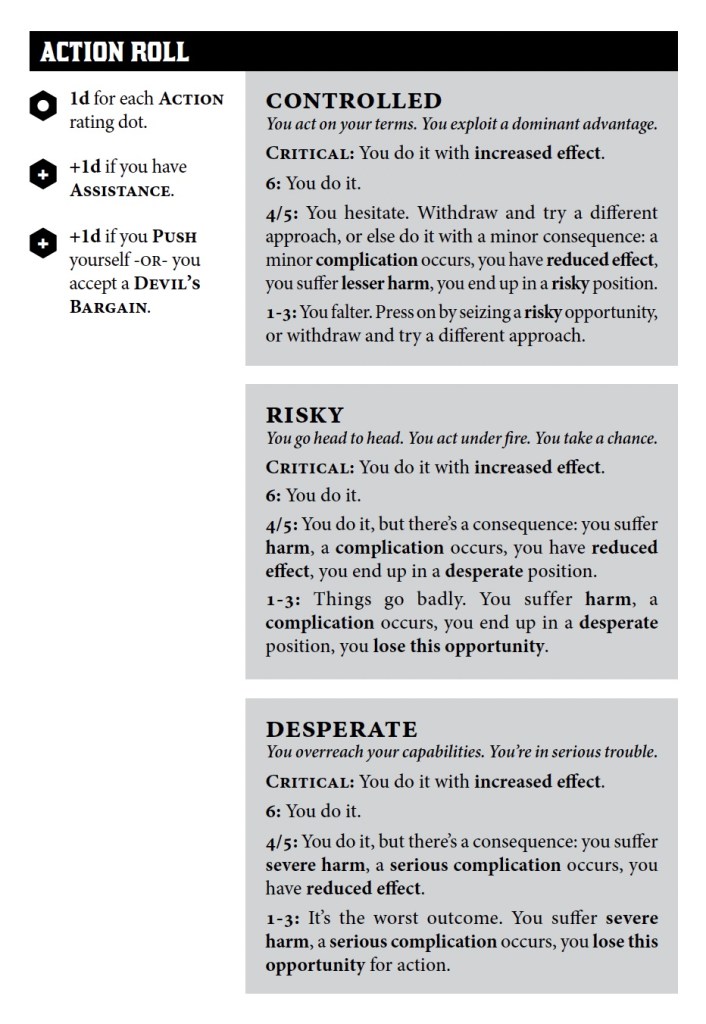
Rules-wise, we found the character sheets incredibly useful. Almost everything a PC might do is described on the sheet. And for most of the other things, they were on cheat sheets which I had printed out for each player. A couple of times I had to look things up. I ran the rules for the Plan Types, the Plan Detail and the Engagement Roll straight out of the book, which was, thankfully pretty easy to do. The main sticking point, for me, was learning how to assign Position and Effect to Action Rolls. It feels like more art than science to me. There are some useful pieces of advice in the book, but it still feels like a process I will simply get used to, like figuring out DCs in D&D type games, or Resistances in Heart. I referred to the two pages below constantly through that first score and I imagine I’ll return to them again and again in coming sessions. Very useful indeed.

Conclusion

Naming the crew was left until after the first score, as per the advice in the book. It seems the ringing of those spirit bells struck a chord with the players because we had three options in the running:

  • The Deathbells
  • The Dead Ringers
  • The Death-knells

All great names, but it was the Death-knells that won out in the end. It’s a good name and one that is likely to put the fear of death in the other gangs of Crow’s Foot, and maybe the whole city of Doskvol in the weeks to come…