
Blood in Ferelden
There have not been a lot of supplements for the Dragon Age RPG from Green Ronin. Other than a quickstart guide, a GM’s Kit and Faces of Thedas, a sourcebook filled with fan-favorite characters from the video game series, Blood in Ferelden is pretty much it. It’s a collection of adventures designed by Walt Ciechanowski, Kevin Kulp, T.S. Luikart and it came out in 2010. It contains three full scenarios and a few adventure seeds all of which take place in and showcase various regions of the land that played host to Dragon Age Origins.
It came out at a time before the Dragon Age core book collected all the rules from Dragon Age boxed sets 1, 2 and 3. Dragon Age set 1 only dealt with levels 1-5 and, indeed, Blood in Ferelden’s adventures are designed to get characters from 1st to 5th level.
I discussed another published adventure, Duty Unto Death previously. That was the first Dragon Age adventure I ran for my group and it assumed the PCs started at level 3. So that’s what we did. Not only that, but they progressed to level 4 and became fully fledged Grey Wardens before we moved on to the first adventure from Blood in Ferelden, Amber Rage. I made only a few adjustments to Target Numbers (like DCs in D&D) and enemy stats to increase the difficulty. Despite this, this level 1 adventure proved quite challenging enough at times.
SPOILER ALERT! This review is absolutely packed with spoilers. Turn back now, potential players!
Overview

Amber Rage is a 39 page adventure. It’s split into six distinct parts, each of which presents its own unique challenges for the PCs, a variety of enemies, NPCs and moral dilemmas for them to wrestle with. All of these are of varying quality.
Here’s the summary: The PCs find themselves in Sothmere, a village near the Korcari Wilds. Our group of newly minted Grey Wardens had been sent south by Duncan, their commander, to determine the strength of the Darkspawn force amassing in the south, preparing for the Fifth Blight. Sothmere was just a pitstop for them. There was a festival happening there to celebrate the building of a new fort, which gave the PCs a chance to take part in some axe-throwing, mud-wrestling, archery competition mini-games. While this was going on, the village was attacked by a band of crazed Chasind stalkers. These lads had been infected with the eponymous Amber Rage and were spreading it all over town. If no-one did anything about it, all the infected villagers were going to transform into mindless Ragers in three days! After some debate amongst the NPCs, it was decided that the Grey Wardens should go and find an ingredient in a grotto in the Korcari Wilds. This shadowmoss could be used to cure the infected.
So, off they went, following a magic raven, through the rain and the swamp, fording rivers, defeating enemies and stabling horses, until they got to the appointed place and the raven dropped dead. There they boiled up a stew and this attracted the firesprites. These guys lived in the grotto of the shadowmoss, so the PCs followed them home. Kind of creepy, when you think about it. Not only that, but they then went ahead and murdered the firesprites’ Guardian Serpent. I mean, the serpent didn’t leave them much choice, but they were invading its home after all. The real problem with this, as the wardens discovered in a sort of psychic vision provided by the firesprites later, was that the firesprites consumed the shadowmoss for sustenance, and the Serpent, ahem, excreted the shadowmoss. So, with the serpent dead, if the PCs collected all the shadowmoss they would need to cure the infected, they would be condemning the firesprites to starvation and extinction. But if they left them with the shadowmoss they had, that would give them enough time for a new Guardian Serpent to mature (this weird symbiotic arrangement was further compounded but the revelation that one of the firesprites would transform into the Serpent itself!) This was the central moral conundrum of the scenario, save the villagers or allow the firesprites to live.

Once this decision was made, they had to make their way back to Sothmere where a local judge, known as a blackhaller, had been helicoptered in to force the issue of the infected villagers. As the PCs got back to Sothmere, they had the sick ones tied to stakes, ready to be barbecued. The PCs had to make another big decision here, and, perhaps, try to convince the blackhaller to back down.
Thus ends the adventure. I skipped over some middle bits, but that is the essence of it.
Layout, artwork and maps
The layout of this thing is kind of all over the place. There are NPC descriptions separated from their stat blocks by entire pages in some instances. There are some which have the stat blocks of one NPC associated with the description of another, making it really hard to find what you need in a pinch. It’s the same with the enemy stat blocks, which are sometimes so far removed from the encounter descriptions as to make them seem as though they belong to another encounter altogether. I think one of the problems here is the massive parcels of real estate demanded by the standard Dragon Age RPG stat blocks, which presents some serious layout headaches. I had to do a lot of prep to make sure I had all of the relevant info and stat blocks on hand for any given encounter, social or combat.

The splitting of the adventure into parts, like chapters in a novel, was something I found useful. I tried to aim for completing one part each session. In the end, it did take 6 sessions to complete it.
The artwork is nice, although much of it was clearly supposed to be full colour but was presented in black and white, which was a shame.

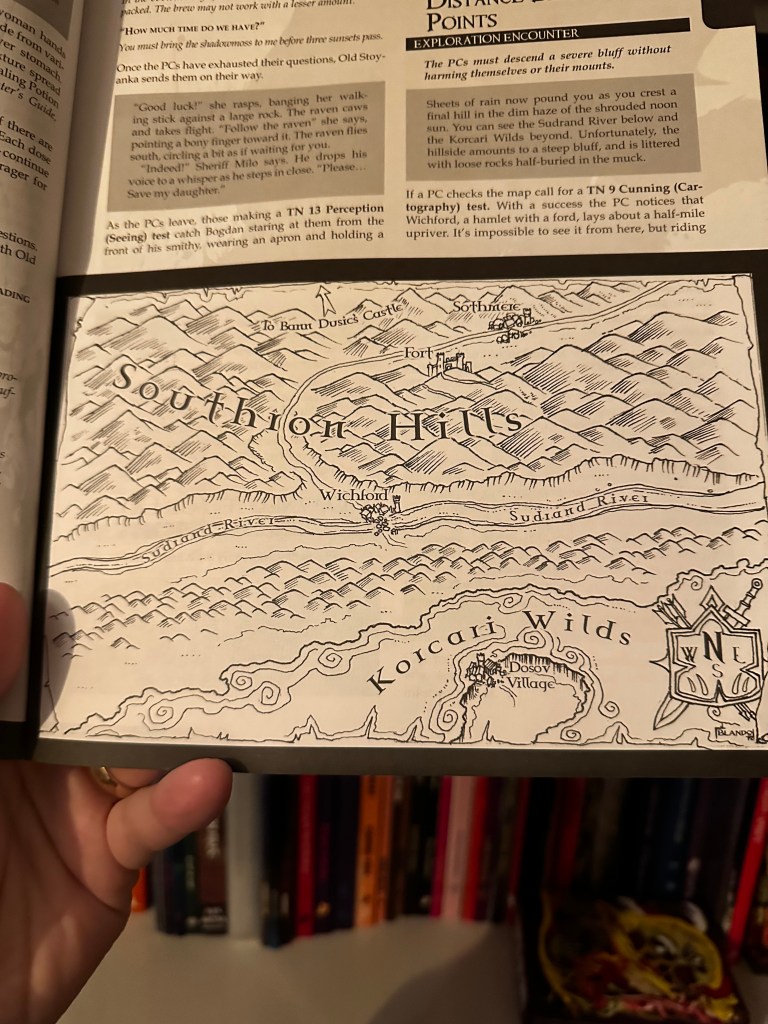
The maps are great. I really liked the small regional map and the one of the grotto. I used both at the table, revealing parts of the grotto map to the players as they discovered more of it.
Decisions, Decisions
Dragon Age is built upon difficult decisions, choices that matter and have lasting consequences and you can see that’s what the writers are trying to present as the frame that Amber Rage is built on. Should they allow the little boy be killed by ragers, or his sister? Should they kill the leatherworker who’s been infected but hasn’t turned yet, or should they give him their brew that slows the infection, endangering themselves? And, ultimately, should they condemn the firesprites to extinction or save the villagers?
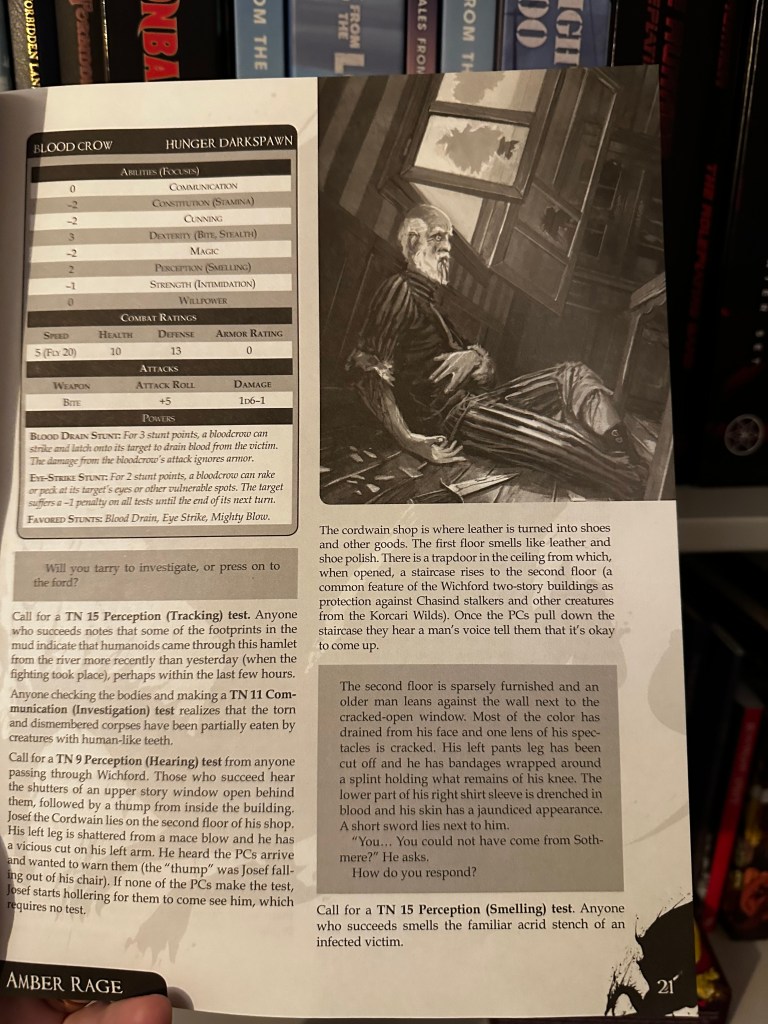
Now, this is an adventure that is written with some trad sensibilities. There are long paragraphs that examine each and every option available to the PCs in any given situation (or so the designers thought.) It presents you with the sorts of ability tests the PCs will need to make, their target numbers, the modifiers applied due to darkness or marshiness or stinkyness etc, etc. But, in almost every situation, my PCs found another alternative. They saved both children by the clever application of (checks notes) ranged weapons, They debated over the fate of the leatherworker so long that he turned Rager while they were still talking, and the shadowmoss problem? Well, they took the long view, what if they stole all the shadowmoss, killing all the firesprites in the process, and saved the villagers, but then there was another infection later and there was no Shadowmoss to help them? So they said, screw you Sothmere, we’ll only bring enough of this shit back to cure one individual fucking villager and then leave you to decide who should get it! The firesprites were happy, but no-one else was.
What particularly annoyed me about the text was this, it assumes that the party would choose to take the Shadowmoss. Almost all of the events described after the grotto involve the “fact” that they have a potential cure for the Amber Rage and others want it or others don’t want it used or something along those lines. So, those were largely useless to me. At least this allowed me to cut out swathes of what was always going to be the least interesting portion of the adventure, the trip back to town, which was staged as a series of encounters. There is a box on one page entitled, “Sustaining Drama and Varying Beats on the Journey Back.” The text in this is there to advise you to switch things up and vary the encounters because otherwise they might seem a bit samey… Could have just left them out, in my humble opinion.
They also present a number of NPCs that are either sympathetic or not, though. I can’t imagine anyone really liking Bogdan, the blacksmith, or even agreeing with him, in fact. Everyone is going to like the personable and honourable Sherrif Milo, though. So, when the players are asked to choose between the two, it’s no choice at all.
Some of the more sympathetic NPCs were the elven performers, the brother and sister duo, Oleg and Dielza. Our very own elven Grey Warden, Halvari, developed a closeness to them early on, so when Oleg was infected and Dielza was not, she promised to save him… But of course, in the end, she couldn’t. She had had to send over the single portion of shadowmoss and the good people of Sothmere were never going to cure the elf with it, so Halvari was left with no choice but to take Ole’g life before he turned and before the villagers could burn him. This was a truly sad moment that was always a possibility in the text but which was brought alive by the player in some outstanding role-play.
Conclusion
I loved the set-up for this, the festival, the mini-games (I forgot to mention a drinking mini-game from later in the adventure that was also very fun,) the moral dilemmas. But, throughout, I found myself wishing to be freed of the constraints of the text. I wanted to have been presented with the overall situation, the NPCs and some potential encounters and locations, and then let the PCs just go and figure it out. I guess I have been playing a lot of OSR recently, and it’s had an effect on my brain. In my thinking though, this would have solved the problem of the designers assuming the decisions the PCs would make, that I pointed out above.
I also don’t feel like it was quite Dragon Agey enough. It was missing abominating mages, darkspawn, spirits and demons. It could have been set in almost any generic fantasy setting without making almost any changes.
Finally, our crew of fourth level grey wardens had a very tough time with some of the only slightly upgraded combat encounters. They were lucky to have survived the evil giant crab attack and don’t even mention the marsh wolves, the mage went down twice… Actual 1st level characters would have been completely buggered, in my opinion.

Despite all my gripes with this adventure, we had a great time with it. This had a lot more to do with the fantastic bunch of Tables and Tales members and Dragon Age fans we’ve gathered, who have gotten into the game, the system, the stunts and the potential for heartache, than it had to do with the scenario itself.
My advice, dear reader, is, if you’re still interested in running this adventure, go through each part of it and prepare it your own way first. Think of potential consequences for decisions the PCs might make that the text does not prepare for, and feel free to cut out large parts of the journey back to the village.
Discover more from The Dice Pool
Subscribe to get the latest posts sent to your email.

 The Dice Pool