This is the third in a series of character creation posts I’m using to figure out which game I want to schedule of our next campaign. You can find the Triangle Agency one here. And you can find the Slugblaster one here.
Forging a New Era
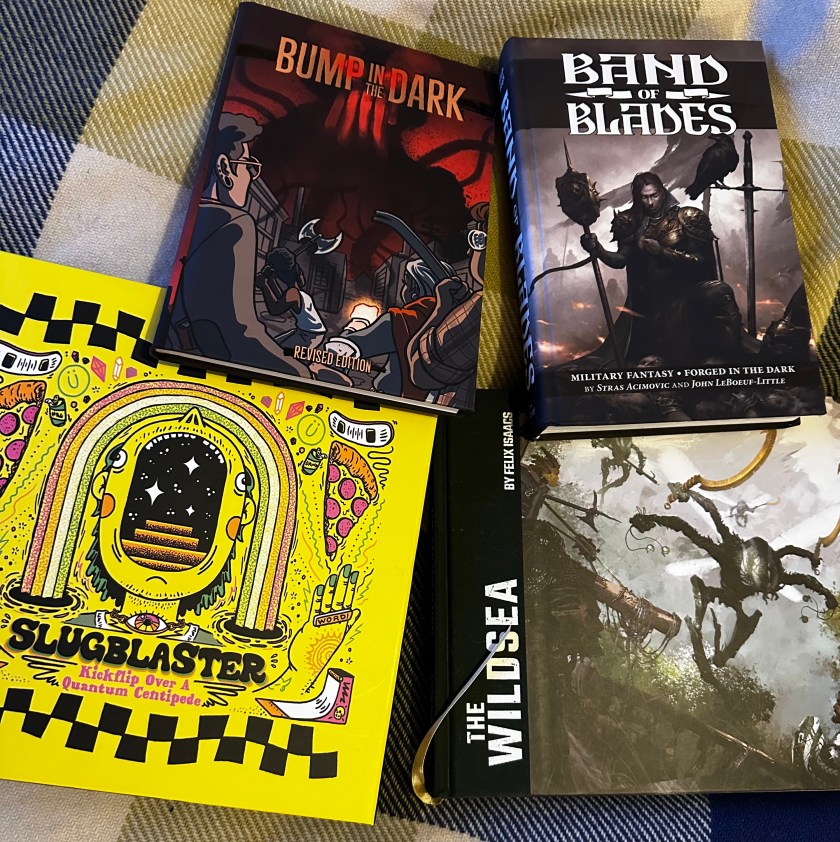
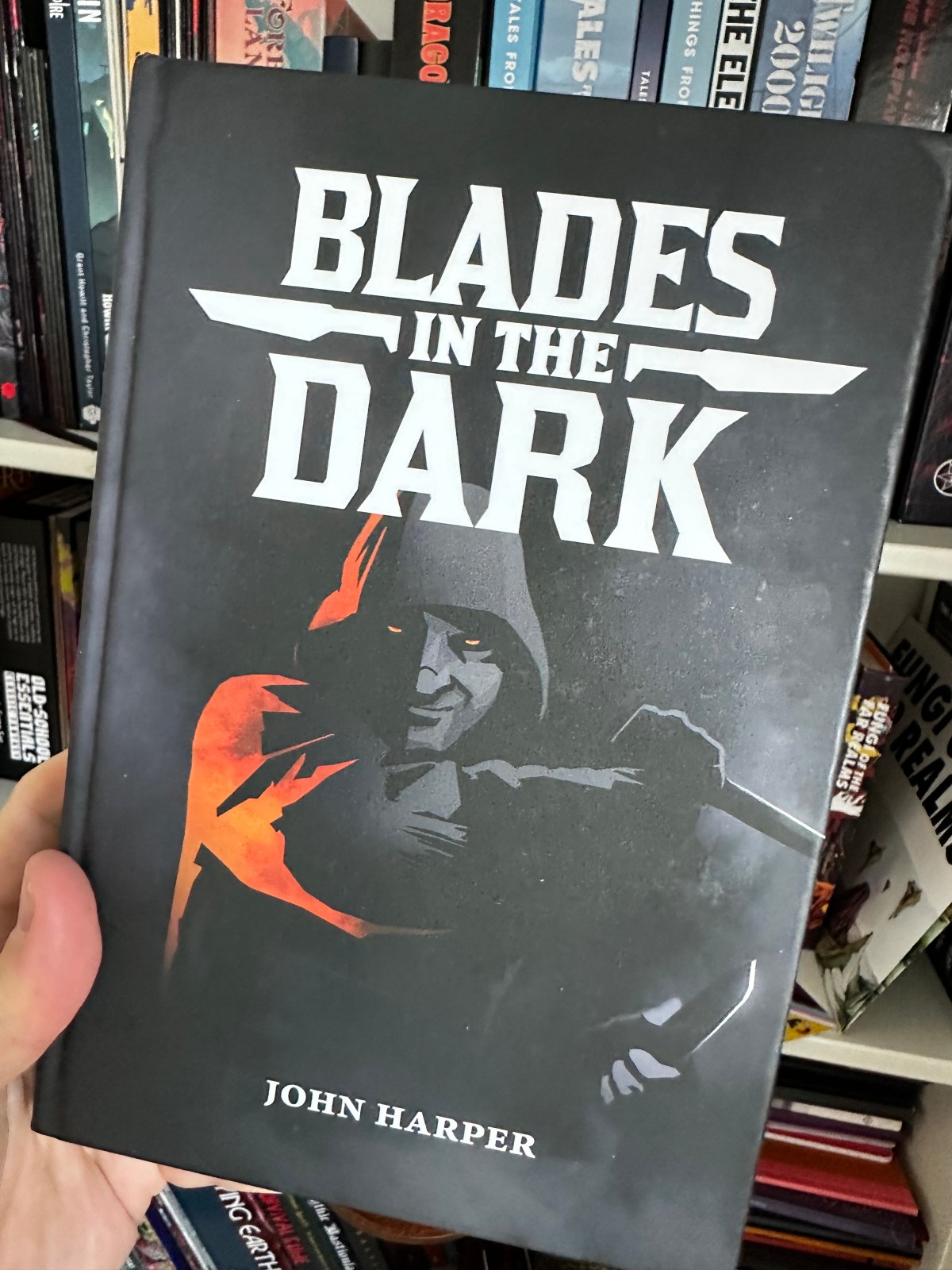
Blades in the Dark, by John Harper has had such a profound impact on the TTRPG landscape since its release in 2017, that it’s hard to overstate it. It has a devoted following, it consistently appears on top ten RPG lists and it has spawned a bewildering array of games based on its system and setting. Forged in the Dark games like Band of Blades, Girl by Moonlight, Bump in the Dark, Slugblaster and Wildsea (debatably.) You can find a non-exhaustive list here.
The system is story-focused, encouraging players as well as GM to take a hand in building the narrative. Near the start of the book, it is pointed out that, “no-one is in charge of the story.” If I were to encourage you to take anything from this short summary, it would be that.
As in Slugblaster, you roll a D6 when attempting something. 1-3 is a failure, 4/5 is a success with consequences and 6 is a full success. The consequences from a failure or mixed success can come in the form of Stress, and thereby Harm and Trauma Conditions, which have more of an narrative effect on the story than a mechanical one (although they certainly have that too.) You can also add more dice to your roll and build a dice pool to give you more chance of rolling higher. You do this in several ways, by using pushing yourself, getting assistance or taking a Devil’s Bargain.
In all of these Forged in the Dark games, the rolls you make are highly abstracted. Instead of making a stealth roll, an investigation roll or a thieves’ tools roll, you describe what your character wants to do and then roll with the appropriate Action Rating. In most cases the Action encompasses a character’s whole part in a scene, rather than a single, explicit skill or combat thing like in D&D and similar games. The choice of the Action Rating used is explicitly left up to the player, but if the GM thinks it might be more effective to use a different one, they can reduce the impact of the action or increase the danger of the PC’s position, making the consequences for failure more severe.
Blades has several really cool mechanics, like the Flashback to go back and prepare something for the situation you find yourself in, but I don’t have the space to go into every rule here. Maybe I’ll do more of a deep-dive into the rules in another post. For now, let’s go about creating my Scoundrel.
Dark Heists
It’s important to remember the setting and the type of game this is. You play a scoundrel of some sort, doing jobs/heists/cons with your crew. The setting is Doskvol (or Duskwall), a city in perpetual darkness beset by inter-faction strife, corrupt leaders, and supernatural entities. The end goal for the character is usually to retire from that life with enough coin in their stash to live safely and securely without worrying about rivals or the authorities.

Playbooks
The types of characters available to play are suitably goth.
- Cutter – violent and intimidating
- Hound – crack-shot tracker
- Leech – explosive alchemist
- Lurk – shadowy sneak-thief
- Slide – social and manipulative
- Spider – factional mastermind
- Whisper – magic and ghosts
There are seven of them, as you will have noticed. So, I’m breaking out the DCC zocchi dice again. I got a 4 on the d7 making this character a Lurk.
The Lurk

There is no longer any sunlight — the world is plunged into eternal night. There are scoundrels who live in the darkness, who prowl the underworld unseen, trespassing where they will. They are the burglars, the spies, the infiltrators, the cut-throats — commonly called Lurks.
After this pleasing intro, the playbook description tells me that my Lurk will gain xp whenever they “address a challenge with stealth or evasion.” Each of the playbooks have a different way to earn xp that’s individual to them.
Here also, it asks a couple of questions to get the player thinking, not just about the mechanics of the playbook, but about the personality and background of their character:
Q. How did you learn the stealthy arts of the Lurk?
A. I was taken in at a young age by a band of pickpockets and sneak-thieves.
Q. Which Aspect are you drawn to most? The invisible watcher, spying on the unwary? The adroit acrobat, racing across rooftops? The deadly ambush predator, waiting for a victim in the darkness?
A. The intimate knowledge of the city’s underworld, its back alleys and interconnected cellars, its rooftops and sewers. Where to spy from, where to approach a potential mark/victim from and how.
Starting Actions
Everyone has three Attributes:
- Insight
- Prowess
- Resolve
Each of these has four Action Ratings hanging off it.
Insight has
- Hunt
- Study
- Survey
- Tinker
Prowess has
- Finesse
- Prowl
- Skirmish
- Wreck
Resolve has
- Attune
- Command
- Consort
- Sway
You can have up to four points, or dots, in each Action Rating although you can only have up to two dots at the start.
The Attribute Ratings will equal the number of associated Action Ratings they have any score in. So if you have any dots in Attune and any dots in Command, you will have a Resolve of 2. You use the Attribute Ratings to resist different types of stress.
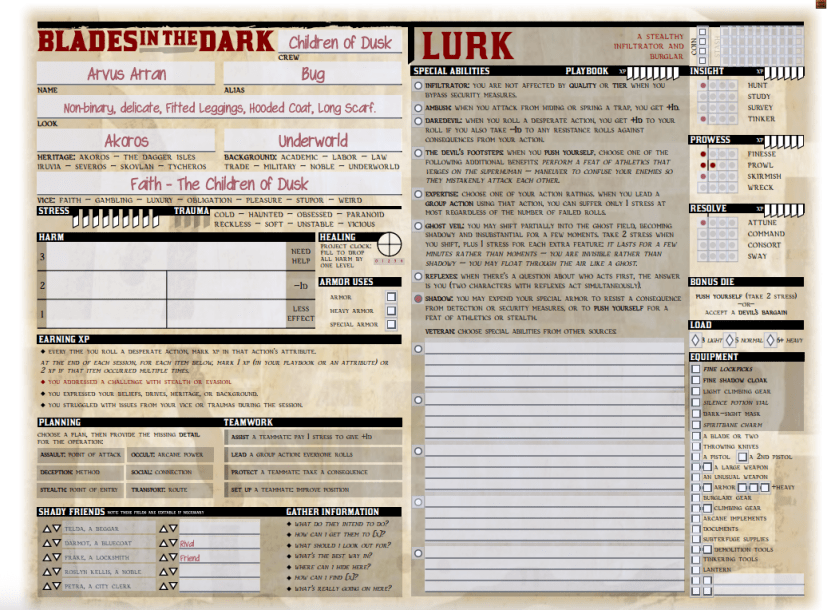
In the case of the Lurk, I start off with 1 point in Finesse and 2 in Prowl. I will add four more points to Action Ratings at a later step.
Shady Friends/Rivals
Your connections to NPCs can be key to a successful or disastrous career as a scoundrel. There is a list of five in a table here. I’m going to roll my d5 once for a Friend and once for a Rival
- Friend – 3 – Frake. This is a locksmith who has taught me everything I know about lock-picking. He has an encyclopaedic knowledge of every type of lock, chest, safe and safe room in the city
- Rival – 2 – Darmot. Once, he was one of our band of pickpockets, now, he uses his knowledge against them. He’s busted me many times
Lurk Special Abilities
You only get one of the eight listed abilities to start with.
- Infiltrator – you don’t suffer negative effects due to higher quality security measures employed by higher Tier enemies
- Ambush – Gives you an extra d6 when attacking from hiding
- Daredevil – get a bonus die if you take a desperate action as long as you take -1d6 to resist any consequences of it
- The Devil’s Footsteps – push yourself to do the impossible. This ability has a variety of effects
- Expertise – you have to choose an action rating and when you lead a group action with that, you can only take a maximum of 1 stress
- Ghost Veil – go completely invisible by shifting into the ghost field. Just take some stress to do it
- Reflexes – who should act first? You should, of course!
- Shadow – use your special armour to resist consequences from security measures or pushing yourself in physical endeavours
The book suggests taking the first one listed if you can’t decide between them. However, I am going to roll a d8 to make the decision for me. That’s an 8!
Shadow
You may expend your special armor to resist a consequence from detection or security measures, or to push yourself for a feat of athletics or stealth.
When you use this ability, tick the special armor box on your playbook sheet. If you “resist a consequence” of the appropriate type, you avoid it completely. If you use this ability to push yourself, you get one of the benefits (+1d, +1 effect, act despite severe harm) but you don’t take 2 stress. Your special armor is restored at the beginning of downtime.
I like this a lot. It matches the growing image of this character that I have in my mind.
Lurk Items
There is a section in the playbook description for items specific to the Lurk, but there is no need to choose anything at this stage. In Blades in the Dark, you simply indicate at the start of a Score how heavy a Loadout you have on you. That gives you a number of Load points to assign as the Score progresses. When you come across a situation in which you need “Dark-sight goggles” for instance, you write them down and mark the 1 Load that they take up. You never need to describe the items you have in your pack beforehand.
Heritages

There are six options here. Your Heritage is more akin to a real-world ethnicity or national background than a race or species. It is quite likely to shape your character’s politics, social circles and general way of thinking. It is unlikely to have any mechanical effect.
Here are the Heritages:
- Akoros – big, industrialised land. Like Europe. Duskwall is here.
- Dagger Isles – peopled by corsairs and merchants who sail the seas between their isles and beyond
- Iruvia – a desert kingdom to the south. Think Egypt.
- Severos – a wild place with nomadic people who survive in the ruins of ages past
- Skovlan – recently colonised by Doskvol. Many refugees from here have come to the city to look for opportunity
- Tycheros – a far-away land where the people are part demon. These characters get demonic telltales that mark them physically
Rolling a d6 for this as well: That’s a 1! Akoros. This is a local person whose family fell on hard times. While their parents were out looking for work, this guy was out running around with their gang, stealing and sneaking.
Backgrounds
What did this character do before going their crew? There are 7 options:
- Academic
- Labour
- Law
- Trade
- Military
- Noble
- Underworld
I would normally roll for this but I feel like I already have such a solid picture of this Lurk in my head that I am going to have to go for Underworld here. They were a street kid, a pickpocket within a network of urchins that spanned the city.
Assigning Action Dots
There are only a couple of rules to the way you can assign these dots (points) on your character sheet. You can’t start with more than two points in any one Action Rating. Also you should add one dot to an Action rating that reflects your Heritage and one dot to an Action Rating that reflects your Background.
I think, as a local in this industrial city, this character would get a dot in Tinker and as a wee guttersnipe, they would need a dot in Skirmish. I get two more dots to spend freely so I would like to add one to Hunt and one to Attune.
Vices
In your downtime between Scores, you might want to blow off some steam to relieve stress. That’s why you need a good vice!
Here are the options:
- Faith
- Gambling
- Luxury
- Obligation
- Pleasure
- Stupor
- Weird
There is a great deal of leeway to describe the specifics of your vice within the confines of the category. I’m going to roll a d7 for this. That’s a 1, Faith. I think my Scoundrel has found his place amongst an underground cult in the city. In fact, I think the band of urchins they have been part of since childhood is led by a prophet, a visionary with the ability to speak to god through the dead.
Name, Alias and Look
Name: Arvus Arran (I chose this from the long list of names in the book)
Alias: Bug (small, sneaky, seems to fly)
Looks: Non-binary, delicate, Fitted Leggings, Hooded Coat, Long Scarf.
Crew Creation
Just like in Slugblaster, you really need a crew to finish out a Blades in the Dark character, but this isn’t really possible here, except to say there are a few crew types:
- Assassins
- Bravos
- Cult
- Hawkers
- Shadows
- Smugglers
And Cult seems to make sense here, imagining that the rest of the crew are also members of Arvus’ gang.
Conclusion
This is such a straight-forward character creation process that involves very little flipping between sections of the book. With a new character, you don’t have too many decisions to make and you can begin to get a feel for the character you’re creating very quickly. You can also see the potential for future stories and drama in elements of the process such as the friends and rivals.
I have only played the one campaign of Blades in the Dark but writing this post has whetted my appetite for more!
Discover more from The Dice Pool
Subscribe to get the latest posts sent to your email.

 The Dice Pool
6 thoughts on “Blades in the Dark Character Creation”