Still Prepping
This post is part of a blog bandwagon started on the Roll to Doubt blog.
Click on the link above to take in the blogpost that’s piloting this bandwagon. Wagon-jumpers abound. You can find a very nice read on the same topic and a handy list of related blogposts on the Among Cats and Books blog.
And here’s a link to the first post on this topic on the dice pool dot com.
Between the Sessions
I am an unapologetic shill for Huffa’s Between the Skies. It’s one of my most used and most valuable RPG books. I use it constantly in lots of contexts. But I love using it to prepare for sessions. Its approach to random encounters in particular is one I highly recommend. The encounters are built, not just to make your session interesting, but to introduce potential allies and enemies, recurring characters, locations, objects. In short, they help you to truly build your campaign without relying on GM-written plots that the players may or may not want to interact with.
The methods and tables introduced in the book make for interesting, impactful characters and occurrences. And they have depth, too, enough to hook your players and keep them hooked. You know that old story that your players would die for the unnamed goblin you just made up on the spot but won’t give a shit about the NPC you spent two weeks crafting an elaborate back story for? I feel like the techniques in Between the Skies are almost designed to prevent that. Why? Well, firstly because, if used as your main way to drive the game forward, you are not going to be spending so long lovingly hand-crafting those NPCs, you are just going to roll them up on the tables provided and not worry about whether or not the PCs run into them, because whatever they run into will be interesting and fun enough to capture their imaginations. So, all the NPCs are more like the loveable nameless goblin and you don’t feel the need to make sure the PCs interact with any of them in particular. This has the effect of allowing the players to dictate the direction of the game to a large extent. This is a good thing!
Let’s Interact with the Mechanics
So, Huffa’s advice when it comes to travel is that, unless it is going to be interesting or important, skip it. I can get behind this approach. Recently, I have tended towards the idea of the journey being the game, but sometimes, when you know the next scene you need to play is across the city and its a relatively safe place, just skip to it, or montage it if there is something interesting to see along the way or if its a good opportunity for conversation between characters.
If and when you want to play the travel, though, Between the Skies presents you with two options, progress-based travel and route-based travel.
Route-based travel
Using this method, you use a map, just a basic one that includes routes and locations along them. You roll once on the Encounter die between locations and resolve that before arriving at the next place. Simple. The book includes several ways to generate route maps and destinations but I won’t concern myself with that here.
Your route map should have options, different ways of getting from A to B with more locations in between your starting point and the final destination depending on how long you want the journey to last.
This has the feeling of the caravan travel methods used in Ultraviolet Grasslands.
Progress-based travel
This gives me the impression of beating the resistance of a delve in Heart. Before the journey starts, determine the journey length. There is a helpful table that indicates the amount of Progress points required to reach the destination depending on how long the journey is. You record progress through the resolution of Encounter Die rolls.
The Encounter die works as follows:
- Encounter
- Something Approaches
- Environmental hazard
- Complication
- Hint as to what is nearby
- Progress/breakthrough/boon
So you only get progress points on a 6.
What I did
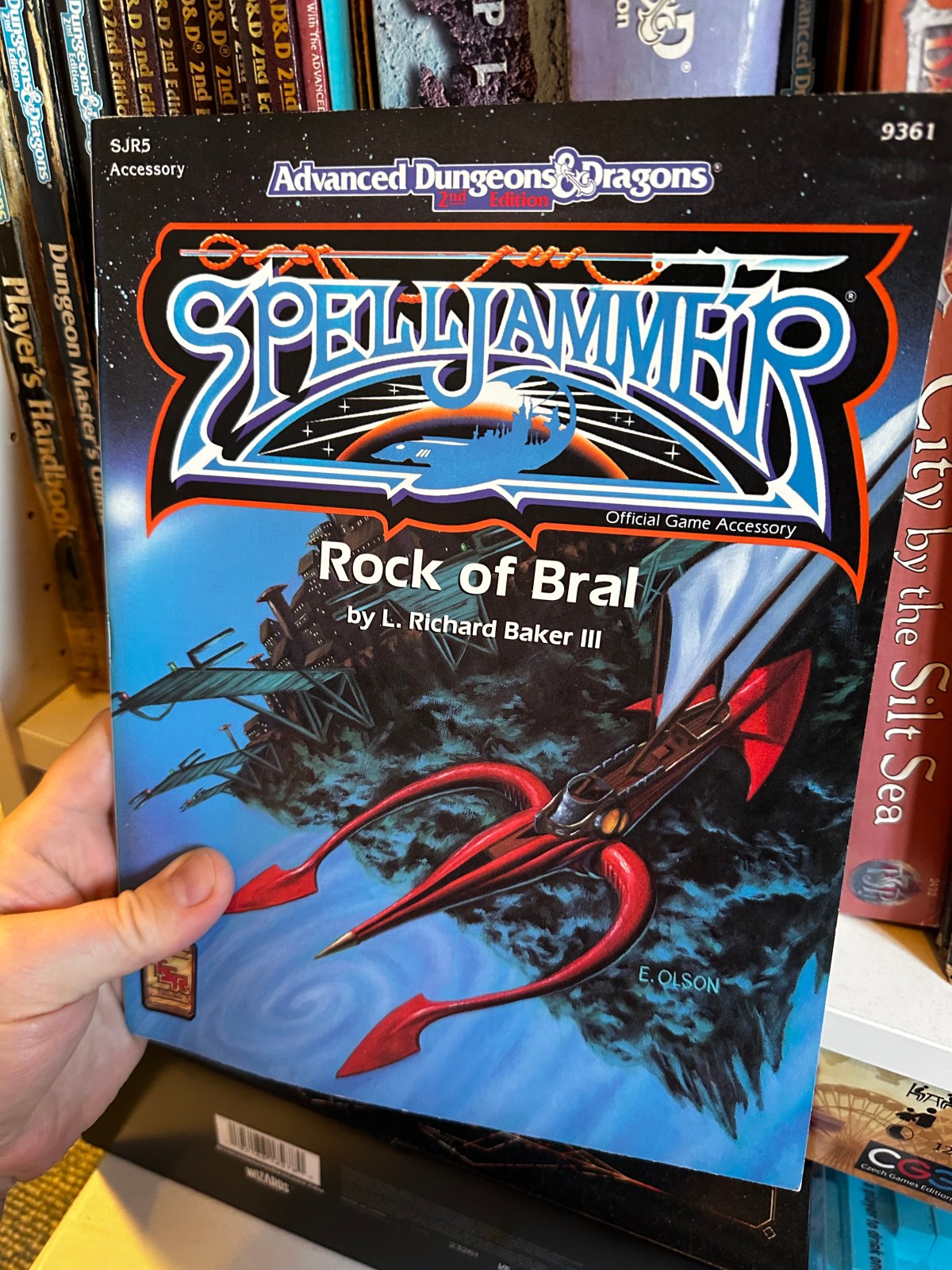
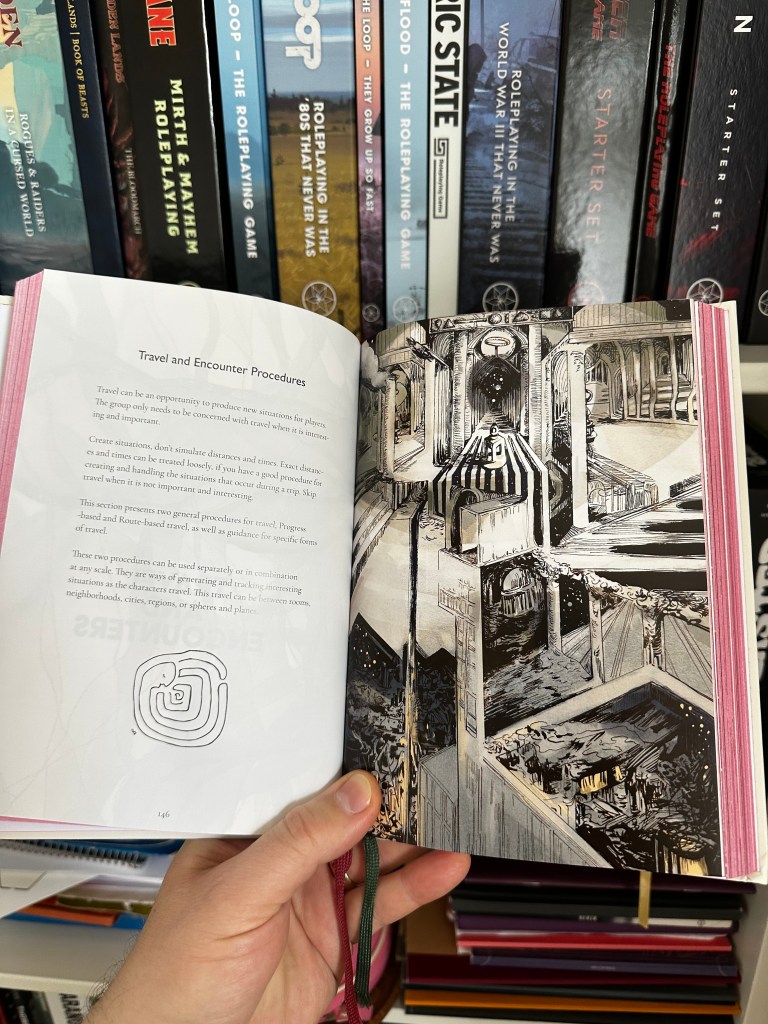
As with everything in Between the Skies, you can take it or leave it. I have used a combination of the two methods, where I decided that a spelljammer ship journey from the Rock of Bral to the First Home asteroid would take three days and I would have them roll on an encounter table once per day. So this is the table I used:
Wildspace encounter table d6
1-2 No encounter
3 Environmental/Ship Hazard
4 Ship Problem
5-6 Encounter
When you only have three days and so, three possible rolls on the table, I felt it was better to increase the chances of actual encounters/problems/hazards occurring. If it was a more exploratory journey, I would use the progress-based method as described in the book.
Now, using the tables in this book, of which there are many, you should be able to create a fascinating encounter on the fly, but, if you can, I think its nice to prepare a few beforehand, at least one of each kind. So let’s do that here.
I thought it would be a good idea to roll up some options on the spark tables in the book and add them to a d4 table for each encounter type (environmental/ship hazard, ship problem and ship travel encounter.)

Environmental/Ship Hazard
We’ll start with the hazards. For each hazard you want to prepare, you roll 1d6 to determine the hazard type and then d66 to generate a hazard keyword on the Environmental Hazards during ship travel table in Between the Skies.
I shared this table in the last post so lets use the results I rolled up on that.
3 Ship Hazards
Roll 1d4
- Hazard 1 – Storm, Flood
- Hazard 2 – Disorientation, Sphere
- Hazard 3 – Obstruction, Cold
- Hazard 4 – Trap, Haunting
I then go ahead and prepare a few details of the hazards. Here’s the first one as an example.
Hazard 1
A solar storm rolls in from the direction of the sun.
- The gusts of solar winds batter the ship
- The deck is flooded in light and other solar radiation
- All those on deck risk blindness
- There is also a chance of taking radiant damage
- All on deck must make a Dexterity save, DC 15 to avoid blindness
- If they are afflicted with blindness it lasts 1d4-1 days. If you roll a 1, Roll 2d12-1 for the number of hours it lasts
- Even if they saved against blindness they must make a Constitution save, DC 15, against radiant damage. If they fail they take 4d6 radiant damage. If they succeed they take none.
- This goes for the ship too, if the damage roll beats the damage threshold
You can see that I took the hazard type fairly literally but moved it into a wildspace context. A solar storm seemed obvious but also pretty cool. The keyword, “flood,” took me a little while to work out but I thought flooding the deck with light seemed both like a cool, spacey event and something that could present a real problem for the PCs.
Obviously, you can prepare the details for each entry in the table. They don’t have to involve a lot of work but putting a little extra preparation in at this stage can remove the need for it at the table.
Ship Problem

Similar to the hazards, you simply roll up a problem type and a problem keyword on the Ship Problems tables in Between the Skies. I did this four times and created the d4 table below.
4 Ship Problems
Roll 1d4
- Problem 1 – Armament, Separation
- Problem 2 – Quarters, Shrinkage
- Problem 3 – Cargo, Disappearance
- Problem 4 – Bridge (spelljammer helm), Error
Here’s the detail on one of these entries:
Problem 2
One of the crew has stowed something large and awkward in the crew quarters. It is limiting the amount of space available to sling hammocks and the rest of the NPC crew is unhappy about it.
This crew member refuses to be parted from their huge steamer chest as it contains something of extreme personal significance.
The PCs will need to resolve the interpersonal issue.
You can see that the details here are left deliberately vague. You Ould ask the players to decide which member of the crew is the problem, what’s in the chest that’s so important and, most importantly, how the resolve the issue.
Encounters

And finally we have encounters.
There are a lot of different encounter tables in the book. You can choose the one that best describes the surroundings of the PCs at the time. There are two space encounter tables, one for known space and one for wildspace. They are d66 tables. Once you have done rolled on them, you can get some more inspiration by rolling on the encounter keyword, detail and related entities tables.
Once you have rolled on the Encounter distance and awareness tables in Between the Skies to determine how far away the encounter is and how much attention they are paying to the PCs you can roll on the d4 table below.
You’ll note that the results on the table below are not all similar. For instance, encounter 2 doesn’t have a related entity. In general, such entities, as generated by the tables in Between the Skies, are sentient NPCs so I didn’t think it necessary for the parasite I rolled up. But mostly each of them includes an encounter keyword, a related entity, and two encounter details.
5-6 Encounters
- Isolationists – Confusion, Related Entity – Unknown NPC, Glittering, Prayers
- Ship Parasite – Loss, Scales, Experiments
- Ruins, Ancient – Mourning, Related Entity – Petty God, Knots, Miscommunications
- Stowaway – Battle, Related Entity – Creature, Eggs, Blindspots
Stowaway
Size, substance and form table: Very small biota, piecemeal.
Weakness: True name
Needs: Brains
Characteristics and details: Pacifist, stalks
Behaviour: Social: Family: 5 appearing
Demeanor and current behaviour: Protective, healing
Attacks: Blast – teleporting
For the final example, I’m using the creature generation tables in the Entities chapter of Between the Skies. You can see all the details and keywords that I rolled up above.
Along with the keywords, battle, eggs and blindspots, that came from the original encounter detail rolls, these will make for a fascinating encounter with some sort of very small fungal entity that has escaped a battle to find refuge aboard the PCs’ ship. The mushroom creature has a desperate need for brains to help heal its young but will not take them by force. Perhaps they only consume the brains of dead beings. Perhaps they have a blindspot that means they cannot sense constructs. And maybe, also, they have crawled into the ship’s stores to try to feed on the eggs, mistaking them for heads containing brains. I like the idea of them lashing out with a teleporting blast to deposit attackers some way off the deck of the ship, leaving them to perish in wildspace. If the PCs can figure out the creatures’ true names, they’ll be able to get them off the ship, but how?

Conclusion
I think you can see the fun you can have preparing encounters and encounter tables using Between the Skies. Once again, dear reader, I can only urge you to go and purchase it. It’s so useful and you won’t regret it!
Discover more from The Dice Pool
Subscribe to get the latest posts sent to your email.

 The Dice Pool
2 thoughts on “Prep Part 2”