
If you’re interested, go check out my post previewing this game here.
A Bad Call?
Burke, Carter J “confessed” to Ripley that he had made a bad call in sending them to a colony on the moon, LV-426. But did he mean it? No. He was a scumbag of the highest order. He was just fucking someone else over for a percentage. I sent my players to LV-426 too. I wasn’t looking to fuck them over for a percentage, but, at the very least, I expected most of their characters to get impregnated by facehuggers, ripped to shreds by drones or melted by acid blood. Did any of that happen? Did I make a bad call in choosing the Cinematic Alien RPG scenario, Hope’s Last Day, from the core book, rather than the one from the Starter Set? Well, dear reader, why not come with me on a trip through our one-shot and my thoughts on it, and you’ll find out.
Shake and Bake

These two scenarios couldn’t really be much more different. The one from the Starter Set, Chariot of the Gods, is set on a ship out in space, you know, where no-one can hear you scream? It’s also very much a full scenario with an entire three act structure. They say it would take three sessions to play but I have my doubts about that estimate, having played Hope’s Last Day.
Speaking of which, Hope’s Last Day is a scenario that’s set totally on the moon where Ripley and the Nostromo’s crew found the Alien eggs in the first movie and the setting for the action of the second. This scenario was not even a full Cinematic experience. It is billed as a taster, since it really only encompasses what would be the third act in a normal Cinematic scenario. The book confidently asserts that it could easily be played in under two hours.
Frankly, duration was the deciding factor for me. I only had one night to get through a whole scenario. I don’t have a lot of wiggle-room in my schedule due to the fact that I have at least seven other ongoing games at any given time, so it really had to get wrapped up in one shot. So, I shook it and baked it.
Shaking
Shaking, essentially, meant reading through the scenario a couple of times. It’s very short, so this was not a problem. I also took notes on the various major beats and summarised the contents of the various blocks and rooms into bullet points. Most of the scenario consists of these location descriptions so this was key for me. Also, they are all presented in what I consider to be unwieldy blocks of text in the book, and I prefer referring to bullet points at the table. This work helped me to keep things flowing a little more smoothly on the night. I also screenshot handed the pregenerated characters out to the players I thought they would suit best a couple of days before. This part was fun, and the players were left to wonder how I decided who should play which character. Each character had an agenda that was generally meant to be kept secret from the others. Now these were fun. Stuff like, being willing to sacrifice themselves for the others, wanting to acquire an alien and escape with it or just to keep the company’s actions a secret at all costs. You know, normal stuff. Anyway, I examined these agendas and assigned the characters purely out of a desire to see each player pursue that secret agenda. Other than this fairly sparse preparation, I got a couple of copies of the map of Hadley’s Hope printed and a few character sheets. I familiarised myself with the relevant rules as much as I could and that was it for the shaking.
Baking
At the table, we baked. And, I will say most of the time this one-shot spent in the oven, there were no issues at all. Was I ready to nuke the site from orbit by the end? Not quite, thankfully. I’m mixing my metaphors quite egregiously at this point so I’ll abandon them both and just tell you what happened.
I started exactly as the scenario suggests you start, with the four PCs inside the West airlock of Hadley’s Hope. They had just returned from a day or more outside the settlement and were not aware the Aliens had already decimated the population. I let them investigate a bit, try and get an intercom working, and generally futz around. The scenario calls for an Alien attack whenever the PCs dawdle but I didn’t want to lose anybody so early on. I think this was a mistake on my part. Their first encounter with an Alien occurred a little later after they had made their way to another block of the station and messed around looking at eggs and facehuggers and whatnot. This gave one character the opportunity to collect an egg and another to sacrifice himself to keep the others safe and made them all start running to find the way out. This was more like it. Things really started moving then. The one who sacrificed himself turned out to be an artificial person as Bishop would have us call them. So, the alien just left him, innards outed, on the floor and unable to move, but not dead. Luckily there was an extra pregen for that player to take over so we continued on.
Later they encountered a couple of facehuggers after finding a few weapons. They made short work of them and moved on again. They spent much of the last part of the session effectively split into two parties running from two different drones towards the only way off the planet, a shuttle. And you know what? They all made it! Except the android, who, I can only assume was caught in the conflagration when the nuclear reactor in the processing plant went up as Ripley and the others escaped. Also, they didn’t all make it, because the pilot turned out to be the company plant and she spaced everyone else as soon as they left the atmosphere. I guess that made her the winner?
Game Over, Man
So, what was the verdict? It’s a mixed bag, to be honest.
I think our main complaint was that this was mislabeled as an under-two-hour scenario. I mean, ok, it was our first time playing the Alien RPG so we did have to spend a little extra time referring to the rules and figuring out what all the stats meant, but that does not account for the fact that this thing took us almost four hours. Even then, I had to abandon some integral rules to allow us to make it to the end in that time. I don’t honestly know how anyone gets five people around a table, people who want to role-play, who want to fuck around and find out, people for whom the joy is in the playing, not in the finishing, and have them get through this scenario in anything less than four and a half hours if you stick to all the rules of the game.
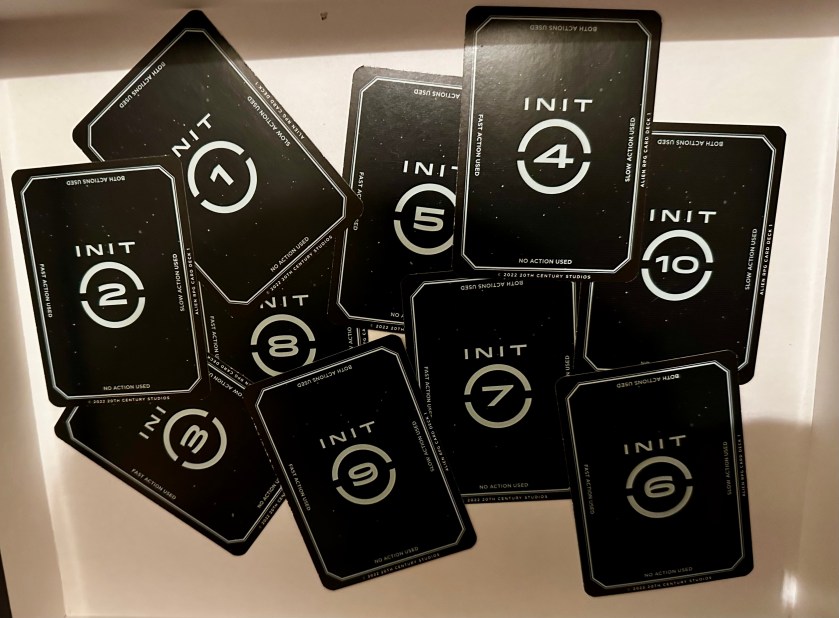
As for the rules. The main negative was the initiative system. Alien, like other Free League games, uses an initiative card system. We generally found it a little difficult to keep track of things using this and found it slowed the action down significantly. One of the main issues was that the PCs kept getting into initiative, running away from fights, getting out of initiative, getting caught again and getting into initiative again! So we were shuffling and picking those cards a lot. In fact, as time ran out on our session, I just left the cards to one side and did it narrative style. I got each player in turn to tell me what they were doing and told them how the Aliens or the environment reacted or acted against them. This really sped things up and drew the evening to a very exciting close, in fact. Would I use the initiative system as-is if I played again? I think I would give it a go as long as I had more time to play with but I would be ready to give up on it in a second if it started to get in the way again.
One more issue for me was the system used to figure out how the Aliens attack. Every time it’s their turn, the Game Mother has to roll on a table to determine which of their special attacks they use. This started off as a fun activity, but quickly got frustrating. It felt like each time the Alien had one of the PCs in their grasp, I would roll up an attack that allowed them the chance to escape. Now, if this happens a couple of times, it adds a nice dramatic element to the chase. But this is literally how they all managed to get away in the end. If I had been just choosing the attacks for the Aliens, there would not have been so many occupied seats on the shuttle when it took off. I feel like there is a better way to adjudicate the moves they make. Admittedly, you would not want every attack to be lethal, either, but it felt as though far too many of them were underpowered.

One element that worked well but felt like it was under-utilised or tacked on was the Stunt mechanic. Each skill had a stunt table that told you how you could spend your excess successes (each 6 you get when you roll your dice pool is a success and you gnerally only need one to succeed at your task,) but the players almost exclusively went for one of two options, at least in combat situations: they added extra damage or they pinned the enemy down to prevent them from taking as many actions on their next turn. This was fine but it feels like this needs more work. Perhaps the new edition will deal with this.

You know, there were plenty of mechanics we liked in the game too. The main mechanic in the Alien RPG, the thing you would lean on to sell the system, is Panic. Like other Year Zero Engine games, you roll a dice pool consisting of a number of dice equal to your score in a given skill plus the number of dice equal to your score in the related ability. So, if you have a 1 in Mobility and a 2 in Agility, you roll 3 dice. But, as you play, your character gains Stress for all sorts of awful reasons. For every point of Stress you gain, you get to add another die to every dice pool. This gives you a greater chance of success but also gives you a chance that you’ll have to roll on the Panic Table. This happens if you roll a facehugger (a 1) on the official Alien RPG Stress Dice. There are other ways of panicking. Usually, if one of your companions does something unhinged or crazy or if you see an Alien for the first time. That kind of thing. By the end of the session, everyone had so much Stress that they were rolling obscene numbers of dice and there were Panic rolls happening almost constantly. One Panic roll would often lead to another from someone else because of the result they would get. Also, because, each time you roll on the Panic table, you have to add your Stress Score to the roll and the shit at the bottom of the table is way worse than the shit at the top, the results got very bad as time went on. For example, this is what you get for rolling a 7 gets you:
NERVOUS TWITCH. Your STRESS LEVEL, and the STRESS LEVEL of all friendly PCs in SHORT range of you, increases by one.
This is what you get if you roll a 15+:
CATATONIC. You collapse to the floor and can’t talk or move, staring blankly into oblivion.
This did happen to one character but they were already at the shuttle at that stage and someone was able to drag them inside.
The feedback I got in stars and wishes from the session indicated that the players also loved the agendas they were given with their PCs. This was a worry for me before we started. I mean, not only did they not get to create their own characters, I didn’t even give them the choice of which one to pick. Obviously, this was because I didn’t want to reveal the secret agendas to everyone before play started. And I’m so glad I did it this way! Everyone had pretty much figured out who was the android in under an hour, but no-one, and I mean even me, because I forgot what the pilot’s agenda was, expected to be spaced by one of their own when they were on the verge of escape. Incredible scenes. This element of the game is specific to the short Cinematic Play scenarios. And, indeed, normally, in a full scenario, your PC’s agenda changes as you move through the three acts. I can’t account for how well this works, obviously, but it sounds great.
As for the scenario itself, there is not a lot to it. This is definitely a good thing. If you play it, you’re not going to get to most of the compound. A lot of those areas I summarised into bullet points remained completely unexplored. Once the drones were after them, the PCs soon discovered a sense of urgency and a definite goal, i.e. escaping on the shuttle. There was a bit more to it than that, but not much. Like I said, this was fine, especially as the PCs’ agendas took the place of a set plot most of the time anyway.
It was also cool that the scenario was so closely related to Aliens, the movie. I watched it the night before running the session, and that definitely helped me to picture the place and to describe it at the table. I’d recommend doing that if you do intend to run Hope’s Last Day. I’d also recommend leaving yourself at least four hours to do it justice.

So, was it a bad call? No, but if I went into it again, knowing what I know now, I would have made a few alterations to my expectations.
What about you, dear reader? Have you played this scenario or this RPG? Are you looking forward to the Alien Evolved Edition? Get in the comments?
Discover more from The Dice Pool
Subscribe to get the latest posts sent to your email.

 The Dice Pool
2 thoughts on “Alien RPG’s Hope’s Last Day: A Review”