
Learning to Crawl
It’s been quite a while since I’ve done one of these posts. I think my Dragon Age Character Creation post was the last one. And it was very useful to me in figuring out how that game worked before I started a campaign of it (which is ongoing. The PCs have all just become Grey Wardens without dying during the Joining!) Well, I’ve got a short game of Dungeon Crawl Classics coming up this weekend so I thought this would be a good opportunity to create a character using the DCC rules to help familiarise myself with them.
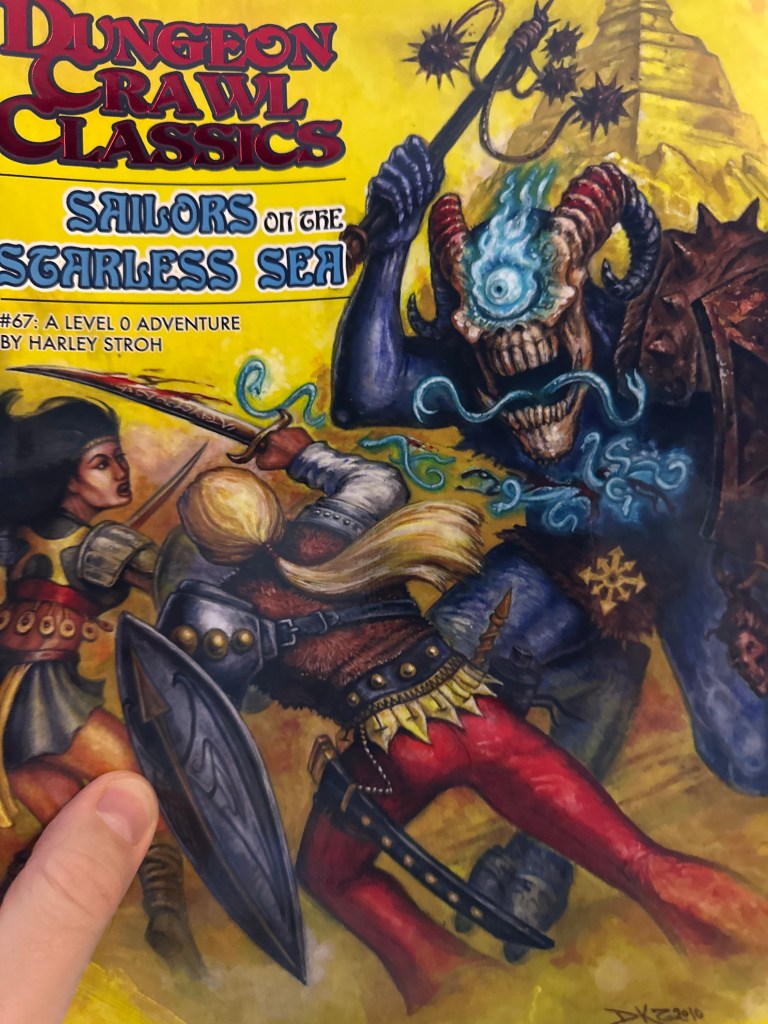
I’ll be running the iconic DCC #67 Sailors on the Starless Sea for a group of four or five players. To be honest, I don’t expect any of the PCs who survive this 0-level funnel (this is a module where the players play three or four 0-level peasants who delve into a dungeon. Whichever of their PCs survive get to advance to 1st level in their chosen class, normally) to go on to choose a class or progress to 1st level as its more of a one-shot deal. But, you never know! If it proves to be popular or any of them get particularly attached to one of their characters, maybe I’ll brew up a campaign for them. I certainly have enough DCC resources and modules to run campaigns for the next ten years straight!
Anyway, the point is, I think I’ll still get something out of creating an actual character using these rules. So here we go!
Funnelling
For the purposes of this post, I am going to roll up four 0-level characters and then roll 1d20 for each of them. The character that rolls the highest will progress to 1st level while the rest are assumed to have died a gristly and unfortunate death in some stinking hole beneath a castle or in the gullet of some demon lord.
To roll up the 0-level characters, I’m going to use the fabulously useful purple sorcerer, which will do it automatically for me. This is what I expect my players to use when generating their own PCs.
But first, a note on what’s being generated:
- Ability Scores – These are Strength, Agility, Stamina, Personality, Intelligence and Luck. All DCC ability scores are generated by rolling 3d6. There are no alternate methods of generating them, no point-buy, no 4d6 and drop the lowest… it’s brutal.
- 0-level Occupation – there is a d100 table that covers a page and a half of the book to determine this. Your Occupation also determines your starting Trained Weapon and which Trade Goods you begin with. It will also indicate the type of skills you are trained in.
- Money and Purchased Equipment – a 0-level character starts with 5d12 copper pieces. On top of the weapon they start with, they can use these to purchase other stuff
- 1d4 hit points, modified by Stamina
- A +0 modifier to attack rolls and saving throws
- A Lucky Sign – DCC characters begin with a Lucky Sign, which you roll for on a table. This can give the character a +1 to a particular type of roll forever!
One thing that’s not generated is alignment. For D&D type games, I don’t normally bother with alignment. But I think it is so integral to so many of the mechanics of DCC, that I can’t avoid it. The available alignments are Chaotic, Neutral and Lawful. I am going to roll for this on 1d3. I rolled a 2, so this character, whoever they turn out to be is going to be Neutral in alignment.
So, without further ado:

I rolled up one Dwarven blacksmith, a Minstrel, a Herbalist and a Butcher. I’ll quickly go through the high points and low points of each:
- Dwarven blacksmith – I’ll name them Grund. Grund has a Personality score of 13! That’s his highest. However, his Strength, which would be one of the main abilities of the Dwarf class, is just an 8. Even more alarming is that they have the approximate intelligence of a fence-post, with a score of just 3. Since their Luck modifier is 0 they don’t get any Lucky Sign bonus
- Minstrel – I’ll name them Flor. Flor’s ability scores are generally very high, strength 12, stamina 14, personality 14 and Luck 15. Only Agility lets them down with a score of 7. They start with 5 HP! Also, Flor as the Lucky Sign, Raised by Wolves, which gives them a +1 to Unarmed Attacks.
- Herbalist – I’ll name them Bud. Bud’s ability scores are incredibly average. Only Luck gives any kind of bonus (+1) and only Agility gives a minus (-1.) They do have the Four Leafed Clover Lucky Sign, which provides a +1 to Find secret doors. Only starting with 1 hit point, though…
- Butcher – I’ll name them Cutter. Cutter is weak, (strength 7) clumsy, (agility 8) and unpleasant to be around, (personality 5) but is pretty smart, (intelligence 15) so they’re probably pretty annoying. Luck provides a 0 modifier so no Lucky Sign bonus here.
OK, I’m not going to lie, I’m holding out for Flor to survive the funnel but it’s entirely random so there’s really no telling…
“Funnel” Rolls

So, it all comes down to a single d20 roll for each PC. In case of a tie, I’ll just re-roll both.
- Grund the Dwarven blacksmith – 17 (oh no)
- Flor the Minstrel – 4 (wah!)
- Bud the Herbalist – 18 (a reprieve!)
- Cutter the butcher – 6
So, Bud, alone, bleeding and traumatised, crawls out of the crumbling remains of the ancient temple having, with the help of the heroic and now deceased Grund, Flor and Cutter, defeated the ancient evil beneath it. Grabs some treasure on the way out too!
Choosing a Class
So, since Bud is a human (all 0-level characters are assumed to be human unless it’s clearly stated in their title, i.e. Dwarven blacksmith) they can choose from any of the classes except Elf, Dwarf and Halfling, for obvious reasons. Yes, this is another one of those old school games in which “Demi-human” races are treated as classes, kind of like in Old School Essentials. You can check out my disastrous OSE character creation post here.
Anyway, that leaves the following classes to choose from:
- Cleric
- Thief
- Warrior
- Wizard
Now, Bud’s ability scores are as follows:
- Str: 9 (0)
- Agi: 8 (-1)
- Sta: 12 (0)
- Per: 11 (0)
- Int: 9 (0)
- Luck: 13 (+1)
Normally you would go with the class that matches your highest ability score, right? Well, I could do that, but Bud’s highest is 13 for Luck, which is useful for all classes. Next is Stamina, on 12, but, once again, no one class relies on that. You could argue for Warrior there, but with a Strength score of 9, I don’t think it makes sense. So, instead, I think I will go for Cleric, since they use Personality to cast their spells and that’s Bud’s next highest Ability score, at 11. They don’t get a bonus from it, but it’s as good a reason as any to choose a class, I think. Oh, also, the Herbalist already started with a Holy Symbol, so it seems fitting.
From the DCC book:
An adventuring cleric is a militant servant of a god,
often part of a larger order the faithful, they wield the
weapons of their faith: physical, spiritual, and magical.
Physically, they are a skilled fighter when using their
god’s chosen weapons. Spiritually, they are a vessel for
the expression of their god’s ideals, able to channel holy
powers that harm their god’s enemies. Magically, they
are able to call upon their god to perform amazing feats.
Hit Points
Each class rolls a different die for hit points, just like in D&D and OSE. If you’re a Cleric, you roll 1d8 per level.
Bud rolls a 6 on their 1d8 and adds it to their 1 hit point from level 0 to make 9.
- HP: 9
Choosing a God
If you choose to be a Cleric, you have to choose to worship a God of similar alignment to you. In Bud’s case, that Neutral. I am going to consult the Gods of Eternal Struggle table and choose one of the Neutral deities from that.
I have recreated the Neutral gods section of the table below:
| Alignment | Gods | Weapons | Unholy Creatures |
|---|---|---|---|
| Neutral | Amun Tor, god of mysteries and riddles. Ildavir, goddess of nature. Pelagia, goddess of the sea. Cthulhu, priest of the Old Ones | Dagger, mace, sling, staff, sword (any) | Mundane animals, un-dead, demons, devils, monsters (e.g., basilisk or medusa), lycanthropes, perversions of nature (e.g., otyughs and slimes) |
With their background in herbalism, I feel as though Bud would lean towards the worship of Ildavir, goddess of nature. As you can see from the table above, they get a semi-decent selection of weapons they can use. It is also interesting to note at this point that Clerics can wear any armour and it won’t affect their spell-checks. Finally, you can see they are able to turn an array of interesting creatures, not just undead.
Magic
In DCC, when you want to cast a spell, you have to roll a spell-check. This is an obvious departure from D&D. Another difference is that they don’t get spell slots. However, there is a downside here. If you fail in your spell-check roll, you risk the ire of your deity. In the normal state of affairs, if you are trying to cast a spell and you roll a nat 1 on your spell-check, the spell auto-fails and you get to roll on the Disapproval Table. This can lead to consequences ranging from this:
The cleric must atone for their sins. They must do nothing but utter chants and intonations for the next 10 minutes, starting as soon as they are able (i.e., if they are in combat, they can wait until the danger is over).
To this
The cleric’s ability to lay on hands is restricted. The ability works only once per day per creature healed – no single character can be healed more than once per day. After 24 hours, the ability’s use reverts to normal.
Worse still, your chance of auto-failing goes up by one, meaning auto-failure and a Disapproval Table roll on a 1 or a 2. It gets worse; for every spell-check failure in the same day after this, that auto-failure range increases by another 1, with no real upper limit.
You can also piss off your deity by “sinning,” e.g. acting in a way that contradicts the god’s teachings or benefits one of their enemies.
Now, there is a way to offset these consequences: sacrifice. Yep, all you have to do is destroy or give away 50gp worth of wealth in your god’s name to reduce the failure range by 1 point. They might also accept a great quest of undertaking of faith instead.
Spells
Anyway, back to the spells! Bud starts knowing four Level 1 Cleric Spells, according to Table 1-5: Cleric. So, let’s choose them!
- Blessing – this can be used to bestow all sorts of boons on the cleric themself, an ally or even an object. Since every spell in the game comes with its own table to determine the exact results, I’m not going to get into it here. Suffice it to state that you can get anything from a +1 to attack rolls for a round, right up to getting a permanent +1 for the whole party to any actions to do with a sacred endeavour they have undertaken.
- Holy Sanctuary – this creates a place of safety for the Cleric and their allies. It might simply make it harder for enemies to hit them in that space, or it might allow the Cleric to create a permanent place of sanctuary, such as a temple, where powerful enemies cannot attack the faithful at all.
- Second Sight – the Cleric gains divine insights into the results of their own actions. It might be a +4 bonus to a single action roll or it might be able to divine the outcomes of great events for a month and also receive a +1 bonus to all actions taken during that period!
- Word of Command – Use a single word to command a creature to do something. The effects range from just that to it targeting all desired creatures they can see, who must obey it for a number of days.
All Cleric spell checks are made like this: 1d20 + Personality modifier + caster level
Turn Unholy
You saw above the range of creatures that Bud can turn with a Turn Unholy roll. This roll works the same as a spell check, so 1d20 + Personality Modifier + caster level. However, when Turning, the cleric can also add their Luck modifier. In Bud’s case, this is good because they have a +1 in that.
Failing a check can incur the Disapproval of their deity just like failing to cast a spell.
On a success, there is a fairly complicated set of potential outcomes depending on your turn check roll and the Hit Dice of the creatures you’re trying to turn.
Lay on Hands
Bud is a healer as well, of course. In fact, the Lay on Hands power is the only real way they have to heal anyone. But! They can use that to heal them of hit point damage, disease, poison, broken limbs etc. They can use it to deal with pretty much any condition.
Of course, just like with Turn Unholy, you have to make a spell check to use this power, 1d20 + Personality modifier + caster level.
The dice you use to heal someone depends on their class/type of hit dice they use. So, for a Warrior, who uses a d12 for their HD, healing is also rolled on a d12, which I think is neat. Although you can never roll more dice to heal than your target has in HD already.
Alignment is a factor in healing. If you try to heal someone of different or even opposing alignment to your character, you are going to probably do less healing than if you were healing someone of a similar alignment. As a Neutral Cleric, Bud is probably in the best position in this respect, as both Chaotic and Lawful creatures are considered adjacent to him on the alignment table, which I have reproduced below:
| Spell check | Same | Adjacent | Opposed |
|---|---|---|---|
| 1-11 | Failure | Failure | Failure |
| 12-13 | 2 dice | 1 die | 1 die |
| 14-19 | 3 dice | 2 dice | 1 die |
| 20-21 | 4 dice | 3 dice | 2 dice |
| 22+ | 5 dice | 4 dice | 3 dice |
Divine Aid
You can just ask your god for anything really. But it must be a truly extraordinary act to get them to intervene on your behalf so directly, when they are already giving you spells and other powers. So, to achieve this, you make a spell check as normal, and, even if you succeed, you are lumped with a cumulative +10 penalty to future Disapproval range… the Judge (DM) gets to decide the exact DC and effect of the request depending on what the intention was, what the god might want and how big the intervention needs to be. This seems like it could be used in some really clutch moments though.
There are a couple of notes right at the end of the Cleric class description. One relates to Luck and how their Luck modifier can be added to Turn Unholy rolls. The other indicates that their Action Dice can be used to attack or cast spells.

Equipment
The Equipment Chapter starts with a table that indicates how much gold your character stats with if you decide not to opt for the 0-level funnel method of character creation. If a Cleric starts at level 1, they get 4d20 gp. So let’s roll that:
- 20 (yep, out of a possible 60 gp)
At least I can add the 48cp I rolled up on their level-0 character sheet. Well, let’s make the best of it. I am going to buy a decent weapon, since Bud started with nothing but a club, and hopefully some armour.
I think I am going to go for a modest
- mace (1d6 dmg)
and back it up with a
- sling (1d4 dmg)
That’s a total of 7gp. I had also better get some
- sling stones
for another 1gp.
Finally, the only armour poor Bud can afford is
- padded armour (+1 AC)
That makes Bud’s AC 10 because of the -1 Agility modifier.
That costs 5gp. So, Bud has 7gp and 48cp left.
So, let’s grab a
- Backpack for 2gp
- Flint and steel for 15cp
- 10 torches for 10cp
- 5 days of rations for 25cp
- a waterskin for 5sp
- 50’ rope for 25cp
- A grappling hook for 1gp
For a total cost of 3gp, 5sp and 75cp.
Which leaves Bud with 3gp 2sp and 3cp.
So, that’s pretty much it for Bud the Witness (that’s their title as per the Cleric Table) I like Bud. They’re a survivor and a true devotee of Ildavir, goddess of nature, but they will never forget their humble beginnings as a herbalist, nor their old companions, Grund, Flor and Cutter.

Thanks to Soxzilla2 on reddit for the form fillable character sheet! You can find that here.
Discover more from The Dice Pool
Subscribe to get the latest posts sent to your email.

 The Dice Pool