Gods are superheroes too
In the last post, I wrote about how D&D 5E characters are basically superheroes by another name. I also introduced the new Warlock patron that we came up with for Yulla in our D&D 5E campaign, Erlendheim, a few years ago. She had abandoned her “Fathomless” patron and taken up with “The Source.” After Yulla got her groove back and started living up to her potential, it was our Druid’s turn.
Habjorn, played by David, had not wasted the years since their former adventuring days. He’d settled down with his wife, Lydia and started a little family which quickly ballooned into a sizeable troupe of children. There were seven in total, Habjornson, Sigrid, Gurt, Hogarth, Jankur, Flaarj and Yeet, the little one. But, as I noted last time, they, along with several of their neighbours, went and got themselves kidnapped by one of the antagonists. Lydia had already passed away a few years previous.
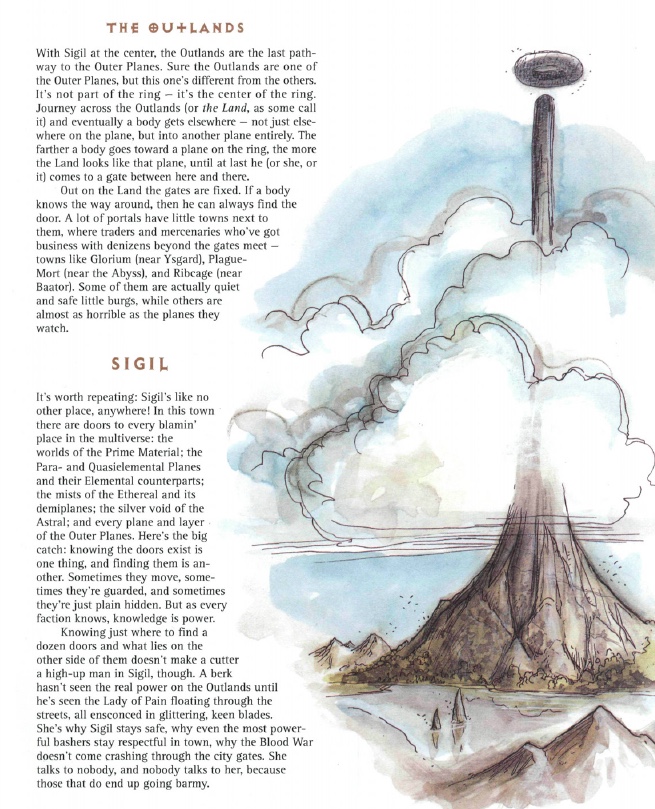
So, obviously, the party to go to great lengths to find them. Lengths that eventually led them to Sigil and beyond.
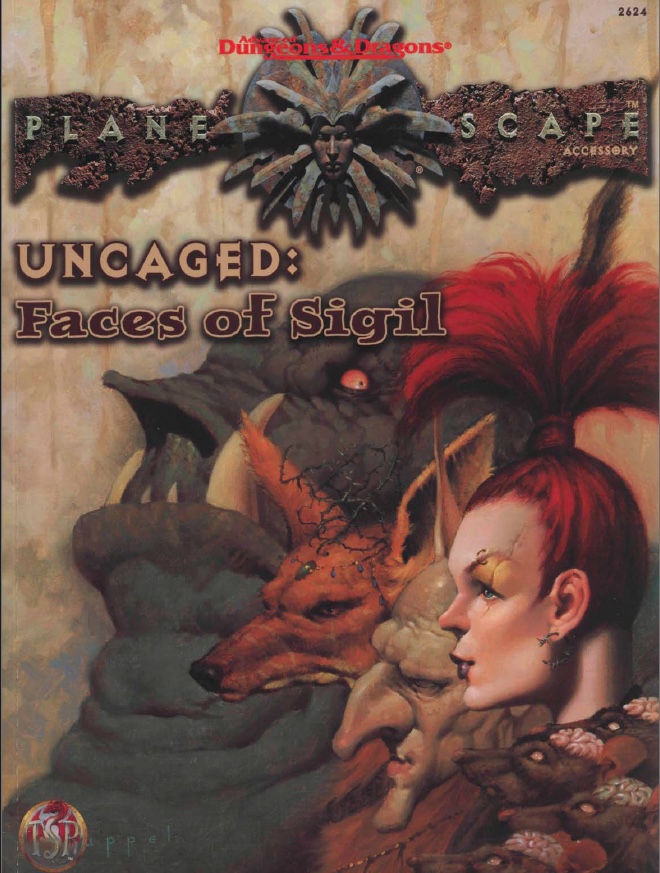
While the party were in the City of Doors, they got a job from Kesto Brighteyes, the gnomish owner of the Parted Veil, a bookshop where the PCs went to find the tome they were looking for. I found Kesto and everything about him in Uncaged: Faces of Sigil. This was an invaluable source-book for this campaign and provided at least three incredibly useful, well drawn and significant NPCs who were residents of the Cage with depth and interconnectedness.

Anyway, this quest led them off to the Lady’s Ward of the city, where they managed to defeat the object of their quest, a Gautierre. Upon the occasion of their victory, Habjorn the druid was approached by Lydia, his dead wife, in the form of a Petitioner. Petitioners are the souls of dead sentients, ascended to the Outer Planes who are, to all intents and purposes, reborn into new lives there with no memories of their old ones. They normally turn up on the plane where their gods lived or, at least, on a plane that matches their alignment. But, Lydia’s god, it turned out, was dead. So, she started wandering the planes looking for somewhere to belong. Until she felt a pull drawing her to her husband when he passed through a portal into Sigil.
Lacking a god or any sense of purpose, she felt a connection with Habjorn that she thought she should have had with her god, Helm, but didn’t due to his deceased state. So she started to believe in Habjorn like a god. She didn’t necessarily agree with him all the time or obey him at all, in fact, but she still had a strong enough belief in him to essentially grant him the status of a Minor Power, a godling out there on the Outer Planes.
It was actually pretty tragic. He was overjoyed/heartbroken to see her again but she didn’t recognise him and had no memory of their life together before her death. She knew nothing of their family and her motivations were totally different as a Petitioner.
But I digress. Before he knew it, Habjorn started hearing the prayers of his kids, held deep underground on the plane known as the Outlands, under the roots of one of the World Tree’s saplings. They were hoping and praying that he would come and save them and their belief began to compound the meagre abilities provided by Lydia’s own prayers.
And thus the Druidic Deity was born. So, like Thor and Hercules (kinda) before him, Habjorn became a superhero god!
Now, believe me, I understand that this stuff is totally unbalanced and potentially game-breaking. But I was throwing these characters up against some very tough situations, so I felt ok about it. I will point out, also, that, unlike the Warlock patron from the last post, this is not a subclass. Instead, its a couple of new features that work for Habjorn the Circle of the Land Druid/minor god, in particular. It is unlikely to work for anyone else in its current form but I think it was a fun addition to his set of abilities that allowed him to do some interesting stuff in particular situations and led to some truly fantastic character and story moments in our game. So, take it under advisement! But, if you want to use it or any part of it, please feel free!
New Druid Features: Druidic Deity
Grant Druidic Magic
The Druidic Deity can grant two cantrips and two first level spells from the Druid Spell List to their follower/s. The druidic deity can grant the cantrips and spells once and cannot do so again until they have completed a long rest.
The Power of Prayer
When a worshiper has prayed for spells to be granted the Druidic Deity gains a Prayer. There is no upper limit to the number of Prayers the Druidic Deity can be in possession of and if not spent before taking a long rest, they carry over. The Druidic Deity can spend a Prayer using a bonus action. This Prayer can be spent in several different ways:
- Allow the Druidic Deity to regain an expended spell slot of any level they have access to
- Allow the Druidic Deity to gain another use of Wild Shape
- Allow the Druidic Deity to Wild Shape into any CR 2 Beast or Monstrosity that they have seen
- Allow the Druidic Deity to remain in Wild Shape for double the normal length of time
- Allow the Druidic Deity to cast spells while in Wild Shape
- Allow the Druidic Deity to use the Natural Recovery feature to regain all used spell slots including 6th level ones and higher
- Allow the Druidic Deity to cast one of their Circle Spells without expending a spell slot
- Allow the Druidic Deity to empower their Land’s Stride ability , granting them the opportunity to pass into a plant of sufficient size and emerge from a similar plant of sufficient size within 200 ft
- Allow the Druidic Deity to empower their Nature’s Ward feature, granting them immunity to one more damage type of their choice until they complete a long rest
- Allow the Druidic Deity to empower their Nature’s Sanctuary feature so that beast and plant creatures cannot attempt to save against it.
- Grant a worshiper another cantrip or first level spell
So, like I mentioned above, I know these features are potentially game-breaking and open to abuse. But my players took this sort of thing in good faith and David played his character as he thought he should react to becoming a slightly shitty kind of god. He was somewhat incredulous but used every ounce of his power to do the things his “worshipers” wanted of him. In other words, for Daddy to come and save them. And that’s what he did.
I would mention here as well, that balance, as a concept in D&D/TTRPGs in general is a concept that I take with extreme caution. I would rather chuck an unbeatable monster at them and have them figure out they need to run away or use their wits instead of charging headlong into the fray, then stick to Challenge Ratings most of the time. In this respect, I think the OSR has it right. But, I think this door swings both ways, if a challenge can be unbalanced due to an encounter’s difficulty, the PCs can also be a challenge due to their ability. They should get to feel like the superheoroes thery are. On the other hand, I also have the ability to keep piling on the difficulty as the party gets more and more powerful, so I see it as a win-win.
Let me know if you have any comments on these nutty druid features, dear reader.
Discover more from The Dice Pool
Subscribe to get the latest posts sent to your email.

 The Dice Pool
One thought on “New Character Options from Erlendheim Part 2”