
D&D Superheroes
There’s no doubt in my mind that the creators of the current version of D&D meant to make the PCs into superheroes. This goes for 5E 2014 as well as 2024.
You can have opinions about this. There are times when it frustrates the hell out of me as a DM just trying to introduce potentially deadly situations to our games. I usually overestimate the lethality of these situations, whether they might be traps, encounters or particularly difficult episodes of exploration. The players normally trounce these situations readily. They always have a feature or a spell or a power or a magic item or a special friend who will come to their rescue so that they emerge largely unscathed and only further emboldened. On the other hand, I do feel bad when a PC dies in one of my campaigns. I mean, of course! They spent hours designing and imagining and embodying this person… and they died… it can be devastating. It should be devastating. Not just for the player in question, but for every player in the game, including the DM. So I get it. I understand why the average D&D PC’s life expectancy has sky-rocketed in the last couple of decades. I also understand that if you want something more lethal, Troika! is right there. So, if you want more lethal play, there are plenty of options.
Anyway, when I finally realised the superheroness of the characters, we were playing one of my long-time RPG group’s more iconic campaigns. It was called Erlendheim and it was based on my home-brew world of Scatterhome. Here’s the TLDR for the campaign:
The PCs were all former adventurers living in or around their hometown of Dor’s Hill on the island of Erlendheim. The island was surrounded by a terrible and eternal storm meaning no-one could leave and no-one new ever turned up. The PCs started at level 8, but their adventuring days were behind them. Until one day, they were asked by the powers that be in Dor’s Hill to investigate some strange reports from an outlying fishing village. While they were off fighting what turned out to be Yugoloth fiends there, all six of the Druid’s kids were kidnapped by some more extraplanar beings. This, eventually and after much adventuring, roleplaying, schmoozing and drama, led them to Sigil, The City of Doors, The Cage. For the uninitiated, Sigil is the city at the centre of the Outlands, the plane at the centre of the Outer Planes in the D&D cosmology.
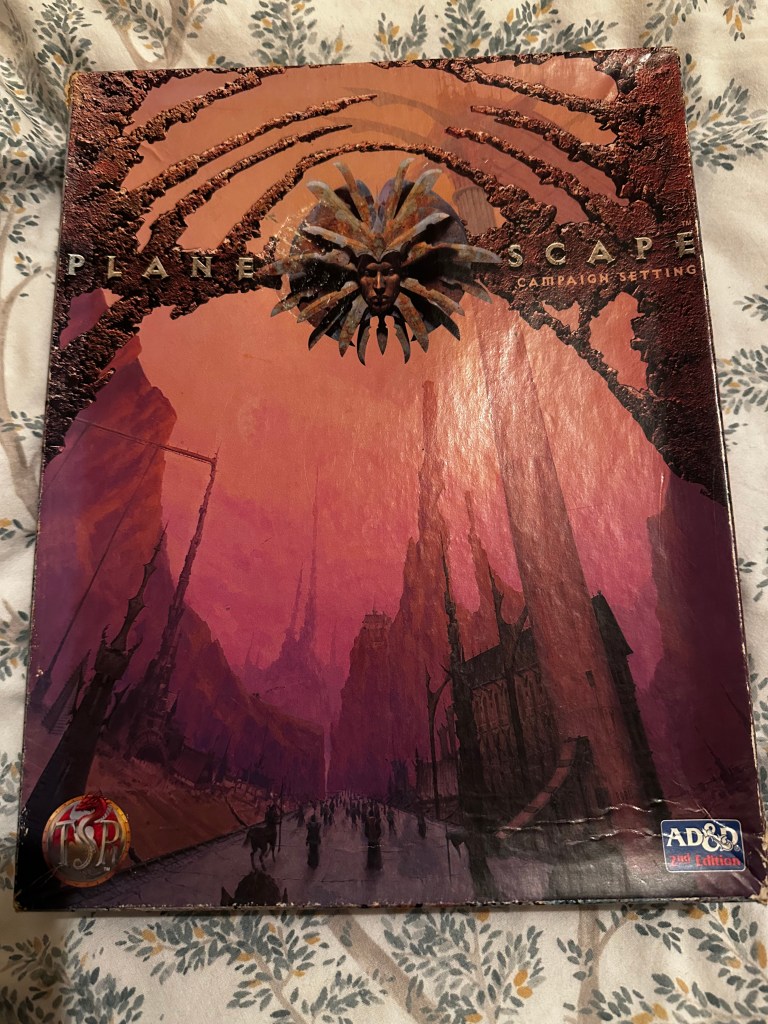
Now, as a die-hard AD&D 2nd Edition player of old, I was a massive fan of the original Planescape setting, the new shit it introduced to the game and the way it expanded our horizons as both DM and players when it came out in the nineties. But, I’ll be honest, I don’t think I knew how to use it as a 14 or 15 year old DM. It was just too massive. I wrote and ran adventures that were pretty much standard AD&D adventures except in a place in the Outlands instead of on the bog-standard fantasy world I had devised. So, in 2021, when I got the chance to send these PCs to Sigil!!! I grabbed that bull by both horns. It was so much better than I could have hoped. Even just the act of getting there was a major campaign milestone. And before long, both the players and the characters were knee-deep in planar weirdness. They didn’t know it, they didn’t understand most of it, but they still had goals. They were there for a reason (they had to find a book that explained the keys to all the planar doors in a mysterious tower beneath the town of Dor’s Hill back home.) So they pursued that. On the way, they all gained even more super powers than they already possessed. Why? Because, once you understand that D&D 5E is a superhero game, it’s a good idea to lean into it.

The first PC to get blessed in this manner was our warlock, Yulla (played by Tom.) Now, it just so happened that Yulla, up until this point, had a patron named Aegir, an elemental spirit that turned out to be the baddest guy of the entire campaign. So, when she went to Sigil her confidence in their patronage had taken a few knocks. When she then discovered her long lost, presumed dead parents there she was open to new possibilities. Now I was using the gorgeous, unimpeachable original version of the Planescape setting for this game. It was made for AD&D 2nd Edition but that was no impediment at all. (When I got the new 5E version I was a little shocked and affronted to find that they had done away with one of my favourite Sigil factions, the Believers of the Source. I understand that this actually happened way back in one of the nineties Planescape novels but I never read those so I had no way of knowing.) Anyway, the entirety of my Erlendheim campaign had been built around the Believers, their doctrines, their headquarters, etc. And it turned out that Yulla’s birth-parents had been members of the believers for decades since their supposed deaths. Anyway, this led Yulla to seek the Source as a patron, instead of the untrustworthy and, frankly quite evil Aegir.
And this is where the extra super powers come in. Tom and I designed a new Warlock Patron for Yulla, the Source itself. I based it around the philosophy of the Believers: you must try to reach your potential, your existence should be evolved as much as possible within your own lifetime, etc. Here is the result. If you like the look of it and you can find a way or reason to use this in your own campaign, please feel free.
New Warlock Patron – The Source V 2.1

Description
You have have made a pact with the ultimate creative and destructive power in the multiverse. The Source is that from which all things come and which all will someday rejoin. The members of Sigil’s faction, The Believers of the Source understand that all beings should be striving to evolve within their lifetimes to become one with the Source. To this patron, time and space have little meaning; sentients are beings of pure potential and a deep understanding of the planes of existence is essential.
Expanded Spell List
| Spell Level | Spells |
|---|---|
| 1st | Find Familiar, Inflict Wounds |
| 2nd | Wither and Bloom, Vortex Warp |
| 3rd | Motivational Speech, Life Transference |
| 4th | Aura of Life, Vitriolic Sphere |
| 5th | Destructive Wave, Legend Lore |
Features
1st Level Feature
Burst of Potential
From 1st level, as an action the warlock becomes a silhouette of themselves and emits a brief burst of soft yellow light. They draw on a fraction of the unlimited potential of the Source and grant it to those allies in a ten foot cube around them. Until the end of the Warlock’s next turn all within the aura gain advantage on a single ability check, attack roll or saving throw of their choice.
Once you use this feature you cannot use it again until you finish a short or long rest.
1st Level Feature
Fragment of the Source
From 1st level, using a bonus action, the Warlock of the Source gains the ability to summon a fragment of the Source in the shape of a softly glowing orb. It will appear at a chosen point anywhere within 60ft of the Warlock. The Fragment of the Source will remain for a number of rounds equal to the Warlock’s Charisma modifier. The Fragment can use its potential energy to allow a creature within 5 feet of it to roll with advantage or force a creature within 5 feet of it to roll with disadvantage on any attack roll, saving throw or ability check. As a bonus action on their turn, the Warlock can move the Fragment up to thirty feet. The Warlock can summon the Fragment a number of times equal to their proficiency bonus and regains all expended uses when they finish a long rest. The Fragment of the Source will act on the same initiative as the Warlock.
6th Level Feature
Aura of Potential
From 6th level, the Warlock of the Source’s Burst of Potential feature becomes an aura. The effects are the same as the Burst but apply to each ally that starts their turn in the aura. Also, the effect can be used to ensure maximum damage on an attack roll.
The Aura of Potential lasts a number of rounds equal to the Warlock’s Charisma modifier.
Once you use this feature you cannot use it again until you finish a short or long rest.
6th Level Feature
Wasted Potential
From 6th Level, as a reaction, the Warlock of the Source may fire a sparkling yellow orb at any creature taking an action, making an attack roll or rolling a saving throw within a 30ft range. The creature must make a Charisma saving throw against the Warlock’s spell save DC or apply disadvantage to their roll.
10th Level Feature
Mark of Potential
From 10th Level, the Warlock of the Source begins to gain benefits from the potential bestowed or denied by the Aura of Potential and Wasted potential features. Each time an ally succeeds on a roll which benefits from the advantage bestowed by the Aura of Potential the Warlock gains a Mark of Potential. Each time a creature fails on a roll affected by Wasted Potential, the Warlock gains a Mark of Potential. Gained Marks spark briefly into being around the Warlock’s head before fading into invisibility.
At 10th level the Warlock can hold up to a maximum of nine Marks of Potential. At 14th level the Warlock can hold up to ten Marks of Potential (See the “Evolution” feature below for how ten marks can be spent.)
The appearance of the Marks is up to the individual Warlock.
Marks of Potential may be held until spent.
Marks of Potential can be used in the following ways:
| Marks Spent | Effect 1 | Effect 2 | Effect 3 |
|---|---|---|---|
| 1 | Apply advantage to any attack roll, saving throw or ability check | Double the range of Fragment of Potential | |
| 2 | Roll a hit die plus your Charisma modifier to regain hit points | ||
| 3 | Maximise any damage effect | Induce a critical success | |
| 4 | Roll two hit dice plus your Charisma modifier to regain hit points | ||
| 5 | Double the area of Aura of Potential | Double the number of targets affected by Wasted Potential | Double the number of Fragments of Potential Summoned |
| 6 | Roll three hit dice plus your Charisma modifier to regain hit points | ||
| 7 | Increase the casting level of any appropriate spell by one | ||
| 8 | Roll four hit dice plus your Charisma modifier to regain hit points | ||
| 9 | Regain a Spell Slot |
14th Level Feature
Evolution
At 14th level the Warlock of the Source gains the ability to use ten Marks of Potential to evolve into a form which brings them closer to the Source for a number of rounds equal to the Warlock’s Charisma modifier. For each level the Warlock gains above 14th, the duration of the evolution is increased by one round.
In their evolved form, the Warlock gains the following features:
- 5 hit dice plus Charisma modifier of temporary hit points
- Makes all attack rolls, ability checks and saving throws with advantage
- Triples the area of Aura of Potential
The appearance of the evolved form is up to the individual Warlock.
Once you use this feature you cannot use it again until you finish a long rest.
Discover more from The Dice Pool
Subscribe to get the latest posts sent to your email.

 The Dice Pool
It was great fun evolving Yulla through the narrative and play. I hold the story of the campaign close to my heart and remember it fondly!
i really liked the character evolution and development, the PCs getting involved in Sigil and how it changed them upon returning to Erlendheim. It all played out so well! Also was cool to have a PC character join after we arrived in Sigil. It kept things moving along at a fast pace.
I definitely agree with the superhero aspect, it’s very difficult to put D&D characters in danger aside from the big bad at the end.
There’s a unique balancing act as It makes for feeling powerful but enemies need to be tough enough to at least last a couple rounds to feel like any kinda of threat and to allow the players to all act.
LikeLiked by 1 person
I loved that campaign too. All of your characters were so well realised and distinct. I was very happy that you all leaned into the epic nature of it and went along with what I wanted for your PCs.
I also had a great time coming up with all your new subclasses and features. That was very fun.
LikeLiked by 1 person