
Getting my flash in
Orlen, dusty, wide-brimmed chapeau drowning her alarming eyes in shadow, holds aloft her trophy, beaming. The bag of coin, pleasingly hefty, dangling from her dextrous digits. “‘Aah ‘baht ‘at ‘en?” Her companions, ensorcelled by something above her sturdy, sinister shoulder, point. A hiss, as a punctured bladder, sounds in her ear. Speculative, her left hand shoots up, ready to throttle the looming serpent. It narrowly misses losing its ring finger as a dagger, recently released by Rasei, skewers the snake to the formerly coin-concealing statue. Orlen chances a glance. The cold blood dribbles down the stone man’s shoulder, over the sickle he holds dramatically crossing his sword over his chest. Nima cries, “More snakes!” Time to go. The treasure hunters scarper down the path of the sickle, ignoring the sword’s point and the keep slouching beyond it on the horizon, hoping for Hester’s Mill.
A dramatic retelling of the opening scene of our recent game of Trophy Gold, run by friend of the blog, Isaac. To those who were there, apologies. I’m sure I got a few details wrong, either deliberately or by mistake. Drama seems appropriate for this fascinating game, defined as it is, within Sets.
Trophy
So, as you probably know, dear reader, if you have been with me for a while, here on the dice pool dot com, I am a more-or-less avid listener of the Fear of a Black Dragon podcast from the Gauntlet. I wrote a post on my appreciation for it and the Indie RPG Podcast last Summer. Our path to playing this incursion (as Trophy scenarios are called) leads very much from that. Jason Cordova, one of the podcast’s capable hosts, rarely ventures into the OSR’s hex-defined landscapes. Rather, you can generally find him in the narrative woods and trails of story-based games. On the podcast, he often discusses his experiences in running OSR (or just old tbh) modules in other systems. Back in the olden days of Fear of a Black Dragon, this generally meant either the incredibly rules-lite World of Dungeons or Dungeon World My last post on this blog was about the feelings Dungeon World made me feel. Go and have a look!) These both have PBTA DNA. Their mechanics lend themselves more to the application of imagined narrative than cut-and-dried, D&D-esque, result-binary systems. And this is really only because of the inclusion of a third option, a mixed success, or success at a cost. Since the implied consequence cannot be defined outside the context of the situation, it is usually left up to those at the table to invent it (although Dungeon World generally provides far more pre-written options than does the baldly efficient text of World of Dungeons.) And look, if you’re a PBTA maven, my deepest apologies for what is, no doubt, a faintly condescending and largely inaccurate paring down of a game system that is probably the most influential in the indie game space of the last decade and a half. But if you were raised on a distilled diet of Borgs in your old schools, you’re welcome.
I have gotten off track. The point I was trying to get to was that, a few years ago, Jason switched to running pretty much every module in Trophy Dark or Trophy Gold instead. Mostly Trophy Gold, in fact. Obviously, this got me very interested in the game. The idea of running D&D style modules in a more narrative style highlights a whole new facet of the hobby that I always thought would be very fun to explore. And, after reading a bit about the game and learning of its mechanical descent from Blades in the Dark I wanted to try it even more. It just turns out that, much like Tom (with Dungeon World,) before him, Isaac got there before me. I’m not complaining. I love being a player in these games.
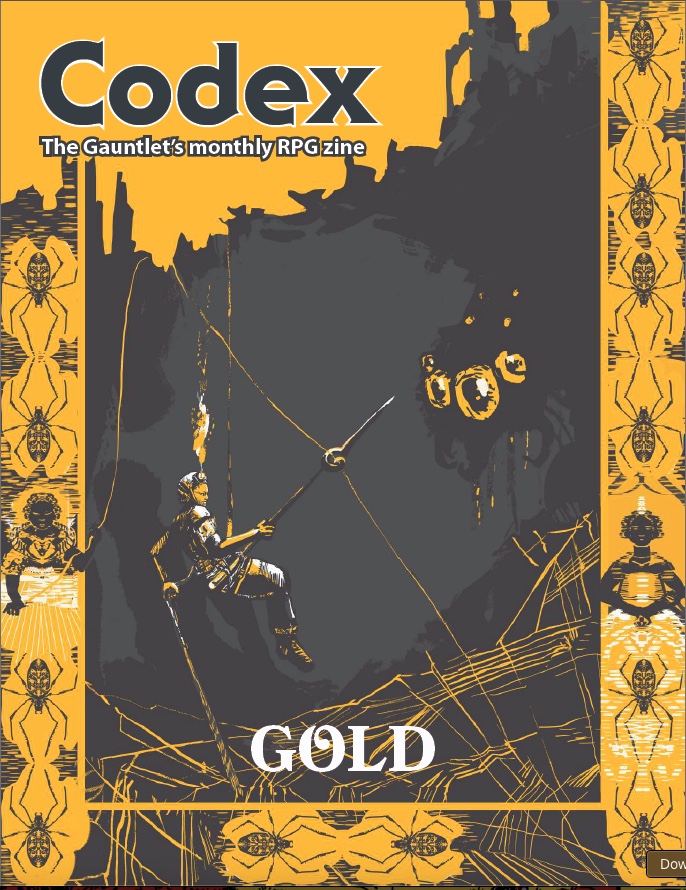
So, to put it briefly, both Trophy games were written by Jesse Ross and published by Gauntlet Publishing. Elements of the rules have been adapted from Blades in the Dark by John Harper, who is also responsible for World of Dungeons and other elements were cribbed from Graham Walmsley’s seminal Cthulhu Dark. They are games about treasure hunters going out into the dark forest to find gold and bring it home so they can continue to survive in a hostile world. In Trophy Dark, your vile little adventurer is a goner; you’re not making it past the end of the session. Sorry. That’s the point of Trophy Dark. But in Trophy Gold you make a treasure hunter who might live to the end of the incursion if you’re lucky. They might even weasel their way through to another one. Speaking of which, I wrote a blog post about making a Trophy Gold character last summer. You may find it illuminating if you’re interested. Do bear in mind, though, the game I used in that post is not quite the same as the one presented in the book published in 2022. I used the game from the Codex Gold magazine, which you can pick up for a steal over on Drivethru. I don’t think there are any really drastic rule changes but we noticed some discrepancies in a few of the tables.
Hester’s Mill
So, what’s all this about Sets? You didn’t think I remembered mentioning that earlier, did you, dear reader? Well, Incursions are formatted in a very particular way. Trophy Gold helpfully breaks it up and introduces the format like this:
- Theme – much like any dramatic work that might be presented on the stage, a Trophy Gold incursion should be built around a theme, even if you are adapting it from another type of module. I would call the broad theme of Hester’s Mill to be “Harvest”
- Sets – these are particular locations in which the treasure hunters will be presented with clear goals. I find it fascinating that the rules tell the GM to make the goal explicit to the players. I’m not giving away too much by telling you that the goal in the opening Set I wrote up in the intro is to find the way to Hester’s Mill. You complete the Set by achieving this goal and this is eminently important to the cycle of play. You may not wish to complete the goal of every Set. It might not be clever or necessary for you. Your character’s overall goal is to earn enough Gold to relieve them of their Burden, both of which are abstract scores on the character sheet. In other words, you know from the start how much you need to take home so you don’t die on the streets or get consumed by the evils of the world. I don’t think anyone would blame you for trying to convince the party to get the heck out of there once you had managed to collect enough money. But, just because you got your Benjamins, doesn’t mean everyone else did. This can lead to inter-personal conflict, unsurprisingly. But it might also lead to moments of support and kindness in these Sets. Drama, gettit? And guess what you call the things you find within the Sets… Yep, Props. It’s obvious, really. So the statue of the man with the sickle and sword in the intro? Yep, that’s a Prop. You also have Treasure and Traps as defined elements within Sets
- Flowchart – What the holy business-process, Batman? Yep, it makes so much sense, when you think about it. When you are trying to play something like an OSR module, you might have a map which visually represents the location but that does not necessarily represent the decisions, actions and repercussions that might lead the PCs from one Set to the next. In many ways, the Flowchart is the more useful of the two. I’d like to give it a go in any game where I’m running a particular scenario, honestly. Not very theatrical though, disappointingly
- Monsters – these are specifically mentioned because the section I am referring to in the Trophy Gold rules from Codex Gold is there to explain how you might convert an OSR module to be played using Trophy Gold instead. So, Jesse Ross has helpfully provided a lot of advice on converting Monsters, a staple of the genre, to be used in that system. One of the most fascinating aspects of the game is that the monsters do not come pre-named. That is left up to the party. This can be either cool AF or disastrous. The monsters we encountered in Hester’s Mill so far have been both bonkers and horrifying. And if it had been left up to me, they would have been called something stupid
- Magic – Similar to Monsters, this includes advice on conversion. But, I will say that there is a very useful table of already converted D&D style spells presented in the rules for you to use.
Anyway, it should be clear that the Set is the main denomination of organisational structure within an Incursion. So far, I think we have interacted with three or four Sets in Hester’s Mill and achieved the Goal in two or three of them. You can use another highly abstracted currency, the Hunt Token, to complete a Set without having to actually face its dangers. You can receive (and also lose) these tokens on a Hunt Roll, one of the three types of rolls in the game. If you spend three Hunt Tokens like that, you simply draw the curtain across the stage and open again on the next Set and get to work on the new goal.
In general, rolls, of which you have Hunt, Combat and Risk, are made using a dice pool mechanic much like that used in Blades in the Dark. The D6 is the only die you need but you will need them in Dark and Light varieties. You will always roll a Dark Die in Combat and you can roll one to give you a better chance of success on a Risk Roll if you’re willing to risk mind or body… More drama.
The Combat Roll is particularly fascinating because it doesn’t work like a regular success/failure roll at all. Instead, you describe how your character exposes themselves to harm in the battle and then roll your Light Die. That number is your Weak Point. You then roll a Dark Die for each of the treasure hunters in the fight. Ostensibly, you’re rolling against the Endurance of the Monster, but, if any of them roll your Weak Point, that increases your Ruin, which is like a harm track. One you hit 6 Ruin, you are Lost… So dramaaaatic, right?
Add to this the Devil’s Bargain, nicked from Blades in the Dark and you have a recipe for some real dark character moments in Trophy games. You crowdsource the possible options for both Devil’s Bargains and unfortunate consequences of failed rolls from everyone around the table and this makes for some extremely fucked up inevitabilities on a lot of rolls.
In conclusion
We have yet to finish Hester’s Mill. I know we have at least one more Set to get to. I’m really looking forward to going back to it. We’ll be dealing with the aftermath of something pretty messed up and, hopefully, finding some more goodies. I have to say, the Incursion has been very pleasing in introducing us to a lot of lore and cool fantasy history while also giving us the opportunity to get into fights and burn down shrines so far. With any luck, there’ll be more of that as we wrap it up next time.
How about you, dear reader? Have you played Trophy Gold? Or Hester’s Mill? What did you think?
Discover more from The Dice Pool
Subscribe to get the latest posts sent to your email.

 The Dice Pool