There is a special sort of feeling when one of the things you were backing turns up at your door. Like, you might have been keeping track of it and the creator has maybe been telling you, if you’re lucky, where they are in the fulfilment process but when the physical object is in your hands? It’s like someone sent you a present. It’s like opening up a gift from a stranger. It makes you feel something for that person, gratitude, wonder, amazement. You know what I’m talking about.
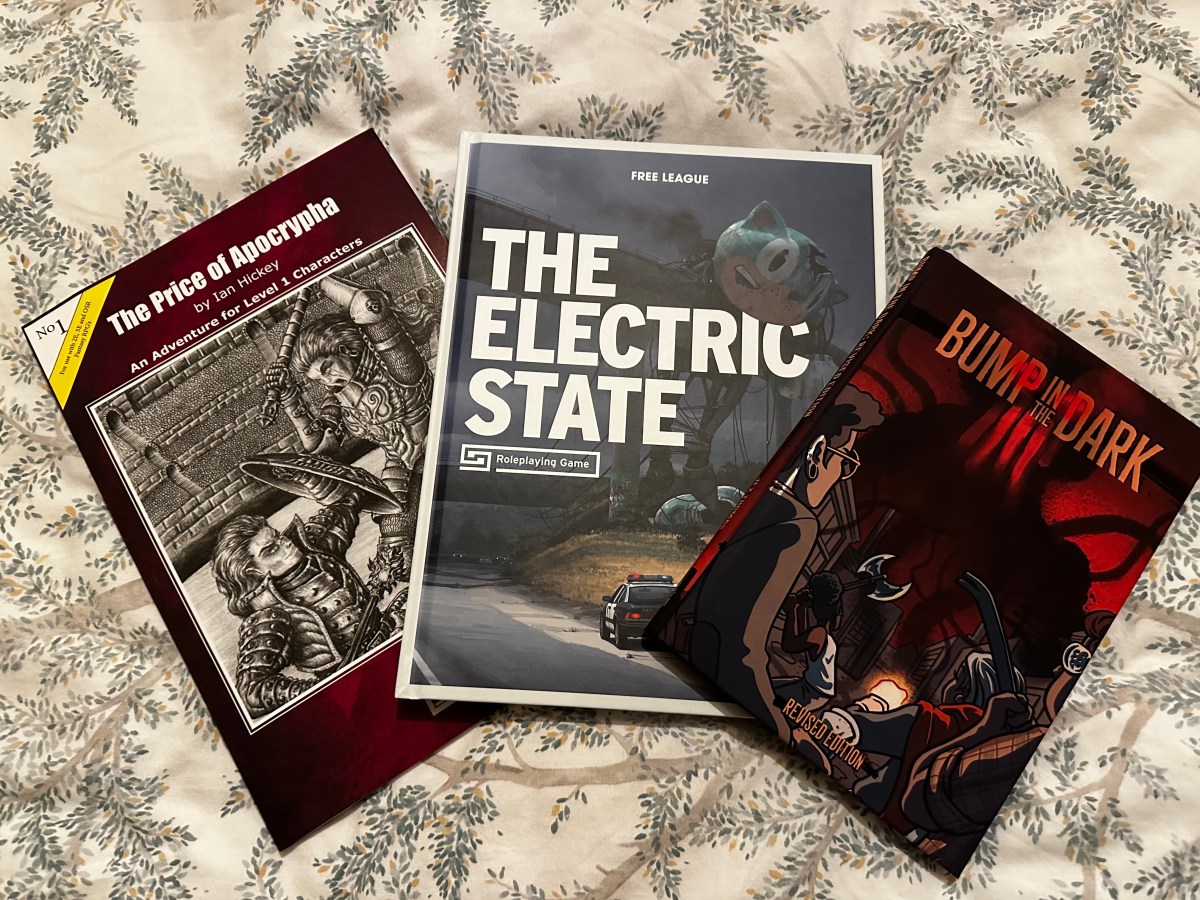
Anyway, I got some stuff that I backed! Just look at the photo up at the top there! Go on!
The Electric State
I backed this one in December last year because I love Simon Stålenhag’s artwork and imagination, as you will know if you have been around the blog for a while. The Electric State is the latest in a line of RPGs from Free League that explore the world that never was. It started off in the eighties with Tales from the Loop, where you play kids scoobying about the wilds of suburban Sweden (or Nevada,) getting into trouble and investigating the weird shit that local scientists had unleashed on the world. Things from the Flood took us into the nineties that never were. You played teenagers in that, in a world much less full of wonder and much more full of uncertainty and dread. The Electric State takes us into the late nineties in the state of Pacifica where the countryside is riddled with he remains of busted battle-bots and everyone’s addicted to some sort of cyber-helmet device. It’s a road-movie game! I have not yet played either Things from the Flood or Electric State (I mean it just arrived on Monday) but I can’t wait to. I loved the slightly eerie vibes of Tales from the Loop seen through the eyes of kids who had literal plot armour. I am looking forward to experiencing something similar through the eyes of older, more jaded or just more experienced characters. I am sure the horrific elements of Stålenhag’s work are likely to come though much more starkly. I’ll let you know how I get on with it, dear reader!
Here are a few photos from the core book and of the extras that came with it, including some very tasty custom dice.
Oh, I also got the artbook with this Kickstater. It’s not new, it came out in 2017, but just look at it!
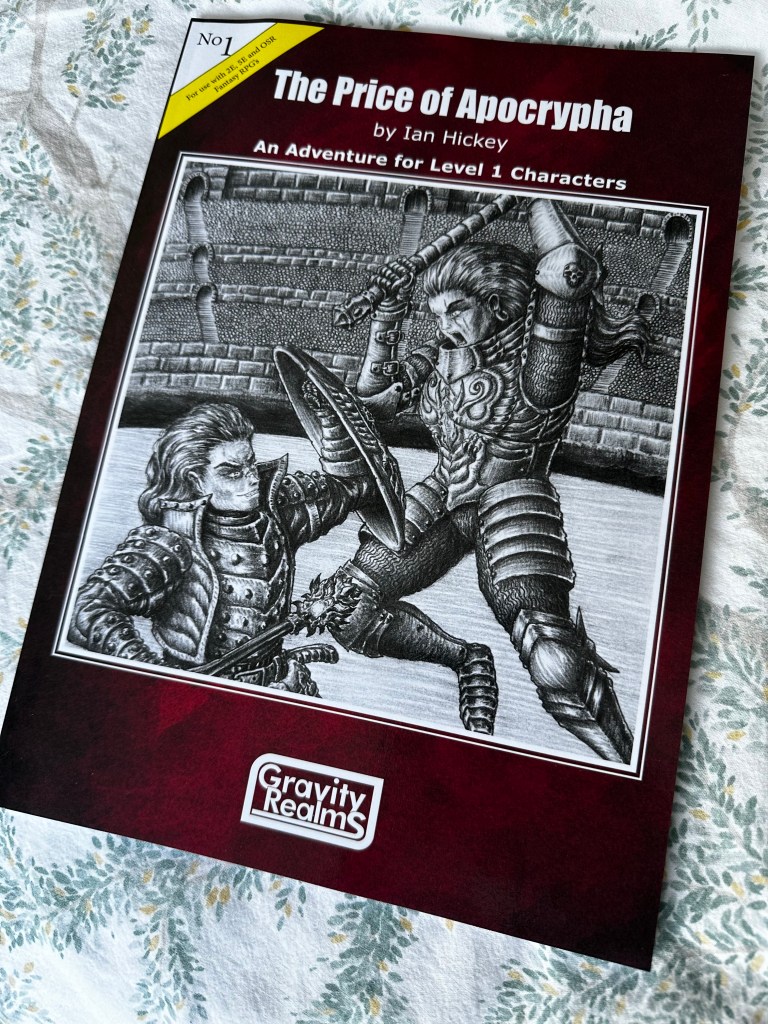
The Price of Apocrypha
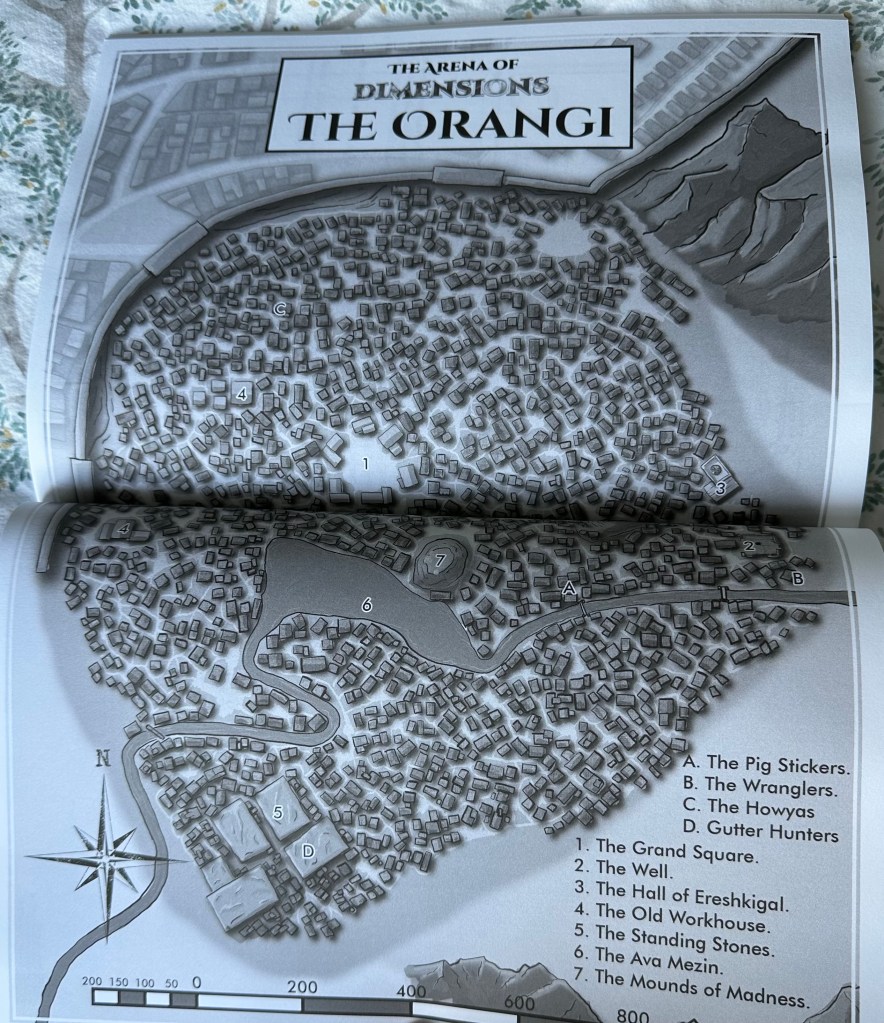
@drunkndungeons is an instagram mutual with a D&D podcast, which, I confess, I have not yet listened to. Anyway, up until relatively recently, I thought they were just into posting things about 1st and 2nd edition Ad&D on their account but then they revealed that they had a kickstarter on the way back in August. August! Let that sink in. They kickstarted a D&D/OSR adventure module in August and I now hold it in my little paws (OK, fine, I don’t. I’m typing right now. But, if I stopped and reached over to my right, I could just pick it up, you pedants!) Quite the turn around. By the start of September the Kickstarter campaign was done and I ordered up my copy from Drivethru RPG POD service, which was cheap and efficient and looks great, honestly. I have had no time to read this one yet but it I’m looking forward to digging in. I love the look of the map and the monsters and the general idea of an interplanar arena of some kind. Gravity Realms produce it and you can get it here.
Bump in the Dark Revised Edition
Bump in the Dark is another game set in the 90s. It has spooky Scooby vibes again as well. But in this case, you are more Buffy and the gang than the Famous Five. One of the touchstones Jex Thomas, the author, lists in the book is Buffy the Vampire Slayer, in fact. I don’t know a huge amount about it, to be honest. I backed it on something of a whim. I know that you play hunters in it who are sworn to protect the people of Iron Country from the monsters and the beasties out in the darkness, along with your team of found family and friends. It’s based on a Forged in the Dark Ruleset but rather than the heists of Blades in the Dark, you go on Hunts. And this Backerkit pledge level came with a bunch of hunts in the form of little leaflets! I didn’t know what the heck they were when they arrived in a little white envelope that had a fluorescent sticker on it saying “Do Not Bend.” Even after I opened them up it still took me a while to figure out they were Bump Hunts. But just look at them! Aren’t they cool? I think I would like to try one for the season that we’re in, you know? Anyway, go and get it here!
That’s all I have for you for today, dear reader, just showing off my goodies. See you again soon!
Maryk has seen better days. He has found himself living in the woods in a leaky old shack and subsisting on conjured fruit. For three years. He’s bored of it, and what’s more, he’s clearly not looking after himself. He needs a good meal, maybe one of those tasty crabs that live in the fens? And someone to look after him. That’d be nice too, wouldn’t it?
Chapter 11: Fen-crabs and Little Toes
Years passed. I grew up, not very much actually but nonetheless, I became a young man. By the time I was fifteen years old I possessed the face of a man far older, grey and white and blue in splotches as well. I spent most of my time in amongst the trees of Creakwood, the colour of which matched my own quite well. “I could blend in here like a twig-bug if I went around these woods in the nip,” I often said to myself, “never even need Invisible.” Sometimes I went out into the Crabfen, if for no other reason than to catch myself a couple of the eponymous crabs for dinner when I tired of fruit and berries. Sometimes I visited the old quarry not so very far from my old world to gather chalk for my homemade blackboard since I had no paper. I never saw anyone else. People did not go to the places I went. This satisfied me. That was the purpose of my new life. I could do no-one any harm out in these forgotten places, these abandoned houses and weathered graveyards. Well, no-one other than myself, of course.
For instance, came the day I lost my other little toe. The Crabfen had called me out again. My diet of water-fruit, grubs and occasional squirrel had begun to take its toll on my mood as it always did. “Oh! Water-fruit, so nourishing, oh, water-fruit, so dull, oh water-fruit, so boring, I want to smash my skull,” was a verse I penned all on my own and could often be heard to sing sitting under the glowing leaves of the water-fruit bush, in between tired chomps of unwelcome fruit. I had tried a number of other spells, which I thought might produce food of different varieties. They resulted in the creation of a number of poisonous toadstools (I spent two days over a pit behind my cabin after trying those,) the skeletal remains of a chicken unsuitable even to make stock, and a leather purse which has, admittedly, come in handy for the collection of berries and grubs. I came to the conclusion that the Fomori Emperor who wrote the book or, at least, had it written for him, had no need for spells to feed him; he had slaves for that. The water-fruit spell was, no doubt, no more than a novelty.
The weather was the type reserved for the days when your emotions are felt so strongly that they must surely be affecting it with their deep, bog-misery and their thunderous angers. Unsuitable for crab hunting in the fens, as the day may have been, I could not have put it off ‘till another one without, as the song suggested, smashing my skull. Rain fell, not in drops so much as in waves, drowning the fens. I could see not ten paces in front of me and the sheer weight of my conjured, sodden, cotton clothing weighed my emaciated body down so much that I considered simply doffing them. Of course the bitterness of the wind across the open bog might have done for me so I decided to keep them on. I performed the Umbrella spell to stave off a small fraction of the torrents. So, I squelched my way on through the Crabfen, determined to find a crustacean or two for my supper. “Crab, crab, crabbie, crabbie, crab crab,” I would call, counter to the effect that I wished it to achieve. “Where are you, my tasty little beauties,” I used to sing, thinking that it might entice them into my supper sack. It didn’t, not that day. I did encounter one but it avoided the sack. It felt like days that I had been creeping and hunting and calling and singing for crabs. My boots, a hardy pair of conjured crocodile skin ones, went up to my knees and I was sure they were more than up to the task of crab hunting. On any other day, they would have been. But on this hellish, rain-soaked nightmare of a day the bog attempted to suck me down into it with each step. It did not get me, it almost did. It had me and it lost me.
A step in the wrong spot was all it took. I knew the fen quite well, I thought, but it transformed on that day. the whole thing was a trap and I was the prey. One step, as I said, was almost my undoing. The boot went thigh-deep into a patch of ground I had stood upon many times to seek out my own prey. I struggled and wiggled and pulled at my own leg and finally dislodged myself, leaving the boot there, in a grave of its own construction. My bare foot came out at speed and I fell back into the bog. Dirty, brown water crept into every opening and crevice both in myself and my clothing; my crab sack was gone; I spluttered and coughed up a lungful of bog in an attempt to right myself and that’s when I felt it; a slice, a thin, hard pressure and a crunch. I felt the warmth of the blood rolling down my foot and calf as they stuck up in the air like birch saplings. I spat and gurgled into a scream. “Bastard! Bastard, clawing, tearing, toe-clipper! Bastard!” I got my hand to my face to free eyes, mouth and nose completely of mud and bog water. I took a deep breath to shout some further obscenities at the little aquatic bastard that had shorn me of my last remaining little toe when I looked up. I used the breath for another scream instead.
Straight out of a fireside story had she come, and there she stood before me. I had no doubt about her identity. The Fae-Mother stood tall and spindly like a trellis supporting her clothes, most of which did, in fact, resemble plants. Stuck in the bog as I was I could not even guess at her true height but it was certainly taller than the tallest man I had ever met. The face she showed me was grey and swathed in shadows thrown by the leaf-like hood she used to keep the rain off. It seemed to do just that and better, I might add, than my Umbrella cantrip did. Her arms hung limply at her sides, hands twig-fingered and pendulous by her knees even when standing unbent. Her wrists, neck and ankles were adorned in layered circlets of black and bronze. The very surface of the fen is where she walked, disturbing neither bog pool nor grass blade. Feet spotless, she stepped and glided.
“You are in some distress, old man. Would you like some help? Perhaps I could assist you with your wound…” The voice which vibrated from her reminded me greatly of a lark’s song and a bear’s roar.
“I am no old man!” I said, foolishly indignant as the blood poured freely from the stump of my former little toe and wallowed in a bog more foul than the famed dung pits of Arampour, “I’m a fifteen year old young man!”
“Maybe it has been too long since I have seen a human, your kind have changed if all young men look as you do.” This time the sound on the air which formed these words was the blowing of a summer breeze and the the rumble and crack of a rockslide. I looked her in the eye as she spoke and I saw her in there. Eyes so old are not to be found anywhere else in the world. Her grey and shimmering green orbs looked back into my own eyes. “I can explain later about my looks; I would be more than happy to, Fae-Mother. Right now, I would like to graciously accept your offer of aid. I am in dire need.” Being polite was difficult. It had not been necessary for more than three years. I don’t care if I am spoken to politely when I am my only conversation partner.
She reached down with her long fingers and I grasped them. They were so long and slender that I almost feared to grip too tight but then, as I did, I could feel the fingers like thin iron rods pull me easily to my feet. Once upright, I found myself atop the grass like my saviour was. “Please follow me, old young man, and I will attend to your foot.” I limped along behind the Fae-Mother all the way to the edge of the Creakwood. Below a particularly wide-canopied weeping-willow bordering the bog and the wood we were totally protected from the elements. In fact, once the tree’s curtain of leaves had closed behind us I could hear neither wind nor rain and the light which filtered through from outside was that of a hazy summer’s day. The ground beneath us was firm and dry and I gratefully threw myself upon it before removing my shirt to expose my ribs and sagging-skinned belly. It was surprisingly warm also.
My saviour, the Fae-Mother, took my newly deformed foot in her iron grip and looked at it. She removed my other boot and compared the foot to the injured one. “It seems you are careless with your toes,” she said. In this place her voice reminded me of the whisper of tree leaves in a light wind and the echo one discovers in the boles of hollowed out trees.
“I have often been unlucky,” I said. She penetrated my soul with those timeless eyes of hers and spoke again, “Unlucky? I think you would say there is more than mere misfortune involved in the story of your short life’s troubles. You are a boy who resembles a man of advanced years as your race reckons such things; you have lost two toes; you are nothing short of emaciated and you live by yourself in the Creakwood where no people come any longer. It would take one person many more years to accrue that degree of bad luck.” Those eyes kept me pinned and I answered her because I had no choice.
“My name is Maryk Sharpetzi. I am accursed for the murder of my mother and twice accursed for the murder of my first mistress and thrice accursed for the murder of my own sister. My mistress, Old Aggie, cursed me to look the way I do but everything else that has happened in my life has been as a direct result of the curses I gained at birth when I killed my mother and three years ago when my sister died by my hand.” She continued to simply hold my foot in her hand. I started to worry that it was incredibly filthy (a young boy without a mother or governess to tell him when to do it can easily fail to wash himself regularly.) I wriggled it a little but she simply held on firmly. “Yes, that makes sense. Curses, of course I can see them rising off of your shoulders and head like fumes and smoke, two black, one red. It was not such a bad thing to kill Old Aggie, I think. She was a lying, devious, selfish, murderous human as so many of you are. It was not the act that cursed you in that case, it seems, but the woman herself. The other deaths and several other acts of lesser evil have become a part of your soul. They are terrible things to live with, curses such as those you labour under, and you have suffered greatly for them.”
Laying my foot back on the ground, she continued to speak while I looked in wonder at the wound. The flow of blood was totally stemmed, the stump seemed cauterised (I remember still the dreadful searing of the hot poker used to seal the stump of the toe on the other foot) and I felt no pain.) “But I think I know some things about curses that you do not. I would like you to find me again when you need to know more about this. Now, you need to go back to your shack and rest. You must be exhausted. Here, you may want one of these to help you recuperate.” She reached around behind her and drew out a sack, my sack. Inside, wriggling and snapping, was a brace of fen-crabs. She placed the sack on the ground before me and I grabbed it before my supper could escape. “Thank y-” I looked up and the Fae-Mother was gone.
Perhaps I should explain a little about the Fae-Mother.
And you’ll get to read all about her in Chapter 12 in a few days, dear reader!
Today is the first anniversary of my big brother’s passing. We interred his ashes in the local graveyard yesterday. It has been a tough week for my family and me. It’s been a tough year.
He died after a short but vicious illness that we could not have predicted. He was only 53 years old. His death came far, far too soon. And even during the years he had, much of his time was spent contending with the draining, exhausting illness known as M.E. But he had made his life so rich and so full in the short time he had that he has been an incredible inspiration to me, particularly over the last twelve months, but through all the years of his life as well.
Lorcan McNamee
Lorcan McNamee was a teacher first and foremost. Most of his working life he spent teaching languages; English, Spanish, Portuguese. He was a polyglot, obviously. Even at the time he died, he was working on learning French and German. But he taught other things too. Most notably, salsa! He taught salsa dancing to all comers in a church hall in our home town.
We, his family, stood for two hours greeting those who had come to grieve with us at his funeral. Many, many of the hundreds who came were his students or his former students, including his dance students and a host of people from Ukraine and many other parts of the world. And so many people from Spanish speaking countries who had been welcomed to our town and helped by Lorcan and the Sligo Spanish Society, which he was instrumental in organising.
I will be honest with you, dear reader, the sheer numbers and the obvious and genuine emotion expressed by these people was something of a shock to me. I knew, of course that he was an excellent teacher, that was not the shock. But I had known so little of the key part he played in the lives of so many through his involvement in all of these different activities, organisations and communities. To me, of course, he was just my big brother. He always would be that to me and always will and I think that prevented me from seeing all the rest. Additionally, he was never one to toot his own horn, except when it was beneficial to a cause. For instance when he led the charge to gain fuller rights and benefits from the government and unions for language tutors. Indeed, a representative of his union spoke at his funeral, reading a glowing tribute from the union’s president. Lorcan had told everyone about the fact that he would be protesting at Government Buildings and that he was interviewed for the news. Such pride I felt then, especially as someone also working in an education sector ravaged by real-terms cuts for decades.
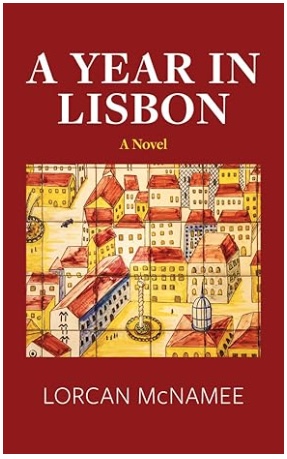
The Front cover of A Year in Lisbon, by Lorcan McNamee
Lorcan was an author. He published two novels and several poems in collections over the years. You can find his novels, A Year in Lisbon and Be Do Go Have here. He had a blog, on which he liked to post things about media he had enjoyed or wanted to to talk about. Never would he be lost for something interesting to say about the latest movies he had seen and the books he had been reading. This man had a first class honours degree in English and three more degrees that he had picked up over the years so you know the blog is worth a read. We’re currently working on getting that back up and running. When we do, I’ll post a link to it here.
You might be starting to see a pattern now.
I think some of the connections are genetic. Both he and I love to travel, are crazy about all sorts of food, enjoy really good science fiction (Iain M Banks was a particular shared pleasure,) we’re both really bald. I was told by his neighbour yesterday that, if I just lost some weight, I would look just like him. All this is true. But why I am writing this post today is the effect he has had on me over the last few years.
This blog would not exist without Lorcan. I started it because I was looking for a creative outlet, mainly for me but for anyone else who might have an interest in the same things as me. That’s very much how Lorcan approached his blog.
I have written several books. I don’t think I would have done that if not for him, his encouragement and his example. I should probably get around to publishing them too… Still you can check at least one of them out here on this blog, serialised with a chapter coming out every few days. Lorcan self-published his books because he very much wanted to see his own work in print. I think it took a lot of guts to do that, have them printed, arrange his own launch parties (I was very proud to introduce him at a couple of those even though no-one knew who I was) and everything else that goes into it. And of course, to write them in the first place. I feel very close to him when I think about these things.
Most recently, after the funeral and the avalanche of grief and love from all of these people who had been brought together by my brother in different ways, who had been made into little communities and who came to learning and creativity because of him, I thought, I could try a bit of that. So, in the smallest way possible, I did.
I started off by joining the discord server of my local game shop here in Bangor, Replay. There, I started looking for players who might want to try out a new RPG. Because I’m not a salsa dancer, I’m a GM at heart. From that, five mostly strangers came together to play a few sessions of Spire in the wonderfully welcoming Replay store where they have lots of gaming tables that you can use for free. That was Tables and Tales in a proto-community form. Not long after that, friends of the blog, Isaac and Tommy, suggested that we set up a local TTRPG community and I leaped at the chance, knowing that that is what I had been wanting all along. I wanted to try to emulate my brother in that all important way; by connecting people and helping in some small way to bring them together to do a thing they love. We are still a relatively small group but have been growing bit by bit and I genuinely love to see it.
A photo of the front cover of City of Thieves, A Fighting Fantasy Adventure book by Ian Livingstone.
You know, it just occurred to me that I might owe Lorcan more when it comes to my RPG interests. He might even have been instrumental in getting me into RPGs in the first place. Probably the first game I played that had any RPG elements was City of Thieves, by Ian Livingstone, a Fighting Fantasy Gamebook from 1983. Of course, I nicked off Lorcan’s bookshelf, didn’t I?
I have not done my brother justice in this short post at all. He was far more amazing than my meagre powers are able to convey, I didn’t even mention that he was the most incredible uncle to our two nieces, that he was an accomplished translator, that he earned a Master’s Degree in Spanish Studies posthumously, that he was an art lover and the origin of all my best musical tastes, that he was a podcaster, that he was the first in our family to get a tattoo, that he will be missed forever by all of those who knew him and that the world is better for having had him in it.
Thanks for reading about my brother today, dear reader. Normal service will resume in the next post.
I hate moving. It’s one of the most exhausting and stressful experiences in life. All that organising and physical labour and long days and nights of work to get all of the stuff you have but are not sure you need to a new place. Maryk’s moving in today’s chapter. He felt he had no choice after the events of the last chapter. But at least he doesn’t have much stuff to move, I suppose. Just the clothes he stands up in and that one big old book he procured from his master.
Chapter 10: Life in the Wilderness
Twelve years is not a very long time in the grand tapestry of the world and, though I had been of the opinion that my own depth and breadth of knowledge and learning was vast and fathomless, in my own twelve years I had somehow managed not to learn a single thing about woodsman-ship, orienteering or foraging. I also had little to no knowledge of the town’s surrounding countryside. Countryside is rather a generous word for the scrubland, ancient forests, swamps and bogs of which it consisted, in all honesty. I eventually spent rather a long period of my life amongst the stinking fens and mouldering woods of the Giarri Valley and grew to know them even better than my first home on the farm but I never learned to love them. They were harsh and I was soft. My muscles had weakened to such an extent that I could walk for no more than an hour at a time and if my levitation spell gave up the ghost I could not shove the libram even an inch from where it had been deposited. To put it mildly, I was in trouble out there.
I was in trouble before I had even left the town boundaries. I stopped at the crossroads on the other side of the bridge, staring at the signposts in the middle of the junction. Priest’s Point was twenty-four miles away to the south and Holdtbridge thirty-eight miles to the north-west. I had never been to these places so I thought that it would be safe enough to go to either one and be left to myself. I started towards Priest’s Point since it was the closer but soon realised the mistake in my decision. It was not a matter of living in a town where people would leave me alone. My curse would be no respecter of the choice of a hermit’s life-style. Proximity alone could be sufficient to kill those around me and destroy the lives of my unknowing neighbours. No, I could not be allowed to do that again. Murdering my sister and transforming her into a dreadful form of walking corpse were the actions of a person who no longer deserves the company of other people. I would live a hermit’s life, thought I, but out here, in the wilderness amongst the other animals, far away from the lives of others.
Leaving the main road of dust and stone walls, I took a track, which was made mainly of roots and puddles of dull, stagnant water, into the Creakwood. The wood was a thousand years old and I had heard so many horror stories about the place as a lad that I was in possession of a deep dread of its crumbling, creaking boughs and its moss bedecked trunks and its canopy from which seemed to peer a host of malevolent eyes. Still, I had made my decision, yet another decision of life-changing importance in the space of no more than a few hours. The woods were as good a place to start my new life as any, and better than most.
Dropped foliage conspired to hide the path from me before I had gone a mile down the track. The confidence I had had in my decision waned and I felt sweat trickle down my back. What had I been thinking, I thought as my pace slowed, I had no business out in the wilds, fending for myself. I could barely fend for myself in town. How could I have thought that this was going to work? I’ll barely last a day without starving to death or having my liver eaten out by a rabid badger or my eyes by a vicious pigeon or my soul by a wood wraith. The fact was, however, I saw not another living thing moving in those woods that day. The story goes that the woods perceived my puissance and quieted its denizens in respect. Looking back, however, the atmosphere was one, not of respect but of fear. Of course, at that time, my fear was all I was aware of, well, except for a vague sense of being watched.
I walked deeper, mind still a web of terror. Determination and a lack of options drove me on. The darkness was distilling itself down to a cruel, iron-dull fog. I no longer knew how long I had been walking and I could not tell the time of day or evening anymore. I stopped for a brief, terrified rest and wished I had thought to bring food or, at least, water along. I glared at the useless floating libram, accusingly. It had no response to my blame and could do nothing for my hunger and diminishing physical strength. Was that true? I took hold of it and drawing it nearer to me, I opened it. Only a faint glimmer appeared and only if one of the rare droplets of light in Creakwood’s gloom happened upon one of the book’s gilded characters. I stood to cast a Light cantrip and seconds later I was searching the book of Royal Magic for food conjuration. Now, obviously I had only been burned by this book so far and the idea of performing another spell from it at this point actually formed in my stomach a little brick of fear and loathing but I was desperate, lost and alone and I was out of ideas. “Nourish” was the name of the spell I found. I could find none better suited to the task of feeding me than that. I chose a small patch of relatively flat forest floor and began the casting. Its movements were complex and the timing incredibly subtle but I was just about up to the task. I finished the performance and brought into being a tendril of green-tinged energy which escaped from my cupped hands, seeming to drip through them and into the ground at my feet. Rumbling emanated gently from the earth beneath me so I stepped back, just in time, as it happens, to watch a bush grow before me from a sapling to the height of a tall man in a matter of seconds. It was laden with an abundance of large, heavy, red and orange fruit the like of which I had never before seen. Green illumination glowed out of the plant’s leaves away from which the trees in its vicinity drew. The branches above creaked and groaned with such a racket that I was sure they would start to break and fall all around me. Instead, a gap formed in the canopy and honest sunlight streamed through rendering my meagre Light sphere redundant. I stepped into the rays of sunlight and picked a fruit from the new grown bush. I bit into it savagely. Lightly citrus flavoured water poured into my mouth from the centre of the fruit while I chewed the soft mauve flesh which tasted much like the water and had the texture of a perfectly ripe pear. Water Fruit seemed the ideal name for them so that is what I called them. Success! Finally success to celebrate. I sat on the forest floor in the sunlight by the water-fruit bush and smiled to myself, one hand grasping a second fruit and the other resting lightly on the libram. “Perhaps,” I said aloud, “I shall survive this after all.” Even then, before I was aware of her existence, the Fae-Mother heard my words, spoken naively, like the child I was still. Back then I knew nothing of her, despite all the power in the pages beneath my left hand. Why was she paying me any attention then? I wonder often myself. I like to think that, just as the Creakwood did, she felt the potential power in me but I can see now that she desired power, certainly, but it was not the power inside me, it was that inside the Emperor’s Libram. In hindsight, she seems very short-sighted but I would only say that now because I know she is no longer spying on my words or my thoughts.
I had created the water-fruit bush which would feed and water me, it had even provided precious sunlight through its effect on the dry and cracking trees that stood about it. When I finished eating I began planning. Realising that I should try to discover more about my surroundings I set off on a walk around the perimeter of the newly created water-fruit clearing. My floating Light sphere bobbing along at my right shoulder I found a few useful things. The first and most important was a woodland stream. The stretch of it in the immediate vicinity was choked and swollen with reeds, dead tree limbs and long-ago fallen leaves but I thought I might know a spell or two which would make short work of that particular obstruction. I also came across an eminently climbable horse chestnut of a venerable age and a profusion of sky-reaching branches. Finally, I found signs of life, or, if you can’t put it that way exactly, signs of a human presence nearby: a graveyard. It was an ancient place; you could tell there had once been engravings on the stunted, rounded stones but they were so weathered and covered in lichen and moss that whatever the ancient mourners had wanted remembered of their loved ones for generations was now unrememberable. Perhaps this wood had once been no more than a grove on the outskirts of the cemetery. Maybe the people all abandoned the area or were killed. It is possible they were all enslaved by Fomorin invaders leaving their rotting ancestors’ last resting sites to become annexed by the trees, which once shaded the dead’s living visitors. I continued on my patrol of the area and found the last item of interest, the wreck of a shack. Damp and mould had had their way with the roofless emerald and black log cabin. It was home to a multitude of birds, bugs and rodents.
I returned to the water-fruit bush, looked about the clearing around it and decided that this was the place for me. To the average twelve year old, obviously, there would be nothing about any of my discoveries that would lead them to think this would be the place in all the world where they would want to live. No bed, no toys, no mother, no father, no blankets, no bread, no tea. No matter, thought I and looked to the book, still where I had left it, floating by the bush.
My first priority, since I already had food and water, was to attend to the cabin. I started with a simple Clean and Tidy cantrip, one of the first I had learned to help me in my work in my master’s house. It achieved little but the removal of the mould from the wooden walls, the weeding of extraneous growths and the clipping of the grass around its outskirts. The fallen-in roof would have to be replaced, a door attached, floors and walls repaired and brickwork rebuilt. It would take me a lot of work to complete all of these tasks. Not muscle-work, not leg-work, but brain-work. I sat on the step of the house and began. As I studied, raindrops started to drop as thick, round pearls through the canopy above, falling on the precious pages of the libram. I cast a quick Umbrella and then continued. It would not be the last time I sat on the front step of my new home and studied the Emperor’s book until the small hours of the morning, no, not by a long, long way.
So, it looks pretty straightforward as a system, if I am honest. The basics, at least. I do believe that, from what I have read in the past, there is one major innovation in the AGE system and I will get to that later. For now, let’s just get a grip of the basis of the whole thing, ability tests.
Ability tests
You need to roll an ability test to do any sort of action in the game. In general, you can try to do anything, even if you don’t have the appropriate ability focus, which is kind of like a skill or proficiency in D&D and similar games. Sometimes, the fiction of the game or the situation might require you to have a particular ability focus to even attempt a roll, but this seems to be the exception and not the rule.
Anyway, the way it works out is you roll 3d6 when you want to try to do something. One of these dice needs to be identified as the Dragon Die, more on that later. Then you add the ability you are rolling and another 2 if you have the right focus.
3d6 + Ability + 2 for Focus
Obviously, the intention is to roll high. The GM sets a Target Number depending on difficulty and circumstances. The higher that number is, the harder the action is. If you roll the Target Number or higher, you succeed. Simple enough.
They identify the Opposed Test as a separate type in the rules but essentially they work the same way, except, instead of having a Target Number, both characters roll their opposing ability tests to see who rolls higher. Also, if your scores are tied, you use the number on the Dragon Die to decide who wins.
It also makes it clear that you will need to use tests, in some situations, as if they are saving throws. So, you would make a Dexterity test to avoid falling off an unexpected cliff. That sort of thing.
There is a short section here on degrees of success. But, honestly, it doesn’t make an awful lot of sense and I would be loath to include it. Essentially, it seems to be a narrative tool, only. It allows you to show off how well you succeeded in a test, or how you only just scraped by. You do this by referring to the result on the Dragon Die. The higher the Dragon Die roll, the more spectacular the action. But, from my point of view, it’s still a success and, if you want to see how well a character did in their success, can’t you just look at the number you beat the Target Number by? (Since I wrote this, I was chatting with a mutual on Instagram, @otherstuffrpg about this very subject. They were a big fan of this mechanic! They felt it was a unique aspect of the rules that added a lot to the game. It might be one of those things that comes alive in play.)
Time and Actions
So, time is explicitly divided into Narrative Time and Action Time. It’s pretty much always Narrative Time until the Action starts, is more or less how they put it in the book. There’s not a lot to explore regarding Narrative Time, to be honest.
Action Time happens when you get into any scene that requires the rolling of initiative. Once that happens you are dealing with rounds. Each round is 15 seconds. Within a round you can take one Major Action and one Minor Action or two minor actions. There is a list of major and minor actions that are possible within a round. Major ones include stuff like All-out Attack, Heal, Melee Attack and Ranged Attack. Meanwhile, Minor Action examples are Aim, Guard Up, Ready and Press the Attack. I’m not going to get into the description of each and every action. Suffice it to say there is quite a lot of detail here. I imagine a cheat-sheet would be all but essential at the table to help players remember what they can do in a round and how each action works.
Initiative is sorted by everyone making a Dexterity (Initiative) roll. Ties are broken by the result on the Dragon Die and only PCs and major NPCs get their own individual initiative rolls. Minor NPCs act together in a group. You only roll initiative at the top of an encounter, not every turn.
Combat
I realise I already started the combat stuff above but that is the way it’s presented in the book. Also, it does suggest that the initiative and Action Time rules can be used in any situation that could be an action scene in a movie. You could lump chases, hunts, and other similar activities in there too.
Anyway, here’s how you do violence in Dragon Age:
Make and attack roll. That’s a test using the ability associated with your weapon type, Strength or Dexterity.
Add any bonuses from focuses, magic etc
Compare the result to your enemy’s Defense rating
If your roll is equal to or higher than that Defense rating, you hit! Well done!
Then you inflict damage. Everyone’s favourite part
You roll the damage dice of your weapon and add the relevant ability to it. This is usually Strength, but, interestingly, you add your Perception score to a ranged attack roll, rather than your Dexterity.
If your attack is Penetrating skip this step, otherwise, subtract your opponents armour rating from the damage roll
The result is the damage you do to the enemy’s Health
@Otherstuffrpg suggested an interesting house rule for damage, which I thought was a pretty fun way to speed up combat a little and beef up the Dragon Die. Instead of rolling damage for every hit, you take the result of the Dragon die and add a +4 for each damage die your weapon normally has. So, if you roll a 3 on your Dragon Die on your attack roll and you are using a longsword, which normally does 2d6 damage, you get 11 damage, 3 + 4 + 4 (plus whatever other miscellaneous bonuses you might have.) Sounds good, right?
There are a bunch of other rules around how you deal with dying characters, pulling killing plows and coups-de-grace but I am not going to get into them here. Most of them are the sorts of things you are more likely to tackle using your own judgement at as a GM anyway.
Stunts
This is the part I was most interested in getting to. It is also the mechanic that I feel provides the most uniqueness to the system, was I hinted at earlier.
Here, I am only referring to Combat Stunts but the game has Exploration, Roleplaying and Magic Stunts too, which is interesting.
Essentially, in combat, if you roll doubles on any of your dice in your attack roll, you get Stunt Points. You get a number of Stunt Points equal to the number on your Dragon Die, so, you want to roll high on that too. If you want to do a stunt, you have to use those points immediately or they disappear. Now, different stunts cost different numbers of points. There is a table of stunts and their SP costs.
You can see from the table that it includes some pretty cool little tricks and actions. I particularly like the Set Up one, that allows you to help another PC on the battlefield and Seize the Initiative, which means you literally move to the top of the initiative table.
But, when I first heard about stunts I was imagining something a lot more freeform. I guess, even when restricted to the items on this table, you are relatively free to describe how you achieve the results. I think I would almost certainly play stunts much looser at the table, allowing players to come up with their own stunts on the fly and assigning the required stunt points to what they are trying to do.
Healing
You can recover a few Health points by taking a Breather, like a five minute break, you can recover more by sleeping for a solid 6 hours or you can gain some back instantly by using the Heal action or the wizard spell of the same name.
Magic
I am skipping the chapters on focuses, talents, specialisations and equipment, mainly because I touched on them in the character creation post, but also because I just want to get to the section on Magic.
Magic in Dragon Age the video games, while not necessarily very different o to other games in how it is presented on screen, is such an interesting and integral part of the lore and story of the setting. With most mages being controlled by the Chantry, or church, due to their volatility and the potential for them to become possessed by demons and turned into violent abominations, you have a fascinating dynamic in place already. If you then throw in the apostate mages on the run for the chantry and their enforcers, the Templars, the existence of the Magocracy in the Tevinter Imperium and the fully enslaved and tightly controlled magic users of the Qunari, things get pretty explosive. It is always at the centre of the stories in Dragon Age games and I am hoping they have retained a lot of that flavour here.
The chapter on Magic does take quite a few pages to cement your understanding of the subject in the setting, which is good, although, once again, potentially a bit too much for the beginner.
It then gets into the rules, starting by suggesting several basic mage builds that equate largely to those from the video games, Creation Mage, Entropy Mage, Spirit Mage etc. These are essentially just the selection of three spells that you should start off with if you have a preference for the type of magic you would like your mage to cast.
Mana
We then get into Mana Points. Once again, I got into this a little during character creation. A mage gets a 10 + Magic + 1d6 MP to start. You have to spend MP to cast spells. Each spell has a set cost but this cost can be increased if you are wearing armour, the heavier the armour, the higher the cost. Once you run out of MP, you are done casting spells until you recover some. Resting/meditation or sleeping will regain you some or all of your MP. Pretty straightforward there.
Casting Spells
You have to make a Magic ability test to cast any spell. Every spell will have a Target Number in the spell block and you have to hit that number or the spell fizzles, taking your mana with it. This seems pretty rough. You only have so many MP and even if your spell fails you lose them. This smacks of the spell casting rules in Dungeon Crawl Classics. There are even a number of tables in here describing specific Spell Stunts and Magical Mishaps that might happen depending on the results of your rolls. Magical Mishaps happen on a failed casting roll where the Dragon Die shows a 1. Here’s the table:
You can see there, that the mage risks becoming an abomination on a roll of 6!
Spellpower
This is another one of those rules that makes me wonder why they have bothered with it. Some spells will require a character to make a test against your Spellpower. Now your Spellpower is calculated like this:
10 + Magic + Focus (if applicable)
So, it is not a constant, like a D&D magic user’s Spell Save DC. What I don’t understand is, why not just use the roll you made to cast the spell and make your opponent roll against that? This whole Spellpower business seems like an unnecessary mechanic.
Spell Stunts
These work just like Combat Stunts. If you roll doubles on your spell casting test, you get the number of spell stunt points that shows on the Dragon Die. You have to use them straight away and you do so by spending them according to the cost of the spell stunt. See the table below:
I really like Fast Casting and Imposing Casting. No surprise really since they are the most powerful.
There are also Spell Stunt tables for each type of magic, like Creation, Primal, Spirit etc. And, if you want, you can include the optional Advanced Spell Stunts but only at higher levels.
I like the stunts a lot. It feels like something really special that I could imagine players hoping and praying for sometimes. I can imagine the burst of excitement at the table whenever doubles are rolled!
Spells
The spells themselves, I am not going to get into. I think it’s enough to state that the spells accurately reflect those presented in the video games. As a piece of flavour and lore, I really appreciate that. Spells like, Death Magic, Crushing Prison, Frost Weapons and others are very evocative of the Dragon Age games for me so I am glad they have chosen to stick so closely to them.
Also, the most iconic of the magic specialisations in Dragon Age, Blood Magic, is very much an option here, but to emphasise its otherness, the Blood Magic spells have all been listed separately. They’re pretty horrific, most of them, too.
Although there is no level requirement for the spells, as such, many of them have another spell as a requirement. I like this as it will force mage players to take a certain path through the spell lists if they want powerful, top tier ones. Just like in the video games, once again.
Conclusion
So, thems the rules for Dragon Age, pretty much. They are not as crunchy as I was expecting given the size of the tome but there are definitely a few mechanics that I would probably just not use. I would also definitely consider @Otherstuffrpg’s home-brew damage rules. I am a fan of the stunt mechanic overall, but I would probably be quite happy to allow a lot of improvisation of stunts at the table too.
I didn’t expect this, but getting to grips with the rules has made me excited to play it!
How about you, dear reader, have you ever played this game? Would you be interested to give it a try now that you know a bit more about the rules?









 The Dice Pool