The Apprentice, Chapter 9

The Match-maker

What a good brother and friend! Maryk just wants his friend and his sister to be happy together forever. A laudable and romantic ambition, I think we can all agree. He wants to use his skills and abilities to allow love to flourish and happiness to reign! Perhaps he can even do enough good to wipe out the curse his short life has laboured beneath since his very birth. I’m sure it will all work out perfectly.

Chapter 9: The Consequences of Magic Potions

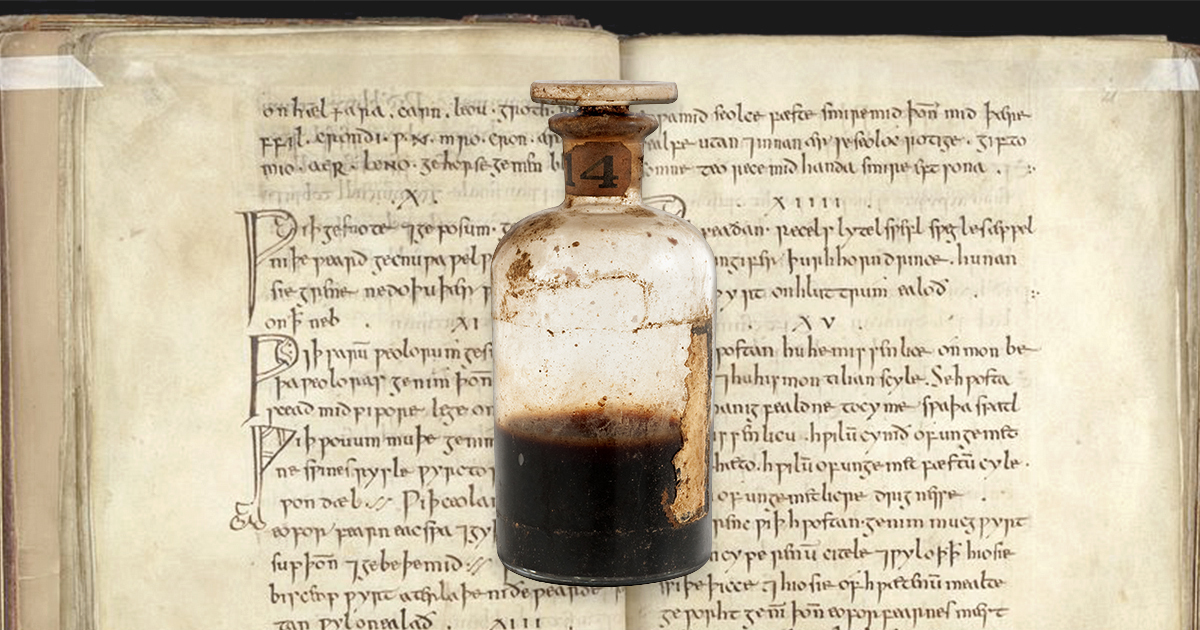
Our water had monster’s blood in it, although this was never verified by a visual inspection of the site, it is the general consensus, or, at least, the belief. No-one drank from it or fished from it; certainly no-one swam in it. A few brave boatmen fared the black waters but most people got no closer to it than the crumbling wooden bridge over it. It did not smell bad or feel strange to the touch and it even looked quite beautiful sometimes when the sunlight or moonlight struck it just so but everyone knew it could kill you.
I knew that but, also, I knew I could make it not kill you. I could do it, at least, I could now…not then, though.

Inevitably, Cobbles knew a man who ran a boat. He brought trade goods from Pitch Springs to Priest’s Point on the coast. In exchange for a day’s work, this man was willing to look the other way when Cobbles filled his canteen with poison water. This was the final ingredient. His love was only days away from embracing him now.
We met by the fountain in Saint Frackas’ Square and he handed me the canteen. “I’d like that back when you’re finished with its contents. I’ve had it since I was wee,” he said to me, as if he were not performing the single most important act in his life. “Of course, of course. It’s yours after all,” I replied as if I was not about to seal my fate. “So, how long?” he asked. “Perhaps two days; you shouldn’t rush these things, you know,” but I should have said three days or four, not two. “Fine, fine!” he said, “I can’t wait, eh? Primmy will be mine just like I’ve wanted all these months.” I nodded and shook his hand. “Oh!” he said as an afterthought and yanked a single hair from his curly head, “You need this too, right?” “It wouldn’t work at all without it, Cobb,” said I, taking the hair. We said our goodbyes and I went to stash the pitch water in my laboratory.

Later, I sat at the dinner table and discussed the events of the day with Mrs Blanintzi and Primmy, who beamed her happy smile at us both and spoke of her friend, Olka. Olka was in love with the baker’s lad but had a boil the size of a grape on the back of her neck. So, obviously, she couldn’t show an interest in the boy in case he should fumble across it when they were courting. “Courting!” said our governess, “There was no courting in my day. You young people have no morals. I should stay away from that Olka girl; she sounds like a tart. Courting! In my day you married the man your parents arranged for you and that was that. Courting didn’t come into it.”

I sat and smiled and enjoyed the company of my family. I wondered what it would be like in the house when Primula left to marry Hindryk (that’s Cobbles’ real name incase you’ve forgotten. I know I often did.) It would be odd but I thought I’d like to have the old place mostly to myself. Mrs Blanintzi, after all, wasn’t so bad. She had strict rules but was less strict in their enforcement.

That night I prepared the equipment to distill the poison out of the black water and began the process. It would take 36 hours by my calculation. I was off. I should have experimented on a small volume of the liquid first to be certain of my calculations. I should have given some to one of the many rats that were so easily caught in the cellars and gutters of the town to see it’s effect. I should, perhaps, have thought twice about the entire damned undertaking. Refusing to craft the potion for Cobbles at this point would have been cruel to him, certainly. I might have lost a friend over it. But looking back at it, I can see how much I might have, not just retained, but also gained. A whole life of learning and maybe even teaching, of respect from my peers and maybe even of those far above my own station. Master Gedholdt had met His Majesty, the King. He displayed a medal on his mantle. I could have been ten times the sorcerer that my master was. Instead, I made a love potion for my friend.

Two nights later, I took the ruby liquid which had resulted from the distillation of the Pitch Springs Water and mixed it with the other ingredients in a small cauldron I had for just such purposes. It should have been the colour of beets when it was finished, instead it was the colour of stout. I paid the colour no mind, trusting instead in my own expertise. I had never made a potion that did not work as it should. This was an indisputable fact of which I was very proud. So I bottled the stout-coloured elixir and went downstairs with it. My sister had just arrived home for dinner and was at the door shaking herself dry like a dog. The weather had been miserable all day. Sheets of rain and hail had been sweeping over the town since early morning. I had not been out in it as I had been busy with the potion and Master Gedholdt had not needed my services. I helped her off with her coat and hung it to dry by the fire. Surprised, she smiled at me and said, “What’s all this about, turnip-head?” she said with suspicion. “Why, Primmy! I don’t know what you mean!” I answered, all innocence. “You want something…” she was right of course. “Well, there was something small. I made something, a concoction I’m thinking of bottling and taking to the market next month…” I started. “And? What has that got to do with me?” “You’re too clever, sister of mine. I thought, since it might bring in some extra silver it would allow you to, perhaps, cut  the number of hours you have to toil for that old bat if it works out. But I need someone to test it first. Just to taste a bottle of it to see if folks would want to drink it.” Smile slackening, Primula asked, “what does it do?” Little did she know…”Do? Why, nothing, not really. It’s more of a savoury fancy. A beverage for those who would rather not become inebriated.” “Oh. Why would someone want that?” She asked “My good sister. Our family has been lucky enough not to have endured a religious education or upbringing but many are those worshippers who are forbidden the taste of liquor. Followers of Saint Kannock, for example, though not completely abstinent, are not permitted alcohol at the weekends. That is when I intend to sell my beverage outside their temple.”
“Smart,” said she, and took the bottle. The lot was gone in a nonce. She smacked her lips said, “Not terrible, brother,” swayed in place, groaned, “something, something’s wrong,” stumbled two paces through a little side table and towards the fireplace. I caught her just in time, preventing her immolation by only a fraction of an inch. We fell in a heap on the parlour floor and I was laughing, what a jolly joke she was playing on me! When I took a breath I realised… Primmy was not laughing, she lay on top of me not even moving, not even breathing. She had fallen face down and I could see her pretty hair all in a mess, duller than normal. I struggled out from under her and saw her right arm trapped uncomfortably beneath her and her legs stuck out at odd angles. I had to be sure. Of course, I knew what this was, but I had to be sure. Turning her was not easy. As I said, I was wasting away and my muscles were weaker, then, than when I was a six year old boy. But turn her, I did. The deep blue veins in her face and neck stood out as if the blood had tried to force itself out through her skin. The eyes in her pretty face were like great black pearls, glistening with a liquid light but the worst was her mouth. Her teeth had all become like shards of coal and her tongue, also black, protruded rudely from between them. She was dead and I had done it. I did weep, if I remember clearly, I did, but I do not recall wailing or crying. Silently, I took up the empty bottle of Love Potion and pocketed it, then I went downstairs to the kitchen and informed Mrs Blanintzi that something had happened to Primula. I thought only of Cobbles then, oddly. What would he do now that his love was dead and gone? Would he be alright? I followed the old woman upstairs, thoughts occupied by the plight of Cobbles all the while. The governess stopped and stooped and wailed over my sister’s still-warm corpse and I thought that Hindryk’s life would be ruined now. Mts Blanintzi ran into the square and I followed as if attached to her by a string. I looked around and saw him there, Cobbles looked at me and I knew that it was even worse than I had thought. He knew. Cobbles knew I had killed her.

No-one else knew what killed poor Primula. The town doctor looked at her but the best he could come up with was, “she was poisoned.” He was not incorrect of course, but he could not be any more specific. A letter was sent for my father to return immediately but he was far away on the borders of our country defending a fortress against an infidel foe. He might not have been able to return for weeks and essentially, it would have been too late for him to do anything. Perhaps if he had been there I might not have continued down the pitch black path I had laid in tomb-stones before me. Perhaps, but then again, perhaps not. What is the point in considering such might-have-beens when the past is immutable and the future, for me, at least, forever ruined? At the time, I had only one thought for the future. I had the thought that if I was going to be a sorcerer then I should be able to gain from it, and so should Primula. You have guessed by now, of course, what was on my mind. I did not have the knowledge. I could not perform the spell, if it even existed, because I did not know it. I knew where it could be found, though, and I knew how to get it. I just hoped that Master Gedholdt had not heard of Primula’s death because, if he had, he would certainly prevent me from even entering his house. I had to go that very night. I was just lying awake in my bed, considering the problem, as I saw it, of my sister’s death and how to fix it. So, once I had hit upon the answer it made sense to go immediately.

I skulked for an hour beneath the tree in front of my Master’s house before the lamp light went out in the front window. He was finally off to bed. I saw the lamp snuffed out from my vantage point and wondered why Gedholdt did not simply use a light spell all the time. I waited another thirty minutes and then crept, black-clothed, to the window. It was an old one with a latch, which would come loose with a jiggle or by the simple manipulation of a magic hand. I cast the spell, whispering the words and performing the actions as untheatrically as possible (this is a difficult thing to achieve when performing magic. It is always a performance and so, usually requires grand movements and projected voice.) Once it was open, I climbed awkwardly through and into the front room. The book I was looking for was not where I expected it to be. I could not have foreseen this as I had never been in the Master’s house so late before. The Master’s current work was the study and translation of the “The Emperor’s Libram, Royal Magic” and whenever I had previously been to his house it was placed, open to a particular page or closed against prying eyes on a stand on his desk. He often spent eight or ten hours a day at the libram, whispering and memorising and making notes. I did not know that he moved it at night. I went to the strongbox in the kitchen. I was certain that’s where he would secure it. Gedholdt kept all his valuables in the strongbox, thinking, incorrectly, as it turned out, that if a thief came to rob a magician, he would not expect the valuables to be there. It was an unassuming but large box with a sturdy, but not magical, lock. I had taken great care in creeping through the house and slowly shifting open the door but I knew the box creaked unnaturally when it was opened or closed. I had no choice, of course, but I steeled myself for the possible repercussions of my next action. Everything up until this point, my master might have forgiven. Breaking into his house was one thing but the Emperor’s Libram was not only his most prized possession, it was also the most dangerous by an extremely wide margin. I did not hesitate long before casting the “Open” spell. The sturdy lock was helpless against the magical spell; I heard the click and then I pushed up the lid. Wood groaned, iron scraped and I gasped. I cast another spell, “Levitate” this time, and took the glittering gold book from its ineffectual hiding place beneath a pile of tea cloths. As I did so, I heard a disturbance upstairs. The groans which had woken my master were echoed by the groans he made in the floorboards. He yawned and said something to himself. I could hear him coming downstairs. I pushed the floating book before me and ran for the front door, heedless, now, of the noises I made. The footsteps on the stairs quickened but by the time I heard him reach the bottom I was gone.

Home again, I had to find the spell. I floated the book up to my lab where it occupied most of the free space. I sat cross-legged on the attic floor and studied. Knowing that Gedholdt would figure out soon enough who had performed the daring robbery, I worked as fast as I could. The wonders writhing restlessly on every page made it difficult to skip anything and I could finally see why my master seemed so obsessed with it. But there was just one spell that I needed. Just one. I was confident, once again, in my ability to accurately translate such ancient writings. The spell I was searching for would be called “Revive.” It took two hours but I discovered it near the back of the book in ink of red and black. The sun would soon be up, I had to move fast or no-one would ever believe that she had simply recovered from her injuries.

I had devised the story that I would tell to explain her revival, if, for some reason, I was questioned. She had not died, no, she had but fallen into a semblance of death, a coma-paralysis caused by whatever poison she had consumed. When I went to visit her body in the temple, that night, it had worn off. She awoke, groggy and ill, right enough, but alive!
I hurried to the Grand Temple of Mictus, Saint of Souls, where the dead were laid before burial, armed now with the knowledge that would make things alright. If only I had managed to do this before word had been sent to my father, I remember thinking, I might have saved him some heartache. He would be happy, still, to find her alive when he arrived and she and he would enjoy a pleasant family visit, instead. Ha!

The door to the temple was unlocked, as always, but there did not seem to be anyone around other than the dead. It was a long, high-ceilinged, marble and granite, grey and white space. The tiles beneath my feet caused my footsteps to echo maddeningly as I walked the aisle, guided by dim torchlight. My sister was not the only occupier of the altar that evening. Two more corpses flanked her, all three draped in red cotton sheets as tradition demanded. I looked at her and thought, how dead she looked. She did not look like my sister anymore, she looked like a thing, an object, no desires or worries or likes or dislikes or emotions or…well…life. A second-guess stayed my lips as I approached the corpse and set my body in the opening pose of the spell. Maybe she’s the lucky one, I thought, maybe she is the one to have escaped this world of pain and disappointment and suffering and toil. Then I thought again of Cobbles and his misery and his knowledge of my murder and I proceeded. It was a long spell, and I performed it for close to an hour. As I reached its final syllable and flicked my wrist with the last movement I heard a cock crow and then I heard the temple door creak open.

“What are you doing? What are you doing here? What are you doing to her, you little wraith? Haven’t you done enough, already? Haven’t we done enough!?” It was Cobbles, come to pay his respects and beg her forgiveness as well, of course. I lowered my arms and turned to face my friend as he ran towards me up the aisle. I shifted a step backwards and almost tripped over a rug. “Its alright!” I cried, “She, she’s not dead after all, she’s not, look!” I could hear her move behind me on the cold stone altar and I knew then that it had worked and that I had performed a miracle, that I was blessed, even. I watched my friend slow a little and, just before he had reached me, stop, looking, gaping at the miracle behind me. “What did you do, you little monster?” he breathed. Finally, I looked and realised that it had been no miracle, it was yet another curse I had lumbered myself with. Primula, still wearing her red cotton sheet had slipped off the slab she had occupied and begun to shamble towards Cobbles, arms bent at the elbow, hands pointing in his general direction, eyes, still black as coal, rolled back in her head and mouth hanging open limply. There was that slug-like tongue sticking straight out and around it came the sound, a groan and a scream in one, high pitched and low at the same time, echoing out through a jagged cave of a blackened mouth. Her pallor had not changed from the time I entered the temple, she was grey and blue and black in splotches and her veins still protruded startlingly from the skin of her face and neck and now her hands and her feet too. Nor was she alone. Her two altar mates had risen now also, one a burly corpse of a man who seemed to have encountered some sort of agricultural accident as he was missing his left arm from the shoulder down. His colouring was more red and pink with blue spots but he, too, was black around the stump of his lost arm. The other one was a child no more than six years of age. A girl I think, though it was difficult to tell. The corpse presented nothing more than a burnt and ruined face, lipless, lidless and hairless, its unsheathed teeth chattered horribly as it worked its charred jaw.

I stumbled away from them, Cobbles and his opinions and his troubles vanished from my mind but my feet had lost all sense and I fell backwards onto the tiled floor, I hit it hard, jarring my shoulder and knocking my head to momentarily stun myself. Despite this, I saw what happened when they got to Cobbles. He had, perhaps, been paralysed by fear and disgust at my actions. Finally, my friend felt the embrace of my sister, not-so-pretty Primmy now. She kissed him and he screamed as she came away from his face with a sliver of it in her teeth. The others surrounded him then and I looked away as he screamed horribly for another ten seconds or ten minutes, I don’t know. When it was over, I was left, still on the floor with the blood of my friend, Hindryk, pooling about me. My walking corpses had gone, they had left me alone and gone out into the town. I took off my gore-soaked jacket and threw it over Cobbles’ grisly remains, then I ran out into the Pitch Springs dawn to follow the trail of blood. Unfortunately, they had split up. What could I do anyway? I was just a boy still and all of my skills were failing me. I had killed my sister with a magic potion and then revived her to a vile state of undeath along with two others. They were all, no doubt, decent people who did not deserve this treatment. Everything I did to try to fix things only exacerbated my problems or created brand new ones. It was time I stopped. It was time I left.

Decision made, I ran to our narrow house on Saint Frackas’ Square, retrieved the Libram and ran to the bridge over the accursed pitch water and left Pitch Springs behind for good, or so I thought.

Dragon Age Character Creation

Dragon AGE

I’ve recently been playing through Dragon Age Origins again. It’s been a long time since I have played that particular game although, I have played a lot of Inquisition and even Dragon Age II since then. Playing Origins has put me in a nostalgic frame of mind but also, I thought it might be a good incentive to try something new, TTRPG-wise. The Dragon Age RPG has been out for some time, about ten years I think. Green Ronin published it and it is based on the AGE (Adventure Game Engine,) which is maybe better known for being used by their Fantasy AGE game. I got both of those on a Bundle of Holding years ago but have never even gotten around to reading them. So, I asked in the Tables and Tales discord if anyone would be interested in trying the Dragon Age RPG and I was surprised and delighted to discover that I am not the only DA fan in the community!

If I needed an excuse, I could also say this is all in preparation for the new DA game, “Veilguard,” which is due out soon. But, honestly, it has more to do with replaying the old game than waiting for the new one.

Anyway, I have had some decent success in getting to know new systems by creating characters on here in recent posts, so I thought I would do that again today. Off to Thedas with us!

The steps

So, I am doing this using the Dragon Age RPG Core Rulebook published in 2015. I have it in PDF format. I would like to start by praising it for having a comprehensive set of internal links from the table of contents. For a book of over 400 pages, this is invaluable.

So, what are the steps to creating a Dragon Age character? Having a quick look at them, there are similarities with the video games but with some flourishes and differences presented by the AGE system.

A screenshot of the Dragon Age Character Creation Steps table from the Daraon Age RPG core book. The table includes the 8 steps you need to complete to create a PC for the game.

As you can see from the screenshot, the first step is coming up with your character concept. I quite like this as a starting point, although, I do wonder if it might be rather a tall first hurdle for some players. I often find myself coming to know the concept of my characters in other games during the process of creating them. But, let’s give the game and its designers the benefit of the doubt and go with it.

1. Step 1: Character concept

This section in the book urges you to go and read through Chapter 7: Welcome to Thedas, if you’re not terribly familiar with the setting, and maybe haven’t played the video games. Now, chapter 7 is almost fifty pages long and covers everything from the major nations and races to the cultural significance of the Dwarven Paragons. You would want to be pretty invested in the game before you ever start to read that whole thing, as interesting and even pleasurable as it might be to do so (the writing is not bad but the illustrations are very good indeed.) As I have played through all the games multiple times, and even stopped to read all the books I picked up off bookshelves and desks as I played, I feel like I am already well enough equipped to get away with not reading it before embarking on the character concept step here.

  • An adventurous youth who has finally found a way to escape their home.

That’s it, that’s the concept. I will say, I don’t think a thorough knowledge of the game’s setting is required to make this sort of thing up. Most of the example concepts they provide in the book are vague enough that they could belong in any traditional fantasy setting, in fact.

Step 2: Determine abilities

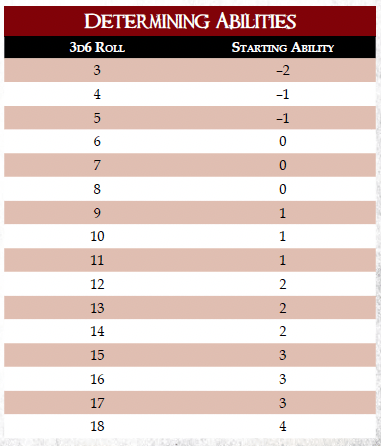
You’ve got a whopping eight abilities in this system: Communication, Constitution, Cunning, Dexterity, Magic, Perception, Strength and Willpower. Other than Perception and Communication these match up pretty well with the stats in Origins. We are rolling 3d6 for each one of these and then we record the modifier from the table below, not the sum of the dice, much like your average Borg game.

A screenshot of the Determining Abilities table from the Dragon Age RPG core book. It is a 3d6 table, which indicates what your starting ability score will be depanding on your roll. It goes from -3 to 4.

Communication: Rolled an 8 so that’s a score of 0
Constitution: Rolled a 13 so that’s a score of 2
Cunning: Another 13 for this one, so, 2 again
Dexterity: That’s a 10, which equates to a 1 on the table
Magic: I rolled a 12, so that is 2 yet again
Perception: Not wonderful. That’s a 6, which is another 0
Strength: A below average 9. Still, it gives me a 1
Willpower: That’s a 7 on the dice. And that gives me my third 0

The book does give options to either roll the scores and assign them to abilities as you see fit, or to do use point buy system instead. But, I think I will continue the tradition of randomising the process that I started way back in the OSE character creation post.

Step 3: Backgrounds

So, in this game, your choice of background also determines your race and has some pretty major mechanical effects, as well as the obvious cementing of your character concept from earlier. Here are the effects they generally have:

A screenshot of the list of features a PC's Background gives them in the Dragon Age RPG. These include ability score increses, ability focuses, race, class choices and languages.
A screenshot of the list of features a PC’s Background gives them in the Dragon Age RPG. These include ability score increses, ability focuses, race, class choices and languages.

Now, the book says nothing about rolling for your background randomly. In fact, I believe it encourages you to choose based on your original character concept and the ability scores you rolled. But I’m not here to play by the book (actually, that’s not true, really. I just enjoy the thrill of the roll!)

So, there are a total of thirty, 30, backgrounds (!) in the core book. It just so happens that I have a 30-sided die thanks to my flirtation with Dungeon Crawl Classics. So here we go!

That’s a 28! This means my character’s background will be:

Tevinter Laetan

And that is pretty cool! So, it means that I will necessarily take the mage class as the Laetans in Tevinter society are magic users from the mundane classes who are identified at a young age and trained to serve the Imperium. It fits quite nicely with my character concept, too. I can imagine a young Tevinter mage, disillusioned with the unfair system under which their own class of people toils while the upper class mages reap all the benefits. Not to mention the binding of so many elven slaves in general society.

Here are the benefits gained from this background.

  • +1 to Cunning – this makes my Cunning score 3 now!
  • One ability focus, either Communication (Deception,) or Cunning (Arcane Lore) – I rolled again on a d2 for this and got Cunning (Arcane Lore)
  • Languages – Tevinter and the Trade Tongue
  • Take the Mage class
  • Roll twice on the Tevinter Laetan table:
The Tevinter Laetan Benefit table from the Dragon Age RPG core book. It is a 2d6 table. Depending on wht you roll you will get a particular benefit such as +1 Consititution, Focus: Communication (Deception) and +1 Magic.

First roll – 11 Focus: Cunning (Cultural Lore)
Second roll – 9 Focus: Communication (Persuasion)

Step 4: Classes

A screenshot of the page from the Dragon Age core book that describes the Mage class. It includes an illustration of a femme human in red robes with long blonde hair, a staff with a blue stone on top, three bluish potions at her hip and some magical enegy emanating from her outstretched fingertips.

This game, much like the video games, only has three classes:

  • Mage
  • Rogue
  • Warrior

But within these classes you have a selection of specialisation options. I often wonder that there is no Priest class in this relatively traditional fantasy world. They gave the healing duties to mages and that is one specialisation option you can take as a mage. You can’t take Bard as a class but if you are a Rogue, you can choose to specialise as a Bard. And Barbarian isn’t an option in the Class list, but Warriors can go down that sort of route if they want.

Anyway, all that is academic as I am required to choose the mage class due the background I rolled.

The Class section starts off with an explanation of the broadness of the classes as I said above and then tells us a little about character advancement. You start at Level 1 and can get up to Level 20. There are options for XP and milestone leveling and it explains how you improve with a new level. Suffice it to say, ability score improvement is one of the main ways you gain in power, but you also get more Health, new ability focuses (which I don’t understand yet,) new class powers and “stunt points” (which I also don’t understand yet.) I just know you start with 6 Stunt Points. Everybody does.

It’s important to note that you don’t get a specialization until level 6.

As a mage, my character starts with three spells but can’t wear armour or use many types of weapons.

They have three Primary Abilities (as do all classes.) For a mage that’s Cunning, Magic and Willpower. The first two are not bad for me but that last one is a 0. Oh well.

All the others are Secondary Abilities.

Starting health is 20 + Con + 1d6. I rolled a 5 so that means it’s 27! Not too shabby.

My Weapon Groups are Brawling and Staves.

At Level 1, my Class Powers are

  • Arcane Lance, which means I can send a burst of magical energy from a staff
  • Magic Training allows me to cast spells. Here are the spells I’ve got:
    • Arcane Bolt
    • Arcane Shield
    • Daze
  • Mana Points. I start with 10 + Magic + 1d6. That’s a 4 on the d6 so a total of 16.
  • Starting Talent. I choose one talent from Chirurgy, Linguistics and Lore. Can’t get Chirurgy because it has a requirement that I don’t have. Gonna go for Lore, which seems the most generally useful.

Step 5: Equipment

You don’t get a lot to start with to be honest. I’ve got a backpack, some traveling clothes and a water skin as well as a staff and another weapon. I can only use staves or Brawling weapons. The Staves group includes clubs and morning-stars, I guess I’ll take a morning star then!
I also get 50 + 3d6 silver pieces to buy other gear. I rolled 10 on the 3d6. So that’s 60 silver.

I guess I’ll pick up a bedroll for 10 sp and a blanket for 6 sp. I’m not going to get into any more shopping right now.

Step 6: Defense and Speed

Your Defense score is, unsurprisingly, a measure of how hard it is to hit your character. It is 10 + Dex + Shield Bonus (if you have one.) So, that’s an 11 for me.

You can move up to a number of yards equal to your Speed when taking move actions. For a human, that’s 10 + Dex – Armour Penalty. I don’t have any armour so that’s not an issue. So essentially my Speed and Defense are the same, 11.

Step 7: Name

They have a long list of sample names in the book. Not just for Dwarves, Elves, Qunari and Humans but for the full variety of cultures and backgrounds (actually this mainly applies to the various human cultures) that they might come from. First, I need to decide what this character’s pronouns might be. I think I will go with he/him this time. As a Tevinter character, I can choose from some pretty cool names, including Dorian, Florian and Ether. But I have decided to go with Amatus. Amatus the Tevinter Laetan Mage.

Step 8: Goals and Ties

I like that they have included this step in character creation. Just go and take a look at my Motivation post to see why I think that, at least about Goals.
Anyway, I have to pick three Goals, a mix of long a shorter term ones.

  • Find the only friend I ever knew, an Elf named, Adanna, who was once a slave who belonged to his family in Tevinter, but escaped to Ferelden a year ago.
  • Try to make a name as an adventurer in Ferelden while staying out of the hands of the Templars.
  • To earn some coin and find some companions.

The other part of this is the Ties part. Now this specifically refers to other PCs. Since I don’t have any of those, I’ll have to skip that part.

I think I will have to do another post on the general AGE system and particularly how it relates to this game as there are still several elements that are a mystery to me but I feel like I have gone on long enough for one post.

The Apprentice, Chapter 8

Origin stories

Find the other chapters here.

I like an origin story with a little bit to it. A lot of place names are pretty dull. I come from a place called Sligo, Sligeach in Irish. It means “shelly place.” And, yep, it is. No mystery there. And maybe Pitch Springs got its name from the unnatural depth of the river at the location of the town or maybe the colour of the earth was so dark below the river that it made the waters seem black. But, actually, there’s a far more interesting tale behind it…

Chapter 8: The Story of the Naming of Pitch Springs

Pitch Springs had not always been named such. In fact there is a story attached to its renaming which has fascinated me since I first heard it. Many now say that the tale is nothing more than a bucket of bull’s manure but I am certain there are nuggets in it, even still, of truth or half-truth at least. I will relate here the Story of the Naming of Pitch Springs

Many years ago, in the village of Brightwash the mayor, a man of great girth and booming voice named Moltotzi, decided to build a series of mills along the riverside in and around the town. This would be of great benefit to the people of Brightwash and provide much-needed employment for several of the younger men who had been born too late to inherit any land and too stupid to study something worthwhile. The mills were really very popular. The town became famous for the fine bread flour it produced. Brightwash began to prosper and so did Mayor Moltotzi. He was hailed as a miracle-worker. The young men who found jobs at the mills soon found themselves prosperous enough to take wives and build houses of their own. Before long, nature took its course and lots of little would-be mill-workers came into the world. The village grew and Moltotzi said it was time they changed the name. Brightwash became Milltown and felt just a little bit darker.

Now, the folk of Milltown had always lived on the banks of the sparkling River Giarri so stories of the river’s odder inhabitants had been passed down for generations. Occasionally, a farmer making a delivery in the early gloom of morning or a sot wending his way home in the late black of night might report ed that they had seen one of them lurking or leaping in the middle of the deep river, sylkies; beasts that could take human form. While immersed in the river’s silvery mirror waters they appeared as nothing more than otters, remarkable only in their exceptional size but on the occasions when they left the river they were transformed into short, dark-haired men and women with deep black eyes. It was said that they survived on the bounty of the river itself: its fish and weeds and the plants of the river banks; so they did not interfere with the doings of the people of the town. Well, except in one very serious respect: supposedly they kidnapped young children. It was said that they did not procreate in the same way that people and animals did, you see, due to the fact that they were a magical species which were left over from the ancient times of the Fomorin Empire. So, to make more little sylkies they had no choice but to draw from the population of humans in their area.

The people of the town did not, at first, realise what was occurring. Their children simply disappeared from their beds. It was thought to be the evil work of some wicked man but there was never any evidence of that found at the homes of the disappeared. One father, one of the newly married mill workers named Davus was not willing to let his two year old son, Krish, go the same way as the dozen others taken from his neighbours. He determined to stand watch all night every night, if necessary, to find out who was responsible for these outrageous abductions, and to kill them. Darkened by night and partially hidden behind a curtain in their bedroom, he sat as Krish slumbered in his cot. His wife, Yolanna, slept in the bed next to the cot. He fought off sleep all night with a concoction prepared by the wise woman of the town (I often wonder if Aggie was this old.) The first night passed by without exceptional incident as did the second but on the third, Davus was sitting there behind his curtain, clutching the spade he intended as a weapon, when the silhouette of a darkened, naked woman slipped, soundlessly through the window, even as he watched. He did not act immediately, but paused to determine the intentions of the intruder. The little, hairy woman skulked to the edge of the cot, looked in, reached down. He burst from his place of hiding, thrusting the point of the spade like a spearhead at the neck of the kidnapper. A sylkie is not a defenceless creature, however, and is swift as an adder when attacked. This one sidestepped Davus’ effort and screaming like a cat, flipped out of the still open window. The whole house was awake now, Yolanna and Krish crying in startled horror. Davus vaulted through the window and made chase, raising a hue and cry as he went: “Awake, awake now!” He shouted, “Enemies here! Enemies! Up Milltown, Up! Up!” He whooped and hollered all the way to the river until half the town had come out of their houses and onto the streets. It was enough to cause the would-be kidnapper to be trapped. the sylkie, only strides from the safety of her river home found a wall of Milltowners blocking her path. The surrounding enemies made her crouch into a defensive position and watch as Davus came on, spade twirling in his hands as he did.

“Stop!” Cried the woman, in a gurgling bark. She held her hands out to Davus who smacked one of them with the flat of his spinning spade. She yelped and squealed in pain and stuck two of her bruised fingers in her mouth. “Where are our children?” asked Davus. “No children in the river! Just pups!” she garbled, fingers still mouth-bound. Davus’ spade spun and whirled about and then it stretched from his hands and struck her in the right knee. The sylkie woman went down and wailed terribly. “Where are our children, monster?” Shouted her tormentor now. “No children in river…just…pups,” she managed, whining and shaking all the while. Davus did not accept her answer. Had he not seen her attempt to take the child from his cot under his very nose? Had she not confessed by simply being? As if someone else had decided to voice his own thoughts, a shout came from the crowd, “You’re a sylkie, you can’t be trusted! That’s what you do! You take children and spirit ‘em away under the water. You have my Mikel! You have him down there!” The Sylkie fell to her knees as if struck again and growled, “No! We have pups. Not want your children. Not for the river, not for us, for the mayor!” Davus paused, his interest piqued. He had long been suspicious of the mayor and his ever-growing palace with its ever heightening walls in the centre of old town. He thought him a venal and greedy glutton but he could not imagine that he would have something to do with the disappearance of all those children, eleven in all now. “The mayor?” he asked, using the spade to support him as he knelt down beside the bruised and pathetic sylkie, “what about the mayor? Tell me n-”

“What’s all this, here!” The voice was unmistakable. The mayor had won elections based entirely on the strength, depth and timbre of his voice. Many claimed it had persuasive powers. Some said they had been hypnotised by the merest greeting from the man. Davus felt the reverberations of the mayor’s famous vocal cords in his own breastbone. He turned, and there the man was, dressed as if for the hunt, enormous red jacket over cream waistcoat, leather jodhpurs. He held a crossbow: Mayor Moltotzi. The mayor parted the crowd like so many chickens and came through to stand beside Davus. “Your Honour, I caught this sylkie trying to take my child, Krish. I chased her out and woke up the town.” “Yes, yes, good man…” “Davus, Mayor, it’s Davus.” “Yes, yes, I know that. Now, let’s just have a look. Well, she is a beastly looking whelp and no mistake. Still, how do you know she’s one of these river-dwellers? Hmm?” The mayor was questioning Davus but his reply came from the crowd of townspeople which had expanded till almost everyone was there, “She tried to take his lad! She’s a demon!” There was a rowdy chorus of agreement from the rest of the assemblage. “Indeed? A demon, well th-” “No!” interrupted the injured woman on the ground and attempted to crawl away. “It was you, you, you. Monster! Monster! You, monster mayor! You made us, you!”
A stone flew from the back of the crowd, hitting the sylkie woman square in the nose and knocking her back to the ground; another came from closer to the front and in no time the crowd was a mob and the stones flew freely. Davus ducked and covered his head with the blade of his spade and crawled away from what had just become a lynching. creeping away, wanting nothing to do with it, he hid and watched from the trees at the riverside until it was over and the town had gone home. Then he emerged and slumped to the spot where lay, not a woman, but the carcass of a large river otter, bleeding and battered almost beyond recognition. “What had she meant about the mayor?” he muttered to himself and then picked up the sylkie and brought her to the river.

A month passed; the abductions had stopped. The people of the town had forgotten all about the events of that night by the river. Well, everyone except Davus and his wife at least and Yolanna only because she had stayed where she was to look out for young Krish. He began to wonder if folk had been right about the mayor and the power in his voice. Everyone had turned so quickly. By the time they had started beating the poor woman they had sounded more like a pack of hyenas than the pleasant townsfolk he knew, no more words just howls and grunts and screams. And now…now the event may as well not have happened. He did not bring it up. He had been suspicious of the mayor since then and he was worried that there were agents amongst the Milltowners now. Making up his mind to go to the river and ask the sylkies what happened, and why, Davus made his excuses to his wife and went that very night.

It was just before midnight when he reached the riverside and he was reminded, uncomfortably of the night of the stoning. There was the stain still on the paving stones of the path to the jetty; there was the tree he had hidden behind; his shame hurried him along. He stood at the edge of the jetty and called, “Sylkie, sylkie, sylkie-o.” Over and over. He had brought an offering, of course, salted sardines. It had cost him a full day’s wages but he thought a sea fish would be a delicacy to river dwellers. The bells in the clock tower rang twice while he called and waited and introduced his bucket of fish to the river’s slow-flowing waters. His patience eventually bore fruit; a head bobbed out in the centre of the river. He had not seen it emerge and did not know how long it had been there by the time he finally spotted it but once he did, there was no mistaking it. Sleek, wet, shining dark, with moon-mirror eyes, the giant otter yawned, casually revealing the set of long glinting teeth in a jaw that he had heard could shatter the leg of a full grown man. He hesitated, but of course it was already too late. They would not let him turn around now. There were more heads bobbing out there, perhaps a dozen of them; one of them changed, becoming the head of a beardless youth. “Come in. Leave your clothing. Bring the fish.” He undressed clumsily and then, holding onto his bucket, jumped in. “Let the bucket go,” said the young sylkie man. Doing as he was told he watched the heads all submerge and then felt their wakes swirling about him below the surface. As they gathered and played with their food. He took a breath and dived. He could discern their dark bodies blur in dance about him; claws swiped at his face and missed by a whiskers’ breadth; a sideswipe almost surprised the air out of his lungs and then he was hoisted uncomfortably with little paw-hands in his oxters and dragged swifter than any man has ever swum in water. His eyes were forced closed by the pressure of the water on them and he kept his arms and legs as straight as he could so they didn’t catch on anything. They swam him for far too long.

Lungs burning and underarms aching he emerged finally from the water. His surrogate swimmers chucked him unceremoniously out of the water and onto the riverbank. Coughs wracked his chest and head for a few minutes and he spat up river weed and tiddlers. When he looked up there was a scrubbing brush-bearded man before him, dressed only in filthy torn britches and a sackcloth shirt.
“What?” Dared this sylkie wise man. “I was there…” “Where?” The man’s face betrayed a deep impatience. “When your woman died, I was there. I was one of them,” confession felt good, “I caught her.” The strike came too fast for Davus to see but he screamed when it came. Blood ran freely down his face from the four long slices made by the sylkie’s claws. Hand to face, he pushed on it to try and stop the bleeding. When he looked back at the man, it was as though he had never moved. “I deserve worse,” he said. “Did you come for worse? For punishment? We could do that but it would do our kind no good. It would make our lives much more difficult. No. Why did you come?” said the elder. “I came to ask you about Mayor Moltotzi. Your woman said the children were for him, not for you.” Davus’ voice was thick with his own blood, he spat some out and looked at the man again. He said nothing. “You don’t steal children to make them into sylkies, do you? You don’t kidnap them so you can have your own young. Am I wrong? You know what people think of you. I can see to it that they learn the truth. Just help me discover it!” The old sylkie hawked and spat a black gob into the mud. “The mayor is an evil thing. Not a man. Not him. Looks like it but so do I, eh? No, not a man. It’s name is Mulloch. It is here to feed. It eats usually sheeps and goats and rabbits and birds but once every month it wants a little one. ‘Give us human ones,’ it says, ‘and I’ll let you keep your pups.” Davus was aghast. “He knew, didn’t he, that we would all blame the sylkies for this? We are all so sure that sylkies take our wee ones for their own that we wouldn’t even think of another culprit. That’s what I believed but I needed proof as well…and then I found your woman in my house that night. The Mayor was able to use that discovery to deflect the blame onto you and your people.” The sylkie elder nodded curtly. “We will be leaving here. We have lived here in this river for many birthings but the mills hurt the water and they hurt our pups. Three have been sucked into them and killed already. They are too young to know the dangers and we want our children to roam free in their own homes. But I do not want to go until I know that Mulloch is no more.” The elder held out his long nailed hand to Davus and Davus held out his. They shook and and agreed. “That bastard will die. I will make certain of it.”

Davus was not a warrior; he was not an assassin; he had no magical powers, but he had a desire for true justice and the will to achieve it. His adversary was the most powerful man in the town and extremely popular with the citizens of Milltown. Also, he lived in a fortress. But, he had his weaknesses. He had a passion for the hunt and spent much of his time tracking and shooting game with his hounds. A retinue always accompanied him on these hunts since he could not be expected to fetch the kill or cook his own food while out. Also, he needed a squire, a stablehand and even a coachman if the hunt was to happen far from the town. Davus knew this about the Monstrous Mayor, as he began to think of him, because he had a friend who worked as a beater in this retinue, a friend he could replace. He would have to bide his time, though, and formulate his plan, not to mention waiting for his face to heal. Injuries like that never healed fully of course and he was scarred forever afterwards. His wife told him it added character and he earned the nickname, Scar.

Came the fateful day of the hunt. Davus replaced his friend in the role of beater and he joined the hunt at the gates of the mayoral palace in the centre of town. He never even entered; he didn’t have to. Out came Moltotzi astride a huge dray horse, the biggest in the region, it was said. Davus kept his head low and sat astride his own plain pony, trying to stay out of sight. They were to go, that day, to the nearby Hills of Heather where the mayor would hunt grouse with his specially made crossbow. It was not a long ride to this place, just an hour from the town but it was very different: colder, wilder and wetter. There was a mist blanketing the hills when they arrived, poor weather for hunting. The mayor managed to bag just one grouse all morning. Davus he knew it was a sign and he knew an opportunity like this one would not come again. They stopped for lunch near the top of a long-dropping waterfall, the very source of the Giarri on which Milltown stood. The company camped near enough to the water for the cook to fetch it but not close enough to allow its noise to overwhelm conversation. As the other servants busied themselves around the fire, Davus snuck off and planted something near the mayor, just close enough for him to see it from the corner of his eye, a feather. It was one of enormous length and had been part of a fan, once gifted to Yolanna by her mother. “What’s this?” said Moltotzi when he spotted the feather and, grabbing his crossbow, went to get a closer look. He picked it up and marvelled that it might have been dropped by a bird he had never before shot. He looked around for the beast only to discover, that’s right, another feather and another and another until the trail of them had wound him a zigzag as far as the waterfall. He stood there at the cliff, looking around dumbly for the bird he had come for, crossbow cocked and raised. But there was no bird, there was only Scar. “For the children,” whispered Davus as he crept up behind the bulk of the monster. He calculated for a just a moment and then ran at the broad red-coated back of the mayor. He managed to stop himself from going over too, only by clutching the hardy heather on the edge of the cliff. Davus watched him disappear into the mist and heard his unearthly scream all the way to the bottom. No-one else did. The little retinue returned to the town after hours of searching the hills, assuming the mayor had wandered off in the mist and fallen over the cliff side. They were partly right. When they returned to the town they entered the mayor’s palace to see if he had somehow made his way back there. They searched it high and low and found no sign of him. What they did find shocked the whole town, well almost the whole town, Davus and Yolanna were not surprised when a secret dungeon was uncovered. It was littered with the bones of children and the truth was revealed to Milltown. Of course it was not called Milltown for much longer. Once the party had returned from the hills the waters of the bright Giarri had turned unaccountably dun and then dark and then black and they have stayed that way to this very day. Black as pitch is what they were. It was not the residents’ idea to rename the town again. No-one knew exactly who started it, in fact, but that’s when Milltown became Pitch Springs.

Non-standard Holidays

Celebrations

I’ve begun to realise recently that I would much prefer to celebrate a fictional or “made-up” holiday than a real one. At least a real western one. I have had to interrogate the reasons for that, of course. But, let me tell you, dear reader, it did not take me very long to hit upon the answers.

Religion is, naturally, the top reason. It’s been a long time since the church and I parted ways. We had a fundamental philosophical conflict that was irreconcilable. Anyway, as a result, I don’t feel I’m a part of the religious side of any of our really major holidays. Christmas and Easter are the ones I am thinking of but in Ireland, at least, there are plenty of other saints’ names attached to days throughout the year. Of course, I know that these holidays, and even some of the saints have been recycled from pagan ones by the church. Same with a lot of the traditions. I’m sure dominant religions have been doing that throughout history as a clever way to stamp their authority on a people or place. You can see it happening in real time to our big holidays too, of course, as they are co-opted by consumerism. The original meanings have become mixed up and diluted and lost. What even is the meaning of Christmas? (there’s a saccharine Christmas movie in there somewhere.)

The second reason is related to the first in that rampant consumerism is the focus of these big holidays that we tend to celebrate in the West. So, as diluted as the pagan purposes of the holidays have become, even the Christian meanings of more recent centuries have been co-opted by Black-Fridayism. These times, when families and communities come together, are often the most stressful and worrisome occasions for those struggling financially in the first place. It just doesn’t feel worth it…

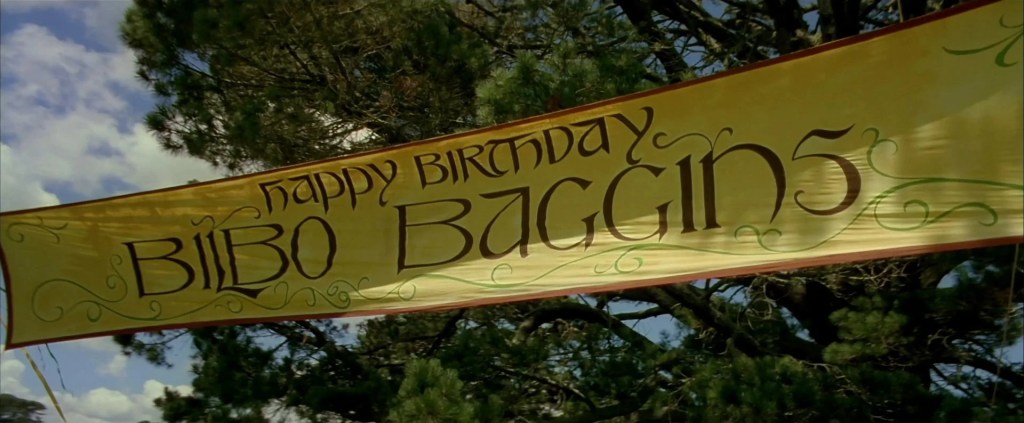
So why not celebrate occasions where the meaning is as clear and sparkling as Caribbean waters, and as fun and uncomplicated as a Hobbit’s birthday party? And let’s not forget, themes worthy of really kick-ass RPGs.

Talk Like a Pirate Day

Those of you have been around a couple of weeks might remember that I made a character using Pirate Borg a while back. That was by way of familiarising myself with the game, the setting, the character classes and the general rules. And all of that was in the service of a Talk Like a Pirate Day one-shot on September 19th.

I was the GM for this game so I never ended up using Isabella “Butcher” Fernando, the buccaneer I created for that other post. However, we did have another buccaneer in the party, recently returned from hell, where the devil didn’t want her, was Eliza “Bad Omen” Rackham. She made an incredible entrance (her player was unavoidably detained so she appeared about an hour and a half into the action.) As though rising from Davy Jones’ Locker, she emerged from he water by the other characters’ little row-boat and hoisted herself into it by grabbing their oars, shocking her companions who all knew she was dead. Eliza was, surprisingly enough, the most normal member of this cursed crew. As well as “Bad Omen,” we had a couple of skeletons, one a swashbuckler and one a zealot, a vampiric rapscallion and, a mutant great old one from another reality who also happened to be a sorcerer with a taste for human flesh. So, I decided to skip any town-based interactions with NPCs and start them off in medias res, facing down a British naval vessel who wanted to kill or capture at least three members of the small crew. Raymond, our vampire took the role of captain, despite being disadvantaged by the glaring Caribbean sunlight, while Jolly Roger, the Great Old One Mutant and our skeletons, All Bones McKeown and Hector blasted off broadsides.

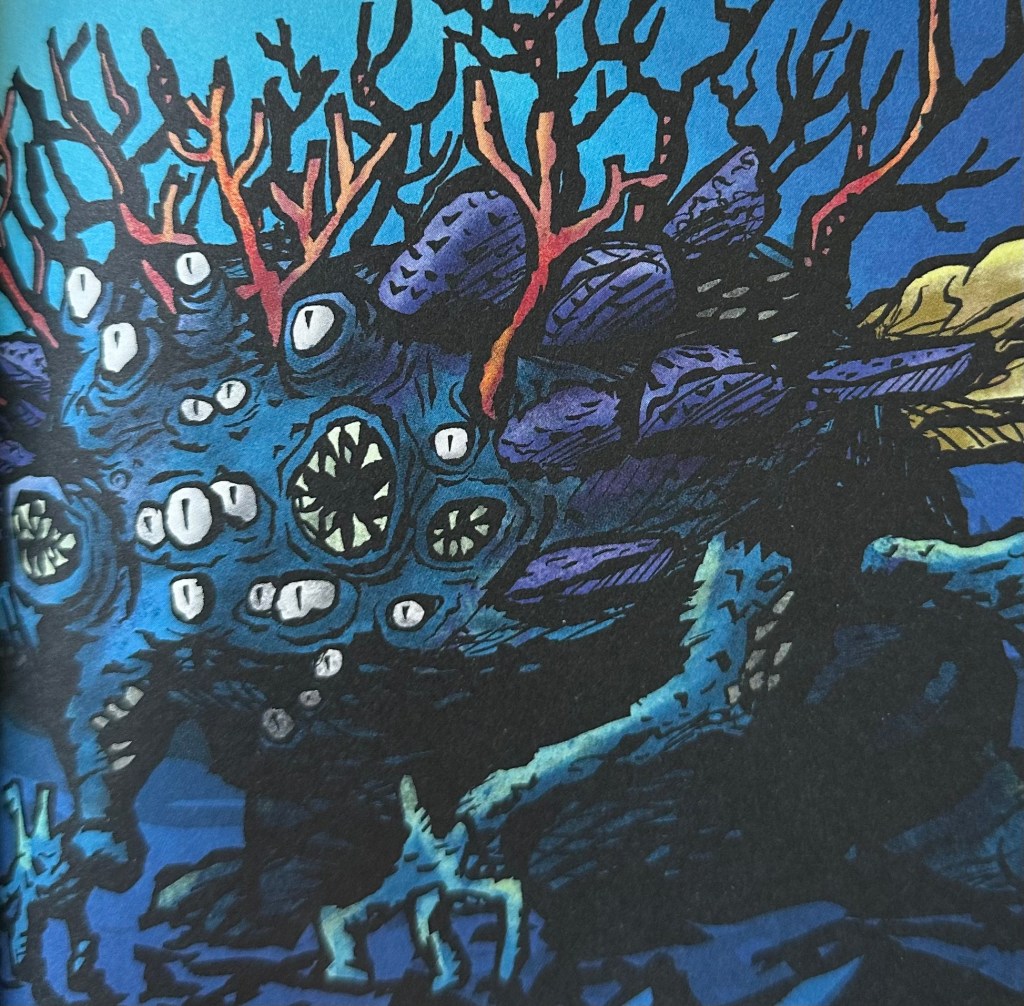
After they escaped that fight, we did a smash cut to them rowing ashore, greeting the resurrected Eliza and then to the carved door of a lost temple in the jungles of Black Coral Bay. That’s the island presented in the core Pirate Borg book as a place to start your adventures. I took three of the dungeons (Shrine of the Nameless Skull, Sanctum of Nameless Blood and the Lake of the Nameless One, which are all a part of the larger Temple of the Nameless One but are distinct nonetheless) described in the book and used those for the one-shot. It might seem counterintuitive to use three dungeons where one would have been more than enough for a one-shot, but, for the Pirates of the Caribbean type theme and for the satisfaction it would bring, I thought it was important. So, I did the first dungeon entirely in montage, finally describing how the PCs figured out the way through the temple door and let play begin there. For, the second dungeon I took out all but two main rooms, putting several major items and encounters into those rooms instead. The third dungeon, I left in its entirety and I’m glad I did because it had so many cool moments. These were topped off with a bunch of curses handed out by an ancient golden idol in the hold of a sunken Spanish galleon in an underground lake, the skeletons regaining their flesh, and All Bones McKeown being eaten by the giant Cthulhoid monster from the home-dimension of Jolly Roger. The survivors escaped through a maze of flooded underground tunnels and emerged into the creepy and atmospheric Black Coral Reef.

I loved it. It was a very good time and I think the players liked it too. One of them announced that they would happily play a full campaign of Pirate Borg, in fact. Their roleplaying was fantastic, because, as game designer and mutual on Instagram, sean_f_smith recently commented on one of my posts “everyone knows how to play a pirate.” I was worried about the strangeness of the PCs at the start, but the madcap elements introduced by their weirdo characters only heightened the atmosphere. Add in some pirate tunes and a few glasses of grog and we had a whale of a time. 10/10, might just go back to it before next Talk Like a Pirate Day.

Bilbo and Frodo’s Birthday

Did you know that it was Bilbo and Frodo’s birthday on September 22nd? The Bagginses of Bag End? Well, I didn’t. Not until the day before at least (although, I’m sure a younger me would have known it.) Anyway, I got in the Discord for Tables and Tales, our local TTRPG community and requested a Lord of the Rings flavoured game. It was incredibly short notice but our resident Tolkienite, Isaac of Lost Path Publishing did not shirk. He suggested a one-shot of a scenario that came in the core rules of The One Ring 2E from Free League. In no time at all we had swords, bows and axes being proferred in the comments and a full fellowship was formed.

In fact, we had five players and Isaac in total so it was a very fun table. We started off, on the night, with a spot of light character creation. Now, you need a bit of time for this in The One Ring. It’s not as time-consuming as D&D 5E character creation but it’s somewhat more involved, than say, Pirate Borg. Even then, with Pirate Borg, we had plenty of prep time and we had all met for a session 0 online a few days before so everyone had their characters ready to go. Since I had given Isaac only a single night to pull this together, (sorry Isaac) we had to include it in the session. By this point, we already knew this was going to take longer than one night to get through but we were all alright with that.

Actually, by the time we all had out characters ready we still had plenty of time to get into “the Star of the Mist.” The scenario began with our Player Heroes meeting Gandalf in the Prancing Pony! How my nerdy heart swooned! Isaac, producing an Oscar worthy performance as Ian McKellen as the old wizard, sent us off on a quest into southern Eriador where some folk had been going missing.

Our party consisted of two Dwarves of the Lonely Mountain, one of which was played by me. I said I was going to go full Nesbitt (as in Jimmy who played Bofur in the Hobbit movies) But I think I was more Belfast than that in the end. My guy is Frár, the Champion. The other dwarf is Berfa, a Treasure Hunter. We have a second Treasure Hunter, Porro, one of our two Hobbits. The second Hobbit is, Rollo, a Messenger and finally, our Barding, Dagstan, is a Warden. We set off into the wilds to find the source of the trouble and we managed to get a fair way into the scenario despite our time constraints. I don’t want to give anything away but it has Dwarves ruins, monsters in the water and a mysterious “she” who has so far remained unnamed. That’s a trio of Tolkien ticks right there.

As I said to the rest of the players, this session was special to me. It felt like the realisation of the dream of Tables and Tales; the ability to get a game together at a day’s notice for people to enjoy and to celebrate an important occasion, Bilbo’s onehundredandeleventh birthday!

I’m so looking forward to continuing this adventure. It had been a long time since any of us had played the system so there was a fair amount of scrabbling through the book for rules by all concerned. I feel like next time, we’ll know what we’re doing a lot better and, from recent experience, I find Free League games to pretty intuitive once you grasp the basics.

Other festivities

These are just the latest games played with a particular non-standard festival in mind. On May the Fourth, we played a Never Tell Me the Odds one-shot set during the events of Star Wars Episode Four, A New Hope. The PCs had to infiltrate the Death Star to rescue a certain Princess before the storm troopers got them, or indeed, before anyone else could rescue her!

Obviously, we are coming into the season for horror and spooky games as Halloween approaches. This is one holiday I can get behind. There are so many games that could suit this season that I am excited to start coming up with a few ideas.

How about you, dear reader, are there any occasions, events or holidays that you like to mark with a festive game? Let me know in the comments!

The Apprentice, Chapter 7

Making friends

Our protagonist is not, perhaps, the most gregarious of characters. He is bookish and strange and somewhat obsessive. But we all need a friend sometimes, don’t we? In today’s chapter, Maryk attempts to cement a new friendship with a little light alchemy. Should go fine.

Chapter 7: The Happiest Time of My Life

The two years I was apprenticed to Master Gedholdt were the happiest of my life. I treasured, still, the memories of my self-teaching on the farm but they were soon eclipsed when the true nature of my studies in the house of the sage became clear to me. I had had no inkling the real potential of magic. But I learned; I absorbed it like a soft white bread absorbs the honey spread over it. I had mastered the twenty four basic runes used in the writing of magic spells and the two hundred and eighty eight compound runes derived from each of them within the first six months, purely through my own studies. These continued night and day unless I was occupied in cleaning up after my master, eating or socialising with friends (left to my own devices, I would have forgone human contact in favour of books but Master Gedholdt insisted, “Magic can make you powerful and knowledge can make you wise but if you have no-one with whom to share these gifts, what is the purpose? Learning for the sake of knowledge, alone, is worse than pointless; it is a waste of a fine mind.” I did not understand this point of view. I thought that knowledge would allow me to help people whether they were aware of it or not. All I needed was to trust my own judgement, and certainly I did that, more so than anybody else’s.) By the end of the first year I could read and even write basic spells. Master Gedholdt would not allow me to cast even the most elementary of cantrips, however (I was sure I was more than capable and only the esteem in which I held my Master stayed my hand.) Six months after that the written Fomorin language gave up the last of its secrets to me. Though Master Gedholdt forbade me from studying the great tome which had brought the two of us together, the title of which, “Dansh no Tikka, Ekktu Nakkori,” I was now capable of translating as “The Emperor’s Libram, Royal Magic.”

In the six months that followed, I finally realised my ambition to cast real magical spells. I watched my Master cast a simple illumination spell one day after I had finished the chores he had set for me. He did it, he said, because the oil lamps were too dim for reading in the evenings, but he looked at me pointedly when he did it. I watched the choreography of hands and feet and listened carefully to the exact tone and inflection of each syllable as he spun the spell a second time. “Now, Apprentice, perhaps if you could master this trifle, it would save me the bother of having to do it for myself in the future,” he said as if setting me yet another chore. With that, he turned away and walked into the kitchen, claiming to have left his spectacles there (even though I had clearly seen them resting on top of his head.) It disappointed me a little when I realised that he had left, not to save me embarrassment if it did not work but to save his own eyesight if it worked too well. I duplicated my Master’s spell exactly and produced in the air above my head a sphere, perhaps two inches in diameter, glowing with a soft, creamy light, the like of which could never be produced by a flame. When Master Gedholdt realised it was safe, he re-entered the room and said, “Good. Not a bad little light. Perhaps next time you can make one that doesn’t follow you around, eh?”

After the Light spell I perfected the casting of many relatively risk free, minor spells: Simple Levitation; Munch’s Floating Hand; Warm; Animate Minor Object; Read; Throw Voice; Clean; Minor Umbrella and too many others to list here without your gracious patience being tested to its limits. I was a Magician. The type of magic I learned could often have been reproduced by a talented illusionist or charlatan. Still, I felt a suffusion of wonder at my own achievements. My Master informed me that, as a rule, practitioners spent the first six years of study simply amassing the knowledge required to sufficiently control the power that was to be theirs. “It seems that you came to me almost prepared for it, however. You knew instinctively the balance between delicacy and power and will be required to channel the thaumaturgical currents responsible for the acts of which we are capable. It is a rare gift. That is why I have allowed you to progress to the more practical level of study that you are now mastering.” He kept a much closer eye on my activities, after that, though, and he expressly forbade me to perform any magic outside the confines of his house. “Folk would not understand if they witnessed it. We keep our more arcane abilities an open secret so that people can ignore it if they choose and make use of our services if they wish. Be discreet.” I obeyed this order almost always. Occasionally, when I sat, exiled from the Land of Nod in my tiny laboratory I would conjure a Light to replace the smelly, flickering oil lamp but I never demonstrated my new found abilities in the presence of anyone else.

Meanwhile, my friendships developed with some of the other local children. To be honest, when I first attempted to cultivate relationships with them, it seemed like a waste of time. And yet, I soon discovered that it was good to have friends and confidantes. I told them nothing of my real studies of course but I revealed just enough of the exotic truth to whet their appetites for more of my company. One lad, in particular, sought me out as often as he could. His name was Hindryk Scheimatzi. He was the shoemaker’s son so he lived next door, right above his father’s shop. He had obviously earned the nickname, “Cobbles,” by virtue of his father’s noble profession. He enjoyed being called by this alias. Apparently it denoted some degree of intimacy between acquaintances. Cobbles was not a person of any special intelligence nor was he a dullard; in fact he was very funny. He loved to entertain me with his japes and acrobatics. His particular favourite trick was to run directly at a wall and then backflip off of it. It was impressive but difficult and dangerous so he saved that one until he was sure he was in full view of a gaggle of school girls or sometimes even young mothers. He was not fussy, as long as they were of the opposite sex and paying him attention. I was still quite young when he started this, just eleven years of age, and I had yet to develop an interest in the female of the species. Cobbles, though, was several years older (in fact, he was the same age as my sister) he even sported a wispy moustache, of which I liked to make fun but was secretly jealous.

Cobbles worshipped me, he came looking for me before I went to Master Gedholdt’s house every morning and met me outside his front door. Why? You might well ask. I was a diminutive, bookish young lad, who was developing a pallor comparable only to that of his Master. Cobbles, in contrast, was five years older than me, tall, athletic and moustachioed. The answer, of course, is that he befriended me to get closer to my sister. Still, there was mutual advantage in our friendship. For me, Cobbles kept the rest of the town’s youths off my back when I was clearly a prime target for them. For him, I provided a very good reason to spend time around Pretty Primula and to garner a great deal of advice on the likes and dislikes of my sister.

A budding relationship between the two of them, I felt, was of use to me. If it worked out, it would be handy to have someone like Cobbles around me in the future. I had once been robust and even strong but my muscle was wasting away, I assumed because of my constant studies and lack of healthy exercise. I was wrong about the reason for it of course but nevertheless, I knew that I would be requiring the services of a strapping lad as my physical powers waned.

There was a problem, of course; my stubborn sister. Her refusals of Cobbles’ affections became embarrassing even to me and his clumsy, slipshod advances made me cringe. For example, one evening Primmy was returning from her day’s work where she had clearly been beaten again. Her cheeks were plum with blood and bruise and she was wearing her hair as a veil in an attempt to disguise it. She encountered us in Saint Frackas’ Square where Cobbles was doing handstands on the edge of the old fountain while I watched from our front doorway in an attempt to stave of the encroaching cold. At the very scent of Primula (she had the constant, if not exactly unpleasant odour of soap about her) he launched himself off his perch and performed a backflip to come to a landing directly in her path. Primula had not noticed his acrobatic feats but was startled to find Cobbles blocking her way. She looked up and spoiled the curtain effect of her locks. She was smiling her big, dumb smile as usual but she reached up to cover her cheeks with her hands. This is what Cobbles said:
“Oh no! You don’t need to cover you face, that colour in your cheeks makes you look pretty.”
The perpetual smile dropped to a momentary scowl before she pushed past him, saying, “Hindryk, You don’t know how to talk to a girl!” I could not have uttered the sentence any more succinctly myself. She was upset with him from that point on. His pathetic, crushed expression was spelling disaster for my plans to keep him around. I had to do something more direct to help this potential relationship to flourish for it could most certainly not be left in the hands of the erstwhile Prince Charming.

Now, Master Gedholdt had forbidden me from using magical spells anywhere outside his house and I did not want to jeopardise the days of contentment and learning which I so treasured by committing that most cardinal of sins. You have already guessed it, no doubt: I would have no choice but to write some lines for Cobbles to use to win the heart of my sister and perhaps some simple verses of love poetry for him to recite outside her window of an evening to woo her and show her how much he cared…Absurd! I was no poet, though I could write a pleasant enough passage of prose, I do not think it is the sort of thing one’s lover would appreciate read aloud to them to fill them with desire, no. I decided instead to return to the teachings of my old Mistress, one of her stocks in trade, The Love Potion. My current Master knew nothing of my former alchemies so could not forbid it. Even if he had known, I do not feel that he would have had the right to prevent me from practicing this particular art.

My plan presented several difficulties. Firstly, the ingredients for a real Love Potion were expensive and difficult to track down. The potion Burnt Aggie used to pawn off on her unfortunate customers was not merely inferior quality. In fact, it produced an effect which no-one particularly wants in a lover (or at least I assume so, I am not what one might term experienced in these matters,) uncontrollable flatulence. Saint Valentzi’s Day in Pitch Springs was rivalled only by market day in the intensity of the odour infusing the town (although things had changed considerably in the years since the murderous harridan had burnt to the ground with her hut.) I was certain that my new recipe would achieve the desired results without any appreciable side effects. I would have to recruit Cobbles into my plan to procure the ingredients. I was reluctant to do this as Master Gedholdt had told me never to make my abilities known to others if it was avoidable but I felt I could trust Cobbles and I wanted him to trust me completely too. Of course, when I told him my intentions, he leapt at the opportunity and offered to use his own money to pay for the herbs, booze and gold needed for it. This was the greatest risk I had taken since I first went to spy on that contemptible sow, Aggie, when I thought there was a very good chance she might like me for dinner and possibly dessert too. I considered it very carefully. I compared both of those situations and decided that the Old Aggie business had gone about as well as it could have despite having ended up with her resembling an overcooked lamb joint. Of course, I was only interested in how things had turned out for me, not for her, and for me the results of my association with her had been overwhelmingly positive. I weighed the risks and came to the decision that it would be riskier for me in the long run if I were not to bring Cobbles into my confidence.

One Friday evening when I had finished some magical cleaning chores for the day in Master Gedholdt’s house. As I was leaving I spotted Cobbles climbing a tree in the Lord Belintzi Memorial Gardens. I walked over to the tree and looked up at him as he hung upside-down from a sturdy branch and told him, “I am an alchemist and I am going to make you a Love Potion so you can woo Primula.” He tumbled from the bough and broke the middle finger of his left hand.

Here is a list of the ingredients required to craft Maryk’s Love Potion:

  • The roasted heart of a rabbit
  • A leaf of gold
  • Essence of lover’s tears
  • The egg of a storm gannett (yolk only required)
  • A ring of silver
  • A sprig of honeyleaf
  • Four gooseberries
  • A single hair from the would-be lover’s head
  • A quart of Pitch Springs water

You can, perhaps, see why I needed the help of one somewhat more able-bodied than myself to obtain some of these items. I had made one of these potions only once before and that was when I had access to the well-stocked and arcane larder of Abominable Aggie. I had never had to think about where one would have to go to find the egg of a storm gannett, what one would have to do to retrieve the lover’s tears from which I could derive an essence. The most unattainable of all, of course, was the leaf of gold. I did not have money, Cobbles did not have money and I knew no-one to borrow it from who would not ask uncomfortable questions as to its necessity. I was going to bring up all of these issues with Cobbles before handing him the list. We were sitting on the fountain steps in our square where I had told him I would give him the list. He was looking at me with an hint of wonder, a hint of fear and a hint of anxious expectation. “Just give me the list, Maryk, don’t you worry about what’s on it. Whatever it is, I’ll get it, just you see. For Primmy, I’ll get it.” So, I handed it to him, saying simply, “Get me the lovers’ tears and I’ll distill them.” He nodded then asked hesitantly, “Which one’s honeyleaf, again?” I smiled and watched him cringe (I had become gaunt as a scarecrow and my teeth were beginning to yellow noticeably. I was starting to think my growing list of physical abnormalities had more to do with Aggie and her curse than my propensity to study indoors.) “I’ll show you the right herb. By the way, if you have to do…anything…anything to get some of those ingredients…don’t tell me about it, eh?” And he didn’t.

He brought each item to me as he came into them. Surprisingly, he brought me the tears first. I asked him how he obtained them so quickly.
“Kitten,” he said with a shrug as if the explanation were somehow obvious and I was to wave my hand at him and say, “Oh, Kitten! Of course. Why did I even ask?” Instead, I peered at him for a brief moment before finally asking, “Kitten..?”
“You don’t know her? She’s one of the whores that work over in front of the garrison most nights, you might have seen her there.” In truth, Cobbles often forgot about our age difference. “She was in school with me till a few years ago. Kitten’s not her real name, you know. She’s really called Hochti. You can see why she doesn’t go by that, rea-“
“I don’t need a whore’s entire biography, Cobbles,” I interrupted.
“‘Course you don’t. Anyway, she said she had this regular fella who always cries after they do the thing.” I laughed as I knew Cobbles would expect that.
“Let me guess. Was it because he loved her so dearly and could not have her to himself?”
“How did you…you really are clever, Maryk, you really are.” I said nothing, simply basked in his lightly won admiration. “Anyway, I gave her a couple of coins to purloin some of these tears and there we go. Nothing untoward or even unlawful really. He paid her for her time and so did I in a way.”

I told him he’d done well and then dismissed him. It was very late and I had to get the tears to my attic laboratory before too many of them evaporated. I thought about the man Cobbles told me of. He was so in love with a whore that he tortured himself by going to visit her regularly. He probably spent all his earnings on his visits, for which she cared nothing at all. He wept like a rejected schoolgirl because he knew he could have her as often as he could afford but she would never want to have him. Why would someone subject themselves to such base indignities in the name of an indefinable emotion that has only served to cause strife and mental anguish, wars and bar brawls and murder and tears? Songs compare the feeling to magic. Well, I had never experienced love but the feeling of magic, that was unlike all others. The stomach plunging of fear, the volcano of hate, the sweet nothing of happiness, all dull and distant compared to the emotion of magic. That was molten gold running in your veins and clouds lifted from your eyes and a light of such intensity and vitality that you are sure it could never go out of your mind until it does and you are reduced again to the status of animal and base human.

I completed the extraction of the essence of emotion from the tears and went to bed to lie down for an hour before dawn.
The next day I spoke to Master Gedholdt of the love my friend, Hindryk bore for my sister and how she did not reciprocate.
“It may surprise you to learn, Maryk my lad, that I myself, have never been much of a ladies’ man (is that the term?)” I feigned shock, he saw through my inept play-acting. “It’s alright, really. I expect that the time is now past for me, though I do still think of, well, of, uhm, of taking a wife, shall we say. Yes, I still think of it often. As you have seen, however, I do not often have the opportunity to meet other folk. My studies and my work occupy my time most exclusively. I have my regrets, Maryk. You do not have to have the same sort. You are still a little young, I know but you should never neglect that side of life. My father once told me that the love of a good woman is what truly makes a man. Of course this was before he was tried and imprisoned for attempting to actually make a man from the parts of others. Hopelessly insane, of course, Old Papa.” He continued talking about his family and the various insanities, obsessions and mental misbalancings which defined them for some time. Continuing to consider his words of advice about women, I did my chores, half listening to his stories, all of which I had heard many times before. Do not think this disrespectful; on the contrary, I had nothing but the utmost respect for my Master and his opinions and advice but I felt the advice was more like a library: there to be picked and chosen from rather than read from A to Z.

That evening Cobbles and I met again. He brought most of the rest of the ingredients I needed for the potion: the roasted rabbit heart, the leaf of gold (borrowed from the gilded cover of a book in the Master’s Library in the school), the silver ring (I did not ask), the honeyleaf sprig (he was able to find some of the potent herb in the mouth of an old mine shaft near the quarry) and the four gooseberries which were actually quite difficult to find as they were out of season (I would make do with dried ones, I told him.) The last item he revealed was a thing of real beauty, the egg of a storm gannett. It’s shell glistened in the light of the oil lamps on the square. It had a lustre like mother of pearl and the colour of an oil spill on the surface of a deep pool of still water and wherever the light struck it, it seemed to leave a lightning strike.
“I’m going to crack this open and use only the yolk!” I said.
“Tomorrow, I’ll fetch you the quart of Pitch Springs water and you will make me my Love Potion. Maryk, I’ll never be able to repay you for this,” said Cobbles.
“Don’t you worry about the payment, Cobb, just leave that to me,” I answered.

Case Closed

The suspects

I finished up two investigative scenarios in the last week or so. The experiences could not have been more different. I was the GM for one and a player in the other. They were in very different genres and systems too. I am going to have a go at dissecting them and trying to compare them, nonetheless.

D&D 5E – An Unexpected Wedding Invitation

I wrote a little about this short campaign here. At the time I wrote that, I didn’t even know it was a murder mystery, to be honest. It is a published, third-party 5E scenario so I could have looked it up, but I avoided reading anything about it online. Our wonderful DM was also the consummate host and was always wonderfully welcoming. She was a great DM too. We met in person over the space of eight sessions, more-or-less every two weeks. Our DM, who has run this scenario more than once previously, informed us afterwards that we took far longer to get through the scenario than other groups. Personally, I think that’s probably because of a couple of very important factors. Firstly, we had a fairly large group, five players and the DM. But, I think the second factor is what really pushed it so far beyond the normal length for the scenario. We were all chewing the scenery at every available opportunity. This group of players does not shy away from the first person, expansive, full-chested role-playing and it honestly does my withered heart good to see it every time we get together. We all had reasons for going ham as well. There was the promise of romance and, failing that, friendship. The possibility for court intrigue and drama was there as well. But, certain sections of the table were there to get their kisses in (in the infamous words of Lou Wilson.) The mystery was almost secondary to those folks.

As for the mystery itself; I won’t go into details. No spoilers except to say that there is a murder and we were not aware of that aspect going in. I don’t know if the DM advice is to keep that from the players until it happens but that was the case for us. Anyway, that was quite exciting actually. To discover there was an actual crime to figure out gave us all a shot in the arm! Up until then we had been essentially casing the wedding for curses and harassing the guests with weird, cryptic questions about the nature of one family’s bad luck. So, when we had a specific thing to investigate, it filled us with the sort of motivation that, I feel, the scenario failed to provide up to that point.

As for the investigation itself, it’s all about the NPCs in this adventure. That seems appropriate for a mystery game and this particular scenario was replete with well drawn NPCs who had distinct personalities, motivations, idiosyncrasies and voices (provided quite expertly by our DM.) You have the bride and groom, of course but you also have a cast of characters drawn mainly from the families on both sides. There are several set-piece scenes that are designed to allow the PCs to get to know the cast and our DM graciously provided us with portraits for all the main NPCs, hanging them on her DM screen. This was very helpful as there were a lot of them and without that constant visual aid, it would have been much harder to keep track. Our interactions with the NPCs seemed to give us positive or negative standing with them, leading to later conversations being more or less difficult for us.

The setting was integral, of course. An opulent country manse belonging to one of the families involved, surrounded by a generous estate on which they enjoyed hunting and picnicking. The adventure provided a couple of maps; more for reference than anything else as there was not a fight to be had at this affair.

As I said, I am not going into spoilers here about the murder, the suspects or the ending but there are a few things I can say. It seems as though the adventure comes with several prepared possible endings. The actions of the players, their standing with the major NPCs and their final pronouncement of who they figure did the murder all seemed to have an effect on that. This served to give it a slightly video-gamey feel, which was neither good nor bad but certainly leant a lot to the idea that everything was laid out in the adventure quite prescriptively.

Speaking of which, the actions of the PCs throughout felt a little restricted. This was purely a result of playing D&D 5E characters in a genre they were never meant to exist in. Few of our powers or abilities were of much use in this milieu and that felt a little frustrating at times.

Equally, there were several timed events that could not be prevented or changed in any real way by the PCs. Once again, this had the effect of making us feel more like spectators than active participants.

Questioning the NPCs, the most important part of the scenario, by far, and the only one where you could make inroads in your romantic or duelling ambitions, was difficult to say the least. Pretty much all of them could have done it, to be honest. That, by itself, is ok, but failing certain rolls here and there made the process feel fruitless at times. Without some mechanic to allow you to fail forward, it was always going to feel like this.

In the end, we failed to catch the killer. We fingered the wrong guy for the crime. This was due, in large part, to us interacting less with the killer than we might have, failing s couple of clutch rolls in interacting with them and the fact that we were left with too many potential culprits at the end that we couldn’t whittle down further with the evidence we had. Our failure was revealed to us in a sort of cut-scene right at the end. After all the effort we had put in, this felt like losing even though we had all enjoyed playing together around the table. The overall consensus from the players was that 5E was not the system for this scenario. It is not built for this sort of investigation and it led to an unsatisfying feeling from the result of the game even if we had a good time playing together, as we always do.

Blade Runner, Electric Dreams

Two blade runners posing like neon noir heroes in front of a stylised Wallace Corp ziggurat beneath the title of the Blade Runner Role Playing Game.
A photo of the front of my copy of the Blade Runner Start Set box.

I wrote a little about this game here while we were still playing it. At the time of writing that, we were only two sessions in and I was greatly looking forward to the next one. There were two players, playing Detective Novak and Fenna. We did this online, using Zoom and Roll20. It took five sessions of two and a half to three hours each. Having checked out other groups’ experiences with the same case file, I can say that’s about average. I could absolutely see it taking both less or more time since it would be dependent on how quickly the blade runners discover the key clues and how quickly they act.

Electric Dreams is also a pre-written scenario but, I think, importantly, it was produced by Free League as the intro to the Blade Runner RPG. There was never going to be a mismatch of scenario and system like we saw in An Unexpected Wedding Invitation. In fact, it felt as though this scenario was close to perfectly designed to bring players into the world and the system at the same time.

If you are a Blade Runner fan but not familiar with the Year Zero engine or RPGs in general, its got elements from the movies for you to geek out over and allow you to feel part of the megacity of LA by referencing the media you know and love. Meanwhile, it holds your hand through the early interactions with the mechanics, kicking things off with a few basic Observation and Manipulation rolls, teaching you that the more successes you get on your dice rolls, the better the result. As time goes on, the references to the movies remain strong, keeping the whole thing feeling like a natural continuation of or bridge between those stories and establishing a consistent and immersive tone and atmosphere. But you get more and more in-depth interactions with the rules as it introduces you to chase mechanics, combat, use of more complicated investigative techniques and character advancement.

And if you are an old hand at Free League’s signature rules engine, you will be good to go from the start. I was somewhere in between when we started playing. I am a big fan of Blade Runner and I have run Tales from the Loop before so I knew how the system worked well enough. But it was a long time since I had played it and I definitely had to look some rules up in play. This was generally fine, and didn’t take too long. What we also found, was that, once we looked up those rules once, we grokked them and didn’t have to keep referring to the rulebook, which was a refreshing change of pace for a group of players who have mainly only played D&D 5E together before (at least in recent years.)

Now, down to the scenario itself. As with the Wedding mystery, this was largely based around really well drawn NPCs, all of whom were potentially important to the plot. But, from the start, it felt as though the PCs knew who their main suspect was. They were rarely dissuaded from that notion, despite (or perhaps because of) the powers-that-be forcefully reminding them about the way they would like to see the investigation go. Since the characters were playing blade runners, cops in the LAPD, there were a number of NPCs that were there purely to back them up or chivvy them along. You had Coco, the medical examiner (who you also meet in Blade Runner 2049) and Deputy Chief Holden (who got his chest punctured in an interaction with Leon the replicant in Blade Runner) as well as any number of ad-libbed beat cops and the AI LAPD Despatch. The Wallace Corp is represented by one of their replicant executives who was immense fun to play. You also had a few NPCs that were witnesses and were never going to be anything but witnesses. The investigation was not designed to send the detectives off on the wrong path. There was no more than one red herring and that was there more to reinforce a theme than as a real way of derailing things.

What we found was that most of the sessions involved them trying to track the one suspect and discover their motivations and whereabouts. This led them into a web of corporate intrigue and moral dilemmas. That’s what Blade Runner should be about, of course, and Free League nailed that. The PCs were able to use the abilities of their pregenerated characters to do that pretty well. In fact, I would say that they were implausibly successful most of the time. On a couple of occasions they rolled so well that I felt compelled to reward them with information that would not, otherwise, have come up until later in the investigation. Moments like these allowed them to make incredibly effective leaps. What I liked about this scenario is that it allowed for that. There is a timeline of events that will happen at particular points of the investigation, but only if the PCs do nothing to prevent them. So, that doesn’t stop you moving them two steps forward, instead of the usual one. I think it actually encourages that sort of thing, in fact, as the timed events are generally pretty bad for the investigators or the other major characters.

We got an ending that was equal parts satisfying and open-ended, with the PCs making the moral, rather than the legal choice after the corporation took the law into its own hands one too many times. We might return to Novak and Fenna someday, maybe in the next published case file, Fiery Angels. The first one ran so well that I would definitely be confident to play the next one.

Conclusion

It is almost unfair to compare these two games, but it has been impossible for me to do anything else. In blade runner, you had a scenario where any outcome the PCs reached was likely to be satisfying and a system that supported the sort of game you were playing, investigative, character driven and darkly themed. In the other, the scenario felt a little too restrictive and was hampered further by a system that was never designed to support the investigative nature or the regency feel. I had fun with both, but I know where I would turn first if someone asked to play a mystery game.

The Apprentice, Chapter 6

Time

I don’t have any this week. Had to cancel D&D this evening and all! So, here is the next chapter of the Apprentice. Enjoy!

Chapter 6: Gedholdt the Sage

A year passed. I continued to attend the classes of Mr Schpugelmann, irregularly at least. I assisted Mrs Blanintzi in the running of our small household and I did not sleep. For this last I discovered a solution, at least. Not a sleeping draft as you might imagine (such potions are unreliable, at best, and highly addictive at worst) but an infusion which allowed me to resist the ill effects of sleeping little or not at all. No-one suspected that I spent most of the nighttime hours experimenting in my attic laboratory or writing in my journals.

One winter’s day, while out wandering the town, avoiding school, I spied a man I had never seen before. His appearance was striking. His hair was brown and red but turning grey in streaks and he sported a beard which had never experienced the pleasure of being introduced to a comb. His spectacles were so thick that the precise colour of his eyes was not perceptible. He wore a long brown coat punctuated with burn marks and curiously coloured stains and a pair of boots, the soles of which stayed in place, presumably, through the power of wishful thinking alone. Most notably, however, he bore a book; an enormous tome at least two feet long and five inches thick. In fact, he was having some trouble with it, it was so large. The book was flattened against his scrawny chest and he was supporting it with two hands by its spine underneath. I did not know his destination but I would have been surprised to see him make it. This, I took to be an opportunity. Even though, as I indicated previously, my stature was not great, I had spent most of my life to that point as an unpaid farmhand so my arms and back were strong. I jinked across the muddy street, avoiding dung and carriages and hoisted up the left hand side of the great book, smiling up at the scraggly man.

“What do you think you are doing, you little urchin? What do you want with a libram like this? Let go, you diminutive beast!” He cried. There were folks watching and laughing. I laughed too, and answered with, “You misunderstand, Master. I wish only to assist you with the burden of knowledge you bear! Please, Wise Master, allow me the pleasure of helping you.” “Oh, well, perhaps you’re not the scallywag I took you for. Very well, you may continue to hold your side of the “burden of knowledge,” ha! Very droll!” He laughed and so did I.

Arriving at his home he bid me enter. I considered this a formality since he would not have managed the three steps up to his front door on his own with the titanic tome but I said nothing except, “How gracious, Master. I would be honoured.” We shuffled up the steps with some difficulty and two breaks for him to rest and one for him to unlock the Iron bound, thick oak front door. The house was a large, two storey affair, made solidly of granite bricks and long wooden beams. It stood on the edge of the town’s only park, a postage stamp of greenery (mostly weeds) grandly called the Lord Belintzi Memorial Garden and in between the town’s garrison and a blacksmith by the unlikely name of Smitzi. It was a handsome place in a respectable part of town. Inside was a different matter.
Likening the inside of this man’s home to a cave was to be ungenerous to caves and accurate only in the aspect of light and the lack thereof. Comparing it to a library would, perhaps have been more useful but libraries, I was led to believe, had a great deal of order to them whereas the books, papers and leaflets which occupied the lion’s share of space in the house’s interior appeared to do so in a manner that was totally random and inconsiderate of household appropriateness.

“Bring the book over here to the desk,” I followed him, though I could not find the desk he spoke of amongst the general disarray. He momentarily released one hand from its duty holding the book and used it to sweep away a pair of long unrolled scrolls which had contrived to hide the aforementioned desk beneath themselves. A space finally prepared for it, we slid the tome, spine first, up onto the desk and both sighed a long relieved breath. “You must have a cup of tea to revive you after your efforts and by way of thanks. I’m certain I would not have been capable of hefting this monstrous thing all the way home alone.” He exited through a door in the north wall and presently began clattering in the other room. Finally alone with the book I peered through the gloom at the title, written delicately in gold along the spine, and found I could not read it. “Master,” I called. “What is this book? I cannot read its title.” Poking his head back through the doorway he asked, “You can read?” “Of course, Master,” I answered. He shook his head and walked off, muttering into the kitchen again.

He returned momentarily after a kettle’s whistle and the rattle of cups and tray being readied. He served me tea at a table wholly covered in tiny notes which were, in turn, covered in words in a language I did not know. This was the second time in five minutes that I had encountered writing in a foreign tongue and the second time in my life. It was a revelation to me. There was so much to know just in the language I had been born to, but considering all the many languages of the world, there must be just as much to learn from books written in their scripts too. I was fascinated and I asked him about it. “How many languages do you know, Master…?” “You may call me Master Gedholdt. They call me Gedholdt the Sage in this town though so few of the townsfolk ever come seeking my “sage advice” that you would wonder why. I know ten different languages and perhaps thirty different dialects within those. Most of the work I perform in the town is translation; mercantile contracts; letters from abroad; diplomatic missives, that sort of thing. Not my only work, though, no, no, no.” I held my tongue. I could already see that this reclusive, intelligent man would need no prodding to let me in on the secret of his “other” work. Frankly, he could not wait to tell and had been waiting for just such an opportunity to talk to a like-minded individual about it, even if he was a short-arsed eleven-year-old boy. “I work most often for the garrison. They often need my assistance in matters martial and strategic. Though, they have asked me to keep my involvement with them secret I feel that I have no reason to mistrust you, my young scallywag, eh?” “Of course, Master. And it’s Maryk by the way.” “Young Maryk, of course. Well, Maryk, I can see things at a great distance in my mind’s eye through the application of magical spells…” with this he paused and peered at me as though challenging me to refute his preposterous claims. I did no such thing of course. “…and I have the ability to direct troops on the field of battle with no more than a thought. Such powers and more have I gleaned from the ancient writings of the lost Fomorin people whose empire once spanned the continent and was based entirely on the mastery of the magical arts. Theirs is not an easy language to master, not least because it is a dead one but also because of its arcane writing system which requires of the reader an understanding of the magical arts. It is like trying to read sheet music without the benefit of knowledge of musical notation. Impossible.” He sipped his steaming black tea and scrutinised me over his glasses for a moment. “Could you…I mean, excuse the impertinence, Master Gedholdt, but would you teach someone this Fomoron tongue?” I dipped my toe in the water with this question. “You have the look of knowledge-hunger in your eyes, alright. I knew it. I am not surprised by your question. I could be persuaded to impart my years of experience and wisdom to you, young Maryk, but there would be a price…” He arose from his seat, still grasping his teacup, and walked into the centre of the room. I turned in my chair to follow his movements. What might he demand of me? I tried not to think of the possibilities. “I need a… perhaps valet would be the best way to describe the position I have in mind.” He indicated with his teacup, the whole room and inferred the apocalyptic mess. I was to be his cleaner, of course. Valet, ha! “In return, I would be willing to apprentice you. But only…only with the express written consent of your parents.”

Damn. “My parents, Master Gedholdt…are no longer with us.” A technical white lie, at worst. “Indeed? An orphan are you? Well, then, who is your guardian? It is important to me that your presence here is sanctioned by the appropriate adult. You do have one? You certainly don’t have the air of one of those beastly street urchins who congregate in the market square.” “No, Master, not a street urchin. I have a governess. Perhaps she can provide the permission you require,” said I. “Indeed, there we have it. Return tomorrow with a note of permission. I will know if it is a forgery,” he pointed at me. I looked left and right and finally just nodded. “Off you go, then. I have work to do and you must leave. Goodbye.” With that, I was dismissed. I thought about protesting and telling him that as long as I was already there, I might as well make a start on the tidying but he had already been swallowed by an archway in the west wall, his mind made up.

It seemed there was no way around this. If he could, as he insisted, tell a forgery from the genuine article and I did try it anyway Gedholdt would never take me on as an apprentice and apprenticing to him was the only possible way I could advance my knowledge of the magical arts and escape the drudgery of Pitch Springs Elementary School for Boys. There was no way that Mrs Blanintzi would allow it, however. She wanted for me nothing more adventurous than a solid career in the bank or possibly the town hall. A life in leadership held some appeal to me, even at that early age and I thought that perhaps I could make a difference in the lives of everyday people in the town and the countryside if provided the opportunity, but I was driven to learn all I could about the magical arts. In comparison, taxes, town-planning, budgets felt too mundane and unfulfilling. I knew where my potential lay and I did not want anyone to endanger that. No, Mrs Blanintzi could not be allowed to spoil my chance at real knowledge, the knowledge of the Great Fomori Empire. However, my father would support me in this, I was sure of it. By the time I had reached our slender house I had figured out what to do. I sat down to write a letter.

I had to wait longer than the single day Master Gedholdt had envisioned but eventually my permission came. My father’s reply came a week later. He was waist deep in infidels, it seemed, commanding a garrison in a hellish little border town known as Three Towers. I read his news with impatience, never once stopping to think that this letter might very well be the last time I ever heard from him (It was not, but the possibility certainly existed. My father was invincible in my eyes. I never worried that he might come home dead.) Finally he got to his response to my request, an affirmative one! I showed Mrs Blanintzi the letter and told her briefly of its contents before rushing out the door and running all the way to the house by the Lord Belintzi Memorial Garden. When I arrived, I did not stop to knock, I swung the door open and, waving my father’s letter in the air about my head shouted, “I have it! I have it! My father’s permission, Master, it came!” Master Gedholdt turned to me and, puzzled, replied, “Didn’t you say you were an orphan?”
Damn. “Not exactly, Master Gedholdt, you said that. I simply neglected to correct you as I thought it might seem impertinent.” His eyebrows shot up, “Indeed! Impertinent! Well, perhaps it would have been but it would have been not half so impertinent as bursting into a gentleman’s home uninvited and unannounced, eh?” He clicked his finger and waved towards the letter. “Your father is a military man, is he? Well, I’m surprised he didn’t teach you more discipline, then.” “Yes, Master, you’re correct, of course, Master Gedholdt,” I mumbled, head hung low inspecting my brogues. “I am not a school master, lad, and I am not a slave driver either. You will learn a thing or two here, you may count on that but you must watch me closely when I tell you too and note everything. Nothing is unimportant. We shall start with the basics…tomorrow. First, tidy up this dreadful mess, I can’t find a blasted thing.”

The Apprentice, Chapter 5

Link

I realise I should have been sharing a link to all the previous chapters of the Apprentice at the start of each new one. So, I will start doing that today, Here it is:

The Apprentice Chapters

I won’t go on in the introduction this time as it is a long instalment. Let’s get into it:

Chapter 5: Mistress Aggie

Even before we left my world behind at the farm I knew I wanted to know things. At first, almost anything would do: wildlife lore; plant lore; astronomy; languages; money; weather; medicine; gambling; food and cooking; anything, as I said.

My father taught me what he could but his lack of education was an obvious stumbling block. He taught himself to read and write, though his handwriting was abominable and barely legible and he had no feel for spelling. Still, what he knew in this regard, he helped me to learn. I had surpassed his reading and writing abilities by the time I was seven years old although there was precious little to practice on. Most of the time, when I wanted to write something I would choose a dried up patch of mud out in the farmyard and make my marks with a sharpened stick or the end of a farming implement of some kind. The next rain would wash it away but the mere act of writing would always help me to illustrate a problem for myself and to solve it or simply to memorise a thing. As I scraped a verse or a formula or a passage of prose into the ground, it was scraped also into my memory forever. The memorisation of more private things would take me up to the mud in the western field where I would use my stick or pitchfork to scribble. Once I had written my private meanderings or recorded my feelings in the glutinous mess of earth and water and sheep-shit I would just walk through it in my bare feet and erase it for good now that it was etched on my mind.

Eventually, father noticed my dirt scribbles and perhaps thought that that was no proper use for a farmyard. As a result he fashioned me a chalkboard by fixing some old pieces of rubbish wood to the edges of a roof slate. To write on it, I was told, I would have to venture down to the quarry on the eastern edge of the farm and wrest some chalk from it. I dutifully did as I was bid and brought back from the quarry a basket full of crumbling chalk blocks. It had been lying around on the floor of the old quarry and was yellow and brown in patches and had scraggles of dirt and grass attached to it in many places. It was the best present my father had ever given me, even though he had made me fetch half of it myself and the chalk broke so quickly and produced a choking cloud of dust once dried and used. I went to the quarry after that to scavenge hunks of chalk whenever I needed them, which was often. I could finally jot and scribble and work at my leisure in and out of the house. My sister made fun of my writing and complained of the chalk-dust constantly but it made no difference to me, I already knew she hated me at that point and I realised she was but jealous of my intelligence and knowledge.

I had learned a lot and memorised a lot in this way, I had even taught myself many of the natural laws that I would later read of in old tomes and new treatises, though, perhaps, I did not have quite the vocabulary necessary to record them as the sages did. I made up for that later in life. I wrote volumes later in my life on all subjects from the most efficacious practices in agriculture to the most terrible spells of the occult. Had I led a different sort of life I would have been a famous sage, advisor to kings or provost of a university perhaps. My fame was not to be derived in such mean and mundane pursuits though…I am getting too far ahead of myself now. I must rein in my errant thoughts and focus on the tale and task at hand.

There was, of course, a whole world outside my world of which I knew absolutely nothing. While back on the farm I could progress no further. I had not books nor teachers nor knowledgeable company of any kind. I often wondered if the most well educated being in my life other than myself was the owl, which I often heard hoo-hooing outside my window at night as it hunted around the barn and the great oak which gnarled its way around the east and north sides of our farmhouse. I discovered this was not the case when one night I saw the owl caught in a net after it was fooled by a fake mouse on the ground in the Markinson’s yard. I remember weeping that the evil and thick-headed young Markinson boys should trap and keep the owl as a pet. Soon, I realised that if the bird was stupid enough to be snared by a Markinson then it deserved to be caged.

Not long after this incident we were forced to move from the farm, Greysteel was made bird-feed, father left and Primula and I were lumped on old Mrs Blanintzi. All of these things seemed terrible to me but soon I determined that it was not such a heinous fate after all. For I was in a town. I had not dreamt that there could be advantages to this. I had never considered that wise people made their homes in towns because there were other, not so wise people in towns who always seemed to need advice or mechanisms or tinctures or money or even, in the most extreme circumstances, magic. Real magic was not what most of these idiots wanted but the kind that fooled them into believing in wishes and good fairies and healing touches and love. I could see that most of the folks who claimed to be purveyors of such powerful magicks were nothing more than charlatans. Still, I admired them for the way they took advantage of those who were easily parted from their silver crowns. I had little interest in learning their ways, though. There were two people only in the town from whom I desired knowledge but they had no notion of imparting their hard-won secrets to the likes of me, I am sure, even had they known I existed.

Old Aggie, as you will, no doubt, recall was called Old Aggie even on the fateful day of my birth, now almost nine years previous. She was, as you might also recall, a “mad, old biddy,” as my sister so eloquently put it. But I had seen things that you would not believe, feats performed by Old Aggie that would have been described as unnatural and blasphemous by the stupid and pious of the town.

Once, I crept out my bedroom window at extreme personal risk. My room was on the second floor and its window accessed the ground only by a poorly maintained and rusting drainpipe. I did this foolish thing and survived it in order to go and spy on the “Wise-woman” (this was the euphemism applied to Aggie in her presence. Everyone obviously just called her “The Witch” when she wasn’t within earshot.) This was more difficult an adventure than I had anticipated. Old Aggie resided in a dilapidated pig-shit and wattle hovel on the edge of town and the edge of a tanner’s pit. The stench was close to unbearable, I remember. I came close to fainting away on two occasions as I attempted to hold my breath (I find this quite amusing now considering the olfactory calumnies I would be subjected to in my later life.) Her windows were tiny portholes placed high on the wall even though the place was, of necessity, a one floor affair. I was short. Even for a boy of almost nine, I was considered improperly short (is there no end to the ignominies of my existence?) so I was forced to find something to stand upon to see through her window into the torch lit space beyond. It was pitch dark outside the house so I felt about me and connected with something more or less solid that seemed about the right height for me to stand upon. It felt, I recall, as though it were perhaps a lichen-covered wooden frame of some kind. It was solid but slippery to the touch. I dragged it just below the window and climbed atop it to spy on the Witch.

A museum of the grotesque I always felt was a good title for Old Aggie’s house. Every inch of spare floor and wall was occupied by a basket, jar, phial, bottle, amphora, tank, sack or pouch of something. I would never discover what most of them contained but I could see clearly enough what the glass vessels had in them. There were homunculi; deformed, two-headed, horned, broken creatures (of course, now, I know that they were the formaldehyde pickled aborted foetuses from ashamed or deceased mothers. At the time, though, they seemed to me to be goblin children or perhaps deformed fairies. The uses she found for them would one day repel me and force me to abandon her as a mistress.) One contained black liquid with a hint of crimson when the torchlight played on it. I assumed this to be blood, though, it’s provenance, I could not have guessed at. Another trapped a clear liquid which I immediately took to be the tears of my father (in this assumption I was correct. How she had managed to prevent them from evaporating, I am not certain. It is a magic I was never made privy to or else the magical properties of the fresh tears of a widowed father preserved them. It is not important now, anyway.) There was dung, fangberries, elephant’s tail seaweed, a quart of an unidentified white fluid, live wasps, a grass-snake, fermented beans, half a brain (possibly human,) no fewer than twelve pairs of disembodied testicles and a number of other internal organs which, at the time, I possessed not the education to allow me to identify. Some of the more opaque containers moved of their own accord and one of them was animated all about its rim with the popping bubbles of some black liquid I took to be tar but might just as well have been demon’s blood. The smoke-blackened ceiling with its chimney-hole in the centre was festooned all about with skins of mammal and reptile, ruined nets, sticks of varying length and girth, giant black and grey feathers, bloodied rags and seemingly ancient cobwebs.
Old Aggie herself must have taken her rest on furs and blankets on the minuscule patch of clear floor space in the centre of the one-roomed hut.

Right now, however, she was not sleeping. Her eyes were shut in a dreamy, heavy-lidded, trance-like way and she swayed side to side, forwards and backwards to no particular rhythm but as if she were standing, chest deep, in the water of a gently lapping lake. Even her filth-matted hair seemed to drift weightlessly in the stinking air of her home. As odd as these facts may seem they were not what instantly caught my attention in this scene: she was bare from pate to sole. The sight, I will not deny it, came close to making me retch, what with the sensory hurricane to which I was already being subjected. I controlled myself, however, and my rebellious digestive system, so as to avoid the attention of my erstwhile subject. Although she was unclothed, she was covered by something: something which resembled a mixture of horse-shit and blue paint. My nose was so assaulted by the tanner’s pit that it was of no use in identifying the concoction she was wearing. Aggie was moaning, a low monotonous tone. She did this without moving her lips in the slightest. In the benighted back of the hut a bird squawked, the noise of it becoming louder and, to my ears, more insistent as the moaning continued.

As I watched I could see something happening to the air above the great clay jar over which Old Aggie stood; it became illuminated, gently at first but brighter and brighter as, gradually, the witch’s moaning rose in pitch and speed and volume. The bird’s squawking was now quite fevered and desperate too. And then it was finished. Aggie fell silent, the unidentified bird ceased carking, and the illumination from the jar’s mouth disappeared. Then, I watched in astonishment as the jar rocked a little, scraping its bottom on the dirty clay floor, before it expectorated from its belly a monkey. A monkey emerged from the jar. An orange furred, pug-nosed, eighteen inch tall monkey was now sitting on the edge of the clay jar which had just given birth to it. It looked up, adoringly, at the gnarled and naked witch. She simply said, “You’re here to help me, Monkey, eh? You’ll help Old Aggie with whatever she needs, won’t you?” The monkey did not reply (I had fully expected it to also have been blessed with the power of speech given, normally, only to us lucky humans. I could not have been any more surprised than I already was.) but he did wave his hands and waggle his fingers at the old woman. “No, I don’t think so. I go naming you and before you know it, you’ll have gone and freed yourself and made all sorts of trouble for me, no doubt. I know all your little tricks, and don’t you forget it.” Mercifully, Aggie dressed as she spoke, throwing an old robe over the blue shit on her skin. “Now, fetch me my slippers, they’re over yonder there, under the box with the thing in it.” The newly conjured monkey scampered off to the far corner of the hut and I heard a rattle and squawk from the bird but could see nothing. I tried peering around the window frame but still could make nothing out. “No, no, not that thing the other th-” Then, I crashed with a crack and a slip through my impromptu step and found myself, very quickly, in a fleshy, stinking, rotting nightmare. When I opened my eyes after the fall, I found myself, like a common lung or heart, trapped in a cow’s ribcage and, of course, I screamed. I remember that scream as having been shrill and piercing, like that of a small girl. Aggie came hobbling out, Monkey in tow. “What are you up to there, hiding in that there cow’s chest? What?” So, that’s how I met the first of my teachers.

Aggie, as a teacher, left one wanting. Her ways were her ways and she was desperately set in them. She would always do a full circle of her house before she ever entered it, even in the most inclement of weather. She always woke before dawn and prepared herself a single fried egg and ate it on a piece of dry, white toast. As far as I could tell she never then ate another thing until well after the sun had gone down. She was incredibly messy but always knew where she had put everything and she flat out refused to learn to read and write. She actually said to me once when I offered to show her how to write, “Why are you trying to steal my spirit? Your spirit leaks out of your writing hand and into the those damned squiggles you draw.”

For the first couple of years my illicit visits to the Wise Woman’s home led to me being just as much the helper monkey as the helper monkey was. It was, “Maryk, fetch me water from the well, I need it to make some grub soup (which was exactly what it sounded like,) “Maryk, I need a sparrow’s egg. Didn’t I see some nesting in the eaves of your house?” (I broke my arm that time,) “Maryk, I spotted a pair of pig’s trotters in the tanner’s pit. I need them. Fetch them out of there, will you? Good lad.” (I puked all the way down the side of the pit and all the way back up it again.) I had my own chores to do in my own house. Why would I want to go to her house to do more? I said as much to her one day so she told me to leave. I was back the next morning with my sleeves rolled up and she took me back. “Why?” you ask. Well, even, you see, if I only saw the witch perform a minor cantrip or she taught me one of the basic building blocks of the natural magic that she practised or told me of one of the world’s magical beasts, it was worth every hour of chores. I was learning magic. I was able to perform a couple of insignificant but impressive tricks. I was becoming a magician.

As I mentioned, these visits were unsanctioned. Mrs Blanintzi saw me conversing with Aggie on our square one evening before dark. Later, she said to me at the dinner table, “You know, don’t you, what that Aggie is? You know what she is and you know what she does, eh? I heard that she once destroyed the mayor’s dog and that she used a spell to make young Lena Hedtzi run off on her husband. She is evil, boy and is not fit company for a lad from a respectable family.” It was the first I had heard that we were known as a respectable family but it was not the first time I had heard of these accusations thrown at the feet of my magic mistress. Aggie had explained both of these incidents to me. First, the mayor destroyed his own dog one night when he had drunk so much wine that he fell unconscious in the middle of a dance step, fell and flattened poor Lucky (a misnomer if ever I heard one.) Second, Lena had been beaten so badly and so often by her abusive and ignorant spouse that she had been left with no choice but to take her baby daughter and move somewhere far away. Aggie had had nothing to do with either incident but the majority of human failings are more palatable for folks when they can attribute them to witches. “Its an important public service that we provide!” Aggie used to often say (I later discovered that she was not totally blameless, though.)

So, I was left with no choice but to sneak off to see her whenever I was able. This was difficult because our governess had her eye planted firmly on me at almost all times. I had to escape very often from the town’s school. I hated the school, I had few friends there and the teachers were generally more ignorant than the students. Fortunately the teacher for my class was Mr Schpugelmann, a moustachioed foreigner with a gambling addiction so pronounced that it generally led to him missing more days of school than I did.

I picked it up quickly, magic. Old Aggie said so. She said that I picked it up much quicker than she had and she had been even younger than me when she started to learn at the foot of her mother. Aggie’s mother was still remembered in the Pitch Springs area for having poisoned the water on the Raventzi Farm, stopped the heart in the chest of the high priest in the temple and murdered a whole classroom of children in a terrible explosion. Aggie had loved her mother dearly and still spoke about her whenever I would listen. Sometimes I even enjoyed her stories. Mostly, when I went to the hut, I was impatient to learn something new and never really listened to the rambling of the mad old biddy until I heard the sound of precious knowledge rasping through her puckered and hairy lips.

She might not have agreed with writing but at least she didn’t try to prevent me from doing it. I filled volumes as I followed her every movement, wrote down everything and sometimes made crude diagrams or drawings. We started with potions. At first, all I was permitted to do was fetch ingredients and occasionally stir the cauldron. Soon, however, I started to anticipate my mistress’ needs, bringing the reagents she required before she had asked for them, preparing them to the correct proportions and even suggesting subtle alterations in order to achieve a stronger or lengthier effect. Before long, she had left the preparation of potions, lotions, ointments and unguents, entirely in my hands, leaving her, she said, to worry about the more important work of curses, summonings and healings.

I was proud of the swiftness of my progress under Old Aggie’s unorthodox tutelage. I had mastered the creation of more than a dozen different potions in less time than it took my sister to master the art of eating with her mouth closed. But at the same time, I was unhappy that she seemed content to let me stagnate like a batch of unwanted hair-growth ointment slowly developing a crust in her cauldron.

“Show me how you summoned Monkey,” I demanded one day. “Not today, Maryk, not today. I am drained and you still have a quart of that eyesight potion to whip up. Perhaps if you come tomorrow, eh?” But tomorrow came and she was still too tired and besides she would always find another task to occupy me. I was still young by now, ten years old, but I was beginning to be able to sense things, perhaps in a similar way to father’s “feelings.” I was getting the feeling that Old Aggie feared me. She knew that, if she allowed it, she would quickly be surpassed by me and she was desperately afraid of that. If I wanted to learn any more from Aggie, I would have to do it by stealth.

So, stealing a few reagents from her macabre larder I decided to use Old Aggie’s knowledge against her. I had set up a tiny kitchen for the creation of my own potions in the attic space of our house on Saint Frackas Square. I knew that my sister would have no interest in invading this space and that Mrs Blanintzi was too frail to consider climbing the short but ill constructed ladder which connected it to the first floor. So, sneaking up to my cramped laboratory one autumn night long after everyone else was sound asleep, I brewed up a potion of invisibility. This was one of the recipes which I had learned from Aggie but which I had perfected through the accurate measurement of the ingredients and the obtaining of higher quality reagents than Aggie had ever used (I had estimated that Aggie was actually quite wealthy due to obsessive thriftiness and a general fear among the citizens of Pitch Springs that cheating a witch could have dire consequences.) Due to my improvements its effects lasted twice as long as Aggie’s recipe so I knew I would have at least thirty minutes, possibly up to forty, of total invisibility. It bothered me that there was such a margin for error and it gave me one of those feelings of my father’s when I thought about it.

I knew that this night she was planning on performing a summoning, much like last time when she she made a Monkey come out of her jar. She had asked me to prepare a few items she would need for the spell and to clear a space on the floor for her. Normally, she would not have allowed my presence at such a casting but on that night, she was not going to have the option to exclude me. Having brewed up my potion I tipped it into a little vial which I stored safely away in my satchel, wrapped in a rag. Then I wrapped myself up warm and set off to the edge of town and the Witch’s house. I arrived and waited outside until I heard the squawking of her bird. This usually meant she was beginning a spell. That’s when I necked the potion. I felt it tingle from my scalp to my big toes. It was as though I had grown a halo of super-fine hairs which extended out straight from my body in all directions, hiding me. It seemed also to heighten my senses of touch and vision. Once I was sure I was completely invisible I crept slowly, sure-footed, beneath the curtain which acted as Aggie’s front door, careful not to disturb it at all and then hunkered down in the corner by the doorway, holding my breath and watching the shit-daubed witch go about her witching business. I was not prepared for what I was about to be witness too.

Aggie stood there in the same blue excrement, over her large cauldron. I listened to her begin her low moan, slowly adding all the reagents I had set out earlier to the mixture. The fire was roaring below and every addition was met with a hiss. I made a mental note of the order in which she added all the items and then she picked up an item which I had not prepared for her earlier. It was one of the jar-bound homunculi, the tiniest of them which had a horn growing from its misshapen head and a tail as long as my little finger. She removed this thing from its confinement and held it two-handed above the cauldron. She ceased her moaning and spoke,
“On the body of this baby,
unborn and unloved,
I curse Jana’s child-bearing,
in the name of her husband,
and in your name Great Lord Shuggotz.”
and then dropped the body into the cauldron, the last ingredient. There was a plop and a hiss and gurgle and then a burst of sickeningly black and oily smoke from an enormous bubble which burst at the top of the mixture. the smoke dispersed about the hut and languidly circled until it escaped through the chimney hole.

I was shocked and disgusted. I was appalled that the woman with whom I had been spending so much time, the woman who was a teacher to me and who had encouraged me at the start, was a murderer, an assassin. I knew the couple she mentioned in her spell. Jana was heavily pregnant and infectiously happy with it but her husband was a layabout and a ne’erdowell. He would not want another mouth to feed. I had underestimated the depth of the man’s depravity, it seems. I wondered what he must have paid or promised Aggie for this service. It didn’t matter, I realised. I couldn’t kneel there on the hut’s dirt floor and allow this to continue any further. I had to act before Aggie finished her ritual and the curse was complete. I crept, still invisible, but more conscious than ever of the tracks I would be leaving on the dusty floor. I stayed low and moved directly towards the cauldron. Praying to Saint Volga, patron saint of alchemists that my potion would last long enough for me to perform my sabotage and escape, I took the rag I had wrapped my vial in and tied my right hand in it. Then I pushed on the underside of the cauldron. The rag was thin and did not cover my hand completely, I scalded myself quite badly and lost my fingerprints on that hand but it was as nothing compared to the injuries I inflicted on my mistress. The contents of the cauldron poured over the floor and Old Aggie’s feet, she screamed in agony as the boiling liquid blistered her skin and worse, I suspect. But soon, the pain of her cooked feet would become lost in the searing agony as her hut burned down around her. It might be truer to say it exploded around her. I watched as a few drops of the, as it turns out, highly flammable liquid splattered into the fire. It suddenly grew to twice its previous size and began to spread through the witch’s dangerously overfilled home, blowing up jars of volatile substances as it did so. I ran, and just as I did, my potion wore off. “Maryk! You killed me! I curse you! I curse you! I curse you!” cried Old Aggie as I slid under the burning curtain and ran home, never looking back.

So, there you have it, accursed twice by the age of ten. Not to mention the fact that I had murdered yet again. Greysteel did not count as murder perhaps, except to my father. Still, I imagined I had done a good thing by disrupting the witch’s spell. Perhaps one day, Jana’s child would do some great good in the world and my actions would be vindicated. Such were the arguments corkscrewing my mind in the nighttime for months afterwards. I have never slept soundly since that night, though the thoughts which occupied my consciousness naturally changed, their effects did not. These days I don’t sleep at all, not really.

Oh Mother!

Moonbase Blues

New member of the Tables and Tales crew, and experienced GM, Joel, is going to be holding our hands and releasing them when we reach the airlock, only to lock the door and start the cycle sequence while we batter our fists raw on the glass. He will watch us, impassive and seemingly unaware of our distress. Is that a hint of reptilian hunger in his eyes?
If this is how Moonbase Blues actually goes down, I’d honestly be ok with that.

Mothership character creation

Any excuse for a character creation post, eh?

Mothership has a very handy method of guiding the prospective victim through the process. The third paragraph in the Player’s Survival Guide tells you to turn to the sheet in the back of the book as it leads you through character creation. And, guess what? It does! All the instructions are right there on pages 5 and 6 as well though.

Our thoughtful and wise GM has also provided us a lovely form-fillable character sheet. That’s what I will be using tonight.

A screenshot of the Mothership Character Profile. It is a form-fillable character sheet, which also includes almost all the instructions you need to create a Mothership character.

We are five-by-five. Let’s go.

Step 1 – Roll Stats

We have four stats: strength, speed, intellect and combat. For each one we will roll 2d10 and add 25. Just watch me fuck this up:

Strength: 31
Speed: 28
Intellect: 32
Combat: 36

It’s not a total shit-show but it’s not great. I only got one roll above ten and that was eleven.

Moving swiftly on to leave this debacle behind!

Step 2 – Roll Saves

You have three types of saves in this game: sanity, fear and body. I think they pretty much speak for themselves, no?
For the saves I am rolling 2d10 and adding 10.

Sanity: 21
Fear: 14
Body: 25

I feel like having a low fear save score in a horror game is a distinct and unfortunate disadvantage. I just have to remember to milk it for role-playing opportunities, I suppose.

Step 3 – Choose Class

I like the choice of Class you have here. They are the classic Alien archetypes after all:

Marine
Android
Scientist
Teamster

I very much like the description each one gets in the intro.

A screenshot of the "Step 3. Choose Your Class" table from the Mothership Player's Survival Guide. It shows the available classes, Marines, Androids, Scientists, Teamsters, and describes them.
A screenshot of the “Step 3. Choose Your Class” table from the Mothership Player’s Survival Guide. It shows the available classes, Marines, Androids, Scientists, Teamsters, and describes them.

I am leaning towards marine, mainly because my Fear save is so low and there is that crack about marines being a danger to everybody when they panic. Heh. This is why I like one-shots. No fucker is getting out alive.

Yeah, marine it is.

“How do I get outta this chicken-shit outfit?”

You actually do also get some mechanical effects through your choice of class, it’s not all planned panic and movie quotes.

A Marine gets:

  • +10 Combat
  • +10 Body Save
  • +20 Fear Save
  • +1 Max Wounds

Sounds good.
That makes my Combat now a more respectable 46, my Fear Save a 34 and my Body Save a 35.

Step 4 – Roll Health

Health is rolled with 1d10 and you add 10 to it. I’m sure this roll will go just fine.
It’s a 7! I genuinely expected so much worse.

Anyway, that makes it

Health: 17

So, the way it works is that, once you drop below zero health, you get a wound. Most people start with 2 max wounds before things start getting more permanent. Marines, as noted above, get 3 max wounds. Once you mark a wound, you reset your health to its max minus any damage that carried over.

Step 5 – Gain Stress

What? Already?
I start with 2 minimum.

Step 6 – Trauma Response

“They’re all around us, man…Jesus…They’re comin’ outta the goddamn walls!”

Yep, this is a fun bit of Mothership specific stuff here. The Marine’s trauma response is:

Whenever you panic, every close friendly player must make a Fear Save.

Just stay outta my way.

Step 7 – Note Class Skills and Choose Bonus Skills

So, my class skills as a marine are no big surprise. Military Training and Athletics.
My Bonus Skills, though, I get to choose one Expert Skill or two Trained Skills. There is a sort of skill tree that you can see in the screenshot of the character sheet above. To choose a skill you have to have at least one pre-requisite skill. In other words, if you don’t have an arrow coming out of your trained skill and into the skill you want, you can’t have that one.

I’m realising that Marines have a very narrow range of potential specialities here. But that’s ok, do you really need any more than Firearms and Hand-to-Hand Combat? Nope.
“Check it out. I am the ULTIMATE badass.”

Step 8 – Equipment, Loadout, Trinket and Patch

We have got some tables on page 7 of the Player’s Survival Guide. There is one for each class. I am going to roll on the Marine one with a d10 to see what shit I have.

A screenshot of the "Marine Loadouts" table from the Mothership Player's Survival Guide. It is a d10 table. Each entry has a different set of equipment for a marine character to start with.
A screenshot of the “Marine Loadouts” table from the Mothership Player’s Survival Guide. It is a d10 table. Each entry has a different set of equipment for a marine character to start with.

I rolled a 3. So this is what that gives me:
Standard Battle Dress (AP7 (that’s short for Armour Points, yw,)) Pulse Rifle (3 mags (that’s short for magazines)) and Infrared Goggles.

I’m quite happy with that.

On page 8, we have a d100 table of trinkets. Let’s see what I get.

That’s a 005.
Ok, this guy is a total jarhead. That’s a necklace of shell casings. Cool. Cool, cool, cool.

Page 9 has another d100 table, this time for your patch. And that is exactly what it sounds like. It’s a patch that is sewn into your clothes, somewhere.

I rolled a 72 which means I have a patch of a black widow spider. I’m beginning to feel a character coming on.

I am pretty sure this marine is super serious about the job, really does consider themself a badass and is weird about it. Collects spent bullet casings and makes jewellery out of them, has a patch of the black widow spider because they truly respect her ruthlessness. But they are faintly ridiculous to their fellow crew and anyone who meets them, probably.

I am going to roll up my starting Credits. It’s 2d10 multiplied by 10. Here we go:

I rolled a 3 so that’s 30 credits. Clearly this marine has spent too much money on bullet casing jewellery courses. Should not be in charge of their own finances.

Step 9 – Finishing touches

That means name and stuff.

She is Corporal Victoria Ibanez, she/her.

Despite all those Hudson quotes, I think this marine is more like Vasquez. She knows she is the greatest marine to grace the corps in all the years it has existed and she doesn’t mind letting people know.
She has two brothers and a girlfriend at home on Theseus IV. She keeps promising to send credits to them but she somehow never has any left at the end of the month.
Victoria is 28 years old. She has a shaved head but it shows ginger when it’s growing out. She is stocky and broad and sports a lot of scars that she tells everyone she got in combat.

Also, I have to mark a zero above High Score on my character sheet. That’s because this records the number of sessions your character has survived!

The final chacter profile for Corporal Victoria Ibanez, she/her, my Mothership PC. She has a relatively high Combat score, mostly quite low Saves and is specialised in Firearms and Hand-toHand Combat. She knows she is the greated marine in the corps.
The final chacter profile for Corporal Victoria Ibanez, she/her, my Mothership PC. She has a relatively high Combat score, mostly quite low Saves and is specialised in Firearms and Hand-to-Hand Combat. She knows she is the greatest marine in the corps.

So there we go, Victoria Ibanez, Corporal in the Marine Corps, all ‘round badass and potential cautionary tale. Can’t wait to start playing this PC at the table tomorrow night!

The Apprentice, Chapter 4

Feelings

Did you ever have a feeling that, no matter how good things seem to be, everything’s about to turn to shit? Our protagonist lives with that constant knowledge. Things started off pretty bad for him and only continued in that vein, a chain of misfortune and karmic justice interspersed with periods of seeming normality. Almost as soon as life seems to have reached a plateau, he begins to look ahead to the potential for disaster on the horizon. Welcome to Pitch Springs.

Chapter 4: Life in Pitch Springs

My father went to war (“What war?” I recall innocently asking the day he told us of his plans. “Whichever one will have me,” he replied and laughed grimly) and left us in the care of a governess.

His governess, it turned out. Her name was Mrs Blanintzi (although, strangely enough, I never heard a single word nor saw hide nor hair of a Mr Blanintzi.) She was a tiny woman who had used to be very tall indeed, or, at least so my father told my sister and me. Of course, it occurred to me that he had used to think her tall because when he knew her, he was a wee lad, himself. Still there was no denying that her stature seemed to be affected by her extreme age. When first I was introduced to her I cringed a little and fell back before her. She had reminded me of the evil sorceress, Valenna Gretzi from the Tale of the Dead Count. I never totally overcame that first impression though our governess was far from evil. Admittedly, I could not call her kind-hearted either. Her defining characteristic was her sternness. She balanced my sister’s stupidly happy nature by never smiling, at least never in my presence. This may have had more to do with a dentally challenged nature, I realise now, but at the time I imagined it was due to a strict seriousness which I appreciated and even admired. I would not like to give the impression that Mrs Blanintzi was anything other than devoted to her young charges, however. Unsmiling and hard though she might have been, Mrs Blanintzi’s only concern was the welfare of my sister and me. She cooked and cleaned for us, mended our clothes and trained us to fend for ourselves as much as possible. Meanwhile she tried to procure for me a suitable education and, for my sister, a suitable suitor.

Now, by this time in my life I was aware of what had happened to our farm life and why and who was responsible: me. I do not think that my family had guessed it or at least not all of it. My father felt it, though, of that I am sure. His feelings never steered him wrong, not until the end, at least. He used to often tell us of feelings he’d had which had saved his life.

A true story (as opposed to the likes of the Man who Stared at Sheep and the Tale of the Dead Count) that he once told us illustrated the value he placed on his “feelings.” He had been in the top field watching Greysteel chew on the long-grown grass under the great old chestnut tree near the edge of his land. The weather was fine and warm and my father was sitting in the shade of the tree himself when this occurred. The scene seemed so tranquil, he said, that he even began to drift off as his trusty steed ate his fill in the shade beside him. There was no cause for unease, my father told us, and yet as he lay there, back to chestnut, his stomach fluttered and he awoke wholly from his doze. He looked around, sniffed the air and held his breath to listen for danger. He heard, smelled and saw nothing, but the “feeling” grew worse until he felt so uneasy that he gathered Greysteel’s bridle in his hand and led him down towards the farmhouse. The feeling, he said, grew still worse until he felt close to nauseous so he mounted the horse bareback and galloped all the way to the house. He locked Greysteel in the stable and went into the house himself, urging my mother to do the same (this was before either Primula or I were born.) Ten minutes after he had done this the stampede came upon the Sharpetzi farm. A herd of four hundred wild buffalo destroyed the top field in a sea of flesh. Many of the sheep were killed and many more scattered, fences were torn away as if made of paper and many of the farm’s outbuildings needed repairs afterwards.

So, you can easily see, it stood to reason that he would have felt something about my hand in our fate, in the disaster and disappointment of our lives. He must have had a feeling about my curse. Perhaps it even drove him away to his unspecified war, leaving my sister and me in our new home in Pitch Springs.

Our new home was a townhouse that slotted between a shoemaker’s and a pie-shop. The house appeared to have been built later than these two businesses, filling the gap between them perfectly. Perhaps once it had been a darkened alleyway where unknown rascals picked pockets and murderers garrotted their victims. Such thoughts often passed through my mind as a boy growing into a young man in that house. I learned much later and rather disappointingly that there had never been an alleyway in that spot and that before our house was balanced perfectly between shoes and pies a small garden had stood in that place, brightening the otherwise dull square on which it stood. The square was called Saint Frackas’ Square. Saint Frackas is the patron saint, rather fittingly, of all soldiers and warriors, which is why my father bought the house where he did. He was not an especially religious man but he treasured his own well cultivated beliefs and superstitions.

My sister; you might be wondering by now what had happened to her. Nothing, is the answer. Not a thing happened in my sister’s life. Even before moving to Pitch Springs she seemed to lead an incredibly dull existence. She would wake each morning, prepare a meagre breakfast for herself and then leave the house, off to work for Grey Greta, the washer woman who so feared the wrath of my father (It had always been common practice in our region to prefix a person’s name with their most noticeable physical characteristic: there was Tall Merchyn, Stick-skinny Glyndi, Elephant-ears Tomanz and Eyebrows Maryk (that last one is me. I have been afflicted with more than one curse and the eyebrows which move about my forehead of their own volition are the second most terrible of them.) Her employer, as I believe I have already illustrated, treated Primula abominably; beating her when she was unhappy with the standard of her work or if she was tardy, calling her names (she called her “Miss Flimula” which apparently filled Grey Greta with vicious mirth and left her employee baffled but unaccountably insulted) and worked her like a mule twelve to sixteen hours each day. Despite all of this, Primula remained irrepressibly cheery. She was pretty, everyone said so, and she had an exceptionally fine set of teeth which she delighted in displaying as often and for as long as possible. This penchant for smiling often led her to look rather stupid. Once, in the farm days, when the Meat Man came to the house, my father invited him in. When he was left alone with just us children in the parlour he began to regale us with what passed for funny slaughterhouse anecdotes. I was only five years old at the time and I knew enough to laugh at all the right junctures and ask questions in the right places (I was an unusually bright and well-mannered child, it’s true.) Meanwhile, Primmy sat there smiling the same blank-faced smile. Even after the Meat Man had asked her a pointed question about her preference for liver or tongue. I saved her bacon by answering the query myself, indicating my personal preference for kidney which sent him into gales of laughter. I remember watching the Meat Man leave our house that evening shaking his head and chuckling to himself and repeating “Kidney! Hah! Kidney!”

I envied Primula. No matter what the World and events conspired to inflict upon her, from my mother’s murder at my infant hands to the twice-weekly thrashings from the bully who employed her, her chin never slumped and she never, ever cried. I never saw her cry at least, so I assume she didn’t. She clearly took after my good father very strongly (apart from the smarts, my father was an uneducated but very intelligent man.) But I knew where she drew her unmitigated happiness from and it was from a mean place inside her heart. She would forever be smugly certain that, no matter what she did or how bad things seemingly got, she would never have to live with the burden of being a Mother-Killer. I often spotted her watching me and smiling her stupid, wide-mouthed smile like the wood-carving of an ass and then suddenly looking away and becoming occupied by an invisible stain on her dress or a non-existent cobweb when she became aware that I knew she was looking at me.

When we moved to town things did become a little easier for Primula. Her place of work was much closer so she no longer had to wake before the break of dawn. Also, she began to meet other people her own age and her prettiness was admired the town over. My sister was five years my elder. (My own birth was a mistake in more ways than one: my parents had never been expecting another child when I came along; Mother had been very ill for several years previous to my birth and the wise-woman I mentioned earlier, Old Aggie, told her she’d never live to see another child. She was, of course correct but not in the way my parents expected.) She was beginning to attract male attention. One day in spring when I was nine or ten years of age, while Primula was in the square outside our house talking with the other adolescent girls and grinning her inane grin at the group of boys on the other side of the square, our governess, Mrs Blanintzi, told me, “Your father only wants a good man for young Miss Sharpetzi (she was referring to my sister), a good match.” This was the first I had heard of this, in fact I had never heard my father express any wishes about either of us except that we be looked after and that I gain some degree of education (I shall come to that presently (are these constant parenthetical interruptions becoming distracting? They seem to be the only way I can convey these interesting but narratively unnecessary tidbits so I believe I will continue to use them where I deem it fitting.)) Indeed, I doubt very much that Primula, herself, was any more aware of our father’s plans for her than I had been. I decided to keep the knowledge to myself. It made me feel good to know this thing when she did not. It was petty, I am aware of this, and yet I will not deny it. After Mrs Blanintzi told me of the marital designs my father was formulating for my sister I began to watch more closely the behaviour both of our governess and of Primula and how the actions of the younger frustrated and annoyed the older repeatedly.

This became important later in the relationship I had with Primula. Up until that point I had almost no relationship with her. I was probably the only thing in this dreadful world which could dampen her otherwise unflappable happiness so she avoided me as much as possible. I still rose early because it was necessary for me to do so, meanwhile Primmy slept late; I returned home early while she worked as late as possible; on our free days she would dance about the town with her gaggle of friends from morning, late into the evening. Meanwhile I stayed at home and studied even though that’s what I did most of the week anyway.

Still, one day I discovered something that she wanted more than anything else and told her I could help her get it. This is how I was to do it.

To be continued…