Postponed
So, when I wrote the post listing the games I wanted to play during the remainder of this year, I had Deathmatch Island pencilled in for this Friday. I only had one session in my calendar so I thought, “oh! It must have been a one-shot that I had planned.” But no, reader, no.
First of all, I have had to put this one on the back burner for now. I only had three players for it and one is unable to attend so I decided it’s best to leave it to a more convenient time for everybody. These are the iniquities of arranging to play RPGs with adults. Thus has it ever been. I am determined to get to it at some point soon but it’s not happening this weekend, that’s for sure.
Second of all, Looking back at the original invitation I sent out to players within our little, local RPG community, Tables & Tales, I realised I had advertised it as a three session game with the possibility of stretching to six more sessions if the players were into it. Now this makes perfect sense. The core book suggests that you can complete a satisfying arc in three sessions but, if you wanted to make it to the end of the Death Match, as it were, you would probably need nine in total, if not more. It does provide guidance for making one-shots using the system and the structure of the game but I think it would be far less meaningful to do so.
Inspirations

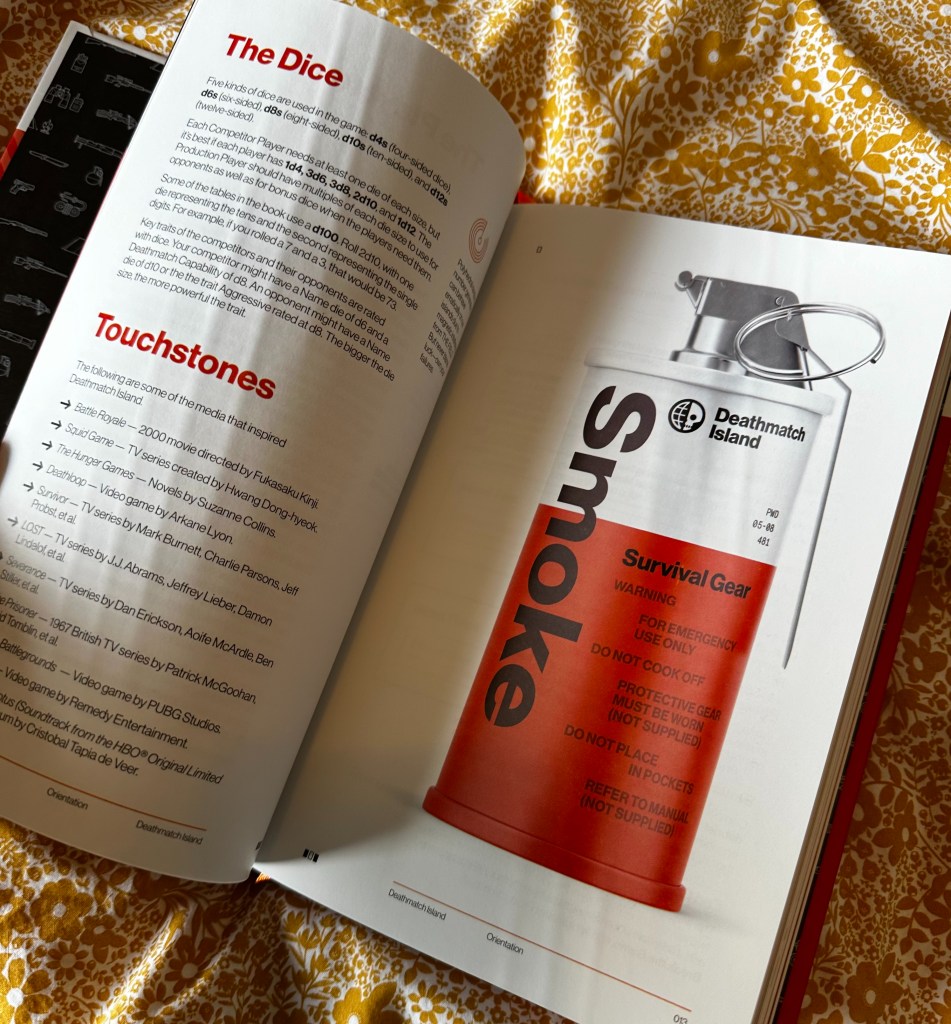
No-one, I think, is going to be terribly surprised by the inspirations behind Deathmatch Island. You’ve got Battle Royale, The Hunger Games, Squid Game, even Survivor of course, but, slightly less predictably, Tim Denee, the designer, also references Severance and The White Lotus, two of my very favourite TV shows from the last few years. A couple of touchstones that are, surprisingly, absent from the list are the video games, Portal and Portal 2. Many of the design choices and even the arguably, most important, decision the player characters need to make align with the choices your character makes in those games, “play to win,” or “break the game.” Of course, in all of these pieces of media, this is the central and most important choice.
The game, not the-game-within-the-game
What I am trying to say is that I was always going to back a game like this when it popped up on Backerkit. I am a fan of all of those properties to one extent or another. And, to me, the themes are never going to get old. And, although I haven’t had a chance to actually play it yet, I think that, if you feel the same about any of the media I listed above, you could do a lot worse than picking up this game.
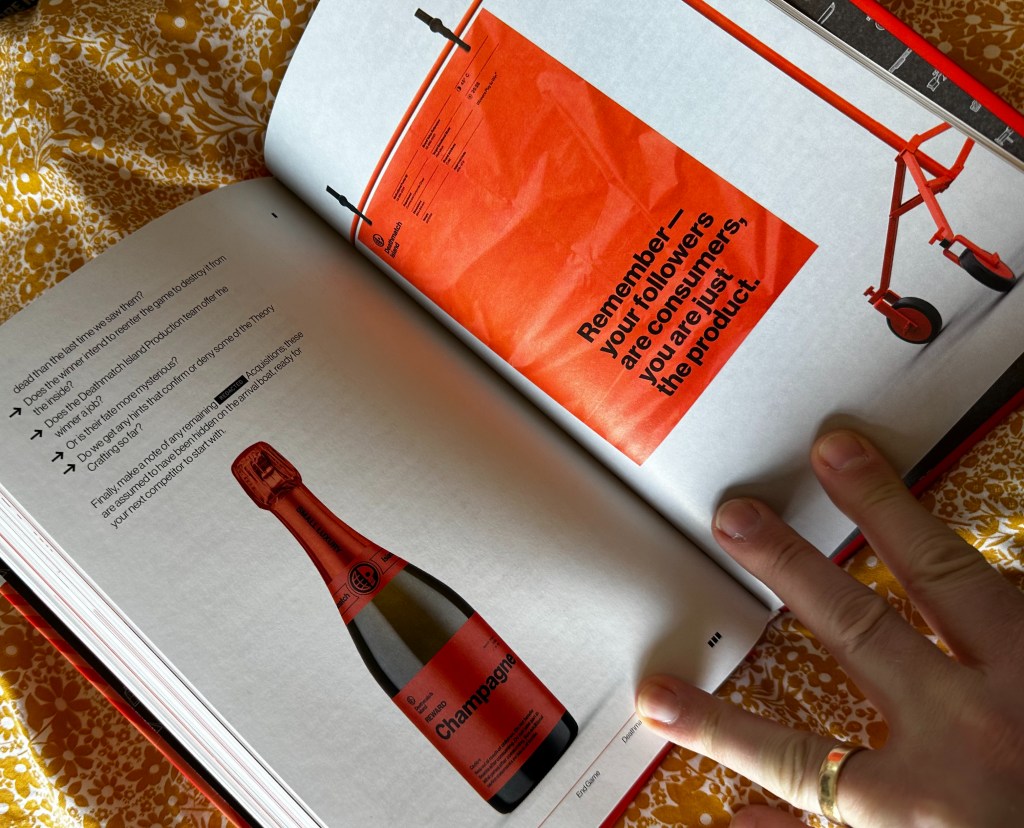
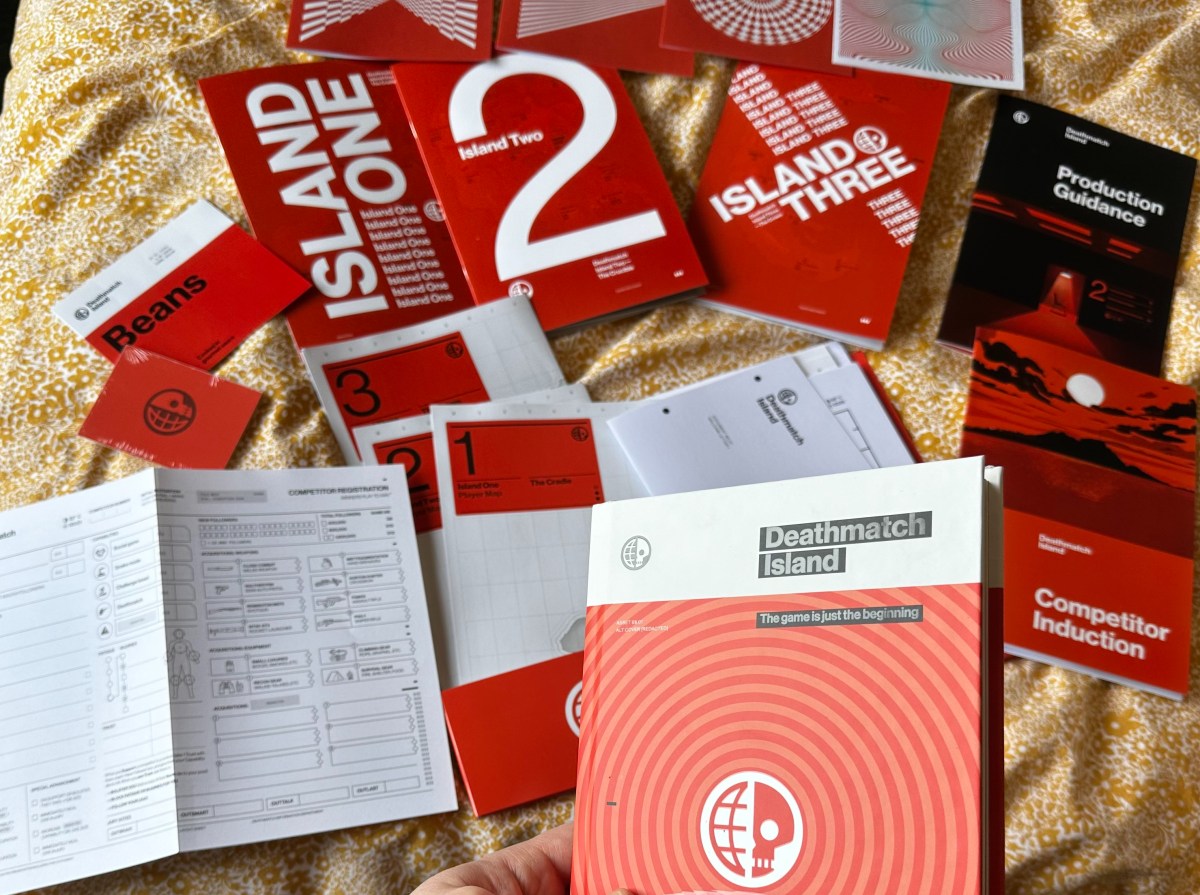
Apart from anything else, it is slick. The production quality is high, as you would expect from Evil Hat Productions, and all of the extras I got from my pledge tier are great. They include booklets describing each of the Islands and each of the Casts (which, to a large extent determine the type of scenario you’ll be playing,) official-looking Competitor Registration forms that act as character sheets, player maps of each of the islands as well as rules glossaries for both Competitors (players) and Production (GM.)
Mechanically, Deathmatch Island is based on the Paragon system developed by John Harper of Blades in the Dark fame and Sean Nittner. I knew nothing about this system before I read the Deathmatch Island book, except that it originated with another game called AGON.
It is highly structured, with play occurring in clearly defined phases. It starts with Competitor Registration, in which the players create their characters, largely through rolling on a series of tables. Then you proceed to the first island.
Each island is split into Phase One, where the Competitors explore, interact and collect resources and Phase Two which is the climax, in which the Battle Royale itself occurs. Even within each phase, there are only a few set actions that can be taken. There is a fair amount of leeway regarding how you achieve the actions within the narrative, but it essentially comes down to opposed rolls from the teams as they stand on the island. Although, the rolls themselves are of utmost importance to the outcome, the players get to do a Confessional after the rolls are all done, giving them each narrative control, as if describing their actions to a camera on a reality TV show. It’s a fun conceit and one I’d like to see in action.
You play up to three islands. There is a phase of play between each island. This works a bit like downtime in Blades in the Dark and gives the PCs a chance to improve their characters, debrief, and come up with some theories about what the hell is going on. And then there is the End Game. I’m not going to go into that here.
From reading the book, the system feels sufficiently different from anything I have played before to have me really interested to find out how it plays at the table. One of the most fascinating parts is that I feel like you could replay this game on the same islands, with the same players, but choose different casts and have a very different experience each time.
I hope I get to try it out soon!
Have any of my readers played Deathmatch Island? If so, what did you think?
Discover more from The Dice Pool
Subscribe to get the latest posts sent to your email.

 The Dice Pool
5 thoughts on “Death Match Island – Short Campaign”